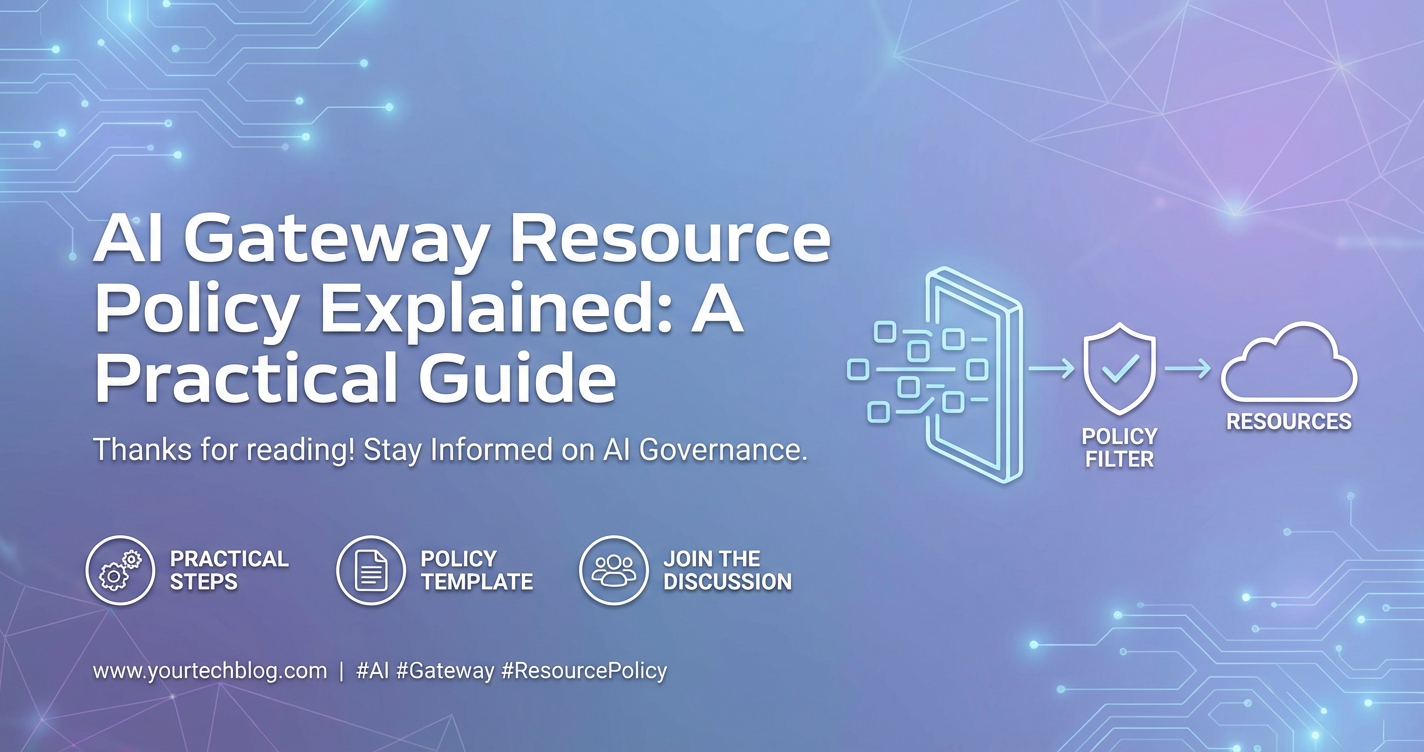
AI Gateway Resource Policy Explained: A Practical Guide
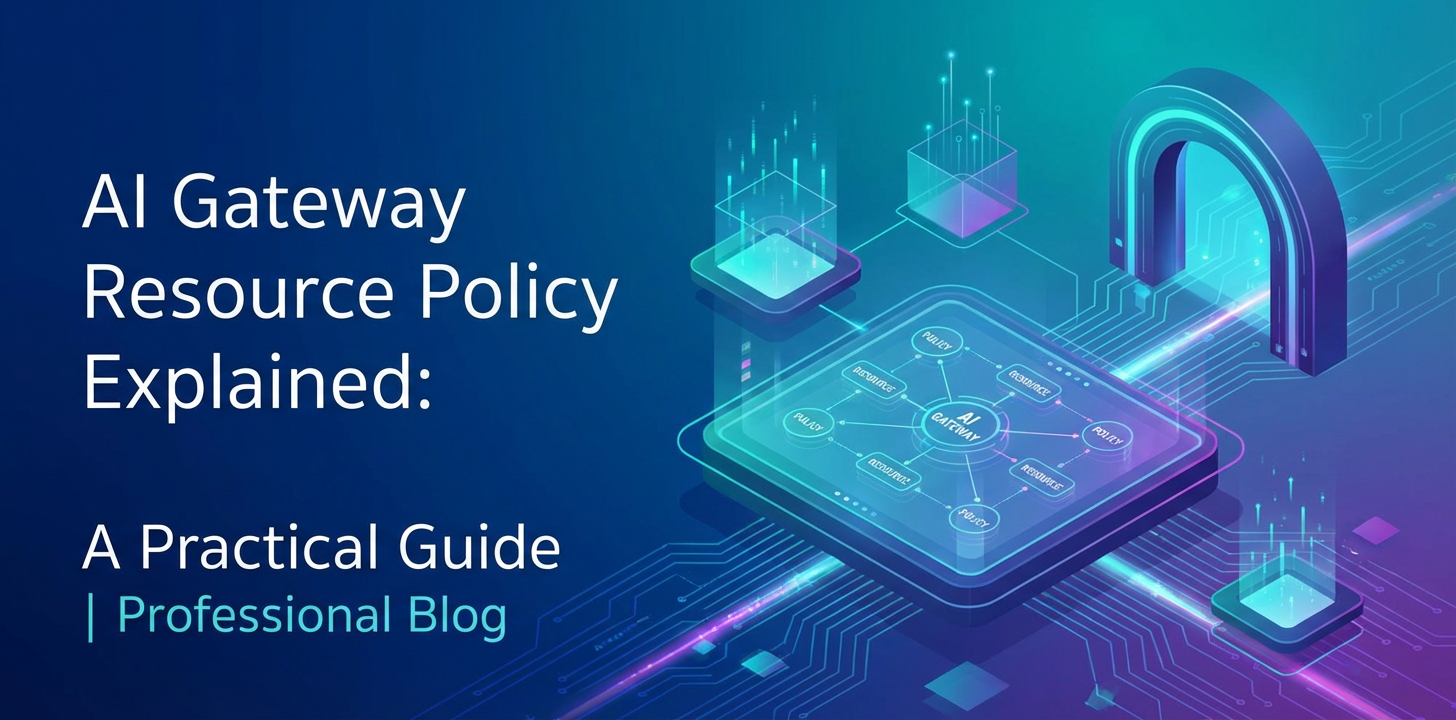


The rapid proliferation of Artificial Intelligence (AI) models, particularly Large Language Models (LLMs), has ushered in an unprecedented era of innovation and transformation across virtually every industry. From enhancing customer service with intelligent chatbots to powering sophisticated data analysis and content generation, AI services are becoming the foundational pillars of modern digital infrastructure. However, as organizations increasingly integrate these powerful capabilities into their applications and microservices, they are confronted with a unique set of challenges related to management, security, cost control, and performance optimization. It is within this dynamic landscape that the AI Gateway emerges not merely as an optional component, but as an indispensable architectural necessity.
At its core, an AI Gateway acts as a central control point for all AI service interactions, orchestrating requests and responses between client applications and various AI/ML models. While conceptually similar to a traditional API Gateway, an AI Gateway is specifically tailored to address the nuances and complexities inherent in AI workloads, such as managing token usage, handling diverse model APIs, ensuring prompt security, and optimizing inference costs. The true power and utility of an AI Gateway, however, are unlocked through its robust system of resource policies. These policies are the guiding principles and rules that dictate how AI services are accessed, utilized, secured, and managed, transforming a simple proxy into an intelligent traffic cop and security guardian for your AI ecosystem.
This comprehensive guide aims to demystify the intricate world of AI Gateway resource policies. We will delve deep into what these policies entail, why they are critically important for the successful and responsible deployment of AI, and explore the diverse categories that form the bedrock of a resilient AI infrastructure. From safeguarding sensitive data and preventing abuse to optimizing performance and managing expenditure, understanding and effectively implementing these policies is paramount for any organization navigating the frontiers of AI. Whether you are an architect designing AI systems, a developer integrating AI models, or an operations professional managing AI services, this guide will provide a practical framework for leveraging resource policies to build secure, scalable, and cost-effective AI solutions.
The Evolving Landscape of AI Gateways: More Than Just a Proxy
Before diving into the intricacies of resource policies, it's crucial to establish a clear understanding of what an AI Gateway is and how it distinguishes itself from its more general-purpose counterpart, the API Gateway. While an API Gateway is a fundamental component for managing all types of API traffic, providing features like routing, authentication, and rate limiting for traditional REST or GraphQL services, an AI Gateway extends these capabilities with specialized functionalities designed to meet the unique demands of AI and machine learning models.
An AI Gateway functions as a centralized entry point for interacting with various AI models, abstracting away the underlying complexities of different AI service providers (e.g., OpenAI, Google AI, AWS Bedrock, Hugging Face) or internally hosted models. This abstraction is critical because AI models often have diverse API schemas, authentication mechanisms, and operational characteristics. Without a gateway, client applications would need to manage these variations directly, leading to brittle code, increased development overhead, and significant maintenance challenges whenever an AI model is swapped or updated.
Specifically, for Large Language Models, the term LLM Gateway is often used interchangeably or as a more specialized subset of an AI Gateway. An LLM Gateway focuses on specific challenges associated with large language models, such as:
- Token Management: LLMs often bill based on token usage (input and output tokens). An LLM Gateway can precisely track token consumption, enforce quotas, and provide insights into cost.
- Prompt Engineering and Security: Managing and protecting prompts from injection attacks or sensitive data leakage is paramount. The gateway can sanitize prompts, enforce prompt templates, and even cache common prompt responses.
- Model Routing and Fallback: Dynamically routing requests to different LLMs based on performance, cost, availability, or specific task requirements. It can also manage failovers to alternative models if a primary one becomes unavailable or exceeds its rate limits.
- Unified API Format: Standardizing the request and response format across disparate LLMs, so client applications interact with a consistent interface regardless of the backend model.
The core functions of an AI Gateway therefore encompass:
- Centralization and Abstraction: Providing a single, consistent endpoint for all AI services, regardless of their underlying provider or model architecture. This simplifies client-side integration and reduces coupling.
- Security Enhancement: Acting as the first line of defense for AI models, enforcing authentication, authorization, and advanced threat protection.
- Performance Optimization: Implementing caching mechanisms, load balancing across multiple model instances, and intelligent routing to minimize latency and maximize throughput.
- Cost Control and Visibility: Tracking usage metrics (e.g., tokens, inference time, API calls) and enforcing budget-based quotas to prevent unexpected expenditure.
- Observability and Monitoring: Providing detailed logs, metrics, and tracing capabilities to understand AI service performance, diagnose issues, and ensure operational stability.
- Lifecycle Management: Facilitating the management of different AI model versions, enabling smooth updates, A/B testing, and phased rollouts without disrupting consuming applications.
The architectural significance of an AI Gateway cannot be overstated. It typically sits between the client applications and the actual AI model endpoints, intercepting all requests and responses. This strategic position allows it to inject policies, perform transformations, and collect vital telemetry data, making it an intelligent layer that enhances the reliability, security, and efficiency of your entire AI-powered application stack. Without such a dedicated gateway, managing a complex ecosystem of AI models would quickly become a chaotic and resource-intensive endeavor, fraught with security vulnerabilities and unpredictable costs.
Demystifying AI Gateway Resource Policies
Having established the foundational role of an AI Gateway, we now turn our attention to the heart of its intelligence: resource policies. In the context of an AI Gateway, a resource policy is a set of rules or conditions that govern how users, applications, or other services interact with the AI models exposed through the gateway. These policies are not merely static configurations; they are dynamic directives that dictate crucial aspects like who can access what, how much they can consume, under what conditions, and with what level of security.
The indispensable nature of resource policies stems from several critical needs in the AI domain:
- Security and Access Control: AI models, especially those handling sensitive data or performing critical operations, must be protected from unauthorized access and malicious intent. Policies ensure that only authenticated and authorized entities can invoke specific models or functionalities.
- Reliability and Stability: Uncontrolled access or sudden spikes in demand can overwhelm AI models, leading to performance degradation, service outages, and poor user experiences. Policies like rate limiting and circuit breaking safeguard the backend AI services.
- Cost Management and Financial Predictability: Many AI services are usage-based, making cost management a significant concern. Policies allow organizations to set budgets, enforce quotas, and prevent runaway spending on token consumption or compute time.
- Compliance and Data Governance: AI applications often process vast amounts of data, some of which may be sensitive or subject to strict regulatory requirements (e.g., GDPR, HIPAA). Policies help enforce data residency, privacy, and auditing standards.
- Performance Optimization: Policies can direct traffic intelligently, cache responses, and prioritize critical workloads, thereby enhancing the overall speed and responsiveness of AI-powered applications.
- Operational Visibility: Robust logging and monitoring policies are essential for understanding how AI services are being used, identifying bottlenecks, troubleshooting issues, and generating insights for future optimization.
The core components of a typical resource policy can often be broken down by asking fundamental questions:
- Who? (Identity): Which user, application, or service is making the request? This is usually determined through authentication credentials like API keys, OAuth tokens, or client certificates.
- What? (Resource/Action): Which specific AI model endpoint, operation, or data is being requested?
- When? (Time/Frequency): At what time, during which period, or how frequently can the request be made? This relates to scheduling, time-based access, or rate limits.
- Where? (Origin/Context): From which IP address, geographic region, or network segment is the request originating? This enables IP whitelisting/blacklisting or geo-fencing.
- How? (Conditions/Constraints): Under what specific conditions (e.g., token usage, data sensitivity, request payload content) should the request be processed, modified, or rejected?
These policies are enforced at strategic points within the AI Gateway's request-response lifecycle. When a client application sends a request to an AI model through the gateway, the policy engine intercepts this request and evaluates it against all applicable rules. Depending on the policy definitions, the gateway might:
- Allow the request to proceed to the backend AI model.
- Block the request and return an error.
- Transform the request (e.g., add headers, modify parameters, sanitize prompts).
- Log the request for auditing and monitoring purposes.
- Redirect the request to a different AI model or service.
- Apply rate limits or quotas before forwarding.
The robust and granular application of resource policies ensures that AI services are not only accessible but also secure, stable, and cost-effective, forming the bedrock of responsible AI deployment.
Comprehensive Categories of AI Gateway Resource Policies
The versatility of an AI Gateway lies in its ability to implement a wide array of resource policies, each addressing a specific facet of AI service management. These categories often overlap and work in concert to create a robust and resilient AI ecosystem. Let's explore the most critical types of policies in detail.
4.1. Authentication and Authorization Policies
These policies are the frontline defense for any AI service, ensuring that only legitimate and permitted entities can access AI models. Without strong authentication and authorization, AI models are vulnerable to unauthorized use, data breaches, and service abuse.
- Authentication: The process of verifying the identity of a user or application.
- API Keys: A simple, commonly used mechanism where clients include a unique key with each request. The AI Gateway validates this key against a stored list. While easy to implement, API keys require careful management (rotation, revocation) as they grant broad access.
- OAuth 2.0 / OpenID Connect (OIDC): Industry-standard protocols for delegated authorization. Clients obtain an access token from an authorization server, which the AI Gateway then validates. This method is highly secure and suitable for scenarios involving user consent and third-party applications.
- JSON Web Tokens (JWT): Self-contained tokens that can carry identity and authorization information, signed to prevent tampering. The AI Gateway can validate JWTs cryptographically without needing to query an authorization server for every request, improving performance.
- Mutual TLS (mTLS): Provides strong mutual authentication between the client and the gateway (and potentially the gateway and the backend AI model) using client certificates. This is often used in highly secure enterprise environments.
- Authorization: The process of determining what an authenticated entity is allowed to do.
- Role-Based Access Control (RBAC): Users or applications are assigned roles (e.g., "admin," "developer," "read-only"), and permissions are attached to these roles. The AI Gateway enforces these permissions, allowing access to specific AI models, versions, or functionalities based on the caller's role. For example, a "developer" role might access experimental AI models, while a "read-only" role can only access production models with specific output restrictions.
- Attribute-Based Access Control (ABAC): A more granular approach where access decisions are based on a combination of attributes (user attributes, resource attributes, environment attributes). This allows for highly dynamic and context-aware authorization rules, such as "allow access to sentiment analysis model if the user is in the marketing department and the request originates from within the corporate network."
- Granular Permissions: Policies can dictate access down to specific endpoints, methods (e.g.,
POST /generatevs.GET /status), or even specific parameters within an AI model's API call. This ensures a principle of least privilege, minimizing the blast radius of any security incident.
4.2. Rate Limiting and Throttling Policies
These policies are essential for preventing abuse, ensuring fair usage, and protecting backend AI models from being overwhelmed by excessive requests, which could lead to performance degradation or denial of service.
- Purpose:
- DoS Prevention: Stop malicious actors from flooding the AI Gateway or backend AI models with requests.
- Fair Usage: Ensure that all consumers get a reasonable share of the available AI resources, preventing a single user from monopolizing capacity.
- Cost Management: For usage-based billing models, rate limits can cap consumption, helping to control costs.
- Service Stability: Protect backend AI models, which can be computationally intensive and sensitive to sudden load spikes, from being pushed beyond their capacity.
- Algorithms:
- Fixed Window: Allows a certain number of requests within a fixed time window. If the limit is reached, all subsequent requests until the window resets are rejected. Simple but can lead to bursts at the window boundary.
- Sliding Window Log: Stores timestamps of all requests. When a new request arrives, it counts how many requests fall within the current time window (e.g., last minute). More accurate but memory-intensive.
- Sliding Window Counter: Divides the time into windows and uses a weighted average of the current window's count and the previous window's count to estimate the rate, offering a good balance between accuracy and resource usage.
- Leaky Bucket: Models requests as water droplets filling a bucket, which leaks at a constant rate. Requests are processed at the leak rate, and if the bucket overflows, requests are dropped. Smooths out traffic.
- Token Bucket: Similar to Leaky Bucket, but tokens are added to a bucket at a constant rate. A request consumes a token, and if no tokens are available, the request is rejected or queued. Allows for bursts up to the bucket size.
- Configuration: Rate limits can be applied based on:
- Per Client/API Key: Limiting requests from a specific authenticated entity.
- Per IP Address: Limiting requests originating from a single IP.
- Per Endpoint/Model: Applying different limits to different AI services or model versions based on their resource intensity.
- Per Tier/Subscription: Offering higher rate limits to premium subscribers.
- Hard vs. Soft Limits: Hard limits outright reject requests, while soft limits might queue them or return a "try again later" status.
4.3. Traffic Management and Routing Policies
These policies are crucial for optimizing performance, ensuring high availability, and enabling flexible deployment strategies for AI models.
- Load Balancing: Distributing incoming requests across multiple instances of an AI model to prevent any single instance from becoming a bottleneck and to improve overall throughput and latency.
- Round Robin: Distributes requests sequentially to each instance.
- Least Connections: Directs requests to the instance with the fewest active connections.
- Weighted Round Robin/Least Connections: Prioritizes instances based on their capacity or health.
- Geographic Load Balancing: Routes requests to the closest AI model instance to minimize latency for global users.
- Routing based on Request Parameters: Directing requests to specific AI models or versions based on elements within the HTTP request.
- Header-Based Routing: E.g., routing requests with
X-Model-Version: v2to the version 2 of an AI model. - Path-Based Routing: E.g.,
/ai/sentiment-analysisroutes to a sentiment model,/ai/image-generationroutes to a different model. - Query String-Based Routing: Using query parameters to specify model preferences or features.
- Header-Based Routing: E.g., routing requests with
- Circuit Breaking: A design pattern to prevent cascading failures. If an AI model or service repeatedly fails or becomes unresponsive, the AI Gateway can "open the circuit," temporarily stopping requests to that service. After a configured timeout, it will periodically allow a small number of requests to check if the service has recovered, "closing the circuit" if it's healthy. This prevents overwhelming a struggling backend and allows it to recover gracefully.
- Retries and Timeouts:
- Retries: Automatically retrying failed AI model invocations (e.g., due to transient network issues) up to a certain number of times, often with exponential backoff.
- Timeouts: Setting maximum durations for requests to AI models. If a response isn't received within the timeout, the request is aborted to prevent resources from being tied up indefinitely.
- A/B Testing and Canary Releases: Policies can split traffic to different versions of an AI model.
- A/B Testing: Routing a percentage of users (e.g., 50%) to model A and the rest to model B to compare performance or user satisfaction.
- Canary Releases: Gradually rolling out a new AI model version to a small subset of users (e.g., 5%) to monitor its stability and performance before a full rollout. The AI Gateway can manage this traffic distribution.
4.4. Cost Management and Quota Policies
Given that many AI services are billed on a usage basis (e.g., per token, per inference, per compute hour), controlling costs is a paramount concern. These policies provide financial governance and predictability.
- Usage Tracking: The AI Gateway serves as a central point to accurately track various consumption metrics:
- Number of LLM Gateway API calls.
- Input and output token count for language models.
- Compute time for complex AI inferences.
- Data transfer volumes.
- Hard and Soft Quotas:
- Hard Quotas: Absolutely block further requests once a predefined limit (e.g., 100,000 tokens per month) is reached. Essential for strict budget enforcement.
- Soft Quotas: Allow requests to continue but trigger alerts or warnings when a threshold (e.g., 80% of monthly budget) is approached or exceeded. This provides notice without immediately disrupting service.
- Budget Overrun Alerting: Automated notifications (email, Slack, monitoring dashboards) to administrators or relevant teams when usage approaches or exceeds defined budget limits.
- Tiered Access based on Subscription Levels: Offering different usage quotas and rate limits based on user subscription plans (e.g., "Free" tier gets 1,000 tokens/day, "Premium" tier gets 1,000,000 tokens/day). This can be integrated with monetization strategies for AI services.
4.5. Security and Data Governance Policies
AI models, especially LLMs, are susceptible to unique security vulnerabilities like prompt injection, data exfiltration, and model inversion. Furthermore, handling sensitive data requires strict adherence to privacy regulations.
- Input/Output Sanitization:
- Prompt Injection Prevention: Policies can scan incoming prompts for malicious patterns, keywords, or scripts designed to manipulate the LLM's behavior or extract sensitive information. They can redact, sanitize, or block suspicious prompts.
- Data Exfiltration Prevention: Policies can inspect AI model responses for sensitive data patterns (e.g., credit card numbers, PII, internal project names) and redact or block them before they reach the client, preventing unintended data leaks.
- Data Masking/Redaction: Automatically identifying and obscuring sensitive information (e.g., names, addresses, financial details) in both prompt inputs and model outputs before they are processed by or returned from the AI model. This is crucial for privacy and compliance.
- Data Residency and Compliance (GDPR, HIPAA, CCPA): Policies to ensure that data processed by AI models remains within specified geographic boundaries (e.g., EU data stays in EU data centers). The AI Gateway can enforce routing to region-specific AI model instances and log data processing trails for auditability.
- Web Application Firewall (WAF) Integration: While a general api gateway feature, integrating a WAF into the AI Gateway adds an essential layer of security by detecting and blocking common web-based attacks (SQL injection, cross-site scripting, broken authentication) that could target the gateway itself or attempt to manipulate AI service requests.
- Confidential Computing Integration: For highly sensitive AI workloads, policies can route requests to AI models running in confidential computing environments, where data remains encrypted even during processing, offering the highest level of data privacy.
4.6. Observability and Monitoring Policies
To ensure the health, performance, and proper functioning of AI services, comprehensive monitoring and logging are indispensable. These policies dictate what data is collected, how it's stored, and how it can be accessed.
- Detailed API Call Logging: The AI Gateway is the ideal place to capture every detail of an AI service request and response, including:
- Client IP address and user ID.
- Request headers and body (potentially redacted for sensitive data).
- Response headers and body (also potentially redacted).
- Request timestamp, duration, and latency.
- HTTP status codes and error messages.
- Backend AI model invoked and its version.
- Token usage for LLMs.
- This granular logging is critical for debugging, auditing, security analysis, and billing reconciliation.
- Metrics Collection: Collecting quantitative data about AI gateway and model performance:
- Throughput (requests per second).
- Error rates (e.g., 5xx errors from AI models).
- Latency (average, p90, p99 percentiles for AI model response times).
- CPU/memory utilization of gateway and proxy components.
- Queue sizes.
- Alerting and Incident Management Integration: Policies to define thresholds for key metrics (e.g., "latency exceeds 500ms for 5 minutes") and automatically trigger alerts to on-call teams via PagerDuty, Slack, email, or other incident management systems.
- Distributed Tracing: Integrating with tracing systems (e.g., OpenTelemetry, Jaeger) to provide end-to-end visibility of a request's journey through the AI Gateway and into the backend AI model, helping to pinpoint performance bottlenecks and troubleshoot complex distributed systems. This is especially useful in microservices architectures involving multiple AI models.
4.7. Versioning and Lifecycle Management Policies
Managing different versions of AI models and orchestrating their deployment and retirement is a complex task. Policies facilitate smooth transitions and minimize disruption.
- Stable Gateway Endpoints: Providing a stable, version-agnostic endpoint to client applications (e.g.,
/ai/summarize), while the AI Gateway internally routes to different underlying AI model versions (v1, v2, v3) based on policies. - Dynamic Model Swapping: Policies allowing administrators to instantly switch traffic from one AI model version to another (e.g., promoting a canary release to production, rolling back to a previous stable version in case of issues) without requiring client application updates.
- Deprecation Strategies: Policies to gracefully sunset older AI model versions, perhaps by returning deprecation warnings in responses, gradually reducing traffic, or eventually blocking access to deprecated endpoints after a notification period.
- Blue/Green Deployments: Maintaining two identical production environments ("Blue" and "Green"). The AI Gateway routes all traffic to the active environment (e.g., Blue) while the new version is deployed to the inactive environment (Green). Once Green is validated, the gateway instantly switches all traffic to Green. If issues arise, it can switch back to Blue with minimal downtime.
By leveraging these comprehensive categories of resource policies, an AI Gateway transforms from a simple traffic director into a powerful, intelligent control plane that ensures the security, performance, cost-effectiveness, and operational stability of your entire AI infrastructure.
Designing and Implementing Robust Policies
The effectiveness of an AI Gateway is directly proportional to the thoughtfulness and robustness of its resource policies. Designing and implementing these policies requires a strategic approach that balances security, performance, cost, and usability. Merely activating default settings is rarely sufficient for complex AI workloads.
Best Practices for Policy Design
- Principle of Least Privilege: Grant only the minimum necessary permissions for users and applications to perform their intended functions. Instead of granting blanket access to all AI models, specify access to particular endpoints or versions. This significantly reduces the attack surface and limits the impact of compromised credentials.
- Layered Security (Defense-in-Depth): No single policy or security measure is infallible. Implement multiple layers of security policies. For example, combine API key authentication with rate limiting, IP whitelisting, and input sanitization. If one layer fails, others can still offer protection.
- Idempotent Policies: Aim for policies that produce the same result regardless of how many times they are applied or in what order. This simplifies reasoning about policy behavior and reduces unexpected side effects.
- Testability and Validation: Policies should be testable. Develop automated tests to ensure that policies behave as expected under various conditions (e.g., exceeding rate limits, attempting unauthorized access, valid requests). This is crucial for continuous integration and deployment (CI/CD) pipelines.
- Granularity vs. Manageability: Strive for a balance. While fine-grained policies offer maximum control, an overly complex policy set can become difficult to understand, maintain, and troubleshoot. Group related policies, use hierarchical structures, and apply sensible defaults where appropriate.
- Fail-Safe Defaults: In security-critical scenarios, configure policies to err on the side of caution. If a policy evaluation fails or an unknown condition is encountered, the default action should be to deny access or block the request, rather than allowing it.
- Clear Documentation: Policies, especially complex ones, must be thoroughly documented. This includes their purpose, conditions, actions, and any dependencies. Clear documentation is vital for new team members, auditing, and troubleshooting.
Policy as Code (PaC) Principles
Adopting a "Policy as Code" approach is highly recommended for modern AI Gateway implementations. This involves defining policies in a version-controlled, human-readable format (e.g., YAML, JSON, or a domain-specific language) alongside your application code.
- Version Control: Store policy definitions in Git or similar version control systems. This enables tracking changes, reverting to previous versions, and collaborating on policy development.
- Automation: Policies can be automatically deployed and updated as part of your CI/CD pipeline, reducing manual errors and ensuring consistency across environments.
- Reusability: Common policy patterns can be templated and reused across different AI services or environments.
- Auditability: A version-controlled policy repository provides an auditable history of all policy changes, crucial for compliance and security reviews.
Implementation Strategies
- Centralized Policy Management: The AI Gateway serves as the central enforcement point for all policies. This simplifies management and ensures consistent application of rules across all AI models, regardless of their backend location or technology. It also reduces the need to implement policy logic within each individual microservice or AI model.
- Iterative Deployment: Start with a basic set of essential policies (authentication, basic rate limiting) and gradually add more sophisticated ones (granular authorization, advanced traffic management) as your understanding of AI usage patterns evolves.
- Monitoring and Feedback Loop: Continuously monitor the effectiveness of your policies. Analyze logs and metrics to identify if policies are too restrictive (blocking legitimate traffic) or too permissive (failing to prevent abuse). Use this feedback to refine and update policies.
- Graceful Degradation: Design policies that allow for graceful degradation rather than hard failures. For instance, if an LLM Gateway encounters an external rate limit, it might return a cached response, a simplified response, or a specific error message encouraging the client to retry later, rather than a generic server error.
- Environment-Specific Policies: While striving for consistency, acknowledge that development, staging, and production environments might require slightly different policy configurations (e.g., more relaxed rate limits in dev, stricter security in prod). Manage these differences carefully, potentially using environment variables or configuration overlays.
By adhering to these design principles and implementation strategies, organizations can build a robust policy framework that not only protects and optimizes their AI Gateway but also fosters innovation and confident deployment of AI services. The effort invested in thoughtful policy design pays dividends in enhanced security, improved reliability, and predictable operational costs.
APIPark is a high-performance AI gateway that allows you to securely access the most comprehensive LLM APIs globally on the APIPark platform, including OpenAI, Anthropic, Mistral, Llama2, Google Gemini, and more.Try APIPark now! 👇👇👇
Overcoming Common Challenges in AI Gateway Resource Policy Management
While resource policies are indispensable for managing AI services, their implementation and ongoing management are not without challenges. Understanding these hurdles and having strategies to overcome them is crucial for successful AI Gateway operations.
- Complexity of Policy Definition:
- Challenge: As the number of AI models, users, and use cases grows, the policy set can become incredibly complex. Defining fine-grained rules that cover all scenarios without conflicts can be daunting. Policies might need to consider multiple attributes (user role, IP address, time of day, token usage, prompt content), leading to intricate conditional logic.
- Solution: Adopt a structured, modular approach to policy definition. Use Policy as Code (PaC) to manage policies in a version-controlled system, allowing for clear documentation, review, and automated deployment. Leverage hierarchical policy structures where broader rules can be refined by more specific ones. Utilize declarative policy languages that simplify the expression of complex conditions. Regularly review and refactor policies to remove redundancy and simplify logic.
- Performance Overhead:
- Challenge: Every policy enforced by the AI Gateway adds a certain amount of processing overhead (e.g., checking authentication tokens, evaluating authorization rules, inspecting request payloads for rate limits or security threats). If policies are inefficiently designed or too numerous, they can introduce noticeable latency, negating the performance benefits of the gateway itself.
- Solution: Optimize policy execution by prioritizing critical policies first. Implement caching for frequently checked data (e.g., validated JWTs, user permissions). Leverage efficient algorithms for rate limiting. Utilize underlying gateway technologies that are highly optimized for performance (e.g., those built on high-performance proxies like Nginx or Envoy). Conduct thorough performance testing to identify and address bottlenecks introduced by policies. For example, APIPark, with its performance rivaling Nginx and ability to achieve over 20,000 TPS on modest hardware, is designed to minimize policy-related overhead, supporting cluster deployment to handle large-scale traffic without compromising efficiency.
- Maintaining Consistency Across Environments:
- Challenge: Ensuring that policies are consistently applied across development, staging, and production environments can be difficult. Manual configuration leads to discrepancies and potential security gaps or operational issues when promoting code.
- Solution: Enforce Policy as Code rigorously. Automate the deployment of policies through CI/CD pipelines, treating policy definitions like any other source code. Use templating and configuration management tools to handle environment-specific variations (e.g., different API keys for dev vs. prod) while maintaining a core set of consistent rules. Regular automated audits can verify policy configurations across environments.
- Granularity vs. Manageability:
- Challenge: There's a constant tension between wanting extremely granular control over AI resource access and the practical challenges of managing an overwhelming number of specific rules. Too much granularity can lead to policy sprawl, making it hard to understand the overall security posture or troubleshoot specific access issues.
- Solution: Start with broader, more generic policies and only introduce fine-grained rules where specifically required by security, compliance, or cost-management needs. Categorize policies logically and use tags or labels for easier filtering and management. Leverage RBAC or ABAC frameworks to abstract away individual permissions behind roles or attributes, simplifying the assignment of access rights.
- Dynamic Policy Updates:
- Challenge: In a rapidly evolving AI landscape, policies often need to be updated frequently (e.g., to adjust rate limits, add new authorization rules for a new model, or respond to emerging security threats). Applying these updates dynamically without downtime or service disruption is a significant operational challenge.
- Solution: Use an AI Gateway that supports dynamic policy updates without requiring a full restart. Implement a controlled deployment process for policy changes, similar to application rollouts, potentially leveraging blue/green or canary deployment strategies for policies themselves. Have a robust rollback mechanism in case a new policy introduces unintended side effects. The ability to manage end-to-end API lifecycle, as offered by platforms like APIPark, is critical here, allowing for versioning and controlled deployment of API and policy configurations.
- Visibility and Debugging:
- Challenge: When a request is blocked or routed unexpectedly, identifying which specific policy caused the action can be difficult, especially with complex, layered policies. Lack of detailed logging and clear error messages complicates troubleshooting.
- Solution: Implement comprehensive logging for all policy decisions, indicating which policy was triggered and why. Ensure error messages returned to clients are informative enough to guide them without revealing sensitive internal details. Integrate with robust monitoring and tracing systems (as discussed in Observability Policies) to visualize the policy evaluation flow for each request. Tools that provide detailed API call logging and powerful data analysis, like APIPark, are invaluable here, enabling businesses to quickly trace and troubleshoot issues and analyze historical call data for performance changes.
By proactively addressing these common challenges, organizations can build a resilient, adaptable, and secure AI Gateway infrastructure where resource policies are not just a necessity but a powerful enabler for innovation and responsible AI deployment.
The Practical Advantage of a Dedicated AI Gateway - APIPark
Implementing and managing the intricate web of resource policies discussed above can be a daunting task, especially for organizations dealing with a growing number of AI models, diverse client applications, and stringent security or compliance requirements. This is where a dedicated AI Gateway and API Management Platform like APIPark offers significant practical advantages, streamlining the process and abstracting away much of the underlying complexity.
APIPark, an open-source AI gateway and API developer portal licensed under Apache 2.0, is specifically designed to help developers and enterprises manage, integrate, and deploy AI and REST services with ease. It provides a comprehensive suite of features that directly address the challenges of policy implementation, making it an excellent example of how such a platform facilitates robust resource management.
Consider how APIPark simplifies the application of the various policy categories:
- Unified API Format for AI Invocation & Quick Integration of 100+ AI Models: APIPark standardizes the request data format across all integrated AI models. This directly simplifies traffic management and versioning policies, as the gateway can route requests to any backend AI model without client applications needing to understand the underlying model's specific API. Integrating numerous AI models through a single point allows for consistent policy application across your entire AI ecosystem, rather than configuring policies individually for each model.
- Prompt Encapsulation into REST API: The ability to combine AI models with custom prompts to create new REST APIs (e.g., a sentiment analysis API) means that specific AI functionalities can be treated as managed API resources. This makes it easier to apply granular authentication, authorization, rate limiting, and security policies to these encapsulated prompts, protecting against prompt injection and ensuring controlled access to specific AI-driven functions.
- End-to-End API Lifecycle Management: APIPark assists with managing the entire lifecycle of APIs, from design and publication to invocation and decommission. This capability is paramount for implementing effective versioning and lifecycle management policies. It ensures that changes to AI models or their associated policies can be rolled out, monitored, and retired in a controlled, non-disruptive manner, allowing for Blue/Green deployments or canary releases of policies themselves.
- Independent API and Access Permissions for Each Tenant: For organizations with multiple teams or business units, APIPark enables the creation of multiple tenants, each with independent applications, data, user configurations, and security policies. This directly supports granular Role-Based Access Control (RBAC) and Attribute-Based Access Control (ABAC) policies, allowing each team to define and enforce its own access rules for shared AI resources, ensuring data isolation and customized security postures.
- API Resource Access Requires Approval: This feature of APIPark is a direct embodiment of an authorization policy. By requiring callers to subscribe to an API and await administrator approval before invocation, it acts as a proactive gatekeeper, preventing unauthorized API calls and potential data breaches. This is a crucial layer in a comprehensive security policy framework.
- Detailed API Call Logging & Powerful Data Analysis: APIPark provides comprehensive logging capabilities, recording every detail of each API call. This robust logging is foundational for implementing effective observability and monitoring policies. Businesses can quickly trace and troubleshoot issues, understand usage patterns, and perform forensic analysis. The powerful data analysis tools further leverage this historical data to display long-term trends and performance changes, which is vital for refining cost management, rate limiting, and performance optimization policies before issues escalate.
- Performance Rivaling Nginx: The high-performance architecture of APIPark, capable of over 20,000 TPS, ensures that the overhead introduced by enforcing complex policies is minimal. This means that organizations can implement sophisticated security, rate limiting, and traffic management policies without significantly impacting the latency or throughput of their AI services. Its support for cluster deployment further enhances its ability to handle large-scale traffic under strict policy enforcement.
In essence, platforms like APIPark abstract away the low-level complexities of policy implementation, offering a user-friendly interface and robust backend to define, enforce, and monitor these crucial rules. By providing a centralized, intelligent control plane, an AI Gateway like APIPark transforms the theoretical concepts of resource policies into practical, manageable solutions for both specific AI Gateway needs and broader API Gateway requirements, empowering enterprises to leverage AI confidently and securely.
Future Trends in AI Gateway Policies
The landscape of AI is continually evolving, driven by advancements in model capabilities, new use cases, and emerging regulatory frameworks. Consequently, AI Gateway resource policies must also adapt and innovate to meet these future demands. Several key trends are likely to shape the next generation of policy management for AI services.
- Adaptive and AI-Driven Policies:
- Trend: Moving beyond static rules, future AI Gateway policies will increasingly leverage AI itself to become more adaptive and intelligent. Machine learning algorithms can analyze real-time traffic patterns, historical usage, and security events to dynamically adjust policies.
- Implication: Rate limits could automatically increase or decrease based on predicted load or available backend capacity. Security policies could identify novel prompt injection attacks or anomalous data access patterns in real-time, blocking them proactively. This shifts policy management from reactive to predictive and self-optimizing.
- Example: An LLM Gateway could dynamically adjust token quotas for different users based on their historical usage patterns and the current demand on the underlying LLM infrastructure.
- Edge AI Policy Enforcement:
- Trend: As AI models become smaller and more efficient, there's a growing movement towards deploying AI closer to the data source or end-user – at the "edge." This means that policy enforcement will also need to extend beyond centralized cloud gateways.
- Implication: AI Gateway functionalities, including resource policies, will be pushed to edge devices, IoT gateways, or local computing clusters. This necessitates lightweight, efficient policy engines capable of operating with limited resources and intermittent connectivity.
- Example: A local AI Gateway on a smart factory floor could enforce rate limits for inferencing on real-time sensor data, ensuring critical real-time operations are not disrupted by non-essential AI queries, even if disconnected from the central cloud.
- Enhanced Privacy-Preserving AI Policies:
- Trend: With increasing scrutiny on data privacy and the deployment of AI in sensitive domains (healthcare, finance), policies focused on privacy-preserving AI techniques will become paramount.
- Implication: Policies will need to support and enforce the use of Federated Learning, Differential Privacy, or Homomorphic Encryption. This might involve routing requests to specialized privacy-enhanced AI models, enforcing data anonymization/pseudonymization at the gateway level, or ensuring only encrypted data is passed to specific AI services.
- Example: An AI Gateway could automatically redact PII from customer queries before sending them to a cloud-based LLM, ensuring that sensitive data never leaves the on-premise environment unmasked, thereby enhancing compliance with privacy regulations.
- Standardization and Interoperability of AI Gateway Policies:
- Trend: The proliferation of different AI Gateway products and platforms (both open-source and commercial) highlights a need for greater standardization in how AI policies are defined and enforced.
- Implication: Efforts similar to OpenAPI (for API definitions) or OPA (Open Policy Agent) could emerge for AI resource policies, allowing for greater interoperability, portability of policy definitions across different gateway implementations, and simplified tooling. This would benefit multi-cloud strategies and hybrid AI deployments.
- Example: A universal policy language could allow an organization to define a single set of rate limiting rules that can be understood and enforced by any compliant AI Gateway product, whether it's running on AWS, Azure, or an on-premise Kubernetes cluster.
- Explainability (XAI) and Auditability Policies:
- Trend: As AI decisions become more critical, the demand for explainability and auditability of how AI models arrive at their conclusions will intensify, especially in regulated industries.
- Implication: AI Gateway policies will evolve to facilitate the collection of data points necessary for XAI. This could include policies for logging specific model inputs, intermediate inference steps, or confidence scores from AI models. These policies would ensure that a clear audit trail exists for every AI-driven decision, supporting regulatory compliance and accountability.
- Example: For an AI model used in loan approval, the AI Gateway might enforce logging of all input features, the specific model version used, and the confidence score of the decision, providing a comprehensive record for auditing purposes.
These trends underscore that AI Gateway resource policies are not static but are dynamic, evolving mechanisms that will continue to adapt to the complexities and opportunities presented by the rapidly advancing field of Artificial Intelligence. Embracing these future directions will be key for organizations seeking to build truly intelligent, secure, and resilient AI ecosystems.
Conclusion
The journey through the intricate world of AI Gateway resource policies reveals a fundamental truth: as AI becomes increasingly integrated into the fabric of our digital lives, the intelligent management of these powerful services is no longer optional but imperative. From safeguarding sensitive data against malicious attacks to meticulously controlling operational costs and ensuring the uninterrupted flow of critical AI-powered applications, resource policies form the bedrock of a robust, secure, and scalable AI infrastructure.
We have explored how a dedicated AI Gateway, serving as a specialized LLM Gateway for large language models, extends the traditional functions of an API Gateway by addressing the unique challenges of AI workloads. Its strategic position as the central control point allows for the comprehensive enforcement of policies across diverse categories: authentication and authorization to control who accesses what; rate limiting and throttling to ensure fair usage and prevent abuse; sophisticated traffic management for optimal performance and availability; precise cost management for financial predictability; stringent security and data governance for compliance; detailed observability for operational stability; and robust versioning for seamless lifecycle management.
Designing and implementing these policies effectively requires adherence to best practices, embracing Policy as Code principles, and continuous monitoring to adapt to evolving needs. While challenges such as complexity, performance overhead, and consistency across environments exist, they are surmountable with thoughtful planning and the right tools. Platforms like APIPark exemplify how an advanced AI Gateway can significantly simplify this process, providing a unified and high-performance solution for implementing and managing these critical policies.
Looking ahead, the evolution of AI Gateway policies towards adaptive, AI-driven, edge-enforced, and privacy-preserving mechanisms, coupled with greater standardization and explainability, promises an even more intelligent and resilient future for AI deployments. For any organization venturing into or deepening its engagement with AI, understanding and mastering these resource policies is not merely a technical exercise but a strategic imperative. They are not obstacles to innovation but rather the essential guardrails that enable secure, efficient, and responsible exploration of AI's transformative potential, empowering developers, operations teams, and business leaders to harness the full power of artificial intelligence with confidence.
Frequently Asked Questions (FAQ)
Q1: What is the primary difference between an AI Gateway and a traditional API Gateway? A1: While both an AI Gateway and a traditional API Gateway serve as central proxies for managing API traffic, an AI Gateway is specifically designed to handle the unique complexities of AI and machine learning models. This includes specialized features for managing token usage (especially for LLM Gateway), prompt engineering and security, dynamic model routing, cost tracking based on AI-specific metrics (like inference time or token count), and abstracting diverse AI model APIs into a unified format. A traditional API Gateway focuses more on general REST or GraphQL API management, authentication, and routing without these AI-specific considerations.
Q2: Why are resource policies so important for an AI Gateway? A2: Resource policies are crucial for an AI Gateway because they provide the necessary framework for controlling access, ensuring security, optimizing performance, managing costs, and maintaining compliance for AI services. Without robust policies, AI models are vulnerable to unauthorized use, malicious attacks (like prompt injection), unpredictable costs due to unconstrained usage, and performance degradation from overwhelming demand. Policies enable organizations to confidently deploy and scale AI, ensuring stability, security, and financial predictability.
Q3: Can an AI Gateway help manage costs for AI models, especially Large Language Models (LLMs)? A3: Absolutely. AI Gateway and LLM Gateway platforms are highly effective for cost management. They can precisely track usage metrics such as the number of API calls, input/output token counts, and compute time consumed by different AI models. With this data, organizations can implement granular cost management policies, including setting hard or soft quotas for usage, configuring alerts for budget overruns, and even offering tiered access levels based on subscription plans. This prevents unexpected expenditures and provides greater financial control over AI resource consumption.
Q4: How do AI Gateway policies address prompt injection attacks? A4: AI Gateway policies can be instrumental in mitigating prompt injection attacks by acting as a crucial inspection point. Policies can be configured to: 1. Sanitize Inputs: Scan incoming prompts for malicious patterns, keywords, or scripts before they reach the LLM. 2. Enforce Templates: Ensure prompts adhere to predefined templates, preventing arbitrary user input from manipulating the model. 3. Redact Sensitive Information: Mask or remove sensitive data from prompts to prevent potential data exfiltration attempts by a compromised LLM. 4. Block Suspicious Prompts: Reject prompts identified as potentially malicious or containing unusual patterns. This provides a critical layer of defense beyond the LLM itself.
Q5: What is Policy as Code (PaC) and why is it beneficial for AI Gateway resource policies? A5: Policy as Code (PaC) is the practice of defining and managing resource policies using human-readable, version-controlled files (e.g., YAML, JSON) rather than through manual configurations or GUI interfaces. For AI Gateway resource policies, PaC is highly beneficial because it: 1. Enhances Auditability: All policy changes are tracked in a version control system, providing a clear history. 2. Enables Automation: Policies can be deployed and updated automatically through CI/CD pipelines, reducing manual errors and ensuring consistency across environments. 3. Facilitates Collaboration: Teams can collaborate on policy definitions, review changes, and maintain a shared understanding. 4. Improves Reliability: Policies become testable assets, allowing for automated validation before deployment. PaC ensures that your AI Gateway's protective rules are as robust and maintainable as your application code.
🚀You can securely and efficiently call the OpenAI API on APIPark in just two steps:
Step 1: Deploy the APIPark AI gateway in 5 minutes.
APIPark is developed based on Golang, offering strong product performance and low development and maintenance costs. You can deploy APIPark with a single command line.
curl -sSO https://download.apipark.com/install/quick-start.sh; bash quick-start.sh

In my experience, you can see the successful deployment interface within 5 to 10 minutes. Then, you can log in to APIPark using your account.

Step 2: Call the OpenAI API.