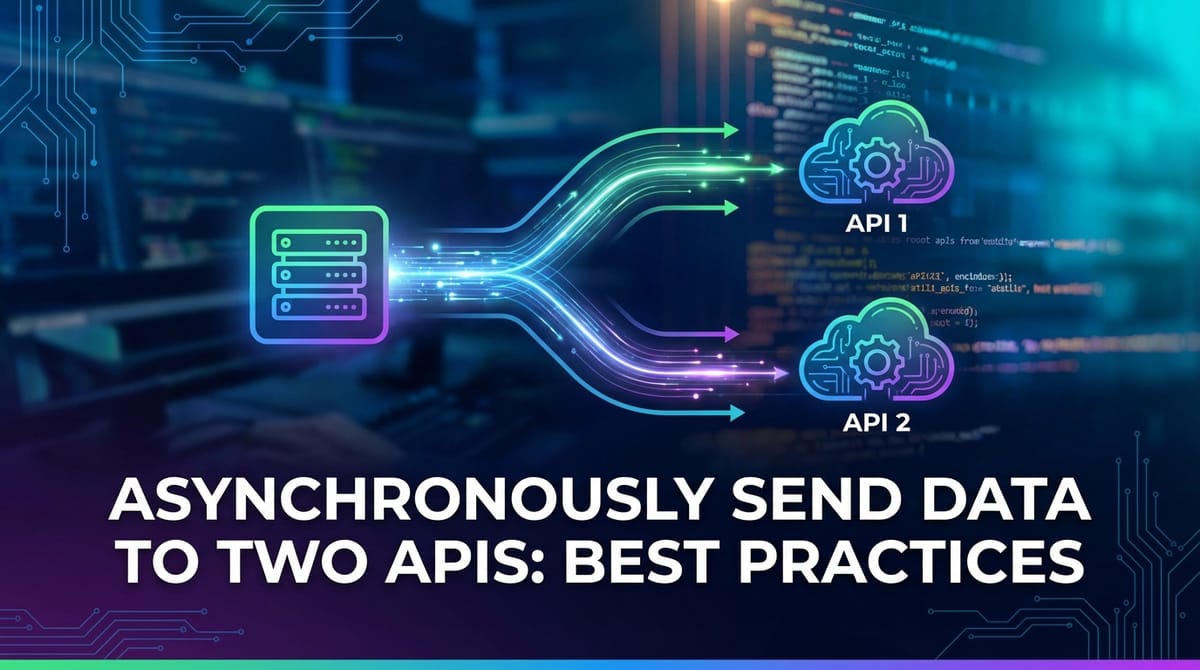
Asynchronously Send Data to Two APIs: Best Practices


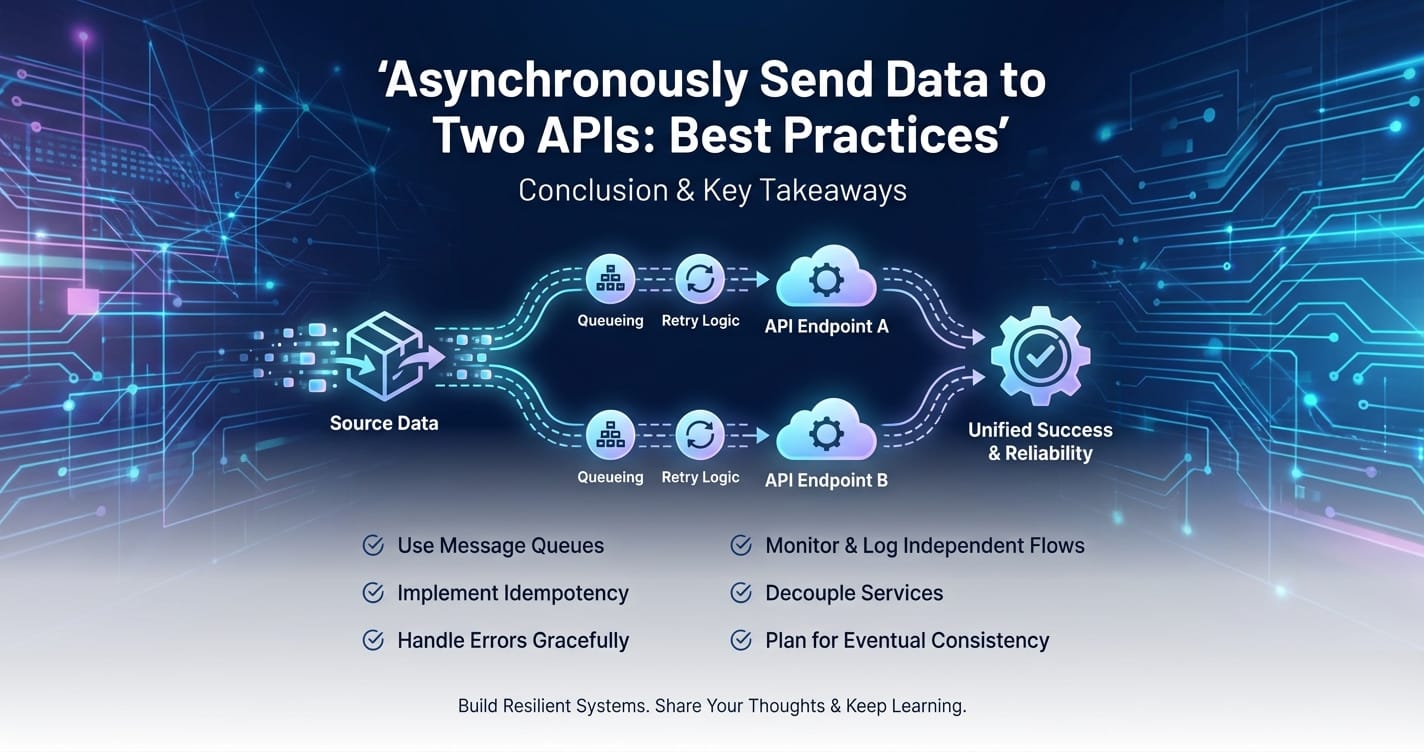
In the intricate landscape of modern software architecture, the need to interact with multiple external services or internal microservices simultaneously has become commonplace. Whether driven by the demand for enhanced user experiences, complex business logic, or the distributed nature of cloud-native applications, systems frequently find themselves in a position where they must communicate with more than one API. However, simply firing off multiple synchronous requests can lead to a sluggish user interface, poor resource utilization, and an overall brittle system. This is where the paradigm of asynchronously sending data to two APIs emerges not merely as an optimization but as a fundamental best practice for building resilient, scalable, and responsive applications.
This comprehensive guide delves into the nuances of asynchronous data dispatch to multiple API endpoints. We will explore the underlying motivations, common architectural patterns, critical best practices for implementation, and the inherent challenges that demand careful consideration. By adopting these strategies, developers and architects can construct systems that are not only performant but also capable of graceful degradation, fault tolerance, and seamless integration within a highly interconnected digital ecosystem. The journey through this topic will cover everything from foundational concepts like message queues and event streams to advanced orchestration capabilities offered by an API gateway, equipping you with the knowledge to architect superior solutions.
The Imperative of Asynchronous Processing: Why Not Synchronous?
Before diving into the "how," it's crucial to understand the "why" behind asynchronous processing, particularly when dealing with multiple external dependencies. Synchronous API calls, while conceptually straightforward, operate on a blocking model: the calling process initiates a request and then pauses its execution, waiting for the API to respond before proceeding. When this interaction is limited to a single, fast API, the performance impact might be negligible. However, the complexity escalates dramatically when multiple APIs are involved, especially if these APIs exhibit varying response times or are prone to latency spikes.
Consider a scenario where an application needs to update a customer record in a CRM API and concurrently log the activity in an auditing API. If these calls are made synchronously, the total response time for the user will be the sum of the CRM API's response time, the auditing API's response time, and any network overhead between them. If the CRM API takes 500ms and the auditing API takes 300ms, the user waits a total of 800ms, plus processing time. This cumulative delay can quickly degrade the user experience, leading to perceived slowness and frustration, particularly in high-traffic applications or interactive user interfaces.
Asynchronous processing fundamentally alters this dynamic. Instead of blocking, the calling process dispatches a request and immediately continues with other tasks or returns control to the user. The response from the API is handled later, often via callbacks, promises, or by consuming messages from a queue. When sending data to two APIs asynchronously, these requests can be initiated almost simultaneously. This parallel execution dramatically reduces the perceived latency for the end-user, as the total wait time is no longer the sum but rather the maximum of the individual API response times, plus the minimal overhead of asynchronous dispatch. In our example, if both calls are made in parallel, the user might wait only 500ms (the duration of the slower API), a significant improvement.
Beyond performance, asynchronous operations bring several other profound advantages. Firstly, they enhance system responsiveness. By not tying up application threads waiting for API responses, resources are freed up to handle new incoming requests, leading to higher throughput and better overall system utilization. Secondly, asynchronous patterns inherently improve fault tolerance. If one of the two API calls fails or times out, the other call is unaffected, and the system can often gracefully handle the partial failure without bringing down the entire process. This decoupling means that a problem with a non-critical auditing API, for instance, won't prevent a critical CRM update from proceeding successfully.
Moreover, asynchronous communication fosters a loosely coupled architecture. Services become independent of each other's immediate availability, communicating through intermediaries like message queues rather than direct synchronous calls. This decoupling simplifies system design, makes services easier to develop and deploy independently, and allows for greater flexibility in scaling different parts of the application as needed. It paves the way for event-driven architectures, where services react to events rather than orchestrating complex sequences of direct calls, leading to more resilient and scalable systems. The implications for system design are far-reaching, transforming potentially brittle, tightly coupled monoliths into agile, independently deployable microservices.
Common Scenarios Demanding Dual API Dispatch
The requirement to send data to two or more APIs asynchronously arises in a multitude of real-world application contexts. These scenarios span various industries and architectural patterns, each highlighting the benefits of a non-blocking approach. Understanding these common use cases helps contextualize the technical solutions and reinforces the necessity of robust asynchronous strategies.
One of the most frequent scenarios involves data replication or synchronization across different systems. Imagine an e-commerce platform where a new order is placed. This order needs to be recorded in the primary order management system (OMS) API for fulfillment, but also simultaneously pushed to an external analytics or data warehousing API for business intelligence and reporting. Sending these updates synchronously would mean that any delay or failure in the analytics API could block the critical order placement process. Asynchronous dispatch ensures that the primary order transaction completes quickly, while the analytics update is handled in the background, minimizing impact on the customer experience. This pattern is vital for maintaining data consistency across disparate data stores without introducing tight coupling.
Another compelling use case is parallel processing for enhanced user experience or operational efficiency. Consider a user registration process. Upon a new user signing up, the system might need to create an account in an authentication API and simultaneously subscribe the user to a marketing newsletter via a marketing API. If these operations can run in parallel without the user waiting for both to complete, the registration flow feels instantaneous. The marketing subscription, being less critical to the immediate user experience, can afford to be eventually consistent, making it a perfect candidate for asynchronous execution. This approach prioritizes the user's immediate need (account creation) while ensuring ancillary processes are still handled.
Integration with external third-party services often mandates asynchronous patterns. A financial application might process a transaction that requires simultaneous notification to a fraud detection API and an SMS notification service API. Both of these external services might have varying response times, rate limits, or availability issues. By sending data to them asynchronously, the core transaction logic isn't held hostage by external dependencies. The application can initiate the fraud check and SMS delivery requests and continue processing, potentially handling the responses or failures for these secondary services later. This shields the primary business process from the inherent unreliability of external systems.
Auditing, logging, and monitoring are also prime candidates for asynchronous dual API calls. Every significant event in an application – a user login, a data modification, a critical system state change – might need to be recorded in a central logging or auditing API for compliance and debugging, and perhaps also pushed to a monitoring API for real-time alerting. These operations are typically non-blocking and shouldn't impede the main application flow. Sending log data asynchronously ensures that logging overhead doesn't impact performance, even during peak loads, and allows for aggregation and analysis by dedicated systems without burdening the primary application.
Finally, complex business workflows and task orchestration often benefit from this approach. Imagine a multi-step workflow triggered by a single event, where different steps are handled by different APIs. For example, after an order is paid, an inventory API needs to decrement stock, a shipping API needs to create a label, and a customer service API needs to generate a confirmation email. While some of these might have dependencies, others can run in parallel. An orchestration layer can asynchronously trigger the independent API calls, significantly speeding up the overall workflow execution and making the system more resilient to individual service failures. The decoupling inherent in asynchronous processing allows for a more robust and manageable orchestration of complex, distributed tasks.
Foundational Pillars of Asynchronous Communication
Successfully implementing asynchronous data dispatch to multiple APIs hinges on a solid understanding and strategic application of several foundational concepts and technologies. These mechanisms enable the decoupling of request initiation from response handling, facilitating parallel execution and enhancing system resilience.
At the heart of many asynchronous patterns lies the concept of a Message Queue or Message Broker. Technologies like Apache Kafka, RabbitMQ, Amazon SQS, Azure Service Bus, and Google Cloud Pub/Sub provide a robust and durable intermediary for communication between services. When data needs to be sent to multiple APIs, the sending service publishes a message (containing the data) to a queue. Instead of directly calling the target APIs, the message queue acts as a buffer. One or more consumer services can then subscribe to this queue, retrieve the message, and subsequently make the necessary API calls. This publisher-subscriber model offers significant advantages:
- Decoupling: The sender doesn't need to know about the recipients or their state. It simply publishes a message. Consumers can be added or removed without affecting the sender.
- Durability: Messages can be persisted in the queue, ensuring they are not lost even if consumers are temporarily offline or crash.
- Load Leveling: If target APIs become overloaded, messages can accumulate in the queue, preventing the sending service from being overwhelmed and allowing consumers to process messages at their own pace.
- Scalability: Multiple consumers can process messages from the same queue in parallel, scaling out the processing capacity to match demand.
- Fan-out: A single message can be consumed by multiple distinct services, each responsible for interacting with a different API. For instance, one consumer might call a CRM API while another calls an analytics API upon receiving the same customer update message.
Closely related to message queues are Event Streams. While message queues often focus on point-to-point or work queue patterns, event streams (e.g., using Kafka or Kinesis) emphasize an ordered, append-only log of events that multiple consumers can read from independently. This is particularly powerful for event-driven architectures where system components react to "facts" or "events" that have occurred. When an event (e.g., OrderPlaced) is published to a stream, multiple downstream services, each responsible for a different external API interaction (e.g., InventoryService for inventory API, ShippingService for shipping API), can consume this event and act upon it. The key difference is the persistent, replayable nature of event streams, allowing for historical analysis and the creation of new consumers that process past events.
Webhooks represent another form of asynchronous communication, though often more direct. Instead of pulling messages from a queue, a webhook is a user-defined HTTP callback. When an event occurs in a source system, it sends an HTTP POST request to a configured URL (the webhook URL) of a target system. While this is one-to-one by default, a "fan-out" webhook mechanism could be implemented where a single event triggers notifications to multiple webhook endpoints, each corresponding to a different API call. This is commonly used for integrating with external SaaS platforms that provide webhook capabilities to notify your system of events.
Background Job Processors are frameworks or libraries that allow for the deferral of time-consuming tasks to separate processes or threads, often managed by a worker pool. Examples include Celery for Python, Sidekiq for Ruby on Rails, and Laravel Queues for PHP. When an application needs to send data to two APIs asynchronously, it can enqueue a job that encapsulates these API calls. A background worker then picks up this job and executes the API interactions. These processors usually integrate with message queues internally for job persistence and distribution, providing a higher-level abstraction for managing deferred tasks, including retry mechanisms and error handling.
Finally, at the programming language level, modern languages offer built-in constructs for asynchronous programming, such as Futures, Promises, Async/Await patterns, and Goroutines. * Futures/Promises (common in JavaScript, Java, C#) represent the result of an operation that may not have completed yet. They allow you to attach callbacks that execute once the operation finishes (successfully or with an error). * Async/Await (Python, JavaScript, C#, Kotlin) provide a more synchronous-like syntax for writing asynchronous code, making it easier to read and reason about. An async function can await the result of another async operation without blocking the main thread. * Goroutines (Go language) are lightweight threads managed by the Go runtime, enabling highly concurrent execution with minimal overhead.
These language-level features are crucial for orchestrating concurrent API calls within a single application service. For instance, a single web service might use async/await to concurrently call two different external APIs and then combine their results or handle their side effects without blocking the incoming HTTP request. While powerful for intra-service concurrency, for inter-service asynchronous communication and long-running tasks, message queues or background job processors typically offer more robust solutions regarding durability and scalability. Understanding how these foundational concepts intertwine is key to designing resilient asynchronous systems that interact with multiple APIs effectively.
Architectural Patterns for Orchestrating Dual API Calls
The choice of architectural pattern for asynchronously sending data to two APIs significantly impacts system complexity, scalability, and resilience. Different patterns are suitable for varying levels of coupling, transactionality requirements, and infrastructure preferences.
1. Direct Asynchronous Calls within a Service
This is often the simplest approach for internal application concurrency. Within a single service, programming language features like async/await (Python, JavaScript, C#), Goroutines (Go), or CompletableFuture (Java) can be leveraged to initiate multiple API calls concurrently.
Mechanism: The application code makes two non-blocking API calls in parallel. It then uses language-specific mechanisms to await or join the results of both calls. Pros: * Simplicity: Relatively easy to implement for contained scenarios within a single application. * Low Latency: Direct communication with APIs, no intermediate message broker. * Immediate Feedback: Responses are processed directly by the calling service. Cons: * No Durability: If the calling service crashes before responses are received or processed, calls might be lost or not handled. * Tight Coupling: The calling service is directly dependent on the availability and performance of both target APIs. * Limited Scalability: If the number of parallel calls increases significantly, the calling service can become a bottleneck or exhaust resources. * Error Handling Complexity: Requires careful manual implementation of retries, timeouts, and error handling for each individual API call. Use Case: When two API calls are tightly coupled to a single immediate user action, their combined success is critical, and the calling service itself is designed for high availability and quick processing (e.g., updating user profile in two closely related internal microservices).
2. Message Brokers (Publisher-Subscriber Pattern)
The publisher-subscriber pattern using a message broker (e.g., Kafka, RabbitMQ, SQS) is a robust and highly decoupled approach.
Mechanism: The initial service publishes a single message containing the relevant data to a topic or queue on the message broker. Multiple consumer services (or different instances of the same consumer service) subscribe to this topic. Each consumer picks up the message and is responsible for calling one of the target APIs. Pros: * High Decoupling: Sender is completely unaware of consumers. Consumers can be added/removed without impacting the sender. * Durability and Reliability: Messages are persisted, ensuring delivery even if consumers are temporarily unavailable. * Scalability: Consumers can be scaled independently to handle varying loads. Multiple consumers can process messages in parallel. * Fault Tolerance: A failure in one consumer (or one target API) does not prevent other consumers from processing the message and calling their respective APIs. * Load Balancing: The broker can distribute messages among multiple instances of a consumer service. Cons: * Increased Complexity: Introduces an additional component (the message broker) to manage and monitor. * Eventual Consistency: Data updates across the two APIs are eventually consistent, not immediately atomic. This might not be suitable for scenarios requiring strong transactional guarantees across multiple external systems without further patterns like Saga. * Debugging Challenges: Tracing messages through a distributed system can be more complex. Use Case: Ideal for scenarios requiring high throughput, reliability, and loose coupling, such as logging, analytics, notifications, or propagating data changes to multiple downstream systems that handle different aspects (e.g., an order service publishing an OrderPlaced event, consumed by an inventory service and a shipping service).
3. Event-Driven Architecture (EDA)
EDA extends the message broker concept, focusing on events as first-class citizens and promoting a reactive approach.
Mechanism: A core service emits an "event" (e.g., UserRegistered, ProductUpdated) to an event stream (like Kafka). Other services, acting as event consumers, subscribe to these specific events. Upon receiving an event, each subscriber processes it independently, which might involve calling one of the target APIs. Pros: * Extreme Decoupling: Services are loosely coupled, reacting to facts rather than coordinating directly. * Scalability and Resilience: Inherits benefits from message brokers, allowing for highly scalable and fault-tolerant systems. * Auditability: Event streams provide a historical log of all system changes. * Flexibility: New features can be added by simply creating new event consumers without modifying existing services. Cons: * High Initial Complexity: Designing and implementing a robust EDA requires significant upfront effort. * Distributed State Management: Managing state across different services reacting to events can be challenging. * Debugging and Testing: Understanding the flow of events and their impact across many services can be difficult. Use Case: Large-scale microservices architectures, real-time data processing, scenarios where multiple independent actions need to be triggered by a single system event, often involving multiple external API integrations (e.g., a customer lifecycle management system where a "Customer Updated" event triggers updates in CRM, marketing, and billing APIs).
4. API Gateway as the Orchestration Hub
An API gateway acts as a single entry point for all client requests, often routing them to the appropriate backend services. More advanced api gateways can also perform request aggregation, transformation, security enforcement, and sophisticated routing logic, making them excellent candidates for orchestrating calls to multiple backend APIs.
Mechanism: A client sends a single request to the api gateway. The gateway then, based on its configuration, internally fans out this request to two or more backend APIs, gathers their responses (if needed), potentially transforms them, and then returns a consolidated response to the client. This "fan-out" capability is crucial for asynchronous dual API calls. The gateway can internally use asynchronous mechanisms (like thread pools or non-blocking I/O) to make these backend calls in parallel.
In scenarios demanding robust API management and orchestration, particularly when dealing with diverse services or AI models, an advanced APIPark, serving as an open-source AI gateway and API management platform, can significantly streamline operations. APIPark provides a unified api gateway that allows developers to manage, integrate, and deploy AI and REST services with ease. Its capabilities extend to standardizing api invocation formats, encapsulating prompts into REST apis, and offering end-to-end api lifecycle management. When sending data to multiple backend systems, APIPark’s gateway can act as a single entry point, intelligently routing requests, applying security policies, and even transforming data before forwarding it to various target apis, thereby simplifying the distributed architecture. Its high performance, rivaling Nginx, ensures that even with complex fan-out scenarios, the gateway itself does not become a bottleneck, capable of handling over 20,000 TPS with an 8-core CPU and 8GB of memory. This efficiency, combined with detailed api call logging and powerful data analysis, makes it an invaluable tool for complex asynchronous API interactions.
Pros: * Centralized Control: All API interactions go through a single point, simplifying security, monitoring, and rate limiting. * Abstraction: Clients only interact with the gateway, unaware of the complex backend architecture or the multiple API calls happening behind the scenes. * Improved Performance (for clients): The gateway can make parallel calls to backend APIs, reducing the perceived latency for the client. * Request Aggregation/Transformation: Can combine responses from multiple APIs or transform data formats to suit client needs. * Simplified Client-Side Logic: Clients don't need to manage multiple API calls or their respective authentication. Cons: * Single Point of Failure (if not highly available): The API gateway itself becomes a critical component. * Increased Latency (if not optimized): Poorly configured gateways can add overhead. * Complexity for Gateway Configuration: Orchestrating complex logic within the gateway can become intricate. * Limited Transactionality: Similar to message brokers, ensuring atomic operations across multiple backend APIs orchestrated by the gateway requires additional mechanisms. Use Case: Mobile backends (BFF patterns), public-facing APIs, microservices architectures where clients need a simplified interface to a complex backend, or when integrating a client with multiple microservices that need to respond to a single request.
5. Service Mesh
For highly distributed microservices environments, a service mesh (like Istio, Linkerd) provides transparent network functionality and capabilities for inter-service communication. While not primarily an orchestration tool, it can facilitate resilient asynchronous communication.
Mechanism: A service mesh injects a proxy (sidecar) alongside each service instance. This proxy intercepts all incoming and outgoing network traffic, enabling features like retries, circuit breaking, and load balancing. When a service makes a call that needs to trigger two other services, the mesh ensures the network layer is robust. For asynchronous calls, this might involve integrating with a message broker, where the mesh enhances the reliability of the producer/consumer communication, or by providing advanced traffic management for direct asynchronous calls. Pros: * Network Resilience: Provides out-of-the-box features like retries, timeouts, and circuit breakers at the network level, improving the reliability of direct API calls. * Observability: Centralized logging, metrics, and tracing for all inter-service communication. * Security: Enforces mTLS and access policies at the network edge of each service. * Decoupling: Network concerns are abstracted from application code. Cons: * Significant Overhead and Complexity: Adds a complex infrastructure layer to manage. * Learning Curve: Requires specialized knowledge to deploy and operate. * Not an Orchestrator: While it makes communication more reliable, it doesn't inherently orchestrate the logic of calling two distinct APIs from a single trigger unless combined with other patterns. Use Case: Large-scale microservices deployments where granular control over network traffic, resilience, and observability is paramount. It complements other asynchronous patterns by making the underlying communication more robust.
The selection of the appropriate pattern depends on factors such as required coupling, transactional guarantees, scalability needs, existing infrastructure, and team expertise. Often, a hybrid approach combining aspects of these patterns yields the most effective solution.
APIPark is a high-performance AI gateway that allows you to securely access the most comprehensive LLM APIs globally on the APIPark platform, including OpenAI, Anthropic, Mistral, Llama2, Google Gemini, and more.Try APIPark now! 👇👇👇
Robustness and Reliability: Essential Best Practices
Implementing asynchronous data dispatch to multiple APIs introduces complexity that necessitates a rigorous approach to robustness and reliability. Without careful consideration, the benefits of asynchronous processing can be negated by data inconsistencies, unhandled errors, and a general lack of system stability.
1. Comprehensive Error Handling and Retries
Failures are inevitable in distributed systems, especially when interacting with external APIs. A robust asynchronous system must anticipate and effectively handle these failures.
- Idempotency: This is perhaps the most critical concept for reliable asynchronous retries. An idempotent operation is one that can be applied multiple times without changing the result beyond the initial application. When sending data to an API asynchronously, a network glitch or a timeout might cause the request to be sent twice. If the target API is idempotent for that operation (e.g., using a unique transaction ID), receiving the same request multiple times won't cause duplicate processing. For non-idempotent operations (like creating a new resource without a unique identifier), retries can lead to unintended side effects. Design your APIs and message payloads with idempotency in mind.
- Retry Mechanisms: Implement automatic retries for transient failures (e.g., network errors, temporary service unavailability).
- Exponential Backoff: Instead of retrying immediately, wait for progressively longer intervals between retries (e.g., 1s, 2s, 4s, 8s). This prevents overwhelming a struggling API and gives it time to recover.
- Jitter: Add a small random delay to the exponential backoff to prevent "thundering herd" problems where many retrying clients hit the API simultaneously.
- Max Retries and Timeout: Define a maximum number of retries or a total time limit after which the operation is considered a permanent failure.
- Circuit Breaker Pattern: This pattern prevents an application from repeatedly trying to invoke a service that is currently unavailable or experiencing high latency. If an API fails consistently, the circuit breaker "trips," preventing further calls to that API for a predefined period. After this period, it allows a few test requests to see if the API has recovered before fully closing and allowing normal traffic. This protects both your application and the struggling downstream API.
- Dead-Letter Queues (DLQs): For messages that cannot be successfully processed after a specified number of retries, they should be moved to a DLQ. This prevents poison pill messages from perpetually blocking the main processing queue and allows operators to inspect and manually intervene or reprocess these messages later. DLQs are invaluable for debugging and ensuring no data is permanently lost.
- Compensating Transactions / Saga Pattern: For scenarios requiring strong transactional integrity across multiple, distributed API calls (where direct atomic commits aren't possible), consider the Saga pattern. A Saga is a sequence of local transactions, where each transaction updates data within a single service and publishes an event that triggers the next local transaction. If a step fails, the Saga executes compensating transactions to undo the changes made by previous successful steps, aiming for eventual consistency or rollback.
2. Data Consistency Strategies
When data is asynchronously sent to two different APIs, ensuring consistency between the two systems becomes a critical concern. Unlike atomic transactions that guarantee all or nothing, asynchronous operations often lead to eventual consistency.
- Eventual Consistency: This is the most common model for distributed asynchronous systems. It guarantees that if no new updates are made to a given data item, eventually all accesses to that item will return the last updated value. This is acceptable for many scenarios (e.g., analytics updates, marketing emails) but not for critical, immediately visible financial transactions.
- Transaction Outbox Pattern: To ensure that a database update and a corresponding message publication (e.g., to a message queue for triggering two API calls) are atomic, use the Transaction Outbox pattern. The service first saves the data and an "outbox" message within the same local database transaction. A separate process (e.g., a "outbox relay") then scans the outbox table and publishes these messages to the message broker. This guarantees that either both the data update and message publication happen, or neither does.
- Correlation IDs: Implement correlation IDs that are passed through all services and API calls related to a single logical transaction. This allows you to trace the full flow of a request, even when it fans out to multiple asynchronous operations, which is crucial for debugging and auditing consistency.
3. Monitoring and Observability
Visibility into the state and performance of your asynchronous API interactions is paramount.
- Logging: Implement comprehensive logging at every stage of the asynchronous process – message publication, message consumption, API call initiation, API response, and error handling. Use structured logging (e.g., JSON) to facilitate easy parsing and analysis. Ensure logs include correlation IDs for end-to-end tracing.
- Metrics: Collect metrics on key performance indicators (KPIs) for your asynchronous pipeline:
- Queue Lengths: Monitor the number of messages in queues to detect backlogs.
- Consumer Lag: How far behind are consumers from the head of the queue?
- Processing Time: Time taken to process a message, including API call duration.
- Error Rates: Percentage of failed API calls or message processing failures.
- Throughput: Number of messages processed per second/minute.
- Latency: Time from message publication to successful API call completion.
- Distributed Tracing: Tools like OpenTelemetry, Jaeger, or Zipkin are essential for visualizing the flow of a single request across multiple services and asynchronous boundaries. They allow you to see the exact path and latency of each step, pinpointing bottlenecks or failures in a complex distributed system that involves multiple API calls. This is especially useful when requests fan out to several APIs and then potentially converge.
4. Security Considerations
Asynchronous interactions, especially involving external APIs, introduce additional security vectors.
- Authentication and Authorization: Ensure that messages consumed by services are from trusted sources. Authenticate your application with external APIs using appropriate mechanisms (e.g., OAuth 2.0, API keys). Authorize your service to perform specific actions on the target APIs.
- Data Encryption: Encrypt sensitive data both in transit (e.g., using TLS/SSL for API calls and message broker connections) and at rest (if messages are persisted in queues or databases).
- Input Validation: Always validate incoming data, whether from a message queue or an API response, to prevent injection attacks or processing of malformed data.
- Rate Limiting: Protect your own APIs and be mindful of rate limits imposed by external APIs. An API gateway like APIPark can centrally manage rate limits for both incoming and outgoing traffic, preventing your system from being overwhelmed or from over-calling external services.
5. Scalability and Performance Optimization
Designing for scale is crucial for asynchronous systems, which are often chosen for their performance benefits.
- Horizontal Scaling: Consumers processing messages from a queue should be designed to scale horizontally. Add more instances of a consumer service to increase processing throughput.
- Batching: When making calls to an API that supports it, batching multiple updates into a single API request can significantly reduce network overhead and API call limits. However, consider the failure implications: if one item in a batch fails, how do you handle the others?
- Throttling/Backpressure: Implement mechanisms to slow down message production or consumption if downstream APIs or services become overloaded. Message brokers inherently provide some backpressure, but application-level throttling might also be necessary.
- Caching: Cache frequently accessed data or API responses to reduce the number of actual API calls. Be mindful of cache invalidation strategies.
By meticulously applying these best practices, developers can construct asynchronous systems that reliably send data to multiple APIs, providing a robust foundation for modern, distributed applications.
Navigating the Labyrinth of Challenges
While asynchronous data dispatch to multiple APIs offers compelling advantages in performance and resilience, it also introduces a distinct set of challenges that require careful navigation. Ignoring these pitfalls can lead to complex debugging nightmares, data inconsistencies, and a system that is harder to maintain than its synchronous counterpart.
One of the most significant challenges is managing data consistency across distributed systems. When two APIs are updated asynchronously, there's an inherent time lag between the successful update in the first API and the second. During this window, the two systems can be in an inconsistent state. For example, if a user profile is updated in a primary user management API and an event is sent to asynchronously update a CRM API, for a brief period, the CRM might still reflect the old data. If the CRM update then fails, the systems diverge. While eventual consistency is often acceptable, critical business processes may demand stronger guarantees, which then requires more complex patterns like the Saga pattern or compensation logic, adding significant design and implementation overhead. Reasoning about the state of the system when parts of it are in flux across multiple, independently evolving services becomes intellectually demanding.
Increased system complexity and operational overhead are another prominent challenge. Introducing message queues, event streams, or API gateways for orchestration adds new components to the architecture. Each new component must be deployed, configured, monitored, and maintained, increasing the cognitive load on development and operations teams. Debugging a problem in a synchronous, monolithic application is typically straightforward; tracing a message through a Kafka topic, to a consumer, which then calls an external API, where that API might itself be a distributed system, is far more intricate. Tools for distributed tracing and enhanced logging become not just nice-to-haves but absolute necessities. The operational effort to ensure high availability and disaster recovery for all these interdependent components can be substantial.
Debugging and troubleshooting distributed asynchronous systems is notoriously difficult. When an error occurs, pinpointing the exact location and cause can be a Herculean task. Was it a network issue during message publication? A misconfigured consumer? A bug in the consumer's logic? A timeout on one of the target APIs? Or a data validation error from the external API that was not properly propagated back? Without robust logging, correlation IDs, and distributed tracing, diagnosing these issues becomes a "needle in a haystack" problem. The non-blocking nature means errors might manifest much later than the initial trigger, making cause-and-effect relationships harder to establish. Reproducing specific error conditions in a development environment can also be significantly harder due to the distributed and time-dependent nature of asynchronous operations.
Handling partial failures gracefully is crucial but also complex. If you're sending data to two APIs, and one succeeds while the other fails, what's the desired outcome? Do you retry the failed one indefinitely? Do you rollback the successful one (if possible)? Do you log the failure and accept the partial success? The decision often depends on the business context and the criticality of each API call. Implementing sophisticated retry logic, circuit breakers, and dead-letter queues is essential, but configuring them correctly and ensuring they interact seamlessly across different services requires deep architectural thought. The lack of atomic transactions across external services means that you must design for these partial failures explicitly, rather than relying on database-level guarantees.
Resource contention and resource leaks can also emerge. While asynchronous systems are designed for efficiency, poorly managed resources can lead to issues. If consumer services are not properly rate-limiting their calls to external APIs, they might overwhelm those APIs, leading to throttling or outright rejections. Conversely, if message queues grow too large due to slow consumers, they can exhaust disk space or memory. Unmanaged open connections, thread pools, or memory leaks within asynchronous worker processes can silently degrade performance or cause crashes over time, especially under sustained load. Careful resource management, connection pooling, and thorough load testing are necessary to identify and mitigate these issues.
Finally, lack of immediate feedback for the user in certain scenarios can be a design challenge. While asynchronous operations are excellent for improving perceived responsiveness, some user actions might logically require immediate confirmation that all relevant API calls have completed successfully. If a user expects immediate confirmation that their profile update has been reflected across all systems, an eventually consistent asynchronous pattern might lead to confusion. This requires careful consideration of the user interface design, perhaps involving polling for status updates or using real-time notification mechanisms (like WebSockets) to inform the user when all background tasks have finished. The decision on when to provide immediate synchronous feedback versus embracing eventual consistency is a critical design choice that impacts both system architecture and user experience.
Selecting the Right Technological Stack
Choosing the appropriate technological stack is paramount for building robust and scalable asynchronous systems that interact with multiple APIs. The selection should align with the project's specific requirements, existing infrastructure, team expertise, and scalability needs. Here, we outline key categories of tools and specific examples that facilitate asynchronous data dispatch.
1. Message Brokers and Event Streaming Platforms
These are often the backbone of asynchronous, decoupled architectures. They provide the necessary reliability and scalability for inter-service communication.
- Apache Kafka: An industry-standard distributed streaming platform. Excellent for high-throughput, fault-tolerant event streaming and persistent messaging. It excels in scenarios where multiple consumers need to read the same stream of events and for building real-time data pipelines. Kafka's log-based design makes it highly scalable and durable, ideal for event-driven architectures.
- RabbitMQ: A widely adopted open-source message broker that implements the Advanced Message Queuing Protocol (AMQP). It's flexible, supports various messaging patterns (including publish/subscribe), and is well-suited for reliable message delivery and complex routing scenarios. RabbitMQ is often preferred for more traditional queue-based asynchronous task processing.
- Amazon SQS (Simple Queue Service): A fully managed message queuing service by AWS. It's incredibly easy to use, scalable, and offers both standard queues (high throughput, at-least-once delivery, best-effort ordering) and FIFO queues (exactly-once processing, strict ordering). Ideal for serverless architectures and applications heavily relying on AWS ecosystem.
- Azure Service Bus: Microsoft Azure's fully managed enterprise integration message broker. It supports various messaging patterns, including queues and topics, and offers advanced features like message sessions, dead-lettering, and scheduled messages. Suited for enterprise-grade applications within the Azure cloud.
- Google Cloud Pub/Sub: Google Cloud's globally distributed real-time messaging service. It's designed for scalability and durability, enabling asynchronous integration between applications. It offers both topic-based publish/subscribe and durable pull subscriptions, making it versatile for event-driven architectures and streaming analytics.
Choosing between them: Kafka is often chosen for high-throughput streaming and event sourcing. RabbitMQ is great for fine-grained control over message routing and queue features. SQS/Service Bus/Pub/Sub are excellent for cloud-native applications seeking managed services and ease of integration within their respective cloud ecosystems.
2. Background Job Processors and Task Queues
These frameworks provide an abstraction layer over message queues, simplifying the definition and execution of background tasks.
- Celery (Python): A powerful, distributed task queue for Python applications. It supports various message brokers (RabbitMQ, Redis, SQS, etc.) and offers features like scheduling, retries, and monitoring. Widely used for offloading long-running operations from web requests.
- Sidekiq (Ruby): A simple, efficient background processing framework for Ruby applications. It uses Redis as its message backend and is known for its high performance and integration with Ruby on Rails.
- Laravel Queues (PHP): Built into the Laravel framework, this system provides a unified API for various queue backends (Redis, Beanstalkd, SQS, databases). It simplifies the creation and processing of queued jobs within Laravel applications.
- Go's
syncandgoroutineprimitives: While not a "framework," Go's native concurrency features (goroutines and channels) make it exceptionally well-suited for building highly concurrent background workers that can directly make asynchronous API calls without external frameworks.
Choosing between them: The choice often depends on your primary programming language and framework. They all aim to simplify the pattern of offloading tasks to background workers.
3. API Gateway Solutions
An API gateway is critical for centralizing API management, security, and especially for orchestrating calls to multiple backend APIs.
- APIPark: An excellent example of a modern, open-source AI gateway and API management platform. APIPark is particularly compelling for scenarios involving multiple API calls because it offers:
- Unified API Format for AI Invocation: Standardizes requests across AI models, simplifying fan-out to different AI APIs.
- Prompt Encapsulation into REST API: Allows combining AI models with custom prompts into new APIs, which can then be orchestrated.
- End-to-End API Lifecycle Management: Helps manage traffic forwarding, load balancing, and versioning, which are crucial when sending data to two APIs behind the gateway.
- Performance: Capable of handling over 20,000 TPS, ensuring the gateway itself doesn't become a bottleneck when orchestrating multiple calls.
- Centralized Logging and Analytics: Essential for monitoring asynchronous API interactions.
- Commercial Support: While open-source, it offers commercial versions with advanced features for enterprises, providing a robust solution for managing complex API landscapes.
- Kong Gateway: A popular open-source API gateway and service mesh platform. It's highly extensible via plugins and supports advanced routing, authentication, rate limiting, and traffic management, making it suitable for orchestrating complex API interactions.
- Ambassador Edge Stack: Built on Envoy Proxy, it functions as an API gateway, ingress controller, and service mesh. It offers robust routing, authentication, and traffic management capabilities, especially powerful in Kubernetes environments.
- AWS API Gateway, Azure API Management, Google Cloud API Gateway: Cloud-native managed API gateway services that offer seamless integration with their respective cloud ecosystems, providing features like request/response transformation, security, and custom domain support.
Choosing between them: For AI-centric and open-source flexibility, APIPark stands out. Kong and Ambassador offer powerful self-hosted options. The cloud-managed gateways are ideal for organizations deeply embedded in a specific cloud provider. The key for asynchronous dual API calls is the gateway's ability to fan out requests and its performance characteristics.
4. Language-Specific Asynchronous Libraries/Frameworks
For direct asynchronous calls within a single service, leverage native language capabilities.
- Python:
asynciofor event-driven I/O,aiohttpfor asynchronous HTTP requests. - JavaScript (Node.js):
async/awaitsyntax,fetchAPI for HTTP requests,Promise.all()for parallel execution. - Java:
CompletableFuturefor asynchronous computations, Reactor (Spring WebFlux) or RxJava for reactive programming. - Go:
goroutinesandchannelsfor lightweight concurrency. - C#:
async/awaitkeywords,HttpClientfor HTTP requests.
Choosing between them: Use the asynchronous constructs native to your primary development language to manage concurrent API calls efficiently within your services. Promise.all in JavaScript or CompletableFuture.allOf in Java are particularly useful for waiting for multiple parallel API calls to complete.
5. Monitoring and Observability Tools
Essential for debugging and ensuring the reliability of asynchronous systems.
- Prometheus & Grafana: For collecting and visualizing metrics.
- Elastic Stack (ELK): For centralized logging and log analysis.
- Jaeger / Zipkin / OpenTelemetry: For distributed tracing to visualize request flow across services and asynchronous boundaries.
Overall Stack Consideration: A common, powerful stack might involve Kafka for reliable message passing, a background job processor (like Celery) for worker management, and an API gateway (such as APIPark) for inbound API management and initial orchestration. For cloud-native deployments, the respective cloud provider's managed services for messaging and API gateways simplify operations significantly. The interplay between these components is critical to achieving the desired levels of performance, resilience, and maintainability.
Practical Implementation Walkthrough: A User Onboarding Scenario
To solidify the concepts discussed, let's walk through a practical scenario: a new user registration process that requires asynchronously sending data to two distinct external APIs.
Scenario: When a new user signs up for an online service, the system needs to: 1. Create a user account in the internal User Management Service (UMS) and store their profile data in the primary database. 2. Subscribe the user to a marketing email list via a third-party Marketing Automation Platform (MAP) API. 3. Log the registration event to an external Analytics API for real-time dashboards and business intelligence.
Crucially, the user should receive immediate feedback about their successful registration, even if the marketing subscription or analytics logging takes longer or encounters transient issues. The marketing subscription and analytics logging are considered eventually consistent operations.
Architectural Choice: We will use a combination of a Message Broker (Kafka) and a custom background worker for this. An API Gateway would sit in front of the User Management Service to handle initial request routing and security, but the asynchronous fan-out logic will be handled by the backend service through the message broker.
Components: * Web Application/Frontend: Initiates the registration request. * API Gateway (e.g., APIPark): Routes the registration request to the User Management Service. * User Management Service (UMS): Handles user creation, publishes events. * Apache Kafka: The message broker for event distribution. * Marketing Subscriber Worker: A consumer service that subscribes to user events and interacts with the MAP API. * Analytics Logger Worker: A consumer service that subscribes to user events and interacts with the Analytics API.
Flow Description:
- User Initiates Registration: The user submits their registration form (email, password, name) through the web application.
- Request to API Gateway: The web application sends an HTTP POST request to
/api/v1/registeron the API Gateway. The API Gateway (APIPark) handles authentication, rate limiting, and then routes this request to the User Management Service.- APIPark's role here is crucial for ensuring the initial request is secure, properly routed, and can be monitored. Its performance capabilities ensure this entry point is not a bottleneck.
- User Management Service (UMS) Processing:
- The UMS receives the request.
- Database Transaction: It performs input validation and attempts to create a new user record in its database. This is a local, atomic transaction.
- Transaction Outbox Pattern (Implicit/Explicit): To ensure atomicity between database commit and message publication, the UMS would ideally employ a Transaction Outbox pattern. After successfully committing the user record to the database, it also "stages" an event (
UserRegisteredEvent) in an outbox table within the same database transaction. - Event Publication: A separate process (an outbox relayer, or directly within the UMS if using a framework that abstracts this) then picks up the
UserRegisteredEventfrom the outbox table and publishes it to a Kafka topic nameduser-events. The event payload includes user details (e.g., user ID, email, name) and a uniquecorrelationIdto track this specific registration. - Immediate Response: After successfully committing the user to the database and publishing the event (or staging it in the outbox), the UMS immediately sends a successful HTTP 201 Created response back to the web application via the API Gateway. The user receives immediate feedback that their account has been created.
- Kafka Event Distribution:
- The
UserRegisteredEventis now available on theuser-eventsKafka topic.
- The
- Marketing Subscriber Worker:
- This worker service constantly polls or subscribes to the
user-eventstopic. - Upon receiving a
UserRegisteredEvent, it extracts the user's email and name. - External API Call: It constructs a request to the Marketing Automation Platform (MAP) API (e.g.,
POST /api/v1/subscribers). - Asynchronous Retry Logic: If the MAP API call fails (e.g., network timeout, MAP service unavailable), the worker implements exponential backoff with jitter and a maximum number of retries.
- Idempotency: The worker ensures that the MAP API call includes a unique identifier (e.g., the
correlationIdfrom the Kafka message, or the user's email) so that if the MAP API call is retried and the MAP itself is designed idempotently, duplicate subscriptions are prevented. - Error Handling/DLQ: If the MAP API call fails after all retries (e.g., due to a persistent error or invalid data), the worker moves the message to a Marketing DLQ for manual investigation.
- Logging: Logs the success or failure of the MAP API call, including the
correlationId.
- This worker service constantly polls or subscribes to the
- Analytics Logger Worker:
- This worker service also subscribes to the
user-eventstopic, independently of the Marketing Subscriber Worker. - Upon receiving the same
UserRegisteredEvent, it extracts relevant user data. - External API Call: It constructs a request to the Analytics API (e.g.,
POST /api/v1/events/registration). - Asynchronous Retry Logic: Similar to the marketing worker, it employs robust retry logic for transient failures.
- Error Handling/DLQ: If analytics logging persistently fails, the message is moved to an Analytics DLQ.
- Logging: Logs the success or failure of the Analytics API call, including the
correlationId.
- This worker service also subscribes to the
Monitoring and Observability: * APIPark's Detailed API Call Logging: The initial request to the UMS via APIPark would be logged, showing its successful routing and response. * Kafka Metrics: Monitor user-events topic message rates, consumer lag for both workers. * Worker Logs: Both worker services continuously log their actions, including successful API calls, retries, and failures (with correlationId). * Distributed Tracing: Tools like Jaeger would trace the correlationId from the initial API Gateway request, through the UMS processing, to the Kafka message, and then into both worker services, showing their independent API calls to MAP and Analytics. This provides a complete picture of the asynchronous fan-out.
Benefits Demonstrated: * Responsiveness: The user receives immediate feedback, improving UX. * Decoupling: UMS is decoupled from MAP and Analytics APIs. If MAP or Analytics are slow or down, UMS continues to function. * Reliability: Kafka ensures messages are not lost. Workers implement retries and DLQs for fault tolerance. * Scalability: UMS can scale independently. Marketing and Analytics workers can scale horizontally by adding more instances to handle increased event volume. * Observability: Comprehensive logging, metrics, and tracing facilitate debugging and operational insights.
This practical walkthrough illustrates how an asynchronous architecture, leveraging message brokers and worker services, enables efficient, resilient, and scalable interaction with multiple APIs, with an API gateway like APIPark providing crucial front-end management and initial routing.
Conclusion
The ability to asynchronously send data to two or more APIs is not merely a technical capability but a fundamental design principle for building modern, high-performance, and resilient applications. In today's interconnected world, where systems frequently depend on a myriad of internal and external services, abandoning the blocking nature of synchronous calls in favor of non-blocking, parallel execution is paramount. This paradigm shift directly addresses critical challenges such as latency, system responsiveness, and fault tolerance, leading to significantly enhanced user experiences and more robust operational postures.
Throughout this extensive discussion, we have explored the compelling "why" behind asynchronous processing, dissecting its advantages over traditional synchronous models. We delved into a rich array of common scenarios where dual API dispatch becomes an imperative, ranging from data synchronization and parallel processing to critical logging and complex workflow orchestration. A deep dive into the foundational pillars of asynchronous communication—message queues, event streams, webhooks, and language-level concurrency constructs—provided the essential building blocks for understanding the underlying mechanisms.
Furthermore, we meticulously examined various architectural patterns for orchestrating these dual API calls, including direct asynchronous calls, robust message broker implementations, sophisticated event-driven architectures, and the powerful role of an API gateway as an orchestration hub. Notably, platforms like APIPark demonstrate how a specialized api gateway can streamline the management, security, and routing of complex API interactions, particularly for diverse services including AI models, providing a centralized control plane for what would otherwise be a distributed tangle of concerns.
The emphasis on robustness and reliability underscored the critical best practices for error handling, including idempotency, retry mechanisms, circuit breakers, and dead-letter queues, which are indispensable for navigating the inherent unreliability of distributed systems. Strategies for maintaining data consistency, robust monitoring and observability, stringent security measures, and thoughtful scalability optimizations complete the holistic picture of a well-architected asynchronous system.
We also candidly addressed the labyrinth of challenges that accompany asynchronous processing, such as increased complexity, difficulties in debugging, managing partial failures, and potential resource contention. Finally, a practical implementation walkthrough of a user onboarding scenario tied all these concepts together, illustrating how an integrated approach, leveraging components like an API gateway, message brokers, and background workers, can effectively manage the asynchronous dispatch of data to multiple APIs.
Ultimately, mastering the art of asynchronously sending data to multiple APIs is about more than just employing specific technologies; it's about adopting a mindset that embraces eventual consistency, anticipates failure, and designs for resilience from the ground up. By thoughtfully applying the architectural patterns, best practices, and technological tools outlined in this guide, developers and organizations can unlock the full potential of distributed systems, delivering applications that are not only performant and scalable but also exceptionally reliable in the face of an ever-evolving digital landscape.
Frequently Asked Questions (FAQ)
1. What is the primary benefit of sending data to two APIs asynchronously instead of synchronously? The primary benefit is significantly improved performance and responsiveness for the end-user or calling service. Asynchronous calls do not block the calling process while waiting for API responses. This allows multiple API calls to execute in parallel, reducing the total perceived latency to the duration of the slowest API call (plus minimal overhead), rather than the sum of all API call durations in a synchronous setup. It also enhances system resilience and decoupling.
2. When is using a Message Queue a better approach than direct asynchronous API calls for dual dispatch? A Message Queue is generally a better approach when you need high decoupling between services, guaranteed message delivery (durability) even if target APIs or consumer services are temporarily unavailable, and robust scalability. Direct asynchronous calls are suitable for simpler, contained scenarios within a single service where immediate processing is desired and the calling service can handle retries and errors directly. For long-running tasks, scenarios requiring fan-out to multiple independent consumers, or when the reliability of message delivery is critical, a Message Queue like Kafka or RabbitMQ is superior.
3. What is idempotency and why is it crucial for asynchronous API interactions? Idempotency means that an operation can be applied multiple times without changing the result beyond the initial application. It is crucial for asynchronous API interactions because network issues or timeouts can lead to messages being delivered or API requests being sent more than once. If your target APIs are idempotent for the operations you perform (e.g., using a unique transaction ID for creation or update operations), repeated requests will not cause unintended side effects like duplicate records or incorrect state changes. Without idempotency, retries, which are essential for reliability in asynchronous systems, can lead to data inconsistencies.
4. How does an API Gateway like APIPark assist in asynchronously sending data to multiple APIs? An API gateway like APIPark can act as a central orchestration hub. It receives a single request from a client, and then, based on its configuration, can fan out this request internally to multiple backend APIs in parallel. It handles routing, security, rate limiting, and can even transform requests/responses, abstracting the complexity of multiple backend interactions from the client. APIPark's specific features, such as unified API formats and high performance, make it particularly effective for managing diverse API calls, especially those involving AI services, streamlining the overall process and improving observability.
5. What are the key challenges when implementing asynchronous dual API calls, and how can they be mitigated? Key challenges include managing data consistency (due to eventual consistency), increased system complexity, and difficulties in debugging distributed systems. These can be mitigated by: * Data Consistency: Employing patterns like the Transaction Outbox for atomic updates and message publication, or the Saga pattern for complex distributed transactions. * Complexity: Using robust architectural patterns (e.g., Message Queues, API Gateways) and well-established frameworks/libraries. * Debugging: Implementing comprehensive logging, correlation IDs for end-to-end tracing, and distributed tracing tools (like OpenTelemetry). * Reliability: Integrating error handling with exponential backoff retries, circuit breakers, and Dead-Letter Queues.
🚀You can securely and efficiently call the OpenAI API on APIPark in just two steps:
Step 1: Deploy the APIPark AI gateway in 5 minutes.
APIPark is developed based on Golang, offering strong product performance and low development and maintenance costs. You can deploy APIPark with a single command line.
curl -sSO https://download.apipark.com/install/quick-start.sh; bash quick-start.sh

In my experience, you can see the successful deployment interface within 5 to 10 minutes. Then, you can log in to APIPark using your account.

Step 2: Call the OpenAI API.