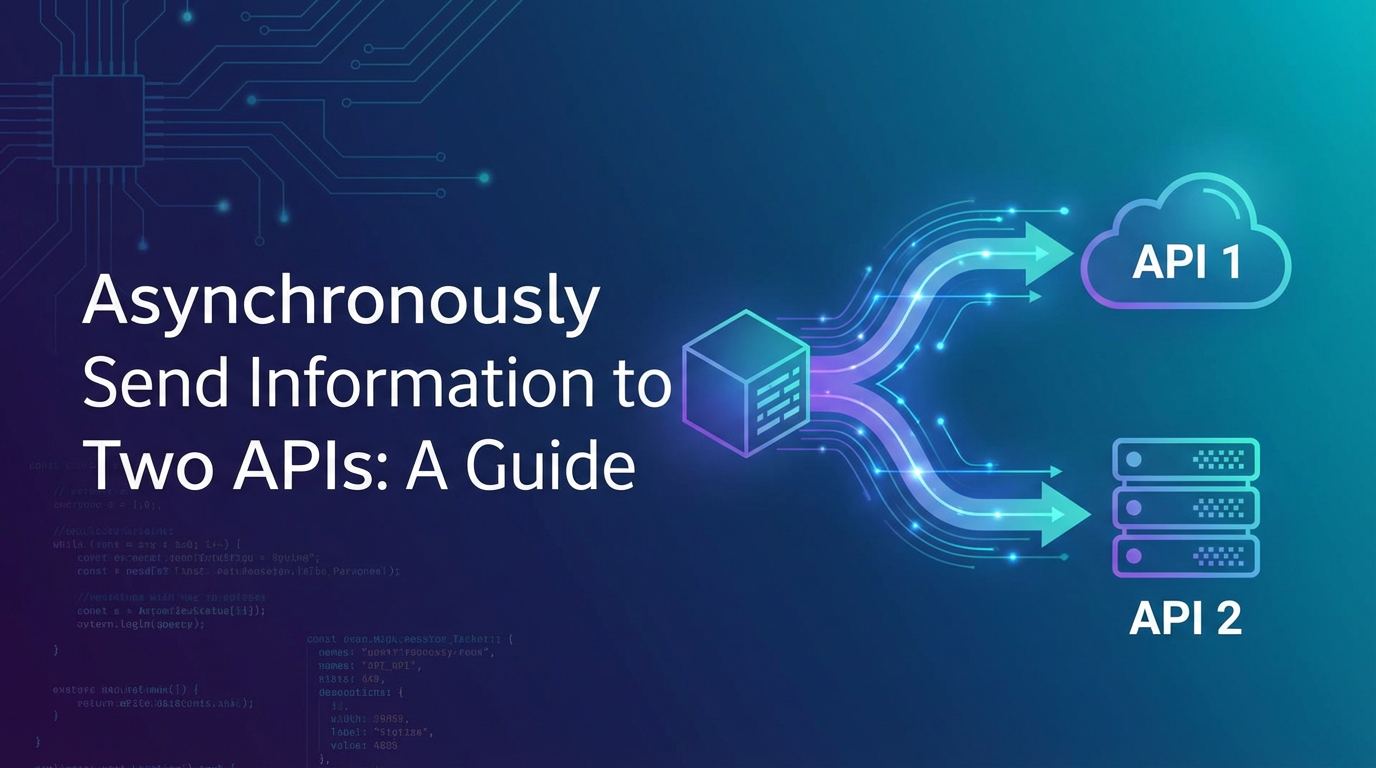
Asynchronously Send Information to Two APIs: A Guide


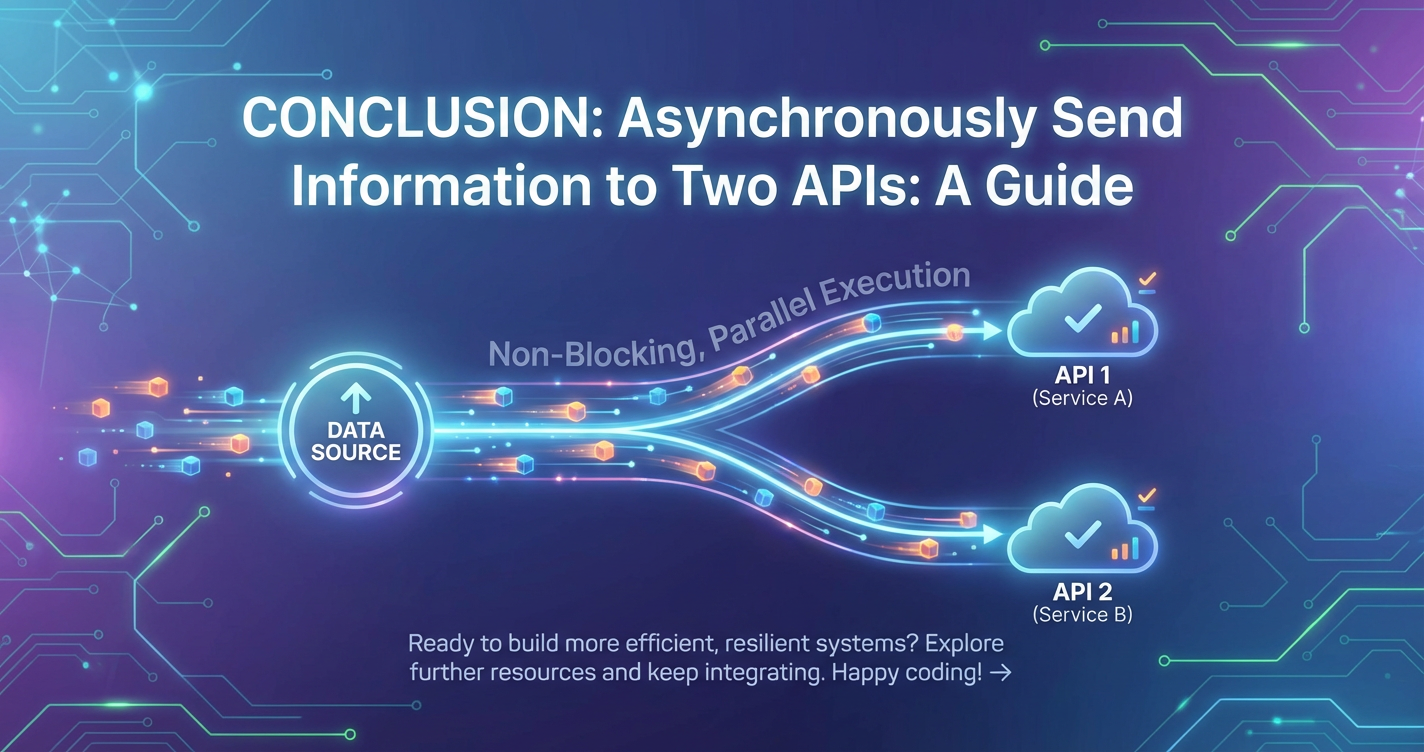
In the intricate tapestry of modern software architecture, the ability to communicate efficiently and reliably between different services is paramount. As applications grow in complexity, the need to interact with multiple external systems or internal microservices becomes a common requirement. While synchronous communication has its place, often, the demand for high performance, resilience, and a superior user experience drives developers towards asynchronous patterns, particularly when information needs to be dispatched to two or more independent API endpoints. This comprehensive guide delves deep into the methodologies, benefits, challenges, and best practices for asynchronously sending information to two APIs, exploring the pivotal role of an API Gateway in orchestrating such intricate interactions.
The Imperative of Asynchronous Dual API Communication: Why It Matters
Before dissecting the "how," it's crucial to understand the "why." Why would an application need to send the same or related information to two different APIs, and why do it asynchronously? The motivations are multi-faceted, stemming from fundamental principles of system design, performance optimization, and operational robustness.
Performance and Responsiveness: Liberating the User Experience
In a synchronous request-response model, the calling service or client must wait for all downstream operations to complete before it can proceed or respond. When dealing with a single API, this might be acceptable. However, when two distinct APIs need to be invoked, the total latency becomes the sum of the longest operation, potentially compounded by network overheads, processing delays, and external system response times. If these API calls are sequential, the wait time doubles or more.
Imagine an e-commerce platform processing an order. Upon successful payment, the system needs to: 1. Update inventory via the Inventory Management API. 2. Initiate shipping via the Shipping Provider API.
If these operations are performed synchronously, the user's payment confirmation might be delayed until both services confirm completion. This introduces unnecessary lag, potentially leading to a frustrating user experience, especially if one of the downstream APIs is slow or temporarily unavailable. By dispatching these tasks asynchronously, the primary application can immediately acknowledge the payment and respond to the user, offloading the subsequent API calls to background processes. This greatly enhances perceived performance and overall responsiveness, ensuring the user interface remains snappy and interactive. The system can continue processing other requests without being held hostage by the slowest link in the chain, making it more efficient and user-friendly.
Resilience and Fault Tolerance: Building Robust Systems
Synchronous calls introduce tight coupling. If one of the two target APIs is down, slow, or returns an error, the entire synchronous transaction might fail, impacting the primary application and potentially the user. This creates a single point of failure within the communication flow, making the system brittle and susceptible to external dependencies.
Asynchronous communication, often mediated by message queues or event streams, inherently promotes resilience. When an application publishes a message or an event, it typically doesn't wait for immediate confirmation from the consuming services. If a target API is temporarily unavailable, the message or event can persist in the queue, awaiting the API's recovery. This means the primary operation (e.g., placing an order) can succeed even if a downstream system is experiencing issues. The consuming service can then retry the API call when it becomes healthy, without requiring the initiating application to re-send the request. This decoupling ensures that failures in one part of the system do not cascade and bring down the entire application, making the overall architecture significantly more fault-tolerant and stable. It allows for graceful degradation rather than outright failure, which is critical for continuous operation.
Decoupling and Microservices Architectures: Fostering Independence
Modern software often adheres to microservices principles, where applications are broken down into smaller, independent services that communicate over APIs. One of the core tenets of microservices is loose coupling, meaning services should be able to evolve, scale, and fail independently. Synchronous dual API calls directly contradict this principle by creating a tight dependency chain.
Asynchronous patterns enable greater decoupling. When an event occurs (e.g., "order placed"), the system emits an event. Multiple services, including those responsible for inventory and shipping, can subscribe to this event independently. They don't need to know about each other's existence or the specific implementation details of the originating service. This architectural flexibility allows teams to develop, deploy, and scale their services autonomously. If the inventory service needs an update, it doesn't impact the shipping service or the order placement service. Furthermore, new services can be added later to react to the same event without modifying existing code, fostering extensibility and maintainability. This loose coupling is vital for large, distributed systems, promoting agile development and reducing the blast radius of changes or failures.
Fan-out Scenarios and Data Synchronization: Distributing Information Efficiently
Many business processes require the dissemination of information to multiple interested parties. For instance, when a new user signs up, the user management service might need to inform: 1. The CRM system (via its API) to create a new customer record. 2. The marketing automation system (via its API) to add the user to a mailing list. 3. The analytics platform (via its API) to record the sign-up event.
This is a classic fan-out scenario. Performing these synchronously would be highly inefficient and prone to failure. Asynchronous mechanisms are perfectly suited for such tasks, allowing a single event or message to trigger multiple, independent actions. Similarly, data synchronization across different systems often benefits from an asynchronous approach. If a master data record is updated, various dependent systems might need to be notified to update their caches or local copies. Instead of the master system attempting to synchronously call every dependent API, it can publish an event, and interested systems can consume it at their own pace, ensuring eventual consistency across the ecosystem without overburdening the source system. This pattern greatly simplifies the management of complex data flows and ensures data propagation efficiently.
User Experience Enhancement: The Illusion of Instantaneity
Beyond just responsiveness, asynchronous processing can significantly enhance the overall user experience by creating an "illusion of instantaneity." When a user initiates an action that involves complex backend processing and multiple API calls, immediate feedback is crucial. If the application can quickly respond with "Your request is being processed" or "Your order has been received, confirmation email sent shortly," while the heavy lifting happens in the background, the user perceives the system as fast and efficient.
Consider a content publishing platform. When a user clicks "Publish Article," the system might need to: 1. Save the article to the main database (via its API). 2. Index the article for search (via a Search API). 3. Generate social media posts (via Social Media APIs). 4. Send notifications to followers (via a Notification API).
A synchronous approach would leave the user staring at a spinner for an extended period. An asynchronous approach allows the system to instantly confirm "Article published!" while all subsequent, non-critical operations are queued and processed in the background. This not only improves user satisfaction but also allows the user to immediately move on to other tasks, enhancing productivity and engagement with the platform.
Unpacking Asynchronicity: Core Concepts and Mechanisms
To effectively implement asynchronous communication with two APIs, a solid grasp of its underlying concepts is essential. Asynchronicity, in its essence, means that an operation does not block the caller, allowing the caller to proceed with other tasks while the operation runs independently.
Synchronous vs. Asynchronous Models: A Fundamental Divergence
Synchronous Model: In a synchronous model, a request is sent, and the caller waits for the response before proceeding. It's like calling a friend and staying on the line until they answer and finish their conversation. If they don't answer, you just keep waiting. This model is straightforward for simple interactions but introduces blocking behavior and tight coupling.
Asynchronous Model: In an asynchronous model, a request is sent, and the caller is immediately free to perform other tasks. The response, when it eventually arrives, is handled separately, often via a callback, an event, or by polling for status. It's like sending a letter or an email; you send it, and you don't wait for a reply before doing something else. When the reply comes, you deal with it. This model excels in scenarios requiring high concurrency, responsiveness, and resilience, as it avoids blocking resources unnecessarily.
Blocking vs. Non-blocking Operations: The Resource Perspective
Blocking Operations: A blocking operation prevents the execution of other code until it completes. In a multi-threaded environment, this means the thread is tied up, consuming resources without doing productive work while it waits. For example, a synchronous API call blocks the thread until the API responds.
Non-blocking Operations: A non-blocking operation initiates an action and immediately returns control to the caller, allowing it to continue processing. The actual completion of the operation might be signaled later. For instance, putting a message onto a queue is often a non-blocking operation; the message is sent, and the application moves on. The processing of that message by a consumer is decoupled. Embracing non-blocking operations is a cornerstone of efficient asynchronous system design.
Key Constructs: Queues, Events, Callbacks, and Promises
To facilitate asynchronous interactions, various constructs and patterns are employed:
- Message Queues: These act as temporary storage for messages. A producer sends a message to a queue, and a consumer retrieves it. Queues decouple producers from consumers, allowing them to operate at different paces and ensuring messages are delivered even if a consumer is temporarily unavailable. They are central to many asynchronous integration patterns. Examples include RabbitMQ, Apache Kafka, and cloud-native services like AWS SQS or Azure Service Bus.
- Events: An event represents a significant occurrence or a state change within a system (e.g., "OrderCreated," "UserUpdated"). Services can publish events, and other services can subscribe to these events to react accordingly. Event-driven architectures are a powerful way to achieve loose coupling and enable real-time reactions across a distributed system.
- Callbacks: In programming, a callback is a function passed as an argument to another function, which is then invoked inside the outer function to complete some kind of routine or action. In asynchronous programming, callbacks are often used to handle the result of an operation once it completes, without blocking the main execution thread. While powerful, deeply nested callbacks (callback hell) can lead to complex and hard-to-maintain code.
- Promises/Futures: These are constructs in many programming languages (e.g., JavaScript, Python's
asyncio) that represent the eventual completion (or failure) of an asynchronous operation and its resulting value. They provide a more structured and readable way to manage asynchronous code compared to raw callbacks, allowing for chaining of operations and cleaner error handling.
Understanding these concepts forms the bedrock for designing and implementing robust asynchronous systems, especially when coordinating multiple API calls.
Core Architectural Patterns for Asynchronous Dual API Calls
Achieving reliable asynchronous communication to two APIs typically involves leveraging established architectural patterns. These patterns provide blueprints for structuring systems to handle messages, events, and background tasks efficiently.
Message Queues (MQ): The Foundation of Decoupling
Message queues are perhaps the most common and robust mechanism for asynchronous communication. They provide a durable, reliable, and scalable way for different parts of a system to communicate without direct dependencies.
How They Work: At its core, a message queue system consists of: * Producer: An application or service that creates and sends messages to the queue. * Queue: A durable buffer that stores messages until they are processed. * Consumer: An application or service that retrieves messages from the queue and processes them.
When an application needs to send information to two APIs asynchronously, it can act as a producer. Instead of directly calling the APIs, it publishes a single message to a queue (or multiple messages to separate queues). One or more consumers then pick up these messages. A dedicated consumer could be designed to receive a message and then call both target APIs. Alternatively, the single initial message could be "fan-out" to multiple internal queues, each with a consumer responsible for calling one specific API. This approach offers significant flexibility and resilience.
Benefits: * Decoupling: Producers and consumers don't need to know about each other's availability or implementation details. * Load Leveling: If target APIs are temporarily overwhelmed, messages accumulate in the queue, preventing the upstream system from being blocked or failing. Consumers can process messages at their own pace. * Fault Tolerance: Messages are persisted. If a consumer fails, another instance can pick up the message, or the original consumer can restart and continue processing. * Scalability: Consumers can be scaled independently to handle varying message loads. * Asynchronous Processing: The producer doesn't wait for the message to be processed, allowing it to continue with other tasks.
Examples: * RabbitMQ: A popular open-source message broker implementing the Advanced Message Queuing Protocol (AMQP). Known for its robust routing capabilities and versatile exchange types. * Apache Kafka: A distributed streaming platform designed for high-throughput, fault-tolerant real-time data feeds. It's often used for event sourcing and stream processing, offering stronger ordering guarantees than traditional queues. * AWS SQS (Simple Queue Service): A fully managed message queuing service by Amazon Web Services, offering standard queues for high-throughput and FIFO queues for strict message ordering.
Event-Driven Architectures: Reacting to Changes
Event-driven architecture (EDA) is a design paradigm where the communication between services revolves around events. Services publish events when something significant happens, and other services subscribe to these events to react accordingly.
How They Work: In an EDA, an application generates an event (e.g., UserRegisteredEvent, PaymentProcessedEvent). This event is published to an event broker or an event bus. Instead of directly calling target APIs, the event contains the necessary information. Multiple independent services can subscribe to this event type. When an event is published, all subscribed services receive a copy and can then trigger their respective actions, such as calling their specific APIs. For sending information to two APIs, this means the initial event triggers two separate, independent consumers, each responsible for one API call.
Benefits: * Extreme Decoupling: Services are even more decoupled than with traditional queues, as they only need to know about the event schema, not the specific queues or consumers. * Scalability and Extensibility: New services can subscribe to existing events without modifying existing publishers or consumers. * Real-time Reactions: Events enable systems to react almost instantly to changes across the enterprise. * Auditability: Event logs can provide a rich history of system state changes.
Examples: * Apache Kafka: Can serve as a powerful event broker for highly scalable event streams. * AWS SNS (Simple Notification Service): A fully managed messaging service that supports both application-to-application (A2A) and application-to-person (A2P) communication. It excels at fan-out to multiple subscribers. * Google Cloud Pub/Sub, Azure Event Grid/Service Bus: Cloud-native eventing services that integrate well with other cloud offerings.
Background Jobs/Workers: Offloading Intensive Tasks
Sometimes, the asynchronous task isn't just a simple API call but a more complex, potentially long-running process that culminates in one or more API calls. In such scenarios, background job systems or worker processes are highly effective.
How They Work: When the primary application receives a request that involves heavy processing or multiple API calls, it can create a "job" describing the task. This job is then placed into a dedicated task queue. A pool of independent worker processes constantly monitors this queue, picking up jobs and executing them in the background. For sending information to two APIs, the job itself could contain the logic to call both APIs sequentially or in parallel, depending on the job's complexity.
Benefits: * Offloading Work: Keeps the main application responsive by moving intensive tasks out of the request-response cycle. * Retries and Error Handling: Most job queues provide built-in mechanisms for retrying failed jobs, often with exponential backoff. * Prioritization: Jobs can often be assigned priorities, ensuring critical tasks are handled first. * Resource Management: Workers can be scaled up or down based on the job load.
Examples: * Celery (Python): A widely used distributed task queue for Python, often paired with Redis or RabbitMQ as a message broker. * Resque/Sidekiq (Ruby): Popular background job frameworks for Ruby applications, leveraging Redis. * AWS Lambda (with SQS trigger): Serverless functions can act as workers, triggered by messages in a queue, executing specific tasks like making API calls.
Serverless Functions: Event-Driven Compute on Demand
Serverless functions (like AWS Lambda, Azure Functions, Google Cloud Functions) provide an excellent way to implement event-driven, asynchronous API interactions without managing servers.
How They Work: Instead of deploying long-running services, you write small, single-purpose functions that are triggered by events. These events can come from various sources: a message arriving in a queue, a new file uploaded to storage, an HTTP request, or a scheduled timer. For our scenario, when the primary application needs to send information to two APIs, it might publish a message to a queue. This queue then triggers two separate serverless functions. Each function is responsible for calling one specific target API based on the message content. This decouples the functions entirely, allowing them to scale and operate independently.
Benefits: * No Server Management: The cloud provider handles all infrastructure. * Cost-Effective: You only pay for the compute time consumed when functions are actively running. * Automatic Scaling: Functions scale automatically to handle fluctuating loads. * Event-Driven Nature: Naturally integrates with event sources and services. * Rapid Deployment: Easy to deploy and iterate on small pieces of logic.
Orchestration Tools (e.g., AWS Step Functions, Azure Logic Apps): For more complex asynchronous workflows involving multiple steps, retries, and conditional logic, serverless orchestration tools can be invaluable. They allow you to visually define state machines that coordinate the execution of multiple serverless functions and other services, ensuring a robust and managed flow for calling your two APIs. This can simplify error handling and state management across complex, multi-step asynchronous processes.
Implementing Asynchronous Dual API Calls: Practical Approaches
Now that we've covered the theoretical underpinnings, let's explore concrete architectural approaches for sending information to two APIs asynchronously. Each approach has its strengths and is suited for different scenarios.
Approach 1: Direct Message Queue Fan-out
This is a fundamental pattern, leveraging the power of message queues to distribute tasks.
Scenario: An "Order Placed" event needs to trigger both an Inventory Update API and a Shipping Initiation API.
Mechanism: 1. Producer (Order Service): When an order is placed, the Order Service constructs a message containing all relevant order details (e.g., order_id, item_list, customer_info). It then publishes this single message to a central "OrderEvents" message queue. This operation is non-blocking. 2. Consumers (Inventory Service & Shipping Service): * The Inventory Service has a dedicated consumer that subscribes to the "OrderEvents" queue. Upon receiving an "Order Placed" message, it extracts the item_list and calls the Inventory Update API to decrement stock. * The Shipping Service has its own dedicated consumer, also subscribing to the "OrderEvents" queue. When it receives the same "Order Placed" message, it extracts customer_info and item_list and calls the Shipping Initiation API to create a new shipment request.
Detailed Steps:
- Step 1: Message Broker Setup: Configure a message broker (e.g., RabbitMQ, Kafka, AWS SQS). If using RabbitMQ, create an "exchange" and bind multiple "queues" to it with routing keys, so that a single message published to the exchange is delivered to all bound queues (a fan-out exchange). For Kafka, create a topic to which multiple consumer groups can subscribe. For SQS, you might use SNS to fan out to multiple SQS queues.
Step 2: Producer Logic (Order Service): ```python # Pseudo-code for Order Service (Producer) import json from your_message_broker_client import publish_messagedef process_new_order(order_data): # ... logic to save order to database ...
# Construct message payload
message_payload = {
    "eventType": "OrderPlaced",
    "orderId": order_data["id"],
    "items": order_data["items"],
    "customerInfo": order_data["customer"]
}

# Publish message to the queue/topic
# This is an asynchronous, non-blocking operation
publish_message("order_events_topic", json.dumps(message_payload))

print(f"Order {order_data['id']} placed and event published.")
return {"status": "success", "message": "Order processing initiated."}
* **Step 3: Consumer Logic (Inventory Service):**python
Pseudo-code for Inventory Service (Consumer)
import json from your_message_broker_client import subscribe_to_topic from inventory_api_client import update_inventory # Hypothetical API clientdef handle_order_placed_event(message_payload): event_data = json.loads(message_payload) if event_data["eventType"] == "OrderPlaced": order_id = event_data["orderId"] items = event_data["items"]
    try:
        # Call Inventory Update API (can be synchronous from consumer's perspective)
        response = update_inventory(items)
        if response.status_code == 200:
            print(f"Inventory updated for order {order_id}")
            # Acknowledge message in queue
        else:
            print(f"Failed to update inventory for order {order_id}: {response.text}")
            # Requeue message or move to DLQ
    except Exception as e:
        print(f"Error calling Inventory API for order {order_id}: {e}")
        # Requeue message or move to DLQ
Start consuming messages
subscribe_to_topic("order_events_topic", handle_order_placed_event) ``` * Step 4: Consumer Logic (Shipping Service): This would be very similar to the Inventory Service consumer, but calling the Shipping Initiation API instead.
Advantages: High decoupling, excellent resilience, load leveling, easy scalability of consumers.
Disadvantages: Requires managing a message broker infrastructure. Eventual consistency needs to be handled.
Approach 2: Dedicated Orchestration Service
For more complex scenarios where the logic for dispatching to two APIs needs to be centralized, or if specific retry and compensation logic is required, a dedicated orchestration service (a microservice specifically for this purpose) can be beneficial.
Scenario: A user performs an action that requires updating data in System A and triggering a complex workflow in System B, with specific error handling logic if one fails.
Mechanism: 1. Initiating Service: Calls the Orchestration Service with a single synchronous request, providing all necessary data. 2. Orchestration Service: This service receives the request. Instead of directly calling the two target APIs synchronously, it immediately publishes messages to two internal queues (e.g., QueueA and QueueB), or it might use an event-driven mechanism to trigger two background workers. It then responds to the initiating service that the request has been accepted for processing. 3. Workers/Consumers: * A worker process dedicated to QueueA retrieves the message and calls API A. * A worker process dedicated to QueueB retrieves the message and calls API B. 4. The Orchestration Service can monitor the status of these asynchronous calls (e.g., through callbacks, polling internal status, or listening for completion events) to implement more sophisticated logic, such as ensuring both succeed or triggering compensation if one fails after the other succeeded.
Detailed Steps:
- Step 1: Orchestration Service API: Define a synchronous API endpoint for the orchestration service to receive the initial request.
Step 2: Orchestration Service Logic: ```python # Pseudo-code for Orchestration Service from flask import Flask, request, jsonify import json from your_message_broker_client import publish_message_to_queueapp = Flask(name)@app.route('/process_dual_api_request', methods=['POST']) def process_request(): request_data = request.json transaction_id = generate_unique_id() # For tracking
# Publish message for API A
message_for_api_a = {
    "transactionId": transaction_id,
    "apiTarget": "API_A",
    "payload": request_data["dataForApiA"]
}
publish_message_to_queue("queue_for_api_a", json.dumps(message_for_api_a))

# Publish message for API B
message_for_api_b = {
    "transactionId": transaction_id,
    "apiTarget": "API_B",
    "payload": request_data["dataForApiB"]
}
publish_message_to_queue("queue_for_api_b", json.dumps(message_for_api_b))

# Respond immediately to the caller
return jsonify({
    "status": "accepted",
    "message": "Processing initiated asynchronously.",
    "transactionId": transaction_id
}), 202
if name == 'main': app.run(port=5000) `` * **Step 3: Worker Services (for API A and API B):** These would be independent consumer applications, similar to Approach 1, each listening to its specific queue and making the respective **API** calls. ThetransactionId` allows for correlation and monitoring if the orchestration service needs to track the end-to-end flow.
Advantages: Centralized logic for complex workflows, better control over error handling and retries across multiple APIs, clear separation of concerns.
Disadvantages: Adds an extra layer of indirection and complexity, potentially higher operational overhead.
Approach 3: API Gateway as an Entry Point and Dispatcher
While an API Gateway primarily handles synchronous inbound requests, its role can be extended to initiate asynchronous dual API calls. It typically doesn't perform the asynchronous fan-out itself to external APIs directly (that's better handled by message brokers or orchestration services), but rather acts as the intelligent front door that hands off the initial request to an internal asynchronous pipeline.
Scenario: A client makes a single request to the API Gateway for an operation that should trigger two backend APIs asynchronously.
Mechanism: 1. Client Request: A client sends a single HTTP request (e.g., POST /order) to the API Gateway. 2. API Gateway: * Authenticates and authorizes the request. * Performs rate limiting, caching, and potentially basic request validation. * Instead of directly forwarding to a single synchronous backend service, the API Gateway is configured to integrate with an asynchronous backend system. This might involve: * Directly publishing to a Message Queue/Topic: The gateway transforms the incoming HTTP request payload into a message format and pushes it onto an internal message queue (e.g., an SQS queue, Kafka topic, or an SNS topic). This is a non-blocking operation from the gateway's perspective, and it can immediately respond to the client. * Invoking a Serverless Function: The gateway could trigger a lightweight serverless function (e.g., AWS Lambda). This function's sole responsibility is to take the incoming data and then publish it to two different message queues or directly invoke two other serverless functions (which then call the target APIs). * The gateway responds immediately to the client with a 202 Accepted status, indicating that the request has been received and processing has been initiated asynchronously. 3. Asynchronous Backend: The message queue or serverless function then takes over, initiating the fan-out to the two target APIs using mechanisms described in Approach 1 or 2.
Detailed Steps:
- Step 1: Configure API Gateway Endpoint: Set up an endpoint in your API Gateway (e.g., AWS API Gateway, Azure API Management, Nginx/Kong/Apigee).
- Step 2: Gateway Integration: Configure the gateway to integrate with an asynchronous backend.
- Example: AWS API Gateway with SQS:
- The gateway endpoint would be configured with an AWS Service Proxy integration.
- The integration type would be set to SQS.
- The mapping template would transform the incoming HTTP body into an SQS message format.
- The gateway invokes the
SendMessageaction on an SQS queue. - The gateway then returns a 202 Accepted response to the client.
- Example: AWS API Gateway with SQS:
- Step 3: Backend Processing:
- Two separate AWS Lambda functions (or traditional services) are configured to be triggered by messages arriving in the SQS queue.
- Each Lambda function is responsible for parsing the message and making a call to one of the target APIs.
- Alternatively, the initial SQS message could trigger one Lambda, which then publishes two separate messages to two different SQS queues, each for a specific target API, which are then consumed by their respective Lambdas. This provides even greater decoupling.
Advantages: * Centralized API Management: The API Gateway handles common concerns like security, rate limiting, and analytics at the edge. * Decoupling from Clients: Clients only interact with the gateway, unaware of the complex asynchronous backend. * Reduced Latency for Clients: The client receives an immediate response. * Flexible Backend Integration: The gateway can abstract away the backend's asynchronous nature.
Disadvantages: Requires careful configuration of the API Gateway and potentially additional cloud services. The gateway itself is not performing the fan-out directly but is initiating an asynchronous workflow.
A note on APIPark: In scenarios where an API Gateway plays a central role, products like ApiPark offer powerful capabilities. As an open-source AI gateway and API management platform, APIPark not only excels at providing centralized entry points, security, and lifecycle management for your APIs but also offers quick integration of 100+ AI models and uniform API formats for AI invocation. Its ability to encapsulate prompts into REST APIs and manage end-to-end API lifecycle, including traffic forwarding, load balancing, and versioning, makes it an ideal choice for managing the ingestion point of such complex asynchronous workflows. While not performing the dual API calls directly, APIPark could efficiently manage the public-facing API that initiates the asynchronous process, ensuring robust authentication, authorization, and monitoring before handing off to the internal messaging or serverless components that fan out to the two downstream APIs. This can significantly enhance the efficiency, security, and data optimization for developers, operations personnel, and business managers orchestrating these sophisticated integrations.
APIPark is a high-performance AI gateway that allows you to securely access the most comprehensive LLM APIs globally on the APIPark platform, including OpenAI, Anthropic, Mistral, Llama2, Google Gemini, and more.Try APIPark now! 👇👇👇
The Crucial Role of the API Gateway
An API Gateway is an indispensable component in modern distributed architectures, serving as the single entry point for all clients. While often associated with synchronous request routing, its capabilities are highly valuable in orchestrating and managing the initial phases of asynchronous dual API calls. It acts as a sophisticated traffic cop, security guard, and often, a preliminary dispatcher.
Centralized Entry Point: The Front Door to Your Services
An API Gateway provides a unified API endpoint for clients, abstracting the complexity of your backend services. Instead of clients needing to know the individual addresses of multiple services, they interact solely with the gateway. This simplification is crucial when dealing with an increasing number of microservices, especially when initiating operations that fan out to two or more independent APIs. The gateway serves as the public face of your entire API landscape, offering a consistent and managed interface.
Request Routing and Transformation: Intelligent Traffic Management
One of the gateway's primary functions is intelligent request routing. It can direct incoming requests to the appropriate backend service based on paths, headers, or query parameters. More importantly for asynchronous scenarios, the gateway can perform request and response transformations. It can modify request payloads, add headers, or flatten complex structures before forwarding. When initiating an asynchronous workflow, the gateway can transform the client's synchronous HTTP request into a format suitable for an internal message queue or a serverless function trigger, effectively bridging the synchronous world of the client with the asynchronous backend. This transformation capability allows the internal asynchronous components to receive precisely the data they need, already formatted correctly.
Security and Authentication: Protecting Your Digital Assets
Security is paramount for any publicly exposed API. An API Gateway centralizes authentication and authorization, enforcing security policies at the edge of your network. It can validate API keys, OAuth tokens, or JWTs before any request reaches your backend services. This offloads security concerns from individual microservices, simplifying their development. For asynchronous dual API calls, the gateway ensures that only legitimate requests can even initiate the asynchronous process, preventing unauthorized message publication or serverless function invocation. This is a critical first line of defense, safeguarding the integrity of your system and protecting sensitive data from potential breaches.
Rate Limiting and Throttling: Preventing Overload
To protect backend services from being overwhelmed by excessive traffic, API Gateways provide rate limiting and throttling mechanisms. They can define limits on the number of requests a client can make within a certain timeframe. This is especially vital when an API call initiates a resource-intensive asynchronous process involving multiple downstream APIs. By controlling the ingress rate, the gateway prevents a surge of requests from cascading into a flood of asynchronous tasks that could strain your message brokers, worker pools, or serverless functions, ensuring the stability and availability of your entire system.
Monitoring and Analytics: Gaining Insights into API Usage
API Gateways are excellent points for collecting metrics and logs related to API usage. They can record details about every request, including latency, error rates, and traffic volume. This centralized observability provides invaluable insights into how your APIs are being consumed and the overall health of your system. While the gateway might only see the initial synchronous request and the immediate asynchronous hand-off, its metrics can still indicate the load on the asynchronous initiation point. Combined with distributed tracing systems, gateway logs form a crucial part of an end-to-end monitoring strategy, allowing developers to identify bottlenecks and troubleshoot issues effectively.
How it Integrates with Asynchronous Patterns
As mentioned in the previous section, the API Gateway's role in initiating asynchronous dual API calls is typically to act as the synchronous façade. It receives the client's request, applies its policies, and then triggers an internal asynchronous workflow. This trigger might be:
- Publishing to a Message Queue: The gateway itself has an integration to publish the request payload (or a transformed version of it) to a message queue (e.g., SQS, Kafka).
- Invoking a Serverless Function: The gateway invokes a short-lived serverless function, which then takes on the responsibility of orchestrating the asynchronous fan-out (e.g., publishing to multiple queues, invoking other functions).
- Calling a Dedicated Orchestration Service: The gateway routes the request to a dedicated internal microservice whose sole purpose is to manage the complex asynchronous dual API calls.
In all these scenarios, the API Gateway provides an immediate, non-blocking response to the client, confirming that the request has been received and the asynchronous processing has begun. This abstraction is key to delivering a responsive user experience while maintaining the robustness and scalability of asynchronous backend operations. The gateway ensures that the initial client interaction is smooth and secure, setting the stage for the decoupled and resilient backend processing.
Challenges and Considerations in Asynchronous Dual API Calling
While asynchronous dual API calls offer significant advantages, they also introduce a new set of complexities that require careful planning and robust solutions. Overlooking these challenges can lead to subtle bugs, data inconsistencies, and operational headaches.
Error Handling and Retries: Ensuring Eventual Success
In a synchronous world, an API call either succeeds or fails immediately, and the calling service typically handles the error. In an asynchronous world, things are more nuanced. If one of the two target APIs fails or is temporarily unavailable, how do you ensure the message is eventually processed?
- Idempotency: When retrying API calls, it's crucial that the target APIs are idempotent. An idempotent operation produces the same result regardless of how many times it's executed with the same input. For example, updating a user's address should be idempotent; calling it twice with the same address should not cause issues. If an API call is not idempotent, retrying it might lead to duplicate entries, incorrect updates, or other data integrity problems. Designing idempotent APIs is a fundamental best practice for distributed systems.
- Exponential Backoff: Blindly retrying immediately after a failure can exacerbate problems, especially if the target API is overwhelmed. Exponential backoff involves waiting for increasingly longer periods between retries (e.g., 1 second, then 2, then 4, then 8, etc.). This gives the failing service time to recover and prevents the retrying service from overwhelming it further. Most message queue consumers and HTTP clients offer configurable retry policies with exponential backoff.
- Dead-Letter Queues (DLQ): Messages that repeatedly fail to be processed after several retries (e.g., due to persistent errors in the consumer logic or a fundamental issue with the message content) should not remain in the main queue indefinitely. They should be moved to a Dead-Letter Queue (DLQ). A DLQ is a separate queue for storing messages that could not be processed successfully. This prevents poison messages from blocking the entire queue and allows operators to inspect, fix, and potentially reprocess these messages manually. DLQs are an essential safety net for asynchronous systems.
- Circuit Breakers: A circuit breaker pattern prevents a service from repeatedly trying to invoke a failing remote API. If an API experiences a certain number of failures within a threshold, the circuit breaker "trips," causing subsequent calls to fail immediately without actually attempting the remote call. After a configurable timeout, the circuit breaker enters a "half-open" state, allowing a few test requests to pass through to see if the API has recovered. If they succeed, the circuit "closes"; otherwise, it remains open. This pattern prevents wasted resources and faster error detection.
Data Consistency: Eventual vs. Strong
When information is sent to two APIs asynchronously, it's highly likely that the updates to these two systems will not occur at precisely the same moment. This leads to the concept of data consistency.
- Eventual Consistency: This is the most common consistency model for distributed asynchronous systems. It guarantees that if no new updates are made to a given data item, eventually all accesses to that item will return the last updated value. In our scenario, this means that after an order is placed, the inventory and shipping systems might not reflect the updated state simultaneously, but they will eventually become consistent. This is often acceptable for non-critical reads or when the delay is minimal.
- Strong Consistency: Requires that all accesses to an item return the most recently updated value. Achieving strong consistency across two independent APIs in an asynchronous fashion is much harder and often requires distributed transactions (two-phase commit), which are notoriously complex, slow, and can negate many benefits of asynchronicity. Generally, for dual API calls, eventual consistency is the practical and preferred approach, coupled with mechanisms to handle discrepancies.
- Saga Pattern: For business transactions that span multiple services and require strong consistency-like guarantees (e.g., if one API call succeeds but the other fails, you need to "undo" the first), the Saga pattern is often employed. A Saga is a sequence of local transactions, where each transaction updates data within a single service and publishes an event to trigger the next step of the saga. If a step fails, the saga executes a series of compensating transactions to undo the changes made by previous successful steps. This complex pattern helps manage long-running distributed business processes and is crucial when failures in one part of a multi-step asynchronous flow require remediation in others.
Ordering Guarantees: When Sequence Matters
In some scenarios, the order in which messages are processed is critical. For example, if you're sending updates for a user's address, you want to ensure they are processed in the order they occurred (e.g., "move to City A" before "move to City B").
- Default Behavior: Most standard message queues (like SQS Standard) do not guarantee strict message ordering. Messages might arrive at consumers out of sequence due to concurrency, network issues, or internal queue re-ordering.
- Ordered Queues: Some message brokers offer "FIFO" (First-In, First-Out) queues (e.g., SQS FIFO, Kafka topics with a single partition per consumer group) that guarantee strict message ordering. However, this often comes with trade-offs, such as reduced throughput or increased complexity in consumer scaling.
- Application-Level Ordering: If strict ordering is required but the messaging system doesn't provide it, you might need to implement application-level ordering. This could involve adding sequence numbers or timestamps to messages and having consumers buffer and reorder messages before processing them, discarding older duplicates. This adds significant complexity. When sending information to two APIs, if the updates to both APIs must always be in a specific relative order, careful design of message keys (e.g., per user ID) in Kafka or specific consumer logic is necessary.
Monitoring and Observability: Seeing the Unseen
The distributed and asynchronous nature of these systems makes traditional debugging challenging. It's difficult to trace a single request as it jumps from service to queue to worker to API.
- Distributed Tracing: Tools like OpenTelemetry, Jaeger, or Zipkin are essential. They allow you to trace a single request or operation as it flows through multiple services, queues, and API calls, providing a complete timeline and revealing bottlenecks. Each message or API call should carry a correlation ID that is propagated across all services involved.
- Comprehensive Logging: Services should emit structured logs (e.g., JSON logs) with correlation IDs, transaction IDs, and context-rich information. Centralized log aggregation systems (e.g., ELK Stack, Splunk, Datadog) are crucial for searching, filtering, and analyzing these logs across your entire ecosystem.
- Metrics and Alerting: Collect operational metrics from all components: message queue depths, consumer processing rates, API response times, error rates. Set up alerts on critical thresholds (e.g., DLQ messages accumulating, API latency spikes, consumer lag).
- Health Checks: Implement health check endpoints for all services and monitor them to ensure components are up and running and processing messages effectively.
Scalability: Handling Growth
As your application grows, the volume of data and the number of API calls will increase. Your asynchronous system must be designed to scale horizontally.
- Horizontal Scaling of Consumers: Message queue consumers should be stateless and designed to be scaled out easily. Adding more instances of a consumer service should automatically distribute the workload.
- Elasticity of Message Brokers: Choose a message broker that can scale to handle high throughput and storage demands (e.g., Kafka clusters, cloud-managed queues).
- Database Scaling: Ensure your backend databases can handle the increased load resulting from the API calls.
Security: Protecting Data in Motion and at Rest
Security remains paramount. When moving data asynchronously to two APIs, you must consider:
- Secure Message Brokers: Ensure your message broker is configured with authentication and authorization. Messages in transit should be encrypted (TLS/SSL).
- Secure API Endpoints: Both target APIs should enforce robust authentication and authorization, as well as use HTTPS.
- Data Encryption: Sensitive data within messages should ideally be encrypted at rest within the queue and decrypted only by authorized consumers.
Addressing these challenges upfront through thoughtful design, robust tooling, and continuous monitoring is key to building a resilient, scalable, and maintainable asynchronous system for dual API calls.
Advanced Topics and Best Practices
Moving beyond the fundamentals, several advanced topics and best practices can further enhance the robustness, efficiency, and maintainability of asynchronous dual API calling architectures.
Choosing the Right Messaging System: Tailoring to Needs
The choice of messaging system is foundational and depends heavily on your specific requirements:
- For simple task queuing and durable delivery:
- RabbitMQ: Excellent for complex routing rules, message acknowledgements, and traditional message queuing patterns. Good for explicit message processing and task distribution.
- AWS SQS (Standard): Fully managed, highly scalable, and very cost-effective for basic message queuing where strict ordering is not critical.
- For high-throughput event streaming, event sourcing, and strong ordering guarantees (within a partition):
- Apache Kafka: A distributed streaming platform that excels at handling massive volumes of data streams, replaying events, and supporting multiple consumers. It's a powerhouse for event-driven architectures and real-time analytics.
- AWS Kinesis / Google Cloud Pub/Sub / Azure Event Hubs: Cloud-native alternatives to Kafka, offering similar capabilities with managed infrastructure.
- For strict FIFO ordering (with potentially lower throughput than standard queues):
- AWS SQS (FIFO): Guarantees that messages are processed exactly once, in the exact order they are sent, often required for financial transactions or state-dependent updates where sequence is critical.
Consider factors like throughput, latency, ordering guarantees, message durability, ease of management, and cost when making your selection. For sending information to two APIs, if the order of operations between the two APIs is irrelevant, a standard queue or fan-out mechanism is sufficient. If the operations must be ordered relative to a specific entity (e.g., all updates for user_id=123 must be processed in sequence by both APIs), then a partitioned system like Kafka (keyed by user_id) or an SQS FIFO queue is more appropriate.
Designing Idempotent Operations: The Cornerstone of Retries
Asynchronous systems inherently lead to retries. Therefore, designing idempotent APIs and message consumers is not merely a best practice; it's a necessity.
- Idempotent API Design:
- Use unique identifiers: For
POSTrequests that create resources, generate a unique client-generated ID (e.g., arequestIdheader or field in the payload). The server can store this ID and, if a duplicate request arrives with the same ID, simply return the original successful response without re-processing. - Leverage
PUTsemantics:PUToperations are typically idempotent by nature, as they replace a resource entirely or update specific fields. RepeatedPUTs with the same data have the same effect. - Conditional Updates: For updates, use versioning or optimistic locking. Only apply the update if the current version matches the expected version.
- Use unique identifiers: For
- Idempotent Consumer Logic:
- Track processed messages: Consumers should record the message ID (or a derived unique identifier for the specific operation) in a durable store (database, cache) before processing the message.
- Check before processing: Before performing the actual API call or business logic, the consumer should check if that message ID has already been processed successfully. If so, it can acknowledge the message and discard it. This prevents duplicate API calls even if the message is redelivered.
Implementing Distributed Tracing: Following the Thread
In an asynchronous system, a single logical operation can span multiple services and queues. Distributed tracing is critical for understanding the flow and diagnosing issues.
- Correlation IDs: Every incoming request to your API Gateway or initial service should be assigned a unique
correlationId(also known as atraceId). - Propagate IDs: This
correlationIdmust be propagated through every component:- Add it to messages published to queues.
- Include it in headers when calling downstream APIs.
- Include it in serverless function invocations.
- Enrich Logs: All logs across all services should include the
correlationId. - Use Tracing Tools: Integrate with distributed tracing tools (e.g., OpenTelemetry, Jaeger, AWS X-Ray) that visualize the entire request flow, showing timings and dependencies between services, messages, and API calls. This allows you to quickly pinpoint where latency is introduced or where failures occur in the asynchronous chain.
Testing Asynchronous Flows: Beyond Unit Tests
Testing asynchronous systems is inherently more complex than testing synchronous ones.
- Integration Tests: Focus on testing the entire flow from producer to message broker to consumer to target API. Use test doubles for external APIs if they are not readily available in your test environment.
- End-to-End (E2E) Tests: Simulate a real user action and verify that all downstream APIs are eventually called and the system reaches its expected consistent state. This often requires polling or waiting for eventual consistency.
- Fault Injection Testing (Chaos Engineering): Deliberately introduce failures (e.g., making one target API unavailable, increasing latency, killing a consumer) to verify that your retry mechanisms, DLQs, and overall resilience patterns work as expected.
- Performance Testing: Measure the throughput and latency of your asynchronous pipeline under load. Ensure your message broker and consumer scale appropriately.
Performance Tuning: Optimizing for Speed and Efficiency
While asynchronicity inherently improves perceived performance, actual throughput and efficiency can be further optimized.
- Batching Messages: If appropriate, consumers can process messages in batches rather than individually. This reduces overhead for database interactions or API calls.
- Consumer Concurrency: Adjust the number of concurrent consumers and the number of threads/processes within each consumer to match the processing capacity of your backend APIs.
- Message Size: Keep message payloads as small as possible, sending only essential information. If large data is needed, store it in a shared repository (e.g., S3, database) and send a reference ID in the message.
- Network Optimization: Ensure network paths between services, message brokers, and APIs are optimized for low latency.
- Efficient API Clients: Use high-performance HTTP clients for making API calls from your consumers.
By incorporating these advanced practices, organizations can build highly reliable, scalable, and observable asynchronous systems that efficiently send information to two or more APIs, forming the backbone of resilient distributed applications.
| Feature / System | Apache Kafka | RabbitMQ | AWS SQS (Standard) | AWS SQS (FIFO) |
|---|---|---|---|---|
| Primary Use Case | High-throughput event streaming, event sourcing | General-purpose message queuing, complex routing | Decoupling, fan-out, high-throughput message queuing | Strict ordering, exactly-once processing (within a group) |
| Ordering Guarantee | Per-partition ordering | No strict ordering (unless configured with single consumer) | No strict ordering | Strict FIFO ordering (within a message group) |
| Message Durability | Highly durable, persistent storage | Persistent messages (if configured) | Durable (retains messages until processed or expired) | Durable |
| Delivery Guarantee | At-least-once | At-least-once (can be configured for exactly-once) | At-least-once | Exactly-once (within a message group) |
| Scaling | Horizontal scaling with partitions | Horizontal scaling of consumers, complex broker clustering | Highly scalable, fully managed | Scalable, but throughput can be limited compared to Standard |
| Complexity | Higher operational complexity (cluster management) | Moderate operational complexity | Low operational complexity (fully managed) | Low operational complexity (fully managed) |
| Fan-out Capability | Multiple consumer groups can read same topic | Exchanges can fan out to multiple queues | SNS integration allows fan-out to multiple SQS queues | SNS can fan out to FIFO, but message group ID is critical |
| Message Retention | Configurable (e.g., 7 days by default) | Configurable (until acknowledged or expired) | 1 minute to 14 days | 1 minute to 14 days |
| Best for Dual API | When both APIs process based on events from a stream | When both APIs consume from distinct queues or shared queue | When both APIs need to react to a single event without order concern | When both APIs need ordered processing for an entity |
Table: Comparison of Asynchronous Messaging Technologies for Dual API Calls
Conclusion: Embracing Asynchronicity for a Resilient Future
The journey through the realm of asynchronously sending information to two APIs reveals a landscape rich with architectural patterns, intricate challenges, and powerful solutions. It is a fundamental paradigm shift from the simpler, but often brittle, synchronous world, paving the way for systems that are not only faster and more responsive but also inherently more resilient and scalable.
We've explored the compelling "why" – from enhancing performance and user experience to fostering robust, decoupled microservices architectures capable of graceful degradation in the face of failure. The core concepts of asynchronicity, message queues, event-driven designs, and background processing form the bedrock upon which these advanced systems are built. Practical approaches, whether leveraging direct message queue fan-out, a dedicated orchestration service, or initiating workflows via an API Gateway, provide concrete paths for implementation.
The pivotal role of an API Gateway emerges as that of an intelligent frontier, managing the initial synchronous interaction with clients, enforcing security, and providing an elegant hand-off to the asynchronous backend. Products like ApiPark, with their comprehensive API management capabilities, can significantly streamline the gateway layer, ensuring efficient, secure, and well-governed API interactions that initiate these complex workflows.
However, with great power comes great responsibility. The complexities of error handling, ensuring data consistency (often eventual consistency), managing message ordering, and providing end-to-end observability are not trivial. These require meticulous design, the adoption of patterns like idempotency and distributed tracing, and rigorous testing.
As organizations continue to embrace microservices and distributed systems, the ability to orchestrate asynchronous communication to multiple APIs will remain a critical skill. By carefully considering the motivations, understanding the underlying patterns, and diligently addressing the inherent challenges, developers and architects can construct highly performant, fault-tolerant, and scalable applications that gracefully navigate the complexities of the modern digital landscape, delivering superior value and a seamless experience to their users.
Frequently Asked Questions (FAQs)
1. Why should I send information to two APIs asynchronously instead of synchronously? Asynchronous dispatch offers several key benefits: improved performance and responsiveness for the user (the calling application doesn't wait for both APIs), enhanced system resilience (failures in one API don't block the other or the caller), better decoupling between services, and efficient handling of fan-out scenarios. It prevents long wait times and cascading failures that are common in synchronous multi-API calls.
2. What are the common methods or architectural patterns for achieving asynchronous dual API calls? Common patterns include using message queues (e.g., RabbitMQ, Kafka, AWS SQS) to publish a message that two separate consumers (each responsible for one API call) can pick up. Other methods involve dedicated orchestration services that manage the asynchronous dispatch, or leveraging serverless functions triggered by events. The choice depends on the specific requirements for message ordering, resilience, and complexity.
3. How does an API Gateway fit into an asynchronous dual API call strategy? An API Gateway acts as the initial synchronous entry point for clients. It can validate, secure, and rate-limit incoming requests. Crucially, instead of synchronously calling backend services, the API Gateway can be configured to initiate an asynchronous workflow (e.g., by publishing a message to a queue or invoking a serverless function) which then handles the fan-out to the two target APIs. It provides an immediate "202 Accepted" response to the client, abstracting the backend's asynchronous processing.
4. What are the biggest challenges when implementing asynchronous dual API calls? Major challenges include robust error handling and retries (e.g., implementing idempotency, exponential backoff, and Dead-Letter Queues), managing data consistency (often aiming for eventual consistency), ensuring message ordering when critical, and providing comprehensive monitoring and observability across distributed components (e.g., using distributed tracing and centralized logging).
5. How do I ensure data consistency when updating two separate APIs asynchronously? Achieving strong, immediate consistency across two independent APIs asynchronously is very difficult and often impractical. The most common approach is "eventual consistency," where you accept a temporary period of inconsistency, knowing that both systems will eventually converge to the same state. For scenarios requiring stronger guarantees, patterns like the Saga pattern can be used to coordinate multiple local transactions and implement compensation logic if one part of the multi-API update fails, ensuring that the overall business transaction is consistent.
🚀You can securely and efficiently call the OpenAI API on APIPark in just two steps:
Step 1: Deploy the APIPark AI gateway in 5 minutes.
APIPark is developed based on Golang, offering strong product performance and low development and maintenance costs. You can deploy APIPark with a single command line.
curl -sSO https://download.apipark.com/install/quick-start.sh; bash quick-start.sh

In my experience, you can see the successful deployment interface within 5 to 10 minutes. Then, you can log in to APIPark using your account.

Step 2: Call the OpenAI API.