Asynchronously Send Information to Two APIs: Tips
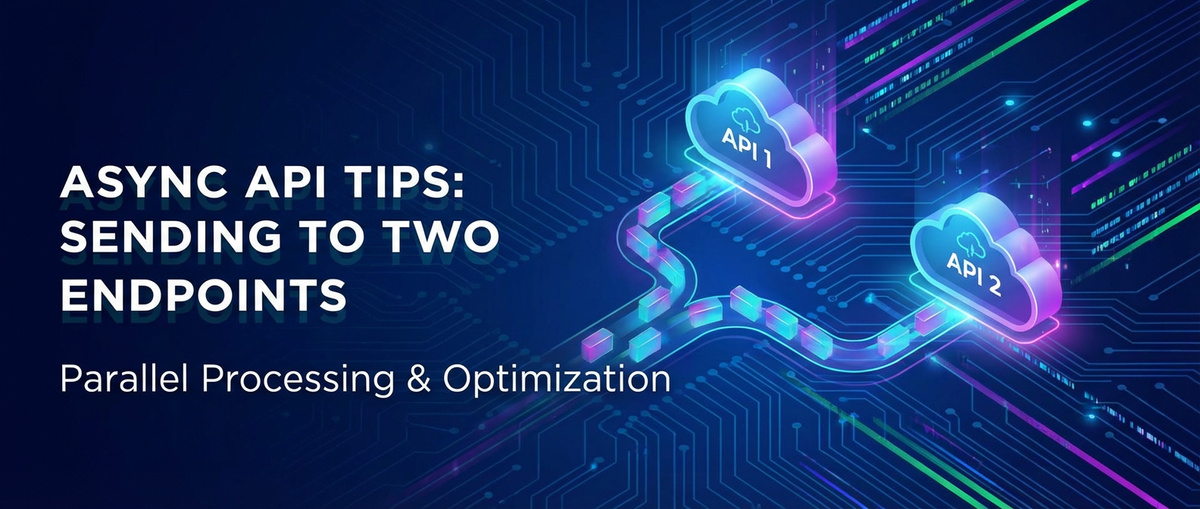


In the intricate tapestry of modern software applications, the need for seamless, efficient, and reliable communication between various services is paramount. Today's digital landscape is characterized by distributed systems, microservices architectures, and an ever-increasing reliance on external and internal Application Programming Interfaces (APIs). Developers are frequently tasked with the challenge of interacting with multiple APIs to fulfill a single user request or system process. While synchronous calls can be straightforward for isolated interactions, their limitations become glaringly apparent when an operation requires sending information to two or more APIs, especially if those operations are independent or time-consuming. This is where the power of asynchronous communication truly shines, transforming potential bottlenecks into fluid, concurrent processes.
This article delves deep into the art and science of asynchronously sending information to two or more APIs. We will explore the fundamental reasons why asynchronous patterns are not just a luxury but a necessity, examining the tangible benefits they bring in terms of performance, user experience, and system resilience. We will dissect various architectural patterns and technological tools, including the critical role of an API gateway, that enable robust asynchronous interactions. From basic client-side techniques to sophisticated message-queue driven architectures, we will provide a comprehensive guide, offering practical tips and best practices to navigate the complexities of multi-API asynchronous communication, ensuring your applications remain responsive, scalable, and fault-tolerant in the face of diverse API dependencies. Understanding these principles is key to building high-performance, maintainable, and adaptable systems that can meet the demands of tomorrow's digital ecosystem.
The Indispensable Shift: Why Asynchronous Communication is Critical for Multiple APIs
The traditional model of making synchronous calls to APIs, where one operation must complete before the next can begin, quickly hits its limits when an application needs to interact with multiple external services. Imagine a scenario where a user signs up for a service. This single action might trigger a series of downstream operations: creating a user record in a database, sending a welcome email via an email API, updating a CRM system via another API, and perhaps notifying an analytics platform. If each of these calls were made synchronously, the user would experience significant delays, potentially leading to frustration and abandonment. Each API call, with its inherent network latency, processing time, and potential for external service unavailability, adds cumulatively to the total response time.
The Pitfalls of Synchronous Multi-API Interactions
Before we fully embrace the asynchronous paradigm, it's crucial to understand the inherent drawbacks of its synchronous counterpart when dealing with multiple APIs:
- Performance Bottlenecks and High Latency: The most immediate and noticeable issue is the serial nature of synchronous calls. If API A takes 500ms and API B takes 800ms, a synchronous sequence of A then B will take at least 1300ms (plus any overhead), even if A and B are entirely independent. This accumulated delay directly impacts user experience, particularly in web or mobile applications where responsiveness is paramount. For backend processes, it limits throughput, as one thread or process is blocked awaiting responses, unable to serve other requests.
- Cascading Failures and Reduced Fault Tolerance: In a synchronous chain, if any one API in the sequence fails or becomes unresponsive, the entire operation grinds to a halt. This leads to partial data updates, broken user flows, and can even cascade into system-wide failures if the calling service becomes overloaded due to blocked threads waiting for timed-out responses. Debugging such failures can be challenging, as the point of failure might be deep within a long chain of dependencies.
- Resource Inefficiency: While waiting for an API response, the thread or process making the synchronous call remains active but idle, consuming system resources (memory, CPU cycles) without performing useful work. This can lead to inefficient resource utilization, especially under high load, requiring more server capacity to handle the same number of requests compared to an asynchronous approach. Scaling becomes more expensive and complex.
- Tight Coupling and Reduced Flexibility: Synchronous calls often imply a direct dependency between the calling service and the called services. This tight coupling makes it harder to modify, replace, or update individual APIs without impacting the services that depend on them. Changes in one API's response structure or availability can break the entire chain, necessitating coordinated deployments and reducing architectural flexibility.
- Poor User Experience: Ultimately, all these technical limitations translate into a subpar experience for the end-user. Long loading spinners, unresponsive interfaces, or incomplete actions due to backend failures directly detract from the perceived quality and reliability of the application. In today's competitive digital landscape, user patience is a scarce commodity, making application responsiveness a critical success factor.
The Unleashed Potential: Benefits of Asynchronous Communication
By shifting to an asynchronous model, where operations can be initiated without immediately waiting for their completion, applications gain a profound advantage, especially when orchestrating interactions with two or more APIs. This paradigm shift offers a multitude of benefits that address the shortcomings of synchronous communication directly:
- Enhanced Responsiveness and Improved User Experience: The most significant immediate benefit is the ability for the calling service to release its hold on the user or the primary thread almost immediately after initiating the API calls. Instead of waiting for all responses, it can signal success, provide immediate feedback, or continue processing other tasks. This dramatically reduces perceived latency, making applications feel snappier and more fluid. For example, a user sign-up can show "Welcome! Your account is being set up" instantly, while background tasks like sending emails and updating CRMs proceed in parallel.
- Increased Throughput and Scalability: Asynchronous operations allow a single thread or process to manage multiple concurrent tasks without blocking. This means a server can initiate many API calls to different services and then process their responses as they arrive, rather than waiting for each one serially. This concurrent processing ability significantly increases the number of requests a system can handle (throughput) with the same amount of hardware. Consequently, applications become inherently more scalable, as more work can be done efficiently with existing resources, delaying the need for costly infrastructure upgrades.
- Greater Fault Tolerance and Resilience: In an asynchronous setup, the failure of one API call does not necessarily halt the entire operation or affect other ongoing calls. If one API fails, mechanisms like retry policies, dead-letter queues, or compensating transactions can be employed to handle the specific failure gracefully, often without impacting the overall system's stability or the success of other parallel operations. This decoupling reduces the risk of cascading failures, making the system more robust against transient issues and external service outages.
- Decoupling of Services and Architectural Flexibility: Asynchronous communication patterns, particularly those involving message queues or event streams, promote loose coupling between services. The calling service doesn't need to know the intricate details of how the downstream services process the information or even their immediate availability. It simply publishes an event or sends a message, and interested parties consume it independently. This architectural independence allows individual services to evolve, scale, or fail without directly impacting others, fostering a more modular and maintainable system landscape.
- Optimized Resource Utilization: By not blocking resources while waiting for external responses, asynchronous processing makes far more efficient use of system resources. Threads or processes are released to handle other incoming requests or perform other computations, rather than remaining idle. This optimization translates into lower operational costs, as more work can be accomplished with fewer servers or virtual instances. It also aligns perfectly with modern cloud-native and serverless computing models, where resource consumption directly translates to cost.
- Simpler Management of Complex Workflows: For multi-step business processes involving numerous API interactions, asynchronous patterns, especially when combined with orchestration tools or event-driven architectures, provide a clearer and more manageable way to define, track, and execute complex workflows. Each step can be a separate asynchronous task, allowing for independent development, deployment, and monitoring.
By understanding these profound advantages, it becomes clear that adopting asynchronous communication strategies is not merely a technical choice but a strategic imperative for building high-performance, resilient, and scalable applications in today's API-driven world.
Core Concepts and Technologies for Asynchronous API Calls
Implementing asynchronous communication, especially when interacting with two or more APIs, relies on a foundational understanding of various patterns and technologies. These tools and concepts empower developers to design systems that are not only performant but also robust and maintainable.
1. HTTP Basics and the Asynchronous Perspective
At its heart, most API communication over the internet relies on the Hypertext Transfer Protocol (HTTP). While HTTP itself is a request-response protocol, the "asynchronous" aspect refers to how the calling application manages its state and threads while awaiting that response, and how it initiates multiple requests.
- Request/Response Model: A client sends an HTTP request to a server, and the server sends back an HTTP response. This fundamental interaction remains the same whether the operation is synchronous or asynchronous. The difference lies in what the client does after sending the request.
- Non-Blocking I/O: Modern programming languages and frameworks leverage non-blocking I/O. Instead of a thread pausing its execution to wait for data from a network socket (blocking), it registers a callback or a promise and continues with other tasks. When data arrives, the callback is invoked, or the promise resolves. This is fundamental to achieving high concurrency with fewer threads.
2. Fundamental Asynchronous Patterns
Several common patterns facilitate asynchronous operations:
- Fire-and-Forget: This is the simplest asynchronous pattern. The calling service sends a request to an API and immediately moves on, without waiting for a response or caring about its outcome. This is suitable for non-critical tasks like logging, analytics events, or non-essential notifications where occasional loss is acceptable. While easy to implement, it lacks reliability guarantees.
- Callbacks: A callback is a function passed as an argument to another function, which is then executed after the main function completes its operation. In asynchronous API calls, a callback function is invoked once the API response is received or an error occurs. This pattern is common in older JavaScript codebases. The challenge with callbacks is "callback hell" or "pyramid of doom" when chaining multiple asynchronous operations, making code hard to read and maintain.
- Polling: The client makes an initial request that triggers a long-running process on the server. The server responds immediately with an acknowledgment and a unique identifier for the ongoing process. The client then repeatedly "polls" a status API endpoint using this identifier until the server indicates the process is complete or has failed. This pattern is useful for operations that genuinely take a long time, but it can be inefficient if polling occurs too frequently, wasting resources on both client and server.
- Webhooks: Instead of the client polling the server, webhooks invert the control flow. The client (which is now often acting as a server) registers a callback URL with the target API. When a specific event occurs on the target API's side, it sends an HTTP POST request to the registered webhook URL, notifying the client of the event. Webhooks are highly efficient for event-driven systems as they eliminate unnecessary polling, but they require the client to expose a public endpoint.
3. Concurrency Models in Programming Languages
Modern programming languages offer built-in constructs to handle concurrency and asynchronous programming gracefully:
- Async/Await (JavaScript, Python, C#, Rust, etc.): This powerful syntactic sugar makes asynchronous code look and behave like synchronous code, significantly improving readability and maintainability.
asyncfunctions canawaitthe result of a Promise (or similar future-like object) without blocking the entire program execution. This is often the preferred method for client-side or single-service asynchronous API calls to two or more endpoints. - Promises/Futures (JavaScript, Java, C++): Promises represent the eventual completion (or failure) of an asynchronous operation and its resulting value. They provide a cleaner way to handle asynchronous results and errors compared to callbacks, allowing for chaining and parallel execution (
Promise.allin JavaScript). - Event Loops (Node.js, Python's Asyncio): Many modern asynchronous runtimes operate on a single-threaded event loop. Instead of creating a new thread for every concurrent operation, the event loop continuously checks for tasks that are ready to run (e.g., an API response has arrived, a timer has expired). This model is highly efficient for I/O-bound operations like API calls.
Example (JavaScript conceptual): ```javascript async function sendDataToTwoAPIs(data) { try { const api1Promise = fetch('https://api1.example.com/data', { method: 'POST', body: JSON.stringify(data) }); const api2Promise = fetch('https://api2.example.com/other-data', { method: 'POST', body: JSON.stringify(data) });
    // Wait for both promises to settle
    const [response1, response2] = await Promise.all([api1Promise, api2Promise]);

    if (!response1.ok || !response2.ok) {
        // Handle non-OK responses
        console.error('One or both API calls failed');
        // Further error handling or partial success logic
    }

    const result1 = await response1.json();
    const result2 = await response2.json();

    console.log('API 1 response:', result1);
    console.log('API 2 response:', result2);
    return { success: true, result1, result2 };

} catch (error) {
    console.error('Error sending data to APIs:', error);
    return { success: false, error };
}
} ``` This pattern directly addresses sending information to two APIs concurrently from a single point of execution.
4. Message Queues and Event-Driven Architectures
For more complex, reliable, and scalable asynchronous interactions, especially when many services need to react to an event or when reliability is paramount, message queues and event-driven architectures are indispensable.
- Message Queues (e.g., RabbitMQ, Apache Kafka, AWS SQS, Azure Service Bus, Google Cloud Pub/Sub): A message queue acts as an intermediary for messages between different services. A "producer" service sends a message to a queue, and one or more "consumer" services subscribe to that queue to receive and process messages.
- Key benefits for multi-API asynchronous calls:
- Decoupling: Producer and consumer services are completely independent. The producer doesn't need to know who the consumers are or if they are currently online.
- Reliability: Messages are typically persisted in the queue, ensuring they are not lost even if consumers fail. Delivery guarantees (at-least-once, exactly-once) can be configured.
- Load Leveling: If a sudden burst of requests occurs, the queue can absorb the load, allowing consumers to process messages at their own pace, preventing overwhelming downstream services.
- Scalability: You can easily scale consumers horizontally by adding more instances to process messages from the queue in parallel.
- Broadcast/Fan-out: A single message can be consumed by multiple distinct services, each triggering its own API calls. This is perfect for sending information to two (or more) different APIs based on one event.
- Workflow Example:
- User performs action (e.g., places an order).
- Application service publishes an "OrderPlaced" message to a message queue.
- Two separate consumer services (or even one intelligent consumer) are listening to this queue:
- Consumer 1 picks up the message and asynchronously calls API A (e.g., payment processing API).
- Consumer 2 picks up the same message (or a derived one) and asynchronously calls API B (e.g., inventory update API).
- Both consumers operate independently, and their failures or successes don't directly block the initial application service.
- Key benefits for multi-API asynchronous calls:
- Event-Driven Architectures (EDA): Building upon message queues, EDAs revolve around the concept of events. Services emit events when something significant happens (e.g.,
UserRegistered,OrderShipped). Other services can then subscribe to these events and react accordingly, often by making their own API calls. This promotes extreme decoupling and scalability. Sagas are a common pattern in EDAs for managing distributed transactions across multiple services and APIs.
By understanding and judiciously applying these core concepts and technologies, developers can architect highly efficient, resilient, and responsive systems that seamlessly interact with multiple APIs asynchronously. The choice of pattern depends heavily on the specific requirements for reliability, latency, and complexity of the interactions.
Designing for Robust Asynchronous Dual-API Interaction
Successfully sending information asynchronously to two APIs requires more than just choosing the right programming constructs. It demands careful architectural design, particularly around error handling, data consistency, and observability. When you introduce asynchronicity and multiple independent endpoints, the complexity of managing state and ensuring reliable outcomes increases.
1. Identifying and Structuring the "Two APIs"
While the title specifically mentions "two APIs," the principles extend to any number of independent API interactions. The first step is to clearly define the role of each API in your overall workflow:
- Internal vs. External APIs: Are both APIs internal services within your control, or are they external third-party services? External APIs often have rate limits, stricter authentication requirements, and less predictable availability, demanding more robust error handling.
- Primary vs. Secondary Operations: Is one API call absolutely critical for the immediate success of the operation, while the other is a secondary, perhaps less critical, background task? For example, saving user data to your database might be primary, while sending a welcome email is secondary. This distinction influences error handling strategies.
- Independent vs. Dependent: Do the two API calls truly run in parallel without affecting each other's input or outcome (beyond overall success/failure)? Or does the output of one API feed into the input of the other? For the purpose of asynchronous calls, we primarily focus on independent or loosely coupled operations. If they are strongly dependent, you might still initiate them asynchronously, but the second call would await the result of the first, introducing a sequential dependency within the asynchronous flow.
2. Comprehensive Error Handling and Resiliency
The asynchronous nature means failures might not be immediately apparent to the initiating service. Robust error handling is paramount.
- Retry Mechanisms with Exponential Backoff: Network glitches, temporary service overloads, or rate limits are common transient errors. Instead of failing immediately, implement retry logic. Exponential backoff means increasing the delay between retries (e.g., 1s, 2s, 4s, 8s) to avoid overwhelming the struggling API and give it time to recover. Limit the maximum number of retries to prevent infinite loops.
- Circuit Breakers: This pattern prevents an application from repeatedly trying to invoke a service that is likely to fail. If an API experiences a certain number of failures or timeouts within a defined period, the circuit breaker "opens," preventing further calls to that API for a set duration. This allows the failing API to recover and prevents your application from wasting resources on doomed requests. After the timeout, the circuit enters a "half-open" state, allowing a few test requests to see if the API has recovered before fully closing.
- Dead Letter Queues (DLQs): When using message queues for asynchronous processing, messages that cannot be successfully processed after a certain number of retries should be moved to a DLQ. This prevents poison pill messages from perpetually blocking the main queue and allows operators to inspect, fix, and potentially re-process these failed messages manually or through a separate automated process.
- Idempotency: Design your API endpoints to be idempotent. An idempotent operation produces the same result whether it's called once or multiple times with the same inputs. This is crucial for retry mechanisms. If an API call is retried and it was already successful, calling it again should not cause unintended side effects (e.g., charging a customer twice, creating duplicate records). Often, unique transaction IDs or correlation IDs can help target APIs detect and ignore duplicate requests.
- Compensating Transactions / Sagas: For complex business workflows spanning multiple services and APIs where eventual consistency is accepted but strong consistency is not achievable with a single distributed transaction, consider the Saga pattern. If one step in a multi-API asynchronous process fails, a compensating transaction is executed to undo the effects of previously completed steps, ensuring data integrity. This is more involved but necessary for critical operations.
- Timeouts: Always configure sensible timeouts for your API calls. Indefinite waits for an unresponsive API can block resources and lead to cascading failures.
3. Data Consistency and State Management
When operations span multiple independent systems, achieving immediate strong consistency across all of them asynchronously is challenging and often impractical. Eventual consistency is a more common and pragmatic approach.
- Eventual Consistency: Acknowledge that data might not be immediately consistent across all systems after an asynchronous update. For instance, a user might be created in your database, but the welcome email might be sent a few seconds later. Inform users about this possibility when appropriate.
- Correlation IDs: Implement a consistent correlation ID (or trace ID) across all your asynchronous calls and services. When an initial request comes in, generate a unique ID and pass it along in message headers, API request headers, and logs for all subsequent calls to the two (or more) APIs. This allows you to trace a single logical operation across multiple asynchronous components for debugging and monitoring.
- Shared Context/Payload: Ensure that any necessary context or data required by both APIs is included in the initial message or payload that triggers the asynchronous calls. Avoid having one API call's success or failure silently modify data in a way that breaks the other.
4. Observability: Logging, Monitoring, and Tracing
Asynchronous systems, especially those interacting with multiple APIs, can be challenging to debug due to their distributed and non-linear nature. Robust observability is non-negotiable.
- Structured Logging: Implement comprehensive, structured logging at every critical point:
- When an asynchronous operation is initiated.
- Before and after each API call (including request and response details, but sensitive information should be masked).
- On success, failure, or retry of an API call.
- Include the correlation ID in all log entries.
- Distributed Tracing: Tools like OpenTelemetry, Jaeger, or Zipkin allow you to visualize the flow of a single request across multiple services, queues, and API calls, even in an asynchronous environment. This is invaluable for identifying bottlenecks and pinpointing failures.
- Monitoring and Alerting: Monitor key metrics for both your services and the external APIs you depend on:
- API call success rates, latency, and error rates.
- Queue lengths and message processing times.
- Resource utilization (CPU, memory) of your worker services.
- Set up alerts for anomalies (e.g., sudden drops in success rates, long queue depths, high error rates from a specific API).
- Dashboards: Create dashboards that provide a holistic view of the health and performance of your asynchronous workflows, integrating data from logs, traces, and metrics.
By meticulously designing these aspects into your asynchronous multi-API interactions, you can build systems that are not only performant but also resilient, reliable, and easy to operate in a complex distributed environment. The initial investment in these design considerations pays dividends in reduced debugging time and improved system stability.
APIPark is a high-performance AI gateway that allows you to securely access the most comprehensive LLM APIs globally on the APIPark platform, including OpenAI, Anthropic, Mistral, Llama2, Google Gemini, and more.Try APIPark now! 👇👇👇
The Pivotal Role of an API Gateway in Multi-API Scenarios
When orchestrating interactions with multiple APIs, particularly in complex or high-traffic environments, an API gateway emerges as a critical architectural component. Far more than just a proxy, an API gateway acts as a single entry point for all client requests, abstracting the complexities of backend services and providing a powerful layer of control, security, and optimization. For asynchronous multi-API scenarios, its capabilities are especially beneficial, centralizing concerns that would otherwise need to be implemented across numerous services.
What is an API Gateway?
An API gateway is a server that sits between client applications and a collection of backend services (which could be microservices, monoliths, or external APIs). It acts as a single point of entry, receiving all API requests, routing them to the appropriate backend service, and often performing various cross-cutting concerns on the way. The API gateway pattern helps encapsulate the internal structure of the application and simplifies the client-side code by providing a unified API facade.
How an API Gateway Simplifies Asynchronous Multi-API Calls
While an API gateway itself typically handles synchronous client requests, its capabilities can significantly simplify the orchestration and management of underlying asynchronous multi-API interactions.
- Request Routing and Orchestration:
- Unified Entry Point: Clients make a single request to the API gateway, even if that request needs to trigger operations involving two or more backend APIs. The gateway then intelligently routes parts of the request, or orchestrates calls, to the relevant internal services.
- Backend Abstraction: The gateway can abstract away the specifics of individual backend services, shielding clients from changes in their URLs, versions, or even their very existence. This is crucial when dealing with multiple evolving APIs.
- Service Composition: For complex operations that require data from or actions across multiple backend services (e.g., retrieving a user's profile which involves calls to a user service and a preferences service), the API gateway can perform this composition. It can make concurrent calls to multiple internal APIs, aggregate their responses, and return a single, tailored response to the client. While this is often a synchronous composition from the client's perspective, it can efficiently trigger asynchronous processes in the backend.
- Centralized Security and Authentication:
- Unified Authentication & Authorization: Instead of each backend API implementing its own authentication and authorization logic, the API gateway can handle this centrally. It validates tokens (e.g., JWTs, OAuth tokens), manages API keys, and enforces access policies before forwarding requests. This simplifies security management, especially when diverse APIs are involved.
- Rate Limiting and Throttling: The gateway can enforce rate limits at a global or per-client level, protecting your backend APIs from being overwhelmed by too many requests, whether they are synchronous or intended to trigger asynchronous processes. This is vital when consuming external APIs with strict rate limits or protecting your own services.
- Threat Protection: An API gateway can offer protection against various threats, such as SQL injection, DDoS attacks, and unauthorized access, before requests even reach your backend services.
- Performance Optimization:
- Caching: The gateway can cache responses from backend APIs, reducing the load on these services and speeding up response times for frequently requested data.
- Load Balancing: It can distribute incoming requests across multiple instances of backend services, ensuring optimal resource utilization and high availability, even for services that might be processing asynchronous tasks.
- Request/Response Transformation: The gateway can transform request payloads or response formats to suit different clients or backend service expectations, reducing the need for individual services to handle various data formats.
- Protocol Translation: It can enable communication between clients and backend services that use different protocols (e.g., translating HTTP/1.1 requests to gRPC calls for internal services).
- Centralized Observability and Management:
- Logging and Monitoring: The API gateway provides a central point for logging all incoming and outgoing API traffic. This unified logging view simplifies debugging, performance monitoring, and auditing of multi-API interactions.
- Analytics: It can collect metrics on API usage, performance, and errors, offering valuable insights into system behavior and user patterns.
- Version Management: The gateway can facilitate API versioning, allowing different client applications to consume different versions of an API without breaking older clients.
APIPark: An Advanced Solution for API Management and AI Gateway
For complex scenarios involving numerous APIs, especially in an AI-driven landscape, an advanced API gateway like APIPark can be invaluable. APIPark, an open-source AI gateway and API management platform, excels at unifying API invocation formats, handling lifecycle management, and providing robust security and performance, which are critical when coordinating multiple asynchronous calls.
APIPark offers several features directly benefiting multi-API asynchronous architectures:
- Quick Integration of 100+ AI Models & Unified API Format: In scenarios where your asynchronous processes involve calling various AI models (which themselves are external APIs), APIPark standardizes the request data format. This means your backend services don't need to worry about the specific nuances of each AI API, simplifying the logic for sending information to these diverse services. This unification greatly reduces complexity when your asynchronous workers need to interact with multiple distinct AI models.
- Prompt Encapsulation into REST API: APIPark allows you to combine AI models with custom prompts to create new, standardized REST APIs. This can simplify your asynchronous calls: instead of an internal service knowing how to call an AI model directly, it can simply call a well-defined REST API exposed by APIPark, which then handles the AI interaction. This further decouples your services from the intricacies of external AI APIs.
- End-to-End API Lifecycle Management: Managing multiple APIs means managing their entire lifecycle – design, publication, invocation, and decommission. APIPark assists in regulating these processes, including traffic forwarding, load balancing, and versioning. These are crucial for maintaining stability and scalability in an environment where your asynchronous tasks depend on multiple underlying APIs.
- Performance Rivaling Nginx: With its high-performance capabilities, APIPark can act as a highly efficient gateway for incoming requests that trigger your asynchronous workflows, or as an internal gateway orchestrating calls to backend services that then queue tasks for asynchronous processing. Its ability to handle large-scale traffic ensures that the gateway itself doesn't become a bottleneck.
- Detailed API Call Logging and Powerful Data Analysis: When dealing with asynchronous calls to multiple APIs, tracing and troubleshooting can be complex. APIPark's comprehensive logging capabilities record every detail of API calls passing through it. This centralized logging, combined with powerful data analysis, provides invaluable insights for monitoring, debugging, and optimizing your asynchronous multi-API interactions. You can quickly identify which API is causing delays or failures within your asynchronous chains.
By leveraging an advanced API gateway like APIPark, organizations can significantly streamline the development, deployment, and management of applications that rely on complex asynchronous interactions with numerous APIs, ensuring scalability, security, and operational efficiency. It centralizes concerns, reduces boilerplate code in individual services, and provides a clear separation of concerns, making your architecture more robust and easier to evolve.
Practical Implementation Strategies and Conceptual Code Examples
Bringing asynchronous dual-API interaction to life requires practical coding strategies. The approach you choose depends on the complexity of your application, the language/frameworks you're using, and the reliability requirements of your operations. We'll explore two primary strategies: client-side asynchronicity (suitable for simpler, direct concurrent calls) and server-side asynchronicity via message queues (for robust, scalable, and decoupled workflows).
1. Client-Side Asynchronicity (Direct Concurrent Calls)
This strategy is ideal when a single logical component (e.g., a backend service, a serverless function, or even a browser-side application) needs to initiate two independent API calls and doesn't require complex reliability patterns like guaranteed delivery or long-term persistence. The key is to initiate both calls near-simultaneously and then wait for both to complete.
Conceptual Example: Node.js (JavaScript) using async/await and Promise.all
Let's imagine a scenario where a user action triggers an update that needs to be mirrored in an internal CRM API and also sent to an external analytics API.
// A hypothetical utility for making HTTP requests
async function makeApiRequest(url, method, data, headers = {}) {
    try {
        const response = await fetch(url, {
            method: method,
            headers: {
                'Content-Type': 'application/json',
                ...headers
            },
            body: JSON.stringify(data)
        });

        if (!response.ok) {
            const errorBody = await response.text();
            throw new Error(`API call failed with status ${response.status}: ${errorBody}`);
        }
        return await response.json();
    } catch (error) {
        console.error(`Error making request to ${url}:`, error.message);
        throw error; // Re-throw to be caught by the caller
    }
}

async function processUserUpdate(userId, updateData) {
    console.log(`Processing update for user ${userId}...`);

    const crmApiUrl = 'https://internal-crm.example.com/api/users';
    const analyticsApiUrl = 'https://external-analytics.com/api/events';

    const crmPayload = { userId, ...updateData };
    const analyticsPayload = { event: 'user_profile_updated', userId, timestamp: new Date().toISOString(), data: updateData };

    try {
        // Initiate both API calls concurrently using Promise.all
        const [crmResponse, analyticsResponse] = await Promise.all([
            makeApiRequest(`${crmApiUrl}/${userId}`, 'PUT', crmPayload, { 'Authorization': 'Bearer YOUR_CRM_TOKEN' }),
            makeApiRequest(analyticsApiUrl, 'POST', analyticsPayload, { 'X-Analytics-Key': 'YOUR_ANALYTICS_KEY' })
        ]);

        console.log('CRM API response:', crmResponse);
        console.log('Analytics API response:', analyticsResponse);
        console.log(`User ${userId} update successfully processed and analytics recorded.`);
        return { success: true, crm: crmResponse, analytics: analyticsResponse };

    } catch (error) {
        console.error(`Failed to complete all API operations for user ${userId}:`, error);
        // Implement robust error handling here:
        // - Log detailed error
        // - Potentially retry individual failed calls (with backoff)
        // - Store failed event in a database for later manual review/reprocessing
        // - Notify relevant monitoring systems
        // - Return partial success if one API succeeded, or full failure
        return { success: false, message: 'One or more API calls failed', error: error.message };
    }
}

// Example invocation
// processUserUpdate('user123', { name: 'Jane Doe', email: 'jane.doe@example.com' })
//     .then(result => console.log('Overall Result:', result))
//     .catch(err => console.error('Overall Error:', err));
Key takeaways from this approach:
- Concurrency:
Promise.allensures thatmakeApiRequestcalls for CRM and Analytics are initiated almost simultaneously. Theawaitthen waits for both to complete before proceeding. - Error Handling: A single
try...catchblock wraps thePromise.all. If any promise rejects (e.g., due to network error or non-OK HTTP status),Promise.allimmediately rejects, and thecatchblock is executed. This makes error management straightforward but means if one API fails, the wholePromise.allfails. - Partial Success: This pattern doesn't naturally handle scenarios where one API succeeds and the other fails, and you want to continue with the successful one. For such cases,
Promise.allSettled(which waits for all promises to settle regardless of success or failure, returning their status) might be more appropriate.
2. Server-Side Asynchronicity (via Message Queues)
This strategy is paramount for scenarios demanding high reliability, scalability, eventual consistency, and loose coupling, especially when the originating request doesn't need an immediate, aggregated response from the two APIs. This pattern moves the responsibility of calling the secondary APIs out of the direct request-response cycle.
Conceptual Workflow:
- Producer Service:
- Receives an initial request (e.g., HTTP POST).
- Performs any immediate, critical work (e.g., saving the primary record to its database).
- Constructs a message (event) containing necessary data (e.g.,
OrderCreated,UserRegisteredwith a correlation ID). - Publishes this message to a message queue.
- Returns an immediate response to the client (e.g., "Order received, processing in background").
- Message Queue:
- Persists the message reliably.
- Acts as a buffer and decoupler.
- Consumer Services (Workers):
- Independent services (or separate functions within a single service) subscribe to the message queue.
- When a message arrives, a consumer picks it up.
- Each consumer has specific logic to call one of the target APIs.
- Consumer 1 (e.g., Payment Processor): Processes the
OrderCreatedmessage, extracts payment details, and calls API A (e.g., a payment gateway API). Handles retries, errors, and idempotency for payment. - Consumer 2 (e.g., Inventory Updater): Processes the same
OrderCreatedmessage (or a derived event), extracts order items, and calls API B (e.g., an inventory management API) to decrement stock. Handles its own specific error logic.
Conceptual Example: Python with RabbitMQ (pseudo-code)
Let's consider an e-commerce order processing system. When an order is created, we need to update inventory and notify a fulfillment partner.
a) Producer Service (e.g., a Flask/Django endpoint):
import pika # RabbitMQ client library
import json
import uuid

# Establish connection to RabbitMQ (production setup would use connection pooling)
connection = pika.BlockingConnection(pika.ConnectionParameters('localhost'))
channel = connection.channel()
channel.queue_declare(queue='order_events', durable=True) # Durable queue persists messages

def create_order_and_publish_event(order_data):
    order_id = str(uuid.uuid4())
    # 1. Save order to your database (critical primary action)
    # db.save_order(order_id, order_data)
    print(f"Order {order_id} saved to DB.")

    # 2. Prepare message for queue
    message_payload = {
        'event_type': 'OrderCreated',
        'order_id': order_id,
        'customer_id': order_data['customer_id'],
        'items': order_data['items'],
        'correlation_id': str(uuid.uuid4()) # For tracing
    }

    # 3. Publish message to RabbitMQ
    channel.basic_publish(
        exchange='',
        routing_key='order_events',
        body=json.dumps(message_payload),
        properties=pika.BasicProperties(
            delivery_mode=2,  # Make message persistent
        ))
    print(f"Published OrderCreated event for order {order_id}")
    return order_id

# Simulate an incoming HTTP request
# new_order = {'customer_id': 'cust_abc', 'items': [{'product_id': 'prod_1', 'qty': 2}]}
# order_id = create_order_and_publish_event(new_order)
# print(f"Client can now get an immediate response, order ID: {order_id}")

# In a real application, connection.close() would be managed properly.
# connection.close()
b) Consumer Service 1 (Inventory Updater):
import pika
import json
import requests
import time

# Establish connection to RabbitMQ
connection = pika.BlockingConnection(pika.ConnectionParameters('localhost'))
channel = connection.channel()
channel.queue_declare(queue='order_events', durable=True)

def update_inventory_api(order_id, items, correlation_id):
    # This simulates calling an external Inventory API
    print(f"[{correlation_id}] Calling Inventory API for order {order_id}...")
    try:
        response = requests.post(
            'https://inventory.example.com/api/deduct_stock',
            json={'order_id': order_id, 'items': items},
            headers={'X-Correlation-ID': correlation_id},
            timeout=5
        )
        response.raise_for_status() # Raise an exception for HTTP errors (4xx or 5xx)
        print(f"[{correlation_id}] Inventory updated successfully for order {order_id}.")
        return True
    except requests.exceptions.RequestException as e:
        print(f"[{correlation_id}] Error calling Inventory API for order {order_id}: {e}")
        return False

def on_message_inventory(ch, method, properties, body):
    message = json.loads(body)
    event_type = message['event_type']
    order_id = message['order_id']
    items = message['items']
    correlation_id = message.get('correlation_id', 'N/A')

    if event_type == 'OrderCreated':
        print(f"[{correlation_id}] Inventory Updater: Received OrderCreated event for order {order_id}")

        retries = 0
        max_retries = 3
        success = False
        while retries < max_retries and not success:
            success = update_inventory_api(order_id, items, correlation_id)
            if not success:
                retries += 1
                if retries < max_retries:
                    backoff_time = 2 ** retries # Exponential backoff
                    print(f"[{correlation_id}] Inventory update failed, retrying in {backoff_time}s (attempt {retries}/{max_retries})...")
                    time.sleep(backoff_time)
                else:
                    print(f"[{correlation_id}] Inventory update failed after {max_retries} retries for order {order_id}. Moving to DLQ or error handling.")
                    # NACK the message, potentially routing to a Dead Letter Queue
                    ch.basic_nack(method.delivery_tag, requeue=False)
                    return # Exit consumer for this message

        if success:
            ch.basic_ack(method.delivery_tag) # Acknowledge message if processed successfully
            print(f"[{correlation_id}] Inventory Updater: Message ACKed for order {order_id}")
    else:
        print(f"[{correlation_id}] Inventory Updater: Unhandled event type {event_type}")
        ch.basic_ack(method.delivery_tag) # Acknowledge and ignore

channel.basic_consume(queue='order_events', on_message_callback=on_message_inventory)
print('Inventory Updater: Waiting for messages. To exit press CTRL+C')
channel.start_consuming()
c) Consumer Service 2 (Fulfillment Notifier):
import pika
import json
import requests
import time

# Establish connection to RabbitMQ (similar to Consumer 1)
connection = pika.BlockingConnection(pika.ConnectionParameters('localhost'))
channel = connection.channel()
channel.queue_declare(queue='order_events', durable=True)

def notify_fulfillment_api(order_id, customer_id, items, correlation_id):
    # This simulates calling an external Fulfillment Partner API
    print(f"[{correlation_id}] Calling Fulfillment API for order {order_id}...")
    try:
        response = requests.post(
            'https://fulfillment.partner.com/api/new_order',
            json={'order_id': order_id, 'customer_id': customer_id, 'items': items},
            headers={'X-Partner-Auth': 'YOUR_PARTNER_TOKEN', 'X-Correlation-ID': correlation_id},
            timeout=10
        )
        response.raise_for_status()
        print(f"[{correlation_id}] Fulfillment notified successfully for order {order_id}.")
        return True
    except requests.exceptions.RequestException as e:
        print(f"[{correlation_id}] Error calling Fulfillment API for order {order_id}: {e}")
        return False

def on_message_fulfillment(ch, method, properties, body):
    message = json.loads(body)
    event_type = message['event_type']
    order_id = message['order_id']
    customer_id = message['customer_id']
    items = message['items']
    correlation_id = message.get('correlation_id', 'N/A')

    if event_type == 'OrderCreated':
        print(f"[{correlation_id}] Fulfillment Notifier: Received OrderCreated event for order {order_id}")

        retries = 0
        max_retries = 5 # Maybe partner API is less reliable, so more retries
        success = False
        while retries < max_retries and not success:
            success = notify_fulfillment_api(order_id, customer_id, items, correlation_id)
            if not success:
                retries += 1
                if retries < max_retries:
                    backoff_time = 2 ** retries
                    print(f"[{correlation_id}] Fulfillment notification failed, retrying in {backoff_time}s (attempt {retries}/{max_retries})...")
                    time.sleep(backoff_time)
                else:
                    print(f"[{correlation_id}] Fulfillment notification failed after {max_retries} retries for order {order_id}. Alerting ops and moving to DLQ.")
                    ch.basic_nack(method.delivery_tag, requeue=False)
                    return

        if success:
            ch.basic_ack(method.delivery_tag)
            print(f"[{correlation_id}] Fulfillment Notifier: Message ACKed for order {order_id}")
    else:
        print(f"[{correlation_id}] Fulfillment Notifier: Unhandled event type {event_type}")
        ch.basic_ack(method.delivery_tag)

channel.basic_consume(queue='order_events', on_message_callback=on_message_fulfillment)
print('Fulfillment Notifier: Waiting for messages. To exit press CTRL+C')
channel.start_consuming()
Comparison Table: Asynchronous Patterns for Dual API Interaction
| Feature/Pattern | Direct Client-Side Async (e.g., Promise.all) |
Message Queue / Event-Driven Architecture |
|---|---|---|
| Complexity | Low to Medium | Medium to High |
| Reliability (Guaranteed Delivery) | Limited (depends on caller's retry logic) | High (messages persisted, retries handled by consumers) |
| Scalability | Scales with calling service's concurrency | Highly scalable (add more consumers) |
| Decoupling | Moderate (caller still knows target APIs) | High (producer unaware of consumers) |
| Latency (to client) | Immediate (client released quickly) | Immediate (client released very quickly) |
| Error Handling | Handled by caller's try/catch on Promise.all |
Distributed to individual consumers, DLQs, retries built-in |
| Partial Success | Needs explicit handling (e.g., Promise.allSettled) |
Each consumer handles its part independently |
| State Management | Caller manages overall state | Messages are stateless; consumers manage their own state for processing |
| Use Case Example | UI updates + Analytics ping; small backend tasks | Order processing + Inventory update + Notification; large-scale distributed systems |
3. Orchestration vs. Choreography
When dealing with complex asynchronous multi-API workflows, particularly with message queues, two common architectural styles emerge:
- Orchestration: A central service (the "orchestrator") is responsible for managing and coordinating the entire business process. It makes decisions, sends commands to various participant services, and waits for their responses before proceeding to the next step.
- Pros: Centralized control, easier to understand overall flow, good for complex sagas.
- Cons: Potential for single point of failure (if orchestrator is not resilient), can become a bottleneck, tight coupling to orchestrator.
- Example: An Order Orchestrator service receives an
OrderPlacedevent, sends a command to a Payment Service, waits for payment confirmation, then sends a command to an Inventory Service, etc.
- Choreography: There is no central orchestrator. Instead, each service (or consumer in our message queue example) listens for relevant events and reacts autonomously. Services are loosely coupled and react to events published by others.
- Pros: Highly decoupled, resilient (no single point of failure for control), very scalable.
- Cons: Harder to trace end-to-end flow, can lead to "event soup" if not managed well, complex for long-running transactions (sagas become more complex to implement without a central coordinator).
- Example: An Order Service publishes an
OrderPlacedevent. A Payment Service consumes this event and processes payment. An Inventory Service also consumes theOrderPlacedevent and updates stock. A Notification Service also consumes it and sends a confirmation email. Each service acts independently.
For sending information to two APIs asynchronously, both can work. If the two API calls are truly independent (like our inventory and fulfillment example), choreography is often simpler and more robust. If there's a specific sequence or conditional logic between the two API calls that needs centralized control, an orchestrator might be more suitable. However, for most simple dual-API asynchronous operations, particularly where the initial client wants a quick response, directly kicking off two independent processes (via Promise.all or separate message queue consumers) falls closer to a choreographed style.
Choosing the right implementation strategy involves careful consideration of reliability, performance, complexity, and maintainability. For many scenarios, a combination of these patterns, possibly fronted by an API gateway like APIPark to manage incoming requests and external API interactions, will provide the most robust and scalable solution.
Advanced Considerations and Best Practices
Building robust asynchronous systems that interact with multiple APIs goes beyond basic implementation. It requires a deep understanding of security, scalability, testing, and operational considerations to ensure long-term stability and efficiency. These advanced practices are crucial for moving from functional prototypes to production-grade applications.
1. Security in Asynchronous Multi-API Interactions
When orchestrating calls to two or more APIs, each interaction point introduces a potential security vulnerability if not handled meticulously.
- API Key Management: For external APIs, manage API keys securely. Avoid hardcoding them. Use environment variables, secret management services (e.g., AWS Secrets Manager, HashiCorp Vault), or a secure configuration store. Ensure API keys are rotated regularly.
- OAuth2 / JWTs: For internal APIs or more secure external APIs, implement OAuth2 for delegated authorization and JSON Web Tokens (JWTs) for stateless authentication.
- Your calling service (e.g., the producer or consumer from a message queue) should obtain a token from an identity provider and include it in the
Authorizationheader of its API requests. - API gateways, like APIPark, are excellent for centralizing token validation, ensuring that all incoming requests are authenticated and authorized before reaching backend services. This offloads a significant security burden from individual microservices.
- Your calling service (e.g., the producer or consumer from a message queue) should obtain a token from an identity provider and include it in the
- Rate Limiting and Throttling: Beyond protecting your own APIs, be mindful of the rate limits imposed by external APIs. Your asynchronous consumers should respect these limits, potentially by introducing artificial delays or using token bucket algorithms. An API gateway can help enforce these limits uniformly for internal services or act as a proxy for external API calls, managing quotas.
- Input Validation: Always validate and sanitize inputs before sending them to any API, especially external ones. Malformed or malicious data can lead to security vulnerabilities (e.g., injection attacks) or unexpected behavior.
- Least Privilege: Configure your services and API clients with the minimum necessary permissions. For example, if a consumer only needs to write to an inventory API, it shouldn't have read or delete access.
- Data Encryption: Ensure data is encrypted in transit (using HTTPS/TLS for all API calls) and at rest (for messages stored in queues or sensitive data in logs).
2. Scalability and Performance Tuning
Asynchronous architectures are inherently more scalable, but proper tuning is still required to maximize their potential.
- Horizontal Scaling of Consumers: When using message queues, scale out your consumer services horizontally by running multiple instances. The message queue will distribute messages among available consumers, allowing parallel processing and increased throughput.
- Message Queue Configuration:
- Queue Size and Durability: Configure queue sizes to prevent them from becoming backlogged under heavy load. Ensure messages are durable if reliability is critical.
- Acknowledgement Mechanisms: Use proper message acknowledgment (ACK/NACK) to ensure messages are only removed from the queue after successful processing, and to handle failures gracefully.
- Fan-out Exchanges: For sending the same message to multiple distinct consumers (e.g., two APIs), use fan-out exchanges (in RabbitMQ) or publish/subscribe models (in Kafka, SQS Pub/Sub) where a single message is delivered to multiple queues/topics.
- Batching API Calls: If an API supports it and your use case allows, batch multiple operations into a single API call. This reduces network overhead and can significantly improve efficiency, especially for services with high latency.
- Optimized Resource Allocation: Monitor CPU, memory, and network utilization of your services (producers, consumers, message queue brokers). Adjust resource allocations (e.g., CPU cores, RAM, network bandwidth) to prevent bottlenecks and ensure smooth operation. For serverless functions, optimize memory and timeout settings.
- Efficient Data Serialization: Use efficient data serialization formats (e.g., Protobuf, Avro) instead of less efficient ones (like XML) when performance and bandwidth are critical. JSON is a good balance of human readability and efficiency for most web APIs.
3. Version Control and API Evolution
Managing changes when interacting with multiple APIs, especially external ones, can be a headache.
- Semantic Versioning: Strongly advocate for and adhere to semantic versioning (e.g.,
v1.0.0,v2.1.3) for your own APIs. Major version changes indicate breaking changes and require careful coordination. - Backward Compatibility: Design your APIs to be backward compatible as much as possible. Adding new fields is generally safe; removing or renaming fields, or changing data types, are breaking changes.
- API Gateway for Versioning: An API gateway can help manage multiple versions of the same API. It can route requests based on version headers (e.g.,
Accept: application/vnd.myapi.v2+json) or URL paths (/v1/users,/v2/users), allowing you to deploy new versions without immediately breaking older clients. - Deprecation Policy: Establish a clear deprecation policy for older API versions, giving consumers ample time to migrate to newer versions.
4. Cost Optimization in Cloud Environments
Cloud computing costs are often tied to resource consumption. Asynchronous architectures, especially when well-tuned, can be very cost-effective.
- Serverless Functions: For sporadic or event-driven asynchronous tasks, serverless functions (e.g., AWS Lambda, Azure Functions, Google Cloud Functions) are highly cost-effective. You pay only for the compute time consumed, making them ideal for message queue consumers.
- Auto-Scaling: Leverage auto-scaling for your consumer services. Scale out automatically during peak loads and scale in during low periods to save costs.
- Managed Services: Utilize managed message queue services (e.g., AWS SQS/SNS, Azure Service Bus, Google Cloud Pub/Sub) rather than self-hosting, as they abstract away operational overhead and often offer cost-effective scaling.
- Monitoring and Rightsizing: Continuously monitor resource usage and rightsize your instances or serverless function configurations to avoid over-provisioning.
5. Robust Testing Strategies
Testing asynchronous multi-API interactions is complex due to concurrency, timing, and distributed nature.
- Unit Tests: Test individual components (e.g., your message producer, your consumer logic, your retry helper function) in isolation.
- Integration Tests: Test the interaction between your service and a single dependent API (using mocks/stubs for the actual external API call) to ensure the data contract and error handling work correctly.
- End-to-End (E2E) Tests: Simulate a full user flow that triggers the asynchronous multi-API calls. This often involves orchestrating messages through queues and asserting the final state in all relevant backend systems. These tests can be fragile and slow but are critical.
- Contract Testing: Use tools like Pact to define and enforce contracts between your services and the APIs they call. This helps catch breaking changes early, especially when dealing with multiple independent API teams.
- Chaos Engineering: For critical systems, introduce controlled failures (e.g., inject network latency, make an API unavailable, overload a queue) to test the resilience and error handling of your asynchronous architecture in a production-like environment.
By diligently applying these advanced considerations and best practices, developers can build truly resilient, scalable, and secure applications that thrive on the power of asynchronous communication with multiple APIs, minimizing operational headaches and maximizing business value. The investment in these areas is what separates fragile systems from robust, future-proof architectures.
Conclusion: Embracing the Asynchronous Paradigm for Multi-API Mastery
The modern application landscape is undeniably API-driven, characterized by distributed services and a relentless demand for responsiveness, resilience, and scalability. The ability to asynchronously send information to two or more APIs is no longer an edge case but a foundational requirement for building high-performance systems. We have explored the compelling reasons for this paradigm shift, moving beyond the inherent limitations of synchronous interactions to embrace a world where operations can proceed concurrently, unimpeded by the latencies or failures of individual dependencies.
Throughout this extensive discussion, we've dissected the core concepts that underpin asynchronous communication, from async/await in programming languages to the robust decoupling power of message queues and event-driven architectures. We've highlighted the critical importance of meticulous design, emphasizing comprehensive error handling with retry mechanisms, circuit breakers, and dead letter queues. Data consistency, though challenging in an asynchronous world, finds its balance in eventual consistency patterns and the meticulous use of correlation IDs for enhanced observability.
Crucially, we've underlined the transformative role of an API gateway in multi-API environments. By centralizing concerns such as routing, security, rate limiting, and logging, an API gateway significantly simplifies the orchestration and management of complex API interactions, whether they are synchronous client-facing calls or triggers for underlying asynchronous workflows. Advanced platforms like APIPark exemplify this, providing an open-source solution that not only streamlines traditional API management but also unifies the complexities of integrating diverse AI models, which are increasingly integral to modern API landscapes. Its focus on performance, detailed logging, and lifecycle management makes it an invaluable asset for coordinating numerous asynchronous API calls.
Finally, we delved into advanced considerations, emphasizing robust security practices, strategic scalability tuning, proactive API version management, shrewd cost optimization, and comprehensive testing methodologies. These best practices are the pillars upon which production-ready, highly available, and maintainable systems are built.
In essence, mastering asynchronous communication with multiple APIs is about more than just technical implementation; it's about adopting a mindset that prioritizes resilience, efficiency, and architectural flexibility. By thoughtfully applying the strategies and tools discussed, developers can unlock the full potential of their distributed systems, ensuring that their applications remain responsive, scalable, and adaptable to the ever-evolving demands of the digital world. The future of software development is asynchronous, and those who embrace its principles will be at the forefront of innovation.
Frequently Asked Questions (FAQs)
- What is the primary benefit of sending information asynchronously to multiple APIs compared to synchronously? The primary benefit is significantly improved responsiveness and user experience. Synchronous calls block the calling process until all API responses are received, leading to increased latency. Asynchronous calls allow the calling process to immediately continue with other tasks or respond to the user, while the API calls execute concurrently in the background. This also enhances throughput, fault tolerance, and resource efficiency.
- When should I use
Promise.all(or similar language constructs) versus a message queue for asynchronous API calls to two APIs? UsePromise.all(orasyncio.gatherin Python, etc.) when:- The two API calls are relatively simple, independent, and you need to wait for both results before proceeding or providing a final aggregated response.
- The calling service itself has enough resources and is not prone to blocking.
- Immediate consistency or a direct aggregated response is desired, and the overall operation's maximum duration is acceptable. Use a message queue (like RabbitMQ, Kafka, SQS) when:
- High reliability, guaranteed delivery, and persistence are critical.
- The API calls are long-running or prone to transient failures, requiring robust retry mechanisms and dead-letter queues.
- You need to completely decouple the calling service from the API consumers, allowing independent scaling and evolution.
- A single event needs to trigger multiple independent actions that might involve different sets of APIs, possibly with different failure characteristics.
- How does an API Gateway help in scenarios where I need to send information to two APIs asynchronously? While an API Gateway primarily handles incoming synchronous client requests, it indirectly and significantly aids asynchronous multi-API scenarios by:
- Centralizing security: Handling authentication, authorization, and rate limiting upfront for all API interactions, whether they trigger synchronous or asynchronous backend processes.
- Simplifying client interactions: Providing a single, unified endpoint for clients, even if that endpoint triggers complex, multi-API asynchronous workflows in the backend.
- Orchestration (for complex cases): Some advanced gateways can orchestrate calls to multiple backend services, aggregate responses, or even trigger messages to queues, simplifying the client's perspective.
- Observability: Centralizing logging, monitoring, and analytics for all API traffic, making it easier to trace requests that lead to asynchronous tasks. An advanced API gateway like APIPark, for instance, provides unified API formats and lifecycle management crucial for diverse API integrations, including AI models.
- What is a "correlation ID," and why is it important for debugging asynchronous multi-API interactions? A correlation ID is a unique identifier (typically a UUID) generated at the very beginning of a request or business transaction. This ID is then passed along with every subsequent message, API call, or event that is part of that original transaction, even across different services, message queues, and APIs. It's crucial for debugging because in asynchronous, distributed systems, logs from different services are scattered. By including the correlation ID in every log entry, you can quickly filter and stitch together all relevant log messages to trace the entire flow of a single logical operation, identify bottlenecks, and pinpoint points of failure across multiple asynchronous components and APIs.
- What is the "Circuit Breaker" pattern, and why is it important when interacting with multiple external APIs asynchronously? The Circuit Breaker pattern is a resilience pattern designed to prevent an application from repeatedly invoking a service that is likely to fail, thereby wasting resources and potentially exacerbating the problem for the failing service. When interacting with multiple external APIs asynchronously, if one API starts experiencing failures (e.g., due to overload, network issues, or internal errors), the circuit breaker "opens" and immediately fails subsequent calls to that specific API without even attempting the network request. This allows the failing API to recover and prevents your application from getting bogged down waiting for timeouts or receiving continuous errors. After a configurable timeout, the circuit enters a "half-open" state, allowing a few test requests to see if the API has recovered before fully closing, resuming normal operation. It's vital for maintaining the stability of your application when external dependencies become flaky.
🚀You can securely and efficiently call the OpenAI API on APIPark in just two steps:
Step 1: Deploy the APIPark AI gateway in 5 minutes.
APIPark is developed based on Golang, offering strong product performance and low development and maintenance costs. You can deploy APIPark with a single command line.
curl -sSO https://download.apipark.com/install/quick-start.sh; bash quick-start.sh

In my experience, you can see the successful deployment interface within 5 to 10 minutes. Then, you can log in to APIPark using your account.

Step 2: Call the OpenAI API.