Azure AI Gateway: Secure & Scale Your AI Deployments
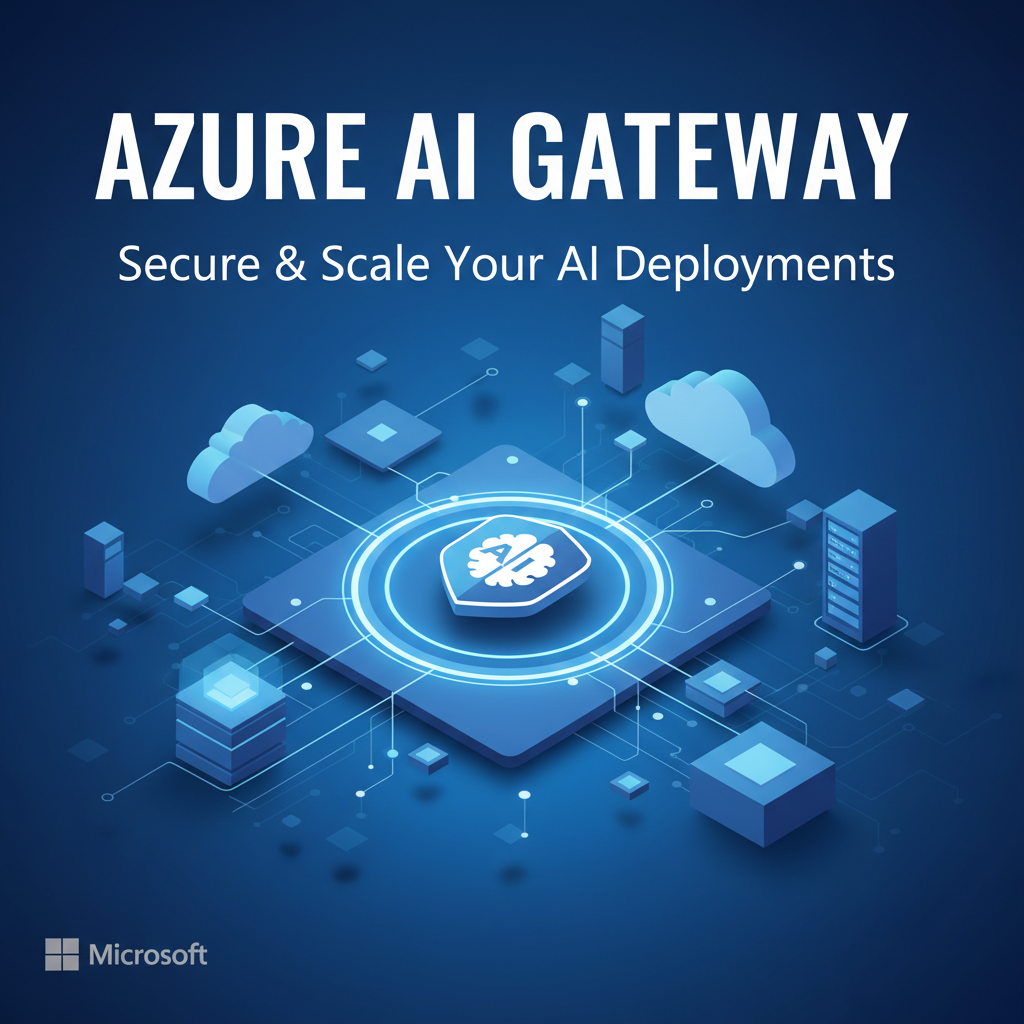


In the rapidly evolving landscape of artificial intelligence, organizations are increasingly embedding sophisticated AI models, particularly Large Language Models (LLMs), into their core business processes and customer-facing applications. This transformative shift, however, introduces a myriad of operational complexities that extend far beyond the mere development of these intelligent systems. From ensuring robust security and managing unprecedented scales of requests to optimizing performance and maintaining cost efficiency, the challenges of deploying AI in production are substantial. This is precisely where the concept of an AI Gateway becomes not just beneficial, but absolutely critical. It serves as the intelligent intermediary, the strategic control point that dictates how AI services are accessed, managed, and secured across an enterprise.
This comprehensive exploration delves into the pivotal role of an Azure AI Gateway in revolutionizing the way businesses approach their AI deployments. We will uncover how this specialized API Gateway extends traditional API management capabilities to meet the unique demands of AI, especially the dynamic and resource-intensive nature of LLM Gateway functions. By understanding its architecture, features, and the profound benefits it offers, organizations can unlock the full potential of their AI investments, driving innovation while maintaining an unwavering commitment to security, scalability, and operational excellence. Prepare to embark on a deep dive into how Azure's cutting-edge capabilities empower developers and enterprises to confidently build and operate the next generation of intelligent applications.
The AI Revolution and Its Inherent Deployment Complexities
The past decade has witnessed an unprecedented acceleration in artificial intelligence capabilities, moving from theoretical concepts to tangible, impactful solutions integrated into nearly every industry imaginable. Machine learning, deep learning, and most recently, generative AI models, particularly Large Language Models (LLMs), have become cornerstones of digital transformation. These advanced algorithms are reshaping how we interact with technology, automate mundane tasks, derive insights from vast datasets, and even create novel content. From intelligent customer service chatbots and sophisticated fraud detection systems to personalized recommendation engines and groundbreaking scientific research tools, AI is no longer a futuristic vision but a present-day reality driving immense value. Businesses are realizing significant gains in efficiency, productivity, and competitive advantage by leveraging AI to innovate product offerings, streamline operations, and deliver superior customer experiences.
However, the journey from a trained AI model in a lab to a robust, secure, and scalable AI service in production is fraught with significant challenges. Unlike traditional software services, AI deployments present unique hurdles that demand specialized solutions and architectural considerations. The very nature of AI models, especially large, complex ones, introduces distinct complexities across several critical dimensions:
1. Security and Data Governance: The data-intensive nature of AI models means that security is paramount. Protecting sensitive information that feeds into models, as well as the intellectual property embedded within the models themselves, is a continuous battle. Traditional security measures often fall short when dealing with dynamic inputs like user prompts or the potential for data leakage in model outputs. Concerns around data privacy (e.g., GDPR, CCPA, HIPAA compliance), model integrity (preventing model poisoning or adversarial attacks), and stringent access control become exponentially more complex. Organizations must ensure that only authorized users or applications can invoke AI services, that data is encrypted both at rest and in transit, and that robust auditing mechanisms are in place to track every interaction. The potential for malicious prompts to extract sensitive model knowledge or elicit harmful responses also requires advanced filtering and sanitization techniques.
2. Scalability and Performance at Peak Demand: AI models, especially LLMs, can be incredibly resource-intensive, demanding significant computational power for inference. As applications gain traction, the volume of requests can skyrocket unpredictably, necessitating an infrastructure that can scale elastically and instantaneously without degradation in performance. Spikes in demand during peak hours, promotional events, or viral trends can overwhelm static deployments, leading to slow response times, service unavailability, and a poor user experience. Achieving high throughput and low latency for AI services, particularly those requiring real-time interaction, requires sophisticated load balancing, efficient resource provisioning, and potentially global distribution strategies. The challenge is exacerbated by the diverse computational requirements of different models, some needing GPUs, others CPUs, each with varying memory footprints and processing speeds.
3. Observability, Monitoring, and Debugging: Understanding the behavior of AI models in production is notoriously difficult. Unlike deterministic software, AI models can exhibit emergent behaviors, biases, or unexpected outputs that are hard to trace back to specific inputs or internal states. Comprehensive observability is crucial, encompassing detailed logging of every request and response, real-time monitoring of model performance metrics (e.g., accuracy, latency, error rates), and tracing capabilities to follow the lifecycle of a request through multiple AI services or components. Without these insights, diagnosing issues, identifying performance bottlenecks, and maintaining model health becomes a formidable task. Furthermore, debugging issues in an AI pipeline often involves not just code but also data quality, prompt engineering, and model versioning.
4. Cost Management and Resource Optimization: Running powerful AI models, particularly those hosted on cloud infrastructure, can incur significant operational costs. Inference costs for LLMs, often billed per token, can escalate rapidly with increased usage. Optimizing resource utilization – ensuring that provisioned compute resources are neither over-provisioned (leading to wasted spend) nor under-provisioned (leading to performance bottlenecks) – is a delicate balancing act. Implementing intelligent caching strategies, efficient request routing, and fine-grained usage tracking are essential to keep costs under control while maintaining service quality. Without transparent cost attribution, departments or projects might unknowingly overspend on AI resources, impacting overall budget efficacy.
5. Integration Complexity and Vendor Lock-in: Modern AI applications often rely on a mosaic of models from various providers (e.g., Azure OpenAI, custom models, open-source models) or different Azure AI services (e.g., Cognitive Services, Azure Machine Learning). Integrating these disparate services, each with its own API contract, authentication mechanism, and data format, can lead to significant development overhead and technical debt. Developers are forced to write bespoke integration logic for each model, hindering agility and creating tightly coupled systems that are difficult to evolve. Furthermore, relying heavily on a single vendor's specific API can lead to vendor lock-in, making it challenging to switch models or providers in the future without extensive refactoring.
6. Version Control and Lifecycle Management: AI models are not static; they are continuously improved, retrained, and updated. Managing different versions of models, rolling out new versions seamlessly without disrupting live applications, and providing mechanisms for A/B testing or canary deployments are essential for continuous improvement. The ability to revert to previous versions quickly in case of issues is equally important. Without a structured approach to model lifecycle management, enterprises risk deploying unstable models, introducing breaking changes, or failing to capitalize on model enhancements effectively.
7. Governance and Compliance: Ensuring that AI deployments adhere to internal governance policies and external regulatory requirements is a complex undertaking. This includes establishing clear guidelines for model usage, data handling, ethical AI principles, and audit trails. Compliance with industry-specific regulations and international data protection laws requires a robust framework for managing access, ensuring transparency, and demonstrating accountability. The ethical implications of AI, such as fairness, transparency, and accountability, also necessitate careful governance beyond purely technical considerations.
These multifaceted challenges underscore the critical need for a centralized, intelligent control layer that can abstract away the underlying complexities of AI infrastructure, providing a unified, secure, and scalable interface for consuming AI services. This control layer is precisely what an AI Gateway is designed to provide, acting as the indispensable bridge between AI consumers and AI providers.
Understanding AI Gateways: The Critical Intermediary
At its core, an AI Gateway is a specialized type of API Gateway specifically engineered to address the unique requirements of managing, securing, and scaling artificial intelligence services. While traditional API Gateways primarily focus on HTTP/REST APIs, an AI Gateway extends these capabilities to encompass the intricacies of AI model invocation, from large language models (LLMs) and computer vision services to custom machine learning inferences. It acts as the single point of entry for all AI-related requests, abstracting the complexity of diverse backend AI services and providing a consistent, controlled, and optimized experience for consuming applications.
The evolution from a generic API Gateway to a dedicated AI Gateway has been driven by the distinct nature of AI workloads. Traditional API Gateways excel at routing, authentication, and rate limiting for conventional CRUD operations or microservices interactions. However, AI services, particularly those powered by LLMs, introduce new dimensions:
- Diverse Model Types and APIs: AI models come in various forms (e.g., text-to-text, image generation, speech recognition) and are often exposed through different APIs, some proprietary, some open-source, each with its own input/output formats and authentication schemes.
- Prompt Engineering and Context Management: For LLMs, the "prompt" is a critical input that significantly influences the output. Managing prompt templates, versioning them, and ensuring their security requires specialized handling. Context windows and conversation history also add complexity.
- Token-Based Billing: Many generative AI models are billed based on token usage (input and output), necessitating granular tracking and cost control mechanisms at the gateway level.
- Computational Intensity: AI inference can be computationally expensive, requiring efficient load balancing across GPU-accelerated instances and potentially caching of frequently requested results.
- Model-Specific Security Concerns: Beyond traditional API security, AI models introduce risks like prompt injection, data poisoning, and model extraction, requiring specific mitigation strategies.
- Dynamic Nature of AI: Models are frequently updated, retrained, or swapped out. The gateway needs to facilitate seamless versioning and A/B testing without disrupting consuming applications.
An AI Gateway is therefore an intelligent proxy that understands these nuances. It doesn't just forward requests; it actively participates in the AI interaction lifecycle, enhancing it with a suite of specialized functions.
Key Functions of an AI Gateway:
The functions of an AI Gateway are expansive and designed to address the challenges outlined earlier, offering a robust layer of control and optimization:
1. Request Routing and Intelligent Load Balancing: At its core, an AI Gateway intelligently directs incoming requests to the appropriate backend AI model or service. This isn't just round-robin; it involves sophisticated algorithms that consider factors like model availability, current load, instance health, geographic proximity, and even the specific capabilities of the model. For instance, a gateway might route a "summarization" request to one LLM instance and a "code generation" request to another, or distribute traffic across multiple instances of the same model to prevent overload, ensuring optimal resource utilization and minimizing latency. This intelligent routing is crucial for maintaining high availability and consistent performance under varying loads.
2. Robust Authentication and Authorization: Security is paramount. The AI Gateway enforces stringent access controls, verifying the identity of the calling application or user (authentication) and determining if they have the necessary permissions to invoke a specific AI service (authorization). This often integrates with enterprise identity providers like Azure Active Directory, enabling Role-Based Access Control (RBAC) to define granular permissions. This ensures that only authorized entities can interact with valuable AI assets, protecting intellectual property and sensitive data.
3. Rate Limiting and Throttling: To prevent abuse, manage costs, and ensure fair usage among multiple consumers, an AI Gateway implements rate limiting and throttling policies. These policies can be configured at various levels – per user, per application, per model, or even per API key – to restrict the number of requests or tokens that can be processed within a given timeframe. For LLMs, this often includes specific token-based rate limits, which are crucial for preventing unexpected cost overruns and ensuring service stability for all users.
4. Strategic Caching: For AI requests that yield consistent responses for identical inputs (e.g., certain classification tasks or stable summarizations for specific texts), caching can dramatically improve performance and reduce backend load and cost. The AI Gateway can store responses to frequently made requests, serving them directly from the cache without involving the underlying AI model. This not only speeds up response times but also significantly reduces the computational expense of repeatedly running expensive inferences.
5. Comprehensive Logging, Monitoring, and Auditing: An effective AI Gateway provides detailed observability into all AI interactions. It logs every incoming request, outgoing response, and any intermediate transformations or errors. This data feeds into monitoring systems, providing real-time metrics on usage, performance (latency, throughput), and error rates. These logs are invaluable for debugging, performance analysis, cost attribution, and satisfying auditing and compliance requirements, offering a clear trail of AI service consumption.
6. Request/Response Transformation and Orchestration: The gateway can act as a data transformer, modifying requests before they reach the backend AI model and shaping responses before they are sent back to the client. This is particularly useful for standardizing API formats across heterogeneous AI models, masking sensitive data within requests, or enriching responses with additional metadata. For complex scenarios, it can orchestrate multi-step AI workflows, chaining multiple model inferences together to achieve a more sophisticated outcome.
7. Advanced Security Policies and Data Protection: Beyond basic authentication, an AI Gateway can enforce advanced security policies such as data masking (redacting sensitive information from prompts or responses), input validation to prevent malicious injections (e.g., prompt injection attacks), and output sanitization to filter out harmful or inappropriate content generated by LLMs. It can integrate with threat intelligence services to block known malicious sources and apply robust encryption for data in transit and at rest.
8. Granular Cost Management and Reporting: With AI models often incurring costs based on usage (e.g., tokens, transactions), the gateway provides the ideal vantage point for tracking and reporting on these expenses. It can attribute costs to specific applications, users, or departments, offering clear insights into AI consumption patterns and enabling proactive cost optimization strategies. This level of granularity is essential for budget management and chargeback models.
9. Prompt Management and Standardization (LLM Gateway Specific): For LLMs, the LLM Gateway aspect of an AI Gateway is particularly potent. It allows for the centralized management, versioning, and deployment of prompt templates. Instead of client applications directly sending raw prompts, they might send a simple identifier for a specific prompt template, which the gateway then injects with dynamic variables before sending it to the LLM. This standardizes interactions, simplifies prompt engineering, and allows for rapid iteration on prompt strategies without code changes in consuming applications. It also provides a layer of protection against direct prompt injection attacks by controlling the template.
10. Model Versioning and A/B Testing: The AI Gateway facilitates seamless deployment of new model versions. It can route a percentage of traffic to a new version (canary release) or evenly distribute traffic between two versions for A/B testing, allowing for real-world performance evaluation before a full rollout. This capability is vital for continuous improvement and mitigating risks associated with model updates.
In essence, an AI Gateway elevates the management of AI services from an ad-hoc integration challenge to a systematically governed and optimized process. It provides the crucial layer of abstraction, control, and intelligence needed to deploy AI securely, scalably, and cost-effectively in any enterprise environment.
Azure's Comprehensive Ecosystem for AI Deployments
Microsoft Azure stands as a leading cloud platform, offering an expansive and deeply integrated ecosystem specifically designed to support the entire lifecycle of artificial intelligence. From data ingestion and preparation to model training, deployment, and management, Azure provides a rich suite of services that cater to every stage of AI development. This holistic approach ensures that organizations have access to powerful tools, scalable infrastructure, and cutting-edge models, all within a secure and compliant environment.
At the heart of Azure's AI capabilities are several key pillars:
1. Azure OpenAI Service: This groundbreaking service provides developers with access to OpenAI's powerful language models, including GPT-3, GPT-4, DALL-E 2, and the Codex series, directly within the Azure environment. It combines the advanced capabilities of these models with the enterprise-grade security, compliance, and scalability of Azure. Organizations can deploy these models as private endpoints within their own virtual networks, ensuring data privacy and control. Azure OpenAI Service is a cornerstone for building generative AI applications, enabling use cases like content creation, summarization, code generation, and intelligent chatbots.
2. Azure Machine Learning (Azure ML): Azure ML is a comprehensive platform for building, training, deploying, and managing machine learning models. It supports the full MLOps lifecycle, providing tools for data scientists and ML engineers to experiment with various algorithms, track experiments, manage datasets, and deploy models as scalable web services. It offers capabilities for automated machine learning (AutoML), responsible AI, and integrates seamlessly with other Azure services for data storage, compute, and analytics.
3. Azure Cognitive Services: A collection of AI services that enable developers to build intelligent applications without requiring deep AI expertise. These pre-built, domain-specific AI models cover a wide range of capabilities: * Vision: Object detection, facial recognition, image analysis, optical character recognition (OCR). * Speech: Speech-to-text, text-to-speech, speaker recognition. * Language: Text analysis (sentiment, key phrase extraction, entity recognition), language understanding, translation. * Decision: Anomaly detection, content moderation, personalization. These services are readily available via REST APIs and SDKs, making it easy to embed advanced AI functionalities into applications with minimal effort.
4. Azure AI Search (formerly Azure Cognitive Search): An AI-powered search-as-a-service solution that enhances traditional keyword search with cognitive capabilities. It allows organizations to build rich search experiences over diverse content, applying AI skills (from Cognitive Services or custom models) to extract insights, enrich data, and create intelligent indexes. This is crucial for RAG (Retrieval-Augmented Generation) patterns where LLMs need to access specific, up-to-date knowledge bases.
5. Azure Databricks: A fast, easy, and collaborative Apache Spark-based analytics platform optimized for Azure. It provides a unified platform for data engineering, machine learning, and data science, making it ideal for large-scale data processing and machine learning workflows, especially for preparing data for AI model training and deployment.
6. Azure Kubernetes Service (AKS): For deploying custom AI models or complex AI microservices, AKS offers a managed Kubernetes service that simplifies the deployment, scaling, and management of containerized applications. It provides the necessary compute infrastructure to host high-performance AI inference endpoints.
7. Data & Analytics Services: A broad array of services including Azure Data Lake Storage, Azure Synapse Analytics, Azure Cosmos DB, and Azure SQL Database provide scalable and secure storage and processing capabilities for the vast amounts of data that fuel AI models.
The Need for a Unified Control Plane:
While Azure's extensive suite of AI services provides unparalleled power and flexibility, their very diversity can introduce operational fragmentation. An enterprise might be using Azure OpenAI for generative text, Cognitive Services for image analysis, and custom models deployed via Azure ML or AKS. Each of these services might have its own API endpoint, authentication mechanism, rate limiting policies, and monitoring interfaces.
Without a unified control plane, developers and operations teams face several challenges: * Inconsistent Security: Applying uniform security policies (e.g., specific IP whitelists, token validation rules) across disparate AI endpoints becomes a manual and error-prone process. * Fragmented Observability: Gaining a holistic view of AI usage, performance, and costs across different services requires aggregating data from multiple monitoring tools. * Complex Integration: Client applications must be aware of each specific AI service's API contract, increasing development complexity and coupling. * Inefficient Resource Management: Optimizing resource allocation and managing costs across various services becomes difficult without a centralized point of control. * Lack of Governance: Enforcing consistent governance policies for AI usage, data handling, and compliance across a distributed landscape is challenging.
This is precisely the gap that an Azure AI Gateway fills. It acts as the intelligent orchestration layer that sits atop this diverse ecosystem, consolidating access, enforcing policies, and providing a unified operational view. By doing so, it transforms a collection of powerful but disparate AI services into a coherent, manageable, and highly governable AI platform.
Azure AI Gateway: A Deep Dive into Features and Benefits
The Azure AI Gateway represents a significant advancement in managing and securing AI deployments within the Azure cloud. It extends the robust capabilities of an API Gateway to specifically cater to the unique requirements of artificial intelligence, particularly those involving advanced models like Large Language Models (LLMs). By acting as a central control point, it abstracts away much of the underlying complexity, offering a unified, secure, scalable, and cost-effective interface for consuming diverse AI services. Let's delve into its features and the profound benefits they deliver.
1. Security Enhancements: Fortifying Your AI Perimeter
Security is arguably the most critical concern when deploying AI, especially with sensitive data and intellectual property involved. An Azure AI Gateway provides a multi-layered security posture that extends far beyond basic API key management, ensuring the integrity, confidentiality, and availability of your AI services.
- Azure Active Directory (AAD) Integration: Deep integration with Azure Active Directory (now Microsoft Entra ID) means you can leverage your existing enterprise identity management system for authenticating users and applications accessing AI services. This eliminates the need for separate credential management and ensures a consistent security experience across your Azure estate. It supports modern authentication protocols like OAuth 2.0 and OpenID Connect.
- Role-Based Access Control (RBAC): Granular control over who can access what AI service, and with what permissions, is achieved through RBAC. You can define specific roles (e.g., "AI Consumer," "AI Administrator," "Data Scientist") and assign them permissions to invoke particular models, access specific endpoints, or even perform administrative tasks on the gateway itself. This principle of least privilege ensures that users and applications only have the access necessary for their function, significantly reducing the attack surface.
- Network Isolation with Virtual Network (VNet) Integration and Private Link: For maximum security and compliance, AI services can be deployed within your private Azure Virtual Networks (VNets). The AI Gateway can then be configured to access these services via Private Link, establishing a secure, private connection over the Microsoft backbone network. This eliminates exposure to the public internet for your AI endpoints, preventing data exfiltration and unauthorized access, which is crucial for sensitive workloads.
- Threat Protection with Azure Firewall and DDoS Protection: The gateway can integrate seamlessly with Azure's network security services. Azure Firewall provides a managed network security service that protects your Azure Virtual Network resources, allowing you to centrally create, enforce, and log application and network connectivity policies across subscriptions and VNets. Azure DDoS Protection shields your AI services from large-scale distributed denial-of-service attacks, ensuring business continuity even under malicious pressure.
- Data Encryption at Rest and in Transit: All data handled by the Azure AI Gateway, whether cached responses or configuration data, is encrypted at rest using Azure Storage encryption. Data transmitted between clients, the gateway, and backend AI services is secured using industry-standard TLS/SSL protocols, ensuring end-to-end encryption and protecting against eavesdropping or tampering.
- Compliance Certifications: Leveraging Azure's global compliance portfolio, AI Gateway deployments can inherit certifications such as HIPAA, GDPR, FedRAMP, PCI DSS, and ISO 27001. This is vital for organizations operating in regulated industries, providing assurance that their AI deployments meet stringent security and privacy standards.
- API Security Best Practices Enforcement: The gateway can enforce various API security best practices, such as validating input schemas, sanitizing user-provided data to prevent injection attacks (like prompt injection in LLMs), and filtering potentially harmful outputs generated by AI models. This proactive filtering layer acts as a crucial defense against both accidental and malicious misuse of AI.
2. Scalability and Performance: Meeting Demands with Agility
AI workloads, especially LLMs, can be highly unpredictable in their demand patterns. An Azure AI Gateway is engineered for extreme scalability and optimal performance, ensuring your AI applications remain responsive and available even under peak loads.
- Elastic Scaling of Underlying AI Resources: The gateway itself is designed to scale horizontally to handle increased API traffic. More importantly, it can dynamically trigger the scaling of backend AI services (e.g., Azure OpenAI deployments, Azure ML inference endpoints) based on demand. This elastic nature ensures that resources are provisioned precisely when needed, preventing performance bottlenecks during traffic surges and optimizing cost during periods of low activity.
- Global Distribution and Low Latency with Azure Front Door/Traffic Manager Integration: For globally distributed applications, the Azure AI Gateway can be integrated with Azure Front Door or Azure Traffic Manager. Azure Front Door provides global load balancing and site acceleration for web applications, routing requests to the closest, fastest backend instance of your AI Gateway, thereby minimizing latency for end-users worldwide. Traffic Manager offers DNS-based traffic distribution, directing users to the optimal AI service endpoint based on various routing methods. This multi-region deployment capability ensures high availability and disaster recovery.
- Intelligent Caching Mechanisms: The gateway supports configurable caching policies. For idempotent AI requests (e.g., asking for a summary of a static document), the gateway can cache the response and serve subsequent identical requests directly from memory, dramatically reducing latency, decreasing load on backend AI models, and consequently lowering inference costs. Cache invalidation strategies ensure data freshness.
- Load Balancing Across Multiple Model Instances: Beyond simply routing, the AI Gateway can distribute requests across multiple instances of the same AI model or even across different providers. This is crucial for handling high throughput and for ensuring resilience. If one model instance becomes unavailable or overloaded, the gateway automatically reroutes traffic to healthy instances, maintaining service continuity.
- Geographic Redundancy and Failover: By deploying AI Gateways across multiple Azure regions, organizations can achieve high availability and disaster recovery. In the event of a regional outage, traffic can be seamlessly failed over to a healthy gateway instance in another region, ensuring uninterrupted access to critical AI services.
3. Management and Observability: Gaining Control and Insights
Managing a growing portfolio of AI services requires robust tools for configuration, monitoring, and analysis. The Azure AI Gateway provides a unified control plane that simplifies operational tasks and offers deep insights into AI usage.
- Unified Control Plane for Diverse AI Services: Instead of managing individual API endpoints for Azure OpenAI, Cognitive Services, and custom ML models separately, the gateway provides a single interface. This streamlines configuration, policy application, and monitoring across all your AI assets, reducing operational overhead and complexity.
- Comprehensive Logging with Azure Monitor and Application Insights: Every interaction passing through the AI Gateway is meticulously logged. These logs are seamlessly integrated with Azure Monitor and Application Insights, providing rich telemetry data. You can track request details, response times, error codes, and even payload sizes. This detailed logging is indispensable for auditing, compliance, and post-incident analysis.
- Real-time Metrics and Configurable Alerts: Azure Monitor collects a wide array of metrics from the AI Gateway, including request rates, latency, error percentages, and resource utilization. These metrics can be visualized in dashboards, allowing operations teams to monitor the health and performance of their AI services in real-time. Configurable alerts can notify administrators proactively via email, SMS, or integration with incident management systems when critical thresholds are breached (e.g., high error rates, increased latency).
- Distributed Tracing for Request Flow: For complex AI applications that involve multiple chained services or external calls, distributed tracing capabilities allow developers to follow a single request's journey across various components. This helps pinpoint performance bottlenecks or identify failure points within a multi-stage AI pipeline, greatly simplifying troubleshooting.
- API Analytics and Reporting: The gateway provides out-of-the-box analytics and reporting features. These can include dashboards showing top consumers, most used AI models, peak usage times, and overall traffic patterns. These insights are invaluable for capacity planning, understanding user behavior, and demonstrating the value of AI investments to business stakeholders.
- Centralized Configuration Management: All policies, rate limits, routing rules, and security configurations are managed centrally through the gateway. This ensures consistency, simplifies updates, and reduces the risk of misconfigurations across disparate AI endpoints.
4. Cost Optimization: Smart Spending on AI
The computational intensity of AI models, particularly LLMs, can lead to significant infrastructure and inference costs. An Azure AI Gateway offers intelligent mechanisms to optimize spend without compromising performance or accessibility.
- Granular Usage Tracking per Consumer/Model: The gateway provides the most accurate point for tracking API calls and token usage for AI models. It can attribute these costs to specific applications, departments, or even individual users, enabling transparent chargeback models and detailed cost analysis. This allows organizations to understand exactly where their AI budget is being spent.
- Tiered Access and Rate Limits to Control Spend: By implementing tiered access (e.g., basic, premium) and setting differentiated rate limits or quotas for various consumers, the gateway allows organizations to manage and control AI consumption proactively. This prevents unexpected cost spikes from a single high-usage application or malicious activity.
- Caching to Reduce Redundant Calls: As discussed, caching frequently requested AI inference results directly reduces the number of calls to the expensive backend AI models. This translates directly into cost savings, as you're not paying for repeated computations.
- Efficient Resource Utilization: By intelligently load balancing and dynamically scaling backend AI resources based on real-time demand, the gateway helps ensure that compute resources are neither over-provisioned (wasting money) nor under-provisioned (leading to performance issues). This optimizes the efficiency of your AI infrastructure spend.
5. Integration and Flexibility: Bridging AI Ecosystems
Modern enterprises rely on a mix of off-the-shelf AI services and custom-built models. The Azure AI Gateway provides the flexibility to integrate seamlessly with various AI sources and adapt to evolving needs.
- Seamless Integration with Azure OpenAI, Azure ML, and Cognitive Services: The gateway is designed to natively integrate with Azure's flagship AI offerings. This means you can easily expose and manage APIs for models deployed in Azure OpenAI, custom models managed by Azure Machine Learning, and pre-built Cognitive Services, all through a single, consistent interface.
- Support for Custom Models and External Endpoints: Beyond Azure's native services, the AI Gateway can also front-end custom AI models deployed on virtual machines, Azure Kubernetes Service (AKS), or even external, third-party AI endpoints. This provides immense flexibility, allowing organizations to manage their entire AI landscape from one central point.
- API Standardization and Transformation Capabilities: The gateway can abstract away the idiosyncratic API contracts of different AI models. It can transform incoming requests into a unified format expected by the backend models and then transform the diverse responses back into a standardized format for client applications. This significantly simplifies client-side integration and promotes a consistent developer experience.
- Developer Portal for Easy Consumption: Many API Gateways, including the principles applied to an Azure AI Gateway, offer a developer portal. This portal serves as a self-service platform where developers can discover available AI APIs, view documentation, test endpoints, subscribe to services, and manage their API keys. This fosters adoption and accelerates the integration of AI into new applications.
6. Specific LLM Gateway Aspects within Azure AI Gateway: Empowering Generative AI
The advent of Large Language Models has introduced new requirements that an LLM Gateway specifically addresses, which are either native to Azure AI Gateway capabilities or can be engineered atop it.
- Prompt Management and Versioning: The gateway can host and manage a library of standardized prompt templates. Instead of applications sending raw, complex prompts, they can send a simple identifier and variables, and the gateway will dynamically construct the full prompt before forwarding it to the LLM. This allows for centralized prompt optimization, A/B testing of prompts, and version control, ensuring consistency and preventing prompt injection vulnerabilities.
- Response Parsing and Standardization: LLMs can generate diverse outputs. The gateway can parse these responses, extract relevant information, and format them consistently before sending them to the client application. This simplifies downstream processing and integration.
- Fallbacks and Retries for LLM Calls: LLM inference can sometimes be unreliable due to transient errors or rate limits. An LLM Gateway can implement automatic retry mechanisms with exponential backoff and, in some cases, fall back to alternative, less expensive, or less performant LLMs if the primary one is unavailable, ensuring higher reliability for generative AI applications.
- Safety Filters for LLM Outputs: Beyond basic content moderation, an LLM Gateway can apply additional layers of safety filtering to the generated text from LLMs, using services like Azure Content Moderator or custom logic. This helps prevent the propagation of harmful, biased, or inappropriate content, ensuring responsible AI deployment.
- Cost Tracking per Token/Model: Given that LLMs are often billed per token, the gateway provides the most accurate point for collecting and aggregating token usage data, offering precise cost insights and enabling granular cost control specifically for generative AI workloads.
By bringing together these sophisticated features, the Azure AI Gateway transforms the complex endeavor of deploying and managing AI into a streamlined, secure, and highly efficient process. It empowers organizations to confidently leverage the full power of artificial intelligence, knowing that their models are protected, performant, and perfectly scaled for demand.
APIPark is a high-performance AI gateway that allows you to securely access the most comprehensive LLM APIs globally on the APIPark platform, including OpenAI, Anthropic, Mistral, Llama2, Google Gemini, and more.Try APIPark now! 👇👇👇
Use Cases and Scenarios for Azure AI Gateway
The versatility and robustness of an Azure AI Gateway make it an indispensable component across a wide array of enterprise scenarios. It facilitates secure, scalable, and manageable access to AI, transforming how organizations integrate intelligence into their operations and products. Here are some compelling use cases:
1. Enterprise Applications Integrating Generative AI: Modern enterprise applications, such as CRM systems, ERP platforms, or internal knowledge bases, are increasingly embedding generative AI capabilities (e.g., automated report generation, personalized customer responses, internal documentation summarization). An Azure AI Gateway acts as the secure conduit for these applications to access powerful LLMs (like those in Azure OpenAI Service). * Scenario: A large financial institution wants to integrate an LLM to assist its analysts in summarizing complex financial reports and drafting preliminary market analysis. * Gateway Role: The gateway secures access to the Azure OpenAI service, ensures only authorized internal applications can send prompts, enforces rate limits to manage token consumption and costs, and applies content moderation filters to ensure all generated text adheres to compliance standards before reaching the analysts. It standardizes the prompt interface, allowing analysts to use simple inputs while the gateway constructs complex, versioned prompts for the LLM.
2. Building Multi-Tenant AI Services and Platforms: Software as a Service (SaaS) providers often build platforms that offer AI capabilities to multiple distinct customers (tenants). Managing resources, security, and usage for each tenant can be incredibly complex. * Scenario: A SaaS platform provides an AI-powered content generation tool for marketing agencies. Each agency is a separate tenant with its own subscription, usage quotas, and data privacy requirements. * Gateway Role: The Azure AI Gateway enables multi-tenancy by enforcing tenant-specific authentication and authorization. It can apply distinct rate limits and quotas for each tenant, ensuring fair usage and preventing one tenant from consuming all resources. Detailed logging allows for accurate chargeback to each agency based on their actual AI consumption, providing transparent billing and resource management.
3. Securing Sensitive Data Flows to AI Models: Many AI applications deal with highly sensitive personal identifiable information (PII), protected health information (PHI), or confidential business data. Sending this data directly to AI models, especially external ones, poses significant privacy and compliance risks. * Scenario: A healthcare provider uses an AI model to analyze patient medical notes for diagnostic assistance, where patient data is highly sensitive. * Gateway Role: Before forwarding patient notes to the AI model, the Azure AI Gateway can perform real-time data masking or de-identification. It uses built-in or custom policies to identify and redact PII/PHI, ensuring that the core AI model only receives anonymized data. This protects patient privacy, maintains compliance with regulations like HIPAA, and significantly reduces the risk of data leakage.
4. Managing AI Services Across Different Departments: In large organizations, different departments (e.g., HR, Legal, Marketing) may want to leverage AI, potentially using different models or consuming services from different providers. A centralized gateway ensures consistent governance. * Scenario: A global corporation has marketing teams using an LLM for copywriting, HR using a conversational AI for employee queries, and legal teams using AI for document review. * Gateway Role: The Azure AI Gateway provides a unified catalog of all available AI services. It enforces department-specific access policies and cost centers. HR's application might be authorized for a specific conversational AI model, while marketing's application has access to a generative text model. The gateway ensures that each department's AI usage is tracked separately for budgeting and audit purposes, streamlining IT governance.
5. A/B Testing and Canary Deployments of AI Models: Continual improvement of AI models is essential, but deploying new versions carries risks. A/B testing and canary deployments allow for gradual rollout and performance validation. * Scenario: A product team has developed an improved version of its customer sentiment analysis model and wants to test its performance against the existing model with a small segment of live traffic before a full rollout. * Gateway Role: The Azure AI Gateway can be configured to split incoming traffic intelligently. For example, 90% of requests go to the old sentiment model, and 10% go to the new model. The gateway logs detailed metrics for both versions, allowing the team to compare performance (e.g., accuracy, latency) in real-world conditions without impacting the majority of users. If the new model performs better, the gateway can gradually shift more traffic until it handles 100%.
6. Building Intelligent Virtual Assistants and Chatbots: Sophisticated chatbots and virtual assistants often rely on a combination of natural language understanding (NLU), knowledge retrieval, and generative AI. Orchestrating these components securely is vital. * Scenario: A bank is building an intelligent virtual assistant for its customers that can answer complex financial queries, process transactions, and even generate personalized financial advice. * Gateway Role: The gateway acts as the central brain. It receives user queries, routes them to an NLU service (e.g., Azure Language Understanding) for intent recognition, potentially queries an internal knowledge base via Azure AI Search, and then uses an LLM (via Azure OpenAI) to synthesize a coherent response. The gateway manages the flow, caches common responses, and ensures that sensitive transaction requests are routed to secure, authenticated backend systems.
7. Real-time Analytics and Anomaly Detection: AI models are crucial for processing high-velocity data streams to detect anomalies, perform real-time analytics, or trigger automated actions. * Scenario: An IoT platform is ingesting sensor data from thousands of devices and needs to detect equipment malfunctions in real-time using an anomaly detection AI model. * Gateway Role: The Azure AI Gateway can receive high volumes of sensor data, apply initial filtering or aggregation, and then feed it to the anomaly detection model (e.g., deployed in Azure ML). The gateway ensures low-latency processing, scales dynamically to handle bursts of data, and logs all invocations and detections for auditing and further analysis. It can also route detected anomalies to alerting systems or automated remediation workflows.
8. Prompt Encapsulation for Simplified AI Integration: For developers, directly interacting with LLMs and managing complex prompt structures can be cumbersome and error-prone. * Scenario: A development team wants to enable various internal applications to perform "customer feedback sentiment analysis" without each application needing to understand the underlying LLM's prompt structure or API. * Gateway Role: The Azure AI Gateway (or an LLM Gateway component) can encapsulate a specific LLM and a carefully engineered prompt template for sentiment analysis into a simple, high-level API endpoint, e.g., /analyze-sentiment. An application merely sends the customer feedback text to this endpoint. The gateway then injects this text into the predefined prompt template, sends it to the LLM, and returns the extracted sentiment, simplifying integration and ensuring consistent prompt quality across all consuming applications. This capability is strongly featured in open-source solutions like APIPark, which offers "Prompt Encapsulation into REST API" as a core feature. This illustrates a common and highly valuable use case for any robust AI Gateway solution.
These examples highlight how an Azure AI Gateway acts as a foundational layer, abstracting complexity and providing the necessary controls to responsibly and effectively integrate AI across the enterprise, fostering innovation while maintaining operational excellence.
Implementing Azure AI Gateway: Best Practices
Successful implementation of an Azure AI Gateway transcends mere technical configuration; it requires a strategic approach that prioritizes security, scalability, performance, and maintainability from the outset. Adhering to best practices ensures that your AI Gateway not only functions effectively today but also remains robust and adaptable for future AI advancements.
1. Design for High Availability and Disaster Recovery: Your AI Gateway is a critical single point of entry for AI services. Its unavailability can cripple AI-dependent applications. * Best Practice: Deploy the AI Gateway across multiple Azure availability zones or, for global reach and resilience, across multiple Azure regions. Leverage Azure Front Door or Azure Traffic Manager for global load balancing and intelligent routing to healthy instances. Design your backend AI services with redundancy and ensure the gateway can fail over gracefully if a backend service or an entire region becomes unresponsive. Regularly test your failover procedures.
2. Implement Robust Authentication and Authorization: Access control is the bedrock of AI security. Assume all API access attempts are malicious until proven otherwise. * Best Practice: Mandate strong authentication for all consumers of your AI Gateway. Integrate with Azure Active Directory (Microsoft Entra ID) and enforce OAuth 2.0 or other modern identity protocols. Implement Role-Based Access Control (RBAC) to define granular permissions, ensuring that applications and users only have the minimum necessary access to specific AI models or endpoints. Avoid sharing generic API keys; instead, use managed identities for Azure resources or service principals for applications.
3. Define Clear Rate Limits and Quotas: Uncontrolled consumption can lead to spiraling costs, resource exhaustion, and potential denial-of-service for other consumers. * Best Practice: Establish comprehensive rate limiting and throttling policies at multiple levels: per consumer, per application, per API key, and crucially, per AI model (especially for LLMs with token-based billing). Start with conservative limits and adjust based on actual usage patterns and cost budgets. Implement soft quotas with alerts to warn consumers before hard limits are hit, allowing them to adjust their usage or request increases.
4. Monitor Relentlessly and Proactively: Blind spots in your AI pipeline can quickly lead to degraded performance, undetected errors, or security breaches. * Best Practice: Leverage Azure Monitor, Application Insights, and Azure Log Analytics to collect extensive telemetry from your AI Gateway and its backend services. Monitor key metrics such as request latency, throughput, error rates, cache hit ratios, and resource utilization (CPU, memory). Configure proactive alerts for anomalies or deviations from baseline performance. Implement custom dashboards to provide real-time operational visibility and enable swift incident response.
5. Implement Caching Strategically: Caching can significantly improve performance and reduce costs, but improper caching can lead to stale data. * Best Practice: Identify AI endpoints that return consistent results for identical inputs and are frequently invoked. Implement caching for these endpoints, defining clear cache invalidation policies (e.g., time-based expiration, event-driven invalidation) to ensure data freshness. Carefully consider the trade-off between performance gain and potential staleness for each specific AI service.
6. Plan for Disaster Recovery and Business Continuity: Unexpected outages can severely impact business operations. * Best Practice: Beyond high availability, develop a comprehensive disaster recovery plan for your AI Gateway and its dependencies. This includes backup and restore procedures for configuration, data, and keys. Regularly test your DR plan to ensure its effectiveness. Consider an active-active or active-passive deployment across geographically separate Azure regions to minimize recovery time objectives (RTO) and recovery point objectives (RPO).
7. Regularly Review and Update Security Configurations: The threat landscape is constantly evolving, as are your AI models and data. * Best Practice: Conduct periodic security audits of your AI Gateway configurations, including access policies, network rules, and content filters. Stay informed about the latest security vulnerabilities and best practices for AI models. Ensure all components of your AI Gateway (and underlying Azure services) are patched and up-to-date. Implement strong secrets management for API keys and credentials, using Azure Key Vault.
8. Leverage Azure Policy for Governance and Compliance: Maintaining consistency and compliance across a large-scale deployment can be challenging. * Best Practice: Utilize Azure Policy to enforce organizational standards and assess compliance at scale. Define policies that ensure AI Gateway deployments adhere to specific configurations (e.g., requiring Private Link, enforcing specific TLS versions, mandating logging to a central Log Analytics workspace). This automates governance and prevents deviations from established best practices.
9. Implement Versioning for AI APIs and Prompts: AI models and the ways they are invoked (especially LLM prompts) are not static. * Best Practice: Implement clear API versioning strategies for your AI Gateway endpoints (e.g., /v1/sentiment, /v2/sentiment). This allows you to introduce breaking changes without impacting existing consumers. For LLMs, version control your prompt templates within the gateway, allowing for experimentation and updates without requiring client application redeployments. Enable graceful deprecation strategies for older versions.
10. Automate Deployment and Configuration (Infrastructure as Code): Manual configurations are prone to errors and don't scale. * Best Practice: Treat your AI Gateway infrastructure and configurations as code. Use tools like Azure Resource Manager (ARM) templates, Bicep, Terraform, or Azure DevOps pipelines to automate the deployment, configuration, and updates of your gateway. This ensures consistency, reproducibility, and simplifies management of your AI infrastructure.
By meticulously applying these best practices, organizations can build an Azure AI Gateway that not only secures and scales their current AI deployments but also provides a resilient, manageable, and future-proof foundation for continuous AI innovation.
Comparing Azure AI Gateway with Other Solutions / The Broader Ecosystem
While Azure offers a comprehensive and robust ecosystem for AI deployment, the landscape of AI Gateway and API Management solutions is diverse. Organizations often explore various options, from cloud-native services to open-source platforms and self-hosted solutions, each with its unique strengths and trade-offs. Understanding this broader ecosystem helps in making informed architectural decisions.
1. Azure's Native API Management vs. AI Gateway Focus: Azure API Management (APIM) is Azure's flagship service for managing traditional REST APIs. It provides robust features for authentication, authorization, rate limiting, caching, and developer portals. An Azure AI Gateway, while potentially built upon or leveraging APIM principles, is often more specialized. * Azure APIM Strengths: Highly mature, enterprise-grade, broad API protocol support, integrates deeply with Azure AD, VNet, and monitoring services. * AI Gateway Specific Enhancements (in Azure context): Focus on LLM-specific features like token-based rate limiting, prompt management, model versioning for AI, content moderation specific to generative AI outputs, and deeper integration with Azure OpenAI Service or Azure Machine Learning inference endpoints. While APIM can be configured to act as an AI Gateway, a dedicated "Azure AI Gateway" offering often pre-packages these AI-centric features for easier deployment and management.
2. Open-Source AI Gateways and Self-Hosted Solutions: Many organizations, particularly those with strong DevOps cultures or specific compliance requirements, may opt for open-source AI Gateways or self-hosted API management solutions. These offer maximum control and customization but come with increased operational overhead. * Examples: Solutions built on Nginx or Envoy proxy, custom-developed gateways, or specialized open-source AI gateway platforms. * Strengths: Full control over the environment, highly customizable, can be cheaper for specific use cases (no cloud service fees), avoids vendor lock-in, can be deployed in hybrid or multi-cloud scenarios. * Weaknesses: Significant operational burden (deployment, patching, scaling, monitoring), requires in-house expertise, slower feature velocity compared to managed cloud services, may not offer out-of-the-box integrations with specific cloud AI services.
3. Other Cloud Providers' Offerings: AWS, Google Cloud, and other major cloud providers also offer their own API Gateway services and AI platforms. * AWS: API Gateway, Amazon SageMaker Endpoints, Amazon Bedrock (for foundation models). Customers can build an AI Gateway using AWS API Gateway combined with Lambda functions and other services. * Google Cloud: Apigee (enterprise API management), Cloud AI Platform, Vertex AI. Similar to Azure, a dedicated AI Gateway would often combine these services. * Key Differentiator: The choice often depends on existing cloud investments, specific AI models preferred, and ecosystem lock-in preferences. Azure's strength lies in its deep integration with Microsoft's enterprise solutions and its strong focus on enterprise-grade security and compliance.
Introducing APIPark: An Open-Source AI Gateway & API Management Platform
Within this diverse ecosystem, specialized solutions emerge to cater to specific needs. For instance, while Azure offers a robust ecosystem, organizations often seek additional flexibility or specialized features, sometimes opting for open-source solutions or platforms that offer a more unified approach to all API management, including AI. This is where APIPark stands out as a compelling open-source AI gateway and API management platform.
APIPark provides a holistic solution for managing both traditional REST APIs and a wide array of AI services. It positions itself as an all-in-one platform, available under the Apache 2.0 license, making it an attractive option for developers and enterprises who value control, transparency, and a unified management experience.
Let's look at how APIPark's key features align with and exemplify the capabilities discussed for a robust AI Gateway:
- Quick Integration of 100+ AI Models: Just as an Azure AI Gateway aims to unify access to Azure OpenAI, Cognitive Services, and custom models, APIPark provides a similar capability. Its strength lies in offering a unified management system for a vast array of AI models, simplifying authentication and cost tracking across diverse providers. This highlights the crucial
AI Gatewayfunction of abstracting model diversity. - Unified API Format for AI Invocation: This is a direct answer to the "integration complexity" challenge. APIPark standardizes the request data format across all AI models, ensuring that changes in underlying AI models or prompts do not ripple through consuming applications. This capability is paramount for any
AI Gatewayaspiring to simplify AI usage and reduce maintenance costs, enabling greater agility and resilience. - Prompt Encapsulation into REST API: This feature directly embodies a key
LLM Gatewayfunction. APIPark allows users to quickly combine AI models with custom prompts to create new, specialized APIs (e.g., sentiment analysis, translation). This means developers don't interact directly with complex LLM APIs; instead, they call a simple, purpose-built REST endpoint, abstracting the complexities of prompt engineering and model interaction. This greatly enhances developer experience and standardizes prompt usage. - End-to-End API Lifecycle Management: Beyond just AI, APIPark offers comprehensive API lifecycle management, covering design, publication, invocation, and decommission. This reflects the broader
API Gatewayrole, extending robust management processes, traffic forwarding, load balancing, and versioning to all APIs, including AI services. - Performance Rivaling Nginx: Performance is critical for any gateway. APIPark's claim of achieving over 20,000 TPS with modest resources (8-core CPU, 8GB memory) and supporting cluster deployment addresses the "scalability and performance" challenge head-on. This demonstrates the capacity required for a high-volume
AI Gatewayhandling large-scale traffic. - Detailed API Call Logging and Powerful Data Analysis: Similar to Azure Monitor and Application Insights, APIPark provides comprehensive logging for every API call, essential for tracing, troubleshooting, and ensuring system stability. Its data analysis capabilities display long-term trends and performance changes, enabling proactive maintenance – a vital aspect of
AI Gatewayobservability. - API Service Sharing within Teams & Independent API and Access Permissions for Each Tenant: These features underline APIPark's strength in enterprise-level API governance. Centralized display of services facilitates discovery, while multi-tenancy support with independent applications, data, and security policies allows for secure and efficient resource sharing within large organizations, much like what is required for managing AI services across different departments or for multi-tenant SaaS platforms.
- API Resource Access Requires Approval: This reflects strong security governance, ensuring that callers must subscribe and await administrator approval before invoking an API, preventing unauthorized access and potential data breaches – a critical security aspect for any
AI Gateway.
APIPark's deployment model is also worth noting: a single command-line quick start (curl -sSO https://download.apipark.com/install/quick-start.sh; bash quick-start.sh) suggests ease of getting started, which is attractive for rapid prototyping or teams looking for quick local setup.
In summary, while Azure AI Gateway provides an integrated, managed, and deeply synergistic solution within the Azure ecosystem, platforms like APIPark offer a powerful, open-source alternative or complementary tool. They share the common goal of providing a secure, scalable, and manageable layer for AI services, with APIPark particularly excelling in offering a unified interface across diverse AI models and robust API lifecycle management, often appealing to organizations seeking greater architectural flexibility or specific open-source advantages. The choice between such solutions often hinges on factors like existing infrastructure, budget, specific feature requirements, and strategic commitment to open-source technologies.
The Future of AI Gateways: Evolving with Intelligence
As AI models, particularly LLMs, continue to advance at an astonishing pace, the role and capabilities of AI Gateways are poised for significant evolution. They will transition from being primarily traffic managers and security enforcers to becoming increasingly intelligent, proactive, and integral components of the AI pipeline itself. The future AI Gateway will not just mediate access; it will actively enhance the AI experience, optimize resource utilization, and bolster resilience against new threats.
1. Increased Intelligence Within the Gateway: Future AI Gateways will embed more AI to manage AI. This means the gateway won't just route requests based on static rules but will dynamically learn and adapt. * Automated Prompt Optimization: An advanced LLM Gateway could analyze incoming prompts, optimize them for brevity, clarity, or performance before forwarding them to the LLM, potentially leveraging smaller, specialized models within the gateway itself. This could reduce token usage and improve response quality. * Adaptive Load Balancing: Beyond simple metrics, the gateway could use machine learning to predict future demand spikes, proactively scale resources, or intelligently route requests based on real-time model performance, cost, and even the "personality" or specialization of different LLM instances. * Proactive Anomaly Detection: The gateway could use AI to detect unusual usage patterns, potential prompt injection attempts, or signs of model drift in real-time, triggering automated mitigation or alerts.
2. Closer Integration with MLOps Pipelines: The distinction between an AI Gateway and the MLOps platform will blur further. The gateway will become a more integral part of the continuous integration, continuous delivery (CI/CD) and continuous monitoring of AI models. * Automated Gateway Updates: Model training pipelines will directly publish new model versions to the gateway, automatically updating routing rules, prompt templates, and security policies without manual intervention. * Feedback Loops for Model Improvement: The gateway will capture detailed interaction data (user prompts, LLM responses, user feedback) and feed it back into the MLOps pipeline for model retraining and fine-tuning, closing the loop on continuous learning.
3. Enhanced Security for Adversarial Attacks and Responsible AI: As AI becomes more sophisticated, so do the methods of attack. Future AI Gateways will be at the forefront of defense. * Advanced Adversarial Attack Detection: Gateways will employ more sophisticated techniques to detect and mitigate prompt injection, data poisoning, and model extraction attempts, potentially using embedded security models or threat intelligence feeds. * Automated Bias and Fairness Checks: Before responses are delivered, the gateway could use specialized models to detect and filter out biased, unfair, or harmful content generated by LLMs, ensuring greater adherence to responsible AI principles. * Explainable AI (XAI) Integration: The gateway might provide hooks or generate summaries that help explain why an AI model produced a particular output, enhancing transparency and trust.
4. Cross-Cloud and Hybrid AI Gateway Solutions: Organizations are increasingly adopting multi-cloud strategies or hybrid cloud deployments. Future AI Gateways will need to span these environments seamlessly. * Unified Management Across Clouds: A single AI Gateway solution will be able to manage AI models deployed in Azure, AWS, Google Cloud, and on-premises, providing a consistent interface and policy enforcement layer regardless of the underlying infrastructure. * Edge AI Integration: As AI moves closer to the data source (edge devices), gateways will extend their capabilities to manage and secure inference endpoints deployed on the edge, orchestrating data flow between edge and cloud AI models.
5. Hyper-Personalization and Contextual Awareness: AI Gateways will become more aware of the context of each interaction, enabling more personalized and relevant AI experiences. * User Profile Integration: The gateway could leverage user profiles and historical interaction data to tailor AI responses or select the most appropriate model for a given user. * Session Management for LLMs: For conversational AI, the LLM Gateway will play a greater role in managing conversation state and context, ensuring that LLMs maintain coherence across multiple turns without redundant input.
6. Deeper Integration with Industry-Specific AI Vertical Solutions: As AI matures, so will specialized, industry-specific AI solutions. Future gateways will be optimized to support these vertical applications. * Healthcare AI Gateways: Specialized for HIPAA compliance, PHI masking, and integration with electronic health records. * Financial Services AI Gateways: Tailored for regulatory compliance, fraud detection model integration, and secure transaction processing.
7. Automated Cost Optimization with AI: Beyond simple rate limiting, future AI Gateways will use AI to dynamically optimize costs. * Intelligent Model Selection: For a given request, the gateway could choose the most cost-effective LLM (e.g., a smaller, cheaper model for simple queries, a more powerful one for complex tasks) based on real-time cost, performance, and accuracy trade-offs. * Dynamic Resource Allocation: The gateway could use predictive analytics to dynamically allocate compute resources for AI inference, ensuring optimal cost-performance balance.
The future of AI Gateways is one of increasing sophistication and autonomy. They will be critical enablers for the next generation of AI-powered applications, acting not just as conduits but as intelligent orchestrators that ensure AI is delivered securely, efficiently, ethically, and at scale, driving unprecedented value across every sector.
Conclusion
The journey of integrating artificial intelligence into the fabric of modern enterprises is transformative, offering unparalleled opportunities for innovation, efficiency, and competitive advantage. However, this journey is also paved with significant challenges, particularly in securing, scaling, and managing the intricate web of AI models and services. From the inherent complexities of data governance and performance optimization for resource-intensive LLMs to the constant battle against evolving security threats, the demands on production AI infrastructure are immense.
This comprehensive article has illuminated the indispensable role of the AI Gateway as the intelligent, strategic control point in this new era. We have explored how an Azure AI Gateway extends the foundational capabilities of an API Gateway, evolving into a specialized LLM Gateway to specifically address the unique requirements of generative AI. By providing a unified layer for robust security, elastic scalability, granular observability, and intelligent cost management, the Azure AI Gateway empowers organizations to harness the full potential of their AI investments without compromising on reliability or compliance.
We've delved into the myriad features that make Azure AI Gateway a formidable ally: its deep integration with Azure Active Directory for ironclad access control, its elastic scaling capabilities powered by Azure's global infrastructure, its comprehensive logging and monitoring, and its astute cost optimization strategies. Through diverse use cases, we've seen how it secures sensitive data flows, enables multi-tenant AI platforms, facilitates seamless A/B testing of models, and simplifies the integration of complex LLM functionalities through prompt encapsulation. Furthermore, we touched upon how open-source solutions like APIPark provide similar critical functionalities for organizations seeking flexible, self-hosted alternatives for managing their diverse AI and REST APIs.
Adhering to best practices in implementation—designing for high availability, rigorously enforcing security, defining clear usage policies, and embracing automation—is not merely an option but a prerequisite for unlocking the full value of an AI Gateway. Looking ahead, the evolution of AI Gateways promises even greater intelligence, tighter integration with MLOps, enhanced defenses against adversarial attacks, and capabilities that span hybrid and multi-cloud environments.
In essence, the Azure AI Gateway is more than just a technical component; it is a strategic enabler. It frees developers and operations teams from the undifferentiated heavy lifting of infrastructure management, allowing them to focus on what truly matters: building innovative AI applications that drive business value. By establishing this robust and intelligent intermediary, organizations can confidently navigate the complexities of AI deployment, accelerate their digital transformation, and secure their place at the forefront of the intelligence revolution. The future of AI is bright, and with a well-implemented Azure AI Gateway, your organization is perfectly positioned to capture its boundless opportunities.
Key AI Gateway Features Comparison
To summarize the diverse functionalities discussed, here's a comparison of common features expected from a robust AI Gateway solution, highlighting both general API Gateway principles and AI/LLM-specific enhancements.
| Feature Category | General API Gateway Principle | AI Gateway / LLM Gateway Enhancement | Azure AI Gateway Example | APIPark Example |
|---|---|---|---|---|
| Security | Authentication, Authorization, TLS encryption | Model-specific RBAC, Prompt Injection Prevention, Output Content Moderation, Data Masking/De-identification, Network Isolation for AI Endpoints | Azure AD Integration, VNet/Private Link, Azure Firewall, Azure Content Moderator Integration | Independent API & Access Permissions for Tenants, API Resource Access Requires Approval |
| Scalability & Perf. | Load Balancing, Caching, Global Distribution | Intelligent Routing to specific AI Models/Providers, Token-based Rate Limiting, AI-specific Caching (e.g., for inference results) | Azure Front Door/Traffic Manager, Auto-scaling of Azure OpenAI/ML endpoints, Configurable Caching | Performance Rivaling Nginx (20,000+ TPS), Cluster Deployment Support |
| Management | API Lifecycle Management, Developer Portal | Unified API Format for diverse AI models, Prompt Management & Versioning, Model A/B Testing, Fallbacks for AI calls | Integration with Azure API Management Dev Portal, Centralized Prompt Management (via configuration), Model Versioning | Unified API Format for AI Invocation, Prompt Encapsulation into REST API, End-to-End API Lifecycle Management, API Service Sharing |
| Observability | Logging, Monitoring, Metrics, Alerts | AI-specific Metrics (e.g., token usage, model accuracy), Tracing through AI pipelines, Cost Attribution per AI model/user | Azure Monitor/Application Insights, Custom Metrics for Azure OpenAI/ML, Distributed Tracing, Granular Cost Attribution | Detailed API Call Logging, Powerful Data Analysis (trends, performance changes) |
| Cost Control | Rate Limiting, Quotas | Token-based Billing Management, Cost Attribution for AI models, AI-aware Caching for inference savings | Granular Usage Tracking (token/request), Tiered Access, Caching for inference cost reduction | Granular Usage Tracking (implied by Detailed Call Logging) |
| Integration | REST API Support, Request/Response Transformation | Seamless integration with various AI providers (Azure OpenAI, custom ML), AI-specific data transformations | Native integration with Azure AI Services, Support for custom endpoints, Request/Response Transformation policies | Quick Integration of 100+ AI Models, Unified API Format for AI Invocation, Prompt Encapsulation into REST API |
5 Frequently Asked Questions (FAQs)
1. What is the core difference between a traditional API Gateway and an AI Gateway (or LLM Gateway)? A traditional API Gateway primarily manages standard REST APIs for microservices or data endpoints, focusing on routing, authentication, and basic rate limiting for generic HTTP requests. An AI Gateway, while built on similar principles, is specialized for AI services, particularly Large Language Models (LLMs). It adds AI-specific capabilities like token-based rate limiting, prompt management and versioning, model-aware routing (e.g., to different LLM providers or versions), content moderation for AI outputs, and advanced security against AI-specific threats like prompt injection. An LLM Gateway is a specific type of AI Gateway tailored for the unique complexities of large language models.
2. Why can't I just expose my Azure OpenAI Service directly to my applications instead of using an Azure AI Gateway? While you can directly expose Azure OpenAI Service endpoints, doing so bypasses critical layers of enterprise-grade control and security. An Azure AI Gateway provides: * Centralized Security: Unified authentication (e.g., Azure AD RBAC), fine-grained authorization, and advanced threat protection beyond basic API keys. * Scalability & Resilience: Intelligent load balancing, caching to reduce latency and cost, and global distribution for high availability. * Cost Management: Granular usage tracking per application/user and enforcement of precise token-based rate limits to prevent unexpected spend. * Prompt Management: Centralized control and versioning of prompts, simplifying client-side integration and enhancing security against prompt injection. * Observability: Comprehensive logging, monitoring, and analytics across all AI services, providing a single pane of glass for operational insights. Without a gateway, each application would need to implement these features independently, leading to inconsistent security, higher development costs, and operational complexities.
3. Can an Azure AI Gateway help manage costs associated with LLMs? How? Yes, an Azure AI Gateway is crucial for LLM cost management. It does this by: * Token-Based Rate Limiting: Enforcing precise limits on the number of tokens (input and output) an application or user can consume within a timeframe, directly controlling spending. * Granular Usage Tracking: Providing detailed logs and analytics on token consumption per model, per application, or per user, enabling accurate cost attribution and chargeback. * Caching: For idempotent LLM requests (e.g., summarizing the same document), caching the response prevents redundant calls to the expensive backend LLM, saving inference costs. * Intelligent Routing/Model Selection: In the future, or with advanced configurations, the gateway could intelligently route requests to the most cost-effective LLM variant or provider based on the complexity of the query.
4. How does an Azure AI Gateway ensure data privacy when dealing with sensitive information in AI prompts? An Azure AI Gateway employs several mechanisms to protect data privacy: * Network Isolation: By deploying AI services and the gateway within private Azure Virtual Networks (VNets) and using Private Link, sensitive data never traverses the public internet. * Data Masking/De-identification: The gateway can be configured to automatically detect and redact or anonymize sensitive data (e.g., PII, PHI) from prompts before they reach the AI model, ensuring the model only processes non-sensitive information. * Strict Access Controls: Azure AD integration and Role-Based Access Control (RBAC) ensure that only authorized entities with specific permissions can submit data to AI services. * Encryption: All data is encrypted at rest and in transit using industry-standard protocols, safeguarding it from unauthorized access. * Compliance Certifications: Leveraging Azure's extensive compliance certifications helps meet regulatory requirements for data privacy (e.g., HIPAA, GDPR).
5. Is an Azure AI Gateway primarily for Azure-native AI services, or can it work with other AI models? While an Azure AI Gateway offers seamless, native integration with Azure's own AI services (like Azure OpenAI, Azure Machine Learning, Azure Cognitive Services), it is also highly flexible. It can be configured to front-end custom AI models deployed on various compute infrastructures (e.g., Azure Kubernetes Service, Azure Virtual Machines) or even external, third-party AI endpoints. The gateway acts as a unified abstraction layer, standardizing API interactions and applying consistent security and management policies across a diverse landscape of AI providers, whether they are Azure-native or not.
🚀You can securely and efficiently call the OpenAI API on APIPark in just two steps:
Step 1: Deploy the APIPark AI gateway in 5 minutes.
APIPark is developed based on Golang, offering strong product performance and low development and maintenance costs. You can deploy APIPark with a single command line.
curl -sSO https://download.apipark.com/install/quick-start.sh; bash quick-start.sh

In my experience, you can see the successful deployment interface within 5 to 10 minutes. Then, you can log in to APIPark using your account.

Step 2: Call the OpenAI API.