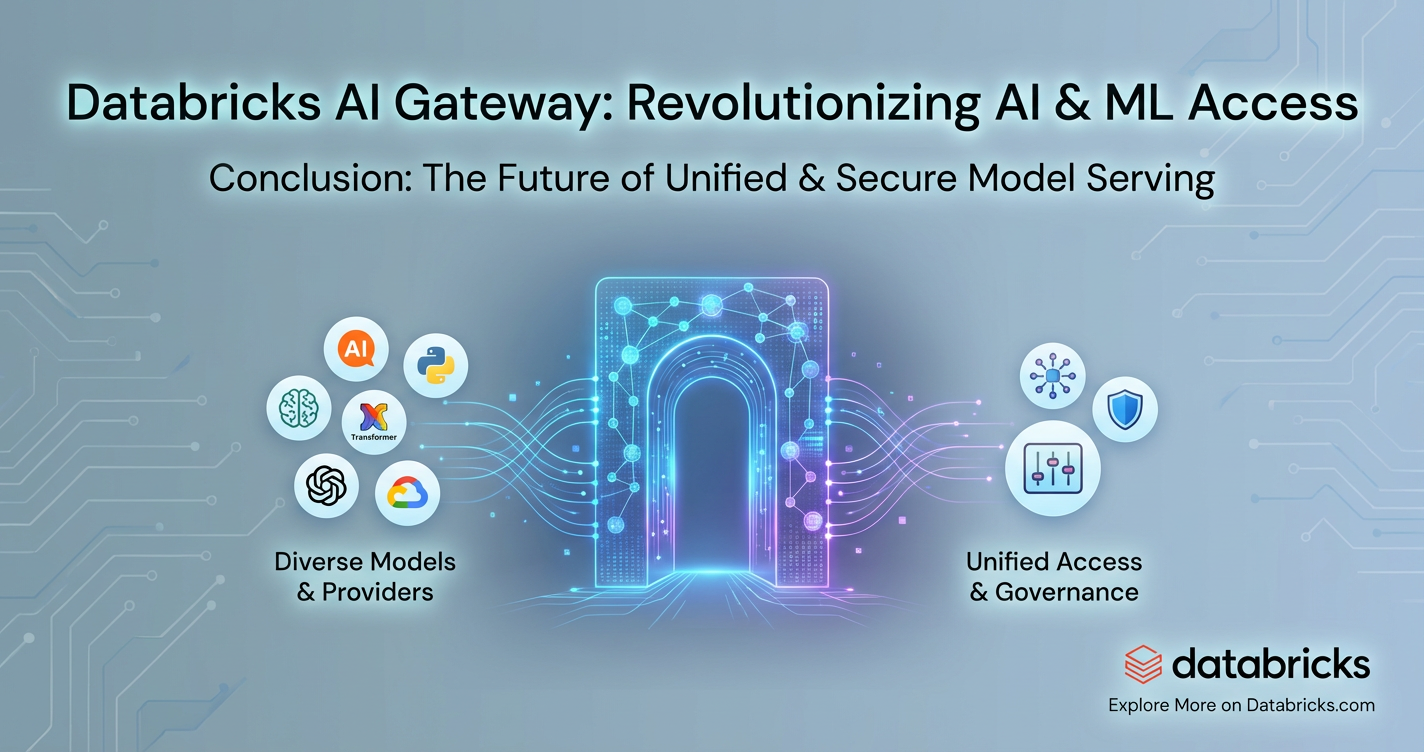
Databricks AI Gateway: Revolutionizing AI & ML Access


The realm of Artificial Intelligence and Machine Learning (AI/ML) has undergone a profound transformation, evolving from a niche academic pursuit to an indispensable pillar of modern enterprise strategy. As organizations globally strive to harness the unparalleled potential of AI, from predictive analytics and personalized customer experiences to sophisticated automation and groundbreaking research, the sheer complexity of deploying, managing, and scaling these intricate models presents an increasingly formidable challenge. The rapid proliferation of diverse AI models, coupled with the emergence of Large Language Models (LLMs) that demand specialized handling, has highlighted a critical need for a streamlined, secure, and highly efficient interface. This is precisely where the concept of an AI Gateway, and more specifically, the Databricks AI Gateway, enters the spotlight, revolutionizing how businesses interact with and leverage their intelligent assets.
In this expansive exploration, we will delve into the intricate world of AI/ML access, dissecting the challenges that have historically hampered widespread adoption, and illuminating how sophisticated solutions like the Databricks AI Gateway are systematically dismantling these barriers. We will meticulously examine the foundational principles of api gateway technology, trace its evolution into dedicated AI Gateway functionalities, and critically analyze the specialized requirements addressed by an LLM Gateway. Our journey will unveil the architectural brilliance and feature richness of the Databricks AI Gateway, demonstrating its pivotal role in unifying data, AI, and governance within the Lakehouse Platform. Furthermore, we will touch upon comprehensive open-source alternatives like APIPark, highlighting the broader industry trend towards robust API management for AI services. By the conclusion, readers will possess a deep understanding of how these transformative technologies are not merely simplifying AI deployment but are fundamentally reshaping the landscape of innovation, empowering organizations to unlock unprecedented value from their data and models.
The Exploding Demand for AI/ML and the Mounting Complexity of Its Deployment
The digital age is unequivocally defined by data, and Artificial Intelligence and Machine Learning are the most potent tools for extracting intelligence and actionable insights from this ever-growing ocean of information. From the subtle recommendations that shape our online shopping experiences to the sophisticated diagnostic tools revolutionizing healthcare, AI/ML models are now embedded in the fabric of countless applications and business processes. Enterprises across sectors—finance, retail, manufacturing, healthcare, and telecommunications—are aggressively investing in AI, recognizing it as a key differentiator for competitive advantage, operational efficiency, and customer satisfaction. The imperative to integrate AI into existing systems and develop new AI-powered products has never been more pressing.
However, beneath the surface of this AI revolution lies a labyrinth of technical and operational complexities that often impede progress. The journey from a meticulously trained ML model in a research lab to a robust, scalable, and secure production endpoint is fraught with challenges. Data scientists and ML engineers, while experts in model development and optimization, frequently encounter significant hurdles when transitioning their work from experimental environments to live applications. These challenges range from managing diverse model frameworks and dependencies to ensuring high availability, low latency, stringent security, and efficient resource utilization in dynamic, real-world scenarios.
One of the primary difficulties stems from the sheer diversity of AI models. An organization might utilize various types of models: classical machine learning algorithms for tabular data (e.g., gradient boosting for fraud detection), deep learning models for image recognition or natural language processing, time series models for forecasting, and more recently, the exponentially growing family of Large Language Models (LLMs) for generative AI tasks. Each of these models often comes with its unique set of runtime requirements, dependency chains, and inference patterns. Exposing these disparate models as consumable services requires a unified interface that can abstract away this underlying heterogeneity. Without such a mechanism, application developers would need to understand the nuances of each model's deployment, authentication, and invocation protocol, leading to fragmented development efforts, increased error rates, and significantly slower time-to-market for AI-powered features.
Furthermore, the operational aspects of AI deployment are anything but trivial. Models need to be deployed to scalable infrastructure, whether on-premises servers, public cloud instances, or serverless functions. This involves configuring compute resources, managing containers, setting up load balancers, and ensuring continuous monitoring for performance degradation, data drift, and model decay. Scaling these deployments dynamically to handle fluctuating demand is another intricate task, requiring sophisticated auto-scaling policies and robust infrastructure automation. Over-provisioning leads to unnecessary costs, while under-provisioning results in poor user experience and potential service outages. The challenge is exacerbated when considering the need for multiple model versions in production—for A/B testing, gradual rollouts, or simply maintaining backward compatibility—each requiring independent management.
Security and access control represent another critical dimension of the AI deployment puzzle. Exposing AI models as API endpoints opens up potential vectors for unauthorized access, data breaches, and malicious exploitation. Robust authentication and authorization mechanisms are paramount to ensure that only legitimate users and applications can invoke specific models. Moreover, sensitive data passed through these models, both as input and output, demands adherence to strict data governance policies, regulatory compliance (like GDPR or HIPAA), and privacy safeguards. Auditing model invocations and data flows becomes essential for accountability and troubleshooting.
Cost management, particularly in cloud environments, emerges as a significant concern. Running powerful AI/ML inference endpoints can consume substantial computational resources. Tracking usage, attributing costs to specific models or applications, and optimizing resource allocation are crucial for maintaining budgetary control. Without granular visibility into consumption patterns, organizations risk ballooning cloud bills and inefficient resource utilization.
Finally, the developer experience for application teams building AI-powered features often suffers due to these complexities. Instead of focusing on innovative product development, engineers spend disproportionate amounts of time grappling with infrastructure configurations, API integrations for diverse models, and debugging deployment issues. This friction slows down innovation and limits the organization's ability to rapidly iterate and experiment with new AI capabilities. The quest for a solution that can abstract away these infrastructure complexities, unify access, enforce security, and optimize performance has become a paramount objective for any enterprise serious about leveraging AI at scale. This is the precise void that modern AI Gateways, exemplified by Databricks, are designed to fill.
Understanding the Core Concepts: API Gateway, AI Gateway, and LLM Gateway
To truly appreciate the transformative impact of the Databricks AI Gateway, it's essential to first establish a clear understanding of the foundational technologies and the evolutionary path that has led to specialized AI/ML access solutions. This involves dissecting the traditional api gateway, tracing its evolution into the more specialized AI Gateway, and then focusing on the distinct requirements addressed by an LLM Gateway. Each represents a layer of abstraction and specialization built upon its predecessor, designed to tackle increasingly complex challenges in the realm of service consumption.
What is an API Gateway? The Traditional Workhorse
At its core, an API Gateway serves as the single entry point for all clients consuming services within a microservices architecture. Instead of clients directly interacting with individual microservices, they communicate with the API Gateway, which then intelligently routes requests to the appropriate backend services. This architectural pattern emerged as a crucial component for managing the complexity inherent in distributed systems, offering a myriad of benefits that go far beyond simple request routing.
A traditional API Gateway typically provides a comprehensive suite of functionalities:
- Request Routing and Load Balancing: It directs incoming API requests to the correct backend service instance, distributing traffic evenly to ensure optimal performance and availability. This is fundamental for scaling applications and preventing service overload.
- Authentication and Authorization: The gateway can handle security concerns by authenticating client requests (e.g., validating API keys, JWT tokens) and authorizing access to specific resources based on predefined policies. This offloads security logic from individual microservices, centralizing governance.
- Rate Limiting and Throttling: It protects backend services from being overwhelmed by excessive requests from a single client, ensuring fair usage and preventing denial-of-service attacks.
- Traffic Management: Features like circuit breakers, retries, and timeouts can be implemented at the gateway level to improve the resilience of the overall system by gracefully handling failures in backend services.
- Request/Response Transformation: It can modify request payloads before forwarding them to services or alter service responses before returning them to clients. This allows for API versioning, data format conversion, and masking sensitive information.
- Monitoring and Logging: The gateway acts as a central point for collecting metrics (e.g., latency, error rates, request counts) and logs for all API traffic, providing invaluable insights into system performance and aiding in debugging.
- Caching: Frequently accessed data or responses can be cached at the gateway, reducing the load on backend services and improving response times for clients.
In essence, a traditional api gateway is a powerful reverse proxy that acts as a façade for a collection of backend services, simplifying client-side development, enhancing security, and improving the overall manageability and resilience of distributed applications. Its primary goal is to abstract the complexity of the microservices ecosystem from the consuming clients.
Evolving to an AI Gateway: Specializing for Machine Learning
While traditional API Gateways provide a robust foundation, the unique characteristics and requirements of Machine Learning models necessitate a more specialized approach. An AI Gateway extends the functionalities of a conventional API Gateway by incorporating features specifically designed for the deployment, management, and consumption of AI/ML models. It addresses the inherent differences between invoking a standard CRUD (Create, Read, Update, Delete) microservice and performing an ML inference.
Key specialized functionalities of an AI Gateway include:
- Model-Specific Routing and Versioning: Unlike static service endpoints, ML models frequently undergo retraining and version updates. An AI Gateway can intelligently route requests to specific model versions, enable A/B testing of new models against existing ones, or facilitate canary rollouts. It can also manage multiple models, potentially even across different frameworks (e.g., TensorFlow, PyTorch, Scikit-learn), behind a unified endpoint.
- Data Pre/Post-processing for Inference: ML models often require specific input data formats (e.g., converting an image to a tensor, tokenizing text) and produce raw outputs that need to be transformed into human-readable or application-consumable formats. An AI Gateway can perform these transformations at the edge, reducing the burden on client applications and ensuring model compatibility.
- Specialized Security for AI Endpoints: Beyond standard authentication, an AI Gateway can implement finer-grained access controls based on model sensitivity or specific use cases. It can also help in anonymizing data before it reaches the model or filtering out potentially biased inputs/outputs.
- Observability for Model Performance: While traditional gateways log HTTP metrics, an AI Gateway dives deeper, collecting metrics relevant to model inference, such as prediction latency, error rates specific to model inference (e.g., failed deserialization of input), and potentially even monitoring for data drift or concept drift at the input/output level. This requires integration with ML lifecycle management tools.
- Resource Optimization for ML Workloads: ML inference can be resource-intensive. An AI Gateway can intelligently manage the underlying compute resources, potentially scaling up or down specific model endpoints based on real-time demand, or routing requests to optimized hardware (e.g., GPUs).
- Abstraction of ML Frameworks: It provides a uniform interface for consuming models regardless of the ML framework they were built with, simplifying client integration.
An AI Gateway thus acts as a crucial abstraction layer between application developers and the complex backend of ML model deployment, ensuring that models are consumed securely, efficiently, and reliably.
The industry has seen a rise in platforms that act as an AI Gateway, often open-source, providing flexibility and control. For instance, APIPark stands out as an open-source AI gateway and API management platform. It offers quick integration of over 100+ AI models, a unified API format for AI invocation, and the ability to encapsulate prompts into REST APIs. These features align perfectly with the evolving requirements of an AI Gateway, enabling developers and enterprises to manage, integrate, and deploy AI services with remarkable ease. APIPark's comprehensive lifecycle management, team sharing capabilities, and robust performance rivaling Nginx further underscore its value in modern AI infrastructure.
The Rise of LLM Gateways: Tailoring for Large Language Models
The advent of Large Language Models (LLMs) like GPT, LLaMA, and Claude has introduced a new paradigm in AI, but also a new set of challenges that warrant even further specialization beyond a general AI Gateway. An LLM Gateway is a specialized form of AI Gateway that specifically caters to the unique characteristics and operational demands of large generative models.
Key distinctions and functionalities of an LLM Gateway include:
- Prompt Management and Versioning: LLMs are highly sensitive to prompts. An LLM Gateway allows for central management, versioning, and templating of prompts, ensuring consistency, enabling A/B testing of different prompts, and reducing prompt engineering burden on application developers. This is crucial for maintaining quality and performance as LLM capabilities evolve.
- Model Switching and Orchestration: Organizations often use multiple LLMs (e.g., one for summarization, another for code generation, a third for content filtering) or want to switch between different providers (OpenAI, Anthropic, Google) based on cost, performance, or specific task requirements. An LLM Gateway can intelligently route requests to the most appropriate LLM, or even chain multiple LLMs for complex tasks.
- Response Parsing and Filtering: LLM outputs can be verbose, unstructured, or even contain undesirable content. The gateway can parse, extract relevant information, format responses (e.g., JSON), and apply guardrails to filter out harmful, biased, or off-topic content.
- Cost Optimization Across Providers: Different LLM providers have varying pricing models. An LLM Gateway can optimize costs by routing requests to the cheapest available provider that meets performance and quality requirements, or by caching common LLM responses.
- Security and Compliance for Generative AI: Beyond general API security, LLM Gateways address concerns like data leakage (preventing sensitive information from being sent to external LLMs), content moderation for inputs and outputs, and adherence to ethical AI guidelines.
- Caching of LLM Responses: Generative models can be expensive and slow. Caching identical or highly similar LLM prompts and their responses can significantly reduce costs and latency, especially for frequently asked questions or common tasks.
- Token Management and Context Handling: LLMs have token limits for their context windows. An LLM Gateway can assist in managing token usage, summarizing context, or handling conversational memory across multiple turns to stay within limits.
In summary, while an api gateway is a general entry point for services, an AI Gateway specializes this role for ML models, and an LLM Gateway further refines it to address the unique complexities and power of large language models. The Databricks AI Gateway strategically positions itself at the intersection of these concepts, offering a unified and comprehensive solution for both traditional ML and the rapidly expanding universe of LLMs.
Databricks AI Gateway: A Deep Dive into its Architecture and Features
The Databricks AI Gateway is not merely an incremental improvement over existing API management solutions; it represents a strategic evolution, deeply integrated into the Databricks Lakehouse Platform. Its design philosophy centers on abstracting the significant complexities associated with deploying, managing, and scaling diverse AI models, particularly Large Language Models (LLMs), enabling organizations to move from data to AI-driven insights with unprecedented speed and efficiency. By providing a unified, secure, and scalable interface for accessing AI models, the AI Gateway democratizes AI consumption, allowing application developers to seamlessly integrate intelligent capabilities without grappling with the intricate nuances of underlying ML infrastructure.
Core Philosophy: Unifying Data, AI, and Governance on the Lakehouse Platform
At the heart of Databricks' strategy is the Lakehouse Platform, a revolutionary data architecture that combines the best attributes of data lakes (cost-effectiveness, flexibility, scale) and data warehouses (data governance, ACID transactions, performance). The Databricks AI Gateway is a natural extension of this vision, ensuring that AI models—which are fundamentally data-driven artifacts—are treated as first-class citizens within this unified ecosystem. The core philosophy is to break down silos between data engineers, data scientists, and application developers, providing a cohesive environment where data ingestion, preparation, model training, deployment, and governance all occur on a single, integrated platform.
This unification is critical for several reasons:
- Accelerated MLOps: By tightly integrating with the data layer, the AI Gateway ensures that models can consume clean, governed data directly from the Lakehouse. This streamlines the MLOps lifecycle, reducing friction between development and deployment.
- Enhanced Governance and Security: Leveraging the robust capabilities of Unity Catalog—Databricks' centralized data and AI governance solution—the AI Gateway inherits a powerful framework for access control, auditing, and lineage tracking. This means that access to AI models can be managed with the same rigor as access to sensitive data, ensuring compliance and security.
- Simplified Data-to-AI Pipeline: The entire journey from raw data to a deployed AI model endpoint becomes more coherent and manageable, minimizing the need for complex, bespoke integrations between disparate systems.
Integration with the Databricks Ecosystem: A Seamless Experience
The strength of the Databricks AI Gateway lies in its deep and seamless integration with the broader Databricks ecosystem, creating a powerful synergy that amplifies its capabilities.
- MLflow Integration: MLflow is an open-source platform for managing the end-to-end machine learning lifecycle, encompassing experiment tracking, reproducible runs, model packaging, and model serving. The AI Gateway builds directly on MLflow's Model Registry, allowing users to register their trained models (regardless of framework) and then expose them via the gateway. This tight integration means that models managed within MLflow can be effortlessly served as API endpoints, leveraging existing versioning and metadata.
- Unity Catalog: As mentioned, Unity Catalog provides a single source of truth for data and AI assets. The AI Gateway integrates with Unity Catalog to enforce granular access policies, ensuring that only authorized users or applications can invoke specific models. This centralized governance simplifies security management and auditing across the entire data and AI landscape.
- Databricks Workflows: For automated model training and retraining pipelines, Databricks Workflows can be used to orchestrate the entire ML lifecycle. The AI Gateway can be integrated into these workflows, allowing for automated deployment of new model versions as soon as they are trained and validated, further accelerating MLOps.
- Delta Lake: The underlying data layer, Delta Lake, provides reliability, performance, and governance for data lakes. Models deployed through the AI Gateway can directly access and process data stored in Delta Lake tables, ensuring data consistency and freshness.
This deep integration ensures that the AI Gateway is not a standalone component but an integral part of a comprehensive, unified platform for data and AI.
Key Features: Powering Intelligent Access
The Databricks AI Gateway offers a rich set of features designed to address the challenges of AI/ML access and deployment at scale.
1. Simplified Model Exposure: Any Model as a REST API
One of the most compelling features of the Databricks AI Gateway is its ability to expose virtually any MLflow-registered model, custom model, or even external LLMs as a standard REST API endpoint. This dramatically simplifies the process for application developers. Instead of wrestling with specific SDKs, deployment frameworks, or inference protocols for each model, they interact with a consistent HTTP interface.
- Universal Interface: Whether it's a Scikit-learn model, a PyTorch deep learning network, or a custom Python function, the gateway standardizes access.
- Automatic Endpoint Creation: With minimal configuration, users can deploy a registered model to the gateway, which automatically provisions the necessary infrastructure and creates a stable, scalable endpoint.
- Flexibility for Custom Logic: Beyond serving models directly, the gateway allows for custom Python functions or pre/post-processing logic to be wrapped around the model, ensuring that inputs are transformed correctly before inference and outputs are formatted appropriately.
2. Unified API Endpoint for Diverse Models and External LLMs
The AI Gateway provides a single, consistent API endpoint that can abstract away multiple underlying models or even different LLM providers. This is particularly powerful in scenarios where:
- Multi-Model Applications: An application might require different models for various tasks (e.g., sentiment analysis, entity recognition, translation). The gateway can route requests to the appropriate model based on the API path or request parameters, all under one unified domain.
- LLM Provider Agnosticism: For
LLM Gatewayfunctionalities, organizations often want the flexibility to switch between OpenAI, Anthropic, or open-source LLMs hosted on Databricks based on performance, cost, or specific capabilities. The gateway can serve as an abstraction layer, routing LLM requests dynamically to the best-suited provider without requiring changes in the client application code. This provides resilience and cost optimization. - Model Chaining and Orchestration: More advanced use cases might involve chaining multiple models or LLMs together to perform complex tasks (e.g., summarize text, then extract entities, then translate). The gateway can orchestrate these multi-step inference pipelines internally.
3. Scalability & Performance: Leveraging Databricks' Robust Infrastructure
Databricks' underlying cloud-native architecture provides inherent scalability and performance capabilities that the AI Gateway fully leverages.
- Auto-Scaling: The gateway automatically scales the compute resources allocated to model endpoints up or down based on real-time traffic demand, ensuring consistent performance during peak loads and cost efficiency during low usage periods. This eliminates the manual effort of capacity planning.
- High Availability: Deployed with redundancy and fault tolerance in mind, the AI Gateway ensures continuous availability of AI services, minimizing downtime and supporting mission-critical applications.
- Low Latency Inference: The platform is optimized for low-latency inference, crucial for real-time applications such as recommendation engines, fraud detection, or interactive chatbots.
- GPU Acceleration: For deep learning models and large LLMs that benefit from specialized hardware, the AI Gateway can deploy models to GPU-accelerated clusters, maximizing inference speed and throughput.
4. Security & Governance: Centralized Control with Unity Catalog
Security and governance are paramount for AI deployments, especially when dealing with sensitive data or mission-critical decisions. The Databricks AI Gateway integrates deeply with Unity Catalog to provide enterprise-grade security.
- Fine-Grained Access Control: Access to specific model endpoints can be controlled at a granular level, specifying which users, groups, or service principals can invoke a model. This prevents unauthorized access and potential misuse.
- Auditing and Logging: Every invocation of a model through the gateway is logged, providing a comprehensive audit trail for compliance, security investigations, and usage tracking. This includes details like who invoked the model, when, and with what parameters.
- Data Lineage: As part of Unity Catalog, the gateway contributes to the overall data lineage, showing how data flows from source systems, through model training, and finally to model inference. This transparency is vital for understanding and trusting AI outcomes.
- Data Masking and Encryption: The platform supports encryption in transit and at rest, and can facilitate data masking policies to protect sensitive information during inference.
5. Observability & Monitoring: Insights into Model Performance
Effective MLOps requires robust monitoring of deployed models. The AI Gateway provides built-in mechanisms for observability.
- Metrics Collection: It automatically collects key performance metrics for each endpoint, including request rates, latency, error rates, and resource utilization (CPU, memory, GPU). These metrics can be visualized through Databricks dashboards or integrated with external monitoring tools.
- Logging: Detailed logs of all API calls, including input and output payloads (configurable for privacy), are captured, aiding in debugging and performance analysis.
- Integration with MLflow: Beyond operational metrics, the gateway can integrate with MLflow to monitor model-specific performance indicators, such as prediction drift, model quality metrics, and performance against baseline models. This proactive monitoring helps in detecting and addressing model degradation early.
6. Cost Optimization: Intelligent Resource Management
Managing the cost of AI infrastructure is a significant concern for enterprises. The Databricks AI Gateway offers several mechanisms for cost optimization.
- Elastic Scaling: As mentioned, auto-scaling ensures that you only pay for the compute resources you use, eliminating the cost of idle infrastructure.
- Usage Tracking: Granular logging and metrics allow for precise tracking of model invocation costs, enabling organizations to attribute spending to specific projects, teams, or applications.
- Caching (for LLMs): For generative AI, caching identical prompts and their responses can dramatically reduce the number of calls to expensive LLMs, leading to substantial cost savings and improved latency.
- Intelligent Routing: For
LLM Gatewayscenarios, the ability to route requests to the most cost-effective LLM provider (e.g., a cheaper open-source model for simpler tasks, or a more expensive proprietary model for complex ones) provides significant leverage for cost control.
7. Prompt Engineering & Management (for LLMs): Mastering Generative AI
The quality of LLM outputs is highly dependent on the quality of prompts. The Databricks AI Gateway recognizes this and provides features specifically for prompt management within its LLM Gateway capabilities.
- Centralized Prompt Store: Store, version, and manage a library of prompts and prompt templates. This ensures consistency across applications and enables best practices in prompt engineering.
- Prompt Templating: Define dynamic prompts with placeholders that can be filled in at runtime by client applications, simplifying prompt creation and ensuring contextual relevance.
- A/B Testing of Prompts: Experiment with different prompt versions to optimize LLM outputs for specific tasks, tracking which prompts yield the best results.
- Guardrails and Filtering: Implement logic at the gateway to pre-process prompts (e.g., detect harmful content) and post-process LLM responses (e.g., remove sensitive information, ensure adherence to brand voice).
8. Developer Experience: Abstracting Complexity for Innovation
Ultimately, the goal of the AI Gateway is to empower developers to build innovative AI-powered applications rapidly.
- Simplified Integration: Developers interact with simple REST APIs, abstracting away the complexities of ML model deployment, scaling, and infrastructure management.
- Consistent Interface: A single, consistent interface for all AI models, reducing the learning curve and integration effort.
- Focus on Application Logic: By offloading infrastructure concerns to the gateway, developers can focus on building core application features and delivering business value.
Use Cases: Real-World Impact of Databricks AI Gateway
The versatility and power of the Databricks AI Gateway make it suitable for a wide array of real-world applications across various industries:
- Real-time Recommendation Engines: Expose product recommendation models as high-throughput, low-latency API endpoints, enabling personalized shopping experiences on e-commerce platforms.
- Intelligent Chatbots and Virtual Assistants: Leverage the
LLM Gatewaycapabilities to power conversational AI agents, routing user queries to appropriate LLMs, managing conversation context, and applying content moderation. - Fraud Detection Systems: Deploy real-time anomaly detection models to identify suspicious transactions instantly, calling the model via the gateway during credit card processing or login attempts.
- Personalized Content Generation: Utilize LLMs via the
LLM Gatewayto dynamically generate marketing copy, news articles, or personalized emails, with prompt management ensuring brand consistency and quality. - Customer Service Automation: Route customer queries to an LLM for summarization or sentiment analysis, then use another model to suggest relevant knowledge base articles or responses.
- Medical Diagnosis and Image Analysis: Deploy highly specialized deep learning models for analyzing medical images (e.g., X-rays, MRIs) or patient data, providing secure API access for clinical applications.
- Supply Chain Optimization: Forecast demand, predict equipment failures, or optimize logistics routes by exposing predictive models as APIs for integration into enterprise resource planning (ERP) systems.
The Databricks AI Gateway stands as a testament to the power of a unified platform, bringing together data, machine learning, and robust governance to truly revolutionize AI and ML access for enterprises globally. Its comprehensive feature set addresses the full spectrum of challenges, from model deployment and scaling to security, cost management, and the unique demands of generative AI.
APIPark is a high-performance AI gateway that allows you to securely access the most comprehensive LLM APIs globally on the APIPark platform, including OpenAI, Anthropic, Mistral, Llama2, Google Gemini, and more.Try APIPark now! 👇👇👇
Implementing and Managing AI with Databricks AI Gateway
Implementing and managing AI models effectively requires more than just deploying them; it necessitates a comprehensive strategy encompassing deployment workflows, security best practices, robust monitoring, and proactive management of model versions and costs. The Databricks AI Gateway is designed to streamline these processes, embedding itself as a critical component in a modern MLOps pipeline. This section delves into the practical aspects of leveraging the AI Gateway, from initial setup to advanced operational considerations.
Workflow: From Model Training to Gateway Deployment
The typical MLOps workflow with Databricks AI Gateway begins with data and culminates in a production-ready, consumable AI service.
- Data Preparation and Feature Engineering: Utilizing Databricks’ capabilities, data engineers prepare and transform raw data into features suitable for model training, often storing them in Delta Lake tables. Unity Catalog ensures data governance and discoverability.
- Model Training and Experimentation (MLflow): Data scientists develop and train various ML models (e.g., classification, regression, NLP, deep learning) using preferred frameworks (TensorFlow, PyTorch, Scikit-learn) within Databricks notebooks or jobs. MLflow Tracking is used to log experiments, parameters, metrics, and model artifacts, ensuring reproducibility and comparability.
- Model Registration (MLflow Model Registry): Once a model demonstrates satisfactory performance, it is registered in the MLflow Model Registry. This acts as a centralized repository for models, managing versions, metadata, and stage transitions (e.g., from
StagingtoProduction). This is a crucial step before deployment via the gateway. - Gateway Endpoint Creation and Deployment: With the model registered in MLflow, users can then configure and deploy it through the Databricks AI Gateway. This involves selecting the registered model, specifying desired compute resources (e.g., CPU, GPU, memory), and defining the endpoint name. The gateway automatically provisions the necessary infrastructure, creates a scalable endpoint, and associates it with the chosen model version. For external LLMs, the process involves configuring the external provider details and defining how requests should be routed.
- Integration with Applications: Application developers can now seamlessly integrate with the deployed model via the stable REST API endpoint provided by the AI Gateway. They consume the service without needing to understand the underlying ML infrastructure complexities.
- Continuous Monitoring and Retraining: Post-deployment, the gateway (and MLflow) continuously monitors the model's performance, latency, and resource utilization. If data drift is detected or model performance degrades, the MLOps pipeline can trigger a retraining process, leading to a new model version, which can then be seamlessly deployed through the gateway.
Creating Endpoints: Practical Steps and Configuration Options
Creating a model serving endpoint with Databricks AI Gateway is designed to be intuitive. Typically, this involves:
- Using the Databricks UI: Navigate to the "Serving" section in the Databricks workspace. Here, users can select an MLflow-registered model from the Model Registry.
- Specifying Endpoint Details: Provide a unique name for the endpoint.
- Configuring Compute: Choose the instance type (e.g., CPU-only, GPU-enabled), desired scale (e.g., number of concurrent requests, auto-scaling parameters), and memory requirements. This allows for granular control over resource allocation, optimizing for both performance and cost.
- Selecting Model Version: Specify which version of the registered MLflow model should be served. This is critical for managing model updates and rollbacks.
- External Model Configuration: For
LLM Gatewayuse cases, configure the external LLM provider API keys, base URLs, and any specific parameters (e.g., model name, temperature, max tokens). - Customization: The gateway allows for custom Python code to be executed before and after model inference, enabling complex data transformations, input validation, or response formatting. This is often done by wrapping the model in a custom MLflow
pyfuncmodel. - Deployment: With the configuration complete, initiating the deployment provisions the necessary infrastructure and makes the endpoint live.
The Databricks AI Gateway provides a unified interface for serving both custom models and external LLMs, simplifying the management of diverse AI assets.
Security Best Practices: Fortifying Your AI Endpoints
Security is non-negotiable for AI deployments, particularly when models handle sensitive data or drive critical business decisions. The AI Gateway provides features to enforce robust security:
- Authentication Mechanisms:
- API Tokens/Keys: The most common method, where client applications present a unique token with each request. The gateway validates this token against registered credentials.
- OAuth/OIDC Integration: For enterprise environments, integrating with existing identity providers via OAuth or OpenID Connect provides a more robust and manageable authentication framework, allowing for single sign-on (SSO) and fine-grained permissions.
- Service Principals: For automated systems or microservices, using Databricks Service Principals for authentication ensures secure, programmatic access without relying on individual user credentials.
- Fine-Grained Access Control (Unity Catalog): As discussed, Unity Catalog extends its governance to AI endpoints. Administrators can define precise permissions, determining which users or groups have
CAN_QUERYprivileges on specific model endpoints. This ensures that only authorized entities can invoke a model. - Network Security: Deploying the AI Gateway within a Virtual Private Cloud (VPC) or private subnet, coupled with network access controls (e.g., security groups, firewalls), restricts inbound traffic to authorized sources, protecting the endpoints from public internet exposure where unnecessary.
- Data Encryption: Ensure data is encrypted in transit (using HTTPS/TLS) and at rest. Databricks ensures data processed and stored within its platform is encrypted according to industry best practices.
- Auditing and Logging: Regularly review audit logs for unusual access patterns or failed authentication attempts. These logs are invaluable for security investigations and compliance.
- Input Validation and Sanitization: Implement logic (potentially through custom pre-processing in the gateway) to validate and sanitize input data before it reaches the model, mitigating risks like injection attacks or malformed requests that could compromise model integrity.
Monitoring and Alerting: Proactive Performance Management
Continuous monitoring is crucial for maintaining the health, performance, and accuracy of deployed AI models. The Databricks AI Gateway provides comprehensive monitoring capabilities:
- Dashboards: Built-in dashboards visualize key metrics such as request rate, average latency, error rates, and resource utilization (CPU, memory, GPU). These provide a real-time overview of endpoint health.
- Custom Metrics: Beyond standard operational metrics, integrate custom MLflow metrics to track model-specific performance, such as prediction accuracy, F1-score, or custom business-relevant KPIs.
- Logging and Tracing: Detailed logs for each API request and response, along with associated internal processing steps, aid in debugging and root cause analysis. Distributed tracing can be implemented to track requests across multiple services and models.
- Alerting: Configure alerts based on predefined thresholds for critical metrics. For example, trigger an alert if latency exceeds a certain threshold, if error rates spike, or if CPU utilization consistently hits max capacity. These alerts enable proactive intervention before issues escalate.
- Data and Concept Drift Detection: Integrate with specialized ML monitoring tools (or custom logic) to detect changes in input data distribution (data drift) or changes in the relationship between input and output variables (concept drift), which often signal model degradation.
Version Control and Rollbacks: Agile Model Management
Managing multiple versions of models is a cornerstone of MLOps. The AI Gateway simplifies this process:
- MLflow Model Registry Integration: The gateway directly consumes models from the MLflow Model Registry, which inherently manages model versions. When deploying, you simply specify which registered version to serve.
- Seamless Updates: To deploy a new model version, register it in MLflow, promote it to "Production" stage, and then update the gateway endpoint to point to this new version. This can often be done with zero downtime through blue/green or canary deployment strategies.
- Instant Rollbacks: If a new model version exhibits unexpected issues in production, the gateway allows for quick rollbacks to a previous stable version simply by changing the serving configuration to an older MLflow model version. This dramatically reduces the risk associated with deploying new models.
- A/B Testing: For experimentation and gradual rollouts, the gateway can route a percentage of traffic to a new model version while the majority still uses the old one, enabling controlled testing and performance comparison.
Traffic Management: Optimizing Model Consumption
Beyond basic routing, the AI Gateway can implement sophisticated traffic management strategies:
- Rate Limiting: Protect your models from abuse or accidental overload by configuring the maximum number of requests per client over a given time period. This ensures fairness and system stability.
- Load Balancing: Distribute incoming requests across multiple instances of your model, ensuring optimal resource utilization and preventing single points of failure.
- Circuit Breakers: Implement circuit breaker patterns to prevent cascading failures. If a backend model service is consistently failing, the gateway can temporarily stop routing traffic to it, allowing it to recover and preventing further errors.
- Request Prioritization: For critical applications, prioritize requests from specific clients or with certain tags, ensuring that high-priority inferences are processed ahead of lower-priority ones.
Cost Management Strategies: Maximizing Value
Effective cost management for AI services involves more than just tracking expenses; it's about optimizing resource allocation and usage.
- Auto-scaling Optimization: Continuously fine-tune auto-scaling policies to match demand closely, minimizing idle compute resources.
- Instance Type Selection: Choose the most cost-effective instance types for your models. For example, a CPU-only model doesn't need expensive GPUs.
- Cache Utilization (for LLMs): For
LLM Gatewayendpoints, aggressively leverage caching for frequently requested prompts and responses to reduce external LLM API calls, which are often charged per token. - Usage Attribution: Utilize the granular logging and monitoring data to attribute AI inference costs to specific departments, projects, or application features, fostering accountability and enabling chargebacks.
- Periodic Review: Regularly review model performance and cost against business value. Decommission underperforming or unused models promptly.
Integration with CI/CD Pipelines: Automating MLOps
For mature MLOps practices, the AI Gateway should be an integral part of Continuous Integration/Continuous Delivery (CI/CD) pipelines.
- Automated Deployment: Once a new model version is trained, validated, and registered in MLflow, the CI/CD pipeline can automatically trigger the update of the AI Gateway endpoint to serve this new version.
- Automated Testing: Integration tests and performance tests for the AI endpoint can be incorporated into the CI/CD pipeline, ensuring that new deployments meet quality and SLA requirements.
- Configuration as Code: Manage AI Gateway configurations (e.g., endpoint definitions, scaling policies, security rules) as code using tools like Terraform or Databricks Asset Bundles, enabling version control, peer review, and automated deployment.
Advanced Features: Extending Capabilities
While the Databricks AI Gateway offers robust out-of-the-box functionality, it also allows for advanced customizations:
- Custom Transformers: Implement more complex pre-processing or post-processing logic using custom Python code integrated directly with the model serving. This could involve advanced feature engineering at inference time or sophisticated response parsing.
- Advanced Routing Logic: Beyond simple path-based routing, implement custom logic for routing requests based on payload content, user characteristics, or dynamic load conditions across multiple model versions or providers.
- Integration with External Systems: Utilize webhooks or custom alerts to integrate the gateway's monitoring data with external incident management systems, data visualization tools, or business intelligence platforms.
By embracing these implementation and management strategies, organizations can fully leverage the Databricks AI Gateway to create a robust, secure, scalable, and cost-effective AI delivery platform, accelerating innovation and driving measurable business impact.
The Future of AI/ML Access and Databricks' Role
The trajectory of Artificial Intelligence and Machine Learning is one of continuous acceleration, with new models, techniques, and applications emerging at a dizzying pace. As AI transitions from a specialized domain to an embedded capability across all industries, the mechanisms for accessing and managing these intelligent assets will become even more critical. The AI Gateway, particularly its specialized LLM Gateway incarnation, is poised to play an increasingly central role in this evolving landscape, and Databricks is strategically positioned at the forefront of this transformation.
The Ongoing Democratization of AI
One of the most significant trends in AI is its democratization. What was once the exclusive domain of highly specialized researchers is now becoming accessible to a broader audience of developers, data analysts, and even business users. This democratization is fueled by several factors:
- Easier-to-use Tools and Platforms: Platforms like Databricks abstract away much of the underlying infrastructure complexity.
- Pre-trained Models: The availability of powerful pre-trained models, especially large language models, allows developers to build sophisticated AI applications with minimal training data or specialized ML expertise.
- Cloud Computing: Scalable and cost-effective cloud resources make AI accessible without massive upfront hardware investments.
However, the "last mile" problem of deployment and management remains. Even with powerful models, exposing them securely, reliably, and cost-effectively to applications is a persistent challenge. This is precisely where the AI Gateway becomes indispensable. It acts as the bridge, making raw, complex AI models consumable by the applications that drive business value, thereby truly democratizing access. Without a robust gateway, the benefits of advanced AI models would remain locked away in development environments.
The Increasing Importance of Robust, Secure, and Scalable AI Gateway Solutions
As AI adoption proliferates, the demands placed on AI Gateway solutions will intensify. Organizations will require:
- Unparalleled Scalability: As AI-powered features become core to mission-critical applications, the gateway must handle exponentially increasing traffic volumes without sacrificing performance. This means intelligent auto-scaling, efficient resource utilization, and robust load balancing will be paramount.
- Enhanced Security and Compliance: With AI models handling sensitive data and influencing critical decisions, the need for stringent security, granular access control, comprehensive auditing, and adherence to regulatory frameworks will only grow. AI Gateways will evolve to incorporate more advanced threat detection, data anonymization, and ethical AI guardrails at the inference layer.
- Advanced Observability and Governance: Understanding model behavior, performance, and impact in production will be crucial. Future AI Gateways will provide deeper insights into data drift, concept drift, model explainability (XAI), and potentially integrate with governance frameworks for responsible AI deployment.
- Multi-Model and Multi-Cloud Orchestration: Enterprises will continue to use a diverse portfolio of models from various vendors (proprietary LLMs, open-source LLMs, custom ML models) and potentially across different cloud environments. The AI Gateway will evolve to become a sophisticated orchestration layer, intelligently routing, combining, and managing these disparate AI assets from a single control plane. This is where comprehensive open-source solutions like APIPark, which offer integration with 100+ AI models and unified API formats, demonstrate significant foresight into future needs.
- Cost Efficiency and Optimization: As AI becomes more pervasive, controlling costs associated with inference will be a top priority. Gateways will incorporate more sophisticated caching mechanisms, intelligent routing based on cost/performance trade-offs, and fine-grained cost attribution to optimize spending.
Databricks' Vision for the Lakehouse and Its Continuous Innovation in the AI Space
Databricks has established itself as a leader in the data and AI space with its pioneering Lakehouse Platform. Its vision is to unify all data, analytics, and AI workloads on a single, open, and governed platform. The Databricks AI Gateway is a direct manifestation of this vision, addressing a critical component of the AI lifecycle: getting models into production and making them consumable.
Databricks' continuous innovation in AI is evident in its commitment to:
- Open Source Leadership: Significant contributions to open-source projects like Delta Lake, MLflow, and Apache Spark underline its dedication to fostering an open, collaborative ecosystem. The AI Gateway leverages these foundational components, ensuring an open and extensible architecture.
- Generative AI Prowess: Databricks has rapidly responded to the rise of generative AI, not only by providing tools for fine-tuning and deploying open-source LLMs (e.g., LLaMA, Dolly) but also by integrating
LLM Gatewaycapabilities that allow seamless access to leading proprietary LLMs. This positions Databricks as a go-to platform for organizations looking to build generative AI applications. - End-to-End Governance: With Unity Catalog, Databricks provides unparalleled governance across data and AI assets. This holistic approach ensures that models served through the AI Gateway are not just performant but also secure, compliant, and trustworthy.
The Synergy Between Data, Governance, and AI Deployment
The true power of the Databricks AI Gateway lies in its inherent synergy with the broader Lakehouse ecosystem. It's not just an api gateway for AI; it's an intelligent interface that understands the context of data, leverages centralized governance, and integrates seamlessly with the entire MLOps lifecycle. This integration means:
- Higher Quality AI: Models trained on governed, high-quality data from Delta Lake, tracked by MLflow, and deployed via the AI Gateway are more likely to perform better and yield more reliable results.
- Faster Innovation: The reduced friction from data ingestion to model deployment empowers data scientists and developers to iterate faster, experiment more, and bring AI-powered products to market quicker.
- Trusted AI Outcomes: With robust security, auditing, and lineage provided by Unity Catalog and the AI Gateway, organizations can have greater confidence in the fairness, transparency, and compliance of their AI systems.
The Evolving Role of LLM Gateway Solutions in the Age of Generative AI
The rapid advancement and widespread adoption of generative AI have particularly amplified the need for sophisticated LLM Gateway solutions. As LLMs become integrated into everything from content creation to customer service, their specific management requirements become paramount.
Future LLM Gateway solutions, building on the foundation laid by Databricks, will likely offer:
- More Advanced Prompt Orchestration: Intelligent prompt chaining, dynamic prompt generation based on user context, and multi-modal prompt management.
- Enhanced Output Control: Finer-grained control over LLM output formatting, adherence to style guides, and sophisticated mechanisms for preventing hallucination or biased content.
- Federated LLM Access: Seamlessly integrate and manage LLMs across different cloud providers, on-premises deployments, and edge devices, all through a unified interface.
- Contextual Memory Management: More robust and efficient ways to manage long-term conversational memory for LLMs, enabling more coherent and personalized interactions over extended periods.
- Semantic Caching: Beyond simple exact-match caching, intelligent caching that identifies semantically similar prompts to reuse responses, further optimizing cost and latency.
The Databricks AI Gateway is clearly aligned with these emerging trends, continuously evolving to meet the complex demands of generative AI while maintaining its commitment to simplicity, security, and scalability. It's not just reacting to the future of AI; it's actively shaping it by providing the essential infrastructure layer that makes advanced AI truly accessible and manageable for all.
Conclusion
The journey through the intricate landscape of AI/ML deployment reveals a clear and compelling narrative: the burgeoning power of artificial intelligence, particularly with the advent of Large Language Models, is matched only by the increasing complexity of making these intelligent assets accessible, secure, and manageable at enterprise scale. This challenge has historically been a significant bottleneck, preventing many organizations from fully realizing the transformative potential of their AI investments.
Enter the AI Gateway – a pivotal architectural component that has emerged as the definitive solution to this complexity. We've explored how the foundational principles of a traditional api gateway – providing a single entry point, handling routing, security, and monitoring – have evolved to meet the specialized demands of machine learning models. This evolution further extended into the highly specialized LLM Gateway, specifically designed to navigate the unique complexities of large generative models, encompassing prompt management, cost optimization across providers, and advanced content moderation. Throughout this discussion, we've also seen how open-source platforms like APIPark provide robust, flexible solutions that embody these gateway functionalities, offering comprehensive API management for diverse AI services and empowering developers with unified access and control.
At the forefront of this revolution stands the Databricks AI Gateway, a testament to intelligent design and deep integration. By meticulously weaving the AI Gateway into the fabric of its unified Lakehouse Platform, Databricks has engineered a solution that not only abstracts away the infrastructural complexities of AI deployment but also inherently leverages the power of its ecosystem, including MLflow for model lifecycle management and Unity Catalog for unparalleled data and AI governance. The Databricks AI Gateway empowers organizations to expose any MLflow-registered model or external LLM as a scalable, secure, and performant REST API endpoint with remarkable ease.
Its comprehensive feature set addresses every critical facet of AI access: from simplified model exposure and unified API endpoints for diverse models, to intelligent auto-scaling for optimal performance, robust security with fine-grained access control, extensive observability for proactive monitoring, and astute cost optimization strategies. Furthermore, its specialized LLM Gateway capabilities, including prompt management, versioning, and intelligent routing across providers, position it as an indispensable tool for harnessing the power of generative AI responsibly and efficiently.
Ultimately, the Databricks AI Gateway is more than just a technical component; it is an enabler of innovation. By simplifying the path from trained model to production application, it democratizes access to advanced AI capabilities, empowering developers to focus on building groundbreaking features rather than grappling with deployment intricacies. It instills confidence through enterprise-grade security and governance, ensuring that AI deployments are not only efficient but also compliant and trustworthy. As the world continues to accelerate its adoption of AI, solutions like the Databricks AI Gateway will remain critical in unlocking the full potential of this transformative technology, driving unprecedented efficiency, fostering boundless innovation, and ultimately, reshaping the future of enterprise intelligence.
Frequently Asked Questions (FAQs)
1. What is the primary difference between a traditional API Gateway, an AI Gateway, and an LLM Gateway? A traditional api gateway acts as a general entry point for microservices, handling routing, authentication, and traffic management for standard CRUD operations. An AI Gateway extends this by specializing for machine learning models, offering features like model versioning, data pre/post-processing for inference, and ML-specific monitoring. An LLM Gateway is a further specialization within the AI Gateway category, specifically designed for Large Language Models, providing unique functionalities such as prompt management, intelligent routing across multiple LLM providers, response filtering, and specialized cost optimization for token-based usage.
2. How does the Databricks AI Gateway integrate with the broader Databricks Lakehouse Platform? The Databricks AI Gateway is deeply integrated with the Lakehouse Platform. It leverages MLflow Model Registry for managing and versioning AI models, allowing seamless deployment of registered models as API endpoints. It uses Unity Catalog for centralized data and AI governance, enforcing fine-grained access control and providing audit trails for model invocations. This integration ensures a unified experience from data ingestion and preparation to model training, deployment, and ongoing management, all within a secure and scalable environment.
3. Can the Databricks AI Gateway handle both custom machine learning models and external Large Language Models (LLMs)? Yes, absolutely. The Databricks AI Gateway is designed for versatility. It can expose any MLflow-registered custom machine learning model (built with frameworks like TensorFlow, PyTorch, Scikit-learn, etc.) as a scalable REST API endpoint. Simultaneously, it functions as an LLM Gateway, allowing users to configure and manage access to leading external LLM providers (e.g., OpenAI, Anthropic) or even open-source LLMs hosted within Databricks, providing a unified and consistent interface for all AI models.
4. What security features does the Databricks AI Gateway offer for protecting AI endpoints? The Databricks AI Gateway offers robust security features through its integration with Unity Catalog. This includes fine-grained access control, allowing administrators to define precisely which users or applications can invoke specific model endpoints. It supports various authentication mechanisms like API tokens/keys, OAuth/OIDC integration, and Service Principals. Furthermore, it provides comprehensive auditing and logging of all API calls, ensures data encryption in transit and at rest, and can be deployed within private network configurations to restrict access.
5. How does the Databricks AI Gateway help with cost optimization for AI inference? The Databricks AI Gateway incorporates several features for cost optimization. Its auto-scaling capabilities ensure that compute resources are dynamically adjusted to match demand, preventing over-provisioning and reducing idle costs. For LLM Gateway use cases, it can enable caching of frequently requested prompts and responses, significantly reducing expensive external LLM API calls. Additionally, granular usage tracking and metrics allow organizations to attribute costs accurately, facilitating better resource management and cost-effective decision-making.
🚀You can securely and efficiently call the OpenAI API on APIPark in just two steps:
Step 1: Deploy the APIPark AI gateway in 5 minutes.
APIPark is developed based on Golang, offering strong product performance and low development and maintenance costs. You can deploy APIPark with a single command line.
curl -sSO https://download.apipark.com/install/quick-start.sh; bash quick-start.sh

In my experience, you can see the successful deployment interface within 5 to 10 minutes. Then, you can log in to APIPark using your account.

Step 2: Call the OpenAI API.