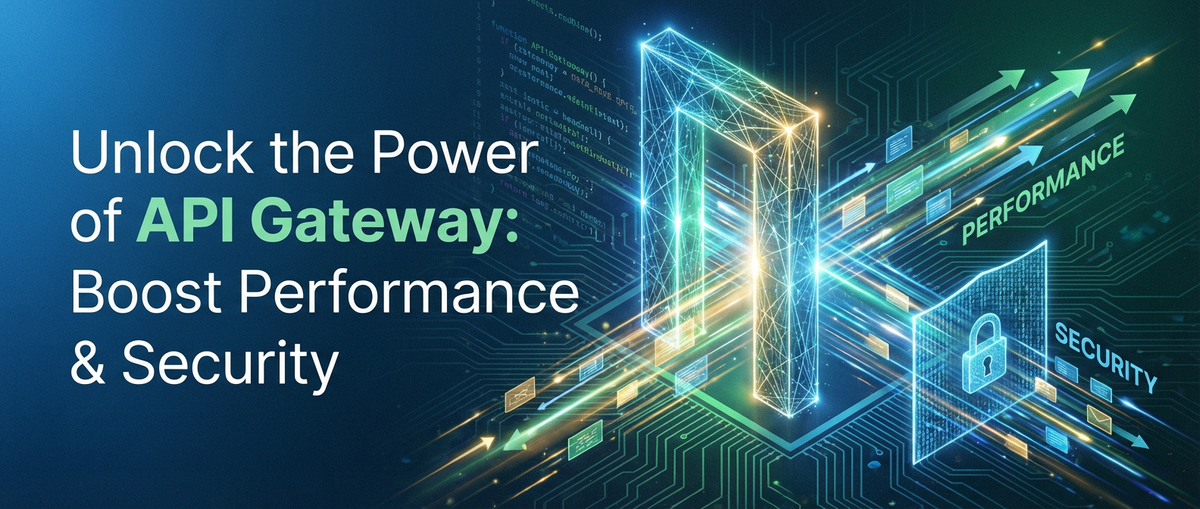
Unlock the Power of API Gateway: Boost Performance & Security


In the sprawling landscape of modern digital infrastructure, where applications communicate tirelessly through intricate networks of data exchange, Application Programming Interfaces (APIs) have emerged as the fundamental building blocks. These sophisticated interfaces are the very language through which software systems interact, enabling everything from seamless mobile banking to real-time data analytics and the intricate dance of microservices. As the reliance on APIs has grown exponentially, so too have the complexities associated with their management, security, and performance. The sheer volume of requests, the diversity of clients, the imperative for robust security, and the constant demand for optimal speed coalesce into a formidable challenge for any organization.
This is precisely where the API gateway steps onto the stage, not merely as a peripheral component, but as a central, indispensable orchestrator in the digital opera. An API gateway acts as a single entry point for all client requests, routing them to the appropriate backend services. More than just a traffic director, it's a sophisticated management layer that encapsulates a plethora of functionalities designed to enhance the overall stability, performance, and security of an API ecosystem. Without a robust API gateway, managing the multifaceted demands of a modern distributed system would be akin to directing a symphony orchestra without a conductor – chaotic, inefficient, and ultimately discordant. This comprehensive exploration will delve into the profound capabilities of the API gateway, dissecting its core functionalities, elucidating its myriad benefits, examining its architectural significance, and outlining the crucial considerations for its implementation, all while uncovering how it truly empowers businesses to unlock the full potential of their digital assets.
I. The Crucial Role of API Gateways in Modern Architectures
The evolution of software architecture has journeyed from monolithic applications to highly distributed, microservices-based systems. In this paradigm shift, APIs transformed from mere programmatic interfaces into strategic assets that power digital transformation, foster innovation, and enable partner ecosystems. Every time a mobile app fetches data, a web application interacts with a backend, or two enterprise systems exchange information, an API is typically at play.
However, this proliferation of APIs introduces a new set of challenges that traditional infrastructure components were not originally designed to address. Imagine a scenario where hundreds, or even thousands, of distinct microservices each expose their own unique set of APIs. If every client application had to individually discover, connect to, authenticate with, and manage error handling for each of these services, the complexity would quickly spiral out of control. Clients would become tightly coupled to the internal architecture, making changes difficult and fragile. Furthermore, implementing consistent security policies, monitoring, and rate limiting across a fragmented landscape of services would be a nightmarish endeavor.
This is the fundamental problem that an API gateway solves. Conceptually, an API gateway is a server that acts as an API frontend, providing a single, unified, and consistent entry point for a multitude of backend services. It abstracts away the complexity of the underlying microservices architecture from the consuming clients. Instead of clients needing to know the locations and interfaces of multiple services, they simply interact with the gateway. The gateway then intelligently routes these requests to the appropriate backend service, applying various policies and transformations along the way. This centralized control point is not just about routing; it's a strategic interception layer that significantly enhances an API ecosystem's overall robustness, manageability, and most importantly, its performance and security. By acting as a sophisticated intermediary, the API gateway liberates both clients and backend services from unnecessary burdens, allowing each to focus on its primary responsibility while the gateway expertly handles the intricacies of inter-service communication and external exposure.
II. Deconstructing the API Gateway: Core Functionalities and Mechanisms
The power of an API gateway lies in its rich array of functionalities, each meticulously designed to address specific challenges in modern API management. These features collectively transform a simple request router into a strategic control plane for all inbound and outbound API traffic. Understanding these core mechanisms is essential to fully grasp how a gateway can profoundly impact an organization's digital capabilities.
A. Request Routing and Load Balancing: Directing the Flow
At its heart, an API gateway is a sophisticated traffic controller. When a client sends a request to the gateway, it doesn't know (or need to know) which specific backend service or instance will handle that request. The gateway takes on the responsibility of intelligently routing the incoming request to the correct backend service. This routing can be based on various criteria, such as the request path, HTTP headers, query parameters, or even custom logic. For instance, a request to /api/v1/users might be routed to a "User Service," while a request to /api/v2/products could go to a "Product Service" and even specifically target version 2 of that service.
Beyond simply directing traffic, the gateway is also critical for load balancing. When multiple instances of a backend service are running to handle increased demand, the gateway can distribute incoming requests across these instances. This prevents any single service instance from becoming overwhelmed, ensuring high availability and contributing significantly to the overall performance of the system. Common load balancing algorithms include:
- Round-Robin: Distributes requests sequentially to each server in the pool.
- Least Connections: Sends new requests to the server with the fewest active connections.
- IP Hash: Directs requests from a specific client IP address to the same server, which can be useful for session persistence.
- Weighted Load Balancing: Prioritizes servers with higher capacity or better performance.
By intelligently routing and balancing the load, the API gateway ensures that resources are utilized efficiently, services remain responsive even under heavy traffic, and the user experience remains consistent and fast.
B. Authentication and Authorization: The First Line of Defense
One of the most critical functions of an API gateway is to act as the primary gatekeeper for your backend services, providing robust security measures. Exposing services directly to the internet without a centralized security layer is an invitation for vulnerabilities. The gateway centralizes authentication and authorization logic, ensuring that only legitimate and authorized clients can access your APIs.
- Authentication: The process of verifying the identity of the client making the request. The gateway can validate various forms of credentials, such as API keys, JSON Web Tokens (JWTs), OAuth2 tokens, or even integrate with enterprise identity providers. Instead of each backend service implementing its own authentication mechanism, the gateway handles this concern once, decoupling security from business logic.
- Authorization: After a client is authenticated, authorization determines what resources or operations that client is permitted to access. The gateway can enforce granular access control policies based on user roles, permissions, or specific attributes embedded in tokens. For example, an authenticated "guest" user might only be able to view product listings, while an "administrator" could modify product details.
By centralizing these security concerns, the API gateway significantly reduces the attack surface, simplifies security management, and ensures consistent enforcement of policies across all exposed APIs. This not only bolsters system integrity but also reduces the development overhead for individual microservices, as they can trust the gateway to have pre-vetted incoming requests.
C. Rate Limiting and Throttling: Preventing Abuse and Ensuring Fairness
Uncontrolled access to APIs can lead to various problems, including service degradation, resource exhaustion, and even denial-of-service (DoS) attacks. Rate limiting and throttling are essential API gateway features that regulate the number of requests a client can make within a specified time frame.
- Rate Limiting: This feature sets a maximum number of requests a consumer can make in a given period (e.g., 100 requests per minute). If a client exceeds this limit, the gateway will reject subsequent requests with an HTTP 429 (Too Many Requests) status code until the window resets. This mechanism is crucial for protecting backend services from being overwhelmed by a single misbehaving or malicious client.
- Throttling: Similar to rate limiting, but often involves a more granular control or a tiered approach. For example, a "free" tier client might be throttled at a lower rate than a "premium" subscriber. Throttling ensures fair usage of resources across different client types and can be a monetization strategy for API providers.
These mechanisms are vital for maintaining system stability and ensuring that all legitimate users receive a consistent level of service. They directly contribute to the performance of the overall system by preventing resource starvation and act as a critical layer of security against brute-force attacks and resource abuse.
D. Caching: Accelerating Responses and Reducing Load
For API calls that frequently return the same data, repeatedly querying backend services can be inefficient and wasteful of resources. An API gateway can implement caching mechanisms to store responses from backend services and serve them directly for subsequent identical requests.
- How it Works: When a request arrives, the gateway first checks its cache. If a valid, cached response exists for that request, it's immediately returned to the client without ever hitting the backend service. If not, the request is forwarded to the backend, and its response is then stored in the cache for future use.
- Benefits: Caching dramatically improves API performance by reducing latency for clients and significantly decreasing the load on backend services, allowing them to focus on processing unique or complex requests. This also translates into cost savings by reducing the computational demands on servers.
- Considerations: Effective caching requires careful management of cache invalidation strategies (e.g., time-based expiry, event-driven invalidation) to ensure that clients always receive up-to-date information when necessary.
By intelligently leveraging caching, the API gateway transforms frequently accessed data into instantaneously available resources, significantly enhancing the speed and efficiency of the entire API ecosystem.
E. Request/Response Transformation: Adapting for Diverse Consumers
In a heterogeneous environment, different clients may have varying expectations regarding API request and response formats. An API gateway can act as a powerful translator and adapter, modifying requests before they reach the backend and responses before they are sent back to the client.
- Header Manipulation: Adding, removing, or modifying HTTP headers to meet backend requirements or client expectations.
- Payload Transformation: Converting data formats (e.g., XML to JSON, or vice versa), restructuring JSON objects, or filtering sensitive data from responses before they reach the client. This is particularly useful for API versioning, where the gateway can translate requests from an older API version to a newer backend service's format, thus providing backward compatibility without burdening backend developers.
- Protocol Translation: While less common for basic REST gateways, advanced gateways can sometimes bridge different communication protocols, allowing clients using one protocol to interact with services using another (e.g., converting a REST request into a gRPC call for a backend service).
This capability simplifies client development by providing a consistent interface and allows backend services to evolve independently without forcing immediate client updates. It enhances flexibility and reduces coupling, making the entire system more adaptable and maintainable.
F. Monitoring and Logging: Gaining Visibility and Insight
To effectively manage, troubleshoot, and optimize an API ecosystem, deep visibility into API traffic is paramount. The API gateway, being the single point of entry, is ideally positioned to collect comprehensive data about every API call.
- Detailed Logging: The gateway records essential information for each request, including the client IP, request method, URL, status code, response time, request/response payload (optionally and securely), and user ID. These logs are invaluable for auditing, compliance, security analysis, and debugging issues.
- Metrics Collection: Beyond logs, the gateway can collect real-time metrics such as request rates, error rates, latency, and resource utilization. These metrics provide a clear picture of the API ecosystem's health and performance.
- Alerting: By integrating with monitoring systems, the gateway can trigger alerts based on predefined thresholds (e.g., if the error rate exceeds a certain percentage or latency spikes). This allows operations teams to proactively identify and address issues before they significantly impact users.
Centralized monitoring and logging simplify operational management, provide actionable insights into API usage and performance, and are crucial for maintaining the stability and security of your services.
G. Circuit Breaking and Fault Tolerance: Building Resilient Systems
In a distributed microservices architecture, one failing service can potentially cascade failures throughout the entire system, leading to widespread outages. The API gateway can implement circuit breaking patterns to enhance the resilience of the system.
- Circuit Breaker Pattern: Inspired by electrical circuit breakers, this pattern monitors the health of backend services. If a service experiences a certain number of consecutive failures or its response time degrades beyond a threshold, the gateway "trips" the circuit. Instead of continuing to send requests to the failing service, it immediately returns an error or a fallback response to the client. After a predefined cooldown period, the circuit moves to a "half-open" state, allowing a few test requests to pass through to check if the service has recovered. If successful, the circuit "closes," resuming normal operation.
- Fallback Mechanisms: When a circuit breaker is open, the gateway can be configured to provide a default or cached response instead of an error, offering a degraded but still functional experience to the client.
By implementing circuit breakers, the API gateway prevents a single point of failure from taking down the entire system, isolates faults, and ensures that the overall system remains available and responsive, even when individual backend services encounter issues. This is a critical component for achieving high availability and robust performance in complex distributed environments.
H. Protocol Translation: Bridging Disparate Systems
While often associated with RESTful APIs, modern API gateways are increasingly capable of handling a wider array of communication protocols. This feature is particularly valuable in environments where legacy systems or specialized services operate on different protocols than the standard web-friendly interfaces.
- REST to gRPC/SOAP/Kafka: A gateway can receive an incoming REST HTTP request from a client, translate it into a gRPC call for a high-performance backend microservice, or even queue a message to a Kafka topic. Conversely, it can translate responses from these backend protocols back into a format consumable by the original client.
- Benefits: This capability allows organizations to gradually modernize their infrastructure, integrate diverse systems without requiring a complete overhaul, and expose legacy services through modern, developer-friendly APIs. It provides significant flexibility and reduces the complexity of integration projects.
Protocol translation offered by a sophisticated API gateway acts as a universal adapter, making disparate systems interoperable and ensuring that the choice of backend protocol doesn't dictate client-side implementation.
I. AI Model Integration and Management (APIPark Specifics)
Beyond traditional API gateway functionalities, the advent of Artificial Intelligence and Machine Learning has introduced new requirements for managing AI models as services. This is where specialized platforms like APIPark exemplify how a modern API gateway transcends traditional roles, acting as an AI Gateway and API Management Platform.
Speaking of advanced capabilities, platforms like APIPark exemplify how a modern API gateway transcends traditional roles, offering specialized features for the rapidly evolving AI landscape. APIPark is an all-in-one AI gateway and API developer portal that is open-sourced under the Apache 2.0 license. It excels in quick integration of 100+ AI models, unifying API formats for AI invocation, and encapsulating prompts into REST APIs. This not only streamlines AI usage but also significantly reduces maintenance costs, a testament to how specialized API gateway solutions are evolving to meet complex demands. Beyond AI, APIPark provides end-to-end API lifecycle management, API service sharing within teams, and robust security features like access approval mechanisms, all while rivaling Nginx in performance with over 20,000 TPS on modest hardware (8-core CPU, 8GB memory). Its detailed API call logging and powerful data analysis further underscore its commitment to performance and security in the API management landscape. This dual focus on traditional API gateway functions and cutting-edge AI integration makes APIPark a powerful tool for organizations looking to leverage both their existing APIs and the burgeoning power of AI models in a unified, managed, and secure manner.
III. The Multifaceted Benefits of an API Gateway
The comprehensive set of functionalities offered by an API gateway translates into a wide array of strategic advantages for organizations. These benefits extend beyond mere technical conveniences, impacting areas from security and performance to developer experience and cost efficiency, fundamentally transforming how businesses manage and leverage their digital assets.
A. Enhanced Security Posture: Centralized Threat Detection and Prevention
One of the paramount benefits of an API gateway is its ability to significantly enhance the security posture of an entire API ecosystem. By acting as the sole entry point, it provides a centralized location to enforce a robust set of security policies, making it much harder for malicious actors to exploit vulnerabilities.
- Unified Security Policies: Instead of implementing authentication, authorization, and encryption protocols independently across numerous backend services, the gateway centralizes these controls. This ensures consistency and reduces the likelihood of configuration errors or forgotten security checks on individual services.
- DDoS Protection: With features like rate limiting and throttling, the gateway can effectively mitigate distributed denial-of-service (DDoS) attacks by blocking or slowing down suspicious traffic before it reaches and overwhelms backend services.
- Web Application Firewall (WAF) Capabilities: Many advanced API gateways integrate WAF functionalities, which can detect and block common web-based attacks such as SQL injection, cross-site scripting (XSS), and buffer overflows.
- Auditing and Compliance: Comprehensive logging of all API requests and responses provides an invaluable audit trail, essential for compliance with various industry regulations (e.g., GDPR, HIPAA, PCI DSS) and for forensic analysis in the event of a security incident.
- TLS/SSL Termination: The gateway can handle TLS/SSL termination, offloading the encryption/decryption burden from backend services and ensuring secure communication with clients. This simplifies certificate management and strengthens overall encryption.
This centralized approach to security not only provides a formidable defense layer but also simplifies the operational overhead associated with maintaining a secure API environment, ultimately protecting sensitive data and maintaining trust with users and partners.
B. Improved Performance and Scalability: Optimizing API Traffic
The quest for speed and responsiveness is unending in the digital realm. An API gateway is a critical enabler of superior performance and effortless scalability, ensuring that your APIs can handle fluctuating demand without compromise.
- Caching for Reduced Latency: As discussed, caching frequently accessed data at the gateway significantly reduces the round-trip time for requests, leading to much faster response times for clients. This directly translates to a better user experience and can reduce the load on backend databases and services.
- Efficient Load Balancing: By intelligently distributing incoming requests across multiple instances of backend services, the gateway prevents individual servers from becoming bottlenecks. This optimizes resource utilization, ensures high availability, and maintains consistent performance even under peak loads.
- Connection Pooling: The gateway can maintain persistent connections to backend services, reducing the overhead of establishing new connections for every request. This is particularly beneficial for protocols like HTTP/1.1 and for frequently accessed services, contributing to lower latency.
- Scalability Through Decoupling: The API gateway allows backend services to scale independently. As traffic increases, you can simply add more instances of a specific microservice, and the gateway will automatically include them in its load balancing pool. This elasticity ensures that the system can gracefully handle sudden surges in demand.
- Reduced Backend Workload: By handling tasks like authentication, rate limiting, and caching at the edge, the gateway offloads significant processing from backend services. This allows backend services to focus purely on their core business logic, improving their individual performance and reducing their resource footprint.
These optimizations collectively ensure that the API ecosystem remains highly responsive, available, and capable of scaling efficiently to meet evolving business needs, directly impacting customer satisfaction and operational costs.
C. Simplified Microservices Management: Taming Complexity
The microservices architectural style, while offering tremendous benefits in terms of agility and scalability, introduces its own set of complexities. An API gateway is instrumental in taming this complexity, providing a manageable façade over a potentially intricate backend.
- Decoupling Clients from Microservices: Clients interact only with the gateway, completely unaware of the number, location, or communication protocols of the underlying microservices. This decoupling means that backend services can be refactored, updated, or even replaced without impacting client applications, fostering greater agility.
- Service Discovery and Abstraction: The gateway handles the discovery of backend service instances, abstracting this detail from clients. Clients don't need to implement complex service discovery logic; they simply send requests to the static gateway endpoint.
- API Versioning: As APIs evolve, managing different versions can be challenging. The gateway can route requests based on API version headers or paths, directing them to appropriate service versions, and even performing transformations to ensure backward compatibility for older clients.
- Composition and Aggregation: For complex client requests that require data from multiple microservices, the API gateway can act as an aggregator. It can fan out a single client request to several backend services, collect their responses, compose them into a single, simplified response, and return it to the client. This significantly reduces the chattiness between client and backend, improving performance and simplifying client development.
- Graceful Degradation: In conjunction with circuit breakers, the gateway can implement strategies for graceful degradation. If a non-critical backend service is unavailable, the gateway can return a cached response or a default value instead of an error, preserving the overall functionality of the application.
By providing a clear separation of concerns and abstracting away internal complexities, the API gateway makes it significantly easier to develop, deploy, and manage microservices architectures, accelerating development cycles and reducing operational burdens.
D. Superior Developer Experience: Providing a Consistent Interface
A well-designed API ecosystem prioritizes the developer experience, recognizing that easy-to-use APIs lead to faster integration and broader adoption. The API gateway plays a crucial role in creating this superior experience.
- Unified API Interface: Developers only need to learn and interact with a single, consistent API endpoint provided by the gateway, rather than juggling multiple service endpoints with disparate authentication schemes and data formats.
- Simplified Client-Side Logic: By handling authentication, rate limiting, caching, and request/response transformations, the gateway offloads complex logic from client applications. This allows client developers to focus on core application features, reducing development time and effort.
- Clear Documentation and Discovery: Many API gateway solutions, including platforms like APIPark, integrate with or provide developer portals. These portals offer centralized API documentation, interactive playgrounds, and self-service dashboards for API key management, simplifying API discovery and consumption for internal and external developers.
- Sandbox Environments: The gateway can be used to route requests to sandbox or staging environments, allowing developers to test their integrations without impacting production systems.
By streamlining API consumption and providing a consistent, well-managed interface, the API gateway empowers developers to build innovative applications more quickly and efficiently, fostering a thriving ecosystem around your APIs.
E. Centralized Observability and Control: A Single Pane of Glass
Understanding the health, performance, and usage patterns of your APIs is critical for operational excellence. The API gateway, positioned at the forefront of all API traffic, offers an unparalleled vantage point for observability and control.
- Aggregated Logs: All API calls passing through the gateway are logged centrally, providing a comprehensive audit trail. This simplifies troubleshooting, allows for anomaly detection, and provides insights into API usage patterns across all services.
- Comprehensive Metrics: The gateway can collect and expose a wealth of real-time metrics, including request rates, latency, error rates, and unique client counts. These metrics are invaluable for performance monitoring, capacity planning, and identifying potential bottlenecks or service degradations.
- Distributed Tracing Integration: Modern API gateways often integrate with distributed tracing systems (e.g., OpenTelemetry, Jaeger, Zipkin). They can inject trace headers into requests, allowing you to follow a single request's journey through multiple microservices, providing deep visibility into the entire transaction flow and pinpointing exact sources of latency or errors.
- Centralized Policy Management: From a single interface, operations teams can apply and modify security policies, rate limits, caching rules, and routing configurations across all exposed APIs, ensuring consistency and simplifying management.
This centralized view empowers operations teams with the insights and control necessary to maintain high availability, optimize performance, and quickly respond to any issues, turning raw data into actionable intelligence.
F. Cost Efficiency: Optimized Resource Utilization
While implementing an API gateway involves initial setup and ongoing management, it can lead to significant cost efficiencies in the long run by optimizing resource utilization and streamlining development and operations.
- Reduced Backend Load: By offloading tasks like authentication, rate limiting, and caching, the gateway reduces the processing burden on backend services. This means backend services can often run on smaller, fewer, or less powerful instances, leading to direct savings on compute resources (CPU, memory) and associated cloud infrastructure costs.
- Efficient Scaling: The gateway enables more efficient scaling. Instead of scaling all microservices indiscriminately, you can precisely scale only the services that are experiencing increased load, thanks to the gateway's intelligent routing and load balancing capabilities.
- Faster Development Cycles: By simplifying client integration, centralizing security, and abstracting backend complexity, the API gateway accelerates development cycles for both client and backend teams. Faster development means quicker time-to-market for new features and products, yielding earlier revenue generation.
- Streamlined Operations: Centralized monitoring, logging, and policy management reduce the operational complexity and the manual effort required to manage a large API ecosystem. This frees up valuable engineering time, allowing teams to focus on innovation rather than firefighting.
- Improved System Resilience: The fault tolerance features of an API gateway (like circuit breaking) reduce the likelihood of costly outages, minimizing potential revenue loss and reputational damage.
The API gateway acts as a strategic investment that pays dividends by optimizing infrastructure costs, accelerating development, and fortifying the operational resilience of your digital services.
IV. API Gateway in Architectural Contexts: Patterns and Placement
The deployment of an API gateway is not a one-size-fits-all proposition; its integration varies significantly depending on the underlying architectural style and specific organizational needs. Understanding where and how an API gateway fits into different architectural patterns is crucial for maximizing its benefits.
A. Traditional Monolithic Architectures: Enhancing Existing Services
Even in older, monolithic application architectures, an API gateway can offer substantial value. While monoliths typically expose a single, large API, adding a gateway in front of it can provide several immediate benefits:
- Centralized Security: The gateway can enforce authentication, authorization, and rate limiting uniformly across the entire monolithic API, enhancing security without modifying the core application code.
- Performance Optimization: Caching and basic load balancing can significantly improve the performance of the monolithic API, especially for read-heavy operations, by reducing the load on the single backend.
- Evolutionary Path to Microservices: An API gateway can act as a crucial first step in a strangler fig pattern, gradually allowing parts of the monolith to be refactored into microservices behind the same gateway interface, without clients needing to know about the transition. This provides a consistent API facade while internal changes are made.
In this context, the gateway primarily acts as an enhancement layer, adding modern API management capabilities to existing systems.
B. Microservices Architectures: The Natural Home for an API Gateway
Microservices architectures are where the API gateway truly shines and often becomes an indispensable component. The very nature of a distributed system with numerous, independently deployable services necessitates a sophisticated routing and management layer.
- Edge Gateway: This is the most common placement, where a single API gateway sits at the perimeter of the microservices cluster, handling all external "north-south" traffic (from outside the cluster to inside). It serves as the primary entry point for all client applications, abstracting the internal complexity of service discovery, multiple endpoints, and communication protocols. This pattern simplifies client interaction significantly.
- Internal Gateways (or API Façades): While less common than edge gateways, sometimes larger microservice ecosystems might employ internal gateways. These could be used to aggregate specific sets of internal services for consumption by other internal services, creating a controlled internal API layer. This can further simplify inter-service communication and enforce policies within specific domains.
- Complementary to Service Meshes: It's important to distinguish an API gateway from a service mesh (e.g., Istio, Linkerd). An API gateway primarily handles "north-south" traffic (external to internal), focusing on client-facing concerns like security, rate limiting, and API aggregation. A service mesh, on the other hand, manages "east-west" traffic (internal service-to-service communication), focusing on concerns like inter-service routing, retry logic, traffic splitting, and policy enforcement within the cluster. They are complementary technologies, with the API gateway often sitting in front of the service mesh.
In microservices, the API gateway is the orchestrator that manages the external exposure of services, providing a stable and secure interface while allowing internal services to evolve independently.
C. Backend-for-Frontend (BFF) Pattern: Tailoring APIs for Specific Clients
The Backend-for-Frontend (BFF) pattern is a specialization of the API gateway concept, particularly relevant in microservices environments serving diverse client applications (e.g., web, mobile iOS, mobile Android, smart TVs).
- Concept: Instead of a single, generic API gateway serving all clients, the BFF pattern suggests creating a separate gateway (or microservice) specifically tailored for each distinct client application. Each BFF aggregates and transforms data from various backend microservices into a format optimized for its specific client's UI requirements.
- Advantages:
- Client-Specific Optimization: Reduces client-side logic and network chattiness by pre-processing data and fetching only what each client needs. This significantly improves performance and user experience, especially for mobile clients with limited bandwidth.
- Decoupling: Changes in one client's UI or requirements don't necessarily affect other clients' BFFs or the core backend microservices.
- Team Autonomy: Allows frontend teams to own and evolve their specific BFFs independently, aligning better with organizational structures.
- Considerations: This pattern introduces more gateway instances, potentially increasing operational overhead. It requires careful consideration of shared concerns (like authentication) that might still be handled by a more generic edge gateway sitting in front of the BFFs.
The BFF pattern acknowledges that "one API for all" doesn't always lead to the best client experience, offering a powerful way to optimize APIs for diverse consumer needs.
D. Cloud-Native and Serverless Environments: Managed Gateway Services
The rise of cloud computing and serverless architectures has also influenced API gateway deployments, with major cloud providers offering managed gateway services.
- Managed Gateway Services: Cloud providers like AWS API Gateway, Azure API Management, and Google Cloud Apigee offer fully managed API gateway solutions. These services abstract away the infrastructure management, allowing users to focus on configuring APIs and policies. They typically offer robust features for security, caching, rate limiting, monitoring, and integration with other cloud services.
- Integration with Serverless Functions: These managed gateways are perfectly suited for fronting serverless functions (e.g., AWS Lambda, Azure Functions, Google Cloud Functions). The gateway handles the HTTP request, authenticates it, and then triggers the appropriate serverless function, seamlessly connecting traditional HTTP clients to event-driven serverless backends.
- Edge Computing Integration: With edge computing, API gateways can be deployed closer to the users, leveraging Content Delivery Networks (CDNs) or edge functions. This reduces latency by processing requests and serving cached content at the network edge, further boosting performance.
Cloud-native API gateways offer ease of deployment, scalability, and integration within the broader cloud ecosystem, making them a popular choice for modern, agile development teams.
APIPark is a high-performance AI gateway that allows you to securely access the most comprehensive LLM APIs globally on the APIPark platform, including OpenAI, Anthropic, Mistral, Llama2, Google Gemini, and more.Try APIPark now! 👇👇👇
V. Implementing an API Gateway: Key Considerations and Best Practices
Deploying and managing an API gateway is a strategic decision that requires careful planning and adherence to best practices to truly unlock its potential for enhanced performance and security. From selecting the right solution to ensuring high availability and robust monitoring, each step contributes to the success of your API ecosystem.
A. Choosing the Right Solution: Open-source vs. Commercial, Cloud vs. On-premise
The market offers a diverse range of API gateway solutions, each with its own strengths and weaknesses. The selection process should align closely with your organization's technical capabilities, budget, compliance requirements, and long-term vision.
- Open-source Solutions (e.g., Kong, Apache APISIX, Tyk, APIPark):
- Pros: Cost-effective (no licensing fees), high degree of customization, strong community support, avoid vendor lock-in. APIPark, for instance, is an open-source AI gateway and API management platform under Apache 2.0, offering core gateway functionalities alongside specialized AI integration.
- Cons: Requires internal expertise for deployment, configuration, maintenance, and potentially enterprise-grade support (though many open-source projects offer commercial support plans, as APIPark does for leading enterprises).
- Commercial Solutions (e.g., Apigee, AWS API Gateway, Azure API Management, NGINX Plus):
- Pros: Comprehensive feature sets, professional support, often fully managed (especially cloud-native solutions), robust documentation, faster time-to-market for complex needs.
- Cons: Higher licensing costs, potential for vendor lock-in, less flexibility for deep customization.
- Cloud-Native vs. On-premise:
- Cloud-Native (Managed): Offers elastic scalability, high availability, reduced operational burden, seamless integration with other cloud services. Ideal for cloud-first strategies.
- On-premise/Self-Hosted: Provides maximum control over infrastructure, crucial for strict compliance or hybrid cloud scenarios. Requires significant operational expertise and resource allocation.
Key factors to consider during selection: * Feature Set: Does it meet your current and anticipated needs for routing, security, caching, rate limiting, and special requirements (e.g., AI integration like APIPark)? * Performance Benchmarks: Evaluate its throughput (TPS), latency, and resource consumption under load, especially if high performance is critical. APIPark, for example, boasts performance rivaling Nginx, achieving over 20,000 TPS on modest hardware. * Scalability and High Availability: How easily can it scale to handle growing traffic? What are its built-in mechanisms for redundancy and fault tolerance? * Developer Experience: Is it easy to configure and manage? Does it offer a developer portal? * Ecosystem Integration: How well does it integrate with your existing monitoring, logging, CI/CD pipelines, and identity management systems? * Cost: Analyze total cost of ownership (TCO) including licenses, infrastructure, and operational effort.
B. Performance Tuning and Optimization: Maximizing Throughput and Minimizing Latency
Even the most powerful API gateway can become a bottleneck if not properly configured and optimized. Performance tuning is an ongoing process that requires careful attention to detail.
- Hardware and Network Considerations: Deploy the gateway on sufficiently provisioned hardware (physical or virtual) with adequate CPU, memory, and high-performance network interfaces. Minimize network latency between the gateway and backend services.
- Efficient Configuration:
- Connection Pooling: Configure the gateway to reuse connections to backend services (HTTP keep-alives) to reduce the overhead of connection establishment.
- Buffer Sizes: Optimize buffer sizes for incoming and outgoing data to prevent unnecessary disk I/O or network fragmentation.
- Compression: Enable Gzip or Brotli compression for responses to reduce bandwidth usage and improve client-side loading times.
- SSL/TLS Offloading: Perform SSL/TLS termination at the gateway using specialized hardware or optimized software to offload this CPU-intensive task from backend services.
- Caching Strategy: Implement a robust caching strategy for read-heavy APIs, carefully defining cache keys, expiry times, and invalidation rules to maximize cache hit rates while ensuring data freshness.
- Asynchronous Processing: Where applicable, leverage asynchronous I/O and non-blocking operations within the gateway to handle a large number of concurrent connections efficiently.
- Benchmarking and Stress Testing: Regularly test your gateway's performance under various load conditions using tools like JMeter, k6, or Locust. Identify bottlenecks, measure latency, and validate scalability assumptions.
- Profiling: Use performance profiling tools to analyze the gateway's resource consumption and identify specific areas for optimization (e.g., excessive CPU usage, memory leaks).
By meticulously tuning these aspects, you can ensure that your API gateway operates at peak performance, providing low-latency responses and handling high throughput even under extreme load.
C. Security Best Practices: Fortifying Your API Perimeter
The API gateway is the frontline of your API security, and its fortification is paramount. Adhering to comprehensive security best practices is non-negotiable.
- Implement OWASP API Security Top 10: This list provides a crucial framework for understanding and mitigating common API security risks. The gateway can help address many of these at a centralized level.
- Strong Authentication and Authorization: Enforce robust authentication mechanisms (OAuth2, JWT, API keys) and granular Role-Based Access Control (RBAC) at the gateway level. Ensure all tokens are validated for integrity and expiry. Implement multi-factor authentication where appropriate.
- TLS/SSL for All Traffic: Mandate HTTPS for all client-to-gateway and gateway-to-backend communication. Use strong ciphers and up-to-date TLS versions. Rotate and manage certificates effectively.
- Input Validation and Sanitization: While the gateway can perform basic validation, comprehensive input validation should occur at both the gateway and backend services to prevent injection attacks and malformed requests.
- Rate Limiting and Throttling: Configure aggressive rate limits to protect against DDoS attacks, brute-force attempts, and resource exhaustion. Implement different tiers for various client types.
- Web Application Firewall (WAF): Utilize WAF capabilities within the gateway to detect and block common web attack patterns.
- Security Logging and Auditing: Enable detailed API call logging, including client details, request/response headers, and any security-related events. Integrate these logs with a Security Information and Event Management (SIEM) system for real-time threat detection and analysis. APIPark provides comprehensive logging capabilities, recording every detail of each API call, which is crucial for quick tracing and troubleshooting issues.
- Principle of Least Privilege: Configure the gateway with only the necessary permissions to interact with backend services.
- Regular Security Audits and Penetration Testing: Periodically conduct security audits and penetration tests on your API gateway and its configurations to identify and remediate vulnerabilities.
- Secrets Management: Securely store and retrieve API keys, certificates, and other sensitive credentials used by the gateway through dedicated secrets management solutions.
A proactive and layered approach to security at the API gateway level is fundamental to protecting your digital assets and maintaining the trust of your users.
D. High Availability and Disaster Recovery: Ensuring Uninterrupted Service
An API gateway is a critical component; if it fails, all API traffic stops. Therefore, designing for high availability (HA) and disaster recovery (DR) is paramount to ensure uninterrupted service.
- Clustering and Redundancy: Deploy the API gateway in a clustered configuration with multiple instances running across different availability zones or data centers. Use load balancers (external to the gateway) to distribute traffic among these gateway instances.
- Active-Passive vs. Active-Active:
- Active-Passive: One gateway instance is active, and others are on standby, ready to take over if the active one fails. Simpler to manage but resources are underutilized.
- Active-Active: All gateway instances are simultaneously active, sharing the load. Offers better resource utilization and potentially higher performance, but requires more complex state synchronization.
- Stateless Gateway Configuration: Design your gateway configuration to be as stateless as possible across instances, or use a distributed state store (e.g., Redis, ZooKeeper) for shared data (like rate limit counters, cache invalidation messages).
- Automated Failover: Implement automated mechanisms to detect gateway instance failures and automatically reroute traffic to healthy instances without manual intervention.
- Multi-Region Deployment: For extreme resilience against regional outages, deploy API gateway clusters in multiple geographic regions. Use global DNS or load balancing to direct users to the closest healthy region.
- Backup and Restore: Regularly back up gateway configurations, policies, and data. Have a well-tested disaster recovery plan to restore services quickly in case of catastrophic failure.
Ensuring high availability and a robust disaster recovery strategy for your API gateway is crucial for meeting uptime Service Level Agreements (SLAs) and safeguarding business continuity.
E. Monitoring and Alerting Strategies: Staying Ahead of Issues
While logging provides historical data, real-time monitoring and proactive alerting are essential for operational health. The API gateway should be a central part of your observability stack.
- Define Key Metrics: Identify critical performance and security metrics to monitor:
- Performance: Request rate (RPS), latency (p95, p99), error rate (HTTP 5xx), CPU/memory usage, network I/O.
- Security: Number of blocked requests (rate limiting, WAF), unauthorized access attempts, anomalous traffic patterns.
- Integrate with Observability Tools: Connect the API gateway to your existing monitoring systems (e.g., Prometheus, Datadog, Grafana), logging aggregators (e.g., ELK Stack, Splunk), and tracing platforms (e.g., Jaeger, Zipkin).
- Set Up Meaningful Alerts: Configure alerts based on predefined thresholds for critical metrics. For example:
- High error rates (e.g., 5% 5xx errors over 5 minutes).
- Spikes in latency (e.g., p99 latency exceeding 500ms).
- Sudden drops in request volume (potential outage).
- Unusual spikes in blocked security requests.
- Dashboards and Visualizations: Create clear, intuitive dashboards to visualize the gateway's health and performance at a glance. Trend analysis, as offered by APIPark's powerful data analysis, can help businesses with preventive maintenance.
- Distributed Tracing: Ensure the gateway propagates tracing headers to backend services, allowing end-to-end visibility of requests across the entire microservices architecture.
- Automated Runbooks: For common alert scenarios, define automated runbooks or incident response procedures to guide operations teams in troubleshooting and resolution.
A comprehensive monitoring and alerting strategy empowers operations teams to detect and address issues proactively, minimizing downtime and maintaining optimal performance.
F. Lifecycle Management of the Gateway Itself: Configuration as Code
Managing the API gateway configuration, policies, and software versions throughout its lifecycle is as important as managing your APIs.
- Version Control for Configuration: Treat the gateway's configuration as code. Store all policies, routing rules, and security settings in a version control system (e.g., Git). This enables trackable changes, rollbacks, and collaborative development.
- Automated Deployment: Use Infrastructure as Code (IaC) tools (e.g., Terraform, Ansible, Kubernetes operators) and CI/CD pipelines to automate the deployment and updates of the API gateway instances and their configurations. This ensures consistency and reduces manual errors.
- Regular Software Updates: Keep the API gateway software itself up-to-date with the latest patches and versions to benefit from new features, performance improvements, and critical security fixes.
- Testing: Thoroughly test new configurations and software versions in staging environments before deploying to production. This includes functional testing, performance testing, and security validation.
- Documentation: Maintain clear and comprehensive documentation for the gateway's architecture, configuration, operational procedures, and troubleshooting guides.
Effective lifecycle management ensures that the API gateway remains stable, secure, and performant throughout its operational lifespan, adapting to evolving requirements with agility.
VI. Challenges and Pitfalls of API Gateways
While the benefits of an API gateway are substantial, it's not a silver bullet without its own set of challenges. Awareness of these potential pitfalls is crucial for successful implementation and management.
A. Single Point of Failure: The Centralized Risk
By design, the API gateway centralizes all inbound API traffic. This centralization, while beneficial for management and policy enforcement, inherently creates a potential single point of failure (SPOF). If the gateway itself experiences an outage, it can bring down the entire API ecosystem, irrespective of the health of the underlying backend services.
- Mitigation: This risk is typically mitigated through robust high availability (HA) strategies. Deploying the gateway in a cluster with multiple redundant instances, distributing them across different availability zones or data centers, and implementing automated failover mechanisms are essential. External load balancers sitting in front of the gateway cluster are also critical for distributing traffic and handling failovers gracefully. While the gateway can be a SPOF, a well-architected deployment with redundancy largely eliminates this concern.
B. Increased Latency: The Overhead of an Additional Hop
Introducing an API gateway means adding an extra network hop and an additional processing layer between the client and the backend service. This can, in some cases, introduce a slight increase in end-to-end latency. While often negligible for most applications, it can be a concern for ultra-low latency scenarios.
- Mitigation:
- Optimize Gateway Performance: As discussed in Section V.B, rigorous performance tuning of the gateway (caching, connection pooling, efficient processing) is key to minimizing this overhead.
- Strategic Placement: Deploy the gateway geographically close to its clients and backend services where possible.
- Offload Heavy Processing: Delegate heavy computational tasks (like complex data transformations) to backend services if the gateway becomes a bottleneck, keeping the gateway focused on its core responsibilities.
- Bypass for Internal Calls: For purely internal service-to-service communication within a microservices mesh, consider allowing services to communicate directly or through a service mesh's sidecar proxy, bypassing the edge gateway to avoid unnecessary hops.
The benefits gained from the gateway's features (security, caching, resilience) often far outweigh the minimal latency increase, but it's a factor to monitor and optimize.
C. Operational Complexity: Managing Another Critical Component
An API gateway is a sophisticated piece of software that requires careful configuration, deployment, monitoring, and maintenance. Adding it to your infrastructure means adding another critical component that needs operational expertise and resources.
- Configuration Management: Managing routing rules, security policies, rate limits, and caching strategies across a large number of APIs can become complex.
- Deployment and Updates: Ensuring smooth deployment of the gateway itself and its configurations, especially in high-availability setups, requires robust CI/CD pipelines.
- Troubleshooting: Diagnosing issues that involve the gateway, client, and backend services requires skilled operators and good observability tools.
- Mitigation:
- Automation: Leverage Infrastructure as Code (IaC) and configuration as code principles to automate gateway provisioning and configuration changes.
- Developer Portals and Self-Service: Provide user-friendly interfaces (like APIPark's developer portal) for teams to manage their API keys, subscriptions, and access basic API metrics, reducing the burden on central operations teams.
- Comprehensive Monitoring: Implement detailed monitoring and alerting for the gateway itself to quickly identify and address operational issues.
- Managed Services: For organizations with limited operational resources, opting for a fully managed cloud API gateway service can significantly reduce this complexity.
While there's an inherent increase in operational complexity, strategic automation and smart management tools can effectively address it.
D. Over-Centralization and Bottlenecks: Avoiding a Monolithic Gateway
The desire to centralize concerns can sometimes lead to an anti-pattern: a monolithic API gateway that becomes too complex, too feature-rich, and ultimately a bottleneck for development and deployment. If the gateway itself becomes a single, massive application handling every conceivable feature for all APIs, it loses its agility.
- Mitigation:
- Keep it Lean: Focus the API gateway on core, cross-cutting concerns (security, routing, rate limiting, caching). Delegate business-specific logic and complex data transformations to backend services or dedicated BFFs.
- Decompose the Gateway: For very large organizations or diverse ecosystems, consider deploying multiple smaller, purpose-specific gateways (e.g., one for public APIs, one for internal APIs, or BFFs for different client types), rather than one massive, all-encompassing gateway.
- Autonomous Teams: Ensure that changes to the gateway configuration can be made by autonomous teams where appropriate, without requiring a single bottleneck team for all modifications.
The API gateway should be a smart, efficient intermediary, not another monolith that hinders agility.
E. Vendor Lock-in (for Commercial Solutions)
Choosing a commercial or cloud-specific API gateway solution can introduce a degree of vendor lock-in. Migrating from one proprietary gateway to another can be a significant undertaking, involving re-configuring all APIs, policies, and integrations.
- Mitigation:
- Evaluate Portability: During selection, consider how easily you could potentially migrate your API configurations to an alternative solution if needed.
- Open Standards: Favor gateways that support open standards (e.g., OpenAPI/Swagger for API definitions, OAuth2 for security).
- Hybrid Approach: For organizations sensitive to lock-in, open-source API gateways provide an excellent alternative, offering greater control and flexibility. APIPark, being open-source, provides this flexibility while still offering commercial support for enterprises desiring it.
- Strategic Choice: Weigh the benefits of a fully managed service (reduced operational burden) against the potential long-term risks of vendor lock-in.
While some level of vendor dependency is often unavoidable in enterprise software, being aware of it and planning for potential migration scenarios can help manage the risk.
Table 1: Key API Gateway Features and Their Strategic Benefits | Feature Category | Specific Feature | Strategic Benefits | Keywords Addressed | | :--------------------- | :----------------------------------- | :---------------------------------------------------------------------------------------------------------------------------------------------------------------------------------------------------------- | :--------------------------- | | Traffic Management | Request Routing | Decouples clients from backend complexity, enables seamless microservices evolution, improves system maintainability. | api gateway, api | | | Load Balancing | Ensures high availability, distributes traffic efficiently across service instances, prevents overloads, boosts overall performance. | api gateway, performance | | | Caching | Significantly reduces latency for clients, lowers load on backend services, improves performance and resource efficiency. | api gateway, performance | | Security & Access | Authentication & Authorization | Centralizes security enforcement, protects backend services from unauthorized access, simplifies security management, ensures consistent policy application. | api gateway, security | | | Rate Limiting & Throttling | Prevents API abuse and DDoS attacks, ensures fair resource usage, maintains system stability and performance. | api gateway, security | | | WAF (Web Application Firewall) | Protects against common web vulnerabilities (SQL injection, XSS), adds a crucial layer of security. | api gateway, security | | Transformation | Request/Response Transformation | Adapts APIs for diverse clients, simplifies api versioning, reduces client-side logic, enhances developer experience. | api gateway, api | | | Protocol Translation | Bridges disparate systems, allows seamless integration of services using different communication protocols, enhances interoperability. | api gateway, api | | Resilience & Op. | Circuit Breaking & Fault Tolerance | Prevents cascading failures, isolates faults, maintains system availability and resilience, crucial for robust performance. | api gateway, performance | | | Monitoring, Logging & Analytics | Provides deep visibility into api usage and health, enables proactive issue detection, aids in security auditing and compliance, powerful data analysis for preventive maintenance (e.g., APIPark). | api gateway, api, security | | Advanced Functions | AI Model Integration (e.g., APIPark) | Centralizes management and access for AI models, unifies invocation formats, streamlines AI adoption, and reduces integration complexity. | api gateway, api, gateway |
VII. The Evolution of API Gateways: Current Trends and Future Outlook
The landscape of software architecture is in a perpetual state of flux, and the API gateway is evolving alongside it. New technologies and paradigms are continuously shaping its role, pushing it beyond traditional traffic management into more intelligent and integrated forms.
A. AI-Powered Gateways: Intelligence at the Edge
The most exciting and transformative trend is the emergence of AI-powered API gateways. Just as APIPark positions itself as an "AI gateway," this signifies a shift from reactive policy enforcement to proactive, intelligent decision-making.
- Intelligent Routing and Optimization: AI/ML models can analyze real-time traffic patterns, backend service health, and historical data to make more intelligent routing decisions, optimizing for latency, cost, or specific service level objectives.
- Anomaly Detection and Predictive Security: AI can detect unusual traffic patterns, potential security threats (like sophisticated bot attacks or zero-day exploits), and system anomalies more effectively than rule-based systems. This enables predictive security and proactive defense.
- Automated Scaling and Resource Management: AI can anticipate traffic surges and automatically scale gateway instances or even backend services, ensuring optimal performance and resource utilization.
- Smart Caching: AI can optimize caching strategies, predicting which data will be requested next or identifying stale data more efficiently.
- Simplified AI Integration: As demonstrated by APIPark, AI gateways are specifically designed to simplify the integration and management of AI models as services, providing unified API formats for invocation and encapsulating prompts into REST APIs. This lowers the barrier to entry for leveraging AI in applications.
The integration of AI transforms the API gateway into an adaptive, self-optimizing, and highly intelligent component of the digital infrastructure, enhancing both performance and security in unprecedented ways.
B. Integration with Service Meshes: Complementary Roles
As discussed earlier, API gateways and service meshes serve different but complementary roles. The trend is towards deeper integration between these two technologies to create a holistic traffic management and observability solution.
- North-South vs. East-West: The API gateway remains the entry point for "north-south" traffic (external client to services), handling external concerns like public API exposure, client authentication, and DDoS protection. The service mesh handles "east-west" traffic (internal service-to-service), managing concerns like internal routing, policy enforcement, mTLS, and observability within the cluster.
- Unified Control Plane: Future developments will see a more unified control plane that can manage both the API gateway and the service mesh. This would allow consistent policy definitions and observability across the entire communication stack, from the edge to the deepest internal service.
- Simplified Configuration: Tools and platforms are emerging to abstract away the complexity of configuring both components, providing a simpler interface for developers and operators.
This integration creates a powerful synergy, combining the external exposure capabilities of a gateway with the internal resilience and management of a service mesh, providing unparalleled control over the entire API lifecycle.
C. GraphQL Gateways: Empowering Flexible Client-Side Data Fetching
Traditional REST API gateways excel at exposing multiple REST endpoints. However, the rise of GraphQL as a query language for APIs has led to the development of specialized GraphQL gateways.
- Solving Over-fetching and Under-fetching: GraphQL allows clients to request precisely the data they need, eliminating the problems of over-fetching (receiving more data than required) and under-fetching (needing multiple requests to get all necessary data) common with REST.
- Schema Stitching and Federation: A GraphQL gateway can aggregate data from multiple backend REST or GraphQL services into a single, unified GraphQL schema. This allows clients to make a single GraphQL query that fetches data from various microservices, significantly simplifying client-side development.
- API Composability: The gateway acts as a powerful composition layer, providing a single endpoint for all data access while abstracting the complexity of the underlying data sources.
GraphQL gateways offer a compelling alternative or complement to REST gateways, particularly for data-intensive applications requiring highly flexible and efficient data fetching capabilities.
D. Serverless Integration and Edge Computing: Pushing Logic Closer to the User
The serverless paradigm and edge computing are pushing API gateway capabilities closer to the data source and the user, respectively.
- Serverless-Native Gateways: Cloud-managed API gateways are increasingly optimized for serverless functions, providing seamless integration, low cold-start times, and cost-effective scaling for event-driven architectures. They act as the HTTP front-end for serverless backends, simplifying development and deployment.
- Edge Gateways/Functions: Deploying API gateway logic at the network edge (via CDNs or edge computing platforms) allows for ultra-low latency responses, especially for geographically dispersed users. This enables faster caching, local authentication, and even simple data transformations to occur closer to the client, significantly boosting performance and user experience.
- Decentralized Control: This trend hints at a more decentralized approach to gateway functions, where some logic resides at the edge for performance, while core management and security policies are still centralized.
These advancements signify a move towards highly responsive, globally distributed API architectures that leverage the power of serverless and edge computing.
E. Focus on Developer Portals: Enhancing Self-Service Capabilities
Recognizing that APIs are products, the importance of a robust developer experience is paramount. API gateways are increasingly being bundled with or tightly integrated into comprehensive developer portals.
- Self-Service Management: Developer portals allow API consumers (internal or external) to discover APIs, access documentation, manage their API keys, monitor their usage, and subscribe to APIs (with approval workflows, as offered by APIPark).
- Community and Support: Portals often include features for forums, tutorials, and support channels, fostering a thriving developer community around the APIs.
- Monetization and Analytics: For public APIs, portals can integrate with billing systems and provide detailed analytics on API usage, helping businesses understand and monetize their API assets.
This focus on developer portals ensures that the investment in a powerful API gateway translates into broader API adoption, faster integration cycles, and a stronger API ecosystem. APIPark's design as an "all-in-one AI gateway and API developer portal" perfectly encapsulates this trend.
VIII. Conclusion: API Gateways as the Cornerstone of Modern Digital Infrastructure
In an era defined by interconnectedness and data fluidity, APIs are no longer just technical interfaces; they are the strategic arteries through which digital businesses operate, innovate, and expand. The relentless demand for agility, scalability, and robust security in this environment has elevated the API gateway from a mere infrastructural component to an indispensable cornerstone of modern digital infrastructure.
We have traversed the vast landscape of its capabilities, from its fundamental role in intelligent request routing and efficient load balancing, which dramatically enhance performance and availability, to its crucial function as the primary enforcer of security policies, shielding valuable backend services from myriad threats. We've seen how its features—like sophisticated caching, transformative data manipulation, and resilient circuit breaking—collectively work to deliver unparalleled speed, stability, and operational efficiency. Furthermore, innovative platforms like APIPark are pushing the boundaries, integrating advanced AI model management directly into the gateway itself, demonstrating how these systems are evolving to meet the complex demands of emerging technologies while upholding foundational principles of performance and security.
The API gateway simplifies the intricate complexities of microservices architectures, empowers developers with a consistent and streamlined experience, and provides a centralized vantage point for unparalleled observability and control. Its strategic deployment leads to significant cost efficiencies, allowing organizations to optimize resource utilization and accelerate their pace of innovation. While challenges such as potential single points of failure and operational complexity exist, these can be effectively mitigated through meticulous planning, robust high-availability strategies, and intelligent automation.
As we look towards the future, the API gateway continues its evolution, embracing AI-powered intelligence, deeper integration with service meshes, flexible GraphQL capabilities, and closer ties with serverless and edge computing paradigms. These advancements promise even greater levels of performance, security, and adaptability, ensuring that businesses can continue to unlock the full potential of their APIs and navigate the complexities of the digital future with confidence and agility. Investing in a powerful and well-managed API gateway is not merely a technical choice; it is a strategic imperative for any organization aiming to thrive in the digital economy.
Frequently Asked Questions (FAQs)
- What is an API Gateway and why is it essential for modern architectures? An API gateway acts as a single entry point for all client requests to your APIs. It's essential because it centralizes critical functionalities such as request routing, load balancing, authentication, authorization, rate limiting, and caching. This centralization enhances security, improves performance, simplifies microservices management, and provides a consistent interface for developers, effectively abstracting the complexity of backend services from clients.
- How does an API Gateway improve API performance? An API gateway boosts performance through several mechanisms:
- Caching: Stores and serves frequently requested data directly, reducing backend load and latency.
- Load Balancing: Distributes incoming traffic efficiently across multiple service instances, preventing bottlenecks and ensuring responsiveness.
- Connection Pooling: Reuses network connections to backend services, reducing connection overhead.
- Offloading: Handles common tasks like SSL/TLS termination and authentication, freeing backend services to focus on business logic.
- Aggregation: Can combine responses from multiple services into a single response, reducing client-server communication.
- What security features does an API Gateway typically provide? API gateways are critical for bolstering API security. They provide:
- Centralized Authentication & Authorization: Verifies client identity and permissions (e.g., via API keys, OAuth2, JWTs).
- Rate Limiting & Throttling: Protects against abuse, DDoS attacks, and resource exhaustion.
- Web Application Firewall (WAF) Integration: Detects and blocks common web-based attacks.
- SSL/TLS Termination: Ensures secure, encrypted communication with clients.
- Auditing and Logging: Provides detailed records of API calls for compliance and forensic analysis.
- Access Control: Enforces granular access policies to backend resources.
- How does an API Gateway differ from a Service Mesh? While both manage traffic in distributed systems, an API gateway and a service mesh serve different primary purposes:
- API Gateway: Focuses on "north-south" traffic (external client to services). It handles concerns like public API exposure, client authentication, API aggregation, rate limiting, and DDoS protection for external consumers.
- Service Mesh: Focuses on "east-west" traffic (internal service-to-service communication within a cluster). It handles concerns like internal routing, retry logic, traffic splitting, mutual TLS (mTLS), and policy enforcement between microservices, improving reliability and observability within the cluster. They are complementary technologies, often used together.
- Can an API Gateway manage AI models, and what benefits does that offer? Yes, modern API gateways, especially specialized "AI Gateways" like APIPark, are increasingly designed to manage AI models. This offers several benefits:
- Unified AI Access: Integrates diverse AI models under a single API interface, simplifying their invocation.
- Standardized Formats: Unifies request and response formats for AI models, reducing complexity for application developers.
- Prompt Encapsulation: Allows wrapping AI prompts into standard REST APIs, making AI functionality easily consumable.
- Centralized Management: Provides a single point for authentication, cost tracking, and lifecycle management of AI services.
- Performance & Security: Applies standard gateway features (caching, rate limiting, security) to AI model invocations, enhancing their reliability and protection. This streamlines the adoption and management of AI within enterprise applications.
🚀You can securely and efficiently call the OpenAI API on APIPark in just two steps:
Step 1: Deploy the APIPark AI gateway in 5 minutes.
APIPark is developed based on Golang, offering strong product performance and low development and maintenance costs. You can deploy APIPark with a single command line.
curl -sSO https://download.apipark.com/install/quick-start.sh; bash quick-start.sh

In my experience, you can see the successful deployment interface within 5 to 10 minutes. Then, you can log in to APIPark using your account.

Step 2: Call the OpenAI API.