Demystifying API Gateway Main Concepts
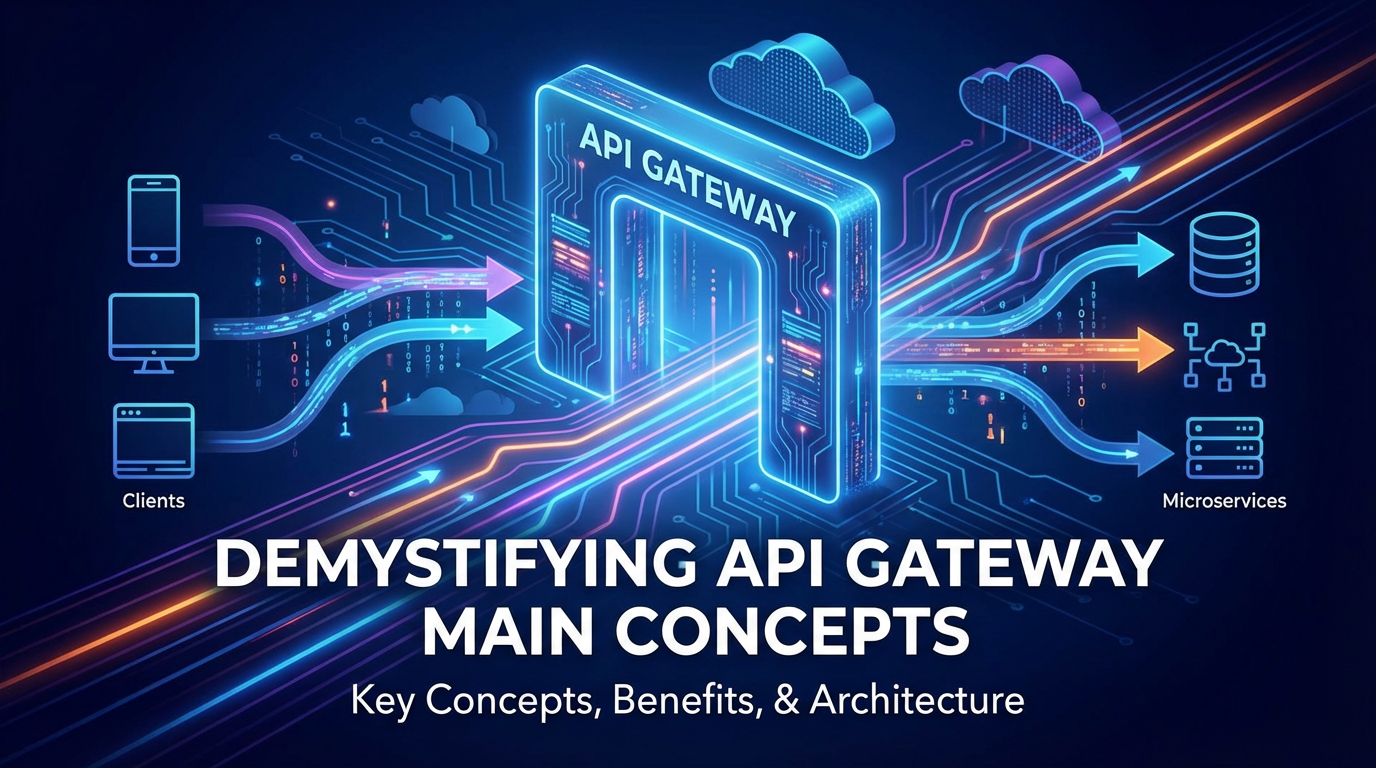


In the sprawling, interconnected landscape of modern software development, where distributed systems, microservices, and a myriad of applications communicate ceaselessly, the seamless flow of data is not merely a convenience but a fundamental requirement. As architectures have evolved from monolithic giants to agile, independent microservices, the complexity of managing interactions between these services and external clients has grown exponentially. This evolution, while offering unprecedented scalability and flexibility, also introduced a new set of challenges: how to handle cross-cutting concerns like security, routing, monitoring, and versioning across potentially hundreds of discrete services. It is precisely in this intricate environment that the API Gateway emerges not just as a useful tool, but as an indispensable architectural pattern, serving as the critical traffic controller and security guard for all incoming and outgoing API requests.
The purpose of this extensive exploration is to thoroughly demystify the core concepts surrounding the API Gateway. We will delve deep into its definition, trace its necessity through the historical evolution of software architectures, meticulously dissect its myriad functionalities, discuss its various types, offer guidance on selection, confront the inherent challenges, and project its future trajectory. By the end of this comprehensive guide, developers, architects, and business leaders alike will possess a profound understanding of what an API Gateway is, why it is so crucial in today's digital landscape, and how it empowers robust, scalable, and secure API-driven systems. Our journey will illuminate how this central gateway simplifies complex integrations, enhances security postures, and optimizes performance, ultimately enabling organizations to harness the full potential of their API ecosystems.
The Evolution of APIs and Distributed Systems: Paving the Way for the API Gateway
To fully appreciate the significance of an API Gateway, one must first understand the architectural shifts that necessitated its rise. For decades, software applications were predominantly built as monolithic structures. In a monolithic architecture, all components—user interface, business logic, and data access layers—are tightly coupled and deployed as a single, indivisible unit. While this approach simplifies development and deployment for smaller applications, it quickly becomes unwieldy as applications scale. Adding new features, fixing bugs, or scaling specific components often required redeploying the entire application, leading to slower release cycles, increased risk, and inefficient resource utilization.
The limitations of monoliths spurred the adoption of distributed systems, particularly the microservices architecture. Microservices advocate for breaking down a large application into a suite of small, independent services, each running in its own process and communicating with others through lightweight mechanisms, often HTTP APIs. Each microservice is responsible for a distinct business capability, can be developed and deployed independently by small, cross-functional teams, and can be scaled independently based on its specific load requirements. This paradigm shift brought forth numerous advantages: enhanced agility, improved fault isolation, technology diversity (allowing different services to use different languages or databases), and greater scalability.
However, this newfound freedom came at a cost. What was once a simple, internal function call within a monolith now became an external API call across a network. Clients, whether web applications, mobile apps, or other services, suddenly faced the daunting task of interacting with potentially dozens or even hundreds of distinct microservices to fulfill a single user request. This client-service direct interaction model introduced a plethora of challenges:
- Service Discovery: How does a client know the network location (IP address and port) of a specific service, especially in dynamic cloud environments where services scale up and down frequently?
- Inter-Service Communication Complexity: Managing diverse communication protocols, error handling, and retries across many services became a significant burden for clients.
- Security Overhead: Every microservice would ideally need its own authentication and authorization mechanisms, leading to duplicated effort and potential inconsistencies.
- Monitoring and Observability: Tracing a request as it traverses multiple services for debugging and performance monitoring became exceedingly difficult.
- Client-Specific API Adaptation: Different types of clients (e.g., mobile vs. web) often require different data formats or aggregations, forcing backend services to cater to multiple client needs or requiring complex client-side logic.
- Rate Limiting and Throttling: Protecting individual microservices from being overwhelmed by a flood of requests became a distributed problem, hard to enforce consistently.
- API Versioning: Managing changes to APIs over time without breaking existing clients became more challenging with independent service deployments.
These formidable challenges quickly demonstrated that while microservices offered immense benefits, a new architectural component was needed to mediate and manage the interactions between clients and the sprawling ecosystem of services. This critical component, designed to abstract away the complexity of the backend, provide a single, consistent entry point, and handle cross-cutting concerns, was the conceptual genesis of the API Gateway. It emerged as the central hub, simplifying client-side development, enhancing security, and bringing order to the distributed chaos.
What Exactly is an API Gateway? The Central Traffic Controller Defined
At its core, an API Gateway is an architectural pattern and a specialized server that acts as a single entry point for all client requests into an application or a set of microservices. Instead of clients interacting directly with individual backend services, they communicate with the API Gateway, which then routes the requests to the appropriate backend service, aggregates responses, and applies various policies and transformations. Essentially, it functions as a reverse proxy, but with significantly enhanced capabilities tailored specifically for managing APIs.
Imagine a grand hotel with hundreds of unique rooms (microservices), each offering a specialized service. Without a gateway, guests (clients) would need to know the exact room number, layout, and internal policies of each room they wish to visit. This would be incredibly confusing and inefficient. Now, introduce a concierge (the API Gateway) at the main entrance. Guests only interact with the concierge, stating their needs. The concierge, in turn, knows exactly which rooms to send them to, handles their check-in details, ensures they have the right access cards, perhaps even combines services from different rooms into a single package, and generally manages the entire guest experience from a central point. This concierge is much more than just a doorman; it's a sophisticated orchestrator and guardian.
In technical terms, an API Gateway is a managed, HTTP/S proxy that sits between the client applications and the backend services. Its primary role is to provide a uniform, public-facing API for clients, abstracting the internal architecture of the backend. It receives all incoming api calls, inspects them, and then performs a series of operations before forwarding them to the relevant microservice. These operations can include:
- Request Routing: Directing requests to the correct backend service based on the URL path, headers, or other criteria.
- Load Balancing: Distributing incoming request traffic across multiple instances of backend services to ensure optimal resource utilization and prevent overload.
- Authentication and Authorization: Verifying the identity of the client and ensuring they have the necessary permissions to access the requested resource.
- Rate Limiting and Throttling: Controlling the number of requests a client can make within a certain time frame to protect backend services from abuse or overload.
- Caching: Storing responses from backend services to serve future identical requests more quickly, reducing latency and backend load.
- API Composition and Aggregation: Combining data from multiple backend services into a single response, simplifying client-side development.
- Protocol Translation: Converting requests from one protocol (e.g., HTTP/1.1) to another (e.g., HTTP/2, gRPC) before forwarding to the backend.
- Monitoring and Logging: Collecting metrics and logs about API usage, performance, and errors at a centralized point.
- API Versioning: Managing different versions of an API, allowing clients to continue using older versions while new versions are deployed.
- Security Policies: Enforcing Web Application Firewall (WAF) rules, protecting against common web vulnerabilities.
Unlike a traditional load balancer or a simple reverse proxy (like Nginx configured for basic routing), an API Gateway is specifically designed with API management capabilities in mind. While it may leverage underlying reverse proxy technology, its core value lies in its rich feature set that addresses the complex requirements of modern distributed API ecosystems. It consolidates cross-cutting concerns, offloads operational burdens from individual microservices, enhances security, improves performance, and ultimately provides a better developer experience for both internal and external consumers of the APIs. It is the sophisticated orchestrator that transforms a collection of independent services into a cohesive, manageable, and secure digital product.
Key Concepts and Functionalities of an API Gateway: A Deep Dive
The true power of an API Gateway lies in its comprehensive suite of functionalities, each designed to address specific challenges in managing and exposing APIs in a distributed environment. Understanding these capabilities is paramount to leveraging an API Gateway effectively.
a. Request Routing and Load Balancing
One of the most fundamental responsibilities of an API Gateway is intelligent request routing. When a client sends a request to the gateway, the gateway must determine which backend service is responsible for handling that specific request. This routing decision can be based on various criteria, including:
- URL Path: Directing requests to
/usersto the User Service and/productsto the Product Service. - HTTP Method: Routing
POST /ordersto an order creation service instance andGET /orders/{id}to an order retrieval service. - HTTP Headers: Using custom headers to route to specific versions of a service or to A/B testing deployments.
- Query Parameters: Distinguishing requests based on parameters in the URL.
The gateway often integrates with service discovery mechanisms (like Consul, Eureka, or Kubernetes service discovery) to dynamically locate available instances of backend services. This is crucial in cloud-native environments where service instances are ephemeral and scale up or down frequently.
Beyond routing, the API Gateway also performs load balancing. Once the correct service is identified, the gateway distributes the incoming request traffic across multiple healthy instances of that service. This prevents any single service instance from becoming a bottleneck and ensures high availability and optimal resource utilization. Common load balancing algorithms include:
- Round-Robin: Distributing requests sequentially to each service instance.
- Least Connections: Sending requests to the service instance with the fewest active connections.
- Weighted Round-Robin/Least Connections: Prioritizing instances based on their capacity or performance metrics.
- IP Hash: Ensuring that requests from a specific client IP always go to the same service instance, which can be useful for session persistence.
Moreover, a sophisticated gateway will continuously monitor the health of backend service instances through active and passive health checks. If an instance becomes unhealthy, it will be temporarily removed from the load balancing pool, preventing requests from being sent to failing services and improving overall system resilience.
b. API Composition and Aggregation
In a microservices architecture, a single client request might necessitate calls to multiple backend services. For instance, displaying a user's dashboard might require fetching user profile data from the User Service, recent orders from the Order Service, and product recommendations from the Recommendation Service. If the client were to make these calls directly, it would result in multiple network round trips, increased latency, and complex client-side orchestration logic (the "chatty API" problem).
The API Gateway can elegantly solve this by acting as an api compositor and aggregator. It can receive a single request from the client (e.g., GET /user-dashboard), internally fan out this request to multiple backend microservices, wait for their individual responses, combine or transform these responses into a single, cohesive payload, and then return that aggregated response to the client.
This capability significantly simplifies client-side development, reduces the number of network calls, and improves the overall responsiveness of the application. It allows backend services to remain focused on their single responsibility, while the gateway handles the presentation-tier logic of combining data for specific client views.
c. Authentication and Authorization
Security is paramount in any networked application, and managing authentication and authorization across numerous microservices can be a significant operational burden. The API Gateway provides a centralized control point for these critical security concerns, offloading them from individual backend services.
- Authentication: The
gatewaycan verify the identity of the client making the request. It supports various authentication schemes, including API Keys, OAuth 2.0 tokens (like JWTs), mutual TLS, and session cookies. Once a client is authenticated, thegatewaycan inject authentication information (e.g., user ID, roles) into the request headers before forwarding it to the backend service, allowing services to trust thegateway's authentication decision. - Authorization: After authentication, the
gatewaycan enforce authorization policies, determining whether the authenticated client has the necessary permissions to access the requested resource or perform a specific action. This can be based on roles (e.g., anadminuser can delete products, aguestcannot), scopes (in OAuth), or other custom attributes associated with the user.
Centralizing authentication and authorization at the gateway ensures consistency across all APIs, simplifies security management, and reduces the attack surface by preventing direct access to unauthenticated backend services. It also ensures that backend services can focus purely on business logic, knowing that security checks have already been performed upstream.
d. Rate Limiting and Throttling
To protect backend services from being overwhelmed by excessive requests, whether accidental or malicious (like a DDoS attack), API Gateways offer robust rate limiting and throttling capabilities. These mechanisms control the number of requests a client, IP address, or API key can make within a specified time window.
- Rate Limiting: This defines a hard limit on the number of requests allowed. For example, a client might be limited to 100 requests per minute. If the limit is exceeded, subsequent requests are typically rejected with an HTTP 429 "Too Many Requests" status code.
- Throttling: This is a more flexible mechanism that often queues requests if the rate limit is exceeded, processing them as capacity becomes available, rather than rejecting them outright. It can also involve dynamic adjustments based on backend service health.
Various algorithms are used to implement rate limiting, such as:
- Token Bucket: Clients receive tokens at a steady rate, and each request consumes a token. If no tokens are available, the request is delayed or rejected.
- Leaky Bucket: Requests are added to a bucket, which "leaks" at a constant rate. If the bucket overflows, new requests are dropped.
By implementing rate limiting at the API Gateway, organizations can ensure fair usage of their APIs, prevent resource exhaustion of backend services, and maintain overall system stability, even under heavy load.
e. Caching
Caching is a powerful technique to improve API performance and reduce the load on backend services by storing responses to frequently requested data. When a client requests data that has been previously cached, the API Gateway can serve the response directly from its cache without forwarding the request to the backend.
The gateway can be configured to cache responses based on various criteria, such as:
- URL Path and Query Parameters: Caching the response for
GET /products?category=electronics. - HTTP Headers: Using
Cache-Controlheaders from the backend to determine caching behavior. - Time-to-Live (TTL): Specifying how long a cached response remains valid.
Effective cache invalidation strategies are crucial to ensure clients always receive fresh data when necessary. This can involve time-based expiration, explicit invalidation via API calls, or event-driven invalidation.
Implementing caching at the gateway layer offers several benefits: * Reduced Latency: Responses are delivered much faster, as they don't involve a trip to the backend. * Reduced Backend Load: Backend services are hit less frequently, freeing up their resources for processing new data or more complex requests. * Improved Scalability: The gateway can handle a larger volume of requests without needing to scale backend services proportionally for read-heavy operations.
f. Protocol Translation and Transformation
Modern distributed systems often involve a mix of technologies and communication protocols. Some services might expose traditional REST APIs, others might use gRPC for high-performance internal communication, while legacy systems might still rely on SOAP or other proprietary formats. Clients, however, typically prefer a consistent and modern interface, often REST over HTTP with JSON payloads.
The API Gateway can act as a sophisticated mediator, performing protocol translation and data transformation to bridge these disparate systems:
- Protocol Translation: It can receive an HTTP REST request from a client, translate it into a gRPC call for a backend service, and then translate the gRPC response back into an HTTP JSON response for the client. This allows clients to interact with gRPC services as if they were REST services, without needing gRPC-specific client libraries.
- Data Transformation: The
gatewaycan modify the payload of requests and responses. This might involve:- Converting XML requests to JSON for modern microservices, or vice versa for legacy systems.
- Restructuring JSON objects to match different client expectations (e.g., flattening nested objects, renaming fields).
- Injecting or removing headers, query parameters, or body content.
This capability is particularly useful for API versioning strategies, where an older client expects a specific response format, but the new backend service only produces a different one. The gateway can transform the new response to match the old format, ensuring backward compatibility without modifying the backend service itself.
g. Monitoring, Logging, and Analytics
Observability is critical in distributed systems. When an issue arises, knowing where the problem occurred and why is essential for quick resolution. The API Gateway, being the single entry point for all API traffic, is an ideal location to centralize monitoring, logging, and analytics.
The gateway can collect a wealth of data about every incoming and outgoing API call, including:
- Request/Response Metrics: Latency, throughput, error rates, payload sizes.
- Request Details: Client IP, User Agent, HTTP Method, URL, headers, query parameters.
- Authentication/Authorization Outcomes: Success/failure of security checks.
- Backend Service Information: Which service handled the request, its response time.
This detailed api call logging and metric collection allows organizations to:
- Troubleshoot Issues: Quickly trace the path of a request, identify where errors occurred, and debug problems more efficiently.
- Monitor Performance: Keep track of API responsiveness, identify bottlenecks, and ensure SLAs are met.
- Analyze Usage Patterns: Understand how APIs are being consumed, identify popular endpoints, and detect potential misuse.
- Audit Compliance: Maintain a record of all API interactions for security audits and compliance requirements.
Platforms like APIPark, an open-source AI gateway and API management platform, exemplify this by offering comprehensive logging capabilities, recording every detail of each API call. This feature is invaluable for businesses to quickly trace and troubleshoot issues, ensuring system stability and data security. Furthermore, APIPark goes beyond basic logging, providing powerful data analysis tools that process historical call data to display long-term trends and performance changes, enabling businesses to perform preventive maintenance and identify potential issues before they impact users. This centralized intelligence is crucial for maintaining the health and security of a complex API ecosystem.
h. Security Policies and Threat Protection
Beyond authentication and authorization, API Gateways often incorporate advanced security features to protect backend services from a wide array of cyber threats. By acting as a perimeter defense, the gateway can filter malicious traffic before it reaches the core services.
Key security capabilities include:
- SSL/TLS Termination: The
gatewayhandles the encryption and decryption of traffic, offloading this CPU-intensive task from backend services. This ensures secure communication between clients and thegatewayand simplifies certificate management. - Web Application Firewall (WAF) Integration: Many
gatewaysoffer WAF-like functionalities or integrate with external WAFs to detect and block common web vulnerabilities such as SQL injection, cross-site scripting (XSS), and directory traversal attacks. - DDoS Protection: By applying rate limiting, IP blacklisting, and traffic shaping, the
gatewaycan help mitigate distributed denial-of-service (DDoS) attacks. - Schema Validation: Validating incoming request payloads against predefined API schemas (e.g., OpenAPI/Swagger definitions) to reject malformed requests early.
- IP Blacklisting/Whitelisting: Allowing or denying requests from specific IP addresses or ranges.
- Header Filtering: Removing sensitive headers or ensuring specific headers are present.
Consolidating these security measures at the gateway significantly strengthens the overall security posture of the application, reduces the attack surface, and allows individual services to focus on their core business logic without needing to implement complex security defenses.
i. API Versioning
As applications evolve, so do their APIs. Introducing new features, optimizing existing ones, or changing data models often necessitates modifications to an API. However, directly modifying an API can break existing clients that rely on the previous version. API Gateways provide robust mechanisms to manage multiple versions of an API concurrently, enabling seamless evolution without disrupting existing consumers.
Common API versioning strategies facilitated by the gateway include:
- URL Path Versioning: Embedding the version number directly in the URL (e.g.,
/v1/users,/v2/users). - Header Versioning: Using a custom HTTP header (e.g.,
X-API-Version: 1.0) to specify the desired version. - Query Parameter Versioning: Including the version as a query parameter (e.g.,
/users?api-version=1.0).
The gateway can inspect these version indicators in incoming requests and route them to the appropriate backend service instance or API version. It can also perform transformations to adapt requests or responses between different API versions, allowing older clients to interact with newer backend services or vice versa. This enables development teams to iterate on APIs independently, deploy new versions without immediate disruption, and gracefully deprecate older versions over time.
j. Developer Portal and Documentation
While not strictly a gateway function in terms of request processing, many full-fledged API Gateway solutions are tightly integrated with or include a developer portal. A developer portal is a self-service website that serves as a central hub for API consumers (internal and external developers) to discover, understand, and integrate with available APIs.
Key features of a developer portal include:
- Interactive Documentation: Providing up-to-date and interactive API documentation (often generated from OpenAPI/Swagger specifications), allowing developers to explore endpoints, parameters, and response structures.
- API Discovery: Centralized listing of all available APIs, often categorized and searchable.
- Subscription Management: Allowing developers to register applications, subscribe to APIs, and manage their API keys or OAuth credentials.
- Test Consoles: Providing tools to make test API calls directly from the portal.
- SDKs and Code Samples: Offering ready-to-use client libraries and code snippets in various programming languages.
- Community Forums: Facilitating communication and support among API consumers.
The integration of a developer portal with the API Gateway streamlines the entire API lifecycle, from design and publication to consumption and decommission. Platforms like APIPark excel in this area, functioning as an all-in-one AI gateway and API developer portal. APIPark assists with managing the entire lifecycle of APIs, including design, publication, invocation, and decommission. It facilitates API service sharing within teams, offering a centralized display of all API services, making it easy for different departments and teams to find and use the required services. Furthermore, APIPark supports independent APIs and access permissions for each tenant, enabling the creation of multiple teams each with their own applications, data, user configurations, and security policies, all while sharing underlying infrastructure. For enhanced security and control, APIPark also allows for the activation of subscription approval features, ensuring callers must subscribe to an API and await administrator approval before they can invoke it, preventing unauthorized API calls and potential data breaches. This comprehensive approach to API lifecycle management and developer experience underscores the modern role of an api gateway within a broader API management platform.
Types of API Gateways: Diverse Solutions for Varied Needs
The landscape of API Gateways is diverse, reflecting the varied requirements and architectural preferences of different organizations. While their core function remains consistent, the form they take, their deployment models, and their feature sets can differ significantly. Understanding these types helps in selecting the most appropriate solution for a given context.
- Cloud-Native API Gateways (Managed Services): These are fully managed services offered by cloud providers, designed to integrate seamlessly with their respective ecosystems. They abstract away much of the operational complexity, allowing users to focus on configuration rather than infrastructure management.
- Examples: AWS API Gateway, Azure API Management, Google Cloud Apigee Edge.
- Advantages: High scalability, reliability, integrated security, pay-as-you-go pricing, tight integration with other cloud services (e.g., serverless functions, identity providers).
- Disadvantages: Vendor lock-in, potentially less customization flexibility, cost can escalate with high traffic.
- Self-Hosted/Open-Source API Gateways: These solutions provide greater control and flexibility, allowing organizations to deploy and manage the
gatewayon their own infrastructure (on-premises, private cloud, or public cloud VMs/containers). Many are open-source, offering transparency and community support.- Examples: Kong Gateway, Envoy Proxy (often used as a building block for gateways), Apache APISIX, Tyk.
- Advantages: Full control over infrastructure, high customization, no vendor lock-in, often cost-effective for large-scale deployments (though operational costs can be high).
- Disadvantages: Requires significant operational expertise, responsible for patching, scaling, and maintaining the underlying infrastructure.
- Commercial API Gateway Products: These are enterprise-grade commercial products that offer comprehensive feature sets, professional support, and often come with advanced analytics, policy management, and developer portal capabilities. They can be deployed on-premises or offered as SaaS.
- Examples: Akana (by Perforce), Mulesoft Anypoint Platform, CA API Management (Layer7).
- Advantages: Rich feature set, dedicated support, robust security, often bundled with other API management tools.
- Disadvantages: High licensing costs, potential for vendor lock-in, complex to set up and manage.
- Micro-Gateways / Service Mesh Proxies: In highly distributed microservices environments, sometimes a lightweight
gatewayis deployed alongside or within each service (often called a sidecar proxy in a service mesh architecture). While a full API Gateway handles external client traffic, these micro-gateways or service mesh proxies manage inter-service communication. They can handle concerns like request routing, retries, circuit breaking, and mutual TLS between services.- Examples: Envoy Proxy (as a sidecar in Istio/Linkerd), Nginx Unit.
- Advantages: Decentralized control, fine-grained traffic management, resilience patterns applied at the service level.
- Disadvantages: Adds complexity to individual service deployments, requires a robust service mesh control plane for orchestration.
- Hybrid Gateways: Some solutions offer hybrid deployment models, where the
gateway's control plane (for configuration and policy management) resides in the cloud, while the data plane (which processes traffic) can be deployed on-premises or in different cloud environments. This allows organizations to leverage cloud benefits while maintaining data locality or compliance requirements.- Examples: Some offerings from Apigee, Kong Enterprise, AWS API Gateway's private endpoints.
- Advantages: Flexibility, ability to bridge different environments, centralized management.
- Disadvantages: Can introduce architectural complexity, potential for network latency between control and data planes.
The choice among these types depends heavily on an organization's specific needs, budget, existing infrastructure, operational expertise, and desired level of control. For instance, a small startup might opt for a cloud-native gateway for its ease of use and scalability, while a large enterprise with strict compliance requirements might prefer a self-hosted or commercial solution with extensive customization capabilities.
| Gateway Type | Deployment Model | Key Advantages | Key Disadvantages | Use Cases |
|---|---|---|---|---|
| Cloud-Native Gateways | Cloud-managed service | High scalability, easy setup, integrated security | Vendor lock-in, potentially less customization | Small/medium businesses, serverless architectures, rapid development |
| Self-Hosted/Open-Source | On-prem, IaaS (VMs/containers) | Full control, high customization, cost-effective (no license fee) | High operational overhead, requires expertise | Large enterprises, specific compliance needs, complex integrations |
| Commercial Products | On-prem, SaaS | Rich features, professional support, comprehensive API mgmt | High licensing cost, vendor lock-in | Enterprises with complex API ecosystems, strict SLAs |
| Micro-Gateways/Service Mesh | Sidecar/Per-service | Fine-grained control, decentralized, resilience patterns | Adds complexity to deployments, internal traffic only | Microservices architectures, inter-service communication optimization |
| Hybrid Gateways | Cloud control, on-prem data plane | Flexibility, centralized management, data locality | Architectural complexity, potential network latency | Enterprises with mixed environments (cloud/on-prem), compliance needs |
This table provides a concise overview of the different gateway types, highlighting their characteristics to aid in the decision-making process. Each type offers a unique balance of control, convenience, cost, and capabilities, underscoring the importance of aligning the gateway choice with the organization's strategic and technical objectives.
APIPark is a high-performance AI gateway that allows you to securely access the most comprehensive LLM APIs globally on the APIPark platform, including OpenAI, Anthropic, Mistral, Llama2, Google Gemini, and more.Try APIPark now! 👇👇👇
Choosing the Right API Gateway: A Strategic Decision
Selecting the appropriate API Gateway is a critical architectural decision that can significantly impact the scalability, security, performance, and maintainability of an application. There is no one-size-fits-all solution, and the ideal gateway depends on a multitude of factors specific to an organization's context. A careful evaluation process is essential.
Here are the key factors to consider when choosing an API Gateway:
- Scalability and Performance Requirements:
- Traffic Volume: How many requests per second (RPS) or transactions per second (TPS) does the
gatewayneed to handle? Look for solutions proven to scale horizontally and perform efficiently under heavy load. - Latency: What are the acceptable latency tolerances? A
gatewayadds a small overhead, so its inherent performance characteristics are crucial. - Throughput: Can it handle the expected data transfer rates without becoming a bottleneck?
- Example: For high-throughput scenarios, APIPark boasts impressive performance, capable of achieving over 20,000 TPS with just an 8-core CPU and 8GB of memory, and supports cluster deployment for massive traffic, making it a strong contender for performance-critical applications.
- Traffic Volume: How many requests per second (RPS) or transactions per second (TPS) does the
- Feature Set Alignment with Needs:
- Core Functionalities: Does it provide essential features like routing, load balancing, authentication, authorization, rate limiting, and caching?
- Advanced Features: Are specific advanced features required, such as API aggregation, protocol translation (e.g., HTTP to gRPC), WAF capabilities, or a sophisticated developer portal?
- AI Integration: For platforms dealing with AI models, capabilities like quick integration of 100+ AI models, unified API format for AI invocation, and prompt encapsulation into REST API (as offered by APIPark) can be a significant differentiator.
- Lifecycle Management: Does it offer end-to-end API lifecycle management, from design to decommission, including versioning and policy enforcement?
- Deployment Options and Environment:
- Cloud vs. On-Premises vs. Hybrid: Does the
gatewayneed to run in a specific cloud environment, on existing private infrastructure, or across a hybrid setup? - Containerization/Kubernetes Support: Is it designed to integrate well with container orchestration platforms like Kubernetes for automated deployment and scaling?
- Ease of Deployment: How quickly and easily can the
gatewaybe deployed and configured? Some solutions, like APIPark, emphasize quick deployment with a single command line, which can be a huge advantage for rapid setup.
- Cloud vs. On-Premises vs. Hybrid: Does the
- Ease of Configuration and Management:
- User Interface/API: Is there an intuitive management UI or a powerful API for programmatic configuration?
- Policy Management: How easy is it to define, update, and manage policies (e.g., security, rate limits, routing rules)?
- Monitoring and Logging: Does it offer comprehensive monitoring, logging, and analytics out-of-the-box, or does it integrate well with existing observability stacks?
- Cost Considerations:
- Licensing Fees: For commercial products, understand the licensing model (per API, per transaction, per server).
- Operational Costs: Factor in infrastructure costs (compute, memory, network), as well as the cost of personnel for management and maintenance.
- Open-Source vs. Commercial Support: Open-source solutions might have no direct licensing cost but require internal expertise or paid commercial support. APIPark, for instance, is open-source under Apache 2.0, providing a cost-effective solution while also offering a commercial version with advanced features and professional technical support for leading enterprises.
- Community Support and Commercial Backing:
- Open-Source Community: For open-source
gateways, a vibrant community indicates good support, frequent updates, and abundant resources. - Vendor Reputation: For commercial or cloud-managed solutions, evaluate the vendor's reputation, stability, and commitment to the product.
- Support Offerings: Understand the levels of support available (e.g., 24/7, tiered response times).
- Open-Source Community: For open-source
- Integration with Existing Ecosystem:
- Identity Providers: Does it integrate with existing authentication systems (e.g., Active Directory, Okta, OAuth providers)?
- Monitoring Tools: Can it push metrics and logs to your preferred monitoring and logging platforms (e.g., Prometheus, Grafana, Splunk, ELK Stack)?
- CI/CD Pipelines: Can its configuration be managed as code and integrated into automated deployment pipelines?
- Security and Compliance:
- Certifications: Does it meet industry-specific compliance requirements (e.g., HIPAA, GDPR, PCI DSS)?
- Security Features: Beyond basic authentication, does it offer advanced WAF capabilities, vulnerability patching, and secure default configurations?
- Access Control: Does it support granular access control for management interfaces and API resources (e.g., subscription approval features, as offered by APIPark)?
By meticulously evaluating these factors, organizations can make an informed decision that aligns with their current and future architectural needs. Whether opting for a robust open-source solution like APIPark, a feature-rich commercial product, or a managed cloud service, the chosen API Gateway should serve as a resilient, secure, and efficient foundation for their API strategy.
Challenges and Best Practices: Navigating the API Gateway Landscape
While API Gateways offer substantial benefits, their implementation and ongoing management are not without challenges. Recognizing these potential pitfalls and adopting best practices can ensure a successful and sustainable API Gateway strategy.
Challenges of API Gateway Implementation
- Single Point of Failure (SPOF):
- Challenge: By centralizing all API traffic, the
gatewayitself can become a single point of failure. If thegatewaygoes down, the entire application becomes inaccessible. - Mitigation: Implement high availability (HA) configurations with multiple redundant
gatewayinstances, often deployed in active-passive or active-active modes across different availability zones or regions. Use robust load balancers in front of thegatewayinstances.
- Challenge: By centralizing all API traffic, the
- Increased Latency (Performance Overhead):
- Challenge: Every request must pass through the
gateway, which introduces a small but measurable amount of additional latency due to processing (routing, authentication, policy enforcement). - Mitigation: Optimize
gatewayconfiguration for performance, leverage caching aggressively for read-heavy APIs, use efficient protocols, and ensure thegatewayinfrastructure is adequately resourced. Keepgatewaylogic lean and push complex business logic to backend services.
- Challenge: Every request must pass through the
- Architectural Complexity:
- Challenge: Introducing an API Gateway adds another layer to the architecture, potentially increasing setup and configuration complexity, especially with advanced features and policy management.
- Mitigation: Start with essential features and incrementally add complexity. Use Infrastructure as Code (IaC) for
gatewaydeployment and configuration. Invest in proper tooling for management, monitoring, and automation.
- Vendor Lock-in:
- Challenge: Relying heavily on a proprietary cloud-managed or commercial
gatewaysolution can lead to vendor lock-in, making it difficult to migrate to a different platform later. - Mitigation: Evaluate open standards and portability. For commercial solutions, understand their API and configuration export capabilities. Open-source solutions offer more freedom but shift operational burden.
- Challenge: Relying heavily on a proprietary cloud-managed or commercial
- Over-Centralization/Bottleneck Risk:
- Challenge: If too much logic or heavy processing is offloaded to the
gateway, it can become a performance bottleneck or a monolithic point of contention for all teams. - Mitigation: Maintain a clear separation of concerns. The
gatewayshould handle cross-cutting concerns, while specific business logic remains within microservices. Avoid implementing complex data transformations or business rules within thegateway.
- Challenge: If too much logic or heavy processing is offloaded to the
- Security Vulnerabilities:
- Challenge: As the public-facing entry point, the
gatewayis a prime target for attacks. Misconfigurations or unpatched vulnerabilities can expose the entire system. - Mitigation: Regularly apply security patches, conduct security audits and penetration testing, implement robust access controls for
gatewaymanagement, and follow security best practices.
- Challenge: As the public-facing entry point, the
Best Practices for API Gateway Implementation
- Design for High Availability and Resilience:
- Deploy
gatewayinstances in redundant configurations across multiple availability zones. - Implement robust health checks for both
gatewayinstances and backend services. - Configure circuit breakers and timeouts to prevent cascading failures.
- Ensure graceful degradation mechanisms are in place.
- Deploy
- Keep Gateway Logic Minimal and Focused:
- The
gatewayshould primarily handle cross-cutting concerns: routing, authentication, rate limiting, caching, and basic transformations. - Avoid complex business logic. Any logic that is specific to a business domain should reside within the relevant microservice. This prevents the
gatewayfrom becoming a new monolith.
- The
- Automate Everything (Infrastructure as Code):
- Manage
gatewaydeployment, configuration, and policy definitions as code (e.g., using Terraform, Ansible, or Kubernetes manifests). - Integrate
gatewaychanges into CI/CD pipelines to ensure consistent, repeatable deployments and reduce human error.
- Manage
- Implement Comprehensive Monitoring and Alerting:
- Collect detailed metrics (latency, error rates, throughput) and logs from the
gateway. - Integrate with centralized monitoring and logging systems (e.g., Prometheus/Grafana, ELK stack).
- Set up proactive alerts for critical performance deviations or security incidents.
- Utilize advanced analytics tools (like those in APIPark) to identify trends and predict potential issues.
- Collect detailed metrics (latency, error rates, throughput) and logs from the
- Adopt a Robust API Versioning Strategy:
- Plan your API versioning approach (URL path, header, query parameter) from the outset.
- Use the
gatewayto route different API versions to appropriate backend services or to perform necessary transformations for backward compatibility. - Communicate version deprecation clearly through the developer portal.
- Prioritize Security at Every Layer:
- Configure strong authentication and authorization policies at the
gateway. - Implement SSL/TLS termination, WAF rules, and DDoS protection.
- Regularly review and update security policies.
- Enforce granular access control to
gatewaymanagement interfaces.
- Configure strong authentication and authorization policies at the
- Provide Excellent Developer Experience (DX):
- Offer a well-documented developer portal (as facilitated by APIPark) with interactive API documentation (OpenAPI/Swagger).
- Provide clear API usage examples, SDKs, and a straightforward subscription process.
- Ensure comprehensive error messages are returned to clients.
- Consider a Federated Gateway Approach for Large Organizations:
- For very large enterprises with many independent teams or domains, a single, monolithic
gatewaymight become a bottleneck. Consider a federated model where multiple, smallergateways(domain-specific or team-specific) are managed, potentially under a unified control plane.
- For very large enterprises with many independent teams or domains, a single, monolithic
By adhering to these best practices, organizations can effectively mitigate the challenges associated with API Gateway implementation, unlock its full potential, and establish a resilient, secure, and performant foundation for their API-driven applications. The gateway transitions from a potential headache to an invaluable asset, streamlining operations and enhancing the developer experience.
The Future of API Gateways: Evolving to Meet New Demands
The digital landscape is in a constant state of flux, driven by emerging technologies and evolving architectural patterns. The API Gateway, as a critical component, is not static; it is continually evolving to meet these new demands and integrate with future paradigms. Several key trends are shaping the next generation of API Gateways:
- Deeper Integration with AI and Machine Learning:
- Intelligent Routing: Future
gatewayswill leverage AI to dynamically route traffic based on real-time service performance, predictive load, or even user behavior patterns for optimized experience. - Anomaly Detection and Security: AI/ML models can detect unusual API usage patterns, identify potential security threats (e.g., bot attacks, zero-day exploits) in real-time, and automatically apply countermeasures like throttling or blocking.
- Automated API Management: AI can assist in generating API documentation, suggesting optimal rate limits, or even automating policy adjustments based on observed traffic characteristics. Platforms like APIPark are already at the forefront of this, functioning as an AI gateway that integrates and manages various AI models, simplifying AI invocation and encapsulating prompts into REST APIs. This convergence of API management with AI capabilities will only deepen.
- Intelligent Routing: Future
- Convergence with Service Meshes:
- Service meshes (like Istio, Linkerd, Consul Connect) manage inter-service communication within a microservices cluster, handling concerns like traffic management, security, and observability at the network level.
- API Gateways primarily manage north-south traffic (client-to-service), while service meshes handle east-west traffic (service-to-service). The future will see tighter integration or even convergence of these two layers. A
gatewaymight act as the ingress point to the service mesh, leveraging the mesh's capabilities for finer-grained control and policy enforcement.
- Edge Computing and Serverless Deployments:
- Edge Gateways: As applications extend to the edge (e.g., IoT devices, CDNs),
gatewayswill be deployed closer to the end-users to reduce latency. These "edgegateways" will be lightweight and optimized for local processing and caching. - Serverless Backends:
Gatewaysare becoming even more crucial for serverless architectures (e.g., AWS Lambda, Azure Functions), providing the necessary routing, authentication, and request transformation layer for functions that expose APIs. Thegatewayeffectively acts as the entry point to a collection of serverless functions.
- Edge Gateways: As applications extend to the edge (e.g., IoT devices, CDNs),
- GraphQL Gateways and API Orchestration:
- GraphQL: The rise of GraphQL as an alternative to REST for flexible data fetching means
gatewayswill increasingly support GraphQL endpoints, translating client GraphQL queries into multiple backend REST or gRPC calls and aggregating the results. - Advanced Orchestration: Beyond simple aggregation, future
gatewayswill offer more sophisticated API orchestration capabilities, allowing developers to define complex workflows and data transformations across multiple services directly at thegatewaylevel, reducing client-side or backend service complexity.
- GraphQL: The rise of GraphQL as an alternative to REST for flexible data fetching means
- Enhanced Security and Compliance Features:
- Zero Trust Architecture:
Gatewayswill play a pivotal role in enforcing zero-trust principles, verifying every request and user regardless of their origin, and implementing micro-segmentation. - Advanced Threat Protection: Integration with advanced threat intelligence, behavioral analytics, and sophisticated WAF capabilities will become standard, providing proactive defense against evolving cyber threats.
- Granular Policy Enforcement: Greater granularity in policy definition, allowing for highly specific rules based on user attributes, device context, and real-time risk assessment.
- Zero Trust Architecture:
- Full API Lifecycle Management Platforms:
- The trend is towards comprehensive platforms that encompass not just the
gatewayfunction, but the entire API lifecycle: design, development, testing, deployment, management, monitoring, and deprecation. Thegatewaywill be one component within this larger, integrated ecosystem. APIPark, for example, is positioned as an open-source AI gateway and API management platform, reflecting this broader vision of end-to-end API governance.
- The trend is towards comprehensive platforms that encompass not just the
The API Gateway is evolving from a mere traffic cop to an intelligent, adaptable, and highly integrated control plane for digital interactions. Its future lies in becoming even more intelligent, automated, and seamlessly woven into the fabric of distributed systems, supporting a wider array of protocols and deployment models, and serving as the foundational pillar for the next generation of API-driven applications.
Conclusion: The Indispensable Nexus of API Ecosystems
In the intricate, dynamic world of modern software development, where microservices reign supreme and digital ecosystems grow in complexity with each passing day, the role of the API Gateway has transitioned from a beneficial addition to an indispensable architectural necessity. We have journeyed through its origins, observing how the shift from monolithic to distributed architectures created a pressing need for a centralized, intelligent traffic controller. This exploration has meticulously dissected its multifaceted functionalities, from intelligent request routing and robust security mechanisms to performance-enhancing caching and sophisticated API versioning.
The API Gateway stands as the crucial nexus, the single point of entry that elegantly abstracts away the labyrinthine complexity of backend services from external clients. It acts as the frontline defender, authenticating and authorizing every interaction, safeguarding precious backend resources with rate limiting and advanced security policies. It is the performance enhancer, optimizing response times through aggregation and caching. Moreover, it serves as the invaluable observer, providing centralized monitoring, logging, and analytics, which are vital for troubleshooting, performance tuning, and understanding API usage patterns. Platforms like APIPark exemplify this evolution, offering not only robust gateway capabilities but also integrating AI management and comprehensive API lifecycle governance, showcasing the modern breadth of this critical component.
While implementing an API Gateway comes with its own set of challenges, from potential single points of failure to increased architectural complexity, adherence to best practices — such as designing for high availability, automating configuration, and keeping gateway logic lean — ensures that these hurdles are overcome. As we look to the future, the API Gateway is poised for even greater intelligence, deeper integration with AI and service meshes, and an expanded role in edge and serverless computing.
Ultimately, the API Gateway is more than just a piece of infrastructure; it is a strategic enabler. It empowers organizations to build resilient, scalable, and secure API ecosystems, fosters efficient collaboration between development teams, and significantly enhances the experience for API consumers. For any enterprise embarking on or operating within the realm of distributed systems, understanding and effectively leveraging the core concepts of an API Gateway is not merely an option, but a foundational imperative for sustained success in the digital age.
Frequently Asked Questions (FAQs)
1. What is the primary purpose of an API Gateway? The primary purpose of an API Gateway is to act as a single entry point for all API requests into a backend system, typically composed of multiple microservices. It centralizes common cross-cutting concerns such as authentication, authorization, rate limiting, request routing, caching, and monitoring, offloading these responsibilities from individual backend services and simplifying client-side interactions.
2. How does an API Gateway differ from a traditional Load Balancer or Reverse Proxy? While an API Gateway functions as a type of reverse proxy, it offers significantly more advanced capabilities. A traditional load balancer primarily distributes incoming network traffic across multiple servers to ensure high availability and responsiveness. A reverse proxy forwards client requests to backend servers without necessarily understanding the API context. An API Gateway, however, is API-aware; it can inspect API requests, apply sophisticated policies based on API definitions, transform requests/responses, aggregate data from multiple services, handle API versioning, and provide a full suite of API management features.
3. What are the key benefits of using an API Gateway in a microservices architecture? The key benefits include: * Simplified Client-Side Development: Clients interact with a single endpoint, abstracting backend complexity. * Enhanced Security: Centralized authentication, authorization, rate limiting, and threat protection. * Improved Performance: Caching, request aggregation, and optimized routing reduce latency and backend load. * Increased Scalability and Resilience: Load balancing, circuit breaking, and health checks ensure high availability. * Better Observability: Centralized logging, monitoring, and analytics provide a comprehensive view of API usage and performance. * Efficient API Lifecycle Management: Facilitates API versioning, documentation, and developer portals.
4. Can an API Gateway become a bottleneck or a single point of failure? Yes, if not properly designed and implemented, an API Gateway can indeed become a bottleneck or a single point of failure. Because all traffic flows through it, poor performance can degrade the entire system. To mitigate this, API Gateways must be deployed in highly available configurations (e.g., multiple instances across different availability zones), optimized for performance, and monitored rigorously. The logic within the gateway should also be kept minimal, focusing on cross-cutting concerns rather than complex business logic, to prevent it from becoming a monolithic bottleneck.
5. Is an API Gateway always necessary for a microservices architecture? While not strictly "always" necessary, an API Gateway becomes increasingly beneficial and often essential as the number of microservices and client applications grows. For very small applications with only a few services, direct client-to-service communication might suffice. However, as complexity increases, the challenges related to service discovery, security, monitoring, and client-side orchestration quickly outweigh the overhead of implementing a gateway, making it a highly recommended and almost indispensable component for robust, scalable, and maintainable microservices architectures.
🚀You can securely and efficiently call the OpenAI API on APIPark in just two steps:
Step 1: Deploy the APIPark AI gateway in 5 minutes.
APIPark is developed based on Golang, offering strong product performance and low development and maintenance costs. You can deploy APIPark with a single command line.
curl -sSO https://download.apipark.com/install/quick-start.sh; bash quick-start.sh

In my experience, you can see the successful deployment interface within 5 to 10 minutes. Then, you can log in to APIPark using your account.

Step 2: Call the OpenAI API.