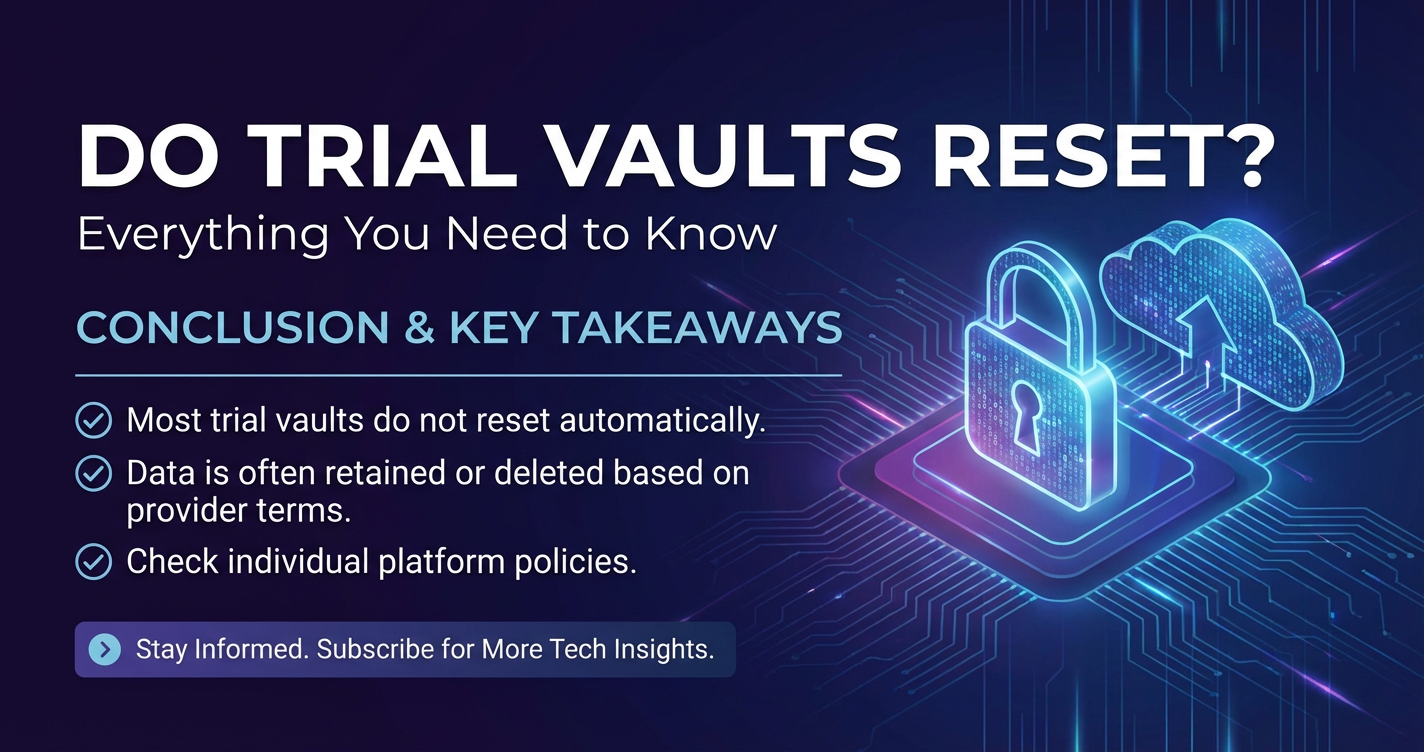
Do Trial Vaults Reset? Everything You Need to Know


The digital landscape, particularly within gaming, simulations, and complex online systems, is teeming with intriguing mechanics designed to engage users, manage resources, and maintain dynamic environments. Among these, the concept of "Trial Vaults" or similar temporary, challenge-based zones has captured the attention of countless enthusiasts and developers alike. These vaults often represent unique opportunities, testing grounds, or specialized content areas that promise rewards, insights, or advancement, but they come with a fundamental question that often sparks debate and curiosity: Do Trial Vaults reset? And if so, what are the intricate mechanisms, design philosophies, and technological underpinnings that dictate such a crucial aspect of their existence?
This exhaustive guide will delve deep into the multifaceted nature of Trial Vaults, exploring the definitive answers to their reset behaviors, the reasons behind these decisions, and the profound implications for users, developers, and the underlying technical architecture. We will uncover the nuances of various reset mechanics, analyze their impact on player engagement and system stability, and illuminate the sophisticated technologies, including the crucial role of an API Gateway, Model Context Protocol, and advanced AI like Claude, that make these dynamic digital experiences possible. Prepare for an intricate journey into the heart of digital design, where temporary challenges meet persistent systems, and the question of a "reset" unravels a tapestry of complex interactions.
Unpacking the Concept of "Trial Vaults": More Than Just a Game Level
Before we can definitively answer whether Trial Vaults reset, it's essential to first establish a comprehensive understanding of what a "Trial Vault" truly represents. While the term itself might conjure images from specific video games, its conceptual essence extends far beyond a single genre or application. At its core, a Trial Vault is a designed digital space, typically temporary or conditional, intended to present users with a specific set of challenges, puzzles, or objectives. Success within these vaults usually yields unique rewards, resources, or progression markers, making them highly sought-after areas.
Consider a role-playing game where a "Vault of Trials" might be a series of combat encounters with unique modifiers, accessible only for a limited time each day. Or perhaps in a strategy game, it could be a "Tactical Gauntlet" that tests a player's strategic prowess against escalating odds, providing rare blueprints upon completion. Even outside of traditional gaming, the concept finds parallels: a "simulation sandbox" where engineers test new algorithms against predefined, temporary conditions, or a "learning module challenge" in an educational platform that refreshes weekly with new questions and scenarios. In each case, the vault serves as a concentrated environment for specific interaction, designed with a clear beginning, middle, and potential end, often distinct from the main, persistent world or application.
The design philosophy behind Trial Vaults is typically rooted in several key objectives. Firstly, they serve as content refreshers, offering new experiences and preventing stagnation in long-running systems. Secondly, they act as resource sinks or gates, controlling the flow of valuable in-game currency, rare items, or critical data access. By making these resources available only through challenging, temporary means, developers can maintain economic balance and encourage active participation. Thirdly, they provide distinct skill checks, allowing users to benchmark their abilities against controlled parameters, often with leaderboards or performance metrics attached. Finally, they inject a sense of urgency and exclusivity, motivating users to engage within specific windows of opportunity, thereby boosting daily or weekly active participation metrics. The temporary nature is key; it defines their value and the specific user behaviors they aim to elicit.
The Definitive Answer: Yes, Trial Vaults Often Reset (But It's Complicated)
To cut straight to the chase: Yes, Trial Vaults very frequently reset. However, this seemingly simple answer masks a significant layer of complexity. The manner, frequency, and extent of these resets are highly variable, dependent on the specific design objectives, the platform's underlying architecture, and the nature of the challenges presented. There isn't a universal "reset button" that functions identically across all digital experiences. Instead, resets are meticulously engineered events, each with its own set of rules and implications.
The decision to implement a reset mechanism is never arbitrary. It stems from a deliberate design choice aimed at achieving specific outcomes. For instance, a daily reset for a combat vault might be intended to give players a consistent, repeatable source of progression material, while a weekly reset for a strategic puzzle vault encourages deeper engagement and collaborative problem-solving over a longer period. Some resets are triggered by time (daily, weekly, monthly events), others by completion (once finished, it resets for the next period), and some by failure (allowing retries). There are even resets tied to major content updates or seasonal changes, fundamentally altering the vault's structure or rewards. Understanding why a reset occurs is just as important as knowing that it occurs. It speaks to the core loop and longevity strategy of the system.
Furthermore, the term "reset" itself can be interpreted in various ways. Does it mean only the challenges inside the vault revert to an initial state? Or does it also imply a reset of player progress, rewards claimed, or leader board standings? The answer often lies in a careful balance of persistence and transience. What elements of the vault persist across resets, and which are truly ephemeral? This distinction is crucial for both user experience and the technical infrastructure that supports it, as it dictates what data needs to be stored long-term and what can be safely cleared. The complexity lies in these details, transforming a simple "yes" into a fascinating exploration of digital design and system engineering.
Delving into Reset Mechanics: Types and Triggers
The mechanisms by which Trial Vaults reset are diverse, each tailored to specific design goals and user engagement models. These mechanics can be broadly categorized based on their triggers and their scope.
1. Time-Based Resets: The Rhythmic Pulse of Content
The most common form of reset is time-based. These vaults adhere to a strict schedule, resetting at predetermined intervals regardless of user activity within them.
- Daily Resets: These are prevalent in mobile games and many online multiplayer experiences. A daily vault might offer specific resources, experience points, or repeatable quests that refresh every 24 hours. The goal is to encourage daily logins and engagement, establishing a routine for players to progress consistently. For example, a "Daily Resource Dungeon" might reset at midnight UTC, allowing players to collect a fresh batch of crafting materials or in-game currency. This predictable cadence helps users plan their play sessions.
- Weekly Resets: Often reserved for more significant challenges or higher-tier rewards, weekly resets provide a longer window for players to complete tasks. These might include "Weekly Raids," "Event Challenges," or "Competitive Ladders" that reset on a specific day each week. The extended duration allows for more strategic planning, group coordination, and a deeper dive into content. Rewards from weekly resets are typically more substantial, reflecting the increased effort and time investment required.
- Seasonal/Event-Based Resets: These resets are tied to larger game cycles or special events. A "Seasonal Trial Vault" might introduce unique mechanics and rewards for a month or a quarter, before resetting entirely with the next season's launch. This allows for large-scale content refreshes, narrative progression, and the introduction of new meta-strategies. These resets often involve significant changes, sometimes even entirely new vault layouts or enemy types, keeping the experience fresh over long periods.
2. Completion-Based Resets: One and Done (Until Next Cycle)
In contrast to time-based resets, completion-based resets mean the vault or a specific challenge within it becomes "completed" for a given period once successfully cleared.
- Single-Clear Resets: Once a player successfully navigates a "One-Time Challenge Vault" and claims its rewards, it might become inaccessible until the next scheduled reset period (daily, weekly, or seasonal). This prevents players from farming the same content repeatedly within a single cycle, ensuring that the rewards retain their value and encouraging players to seek out other content.
- Limited Attempts with Reset on Success/Failure: Some vaults might offer a limited number of attempts within a period. For instance, three tries per day. Upon successful completion or exhaustion of attempts, the vault 'resets' its attempt counter only after the daily/weekly timer ticks over. This adds a layer of risk and strategy, as players must decide when and how to best utilize their limited chances.
3. Conditional Resets: Dynamic and Adaptive
Conditional resets are triggered by specific in-game events, player actions, or external factors, making them more dynamic.
- Progress-Driven Resets: In some cases, a vault might only reset or become available again after a player achieves a certain milestone in the main game, completes a prerequisite quest, or reaches a new progression tier. This ties the vault's availability directly to individual player journey.
- External Trigger Resets: These could be influenced by external factors like server maintenance, emergency patches, or even community-wide achievements. While less common for regular vault content, major "world event" style vaults might reset based on global player participation or server-wide goals.
4. Hybrid Models: The Best of Both Worlds
Many sophisticated systems employ hybrid reset models, combining elements from different categories to create a nuanced experience. For instance, a "Daily Challenge Vault" might have a daily time-based reset, but also a limited number of attempts per day, and specific rewards only unlock after a certain number of successful completions over the week. These complex interactions ensure depth and sustained engagement, catering to various player types and commitment levels. The intricacy of these reset mechanics highlights the careful thought developers put into balancing accessibility, challenge, and reward distribution within their digital worlds.
The Ramifications of Resets: Impact on Player Experience and Game Economy
The decision to reset a Trial Vault, and the specific mechanics chosen, reverberate throughout the entire user experience and significantly influence the system's internal economy. These impacts are carefully weighed during the design phase, as they can determine the long-term viability and popularity of the content.
1. Player Experience: Motivation, Frustration, and Discovery
- Motivation and Engagement: Resets provide a powerful incentive for players to return regularly. Knowing that fresh challenges and rewards await daily or weekly creates a consistent loop of engagement. The "fear of missing out" (FOMO) can also be a strong motivator, pushing players to complete vaults before the reset. This cyclical content ensures that even long-term players always have something new to strive for.
- Sense of Accomplishment: Successfully clearing a challenging vault before its reset offers a tangible sense of achievement. The ephemeral nature of the opportunity can amplify this feeling, as players know they capitalized on a limited window.
- Frustration and Burnout: Conversely, overly frequent or punitive resets can lead to player frustration and burnout. If progress feels constantly wiped clean, or if the challenges are too demanding for the time allotted, players might disengage. Losing progress on a difficult vault due to a reset can be particularly disheartening, especially if the rewards are perceived as not worth the repeated effort.
- Discovery and Adaptation: Resets often introduce new parameters, enemies, or puzzles, forcing players to adapt their strategies and discover optimal approaches. This constant demand for learning keeps the experience fresh and prevents content from becoming stale. Players who master the reset cycle and efficiently clear vaults often feel a greater sense of mastery.
- Fairness and Level Playing Field: For competitive vaults, resets are crucial for maintaining fairness. They ensure that all participants start on an equal footing for each new cycle, preventing permanent advantages and allowing new players to eventually compete for top spots. Without resets, the gap between veteran and new players in competitive modes could become insurmountable.
2. Game Economy and Progression: Resource Management and Value
- Resource Control and Scarcity: Resets are fundamental tools for managing the influx of valuable resources into a system. By limiting the availability of certain rewards to specific reset cycles, developers can control their rarity and prevent inflation. If players could farm the same high-value vault infinitely, the economy could quickly collapse. This creates strategic choices for players on how to best allocate their limited attempts or time.
- Value of Rewards: The temporary nature of vaults and their reset mechanics directly influences the perceived value of the rewards. Unique items, rare crafting components, or powerful gear obtained from a difficult, time-limited vault often feel more significant than those obtained from endlessly repeatable content. The effort and timing required add to their prestige.
- Progression Pacing: Resets dictate the pace at which players can progress through certain content tiers. By making high-end materials or crucial experience gains available only through reset cycles, developers can guide players through specific progression paths, ensuring a controlled and balanced advancement curve.
- Content Longevity: Without resets, static content would quickly be consumed and discarded. Resets breathe new life into existing content, allowing developers to reuse assets and mechanics in novel ways, thereby extending the longevity of the game or application without constantly needing to produce entirely new material. This is particularly cost-effective for smaller development teams.
The intricate interplay between player psychology, economic principles, and the underlying technical architecture is what makes the design of reset mechanics such a critical and fascinating aspect of modern digital experiences.
The Underlying Infrastructure: Connecting Resets to System Architecture
Behind every seamless reset of a Trial Vault lies a sophisticated technical infrastructure designed to handle data persistence, state changes, and concurrent user requests. This infrastructure is the backbone that ensures fairness, stability, and a consistent experience, even when vast amounts of data are being updated simultaneously.
1. The Indispensable Role of APIs in Dynamic Content Management
At the heart of any modern online system, whether it's a multiplayer game, a simulation platform, or a robust enterprise application, are Application Programming Interfaces (APIs). APIs are the contracts that define how different software components communicate with each other. For Trial Vaults, APIs are critical for:
- Fetching Vault Status: When a player logs in, the client application uses an API to query the server for the current state of all available vaults – which ones are active, which have been completed, what the remaining time is, and what rewards are on offer.
- Tracking Player Progress: As a player attempts and progresses through a vault, APIs are constantly invoked to update their progress, record attempts, track scores, and manage inventory changes on the server. This ensures that progress is saved and consistent across devices.
- Triggering Resets: When a reset event occurs, it's typically an API call or an internal server process triggered by a timer or a specific condition. This call initiates the server-side logic to update vault states, clear player progress for that cycle, and refresh associated data.
- Awarding Rewards: Upon successful completion, APIs handle the secure distribution of rewards to the player's account, ensuring that items, currency, or experience points are correctly credited.
Without a well-designed and robust API layer, managing the dynamic nature of Trial Vaults, especially their resets, would be a chaotic and error-prone endeavor.
2. The Crucial Role of an API Gateway
As systems grow in complexity, with multiple backend services, various client applications, and increasing traffic, managing direct API calls becomes unwieldy. This is where an API Gateway steps in as a critical piece of infrastructure. An API Gateway acts as a single entry point for all client requests, routing them to the appropriate backend services. For Trial Vaults and their reset mechanisms, an API Gateway provides several invaluable benefits:
- Centralized Traffic Management: When a reset occurs, or when a new vault becomes active, there can be a sudden surge in requests from clients checking the new status. An API Gateway efficiently manages this traffic, load-balancing requests across multiple backend servers to prevent overload and ensure responsiveness.
- Security Enforcement: Resets involve sensitive data, such as player progress and reward distribution. An API Gateway provides a crucial layer of security, handling authentication, authorization, and rate limiting. This protects backend services from malicious attacks or unauthorized access, especially during critical state changes like a reset.
- Service Orchestration: A single request from a client (e.g., "check vault status") might require data from several backend services (e.g., player profile service, vault definition service, reward inventory service). An API Gateway can orchestrate these calls, aggregate the responses, and present a unified view back to the client, simplifying client-side logic.
- Caching and Performance: An API Gateway can cache responses for frequently requested, static data (like general vault descriptions). While dynamic data for resets is constantly changing, the gateway can intelligently manage caching strategies to improve overall performance, especially during periods of high activity following a reset.
- Monitoring and Analytics: An API Gateway provides a central point for logging and monitoring all API traffic. This is invaluable for troubleshooting issues related to resets, understanding usage patterns, and ensuring the health of the entire system. If a reset fails for a subset of players, detailed logs from the gateway can pinpoint the problem quickly.
For enterprises and developers managing complex digital environments, particularly those involving AI models and diverse services, an efficient API Gateway is not merely a convenience but a necessity. Platforms like APIPark exemplify this need, offering an open-source AI gateway and API management platform designed to help developers and enterprises manage, integrate, and deploy AI and REST services with ease. APIPark provides a unified management system for authentication and cost tracking, crucial for handling the complex integrations required when dynamic content like Trial Vaults interacts with multiple backend services and AI components. It standardizes request data formats, ensuring that changes in underlying AI models or prompts (which might influence vault generation or difficulty) do not disrupt the application, simplifying AI usage and maintenance. By offering end-to-end API lifecycle management, APIPark can regulate API management processes, manage traffic forwarding, load balancing, and versioning of published APIs – all critical functions for ensuring smooth operation and reset integrity within a dynamic system.
3. Data Persistence and State Management
Beyond the network layer, the actual data that defines Trial Vaults and tracks player progress is managed in robust database systems.
- Database Design: Databases are structured to store vault definitions (e.g., challenge parameters, reward tables), player-specific progress (e.g., attempts remaining, current score), and reset timers. A key aspect is distinguishing between global vault states (which reset uniformly) and individual player states within those vaults (which are unique to each user).
- Transactional Integrity: When a reset occurs, or a player completes a vault, multiple database operations might be involved (e.g., update player's inventory, mark vault as completed, reset cooldown). These operations must be atomic, meaning they either all succeed or all fail, to prevent data corruption. This is achieved through database transactions.
- Scalability and High Availability: For systems with millions of users, the database must be highly scalable and available to handle thousands of concurrent read and write operations, especially around reset times. Distributed databases, replication, and sharding techniques are often employed to ensure performance and reliability.
- Audit Trails: Detailed logs and audit trails are maintained for all significant changes, including resets and reward distributions. This allows developers to trace back any discrepancies and ensures accountability.
The interaction between the client, the API Gateway, various backend services, and the database forms a tightly integrated ecosystem that allows Trial Vaults to operate smoothly, resetting as designed and delivering a consistent, fair experience to all users.
APIPark is a high-performance AI gateway that allows you to securely access the most comprehensive LLM APIs globally on the APIPark platform, including OpenAI, Anthropic, Mistral, Llama2, Google Gemini, and more.Try APIPark now! 👇👇👇
Advanced Concepts: AI and Dynamic Content Generation in Trial Vaults
The evolution of Trial Vaults isn't just about static challenges and rigid reset timers. With the advent of advanced Artificial Intelligence, particularly large language models and generative AIs, the potential for dynamic, adaptive, and personalized vault experiences is rapidly expanding. This brings into play sophisticated concepts like the Model Context Protocol and the capabilities of powerful AI models such as Claude.
1. AI in Game Design: Enhancing Dynamic Challenges
AI's role in Trial Vaults can transform them from predictable loops into engaging, ever-evolving experiences:
- Dynamic Difficulty Adjustment: AI can analyze a player's performance in real-time or over a series of vaults, then dynamically adjust the difficulty of subsequent challenges upon reset. If a player consistently clears vaults with ease, the AI might introduce tougher enemies, more complex puzzles, or stricter time limits in the next iteration.
- Procedural Content Generation (PCG): Instead of manually designing every vault, AI can procedurally generate new layouts, enemy compositions, or puzzle variations for each reset. This ensures an almost infinite supply of fresh content, significantly extending the longevity and replayability of the game. A "Vault of Infinite Possibilities" could truly live up to its name.
- Adaptive Narrative and Lore: AI can even contribute to the narrative elements within vaults. Upon reset, the AI might generate new lore snippets, NPC dialogues, or mini-quests that tie into the player's past performance or choices, creating a more personalized story arc within the temporary content.
- Personalized Challenge Selection: Based on a player's preferences, skill set, and historical data, AI could curate a selection of "Trial Vaults" specifically tailored to their interests, offering challenges they are more likely to enjoy and successfully complete.
2. The Importance of Model Context Protocol
When AI models are deeply integrated into dynamic systems like Trial Vaults, they need a structured way to maintain coherence, understand past interactions, and react appropriately to state changes – especially resets. This is where a Model Context Protocol becomes indispensable.
A Model Context Protocol is a defined set of rules and formats for how an AI model maintains and updates its "context" or memory across multiple interactions, sessions, or system states. For Trial Vaults, this protocol would address:
- State Transmission: How does the game server communicate the current state of a Trial Vault (e.g., player's current health, remaining enemies, puzzle status) to the AI model?
- Historical Data Retention: How does the AI model remember a player's performance in previous vaults, their preferred strategies, or specific actions taken, even if those vaults have reset? The protocol would define what historical data is deemed relevant and how it's packaged and provided to the AI.
- Reset Signals: Crucially, the Model Context Protocol defines how an AI model is explicitly informed about a vault reset. Does it receive a simple "reset" flag, or a more detailed message indicating what specific parameters have changed? This signal tells the AI when to clear its short-term memory related to the previous vault instance and prepare for generating new content or adapting its behavior.
- Contextual Updates: After a reset, how does the AI model receive the new context for the freshly generated vault? The protocol would ensure the AI gets all necessary information to begin generating dynamic elements for the new instance without relying on stale data.
- Response Formatting: When the AI generates new content (e.g., enemy types, puzzle solutions, narrative prompts), the protocol dictates the format in which this information is returned to the game server, ensuring it can be seamlessly integrated into the vault.
Without a robust Model Context Protocol, AI-driven Trial Vaults would struggle with consistency. An AI might generate content that doesn't account for a player's previous failures, or it might struggle to create a coherent narrative across multiple resets if it cannot properly manage its understanding of the overarching game state and player history. It provides the structured communication framework for intelligent agents to operate effectively within complex, dynamic environments.
3. Leveraging Claude for Dynamic Vault Generation
Consider how an advanced AI model like Claude (from Anthropic) could be specifically utilized in conjunction with a Model Context Protocol and an API Gateway to power dynamic Trial Vaults:
- Initial Vault Generation: Upon a scheduled reset, the game server (via an API Gateway) sends a request to a Claude instance, providing parameters such as game type, desired difficulty range, and player profile data (obtained from the database). The Model Context Protocol ensures this initial prompt is structured correctly.
- Claude's Role: Claude, leveraging its extensive knowledge and creative capabilities, processes this input. It might:
- Design a unique dungeon layout, detailing enemy placements, trap locations, and environmental hazards.
- Generate a compelling mini-narrative or lore entry specific to this vault instance, perhaps referencing past player achievements or failures (if provided via the context protocol).
- Create unique puzzle elements, complete with solutions or hints, tailored to the player's known problem-solving style.
- Suggest dynamic modifiers for the vault, such as "enemies are immune to ice damage" or "player gains a speed boost every 60 seconds."
- Contextual Adaptation: If the player fails a vault, the game server sends new contextual information to Claude (again, via the API Gateway and Model Context Protocol). This context might include "Player X failed at phase 3 due to insufficient healing." Claude can then, upon the next reset or retry, adapt by perhaps generating a vault with more healing opportunities, or a different enemy composition in phase 3, demonstrating adaptive learning.
- Continuous Evolution: Over time, as Claude receives more data through the Model Context Protocol about player interactions, preferences, and performance across numerous resets, it can refine its generation capabilities, leading to increasingly personalized and engaging Trial Vault experiences. The API Gateway ensures these complex AI requests and responses are handled efficiently and securely, acting as the intermediary between the game server and the AI inference engine.
This integration transforms Trial Vaults from static challenges into living, breathing, adaptive environments. The synergy between a robust API Gateway (managing communication), a clear Model Context Protocol (defining AI memory and state), and powerful AI models like Claude (generating dynamic content) unlocks a new frontier in personalized and endlessly replayable digital experiences.
Designing for Resets: Best Practices and User Experience Considerations
Successfully implementing Trial Vault resets requires more than just technical prowess; it demands a deep understanding of user psychology and careful design considerations. The goal is to maximize engagement while minimizing frustration.
1. Clear Communication to Players
Ambiguity around resets is a significant source of player frustration. Transparency is key.
- Prominent Timers: Always display clear, easily accessible countdown timers for when vaults will reset. This allows players to plan their play sessions effectively and avoids unpleasant surprises.
- Reset Rules Explained: Provide in-game explanations or accessible documentation detailing what aspects of a vault reset (e.g., "enemy progress resets daily," "rewards claimed are final," "leaderboard resets weekly").
- Notification System: Implement optional notifications (in-game or external) that alert players to impending resets or newly activated vaults.
2. Rewarding Effort Despite Resets
Even if progress within a vault is temporary, players should feel that their efforts contribute to a larger, persistent goal.
- Persistent Meta-Progression: Introduce a meta-progression system that persists across resets. For example, completing vaults might award "Vault Tokens" that can be spent in a permanent store, or contribute to a seasonal battle pass.
- Cumulative Rewards: Some rewards could be cumulative over multiple resets, encouraging long-term engagement. "Complete 10 weekly vaults to unlock a special cosmetic item."
- Milestone Achievements: Grant permanent achievements or cosmetic rewards for reaching specific milestones within vaults, even if the internal vault progress resets.
3. Balancing Challenge and Grind
Resets inherently involve repetition, so it's crucial to balance challenge with the potential for grind.
- Variability: Introduce sufficient variability in vault content (e.g., different enemy types, random modifiers, varied layouts) upon each reset to keep the experience fresh and prevent monotony. This is where AI-driven generation shines.
- Meaningful Rewards: Ensure the rewards from vaults are valuable and feel commensurate with the effort and time invested. If rewards are too meager, players will quickly lose motivation.
- Difficulty Scaling: Offer different difficulty tiers for vaults, allowing players to choose challenges appropriate for their skill level and available time. This also allows for progression as players improve.
4. Technical Resilience and Graceful Handling of Errors
The technical implementation of resets must be robust to prevent data loss or service disruption.
- Atomic Operations: Ensure that all database updates related to a reset are atomic (all-or-nothing transactions) to maintain data integrity.
- Redundancy and Backups: Implement high availability for critical services and regular backups of player data to mitigate the impact of unforeseen failures.
- Error Handling and Rollbacks: Design systems to gracefully handle errors during a reset, with clear rollback mechanisms to restore previous states if a reset fails partially.
- Staged Rollouts (for major resets): For very significant resets (e.g., seasonal), consider a staged rollout or a brief maintenance window to ensure a smooth transition and minimize impact on live users.
5. Iteration and Feedback
The design of reset mechanics is rarely perfect from day one. Developers should:
- Monitor Player Behavior: Track player engagement, completion rates, and retention related to vaults.
- Gather Feedback: Actively solicit feedback from the community regarding reset mechanics, perceived fairness, and reward structures.
- Iterate and Adjust: Be prepared to make adjustments to reset timers, difficulty, and rewards based on data and feedback to optimize the player experience over time.
By adhering to these best practices, developers can harness the power of resets to create compelling, long-lasting digital experiences that keep users engaged and coming back for more.
The Future of Trial Vaults: Ever-Evolving Challenges
The trajectory of digital content, particularly within gaming and interactive simulations, points towards an increasingly dynamic and personalized future. Trial Vaults, already a cornerstone of repeatable content, are poised for significant evolution, largely driven by advancements in AI and sophisticated system architectures.
The trend towards procedural generation will continue, moving beyond simple randomized layouts to AI-driven generation of complex scenarios, narratives, and even emergent gameplay mechanics within vaults. Imagine a vault that learns from the global player base's collective strategies and continuously generates new challenges to counter them, creating an ever-shifting meta-game. This moves beyond pre-scripted content towards truly novel experiences with each reset.
AI-driven content will become more seamless and pervasive. With models like Claude becoming more integrated through efficient API Gateway infrastructure and well-defined Model Context Protocols, vaults will likely offer not just dynamic difficulty but also dynamic content themes. A vault might shift from a "jungle exploration" theme to a "cyberpunk heist" theme upon reset, complete with entirely new art assets, enemy types, and puzzle mechanics, all generated or curated by AI in response to player trends or external events. The very fabric of the vault could be rewoven with each cycle.
Personalization will reach new heights. Future Trial Vaults could be truly unique for each player, not just in difficulty but in content. An AI could identify a player's preferred weapon types, lore interests, or puzzle-solving strengths, then construct a vault specifically designed to challenge or reward those aspects upon reset. This hyper-personalization, managed through an API Gateway facilitating secure data exchange and an intelligent Model Context Protocol maintaining player history for the AI, promises an unparalleled level of engagement where every reset feels tailor-made.
The integration of cross-platform and multi-service operations will also deepen. A single Trial Vault might pull data from a game's core progression system, an external social platform for collaborative challenges, and a specialized AI service for generative content, all orchestrated and secured by a robust API Gateway. The ability of platforms like APIPark to quickly integrate 100+ AI models and provide a unified API format for AI invocation will be critical in enabling these complex, multi-faceted dynamic experiences. Such an architecture allows developers to experiment with new AI capabilities and external integrations without rebuilding core systems, ensuring that future Trial Vaults remain at the cutting edge of interactive entertainment and digital engagement.
Ultimately, the question "Do Trial Vaults Reset?" will increasingly be answered with "Yes, and they reset in ways you can barely imagine, thanks to the power of AI and sophisticated technical design." The future promises a perpetual frontier of challenge and discovery, where every reset opens a door to an entirely new adventure.
Conclusion: The Art and Science of the Reset
The question "Do Trial Vaults Reset?" reveals a profound intersection of game design philosophy, user experience psychology, and sophisticated technical architecture. While the simple answer is often "yes," the underlying mechanisms are anything but simple. Resets are meticulously crafted events, driven by timers, conditions, or player actions, designed to maintain engagement, control resource flow, and ensure long-term content viability. They are the rhythmic pulse of many digital ecosystems, providing a consistent loop of challenge and reward.
The implementation of these resets relies heavily on robust infrastructure. APIs serve as the communicative backbone, enabling seamless data exchange between client and server. Crucially, an API Gateway, such as APIPark, acts as the central orchestrator, managing traffic, enforcing security, and streamlining the complex interactions required to handle dynamic content updates and state changes during a reset. Its ability to integrate diverse services and AI models efficiently is paramount for modern, complex digital experiences.
Furthermore, the integration of advanced AI, exemplified by models like Claude, is revolutionizing the concept of Trial Vaults. By leveraging a well-defined Model Context Protocol, these AIs can generate dynamic challenges, adapt difficulty, and even craft personalized narratives, ensuring that each reset offers a truly fresh and engaging experience. This synergy between AI capabilities, structured communication protocols, and powerful API Gateway solutions pushes the boundaries of what temporary content can achieve.
From the user's perspective, understanding resets is key to maximizing enjoyment and progression. For developers, mastering the art and science of the reset is fundamental to creating sustainable, captivating, and technically sound digital worlds. As technology continues to evolve, Trial Vaults will undoubtedly become even more dynamic, intelligent, and personalized, offering an endlessly refreshing stream of challenges for generations of digital adventurers. The reset, far from being a simple wipe, is a sophisticated dance of persistence and transience, critical to the enduring appeal of our digital realities.
Reset Mechanism Comparison Table
To summarize the various ways Trial Vaults can reset and their primary implications, the following table provides a quick reference:
| Reset Type | Primary Trigger | Frequency | Key Purpose | Player Impact | Technical Implication |
|---|---|---|---|---|---|
| Daily Reset | Time (e.g., midnight UTC) | High (every 24 hours) | Encourage daily logins, consistent resource generation. | Routine engagement, daily goals, steady progression. | Scheduled database updates, moderate server load at reset. |
| Weekly Reset | Time (e.g., Tuesday morning) | Moderate (every 7 days) | Larger challenges, higher-tier rewards, group play. | Longer planning, deeper engagement, more substantial rewards. | Scheduled, heavier database updates, potential peak load. |
| Seasonal/Event Reset | Time (e.g., every 3 months) | Low (infrequent) | Major content refresh, narrative progression, new meta. | Significant content changes, long-term goals, FOMO. | Large-scale database schema changes, downtime possible. |
| Completion Reset | Player success | Varies (once per cycle) | Limit resource farming, ensure reward exclusivity. | Sense of accomplishment, strategic use of attempts. | Flags player-specific vault completion in database. |
| Conditional Reset | Specific in-game event | Varies (event-driven) | Dynamic adaptation, tying to player milestones. | Personalized progression, unpredictable opportunities. | Event-driven API calls, complex state management. |
| Failure Reset | Player failure | Varies (on retry/cooldown) | Encourage learning, skill improvement, retry loop. | Frustration (if too frequent), motivation to re-attempt. | Minor state rollback, cooldown timers in database. |
5 Frequently Asked Questions (FAQs)
1. What exactly does it mean when a Trial Vault "resets"? When a Trial Vault resets, it means its state is largely reverted to an initial condition, often allowing players to re-engage with its challenges and potentially earn rewards again. This can involve resetting enemy health, puzzle states, available attempts, or even the entire layout and content of the vault. What specifically resets depends on the design; some aspects (like player inventory) might persist, while others (like vault progress) are cleared.
2. Why do developers make Trial Vaults reset? Developers implement resets for several key reasons: to encourage player engagement and daily/weekly logins, to control the flow of valuable in-game resources and maintain economic balance, to provide fresh content and prevent monotony, to offer fair competitive opportunities by leveling the playing field, and to provide repeatable challenges for skill development.
3. Does my progress reset if a Trial Vault resets? Typically, yes, your progress within that specific vault instance will reset. This means any enemies defeated, puzzles solved, or objectives completed in the previous cycle will be wiped clean, and you'll need to start fresh in the new cycle. However, any rewards you claimed from a successful completion before the reset are usually permanent and remain in your possession. Many games also have "meta-progressions" (like battle passes or cumulative achievements) that persist across vault resets.
4. How do systems like API Gateway and AI (like Claude) factor into Trial Vault resets? An API Gateway acts as a central hub for all communications between the player's game client and the server's various backend services. It ensures that when a vault resets, all related data (new challenges, rewards, player state updates) are securely and efficiently handled across multiple services. AI models like Claude, often integrated via the API Gateway and a Model Context Protocol, can be used to dynamically generate new vault content, adapt difficulty, or even create unique narratives for each reset, providing fresh experiences without manual developer intervention.
5. Are all Trial Vaults the same in how they reset? No, reset mechanisms vary greatly. Some vaults reset daily, others weekly, and some only for major seasonal events. Resets can be triggered by time, by a player's completion, or by specific in-game conditions. The frequency and the extent of the reset (what gets cleared versus what persists) are tailored to the specific design goals of the game or application, ensuring a diverse range of experiences.
🚀You can securely and efficiently call the OpenAI API on APIPark in just two steps:
Step 1: Deploy the APIPark AI gateway in 5 minutes.
APIPark is developed based on Golang, offering strong product performance and low development and maintenance costs. You can deploy APIPark with a single command line.
curl -sSO https://download.apipark.com/install/quick-start.sh; bash quick-start.sh

In my experience, you can see the successful deployment interface within 5 to 10 minutes. Then, you can log in to APIPark using your account.

Step 2: Call the OpenAI API.