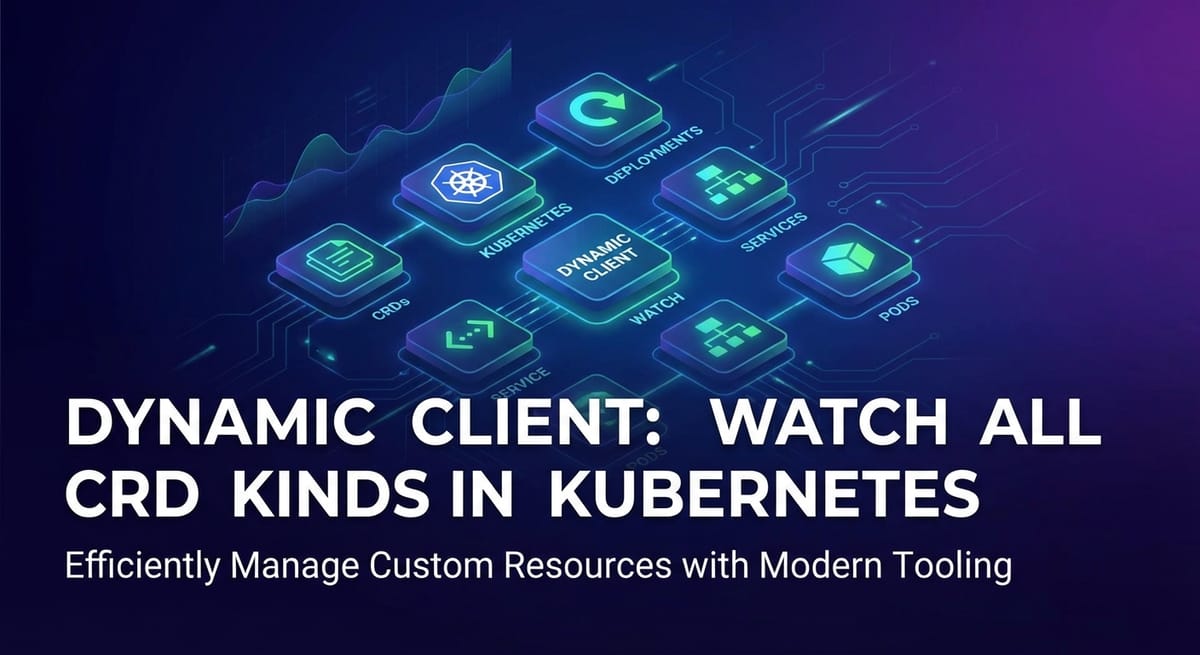
Dynamic Client: Watch All CRD Kinds in Kubernetes


The expansive and increasingly complex landscape of modern cloud-native applications often gravitates towards Kubernetes as the de facto orchestrator. Its declarative nature and extensibility have revolutionized how we deploy, manage, and scale applications. A cornerstone of this extensibility is the Custom Resource Definition (CRD), which allows users to define their own resource types, effectively extending the Kubernetes API itself. While incredibly powerful, interacting with these custom resources in a dynamic, generic, and robust manner presents unique challenges. Developers building operators, monitoring tools, or generalized management solutions frequently encounter the need to observe all instances of any given CRD kind, without prior knowledge of their schema or existence. This article delves deep into leveraging Kubernetes' Dynamic Client to watch all CRD kinds, providing a comprehensive guide for those navigating the intricate dance of custom resource management in a highly dynamic environment. We will explore the underlying principles, practical implementation details, inherent complexities, and best practices for building resilient systems that truly embrace Kubernetes' extensibility.
The Extensible Core of Kubernetes: Custom Resources and Their Definitions
At its heart, Kubernetes is an API-driven system. Everything, from Pods and Deployments to Services and Namespaces, is represented as an API object that can be created, read, updated, or deleted through the Kubernetes API. While Kubernetes provides a rich set of built-in resource types, real-world applications often demand capabilities that go beyond these standard abstractions. This is where Custom Resource Definitions (CRDs) come into play, offering a powerful mechanism to extend the Kubernetes API with user-defined resource types.
A Custom Resource Definition (CRD) is a special resource in Kubernetes that defines a new "kind" of resource, specifying its name, scope (namespace-scoped or cluster-scoped), validation rules (using OpenAPI v3 schema), and supported versions. Once a CRD is created and registered with the Kubernetes API server, users can create instances of this new custom resource, just like they would create a Pod or a Deployment. These custom resources then behave as first-class citizens within the Kubernetes ecosystem. For instance, an operator might define a Database CRD to represent a managed database instance, or a Workflow CRD to encapsulate a complex multi-step process. By doing so, they declarative state management principles of Kubernetes are extended to application-specific concerns, significantly simplifying the management of complex distributed systems.
The power of CRDs lies in their ability to abstract away operational complexities. Instead of directly interacting with various underlying infrastructure components (e.g., creating VMs, configuring network rules, setting up databases), users can simply declare the desired state of their custom resource. A specialized controller, often referred to as an "operator," then watches for changes to these custom resources and takes the necessary actions to reconcile the actual state with the desired state. This pattern has become fundamental to building sophisticated cloud-native applications and services on Kubernetes, pushing the boundaries of what can be natively managed within the cluster. Without CRDs, much of the advanced functionality we see in modern Kubernetes distributions and third-party solutions would be impossible or incredibly cumbersome to implement, requiring complex external systems to manage resources that are inherently application-specific. They transform Kubernetes from a mere container orchestrator into a powerful application platform.
However, interacting with these custom resources programmatically introduces a unique set of challenges. While Kubernetes client libraries like client-go provide "typed" clients for built-in resources (e.g., corev1.Pod, appsv1.Deployment), generating a typed client for every possible CRD is often impractical, if not impossible, especially when the CRDs are defined dynamically or by third parties. This is precisely where the Kubernetes Dynamic Client proves its unparalleled value, offering a flexible and schema-agnostic way to interact with any Kubernetes resource, including all CRD kinds, without compile-time knowledge of their structure.
The Necessity of Dynamic Interaction with CRDs
The traditional approach to interacting with Kubernetes resources in client-go involves using "typed" clients. For example, if you want to manage Pods, you'd use clientset.CoreV1().Pods("namespace"). This approach provides strong type safety, autocompletion, and compile-time checks, which are invaluable for predictable and robust development. However, this model assumes that the resource type is known at compile time and that corresponding Go structs and client interfaces have been generated (typically using tools like code-generator).
This assumption breaks down entirely when dealing with the dynamic nature of Custom Resource Definitions. Consider the following scenarios:
- Generic Operators: An operator designed to manage an entire category of resources (e.g., all database types, regardless of whether they are PostgreSQL, MySQL, or Cassandra) might need to inspect or act upon multiple different CRD kinds. If each database type is defined by a separate CRD, a generic operator cannot be hardcoded with typed clients for all of them. It needs a way to discover and interact with them on the fly.
- Cluster-wide Auditing or Monitoring Tools: Tools that need to provide a holistic view of a Kubernetes cluster, perhaps reporting on all running workloads, network configurations, or security policies, must be able to discover and process all existing resources. This includes not only built-in resources but also every custom resource instance defined by any CRD deployed in the cluster. These tools cannot anticipate every possible CRD that might be installed.
- Policy Engines: A policy engine that enforces certain rules (e.g., "all resources must have an owner label," or "no resource should expose port X") needs to apply these policies across all resource types, including custom ones. A static, typed approach would require constant updates to the policy engine every time a new CRD is introduced.
- UI/Dashboard Development: A Kubernetes management UI might want to allow users to view and interact with all resources in the cluster, including custom ones, without requiring the UI to be recompiled or redeployed whenever a new CRD is installed. It needs a flexible mechanism to fetch and display schema-less data.
- Cross-Cluster Synchronization: Systems that synchronize resources between multiple Kubernetes clusters (e.g., for disaster recovery or multi-cluster deployments) need to be able to handle arbitrary custom resources present in those clusters, as their schemas and definitions might vary.
In all these scenarios, the common thread is the need for schema-agnostic interaction. The application logic cannot be tightly coupled to specific Go types for each CRD. Instead, it requires a mechanism to discover available CRDs, query their instances, and observe changes to them using a generic data structure. This is precisely the problem that the Kubernetes Dynamic Client elegantly solves, providing a powerful, flexible interface that operates on Unstructured objects, allowing developers to build robust and future-proof solutions for the ever-evolving Kubernetes ecosystem.
Introducing the Kubernetes Dynamic Client
The Kubernetes Dynamic Client, found within the k8s.io/client-go/dynamic package, is an indispensable tool for scenarios where compile-time knowledge of resource types is unavailable or impractical. Unlike typed clients, which operate on Go structs that precisely mirror the OpenAPI schema of Kubernetes resources, the Dynamic Client works with Unstructured objects. These Unstructured objects are essentially generic representations of Kubernetes resources, typically encapsulating data as map[string]interface{}. This allows the client to interact with any Kubernetes API resource, whether it's a built-in Pod, a Deployment, or an instance of a Custom Resource Definition, without needing a predefined Go type for it.
The core of the Dynamic Client interface is dynamic.Interface. This interface provides methods like Resource which, when given a schema.GroupVersionResource, returns a ResourceInterface. This ResourceInterface then allows you to perform standard Kubernetes API operations such as Get, List, Watch, Create, Update, and Delete on resources belonging to that specific GroupVersionResource. The GroupVersionResource (GVR) is a crucial identifier for any resource in Kubernetes, uniquely identifying its API Group, Version, and plural form of its Kind. For example, for Pods, the GVR would be core/v1/pods; for a custom MyResource defined in mygroup.io/v1, it would be mygroup.io/v1/myresources.
The Unstructured object, k8s.io/apimachinery/pkg/apis/meta/v1/unstructured.Unstructured, is the key data structure used by the Dynamic Client. It represents a Kubernetes object as a hierarchical map. You can access fields within an Unstructured object using standard map operations or convenience methods like GetName(), GetNamespace(), GetLabels(), GetAnnotations(), Object (to get the underlying map[string]interface{}), and UnmarshalJSON or MarshalJSON for serialization. This flexibility means you don't need to know the specific fields of a custom resource at compile time; you can introspect them at runtime based on the object's structure. For instance, if you expect a custom resource to have a spec.replicas field, you can safely attempt to retrieve it from the Unstructured object's underlying map, perhaps with a fallback or error handling if the field doesn't exist.
Setting up the Dynamic Client typically involves:
- Loading Kubernetes Configuration: This usually involves
rest.InClusterConfig()when running inside a cluster orclientcmd.BuildConfigFromFlags("", kubeconfigPath)when running externally, pointing to a kubeconfig file. This configuration provides the necessary connection details and authentication credentials for the Kubernetes API server. - Creating the Dynamic Client: Using the loaded
rest.Config, you then calldynamic.NewForConfig(config)to obtain an instance ofdynamic.Interface.
import (
    "k8s.io/client-go/dynamic"
    "k8s.io/client-go/tools/clientcmd"
    "k8s.io/client-go/rest"
)

func createDynamicClient(kubeconfigPath string) (dynamic.Interface, error) {
    var config *rest.Config
    var err error

    if kubeconfigPath != "" {
        // Load kubeconfig from file for external access
        config, err = clientcmd.BuildConfigFromFlags("", kubeconfigPath)
    } else {
        // Load in-cluster config for internal access
        config, err = rest.InClusterConfig()
    }
    if err != nil {
        return nil, err
    }

    dynamicClient, err := dynamic.NewForConfig(config)
    if err != nil {
        return nil, err
    }
    return dynamicClient, nil
}
Once you have the dynamic.Interface, you can then use it to target specific GroupVersionResources for operations. The Unstructured type makes it possible to write generic logic that can process any resource, making the Dynamic Client a cornerstone for building powerful and adaptable Kubernetes tooling, especially when the specific resource types are not known beforehand or are subject to change. This flexibility is what enables operators to manage a diverse array of custom resources and allows generic monitoring solutions to provide comprehensive insights across an entire Kubernetes cluster, including the ever-expanding universe of CRDs.
The Watch Mechanism in Kubernetes: Event-Driven Power
A fundamental concept in Kubernetes, and indeed in many modern distributed systems, is the "watch" mechanism. Instead of continuously polling the API server for changes to resources, Kubernetes clients can establish a persistent connection and "watch" for events pertaining to specific resources or collections of resources. This event-driven architecture is critical for building efficient, responsive, and scalable control loops, such as those found in Kubernetes controllers and operators.
When a client initiates a watch operation, the Kubernetes API server returns a stream of events. Each event describes a change that occurred to a resource, along with the state of the resource after the change. The primary types of watch events are:
ADDED: An event indicating that a new resource has been created. The event payload includes the full state of the newly created resource.MODIFIED: An event signaling that an existing resource has been updated. The payload contains the full state of the resource after the modification.DELETED: An event indicating that a resource has been removed. The payload includes the state of the resource just before it was deleted.
The watch mechanism is designed for efficiency. Instead of transferring the full state of all resources on every change, only the changed resource's state (or its deletion marker) is sent. This significantly reduces network traffic and API server load compared to a polling approach, especially in large clusters with many resources and frequent changes. Furthermore, watches are typically resilient to transient network issues; the client-go library often handles reconnecting and resuming watches from the last known resource version, ensuring that no events are missed.
For operators and controllers, watching is not just an optimization; it's a foundational requirement. An operator's core function is to maintain a desired state. To do this, it must react to changes in the actual state. By watching Custom Resources (and potentially other Kubernetes resources), an operator receives immediate notifications when a user creates, updates, or deletes an instance of its managed resource. Upon receiving an event, the operator triggers its reconciliation loop, comparing the current state of the resource (and any related resources it manages) with the desired state specified in the CRD instance, and then takes corrective actions. This immediate feedback loop is what makes Kubernetes operators so powerful and responsive.
Consider an operator managing a Database CRD. When a user creates a Database custom resource, the operator receives an ADDED event. It then might provision a new database instance in an external cloud provider, create a corresponding Kubernetes Service, Deployment, and Secret for accessing it. If the user later modifies the Database CRD to upgrade its version or change its storage capacity, the operator receives a MODIFIED event and reconciles these changes with the underlying database instance. Finally, if the Database CRD is deleted, the operator receives a DELETED event and performs cleanup, such as deprovisioning the external database and removing related Kubernetes resources.
The watch mechanism, particularly when combined with the flexibility of the Dynamic Client, provides the programmatic backbone for building highly responsive, self-healing, and automated systems on Kubernetes. It moves beyond simple CRUD operations to an event-driven paradigm where your application reacts intelligently to the dynamic changes within the cluster. This becomes especially critical when you need to watch an arbitrary number of dynamically defined CRD kinds, as we will explore next.
Deep Dive into Watching All CRD Kinds with Dynamic Client
The real power of the Dynamic Client shines when you need to watch all CRD kinds in a Kubernetes cluster without prior knowledge of their specific GroupVersionResources. This involves a multi-step process: first, discovering all active CRDs; then, for each discovered CRD, creating a dynamic watcher; and finally, processing the Unstructured events received from these multiple watchers. This section will break down each of these critical steps, providing a conceptual framework for implementation.
1. Identifying All CRD Kinds
Before you can watch instances of CRDs, you need to know which CRDs exist in the cluster. CRDs themselves are Kubernetes resources, specifically instances of the CustomResourceDefinition kind, residing in the apiextensions.k8s.io/v1 API group. To discover all CRD kinds, you must first list all CustomResourceDefinition objects in the cluster.
You can achieve this by using a typed client for apiextensions.k8s.io/v1 or even the dynamic client itself, targeting the CustomResourceDefinition GVR.
import (
    apiextensionsv1 "k8s.io/apiextensions-apiserver/pkg/client/clientset/clientset/typed/apiextensions/v1"
    metav1 "k8s.io/apimachinery/pkg/apis/meta/v1"
    "k8s.io/apimachinery/pkg/runtime/schema"
    "log"
)

func discoverCRDs(config *rest.Config) ([]schema.GroupVersionResource, error) {
    apiextensionsClient, err := apiextensionsv1.NewForConfig(config)
    if err != nil {
        return nil, err
    }

    crdList, err := apiextensionsClient.CustomResourceDefinitions().List(context.TODO(), metav1.ListOptions{})
    if err != nil {
        return nil, err
    }

    var crdGVRs []schema.GroupVersionResource
    for _, crd := range crdList.Items {
        // We typically care about the stored version(s) as defined in the CRD.
        // A CRD can have multiple versions, but the 'storage' field indicates the version to use.
        // Or, for simplicity, we can just pick the first version if storage isn't explicitly marked.
        for _, version := range crd.Spec.Versions {
            if version.Served && version.Storage { // Ensure version is served and is the storage version
                gvr := schema.GroupVersionResource{
                    Group:    crd.Spec.Group,
                    Version:  version.Name,
                    Resource: crd.Spec.Names.Plural,
                }
                crdGVRs = append(crdGVRs, gvr)
                log.Printf("Discovered CRD GVR: %s/%s/%s (Scope: %s)", gvr.Group, gvr.Version, gvr.Resource, crd.Spec.Scope)
                break // Move to the next CRD after finding its storage version
            }
        }
    }
    return crdGVRs, nil
}
From each CustomResourceDefinition object, you need to extract the Group, Version, Kind, and Plural name. These pieces of information are essential to construct the schema.GroupVersionResource (GVR) which the Dynamic Client uses to identify the specific resource type to interact with. The crd.Spec.Group provides the API group, crd.Spec.Versions[].Name provides the API version (you typically want the one marked as storage: true and served: true), and crd.Spec.Names.Plural provides the plural name of the resource, which is used in the URL path for API requests. Additionally, crd.Spec.Scope tells you if the CRD instances are Namespaced or Cluster scoped, which affects how you create the watcher (e.g., specifying a namespace for namespaced resources or not for cluster-scoped ones).
2. Setting up the Dynamic Client
As discussed earlier, setting up the dynamic.Interface is straightforward using dynamic.NewForConfig(config) after obtaining a rest.Config. This client will be the central component for creating all your individual CRD watchers.
3. Iterating and Watching Each CRD
Once you have a list of all GroupVersionResources for the active CRDs, the next step is to initiate a watch for each of them. This is where concurrency becomes crucial. You cannot simply block on one watch stream; you need to handle events from potentially dozens or hundreds of different CRD kinds simultaneously. Go routines and channels are the perfect tools for this.
For each GVR identified in the discovery phase:
- Create a
ResourceInterface: CalldynamicClient.Resource(gvr). This gives you an interface capable of interacting with instances of that specific CRD kind. - Determine Scope: Check
crd.Spec.Scope(obtained during CRD discovery) to decide whether to watchNamespacedorClusterresources. If namespaced, you can watch all namespaces by passing an empty string or watch a specific namespace. - Initiate Watch: Call
resourceInterface.Watch(context.TODO(), metav1.ListOptions{}). This returns awatch.Interfacewhich provides a channel (ResultChan()) that will receivewatch.Eventobjects. - Handle Watch Events in a Goroutine: Each
watch.Interface'sResultChan()should be consumed by its own goroutine. This goroutine will continuously read events from its specific watch stream.
The challenge is then to aggregate all these events into a single, unified channel for your application logic to process. This is a classic "fan-in" pattern:
import (
    "context"
    "fmt"
    "log"
    "time"

    metav1 "k8s.io/apimachinery/pkg/apis/meta/v1"
    "k8s.io/apimachinery/pkg/apis/meta/v1/unstructured"
    "k8s.io/apimachinery/pkg/runtime/schema"
    "k8s.io/client-go/dynamic"
    "k8s.io/client-go/rest"
    "k8s.io/client-go/tools/clientcmd"
    "k8s.io/apimachinery/pkg/watch"
)

// WatchManager manages multiple CRD watches
type WatchManager struct {
    dynamicClient dynamic.Interface
    eventChannel  chan watch.Event
    stopCh        chan struct{}
}

func NewWatchManager(config *rest.Config) (*WatchManager, error) {
    dynamicClient, err := dynamic.NewForConfig(config)
    if err != nil {
        return nil, fmt.Errorf("failed to create dynamic client: %w", err)
    }
    return &WatchManager{
        dynamicClient: dynamicClient,
        eventChannel:  make(chan watch.Event),
        stopCh:        make(chan struct{}),
    }, nil
}

func (wm *WatchManager) Start(ctx context.Context, crdGVRs []schema.GroupVersionResource) {
    var wg sync.WaitGroup

    for _, gvr := range crdGVRs {
        wg.Add(1)
        go func(currentGVR schema.GroupVersionResource) {
            defer wg.Done()
            wm.watchSingleCRD(ctx, currentGVR)
        }(gvr)
    }

    // Goroutine to close the aggregated event channel when all watches stop
    go func() {
        wg.Wait()
        close(wm.eventChannel)
    }()

    log.Println("WatchManager started, watching all discovered CRDs.")
}

func (wm *WatchManager) watchSingleCRD(ctx context.Context, gvr schema.GroupVersionResource) {
    for {
        select {
        case <-ctx.Done():
            log.Printf("Context cancelled for GVR %s, stopping watch.", gvr.String())
            return
        case <-wm.stopCh:
            log.Printf("Stop signal received for GVR %s, stopping watch.", gvr.String())
            return
        default:
            // Continue with watch
        }

        log.Printf("Starting watch for GVR: %s", gvr.String())
        resourceClient := wm.dynamicClient.Resource(gvr)
        // For namespaced resources, you'd specify .Namespace("your-namespace") or empty string for all namespaces.
        // For cluster-scoped resources, you don't call .Namespace().
        // For simplicity, we'll watch all namespaces if it's namespaced, or cluster-wide if it's cluster-scoped.
        // The GVR itself doesn't tell scope, you'd need the CRD definition for that.
        // For this example, we assume we want all namespaces for GVRs.
        var watchInterface watch.Interface
        var err error

        // If you know the scope from CRD discovery:
        // if scope == "Namespaced" {
        //     watchInterface, err = resourceClient.Namespace(metav1.NamespaceAll).Watch(ctx, metav1.ListOptions{})
        // } else { // Cluster
        //     watchInterface, err = resourceClient.Watch(ctx, metav1.ListOptions{})
        // }
        // For this general example, we'll just watch all namespaces, which works for both namespaced CRs in all namespaces
        // and cluster-scoped CRs (as namespace is ignored).
        watchInterface, err = resourceClient.Watch(ctx, metav1.ListOptions{})
        if err != nil {
            log.Printf("Error starting watch for GVR %s: %v. Retrying in 5 seconds...", gvr.String(), err)
            time.Sleep(5 * time.Second)
            continue
        }

        func() {
            defer watchInterface.Stop()
            for event := range watchInterface.ResultChan() {
                select {
                case <-ctx.Done():
                    return
                case <-wm.stopCh:
                    return
                case wm.eventChannel <- event:
                    // Event sent to the aggregated channel
                }
            }
            log.Printf("Watch for GVR %s stopped normally, restarting...", gvr.String())
        }()
        time.Sleep(1 * time.Second) // Small delay before restarting watch
    }
}

func (wm *WatchManager) GetEventChannel() <-chan watch.Event {
    return wm.eventChannel
}

func (wm *WatchManager) Stop() {
    close(wm.stopCh)
}
Note: The actual implementation for watching all namespaces vs. cluster-scoped resources would require passing the scope information obtained during CRD discovery to watchSingleCRD and conditionally calling .Namespace(metav1.NamespaceAll).
4. Processing Unstructured Objects
Once events start flowing through your aggregated eventChannel, your main application logic can consume them. Each watch.Event will contain an Object field, which for the Dynamic Client will be an *unstructured.Unstructured object (after type assertion).
import (
    "fmt"
    "log"
    "context"

    "k8s.io/apimachinery/pkg/apis/meta/v1/unstructured"
    "k8s.io/apimachinery/pkg/watch"
)

func processEvents(ctx context.Context, eventCh <-chan watch.Event) {
    for {
        select {
        case <-ctx.Done():
            log.Println("Event processing stopped by context.")
            return
        case event, ok := <-eventCh:
            if !ok {
                log.Println("Event channel closed, stopping processing.")
                return
            }
            // Type assertion to Unstructured
            obj, ok := event.Object.(*unstructured.Unstructured)
            if !ok {
                log.Printf("Received an unexpected object type: %T", event.Object)
                continue
            }

            switch event.Type {
            case watch.Added:
                log.Printf("ADDED: Kind=%s, Namespace=%s, Name=%s, Labels=%v", obj.GetKind(), obj.GetNamespace(), obj.GetName(), obj.GetLabels())
                // Accessing specific fields from the Unstructured object
                if spec, ok := obj.Object["spec"].(map[string]interface{}); ok {
                    if replicas, exists := spec["replicas"]; exists {
                        log.Printf("  -> Replicas: %v", replicas)
                    }
                }
            case watch.Modified:
                log.Printf("MODIFIED: Kind=%s, Namespace=%s, Name=%s, Annotations=%v", obj.GetKind(), obj.GetNamespace(), obj.GetName(), obj.GetAnnotations())
                // More detailed processing based on resource type
            case watch.Deleted:
                log.Printf("DELETED: Kind=%s, Namespace=%s, Name=%s", obj.GetKind(), obj.GetNamespace(), obj.GetName())
            case watch.Error:
                // Handle watch error events
                log.Printf("ERROR event for %s/%s: %v", obj.GetNamespace(), obj.GetName(), obj)
            }
        }
    }
}
When processing Unstructured objects, you access their data using map-like operations. For example, obj.Object["spec"].(map[string]interface{}) would give you the spec field, which you can then further inspect. It's crucial to include type assertions and error handling here, as the schema of custom resources can vary widely, and fields might be missing or have unexpected types. Robust code will always check ok and provide graceful fallbacks. Common operations include GetName(), GetNamespace(), GetLabels(), GetAnnotations(), and accessing .Object for direct map manipulation to delve into spec or status fields.
This comprehensive approach allows you to build a powerful and generic watch mechanism that automatically adapts to any CRD present in your Kubernetes cluster, making your tooling incredibly resilient to changes and extensions in the cluster's API surface. This is the cornerstone for building truly adaptive and future-proof Kubernetes operators and management utilities.
Practical Implementation Details and Code Snippets
Building a robust system to watch all CRD kinds with the Dynamic Client in Go requires careful consideration of several practical aspects, from initial setup to error handling and graceful shutdown. Here, we'll outline a high-level structure and discuss key implementation details.
A typical Go program structure for this task would look something like this:
package main

import (
    "context"
    "fmt"
    "log"
    "os"
    "os/signal"
    "sync"
    "syscall"
    "time"

    apiextensionsv1 "k8s.io/apiextensions-apiserver/pkg/client/clientset/clientset/typed/apiextensions/v1"
    metav1 "k8s.io/apimachinery/pkg/apis/meta/v1"
    "k8s.io/apimachinery/pkg/apis/meta/v1/unstructured"
    "k8s.io/apimachinery/pkg/runtime/schema"
    "k8s.io/apimachinery/pkg/watch"
    "k8s.io/client-go/dynamic"
    "k8s.io/client-go/rest"
    "k8s.io/client-go/tools/clientcmd"
)

// Global context and cancellation function for graceful shutdown
var (
    rootCtx    context.Context
    cancelRoot context.CancelFunc
)

func main() {
    log.SetFlags(log.LstdFlags | log.Lshortfile)
    rootCtx, cancelRoot = context.WithCancel(context.Background())

    // Handle OS signals for graceful shutdown
    sigChan := make(chan os.Signal, 1)
    signal.Notify(sigChan, syscall.SIGINT, syscall.SIGTERM)

    go func() {
        sig := <-sigChan
        log.Printf("Received signal %s, initiating graceful shutdown...", sig)
        cancelRoot()
    }()

    kubeconfig := os.Getenv("KUBECONFIG") // Or hardcode path, or use flags
    config, err := getKubeConfig(kubeconfig)
    if err != nil {
        log.Fatalf("Error getting Kubernetes config: %v", err)
    }

    // 1. Discover CRDs
    crdGVRs, err := discoverCRDs(config)
    if err != nil {
        log.Fatalf("Error discovering CRDs: %v", err)
    }
    if len(crdGVRs) == 0 {
        log.Println("No CRDs discovered to watch.")
        // We could potentially set up a watch for new CRDs here and then dynamically
        // add watchers as new CRDs are created. This adds more complexity.
        // For now, we'll just exit or wait.
        select {
        case <-rootCtx.Done():
            log.Println("Application stopped as no CRDs were found and context cancelled.")
            return
        case <-time.After(5 * time.Minute): // Wait a bit if no CRDs found initially
            log.Println("Still no CRDs found after 5 minutes. Exiting.")
            return
        }
    }

    // 2. Setup Watch Manager
    watchManager, err := NewWatchManager(config)
    if err != nil {
        log.Fatalf("Error creating WatchManager: %v", err)
    }

    // Start all watches in the background
    watchManager.Start(rootCtx, crdGVRs)

    // 3. Process Events
    go processEvents(rootCtx, watchManager.GetEventChannel())

    // Wait for the root context to be cancelled (e.g., by OS signal)
    <-rootCtx.Done()
    log.Println("Main application context cancelled. Stopping WatchManager...")
    watchManager.Stop() // Signal all individual watchers to stop
    log.Println("WatchManager stopped. Waiting for all goroutines to finish...")
    // In a real application, you might want a sync.WaitGroup here to ensure all
    // watch goroutines have truly exited before main exits.
    time.Sleep(2 * time.Second) // Give some time for cleanup
    log.Println("Application gracefully shut down.")
}

func getKubeConfig(kubeconfigPath string) (*rest.Config, error) {
    if kubeconfigPath != "" {
        return clientcmd.BuildConfigFromFlags("", kubeconfigPath)
    }
    return rest.InClusterConfig()
}

// discoverCRDs, NewWatchManager, watchSingleCRD, processEvents, WatchManager struct and methods are as defined previously.
// ... (insert the Go code snippets from "Deep Dive" section here) ...
// The discoverCRDs function from the previous section should be modified to also return the scope of each CRD
// so that watchSingleCRD can use it to determine if it should watch all namespaces or cluster-wide.
// Simplified `discoverCRDs` for demonstration, storing scope:
type CRDInfo struct {
    GVR   schema.GroupVersionResource
    Scope apiextensionsv1.ResourceScope
}

func discoverCRDs(config *rest.Config) ([]CRDInfo, error) {
    apiextensionsClient, err := apiextensionsv1.NewForConfig(config)
    if err != nil {
        return nil, err
    }

    crdList, err := apiextensionsClient.CustomResourceDefinitions().List(rootCtx, metav1.ListOptions{})
    if err != nil {
        return nil, err
    }

    var crdInfos []CRDInfo
    for _, crd := range crdList.Items {
        for _, version := range crd.Spec.Versions {
            if version.Served && version.Storage {
                crdInfos = append(crdInfos, CRDInfo{
                    GVR: schema.GroupVersionResource{
                        Group:    crd.Spec.Group,
                        Version:  version.Name,
                        Resource: crd.Spec.Names.Plural,
                    },
                    Scope: crd.Spec.Scope,
                })
                break
            }
        }
    }
    return crdInfos, nil
}

// WatchManager and its methods, updated to use CRDInfo
type WatchManager struct {
    dynamicClient dynamic.Interface
    eventChannel  chan watch.Event
    stopCh        chan struct{}
}

func NewWatchManager(config *rest.Config) (*WatchManager, error) {
    dynamicClient, err := dynamic.NewForConfig(config)
    if err != nil {
        return nil, fmt.Errorf("failed to create dynamic client: %w", err)
    }
    return &WatchManager{
        dynamicClient: dynamicClient,
        eventChannel:  make(chan watch.Event),
        stopCh:        make(chan struct{}),
    }, nil
}

func (wm *WatchManager) Start(ctx context.Context, crdInfos []CRDInfo) {
    var wg sync.WaitGroup

    for _, info := range crdInfos {
        wg.Add(1)
        go func(currentInfo CRDInfo) {
            defer wg.Done()
            wm.watchSingleCRD(ctx, currentInfo)
        }(info)
    }

    go func() {
        wg.Wait()
        close(wm.eventChannel)
        log.Println("All individual CRD watch goroutines finished.")
    }()

    log.Println("WatchManager started, watching all discovered CRDs.")
}

func (wm *WatchManager) watchSingleCRD(ctx context.Context, crdInfo CRDInfo) {
    gvr := crdInfo.GVR
    for {
        select {
        case <-ctx.Done():
            log.Printf("Context cancelled for GVR %s, stopping watch.", gvr.String())
            return
        case <-wm.stopCh:
            log.Printf("Stop signal received for GVR %s, stopping watch.", gvr.String())
            return
        default:
            // Continue with watch
        }

        log.Printf("Starting watch for GVR: %s (Scope: %s)", gvr.String(), crdInfo.Scope)
        resourceClient := wm.dynamicClient.Resource(gvr)

        var watchInterface watch.Interface
        var err error

        if crdInfo.Scope == apiextensionsv1.NamespaceScoped {
            watchInterface, err = resourceClient.Namespace(metav1.NamespaceAll).Watch(ctx, metav1.ListOptions{})
        } else { // ClusterScoped
            watchInterface, err = resourceClient.Watch(ctx, metav1.ListOptions{})
        }

        if err != nil {
            log.Printf("Error starting watch for GVR %s: %v. Retrying in 5 seconds...", gvr.String(), err)
            time.Sleep(5 * time.Second)
            continue
        }

        func() {
            defer watchInterface.Stop()
            for event := range watchInterface.ResultChan() {
                select {
                case <-ctx.Done():
                    return
                case <-wm.stopCh:
                    return
                case wm.eventChannel <- event:
                    // Event sent to the aggregated channel
                }
            }
            log.Printf("Watch for GVR %s stopped normally, restarting...", gvr.String())
        }()
        time.Sleep(1 * time.Second) // Small delay before restarting watch
    }
}

func (wm *WatchManager) GetEventChannel() <-chan watch.Event {
    return wm.eventChannel
}

func (wm *WatchManager) Stop() {
    close(wm.stopCh)
}

func processEvents(ctx context.Context, eventCh <-chan watch.Event) {
    for {
        select {
        case <-ctx.Done():
            log.Println("Event processing stopped by context.")
            return
        case event, ok := <-eventCh:
            if !ok {
                log.Println("Event channel closed, stopping processing.")
                return
                // You might want to re-initialize watches if the channel closes unexpectedly
            }
            // Type assertion to Unstructured
            obj, ok := event.Object.(*unstructured.Unstructured)
            if !ok {
                log.Printf("Received an unexpected object type: %T for event %s", event.Object, event.Type)
                continue
            }

            // You can add a deeper level of processing here, perhaps dispatching to
            // specialized handlers based on obj.GetKind() or obj.GroupVersionKind()
            log.Printf("Event %s: Kind=%s, APIVersion=%s, Namespace=%s, Name=%s, Labels=%v",
                event.Type, obj.GetKind(), obj.GetAPIVersion(), obj.GetNamespace(), obj.GetName(), obj.GetLabels())

            // Example of accessing a nested field
            if replicas, found, err := unstructured.NestedInt64(obj.Object, "spec", "replicas"); err == nil && found {
                log.Printf("  -> Found spec.replicas: %d", replicas)
            } else if err != nil {
                // log.Printf("  -> Error accessing spec.replicas: %v", err)
            }
            // Other fields like spec.containers, status.conditions can be accessed similarly
        }
    }
}
Error Handling
Robust error handling is paramount. Network issues, API server unavailability, or incorrect permissions can all disrupt watch streams. The watchSingleCRD function demonstrates a basic retry mechanism (time.Sleep) and continuously re-establishes the watch if it terminates due to an error or normal cessation (e.g., API server restarts). A more sophisticated approach might involve exponential backoff for retries. Additionally, parsing Unstructured objects requires careful error checking for missing fields or type mismatches. Using unstructured.NestedField helper functions can simplify safe field access.
Graceful Shutdown
Using context.Context and os.Signal handling ensures that your application can gracefully shut down upon receiving standard termination signals (like SIGINT or SIGTERM). The root context cancellation propagates to all goroutines, allowing them to clean up resources (e.g., stopping watch streams) before the main function exits. The WatchManager.Stop() method acts as an additional signal to internal goroutines.
Performance Considerations
- Initial List Phase: When a watch starts, the API server typically sends an initial "list" of existing resources as
ADDEDevents, followed by subsequent changes. For very large clusters with many CRD instances, this initial list can be substantial. Your processing logic should be able to handle a potential "burst" of events. - Resource Version: Kubernetes watches work by maintaining a
resourceVersion. If a watch is interrupted and restarted, theListOptionscan specifyResourceVersionto ensure no events are missed.client-gooften handles this under the hood, but it's good to be aware of the mechanism. - API Server Load: Watching hundreds of different CRD kinds simultaneously, especially if they are frequently updated, can put a significant load on the Kubernetes API server. Be mindful of the cluster's capacity and implement filters in
metav1.ListOptions(LabelSelector,FieldSelector) if you only care about a subset of resources. - Memory Usage: Storing
Unstructuredobjects in memory, especially if you're building a cache, can consume a lot of RAM. Optimize your data structures and only store the necessary parts of the objects.
This comprehensive framework provides a strong foundation for building applications that dynamically interact with and react to the ever-changing landscape of custom resources within a Kubernetes cluster.
APIPark is a high-performance AI gateway that allows you to securely access the most comprehensive LLM APIs globally on the APIPark platform, including OpenAI, Anthropic, Mistral, Llama2, Google Gemini, and more.Try APIPark now! 👇👇👇
Use Cases and Scenarios
The ability to dynamically watch all CRD kinds is not just a theoretical exercise; it unlocks a myriad of powerful use cases across the Kubernetes ecosystem. From building highly adaptable operators to comprehensive monitoring solutions, the Dynamic Client forms the backbone of applications that truly embrace the extensible nature of Kubernetes.
- Building Generic Operators and Controllers: Perhaps the most intuitive use case is the development of "meta-operators" or highly generic controllers. Instead of being hardcoded to manage specific CRDs, such an operator could dynamically discover CRDs related to a certain domain (e.g., all
*Databaseor*QueueCRDs) and apply common operational logic. For example, a "Backup Operator" could watch for all CRDs that define data-bearing resources and, based on conventions (e.g., labels likebackup.operator.io/enabled: "true"), trigger backup routines for their instances. This significantly reduces the need to write separate backup logic for every new database or storage CRD that gets introduced. - Auditing and Compliance Tools: Enterprises often require robust auditing and compliance frameworks. A tool leveraging the Dynamic Client can watch all resource creations, modifications, and deletions across the entire cluster, including every custom resource. This enables comprehensive logging of who did what, when, and to which resource, providing a complete audit trail. It can also enforce compliance policies by checking every new or modified resource against predefined rules (e.g., "all resources must have specific ownership labels," "no resource should expose unsecured ports"). If a non-compliant resource is detected, the tool can alert administrators, mutate the resource, or even reject its creation.
- Visualization and Dashboarding Solutions: Kubernetes dashboards often struggle to display custom resources in a meaningful way without explicit integrations. A generic visualization tool can use the Dynamic Client to discover all CRDs and then fetch instances of those CRDs. By introspecting the
Unstructuredobjects and potentially using the CRD's OpenAPI schema for hints, it can render generic views of custom resources, allowing users to see their status, specifications, and related metadata, even for newly introduced custom types. This vastly improves the discoverability and manageability of custom resources through a centralized UI. - Cross-Cluster Synchronization and Replication: In multi-cluster environments, replicating custom resources or synchronizing their state across clusters can be challenging. A synchronization agent utilizing the Dynamic Client can watch for changes to specific (or all) CRDs in a source cluster and then replicate those changes (creating, updating, or deleting corresponding
Unstructuredobjects) in one or more target clusters. This is crucial for disaster recovery, geo-redundancy, or federated Kubernetes deployments where custom applications need to be consistent across multiple geographies or infrastructure providers. - Policy Enforcement Engines: Advanced policy engines like OPA Gatekeeper or Kyverno already use similar mechanisms, but for custom development, watching all CRD kinds allows for the creation of bespoke policy enforcement. Imagine a policy that dictates certain fields within any
specof a custom resource must adhere to a specific format or value range. A watcher can intercept allADDEDandMODIFIEDevents for all CRDs, validate theirspecfields, and potentially even mutate them to conform to policy or reject the operation. This offers a highly adaptable layer of governance for the entire cluster. - Real-time Event Stream Processing: For observability platforms, security information and event management (SIEM) systems, or data analysis pipelines, the stream of Kubernetes events from all CRDs can be invaluable. By aggregating these events, companies can gain real-time insights into the operational state of their custom applications, detect anomalies, predict failures, and trigger automated responses. This transforms Kubernetes into a powerful event source for broader enterprise IT operations.
These use cases highlight how the Dynamic Client, in conjunction with the watch mechanism, empowers developers to build highly flexible, resilient, and intelligent systems that can adapt to the evolving nature of Kubernetes and its increasingly diverse ecosystem of custom resources. It moves beyond static, compile-time knowledge to a dynamic, runtime understanding of the entire cluster state.
Challenges and Best Practices
While incredibly powerful, watching all CRD kinds with the Dynamic Client comes with its own set of challenges that developers must meticulously address to build robust and efficient solutions. Understanding these pitfalls and adhering to best practices is crucial for successful implementation.
Challenges
- Resource Discovery Latency: The initial discovery of CRDs is a one-time operation. However, if new CRDs are installed after your application has started its watches, your application will not automatically start watching instances of these new CRDs. This requires a separate mechanism to watch for new
CustomResourceDefinitionobjects themselves and dynamically add new watchers to theWatchManager. This introduces significant complexity in managing the lifecycle of your watchers. - Event Storming and Throttling: In large clusters with many CRDs and frequent changes (e.g., rapid scaling of an application using custom resources), the aggregated event channel can experience an "event storm." Your processing logic must be performant enough to handle a high throughput of events. If not, the processing queue can back up, leading to increased latency and potential memory exhaustion. Implementing backpressure mechanisms, batch processing, or selective filtering might be necessary.
- API Versioning Changes: CRDs can evolve, introducing new API versions (e.g.,
v1alpha1,v1beta1,v1). Your discovery logic must correctly identify the "storage version" (the version Kubernetes stores in etcd) to ensure you're watching the canonical representation of the resource. If your logic is not robust against version changes, you might watch deprecated versions or fail to watch the correct one. - Permissions (RBAC): To watch all CRD kinds, your service account needs extensive Role-Based Access Control (RBAC) permissions. Specifically, it needs
get,list, andwatchpermissions oncustomresourcedefinitions.apiextensions.k8s.io, and alsoget,list, andwatchpermissions on all custom resources (often achieved with a wildcard*for bothapiGroupsandresourcesin aClusterRole). Granting such broad permissions requires careful security consideration, as it gives your application significant visibility into the entire cluster. - Scalability of Watchers: While Go routines are lightweight, hundreds or thousands of concurrent watch streams can still consume significant resources (CPU for deserialization, network connections, memory for buffering). Consider how your application will scale if the number of CRDs in a cluster grows exponentially.
- State Management: If your application needs to maintain a consistent view of the cluster state (e.g., a cache of all resources), simply reacting to
ADDED,MODIFIED,DELETEDevents is not enough. You need to handle initial synchronization (the "list" part of the watch) and reconstruct the full state from events, often using anInformerpattern for robust state management. The Dynamic Client doesn't directly provide theInformerinterface, but you can build one on top of it.
Best Practices
- Context-aware Programming: Always use
context.Contextfor managing the lifecycle of goroutines and watch streams. This allows for graceful shutdown, timeouts, and cancellation propagation, preventing resource leaks and ensuring clean exits. - Robust Error Handling and Retries: Implement exponential backoff for retrying watch streams that fail. Log detailed errors but avoid overwhelming logs during transient issues. Use circuit breakers if an API endpoint becomes consistently unavailable.
- Selective Watching with
ListOptions: If your application only cares about specific subsets of resources, usemetav1.ListOptionswithLabelSelectororFieldSelectorwhen initiating a watch. This reduces the number of events received and the load on both the client and the API server. - Efficient
UnstructuredProcessing: Access fields inUnstructuredobjects using helper functions likeunstructured.NestedString,unstructured.NestedInt64, etc., as they provide safe access withfoundanderrorreturns, preventing panics from non-existent fields or type mismatches. - Dedicated Watcher for CRDs Themselves: To handle dynamically created CRDs, implement a separate
watchonCustomResourceDefinitionobjects. When a new CRD isADDED, dynamically create and start a new watch for instances of that CRD. When a CRD isDELETED, gracefully stop its corresponding instance watcher. This adds a layer of complexity but ensures your system adapts to new CRD types. - Resource Limits and Requests: For the deployment of your application in Kubernetes, define appropriate resource limits and requests for CPU and memory. Monitoring these metrics will help identify bottlenecks and prevent resource exhaustion.
- Consider
DynamicSharedInformerFactory: For more complex scenarios requiring a shared cache and robust event handling,k8s.io/client-go/dynamic/dynamicinformer.NewDynamicSharedInformerFactorymight be a better choice. It provides a higher-level abstraction that handles listing, watching, caching, and resynchronization more effectively, though it's still operating onUnstructuredobjects. - Security Audits: Regularly review the RBAC permissions granted to your application. Ensure they are the minimum necessary (
least privilege) to perform its functions. Over-privileged applications are a significant security risk in a Kubernetes cluster.
By thoughtfully addressing these challenges and adhering to best practices, developers can harness the full power of the Dynamic Client to build sophisticated, resilient, and adaptive Kubernetes-native applications that integrate seamlessly with the extensible nature of CRDs.
Security Implications
The ability to watch all CRD kinds, while powerful, carries significant security implications. Granting an application the necessary permissions to perform such broad observations fundamentally increases its access within the Kubernetes cluster. Understanding and mitigating these risks is paramount for maintaining a secure cloud-native environment.
RBAC for Watching All Resources
To watch all CRDs and their instances, your Kubernetes service account (or user) will need a ClusterRole with extensive permissions. Specifically, it typically requires:
- For
CustomResourceDefinitionobjects: ```yaml- apiGroups: ["apiextensions.k8s.io"] resources: ["customresourcedefinitions"] verbs: ["get", "list", "watch"] ```
- For all custom resource instances: ```yaml
- apiGroups: [""] # Grants access to all API groups resources: [""] # Grants access to all resource types within those groups verbs: ["get", "list", "watch"]
`` ThisapiGroups: [""], resources: [""]` combination is a highly privileged permission. It effectively allows your application to see everything in the cluster. While necessary for the use case of "watching all CRD kinds," it demands extreme caution.
- apiGroups: [""] # Grants access to all API groups resources: [""] # Grants access to all resource types within those groups verbs: ["get", "list", "watch"]
Risks Associated with Broad Access
- Information Disclosure: Your application will have access to all data stored in custom resources. This could include sensitive information like database credentials, API keys, intellectual property embedded in configuration, or personally identifiable information (PII). If your application is compromised, this data could be exfiltrated.
- Escalation of Privilege (Indirect): While the watch mechanism itself is read-only (
get,list,watch), the information gained from watching can be used to inform other attacks. For instance, discovering a misconfigured custom resource could reveal vulnerabilities that an attacker could then exploit with other means if they have additional (even limited) write permissions elsewhere. - Denial of Service (DoS): An application constantly watching all resources, especially in a large and active cluster, can generate a significant amount of traffic and processing load. If not optimized, it could inadvertently contribute to API server overload, leading to a denial of service for other legitimate operations.
Mitigation Strategies
- Principle of Least Privilege: This is the golden rule. Only grant the exact permissions needed. While watching all CRD kinds might necessitate
apiGroups: ["*"], resources: ["*"], reconsider if you truly need all of them or if you can narrow down the scope (e.g., watch only CRDs from specific groups or with specific labels). - Network Policies: Implement strict Kubernetes Network Policies for your application's Pods. Restrict outbound connections only to the Kubernetes API server and any other necessary internal services. Prevent unauthorized external communication that could be used for data exfiltration.
- Application Security Best Practices:
- Secure Code: Ensure your application code is free of vulnerabilities (e.g., buffer overflows, injection flaws).
- Dependency Management: Regularly scan and update third-party libraries to mitigate known vulnerabilities.
- Container Hardening: Use minimal base images, run containers as non-root users, and apply security best practices for your container images.
- Logging and Auditing: Integrate your application's logs with a centralized logging system. Monitor for unusual activity or excessive API calls. The Kubernetes API server's audit logs should also be enabled and monitored to track what your application is doing.
- Runtime Security: Consider using runtime security tools (e.g., Falco, Cilium) that can detect anomalous behavior within your Pods, such as unexpected process execution or network connections.
- API Gateway for External Access: For complex enterprise environments where various Kubernetes services, including those underpinned by dynamically managed CRDs, need to be exposed and consumed securely, an advanced API management platform becomes indispensable. Platforms like APIPark offer a comprehensive solution, acting as an intelligent
api gatewaythat can not only handle traditional REST services but also integrate and manage access to specialized AI models or custom services that might leverage dynamic Kubernetes resources. This provides a unifiedapilayer, simplifying integration, enhancing security through centralized authentication, authorization, rate limiting, and robust lifecycle management for all exposed services, regardless of their underlying complexity in Kubernetes. By offloading these critical functions to a dedicatedapi gateway, the Kubernetes services themselves can remain more secure and focused on their core logic.
By diligently applying these security measures, you can leverage the power of dynamic CRD watching while significantly reducing the associated risks, ensuring your Kubernetes cluster remains robust and protected.
Comparison with Other Kubernetes Client Approaches
When interacting with Kubernetes, developers have several client-side options, each with its strengths and weaknesses. Understanding these differences, particularly in the context of handling Custom Resource Definitions, helps in choosing the right tool for the job.
1. Typed Clients (client-go code-generated)
- How it works:
client-goprovides a set of pre-generated Go interfaces and structs for all built-in Kubernetes resources (e.g.,corev1.Pod,appsv1.Deployment). For custom resources, you can usecode-generatorto generate similar typed clients and structs from your CRD definitions. These clients offer strong type safety and compile-time checks. - Pros:
- Type Safety: Excellent for preventing common programming errors.
- IDE Support: Autocompletion, documentation hints, and refactoring support.
- Readability: Code is generally easier to read and understand due to explicit types.
- Cons:
- Static Nature: Requires CRD definitions (Go structs) to be known at compile time.
- Code Generation Overhead: For every CRD, you need to generate client code, which can be cumbersome and adds to build times.
- Impractical for Unknown CRDs: Cannot be used when you need to interact with CRDs that are not known at the time of compilation or are dynamically introduced.
- Best for: Operators or applications that manage a specific, well-defined set of CRDs whose schemas are stable and known upfront.
2. Kubernetes API Server Direct Calls (REST API)
- How it works: Directly making HTTP requests to the Kubernetes API server endpoints (e.g.,
GET /apis/mygroup.io/v1/myresources). This involves constructing HTTP requests, handling authentication, and parsing raw JSON responses. - Pros:
- Maximum Flexibility: Complete control over every aspect of the interaction.
- Language Agnostic: Can be done in any language capable of making HTTP requests.
- No Client Library Dependency: Reduces the size of your application if
client-gois too heavy.
- Cons:
- High Complexity: Requires manual handling of authentication, request signing, error handling, retries, and JSON serialization/deserialization.
- No Watch Support (Directly): While you can open a streaming HTTP connection for watches, managing the lifecycle, reconnects, and event parsing is entirely manual and very error-prone.
- Less Robust: Without client-go's built-in retry and backoff mechanisms, direct calls are more susceptible to network transient failures.
- Best for: Low-level integrations, highly specialized tools, or environments where
client-gocannot be used for some reason. Generally not recommended for production-grade applications needing robust interaction.
3. Dynamic Client (k8s.io/client-go/dynamic)
- How it works: As extensively discussed, it operates on
GroupVersionResourceidentifiers andUnstructuredobjects, allowing runtime interaction with any API resource. - Pros:
- Dynamic Nature: Can interact with any CRD kind, even those not known at compile time.
- Schema Agnostic: Ideal for generic tools, meta-operators, and UIs.
- Includes Watch Support: Provides a robust watch mechanism similar to typed clients, handling reconnections and resource versions.
- Leverages client-go Infrastructure: Benefits from
client-go's robust authentication, retries, and connection management.
- Cons:
- No Type Safety: Operates on
map[string]interface{}, requiring careful runtime type assertions and error handling. - Less Readability: Accessing fields like
obj.Object["spec"].(map[string]interface{})["field"]is less intuitive thanobj.Spec.Field. - Potential for Runtime Errors: Incorrect field access or type assumptions will lead to runtime errors, not compile-time ones.
- No Type Safety: Operates on
- Best for: Generic tools, auditing systems, policy engines, operators managing broad categories of resources, or any scenario where interacting with unknown or dynamically changing CRD schemas is required.
The following table summarizes the key differences:
| Feature/Client Type | Typed Client (client-go) | Kubernetes API Direct Calls | Dynamic Client (client-go/dynamic) |
|---|---|---|---|
| CRD Schema Knowledge | Compile-time | Runtime (manual parsing) | Runtime (Unstructured objects) |
| Type Safety | High (Go structs) | None (raw JSON) | None (map[string]interface{}) |
| Code Generation | Required for CRDs | None | None |
| Watch Mechanism | Built-in, robust | Manual & complex | Built-in, robust |
| Error Checking | Compile-time & Runtime | Fully manual | Runtime (manual assertions) |
| Initial Complexity | Moderate (setup, code-gen) | High (HTTP, auth, parsing) | Moderate (GVR, Unstructured) |
| Flexibility for CRDs | Low (static) | High | Very High (dynamic) |
| Best Use Case | Specific, stable CRD management | Very low-level/niche | Generic CRD management, auditing |
Choosing between these approaches boils down to a trade-off between type safety, compile-time guarantees, and runtime flexibility. For watching all CRD kinds, the Dynamic Client stands out as the most suitable and pragmatic choice, offering a balance of client-go's robustness with the necessary dynamism.
Future Trends and Evolution
The Kubernetes ecosystem is constantly evolving, and with it, the methods and tools for interacting with custom resources. The foundational concepts of the Dynamic Client and watching will remain relevant, but their application and integration within broader patterns are set to advance significantly.
- Serverless Functions Reacting to CRD Events: The logical extension of watching CRDs is to trigger ephemeral, serverless functions based on these events. Imagine a
DatabaseCRD being created, and a serverless function automatically provisioning the database, sending notifications, or integrating with a CI/CD pipeline. Platforms like Knative or OpenFaaS, when integrated with Kubernetes event sources, could enable incredibly responsive and resource-efficient operators where business logic is executed only when needed, reducing the overhead of always-on controllers. This pushes the event-driven paradigm further, allowing fine-grained reactions to specific CRD lifecycle changes. - More Sophisticated Operator Frameworks: While
client-goprovides the building blocks, frameworks like Operator SDK and Kubebuilder abstract away much of the boilerplate for building controllers. Future iterations of these frameworks will likely offer more streamlined ways to build generic operators that leverage the Dynamic Client, perhaps with declarative policies for dynamically managing new CRDs based on labels or annotations. This could include automated discovery of related resources, smarter reconciliation loops forUnstructuredobjects, and improved tools for defining generic event handlers. - Enhanced CRD Schema Evolution and Validation: Kubernetes continues to improve CRD capabilities, including better schema validation, defaulting, and conversion webhooks. Tools watching CRDs will need to intelligently leverage these features to ensure they are processing valid, canonical representations of resources. The Dynamic Client will benefit from robust webhook implementations that ensure the data it receives is clean and consistent, simplifying the processing of
Unstructuredobjects. - The Growing Role of API Platforms in Hybrid Cloud Kubernetes: As Kubernetes deployments span hybrid and multi-cloud environments, the challenge of consistently exposing and managing application APIs, many of which might be backed by CRDs, will intensify. Centralized API management platforms and
api gatewaysolutions will become even more critical. These platforms will need more sophisticated integrations with Kubernetes' dynamic capabilities. Anapi gatewaycould potentially discover CRDs, expose custom resource instances as RESTfulapiendpoints, and apply advanced traffic management, security policies, and analytics to these dynamically generated APIs. Products like APIPark are at the forefront of this trend, aiming to unifyapimanagement for both traditional REST and AI-driven services, including those deeply integrated with Kubernetes' custom resources. Their ability to quickly integrate 100+ AI models and encapsulate prompts into RESTapis suggests a future where even the most complex, CRD-backed machine learning pipelines could be exposed and managed through a unifiedgateway, simplifying developer experience and governance across distributed Kubernetes clusters. - Declarative Configuration for Dynamic Client Behavior: Instead of writing complex Go code to define what to watch and how to process it, we might see more declarative approaches. Imagine a
WatcherDefinitionCRD that itself defines which other CRDs to watch, which fields to extract fromUnstructuredobjects, and which actions to take (e.g., "ifDatabaseCRD'sstatus.stateisFailed, then create anAlertCRD"). This would allow operations teams to define dynamic watching and reaction logic using YAML, making it more accessible and manageable.
The Dynamic Client, with its ability to adapt to the unknown, will remain a cornerstone in these evolving architectures. It embodies the very spirit of Kubernetes extensibility, enabling systems to react intelligently to the ever-changing state of custom applications and infrastructure. As Kubernetes continues to mature, so too will the sophisticated tooling built upon these fundamental api interaction patterns.
Conclusion
The Kubernetes Dynamic Client stands as a testament to the platform's profound extensibility, offering a critical pathway for interacting with custom resources in a truly agile and schema-agnostic manner. In a world where applications continuously push the boundaries of Kubernetes with bespoke CRDs, the ability to watch all CRD kinds dynamically is not merely a convenience but a fundamental requirement for building robust operators, comprehensive monitoring systems, and intelligent policy engines.
We've journeyed through the intricacies of CRDs, understood the limitations of static typed clients, and unveiled the power of the Dynamic Client. We delved into the event-driven watch mechanism, exploring how to systematically discover CRDs, establish multiple concurrent watch streams using Go routines and channels, and process Unstructured objects with care and precision. Practical implementation details underscored the importance of robust error handling, graceful shutdown, and performance considerations in a production environment.
The myriad use cases, from generic operators to cluster-wide auditing, illustrate the transformative potential of this approach, enabling applications to adapt to an evolving Kubernetes API surface. We also critically examined the significant security implications of granting broad cluster access and outlined essential mitigation strategies, including the strategic use of an api gateway like APIPark to secure and unify access to complex Kubernetes-backed services. Finally, by comparing the Dynamic Client with other client approaches and peering into future trends, we reinforced its enduring relevance in the rapidly advancing cloud-native landscape.
Ultimately, mastering the Dynamic Client and its watch capabilities empowers developers to transcend the limitations of static knowledge, creating systems that are not just reactive but proactively intelligent, truly harnessing the full, extensible power of Kubernetes.
Frequently Asked Questions (FAQs)
1. What is the primary difference between a Kubernetes Dynamic Client and a Typed Client? A Typed Client (client-go's clientset) operates on specific Go structs that represent known Kubernetes resources (e.g., corev1.Pod). It offers strong compile-time type safety. A Dynamic Client, on the other hand, operates on generic schema.GroupVersionResource identifiers and returns Unstructured objects, which are essentially map[string]interface{}. This allows it to interact with any Kubernetes resource, including unknown Custom Resource Definitions, at runtime without compile-time knowledge of their schema.
2. Why would I need to watch all CRD kinds in a Kubernetes cluster? You would need this capability for building generic tools like: * Generic Operators: To manage a category of resources (e.g., all database CRDs) without knowing specific types beforehand. * Cluster-wide Auditing/Monitoring: To provide a comprehensive view or audit trail of all resources, including custom ones. * Policy Engines: To apply rules across all resource types, regardless of whether they are built-in or custom. * Dynamic UI/Dashboards: To display and interact with all resources in a cluster, even newly introduced custom ones.
3. What are the key challenges when implementing dynamic CRD watching? Key challenges include managing a large number of concurrent watch streams, handling "event storms" from frequent resource changes, dealing with CRD API versioning, ensuring correct RBAC permissions (which can be broad), and effectively managing state from Unstructured objects. Developers also need to account for newly created CRDs after their application has started.
4. What kind of RBAC permissions are required to watch all CRD kinds? To watch all CRDs and their instances, your Kubernetes service account typically needs get, list, and watch permissions on customresourcedefinitions.apiextensions.k8s.io. Additionally, it requires get, list, and watch permissions across all API groups and resources, often represented by apiGroups: ["*"], resources: ["*"] in a ClusterRole. This is a highly privileged set of permissions and demands careful security consideration.
5. How can an API Gateway like APIPark enhance security and management for services backed by dynamic CRDs? An API Gateway such as APIPark acts as a central control point for services, including those exposed from Kubernetes, even if they are dynamically managed by CRDs. It can provide a unified api layer that integrates with Kubernetes services. APIPark specifically offers features like centralized authentication, authorization, rate limiting, traffic management, and detailed api call logging. For dynamic CRDs that might back complex application-specific or AI services, APIPark can secure their exposure, simplify their consumption for external users, and provide robust lifecycle management, abstracting away the underlying Kubernetes complexities and enhancing overall security and governance.
🚀You can securely and efficiently call the OpenAI API on APIPark in just two steps:
Step 1: Deploy the APIPark AI gateway in 5 minutes.
APIPark is developed based on Golang, offering strong product performance and low development and maintenance costs. You can deploy APIPark with a single command line.
curl -sSO https://download.apipark.com/install/quick-start.sh; bash quick-start.sh

In my experience, you can see the successful deployment interface within 5 to 10 minutes. Then, you can log in to APIPark using your account.

Step 2: Call the OpenAI API.