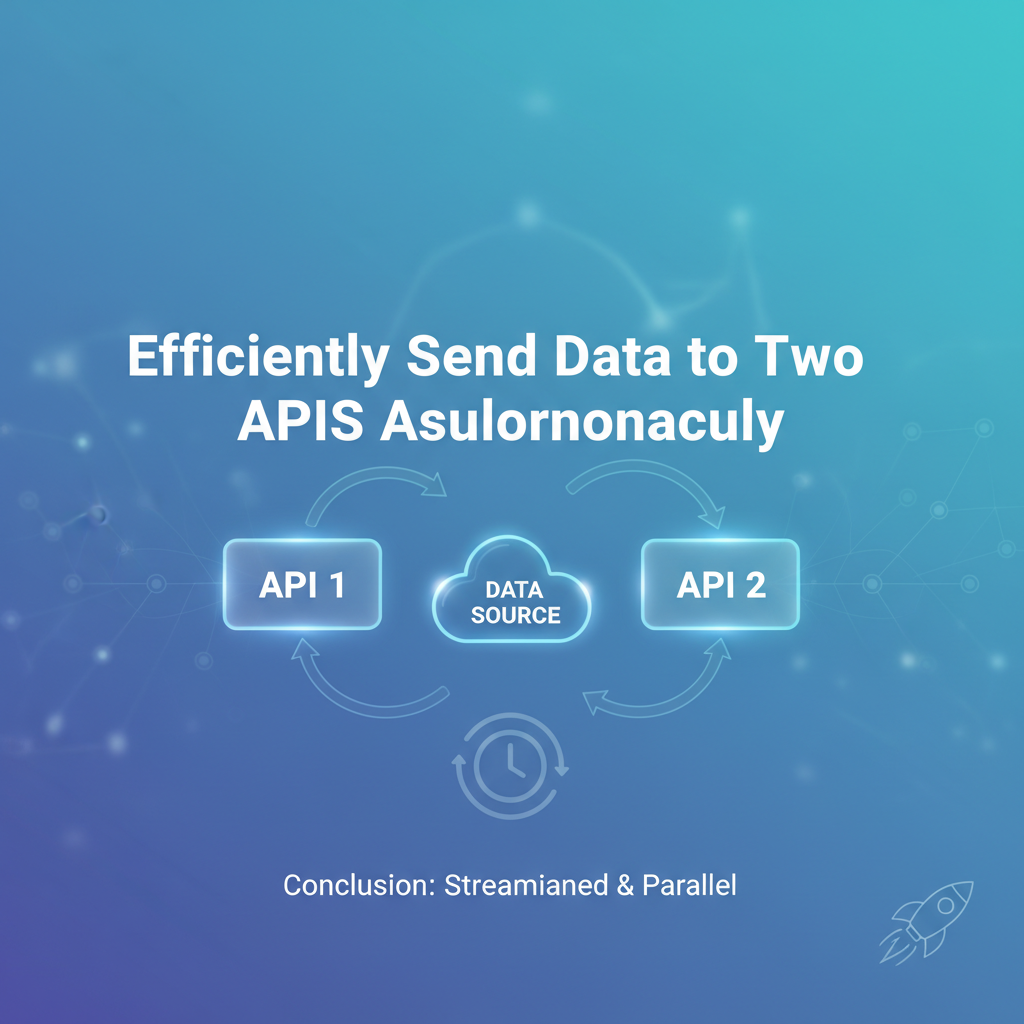
Efficiently Send Data to Two APIs Asynchronously


In the intricate tapestry of modern software architecture, where applications are increasingly distributed and reliant on external services, the ability to communicate efficiently and reliably with multiple Application Programming Interfaces (APIs) stands as a paramount concern. Synchronous interactions, while straightforward for simple, isolated tasks, quickly become bottlenecks in complex systems, leading to sluggish performance, poor user experience, and inefficient resource utilization. The challenge intensifies when an application needs to dispatch data to not just one, but two or more distinct APIs, often simultaneously, without one call impeding the progress of another. This intricate dance requires a thoughtful embrace of asynchronous programming paradigms, architectural patterns, and robust infrastructure solutions.
This comprehensive exploration delves into the compelling necessity of asynchronous processing when sending data to multiple APIs, laying bare the fundamental concepts that underpin such operations. We will dissect various strategies for implementing efficient asynchronous data dispatch, from client-side language constructs to sophisticated message queues and serverless functions. Crucially, we will highlight the indispensable role of an API gateway in orchestrating these complex interactions, acting as a powerful intermediary that streamlines, secures, and optimizes multi-API communication. Furthermore, we will delve into advanced considerations such as error handling, idempotency, and observability, concluding with real-world scenarios that underscore the practical application of these principles. Our goal is to equip developers and architects with a profound understanding of how to achieve robust, scalable, and highly performant systems by mastering the art of sending data to two or more APIs asynchronously.
The Imperative of Asynchronous Processing in Modern Systems
The digital landscape is characterized by its dynamic nature and the relentless demand for instantaneous responses. Users expect applications to be nimble, responsive, and constantly available, regardless of the underlying complexity. In this environment, relying solely on synchronous operations – where each task must complete before the next can begin – is akin to navigating a multi-lane highway by only using one lane at a time. This approach, while conceptually simple, creates significant bottlenecks when an application needs to interact with external services, particularly multiple api endpoints.
Imagine a scenario where a user submits an order on an e-commerce platform. This single action might necessitate several distinct API calls: one to a payment api to process the transaction, another to an inventory api to update stock levels, and perhaps a third to a notification api to send a confirmation email or SMS. If these calls are made synchronously, the entire process is held hostage by the slowest api response. A 500-millisecond delay from the payment api, followed by a 300-millisecond delay from the inventory api, and then another 200-millisecond delay from the notification api, cumulatively results in a full second of blocking time for the user. In a high-traffic system, this accumulates rapidly, leading to frustrated users, dropped transactions, and severely degraded system performance.
Asynchronous processing offers a powerful antidote to these challenges. At its core, asynchronous operation means that a task can be initiated without waiting for its immediate completion. Instead, the application continues to execute other tasks, receiving a notification or callback once the initial task is finished. This non-blocking nature is fundamental to building responsive and scalable systems. For instance, when the e-commerce platform dispatches the payment request asynchronously, it immediately proceeds to send the inventory update request, and then the notification request, without waiting for the payment api to respond. The system can then process the responses as they arrive, potentially in any order, allowing for parallel execution of I/O-bound tasks.
The benefits of embracing asynchronicity are manifold and profound. Firstly, it dramatically improves throughput, allowing an application to handle a significantly larger volume of concurrent requests. By not blocking threads or processes while waiting for external api responses, system resources (CPU, memory) are utilized far more efficiently. Secondly, it reduces perceived and actual latency for users, as they are not left waiting for a cascading series of synchronous operations. A faster response time translates directly into a better user experience, higher engagement, and ultimately, increased business value. Thirdly, asynchronous architectures inherently promote resilience. If one external api experiences a temporary slowdown or outage, the entire system isn't brought to a grinding halt; other asynchronous calls can still proceed or be handled gracefully.
However, the transition to asynchronous programming is not without its complexities. It introduces new challenges such as managing callbacks, understanding event loops, dealing with promises or futures, and ensuring proper error handling in a non-linear execution flow. Debugging asynchronous code can be more intricate, and developers must be vigilant about race conditions and data consistency in concurrent environments. Despite these challenges, the overwhelming advantages in terms of scalability, performance, and responsiveness make asynchronous processing an indispensable paradigm for any application that interacts with multiple external api services in today's demanding digital landscape. The journey from synchronous to asynchronous interactions is a crucial step towards building truly robust and high-performing distributed systems.
Fundamental Concepts of Asynchronous API Communication
To effectively implement asynchronous data dispatch to multiple APIs, it is essential to first grasp the underlying concepts that differentiate it from traditional synchronous programming. These foundational ideas not only guide the choice of programming constructs but also inform architectural decisions that impact system performance and reliability.
Concurrency vs. Parallelism
Often used interchangeably, concurrency and parallelism represent distinct concepts critical to asynchronous API communication. Concurrency refers to the ability to handle multiple tasks seemingly at the same time. It's about managing multiple computations that are making progress, even if they aren't executing simultaneously. A single CPU core can achieve concurrency by rapidly switching between tasks, giving the illusion of simultaneous execution. When your application sends requests to two APIs asynchronously on a single thread, it's leveraging concurrency – it initiates the first request, then the second, and then continues processing without waiting, handling responses as they arrive. Parallelism, on the other hand, is the actual simultaneous execution of multiple tasks. This requires multiple processing units (e.g., multiple CPU cores, distinct machines). If your application uses multiple threads or processes, each making an API call to a different service simultaneously on different cores, that's parallelism. In the context of sending data to two APIs, true parallelism means both HTTP requests are active and receiving responses at precisely the same moment. Modern programming languages and frameworks often abstract this distinction, allowing developers to write concurrent code that the underlying system can then execute in parallel if sufficient resources are available. The goal for efficient API communication is often to achieve both, by designing concurrent code that can then be parallelized by the runtime or operating system.
I/O Bound vs. CPU Bound Operations
Understanding the nature of the tasks involved is crucial for optimizing asynchronous operations. CPU-bound operations are those whose performance is limited by the speed of the processor. Examples include complex mathematical calculations, data encryption, or video encoding. For these tasks, adding more CPU power or utilizing parallel processing is the primary way to improve performance. Asynchronous processing generally offers less benefit here unless combined with parallel execution. I/O-bound operations are limited by the speed of input/output operations, such as reading from a disk, writing to a database, or, most pertinently for this discussion, making network requests to an external api. When an application makes an api call, the CPU is largely idle, waiting for the network round trip and the remote server's response. This waiting time is where asynchronous programming shines. By initiating an api call asynchronously, the application can put that thread (or process) to work on other tasks while the network operation proceeds in the background. Once the api response arrives, the original task can resume. Since most interactions with external services are inherently I/O-bound due to network latency, asynchronous patterns are exceptionally well-suited for improving the efficiency of multi-API communication.
Network Latency and Reliability
Interacting with external APIs introduces inherent challenges related to network latency and reliability, which asynchronous patterns help to mitigate but do not eliminate. Network latency refers to the delay experienced when data travels from your application to the remote api server and back. This latency can be influenced by geographical distance, network congestion, the number of hops, and the performance of intermediary network devices. Even under ideal conditions, a certain amount of latency is unavoidable. Asynchronous calls mask this latency by allowing other work to continue, but the total time for a specific api call to complete remains bounded by the network round trip. Reliability concerns the consistency and availability of the network path and the remote api itself. Networks can be unpredictable, experiencing temporary disconnections, packet loss, or routing issues. Remote APIs can suffer from outages, slowdowns, or return error responses. Asynchronous programming, especially when combined with robust error handling, retry mechanisms, and circuit breakers, can make your application more resilient to these external failures. It allows for graceful degradation or retry logic without blocking the entire application flow.
HTTP Clients and Connection Pooling
Efficiently managing HTTP connections is a cornerstone of performant api communication. An HTTP client library (e.g., requests in Python, HttpClient in Java, axios in JavaScript) provides the necessary functionality to construct and send HTTP requests and handle responses. Modern HTTP clients are designed to work seamlessly with asynchronous programming models, offering non-blocking request methods. Connection pooling is a critical optimization technique. Establishing a new TCP connection for every single HTTP request is resource-intensive and adds overhead (the TCP three-way handshake). A connection pool maintains a set of open, reusable TCP connections to target hosts. When your application needs to make an api call, it can "borrow" an existing connection from the pool rather than establishing a new one. After the request and response are processed, the connection is returned to the pool, ready for the next request. This significantly reduces the overhead associated with establishing and tearing down connections, making repeated api calls to the same host much more efficient. When sending data to multiple APIs, having robust HTTP clients with connection pooling configured for each distinct host is a best practice for minimizing latency and maximizing throughput.
By understanding these fundamental concepts, developers can make informed decisions about how to design, implement, and optimize asynchronous data dispatch, ensuring their applications remain responsive and resilient in the face of distributed system complexities.
Strategies for Asynchronous Data Dispatch to Multiple APIs
When the requirement arises to send data to two or more APIs asynchronously, developers have a spectrum of strategies at their disposal, each with its own trade-offs regarding complexity, scalability, and resilience. The choice of strategy often depends on the specific programming language, the volume and criticality of data, the desired level of decoupling, and the overall architectural vision.
Approach 1: Client-Side Asynchronous Calls
This approach involves using language-specific asynchronous programming constructs directly within your application code to initiate multiple API calls concurrently. It's often the simplest starting point for introducing asynchronicity.
Python with asyncio
Python's asyncio library provides a framework for writing concurrent code using the async/await syntax. It's built around an event loop that manages and schedules coroutines (functions defined with async def).
How it works: You define async functions that perform your API calls. These functions use an asynchronous HTTP client (like aiohttp) to make non-blocking requests. To send data to two APIs concurrently, you would use asyncio.gather() (or similar constructs) to schedule both API call coroutines to run on the event loop. The event loop can then context-switch between them whenever one is waiting for an I/O operation (like a network response).
Conceptual Code Example:
import asyncio
import aiohttp

async def send_to_api_one(data):
    url = "https://api.example.com/endpoint1"
    async with aiohttp.ClientSession() as session:
        async with session.post(url, json=data) as response:
            response.raise_for_status()
            return await response.json()

async def send_to_api_two(data):
    url = "https://api.another-example.com/endpoint2"
    async with aiohttp.ClientSession() as session:
        async with session.post(url, json=data) as response:
            response.raise_for_status()
            return await response.json()

async def main():
    payload = {"key": "value", "id": 123}
    try:
        # Both API calls are initiated concurrently
        result1, result2 = await asyncio.gather(
            send_to_api_one(payload),
            send_to_api_two(payload)
        )
        print(f"API One Response: {result1}")
        print(f"API Two Response: {result2}")
    except aiohttp.ClientError as e:
        print(f"An API call failed: {e}")
    except Exception as e:
        print(f"An unexpected error occurred: {e}")

if __name__ == "__main__":
    asyncio.run(main())
Pros: * Simplicity for few APIs: Relatively straightforward to implement for a small number of concurrent calls. * Reduced overhead: Uses a single thread (or a few threads) with an event loop, avoiding the overhead of managing many threads or processes. * Direct control: Developers have direct control over the request and response handling logic.
Cons: * Blocking point: If one of the API calls is extremely slow or hangs, asyncio.gather (by default) will wait for it. Timeouts need to be carefully managed. * Error handling: If one call fails, asyncio.gather will raise an exception, potentially preventing the results of other successful calls from being processed unless return_exceptions=True is used. * Scalability limits: While highly concurrent, this approach is still tied to the application instance. Scaling out requires running more instances of the application. * Network limitations: The calling service is still responsible for managing network issues, retries, and backoffs.
Node.js with Promise.all
Node.js is inherently asynchronous and event-driven. Promises and async/await are its primary mechanisms for handling asynchronous operations.
How it works: Each API call is wrapped in a Promise. These promises are then passed to Promise.all(), which waits for all promises to resolve (or for the first one to reject).
Conceptual Code Example:
const axios = require('axios'); // A popular promise-based HTTP client

async function sendToApiOne(data) {
    const url = "https://api.example.com/endpoint1";
    try {
        const response = await axios.post(url, data);
        return response.data;
    } catch (error) {
        console.error(`Error sending to API One: ${error.message}`);
        throw error; // Re-throw to be caught by Promise.all
    }
}

async function sendToApiTwo(data) {
    const url = "https://api.another-example.com/endpoint2";
    try {
        const response = await axios.post(url, data);
        return response.data;
    } catch (error) {
        console.error(`Error sending to API Two: ${error.message}`);
        throw error; // Re-throw to be caught by Promise.all
    }
}

async function main() {
    const payload = { key: "value", id: 123 };
    try {
        // Both API calls are initiated concurrently
        const [result1, result2] = await Promise.all([
            sendToApiOne(payload),
            sendToApiTwo(payload)
        ]);
        console.log(`API One Response: ${result1}`);
        console.log(`API Two Response: ${result2}`);
    } catch (error) {
        console.error(`One or more API calls failed: ${error.message}`);
        // Handle specific errors if needed
    }
}

main();
Pros & Cons: Similar to Python's asyncio, with Node.js's single-threaded event loop offering excellent performance for I/O-bound tasks.
Approach 2: Message Queues for Decoupling and Reliability
For scenarios demanding higher reliability, greater scalability, and loose coupling between services, message queues become an invaluable architectural component. They shift the responsibility of delivering data to external APIs from the immediate request-response cycle to a more robust, asynchronous processing pipeline.
How it works: Instead of directly calling the target APIs, your application publishes messages (containing the data to be sent) to a designated topic or queue in a message broker (e.g., Kafka, RabbitMQ, AWS SQS). A separate consumer service (or multiple consumers) then subscribes to this queue, retrieves the messages, and dispatches them to the respective external APIs. This creates a fan-out pattern where a single message published by your application can trigger multiple downstream actions.
Benefits: * Decoupling: The original application no longer needs to know the specifics of the downstream APIs or even if they are currently available. It simply publishes a message and moves on. * Resilience and Reliability: If an external api is temporarily down or slow, the messages remain in the queue. The consumer can retry sending the data once the api recovers, without affecting the upstream application. Messages can be persisted to disk, preventing data loss during system failures. * Scalability: Message queues handle backpressure naturally. If an external api is overwhelmed, the messages queue up, and consumers can process them at the api's pace. You can easily scale out consumers to handle increased message volume. * Load Leveling: Message queues can smooth out spikes in traffic, allowing downstream services to process data at a more consistent rate. * Auditability: Message queues often provide excellent logging capabilities, offering a clear audit trail of data processing.
Challenges: * Increased Complexity: Introduces another component (the message broker) into the architecture, which needs to be managed, monitored, and scaled. * Eventual Consistency: Data sent via a message queue will eventually be processed by the target APIs, but there's no immediate guarantee of completion within the originating transaction. This requires careful consideration of consistency models. * Operational Overhead: Setting up and maintaining a message broker, especially in production, can require significant operational expertise.
When to use: This approach is ideal for high-volume data streams, critical operations where data loss is unacceptable, and when strong decoupling between services is a priority. For example, in an e-commerce system, sending order details to multiple fulfillment services, analytics platforms, and marketing automation tools would benefit greatly from message queues.
Approach 3: Serverless Functions with Fan-out Patterns
Serverless computing (e.g., AWS Lambda, Azure Functions, Google Cloud Functions) offers another powerful paradigm for asynchronous multi-API dispatch, particularly suited for event-driven architectures.
How it works: Instead of your application directly calling external APIs, it can trigger a serverless function. This function then takes the incoming data and orchestrates the calls to multiple downstream APIs. The fan-out can be implemented within a single function (using client-side async patterns like Promise.all) or by having the initial function publish events to other services (like SQS or SNS) that then trigger other serverless functions, each responsible for calling a specific external api.
Benefits: * Managed Infrastructure: The cloud provider handles all the underlying infrastructure, scaling, and maintenance. Developers focus solely on code. * Cost-Effective: You only pay for the compute time consumed by your function executions, making it highly cost-efficient for intermittent workloads. * Scalability: Serverless functions automatically scale to handle varying loads, seamlessly executing thousands of concurrent invocations. * Integration with Cloud Ecosystem: Seamlessly integrates with other cloud services (e.g., event sources like SQS, SNS, API Gateway, S3) to build complex, highly available workflows.
Challenges: * Cold Starts: Infrequently used functions might experience a "cold start" delay as the execution environment needs to be provisioned. * Vendor Lock-in: Code and configuration can become tightly coupled to a specific cloud provider's ecosystem. * Monitoring and Debugging: Distributed serverless architectures can be more challenging to monitor and debug across multiple functions and services.
When to use: Excellent for event-driven workflows, microservices architectures, and scenarios where fluctuating workloads make traditional server provisioning inefficient. For example, processing image uploads that need to be sent to a face recognition api and an object detection api, or handling webhook events that trigger updates in multiple systems.
The choice among these strategies is not mutually exclusive; often, a combination provides the most robust solution. For instance, a client application might use client-side asynchronous calls to a central api gateway, which then uses message queues or triggers serverless functions for fan-out to external services. Understanding these approaches allows for architectural decisions that align with the specific performance, scalability, and reliability requirements of any given system.
Comparison of Asynchronous Data Dispatch Strategies
To provide a clearer perspective on when to apply each strategy, let's summarize their key characteristics and ideal use cases in a comparative table.
| Feature / Strategy | Client-Side Asynchronous Calls (e.g., async/await) |
Message Queues (e.g., Kafka, SQS) | Serverless Functions (e.g., Lambda, Azure Functions) |
|---|---|---|---|
| Complexity | Low to Medium | Medium to High (broker management) | Low (code-centric) |
| Decoupling | Low (direct dependency on target APIs) | High (publisher/consumer model) | Medium (indirect dependency via events/triggers) |
| Reliability | Medium (requires careful error handling/retries) | High (message persistence, retry mechanisms) | High (managed execution, integration with DLQs) |
| Scalability | Medium (limited by application instance resources) | High (can scale consumers independently) | Very High (auto-scaling by provider) |
| Latency | Direct API call latency | Adds queueing latency, but masks API latency | Adds function invocation latency |
| Error Handling | Manual (try-catch, specific logic) | Built-in retries, Dead-Letter Queues (DLQs) | Managed retries, DLQs, integrated monitoring |
| Operational Overhead | Low | High (broker setup, monitoring, maintenance) | Low (managed by cloud provider) |
| Ideal Use Cases | Few APIs, synchronous client response needed, internal services where tight coupling is acceptable. | High-volume events, critical data, long-running processes, microservices communication, fan-out to many systems. | Event-driven workflows, ephemeral tasks, varying workloads, integration with cloud services, internal orchestration. |
This table serves as a quick reference, but the optimal choice often involves a deeper analysis of the project's specific context, team expertise, and existing infrastructure.
APIPark is a high-performance AI gateway that allows you to securely access the most comprehensive LLM APIs globally on the APIPark platform, including OpenAI, Anthropic, Mistral, Llama2, Google Gemini, and more.Try APIPark now! 👇👇👇
The Crucial Role of an API Gateway
In the evolving landscape of microservices and distributed systems, interacting with numerous APIs, especially asynchronously, introduces significant challenges that go beyond simple code-level implementations. This is where an API gateway emerges as an indispensable architectural component. An API gateway acts as a single entry point for all client requests, abstracting the complexities of the backend services, routing requests to the appropriate services, and often performing various cross-cutting concerns. For efficiently sending data to two or more APIs asynchronously, an API gateway doesn't just simplify the process; it fundamentally enhances its security, resilience, and manageability.
What is an API Gateway?
An API gateway is essentially a server that sits in front of one or more APIs, acting as a proxy. It's the central point where all client requests are directed, and it orchestrates their routing to the various backend services. More than just a simple reverse proxy, a robust API gateway typically offers a suite of functionalities that are critical for modern api management. These functionalities include:
- Request Routing: Directing incoming requests to the correct backend service based on defined rules.
- Authentication and Authorization: Verifying client credentials and permissions before forwarding requests.
- Rate Limiting and Throttling: Protecting backend services from being overwhelmed by too many requests.
- Caching: Storing responses to frequently accessed data to reduce latency and load on backend services.
- Protocol Transformation: Translating between different protocols (e.g., REST to gRPC, or even SOAP to REST).
- Monitoring and Logging: Centralizing the collection of request and response metrics for observability.
- Load Balancing: Distributing incoming requests across multiple instances of a backend service.
- Circuit Breakers: Implementing resilience patterns to prevent cascading failures to unresponsive services.
By centralizing these concerns, an API gateway liberates individual backend services from having to implement them repeatedly, allowing them to focus purely on their business logic.
How an API Gateway Enhances Asynchronous Operations
For the specific challenge of sending data to multiple APIs asynchronously, an API gateway provides profound benefits:
- Request Aggregation/Fan-out: This is perhaps the most direct benefit. A client can send a single request to the api gateway which, in turn, can trigger multiple asynchronous calls to different downstream services. For instance, a client sends an "Order Placed" request to the api gateway. The gateway can then internally, and asynchronously, call the Payment API, the Inventory API, and the Notification API. The client receives an immediate acknowledgment from the gateway, while the backend processing happens in parallel. This hides the complexity of multi-API interaction from the client and significantly reduces client-side latency.
- Protocol Transformation and Masking Complexity: The API gateway can handle different communication protocols or data formats required by various backend APIs. If one API expects XML and another JSON, the gateway can perform the necessary transformations, presenting a unified interface to the client. This is crucial for integrating disparate systems and services, especially in asynchronous workflows where data consistency and format integrity are paramount.
- Centralized Authentication and Authorization: Instead of each backend api needing to validate tokens or permissions, the api gateway can handle this once at the entry point. This ensures consistent security policies across all services and simplifies the security posture for asynchronous requests.
- Rate Limiting and Throttling: When fanning out requests to multiple downstream APIs, it's vital to ensure that no single api is overwhelmed. The gateway can apply different rate limits to each downstream service, protecting them from excessive load, even if the incoming client traffic is high.
- Caching: If some of the data needed by downstream APIs is static or changes infrequently, the gateway can cache it, further reducing load and latency for subsequent requests.
- Monitoring and Logging: By serving as the central point of contact, the api gateway can provide comprehensive logging and metrics for all incoming and outgoing api calls. This is invaluable for monitoring the health of the system, debugging asynchronous workflows, and understanding performance bottlenecks across multiple services.
- Circuit Breakers and Retries: Implementing resilience patterns like circuit breakers and automatic retries at the gateway level prevents cascading failures. If an external api becomes unresponsive, the gateway can "trip" the circuit, preventing further requests to that service and allowing other asynchronous calls to proceed, potentially with fallback mechanisms. This significantly improves the overall fault tolerance of the system.
APIPark: An Open Source AI Gateway & API Management Platform
When discussing the vital role of an API gateway in managing complex api interactions, especially in an asynchronous and distributed environment, it's worth highlighting platforms that embody these capabilities. APIPark is an excellent example of an open-source AI gateway and API management platform that offers precisely the kind of features crucial for efficiently sending data to multiple APIs.
As an all-in-one AI gateway and API developer portal, ApiPark is designed to help developers and enterprises manage, integrate, and deploy AI and REST services with ease. For asynchronous data dispatch, particularly involving a mix of traditional REST and AI-driven APIs, APIPark’s features are highly relevant:
- Unified API Format for AI Invocation: Imagine sending a request that needs to go to two different AI models asynchronously for parallel processing (e.g., sentiment analysis and entity extraction). APIPark standardizes the request data format across various AI models, meaning your application doesn't need to adapt to each AI's unique requirements. This simplifies the client-side logic for initiating multiple asynchronous AI api calls.
- Prompt Encapsulation into REST API: Users can quickly combine AI models with custom prompts to create new, specialized APIs. This essentially allows the gateway itself to "compose" new APIs from existing AI services, which can then be invoked asynchronously by clients or other services, providing a flexible fan-out mechanism.
- End-to-End API Lifecycle Management: APIPark assists with managing the entire lifecycle of APIs, including design, publication, invocation, and decommission. This governance ensures that even complex asynchronous workflows involving multiple APIs are well-defined, versioned, and properly managed, reducing the chances of errors or inconsistencies.
- Performance Rivaling Nginx: With its high-performance capabilities (over 20,000 TPS with an 8-core CPU and 8GB of memory), APIPark can effectively handle a massive volume of concurrent asynchronous requests, ensuring that the gateway itself does not become a bottleneck when orchestrating calls to multiple downstream services. Its support for cluster deployment further enhances its ability to manage large-scale traffic.
- Detailed API Call Logging and Powerful Data Analysis: For asynchronous operations, tracing the flow of data and diagnosing issues across multiple APIs can be challenging. APIPark's comprehensive logging records every detail of each api call, enabling quick tracing and troubleshooting. Its powerful data analysis capabilities then help identify long-term trends and performance changes, which is vital for optimizing distributed asynchronous systems.
By leveraging an API gateway like APIPark, organizations can effectively externalize the complexities of managing and orchestrating calls to multiple APIs, including AI models, ensuring that their systems remain performant, secure, and easy to maintain, even as their distributed architectures grow more intricate. The gateway acts as a strategic control point, enabling the efficient, asynchronous dispatch of data and fostering a robust ecosystem of services.
Comparison of Implementing Fan-out Logic
The decision of where to implement the fan-out logic for multiple asynchronous api calls — whether in the client, a dedicated service, or an API gateway — significantly impacts the architecture's maintainability, scalability, and resilience.
- Client-side Fan-out:
- Pros: Simplest for very few, tightly coupled APIs; direct control over requests.
- Cons: Shifts complexity and burden to the client; client needs to manage multiple endpoints, authentication, error handling for each; harder to scale, manage, and evolve. Not suitable for web browsers due to CORS and security concerns if direct calls are made to internal APIs.
- Service-side Orchestrator (e.g., a dedicated microservice):
- Pros: More control than client-side; can implement complex business logic, error handling, and retries. Decouples client from backend services.
- Cons: Adds another service to manage, deploy, and scale; still requires custom implementation of cross-cutting concerns (auth, rate limiting) or reliance on a separate api gateway for them.
- API Gateway (like APIPark):
- Pros: Ideal for externalizing common concerns; provides a single entry point; centralizes authentication, authorization, rate limiting, caching, monitoring. Can natively support fan-out patterns or easily integrate with messaging queues/serverless functions for complex asynchronous workflows. Reduces burden on individual services and clients. Offers resilience patterns like circuit breakers.
- Cons: Adds a layer of abstraction that requires careful configuration and management; potential single point of failure if not properly scaled and made highly available.
Ultimately, for complex systems requiring reliable, scalable, and secure asynchronous data dispatch to multiple APIs, an API gateway is not just an option but often a necessity. It abstracts away the infrastructure concerns, provides a centralized control plane, and enforces consistent policies, allowing developers to focus on core business logic while benefiting from a robust and efficient multi-API interaction layer.
Advanced Considerations and Best Practices
While the strategies for asynchronous data dispatch provide a solid foundation, building truly resilient, scalable, and maintainable systems requires attention to several advanced considerations and best practices. These elements are crucial for navigating the inherent complexities of distributed systems and ensuring smooth operation in the long run.
Error Handling and Retries
In a distributed environment where multiple APIs are involved, failures are not exceptions but rather an inevitability. Network glitches, unresponsive services, or invalid data can all lead to errors. Robust error handling is paramount.
- Granular Error Detection: Identify which specific API call failed. Asynchronous frameworks often allow capturing individual errors, even if other calls succeed (e.g.,
Promise.allSettledin JavaScript,return_exceptions=Trueinasyncio.gather). - Retry Mechanisms: For transient errors (e.g., network timeouts, temporary service unavailability), implementing automatic retries can significantly improve reliability.
- Exponential Backoff: Instead of retrying immediately, wait for progressively longer periods between retries (e.g., 1 second, then 2 seconds, then 4 seconds). This prevents overwhelming an already struggling service.
- Jitter: Add a small, random delay to the backoff period to prevent a "thundering herd" problem where many clients retry at precisely the same interval.
- Maximum Retries: Define a sensible limit to the number of retries to avoid indefinite waiting and resource exhaustion.
- Dead-Letter Queues (DLQs): For persistent failures or messages that have exhausted their retry attempts, route them to a DLQ. This prevents poison pills from clogging the main processing queue and allows for manual inspection and reprocessing of failed items. This is particularly relevant when using message queues or serverless functions.
- Circuit Breakers: Implement a circuit breaker pattern (often available in API gateway or resilience libraries). If an external api repeatedly fails, the circuit breaker "trips," preventing further calls to that service for a period. This gives the failing service time to recover and prevents your application from wasting resources on calls that are doomed to fail, while other asynchronous calls can continue.
Idempotency: Preventing Duplicate Processing
When dealing with asynchronous retries or "at-least-once" delivery guarantees of message queues, it's possible for an api call to be executed multiple times. An operation is idempotent if applying it multiple times produces the same result as applying it once. For example, setting a value is often idempotent, while incrementing a counter is not.
- Design Idempotent APIs: Where possible, design your target APIs to be idempotent. For instance, instead of a
POST /ordersthat creates a new order every time, use aPUT /orders/{order_id}that updates or creates the order with a specific ID. - Idempotency Keys: If an api cannot be inherently idempotent, the client can send an "idempotency key" (a unique identifier for the request) with each call. The api then checks this key: if it has already processed a request with that key, it simply returns the previous result without reprocessing. This is crucial for financial transactions or critical data updates.
- Atomic Operations: Ensure that database operations or other state changes performed by your services are atomic, meaning they either fully complete or entirely fail, preventing partial updates during retries.
Observability: Logging, Tracing, and Metrics
In asynchronous, distributed systems, understanding what's happening at any given moment is challenging. Robust observability is key to debugging, performance tuning, and proactive problem detection.
- Comprehensive Logging: Log relevant information at critical points in your asynchronous workflow:
- Request initiation (payload, target api).
- Request completion (response status, latency).
- Errors (stack traces, error codes).
- Retry attempts.
- Correlation IDs: Crucially, ensure a unique "correlation ID" or "trace ID" is propagated across all services and log entries for a single logical operation. This allows you to stitch together logs from different services to understand the end-to-end flow.
- Distributed Tracing: Tools like OpenTelemetry, Jaeger, or Zipkin allow you to visualize the flow of a single request across multiple services. Each service adds a "span" to a trace, showing the duration and dependencies, which is invaluable for identifying latency bottlenecks in multi-API asynchronous calls.
- Metrics and Monitoring: Collect metrics on api call success rates, latency, error rates, queue depths, and resource utilization. Use monitoring dashboards and alerts to proactively detect anomalies and potential issues before they impact users. An API gateway is an excellent place to collect these centralized metrics.
Security: API Keys, OAuth, and Data Encryption
Security must be baked into the design of asynchronous API communication.
- API Keys/Tokens: Secure access to your APIs and the external APIs you interact with using API keys, OAuth 2.0 tokens, or other robust authentication mechanisms.
- Least Privilege: Ensure that each service or client has only the minimum necessary permissions to perform its required actions.
- Data Encryption: Encrypt data in transit (using HTTPS/TLS for all api calls) and at rest (for any sensitive data stored in queues or databases).
- Input Validation: Validate all input data rigorously at your application's boundaries and before sending it to external APIs to prevent injection attacks or malformed requests.
- Secrets Management: Never hardcode API keys or sensitive credentials. Use secure secrets management solutions (e.g., AWS Secrets Manager, HashiCorp Vault).
Performance Tuning: Connection Pooling, Timeouts, Batching
Optimizing performance goes beyond just making calls asynchronous.
- HTTP Connection Pooling: As discussed earlier, reuse TCP connections to reduce handshake overhead. Configure appropriate pool sizes.
- Timeouts: Implement strict timeouts for all external api calls. This prevents your application from hanging indefinitely if a downstream service becomes unresponsive. Different types of timeouts (connection timeout, read timeout) should be configured.
- Batching: If possible and supported by the target APIs, batch multiple individual data points into a single api call. This reduces the number of network round trips and can significantly improve throughput, especially when sending data to two APIs that share a common domain. However, be mindful of batch size limits and potential for single batch failures impacting multiple items.
- Concurrency Limits: While asynchronous calls enable high concurrency, too many concurrent open connections can overwhelm your own application's resources or the target APIs. Implement sensible concurrency limits.
Data Consistency Models: Eventual Consistency vs. Strong Consistency
When using asynchronous systems, especially with message queues, it's common to deal with eventual consistency.
- Strong Consistency: All readers see the most recent update. This often comes at the cost of availability and performance in distributed systems (e.g., ACID transactions).
- Eventual Consistency: All readers will eventually see the most recent update, but there might be a delay. This is often the default with message queues and highly distributed systems, favoring availability and performance.
- Choosing the Right Model: Understand the consistency requirements for each piece of data. For order processing, payment details might require strong consistency, while an email notification might tolerate eventual consistency. Design your system accordingly, acknowledging the trade-offs.
Choosing the Right Tool/Strategy: Context Matters
There is no one-size-fits-all solution. The best approach depends heavily on your specific context:
- Volume and Velocity: High-volume, real-time data benefits from message queues or serverless. Lower volume might be fine with client-side async.
- Criticality: Critical transactions requiring strict guarantees might lean towards robust message queues with DLQs and idempotency.
- Complexity of Fan-out: Simple fan-out to two APIs could be client-side. Complex orchestration to many APIs, especially with conditional logic, points towards an API gateway or dedicated orchestrator services.
- Team Expertise: Leverage existing team knowledge and familiarity with specific technologies.
- Infrastructure: Consider your current cloud provider and existing infrastructure.
By meticulously addressing these advanced considerations, developers can move beyond simply making calls asynchronous to building truly resilient, observable, secure, and high-performing systems that effectively manage complex interactions with multiple external APIs.
Real-World Scenarios and Use Cases
The theoretical benefits of efficiently sending data to two APIs asynchronously truly shine when applied to practical, real-world scenarios. Modern applications across various industries frequently encounter situations where parallel, non-blocking API interactions are not just an optimization but a fundamental requirement for business success.
E-commerce: Order Processing
Consider a typical e-commerce platform where a customer completes a purchase. A single "place order" action triggers a cascade of backend processes that must interact with multiple distinct APIs.
- Payment Gateway API: The primary and most critical step is to process the customer's payment. This involves sending the payment details (card number, amount, customer info) to an external payment processor's api. This call is often synchronous from the user's perspective (they wait for a "payment successful" message), but internally, the system initiates it asynchronously so it doesn't block other essential tasks.
- Inventory Management API: Concurrently with the payment process, the system needs to update its inventory. This involves sending the purchased product IDs and quantities to an inventory api to decrement stock levels. If this call is delayed by the payment api, there's a risk of selling out-of-stock items, leading to customer dissatisfaction.
- Customer Notification API: Once the payment is confirmed and inventory is updated, the customer expects an order confirmation. This requires sending order details to a notification api (e.g., an email service or SMS gateway) to dispatch a confirmation message. This process is generally less time-critical but still benefits from asynchronous execution, as a delay here shouldn't hold up the entire order finalization.
- Analytics and Reporting API: For business intelligence and marketing purposes, order details might also need to be sent to an analytics api or a data warehouse api. This is almost always a fire-and-forget asynchronous operation, as the customer doesn't directly depend on its immediate completion.
How Asynchronous Dispatch Helps: By initiating these calls (Payment, Inventory, Notification, Analytics) asynchronously, often orchestrated by an API gateway or a message queue system, the e-commerce platform achieves: * Faster User Feedback: The customer receives a "payment successful, order placed" message much quicker, as the system doesn't wait for all backend processes to complete sequentially. * Improved Resource Utilization: The application server threads are not blocked waiting for network I/O from slow external services, allowing them to handle more concurrent customer requests. * Enhanced Resilience: If the notification api or analytics api is temporarily unavailable, the core order processing (payment and inventory) is not affected. Messages for these less critical services can be queued for later processing. An api gateway can manage retries and circuit breakers for these less critical external dependencies.
Social Media: Post Creation
When a user publishes a post on a social media platform, that single action often triggers a complex, distributed workflow.
- Main Data Store API: The post content (text, image links, video links) is first sent to the primary database api for storage. This is a crucial, often synchronous-at-first step for persistence.
- Search Indexing API: Concurrently, the post needs to be indexed so it can be quickly found by other users via search. This involves sending the post content and metadata to a search api (e.g., Elasticsearch). This is a prime candidate for asynchronous processing, as indexing can take time and shouldn't block the user's perception of the post being "live."
- Follower Notification API: For the user's followers, a notification needs to be generated. This could involve sending the post ID to a notification service api which then fans out to push notification services, email services, or in-app feeds. This is highly asynchronous and often involves message queues due to the potentially large number of followers.
- Content Moderation API: Many platforms use AI-driven content moderation. The post's text and images might be sent to an external AI api (or multiple, e.g., one for text, one for images) for sentiment analysis, hate speech detection, or NSFW content flagging. These calls are ideally asynchronous, potentially handled by an API gateway like APIPark to manage different AI models, to avoid delaying the post's initial publication. The results can then be processed later to take action if needed.
How Asynchronous Dispatch Helps: * Instant User Experience: The user sees their post published immediately, while the indexing, notification, and moderation happen in the background. * Scalability: The system can handle a massive influx of posts by distributing the workload across various services and asynchronous processing pipelines. * Robustness: If the search index is temporarily down, posts are still stored and can be indexed later. Critical path is isolated. An api gateway could manage the health checks and retries for these diverse downstream api calls.
Data Ingestion: Receiving Data and Sending to Multiple Analytics/Storage Systems
Many applications act as data aggregators, receiving data from various sources and then distributing it to different internal and external systems for processing, analysis, and storage.
- Ingestion Endpoint: An application receives data, perhaps via a webhook or an internal api endpoint.
- Raw Data Storage API: The raw, unprocessed data might first be sent to a low-cost, highly scalable storage api (e.g., cloud object storage like S3 or an archival database) for auditing and disaster recovery.
- Real-time Analytics API: Simultaneously, the data needs to be streamed to a real-time analytics api or a stream processing platform (e.g., Kafka, Kinesis) for immediate insights and dashboard updates.
- Historical Data Warehouse API: For long-term analysis and reporting, the data might also be sent to a data warehouse api (e.g., Snowflake, BigQuery) for batch processing and complex queries.
- Machine Learning Feature Store API: If the data is used for training or inference, it might also be routed to a feature store api for machine learning models.
How Asynchronous Dispatch Helps: * High Throughput: The ingestion endpoint can process incoming data rapidly without waiting for multiple downstream storage and analytics systems to respond. * Data Integrity: By immediately storing raw data asynchronously, the system ensures data is captured even if other processing systems are temporarily unavailable. * Flexible Processing: Different downstream systems can process the data at their own pace and in their own formats, without blocking the upstream ingestion. This scenario often heavily leverages message queues (e.g., Kafka for real-time streams) and serverless functions orchestrated by an API gateway to manage the fan-out to various internal and external apis.
These examples illustrate that efficiently sending data to two or more APIs asynchronously is not merely a technical optimization but a strategic approach that underpins the performance, scalability, and resilience of modern digital services. By carefully selecting and implementing the right asynchronous strategies and leveraging powerful tools like an API gateway (such as APIPark), developers can build robust architectures capable of handling the demands of a highly interconnected world.
Conclusion
The journey through the intricacies of sending data to two APIs asynchronously reveals a fundamental truth about modern software development: to build responsive, scalable, and resilient applications, synchronous processing is often an impediment, while asynchronous paradigms are an absolute necessity. We have meticulously explored why the traditional blocking model falls short in a distributed landscape, leading to performance bottlenecks and poor user experiences, and how the non-blocking nature of asynchronous operations addresses these critical challenges head-on.
Our exploration delved into the core concepts underpinning efficient multi-API communication, distinguishing between concurrency and parallelism, highlighting the significance of I/O-bound operations, and emphasizing the importance of robust HTTP clients with connection pooling. We then dissected various strategies for asynchronous data dispatch: from the direct control offered by client-side language constructs like async/await in Python and Node.js, to the formidable decoupling and reliability provided by message queues, and the scalable, event-driven architecture facilitated by serverless functions. Each approach presents a unique set of trade-offs, making the choice dependent on the specific requirements for scalability, resilience, and operational complexity.
Crucially, we underscored the indispensable role of an API gateway in orchestrating these complex interactions. An API gateway serves as a strategic control point, abstracting backend complexities, centralizing cross-cutting concerns like security and rate limiting, and uniquely enabling efficient fan-out patterns to multiple downstream APIs. Platforms like ApiPark, an open-source AI gateway and API management platform, exemplify how such a gateway can streamline the management of diverse services, including AI models, ensure high performance, and provide invaluable observability into multi-API communication flows. By consolidating logic such as unified API formats, prompt encapsulation, and robust logging, APIPark empowers organizations to leverage asynchronous interactions with unparalleled ease and effectiveness.
Furthermore, we delved into advanced considerations that transform basic asynchronous implementations into production-grade systems. Robust error handling with intelligent retry mechanisms and dead-letter queues, the critical principle of idempotency to prevent duplicate processing, and comprehensive observability through logging, distributed tracing, and metrics are all non-negotiable for stability. Security measures encompassing API keys, OAuth, and data encryption, alongside performance tuning techniques like connection pooling, timeouts, and batching, ensure efficiency and protection. Finally, understanding data consistency models, whether strong or eventual, allows architects to align their asynchronous designs with business requirements.
The real-world scenarios in e-commerce, social media, and data ingestion unequivocally demonstrate that efficiently sending data to two or more APIs asynchronously is not merely a technical elegance but a fundamental driver of business value. By embracing these principles, leveraging appropriate tools and architectural patterns, and continuously applying best practices, developers and architects can build resilient, high-performing, and scalable distributed systems that meet the ever-increasing demands of the digital age. The future of software architecture undeniably lies in the mastery of asynchronous communication, making it a cornerstone for innovation and competitive advantage.
Five Frequently Asked Questions (FAQs)
Q1: What is the primary benefit of sending data to two APIs asynchronously compared to synchronously?
A1: The primary benefit is vastly improved performance, responsiveness, and resource utilization. When data is sent synchronously, the application must wait for the first API call to fully complete before it can even initiate the second. This blocks the execution flow, leading to increased latency, especially if one API is slow, and inefficient use of system resources. Asynchronous dispatch allows your application to initiate both API calls (and continue with other tasks) without waiting for either to complete, significantly reducing the total time for the operation, increasing throughput, and improving the user experience by providing quicker feedback. It essentially allows parallel execution of I/O-bound tasks.
Q2: What are the main challenges when implementing asynchronous API calls, especially to multiple endpoints?
A2: Implementing asynchronous API calls, particularly to multiple endpoints, introduces several challenges. These include managing complex control flows (e.g., callbacks, promises, futures), ensuring proper error handling across multiple independent operations (what if one API succeeds and another fails?), handling timeouts, and dealing with potential race conditions or data inconsistencies in a concurrent environment. Debugging can also be more complex due to the non-linear execution path. Additionally, ensuring idempotency and designing robust retry mechanisms become critical to prevent duplicate processing and handle transient failures gracefully.
Q3: How does an API Gateway help in efficiently sending data to multiple APIs asynchronously?
A3: An API gateway acts as a powerful intermediary that significantly streamlines and enhances asynchronous multi-API communication. It can centralize the fan-out logic, allowing a single client request to trigger multiple asynchronous calls to backend services. The gateway handles cross-cutting concerns like authentication, authorization, rate limiting, and caching, relieving backend services of these responsibilities. Crucially, it provides a centralized point for monitoring, logging, and implementing resilience patterns like circuit breakers and retries, which are vital for robust asynchronous operations. This reduces complexity for clients and individual services, leading to a more secure, performant, and manageable system.
Q4: When should I consider using a message queue for asynchronous data dispatch instead of direct client-side asynchronous calls?
A4: You should consider using a message queue when you need higher reliability, greater scalability, and strong decoupling between your services. Message queues (like Kafka or SQS) are ideal for high-volume data streams, critical operations where data loss is unacceptable, and scenarios where immediate processing is not strictly required. They handle backpressure, persist messages during outages, and allow consumer services to process data at their own pace. In contrast, direct client-side asynchronous calls are simpler but offer less resilience and can still be bottlenecked by the calling application's resources or direct API availability. Message queues facilitate eventual consistency, which is often acceptable and even desirable for many distributed workflows.
Q5: What is idempotency and why is it important in asynchronous multi-API communication?
A5: Idempotency means that an operation can be applied multiple times without changing the result beyond the initial application. In asynchronous multi-API communication, idempotency is crucial because operations can sometimes be executed more than once due to network retries, message queue "at-least-once" delivery semantics, or client-side retry logic. For example, if a payment API is not idempotent, a retry for a payment request could accidentally charge a customer twice. By designing APIs to be idempotent or by including idempotency keys with requests, you ensure that even if an API call is processed multiple times, the underlying system state remains consistent, preventing unintended side effects like duplicate transactions or corrupted data.
🚀You can securely and efficiently call the OpenAI API on APIPark in just two steps:
Step 1: Deploy the APIPark AI gateway in 5 minutes.
APIPark is developed based on Golang, offering strong product performance and low development and maintenance costs. You can deploy APIPark with a single command line.
curl -sSO https://download.apipark.com/install/quick-start.sh; bash quick-start.sh

In my experience, you can see the successful deployment interface within 5 to 10 minutes. Then, you can log in to APIPark using your account.

Step 2: Call the OpenAI API.