Secure & Optimize LLM Access with an LLM Proxy


The advent of Large Language Models (LLMs) has marked a pivotal moment in the landscape of artificial intelligence, heralding a new era of computational capability and human-computer interaction. From revolutionizing customer service with sophisticated chatbots to accelerating scientific discovery through advanced data analysis, LLMs like GPT, Llama, and Claude are rapidly transforming industries and reshaping the very fabric of how businesses operate and innovate. Their ability to understand, generate, and manipulate human language with remarkable fluency and coherence has unleashed an unprecedented wave of creativity and efficiency across countless applications. Developers and enterprises are now racing to integrate these powerful models into their products and workflows, seeking to harness their immense potential to drive competitive advantage and unlock new value propositions.
However, the journey from recognizing the potential of LLMs to fully realizing their benefits is fraught with a complex array of challenges. Integrating these cutting-edge models into production environments often uncovers significant hurdles related to security, performance, cost management, operational complexity, and robust governance. Developers frequently grapple with the intricacies of managing multiple API keys across various LLM providers, ensuring data privacy in transit, mitigating the risks of prompt injection attacks, and navigating the often-fluctuating rate limits and service availabilities of different models. Furthermore, the burgeoning costs associated with token usage, the need for consistent performance, and the sheer overhead of integrating disparate LLM APIs into existing microservices architectures can quickly become overwhelming, potentially undermining the very advantages these models promise. The rapid evolution of the LLM ecosystem, with new models and updates emerging at a dizzying pace, only adds to this complexity, making it difficult for organizations to maintain agility and avoid vendor lock-in.
Amidst this intricate and rapidly evolving technological landscape, a critical infrastructure layer has emerged as an indispensable solution: the LLM Proxy. Often referred to interchangeably as an LLM Gateway or a more broadly encompassing AI Gateway, this architectural component stands as an intelligent intermediary between an organization's applications and the vast, diverse world of Large Language Models. Its primary purpose is to abstract away the inherent complexities of direct LLM integration, while simultaneously bolstering security postures, optimizing operational performance, and streamlining cost management. By centralizing the management of LLM interactions, an LLM Proxy provides a unified control plane, enabling organizations to leverage the full power of AI safely, efficiently, and cost-effectively.
This comprehensive article will delve deep into the transformative role of an LLM Proxy. We will meticulously explore how this crucial layer addresses the multifaceted challenges of LLM adoption, elucidating its core functionalities, detailing its profound benefits in enhancing both security and optimization, and discussing the practical considerations for its successful implementation. Furthermore, we will examine the nuances between terms like LLM Proxy, LLM Gateway, and AI Gateway, underscoring their shared purpose while acknowledging subtle distinctions. By the end of this exploration, readers will gain a profound understanding of why an LLM Proxy is not merely a convenience but an essential component for any enterprise committed to securely and optimally harnessing the groundbreaking capabilities of Large Language Models in today's dynamic AI-driven world.
Understanding the LLM Landscape and Its Challenges
The current landscape of Large Language Models is characterized by an astonishing pace of innovation and diversification, offering an increasingly wide array of choices for developers and enterprises. On one hand, we have the highly publicized commercial offerings from tech giants like OpenAI (GPT series), Anthropic (Claude), and Google (Gemini, PaLM), which provide access to state-of-the-art models via robust, well-documented APIs. These public APIs offer unparalleled power and convenience, allowing organizations to integrate sophisticated AI capabilities without the need for extensive in-house infrastructure or specialized expertise. Many businesses gravitate towards these solutions for their sheer performance and the continuous updates provided by their developers.
On the other hand, the ecosystem is also vibrant with private, fine-tuned models, where organizations customize existing LLMs (either proprietary or open-source) with their specific datasets to achieve domain-specific accuracy and compliance. This approach allows for greater control over model behavior and data handling, but it also introduces significant operational overhead. Complementing these are the rapidly maturing open-source models, such as Llama by Meta, Falcon, and Mistral, which are gaining significant traction due to their flexibility, transparency, and the ability for organizations to deploy them on their own infrastructure, offering enhanced data privacy and cost control over the long term. The sheer volume and variety of these options, each with its own strengths, weaknesses, API specifications, and pricing structures, create a rich but complex environment for organizations seeking to leverage LLM technology effectively.
While the promise of LLMs is immense, their integration into production environments presents a unique set of common pain points that developers, operations teams, and business leaders must navigate. These challenges are not merely technical; they extend into areas of security, cost, performance, and governance, often threatening to undermine the very benefits that LLMs are intended to deliver.
Common Pain Points for Developers and Enterprises:
- Security Concerns:
- API Key Management: A fundamental security risk arises from the decentralized management of API keys for various LLM providers. As applications proliferate across different teams and environments, managing, rotating, and revoking these highly sensitive keys becomes a formidable task. A single compromised key can grant unauthorized access to an organization's LLM budget or expose proprietary data fed into the models, leading to significant financial losses and reputational damage. Without a centralized system, developers often embed keys directly into code or configuration files, a practice that is notoriously insecure and difficult to audit.
- Data Privacy (PII, Sensitive Data): Interacting with external LLM providers often involves transmitting sensitive business data, customer information, or Personally Identifiable Information (PII). Ensuring that this data is handled in compliance with regulations like GDPR, CCPA, or HIPAA is paramount. The risk of data leakage, unauthorized data retention by third-party LLM providers, or even inadvertent exposure through model training pipelines poses a severe threat to trust and compliance. Organizations need mechanisms to ensure that only sanitized or anonymized data reaches external models.
- Prompt Injection Attacks: This emerging class of attack involves crafting malicious inputs (prompts) designed to manipulate the LLM's behavior, override its safety guidelines, or extract confidential information. An LLM, designed to be helpful, might inadvertently comply with a malicious prompt, leading to data exfiltration, unauthorized actions, or the generation of harmful content. Defending against these sophisticated attacks requires robust input validation and sanitization strategies that go beyond simple regex checks.
- Unauthorized Access: Without proper access controls, internal users or even external actors could potentially abuse LLM resources, leading to excessive costs, misuse of models, or exposure of internal systems. Differentiating between legitimate and malicious access patterns is critical for maintaining system integrity.
- Performance & Reliability:
- Latency: Every interaction with an LLM, especially those hosted externally, introduces network latency. For real-time applications or user-facing interfaces, even a few hundred milliseconds of additional delay can degrade the user experience significantly. Optimizing response times is crucial for maintaining application responsiveness and user satisfaction.
- Rate Limiting: LLM providers impose strict rate limits on API calls to prevent abuse and ensure fair usage. Applications making frequent calls, especially during peak times, can easily hit these limits, resulting in
429 Too Many Requestserrors and service interruptions. Developers must build complex retry logic and backoff strategies into their applications, which adds considerable development and maintenance overhead. - Service Outages: While rare for major providers, LLM services can experience downtime, degraded performance, or regional outages. Applications designed to rely on a single LLM provider are vulnerable to these disruptions, leading to service unavailability and frustrated users.
- Model Switching and Load Balancing: As new and improved models are released, or as specific models become more cost-effective for certain tasks, organizations need the flexibility to switch between them seamlessly. Manually updating application logic to point to different models or to load balance requests across multiple instances or providers is time-consuming and prone to errors.
- Cost Management:
- Token Usage Tracking: LLM costs are primarily based on token usage (input and output). Without granular visibility and control, costs can quickly spiral out of control, especially with large-scale deployments or generative tasks. Developers need a way to monitor, analyze, and predict expenditure across various models and projects.
- Budget Enforcement: Setting and enforcing budgets for LLM usage at team, project, or even individual user levels is challenging. Without automated mechanisms, cost overruns are common, leading to unexpected financial burdens.
- Optimizing Model Selection: Different models have different pricing structures and performance characteristics. Choosing the most cost-effective model for a specific task, or dynamically routing requests based on cost, requires sophisticated logic that is difficult to implement at the application layer.
- Complexity & Integration:
- Multiple APIs, Varying Formats: Each LLM provider, and sometimes even different models from the same provider, has its unique API specifications, request/response formats, authentication mechanisms, and parameter sets. Integrating multiple LLMs directly into an application means writing extensive boilerplate code to normalize data, handle different error codes, and manage diverse authentication flows. This leads to increased development time and maintenance complexity.
- Prompt Engineering at Scale: Managing, versioning, and deploying prompts across multiple applications and models can become an unwieldy task. Changes to a prompt might require updates across various codebases, increasing the risk of inconsistencies and errors. A/B testing different prompts for performance or cost efficiency adds another layer of complexity.
- Governance & Compliance:
- Auditing and Logging: For compliance, security, and debugging purposes, organizations need detailed logs of every LLM interaction, including the input prompts, model responses, and associated metadata. Capturing and securely storing this data, along with robust search and analysis capabilities, is often overlooked in direct integrations.
- Compliance with Industry Regulations: Depending on the industry (e.g., finance, healthcare), there might be specific regulatory requirements regarding data handling, model transparency, and audit trails when using AI services. Ensuring that LLM interactions comply with these regulations can be a complex undertaking.
- Responsible AI Use: Implementing guardrails to prevent LLMs from generating biased, harmful, or inappropriate content is a critical ethical and business imperative. These guardrails need to be consistently applied across all LLM interactions, regardless of the underlying model.
- Observability:
- Beyond simple logging, organizations require comprehensive observability into their LLM interactions. This includes monitoring usage patterns, tracking key performance indicators (like latency, error rates), identifying cost trends, and gaining insights into model behavior. Without robust observability, troubleshooting issues, optimizing performance, and making informed decisions about LLM strategy becomes significantly harder.
These challenges highlight the urgent need for a sophisticated, centralized solution that can abstract away these complexities, enforce critical policies, and empower organizations to leverage LLMs safely, efficiently, and at scale. This is precisely where the LLM Proxy, LLM Gateway, or AI Gateway steps in as an architectural necessity.
What is an LLM Proxy / LLM Gateway / AI Gateway?
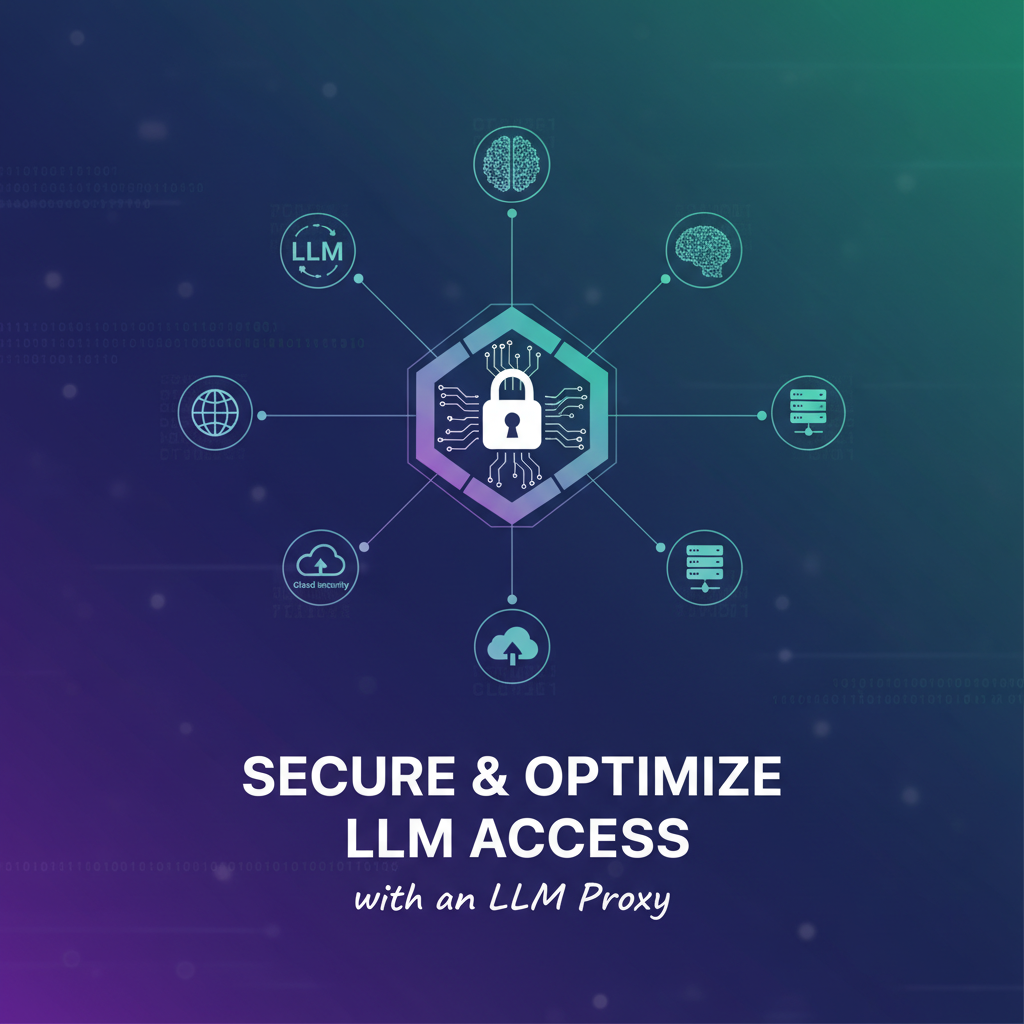
In the intricate and rapidly evolving ecosystem of Large Language Models, the concept of an LLM Proxy, often interchangeably referred to as an LLM Gateway or a more comprehensive AI Gateway, has emerged as an indispensable architectural pattern. At its core, an LLM Proxy is an intelligent intermediary layer that sits strategically between an organization's applications, services, and end-users, and the diverse array of LLM providers or locally deployed models. It acts as a single, unified entry point for all LLM-related requests, abstracting away the underlying complexities and providing a centralized control plane for managing, securing, and optimizing interactions with these powerful AI systems.
Core Function: Abstracting Complexity, Enhancing Security, Optimizing Performance/Cost
The primary mission of an LLM Proxy is threefold:
- Abstracting Away Complexity: Instead of applications needing to directly integrate with multiple LLM APIs, each with its unique authentication methods, request formats, and rate limits, the LLM Proxy provides a standardized, simplified interface. This means developers can write code once against the proxy, and the proxy handles the intricate details of routing requests to the appropriate backend LLM, transforming data as necessary. This significantly reduces development overhead, accelerates integration cycles, and minimizes the cognitive load on engineering teams.
- Enhancing Security: By centralizing access to LLMs, the proxy becomes the gatekeeper for all interactions. It can enforce stringent security policies, manage sensitive API keys securely, implement robust authentication and authorization mechanisms, filter out malicious inputs, and redact sensitive data before it ever reaches external LLM providers. This creates a powerful defensive layer that safeguards an organization's data, budget, and intellectual property.
- Optimizing Performance and Cost: An LLM Proxy is not just a passive pass-through; it actively seeks to improve the efficiency and cost-effectiveness of LLM usage. Through intelligent routing, caching frequently requested prompts, enforcing rate limits, and providing granular cost visibility, the proxy ensures that LLM resources are utilized optimally. It can dynamically select the most performant or cost-efficient model for a given request, ensuring a balance between user experience and operational expenditure.
Analogy: Similar to Traditional API Gateways but Tailored for LLM Interactions
To better understand the role of an LLM Proxy, it's helpful to draw parallels with traditional API Gateways. In microservices architectures, an API Gateway acts as the single entry point for all client requests, routing them to the appropriate backend services, handling authentication, rate limiting, and caching. An LLM Proxy performs a very similar function, but it is specifically tailored to the unique characteristics and demands of interacting with Large Language Models.
Unlike generic REST APIs, LLM interactions often involve: * Token-based billing: Requiring specific cost management features. * Prompt engineering: The need to manage, version, and inject dynamic prompts. * Streaming responses: Handling continuous data streams rather than single-shot responses. * Specific security vectors: Such as prompt injection, which requires specialized mitigation. * Rapidly evolving models: The necessity for seamless model switching and fallback strategies.
The LLM Proxy extends the core capabilities of an API Gateway to address these AI-specific nuances, providing a more intelligent and domain-aware intermediary layer.
Key Components/Architecture of an LLM Proxy:
A robust LLM Proxy or AI Gateway typically incorporates several key functional components that work in concert to deliver its core benefits:
- Request Routing: This is the brain of the proxy, responsible for intelligently directing incoming requests to the most suitable backend LLM. Routing decisions can be based on various factors such as the requested model name, cost, latency, current load, availability, specific prompt characteristics, or even predefined business logic.
- Authentication & Authorization: Manages and validates client credentials (e.g., API keys, OAuth tokens) for accessing the proxy itself. It then securely handles and injects the appropriate backend LLM provider credentials (e.g., OpenAI API keys) into the outbound request, abstracting these sensitive keys from the client applications. It also controls which users or applications can access specific LLMs or functionalities.
- Rate Limiting: Enforces limits on the number of requests an application or user can make within a specified time frame, both at the proxy level and by translating/aggregating rate limits from underlying LLM providers. This prevents abuse, ensures fair usage, and protects against exceeding provider-imposed limits.
- Caching: Stores responses to common or identical LLM prompts. If an identical request arrives, the proxy can serve the cached response instantly, reducing latency, saving computational resources from the backend LLM, and significantly cutting down on costs. Caching policies (e.g., TTL, invalidation strategies) are crucial here.
- Load Balancing: Distributes requests across multiple instances of the same LLM (if deployed internally) or across different LLM providers/regions to ensure high availability, improve response times, and prevent any single endpoint from becoming a bottleneck.
- Observability & Logging: Captures comprehensive details of every LLM interaction—inputs, outputs, latency, errors, token usage, cost. This data is vital for monitoring system health, troubleshooting issues, auditing compliance, and gaining insights into LLM usage patterns and expenditures.
- Data Transformation & Normalization: Translates incoming requests from a unified format into the specific API format required by the target LLM provider, and vice-versa for responses. This crucial component ensures that applications remain decoupled from the specifics of individual LLM APIs, simplifying integration.
- Security Policies & Validation: Implements rules to validate incoming prompts, sanitize inputs to prevent prompt injection attacks, and redact or mask sensitive data (like PII) before it's sent to external LLM services.
- Prompt Management & Versioning: Provides a centralized repository for managing and versioning prompts, allowing developers to test, deploy, and roll back prompt changes independently of application code. This can also include templating and dynamic prompt injection.
Differentiation of Terms: LLM Proxy, LLM Gateway, AI Gateway
While the terms LLM Proxy, LLM Gateway, and AI Gateway are often used interchangeably, it's worth noting the subtle distinctions that sometimes guide their usage:
- LLM Proxy: This term most directly implies a primary function of acting as a forward or reverse proxy specifically for Large Language Models. It suggests a focus on direct request routing, caching, and basic security for LLM-specific traffic. It often highlights the architectural pattern of an intermediary.
- LLM Gateway: Similar to an LLM Proxy, but "Gateway" often implies a broader set of features, akin to a traditional API Gateway. It encompasses more comprehensive API management functionalities, such as advanced security, detailed analytics, developer portals, and potentially lifecycle management specifically for LLM-based services. It suggests a more enterprise-grade solution for managing LLM APIs.
- AI Gateway: This is the broadest term among the three. An AI Gateway handles not just Large Language Models, but potentially any type of AI service, including computer vision APIs, speech-to-text, natural language processing (NLP) beyond generative AI, machine learning inference endpoints, and more. It positions the solution as a unified control plane for an organization's entire AI services portfolio. The distinction is crucial for platforms like ApiPark, which position themselves as comprehensive AI Gateways capable of integrating and managing a wide array of AI models beyond just LLMs, offering a truly unified management system for authentication and cost tracking across all integrated AI services.
For the purposes of securing and optimizing access to Large Language Models, the functionalities described generally apply across all three terms. Regardless of the nomenclature, the core value proposition remains the same: to provide an intelligent, secure, and efficient layer for interacting with powerful AI models, transforming them from complex, disparate services into manageable, integrated components of an enterprise's technological infrastructure.
How an LLM Proxy Secures LLM Access
In an era where data breaches can severely impact an organization's reputation and financial stability, and where AI models themselves can be vectors for new attack types, securing access to Large Language Models is not just a best practice—it's an imperative. An LLM Proxy acts as a formidable bulwark, implementing a multi-layered security strategy that protects against a wide array of threats, from simple credential mismanagement to sophisticated prompt injection attacks. By centralizing security controls, it ensures consistent enforcement of policies across all LLM interactions, significantly reducing the attack surface and bolstering an organization's overall security posture.
Centralized Authentication & Authorization:
One of the most immediate and significant security benefits of an LLM Proxy is its ability to centralize authentication and authorization. In a typical setup without a proxy, each application or microservice would need to directly manage its own set of API keys for every LLM provider it interacts with. This leads to a sprawl of sensitive credentials stored across various applications, often duplicated, and potentially less securely handled, making key rotation and revocation a logistical nightmare.
An LLM Proxy eliminates this credential sprawl by acting as the sole holder of the actual LLM provider API keys. Client applications authenticate with the proxy using their own, often less sensitive, credentials (e.g., internal API keys, OAuth tokens, JWTs). The proxy then, and only then, uses its securely stored LLM provider keys to make the actual call to the backend model. This provides: * Single Point of Control: All LLM API keys are managed in one secure location, simplifying key rotation, auditing, and access control. * Reduced Exposure: Client applications never directly handle LLM provider API keys, drastically reducing the risk of accidental exposure or compromise. * IAM Integration: Many proxies integrate with enterprise Identity and Access Management (IAM) systems (e.g., LDAP, Okta, Azure AD), allowing for robust user and application identity verification.
Data Masking & Redaction:
The transmission of sensitive information, such as Personally Identifiable Information (PII), proprietary business data, or confidential client details, to external LLM providers is a major data privacy concern. An LLM Proxy can act as a crucial filter, preventing this sensitive data from ever leaving the organization's controlled environment.
This is achieved through: * Configurable Data Redaction Rules: The proxy can be configured with rules (e.g., regex patterns, keyword lists, named entity recognition models) to automatically identify and redact, mask, or anonymize specific types of sensitive data within incoming prompts before forwarding them to the LLM. For example, it can replace credit card numbers, social security numbers, email addresses, or specific customer names with placeholders or encrypted values. * PII Filtering: Beyond general redaction, some advanced proxies incorporate specialized PII detection algorithms to ensure compliance with privacy regulations like GDPR, CCPA, or HIPAA. This provides an additional layer of assurance that sensitive user data is not inadvertently processed or stored by external LLM providers. * Compliance Assurance: By enforcing data privacy at the gateway level, organizations can maintain better control over their data footprint and demonstrate compliance with stringent regulatory requirements, mitigating the risk of data breaches and associated legal penalties.
Input Validation & Sanitization:
Prompt injection attacks represent a unique and evolving threat vector in the LLM landscape. Malicious users can craft prompts designed to override system instructions, extract confidential data, or manipulate the LLM into generating undesirable content. Defending against these attacks requires sophisticated input validation and sanitization techniques.
An LLM Proxy can implement robust defenses: * Prompt Sanitization: It can parse incoming prompts and remove or neutralize potentially malicious commands, special characters, or control sequences that could trick the LLM. * Guardrail Enforcement: The proxy can enforce pre-defined safety guardrails, rejecting prompts that fall outside acceptable parameters (e.g., attempting to jailbreak the LLM, requesting harmful content, or trying to access system instructions). * Contextual Analysis: More advanced proxies might use their own smaller, faster AI models or rule-based engines to analyze prompts for suspicious intent or patterns indicative of injection attempts, providing a real-time defense layer. * Schema Validation: Ensuring that the structure and content of the prompt adhere to predefined schemas can prevent malformed requests from reaching the LLM, reducing the risk of errors and potential security vulnerabilities.
Threat Detection & Prevention:
Beyond individual prompt scrutiny, an LLM Proxy provides a vantage point for observing aggregate request patterns, enabling it to detect and prevent broader threats.
- Rate Limit Enforcement: As discussed, the proxy centrally manages and enforces rate limits, not just to optimize usage but also to prevent denial-of-service (DoS) attacks or excessive resource consumption by a malicious actor. If a user or application suddenly starts making an abnormal number of requests, the proxy can detect this anomaly and block further access.
- IP Whitelisting/Blacklisting: It can be configured to allow or deny requests from specific IP addresses or ranges, providing a foundational layer of network-level access control.
- Abuse Prevention: By monitoring usage patterns and identifying unusual or suspicious activity (e.g., rapid attempts to access sensitive models, repeated failed authentication attempts, or sudden spikes in token consumption for a single user), the proxy can trigger alerts or automatically block offending entities, protecting against financial fraud and service misuse.
Auditing & Compliance Logging:
Maintaining detailed records of all LLM interactions is paramount for security forensics, debugging, and regulatory compliance. An LLM Proxy, positioned at the nexus of all LLM traffic, is uniquely suited to provide this comprehensive logging capability.
- Comprehensive Records: The proxy can log every detail of an API call, including the originating user/application, timestamp, target LLM, full prompt (pre-redaction and post-redaction), LLM response, latency, token usage, and any errors encountered.
- Immutable Logs: These logs can be securely stored in an immutable fashion, making them reliable for audit trails.
- Security Forensics: In the event of a security incident or a suspected misuse, these detailed logs become invaluable for reconstructing events, identifying the source of the issue, and understanding the scope of any potential breach.
- Regulatory Compliance: For industries operating under strict regulatory frameworks, robust auditing and logging are often mandatory. The proxy provides the necessary evidence of controlled LLM usage, demonstrating due diligence and accountability. For instance, platforms like ApiPark offer comprehensive logging capabilities, meticulously recording every detail of each API call. This feature is instrumental for businesses to swiftly trace and troubleshoot issues, ensuring not only system stability but also robust data security. This level of detail empowers compliance officers and security teams with the necessary data for thorough audits and incident response.
Access Control & Permissions:
Granular access control is essential for managing enterprise-wide LLM usage, ensuring that only authorized users or applications can access specific models or perform certain actions.
- Role-Based Access Control (RBAC): The proxy can implement RBAC, allowing administrators to define roles (e.g., "AI Developer," "Data Scientist," "Guest User") and assign specific permissions to each role. For example, a "Guest User" might only have access to a basic, low-cost LLM for general queries, while an "AI Developer" has access to more advanced, specialized, or sensitive models.
- Tenant/Team Isolation: In larger organizations or multi-tenant deployments, an LLM Proxy can enable the creation of isolated environments. This means each team or department (tenant) can have its independent applications, data, user configurations, and security policies, even while sharing the underlying infrastructure. This prevents cross-contamination of data and ensures that security policies are strictly enforced per tenant. ApiPark explicitly supports this by enabling the creation of multiple teams (tenants), each with independent API and access permissions, applications, data, user configurations, and security policies. This ensures strong isolation while optimizing resource utilization.
- Subscription Approval Workflow: For critical or sensitive APIs, an LLM Proxy can introduce an approval workflow. Callers must "subscribe" to an API and await administrator approval before they can invoke it. This prevents unauthorized API calls and potential data breaches by establishing a human-in-the-loop validation process for access requests. APIPark implements this feature, allowing for the activation of subscription approval features, ensuring that callers must subscribe to an API and await administrator approval before they can invoke it, thereby preventing unauthorized API calls and potential data breaches.
Network Security:
While much of the security focuses on application-layer interactions, the LLM Proxy also plays a role in foundational network security:
- Encrypted Communication: The proxy ensures that all communication, both from client applications to the proxy and from the proxy to the backend LLM providers, uses secure, encrypted channels (e.g., HTTPS/TLS), protecting data in transit from eavesdropping and tampering.
- Private Endpoints: For cloud-based LLM services, advanced proxies can be configured to use private endpoints or virtual private clouds (VPCs) to ensure that traffic between the proxy and the LLM provider never traverses the public internet, adding another layer of isolation and security.
In essence, an LLM Proxy transforms LLM access from a fragmented, potentially vulnerable set of direct integrations into a well-managed, secure, and auditable control plane. It empowers organizations to confidently integrate and scale their use of Large Language Models, knowing that their data, systems, and budgets are protected by robust, centralized security mechanisms.
How an LLM Proxy Optimizes LLM Access
Beyond robust security, an LLM Proxy is an indispensable tool for dramatically optimizing the efficiency, performance, and cost-effectiveness of Large Language Model interactions. In a world where every token counts and every millisecond impacts user experience, the ability to streamline access and intelligently manage resources is paramount. An LLM Proxy achieves this by abstracting complexities, automating decision-making, and providing granular insights, transforming LLM consumption from a costly and cumbersome endeavor into a finely tuned, highly efficient operation.
Unified API Interface:
One of the most immediate and tangible optimization benefits comes from the proxy's ability to provide a unified API interface. Without a proxy, developers face the daunting task of integrating with a multitude of LLM providers, each with its unique API endpoints, request/response schemas, authentication mechanisms, and error codes. This "integration tax" leads to: * Increased Development Time: Writing custom adapters for each LLM adds significant boilerplate code. * Maintenance Overhead: Changes in one provider's API require updates across all dependent applications. * Vendor Lock-in: Switching LLM providers becomes a major refactoring effort.
An LLM Proxy resolves this by offering a single, standardized API endpoint that applications interact with. The proxy then handles the internal translation and routing to the appropriate backend LLM, regardless of its specific API. This standardization means: * Simplified Integration: Developers write code once against a consistent interface, dramatically reducing integration effort. * Reduced Complexity: Applications are decoupled from the specific implementations of LLM providers, making the system architecture cleaner and easier to understand. * Future-Proofing: As new LLMs emerge or existing ones evolve, only the proxy needs to be updated, not every consuming application. ApiPark, for example, highlights its unified API format for AI invocation, ensuring that changes in AI models or prompts do not affect the application or microservices, thereby significantly simplifying AI usage and maintenance costs. This crucial feature underlines the proxy's role in future-proofing an organization's AI strategy.
Intelligent Routing & Load Balancing:
The ability to intelligently route requests is a cornerstone of an LLM Proxy's optimization capabilities. Instead of blindly sending all requests to a single, default LLM, the proxy can dynamically choose the best model or provider based on a sophisticated set of criteria: * Cost Optimization: Route requests for less critical tasks to cheaper, smaller models, or leverage providers offering better rates for specific token volumes. * Performance Optimization: Direct time-sensitive requests to models known for lower latency, or to regions with closer proximity. * Availability & Reliability: Automatically failover to a healthy LLM provider if the primary one experiences an outage or performance degradation. * Workload-Specific Routing: Route specific types of prompts (e.g., code generation vs. creative writing) to models specialized for those tasks. * A/B Testing: Distribute traffic to different models or different prompt versions to compare their performance, cost, and output quality. * Load Balancing: Distribute incoming requests across multiple instances of the same model (if self-hosted) or across different providers to prevent any single endpoint from becoming overwhelmed and to ensure high availability and responsiveness.
This intelligent routing ensures that resources are always used efficiently, balancing cost, performance, and reliability based on real-time conditions and business priorities.
Caching Mechanisms:
Caching is a powerful optimization technique that significantly reduces latency and cost. Many LLM prompts are repetitive, or certain phrases and questions are frequently asked. * Response Caching: The LLM Proxy can store the responses to specific prompts. If an identical prompt is received again within a defined time-to-live (TTL), the proxy can serve the cached response instantly without making a new call to the backend LLM. This leads to: * Reduced Latency: Instant responses for cached queries. * Significant Cost Savings: Eliminates redundant token usage for repeated prompts. * Reduced Load on LLMs: Frees up LLM resources for unique or more complex queries. * Intelligent Cache Invalidation: Advanced caching strategies can include invalidation based on time, specific events, or even semantic similarity to ensure cached data remains relevant and accurate.
Rate Limit Management:
LLM providers impose strict rate limits (e.g., requests per minute, tokens per minute) to ensure fair usage and prevent abuse. Hitting these limits directly from an application can lead to errors, retries, and a degraded user experience. * Aggregated Rate Limiting: An LLM Proxy can aggregate and manage rate limits across all applications using its services. It acts as a central traffic cop, queuing requests when necessary and releasing them at a controlled pace that respects the backend LLM's limits, preventing individual applications from overshooting their quotas. * Retry Mechanisms: The proxy can automatically implement intelligent retry logic with exponential backoff for rate-limited requests, insulating client applications from the need to handle these complexities. * Custom Rate Limiting: Organizations can define their own rate limits at the proxy level for different users, teams, or applications, ensuring fair internal resource allocation and preventing any single entity from monopolizing LLM access.
Cost Management & Observability:
Controlling LLM costs is a critical concern for enterprises. An LLM Proxy provides unparalleled visibility and control over expenditures. * Granular Token Tracking: The proxy meticulously tracks token usage (input and output) for every request, broken down by user, application, project, and LLM model. This detailed data is crucial for understanding where costs are originating. * Budget Enforcement: Administrators can set hard or soft budget limits at various organizational levels (e.g., per team, per project, per user). The proxy can then enforce these budgets, sending alerts when thresholds are approached and even blocking requests if budgets are exceeded, preventing unexpected cost overruns. * Cost Analytics & Reporting: By collecting extensive historical data, the proxy can generate powerful dashboards and reports, displaying long-term trends, performance changes, and cost allocations. This enables businesses to identify cost-saving opportunities, forecast future expenditures, and justify AI investments. ApiPark offers powerful data analysis capabilities, analyzing historical call data to display long-term trends and performance changes, which is invaluable for businesses to proactively manage costs and perform preventive maintenance before issues impact the bottom line. This level of detail empowers finance and operations teams to make informed decisions. * Performance Monitoring: Beyond costs, the proxy provides deep insights into latency, error rates, and throughput for different LLMs, allowing teams to identify bottlenecks and optimize for performance.
Performance Enhancements:
Beyond caching and intelligent routing, proxies can implement other performance-boosting techniques: * Request Batching: For scenarios where multiple small, independent prompts need to be sent, the proxy can batch them into a single request to the LLM, potentially reducing API call overhead and improving throughput. * Connection Pooling: Maintaining persistent connections to frequently used LLM endpoints reduces the overhead of establishing new connections for each request, leading to lower latency.
Model Agnosticism & Vendor Lock-in Mitigation:
The dynamic nature of the LLM market means that new, more performant, or more cost-effective models are constantly emerging. Without a proxy, switching models often entails significant code changes across multiple applications. * Seamless Model Switching: An LLM Proxy allows organizations to switch between different LLM providers or models (e.g., from GPT-4 to Claude 3, or from a public API to a self-hosted open-source model) with minimal to no changes in the application code. The routing logic within the proxy handles the transition, effectively mitigating vendor lock-in. * Experimentation: This flexibility fosters innovation, allowing teams to quickly experiment with new models and integrate the best-performing ones into production without extensive refactoring.
Prompt Management & Versioning:
Effective prompt engineering is crucial for getting the best results from LLMs. An LLM Proxy can centralize the management of prompts. * Centralized Prompt Repository: Store prompts as configurable assets within the proxy, rather than embedding them directly in application code. * Versioning and A/B Testing: Easily version prompts, test different versions (A/B testing) to compare output quality or cost, and roll back to previous versions if needed. * Dynamic Prompt Injection: The proxy can dynamically inject variables or context into base prompts, allowing for personalized and adaptable LLM interactions without altering the core application logic. ApiPark streamlines this by allowing users to quickly combine AI models with custom prompts to create new APIs, such as sentiment analysis or data analysis APIs, thereby encapsulating prompt logic into easily consumable REST APIs. This feature effectively transforms complex prompt engineering into reusable and manageable API resources.
Fallback Strategies:
Ensuring high availability is a critical optimization. An LLM Proxy can implement robust fallback mechanisms: * Automatic Failover: If a primary LLM provider or model becomes unavailable or experiences high latency, the proxy can automatically route requests to a pre-configured backup model or provider, ensuring continuous service without application interruption. * Graceful Degradation: In extreme cases, the proxy could be configured to return a generic error or a simplified response, preventing complete application failure.
By integrating these powerful optimization capabilities, an LLM Proxy transforms the way organizations interact with Large Language Models. It not only streamlines operations and reduces costs but also significantly enhances the performance and reliability of AI-powered applications, enabling businesses to fully unlock the transformative potential of LLMs with confidence and efficiency.
APIPark is a high-performance AI gateway that allows you to securely access the most comprehensive LLM APIs globally on the APIPark platform, including OpenAI, Anthropic, Mistral, Llama2, Google Gemini, and more.Try APIPark now! 👇👇👇
APIPark: An Open-Source AI Gateway Solution
In the pursuit of securely and optimally accessing Large Language Models, finding a robust, flexible, and comprehensive AI Gateway solution is paramount. This is where APIPark enters the conversation as a compelling, open-source AI Gateway and API Management Platform. Developed under the Apache 2.0 license by Eolink, a leader in API lifecycle governance, APIPark directly addresses many of the security and optimization challenges we've discussed, offering a practical and powerful implementation of the LLM Proxy concept.
APIPark is designed to be an all-in-one solution that not only manages the complexities of integrating diverse AI models but also provides a full-featured API developer portal for traditional REST services. Its open-source nature means transparency, community support, and the flexibility for organizations to adapt and extend its capabilities to their specific needs.
Let's look at how APIPark’s key features directly contribute to securing and optimizing LLM access:
- Quick Integration of 100+ AI Models: This feature directly speaks to the optimization of model agnosticism and simplified integration. APIPark provides a unified management system for authenticating and tracking costs across a vast array of AI models. This means developers don't need to build bespoke integrations for each new LLM or AI service; they can connect through APIPark and immediately gain access to a wide ecosystem, significantly reducing development time and effort.
- Unified API Format for AI Invocation: A cornerstone of optimization, this feature standardizes the request data format across all integrated AI models. As previously discussed, this eliminates the pain point of disparate APIs, ensuring that applications and microservices remain unaffected by changes in underlying AI models or prompts. This dramatically simplifies maintenance, reduces the risk of errors, and cuts down on long-term operational costs.
- Prompt Encapsulation into REST API: This is a powerful optimization for prompt management. APIPark allows users to quickly combine AI models with custom prompts and expose them as new, easily consumable REST APIs. Imagine creating a "Sentiment Analysis API" or a "Legal Document Summarization API" with specific prompts baked in. This centralizes prompt logic, enables versioning, and allows for consistent, controlled usage of prompts across an organization, preventing prompt sprawl and facilitating A/B testing of different prompt strategies.
- End-to-End API Lifecycle Management: While broader than just LLM access, this feature contributes significantly to governance and optimization. APIPark assists with managing the entire lifecycle of APIs, from design and publication to invocation and decommission. This includes regulating API management processes, managing traffic forwarding, load balancing, and versioning of published APIs, all of which are crucial for maintaining a high-performing, secure, and well-governed LLM infrastructure.
- API Service Sharing within Teams: This feature optimizes team collaboration and resource utilization. By providing a centralized display of all API services, APIPark makes it effortless for different departments and teams to discover and use the required API services. This avoids redundant integrations and promotes consistent usage patterns across the organization.
- Independent API and Access Permissions for Each Tenant: This is a critical security feature enhancing access control and isolation. APIPark enables the creation of multiple teams (tenants), each with independent applications, data, user configurations, and security policies. While sharing underlying infrastructure to improve resource utilization, each tenant operates in a secure, isolated environment, preventing unauthorized cross-team access and ensuring strict adherence to departmental security mandates.
- API Resource Access Requires Approval: Directly addressing security through controlled access, APIPark allows for the activation of subscription approval features. This means that callers must subscribe to an API and await administrator approval before they can invoke it. This "human-in-the-loop" gate prevents unauthorized API calls and potential data breaches, adding a crucial layer of review to sensitive or critical LLM interactions.
- Performance Rivaling Nginx: This highlights a key performance optimization. APIPark boasts impressive performance metrics, capable of achieving over 20,000 TPS with modest hardware (8-core CPU, 8GB memory) and supporting cluster deployment for large-scale traffic. This ensures that the gateway itself does not become a bottleneck, guaranteeing high throughput and low latency for LLM interactions.
- Detailed API Call Logging: Essential for both security (auditing) and optimization (troubleshooting & insights). APIPark provides comprehensive logging, recording every detail of each API call. This feature is invaluable for quickly tracing and troubleshooting issues in API calls, ensuring system stability and data security through meticulous audit trails.
- Powerful Data Analysis: This directly supports cost and performance optimization. By analyzing historical call data, APIPark displays long-term trends and performance changes. This predictive capability helps businesses with preventive maintenance, identifies cost-saving opportunities, and provides deep insights into LLM usage patterns, enabling proactive decision-making before issues or cost overruns occur.
APIPark offers rapid deployment with a single command line, making it accessible for quick integration into existing infrastructures. Its dual offering of an open-source version for startups and a commercial version with advanced features and professional technical support for leading enterprises demonstrates its commitment to serving a wide range of organizational needs.
By leveraging an AI Gateway solution like APIPark, enterprises can transform their approach to LLM access. It provides the necessary infrastructure to confidently navigate the complexities of the AI landscape, ensuring that the integration and utilization of Large Language Models are not only secure and compliant but also highly efficient, cost-effective, and scalable. APIPark exemplifies how a well-designed LLM Proxy can empower developers and businesses to fully harness the transformative power of AI.
Implementing an LLM Proxy: Considerations & Best Practices
The decision to implement an LLM Proxy, LLM Gateway, or AI Gateway is a strategic one that can profoundly impact an organization's ability to securely and efficiently leverage Large Language Models. However, successful implementation requires careful consideration of various factors and adherence to best practices to ensure that the chosen solution genuinely delivers on its promises without introducing new complexities or bottlenecks. From selecting the right tool to optimizing its deployment and ongoing management, each step is critical.
Choice of Solution: Build vs. Buy vs. Open Source
The first major decision revolves around how to acquire and deploy an LLM Proxy:
- Build: Developing a custom LLM Proxy in-house offers maximum flexibility and control, allowing for tailor-made features perfectly aligned with specific organizational needs. However, this path is resource-intensive, requiring significant engineering effort for initial development, ongoing maintenance, security patching, and feature enhancements. It demands expertise in API management, distributed systems, and AI-specific security. The time-to-market is typically longer, and the cost of ownership (TCO) can be substantial due to continuous development work. This option is generally only feasible for large enterprises with deep engineering resources and very unique requirements that off-the-shelf solutions cannot meet.
- Buy: Commercial LLM Proxy or AI Gateway products (SaaS or on-premise) provide a robust, production-ready solution with professional support, regular updates, and a rich feature set. This option offers a faster time-to-value and offloads maintenance responsibilities to the vendor. However, it comes with recurring licensing costs, potential vendor lock-in, and may not offer the same level of customization as an in-house build. Organizations must carefully evaluate features, pricing models, and vendor reputations.
- Open Source: Leveraging open-source AI Gateway solutions, such as APIPark, offers a compelling middle ground. It provides access to a powerful, community-driven platform without upfront licensing costs. Open-source solutions benefit from broad community contributions, transparency, and the ability to inspect and customize the codebase. This option provides greater flexibility than commercial products (especially for customization) while reducing the development burden of building from scratch. Organizations still need to consider internal resources for deployment, configuration, maintenance, and potentially contributing back to the community. Commercial support (often offered by the project creators, like APIPark's offering by Eolink) can bridge the gap by providing professional assistance for enterprise deployments. This approach often presents the best balance of control, cost-effectiveness, and community-driven innovation.
Scalability:
The LLM Proxy itself must be designed and deployed to handle the anticipated traffic volume. As LLM adoption grows within an organization, the number of requests flowing through the proxy can quickly escalate. * Horizontal Scalability: The proxy should support horizontal scaling, allowing for easy addition of more instances as traffic increases. This requires stateless design or distributed state management. * Performance Benchmarking: Conduct thorough performance testing to understand the proxy's throughput and latency characteristics under various load conditions. * High Availability: Deploy the proxy in a high-availability configuration (e.g., across multiple availability zones or regions) to ensure continuous service even if an instance fails. This often involves using load balancers in front of proxy instances.
Latency Overhead:
Introducing any intermediary layer into the request path inevitably adds some latency. It's crucial to minimize this overhead. * Efficient Processing: The proxy's internal logic for routing, authentication, caching, and data transformation must be highly optimized to introduce minimal delay. * Network Proximity: Deploy the proxy as close as possible to the consuming applications (and ideally, with low-latency connections to the backend LLM providers) to reduce network round-trip times. * Resource Allocation: Provide sufficient CPU, memory, and network resources to the proxy instances to prevent them from becoming a bottleneck. Monitoring tools should track the proxy's latency contributions to ensure they remain within acceptable limits.
Observability Integration:
A truly effective LLM Proxy is deeply integrated into an organization's existing observability stack. * Logging: Integrate the proxy's detailed logs (including request/response, latency, errors, token usage, cost) with centralized logging systems (e.g., ELK Stack, Splunk, DataDog, Loki) for easy aggregation, search, and analysis. * Monitoring: Collect and expose metrics (e.g., request rates, error rates, latency percentiles, cache hit ratios, token usage, cost per model) in a format compatible with existing monitoring tools (e.g., Prometheus, Grafana). Set up alerts for anomalies or threshold breaches. * Tracing: Implement distributed tracing (e.g., OpenTelemetry) to track requests as they flow through the proxy and into the backend LLMs, providing end-to-end visibility and aiding in root cause analysis. This integrated observability is critical for quick troubleshooting, performance optimization, and cost management.
Deployment Strategy:
The deployment strategy for the LLM Proxy will depend on the organization's infrastructure preferences and existing architecture. * On-premise: Deploying the proxy on internal servers or a private cloud offers maximum control over data residency and security. However, it requires managing the underlying infrastructure. * Cloud-native: Deploying as containerized applications (e.g., Docker, Kubernetes) on public cloud platforms (AWS, Azure, GCP) offers scalability, elasticity, and integration with cloud services. This is a common and highly recommended approach for modern architectures. * Serverless: For highly bursty or infrequent workloads, a serverless deployment (e.g., AWS Lambda, Azure Functions) can automatically scale and reduce operational overhead, though it might introduce cold start latencies. * Hybrid: A combination of approaches, where core logic might be on-premise, and edge proxies are deployed in the cloud, can offer the best of both worlds. The deployment process itself should be automated (Infrastructure as Code) for consistency and reliability. APIPark emphasizes its quick 5-minute deployment with a single command line, making it highly accessible for rapid integration into various deployment environments.
Security Best Practices:
Even with a security-focused LLM Proxy, its own deployment and configuration must adhere to stringent security best practices: * Regular Audits: Periodically audit the proxy's configuration, access controls, and logs for vulnerabilities or misconfigurations. * Secure Configuration: Follow the principle of least privilege for the proxy's own access to backend LLM credentials and other sensitive resources. Disable unnecessary features. * Vulnerability Management: Keep the proxy's software and its underlying operating system/dependencies up-to-date with the latest security patches. * Network Segmentation: Deploy the proxy in a segmented network zone, isolated from other sensitive systems, with strict firewall rules governing its inbound and outbound traffic. * Data Encryption: Ensure all sensitive data (e.g., API keys, cached responses) stored by the proxy is encrypted at rest and in transit.
Team Collaboration & Governance:
Implementing an LLM Proxy is not just a technical endeavor; it's also organizational. * Establish Clear Policies: Define clear policies for LLM usage, including cost limits, data privacy guidelines, acceptable use, and model selection criteria. The proxy should be configured to enforce these policies programmatically. * Developer Onboarding: Provide clear documentation and training for developers on how to interact with the proxy, its capabilities, and its limitations. * Cross-functional Team: Foster collaboration between development, operations, security, and legal teams to ensure all aspects of LLM usage are covered, from technical implementation to compliance. * Version Control for Proxy Configuration: Manage the proxy's configuration files under version control (e.g., Git) to track changes, enable rollbacks, and facilitate collaboration.
By meticulously considering these implementation factors and diligently adhering to best practices, organizations can ensure that their LLM Proxy solution becomes a powerful enabler for secure, optimized, and scalable AI adoption, rather than an additional layer of complexity. The right implementation empowers teams to innovate with LLMs confidently and responsibly.
The Future of LLM Proxies and AI Gateways
The rapid evolution of the AI landscape suggests that LLM Proxies, LLM Gateways, and AI Gateways are not merely transient solutions but foundational infrastructure components that will continue to grow in sophistication and importance. As Large Language Models themselves become more capable, multimodal, and integrated into complex systems, the role of these intelligent intermediaries will expand, encompassing a wider array of functionalities and becoming even more deeply embedded in enterprise AI strategies.
One significant area of evolution will be more sophisticated prompt engineering features. Future AI Gateways will move beyond simple prompt encapsulation and versioning to offer dynamic prompt optimization, where the gateway itself might use meta-AI to automatically refine or enhance prompts based on historical performance data, cost implications, or specific task requirements. This could involve auto-generating variations of prompts for A/B testing, integrating with advanced vector databases for context retrieval, or even translating high-level user intents into optimal LLM prompts. The proxy will become an active participant in the prompt engineering lifecycle, not just a passive conduit.
AI safety guardrails will become increasingly critical and intelligent. As LLMs are deployed in sensitive domains, the proxy will need to implement more advanced mechanisms for detecting and mitigating risks beyond basic prompt injection. This could include real-time output validation to ensure generated content adheres to ethical guidelines, legal compliance, and brand voice, or even detecting and preventing "hallucinations" by cross-referencing against trusted knowledge bases. The gateway will evolve into an essential layer for enforcing responsible AI use at scale, potentially integrating with external AI ethics engines or compliance services.
The rise of multi-modal AI (LLMs that can process and generate text, images, audio, and video) will fundamentally change the scope of an AI Gateway. It will need to seamlessly handle diverse input and output formats, orchestrate interactions across different specialized models (e.g., sending an image to a vision model, then its caption to a text LLM), and ensure consistent security and optimization policies across all modalities. This will transform the gateway from an "LLM" specific proxy to a truly multi-AI orchestrator.
Furthermore, integration with vector databases and advanced knowledge retrieval systems will become a standard feature. As Retrieval-Augmented Generation (RAG) becomes the de facto standard for grounding LLMs in proprietary data, the AI Gateway will facilitate this integration, managing the lifecycle of knowledge bases, orchestrating vector searches, and dynamically injecting retrieved context into LLM prompts. This will allow for more accurate, up-to-date, and context-aware LLM interactions, significantly enhancing their utility for enterprise applications.
Ultimately, the future points towards an increased adoption of AI Gateways as a standard, non-negotiable component in any serious enterprise AI infrastructure. They will not be optional add-ons but core enabling technologies that facilitate the secure, efficient, and governed integration of all forms of AI into business operations. This widespread adoption will drive greater innovation within the AI Gateway space itself, leading to even more sophisticated features and intelligent automation within the gateway layer, possibly even AI-powered optimization where the gateway uses machine learning to dynamically optimize its own routing, caching, and security policies based on observed traffic and performance data. The AI Gateway will become a truly intelligent layer, continuously learning and adapting to provide the best possible AI access experience.
Conclusion
The transformative power of Large Language Models is undeniable, offering unprecedented opportunities for innovation, efficiency, and growth across every sector. However, the path to harnessing this potential is paved with complex challenges—from stringent security requirements and intricate data privacy concerns to the persistent demands of performance optimization, cost management, and the sheer operational overhead of integrating diverse AI models. Without a robust and intelligent intermediary, organizations risk succumbing to these complexities, undermining their AI initiatives, and exposing themselves to unnecessary risks and expenditures.
This is precisely where the LLM Proxy, interchangeably known as an LLM Gateway or a comprehensive AI Gateway, emerges not merely as a beneficial tool but as an indispensable architectural component for any forward-thinking enterprise. As we have thoroughly explored, this crucial infrastructure layer sits at the heart of an organization's AI ecosystem, meticulously designed to abstract away the inherent complexities of direct LLM interactions. It acts as a unified control plane, centralizing management, standardizing access, and enforcing critical policies that would otherwise be fragmented and inconsistent across disparate applications.
The benefits derived from implementing an LLM Proxy are multifaceted and profound. On the security front, it serves as an impregnable shield, offering centralized authentication and authorization to eliminate API key sprawl, enabling sophisticated data masking and redaction to safeguard sensitive information, and implementing robust input validation and sanitization to protect against emerging threats like prompt injection attacks. Its capabilities extend to comprehensive threat detection and prevention, meticulous auditing and compliance logging, and granular access control and permissions—including features for tenant isolation and subscription approval workflows, exemplified by platforms like APIPark. These security features collectively mitigate risks, ensure regulatory compliance, and build trust in AI deployments.
Concurrently, the LLM Proxy acts as a powerful engine for optimization, ensuring that AI resources are utilized with maximum efficiency and cost-effectiveness. It provides a unified API interface that dramatically simplifies developer experience and mitigates vendor lock-in, while intelligent routing and load balancing ensure requests are always directed to the most performant or cost-effective models. Through sophisticated caching mechanisms, it slashes latency and reduces redundant token usage, leading to substantial cost savings. Its rate limit management capabilities prevent service interruptions, and its comprehensive cost management and observability features offer unparalleled insights into usage patterns and expenditures, enabling proactive decision-making. Features like prompt management and fallback strategies further enhance the resilience and adaptability of AI applications.
In essence, an LLM Proxy empowers developers to build AI-powered applications faster and more reliably, frees operations teams from the burden of managing fragmented AI integrations, and provides business leaders with the confidence that their AI investments are secure, compliant, and optimized for maximum return. As Large Language Models continue to evolve and become even more integral to enterprise operations, the role of an intelligent AI Gateway will only become more critical, serving as the cornerstone for responsible, efficient, and scalable AI adoption. Embracing this architectural pattern is not just about keeping pace with technological advancements; it's about strategically positioning an organization to confidently unlock the full, transformative potential of artificial intelligence in the years to come.
LLM Proxy Implementation Comparison
| Feature/Aspect | Without LLM Proxy (Direct Integration) | With LLM Proxy (e.g., APIPark) | Key Benefits with Proxy |
|---|---|---|---|
| Security | |||
| API Key Management | Decentralized, spread across applications, high risk of exposure | Centralized, securely managed by proxy, reduced exposure | Reduced credential sprawl, enhanced security |
| Data Privacy | Direct transmission of sensitive data to LLM providers, compliance risk | Data masking/redaction, PII filtering (e.g., APIPark), compliance | Enhanced data privacy, regulatory compliance assurance |
| Prompt Injection | Applications responsible for basic validation, vulnerable | Advanced input validation & sanitization, guardrails | Stronger defense against prompt injection, improved model safety |
| Access Control | Managed per application, inconsistent, complex | Centralized RBAC, tenant isolation, approval workflows (e.g., APIPark) | Granular control, reduced unauthorized access |
| Logging & Auditing | Basic, often fragmented, difficult for compliance | Comprehensive, detailed, immutable logs (e.g., APIPark) | Full visibility, simplified compliance & security forensics |
| Optimization | |||
| API Complexity | Multiple, disparate LLM APIs, high integration burden | Unified API interface (e.g., APIPark), simplified integration | Faster development, reduced maintenance, less vendor lock-in |
| Cost Management | Difficult to track and control, high risk of overruns | Granular token tracking, budget enforcement, cost analytics (e.g., APIPark) | Cost savings, predictable expenditure, informed decisions |
| Performance | Varying latency, manual rate limit handling, no caching | Intelligent routing, caching, rate limit management, load balancing | Reduced latency, improved reliability, higher throughput |
| Model Agnosticism | High vendor lock-in, difficult to switch models | Seamless model switching, dynamic routing (e.g., APIPark) | Flexibility, continuous optimization, future-proofing |
| Prompt Management | Prompts embedded in code, difficult to version/test | Centralized prompt encapsulation & versioning (e.g., APIPark) | Consistent prompts, easier A/B testing, improved model output |
| Reliability | Single point of failure, manual fallback | Automatic failover, load balancing, retry mechanisms | Higher availability, enhanced resilience |
| Operations | |||
| Deployment & Scalability | Managed per application, inconsistent | Centralized, horizontally scalable, high-performance (e.g., APIPark) | Simplified operations, robust scalability |
| Observability | Fragmented metrics, difficult to get holistic view | Centralized monitoring, detailed analytics (e.g., APIPark) | Holistic insights, proactive issue resolution |
5 Frequently Asked Questions (FAQs)
1. What is the fundamental difference between an LLM Proxy, LLM Gateway, and AI Gateway?
While often used interchangeably, there are subtle distinctions. An LLM Proxy primarily focuses on acting as an intermediary for Large Language Model (LLM) calls, handling basic routing, caching, and security specific to LLMs. An LLM Gateway typically implies a more comprehensive set of API management features for LLMs, similar to a traditional API Gateway but specialized for AI. An AI Gateway, such as APIPark, is the broadest term, designed to manage not just LLMs but a wide array of AI services (e.g., computer vision, speech recognition, machine learning inference endpoints) under a unified management system. All three aim to abstract complexity, enhance security, and optimize access to AI capabilities.
2. How does an LLM Proxy specifically help with data privacy and compliance when using external LLMs?
An LLM Proxy acts as a critical control point for data privacy. It can implement data masking and redaction rules to automatically identify and remove or anonymize sensitive information (like PII, credit card numbers) from prompts before they are sent to external LLM providers. This significantly reduces the risk of data leakage and helps organizations comply with regulations such as GDPR, CCPA, and HIPAA. Additionally, by centralizing access and providing detailed, auditable logs of all interactions, the proxy offers a clear audit trail for compliance purposes, ensuring better control over data exposure and usage.
3. Can an LLM Proxy really save costs, and if so, how?
Absolutely. An LLM Proxy can lead to significant cost savings by optimizing how LLM resources are consumed. Key mechanisms include: Caching, which prevents redundant calls to LLMs for identical prompts, thereby saving on token usage; Intelligent Routing, which directs requests to the most cost-effective LLM model or provider based on the task and current pricing; and Granular Cost Tracking and Budget Enforcement, which provides detailed visibility into token consumption across different teams and projects, allowing organizations to set and enforce spending limits. Platforms like APIPark offer powerful data analysis tools to track these trends and help with preventive cost management.
4. Is an LLM Proxy only beneficial for large enterprises, or can smaller teams and startups also benefit?
An LLM Proxy offers substantial benefits to organizations of all sizes. For startups and smaller teams, it drastically simplifies the integration of diverse LLMs, reduces development complexity, and helps manage costs effectively from day one, preventing unexpected expenses. It also ensures that security best practices are baked into their AI strategy early on, which is crucial for building a robust and trustworthy product. For large enterprises, the benefits scale, addressing complex challenges related to governance, compliance, large-scale security, vendor lock-in, and managing thousands of AI interactions across numerous departments and applications. The open-source nature of some AI Gateways, like APIPark, makes them particularly accessible for smaller entities looking for powerful solutions without prohibitive licensing costs.
5. What are the key considerations when choosing or implementing an LLM Proxy solution?
When choosing an LLM Proxy, consider the following: * Solution Type: Decide whether to build in-house, buy a commercial product, or leverage an open-source solution (e.g., APIPark). * Scalability & Performance: Ensure the proxy can handle your anticipated traffic without introducing significant latency. * Security Features: Evaluate its capabilities for authentication, data redaction, prompt injection defense, and access control. * Optimization Features: Look for intelligent routing, caching, rate limiting, and cost management tools. * Observability: Confirm strong logging, monitoring, and analytics capabilities to track usage and troubleshoot issues. * Integration: Assess its compatibility with your existing infrastructure, LLM providers, and development workflows. * Community & Support: For open-source solutions, a vibrant community and professional support options are valuable.
🚀You can securely and efficiently call the OpenAI API on APIPark in just two steps:
Step 1: Deploy the APIPark AI gateway in 5 minutes.
APIPark is developed based on Golang, offering strong product performance and low development and maintenance costs. You can deploy APIPark with a single command line.
curl -sSO https://download.apipark.com/install/quick-start.sh; bash quick-start.sh

In my experience, you can see the successful deployment interface within 5 to 10 minutes. Then, you can log in to APIPark using your account.

Step 2: Call the OpenAI API.