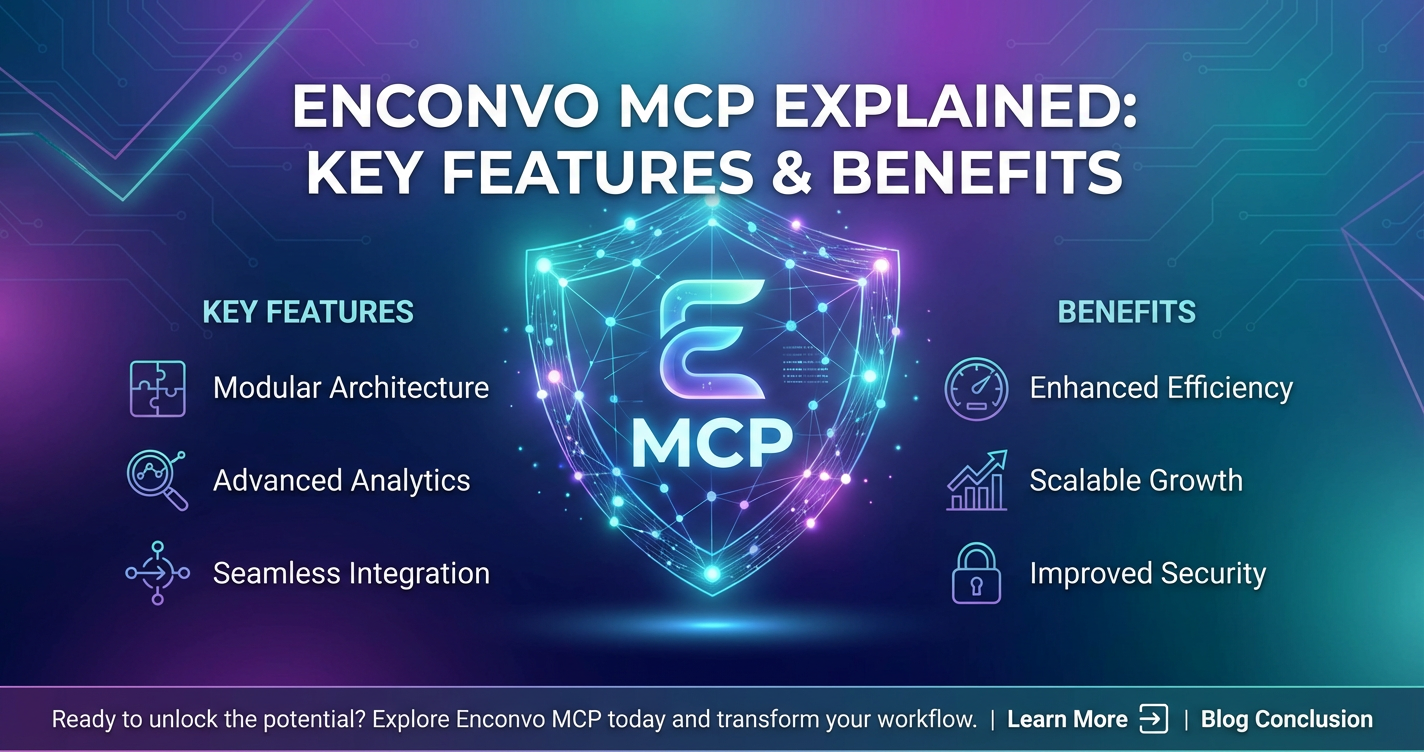
Enconvo MCP Explained: Key Features & Benefits


In the rapidly evolving landscape of artificial intelligence, where models are becoming increasingly sophisticated and their applications more pervasive, one challenge consistently looms large: the effective management of context. As AI systems move beyond simple, single-turn interactions to engage in complex, multi-turn dialogues and tasks, the ability to understand, maintain, and leverage an ongoing "context" becomes paramount. It is in this critical domain that Enconvo MCP emerges as a groundbreaking solution, offering a structured and highly effective approach to what is known as the Model Context Protocol (MCP). This comprehensive article delves deep into the essence of Enconvo MCP, dissecting its fundamental principles, elucidating its transformative features, and highlighting the myriad benefits it brings to the table for developers, enterprises, and end-users alike. We will explore how this innovative protocol addresses the inherent limitations of traditional AI systems, paving the way for truly intelligent, coherent, and personalized interactions.
Chapter 1: Understanding the Landscape – The Pressing Need for Model Context Protocol
The past decade has witnessed an explosion in AI capabilities, driven by advancements in machine learning, particularly deep learning and the advent of large language models (LLMs) and multimodal AI. These sophisticated models, capable of processing and generating human-like text, understanding images, and even interpreting audio, have opened up unprecedented possibilities across various industries, from customer service and content creation to healthcare and scientific research. However, with this burgeoning complexity comes an equally challenging problem: how to maintain a consistent, relevant, and evolving understanding of the interaction or task at hand – in essence, managing the "context."
Consider a user interacting with a modern AI assistant. If each query is treated as an isolated event, the AI quickly loses its ability to engage meaningfully. The user might ask, "What's the weather like in Paris?" and then follow up with, "And how about tomorrow?" Without a robust mechanism to retain the context of "Paris" from the first query, the AI would be unable to correctly interpret the second. This simple example merely scratches the surface of the contextual challenges faced by advanced AI systems today.
The Growing Complexity and Contextual Demands of Modern AI
Modern AI applications are no longer confined to answering simple factual questions. They are expected to:
- Engage in long, multi-turn conversations: Think of virtual assistants that help plan an entire trip, requiring memory of destinations, dates, preferences, and previous suggestions.
- Perform complex, multi-step tasks: An AI assisting with coding might need to understand the entire project structure, previous changes, current file content, and the developer's overarching goal.
- Provide personalized experiences: Tailoring responses, recommendations, or content based on a user's historical interactions, preferences, and even emotional state requires deep contextual awareness.
- Integrate information from diverse sources: A medical AI might need to combine patient history, current symptoms, latest research, and drug interactions, all within a specific case context.
- Handle ambiguity and nuance: Human communication is rich with implicit meaning, sarcasm, and references that depend heavily on shared context. AI needs to navigate this complexity.
Key Challenges in Managing AI Model Context
The sheer volume and dynamic nature of information that constitutes "context" present several technical hurdles:
- Context Window Limitations: Even the most powerful LLMs have a finite context window – the maximum number of tokens they can process at once. For longer interactions, this becomes a severe bottleneck, forcing models to "forget" earlier parts of a conversation. Strategies like truncation often lead to a loss of critical information, degrading the quality and coherence of AI responses.
- Maintaining Statefulness Across Interactions: Unlike stateless API calls, a true AI conversation or task execution requires the system to remember past events, user inputs, and AI outputs. Without a persistent state, each interaction is a fresh start, leading to repetitive questions, disjointed responses, and a frustrating user experience.
- Personalization and User-Specific Data: To offer tailored experiences, AI needs access to user profiles, preferences, and historical data. This data needs to be securely stored, dynamically retrieved, and seamlessly integrated into the AI's understanding of the current context without overwhelming its processing capabilities or violating privacy.
- Seamless Model Switching and Integration: Many advanced AI applications leverage multiple specialized models—one for natural language understanding, another for data retrieval, and perhaps another for sentiment analysis. Managing context across these disparate models, ensuring they all operate with a unified understanding of the ongoing interaction, is a significant architectural challenge.
- Ensuring Coherence in Long Conversations/Tasks: As interactions extend, the risk of the AI losing track of the main topic or objective increases. Drift in conversation or task execution can render the AI ineffective, leading to a breakdown in communication and a failure to achieve the desired outcome.
- Computational Overhead: Storing, retrieving, and processing large amounts of contextual data for every AI interaction can be computationally intensive, impacting response times and operational costs. Efficient strategies are needed to manage this overhead without compromising quality.
How Traditional Approaches Fall Short
Historically, developers have employed various techniques to manage context, but these often prove insufficient for today's sophisticated AI demands:
- Simple Prompt Engineering: Manually inserting previous turns or key facts into the current prompt works for short interactions but quickly hits context window limits and becomes unwieldy for long, complex dialogues.
- Session-based Memory: Storing conversation history in a temporary session variable offers some statefulness but typically lacks semantic understanding or long-term persistence, resetting with each new session.
- Database Storage of Raw Data: While useful for persistence, simply storing raw chat logs or user inputs in a database doesn't inherently provide the AI with a structured, semantically enriched context that it can easily interpret and utilize efficiently.
- Ad-hoc Logic and Hardcoded Rules: Implementing custom code to manage specific contextual scenarios is brittle, difficult to scale, and fails to generalize across different AI models or applications. It creates maintenance nightmares as AI capabilities and user expectations evolve.
These limitations underscore the critical need for a more robust, standardized, and intelligent approach to context management. This is precisely where Enconvo MCP, built upon a sophisticated Model Context Protocol, steps in to revolutionize how AI systems interact with the world and with us.
Chapter 2: What is Enconvo MCP? A Deep Dive into Model Context Protocol
At its core, Enconvo MCP represents a paradigm shift in how AI systems handle continuous interaction and knowledge retention. It is not merely a feature but a comprehensive framework designed to imbue AI models with a profound and persistent understanding of their operational environment, past interactions, and evolving goals. By standardizing the Model Context Protocol (MCP), Enconvo MCP provides a universal language and architecture for context management, moving beyond ad-hoc solutions to a systematic and intelligent approach.
Formal Definition of Enconvo MCP
Enconvo MCP can be formally defined as an advanced, structured framework that implements the Model Context Protocol (MCP) to enable AI systems to dynamically capture, store, manage, and leverage contextual information across single and multi-turn interactions, diverse AI models, and extended timeframes. Its primary objective is to facilitate highly coherent, personalized, and efficient AI engagements by ensuring that models always operate with the most relevant and up-to-date understanding of the ongoing dialogue, task, or user state. This protocol ensures that context is not just remembered but deeply understood and strategically utilized.
Explaining Model Context Protocol (MCP) as its Core
The Model Context Protocol (MCP) is the underlying set of rules, formats, and mechanisms that define how context is represented, exchanged, and processed within an AI system managed by Enconvo MCP. It dictates:
- How context is structured: Defining schemas and data models for different types of contextual information (e.g., user profiles, conversation history, task goals, environmental variables).
- How context is updated: Specifying methods for adding new information, modifying existing context, and identifying outdated context.
- How context is accessed: Providing APIs and interfaces for AI models and other system components to retrieve relevant contextual snippets.
- How context is interpreted: Establishing guidelines for semantic understanding and embedding of contextual data, allowing models to grasp meaning beyond raw text.
- How context is maintained over time: Mechanisms for persistence, summarization, and prioritization to manage context window limitations and long-term memory requirements.
Core Concepts Central to Enconvo MCP
To fully appreciate the power of Enconvo MCP, it's crucial to understand several core concepts:
- Contextual State: This refers to the aggregated and dynamically updated pool of information relevant to an ongoing interaction or task. It includes explicit data (e.g., user inputs, AI responses, specific parameters) and implicit data (e.g., user sentiment, inferred intent, historical patterns). The contextual state is the living memory of the AI.
- Contextual Awareness: This is the AI system's ability to not just store context, but to actively recognize, interpret, and prioritize relevant pieces of information from its contextual state in real-time. It's about understanding what parts of the context matter now.
- Contextual Persistence: The capability to store contextual information beyond a single session or interaction, allowing AI to build long-term relationships with users, remember preferences, and maintain continuity over extended periods. This requires robust storage and retrieval mechanisms.
- Dynamic Context Management: The intelligent processes within Enconvo MCP that actively manage the context window, summarization, pruning, and prioritization of contextual data. It's about keeping the context lean, relevant, and within the operational limits of the AI models.
- Contextual Encoding/Decoding: The methods used to transform raw input data into a structured, semantically rich contextual representation that AI models can easily consume, and vice versa. This often involves embedding techniques, knowledge graph construction, or specialized serialization formats.
- Semantic Context vs. Raw Data Context: Enconvo MCP distinguishes between simply recalling raw information (e.g., "the user said X") and understanding the meaning or implication of that information (e.g., "the user expressed frustration regarding X, indicating a need for Y"). This semantic understanding is key to truly intelligent responses.
How Enconvo MCP Differs from Simple Prompt Engineering
While prompt engineering involves crafting effective inputs for AI models, it primarily focuses on the current query. Enconvo MCP operates on a fundamentally different and more comprehensive level. Prompt engineering might manually append a few previous turns to a prompt; Enconvo MCP automatically and intelligently manages an entire, evolving contextual state, performing summarization, retrieval of relevant long-term memory, and even inferring intent, before constructing a finely tuned prompt that leverages this rich context. It provides the infrastructure that makes advanced, context-aware prompt engineering possible at scale, without requiring manual intervention for every single interaction.
The Architecture of Enconvo MCP
The robust functionality of Enconvo MCP is underpinned by a sophisticated architectural design, typically comprising several interconnected components:
- Context Store: This is the foundational layer responsible for durable storage of all contextual information. It can encompass various data technologies, including:
- Vector Databases: For storing embeddings of conversation turns, user profiles, or document snippets, enabling semantic search and retrieval of relevant context.
- Relational Databases: For structured user preferences, historical transaction data, or predefined knowledge bases.
- Key-Value Stores/In-memory Caches: For high-speed access to frequently used or short-term contextual data.
- Knowledge Graphs: For representing complex relationships between entities, concepts, and events, allowing for deeper semantic understanding.
- Context Manager: This component acts as the central orchestrator for all context-related operations. Its responsibilities include:
- Contextualization: Processing incoming user inputs and AI outputs to extract and update relevant contextual information.
- Summarization and Compression: Employing techniques (e.g., extractive, abstractive summarization, embedding compression) to reduce the size of context while retaining critical information, addressing context window limits.
- Prioritization: Ranking contextual elements based on recency, relevance, and predefined rules, ensuring the most important information is always accessible.
- Pruning and Archiving: Intelligently removing outdated or less relevant context to prevent overload and maintain efficiency.
- Context Orchestrator: This layer sits between the AI models and the Context Manager. When an AI model needs to generate a response, the Context Orchestrator:
- Retrieves the most relevant contextual information from the Context Manager.
- Formats this context in a way that is optimal for the specific AI model being used (e.g., constructing a system message, appending to a prompt).
- Manages the dynamic construction of the final input prompt, incorporating both the current user input and the derived context.
- Captures the AI model's output and feeds it back to the Context Manager for contextualization and storage.
- Model Adapters: These are specialized modules that translate between the generic Model Context Protocol format and the specific input/output requirements of different AI models (e.g., OpenAI's API, Hugging Face models, custom on-premise models). They ensure seamless interoperability and allow Enconvo MCP to work with a diverse ecosystem of AI technologies.
- Interface Layer: Provides APIs and SDKs for developers to interact with Enconvo MCP, allowing them to integrate context management into their applications without needing to manage the underlying complexities of the protocol directly. This layer simplifies the development of context-aware AI applications.
By integrating these sophisticated components, Enconvo MCP provides a robust, scalable, and intelligent solution for managing the dynamic and evolving context that is crucial for building next-generation AI applications. It transforms AI interactions from isolated events into coherent, continuous, and deeply informed dialogues.
Chapter 3: Key Features of Enconvo MCP
The true power of Enconvo MCP lies in its meticulously designed features, each addressing a specific facet of context management. These features collectively elevate AI capabilities, enabling more sophisticated and human-like interactions.
Dynamic Context Window Management
One of the most significant limitations for large language models (LLMs) is their finite context window. Enconvo MCP tackles this head-on with intelligent, dynamic management techniques:
- Adaptive Context Sizing: Instead of a fixed context length, Enconvo MCP can dynamically adjust the amount of context provided to an AI model based on the complexity of the current query, the model's capabilities, and the available computational resources. This ensures optimal utilization of the context window.
- Summarization and Compression Techniques: When the raw context exceeds the model's limit, Enconvo MCP employs advanced algorithms to summarize or compress the historical data. This can include:
- Extractive Summarization: Identifying and extracting the most important sentences or phrases from the conversation history.
- Abstractive Summarization: Generating new, concise sentences that capture the essence of the past interaction, potentially using another AI model for this task.
- Embedding Compression: Representing long textual contexts as dense vector embeddings that capture semantic meaning, which can then be efficiently searched or passed to the model. This allows for "lossy" compression where the fine details might be lost but the overarching meaning is retained.
- Contextual Prioritization: Not all parts of a conversation are equally important. Enconvo MCP intelligently prioritizes context based on factors such as recency, relevance to the current query, explicit user mentions, or predefined importance scores. This ensures that the most critical information always makes it into the AI's active context window.
Multi-Model Context Unification
Modern AI applications often rely on a symphony of different specialized models—one for natural language understanding, another for image generation, a third for data retrieval, and so on. Enconvo MCP excels at unifying context across these disparate systems.
- Shared Contextual State: It provides a centralized, semantically rich contextual state that all integrated AI models can access and contribute to. When one model generates a piece of information, it can be immediately added to the shared context, becoming available for other models to leverage.
- Harmonized Contextual Representation: Through its Model Context Protocol, Enconvo MCP ensures that context, regardless of which model generated or consumed it, adheres to a standardized format. This eliminates the need for complex data transformations between models, streamlining interoperability.
- Use Cases for Hybrid AI Systems: Imagine a customer support system where a generative AI handles natural language, but a separate, specialized search AI retrieves product information from a database. Enconvo MCP ensures that the generative AI understands what the customer is asking about (from the dialogue history) and passes that precise context to the search AI, which then returns relevant results. These results are then fed back into the shared context, allowing the generative AI to formulate a coherent response.
Persistent Context Across Sessions
For AI to truly act as an intelligent assistant or partner, it must remember users and their histories beyond a single interaction. Enconvo MCP enables this long-term memory:
- User Profiles and Historical Interactions: It stores comprehensive user profiles, including preferences, past choices, demographic data (with appropriate privacy safeguards), and a detailed history of all interactions. This allows for truly personalized experiences.
- Long-Term Memory for AI: By persisting context, Enconvo MCP provides AI with a "memory" that spans days, weeks, or even months. An AI can recall that a user preferred certain types of recommendations in the past, or that they previously discussed a particular topic, leading to more informed and intuitive interactions.
- Data Storage and Retrieval Mechanisms: Leveraging its Context Store, Enconvo MCP employs robust databases (e.g., vector databases for semantic recall, relational databases for structured data) and efficient retrieval algorithms to quickly access relevant long-term context when needed, without overwhelming the system.
Semantic Context Understanding
Simply knowing the words in a conversation isn't enough; understanding their meaning and relationships is crucial. Enconvo MCP goes beyond lexical matching to grasp semantic context:
- Beyond Keywords: It analyzes the intent, nuances, and implied meanings within the user's input and the broader conversation. For example, if a user mentions "that project," Enconvo MCP can infer which specific project they're referring to based on previous discussion or their active tasks.
- Knowledge Graphs and Embeddings: By integrating with or building knowledge graphs, Enconvo MCP can represent relationships between entities, concepts, and events, allowing AI to reason over structured knowledge. Vector embeddings are used to capture the semantic similarity of text, enabling the retrieval of contextually related information even if exact keywords aren't present.
- Contextual Reasoning: The system can perform basic contextual reasoning, inferring new facts or relationships from the existing context. For instance, if a user states they live in "New York" and then asks about "weather in the city," Enconvo MCP can infer "New York City" as the current location context.
Contextual Security and Privacy
Managing personal and sensitive information within context demands stringent security and privacy measures. Enconvo MCP integrates these considerations from the ground up:
- Data Anonymization and Masking: Techniques to obscure or remove personally identifiable information (PII) from context when it's not strictly necessary for AI interaction, reducing privacy risks.
- Access Controls and Permissions: Granular control over which AI models, applications, or users can access specific types of contextual data. For example, a public-facing chatbot might have limited access to sensitive user profile data, while an internal support tool has full access.
- Compliance (GDPR, CCPA) within Context: Enconvo MCP assists organizations in adhering to data privacy regulations by providing tools for data retention policies, consent management for context storage, and mechanisms for users to request access or deletion of their contextual data.
- Secure Storage and Transmission: All contextual data, both at rest and in transit, is encrypted and protected against unauthorized access, ensuring the integrity and confidentiality of sensitive information.
Real-time Context Updates
The world is dynamic, and so are user interactions. Enconvo MCP ensures that AI systems can adapt to evolving situations in real-time:
- Adapting to User Feedback: If a user clarifies a previous statement or corrects the AI's understanding, Enconvo MCP can immediately update the contextual state, ensuring subsequent responses are based on the latest information.
- Incorporating External Events: Context can be enriched by external data feeds. For example, if a user is discussing flight delays, Enconvo MCP can fetch real-time flight status updates from an external API and integrate them into the active context, allowing the AI to provide the most current information.
Extensibility and Integration
A powerful Model Context Protocol must be capable of integrating into a diverse and complex AI ecosystem. Enconvo MCP is designed for maximum extensibility:
- API-Driven Architecture: Enconvo MCP provides well-defined APIs that allow easy integration with existing applications, backend systems, and external data sources. This ensures it can fit seamlessly into enterprise architectures.
- Support for Various AI Models: Through its flexible Model Adapters, Enconvo MCP can integrate with a wide array of AI models, from open-source libraries to proprietary cloud services. This modularity ensures future-proofing as new AI technologies emerge.
- Seamless Integration with AI Gateway and API Management Platforms: For organizations managing numerous AI models and services, platforms that streamline API access and lifecycle management become crucial. This is where a product like ApiPark demonstrates its value. ApiPark, as an open-source AI gateway and API management platform, offers quick integration of over 100+ AI models and provides a unified API format for AI invocation. This capability perfectly complements Enconvo MCP's need for robust and managed access to diverse AI capabilities. When Enconvo MCP needs to orchestrate context across several AI models—perhaps one for summarization, another for sentiment analysis, and a third for knowledge retrieval—ApiPark can simplify the underlying API calls, manage authentication, track costs, and ensure consistent invocation. This collaboration allows developers to focus on building intelligent context-aware applications with Enconvo MCP, while ApiPark handles the operational complexities of the AI model ecosystem.
Observability and Debugging of Context
Understanding why an AI responded in a certain way often hinges on inspecting its contextual understanding. Enconvo MCP provides tools for transparency:
- Context Visualization Tools: Interfaces that allow developers to see the current contextual state, including its components, their values, and their confidence scores. This is invaluable for debugging and fine-tuning.
- Contextual Audit Trails: Detailed logs of how context was updated, retrieved, and utilized by AI models, providing a clear history of the AI's understanding and decision-making process. This helps in identifying context drift or misinterpretations.
- Inspection and Troubleshooting: The ability to "step through" the context flow, seeing how it evolves with each interaction, helps developers diagnose issues, understand AI behavior, and optimize context management strategies.
By combining these powerful features, Enconvo MCP offers a holistic and intelligent solution to the complex challenge of context management, setting a new standard for AI interaction and paving the way for truly intelligent applications.
Chapter 4: The Transformative Benefits of Enconvo MCP
The implementation of Enconvo MCP and its underlying Model Context Protocol yields profound benefits that ripple across the entire AI application lifecycle, from development to user experience and operational efficiency. It moves AI from being merely functional to truly intelligent, responsive, and adaptive.
Enhanced User Experience
Perhaps the most immediate and tangible benefit of Enconvo MCP is the dramatic improvement in how users interact with AI systems.
- More Natural, Coherent, and Personalized Interactions: Users no longer feel like they are talking to a "dumb" machine that forgets everything after each turn. Instead, interactions become fluid, resembling human conversation. The AI remembers preferences, past discussions, and personal details (where appropriate and consented), leading to highly personalized and relevant responses. For example, a travel assistant empowered by Enconvo MCP will recall your preferred airlines, dietary restrictions, and past destinations, offering suggestions that truly resonate with your individual needs, rather than starting from scratch every time.
- Reduced Repetition, Improved Understanding: Users are spared the frustration of repeatedly providing the same information. The AI understands the continuity of the conversation, reducing redundancy and leading to a smoother, more efficient interaction flow. If you've mentioned your budget for a purchase, the AI won't ask for it again in the next turn; it will already be part of its active context. This dramatically boosts user satisfaction and reduces friction.
- Seamless Task Completion: For complex tasks spanning multiple steps or sessions, Enconvo MCP ensures that the AI maintains a consistent understanding of the user's objective and progress. This allows for truly multi-turn task completion, where the AI can guide the user through a process without losing track of the overarching goal, leading to higher success rates for task-oriented AI applications.
Improved AI Performance and Accuracy
Beyond user satisfaction, Enconvo MCP directly contributes to the core performance metrics of AI models themselves.
- Better Decision-Making, Fewer Hallucinations: With a richer, more accurate context, AI models are better equipped to make informed decisions and generate relevant outputs. By grounding responses in a verified contextual state, the incidence of "hallucinations"—where AI generates factually incorrect but plausible-sounding information—is significantly reduced. The AI has more verifiable data points to draw upon.
- More Relevant Outputs: The quality of AI output is directly proportional to the quality of its input context. By providing a precisely curated and semantically understood context, Enconvo MCP ensures that AI responses are highly relevant to the specific user, their history, and the current state of the interaction. This moves beyond generic answers to deeply contextualized insights.
- Enhanced Reasoning Capabilities: When AI has a structured and dynamically managed context, it can perform more sophisticated reasoning. It can connect disparate pieces of information, infer logical conclusions, and generate more insightful responses that demonstrate a deeper understanding of the underlying problem or request.
Increased Efficiency and Resource Optimization
Intelligent context management also translates into tangible operational efficiencies and cost savings.
- Smarter Use of Context Windows, Less Redundant Processing: By intelligently summarizing, prioritizing, and compressing context, Enconvo MCP ensures that AI models only process the most relevant information. This avoids feeding large, redundant chunks of text into LLMs, which not only saves computational resources (e.g., GPU cycles) but also speeds up response times.
- Reduced API Calls for Repeated Information: If a piece of information (e.g., user's address, product ID) is already stored in the active context, the AI system doesn't need to re-query external databases or APIs to retrieve it. This minimizes unnecessary API calls, leading to lower operational costs, especially for usage-based AI services, and faster overall system performance.
- Optimized Data Retrieval: The Context Store within Enconvo MCP is designed for efficient storage and retrieval of contextual data, using appropriate database technologies for different data types. This ensures that even massive amounts of historical context can be accessed quickly and cost-effectively, without causing bottlenecks.
Accelerated AI Development and Deployment
For developers and engineering teams, Enconvo MCP significantly streamlines the creation and deployment of advanced AI applications.
- Developers Can Focus on Core Logic, Not Context Management: By abstracting away the complexities of context storage, retrieval, summarization, and prioritization, Enconvo MCP frees developers from writing boilerplate code for context handling. They can concentrate on designing the core AI logic, defining interaction flows, and integrating specialized models, knowing that robust context management is handled by the protocol.
- Easier Integration of Complex AI Workflows: Building multi-agent or multi-model AI systems becomes considerably simpler. Enconvo MCP provides a standardized way for different AI components to share and understand context, reducing integration headaches and accelerating the deployment of sophisticated AI workflows.
- Faster Iteration and Experimentation: With a solid Model Context Protocol in place, developers can more easily iterate on AI model behavior, test different prompt strategies, and experiment with new interaction patterns, knowing that the underlying context remains consistent and manageable. This leads to quicker development cycles and faster time-to-market for new AI features.
Scalability for Complex AI Applications
As AI deployments grow in scale and complexity, the ability to manage context across numerous users and interactions becomes paramount.
- Managing Context in Large-Scale, Multi-Agent Systems: In enterprise environments, AI might involve multiple interacting agents (e.g., a chatbot handing off to a human agent, who then uses another AI tool). Enconvo MCP provides the framework to maintain a unified, shared context across all these agents and interactions, ensuring seamless handoffs and consistent service.
- Handling High Throughput and Concurrent Users: The architecture of Enconvo MCP, with its optimized Context Store and Manager, is designed to handle high volumes of concurrent users and interactions without degrading performance. It ensures that context is efficiently retrieved and updated for every request, maintaining responsiveness even under heavy load.
- Distributed Context Management: For globally distributed AI services, Enconvo MCP can be architected to distribute context storage and processing, minimizing latency and ensuring high availability across different geographical regions.
New Application Possibilities
Ultimately, Enconvo MCP doesn't just improve existing AI applications; it unlocks entirely new frontiers for what AI can achieve.
- Truly Intelligent Assistants: Beyond simple chatbots, Enconvo MCP enables the creation of AI assistants that are deeply integrated into a user's digital life, anticipating needs, proactively offering help, and learning over time.
- Sophisticated Decision Support Systems: AI systems can provide more nuanced and context-aware recommendations for complex financial planning, medical diagnostics, or strategic business decisions, by considering a vast array of historical and real-time contextual factors.
- Dynamic Content Generation: From personalized news feeds to adaptive educational materials and real-time marketing copy, Enconvo MCP allows AI to generate content that is highly relevant, engaging, and specifically tailored to the individual user or the evolving situation.
- Proactive and Autonomous AI: With a persistent and deeply understood context, AI can move from reactive (responding to prompts) to proactive (initiating helpful actions or suggestions) and even autonomous behavior, taking initiative based on its comprehensive understanding of its environment and goals.
In summary, the adoption of Enconvo MCP is not just an incremental upgrade; it is a foundational transformation that empowers AI systems to operate with unprecedented levels of intelligence, coherence, and personalization, delivering immense value to both businesses and end-users.
APIPark is a high-performance AI gateway that allows you to securely access the most comprehensive LLM APIs globally on the APIPark platform, including OpenAI, Anthropic, Mistral, Llama2, Google Gemini, and more.Try APIPark now! 👇👇👇
Chapter 5: Implementing Enconvo MCP – Considerations and Best Practices
Implementing a sophisticated framework like Enconvo MCP requires careful planning, architectural considerations, and adherence to best practices to ensure optimal performance, security, and scalability. While the benefits are substantial, the journey to a fully context-aware AI system involves navigating several technical and operational challenges.
Architectural Integration
The first step in implementing Enconvo MCP is to determine how it will fit within your existing technology stack.
- Where Does Enconvo MCP Fit in the Existing Tech Stack?
- As a Centralized Service: For larger organizations with multiple AI applications, deploying Enconvo MCP as a standalone, centralized service (e.g., a microservice) that all AI components can query is often the most scalable approach. This creates a single source of truth for context.
- Embedded within an Application: For smaller, single-purpose AI applications, a lighter version of Enconvo MCP's components might be embedded directly within the application's backend. While simpler initially, this can complicate sharing context across applications later.
- Integration with Existing API Gateways: Leveraging platforms like ApiPark as the entry point for all AI model interactions can provide a natural integration point for Enconvo MCP. The API gateway can preprocess requests to fetch relevant context from Enconvo MCP and inject it into the AI model's prompt, or post-process AI responses to update context. This creates a clean separation of concerns and enhances manageability.
- Microservices vs. Monolithic Integration: In a microservices architecture, Enconvo MCP's Context Manager and Store can be distinct services. In a monolithic application, they might be tightly coupled. A microservices approach offers greater flexibility, scalability, and fault isolation for context management.
- Choosing the Right Abstraction Layer: Define clear interfaces for interacting with Enconvo MCP to shield application developers from the underlying complexities of context storage and retrieval. This ensures consistency and maintainability.
Data Management and Storage
The Context Store is the heart of Enconvo MCP, making its design and technology choices critical.
- Choosing Appropriate Context Stores:
- Vector Databases (e.g., Pinecone, Weaviate, Milvus): Ideal for storing semantic embeddings of conversation history, user preferences, and knowledge base snippets. They enable fast similarity search for retrieving contextually relevant information.
- Relational Databases (e.g., PostgreSQL, MySQL): Best for structured data like user profiles, explicit preferences, transaction histories, or predefined domain knowledge. They offer strong consistency and robust querying capabilities.
- NoSQL Databases (e.g., MongoDB, Cassandra): Suitable for semi-structured or rapidly changing context, offering flexibility in schema design and horizontal scalability.
- In-memory Caches (e.g., Redis): Essential for storing transient, high-frequency context data that requires extremely low-latency access, such as the active context window for a live session.
- Data Schemas for Context: Develop flexible yet robust schemas to represent different types of contextual information. Consider versioning these schemas as your context requirements evolve. A well-defined schema ensures consistency and makes context easier to interpret by AI models.
- Data Lifecycle Management: Implement policies for context data retention, archiving, and deletion, especially for sensitive or time-limited information. This is crucial for privacy compliance and managing storage costs.
Performance Optimization
Context management can introduce latency. Optimizing performance is paramount for responsive AI.
- Latency Considerations: Minimize the round-trip time between the AI model and the Context Manager/Store. This might involve co-locating services, using high-performance databases, and optimizing query patterns.
- Throughput and Scalability: Design the Context Store and Manager to handle anticipated query volumes and concurrent users. This typically involves horizontal scaling of database instances, read replicas, and distributed caching strategies.
- Caching Strategies: Implement multi-level caching for frequently accessed context. This could include in-memory caches at the application layer, distributed caches for shared context, and potentially edge caching for geographically dispersed users.
- Asynchronous Context Updates: For non-critical context updates (e.g., updating long-term user profiles), consider asynchronous processing to avoid blocking real-time AI interactions.
Security and Governance
Context often contains sensitive information. Robust security and governance are non-negotiable.
- Protecting Sensitive Context Data: Implement strong encryption for context data both at rest and in transit. Use secure key management practices.
- Access Control for Context: Implement Role-Based Access Control (RBAC) to define who (which application, which user, which AI model) can read, write, or modify specific types of contextual data. Ensure least privilege access.
- Audit Trails for Context Usage: Maintain detailed logs of all context access and modification events. This is critical for security monitoring, compliance, and debugging.
- Data Masking and Tokenization: For highly sensitive fields (e.g., credit card numbers, personal identifiers), employ data masking or tokenization techniques before storing them in the context, ensuring only necessary, anonymized data is used by AI.
Monitoring and Maintenance
A well-implemented Enconvo MCP system requires continuous monitoring and regular maintenance.
- Tools for Tracking Context State: Implement monitoring dashboards to visualize key metrics, such as context retrieval latency, update frequency, storage usage, and cache hit rates. This helps in proactively identifying performance bottlenecks or data consistency issues.
- Versioning of Context Schemas: As your AI applications evolve, so too will your context requirements. Implement a versioning strategy for your context schemas to manage changes gracefully and ensure backward compatibility.
- Regular Audits and Review: Periodically review context management policies, access controls, and data retention rules to ensure they align with evolving business needs and regulatory requirements.
Challenges in Implementing Enconvo MCP
Despite its immense benefits, implementers should be aware of potential hurdles:
- Context Drift: Over time, the accumulated context can become stale or less relevant, leading the AI astray. Developing robust mechanisms for context decay, summarization, and intelligent pruning is critical to combat this.
- Computational Overhead of Context Processing: Summarizing, vectorizing, and searching through large context stores can be computationally expensive. Balancing rich context with acceptable latency requires careful optimization and resource allocation.
- Defining Boundaries of Context: Deciding what constitutes relevant context and where the boundaries lie can be challenging. Too much context can overwhelm the system; too little can limit AI intelligence. This often requires iterative experimentation.
- Cold Start Problem: For new users or new tasks, there might be insufficient historical context, leading to a "cold start" where the AI initially performs less optimally. Strategies like prompt templates for initial interactions or integrating default user profiles can mitigate this.
- Complexity of Multi-Modal Context: If context includes text, images, audio, and video, managing and unifying these different modalities adds significant complexity to the Model Context Protocol.
By addressing these considerations and adhering to best practices, organizations can successfully implement Enconvo MCP and unlock the full potential of truly context-aware AI applications. The investment in a robust context management framework pays dividends in enhanced user experience, improved AI performance, and greater operational efficiency.
Chapter 6: Use Cases and Real-World Applications of Enconvo MCP
The versatility and power of Enconvo MCP unlock a new generation of AI applications across virtually every industry. By providing a structured and intelligent way to manage context, it transforms previously limited AI interactions into deeply engaging, highly personalized, and exceptionally effective experiences. Let's explore some compelling use cases.
Advanced Conversational AI/Chatbots
The most intuitive application of Enconvo MCP is in elevating conversational AI from basic question-answering systems to sophisticated, empathetic, and truly helpful digital assistants.
- Maintaining Long-Term User Preferences and Conversation History: Imagine a virtual assistant that remembers you prefer decaffeinated coffee, always books morning flights, or has a specific financial goal you've discussed before. Enconvo MCP stores this information persistently, allowing the AI to integrate these preferences seamlessly into every interaction. This reduces the need for users to repeat themselves and creates a highly personalized experience, mimicking a long-standing human relationship.
- Multi-Turn Complex Task Completion: Instead of a chatbot that can only handle one step of a task at a time, Enconvo MCP enables multi-turn task completion. For instance, a travel bot can help you plan an entire trip: "Find flights to New York for next month," then "Make sure they're non-stop," then "What are some good hotels near Central Park?" Each subsequent query builds upon the established context of the destination, dates, and preferences. The AI remembers your destination, your previous choices, and the objective of finding a suitable hotel within the context of your trip planning.
- Contextual Handoff to Human Agents: When a complex query requires human intervention, Enconvo MCP can package the entire, semantically rich conversation context and transfer it to the human agent. This ensures the agent is fully briefed on the user's history, previous attempts to resolve the issue, and stated preferences, eliminating the frustrating need for users to re-explain their situation.
Personalized Recommendation Systems
Traditional recommendation engines often rely on collaborative filtering or content-based methods. Enconvo MCP adds a powerful layer of real-time, dynamic contextual understanding.
- Contextualizing Recommendations Based on Current User Activity: Beyond static user profiles, Enconvo MCP can consider the user's current browsing session, items in their cart, recently viewed products, and even their stated intent in a conversation. If a user is discussing camping gear, the system recommends tents and sleeping bags, not high heels.
- Integrating Past Interactions and External Factors: Recommendations can be enhanced by recalling past purchases, viewing habits, or expressed preferences (e.g., dietary restrictions for food recommendations). External factors like time of day, weather, or current events can also be integrated into the context to provide hyper-relevant suggestions. For example, a music streaming service could recommend calming music if its AI senses user stress from their conversation patterns, or upbeat tracks for a workout context.
- Dynamic Adaptation to User Feedback: If a user explicitly dislikes a recommendation, Enconvo MCP immediately updates its contextual understanding of their preferences, refining future suggestions in real-time.
Intelligent Document Processing (IDP)
Processing vast amounts of unstructured or semi-structured documents, like contracts, invoices, or research papers, can be significantly streamlined with Enconvo MCP.
- Extracting and Linking Information Across Multiple Documents: Instead of processing each document in isolation, Enconvo MCP allows AI to maintain a global context across a collection of documents. For example, when reviewing a contract and its appendices, the AI can link clauses from the main contract to specific supporting evidence in an appendix, ensuring a holistic understanding.
- Automating Complex Workflows: For tasks like loan application processing, where information from various forms (application, credit report, income verification) needs to be cross-referenced, Enconvo MCP ensures that the AI maintains a consistent view of the applicant's profile and the status of their application, automating validation and flagging discrepancies.
- Contextual Search and Retrieval: Users can query a vast document repository using natural language, and Enconvo MCP ensures the AI understands the nuance of the query, retrieves semantically relevant documents and specific passages, and provides contextually appropriate answers, even if the keywords aren't exact.
AI-Powered Code Generation/Assistance
For developers, Enconvo MCP can transform AI coding assistants from simple snippet generators into truly intelligent collaborators.
- Understanding the Entire Project Context: An AI assistant can maintain context of the entire codebase, including project structure, relevant files, dependencies, and coding conventions. If a developer asks to "implement the
AuthServiceinterface," the AI knows where that interface is defined and how other services use it. - Specific File Content and User Intent: When working on a particular file, the AI can read and understand its current content, recent changes, and the developer's expressed intent (e.g., "refactor this function," "add unit tests"). This allows for highly precise and helpful suggestions, auto-completions, and code generations.
- Debugging and Error Resolution: If a developer encounters an error, the AI, armed with the context of the code, recent changes, and the error message, can offer more accurate diagnoses and solutions than an AI without such a comprehensive understanding.
Automated Customer Support
Enconvo MCP can dramatically improve the efficiency and effectiveness of automated customer support systems.
- Agents with Full Context of Customer History: A virtual agent can access a customer's entire interaction history—previous tickets, product usage, purchase history, and even sentiment from past conversations—providing a holistic view of the customer's needs and current issue.
- Proactive Issue Resolution: By analyzing the evolving context of a customer's account or product usage, the AI can proactively identify potential issues or suggest relevant solutions before the customer even explicitly asks.
- Context-Aware Escalation: When an issue needs to be escalated to a human, the Enconvo MCP system can summarize the entire customer journey and the current context for the human agent, facilitating a smooth transition and faster resolution.
Dynamic Content Generation
Content creation can be revolutionized by AI systems that understand dynamic context.
- Creating Marketing Materials: An AI can generate marketing copy that is contextually relevant to a specific campaign, target audience, recent events, and product updates. If a new feature is launched, the AI automatically integrates it into promotional material based on its understanding of the product context.
- Personalized News Articles or Reports: AI can generate summaries or personalized news feeds based on a user's interests, previous reading habits, and real-time events, ensuring the content is always fresh and highly relevant to the individual.
- Adaptive Learning Materials: In education, AI-powered systems can generate learning content that adapts to a student's current knowledge level, learning style, and progress, all maintained as part of the student's learning context.
These diverse applications demonstrate that Enconvo MCP is not just a theoretical concept but a practical, powerful tool that is shaping the next generation of intelligent systems, making AI more useful, more natural, and more deeply integrated into our digital lives.
Chapter 7: The Future of AI Interaction with Enconvo MCP
The advent of Enconvo MCP marks a pivotal moment in the evolution of artificial intelligence, promising to redefine how we interact with intelligent systems and, indeed, how these systems interact with the world around them. As AI continues its rapid advancement, the importance of robust context management, as epitomized by the Model Context Protocol, will only grow, paving the way for more autonomous, proactive, and deeply integrated AI.
Towards More Autonomous and Proactive AI
One of the most exciting future prospects enabled by Enconvo MCP is the acceleration towards truly autonomous and proactive AI systems.
- Beyond Reactive Responses: Current AI primarily reacts to explicit user prompts. With a comprehensive, persistent, and dynamically managed context, AI can move beyond this reactive mode. It can anticipate needs, recognize patterns in user behavior, and initiate helpful actions or suggestions without being explicitly asked. Imagine an AI assistant that, based on your calendar and historical preferences (context), proactively suggests ordering flowers for a friend's birthday next week.
- Self-Correction and Adaptation: As AI systems accumulate more context and observe the outcomes of their actions, they can use this information to self-correct and adapt their behavior. If a recommendation was poorly received, the AI can update its internal contextual understanding of user preferences, preventing similar mistakes in the future.
- Goal-Oriented Autonomy: For complex, long-term goals (e.g., "plan my move to a new city"), Enconvo MCP provides the persistent context for an AI to manage multiple sub-tasks, track progress, and adapt to unforeseen circumstances, all while keeping the overarching objective in mind. This moves AI from task execution to true goal accomplishment.
The Role of Enconvo MCP in AGI Development
While Artificial General Intelligence (AGI) remains a distant goal, the development of robust context management frameworks like Enconvo MCP is a crucial stepping stone.
- Bridging the Gap to Human-like Understanding: A core characteristic of human intelligence is the ability to maintain and leverage a vast, dynamic context of personal experience, world knowledge, and current situation. Enconvo MCP aims to equip AI with an analogous capability, moving closer to systems that can understand the world and interactions with a human-like breadth and depth.
- Enabling Complex Reasoning and Common Sense: AGI will require sophisticated reasoning abilities that depend heavily on contextual understanding. By providing structured access to a rich context, Enconvo MCP facilitates the development of AI that can infer, deduce, and apply common sense knowledge more effectively.
- Foundation for Learning and Adaptation: For AI to continually learn and adapt to new situations without constant re-training, it needs to efficiently integrate new information into its existing knowledge base and contextual understanding. Enconvo MCP provides the architectural foundation for this continuous, context-aware learning.
Ethical Implications of Persistent Context
As AI systems gain deeper and more persistent contextual awareness, significant ethical considerations emerge that must be addressed proactively.
- Privacy and Data Security: With AI remembering more about individuals over longer periods, the risks of data breaches, misuse of personal information, and surveillance intensify. Robust, transparent privacy policies, strong encryption, anonymization techniques, and user consent mechanisms (e.g., explicit opt-in for long-term context storage) are absolutely critical. Users must have clear control over their data.
- Bias and Fairness: If the historical context data fed to an AI contains biases (e.g., reflecting societal prejudices or unfair historical decisions), the AI might perpetuate or even amplify these biases. Mechanisms for bias detection, mitigation, and regular auditing of contextual data are essential to ensure fair and equitable AI outcomes.
- Transparency and Explainability: As AI decisions become more context-dependent, understanding why an AI made a particular recommendation or responded in a certain way becomes harder. Enconvo MCP's observability features, such as context visualization and audit trails, will be crucial for maintaining transparency and explainability, allowing humans to understand the basis of AI actions.
- User Autonomy and Manipulation: An AI with deep contextual understanding could potentially be used to subtly manipulate user behavior or preferences. Clear ethical guidelines must be established to prevent such misuse and ensure that AI empowers, rather than controls, users.
Integration with Multimodal Inputs and Outputs
The current focus of context management is often textual. However, the future of AI is increasingly multimodal.
- Unifying Context Across Sensory Inputs: Enconvo MCP will evolve to seamlessly integrate context from various modalities – not just text, but also visual information (e.g., objects recognized in an image, video content), audio (e.g., tone of voice, background sounds), and even biometric data (with consent). This would enable AI to perceive and understand the world in a richer, more holistic way.
- Generating Context-Aware Multimodal Outputs: An AI could, for instance, generate a textual response while simultaneously displaying a contextually relevant image or playing an audio snippet, all based on a unified multimodal context. This will lead to much more engaging and effective human-AI interaction.
Open Research Questions and Ongoing Development
The field of Model Context Protocol is still nascent, with many exciting avenues for research and development.
- Optimal Context Representation: What is the most efficient and semantically rich way to represent diverse contextual information for different AI models? Research into advanced knowledge graphs, contextual embeddings, and hybrid representations will continue.
- Automated Context Curation: How can AI systems autonomously identify, summarize, and prioritize context with minimal human intervention, dynamically adapting to new domains or tasks?
- Contextual Reasoning and Planning: Moving beyond simple retrieval, how can AI use context to perform complex, multi-step reasoning and long-term planning, similar to human cognitive processes?
- Scalability for Planet-Scale Context: As AI pervades every aspect of life, how can context management systems scale to handle the immense volume and velocity of global contextual data, while maintaining low latency and high accuracy?
In conclusion, Enconvo MCP is more than just a technical framework; it is a vision for a future where AI systems are profoundly context-aware, capable of engaging in truly intelligent, personalized, and seamless interactions. While challenges remain, the foundational work of Enconvo MCP sets the stage for a new era of AI that is deeply integrated into our lives, making technology more intuitive, helpful, and human-centric. The journey ahead is complex, but the path laid out by Enconvo MCP promises a future where AI truly understands.
Conclusion
The journey through the intricacies of Enconvo MCP and its foundational Model Context Protocol reveals a critical evolution in the field of artificial intelligence. We've seen how the escalating complexity of modern AI, particularly with the rise of sophisticated large language models and multimodal systems, has created an urgent demand for intelligent context management. Traditional, piecemeal approaches to handling contextual information are simply no longer sufficient to power the next generation of AI applications.
Enconvo MCP steps into this void as a comprehensive, structured framework designed to dynamically capture, store, manage, and leverage contextual data across every facet of AI interaction. Its core, the Model Context Protocol, provides the standardized blueprint for how context is represented, updated, and utilized, ensuring coherence, relevance, and persistence.
We've explored the rich array of key features that define Enconvo MCP: from its intelligent dynamic context window management that optimizes resource use through sophisticated summarization and prioritization, to its ability to unify context across diverse AI models. The framework also excels in maintaining persistent context across sessions, enabling long-term memory for personalized interactions. Its capacity for semantic context understanding goes beyond mere keyword matching, diving into the true meaning and relationships within data. Crucially, Enconvo MCP incorporates robust security and privacy features, ensures real-time context updates, and is built for extensibility, capable of integrating seamlessly with platforms like ApiPark to manage the underlying AI model ecosystem. Finally, its commitment to observability and debugging provides essential transparency into AI's contextual understanding.
The benefits derived from implementing Enconvo MCP are transformative. It leads to a dramatically enhanced user experience characterized by natural, coherent, and personalized interactions, free from repetitive queries. AI systems become more performant and accurate, making better decisions and generating more relevant outputs with fewer "hallucinations." Operationally, it drives increased efficiency and resource optimization through smarter context utilization. For developers, Enconvo MCP accelerates AI development and deployment by abstracting away complex context handling, and fundamentally improves scalability for even the most intricate AI applications. Most importantly, it unlocks entirely new application possibilities, paving the way for truly intelligent assistants, sophisticated decision support systems, and dynamic content generation that were previously unimaginable.
As we look to the future, Enconvo MCP is poised to play a crucial role in the development of more autonomous and proactive AI, inching closer to the elusive goal of Artificial General Intelligence. While ethical considerations surrounding privacy, bias, and control must be diligently addressed, the structured approach of Enconvo MCP provides a vital framework for responsible AI development. Its ongoing evolution to integrate multimodal inputs and outputs will further enrich AI's understanding of the world.
In essence, Enconvo MCP represents a fundamental shift in how we approach AI. It acknowledges that true intelligence isn't just about processing data, but about understanding that data within a rich, dynamic, and ever-evolving context. By mastering the Model Context Protocol, we are not merely improving AI; we are transforming it into a more capable, more intuitive, and ultimately, more human-like partner in our digital lives.
FAQ
1. What is Enconvo MCP? Enconvo MCP (Model Context Protocol) is an advanced, structured framework designed to enable AI systems to dynamically capture, store, manage, and leverage contextual information across single and multi-turn interactions, diverse AI models, and extended timeframes. Its primary goal is to facilitate highly coherent, personalized, and efficient AI engagements by ensuring models always operate with the most relevant and up-to-date understanding of the ongoing dialogue, task, or user state. It standardizes how AI remembers and understands past interactions.
2. How does MCP differ from traditional context management? Traditional context management often relies on simple prompt engineering (manually adding previous turns), session-based memory (forgetting context after a session), or ad-hoc rule-based logic, which are limited in scale and semantic understanding. Enconvo MCP (Model Context Protocol) goes beyond this by providing a comprehensive, architectural framework that includes dynamic context window management, semantic context understanding, long-term persistence, multi-model unification, and robust security. It intelligently processes, summarizes, and prioritizes context, enabling AI to truly understand and remember, rather than just recall.
3. What are the primary benefits of using Enconvo MCP? The primary benefits include a significantly enhanced user experience through more natural and personalized interactions, improved AI performance and accuracy with better decision-making and fewer "hallucinations," and increased efficiency and resource optimization by smartly managing context windows and reducing redundant API calls. Additionally, it accelerates AI development by abstracting complex context handling, improves scalability for complex applications, and unlocks new application possibilities for truly intelligent systems.
4. Can Enconvo MCP integrate with existing AI models and platforms? Yes, Enconvo MCP is designed for high extensibility and integration. It features an API-driven architecture and utilizes flexible Model Adapters that allow it to work seamlessly with a wide array of AI models, whether open-source or proprietary cloud services. Furthermore, it can integrate with existing API management platforms and AI gateways, such as ApiPark, which provides a unified API format and lifecycle management for integrating over 100+ AI models, thus complementing Enconvo MCP's contextual intelligence with streamlined access to diverse AI capabilities.
5. What are the main challenges in implementing Enconvo MCP? Implementing Enconvo MCP presents several challenges, including context drift (where context becomes stale), computational overhead for processing large amounts of contextual data, and defining clear boundaries for what constitutes relevant context. Additionally, ensuring robust security and privacy for sensitive contextual information, managing the cold start problem for new users, and addressing the complexity of multi-modal context are crucial considerations that require careful planning and execution.
🚀You can securely and efficiently call the OpenAI API on APIPark in just two steps:
Step 1: Deploy the APIPark AI gateway in 5 minutes.
APIPark is developed based on Golang, offering strong product performance and low development and maintenance costs. You can deploy APIPark with a single command line.
curl -sSO https://download.apipark.com/install/quick-start.sh; bash quick-start.sh

In my experience, you can see the successful deployment interface within 5 to 10 minutes. Then, you can log in to APIPark using your account.

Step 2: Call the OpenAI API.