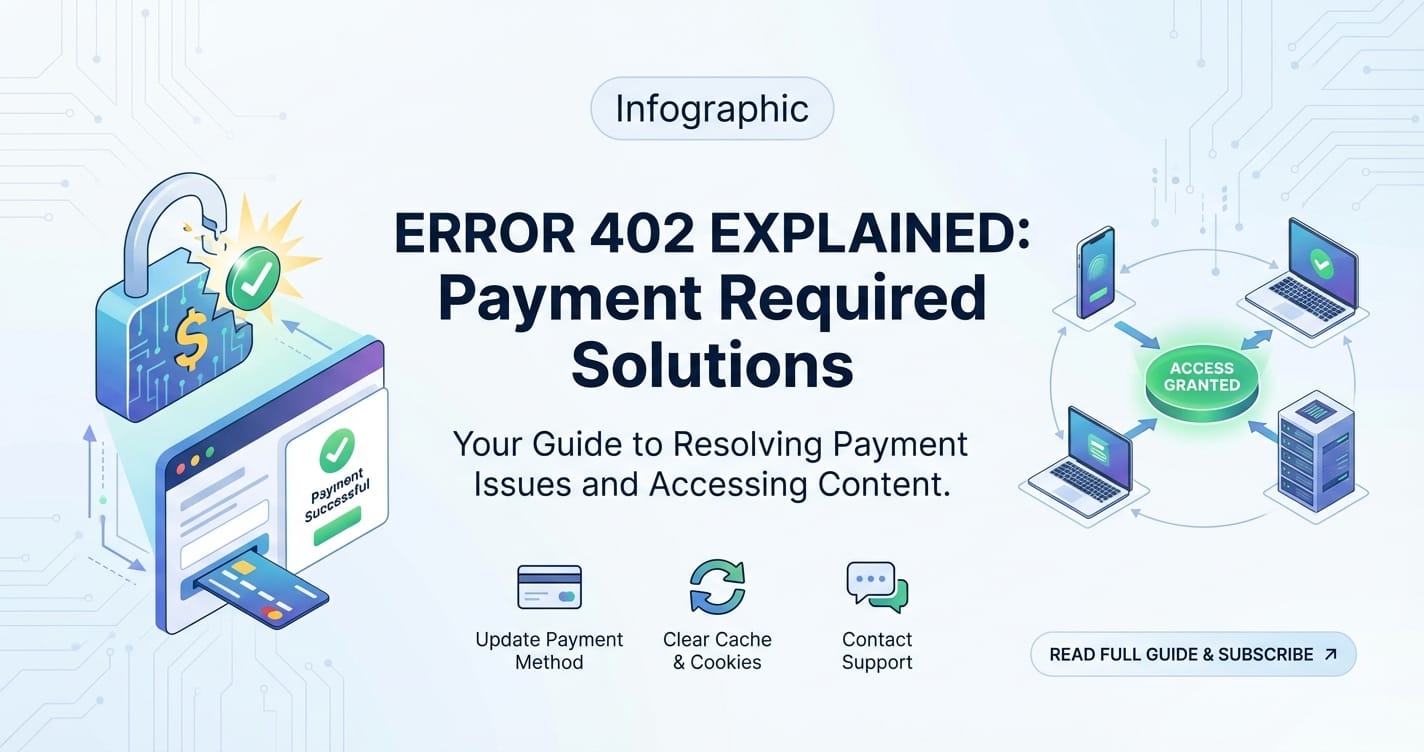
Error 402 Explained: Payment Required Solutions


The vast and intricate world of the internet is built upon a foundation of protocols and status codes, each serving as a vital signal in the ongoing dialogue between clients and servers. From the ubiquitous "200 OK" signifying success to the dreaded "404 Not Found," these numerical indicators provide immediate feedback on the state of a request. Among the plethora of HTTP status codes, the 4xx series stands out as particularly relevant for developers and users alike, as these codes specifically signal client-side errors – issues originating from the request itself rather than the server's inability to process it. While 401 Unauthorized and 403 Forbidden are common encounters, there exists a lesser-known yet increasingly pertinent member of this family: Error 402 Payment Required. This status code, though initially reserved for future use and digital cash schemes, is now finding its footing in the modern digital economy, particularly within the realm of subscription services, premium content access, and sophisticated api monetization models. Understanding Error 402 is not merely an academic exercise; it's a critical skill for both developers designing monetized services and users navigating the landscape of digital consumption. This comprehensive guide will delve deep into the intricacies of Error 402, exploring its historical context, contemporary applications, common scenarios leading to its occurrence, and, most importantly, providing detailed solutions for both clients and server-side developers. We will also examine the pivotal role of advanced tools like an api gateway and an AI Gateway in managing and mitigating these payment-related errors, ensuring a smoother experience for everyone involved in the digital transaction chain.
Deep Dive into HTTP Status Code 402: The Reserved Path to Monetization
The journey of HTTP status code 402 is an intriguing one, marked by foresight, reservation, and a gradual emergence into practical relevance. Officially defined by the Internet Engineering Task Force (IETF) in RFC 7231 (which updates earlier RFCs like 2616), the 402 Payment Required status code is explicitly designated as "reserved for future use." Its original intent, dating back to the early days of the web, was to facilitate digital cash and micro-payment systems. The idea was to create a standard response that a server could issue when a client needed to make a payment to complete a request, perhaps for accessing a specific document, downloading a file, or utilizing a computational service. However, the anticipated widespread adoption of these early digital payment schemes, which the internet's architects envisioned would rely heavily on client-server direct payment negotiations, never quite materialized in the way expected. Consequently, Error 402 remained largely unused for decades, a dormant code awaiting its moment.
The core distinction between 402 and other client error codes like 401 (Unauthorized) or 403 (Forbidden) is paramount. A 401 response typically means the client's request lacks valid authentication credentials, requiring the client to provide them, often via a username and password or an api key. A 403 response, on the other hand, indicates that the server understands the request but refuses to authorize it, even if authentication credentials were provided. This might be due to insufficient permissions or an IP-based restriction. Error 402, crucially, implies neither a lack of authentication nor a general prohibition; instead, it specifically points to a monetary requirement. The server could fulfill the request, and the client is recognized, but a payment is a prerequisite for proceeding. This nuanced difference is vital for developers designing their api endpoints and for clients interpreting the server's response. It tells the client, "You know who you are, and I know what you want, but you need to pay up first."
In modern contexts, while direct digital cash payments from the browser might still be niche, the spirit of Error 402 has found new life in the burgeoning subscription economy and api monetization landscape. Contemporary interpretations of 402 lean towards scenarios where a user's account has insufficient funds, an active subscription has expired, or a specific api call falls outside the scope of a free tier and necessitates an upgrade or one-time payment. For instance, a cloud service provider might return a 402 if a user tries to provision resources beyond their current credit balance. Similarly, a content platform might issue a 402 if a non-subscriber attempts to access premium content. The inherent flexibility of HTTP status codes allows for this evolution, where the original, specific use case expands to encompass broader, functionally similar scenarios. This re-emergence underscores its potential as a powerful, unambiguous signal in a world increasingly driven by metered services and paid access.
Common Scenarios Leading to 402 Errors
As the digital economy matures and services become increasingly sophisticated, the conditions under which an Error 402 might be encountered have diversified significantly. While its original purpose was somewhat narrow, its underlying principle—a payment is required to proceed—has found numerous applications. Understanding these common scenarios is crucial for both service providers aiming to implement clear billing policies and for users trying to diagnose why their requests are being denied.
API Usage & Monetization Models
The proliferation of apis as the backbone of interconnected applications has given rise to complex monetization strategies, making apis a prime candidate for 402 errors. Many api providers offer tiered access: a free tier with limited requests or features, and paid tiers that unlock higher usage limits, advanced functionalities, or dedicated support.
- Free Tier Limits Exceeded, Requiring an Upgrade: A developer building an application might be using a third-party
apiunder its free tier, which typically comes with strict rate limits (e.g., 1,000 requests per month) or restrictions on certain powerful endpoints. If the application's usage surpasses these limits, theapiserver, perhaps managed through anapi gateway, might respond with a 402 error for subsequent requests. This signals to the developer that their current plan does not accommodate the requested volume, and an upgrade to a paid subscription is necessary to continue. The error message accompanying the 402 should ideally specify which limit was exceeded. - Pay-as-You-Go Models Where Credit Runs Out: Some
apis operate on a consumption-based, "pay-as-you-go" model, where users pre-load credit into their accounts, and eachapicall deducts a certain amount. This is particularly common with compute-intensiveapis, such as those involving image processing, natural language understanding, or large-scale data analysis. If a user's pre-paid balance drops to zero or below a minimum threshold, any furtherapirequests might trigger a 402 error. This directly reflects the "Payment Required" nature, as the client needs to replenish their account balance to resume service. Anapi gatewayis often instrumental in enforcing these credit-based policies, checking a user's balance before forwarding the request to the backend service. - Specific Features Behind a Paywall: Within a single
api, certain advanced functionalities or premium data access might be exclusively available to users on higher-tier plans or those who have made a specific one-time purchase. For instance, anapioffering basic weather data might provide historical climate data or specialized forecasting models only to paying subscribers. If a free-tier user attempts to access such a premium endpoint, the server would appropriately respond with a 402, indicating that this particular feature requires payment or an upgraded subscription. - Specialized AI Services: With the rapid advancement of Artificial Intelligence,
apis for AI models (e.g., large language models, image generation, complex analytics) are increasingly common. These services often involve significant computational costs, leading to sophisticated pricing structures. AnAI Gatewaylike APIPark is designed to manage integration with numerous AI models, providing a unifiedapiformat. If a user's allocatedAI Gatewaycredits for a specific, high-cost AI model are depleted, or if they attempt to invoke a premium AI feature not covered by their current plan, APIPark, acting as theAI Gateway, could issue a 402 error. This ensures that the consumption of valuable AI resources is properly aligned with payment.
Subscription Services
Beyond apis, Error 402 is highly relevant in the broader context of subscription-based digital services, ranging from streaming platforms to software-as-a-service (SaaS) applications.
- Subscription Expired: The most straightforward scenario is when a user's subscription period ends, and they attempt to access content or features that require an active subscription. For example, a video streaming service might return a 402 if a user tries to play a movie after their monthly subscription has lapsed. The server acknowledges the user but requires renewal for access.
- Payment Method Failed/Declined: Even with an active subscription, recurring billing failures can lead to a 402. If a credit card on file has expired, has insufficient funds, or is declined by the payment processor for any other reason, the service provider may temporarily suspend access and return a 402 error for any service requests. This prompts the user to update their payment information.
- Account Suspended Due to Non-Payment: In more severe cases of persistent payment issues or chargebacks, an account might be fully suspended. While a 403 (Forbidden) might also be used in such situations, a 402 explicitly points to the financial obligation that needs to be resolved to restore access.
E-commerce/Digital Goods
While not as common for simple checkout flows, 402 could theoretically apply to specific interactions within e-commerce, particularly for digital goods or services that are provisioned on-demand.
- Attempting to Access Premium Content Without Purchase: A digital storefront selling e-books, software licenses, or premium articles might use a 402 if a user tries to download or view a purchased item before the payment transaction has been successfully confirmed. The item is available, but access is contingent on payment.
- One-Time Purchases Not Completed: In systems where a resource (e.g., a specific report, a high-resolution image) is available for a one-time fee, attempting to access it after initiating but not completing the payment process could result in a 402. The server knows the user wants the resource but awaits final payment confirmation.
Micro-payment Systems (Historical and Niche Applications)
Although not widely adopted as originally envisioned, understanding the historical context of micro-payment systems helps illuminate the pure intent behind 402.
- Direct Digital Cash Transactions: The original idea was that a server could send a 402 response, indicating that a small payment was required, and the client's browser or application would then automatically initiate a digital cash transfer. While browser-level support for such direct payments never became mainstream, the concept lives on in different forms, such as cryptocurrency payment gateways or token-based access systems where the "payment" is a specific digital asset. If a user tries to consume a resource that requires a specific token that they don't possess or haven't 'paid' for, a 402 could be an appropriate signal.
These diverse scenarios underscore the versatility of the 402 status code. Its true value lies in its unambiguous message: the barrier to fulfilling the request is monetary. This clarity is invaluable for designing robust, user-friendly, and effectively monetized digital services.
Identifying and Diagnosing 402 Errors
Encountering an Error 402, whether as an end-user or a developer, requires a systematic approach to diagnosis. The key is to understand that a 402 response is an instruction: it's telling you that payment is needed. The process of identification and diagnosis often involves checking multiple points, from client-side configurations to server-side logs and billing systems.
Client-Side Troubleshooting for Users and Developers
For anyone interacting with a service that returns a 402, the first line of investigation should always be focused on the client's account and payment status.
- Check Subscription Status: The most common reason for a 402 in subscription services is an expired or inactive subscription. Users should log into their service provider's dashboard or account settings and verify the status of their subscription. Is it active? Has it lapsed? Is there an upcoming renewal date that might have been missed? For
apiusers, this means checking theirapiprovider's portal to see their plan details. - Review Payment Methods (Expiration, Funds, Validity): A significant number of payment-related errors stem from issues with the payment method on file.
- Expiration Date: Credit cards expire. This is a frequent oversight. Users should ensure their registered credit card or payment method hasn't passed its expiration date.
- Insufficient Funds: For debit cards or bank accounts linked for payment, insufficient funds can lead to transaction declines.
- Card Declined by Bank: Sometimes, banks decline transactions for security reasons (e.g., suspicious activity, exceeding daily limits), even if funds are available. Users might need to contact their bank to authorize future transactions.
- Incorrect Information: Any changes to billing addresses, CVC codes, or card numbers that haven't been updated can lead to payment failures.
- Verify API Keys/Tokens (Contextual): While 401 (Unauthorized) is the primary code for invalid credentials, sometimes
apikeys are tied to specific subscription tiers. If anapikey is associated with a free tier that has been exhausted, or if a specificapikey is only valid for certain paid features, attempting to use it for an unsupported action might contextually return a 402. Developers should double-check whichapikey they are using and its associated permissions and limits in their provider's dashboard. - Consult User Account Dashboard for Payment History: Most service providers offer a detailed billing history within the user's account portal. This history can reveal failed payment attempts, the reasons for failure (if provided by the payment gateway), or a clear indication that a payment is overdue. This is an invaluable resource for self-diagnosis.
- Examine Client-Side Logs for Error Messages Accompanying 402: A well-designed service will not just return a
402 Payment Requiredstatus code but also provide a descriptive error message in the response body. This message might specify "Subscription expired," "Insufficient credits," or "Payment method declined." Developers should always parse the entire response, not just the status code, to glean maximum diagnostic information. For example, a server might respond with:json { "statusCode": 402, "message": "API usage limit exceeded for your current Free Plan. Please upgrade to a Pro plan to continue.", "code": "API_USAGE_EXCEEDED" }Such details are crucial for understanding the exact nature of the payment requirement.
Server-Side/API Provider Troubleshooting for Developers and Operations Teams
For the service providers and api developers, diagnosing a 402 requires deeper access to backend systems, focusing on where payment checks are performed and where usage is tracked.
- API Gateway Logs (Crucial for
apiandAI Gatewaykeywords): Anapi gatewaysits at the forefront of anapiecosystem, managing incoming requests before they reach the backend services. It's often responsible for rate limiting, authentication, and, critically, enforcing payment-related policies. Theapi gateway's logs are therefore a primary source of information. These logs can show:- Which specific
apiendpoint received the 402 response. - The user or client application that made the request.
- The policy that triggered the 402 (e.g., "rate limit exceeded," "subscription check failed").
- The exact time of the event. For an
AI Gatewaylike APIPark, its comprehensive logging capabilities (Feature 9: Detailed API Call Logging) are invaluable here. APIPark would record every detail of anapicall, including when a 402 was issued due to a user attempting to use an AI model without sufficient credit or an appropriate subscription. This allows businesses to quickly trace and troubleshoot issues related toapiand AI model consumption.
- Which specific
- Payment Processing System Logs: If the 402 is due to a payment method failure (e.g., credit card declined), the logs from the integrated payment gateway (e.g., Stripe, PayPal, Adyen) will provide granular details about why the transaction failed. This information is usually more specific than what the user's bank might provide.
- User Account Management System: The internal database or service responsible for managing user accounts, subscriptions, and billing status is the authoritative source. Developers can query this system to verify:
- The user's current subscription tier.
- Their remaining credit balance (for pay-as-you-go).
- The status of their payment method on file.
- Any flags indicating account suspension or payment delinquency.
- Internal Monitoring Tools: Beyond specific logs, aggregated monitoring tools (e.g., Prometheus, Grafana, ELK stack) can show trends in 402 errors. A sudden spike in 402 responses might indicate a systemic issue with the billing system, a new deployment that incorrectly implemented payment checks, or a widespread payment processor outage.
- Rate Limit Enforcement Mechanisms: For
apis, particularly, theapi gatewayor a dedicated rate-limiting service will have configurations and logs detailing the limits applied to different user tiers. Diagnosing a 402 related to exceeding usage limits involves examining these configurations and comparing them to the user's actual consumption patterns. - The Importance of Clear Error Messages from the Server: Ultimately, the best diagnostic tool is a well-crafted error response. Server-side developers should prioritize providing clear, human-readable, and actionable messages in the response body of a 402 error. Instead of just "402 Payment Required," the response should guide the user, e.g., "402: Your monthly
apicalls have exceeded the limit for your Basic plan. Please visit your dashboard to upgrade your subscription." This minimizes frustration and the need for support tickets.
By systematically investigating these areas, both clients and service providers can efficiently pinpoint the root cause of an Error 402 and move towards a resolution. The clarity and actionable insights derived from proper diagnosis are paramount for maintaining user satisfaction and operational efficiency.
APIPark is a high-performance AI gateway that allows you to securely access the most comprehensive LLM APIs globally on the APIPark platform, including OpenAI, Anthropic, Mistral, Llama2, Google Gemini, and more.Try APIPark now! 👇👇👇
Solutions for Resolving 402 Payment Required
Resolving an Error 402 requires distinct approaches depending on whether you are the client encountering the error or the developer/provider whose system is issuing it. Both sides play a critical role in ensuring smooth operation and a positive user experience.
For Users/Clients: Getting Back to Business
When faced with a 402, the immediate goal for a user is to rectify the situation and regain access to the desired service or api.
- Update Payment Information: This is often the simplest and most effective solution if the 402 is due to an expired or invalid payment method.
- Detailed Steps: Log in to your service provider's account portal. Navigate to the "Billing," "Payments," or "Account Settings" section. Look for options to "Update Payment Method," "Add New Card," or "Manage Subscriptions." Carefully enter the new payment details, ensuring the card number, expiration date, and CVC are correct. Verify that the billing address matches the card's registered address. Once updated, try the request again. Many services will automatically re-attempt failed recurring payments shortly after an update.
- Top Up Account/Purchase Credit: For pay-as-you-go models, particularly common with
apis and cloud services, the 402 indicates insufficient funds.- Explain How This Works: Access your service dashboard. Locate the "Credits," "Balance," or "Recharge" section. Select the desired amount to add to your account. Proceed with the payment. Once the transaction is successful and the credit is reflected in your balance, subsequent requests should no longer return a 402. This method is prevalent in services like cloud computing platforms or specialized
apis (e.g., AI transcription services) where usage is metered.
- Explain How This Works: Access your service dashboard. Locate the "Credits," "Balance," or "Recharge" section. Select the desired amount to add to your account. Proceed with the payment. Once the transaction is successful and the credit is reflected in your balance, subsequent requests should no longer return a 402. This method is prevalent in services like cloud computing platforms or specialized
- Upgrade Subscription Plan: If the 402 is triggered by exceeding free-tier limits or attempting to access premium features, upgrading your subscription is the direct path to resolution.
- Benefits and Process: Evaluate the available subscription tiers. Understand the limits and features associated with each. Choose a plan that aligns with your anticipated usage and feature needs. The upgrade process typically involves navigating to your account's "Subscription," "Plans," or "Pricing" section, selecting the new plan, and confirming payment for the upgraded service. An upgraded plan often provides higher
apirate limits, access to advanced features, more storage, or priority support, directly addressing the limitations that led to the 402.
- Benefits and Process: Evaluate the available subscription tiers. Understand the limits and features associated with each. Choose a plan that aligns with your anticipated usage and feature needs. The upgrade process typically involves navigating to your account's "Subscription," "Plans," or "Pricing" section, selecting the new plan, and confirming payment for the upgraded service. An upgraded plan often provides higher
- Contact Support: If the above steps don't resolve the issue, or if the reason for the 402 is unclear, contacting the service provider's customer support is the next logical step.
- When and How to Do It Effectively: Provide support with as much detail as possible: the exact error message received (including any details in the response body), the time of the error, the action you were trying to perform, and any troubleshooting steps you've already taken. Having your account ID or user email ready will also expedite the process. This ensures that the support team has all the necessary information to diagnose the problem quickly.
- Review Usage Against Plan Limits: For developers using
apis, especially those with complex pricing models, proactively monitoringapiusage is key to preventing 402 errors.- Understanding the Value Proposition: Regularly check your
apiprovider's dashboard for usage statistics. Compare your consumption against your current plan's limits. If you're consistently nearing or exceeding limits, it's a clear signal to consider upgrading before a 402 disrupts your application. This proactive approach helps avoid service interruptions and ensures continuous operation.
- Understanding the Value Proposition: Regularly check your
For Developers/API Providers: Designing Resilient and User-Friendly Systems
For service providers, resolving and, more importantly, preventing 402 errors involves designing robust billing systems, clear communication channels, and leveraging appropriate infrastructure.
- Implement Clear Billing and Usage Dashboards: Empowering users with self-service tools is paramount.
- Empowering Users: Provide an intuitive, easy-to-navigate dashboard where users can view their current subscription status,
apiusage statistics, billing history, payment methods on file, and clear options to upgrade their plan or top up their balance. Transparency builds trust and reduces support inquiries. Forapiproviders, this includes real-timeapicall counts against defined limits.
- Empowering Users: Provide an intuitive, easy-to-navigate dashboard where users can view their current subscription status,
- Robust Payment Processing Integration: The reliability of your payment system directly impacts user experience and revenue.
- Secure and Reliable Systems: Integrate with reputable payment gateways (e.g., Stripe, Braintree, PayPal) that offer secure, compliant, and reliable transaction processing. Implement retry mechanisms for failed payments, allowing for temporary issues (e.g., network glitches) without immediate account suspension. Ensure PCI DSS compliance for handling credit card data.
- Effective Rate Limiting and Quota Management: This is where an
api gatewaytruly shines in preventing and managing 402s related toapiconsumption.- How an API Gateway Facilitates This: An
api gatewayis the ideal place to enforceapirate limits, quotas, and subscription-tier access policies. It can inspect incoming requests, check the client's subscription status or remaining credit, and, if limits are exceeded, return a 402 directly, without even forwarding the request to the backend service. This offloads the burden from your core services and ensures consistent policy enforcement. For example, anapi gatewaycan be configured to allow 100 requests/minute for a basic plan, 1000 requests/minute for a pro plan, and block or return 402 for any requests exceeding these limits. - Graceful Degradation vs. Hard 402s: Consider implementing a "soft limit" where users are warned before reaching a hard 402. For non-critical
apis, you might temporarily allow slight overages or degrade service quality before imposing a hard stop. However, for monetizedapis, a clear 402 is often the preferred, unambiguous signal. - Integrating with an AI Gateway: For services that leverage AI models, an
AI Gatewaylike APIPark is indispensable. APIPark enables the quick integration of 100+ AI models and provides unifiedapiformat for AI invocation. Crucially, its end-to-endapilifecycle management features (Feature 5: API Service Sharing within Teams, Feature 6: Independentapiand Access Permissions for Each Tenant, Feature 7:apiResource Access Requires Approval) allow providers to granularly control access to specific AI models based on subscription tiers or usage credits. When a user's access to a high-cost AI model is restricted due to payment requirements, APIPark can gracefully return a 402, along with detailed logging (Feature 9) and powerful data analysis (Feature 10) to help providers understand usage patterns and potential payment-related issues. APIPark's ability to encapsulate prompts into RESTapis also means that providers can offer specialized AI-drivenapis (e.g., sentiment analysisapis) that might have their own billing thresholds, for which a 402 is an appropriate response.
- How an API Gateway Facilitates This: An
- Proactive Notifications: Don't wait for a 402 to happen.
- Warning Users Before Limits Are Reached or Payments Are Due: Implement email or in-app notifications to alert users when their
apiusage approaches a limit (e.g., "You've used 80% of your monthlyapicalls"), when their subscription is due for renewal, or when a payment method is about to expire. This proactive communication significantly reduces the incidence of unexpected 402 errors.
- Warning Users Before Limits Are Reached or Payments Are Due: Implement email or in-app notifications to alert users when their
- Clear Error Responses: As mentioned in diagnosis, the error message accompanying the 402 is vital.
- Providing Actionable Information: The response body should not only state "Payment Required" but also specify why (e.g., "Subscription expired," "Insufficient credits for this
apicall," "Payment method declined") and what to do next (e.g., "Please update your payment method in your account settings," "Upgrade your plan at [link]"). This minimizes user confusion and reduces the burden on customer support.
- Providing Actionable Information: The response body should not only state "Payment Required" but also specify why (e.g., "Subscription expired," "Insufficient credits for this
- Graceful Handling of Payment Failures: For recurring subscriptions, payment failures can be transient.
- Retries, Temporary Access: Implement a sophisticated retry logic for failed recurring payments, perhaps attempting to charge the card again after 24 or 48 hours. Consider offering a short grace period (e.g., a few days) where access is maintained after a payment failure, giving users time to rectify the issue before a hard 402 or service suspension.
- Security Considerations: Protecting payment data is paramount.
- Protecting Payment Data: Never store sensitive payment information (like full credit card numbers) directly on your servers. Leverage tokenization provided by payment gateways. Ensure all payment-related communications are encrypted (HTTPS) and comply with relevant data protection regulations (GDPR, CCPA).
By implementing these solutions and best practices, both users and providers can effectively manage and resolve Error 402, turning a potential point of frustration into a clear communication channel for payment-related matters. The key is transparency, proactive management, and leveraging robust infrastructure, especially advanced api gateway solutions.
The Role of API Gateways and AI Gateways in Managing 402 Errors
In today's interconnected digital landscape, where services are increasingly modular and api-driven, the api gateway has emerged as an indispensable component of any robust architecture. An api gateway acts as a single entry point for all client requests, serving as a powerful intermediary between clients and your backend services. It centralizes critical functions such as authentication, authorization, routing, caching, logging, and, crucially for our discussion, rate limiting and monetization enforcement. For environments dealing with advanced artificial intelligence, a specialized AI Gateway takes this concept further, optimizing for the unique demands of AI model integration and consumption. Both types of gateways play a pivotal role in effectively managing and mitigating Error 402 responses.
How API Gateways Enhance 402 Management for General APIs
For any general api ecosystem, an api gateway provides the infrastructure necessary to implement and enforce payment-related policies efficiently.
- Centralized Policy Enforcement for Paid Tiers: Instead of each backend service individually checking a user's subscription status or credit balance, the
api gatewaycan be configured to handle these checks upfront. Based on the authenticated user'sapikey or token, the gateway can determine their subscription tier and apply corresponding access policies and rate limits. If a request from a free-tier user attempts to access a premium endpoint, or if their usage exceeds their allocated quota, theapi gatewaycan immediately return a 402 response, preventing the request from ever reaching the backend service. This not only centralizes control but also reduces the load on your core services. - Integration with Billing Systems: Many advanced
api gatewaysolutions offer direct or indirect integration with billing and subscription management systems. This allows the gateway to query a user's financial status in real-time or pull cached subscription data to make informed decisions about whether to permit a request or issue a 402. This seamless integration ensures that theapiaccess policies are always synchronized with the user's payment status. - Detailed Logging and Monitoring:
API gatewaysare designed to generate extensive logs for every incoming and outgoing request. These logs are invaluable for diagnosing 402 errors. They can record which user made the request, which policy was violated, the exact time, and the specific reason for the 402 response. This level of detail, often including the exact error message provided to the client, is critical for rapid troubleshooting. Furthermore,api gatewaymonitoring tools can track the frequency of 402 errors, helping providers identify trends, potential issues with their billing system, or widespread customer payment problems. - Traffic Shaping Based on Subscription Status: An
api gatewaycan dynamically adjust how it handles traffic based on a user's payment status. For example, it might prioritize requests from premium subscribers, ensuring lower latency, while imposing stricter rate limits on free users. If a free user attempts to bypass these limits, theapi gatewayeffectively uses the 402 to signal that their current payment level does not permit such usage.
The Emerging Role of AI Gateways: Specialized 402 Management for AI Services
The rise of artificial intelligence has introduced a new layer of complexity to api management, particularly concerning billing and access. AI models, especially large language models (LLMs) and generative AI, can be computationally expensive, leading to usage-based pricing models that necessitate sophisticated api management. This is where an AI Gateway like APIPark becomes essential.
- Managing Access and Billing for Specialized AI Models: An
AI Gatewayspecifically addresses the unique challenges of integrating and monetizing diverse AI models. Different AI models might have different cost structures, usage metrics (e.g., tokens processed, images generated, compute time), and access permissions. AnAI Gatewaycentralizes the management of these varied access rules and billing logic. When a user tries to invoke a specific AI model or perform an action that exceeds their paid quota for that model, theAI Gatewayis perfectly positioned to intercept the request and return a 402 error. - Standardizing Access to Various AI Services with Different Pricing Models: One of APIPark's key features is its ability to offer a unified
apiformat for AI invocation across 100+ AI models. This standardization is critical for billing. When all AI calls flow through a singleAI Gatewaylike APIPark, it can consistently apply billing policies regardless of the underlying AI model. If a user's credit for AI services runs out, or if they attempt to use a premium AI feature that requires an upgraded plan, APIPark, acting as theAI Gateway, can issue a 402. This simplifies the user experience by providing a consistent error signal across diverse AI services. - APIPark's Comprehensive Features for 402 Management:
- Quick Integration of 100+ AI Models & Unified API Format: APIPark facilitates bringing many AI models under a single management umbrella. This unified management system allows for authentication and cost tracking across all integrated models. If a user tries to access a higher-tier AI model or exceeds the cost threshold for their current plan, APIPark's centralized control can enforce payment requirements with a 402.
- End-to-End API Lifecycle Management: APIPark assists with managing the entire lifecycle of
apis, including design, publication, invocation, and decommission. This comprehensive management includes regulatingapimanagement processes, managing traffic forwarding, load balancing, and versioning. Crucially, it managesapiresource access permissions and subscription approval features (Features 6 & 7). This means if a user attempts to call anapiservice (including AI-drivenapis) for which they haven't subscribed or received approval, APIPark can directly return a 402, signaling that payment or a subscription is required. - Detailed
apiCall Logging & Powerful Data Analysis: APIPark's comprehensive logging (Feature 9) records every detail of eachapicall, including those that result in a 402. This allows businesses to quickly trace and troubleshoot issues. The powerful data analysis (Feature 10) on historical call data displays long-term trends and performance changes, helping businesses understandapiconsumption patterns, identify users frequently encountering 402s due to hitting limits, and refine their pricing strategies or proactively reach out to users for upgrades. This makes APIPark an incredibly valuable tool for managing payment-relatedapiaccess for both traditional and AIapis.
In summary, both general api gateways and specialized AI Gateways are fundamental for modern service providers. They not only provide a layer of security and performance but, critically, they offer the necessary tooling to implement, enforce, and manage the complex billing and monetization strategies that often lead to Error 402. By centralizing these functions, they ensure consistent policy application, improve diagnostics, and ultimately contribute to a more stable and user-friendly experience for paid api and AI services.
Best Practices for Preventing 402 Errors
While understanding how to resolve a 402 error is essential, the ultimate goal for any service provider and their users should be to prevent these errors from occurring in the first place. Proactive measures, clear communication, and thoughtful system design can significantly reduce the incidence of Error 402, leading to higher user satisfaction and fewer disruptions.
For Users: Proactive Account Management
Users of apis and subscription services can take several steps to avoid encountering 402 errors.
- Keep Payment Information Updated: Regularly check and update your credit card expiration dates, billing addresses, and any other relevant payment details in your service provider's portal. Set reminders for yourself if needed. Many services allow you to add multiple payment methods for fallback.
- Monitor Usage: For services with usage-based billing or tiered
apiaccess, actively monitor your consumption against your plan limits. Most dashboards provide real-time or near real-time usage statistics. Set up alerts if the service offers them, to be notified when you approach your limits. This is particularly crucial forapidevelopers whose applications might suddenly increase usage. - Understand Terms and Conditions: Before subscribing to a service or integrating with an
api, thoroughly read and understand its pricing model, free-tier limitations, billing cycles, and any overage policies. Knowing what triggers a payment requirement will help you plan your usage and budget accordingly. - Maintain Sufficient Funds/Credit: For pre-paid or credit-based systems, ensure your account always has a healthy balance to cover anticipated usage. Set up auto-recharge features if available and appropriate for your budget.
- Respond to Notifications Promptly: Pay attention to emails or in-app notifications from your service providers regarding upcoming renewals, payment failures, or approaching usage limits. Addressing these promptly can prevent service interruptions.
For Providers: Designing for Clarity and Resilience
Service providers have a greater responsibility in preventing 402 errors through transparent practices and robust system design.
- Transparent Pricing and Clear Communication:
- Plain Language: Present your pricing models, subscription tiers, and
apiusage limits in clear, unambiguous language. Avoid jargon. - Visible Policies: Ensure that terms and conditions related to payment, cancellation, and overages are easily accessible and understandable.
- Proactive Warnings: As previously discussed, implement automated email or in-app notifications to warn users about expiring payment methods, upcoming renewals, or nearing usage limits. Provide clear calls to action (e.g., "Update your card," "Upgrade your plan").
- Plain Language: Present your pricing models, subscription tiers, and
- Robust Billing Systems and Integrations:
- Reliable Payment Gateways: Partner with secure and reliable third-party payment gateways.
- Automated Retries: Implement intelligent retry logic for failed recurring payments to account for temporary issues.
- Grace Periods: Consider offering a short grace period for subscription renewals, allowing users a few days to update their payment method without immediate service interruption.
- User-Friendly Dashboards:
- Self-Service: Provide a comprehensive user dashboard where customers can easily manage their subscriptions, view usage statistics, update payment methods, and access billing history. This empowers users to resolve many payment-related issues independently.
- Clear Status: Clearly display the current subscription status, next billing date, and remaining
apicredits or usage against limits.
- Leverage API Gateway Features for Policy Enforcement:
- Centralized Control: Utilize an
api gatewayto centralize and enforce allapiaccess policies, rate limits, and authentication rules. This ensures consistent application of payment-related restrictions across allapis. - Granular Quotas: Configure granular quotas for different subscription tiers or even specific
apiendpoints. For example, theapi gatewaycan be set to return a 402 if a user on a free tier attempts to make more than X calls per hour to a premiumapiendpoint. - AI Gateway for Specialized AI Services: For AI-driven services, an
AI Gatewaylike APIPark is crucial. APIPark's ability to manage diverse AI models, unify theirapiformat, and enforceapiaccess permissions (including subscription approvals) means it can effectively prevent unauthorized access or overuse of expensive AI resources, returning a 402 when necessary. Its detailed logging and data analysis features also help providers understand where 402s are occurring and refine their AI service offerings and pricing.
- Centralized Control: Utilize an
- Designing APIs with Payment in Mind:
- Clear Error Codes: Ensure your
apis return appropriate HTTP status codes, especially 402, for payment-related issues. - Informative Response Bodies: Crucially, the response body accompanying the 402 should contain a clear, actionable message that explains why the payment is required and how to resolve it. This saves users frustration and reduces the load on your support team.
- Dedicated Billing Endpoints: If applicable, provide specific
apiendpoints for managing billing, subscriptions, and checking usage, allowing developers to programmatically manage their accounts.
- Clear Error Codes: Ensure your
- User Education:
- Documentation: Maintain comprehensive and up-to-date documentation for your
apis and services, including detailed explanations of pricing, usage tracking, and how to interpret error codes like 402. - Tutorials: Offer tutorials or guides on how to manage subscriptions, update payment information, and understand
apiconsumption patterns.
- Documentation: Maintain comprehensive and up-to-date documentation for your
By adopting these best practices, both users and providers can work synergistically to minimize the occurrence of Error 402, fostering a more transparent, efficient, and satisfactory digital service environment. The emphasis shifts from merely reacting to errors to proactively designing systems and processes that prevent them, thereby enhancing the overall user experience and strengthening the relationship between service providers and their customers.
Conclusion
The HTTP status code 402, "Payment Required," stands as a unique and increasingly relevant signal in the intricate communication between clients and servers. Initially envisioned for a digital cash future that never fully materialized as anticipated, it has found its contemporary purpose in the burgeoning landscape of api monetization, subscription services, and specialized AI-driven platforms. Understanding Error 402 is no longer just an academic curiosity; it's a practical necessity for anyone navigating or building within the modern digital economy.
From a user's perspective, encountering a 402 is a direct instruction: payment is needed. Whether it's an expired credit card, an exhausted api credit balance, or an attempt to access premium features beyond one's current subscription, the solution invariably lies in managing one's financial commitment to the service. Proactive steps like regularly updating payment details, monitoring usage, and understanding service terms are crucial for uninterrupted access.
For developers and service providers, implementing robust systems to manage and respond to 402 errors is paramount for maintaining user trust and revenue streams. This involves designing clear billing dashboards, integrating with reliable payment processors, and, most importantly, leveraging the power of an api gateway. Solutions like APIPark, which serves as an open-source AI Gateway and API Management Platform, exemplify how modern infrastructure can centralize the management of diverse apis and AI models, enforcing access policies, tracking usage, and providing the granular data necessary to effectively handle payment-related denials. APIPark's end-to-end api lifecycle management, powerful data analysis, and unified api format for AI invocation make it an invaluable tool for providers looking to offer monetized AI services gracefully and efficiently, turning potential 402 errors into clear, actionable communications.
Ultimately, the optimal strategy for managing Error 402 lies in transparency and proactive engagement from both sides. Service providers must communicate their monetization policies clearly, provide user-friendly tools for account management, and deliver informative error messages. Users, in turn, must stay informed about their usage and payment obligations. By fostering this symbiotic relationship, the "Payment Required" status code transforms from a roadblock into a transparent mechanism for managing value exchange, ensuring a smoother, more predictable, and mutually beneficial experience for all participants in the digital realm. The continued evolution of the internet will only reinforce the importance of such explicit communication, making Error 402 an increasingly vital component of api governance and digital commerce.
HTTP 4xx Client Error Codes: A Comparison
| Status Code | Name | Description | Typical Triggers | Resolution Strategy |
|---|---|---|---|---|
| 401 | Unauthorized | The request has not been applied because it lacks valid authentication credentials for the target resource. The server should include a WWW-Authenticate header field containing at least one challenge. | - Missing api key/token - Invalid or expired api key/token - Incorrect username/password - Attempts to access protected resources without logging in. |
- Provide valid authentication credentials (e.g., correct api key, login details). - Refresh expired tokens. - Check api documentation for proper authentication methods. |
| 402 | Payment Required | Reserved for future use. The original intention was that it could be used as part of a digital cash or micro-payment scheme. It indicates that the client must make a payment to complete their request. | - Expired subscription - Insufficient credits/balance for a pay-as-you-go service - Exceeded free-tier api limits - Payment method declined/failed - Attempting to access premium content without a valid purchase/plan. |
- Update payment method details. - Top up account balance/purchase credits. - Upgrade subscription plan to access higher limits or premium features. - Contact support if the issue persists or is unclear. |
| 403 | Forbidden | The server understood the request but refuses to authorize it. Unlike 401, re-authenticating will not make a difference. Access is permanently denied for the requested resource, regardless of credentials. | - Insufficient user permissions for the requested resource - IP address blacklisted - Accessing a restricted resource (e.g., an administrator-only endpoint) as a regular user - Geographic restrictions. |
- Check user roles and permissions. - Verify that the requesting IP address is allowed. - Ensure the user has the necessary authorization for the specific action/resource. - Contact the administrator if access is believed to be incorrect. |
| 404 | Not Found | The origin server did not find a current representation for the target resource or is not willing to disclose that one exists. This is arguably the most recognized HTTP error. | - Incorrect URL/endpoint path - Resource (page, file, api endpoint) has been moved or deleted - Typo in the request path - Server misconfiguration hiding resources. |
- Double-check the URL/path for typos. - Verify the resource still exists and its correct location. - Consult api documentation for correct endpoint paths. - Clear browser cache/cookies. |
| 429 | Too Many Requests | The user has sent too many requests in a given amount of time ("rate limiting"). | - Exceeding configured api rate limits (e.g., too many calls per second/minute) - Sending rapid-fire requests without appropriate delays. |
- Reduce the frequency of requests. - Implement exponential backoff or other rate-limiting strategies on the client-side. - Check api documentation for rate limit policies and retry-after headers. - Consider upgrading to a higher api plan if increased limits are needed (can sometimes lead to 402 if upgrade requires payment). |
5 FAQs about Error 402 Payment Required Solutions
1. What exactly does an HTTP 402 Payment Required error mean, and how is it different from 401 Unauthorized or 403 Forbidden? An HTTP 402 error means the server understands your request but cannot fulfill it because a payment is required. Unlike a 401 (which indicates missing or invalid authentication credentials, requiring you to identify yourself) or a 403 (which means you're forbidden from accessing the resource even if authenticated, due to insufficient permissions or other restrictions), a 402 specifically points to a monetary barrier. The server acknowledges who you are and what you want, but access is contingent on payment—for an expired subscription, insufficient account balance, or exceeding free-tier limits.
2. I'm getting a 402 error when trying to use an api. What should be my first steps to resolve this? First, log into your api provider's dashboard or account portal. Check your subscription status and api usage against your plan's limits. See if your payment method on file is expired or if there's an outstanding balance. If your usage exceeds the free tier, you might need to upgrade your subscription. If it's a pay-as-you-go api, check if your account balance is depleted and requires a top-up. Also, examine the error message in the api response body for specific guidance from the provider.
3. How can an api gateway help in managing and preventing 402 errors for service providers? An api gateway is crucial for providers as it centralizes policy enforcement. It can intercept requests and apply rules based on a user's subscription tier, api usage limits, or account balance before the request even reaches your backend services. If a user exceeds their quota or lacks the necessary payment, the api gateway can immediately return a 402. This allows for consistent, efficient policy management, reduces backend load, and simplifies troubleshooting through centralized logging. For AI services, an AI Gateway like APIPark further specializes in managing access and billing for various AI models.
4. What are some best practices for users to avoid repeatedly encountering 402 errors? Users should proactively manage their accounts. This includes keeping payment information updated (especially credit card expiration dates), regularly monitoring api usage against their plan limits (many dashboards offer real-time tracking), and responding promptly to any notifications from the service provider regarding upcoming renewals or payment issues. Understanding the service's pricing model and api terms of service beforehand can also prevent unexpected 402 errors.
5. If I'm a developer building a service, what should I include in my 402 error response to make it most helpful for my users? Beyond just returning the 402 status code, your api response body should provide a clear, human-readable, and actionable error message. For instance, instead of just "Payment Required," include details like "Subscription expired," "API usage limit exceeded for your Basic plan," or "Payment method declined." Crucially, guide the user on how to resolve it, perhaps with a link to their billing dashboard or instructions to update their payment method. This transparency reduces user frustration and minimizes support inquiries.
🚀You can securely and efficiently call the OpenAI API on APIPark in just two steps:
Step 1: Deploy the APIPark AI gateway in 5 minutes.
APIPark is developed based on Golang, offering strong product performance and low development and maintenance costs. You can deploy APIPark with a single command line.
curl -sSO https://download.apipark.com/install/quick-start.sh; bash quick-start.sh

In my experience, you can see the successful deployment interface within 5 to 10 minutes. Then, you can log in to APIPark using your account.

Step 2: Call the OpenAI API.