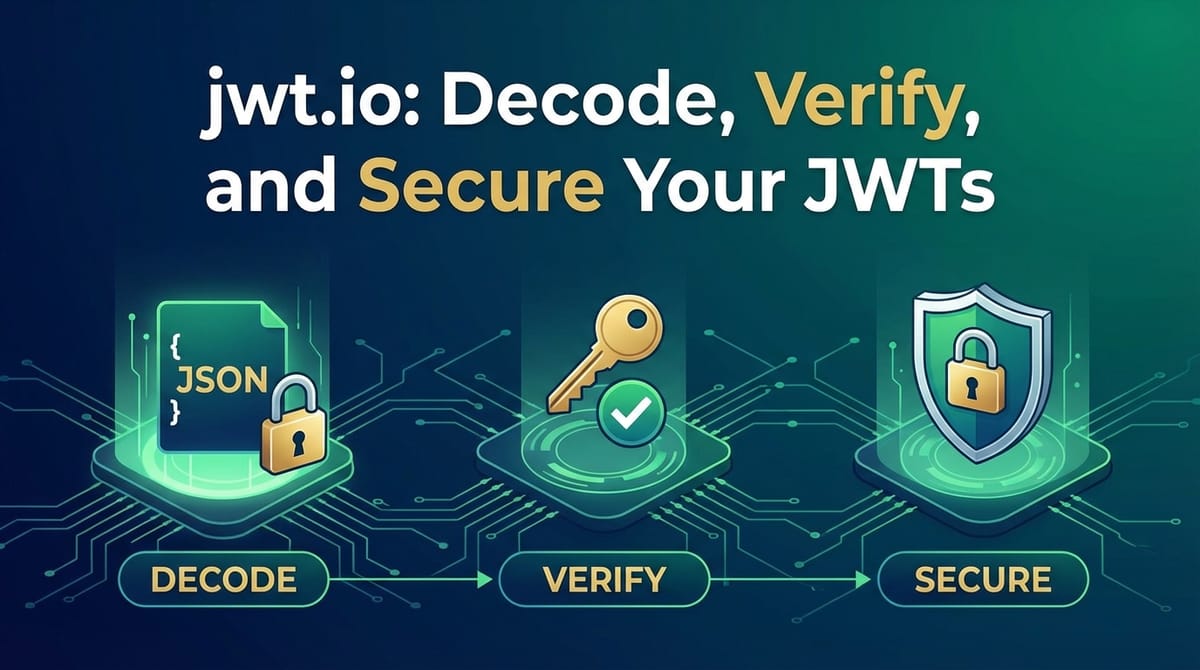
jwt.io: Decode, Verify, and Secure Your JWTs


The digital landscape of today's interconnected world thrives on seamless and secure communication between diverse applications and services. At the heart of this intricate web lies the API, the fundamental interface that allows software components to interact. As enterprises increasingly adopt microservices architectures and cloud-native deployments, the need for robust, scalable, and stateless authentication and authorization mechanisms has become paramount. This is where JSON Web Tokens (JWTs) emerge as a powerful and widely adopted solution, offering a compact, URL-safe means of representing claims to be transferred between two parties.
The concept of statelessness, central to modern distributed systems, presents a unique challenge for traditional session-based authentication. While server-side sessions require the server to maintain a record of each authenticated user, JWTs embody a different philosophy: the token itself contains all the necessary information, digitally signed to ensure its integrity. This self-contained nature allows for highly scalable APIs, as any server can verify a token without needing to query a central session store. This article will embark on a comprehensive journey into the world of JWTs, exploring their fundamental structure, how they function, their diverse applications, and critically, how tools like jwt.io empower developers to decode, verify, and ultimately secure these essential digital credentials. We will also delve into the critical role of an API gateway in managing and protecting JWT-secured APIs, touching upon how platforms like APIPark provide sophisticated solutions for this complex ecosystem.
The Genesis and Philosophy of JSON Web Tokens
Before diving into the technical intricacies, it is crucial to understand the driving forces behind the creation and widespread adoption of JWTs. In the era of monolithic applications, session-based authentication, where a server maintains a session ID and associated user data, was the norm. However, as applications scaled horizontally and embraced distributed architectures, this model presented significant challenges. Scaling a session store across multiple servers introduced complexities related to consistency, latency, and single points of failure.
JWTs address these issues by fundamentally shifting the responsibility of state. Instead of the server maintaining session state, the necessary authentication and authorization claims are encoded directly into the token and signed by the server. When this token is presented back to the server, the server can verify its authenticity and integrity using the signature, extracting the claims without needing to consult a database or a shared session store. This principle of statelessness is a cornerstone of modern API design, enabling greater scalability, resilience, and architectural flexibility, particularly for microservices that interact frequently and across different trust domains.
The philosophy extends beyond mere authentication. JWTs are not just for proving "who you are"; they are also excellent for conveying "what you can do" (authorization) and for securely exchanging other arbitrary information between parties. Their compact nature makes them ideal for inclusion in URL parameters, POST body, or HTTP headers, facilitating efficient transmission across networks. This elegant solution has made JWTs a cornerstone in the security architecture of countless web and mobile applications, powering everything from user logins to secure inter-service communication within complex distributed systems.
Deconstructing the JWT: Anatomy of a Self-Contained Token
A JSON Web Token, despite its seemingly complex name, adheres to a remarkably simple and elegant structure. It is composed of three distinct parts, separated by dots (.): the Header, the Payload, and the Signature. Each of these parts plays a crucial role in defining the token's purpose, conveying information, and ensuring its integrity. Understanding each component is fundamental to effectively working with, and securing, JWTs.
The Header: Setting the Stage
The first part of a JWT is the Header, which is typically a JSON object that describes the token itself. This object contains metadata about the token, primarily specifying the type of token and the cryptographic algorithm used to sign it. The Header is Base64Url encoded, a URL-safe encoding scheme that ensures the characters within the JSON structure can be safely transmitted across various web components, including URLs and HTTP headers, without requiring additional encoding.
Within the Header, two claims are commonly found: 1. alg (Algorithm): This claim identifies the cryptographic algorithm used to sign the JWT. Common algorithms include HS256 (HMAC with SHA-256), RS256 (RSA Signature with SHA-256), and ES256 (ECDSA Signature with SHA-256). The choice of algorithm has significant security implications, dictating whether a shared secret or a public/private key pair is used for signing and verification. For instance, HS256 relies on a symmetric secret key known to both the issuer and the validator, while RS256 and ES256 use an asymmetric key pair, allowing the issuer to sign with a private key and anyone with the corresponding public key to verify the signature. The proper selection and secure management of these keys are paramount for the overall security of the JWT system. 2. typ (Type): This claim specifies the type of the token, and for JWTs, its value is almost always JWT. This helps consumers of the token identify that they are indeed dealing with a JSON Web Token and can process it accordingly. While seemingly simple, this explicit declaration aids in token parsing and validation, especially in systems that might handle multiple types of security tokens.
An example of a Header might look like this in its raw JSON form:
{
  "alg": "HS256",
  "typ": "JWT"
}
After Base64Url encoding, this would form the first segment of the JWT. The Header is crucial because it informs the receiving party how to verify the token, guiding the cryptographic operations that will follow. Incorrect or manipulated alg values can lead to severe security vulnerabilities if not properly handled during the verification process.
The Payload: The Heart of the Claims
The second part of the JWT is the Payload, which is also a JSON object. This part carries the actual data, or "claims," about an entity (typically the user) and additional data. Similar to the Header, the Payload is Base64Url encoded. These claims are statements about an entity (e.g., a user) and additional data. There are three categories of claims: Registered Claims, Public Claims, and Private Claims.
- Registered Claims: These are a set of predefined claims that are not mandatory but are recommended to provide a set of useful, interoperable claims. They offer a common vocabulary for typical JWT use cases, ensuring consistency and ease of integration across different systems. Some common Registered Claims include:
iss(Issuer): Identifies the principal that issued the JWT. This helps in understanding the source of the token and is critical for multi-issuer environments.sub(Subject): Identifies the principal that is the subject of the JWT. This is typically the user ID or a unique identifier for the entity the token is about.aud(Audience): Identifies the recipients that the JWT is intended for. The audience claim is crucial for preventing tokens issued for one service from being accepted by another, a common security practice known as audience restriction.exp(Expiration Time): Identifies the expiration time on or after which the JWT MUST NOT be accepted for processing. This is a numeric date and time, typically expressed as a Unix timestamp (seconds since epoch). Short expiration times are a vital security measure, limiting the window of opportunity for an attacker to use a compromised token.nbf(Not Before): Identifies the time before which the JWT MUST NOT be accepted for processing. This is also a numeric date and time.iat(Issued At): Identifies the time at which the JWT was issued. This can be useful for calculating the age of the token.jti(JWT ID): Provides a unique identifier for the JWT. This claim can be used to prevent the JWT from being replayed. It's often used in token blacklisting or whitelisting schemes to identify and manage individual tokens.
- Public Claims: These are claims defined by those using JWTs, but to avoid collisions, they should be defined in the IANA JSON Web Token Claims Registry or be a URI that contains a collision-resistant name. Essentially, these are custom claims that are exposed publicly and require some form of registration or naming convention to prevent naming conflicts. They allow for extensibility beyond the registered claims, enabling developers to include domain-specific information that might be relevant to a wider set of applications.
- Private Claims: These are custom claims created to share information between parties that agree on their meaning. They are neither registered nor public and are typically used for application-specific data that doesn't need to be standardized or globally unique. For example, an application might include a
roleclaim to indicate a user's permissions (admin,editor,viewer) or acompanyIdclaim to identify the user's organization. While powerful for conveying specific authorization information, care must be taken to avoid sensitive data in private claims, as the Payload is only Base64Url encoded, not encrypted, meaning anyone can read it.
An example of a Payload:
{
  "sub": "user123",
  "name": "Jane Doe",
  "iat": 1516239022,
  "exp": 1516242622,
  "admin": true,
  "aud": "my-api-service"
}
The Payload, once encoded, forms the second segment of the JWT. It is the crucial carrier of information, and its careful construction, adherence to security best practices regarding sensitive data, and proper validation are vital for the security and functionality of any system leveraging JWTs.
The Signature: Ensuring Integrity and Authenticity
The third and final part of a JWT is the Signature. This is arguably the most critical component, as it provides the mechanism to verify that the token has not been tampered with and that it was indeed issued by a legitimate sender. Without a valid signature, a JWT is merely a Base64Url encoded string, easily manipulated and completely untrustworthy.
The Signature is created by taking the Base64Url encoded Header, the Base64Url encoded Payload, and a secret (for symmetric algorithms like HS256) or a private key (for asymmetric algorithms like RS256 or ES256), and then running them through the algorithm specified in the Header. The general formula for generating the signature is:
HMACSHA256(
  base64UrlEncode(header) + "." +
  base64UrlEncode(payload),
  secret
)
Or for asymmetric algorithms, it would involve a similar process using the private key.
The steps for signature creation are: 1. Take the Base64Url encoded Header. 2. Take the Base64Url encoded Payload. 3. Concatenate these two strings with a dot (.) in between. 4. Apply the cryptographic algorithm (e.g., HMAC SHA256, RSA SHA256) specified in the alg field of the Header to this concatenated string. 5. Use a secret key (for symmetric algorithms) or a private key (for asymmetric algorithms) as the cryptographic key for the algorithm. 6. The output of this cryptographic operation is the Signature, which is then Base64Url encoded to form the final third part of the JWT.
When a server receives a JWT, it performs the same signature calculation using the received Header, Payload, and its own copy of the secret or the corresponding public key. If the calculated signature matches the signature provided in the token, the server can be confident that: 1. The token was indeed issued by the legitimate sender who possesses the secret/private key. 2. The Header and Payload of the token have not been altered in transit or by any malicious third party.
The strength of the signature relies entirely on the strength and secrecy of the key used. For HS256, the shared secret must be truly secret and sufficiently long and random. For RS256 or ES256, the private key must be securely stored and managed, and the corresponding public key must be securely distributed to those who need to verify tokens. Compromise of this key immediately invalidates the security guarantees of all JWTs signed with it, allowing attackers to forge tokens. This underscores the critical importance of key management in any JWT-based system.
The Complete JWT
Once all three parts – the Base64Url encoded Header, Payload, and Signature – are generated, they are concatenated together with dots in between to form the complete JWT:
Base64Url(Header).Base64Url(Payload).Base64Url(Signature)
This compact string is what is transmitted between clients and servers. Its self-contained nature and cryptographic signature make it a highly efficient and secure method for transmitting authenticated information in a stateless manner, forming the backbone of modern API security.
The Operational Flow: How JWTs Power Authentication and Authorization
Understanding the static structure of a JWT is one thing; comprehending its dynamic operation in a real-world system is another. The journey of a JWT, from its issuance to its ultimate verification and use, forms a well-defined lifecycle that underpins its effectiveness in modern API security. This operational flow typically involves several key stages, each with its own set of considerations and security implications.
Issuance: The Birth of a Token
The lifecycle of a JWT begins with its issuance, typically initiated after a user successfully authenticates with an authentication server or identity provider. This authentication process might involve traditional username/password credentials, multi-factor authentication, or even federated identity protocols like OAuth 2.0 or OpenID Connect.
- Client Authentication: The client (e.g., a web browser, mobile app, or another service) sends authentication credentials to the authentication server. This is often an API endpoint specifically designed for login.
- Server Verification: The authentication server verifies these credentials against its user store. If the credentials are valid, it identifies the user and their associated attributes (roles, permissions, etc.).
- JWT Creation: The server then constructs a JWT. It creates the Header, specifying the signing algorithm (e.g.,
HS256,RS256) and token type (JWT). It then builds the Payload, populating it with relevant claims such assub(user ID),iss(itself as the issuer),aud(the intended recipient API or service),exp(expiration time), and any custom private claims necessary for authorization, like user roles or permissions. - Signing the Token: Using a secret key (for symmetric algorithms) or a private key (for asymmetric algorithms), the server cryptographically signs the Base64Url encoded Header and Payload. This signature is critical for ensuring the token's integrity and authenticity.
- Token Transmission: The newly minted JWT is then sent back to the client. This token acts as a credential that the client will subsequently use to access protected resources.
The issuance process is highly sensitive. The security of the secret/private key used for signing is paramount. Any compromise of this key would allow an attacker to forge valid JWTs, completely undermining the security of the system. Furthermore, careful consideration must be given to the claims included in the Payload. Only necessary information should be included, and sensitive data should be avoided, as the Payload is only encoded, not encrypted.
Transmission: Carrying the Digital Passport
Once the client receives the JWT, its next step is to store it securely and present it with subsequent requests to protected API resources. The most common method for transmitting JWTs is via the HTTP Authorization header, typically using the Bearer scheme.
Authorization: Bearer <your-jwt-here>
This method is preferred because it's stateless, widely supported, and does not require explicit client-side code to manage cookies, which can be prone to Cross-Site Request Forgery (CSRF) attacks if not handled carefully. Other less common methods include sending the JWT in a cookie (requiring HttpOnly and Secure flags for security) or as part of the request body or URL query parameters (generally discouraged due to exposure in logs and browser history).
The primary consideration during transmission is to ensure confidentiality and integrity. JWTs should always be transmitted over HTTPS (TLS/SSL) connections. This encrypts the communication channel, protecting the token from eavesdropping and man-in-the-middle attacks, where an attacker could intercept and potentially steal the token. Without HTTPS, even a perfectly secure JWT system is vulnerable to token theft.
Verification: Trust, but Verify
Upon receiving an API request containing a JWT, the resource server (or an API gateway acting on its behalf) must verify the token before granting access to the requested resource. This verification process is meticulous and multi-layered, designed to ensure the token's validity, integrity, and authenticity.
- Signature Validation: This is the most critical step. The server takes the received Header and Payload, applies the specified signing algorithm (from the
algclaim in the Header), and uses the appropriate secret key (for HS256) or public key (for RS256/ES256) to re-calculate the signature. It then compares this newly calculated signature with the signature provided in the incoming JWT. If they do not match, the token has either been tampered with or was signed by an unknown entity, and it must be rejected immediately. This step confirms the token's integrity and authenticity. - Expiration Check (
exp): The server checks theexpclaim in the Payload to ensure the token has not expired. If the current time is on or after theexptimestamp, the token is considered invalid and rejected. This limits the window of opportunity for an attacker to use a stolen token. - "Not Before" Check (
nbf): If present, the server checks thenbfclaim to ensure the token is not being used prematurely. If the current time is before thenbftimestamp, the token is rejected. - Issuer Check (
iss): The server verifies that theissclaim matches a trusted issuer. This prevents tokens from being accepted if they were issued by an unauthorized entity. - Audience Check (
aud): The server checks theaudclaim to ensure the token is intended for this specific API service. This is crucial in multi-service architectures to prevent cross-service token misuse. - Other Claims Validation: Any other relevant claims, such as
jti(for replay prevention) or custom authorization claims (e.g.,role,permissions), should also be validated against the application's business logic to determine if the user is authorized to perform the requested action.
Only after all these verification steps pass successfully should the server trust the claims within the JWT and proceed to process the request. Failure to perform any of these checks rigorously can open doors to various security vulnerabilities, from token forgery to unauthorized access. This comprehensive verification process is what imbues JWTs with their significant security value.
jwt.io: The Essential Sandbox for JWT Exploration and Debugging
For anyone working with JSON Web Tokens, jwt.io is an indispensable tool, serving as the de facto online utility for decoding, verifying, and understanding the nuances of these tokens. It provides an intuitive interface that simplifies complex cryptographic details, making it accessible for developers of all experience levels to inspect, debug, and even generate JWTs. Its widespread recognition within the developer community underscores its utility in everyday API development and security analysis.
Decoding: Unveiling the Token's Contents
The primary and most frequently used feature of jwt.io is its ability to decode JWTs. When a JWT string is pasted into the "Encoded" section on the left side of the jwt.io interface, the tool instantly parses the three Base64Url encoded segments and presents their decoded JSON representations in a human-readable format.
- Header Decoded: The Header, with its
algandtypclaims, is clearly displayed. This allows developers to quickly ascertain which algorithm was used for signing and confirm that the token is indeed a JWT. For example, seeingalg: "HS256"immediately indicates that a symmetric secret key is required for verification. - Payload Decoded: The Payload, containing all the claims (Registered, Public, and Private), is also immediately visible. This is invaluable for debugging. Developers can see the
sub(subject),iss(issuer),aud(audience), andexp(expiration time) claims, along with any custom data embedded in the token. For example, if a user is unexpectedly denied access, inspecting theroleclaim in the Payload might reveal that the token doesn't contain the expected permissions. Similarly, checking theexpclaim can quickly diagnose issues related to expired tokens. - Signature Status: While primarily a decoding tool,
jwt.ioalso visually indicates whether the signature is valid. This is crucial because it provides an immediate health check on the token's integrity. If the signature is invalid, it's an immediate red flag, suggesting either tampering or an incorrect secret/public key being used for verification.
The decoding functionality of jwt.io is not just for inspecting valid tokens; it's a powerful diagnostic aid. If an API is rejecting a token, pasting it into jwt.io can instantly reveal discrepancies in claims, unexpected expiration times, or an invalid signature, guiding the developer towards the root cause of the issue without needing to write or debug server-side code for parsing. This immediate feedback loop significantly accelerates the development and troubleshooting process for JWT-based APIs.
Verification: Confirming Integrity and Authenticity
Beyond mere decoding, jwt.io provides a robust verification mechanism that simulates how a server would validate a JWT's signature. This feature is critical for ensuring that tokens are not only well-formed but also trustworthy.
To verify a token's signature on jwt.io: 1. Paste the JWT: The encoded token is pasted into the left panel. 2. Provide the Secret/Key: For symmetric algorithms (like HS256), the shared secret key used to sign the token must be entered into the "Verify Signature" section. For asymmetric algorithms (like RS256 or ES256), the public key (corresponding to the private key used for signing) needs to be provided. jwt.io supports various key formats, including PEM. 3. Instant Feedback: jwt.io then performs the signature calculation using the provided key and compares it against the token's embedded signature. It displays a clear "Signature Verified" or "Invalid Signature" message.
This verification capability is invaluable for several scenarios: * Developer Testing: Developers can confirm that their token generation logic is producing correctly signed tokens. * Integration Testing: When integrating with third-party services that issue JWTs, jwt.io allows developers to quickly verify that the received tokens are valid against the provided public keys or secrets. * Security Audits: Security professionals can use it to test for potential weaknesses, for example, by attempting to modify a token's payload and seeing if it results in an invalid signature, thus confirming the integrity protection. * Understanding Algorithm Behavior: It visually demonstrates how different algorithms behave and the impact of using incorrect keys.
The ability to instantly verify the signature provides confidence in the token's integrity. It ensures that the token hasn't been tampered with since it was signed by the issuer. This feature of jwt.io is a cornerstone for developers committed to building secure and reliable APIs that rely on JWT for authentication and authorization.
Exploring Algorithms and Best Practices
jwt.io is also an excellent educational resource. It provides a dropdown for selecting various signing algorithms, allowing users to experiment and understand their differences. When you select an algorithm, the interface often prompts for the appropriate key type (secret for symmetric, public/private for asymmetric), guiding users through the correct cryptographic setup.
Furthermore, jwt.io often highlights common pitfalls and considerations through its design and accompanying documentation, subtly reinforcing best practices, such as the importance of strong secrets and correct key usage. While jwt.io itself doesn't directly enforce security policies like expiration checks or audience validation (which are application-level concerns), it provides the foundational transparency needed to debug and understand why certain tokens might fail validation at a deeper, cryptographic level.
In essence, jwt.io acts as a crucial bridge between the theoretical understanding of JWTs and their practical implementation. It demystifies the structure and cryptographic operations, empowering developers to confidently integrate, troubleshoot, and secure JWT-based authentication and authorization in their APIs and applications. Its simplicity and effectiveness make it an indispensable tool in the modern developer's toolkit, much like an API gateway is an indispensable tool for managing the flow of these tokens.
Securing Your JWTs: Mitigating Common Vulnerabilities
While JWTs offer significant advantages in terms of scalability and statelessness, their security is not inherent; it is a direct consequence of proper implementation and adherence to security best practices. Misconfigurations or oversight can lead to severe vulnerabilities, allowing attackers to forge tokens, impersonate users, or gain unauthorized access to sensitive data and resources. Understanding these common pitfalls and their respective mitigations is paramount for building robustly secure APIs.
1. alg=none Vulnerability
One of the most infamous JWT vulnerabilities stems from the alg (algorithm) claim in the Header. Some JWT libraries, when encountering {"alg": "none"}, would treat the token as unsigned and simply accept its Payload without any signature verification. An attacker could exploit this by modifying a legitimate token's Header to {"alg": "none"} and then removing the signature. If the server-side verification library is vulnerable, it would accept this tampered token, granting the attacker arbitrary access based on the modified claims.
Mitigation: * Strict Algorithm Whitelisting: The server should never trust the alg claim from the token itself. Instead, it should explicitly define and whitelist the acceptable signing algorithms (e.g., HS256, RS256) and reject any token that uses an unknown or "none" algorithm. Most robust JWT libraries default to this secure behavior, but it's crucial to ensure it's correctly configured. * Static Algorithm Configuration: Configure your server-side JWT verification to use a specific, predefined algorithm, rather than dynamically reading it from the token header.
2. Weak Secrets/Keys
The security of a JWT signed with a symmetric algorithm (like HS256) is entirely dependent on the secrecy and strength of the shared secret key. If an attacker can guess or obtain this secret key, they can forge valid JWTs, impersonate any user, and access protected resources. Similarly, for asymmetric algorithms (like RS256), compromise of the private signing key has the same devastating effect.
Mitigation: * Strong, Random Secrets: For HS256, use a cryptographically strong, sufficiently long (at least 32 bytes/256 bits), and randomly generated secret key. Never hardcode keys or use easily guessable strings. * Secure Key Management: Store secret keys and private keys securely. This means using environment variables, dedicated secret management services (e.g., AWS Secrets Manager, HashiCorp Vault), or hardware security modules (HSMs). Keys should never be committed to source code repositories. * Key Rotation: Implement a regular key rotation policy. If a key is compromised, the impact is limited to the period it was active. This also applies to public/private key pairs, where certificates and keys should be rotated periodically.
3. Improper Signature Verification
Errors in the implementation of signature verification logic can lead to tokens being accepted even if they are invalid or tampered with. This can include: * Skipping Signature Verification: Developers sometimes disable signature verification during development or testing and forget to re-enable it for production. * Incorrect Key Usage: Using the wrong secret for a symmetric algorithm, or the wrong public key (or a private key instead of a public key) for an asymmetric algorithm. * Type Confusion (e.g., HS256 vs. RS256): Some libraries were vulnerable to attacks where a token signed with an asymmetric algorithm (e.g., RS256, requiring a public key for verification) could be re-signed by an attacker using a symmetric algorithm (HS256) and the server's public key as the symmetric secret. The server would then use its public key to try and verify an HS256 signature, which would succeed if the attacker crafted it correctly.
Mitigation: * Use Reputable Libraries: Always use well-vetted, actively maintained JWT libraries in your chosen programming language. These libraries are typically hardened against known vulnerabilities. * Rigorous Testing: Thoroughly test your JWT implementation, including negative test cases where tokens are malformed, expired, or signed with incorrect keys. * Static Code Analysis: Utilize security linters and static analysis tools that can identify potential cryptographic misconfigurations or unsafe practices.
4. Expired Tokens and Lack of Revocation
While the exp claim provides an excellent defense against long-term token misuse, it doesn't solve all problems. A stolen token can still be used until its expiration. JWTs are inherently stateless, making direct server-side revocation (like invalidating a session ID) challenging without introducing a shared state.
Mitigation: * Short Expiration Times: Set JWT expiration times to be as short as practically feasible (e.g., 5-15 minutes). This limits the window during which a stolen token can be used. * Refresh Tokens: Implement a separate system for refresh tokens. When an access token (JWT) expires, the client uses a long-lived refresh token to obtain a new access token. Refresh tokens should be single-use, stored securely (e.g., in an HttpOnly cookie), and revocable on the server side (e.g., by blacklisting them in a database) if a user logs out or credentials are compromised. * Token Blacklisting (for critical events): For critical security events (e.g., password change, account compromise, explicit logout), a blacklisting mechanism can be implemented. This involves storing the jti (JWT ID) of revoked tokens in a fast-access database (like Redis) and checking it during every verification. This reintroduces state, but it's often a necessary trade-off for immediate revocation.
5. Sensitive Data in Payload
The Payload of a JWT is Base64Url encoded, not encrypted. This means anyone who intercepts the token can easily decode and read its contents. Placing sensitive information (e.g., personally identifiable information, financial data, highly confidential permissions) directly into the Payload is a serious security risk.
Mitigation: * Minimalist Payload: Only include non-sensitive, essential information in the JWT Payload that is required for authentication and authorization. * Reference Tokens: For highly sensitive claims or large amounts of data, consider using reference tokens. The JWT itself might contain only a token ID, and the actual sensitive claims are stored on the server side, associated with that ID, and retrieved only when needed. This approach moves sensitive data out of the client-side token, reducing exposure. * Encryption (JWE): For scenarios where sensitive data absolutely must be transmitted in a token, JSON Web Encryption (JWE) can be used. JWE provides a standard way to encrypt the contents of a JWT. However, JWE adds significant complexity and overhead, and should only be used when strictly necessary.
6. Cross-Site Scripting (XSS) and Cross-Site Request Forgery (CSRF)
While JWTs are often lauded for their stateless nature compared to session cookies, they are still vulnerable to client-side attacks like XSS if not handled carefully. * XSS: If a malicious script can be injected into a web page (XSS), it can potentially access JWTs stored in localStorage or sessionStorage and send them to an attacker's server. * CSRF: If JWTs are stored in regular (non-HttpOnly) cookies, they can be vulnerable to CSRF, where an attacker tricks a user's browser into sending authenticated requests to an API.
Mitigation: * Store JWTs in HttpOnly, Secure Cookies: This is generally the most robust approach for browser-based applications. HttpOnly cookies prevent client-side JavaScript from accessing the token, mitigating XSS risks. Secure cookies ensure the token is only sent over HTTPS. This approach offers good protection against XSS, but it does reintroduce some CSRF considerations. * CSRF Tokens with Cookies: If using HttpOnly cookies for JWTs, implement a CSRF protection mechanism (e.g., anti-CSRF tokens in request headers) to mitigate CSRF risks. * Strong XSS Protections: Implement robust Content Security Policy (CSP), input sanitization, and output encoding to prevent XSS vulnerabilities from occurring in the first place, regardless of JWT storage. * Consider Local Storage for SPAs (with caveats): While localStorage is convenient for Single Page Applications (SPAs), it's more exposed to XSS. If using localStorage, ensure your application has extremely strong XSS prevention measures in place.
Securing JWTs requires a multi-faceted approach, combining robust cryptographic practices, secure key management, diligent validation of all claims, and comprehensive client-side security measures. By addressing these common vulnerabilities, developers can harness the full power of JWTs to build highly secure and scalable APIs. An API gateway plays a pivotal role here, offering a centralized point to enforce many of these security policies, offloading the burden from individual services.
APIPark is a high-performance AI gateway that allows you to securely access the most comprehensive LLM APIs globally on the APIPark platform, including OpenAI, Anthropic, Mistral, Llama2, Google Gemini, and more.Try APIPark now! 👇👇👇
Use Cases for JWTs: Beyond Simple Authentication
The versatility of JSON Web Tokens extends far beyond merely authenticating users. Their self-contained nature, cryptographic integrity, and flexible payload structure make them suitable for a wide array of scenarios in modern distributed systems, particularly where multiple services need to securely exchange information or assert identities. Understanding these diverse applications highlights the strategic importance of JWTs in the broader API ecosystem.
1. Authentication and Single Sign-On (SSO)
This is perhaps the most common and intuitive application of JWTs. When a user logs into an application, a JWT is issued. This token then acts as a digital passport, proving the user's identity for subsequent requests to protected resources.
- Stateless API Authentication: In a microservices architecture, a user authenticates once with an identity service, which issues a JWT. This token can then be used to access various backend APIs (each potentially being a different microservice) without requiring each service to perform a full re-authentication or query a central session store. Each service merely verifies the JWT's signature and expiration, trusting the claims within. This greatly simplifies horizontal scaling of APIs, as servers don't need to maintain session state.
- Single Sign-On (SSO): JWTs are a natural fit for SSO solutions. A user authenticates with one identity provider (e.g., Google, Okta, an enterprise IDP) and receives a JWT. This same JWT can then be presented to multiple independent applications or services within the same trust domain, granting them access without requiring the user to log in repeatedly. The
issandaudclaims become particularly important here to ensure the token is valid for the specific application attempting to consume it. OpenID Connect, an authentication layer built on top of OAuth 2.0, extensively uses JWTs for identity tokens.
2. Authorization and Access Control
JWTs are not just for identifying who a user is, but also what they can do. By embedding authorization-related claims directly into the token's Payload, fine-grained access control can be enforced efficiently.
- Role-Based Access Control (RBAC): Claims like
role: ["admin", "editor"]orpermissions: ["create_user", "delete_post"]can be included in the JWT. When an API receives a request with such a token, it can inspect these claims to determine if the user has the necessary permissions to perform the requested action on the specific resource. This offloads authorization logic from the database and allows for quick, in-memory checks. - Attribute-Based Access Control (ABAC): More complex attributes can also be embedded, such as
department: "engineering"ortenantId: "XYZ". This enables more dynamic and context-aware authorization policies, allowing or denying access based on a combination of user attributes, resource attributes, and environmental conditions. For instance, a user might only be allowed to modify resources belonging to theirtenantId. An API gateway often plays a crucial role in enforcing these authorization policies by inspecting JWT claims before forwarding requests to backend services.
3. Secure Information Exchange
Beyond authentication and authorization, JWTs can serve as a secure means to exchange arbitrary, digitally signed information between two parties. The signature ensures the integrity and authenticity of the transmitted data.
- Inter-Service Communication (within Microservices): In a microservices architecture, one service might need to call another. Instead of re-authenticating with each call, the calling service can generate a JWT (or propagate an existing user JWT) with claims specific to the inter-service interaction. This allows the receiving service to verify the identity of the calling service (or the original user) and its authorized scope, without direct database lookups.
- Decoupled Workflows: Imagine a system where an event occurs (e.g., an order is placed), and a signed message (a JWT) containing details of the event is published to a message queue. Multiple consumer services can then independently read this message, verify its signature (to ensure it came from the trusted order service), and process the order details, knowing the information is authentic and untampered.
- Client-Side Data Storage: While generally discouraged for sensitive data, JWTs can be used to securely store non-sensitive, signed data on the client side that the server trusts. For example, user preferences or non-critical state information that doesn't need to be persisted server-side. The signature prevents client-side tampering with this data when it's sent back to the server.
4. API Rate Limiting and Traffic Management
An API gateway can leverage JWT claims to implement intelligent rate limiting and traffic management policies.
- Per-User/Per-Client Rate Limiting: The
sub(subject) or custom client ID claims in a JWT can be used by an API gateway to identify individual users or client applications. This allows the gateway to enforce specific rate limits for each user or application, preventing abuse and ensuring fair usage of API resources. A premium user (identified by a claim likeplan: "premium") could be granted higher rate limits than a standard user. - Routing and Versioning: Claims in a JWT could indicate a user's membership in a specific A/B testing group (
ab_test: "variant_B") or their access to a particular API version (api_version: "v2"). The API gateway can then use these claims to intelligently route requests to different backend service instances or versions, facilitating phased rollouts or personalized experiences. This is a powerful feature for modern API management, where an advanced API gateway like APIPark can offer sophisticated policy enforcement based on JWT claims, allowing for dynamic control over API traffic and access.
5. OpenID Connect Identity Tokens
As mentioned, OpenID Connect (OIDC) uses JWTs as its id_token. This id_token is a security token that allows a client to verify the identity of the end-user based on the authentication performed by an authorization server, as well as to obtain basic profile information about the end-user. The claims within the id_token (e.g., email, name, picture) are signed by the identity provider, ensuring their authenticity and integrity for the consuming client application. This makes OIDC, powered by JWTs, a cornerstone of modern federated identity solutions.
In all these use cases, the core strengths of JWTs – their self-contained nature, compactness, and cryptographic integrity – come to the fore, enabling scalable, secure, and efficient communication across distributed systems. However, the effective application of JWTs critically depends on adhering to the security best practices discussed earlier, ensuring that the benefits are not overshadowed by potential vulnerabilities.
The Pivotal Role of an API Gateway in JWT Ecosystems
As the complexity of modern distributed systems grows, especially with the proliferation of microservices and diverse APIs, the role of an API gateway becomes increasingly critical. Far more than just a reverse proxy, an API gateway acts as a single entry point for all client requests, abstracting the backend services and providing a centralized location to handle cross-cutting concerns. In an ecosystem heavily reliant on JWTs, the API gateway plays a pivotal, strategic role in enhancing security, efficiency, and manageability.
Centralized JWT Validation and Authentication Offloading
One of the most significant benefits of an API gateway in a JWT-based architecture is its ability to centralize token validation. Instead of each backend microservice being responsible for decoding and verifying every incoming JWT, the gateway can handle this task upfront.
- Single Point of Validation: All incoming requests carrying JWTs first hit the API gateway. The gateway is configured with the necessary secrets or public keys to perform comprehensive JWT validation, including signature verification, expiration checks (
exp), "not before" checks (nbf), issuer (iss) and audience (aud) validations. - Offloading Authentication: By validating JWTs at the gateway level, individual backend services are offloaded from this responsibility. They can trust that any request reaching them has already been authenticated and authorized by the gateway. This simplifies the development of microservices, allowing them to focus purely on their business logic, rather than re-implementing complex security mechanisms.
- Consistent Security Policy: Centralizing validation ensures a consistent security policy across all APIs. Any change in security requirements (e.g., updating a signing key, enforcing a new claim) can be applied once at the gateway, rather than needing to update and redeploy numerous backend services.
- Performance Optimization: Advanced gateways can cache validation results or perform optimizations to reduce the overhead of repeated signature verification, especially with asymmetric algorithms.
Enhanced Authorization and Policy Enforcement
Beyond just authenticating the token, an API gateway can enforce sophisticated authorization policies based on the claims contained within the JWT's Payload. This provides an additional layer of security and control before requests ever reach sensitive backend services.
- Claim-Based Authorization: The gateway can inspect claims such as
role,permissions,tenantId, orscopewithin the JWT and determine if the authenticated user is authorized to access the specific API endpoint or perform the requested operation. For example, a request to/admin/usersmight only be permitted if the JWT containsrole: "admin". - Fine-Grained Access Control: Policies can be defined at a very granular level, allowing administrators to control access based on method (GET, POST), specific URL paths, or even dynamically based on resource attributes if the gateway integrates with external policy decision points.
- Dynamic Routing: JWT claims can also drive dynamic routing decisions. A
versionclaim might route requests tov1orv2of a service, or aregionclaim could direct traffic to a specific geographical data center, optimizing performance and compliance.
Rate Limiting and Quota Management
The API gateway is the ideal place to implement rate limiting and quota management, and JWTs provide the necessary identity context to make these policies intelligent and user-specific.
- Identified Rate Limits: By extracting the
sub(subject) or a custom client identifier from the JWT, the gateway can apply different rate limits to individual users or client applications. This prevents a single malicious or misbehaving client from monopolizing API resources. - Tiered Access: Based on claims like
plan: "basic",plan: "premium", orpartner: "true", the gateway can enforce differentiated access tiers, providing higher request quotas or lower latency to privileged users or partners. - Fair Usage and DDoS Protection: Rate limiting helps ensure fair usage of APIs across all consumers and provides a first line of defense against denial-of-service (DoS) or distributed denial-of-service (DDoS) attacks, by limiting the impact of excessive requests.
Security Enhancements: Observability and Threat Protection
An API gateway significantly bolsters the overall security posture of a JWT-based system through comprehensive logging, monitoring, and advanced threat protection features.
- Comprehensive Logging and Auditing: Every request passing through the gateway can be logged, including details about the JWT (e.g., subject, issuer, claims, validation status). This provides a rich audit trail for security investigations, compliance, and debugging. Detailed logging allows businesses to quickly trace and troubleshoot issues in API calls, ensuring system stability and data security.
- Real-time Monitoring and Analytics: Gateways can provide real-time dashboards and analytics on API traffic, including JWT-related metrics like successful/failed validations, expired tokens, and unusual access patterns. This helps in proactively identifying potential security threats or operational issues. The ability to analyze historical call data to display long-term trends and performance changes helps businesses with preventive maintenance before issues occur.
- Threat Protection: Beyond JWT validation, API gateways often include features like IP whitelisting/blacklisting, bot detection, SQL injection, and XSS protection. They can also inspect the contents of requests for malicious payloads, protecting backend services from various attack vectors.
- Centralized Key Management: The gateway acts as the single consumer of signing keys (secrets or public keys) for JWT verification, simplifying key management. It can be integrated with secure key vaults, ensuring that sensitive cryptographic material is not distributed across multiple backend services.
API Management and Lifecycle Support
Beyond security, an API gateway is integral to full API lifecycle management, acting as the control plane for publishing, versioning, and discovering APIs.
- API Publication and Discovery: The gateway provides a single, consistent endpoint for developers to discover and access APIs, regardless of where they are implemented in the backend. This can include features for generating documentation, client SDKs, and developer portals.
- Version Management: When APIs evolve, the gateway can handle versioning, allowing old and new versions of an API to coexist, and intelligently routing requests based on version headers or JWT claims.
- Traffic Management: Features like load balancing, circuit breaking, and retry mechanisms ensure the reliability and resilience of the API ecosystem, directing traffic to healthy services and preventing cascading failures.
- Service Sharing: The platform allows for the centralized display of all API services, making it easy for different departments and teams to find and use the required API services.
- Subscription Approval: Features can be activated to ensure callers must subscribe to an API and await administrator approval before they can invoke it, preventing unauthorized API calls and potential data breaches.
An API gateway is therefore not just a nice-to-have but a fundamental component in any modern API architecture that leverages JWTs. It acts as the intelligent traffic cop, security guard, and central nervous system for your API ecosystem, enabling scalability, security, and efficient management. For enterprises looking to effectively manage, integrate, and deploy AI and REST services, an open-source AI gateway and API management platform like APIPark offers a comprehensive suite of features. APIPark can handle the sophisticated authentication and authorization requirements that come with JWTs, integrating 100+ AI models with a unified management system for authentication and cost tracking, and standardizing API formats for AI invocation. Its robust performance, rivaling Nginx, and detailed logging capabilities make it a strong candidate for securing and managing complex API landscapes, providing end-to-end API lifecycle management, and enabling independent API and access permissions for each tenant. Such a gateway ensures that the promises of JWTs – statelessness, scalability, and security – are fully realized across an enterprise's API landscape.
Advanced JWT Concepts and Ecosystem Tools
The core principles of JWTs are straightforward, but the broader ecosystem and advanced usage patterns introduce additional layers of sophistication. Exploring these concepts allows for even more robust and flexible implementations, addressing specific challenges that arise in complex distributed environments.
JSON Web Key (JWK) and JSON Web Key Sets (JWKS)
Managing cryptographic keys, especially public keys for asymmetric algorithms like RS256, can be cumbersome, particularly in dynamic environments where keys might be rotated or multiple issuers exist. JSON Web Key (JWK) and JSON Web Key Sets (JWKS) address this challenge by providing a standardized, structured way to represent cryptographic keys in JSON format.
- JWK: A JWK is a JSON object that represents a cryptographic key. It contains standard fields like
kty(key type, e.g., "RSA", "EC"),use(how the key is used, e.g., "sig" for signature, "enc" for encryption),alg(the algorithm with which the key is used), and parameters specific to the key type (e.g.,nandefor RSA public keys,xandyfor EC public keys). This standardized format allows keys to be easily exchanged and understood programmatically. - JWKS: A JWKS is a JSON object that contains a set of JWKs. It's typically published at a well-known URL by an issuer (e.g.,
/.well-known/jwks.json). When a service needs to verify a JWT signed with an asymmetric algorithm, it can fetch the issuer's JWKS endpoint, retrieve the appropriate public key (identified by thekidclaim in the JWT's header), and use it for signature verification. This eliminates the need for manual public key distribution and facilitates key rotation. Thekid(Key ID) claim in the JWT header is used to specify which key from the JWKS was used to sign the token. This mechanism is fundamental to OpenID Connect and OAuth 2.0 implementations for dynamic public key discovery.
Nested JWTs (JWS and JWE Combination)
While JWTs are typically Base64Url encoded and signed (JWS - JSON Web Signature), there are scenarios where the information in the Payload needs to be kept confidential. This is where JSON Web Encryption (JWE) comes into play. A JWE is a cryptographically encrypted representation of arbitrary JSON data.
Nested JWTs combine these two specifications: a JWS can be encrypted using JWE. This results in a "nested" token where the inner JWT (containing the claims and signature) is encrypted, and then the outer JWE token is signed.
The process roughly looks like this: 1. Create a standard JWT (JWS) with header, payload, and signature. 2. Encrypt this entire JWS string using JWE, along with its own JWE header (specifying encryption algorithm, key encryption algorithm). 3. The resulting JWE token is transmitted.
Upon receipt, the process is reversed: 1. The outer JWE is decrypted using the appropriate key. 2. The decrypted content reveals the inner JWS. 3. The inner JWS is then verified for its signature.
This provides both confidentiality (via encryption) and integrity/authenticity (via signature). While powerful, nested JWTs add significant complexity in implementation and computational overhead, so they should only be used when there's a strict requirement for payload confidentiality, and not merely for general authentication. Most authentication scenarios only require JWS.
Token Revocation Mechanisms
One of the often-cited challenges with JWTs is their stateless nature, which makes immediate revocation difficult. Once a JWT is issued and signed, it remains valid until its exp claim dictates otherwise, making it problematic if a user logs out, changes their password, or an account is compromised. While short expiration times and refresh tokens are the primary defense, other mechanisms exist for more immediate revocation.
- Blacklisting (JTI Claim): For critical revocation events, a blacklisting approach can be used. Each JWT can be issued with a unique
jti(JWT ID) claim. When a token needs to be revoked, itsjtiis added to a blacklist stored in a fast, in-memory database (like Redis). The API gateway or resource server, during verification, would then not only validate the signature and expiration but also check if thejtiis present in the blacklist. This introduces a form of state to achieve revocation, incurring additional overhead. - Change of Signing Key: If a complete and immediate invalidation of all existing tokens is required (e.g., in a major security breach), rotating the signing key for HS256 tokens or the private key for RS256 tokens can invalidate all previously issued tokens, forcing clients to re-authenticate and obtain new ones. This is a drastic measure and often not suitable for individual user logouts.
- Short-lived Access Tokens with Revocable Refresh Tokens: This is the most common and recommended pattern. Access tokens (JWTs) are issued with very short expiration times (e.g., 5-15 minutes). When an access token expires, the client uses a separate, long-lived refresh token (which is revocable server-side and often stored more securely, like in an HttpOnly cookie or database) to request a new access token. If a user logs out, only the refresh token needs to be revoked, preventing further issuance of access tokens. This minimizes the window for a compromised access token to be misused, while still allowing for long user sessions.
API Gateway and AI Integration with JWTs
In the context of AI services, where an API gateway like APIPark facilitates the integration and management of numerous AI models, JWTs play an even more nuanced role.
- Unified AI API Access: APIPark allows for quick integration of 100+ AI models and unifies their API format. JWTs can be used to authenticate requests to this unified gateway, and the claims within the JWT can specify which AI models a user or application is authorized to invoke, or even dictate specific parameters for those models.
- Cost Tracking and Policy Enforcement: With JWT claims, APIPark can track usage and enforce cost policies per user or application for AI model invocations. A
quotaclaim in a JWT might inform the gateway of a user's remaining AI credits, allowing APIPark to enforce limits before forwarding the request to the AI model. - Prompt Encapsulation and Security: When users combine AI models with custom prompts to create new APIs (e.g., sentiment analysis), JWTs can secure access to these newly created specialized APIs. The gateway ensures that only authorized callers can invoke these prompt-encapsulated APIs, and that the invocation adheres to defined policies.
- Tenant Isolation: APIPark supports independent APIs and access permissions for each tenant. JWTs can carry
tenantIdclaims, which the gateway uses to route requests to the correct tenant's resources and enforce tenant-specific access policies, ensuring isolation and security in a multi-tenant environment.
This highlights how advanced API gateway solutions integrate tightly with JWTs to provide comprehensive security, management, and intelligence for complex API ecosystems, including the rapidly expanding domain of AI services. The ability to use JWT claims for fine-grained control over AI model access, cost tracking, and tenant isolation positions JWTs as a key component in securing the future of intelligent applications.
Table: Comparison of JWT Signature Algorithms
To further illustrate the technical distinctions between common JWT signature algorithms, the following table provides a detailed comparison, highlighting their characteristics, use cases, and key management requirements. This helps in making informed decisions about which algorithm is best suited for a particular security context.
| Feature / Algorithm | HS256 (HMAC with SHA-256) | RS256 (RSA Signature with SHA-256) | ES256 (ECDSA Signature with SHA-256) |
|---|---|---|---|
| Type | Symmetric Key Algorithm | Asymmetric Key Algorithm | Asymmetric Key Algorithm |
| Key Type | Single shared secret key | Public/Private Key Pair (RSA) | Public/Private Key Pair (Elliptic Curve) |
| Signing Process | Message (Header.Payload) + Secret Key = Signature | Message (Header.Payload) + Private Key = Signature | Message (Header.Payload) + Private Key = Signature |
| Verification Process | Message (Header.Payload) + Secret Key = Recomputed Signature. Compare with token's Signature. | Message (Header.Payload) + Public Key = Recomputed Signature. Compare with token's Signature. | Message (Header.Payload) + Public Key = Recomputed Signature. Compare with token's Signature. |
| Key Management | Issuer and validator must share the exact same secret key securely. | Issuer holds private key. Validators use corresponding public key. | Issuer holds private key. Validators use corresponding public key. |
| Security | Depends on the secrecy and strength of the shared secret. If secret is compromised, anyone can forge. | Depends on the secrecy of the private key. Public key can be openly distributed. | Depends on the secrecy of the private key. Public key can be openly distributed. |
| Performance | Generally faster for both signing and verification due to symmetric nature. | Slower than HS256 and ES256 for both signing and verification. | Faster than RS256 for both signing and verification, especially with smaller key sizes providing comparable security. |
| Key Size (Typical) | 256 bits (32 bytes) or more is recommended. | 2048-bit or 4096-bit RSA keys are common. | P-256, P-384, or P-521 elliptic curves. |
| Primary Use Cases | - Internal service-to-service communication within a trusted boundary. - Applications where issuer and consumer are the same entity or have a direct trust relationship. |
- Public APIs where the issuer is an identity provider and consumers (resource servers) need to verify tokens without sharing a secret with the issuer. - OpenID Connect identity tokens. |
- Similar to RS256, for public APIs and federated identity. - Environments where smaller token sizes or better performance for equivalent security strength are desired (e.g., mobile devices). |
| Advantages | Simpler key management for trusted environments, faster. | Clear separation of concerns (private for signing, public for verifying), suitable for decentralized trust. | Smaller signatures, often better performance than RSA for comparable security, less computational overhead. |
| Disadvantages | Requires secure distribution of the shared secret to all verifying parties. If one party is compromised, all are. | Larger key sizes and signatures compared to ECDSA, potentially slower. | More complex mathematics, less widely adopted or understood than RSA by some developers. |
This comparison underscores that the choice of JWT algorithm is not arbitrary but depends heavily on the specific security requirements, trust model, and performance considerations of the application. For internal, tightly coupled services, HS256 might suffice, given careful secret management. However, for public-facing APIs or federated identity scenarios, asymmetric algorithms like RS256 or ES256 are generally preferred, offering a robust separation between signing and verification.
The Future of JWTs and Evolving Standards
The landscape of web security and API management is constantly evolving, and JWTs, while mature and widely adopted, are no exception. Their future trajectory will likely be shaped by ongoing efforts to enhance security, improve interoperability, and adapt to emerging architectural patterns.
One significant area of continuous development lies in refining best practices for secure implementation. As new attack vectors are discovered, and as cryptographic research progresses, the recommendations for key management, algorithm selection, and token lifecycle management will continue to be updated. For instance, the push towards post-quantum cryptography might eventually influence the underlying algorithms used for JWT signatures, though this is a longer-term horizon.
Interoperability remains a key concern. The JSON Web Token (JWT) specification is part of a broader suite of IETF standards, including JSON Web Signature (JWS), JSON Web Encryption (JWE), JSON Web Key (JWK), and JSON Web Algorithms (JWA). Harmonizing these standards and ensuring consistent implementation across diverse platforms and programming languages is an ongoing effort, aiming to reduce fragmentation and improve the robustness of the entire ecosystem. The adoption of JWKS endpoints for public key distribution, for example, is a testament to this drive for simplified, standardized key management.
Furthermore, the rise of serverless computing and edge deployments presents new challenges and opportunities for JWTs. In highly distributed, ephemeral environments, managing token revocation and ensuring consistent validation across a multitude of function instances requires innovative approaches. Concepts like "sidecar" proxies at the edge or highly performant, distributed token validation services become increasingly relevant. An API gateway that integrates seamlessly with such environments, perhaps through lightweight agents or serverless integrations, will be crucial.
The integration of AI into API ecosystems, as exemplified by platforms like APIPark, also suggests an evolving role for JWTs. Beyond mere authentication, JWTs could carry more granular claims related to AI model access, usage policies, and even context-aware authorization for highly dynamic AI-driven services. The ability of an API gateway to interpret and act upon these sophisticated claims will be paramount for securing and monetizing the next generation of intelligent APIs.
Finally, user privacy concerns and regulatory frameworks (like GDPR, CCPA) will continue to influence how claims are managed within JWTs. The emphasis on minimizing sensitive data in tokens, greater use of reference tokens, and more robust encryption (JWE) will likely increase, balancing the need for secure authentication with the imperative to protect user data.
In conclusion, JWTs have cemented their place as a fundamental building block for secure, scalable, and stateless APIs. Tools like jwt.io simplify their understanding and debugging, while advanced API gateway solutions provide the critical infrastructure for their secure deployment and management. As the digital world continues to evolve, JWTs, alongside these supporting technologies, will undoubtedly adapt and remain a cornerstone of modern API security.
Conclusion
The journey through the world of JSON Web Tokens reveals a powerful, elegant, and highly effective mechanism for securing modern web and API interactions. From their foundational structure, comprising the Header, Payload, and Signature, to their operational flow spanning issuance, transmission, and meticulous verification, JWTs offer a stateless and scalable solution to authentication and authorization challenges inherent in distributed systems. Their self-contained nature, coupled with cryptographic integrity, makes them an indispensable tool for everything from Single Sign-On (SSO) and fine-grained access control to secure information exchange between microservices and robust API rate limiting.
However, the efficacy and security of JWTs are not intrinsic but are the direct result of careful implementation and a deep understanding of potential vulnerabilities. Mitigating risks associated with the alg=none exploit, weak secrets, improper verification, and the absence of robust revocation strategies is paramount for building truly secure APIs. The principle of "trust, but verify" must be applied rigorously at every stage, especially during the validation of claims and the cryptographic signature.
In this complex landscape, tools like jwt.io serve as invaluable companions, demystifying the intricate details of JWTs, aiding in decoding, verification, and debugging, thereby accelerating developer productivity and enhancing confidence in token integrity. More broadly, the strategic importance of an API gateway cannot be overstated. By centralizing JWT validation, offloading authentication, enforcing granular authorization policies, and providing critical security features like comprehensive logging and analytics, an API gateway transforms a collection of individual services into a coherent, secure, and manageable API ecosystem.
Platforms like APIPark, as an open-source AI gateway and API management platform, exemplify how a sophisticated gateway can integrate deeply with JWT-based security. It offers a unified approach to managing, securing, and scaling diverse APIs, including those powering advanced AI models. Its capabilities for quick integration, standardized invocation, end-to-end lifecycle management, and robust performance demonstrate how a well-implemented gateway can dramatically enhance the efficiency, security, and scalability of an enterprise's API landscape, leveraging the power of JWTs to control access and manage traffic with intelligent precision.
As the digital frontier expands with new technologies and architectural paradigms, the principles of secure identity and access management will remain at the forefront. JWTs, underpinned by evolving standards and supported by powerful ecosystem tools and intelligent API gateways, are poised to continue playing a pivotal role in shaping the future of secure and scalable API interactions, enabling developers and enterprises to build the next generation of connected applications with confidence.
5 FAQs
Q1: What is a JSON Web Token (JWT) and why is it preferred over traditional session-based authentication? A1: A JSON Web Token (JWT) is a compact, URL-safe means of representing claims (statements about an entity) to be transferred between two parties. It's composed of a Header, a Payload (containing claims), and a Signature. JWTs are preferred over traditional session-based authentication (where the server maintains session state) primarily because they are stateless. This means the server does not need to store session information, making APIs more scalable, resilient, and easier to deploy in distributed architectures like microservices. Each request contains the self-contained JWT, allowing any server to verify it without querying a central session store, thus reducing overhead and improving performance.
Q2: What role does jwt.io play in working with JSON Web Tokens? A2: jwt.io is an indispensable online tool that serves as a sandbox for decoding, verifying, and understanding JWTs. When a JWT is pasted into jwt.io, it immediately decodes and displays the human-readable Header and Payload, allowing developers to inspect claims and metadata. Crucially, it also allows users to input the secret key or public key (for asymmetric algorithms) to verify the token's signature, confirming its integrity and authenticity. This functionality is invaluable for debugging, testing, and learning about JWTs, providing immediate feedback on token structure and validity without requiring custom code.
Q3: What are the key security concerns with JWTs and how can they be mitigated? A3: Key security concerns include the "alg=none" vulnerability (where an attacker can bypass signature verification), the use of weak or compromised signing keys, improper signature verification implementations, and the lack of robust token revocation mechanisms. Mitigations include: 1. Strict Algorithm Whitelisting: Always explicitly define and enforce acceptable signing algorithms on the server, never trusting the alg claim from the token. 2. Strong Key Management: Use cryptographically strong, randomly generated keys/secrets, and store them securely using environment variables or dedicated secret management services. Implement regular key rotation. 3. Reputable Libraries: Utilize well-vetted, actively maintained JWT libraries. 4. Short Expiration Times & Refresh Tokens: Issue short-lived access tokens (JWTs) and pair them with long-lived, server-revocable refresh tokens for secure session management. 5. Payload Confidentiality: Avoid placing sensitive data in the JWT Payload, as it's only encoded, not encrypted. Use reference tokens or JSON Web Encryption (JWE) if confidentiality is required. 6. Secure Storage: Store JWTs in HttpOnly, Secure cookies to mitigate XSS and CSRF risks in browser-based applications, and always transmit over HTTPS.
Q4: How does an API gateway enhance the security and management of JWT-based APIs? A4: An API gateway acts as a centralized entry point for all API traffic, significantly enhancing JWT-based APIs by: 1. Centralized Validation: Offloading JWT decoding and signature verification from individual backend services to a single, trusted point, ensuring consistent security policy enforcement. 2. Authorization Enforcement: Inspecting JWT claims (e.g., roles, permissions) to enforce fine-grained access control policies before requests reach backend services. 3. Rate Limiting & Quota Management: Applying intelligent rate limits and usage quotas based on JWT claims (e.g., per user, per application tier). 4. Enhanced Security: Providing comprehensive logging, real-time monitoring, and advanced threat protection (e.g., WAF capabilities, IP filtering). 5. API Lifecycle Management: Supporting versioning, routing, load balancing, and API service discovery, all of which can leverage JWT claims for dynamic control. An advanced API gateway like APIPark further integrates these capabilities with AI service management, providing a robust solution for diverse API ecosystems.
Q5: Can JWTs be used for managing access to AI models, and what role would an API gateway play? A5: Yes, JWTs are highly effective for managing access to AI models. Claims within a JWT can specify which AI models a user or application is authorized to access, define usage quotas, or even carry context-specific parameters. An API gateway is crucial in this scenario, especially with platforms like APIPark. The gateway would: 1. Authenticate & Authorize: Validate the JWT to ensure the caller is legitimate and authorized to invoke the requested AI model based on claims. 2. Route AI Requests: Intelligently route requests to specific AI model instances based on JWT claims or other policies. 3. Enforce Usage Policies: Apply rate limits and track usage against quotas defined in JWT claims or managed by the gateway itself, particularly for cost-tracking. 4. Standardize API Access: For platforms like APIPark that unify diverse AI models under a standard API format, the gateway ensures consistent JWT-based authentication and authorization across all integrated AI services, simplifying management and security.
🚀You can securely and efficiently call the OpenAI API on APIPark in just two steps:
Step 1: Deploy the APIPark AI gateway in 5 minutes.
APIPark is developed based on Golang, offering strong product performance and low development and maintenance costs. You can deploy APIPark with a single command line.
curl -sSO https://download.apipark.com/install/quick-start.sh; bash quick-start.sh

In my experience, you can see the successful deployment interface within 5 to 10 minutes. Then, you can log in to APIPark using your account.

Step 2: Call the OpenAI API.