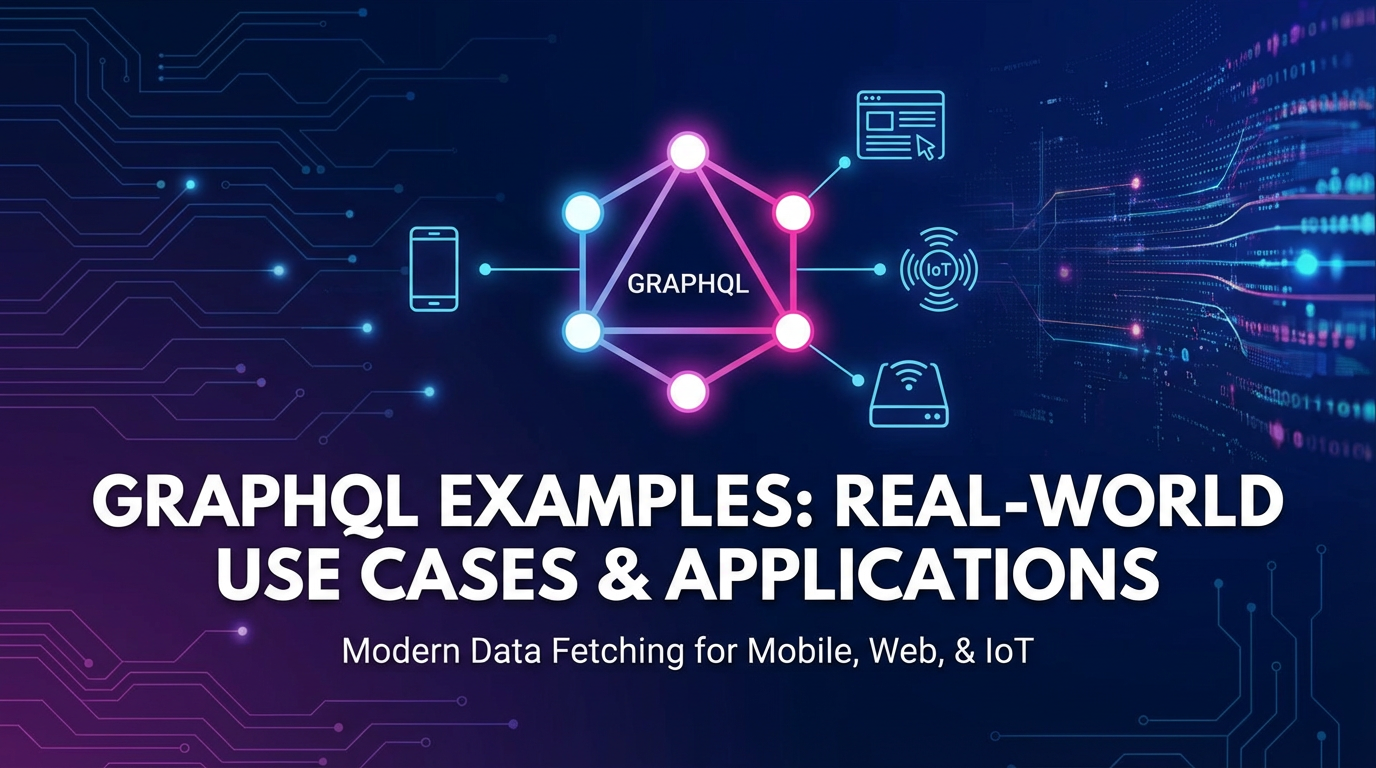
GraphQL Examples: Real-World Use Cases & Applications


In the rapidly evolving landscape of web and mobile application development, the way we fetch and manage data from servers is paramount to creating efficient, scalable, and user-friendly experiences. For decades, REST (Representational State Transfer) has been the dominant architectural style for building APIs (Application Programming Interfaces). However, with the increasing complexity of modern applications, particularly those serving diverse client devices and consuming data from multiple backend services, the limitations of traditional REST APIs have become more apparent. This is where GraphQL emerges as a powerful and increasingly popular alternative, offering a more flexible and efficient approach to data retrieval and manipulation.
GraphQL, developed by Facebook in 2012 and open-sourced in 2015, is not a database technology or a programming language, but rather a query language for your APIs and a runtime for fulfilling those queries with your existing data. It provides a complete and understandable description of the data in your API, giving clients the power to ask for exactly what they need and nothing more. This fundamental shift from "endpoints" to "graphs" has profound implications for how developers build and interact with web services, leading to more nimble development cycles, reduced data transfer over networks, and an improved developer experience.
The core promise of GraphQL lies in its ability to solve common problems associated with REST, such as over-fetching (receiving more data than requested) and under-fetching (requiring multiple requests to gather all necessary data). By allowing clients to specify their data requirements precisely, GraphQL empowers frontend developers with greater autonomy, enabling them to evolve their application's data needs without waiting for backend changes. This article will delve deep into the principles of GraphQL, explore its distinct advantages, and crucially, illustrate its real-world impact through a comprehensive examination of various use cases and applications across different industries. We will uncover how organizations are leveraging GraphQL to build highly performant, flexible, and scalable systems, solidifying its position as a cornerstone of modern API development.
Unpacking the Core Principles and Advantages of GraphQL
To truly appreciate the real-world applications of GraphQL, it's essential to first grasp its foundational principles and the significant advantages it brings over traditional API paradigms. At its heart, GraphQL revolves around a schema that defines the structure of the data clients can query. This schema acts as a contract between the client and the server, ensuring data consistency and providing a self-documenting API.
The GraphQL Schema: A Central Contract
Every GraphQL service defines a schema, which is a collection of types. These types precisely describe the kind of data you can request from that service. For instance, you might define types like User, Product, or Order, each with its specific fields (e.g., User has id, name, email, and posts). The schema is written using the GraphQL Schema Definition Language (SDL), a clear and concise syntax. This strongly typed system is a cornerstone of GraphQL's power, allowing for robust validation, powerful introspection capabilities (clients can query the schema itself to understand available data), and tooling that enhances the developer experience, such as auto-completion and error checking. The schema isn't just a documentation artifact; it's an executable specification that dictates how the server responds to queries.
Data Fetching Efficiency: Requesting Exactly What You Need
One of GraphQL's most celebrated features is its unparalleled data fetching efficiency. In a RESTful API, clients typically request data from fixed endpoints, each returning a predefined data structure. This often leads to either over-fetching, where the client receives fields it doesn't need, or under-fetching, where the client has to make multiple API calls to gather all the necessary information for a single view.
Consider a scenario where a mobile application needs to display a user's name and avatar, along with the title of their most recent post. A traditional REST API might require one request to /users/{id} to get the user data, and another to /users/{id}/posts to get their posts, potentially fetching all post details when only the title is needed. With GraphQL, the client can send a single query like this:
query GetUserAndLatestPost {
  user(id: "123") {
    name
    avatarUrl
    latestPost {
      title
    }
  }
}
This single API call retrieves precisely the data required, dramatically reducing network requests and the amount of data transferred. For applications running on mobile devices or in regions with limited bandwidth, this efficiency translates directly into faster loading times, reduced battery consumption, and a smoother user experience. It fundamentally transforms the client-server interaction from a rigid contract to a flexible negotiation.
A Single Endpoint: Streamlined Client-Side Development
Unlike REST, where different resources are typically exposed through multiple HTTP endpoints (e.g., /users, /products, /orders), a GraphQL API usually exposes a single endpoint, typically POST /graphql. All queries, mutations (data modifications), and subscriptions (real-time data streams) are sent to this one endpoint. This architectural simplification has significant benefits for client-side developers. They no longer need to manage a multitude of URLs, HTTP verbs, and data parsing logic for various responses. Instead, they interact with a unified API gateway that understands the entire data graph. This consistency reduces boilerplate code, streamlines API integration, and makes it easier to onboard new developers to a project, as the interaction pattern with the backend is standardized across the application.
Strong Typing: Enhanced Developer Experience and Robustness
The strong type system enforced by the GraphQL schema offers substantial benefits throughout the development lifecycle. Every field and argument in a GraphQL API has a defined type, ensuring that clients receive predictable data and that servers only process valid requests. This inherent type safety helps catch errors early in development, often before any code is even executed. Tools like GraphiQL or Apollo Studio leverage this introspection capability to provide interactive documentation, query auto-completion, and real-time validation, making API exploration and consumption incredibly intuitive. For backend developers, the strong typing provides a clear contract and helps in building robust resolvers that know exactly what kind of data they are expected to return or process.
Versionless APIs: Evolving Without Breaking Changes
One of the persistent challenges with traditional REST APIs is versioning. As an API evolves, new fields are added, existing fields might change their type, or entire resources might be refactored. Managing these changes often leads to versioning strategies (e.g., api.example.com/v1, api.example.com/v2), which add complexity for both API providers and consumers. With GraphQL, the schema can evolve incrementally without necessarily introducing breaking changes for existing clients. Clients only specify the fields they need. If a new field is added, old clients continue to work unchanged. If a field is deprecated, it can be marked as such in the schema, allowing clients to gradually migrate to newer fields without immediate breakage. This flexibility significantly reduces the maintenance overhead and allows for continuous API evolution, fostering agility in product development.
Real-time Capabilities with Subscriptions
Beyond queries (fetching data) and mutations (modifying data), GraphQL also supports subscriptions, which enable real-time, bidirectional communication between the client and the server. Subscriptions allow clients to subscribe to specific events, and the server will push data to the client whenever that event occurs. This is particularly powerful for applications requiring live updates, such as chat applications, live dashboards, real-time notifications, or collaborative editing tools. Based on WebSocket protocols, GraphQL subscriptions provide a structured way to handle real-time data streams, integrating seamlessly into the same unified API design, unlike REST which typically relies on separate WebSocket implementations or server-sent events for real-time features.
Aggregating Data from Multiple Sources: Unifying Diverse Backends
In modern enterprise architectures, data often resides in disparate systems – legacy databases, microservices, third-party APIs, and even various cloud services. Building a unified frontend experience on top of such fragmented data sources can be a daunting task with traditional REST. GraphQL excels in this scenario by acting as an API gateway or a façade layer that aggregates data from multiple underlying services. A single GraphQL server can define a schema that spans across these diverse sources, and its resolvers can fetch data from different backends, stitch them together, and present a coherent, unified graph to the client. This capability is incredibly valuable for complex applications that need to present a holistic view of data sourced from heterogeneous systems, greatly simplifying client-side data orchestration.
By combining these principles, GraphQL offers a compelling vision for modern API development – one that prioritizes efficiency, flexibility, and an enhanced developer experience, laying the groundwork for more innovative and responsive applications.
Real-World Use Cases & Applications: GraphQL in Action
The theoretical advantages of GraphQL translate into tangible benefits across a wide spectrum of real-world applications. From consumer-facing mobile apps to complex enterprise systems, GraphQL is proving to be a versatile and powerful tool. Let's explore some detailed examples of how organizations are leveraging GraphQL to solve critical challenges and build superior digital products.
1. E-commerce Platforms: Dynamic and Personalized Shopping Experiences
E-commerce platforms are inherently data-intensive, dealing with vast quantities of product information, customer profiles, order histories, recommendations, and inventory levels. The dynamic nature of online shopping, coupled with the need for highly personalized experiences across various devices, makes GraphQL an ideal fit.
Imagine a user browsing an online store. On a product page, they might need to see the product's name, description, images, price, available sizes/colors, customer reviews, related products, and current stock status. With a traditional REST API, this could involve multiple requests: one for product details, another for reviews, a third for related items, and potentially more for inventory data from a separate microservice. This chattiness can lead to slow loading times and a degraded user experience, especially on mobile networks.
GraphQL simplifies this significantly. A single query can fetch all the necessary information for a product page in one round trip. For example:
query GetProductDetails($productId: ID!) {
  product(id: $productId) {
    name
    description
    price {
      amount
      currency
    }
    images {
      url
      altText
    }
    availableSizes
    reviews {
      author { name }
      rating
      comment
    }
    relatedProducts(limit: 3) {
      id
      name
      thumbnailUrl
      price { amount }
    }
    inventory {
      inStock
      quantity
    }
  }
}
This query retrieves a deep, interconnected graph of data, precisely tailored to the frontend's needs. Furthermore, GraphQL's flexibility allows for highly personalized recommendations. If a user is logged in, the API can return tailored suggestions based on their browsing history or past purchases, directly integrated into the same query that fetches other product details. When a user adds an item to their cart, a GraphQL mutation can update the cart and associated inventory in a single API call, ensuring atomicity and efficiency.
For mobile e-commerce applications, the efficiency gains are even more pronounced. Reducing payload size and the number of network requests directly translates to faster page loads, lower data consumption, and improved battery life, which are crucial factors for user retention. GraphQL's ability to fetch data from diverse backend systems—such as a product catalog service, a review service, an inventory management system, and a recommendation engine—and present it as a unified API to the client also simplifies the overall architecture, particularly in a microservices environment. The GraphQL server effectively acts as an API gateway, abstracting the complexity of the underlying services from the client.
2. Social Media Networks: Rich Feeds and Real-time Interactions
Social media platforms are perhaps one of the most natural fits for GraphQL due to their inherently graph-like data structures and the demand for real-time interactions. Users, posts, comments, likes, friends, followers – all form a deeply interconnected graph.
Consider a user's news feed. It displays posts from their friends, pages they follow, and potentially trending topics. Each post might include text, images, videos, the author's profile picture, the number of likes, comments, and shares. Fetching this complex, personalized feed efficiently with REST would typically involve numerous sequential or parallel API calls, resulting in a waterfall of requests and potential performance bottlenecks.
With GraphQL, a single query can fetch all the necessary information for a user's feed, including nested data like comments and their authors, or specific details of liked posts.
query GetUserFeed($userId: ID!, $limit: Int = 10) {
  user(id: $userId) {
    feed(limit: $limit) {
      id
      content
      timestamp
      author {
        id
        name
        profilePictureUrl
      }
      media {
        type
        url
      }
      likes {
        count
        viewerHasLiked
      }
      comments(limit: 2) {
        id
        text
        author { name }
      }
      shares {
        count
      }
    }
  }
}
This single query efficiently aggregates data from various potential microservices (e.g., user profiles, content storage, interaction counters) into a coherent feed. More critically, social media thrives on real-time updates. When someone posts a new comment, likes a photo, or sends a message, users expect to see these updates instantly. GraphQL subscriptions are perfectly suited for this. A client can subscribe to receive notifications for new comments on a specific post, new messages in a chat, or real-time updates to a friend's status. This eliminates the need for constant polling, reducing server load and network traffic while providing an immediate, responsive user experience. Platforms like Facebook itself, where GraphQL originated, and others like Twitter or Instagram heavily rely on such API capabilities to deliver their dynamic and interactive experiences. The API becomes a living, breathing interface that mirrors the real-time nature of social interactions.
3. Content Management Systems (CMS) & Blogging Platforms: Decoupled and Flexible Content Delivery
Modern content management systems are increasingly moving towards a "headless" architecture, where the content backend (the CMS) is decoupled from the frontend presentation layer. This allows content to be delivered to various clients—websites, mobile apps, smart displays, voice assistants—through a flexible API. GraphQL is a natural fit for this headless CMS paradigm, offering unparalleled flexibility in content delivery.
A traditional RESTful CMS might expose endpoints like /articles, /authors, /categories. If a homepage needs to display the titles and thumbnails of the latest five articles, a specific featured article with its full content, and a list of categories, a client might need to make three or more API requests. Different page layouts (e.g., article detail page vs. category page) would demand different sets of data, often leading to either over-fetching (getting full article content for a list view) or N+1 problems (multiple requests to fetch details for each item in a list).
With GraphQL, content consumers can precisely specify the content structure they need for any given context. A homepage query might look like this:
query GetHomepageContent {
  featuredArticle {
    title
    slug
    excerpt
    coverImage { url }
    author { name }
  }
  latestArticles(limit: 5) {
    id
    title
    slug
    publishedDate
    categories { name }
  }
  allCategories {
    name
    slug
    articleCount
  }
}
This single API call retrieves all the required content for the homepage in an optimized manner. Authors, tags, categories, images, and other content types can be deeply nested and selected as needed. This flexibility empowers frontend developers to build diverse user interfaces and integrate content into new platforms without requiring any changes to the backend API. The GraphQL API becomes a versatile content delivery gateway, serving exactly what each frontend application demands. This is especially beneficial for companies managing vast amounts of content across multiple brands or international markets, where consistent yet flexible content delivery is paramount. It allows for A/B testing of different content layouts and rapid iteration on user interfaces without API constraints.
4. Mobile Applications: Optimized Data for Diverse Devices
Mobile applications inherently face constraints related to network bandwidth, battery life, and processing power. They often need to fetch varying amounts of data depending on the screen size, device capabilities, and network conditions. GraphQL is a game-changer for mobile development because it directly addresses these challenges.
Consider a dashboard in a financial app. On a phone, it might display a summarized view of account balances and recent transactions. On a tablet, it might show more detailed portfolio performance and interactive charts. With REST, developers might create separate endpoints or complex query parameters to handle these variations, leading to API bloat and maintenance headaches.
With GraphQL, the mobile client simply crafts a query that requests only the data fields relevant to its current context. A phone might query user.accounts { id name balance }, while a tablet might query user.accounts { id name balance currency transactions(limit: 5) { date amount description } portfolio { totalValue changePercent } }. Both clients interact with the same GraphQL API, but receive precisely what they need. This fine-grained control over data fetching results in:
- Reduced Data Transfer: Smaller payloads mean faster loading times, especially on cellular networks, and less data consumed from the user's plan.
- Fewer Requests: Consolidating multiple data fetches into a single
APIcall reduces network round trips, improving responsiveness and reducing latency. - Faster Development Cycles: Frontend teams can iterate on UI changes without waiting for backend
APImodifications, as they control the query structure.
For an application that interacts with various backend services (e.g., user authentication, payment processing, data analytics), a GraphQL server can act as a crucial API gateway. This gateway abstracts the complexities of the microservices architecture from the mobile client, presenting a clean, unified API. For instance, a mobile app might need to call a user service for profile information, a transaction service for recent activity, and a bank service for account balances. A GraphQL API can seamlessly orchestrate these calls behind a single endpoint, simplifying the mobile client's interaction and ensuring optimal performance. Solutions like ApiPark further exemplify how a robust API gateway can manage, integrate, and deploy such diverse API services, ensuring high performance and simplified API invocation for client applications, including mobile apps. By providing a unified API format and quick integration capabilities, it addresses many of the challenges faced when building powerful mobile experiences on top of complex backend infrastructures.
5. Data Dashboards & Analytics Tools: Customizable and Real-time Insights
Data dashboards and analytics platforms are designed to provide users with a comprehensive, often real-time, view of key metrics and insights. These applications typically aggregate data from a multitude of sources—databases, external APIs, streaming data platforms—and allow users to customize their views, filter data, and drill down into details. GraphQL's ability to precisely query data and its real-time subscription capabilities make it an excellent choice for these scenarios.
Imagine an enterprise analytics dashboard that displays sales figures, customer engagement metrics, website traffic, and server health. Different departments or roles might need to see different slices of this data. A sales manager might focus on revenue trends and customer acquisition, while a marketing manager might need website traffic and campaign performance. With REST, each widget or data point might require a specific API endpoint, leading to an explosion of endpoints or complex, inefficient generic ones.
GraphQL enables clients to construct highly specific queries for each dashboard component. For a sales dashboard, a query could fetch:
query GetSalesDashboardData($startDate: DateTime!, $endDate: DateTime!) {
  totalRevenue(period: { start: $startDate, end: $endDate }) {
    amount
    currency
  }
  topPerformingProducts(limit: 5) {
    name
    unitsSold
    revenue
  }
  customerAcquisitionRate(period: { start: $startDate, end: $endDate }) {
    newCustomers
    growthPercentage
  }
  salesByRegion {
    region
    revenue
  }
}
This single query fetches multiple, potentially complex data points, each tailored to the dashboard's needs. Furthermore, for real-time analytics, GraphQL subscriptions can push updates to the dashboard as new data becomes available (e.g., new sales transactions, updated website visitor counts), providing an always up-to-date view without constant client-side polling. This makes the dashboard highly responsive and dynamic.
GraphQL's schema also provides a clear, discoverable API for all available metrics and dimensions, empowering users (or developers building dashboard components) to explore and combine data points intuitively. It acts as a powerful gateway for diverse data sources, simplifying the development of sophisticated analytics applications and allowing for ad-hoc querying of complex data models.
6. Microservices Architectures: A Unified API Gateway
In a microservices architecture, an application is decomposed into a collection of small, independent services, each responsible for a specific business capability. While this approach offers benefits in terms of scalability, resilience, and independent deployment, it introduces challenges in how client applications interact with these services. Clients typically need data from multiple microservices to render a single view, leading to complex client-side orchestration or the need for an API gateway layer.
GraphQL excels as an API gateway or façade layer in a microservices environment. Instead of clients directly calling various microservices (which could be problematic for security, network overhead, and complexity), they interact with a single GraphQL server. This GraphQL server then becomes responsible for fetching data from the underlying microservices, stitching the responses together, and returning a unified data graph to the client.
Consider an e-commerce platform built with microservices: * A "Product Service" manages product details. * An "Inventory Service" tracks stock levels. * A "Review Service" handles customer reviews. * A "User Service" manages user profiles.
A client needing a product page with reviews and stock information would traditionally have to make multiple calls to these separate services. With GraphQL as the API gateway, the client sends a single query for product(id: "XYZ") { name price inventory { quantity } reviews { text author { name } } }. The GraphQL server's resolvers would then: 1. Call the Product Service to get basic product details. 2. Call the Inventory Service to get stock information for that product. 3. Call the Review Service to get reviews for that product. 4. For each review, call the User Service to get the author's name.
The GraphQL server orchestrates these calls, potentially parallelizing them and caching results, before assembling the final response for the client. This approach offers several advantages:
- Simplified Client-Side Development: Clients interact with a single, consistent
API, abstracting away the underlying microservice boundaries. - Reduced Network Latency: Consolidates multiple internal calls into a single external
APIcall, reducing round trips from the client. - Backend Flexibility: Backend microservices can evolve independently without impacting client
APIs, as long as the GraphQL schema remains consistent. - Centralized API Management: The GraphQL
gatewaycan enforce authentication, authorization, and rate limiting across all underlying services.
For organizations managing a growing number of microservices, integrating a dedicated API gateway solution with GraphQL can be exceptionally powerful. An advanced API gateway product, such as ApiPark, can further streamline this by offering features like unified API formats for AI invocation, end-to-end API lifecycle management, team-based API sharing, and robust performance rivaling high-performance proxies. Such platforms ensure that the API layer, whether it's a GraphQL gateway or a traditional REST API, is managed securely, efficiently, and with detailed logging, providing insights into API performance and usage. This combination of GraphQL's data fetching power and a comprehensive API gateway's management capabilities creates a formidable solution for complex, distributed systems.
7. Internet of Things (IoT) & Edge Computing: Efficient Data Exchange
The Internet of Things (IoT) involves a vast network of interconnected devices that collect and exchange data. These devices often operate in environments with limited bandwidth, intermittent connectivity, and varying processing capabilities. Edge computing, which processes data closer to the source rather than sending it to a centralized cloud, further complicates data management. GraphQL can provide an efficient and flexible API layer for these demanding environments.
Imagine a smart home system with numerous sensors (temperature, motion, light), smart appliances, and actuators. A central hub or a mobile app might need to retrieve specific sensor readings, control device states, or subscribe to real-time alerts. With thousands or millions of devices, sending excessive or unnecessary data over the network can quickly become a bottleneck.
GraphQL's ability to request only the necessary data is incredibly valuable in IoT. Instead of a device or a controlling application polling a generic endpoint that returns all sensor data, it can craft a precise query:
query GetTemperatureSensorData($sensorId: ID!) {
  sensor(id: $sensorId) {
    id
    lastReading {
      value
      timestamp
    }
    batteryLevel
  }
}
This ensures minimal data transfer, conserving bandwidth and reducing power consumption for battery-powered devices. GraphQL subscriptions are also highly relevant for IoT. Devices can publish data to the GraphQL gateway, and client applications (or other devices) can subscribe to specific device events or sensor readings. For example, a smart thermostat could subscribe to a temperature sensor's data stream, or a security system could subscribe to motion sensor alerts, receiving updates only when changes occur. This push-based model is far more efficient than constant polling for real-time applications.
Furthermore, in edge computing scenarios where data processing occurs closer to the source, a GraphQL API can sit on an edge gateway, providing a unified interface to local data and device controls. This allows edge applications to interact with devices and local data stores using a flexible schema, abstracting the underlying communication protocols and data formats of diverse IoT devices. The inherent flexibility and efficiency make GraphQL a compelling choice for managing the data complexity of next-generation IoT and edge computing ecosystems.
8. Fintech & Banking Applications: Secure and Granular Data Access
The financial services industry operates under stringent regulatory requirements and demands extremely high levels of security, data integrity, and real-time performance. Banking applications, trading platforms, and fintech services involve sensitive customer data, complex transaction histories, and dynamic market information. GraphQL's strong typing, granular access control potential, and query flexibility make it a powerful tool, provided robust security measures are in place.
Consider a banking API that allows customers to view their account balances, transaction history, and manage beneficiaries. Different customer segments might have different levels of access, and compliance rules dictate what data can be exposed under various circumstances. A traditional REST API might struggle to enforce such fine-grained permissions without creating an unmanageable number of endpoints or complex server-side logic to filter data post-fetch.
With GraphQL, the schema can accurately represent the complex relationships between accounts, transactions, users, and financial instruments. Queries can be precisely constructed to fetch only the relevant data. For example, a customer might query for:
query GetAccountOverview($accountId: ID!) {
  account(id: $accountId) {
    accountNumber
    balance {
      amount
      currency
    }
    transactions(limit: 5, orderBy: { field: DATE, direction: DESC }) {
      id
      type
      description
      amount {
        amount
        currency
      }
      date
    }
    associatedCards {
      last4Digits
      type
    }
  }
}
This single query fetches a comprehensive view for an account, but crucially, GraphQL allows for sophisticated server-side authorization. Resolvers can check the authenticated user's permissions at the field level. If a user is not authorized to view associatedCards, that field can simply be omitted from the response, or an authorization error can be returned for that specific field, without failing the entire query. This granular control is essential for security and compliance in finance.
Furthermore, real-time market data updates (e.g., stock prices, currency exchange rates) can be delivered efficiently using GraphQL subscriptions, providing a responsive experience for traders and investors. Given the sensitivity of financial data, the use of a secure API gateway like ApiPark is crucial for managing access permissions, enforcing robust authentication and authorization policies, and providing detailed audit logs of all API calls. This combination ensures that the flexibility of GraphQL does not compromise the security and regulatory compliance required in the fintech sector.
9. Collaboration Tools: Real-time Synchronisation and Complex Relationships
Collaboration tools, such as project management software, document editors, and team communication platforms, are characterized by highly interconnected data (tasks linked to projects, comments on tasks, users assigned to multiple roles) and a strong need for real-time synchronization among multiple users. GraphQL is exceptionally well-suited to handle these complexities.
Consider a project management application. A user's dashboard might display a list of projects, tasks assigned to them, recent activity feeds, and team members. Each task might have a title, description, due date, assignee, status, and comments. Multiple users could be viewing and interacting with the same task simultaneously.
A GraphQL query can fetch all the necessary data for a project dashboard in one go:
query GetProjectDashboard($userId: ID!, $projectId: ID!) {
  user(id: $userId) {
    assignedTasks(status: [OPEN, IN_PROGRESS], limit: 5) {
      id
      title
      dueDate
      project { name }
    }
  }
  project(id: $projectId) {
    name
    description
    status
    teamMembers {
      id
      name
      role
    }
    recentActivity(limit: 10) {
      id
      type
      description
      timestamp
      user { name }
    }
  }
}
The true power for collaboration tools comes with GraphQL subscriptions. When a user updates a task description, adds a comment, or changes a task's status, a mutation can update the backend, and a corresponding subscription can instantly push these changes to all other users currently viewing that task or project. This real-time synchronization is critical for maintaining a consistent state across all clients and providing a fluid, collaborative experience. This eliminates the frustration of outdated information and the need for manual refreshes.
The graph-like nature of project data (projects contain tasks, tasks have assignees and comments, comments are made by users) maps perfectly to a GraphQL schema, making it intuitive to model and query. The API effectively becomes a single, real-time source of truth for all collaborative data, greatly simplifying the frontend development required for complex synchronized user interfaces.
Implementing GraphQL: Key Considerations for Success
While the benefits of GraphQL are compelling, successful implementation requires careful planning and adherence to best practices. Several factors need consideration to ensure your GraphQL API is performant, secure, and maintainable.
Schema Design Best Practices
The GraphQL schema is the foundation of your API; a well-designed schema is crucial for its long-term success. * Granularity and Relationships: Design your types and fields to reflect the domain model accurately. Ensure fields are appropriately nested to represent relationships (e.g., a User type having a posts field that returns a list of Post types). Avoid overly broad types or excessively deep nesting that might encourage inefficient queries. * Naming Conventions: Adhere to consistent naming conventions (e.g., camelCase for fields and arguments, PascalCase for types). Clear, descriptive names improve discoverability and readability. * Extensibility: Plan for future growth. Use interfaces and unions where appropriate to allow for polymorphic data. Avoid coupling your schema too tightly to your specific database or microservice structure; the GraphQL schema should be client-centric. * Deprecation: When a field or argument becomes obsolete, mark it as @deprecated in the schema with a reason instead of immediately removing it. This allows clients to gradually migrate, preventing sudden breaking changes. * Idempotency for Mutations: Design mutations to be idempotent where possible. Repeatedly calling an idempotent mutation should produce the same result without unintended side effects.
Performance Optimization
Even with GraphQL's inherent efficiency, performance bottlenecks can arise, especially with complex queries or inefficient resolvers. * The N+1 Problem: This is a common issue where a query might fetch a list of items, and then for each item, it makes an additional API call or database query to fetch related data. For example, fetching 10 posts and then making 10 separate queries to fetch the author for each post. * Batching and Dataloaders: To mitigate the N+1 problem, implement batching. Dataloaders (a popular library in JavaScript) collect all requests for a specific type of data that occur within a single tick of the event loop and then dispatch them in a single batch query to the backend. This drastically reduces the number of database or API calls. * Caching: Implement caching strategies at various layers: * HTTP Caching (for queries): While GraphQL queries are typically POST requests, API gateways or CDNs can still cache them based on their payload hash. * Server-Side Caching: Cache results of expensive computations or database queries in your GraphQL server's resolvers. * Client-Side Caching: Libraries like Apollo Client provide intelligent client-side caching that normalizes data and stores it locally, reducing the need for repeated network requests for the same data. * Persistent Queries: For public APIs or highly optimized clients, persistent queries allow clients to reference queries by an ID rather than sending the full query string. This reduces network payload and enables server-side caching of query plans. * Query Complexity Analysis and Depth Limiting: Malicious or poorly designed clients could send very deep or complex queries that consume excessive server resources. Implement query complexity analysis and depth limiting to prevent such denial-of-service attacks.
Security in GraphQL
Securing your GraphQL API is paramount, especially when handling sensitive data. Many security concerns are similar to REST, but some aspects require specific GraphQL considerations. * Authentication: Integrate with existing authentication mechanisms (e.g., JWTs, OAuth). The GraphQL server should verify the client's identity before processing any query or mutation. * Authorization: Implement robust authorization logic within your resolvers. This means checking if the authenticated user has permission to access each specific field they are requesting or to perform a particular mutation. Field-level authorization is a powerful feature of GraphQL. * Rate Limiting: Protect your API from abuse by implementing rate limiting. This can be based on the number of queries, mutations, or even the calculated complexity of queries per user or IP address over a given time period. An API gateway can effectively enforce these policies upstream from your GraphQL server. * Input Validation: Thoroughly validate all arguments and inputs for mutations to prevent common vulnerabilities like SQL injection or cross-site scripting (XSS). * Error Handling: Provide clear, informative error messages to clients without leaking sensitive backend details. Customize error formats to be consistent and helpful. * Logging and Monitoring: Implement comprehensive logging of all API calls, including query details, execution times, and errors. This is vital for security auditing, troubleshooting, and performance monitoring. Solutions like ApiPark offer detailed API call logging and powerful data analysis, providing invaluable insights into API usage patterns, potential security threats, and performance bottlenecks, making it an essential component for any production-grade API infrastructure. It helps businesses quickly trace and troubleshoot issues, ensuring system stability and data security.
Tooling and Ecosystem
The GraphQL ecosystem is rich and rapidly maturing, offering numerous tools and libraries to aid development. * Client Libraries: Libraries like Apollo Client (for JavaScript/TypeScript, popular with React, Vue, Angular) and Relay (by Facebook) provide powerful client-side caching, data management, and UI integration for GraphQL. Similar clients exist for virtually every major programming language and platform. * Server Implementations: Various server implementations are available for different languages (e.g., Apollo Server for Node.js, Strawberry for Python, Hot Chocolate for .NET, GraphQL-Java for Java). * Developer Tools: GraphiQL and Apollo Studio provide interactive API explorers for writing and testing queries directly against your schema. GraphQL extensions for IDEs offer syntax highlighting, auto-completion, and schema validation. * Code Generation: Tools can generate client-side API service files and TypeScript types from your GraphQL schema, enhancing type safety and developer productivity.
Migration from REST to GraphQL
For existing applications, a complete, immediate switch from REST to GraphQL might not be feasible or necessary. A gradual migration strategy is often more practical: * Hybrid Approach: Start by introducing a GraphQL gateway alongside your existing REST API. New features or critical pages can leverage GraphQL, while older parts of the application continue to use REST. * Incremental Adoption: Identify specific problem areas (e.g., a complex dashboard requiring multiple REST calls) where GraphQL can offer immediate benefits and implement it there first. * Backend for Frontend (BFF): Use GraphQL as a BFF layer, tailored to specific client needs, sitting in front of your microservices or legacy REST APIs. This allows the client to consume a unified GraphQL API while the backend still uses REST internally.
By carefully considering these aspects, organizations can harness the full potential of GraphQL to build efficient, flexible, and robust APIs that meet the demands of modern applications.
APIPark is a high-performance AI gateway that allows you to securely access the most comprehensive LLM APIs globally on the APIPark platform, including OpenAI, Anthropic, Mistral, Llama2, Google Gemini, and more.Try APIPark now! 👇👇👇
GraphQL vs. REST: When to Choose Which
While GraphQL has emerged as a powerful alternative, it's not a universal replacement for REST. Both architectural styles have their strengths and weaknesses, and the choice between them often depends on the specific project requirements, team expertise, and application context. Understanding when to favor one over the other is crucial for making informed architectural decisions.
Here's a comparison outlining key criteria:
| Feature/Aspect | REST (Representational State Transfer) | GraphQL (Graph Query Language) |
|---|---|---|
| Data Fetching | Multiple Endpoints: Each resource type has a dedicated endpoint (/users, /products). |
Single Endpoint: All requests go to a single /graphql endpoint. |
| Fixed Data Structure: Endpoints return predefined data. Prone to over-fetching or under-fetching. | Client-Driven Data: Clients specify exactly what data they need, eliminating over/under-fetching. | |
| Network Requests | Often requires multiple round trips to fetch related data (N+1 problem). | Typically, a single request fetches all necessary data, reducing network overhead. |
| Caching | Strong HTTP Caching: Leverages standard HTTP caching mechanisms (GET requests are cacheable). | Complex Caching: Standard HTTP caching is less effective due to POST requests. Requires client-side or server-side application-level caching. |
| Complexity | Simpler for basic CRUD: Straightforward for simple resource-based operations. | Steeper Learning Curve (Initially): Requires understanding schema, types, resolvers. |
Complex for nested/related data: Can lead to API sprawl or inefficient fetching. |
Simplifies complex queries: Excellent for highly interconnected data and deep relationships. | |
| Versioning | Explicit Versioning: Common strategies like /v1/users, /v2/users. Can be complex to manage. |
Schema Evolution: Backward compatible by default through deprecation. Less need for explicit versioning. |
| Real-time | Not built-in. Requires separate solutions like WebSockets, Server-Sent Events (SSE). | Built-in Subscriptions: Supports real-time data push over WebSockets. |
| Tooling & Ecosystem | Mature and widespread tooling (curl, Postman, many SDKs). | Rapidly evolving and robust tooling (Apollo, GraphiQL, Relay). |
| Error Handling | Standard HTTP status codes (200, 404, 500) and response bodies. | All errors typically return 200 OK with errors array in the response body. Requires client-side parsing. |
| Security | Role-based access control, basic authentication, JWTs, OAuth. Endpoint-level authorization. | Similar authentication. Field-level authorization possible through resolvers. Query complexity limiting crucial. |
| Typical Use Cases | Simple APIs, resources that map well to URLs, public APIs where HTTP caching is critical. |
Complex applications, microservices API gateways, mobile apps, real-time dashboards, frontend-heavy applications. |
When to Choose REST: * Simple, Resource-Oriented APIs: If your API deals with simple resources that map cleanly to URLs and you don't anticipate highly complex data fetching needs (e.g., a simple blog API with /posts and /comments). * Public APIs with Strict Caching Requirements: For public APIs where standard HTTP caching (via GET requests) is a significant performance optimization, REST can be more straightforward. * Existing Infrastructure and Expertise: If your team and existing systems are heavily invested in REST and its principles, and the current approach is not presenting significant bottlenecks, sticking with REST might be more pragmatic. * Small Projects with Limited Data Complexity: The overhead of setting up a GraphQL schema and resolvers might outweigh the benefits for very simple applications.
When to Choose GraphQL: * Complex, Interconnected Data: When your application involves a rich graph of data where clients need to fetch deeply nested or related information from multiple sources (e.g., social media, e-commerce, content management). * Multiple Client Platforms: When serving data to diverse clients (web, mobile, IoT) with varying data requirements. GraphQL allows each client to specify its exact needs, optimizing data transfer. * Microservices Architectures: To provide a unified API gateway or façade layer over a fragmented backend, simplifying client interaction and abstracting backend complexity. * Rapid UI Development & Iteration: When frontend teams need to iterate quickly on UI changes without constant backend API modifications. * Real-time Capabilities: When your application requires live updates, notifications, or chat functionality, GraphQL subscriptions offer a built-in solution. * Avoiding Over-fetching and Under-fetching: When network efficiency and reduced data payload are critical, especially for mobile or bandwidth-constrained environments.
In many modern architectures, particularly those built on microservices, a common pattern is to use a hybrid approach. RESTful APIs might be used for internal communication between microservices, while a GraphQL API gateway sits in front, providing a unified and flexible interface to client applications. This allows teams to leverage the strengths of both paradigms where they are most effective.
Challenges and Mitigation Strategies in GraphQL
While GraphQL offers numerous advantages, it also introduces specific challenges that developers need to be aware of and address through robust mitigation strategies.
1. Caching Complexity
Challenge: Unlike REST's GET requests which are easily cached by standard HTTP mechanisms (CDNs, browser caches) using URLs, GraphQL queries are typically sent as POST requests to a single endpoint, making traditional HTTP caching difficult. This can lead to decreased cache hit rates and increased load on the GraphQL server.
Mitigation: * Client-Side Caching Libraries: Utilize sophisticated client-side GraphQL libraries like Apollo Client or Relay, which normalize and cache data in a local store, reducing redundant network requests for the same data within the application. * Server-Side Caching: Implement caching at the resolver level for expensive database queries or external API calls. Tools like dataloader (for batching) also indirectly improve caching efficiency by reducing repeated requests. * Persistent Queries/Automated Persisted Queries (APQ): Instead of sending the full query string, clients send a hash of the query. The server maps this hash to a known query, enabling proxy/CDN caching based on the hash and reducing payload size. * Caching Proxy: Place a custom caching proxy (e.g., Varnish, Nginx with Lua scripting) in front of the GraphQL server that can inspect the POST body, hash the query, and cache responses based on this hash.
2. File Uploads
Challenge: GraphQL's specification does not natively support file uploads in a straightforward manner, as queries and mutations are typically JSON-based. Integrating file uploads can feel less intuitive than traditional REST approaches using multipart/form-data.
Mitigation: * multipart/form-data Specification: The GraphQL community has developed a standard for file uploads over GraphQL using multipart/form-data. GraphQL servers and clients can implement this specification, allowing files to be sent as part of a mutation. * Separate REST Endpoint: For simplicity, some applications choose to use a dedicated, traditional REST endpoint solely for file uploads. The GraphQL mutation would then receive a URL or ID of the uploaded file, which was obtained from the REST endpoint. * Direct Cloud Storage Upload: Clients can upload files directly to cloud storage providers (e.g., AWS S3, Google Cloud Storage) and then use a GraphQL mutation to record the file's metadata and URL in the application's database.
3. Rate Limiting
Challenge: Because GraphQL allows clients to request any combination of data, traditional rate limiting based on endpoint access count (e.g., "100 requests per minute to /users") is insufficient. A single, complex GraphQL query could consume far more server resources than multiple simple queries, making it difficult to prevent abuse.
Mitigation: * Query Complexity Analysis: Analyze the incoming query to calculate a "cost" based on the number of fields, arguments, and depth. Reject queries that exceed a predefined complexity threshold. * Depth Limiting: Enforce a maximum query depth to prevent overly nested queries that could lead to performance issues or denial-of-service. * Time-Based Rate Limiting: Implement rate limiting based on IP address or authenticated user ID, limiting the number of queries or total complexity score per time unit. This can be effectively managed by an API gateway layer.
4. The N+1 Problem (Revisited)
Challenge: As discussed in performance, fetching a list of items and then individually resolving related data for each item can lead to an N+1 query problem, hitting the database or other services N+1 times.
Mitigation: * Dataloaders: The primary solution is to use batching and caching mechanisms like dataloader. Dataloaders collect all requests for a given type of data within a single request cycle and then execute a single, batched query to retrieve all the necessary data. * Database-Level Joins/Optimizations: Design your database schema and ORM queries to fetch related data using joins or other efficient methods in a single query where possible, before the data even reaches the GraphQL resolver.
5. Error Handling
Challenge: Unlike REST where HTTP status codes indicate different error types, GraphQL typically returns an HTTP 200 OK status even for queries that contain errors. Error details are included in an errors array within the JSON response body. This can sometimes make it less intuitive for clients to determine if a request was fully successful or partially failed.
Mitigation: * Standardized Error Format: Define a clear and consistent error format for your GraphQL API responses, including error codes, messages, and possibly additional context. * Custom Error Types: For specific business logic errors, define custom error types in your GraphQL schema that resolvers can throw. This allows clients to handle specific error conditions more gracefully. * Global Error Handling: Implement global error handling in your GraphQL server to catch unhandled exceptions and format them consistently before sending them to the client. * Client-Side Error Management: Ensure client-side API integration includes robust logic to parse and handle errors from the errors array in the GraphQL response, distinguishing between partial data and complete failures.
By proactively addressing these challenges with appropriate strategies and tools, developers can build robust, high-performing, and secure GraphQL APIs that deliver on their promise of flexibility and efficiency.
The Future of GraphQL
GraphQL's journey from an internal Facebook project to a widely adopted API standard has been remarkable, and its future appears even brighter. Several trends suggest its continued growth and evolution:
- Continued Adoption and Maturity: More companies, from startups to large enterprises, are embracing GraphQL for new projects and integrating it into existing microservices architectures. This widespread adoption is leading to the further maturation of libraries, tools, and best practices across various programming languages and platforms. The community continues to grow, driving innovation and standardization.
- Serverless GraphQL: The combination of GraphQL and serverless computing (e.g., AWS Lambda, Google Cloud Functions) is gaining traction. Serverless functions can act as individual GraphQL resolvers, allowing developers to build highly scalable and cost-effective GraphQL backends. This "function-as-a-service" approach naturally aligns with GraphQL's modular nature, where each field can be resolved by a distinct piece of logic.
- GraphQL Federation and Schema Stitching: For large enterprises with many independent teams or microservices, managing a single monolithic GraphQL schema can become complex. GraphQL Federation (e.g., Apollo Federation) and schema stitching are becoming increasingly important. These approaches allow multiple independent GraphQL services (each owning a part of the overall schema) to be composed into a single, unified
APIgatewayfor clients. This enables independent development and deployment of services while presenting a cohesiveAPIto consumers, aligning perfectly with distributed system principles. - Increased Focus on Security and Performance: As GraphQL becomes more prevalent in production environments, there will be an intensified focus on advanced security features (e.g., fine-grained authorization, persistent queries for enhanced security and caching) and performance optimizations (e.g., better N+1 solutions, faster resolvers, more efficient
API gatewayimplementations). - Integration with Emerging Technologies: GraphQL is likely to see deeper integration with other emerging technologies, such as WebAssembly (Wasm) for high-performance resolvers, new database technologies, and AI/ML platforms. Its flexible data fetching capabilities make it a strong candidate for interacting with complex data models generated or consumed by AI services. This is an area where platforms like ApiPark, with its focus on AI gateway capabilities and unified
APIformats for AI invocation, are paving the way, showing how GraphQL can be a key component in managing and deploying sophisticated AI and REST services.
The GraphQL ecosystem is vibrant and innovative, continuously addressing challenges and expanding its capabilities. Its client-driven nature and ability to unify diverse data sources position it strongly for the future of API development, where flexibility, efficiency, and real-time capabilities are paramount.
Conclusion
GraphQL has undeniably reshaped the landscape of API development, offering a powerful and flexible alternative to traditional RESTful architectures. Born out of Facebook's need to address the challenges of building complex applications across multiple platforms, it has evolved into a robust API query language and runtime that empowers clients to request precisely the data they need, nothing more and nothing less. This fundamental shift from fixed endpoints to a client-driven data contract brings a host of benefits, including unparalleled data fetching efficiency, reduced network overhead, streamlined client-side development, strong typing for enhanced robustness, and seamless real-time capabilities through subscriptions.
As we've explored through various real-world examples, GraphQL's versatility shines across diverse industries and application types. From optimizing dynamic e-commerce platforms and enabling real-time interactions in social media networks to providing flexible content delivery for headless CMS, enhancing mobile application performance, and acting as a crucial API gateway in complex microservices architectures, GraphQL is proving its mettle. Its ability to unify disparate data sources, deliver granular control for sensitive fintech data, and facilitate real-time synchronization in collaboration tools underscores its broad applicability and transformative potential. Even in emerging domains like IoT and edge computing, its efficiency in data exchange offers significant advantages.
However, adopting GraphQL is not without its considerations. Challenges related to caching, file uploads, rate limiting, and the N+1 problem require thoughtful mitigation strategies, often involving sophisticated client-side libraries, server-side optimizations like Dataloaders, and robust API gateway solutions that provide capabilities such as query complexity analysis, access control, and comprehensive logging. Platforms like ApiPark exemplify how a dedicated API gateway can complement GraphQL, enhancing its security, performance, and overall manageability within an enterprise context, especially when dealing with a multitude of API services, including those integrating AI models.
Ultimately, the choice between GraphQL and REST is not about one being definitively "better" than the other, but rather about selecting the most appropriate tool for the job. For applications characterized by complex data graphs, diverse client needs, rapid frontend iteration, and a strong demand for efficiency and real-time capabilities, GraphQL presents a compelling and often superior solution. Its continued evolution and growing ecosystem suggest that GraphQL will remain a cornerstone of modern API development, empowering developers to build more efficient, flexible, and innovative applications for years to come.
5 Frequently Asked Questions (FAQs) about GraphQL
1. What is the main problem GraphQL solves compared to REST? GraphQL primarily solves the problems of over-fetching and under-fetching data that are common with traditional REST APIs. Over-fetching occurs when a client receives more data than it needs, leading to wasted bandwidth. Under-fetching happens when a client needs to make multiple requests to different REST endpoints to gather all the necessary data for a single view, resulting in increased network latency. GraphQL allows clients to specify exactly what data they need in a single request, optimizing data transfer and reducing round trips.
2. Is GraphQL a replacement for all REST APIs? No, GraphQL is not a universal replacement for all REST APIs. While it offers significant advantages for complex, data-intensive applications, REST remains a robust and suitable choice for simpler APIs, resources that map well to standard HTTP methods and URLs, or public APIs where traditional HTTP caching is a critical performance factor. Many modern architectures adopt a hybrid approach, using GraphQL as an API gateway for client-facing applications while internal microservices might still communicate via REST.
3. How does GraphQL handle real-time data updates? GraphQL handles real-time data updates through a feature called "Subscriptions." Subscriptions allow clients to subscribe to specific events defined in the GraphQL schema. When such an event occurs on the server (e.g., a new comment is posted, a stock price changes), the server proactively pushes the relevant data to all subscribed clients, typically over a WebSocket connection. This provides a more efficient and responsive real-time experience compared to constant polling with REST.
4. What are the key security considerations when implementing GraphQL? Security in GraphQL is critical. Key considerations include implementing robust authentication (verifying client identity) and granular authorization (checking permissions at the field level within resolvers). It's also crucial to protect against malicious queries by implementing rate limiting, query complexity analysis, and depth limiting to prevent resource exhaustion and denial-of-service attacks. Thorough input validation for mutations and clear, non-revealing error handling are also essential to maintain API security.
5. Can GraphQL integrate with existing microservices or legacy systems? Yes, GraphQL is excellent for integrating with existing microservices or legacy systems. A GraphQL server can act as an API gateway or a façade layer, unifying disparate backend services (which might be RESTful APIs, databases, or other protocols) under a single, coherent GraphQL schema. The GraphQL server's resolvers are responsible for fetching data from these various internal sources, stitching them together, and presenting a unified data graph to the client, abstracting the complexity of the underlying architecture.
🚀You can securely and efficiently call the OpenAI API on APIPark in just two steps:
Step 1: Deploy the APIPark AI gateway in 5 minutes.
APIPark is developed based on Golang, offering strong product performance and low development and maintenance costs. You can deploy APIPark with a single command line.
curl -sSO https://download.apipark.com/install/quick-start.sh; bash quick-start.sh

In my experience, you can see the successful deployment interface within 5 to 10 minutes. Then, you can log in to APIPark using your account.

Step 2: Call the OpenAI API.