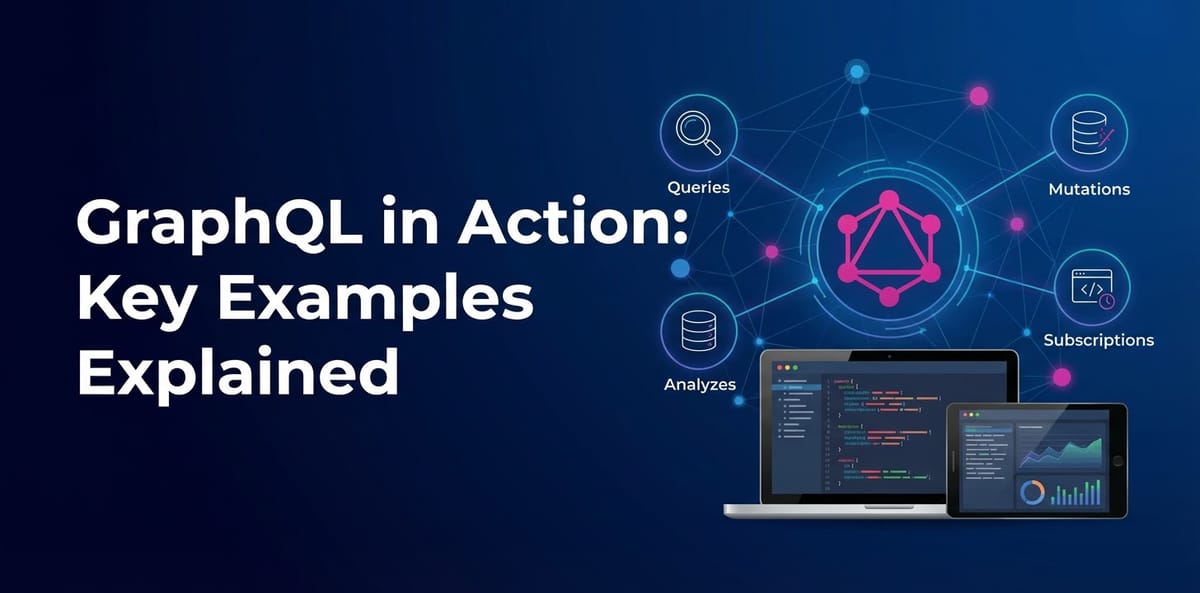
GraphQL in Action: Key Examples Explained


The landscape of data interaction and application development has undergone a profound transformation over the past decade. As digital services proliferate and user expectations for seamless, instantaneous experiences escalate, the methods by which applications consume and manage data have become critically important. For years, REST (Representational State Transfer) reigned supreme as the de facto standard for building web APIs, offering a straightforward, resource-oriented approach that served countless applications well. However, with the rise of complex, data-rich applications, especially those leveraging multiple microservices, mobile platforms, and real-time experiences, the inherent limitations of REST began to surface. Developers found themselves grappling with issues like over-fetching (receiving more data than needed), under-fetching (requiring multiple requests to gather all necessary data), and the rigid versioning challenges that often accompany a fixed resource structure. These inefficiencies not only impacted application performance and development velocity but also introduced unnecessary network overhead and complexity on the client side.
Enter GraphQL, a powerful open-source query language for your API and a server-side runtime for executing queries by using a type system you define for your data. Conceived and open-sourced by Facebook in 2015, GraphQL was designed from the ground up to address many of the pain points inherent in traditional API designs. Its core philosophy revolves around empowering clients to precisely define the data they need, and nothing more, from a single endpoint. Instead of being constrained by the server's predefined resource structures, a GraphQL client sends a query specifying the exact fields and relationships it requires. The server then responds with only that requested data, dramatically reducing payload size and network round trips. This paradigm shift offers unparalleled flexibility, enabling rapid iteration on the frontend without necessitating backend API changes, fostering a more agile and efficient development workflow.
The implications of this client-driven data fetching are vast. For developers, it means less boilerplate code, clearer data contracts, and a more intuitive way to think about data. For end-users, it translates into faster, more responsive applications that consume less data. GraphQL isn't just a query language; it's a holistic approach to API development that encompasses schemas, types, queries, mutations, and subscriptions, providing a robust framework for building modern, scalable applications. While the theoretical advantages of GraphQL are compelling, its true power lies in its practical application. This comprehensive exploration will delve deep into GraphQL in action, dissecting key real-world examples that illustrate how this technology addresses complex architectural challenges and revolutionizes data interaction across diverse application domains. We will uncover how GraphQL unifies disparate data sources in e-commerce, powers real-time social media experiences, and optimizes data delivery for resource-constrained mobile applications, demonstrating its versatility and transformative potential.
The Foundational Principles of GraphQL
Before diving into specific examples, a solid understanding of GraphQL's foundational principles is essential. GraphQL operates on a distinctly different paradigm from traditional RESTful APIs, driven by a client-centric approach and a strong type system. These core concepts form the backbone of any GraphQL service and dictate how clients interact with the server.
Schema Definition Language (SDL): The Contract of Your API
At the heart of every GraphQL service is its schema, defined using the GraphQL Schema Definition Language (SDL). The schema acts as a contract between the client and the server, meticulously outlining all the data types available, the relationships between them, and the operations (queries, mutations, subscriptions) that clients can perform. This strict type system is one of GraphQL's most significant advantages, providing introspection capabilities that allow clients to discover what data is available and how to request it. It ensures data consistency and provides a robust foundation for both client and server development, as both parties can rely on a clearly defined data structure.
Within the SDL, several key components define the structure of your data:
- Object Types: These are the most fundamental building blocks of a GraphQL schema. An object type represents a specific kind of object clients can query for, and it contains a set of named fields. For instance, in an e-commerce application, you might have
ProductorUserobject types, each with its own specific fields likename,price,email, oraddress. Each field, in turn, has a type, which can be another object type, a scalar type, or a list of types. - Scalar Types: These represent primitive pieces of data that resolve to a single concrete value. GraphQL comes with a set of built-in scalar types:
Int(a signed 32-bit integer),Float(a signed double-precision floating-point value),String(a UTF-8 character sequence),Boolean(true or false), andID(a unique identifier, often serialized as a String). Developers can also define custom scalar types for more specific data formats, such asDateorURL. - Enum Types: Enumeration types are a special kind of scalar that restricts a field to a specific set of allowed values. For example, a
OrderStatusenum might only allow values likePENDING,SHIPPED, orDELIVERED. Enums improve data validation and make the schema more self-documenting. - Input Types: These are special object types used as arguments for mutations. Unlike regular object types, all fields in an input type must be input types themselves or scalar types. They allow clients to send structured data to the server for creation or update operations, providing a clear and organized way to manage complex input payloads.
- Fields and Arguments: Fields are the individual pieces of data an object type exposes. Each field can optionally accept arguments, allowing clients to parameterize their queries. For example, a
productfield might accept anidargument to retrieve a specific product, or aproductsfield might acceptlimitandoffsetarguments for pagination. This flexibility is crucial for allowing clients to tailor their data requests precisely.
The root of every GraphQL schema defines three special types: Query, Mutation, and Subscription. These types correspond to the three fundamental operations clients can perform.
Queries: Fetching Data with Precision
Queries are the cornerstone of GraphQL for data retrieval. Unlike REST, where a client might make multiple HTTP GET requests to different endpoints (e.g., /users/123, /users/123/posts, /users/123/comments), a GraphQL client sends a single, structured query to a single endpoint. This query specifies not only the top-level resources but also their nested relationships and the exact fields required. The server then traverses this query structure, gathers the requested data from various underlying sources, and returns a JSON response that mirrors the shape of the query.
Key features of GraphQL queries include:
- Specificity: Clients declare precisely what fields they need, eliminating over-fetching. If you only need a user's name and email, you query for just those fields, even if the user object has dozens of other attributes.
- Nested Queries: GraphQL naturally supports querying nested relationships. You can fetch a user and their posts, and for each post, its comments, all in a single request. This capability greatly simplifies client-side data orchestration compared to stitching together responses from multiple REST endpoints.
- Aliases: If a client needs to fetch the same field multiple times with different arguments, aliases allow them to rename the result field in the response, preventing conflicts. For example, fetching
primaryUser: user(id: "1")andsecondaryUser: user(id: "2")in the same query. - Fragments: Fragments are reusable units of fields that can be included in multiple queries. They help reduce repetition, make queries more organized, and enable better code sharing on the client side, particularly useful when querying common sets of fields for different objects.
- Variables: To make queries dynamic and prevent injection vulnerabilities, GraphQL allows clients to define variables that are passed separately from the query string. These variables are strongly typed, ensuring data integrity.
- Directives: Directives (like
@includeand@skip) allow clients to conditionally include or exclude fields or fragments from a query, adding even more dynamism to data fetching based on client-side logic.
Mutations: Modifying Data with Intent
While queries are for reading data, mutations are for writing data. Any operation that changes data on the server — creating, updating, or deleting resources — is performed via a mutation. Like queries, mutations are defined in the schema and typically return the modified object (or parts of it), allowing the client to update its local cache immediately without making another round trip. This "read-after-write" pattern simplifies client-side state management significantly.
A typical mutation workflow involves:
- Defining an input type for the data to be sent (e.g.,
CreateUserInput). - Defining the mutation field in the
Mutationroot type, accepting the input type as an argument. - Defining the return type of the mutation, which might include the newly created or updated object, along with any relevant status messages or error information.
This structured approach ensures that data modifications are explicit, type-safe, and predictable.
Subscriptions: Real-time Data Streams
Subscriptions provide a mechanism for real-time data updates, enabling clients to receive instant notifications when specific data on the server changes. Built typically on top of WebSockets, subscriptions allow for a persistent, duplex communication channel between the client and the server. When a client subscribes to a particular event, the server pushes data to the client whenever that event occurs, eliminating the need for constant polling.
Subscriptions are particularly powerful for applications requiring live updates, such as chat applications, social media feeds, live sports scores, or collaborative editing tools. The GraphQL server, often integrated with a pub/sub (publish/subscribe) mechanism or an event bus, listens for changes in underlying data sources and, upon detection, publishes the relevant data to all active subscribers. This asynchronous, event-driven model enhances user experience by providing immediate feedback and ensuring data freshness.
Resolvers: Bridging the Gap to Your Data
While the schema defines what data is available and how it can be queried, resolvers are the functions on the server side that actually fetch that data. Every field in the GraphQL schema, from the top-level query fields to nested object fields, has a corresponding resolver function. When a client sends a query, the GraphQL execution engine traverses the query, calling the appropriate resolver for each field.
Resolvers are responsible for connecting the GraphQL server to various backend data sources. These sources can be anything: a traditional SQL database (e.g., PostgreSQL, MySQL), a NoSQL database (e.g., MongoDB, Cassandra), an existing RESTful api, an internal microservice, or even a third-party api. The beauty of GraphQL is its ability to abstract away the complexity of these diverse data sources, presenting a unified api to the client. A single GraphQL query might trigger calls to multiple databases and services, with the GraphQL server intelligently orchestrating these calls and stitching the results together into the client-requested shape. This aggregation capability is a cornerstone of GraphQL's power in modern, distributed architectures, allowing it to act as a powerful data gateway to an organization's entire data ecosystem.
Key Example 1: E-commerce Platform – Unifying Disparate Data Sources
One of the most compelling use cases for GraphQL is in consolidating data from multiple, often disparate, backend services and databases. Modern e-commerce platforms, with their intricate ecosystems of product catalogs, user accounts, order management, payment gateways, and shipping services, present an ideal scenario for GraphQL to shine.
The Problem: A Fragmented RESTful Ecosystem
Consider a typical large-scale e-commerce website. Information for a single "product detail page" might originate from several different backend systems:
- Product Information: Stored in a core product database (e.g., SQL database). This includes name, description, price, images, specifications.
- User Reviews and Ratings: Managed by a dedicated microservice or a separate NoSQL database.
- Inventory/Stock Levels: Potentially a real-time service that tracks product availability across warehouses.
- Shipping Information: An external logistics
apior a dedicated shipping microservice providing estimated delivery times and costs. - Related Products/Recommendations: Generated by a recommendation engine microservice.
- Seller Information: If it's a marketplace, seller details might come from another service.
In a traditional RESTful architecture, fetching all this data for a single product page would typically involve a cascade of HTTP requests from the client (or a backend aggregation service):
GET /api/products/{id}to get basic product details.GET /api/products/{id}/reviewsto get reviews.GET /api/inventory/{productId}to check stock.POST /api/shipping/estimatewith product and user location to get shipping info.GET /api/recommendations/{productId}to get related items.
This multi-request pattern leads to several problems:
- Multiple Network Round Trips: Each request incurs network latency, slowing down page load times, especially on mobile networks.
- Over-fetching and Under-fetching: Each REST endpoint often returns a fixed data payload. The
/api/products/{id}endpoint might return 50 fields, even if the client only needs 5. Conversely, a client might need a specific piece of data (e.g., a reviewer's username) that is not included in the/api/products/{id}/reviewsresponse, forcing an additionalGET /api/users/{userId}request for each review – the notorious N+1 problem. - Client-Side Aggregation Logic: The client (web browser, mobile app) becomes responsible for orchestrating these multiple requests, handling potential failures, and stitching together the fragmented responses, increasing client-side complexity.
- Backend API Versioning Challenges: Changes to specific data requirements on the frontend often necessitate modifications to existing REST endpoints or the creation of new ones, leading to versioning headaches (e.g.,
/api/v1/products,/api/v2/products).
The GraphQL Solution: A Unified Endpoint for All Product Data
GraphQL offers an elegant solution by providing a single, flexible endpoint that acts as a data gateway to all these disparate services. The GraphQL server is responsible for understanding the underlying data sources and fulfilling the client's precise data requests.
Here’s how a GraphQL solution might be structured for an e-commerce product page:
- Unified Schema Design: The GraphQL schema would define a comprehensive
Producttype, along with related types likeUser,Review,ShippingEstimate, andRecommendation. This schema acts as a single, consistent view of all product-related data available across the entire system.```graphql type Query { product(id: ID!): Product products(limit: Int, offset: Int): [Product!]! }type Product { id: ID! name: String! description: String price: Float! currency: String! images: [String!]! stock: Int! reviews(limit: Int, offset: Int): [Review!]! averageRating: Float shippingEstimate(destinationZip: String!): ShippingEstimate relatedProducts(limit: Int): [Product!]! seller: Seller }type Review { id: ID! rating: Int! text: String author: User! createdAt: String! }type User { id: ID! username: String! email: String # ... other user details }type ShippingEstimate { provider: String! estimatedDeliveryDate: String! cost: Float! }type Seller { id: ID! name: String! # ... seller details } ``` - A Single Query for the Product Page: The client (e.g., a web browser rendering the product detail page) can now send a single GraphQL query to fetch all the necessary data:
graphql query ProductDetailPage($productId: ID!, $userZipCode: String!) { product(id: $productId) { id name description price currency images stock averageRating reviews(limit: 5) { # Fetch top 5 reviews id rating text author { username # Only need the username of the reviewer } createdAt } shippingEstimate(destinationZip: $userZipCode) { provider estimatedDeliveryDate cost } relatedProducts(limit: 4) { # Fetch 4 related products id name price images } seller { name } } }This single query, sent to a single/graphqlapiendpoint, eliminates all the cascading HTTP requests seen in the REST example. The client receives a single JSON response that exactly matches the shape of the query, making it incredibly easy to consume and render the UI. - Intelligent Resolvers for Data Aggregation: The magic happens on the GraphQL server, within its resolver functions. Each field in the schema (e.g.,
Product.name,Product.reviews,Product.shippingEstimate) has a resolver that knows how to fetch its specific piece of data.- The
productresolver might initially query the core product database for the basicProductdetails using theproductId. - Once the
Productobject is resolved, its child fields' resolvers are called. - The
Product.reviewsresolver would make an internal call to the "Reviews Microservice" with theproductId. - The
Product.shippingEstimateresolver would call the "Shipping Microservice" or externalapi, passing the product details anddestinationZip. - The
Product.relatedProductsresolver would query the "Recommendation Engine." - Crucially, to solve the N+1 problem (e.g., fetching
authorfor eachReview), GraphQL best practices employ DataLoaders. A DataLoader is a generic utility that provides a consistentapiover various caching and batching strategies. When multipleReview.authorresolvers are called for different reviews within the same query, a DataLoader would batch these requests for user IDs into a single call to the "User Microservice" or database, retrieving all authors in one go and then mapping them back to their respective reviews. This dramatically improves performance for nested relationships.
- The
Benefits of GraphQL in this E-commerce Scenario:
- Reduced Network Overhead: A single network request for an entire page, significantly cutting down latency and data transfer.
- Elimination of Over-fetching and Under-fetching: Clients get precisely what they ask for, leading to smaller payloads and faster response times.
- Simplified Client-Side Development: The client no longer needs complex logic to orchestrate multiple
apicalls and merge their results. Data is delivered in a predictable, unified structure. - Improved Developer Experience: The strong type system and introspection capabilities mean developers can easily explore the available data and construct queries with confidence using tools like GraphiQL or GraphQL Playground.
- Frontend Agility: Frontend teams can iterate rapidly on UI changes without needing backend
apimodifications, as long as the data is available in the schema. Need a new field? Just add it to the client query. - Versionless API: GraphQL inherently avoids the rigid versioning issues of REST. As the schema evolves, new fields can be added, and old ones deprecated, without breaking existing clients.
The unification power of GraphQL, especially when sitting as an api gateway layer aggregating data from various microservices, databases, and external apis, makes it an ideal choice for complex applications like e-commerce where data consistency, performance, and development agility are paramount.
Key Example 2: Social Media Feed – Real-time Updates and Personalized Experiences
Social media applications thrive on immediacy and personalization. Users expect to see the latest posts, comments, and notifications as they happen, along with feeds curated to their interests. Delivering this real-time, dynamic experience efficiently poses significant challenges for traditional API architectures.
The Problem: Polling and Inefficient Updates in Traditional Systems
In a RESTful social media application, achieving real-time updates typically relies on one of two less-than-ideal approaches:
- Polling: The client periodically sends
GETrequests to the server (e.g.,GET /api/feed/latestevery few seconds) to check for new content.- Inefficiency: Most polls will return no new data, wasting network resources and server processing power.
- Latency: There's an inherent delay between when an event occurs and when the client polls and discovers it, leading to a less "live" experience.
- Scalability Issues: High polling frequency from millions of users can overwhelm the backend.
- Long Polling: The server holds a request open until new data is available or a timeout occurs, then sends a response and the client immediately re-requests. Better than traditional polling but still resource-intensive and complex to manage at scale.
For personalized feeds, the REST api might offer an endpoint like GET /api/users/{userId}/feed. However, if the client needs to filter posts based on categories, user relationships, or specific keywords, either the server needs to expose numerous filter-specific endpoints (leading to an api sprawl) or the client has to fetch a broad dataset and filter locally, which is inefficient.
The GraphQL Solution: Subscriptions for Live Data and Flexible Querying
GraphQL's Subscription operations, combined with its flexible Query capabilities, provide a powerful framework for building responsive and personalized social media experiences.
- Schema Design for Social Interactions: The schema would define types for
Post,User,Comment,Notification, etc., along with specific fields and relationships.```graphql type Query { feed(limit: Int, offset: Int, categories: [String!]): [Post!]! user(id: ID!): User notifications(read: Boolean): [Notification!]! # ... other queries }type Mutation { createPost(input: CreatePostInput!): Post! addComment(input: AddCommentInput!): Comment! # ... other mutations }type Subscription { newPost(userId: ID!): Post # Notify when a user they follow posts commentAdded(postId: ID!): Comment # Notify when a comment is added to a specific post newNotification(userId: ID!): Notification # Notify a user of new notifications }type Post { id: ID! content: String! author: User! createdAt: String! likes: Int! comments(limit: Int): [Comment!]! isLikedByViewer: Boolean }type Comment { id: ID! text: String! author: User! createdAt: String! }type User { id: ID! username: String! avatarUrl: String followers: [User!]! following: [User!]! }type Notification { id: ID! type: NotificationType! message: String! isRead: Boolean! targetPost: Post # Optional, if notification is about a post }enum NotificationType { LIKE COMMENT FOLLOW MENTION }input CreatePostInput { content: String! category: String }input AddCommentInput { postId: ID! text: String! } ``` - Initial Feed Fetching with Personalized Queries: When a user logs in, the application first fetches their initial personalized feed using a GraphQL query. The flexibility of GraphQL allows clients to specify filters directly in the query.
graphql query UserFeed($limit: Int!, $offset: Int!, $categories: [String!]) { feed(limit: $limit, offset: $offset, categories: $categories) { id content createdAt author { id username avatarUrl } likes isLikedByViewer comments(limit: 2) { # Fetch recent 2 comments id text author { username } } } notifications(read: false) { id message type targetPost { id } # If notification is post-related } }This single query fetches the initial personalized feed and any unread notifications, tailoring the content and depth of information exactly as required by the client, without over-fetching.- Persist the new post to the database.
- Publish an event (e.g.,
newPostEvent) to the pub/sub system. - The
newPostsubscription resolver, listening to this event, would then push the new post data to all subscribed clients whoseuserIdmatches the author's followers. - Similarly,
addCommentmutation would trigger acommentAddedEvent, pushing the new comment to clients subscribed to that specific post.
Real-time Updates with Subscriptions: For live updates, the client establishes GraphQL subscriptions. When a new post is made by someone the user follows, or a new comment is added to a post they are viewing, the client receives an instant push.```graphql
Client subscribes to new posts from users they follow
subscription NewPostsForMyFeed($userId: ID!) { newPost(userId: $userId) { id content createdAt author { id username avatarUrl } likes isLikedByViewer comments(limit: 0) { id } # Don't fetch comments initially } }
Client subscribes to new comments on a specific post
subscription LiveComments($postId: ID!) { commentAdded(postId: $postId) { id text author { username } createdAt } }
Client subscribes to new notifications
subscription LiveNotifications($userId: ID!) { newNotification(userId: $userId) { id message type isRead targetPost { id } } } ```On the server side, the GraphQL resolvers for subscriptions integrate with a publish/subscribe (pub/sub) mechanism (e.g., Redis Pub/Sub, Apache Kafka, or a dedicated in-memory pub/sub). When a user creates a Post via a createPost mutation, the server-side logic would:
Implementation Details for Subscriptions:
- WebSocket Protocol: GraphQL subscriptions typically leverage WebSockets for persistent, bi-directional communication, ensuring low latency.
- Pub/Sub Mechanism: The GraphQL server backend integrates with a reliable pub/sub system to manage event distribution.
- Context: Subscription resolvers, like query/mutation resolvers, have access to
contextwhich can contain authentication information (userId, roles) to ensure only authorized users receive specific updates (e.g., only a user's own notifications).
Benefits of GraphQL for Social Media:
- True Real-time Experience: Subscriptions provide instant updates, eliminating polling and offering a highly engaging user experience.
- Efficient Data Transfer: Clients specify exactly what they need for both initial loads and real-time updates, minimizing payload sizes.
- Simplified Client-Side Logic: No more complex polling logic or manual data merging. The client receives well-structured updates directly.
- Scalability: A well-architected GraphQL subscription system, backed by efficient pub/sub, can handle millions of concurrent connections, distributing events effectively without overwhelming the
apigatewayor backend services. - Personalization: Queries and subscriptions can be highly parameterized, allowing for deeply personalized user experiences (e.g., filtering a feed by specific categories or only showing posts from followed users).
By combining flexible queries for initial data fetching and robust subscriptions for live updates, GraphQL empowers developers to build dynamic, responsive, and highly personalized social media applications that meet the demands of modern users.
APIPark is a high-performance AI gateway that allows you to securely access the most comprehensive LLM APIs globally on the APIPark platform, including OpenAI, Anthropic, Mistral, Llama2, Google Gemini, and more.Try APIPark now! 👇👇👇
Key Example 3: Mobile Application Backend – Optimized for Device Constraints
Mobile applications operate in an environment fraught with constraints: limited battery life, varying network conditions (from fast Wi-Fi to slow cellular data), and diverse screen sizes. Efficient data transfer is paramount for delivering a fluid user experience and conserving device resources. Traditional REST APIs often fall short in this regard, leading to bloated data payloads and inefficient data consumption.
The Problem: Bloated Payloads and Versioning Headaches with REST
Consider a mobile dashboard application that displays a user's profile, recent activity, and a list of notifications.
- Over-fetching: A REST endpoint like
GET /api/users/{id}might return a user object with dozens of fields (full address, various settings, large profile picture URLs, internal IDs) when the mobile app only needs the user's name, avatar, and a few key settings. Fetching unnecessary data wastes bandwidth and battery. - Multiple Requests: To display the dashboard, the app might need
GET /api/users/{id},GET /api/users/{id}/activities, andGET /api/users/{id}/notifications. Each request adds latency. - Backend Proliferation for Different Clients: Often, backend teams end up creating specialized REST endpoints for mobile (e.g.,
/api/v1/mobile/users/{id}), or even different endpoints for different mobile screen sizes, to optimize payloads. This leads toapisprawl and maintenance nightmares. - Versioning Complexity: If a new field is needed for a specific mobile UI update, it might necessitate a new
apiversion, forcing all clients to update or maintaining multiple parallelapis.
These issues directly impact user experience: slow loading times, increased data consumption, and rapid battery drain, making the application feel sluggish and resource-hungry.
The GraphQL Solution: Client-Driven Data Fetching for Precision
GraphQL provides a perfect fit for mobile backends because it empowers the client to request only the data it needs, in the exact shape it desires, from a single endpoint. This capability drastically reduces payload sizes and optimizes network utilization.
- A Single, Flexible Schema: The GraphQL schema defines all available data, irrespective of the client type.```graphql type Query { me: User # Current authenticated user user(id: ID!): User }type User { id: ID! username: String! email: String firstName: String lastName: String avatarUrl: String bio: String location: String settings: UserSettings recentActivities(limit: Int): [Activity!]! notifications(unreadOnly: Boolean, limit: Int): [Notification!]! friends(limit: Int): [User!]! }type UserSettings { theme: String notificationsEnabled: Boolean privacyLevel: String }type Activity { id: ID! type: ActivityType! description: String! timestamp: String! targetItem: String # e.g., "Post ID" or "Comment ID" }type Notification { id: ID! message: String! read: Boolean! createdAt: String! }enum ActivityType { POSTED COMMENTED LIKED FOLLOWED } ```
- Tailored Queries for Specific Mobile Screens: The mobile app can construct highly specific queries for each screen, fetching only the fields essential for that particular view.Example 1: Mobile Profile Header (small, quick load)
graphql query MobileProfileHeader { me { username avatarUrl } }This query fetches just theusernameandavatarUrlfor the current user, resulting in a minimal data payload.Example 2: Mobile Dashboard (summary view)graphql query MobileDashboard { me { username avatarUrl recentActivities(limit: 5) { # Get only 5 recent activities id type description timestamp } notifications(unreadOnly: true, limit: 3) { # Get 3 unread notifications id message createdAt } } }Here, the client fetches the user's basic info, a small number of recent activities, and a limited count of unread notifications, all in one go and with exact field specificity.Example 3: Tablet/Desktop Dashboard (more detailed view)graphql query LargerScreenDashboard { me { username email firstName lastName avatarUrl bio location settings { theme notificationsEnabled } recentActivities(limit: 10) { # More activities for a larger screen id type description timestamp targetItem } notifications(unreadOnly: true, limit: 5) { # More notifications id message read createdAt } friends(limit: 5) { # Show some friends id username avatarUrl } } }For a larger screen, the client can request more details (email, full name, bio, more activities, more notifications, friends) within the same schema, simply by expanding the query. No need for a separateapiendpoint or version. - Efficient Resolvers: The GraphQL server's resolvers abstract away the underlying data sources, ensuring that even if user settings are in one database and activities in another, the client receives a unified response. DataLoaders (as discussed in the e-commerce example) are crucial here to prevent N+1 issues when fetching nested data like
friends.
A Comparison Table: REST vs. GraphQL for Mobile Development
To further illustrate the benefits, let's look at a comparative table summarizing key aspects for mobile development:
| Feature/Aspect | Traditional REST API | GraphQL API |
|---|---|---|
| Data Fetching | Fixed resource endpoints; often over-fetches data. | Client-driven queries; fetches exactly what's needed. |
| Network Requests | Multiple requests for related resources (N+1 problem). | Single request for complex, nested data. |
| Payload Size | Potentially large, containing unused fields. | Minimal, containing only requested fields. |
| Mobile Performance | Higher latency, increased data usage, battery drain. | Lower latency, reduced data usage, better battery efficiency. |
| API Evolution | Versioning often required for changes, leading to api sprawl (/v1, /v2). |
Additive evolution; new fields added without breaking old clients. Deprecation handles removal. |
| Client Code | More complex for data aggregation and parsing. | Simpler, as data arrives in the exact shape required. |
| Backend Complexity | May need separate endpoints for different clients/views. | Single endpoint, resolvers abstract backend complexity. |
| Tooling | Documentation tools (Swagger/OpenAPI). | Rich introspection, interactive playgrounds (GraphiQL), client libraries with caching. |
Benefits of GraphQL for Mobile Applications:
- Reduced Bandwidth and Faster Loads: By fetching only necessary data, payload sizes are significantly smaller, leading to faster loading times and reduced data consumption, which is critical for users on metered cellular plans.
- Improved Battery Life: Less network activity directly translates to less power consumption.
- Simplified Client Development: Mobile developers can construct highly optimized queries for each UI component, reducing the need for client-side data filtering or complex aggregation logic.
- API Agility and Flexibility: The same GraphQL schema can serve a smartwatch, a mobile phone, a tablet, and a desktop application, each requesting its specific data subset. This eliminates the need for maintaining multiple, client-specific REST APIs.
- Reduced Backend Burden: The backend is freed from creating and maintaining numerous specialized endpoints. The GraphQL layer handles the complexity of data orchestration.
- Offline First Potential: Smaller payloads and predictable data structures can make client-side caching strategies more effective, aiding in building offline-first experiences.
In essence, GraphQL empowers mobile applications to be lean, efficient, and responsive, perfectly aligning with the unique challenges and user expectations of the mobile ecosystem. It acts as an intelligent gateway for mobile clients, providing a highly optimized data delivery mechanism.
Advanced Considerations and Best Practices
While GraphQL offers significant advantages, implementing it effectively at scale requires careful consideration of several advanced topics and adherence to best practices. These areas often involve integration with other tools and architectural patterns, including the crucial role of an api gateway.
Performance Optimization
Even with GraphQL's inherent efficiency, poorly implemented resolvers or complex queries can lead to performance bottlenecks.
- N+1 Problem and DataLoader: As highlighted, fetching child objects for each parent individually (e.g., getting the author for every comment in a list) results in N+1 database or service calls. The DataLoader pattern is indispensable here. It batches requests for similar resources that occur within a single tick of the event loop, ensuring only one underlying data fetch for all similar IDs. This dramatically reduces calls to databases or microservices.
- Caching:
- Client-Side Caching: GraphQL client libraries like Apollo Client and Relay come with sophisticated normalized caches that automatically store and update data, significantly improving subsequent query performance and reducing network requests.
- Server-Side Caching: Traditional HTTP caching mechanisms (like CDN or reverse proxy caching) are less effective for GraphQL's single endpoint and dynamic queries. However, specific resolver results can be cached (e.g., using Redis) or an
api gatewaycan implement response caching for common queries. - Persisted Queries: For static queries, clients can send a hash of the query instead of the full query string. The server then looks up the full query from a pre-registered list. This reduces payload size for known queries and can improve caching efficiency.
- Query Complexity Analysis and Throttling: Malicious or overly complex queries (e.g., deeply nested requests for large datasets) can overwhelm the server. Implementations should include mechanisms to analyze query depth and complexity (e.g.,
maxDepthrules) and reject queries that exceed predefined thresholds. This also ties into rate limiting.
Security
Securing a GraphQL api involves many of the same principles as securing any web api, but with some GraphQL-specific considerations.
- Authentication and Authorization: GraphQL integrates seamlessly with existing authentication systems (e.g., JWT, OAuth). The authentication token is typically passed in the HTTP header to the GraphQL endpoint. Resolvers then use the authenticated user's context (ID, roles) to make authorization decisions – determining if a user has permission to access a specific field or perform a mutation. Fine-grained authorization logic is implemented within each resolver.
- Rate Limiting: Protect against abuse and ensure fair usage by limiting the number of requests a client can make within a certain timeframe. This can be implemented at the
api gatewaylevel, at the GraphQL server level, or even at the resolver level for specific operations. - Input Validation: All input arguments to queries and mutations must be rigorously validated to prevent injection attacks and ensure data integrity. GraphQL's strong type system provides a first layer of validation, but custom validation logic is often required.
- Query Depth Limiting and Cost Analysis: As mentioned for performance, these are also crucial security measures to prevent denial-of-service attacks by excessively complex or deep queries.
- Error Handling: Provide standardized, informative error messages without exposing sensitive backend details. GraphQL's error format allows for structured error responses that can include
codeandpathinformation, aiding debugging.
Integration with API Gateway
An api gateway plays a vital role in securing, managing, and scaling a GraphQL service, especially within an enterprise microservices architecture. It acts as the single entry point for all client requests, sitting in front of one or more GraphQL servers (or hybrid GraphQL/REST services).
- Centralized Authentication and Authorization: The
api gatewaycan handle initial authentication (e.g., validating JWT tokens) before forwarding the request to the GraphQL server. This offloads a common concern from the GraphQL service itself. More complex authorization logic, however, would still reside in the GraphQL resolvers. - Rate Limiting and Throttling: An
api gatewayis an ideal place to implement global rate limiting policies based on client IP, API key, or user ID. It can also be configured to throttle requests based on query complexity if integrated with a GraphQL-awaregatewaysolution. - Logging and Monitoring: All traffic passing through the
api gatewaycan be comprehensively logged and monitored, providing valuable insights intoapiusage, performance, and potential security threats. - Traffic Management: The
api gatewaycan handle load balancing, routing requests to multiple instances of the GraphQL server for scalability, and even perform A/B testing or canary deployments. - Cross-Cutting Concerns: Policy enforcement,
apiversioning (at thegatewaylevel, if needed for broader architectural reasons), caching (for responses that can be cached), and SSL termination are common functions performed by anapi gateway. - Hybrid API Support: In architectures combining GraphQL and RESTful APIs, the
api gatewaycan unify these disparate endpoints under a singlegatewayaddress, presenting a cohesiveapiinterface to clients.
This strategic placement of an api gateway provides a robust and centralized control point for managing the entire API ecosystem, including GraphQL endpoints. For organizations looking to streamline the management of their diverse APIs, including GraphQL endpoints, robust solutions are essential. An advanced api gateway like APIPark can serve as a central control point, offering features such as unified api format, prompt encapsulation, and end-to-end api lifecycle management, ensuring security, performance, and discoverability for all services. For instance, managing a GraphQL api alongside other RESTful services requires a powerful gateway that can offer consistent security, monitoring, and traffic management. This is where platforms like APIPark become invaluable. APIPark, an open-source AI gateway and api management platform, provides comprehensive tools for managing, integrating, and deploying various APIs, including the capabilities to secure, log, and analyze traffic to your GraphQL endpoints, ensuring enterprise-grade stability and insights.
Error Handling
Consistent and informative error handling is critical for both client development and operational monitoring. GraphQL specifies a standard error format that includes message, locations, and path fields, and allows for custom extensions.
- Graceful Error Reporting: Resolvers should catch errors from backend services and translate them into a GraphQL-compliant error format.
- Avoid Leaking Sensitive Information: Error messages should be user-friendly and avoid exposing internal stack traces, database details, or other sensitive information.
- Structured Errors: Use custom error codes or
extensionsin the error response to allow clients to handle specific types of errors programmatically.
Tooling
The GraphQL ecosystem is rich with tooling that enhances developer experience and productivity:
- Apollo Client/Server and Relay: Comprehensive client-side frameworks for building applications with GraphQL, offering features like normalized caching, state management, and declarative data fetching. Server-side libraries like Apollo Server provide powerful implementations for building GraphQL services.
- GraphiQL/GraphQL Playground: Interactive in-browser IDEs for exploring GraphQL schemas, writing and testing queries/mutations, and viewing documentation. These tools leverage GraphQL's introspection capabilities and are invaluable for development and testing.
- Schema Stitching and Federation: For large-scale applications with multiple microservices, schema stitching and Apollo Federation allow combining multiple GraphQL schemas into a single, unified
gatewayschema. This enables independent development of services while presenting a coherentapito clients, facilitating collaboration and scalability. - Code Generation: Tools can generate client-side types and
apimethods directly from the GraphQL schema, improving type safety and reducing manual coding errors.
By embracing these advanced considerations and leveraging the robust tooling available, organizations can unlock the full potential of GraphQL, building highly performant, secure, and maintainable apis that scale with their evolving needs.
GraphQL in the Enterprise: Management and Scalability
In an enterprise context, where applications are often composed of numerous microservices and diverse data sources, GraphQL offers a compelling strategy for consolidating and rationalizing the api layer. The challenge in such environments is not just about building individual services but about managing their interactions, ensuring consistency, and providing a unified developer experience.
GraphQL naturally fits into a microservices architecture by acting as an aggregation layer. Instead of clients directly calling multiple microservices (which can lead to client-side complexity and api sprawl), they interact with a single GraphQL api. This GraphQL layer then orchestrates calls to the underlying microservices, databases, and external apis, effectively acting as an intelligent facade. Each microservice might expose its own internal REST or gRPC api, and the GraphQL server's resolvers are responsible for knowing which microservice to call to fulfill a specific field request. This creates a powerful gateway that simplifies client interactions while allowing backend teams to develop and deploy services independently.
For very large enterprises, where dozens or even hundreds of teams might be building different parts of the overall data graph, Schema Stitching and especially Apollo Federation become critical architectural patterns. These approaches allow multiple independent GraphQL services (each owning a specific part of the overall data graph) to be combined into a single, coherent "supergraph." A central gateway service (often referred to as a "federation gateway") then takes client queries, understands which subgraphs are responsible for which parts of the query, and intelligently routes and aggregates results from those subgraphs. This model decentralizes api development while maintaining a unified api experience for consumers. It addresses scalability by distributing the graph and empowers teams to build and deploy their services autonomously, significantly improving development velocity in large organizations.
The role of an api gateway in such an architecture is multifaceted. Beyond simply routing traffic, an advanced api gateway can enforce enterprise-wide policies, manage api keys, provide granular access control, perform advanced traffic shaping, and offer comprehensive analytics across all api calls. Whether you are running a single monolithic GraphQL server or a federated supergraph, the api gateway serves as the critical front-door, ensuring that all api interactions are secure, performant, and observable.
For organizations navigating the complexities of modern api management, particularly those dealing with a hybrid landscape of GraphQL and RESTful services, solutions that streamline operations are invaluable. This is precisely where platforms like APIPark offer significant value. APIPark, as an open-source AI gateway and api management platform, is specifically designed to help developers and enterprises manage, integrate, and deploy AI and REST services with ease. Its capabilities extend to managing GraphQL endpoints by providing features such as end-to-end api lifecycle management, unified api formats, and robust security policies like api resource access approval. An enterprise might leverage APIPark to centralize the gateway functions for their GraphQL APIs, handling authentication, rate limiting, and detailed logging before requests reach the GraphQL server or federation gateway. By offering powerful data analysis on historical call data, APIPark helps businesses with preventive maintenance and ensuring system stability, providing insights into the performance of their GraphQL apis alongside all other services. This comprehensive api governance solution can significantly enhance efficiency, security, and data optimization for developers, operations personnel, and business managers alike in a complex enterprise environment.
Conclusion
GraphQL has emerged not merely as an alternative to traditional RESTful APIs, but as a paradigm-shifting approach to data interaction that directly addresses the evolving demands of modern application development. As we have explored through the key examples of e-commerce platforms, social media feeds, and mobile applications, GraphQL's client-driven data fetching model offers unparalleled flexibility, efficiency, and developer experience. By empowering clients to precisely define their data requirements from a single, strongly typed schema, GraphQL mitigates the pervasive issues of over-fetching, under-fetching, and api sprawl that often plague traditional architectures.
In action, GraphQL proves its worth by unifying disparate data sources into a cohesive data graph, dramatically simplifying data consumption for complex applications like e-commerce. Its robust support for subscriptions unlocks truly real-time experiences, transforming dynamic applications like social media into responsive, live platforms. Furthermore, for resource-constrained environments such as mobile applications, GraphQL's ability to minimize data payloads and optimize network requests translates directly into faster, more efficient, and battery-friendly user experiences.
Beyond these core benefits, GraphQL's ecosystem of tooling, best practices for performance and security, and its natural fit within microservices architectures — often augmented by advanced api gateway solutions like APIPark for centralized management and security — solidify its position as a mature and highly capable technology for building scalable, maintainable, and future-proof APIs. Adopting GraphQL is not just about choosing a new api technology; it's about embracing a more agile, client-centric philosophy that streamlines development, enhances performance, and ultimately delivers superior user experiences across the entire digital landscape. As applications continue to grow in complexity and data intensity, GraphQL stands ready as a powerful enabler for the next generation of digital innovation.
Frequently Asked Questions (FAQ)
1. What is GraphQL?
GraphQL is an open-source query language for your API and a server-side runtime for executing queries by using a type system you define for your data. It allows clients to request exactly the data they need, and nothing more, from a single API endpoint. This contrasts with traditional REST APIs, where servers define the structure of data responses, often leading to over-fetching or under-fetching of data.
2. How does GraphQL differ from REST?
The primary difference lies in how data is fetched. With REST, clients typically interact with multiple fixed-resource endpoints (e.g., /users, /products/{id}), often receiving predefined data structures. This can lead to multiple requests for related data or receiving more data than needed. GraphQL, on the other hand, uses a single endpoint where clients send a query defining the exact data fields and relationships they require. The server then responds with only that requested data, eliminating over-fetching and under-fetching and often reducing the number of network requests. GraphQL also has a strong type system and built-in introspection, which are less standardized in REST.
3. When should I use GraphQL?
GraphQL is particularly well-suited for applications that: * Require data from multiple, disparate backend services or microservices (e.g., e-commerce platforms). * Need to adapt to diverse client needs (e.g., mobile, web, IoT) that require varying subsets of data from the same API. * Benefit from real-time data updates (e.g., social media feeds, chat applications) through its subscription model. * Prioritize rapid frontend development and iteration, as frontend teams can evolve their data needs without requiring backend API changes. * Struggle with api versioning complexities in traditional REST.
4. What are the main challenges of using GraphQL?
While powerful, GraphQL presents its own set of challenges: * Performance Optimization: Preventing N+1 query problems and managing complex queries requires careful resolver implementation, often using tools like DataLoader. Caching strategies can be more complex than with REST's HTTP caching. * Security: Robust authorization logic needs to be implemented at the resolver level. Measures like query depth limiting and complexity analysis are crucial to prevent denial-of-service attacks. * File Uploads: While possible, handling file uploads isn't as natively straightforward as in REST and often requires multipart form data with GraphQL. * Learning Curve: Developers accustomed to REST might find the initial learning curve for GraphQL's type system, queries, mutations, subscriptions, and resolver logic a bit steeper. * Operational Complexity: Monitoring and tracing specific GraphQL queries can be more involved than monitoring distinct REST endpoints, though specialized tooling is emerging.
5. Can GraphQL work with an existing REST API?
Absolutely. GraphQL is often introduced incrementally into existing architectures. A common pattern is to build a GraphQL server that acts as a facade or gateway in front of existing REST APIs. The GraphQL resolvers then make calls to these existing REST endpoints (or other backend services/databases) to fulfill the client's data requests. This allows organizations to leverage their existing infrastructure while gradually migrating to or augmenting with GraphQL, providing a unified API experience without a complete backend rewrite. Platforms like APIPark can further assist in managing such hybrid api environments.
🚀You can securely and efficiently call the OpenAI API on APIPark in just two steps:
Step 1: Deploy the APIPark AI gateway in 5 minutes.
APIPark is developed based on Golang, offering strong product performance and low development and maintenance costs. You can deploy APIPark with a single command line.
curl -sSO https://download.apipark.com/install/quick-start.sh; bash quick-start.sh

In my experience, you can see the successful deployment interface within 5 to 10 minutes. Then, you can log in to APIPark using your account.

Step 2: Call the OpenAI API.