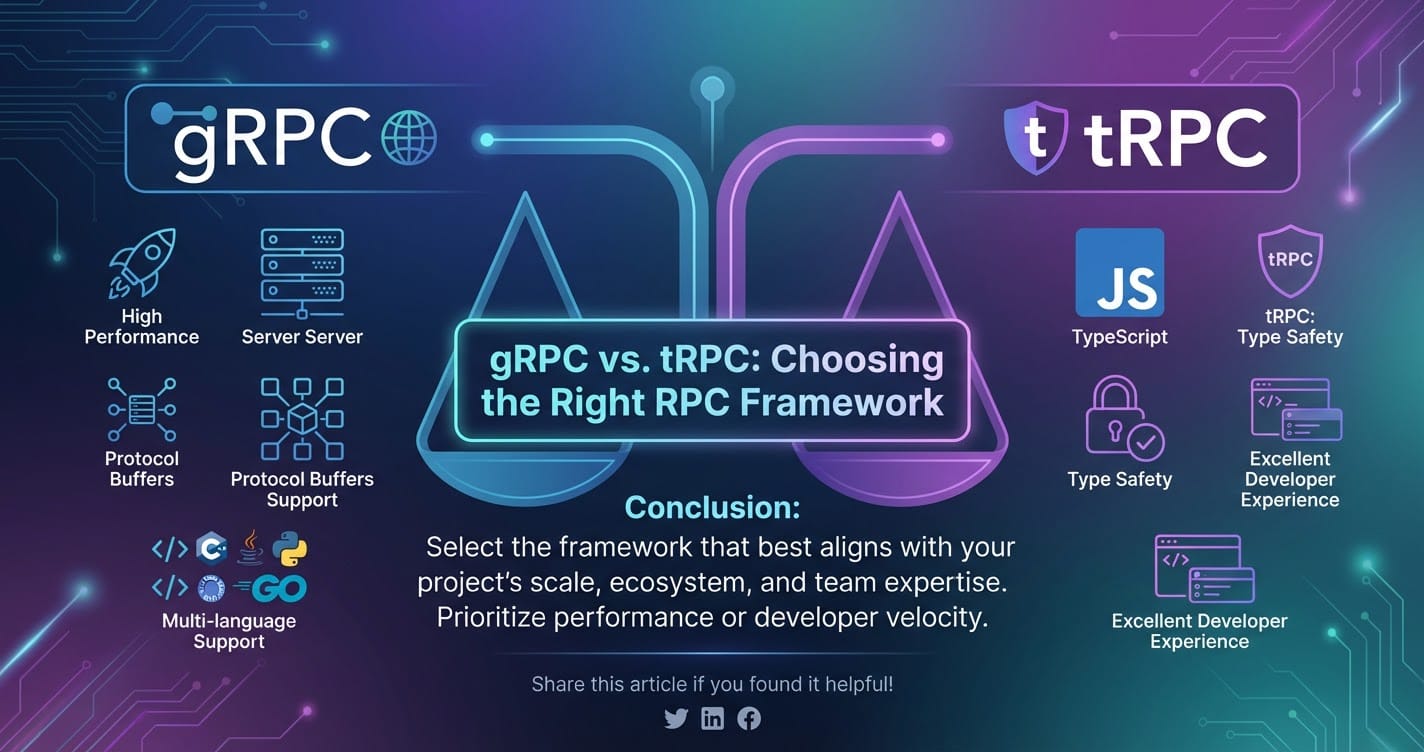
gRPC vs. tRPC: Choosing the Right RPC Framework


The digital landscape is an intricate web of interconnected services, constantly communicating to deliver the rich, dynamic applications we use daily. At the heart of this ceaseless interaction lies the concept of Remote Procedure Calls (RPC), a powerful paradigm that allows a program to execute a procedure (a subroutine or function) in a different address space (typically on a remote server) as if it were a local procedure. This abstraction of network communication is fundamental to modern distributed systems, enabling microservices to interact seamlessly across network boundaries.
The evolution of software architecture, particularly the rise of microservices, has amplified the need for efficient, robust, and developer-friendly inter-service communication mechanisms. While traditional REST APIs have dominated the scene for years, their text-based, often over-fetching or under-fetching nature can introduce overhead and complexity in high-performance or strongly-typed environments. This continuous pursuit of optimization and improved developer experience has led to the proliferation of various RPC frameworks, each offering a unique set of trade-offs tailored to specific use cases.
Among the myriad choices available today, two frameworks, gRPC and tRPC, stand out for their distinct approaches and growing popularity. gRPC, a battle-tested, high-performance framework developed by Google, leverages HTTP/2 and Protocol Buffers to offer a language-agnostic, contract-first approach ideal for polyglot microservice architectures. Its emphasis on efficiency, streaming capabilities, and strong contracts has made it a darling in enterprise-grade distributed systems. In stark contrast, tRPC emerges from the TypeScript ecosystem, championing a code-first, end-to-end type-safe methodology designed to provide an unparalleled developer experience for full-stack TypeScript applications, primarily within a monorepo context. It eradicates the need for traditional code generation by directly inferring types from server-side code, offering a seamless, boilerplate-free interaction between client and server.
Choosing between gRPC and tRPC is not merely a technical decision; it's a strategic one that profoundly impacts developer productivity, system performance, architectural flexibility, and the long-term maintainability of a project. Each framework embodies different philosophies and caters to distinct sets of problems and preferences. A deep understanding of their core principles, advantages, disadvantages, and ideal use cases is paramount for any architect or developer tasked with navigating the complexities of modern distributed system design. This comprehensive article aims to dissect both gRPC and tRPC, providing an in-depth analysis of their underlying mechanisms, comparing their features, and ultimately guiding you through the critical decision-making process to select the RPC framework that best aligns with your project's unique requirements and your team's expertise.
Deep Dive into gRPC: The Enterprise-Grade Performer
gRPC, short for "gRPC Remote Procedure Call," is a modern, open-source, high-performance RPC framework that can run in any environment. Initially developed by Google, it represents a significant evolution from traditional RPC mechanisms, designed to address the challenges of inter-service communication in the context of large-scale, polyglot microservice architectures. Its foundations are deeply rooted in Google's internal "Stubby" RPC system, which has been powering Google's vast network of services for over a decade. The decision to open-source gRPC in 2015 was a game-changer, bringing enterprise-grade capabilities to the broader developer community.
The philosophy behind gRPC is to provide a robust, efficient, and strongly-typed contract for service interactions, decoupling clients and servers while ensuring rigorous type safety across different programming languages. This "contract-first" approach is central to its design, ensuring that all interacting services adhere to a predefined interface, which dramatically reduces the chances of runtime errors due to mismatched expectations. It’s built on a stack that prioritizes performance and scalability, making it a powerful contender for internal microservice communication where raw speed and efficiency are paramount.
Core Architectural Components
To truly appreciate gRPC, one must understand the synergistic components that form its backbone. Each element plays a crucial role in delivering its promised performance, type safety, and language agnosticism.
Protocol Buffers (Protobuf): The Language-Agnostic IDL
At the very core of gRPC lies Protocol Buffers, often abbreviated as Protobuf. It is Google's language-neutral, platform-neutral, extensible mechanism for serializing structured data. Unlike XML or JSON, which serialize data into human-readable text formats, Protobuf serializes data into a highly efficient binary format. This binary encoding is significantly smaller and faster to parse than textual formats, contributing directly to gRPC's high performance.
The definition of messages and services in gRPC is done through .proto files, which act as the Interface Definition Language (IDL). These files are essentially plain text files where developers define the structure of the data they want to send and the methods (procedures) that a service exposes. For instance, a simple user service might define a User message with fields like id, name, and email, and a UserService with methods like GetUser(GetByIdRequest) or CreateUser(CreateUserRequest).
Example .proto file snippet:
syntax = "proto3";

package users;

message User {
  string id = 1;
  string name = 2;
  string email = 3;
}

message GetByIdRequest {
  string id = 1;
}

message CreateUserRequest {
  string name = 1;
  string email = 2;
}

service UserService {
  rpc GetUser (GetByIdRequest) returns (User);
  rpc CreateUser (CreateUserRequest) returns (User);
}
This .proto file serves as the single source of truth for the API contract. The protoc compiler (Protocol Buffer compiler) then takes this .proto file and generates client and server code (stubs or interfaces) in various programming languages. This generated code includes classes for the defined messages and an interface for the service methods, which developers can then implement on the server side and call on the client side.
The advantages of Protobuf are multifold: * Strongly Typed Contracts: The IDL ensures that both client and server agree on the exact structure of data and service methods at compile time, preventing many common integration errors. * Backward and Forward Compatibility: Protobuf is designed with extensibility in mind. As long as field numbers are consistently used and no required fields are removed, older clients can communicate with newer servers, and vice-versa, without breaking. * Efficient Serialization: The binary format drastically reduces payload size, leading to less network bandwidth consumption and faster data transfer. This is a critical factor for microservices that communicate frequently.
HTTP/2: The Foundation of Performance
While Protobuf handles data serialization, HTTP/2 provides the underlying transport layer for gRPC. Unlike traditional HTTP/1.x, which typically uses a separate TCP connection for each request-response cycle, HTTP/2 introduces several groundbreaking features that make it exceptionally well-suited for RPC:
- Multiplexing: HTTP/2 allows multiple requests and responses to be in flight simultaneously over a single TCP connection. This eliminates the "head-of-line blocking" issue prevalent in HTTP/1.x, significantly improving efficiency, especially in scenarios with many concurrent calls.
- Header Compression (HPACK): HTTP/2 compresses request and response headers using a specialized compression format, reducing the amount of data sent over the wire. This is particularly beneficial for RPC, where headers can contain repetitive metadata.
- Server Push: Although less commonly used directly in basic RPC, HTTP/2 allows the server to proactively send resources to the client before they are explicitly requested, which can optimize certain interaction patterns.
- Persistent Connections: HTTP/2's single, long-lived TCP connection reduces the overhead of connection establishment and teardown, a significant cost in high-frequency RPC scenarios.
By leveraging HTTP/2, gRPC achieves levels of performance and responsiveness that are difficult to match with HTTP/1.x-based REST APIs, particularly for scenarios involving frequent, small messages or real-time streaming.
RPC Communication Patterns
gRPC is not limited to simple request-response interactions. It offers four distinct types of service methods, catering to a wide range of communication needs:
- Unary RPC: This is the most straightforward pattern, analogous to a traditional function call or a RESTful
GETorPOSTrequest. The client sends a single request message to the server, and the server responds with a single response message.- Practical Example: A client requests user details by ID, and the server returns the
Userobject.
- Practical Example: A client requests user details by ID, and the server returns the
- Server Streaming RPC: In this pattern, the client sends a single request message, but the server responds with a sequence of messages. The server streams these messages back to the client over a long-lived connection until it has sent all responses.
- Practical Example: A client requests a stream of real-time stock quotes, and the server continuously pushes new quotes until the client disconnects or the stream ends.
- Client Streaming RPC: Here, the client sends a sequence of messages to the server, and after sending all its messages, it waits for the server to send a single response message.
- Practical Example: A client uploads a large file in chunks, streaming each chunk as a message to the server, and the server responds with an "upload complete" message once all chunks are received and processed.
- Bidirectional Streaming RPC: This is the most flexible pattern, where both the client and the server send a sequence of messages independently. They can read and write messages in any order, creating a fully duplex communication channel.
- Practical Example: A real-time chat application where multiple participants send and receive messages asynchronously through a single connection to the server.
These streaming capabilities are a major differentiator for gRPC, enabling complex real-time interactions that are challenging and less efficient to implement with traditional request-response models.
Code Generation: The Two Sides of the Coin
The protoc compiler's ability to generate client and server boilerplate code in numerous languages is a cornerstone of gRPC's multi-language support. This automation ensures: * Consistency: All clients and servers interacting with a gRPC service will use the exact same type definitions and method signatures, enforced at the compiler level. * Reduced Boilerplate: Developers don't need to manually write network communication code, serialization/deserialization logic, or client stubs, allowing them to focus on business logic.
However, code generation also introduces a build step and dependency on the protoc toolchain, which can sometimes add complexity to development workflows, especially in rapidly evolving projects or during debugging sessions where understanding the generated code might be necessary.
Ecosystem and Language Support
One of gRPC's most significant strengths is its broad language support. Official implementations are available for Go, Java, Python, Node.js, C#, C++, Ruby, Dart, PHP, and more. This polyglot nature makes gRPC an excellent choice for organizations with diverse technology stacks or those building microservice architectures where different services might be implemented in the language best suited for their particular function. The ecosystem is mature, with extensive documentation, robust tooling, and a large, active community contributing to its development and adoption.
Advantages of gRPC
The combination of Protocol Buffers, HTTP/2, and code generation yields several compelling advantages for gRPC:
- Superior Performance: The binary serialization of Protobuf combined with HTTP/2's multiplexing, header compression, and persistent connections results in significantly lower latency and higher throughput compared to typical JSON/REST over HTTP/1.x. This is critical for high-volume, low-latency inter-service communication.
- Strong Type Safety and Contract Enforcement: The
.protoIDL ensures that service contracts are explicitly defined and strictly adhered to. This compile-time validation dramatically reduces integration errors and improves the reliability of distributed systems. Changes to APIs require updates to the.protofile, which then triggers recompilation and ensures all consumers are aware of the changes, enforcing disciplined API evolution. - Language Agnostic: With official support for a multitude of programming languages, gRPC is perfectly suited for polyglot microservice environments. Development teams can choose the best language for each service without sacrificing inter-service communication efficiency or type safety.
- Efficient Streaming Capabilities: gRPC's native support for server, client, and bidirectional streaming RPC patterns makes it an ideal choice for building real-time applications, suchata pipelines, IoT device communication, and other scenarios requiring continuous data flow or long-lived connections.
- Maturity and Robustness: Backed by Google and adopted by numerous large enterprises, gRPC is a well-engineered, thoroughly tested, and highly stable framework. Its extensive feature set, including authentication, load balancing, health checking, and tracing, makes it production-ready for demanding environments.
Disadvantages of gRPC
Despite its many strengths, gRPC is not without its drawbacks, and these must be carefully considered:
- Steep Learning Curve: New developers joining a gRPC project need to grasp several new concepts: Protocol Buffers syntax, the
protoccompilation process, HTTP/2 intricacies, and the specific nuances of gRPC client/server interaction patterns. This can increase onboarding time and initial development overhead. - Debugging Challenges: Debugging gRPC services can be more complex than debugging REST APIs. The binary nature of Protobuf payloads makes them unintelligible to human eyes without specialized tools (like
grpcurlor browser extensions for gRPC-Web). Traditional HTTP debugging proxies or browser developer tools are less effective, requiring a shift in debugging methodology. - Limited Browser Support (Natively): Modern web browsers do not natively support HTTP/2 with the characteristics gRPC requires (specifically, arbitrary HTTP/2 frames). This means directly calling a gRPC service from a browser application is not straightforward. Solutions like
gRPC-Webare available, which use a proxy (e.g., Envoy, gRPC-Web Proxy) to translate gRPC requests into a browser-compatible format, but this adds an additional layer of complexity to the deployment architecture. - Less Human-Readable: The binary Protocol Buffer messages, while efficient, lack the immediate human readability of JSON or XML. This can hinder quick inspection during development or troubleshooting without the proper tools.
- Code Generation Overhead: While beneficial for type safety, the code generation step adds an extra build process, which can sometimes complicate CI/CD pipelines or local development environments, especially when dealing with many
.protofiles across multiple services.
Ideal Use Cases for gRPC
Given its characteristics, gRPC shines in specific architectural contexts:
- High-Performance Microservices Communication: When inter-service communication within a backend system requires minimal latency and maximum throughput, gRPC's HTTP/2 and Protobuf foundation makes it an excellent choice. Examples include data processing pipelines, financial trading systems, or real-time gaming backends.
- Cross-Language Distributed Systems: In organizations where different microservices are written in various programming languages, gRPC's polyglot support and strong, language-agnostic contracts ensure seamless integration and type safety across the entire system.
- Real-time Data Streaming Applications: Any application requiring continuous, bidirectional data flow, such as chat applications, live dashboards, IoT device telemetry, or streaming analytics, benefits significantly from gRPC's native streaming capabilities.
- Internal APIs: For APIs that are primarily consumed by other backend services within a trusted boundary, gRPC provides efficiency and strict contract enforcement without the need for the browser compatibility or human readability often required for public-facing APIs.
Deployment and Operational Considerations (API Gateway Context)
Deploying and operating gRPC services introduces specific considerations. Load balancing gRPC traffic, which uses long-lived HTTP/2 connections, is different from traditional HTTP/1.x load balancing. It often requires advanced load balancers that understand HTTP/2 or client-side load balancing. Observability (logging, tracing, metrics) also needs to be specifically configured for gRPC, often leveraging frameworks like OpenTelemetry to ensure proper visibility into the distributed system.
Crucially, when gRPC services need to be exposed to external clients, especially web browsers or third-party applications, an API Gateway often becomes an indispensable component. A robust gateway can sit in front of your gRPC services, providing a unified access point for all your APIs. For browser compatibility, an API Gateway can include a gRPC-Web proxy, translating browser-friendly HTTP/1.1 requests into gRPC calls to the backend. This not only solves the browser compatibility issue but also centralizes crucial functionalities like authentication, authorization, rate limiting, caching, and analytics.
Such a gateway acts as a crucial layer of abstraction, managing security policies, routing traffic, and monitoring the health and performance of your RPC services. It ensures that your internal, high-performance gRPC services are securely and efficiently accessible to external consumers, providing a consistent API experience regardless of the underlying RPC framework. This is a common pattern in enterprise architectures, where a single, powerful API management solution can govern a multitude of backend services, including those built with gRPC, REST, or other protocols.
Deep Dive into tRPC: The TypeScript Developer's Dream
While gRPC caters to the broad needs of polyglot microservice architectures with an emphasis on performance and strict contracts, tRPC (TypeScript Remote Procedure Call) emerges from a more focused, yet equally impactful, philosophy: to provide an unparalleled developer experience and end-to-end type safety for full-stack TypeScript applications. Born out of the desire to eliminate the boilerplate and context-switching typically associated with API development, tRPC aims to make client-server communication feel like calling a local function.
The motivation behind tRPC is deeply rooted in the frustrations often experienced by TypeScript developers building full-stack applications. Historically, even with TypeScript on both frontend and backend, defining an API contract would still involve a separate layer (e.g., OpenAPI schemas, manual interface definitions) that needed to be kept in sync. This synchronization was a constant source of potential runtime errors and development overhead. tRPC was created to bridge this gap, leveraging TypeScript's powerful type inference system to automatically share types directly between the client and server, eliminating the need for IDLs, code generation, or manual type synchronization.
Core Architectural Concepts
tRPC's elegance lies in its simplicity and its deep integration with the TypeScript ecosystem. It fundamentally rethinks how client-server interactions are defined and consumed.
TypeScript-First, Type Inference Driven
The defining characteristic of tRPC is its "TypeScript-first" approach. Unlike gRPC's contract-first model using Protobuf, tRPC is "code-first." You define your API procedures directly in TypeScript on the server, and tRPC automatically infers their types. The client then imports these types, and its client-side API calls are type-checked against the server's definitions at compile time. This means that if you change an argument type or a return value on the server, your client-side code will immediately flag a compile-time error, preventing runtime mismatches.
This mechanism completely sidesteps the need for an Interface Definition Language (IDL) like Protocol Buffers or OpenAPI specifications. The TypeScript code itself is the contract. This significantly reduces boilerplate and makes refactoring much safer and faster.
Monorepo-Centric Design
While tRPC can technically be used in a polyrepo setup (where client and server are in separate repositories), its primary strength and intended use case is within a monorepo. In a monorepo, the client and server can easily share TypeScript type definitions directly from a common packages/api or packages/server directory. This direct sharing of types is what enables the magic of end-to-end type safety without any code generation or separate build steps for contracts.
The typical tRPC setup involves: 1. A server application (e.g., Node.js with Express/Next.js API routes). 2. A client application (e.g., React/Next.js frontend). 3. A shared api or server package within the monorepo that contains the tRPC router definition and its procedures. The client then directly imports the types from this shared package.
Minimalistic RPC Implementation
tRPC focuses on providing a thin, efficient layer for defining and calling "procedures" on the server. These procedures are essentially functions that run on your backend. There's no complex RPC abstraction layer; it's a direct invocation of server-side functions with automatic type inference.
You define a "router" on the server, which groups related procedures. Each procedure can be a query (read-only, idempotent operations), a mutation (write operations that change state), or a subscription (real-time data streams).
Example tRPC server-side router snippet (in a shared package):
// src/server/routers/_app.ts
import { z } from 'zod'; // Zod for schema validation
import { publicProcedure, router } from '../trpc';

const userRouter = router({
  getById: publicProcedure
    .input(z.object({ id: z.string() }))
    .query(({ input }) => {
      // Imagine fetching a user from a database
      return { id: input.id, name: 'John Doe', email: `${input.id}@example.com` };
    }),
  create: publicProcedure
    .input(z.object({ name: z.string(), email: z.string().email() }))
    .mutation(({ input }) => {
      // Imagine creating a user in a database
      return { id: 'new-user-id', name: input.name, email: input.email };
    }),
});

export const appRouter = router({
  user: userRouter,
});

// Export type only for client to consume
export type AppRouter = typeof appRouter;
Example tRPC client-side usage:
// src/pages/users/[id].tsx (Next.js client)
import { trpc } from '../utils/trpc'; // tRPC client setup

function UserProfile({ userId }: { userId: string }) {
  const { data: user, isLoading } = trpc.user.getById.useQuery({ id: userId });
  // ^ Notice the auto-completion and type safety here!

  if (isLoading) return <div>Loading user...</div>;
  if (!user) return <div>User not found.</div>;

  return (
    <div>
      <h1>User: {user.name}</h1>
      <p>Email: {user.email}</p>
    </div>
  );
}
The magic happens when the client imports AppRouter. The trpc client utility then uses this type to infer all available procedures, their input types, and their output types, providing full auto-completion and compile-time validation directly in the client-side code.
No Code Generation
One of tRPC's most appealing features is the complete absence of code generation. Unlike gRPC, where .proto files are compiled into client and server stubs, tRPC relies entirely on TypeScript's structural type system and type inference. This means there's no extra build step, no generated files to commit or ignore, and the mental model is significantly simpler. Developers work directly with their TypeScript code, and the types flow seamlessly from server to client.
HTTP/JSON Transport (Flexible)
tRPC typically uses standard HTTP for its communication, sending data as JSON payloads. This makes it incredibly straightforward to integrate with existing web infrastructure, proxies, and debugging tools. It can run on any HTTP server (Node.js, Express, Next.js API routes, etc.). While gRPC mandates HTTP/2, tRPC is flexible and can operate over HTTP/1.1 or HTTP/2, depending on the server configuration. The choice of JSON for data serialization, while less efficient than Protobuf's binary format, is far more human-readable and compatible with standard browser developer tools, simplifying debugging.
Communication Patterns
tRPC provides three main communication patterns, aligning closely with common web API paradigms:
- Queries: These are read-only operations, analogous to
GETrequests in REST. They are designed to fetch data without side effects.- Example:
trpc.user.getById.useQuery({ id: '123' })
- Example:
- Mutations: These are write operations that typically modify data or trigger side effects on the server, analogous to
POST,PUT, orDELETErequests in REST.- Example:
trpc.user.create.useMutation({ name: 'Jane Doe', email: 'jane@example.com' })
- Example:
- Subscriptions: Leveraging WebSockets, tRPC subscriptions enable real-time, bidirectional communication, allowing clients to receive continuous updates from the server.
- Example: A client subscribing to live notifications or chat messages.
These patterns are intuitive for web developers and integrate seamlessly with data fetching libraries like TanStack Query (formerly React Query), which is commonly used with tRPC for state management and caching.
Ecosystem and Language Support
tRPC is exclusively a TypeScript framework. This is both its greatest strength and its primary limitation. It leverages TypeScript's powerful type system to its fullest, making it an incredible choice for full-stack TypeScript teams. Its ecosystem is vibrant and rapidly growing, heavily integrated with modern frontend frameworks, particularly React and Next.js, often alongside data fetching libraries like TanStack Query. While not as vast as gRPC's polyglot ecosystem, the TypeScript community around tRPC is highly engaged and innovative.
Advantages of tRPC
tRPC offers a compelling set of advantages, particularly for TypeScript-centric development:
- Unparalleled Developer Experience (DX): This is tRPC's killer feature. With end-to-end type safety and automatic inference, developers get full auto-completion, compile-time error checking, and seamless refactoring support for their API calls. It feels like calling a local function, drastically reducing context switching and API integration errors.
- End-to-End Type Safety: The core promise of tRPC is delivered flawlessly. Every API call, from the client's invocation to the server's implementation, is type-checked at compile time, eliminating an entire class of runtime errors related to data shape mismatches. This provides immense confidence in the codebase.
- Zero-Boilerplate: No IDL files to define, no code generation to run, no manual type interfaces to maintain. You simply write your server-side functions in TypeScript, and the types are automatically available on the client. This significantly speeds up development and reduces cognitive load.
- Smaller Bundle Sizes: Without the need for large code generation libraries or complex client-side RPC runtimes, tRPC client bundles tend to be very small, contributing to faster page loads.
- Rapid Prototyping and Development: The combination of excellent DX, zero boilerplate, and compile-time guarantees allows teams to iterate incredibly quickly on features involving client-server communication. Changes on the backend are immediately reflected and type-checked on the frontend.
- Strong Integration with Modern Frontend Frameworks: tRPC plays exceptionally well with React, Next.js, and other popular JavaScript frameworks, often enhancing their capabilities with its type safety and developer tooling. Its integration with TanStack Query (React Query) is particularly seamless.
Disadvantages of tRPC
While tRPC is a boon for TypeScript developers, it comes with specific constraints that limit its applicability:
- TypeScript-Only: This is its most significant limitation. tRPC is inextricably tied to TypeScript. If your backend services are written in languages other than TypeScript (e.g., Go, Java, Python), or if your team isn't fully committed to TypeScript, tRPC is not a viable option for inter-service communication. It's not designed for polyglot systems.
- Monorepo Bias: Although it can be made to work in polyrepos, tRPC's primary advantage of direct type sharing is most effectively realized within a monorepo. In a polyrepo, you would still need to publish and consume type definitions, reintroducing some of the complexity tRPC aims to eliminate.
- Smaller Ecosystem and Community: Compared to gRPC, which has been around for longer and is backed by Google, tRPC is a newer framework. While its community is passionate and growing, the overall ecosystem, tooling, and number of available integrations are smaller.
- Less Suited for Public APIs: Exposing tRPC services directly as a public API to third-party consumers is less conventional and generally not its intended use case. Its strength lies in tightly coupled client-server communication within a controlled environment (like a full-stack application). If you need to expose a public API, wrapping tRPC procedures with a traditional RESTful API layer or an API gateway would be more appropriate.
- Performance: While generally performant enough for most web applications, tRPC's reliance on standard HTTP and JSON serialization might not match the raw throughput and efficiency of gRPC's binary Protobuf and HTTP/2 optimizations in extreme high-performance scenarios.
- Less Opinionated on Transport: While using HTTP/JSON, tRPC is less opinionated on the specifics of the HTTP transport layer compared to gRPC's strict HTTP/2 requirement. This flexibility is generally good, but for ultra-optimized network scenarios, gRPC's dedicated stack might offer an edge.
Ideal Use Cases for tRPC
tRPC shines in contexts where a tightly integrated, TypeScript-first development experience is a top priority:
- Full-Stack TypeScript Applications: Especially those built with Next.js, Create React App, or other frameworks that support monorepo structures. tRPC provides an unparalleled experience for building tightly coupled frontends and backends.
- Internal Microservices (TypeScript Homogeneous): If all your internal microservices are written in TypeScript and ideally within a monorepo, tRPC can significantly boost developer productivity and ensure type consistency across services.
- Projects Prioritizing Developer Experience and Rapid Iteration: For startups, small teams, or projects where fast prototyping and a delightful developer experience are critical, tRPC offers immense value.
- Applications Where End-to-End Type Safety is a Critical Requirement: In domains where preventing runtime type errors is paramount (e.g., financial applications, healthcare, complex business logic), tRPC's guarantees provide a strong safety net.
Deployment Considerations
Deploying tRPC services is often as straightforward as deploying any Node.js or Next.js application, as it primarily relies on standard HTTP/JSON. This means it integrates seamlessly with existing cloud platforms, serverless functions, and containerization strategies. Standard HTTP load balancers and proxy servers work out of the box. For API management, especially if you need to expose tRPC procedures to a wider audience or provide centralized authentication and authorization, you might consider wrapping them with a lightweight REST API layer or routing them through an API Gateway configured for your specific needs. The simplicity of its HTTP/JSON transport makes it compatible with a broad range of existing API infrastructure.
APIPark is a high-performance AI gateway that allows you to securely access the most comprehensive LLM APIs globally on the APIPark platform, including OpenAI, Anthropic, Mistral, Llama2, Google Gemini, and more.Try APIPark now! 👇👇👇
gRPC vs. tRPC: A Comprehensive Comparison
Having delved deep into the individual characteristics of gRPC and tRPC, it becomes clear that while both serve the purpose of facilitating remote procedure calls, they do so with fundamentally different philosophies, architectural choices, and target audiences. The decision to adopt one over the other hinges on a careful evaluation of project requirements, team composition, performance needs, and desired developer experience. This section provides a direct comparative analysis across key dimensions, culminating in a detailed comparison table.
Fundamental Design Philosophies: Contract-first vs. Code-first
- gRPC (Contract-first): Its philosophy centers around defining a strict, language-agnostic contract using Protocol Buffers (
.protofiles) before any implementation begins. This contract serves as the single source of truth, from which client and server code are generated. This approach prioritizes strong API governance, compatibility across diverse language ecosystems, and explicit API evolution. It's about enforcing a rigid agreement between distributed components. - tRPC (Code-first / Type Inference): tRPC embraces a code-first philosophy, where the API contract is implicitly derived from the TypeScript code itself. There's no separate IDL; the types are inferred directly from the server-side procedure definitions and then shared with the client. This approach prioritizes developer experience, rapid iteration, and seamless end-to-end type safety within a homogeneous TypeScript environment. It's about making client-server communication feel like local function calls.
Type Safety and Data Contracts
- gRPC: Achieves strong type safety through its Protocol Buffer IDL. The
.protodefinitions are compiled into strongly typed classes and interfaces in various languages. This ensures that data structures and method signatures are consistent across all services at compile time, regardless of the language. Any deviation from the contract results in a compilation error. - tRPC: Delivers unparalleled end-to-end type safety by directly leveraging TypeScript's inference capabilities. The server-side code's types are exported and consumed by the client, ensuring that client calls exactly match the server's expectations. This eliminates runtime type errors between frontend and backend without any explicit contract definition outside of the TypeScript code.
Performance Characteristics
- gRPC: Engineered for high performance. It uses HTTP/2 as its transport protocol, which offers multiplexing, header compression (HPACK), and persistent connections. Data serialization is handled by Protocol Buffers, a highly efficient binary format that results in smaller payloads and faster parsing than text-based formats like JSON. This combination leads to significantly lower latency and higher throughput, especially for high-volume, low-latency microservice communication.
- tRPC: Generally performs well for typical web applications. It primarily uses standard HTTP (either HTTP/1.1 or HTTP/2, depending on server configuration) with JSON for data serialization. While JSON is human-readable and widely compatible, it is less efficient in terms of payload size and serialization/deserialization speed compared to Protobuf's binary format. For most client-server web applications, tRPC's performance is more than adequate, but it may not rival gRPC in scenarios demanding extreme throughput or minimal microsecond latency.
Language Interoperability
- gRPC: Designed to be language-agnostic. With official support for a broad spectrum of programming languages (Go, Java, Python, Node.js, C#, C++, Ruby, Dart, PHP, etc.), it is the ideal choice for polyglot microservice architectures where different teams or services might use different technologies.
- tRPC: Exclusively a TypeScript framework. Its entire mechanism relies on TypeScript's type system, making it suitable only for projects where both the client and server are written in TypeScript. It is not designed for interoperability with services written in other languages.
Developer Experience (DX)
- gRPC: Provides a good developer experience once the initial learning curve (Protobuf syntax,
protocworkflow) is overcome. The generated code simplifies client-server interaction. However, debugging binary payloads can be challenging, and modifying contracts requires updating.protofiles and regenerating code, which can add a step to the development cycle. - tRPC: Offers an exceptional developer experience, often cited as its strongest feature. With no IDL, no code generation, and direct type inference, developers get instant auto-completion, compile-time error feedback, and seamless refactoring across their full-stack application. It dramatically reduces boilerplate and context switching, making API development feel incredibly fluid and intuitive.
Ecosystem Maturity and Tooling
- gRPC: A mature, enterprise-grade framework backed by Google with a vast and stable ecosystem. It has a large community, extensive documentation, and robust tooling for everything from debugging (e.g.,
grpcurl) to observability (integration with OpenTelemetry). It's widely adopted in mission-critical systems. - tRPC: A newer, rapidly evolving framework with a smaller but highly active and passionate community. Its ecosystem is tightly integrated with modern TypeScript frontend frameworks (especially React/Next.js) and data fetching libraries (TanStack Query). While growing quickly, it doesn't yet possess the sheer breadth and depth of enterprise-grade tooling that gRPC boasts.
Deployment and Operational Overhead
- gRPC: Can introduce higher operational complexity due to its reliance on HTTP/2. This requires specialized load balancers, advanced proxy configurations (e.g., for gRPC-Web), and dedicated observability tools. Debugging and monitoring can also be more involved due to the binary protocol.
- tRPC: Generally simpler to deploy and operate. Its use of standard HTTP and JSON makes it compatible with existing web infrastructure, traditional HTTP load balancers, and familiar debugging tools (like browser developer tools). Its operational overhead is typically akin to a standard Node.js/Next.js application.
Suitability for Different Project Scales and Architectures
- gRPC: Excellently suited for large-scale, complex distributed systems, polyglot microservice architectures, and high-performance backend-to-backend communication. It's a strong choice for enterprise environments where strict contracts and cross-language interoperability are critical.
- tRPC: Ideal for full-stack TypeScript applications, especially those within a monorepo, and smaller to medium-sized internal microservices where all components are in TypeScript. It shines in environments prioritizing rapid development, developer experience, and end-to-end type safety for a homogeneous tech stack.
External API Exposure
- gRPC: While primarily designed for internal microservice communication, gRPC services can be effectively exposed externally using an API Gateway that handles protocol translation (e.g., gRPC-Web for browsers) and provides features like authentication, rate limiting, and analytics. It's a robust solution for public-facing high-performance APIs when properly managed.
- tRPC: Less suited for direct public exposure as a conventional API to third-party consumers due to its TypeScript-centric nature and monorepo bias. While it can be wrapped with a RESTful API layer or managed by an API gateway, its core strengths are optimized for tightly coupled client-server interaction within a controlled environment.
Here's a comparison table summarizing the key aspects:
| Feature/Aspect | gRPC | tRPC |
|---|---|---|
| Core Philosophy | Contract-first, polyglot, high performance | Code-first, TypeScript-only, developer experience |
| IDL / Type Definition | Protocol Buffers (.proto files) |
TypeScript interfaces/types (direct inference) |
| Code Generation | Required (generates client/server stubs) | Not required (types shared directly) |
| Protocol | HTTP/2 with binary Protocol Buffers | HTTP/1.1 or HTTP/2 with JSON (flexible) |
| Serialization | Protocol Buffers (binary, highly efficient) | JSON (text-based, human-readable) |
| Language Support | Broad (Go, Java, Python, Node.js, C#, C++, Ruby, Dart, PHP, etc.) | TypeScript only |
| Type Safety | Strong (compile-time via generated code/Protobuf) | End-to-end (compile-time via TypeScript inference) |
| Developer Experience | Good, but involves IDL and build steps | Excellent (auto-completion, instant feedback, minimal boilerplate) |
| Ecosystem Maturity | Mature, enterprise-grade, large community | Emerging, rapidly growing, strong integration with React/Next.js |
| Monorepo Suitability | Works well in both monorepos and polyrepos | Best suited for monorepos (type sharing is key) |
| Public API Exposure | Well-suited (with gRPC-Web for browsers), often via API Gateways | Less common (usually internal, can be wrapped with a REST API) |
| Learning Curve | Moderate to High (Protobuf, HTTP/2 concepts) | Low to Moderate (familiar TypeScript concepts) |
| Performance | Very High (binary payload, HTTP/2 multiplexing) | Good (standard HTTP/JSON), typically sufficient for web apps |
| Streaming | Unary, Server, Client, Bidirectional | Queries, Mutations, Subscriptions (WebSockets for subscriptions) |
| Debugging | Requires specialized tools due to binary format | Easier (JSON payloads, familiar browser dev tools) |
| Browser Compatibility | Requires gRPC-Web proxy for native browser use | Native (uses standard browser HTTP/WebSocket APIs) |
Choosing the Right Framework: A Decision Matrix
The decision between gRPC and tRPC is rarely about which framework is inherently "better," but rather which one is the right fit for your specific project, team, and architectural goals. Each framework offers a powerful solution, but their strengths and weaknesses align with different priorities. To make an informed choice, consider the following critical factors:
Project Scale and Team Composition
- Large, Polyglot Enterprise (gRPC): If you're building a large-scale enterprise system with numerous microservices developed by diverse teams using different programming languages (e.g., Go for one service, Java for another, Python for ML workloads), gRPC is the clear winner. Its language agnosticism and strong contract enforcement are indispensable in such polyglot environments, ensuring seamless, type-safe communication across the entire ecosystem. The overhead of learning Protobuf and gRPC concepts is amortized across many services and teams, justifying the initial investment.
- Small to Medium-sized, Full-Stack TypeScript Team (tRPC): For smaller teams or startups primarily focused on building full-stack applications with TypeScript (especially with frameworks like Next.js within a monorepo), tRPC offers an unparalleled developer experience. The benefits of end-to-end type safety, zero boilerplate, and rapid iteration far outweigh the need for multi-language support. The development workflow becomes incredibly streamlined, fostering high productivity.
Performance Requirements
- Microsecond Latency and High Throughput (gRPC): If your application demands the absolute highest performance for inter-service communication, such as real-time data processing, financial trading platforms, or high-volume data streams, gRPC's binary Protocol Buffers and HTTP/2 transport provide a significant edge. Its optimizations for network efficiency and serialization speed are critical in these performance-sensitive scenarios.
- Standard Web Application Responsiveness (tRPC): For most web applications where typical network latency and throughput are acceptable, tRPC's HTTP/JSON transport is more than sufficient. While not as raw-performance-optimized as gRPC, it delivers excellent responsiveness for user-facing applications and internal services that don't operate at the extreme edge of data volume or speed.
Language Ecosystem
- Multi-language Services (gRPC): If your architectural design embraces a polyglot approach, where different services are built with different programming languages based on their best fit (e.g., performance, existing libraries, team expertise), gRPC is essential for maintaining a unified communication layer.
- Homogeneous TypeScript Stack (tRPC): If your entire stack, from frontend to backend services, is built exclusively with TypeScript, tRPC provides a cohesive and highly efficient development paradigm. The synergy between client and server TypeScript code is its core strength.
Deployment Strategy and External API Exposure
- Internal Microservices and Managed Public APIs (gRPC): gRPC excels for internal, backend-to-backend communication where efficiency and strict contracts are paramount. When exposing these services externally, an API Gateway is often used to manage authentication, authorization, rate limiting, and protocol translation (e.g., gRPC-Web for browser clients). This pattern allows you to leverage gRPC's internal benefits while providing a robust, managed public API.
- Tightly Coupled Client-Server (tRPC): tRPC is best suited for internal, tightly coupled client-server communication, particularly for web applications where the frontend and backend are developed in tandem. It's generally not designed for direct public consumption by arbitrary third-party developers. If you need to expose functionality developed with tRPC as a public API, you might consider creating a separate RESTful API wrapper or using a sophisticated API gateway to manage and expose specific endpoints as conventional APIs.
For organizations operating a diverse ecosystem of services, whether they rely on gRPC for internal microservices, tRPC for their full-stack applications, or traditional REST APIs, managing this landscape can become a significant challenge. This is where an advanced API Gateway and management platform becomes indispensable. Solutions like APIPark ApiPark provide a comprehensive, open-source platform designed to streamline the integration, management, and deployment of both AI and REST services, and critically, can act as a central gateway for all your API needs. It simplifies authentication, traffic management, and observability, allowing developers to focus on building features rather than wrestling with infrastructure complexities. While APIPark primarily emphasizes AI and REST APIs, its role as a robust API management platform means it can seamlessly sit in front of or alongside services built with frameworks like gRPC (e.g., handling gRPC-Web transformations for browser access) or tRPC, providing a unified management layer. It ensures that regardless of the underlying RPC technology, your services are discoverable, secure, and performant, all managed from a single, powerful platform.
Developer Experience Priority
- Robust Contract Enforcement and Tooling (gRPC): If your priority is rigorous API contract enforcement, extensive tooling, and a mature ecosystem that supports complex distributed systems, gRPC's structured approach is a strong choice. It fosters discipline in API design.
- Rapid Development and Type Safety (tRPC): If your highest priority is developer velocity, end-to-end type safety, and minimizing boilerplate for a homogeneous TypeScript stack, tRPC offers an unparalleled development experience that reduces cognitive load and accelerates feature delivery.
Maintenance and Operational Overhead
- Managing Protobuf/HTTP/2 (gRPC): The operational overhead for gRPC includes managing the
protocbuild process, understanding HTTP/2 specifics for load balancing, and using specialized tools for debugging. While robust, it requires a certain level of operational maturity. - Simpler HTTP/JSON (tRPC): tRPC generally incurs less operational overhead. Its use of standard HTTP/JSON simplifies deployment, monitoring, and debugging, integrating well with existing web infrastructure and conventional DevOps practices.
Future-proofing and Scalability
Both frameworks offer excellent scalability, but in different dimensions. gRPC scales well across language barriers and for extreme performance demands, making it future-proof for evolving polyglot architectures. tRPC scales exceptionally well in terms of developer productivity and type safety for TypeScript-centric applications, ensuring a robust and maintainable codebase as the application grows within its defined ecosystem.
Ultimately, the choice comes down to a careful weighing of these factors. There will always be trade-offs. If you are building the next generation of high-performance, cross-language microservices for a large enterprise, gRPC's strengths are undeniable. If you are a full-stack TypeScript team building a modern web application and value an incredible developer experience above all else, tRPC will empower you like no other. The best framework is the one that best fits your specific constraints and amplifies your team's strengths.
Conclusion: Context is King
In the dynamic world of distributed systems and inter-service communication, the choice of an RPC framework is a foundational decision that reverberates through every layer of a project. We've journeyed through the intricate mechanisms of gRPC, appreciating its enterprise-grade performance, its robust contract-first philosophy, and its unparalleled language agnosticism, all built upon the bedrock of Protocol Buffers and HTTP/2. We've also explored tRPC, a modern marvel for TypeScript developers, celebrating its end-to-end type safety, its code-first elegance, and its commitment to an exceptional developer experience, liberating teams from boilerplate and context-switching.
It has become abundantly clear that neither gRPC nor tRPC stands as a universally "better" solution. Instead, they represent two distinct yet equally powerful paradigms, each meticulously crafted to address different challenges and cater to specific sets of requirements. gRPC thrives in complex, polyglot microservice environments demanding peak performance and strict API governance, making it a cornerstone for large-scale distributed architectures. tRPC, on the other hand, revolutionizes the development workflow for full-stack TypeScript applications, offering an unparalleled blend of developer velocity and type safety, especially within the confines of a monorepo.
The key takeaway is that context is king. Your project's scale, the composition and expertise of your development team, your performance benchmarks, your chosen language ecosystem, and your deployment strategy all play pivotal roles in this decision. Are you building a high-throughput, cross-language backend system where every millisecond counts? gRPC is likely your champion. Are you a full-stack TypeScript team yearning for a seamless, type-safe development experience that feels like magic? tRPC awaits.
As the RPC landscape continues to evolve, offering an increasingly sophisticated array of tools for modern distributed systems, making an informed choice is more crucial than ever. By deeply understanding the nuances of frameworks like gRPC and tRPC, architects and developers can confidently select the right tool for the job, fostering more efficient, reliable, and delightful software development experiences. The future of networked applications rests on these carefully considered decisions, paving the way for systems that are not only performant and scalable but also a joy to build and maintain.
Frequently Asked Questions (FAQ)
1. What is the fundamental difference between gRPC's "contract-first" and tRPC's "code-first" approach?
gRPC uses a "contract-first" approach where you define your API contract using Protocol Buffers (.proto files) before writing any code. This contract is then used to generate client and server code in various languages, ensuring strict type safety and language interoperability. tRPC uses a "code-first" approach (or "type-inference driven") where you define your API procedures directly in TypeScript on the server. tRPC then infers the types from this server-side code, which are directly consumed by the client, providing end-to-end type safety without any separate IDL or code generation.
2. When should I choose gRPC over tRPC?
Choose gRPC if you need: * High performance for inter-service communication (e.g., microservices). * Polyglot support where your services are written in multiple programming languages. * Strict API contracts that are enforced across different teams and languages. * Advanced streaming capabilities (server, client, bidirectional streaming) for real-time applications. * To leverage a mature, enterprise-grade ecosystem with extensive tooling. * To expose your RPC services publicly via an API Gateway capable of handling gRPC traffic.
3. When is tRPC a better choice than gRPC?
Choose tRPC if you: * Are building a full-stack TypeScript application, especially within a monorepo. * Prioritize an unparalleled developer experience with end-to-end type safety, auto-completion, and zero boilerplate. * Want to rapidly prototype and iterate on features without the overhead of IDLs and code generation. * Have a homogeneous TypeScript stack for both frontend and backend services. * Are primarily building internal APIs for your own client applications.
4. Can gRPC and tRPC be used together in the same project?
Yes, it's entirely possible to use both gRPC and tRPC within the same larger system. For example, you might use gRPC for high-performance, cross-language communication between your core backend microservices (e.g., data processing, authentication), while using tRPC for the client-server communication layer of a specific full-stack web application built in TypeScript (e.g., an admin dashboard or a user-facing portal). An API gateway can then help manage and orchestrate access to these diverse services.
5. How do gRPC and tRPC handle browser compatibility?
gRPC does not have native direct browser support because browsers do not expose the necessary HTTP/2 features required by gRPC. To use gRPC from a browser, you typically need a proxy (like gRPC-Web proxy or Envoy) that translates gRPC-Web requests from the browser into standard gRPC calls to your backend. tRPC, on the other hand, primarily uses standard HTTP/JSON (or WebSockets for subscriptions), making it natively compatible with web browsers without the need for additional proxies or translation layers, simplifying its integration into modern frontend applications.
🚀You can securely and efficiently call the OpenAI API on APIPark in just two steps:
Step 1: Deploy the APIPark AI gateway in 5 minutes.
APIPark is developed based on Golang, offering strong product performance and low development and maintenance costs. You can deploy APIPark with a single command line.
curl -sSO https://download.apipark.com/install/quick-start.sh; bash quick-start.sh

In my experience, you can see the successful deployment interface within 5 to 10 minutes. Then, you can log in to APIPark using your account.

Step 2: Call the OpenAI API.