gRPC vs tRPC: Choosing the Right RPC Framework


The landscape of modern software development is characterized by distributed systems, microservices architectures, and an ever-increasing demand for high-performance, scalable, and resilient communication between different components. At the heart of this intricate web of interactions lies the Remote Procedure Call (RPC) paradigm, a fundamental concept that enables programs to request a service from a program located on another computer on a network without having to understand the network's details. As developers strive to build more robust and efficient applications, the choice of an RPC framework becomes a pivotal decision, profoundly impacting performance, developer experience, maintainability, and scalability.
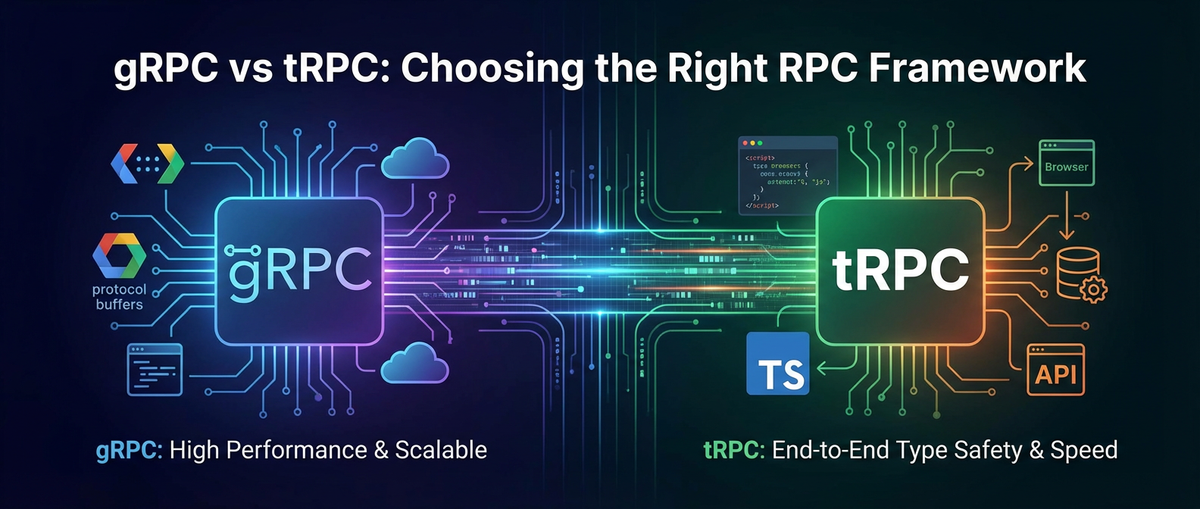
In this exhaustive exploration, we delve into two prominent RPC frameworks that have garnered significant attention in recent years: gRPC and tRPC. While both aim to simplify inter-service communication and enhance developer productivity, they originate from distinct philosophies, cater to different ecosystems, and offer unique sets of advantages and trade-offs. Google's gRPC, a battle-tested, language-agnostic framework built on Protocol Buffers and HTTP/2, champions high performance and polyglot environments. On the other hand, tRPC, a newer, rapidly evolving framework, offers unparalleled end-to-end type safety and an exceptional developer experience specifically within the TypeScript ecosystem, often thriving in monorepo setups. This article will meticulously dissect their core principles, architectural nuances, practical implications, and use cases, providing a comprehensive guide to help you choose the most suitable RPC framework for your specific project needs. Understanding the intricate details of each will empower architects and developers to make informed decisions that align with their technical requirements, team expertise, and long-term strategic goals for api communication.
Understanding RPC: The Foundation of Distributed Communication
Before we embark on a detailed comparison, it's essential to solidify our understanding of what RPC is and why it remains a cornerstone of modern distributed systems. Remote Procedure Call, or RPC, is a protocol that allows a program to execute a procedure (a function or a subroutine) in a different address space (typically on a remote server) as if it were a local procedure call. The calling program doesn't need to know the underlying network communication details; it simply calls a function, and the RPC framework handles the marshalling of parameters, network transmission, remote execution, and unmarshalling of results back to the caller. This abstraction greatly simplifies the development of distributed applications, allowing developers to focus on business logic rather than network protocols.
Why RPC Over Other Communication Paradigms?
For many years, REST (Representational State Transfer) has been the dominant architectural style for api development, particularly for public-facing web services. REST's simplicity, widespread tooling, and human-readable JSON/XML payloads made it an excellent choice for a wide array of applications. However, as systems grew more complex and performance demands intensified, the limitations of REST became apparent in certain contexts.
- Performance: REST typically relies on HTTP/1.1 and JSON, which can incur significant overhead due to text-based serialization and the request-response cycle. JSON parsing and string manipulation are computationally intensive. RPC frameworks, especially those like gRPC, often leverage binary serialization formats (like Protocol Buffers) and more efficient transport protocols (like HTTP/2), leading to substantially lower latency and higher throughput.
- Type Safety: A common challenge with REST
apis is the lack of inherent type safety between client and server. Developers often manually define interfaces or DTOs (Data Transfer Objects) on both sides, which can lead to discrepancies and runtime errors if not meticulously maintained. RPC, by its very nature, often emphasizes strong type contracts, either through Interface Definition Languages (IDLs) or direct code inference, ensuring that client and server agree on theapi's structure at compile time or development time. - Efficiency in Data Transfer: REST
apis often transfer entire resources, even if only a small portion is needed. This can lead to over-fetching or under-fetching of data, necessitating multiple requests or larger payloads. RPC allows for precise definition of the data required for each procedure call, optimizing data transfer. - Streaming: While HTTP/1.1 is primarily a request-response protocol, modern applications often require real-time, bi-directional communication (e.g., chat applications, live dashboards, IoT data streams). While WebSockets can address this, many RPC frameworks offer built-in, first-class support for various streaming patterns, simplifying their implementation.
In microservices architectures, where hundreds or thousands of services need to communicate with each other efficiently and reliably, the benefits of RPC become even more pronounced. It enables faster inter-service communication, reduces the cognitive load on developers by providing clear api contracts, and fosters a more resilient ecosystem. However, not all RPC frameworks are created equal, and the choice depends heavily on the specific needs of the project.
Deep Dive into gRPC: High Performance, Polyglot RPC
gRPC, an open-source, high-performance RPC framework developed by Google, has rapidly become a go-to choice for building robust, scalable apis and microservices. Released in 2015, gRPC leverages a potent combination of technologies to deliver on its promise of efficient, language-agnostic communication.
What is gRPC?
At its core, gRPC enables client and server applications to communicate transparently, allowing you to easily build connected systems. It's designed for low-latency, high-throughput communication, particularly suitable for scenarios involving many small services exchanging data frequently. The fundamental idea is that you define a service using Protocol Buffers (Protobuf), Google's language-agnostic binary serialization format, and gRPC automatically generates client and server code in a variety of languages. This code handles the complexities of network communication, serialization, and deserialization, allowing developers to focus solely on the business logic of their services.
Core Concepts and Technologies
The power and efficiency of gRPC stem from its intelligent integration of several key technologies:
- Protocol Buffers (Protobuf): The Interface Definition Language (IDL) Protobuf serves as gRPC's primary IDL and message interchange format. Instead of relying on human-readable but verbose formats like JSON or XML, Protobuf serializes structured data into a compact binary format.
- Schema Definition: Developers define their service methods and message structures in a
.protofile using a simple, intuitive syntax. This file acts as the single source of truth for theapicontract. For example: ```protobuf syntax = "proto3";package helloworld;service Greeter { rpc SayHello (HelloRequest) returns (HelloReply) {} }message HelloRequest { string name = 1; }message HelloReply { string message = 1; }`` * **Code Generation:** A special Protobuf compiler (protoc) takes the.protofile and generates client and server-side code in over a dozen programming languages, including C++, Java, Python, Go, Node.js, Ruby, C#, and Dart. This generated code includes the data structures (messages) and the serviceapi`s, ensuring strong type safety across different language implementations. * Efficiency: Protobuf messages are significantly smaller than their JSON or XML counterparts due to their binary nature, leading to reduced network bandwidth usage and faster serialization/deserialization times. This efficiency is a major contributor to gRPC's high performance. * Schema Evolution: Protobuf is designed with schema evolution in mind, allowing developers to add new fields to messages or services without breaking existing clients or servers, as long as new fields are optional.
- Schema Definition: Developers define their service methods and message structures in a
- HTTP/2: The Transport Protocol Unlike REST, which traditionally operates over HTTP/1.1, gRPC exclusively uses HTTP/2 as its underlying transport protocol. HTTP/2 introduces several fundamental improvements over HTTP/1.1 that are critical for gRPC's performance:
- Multiplexing: HTTP/2 allows multiple concurrent requests and responses to be interleaved on a single TCP connection. This eliminates the "head-of-line blocking" problem prevalent in HTTP/1.1, where one slow request could hold up others. For gRPC, this means multiple RPC calls can be active simultaneously over one connection, improving resource utilization.
- Header Compression (HPACK): HTTP/2 uses HPACK compression for request and response headers. This significantly reduces redundant data transfer, especially in microservices architectures where many RPC calls might share similar headers (e.g., authentication tokens).
- Server Push: Although less directly used by gRPC's core RPC mechanism, HTTP/2's server push capability allows a server to proactively send resources to a client before the client explicitly requests them, which can be beneficial for optimizing web asset delivery in broader HTTP/2 contexts.
- Binary Framing: HTTP/2 messages are broken down into smaller, binary-encoded frames, making them more efficient to parse and transmit than HTTP/1.1's text-based messages.
- Streaming Capabilities gRPC natively supports four types of service methods, allowing for flexible communication patterns:
- Unary RPC: The simplest form, where the client sends a single request and gets a single response, analogous to a traditional function call.
- Server-side Streaming RPC: The client sends a single request, and the server responds with a sequence of messages. The client reads from this stream until there are no more messages. This is ideal for scenarios like receiving real-time updates or large data sets in chunks.
- Client-side Streaming RPC: The client sends a sequence of messages to the server, and once all messages are sent, the server responds with a single message. Useful for sending large amounts of data to the server, such as uploading a file in parts.
- Bi-directional Streaming RPC: Both client and server send a sequence of messages to each other using a read-write stream. They can send and receive messages concurrently and independently. This is powerful for real-time interactive communication, like chat applications or live gaming.
- Interceptors gRPC interceptors provide a mechanism to intercept and process RPC calls on both the client and server sides. They are similar to middleware in web frameworks and are incredibly useful for adding cross-cutting concerns without modifying the core business logic. Common use cases include:
- Authentication and Authorization: Validating credentials and checking permissions before an RPC call proceeds.
- Logging: Recording details of incoming and outgoing RPC requests and responses.
- Monitoring and Metrics: Collecting performance data, such as request latency and error rates.
- Error Handling: Centralizing error handling logic.
- Rate Limiting: Controlling the number of requests a client can make within a given time frame.
gRPC Architecture and Workflow
The typical workflow for developing a gRPC service involves several distinct steps:
- Define the Service: Create a
.protofile that specifies the service interface, including the methods and their request/response message types. - Generate Code: Use the
protoccompiler (with gRPC plugins) to generate client and server stub code in your desired programming languages from the.protofile. - Implement the Server: Write the server-side code by implementing the generated service interface. This involves providing the actual business logic for each RPC method.
- Implement the Client: Write the client-side code that uses the generated client stub to invoke the remote procedures. The client makes calls to the methods defined in the service, passing the request messages and receiving response messages.
- Run: Start the gRPC server, and then run the client application to make RPC calls.
This structured approach ensures consistency and type safety across heterogeneous services, making gRPC particularly well-suited for large, distributed systems.
Key Advantages of gRPC
- Exceptional Performance: The combination of Protobuf's binary serialization and HTTP/2's efficient transport yields significantly higher throughput and lower latency compared to traditional REST over HTTP/1.1 with JSON.
- Strong Type Safety: The use of Protobuf IDL and code generation ensures that both client and server adhere to a strict
apicontract, catchingapimismatch errors at compile time rather than runtime. - Polyglot Support: gRPC offers first-class support for a wide array of programming languages, making it ideal for organizations with diverse technology stacks or microservices written in different languages.
- Built-in Streaming: Native support for various streaming patterns (server, client, bi-directional) simplifies the implementation of real-time applications and data-intensive services.
- Robust Ecosystem and Tooling: Being backed by Google, gRPC benefits from a mature ecosystem, extensive documentation, and a growing community, along with tools for testing, observability, and integration.
- Efficient for Internal Microservices: Its performance and type safety make it an excellent choice for inter-service communication within a complex microservices architecture, where efficiency is paramount.
Key Disadvantages of gRPC
- Steeper Learning Curve: Developers new to gRPC need to learn Protobuf syntax, the intricacies of HTTP/2, and the code generation workflow. This can be a barrier to entry for teams accustomed to simpler REST
apis. - Limited Browser Support: Browsers do not natively support HTTP/2-based gRPC directly. To use gRPC from a web browser, a proxy layer like gRPC-Web is required, which adds complexity and a conversion step.
- Debugging Challenges: Due to its binary nature, debugging gRPC
apis can be more challenging than debugging human-readable RESTapis (e.g., usingcurlor browser developer tools). Specialized tools are often needed to inspect gRPC payloads. - Verbosity in Some Languages: While the generated code simplifies many aspects, the boilerplate code in some languages can feel verbose compared to more convention-over-configuration frameworks.
- Not Ideal for Public RESTful APIs: While technically possible, gRPC is generally not the best choice for public-facing, widely consumed REST-like
apis due to browser compatibility issues and the prevalence of JSON/HTTP/1.1 tooling in the broader web ecosystem. Often, a gRPC service might sit behind a traditional REST gateway.
Typical Use Cases for gRPC
- Microservices Communication: The primary use case for gRPC, facilitating high-performance, type-safe communication between services written in different languages.
- Real-time Data Streams: Applications requiring real-time updates, such as chat applications, stock tickers, or IoT device data streams, benefit immensely from gRPC's streaming capabilities.
- Low-Latency Applications: Any system where minimizing communication latency is critical, like gaming backends, financial trading platforms, or large-scale data processing pipelines.
- Polyglot Environments: Organizations with diverse technology stacks where different teams prefer different programming languages can unify their service interfaces with gRPC.
- Mobile Backends: gRPC can be used to build efficient backends for mobile applications, reducing battery usage and improving responsiveness due to smaller payloads and efficient protocols.
Deep Dive into tRPC: Type-Safe RPC for TypeScript Monorepos
tRPC, short for "Type-safe RPC," represents a paradigm shift in how developers approach api communication, especially within the TypeScript ecosystem. Unlike gRPC, which emphasizes language agnosticism and binary protocols, tRPC doubles down on the power of TypeScript to deliver an unparalleled developer experience, primarily within full-stack TypeScript applications and monorepos.
What is tRPC?
tRPC is an RPC framework that allows you to build end-to-end type-safe apis without schema definition files or code generation. It leverages TypeScript's powerful inference capabilities to derive the api contract directly from your backend code, making it incredibly intuitive and fast for TypeScript developers. The core idea is that your client-side code automatically understands the types and api endpoints defined on your server, providing full auto-completion and compile-time error checking, eliminating the common pain points of api contract mismatches.
Core Concepts and Philosophy
tRPC's design is heavily influenced by the desire to streamline the developer workflow for TypeScript users:
- TypeScript-Centric Design: TypeScript is not just a supported language; it is fundamental to tRPC's existence. The entire framework is built around leveraging TypeScript's type system to infer
apischemas at development time. - Zero Code Generation: This is a major differentiator from gRPC. With tRPC, there's no need to run a
protoccompiler or any other code generation step. Your backend code itself is theapidefinition. The client library then infers these types dynamically. This significantly reduces boilerplate and accelerates development cycles. - Monorepo Focus (but flexible): tRPC shines brightest in a monorepo setup where your frontend and backend codebases reside in the same repository. This allows the client to directly import and inspect the server's
apitypes, enabling the "zero code generation" magic. While not strictly limited to monorepos (you can publish server types as an NPM package), the monorepo approach maximizes the benefits. - API Router Pattern: tRPC
apis are defined using a router pattern, similar to how routing works in frameworks like Next.js or Express. You define at.router()object on the server and then attach "procedures" (functions) to it. These procedures can bequery(for fetching data),mutation(for modifying data), orsubscription(for real-time data).- Queries: Read-only operations, analogous to GET requests.
- Mutations: Write operations, analogous to POST/PUT/DELETE requests.
- Subscriptions: Real-time, continuous data streams from the server to the client, typically implemented using WebSockets.
tRPC Architecture and Workflow
The development workflow with tRPC is remarkably fluid for TypeScript developers:
Define Procedures on the Server: You create a tRPC router on your backend (e.g., Node.js with Express or Next.js API routes) and define query, mutation, and subscription procedures. Each procedure takes an input (which can be validated using Zod) and returns a payload. ```typescript // server/src/router.ts import { initTRPC } from '@trpc/server'; import { z } from 'zod';const t = initTRPC.create();const appRouter = t.router({ greeting: t.procedure .input(z.object({ name: z.string().optional() })) .query(({ input }) => { return Hello, ${input?.name || 'world'}!; }), post: t.router({ create: t.procedure .input(z.object({ title: z.string(), content: z.string() })) .mutation(({ input }) => { // ... logic to save post return { id: Math.random(), ...input }; }), }), });export type AppRouter = typeof appRouter; 2. **Expose the tRPC Server:** You integrate the tRPC router with your HTTP server (e.g., using `@trpc/server/adapters/node-http` for Node.js or `@trpc/server/adapters/next` for Next.js). 3. **Create a Client:** On the frontend (e.g., React, Vue), you create a tRPC client by importing the `AppRouter` type directly from your shared server types.typescript // client/src/trpc.ts import { createTRPCReact } from '@trpc/react-query'; import type { AppRouter } from '../../server/src/router'; // Direct import of server typesexport const trpc = createTRPCReact(); 4. **Invoke Procedures on the Client:** The client then uses the `trpc` object to call procedures, benefiting from full type inference and auto-completion.typescript // client/src/App.tsx import { trpc } from './trpc'; import { QueryClient, QueryClientProvider } from '@tanstack/react-query';const queryClient = new QueryClient();function App() { const helloQuery = trpc.greeting.query({ name: 'Alice' }); const createPostMutation = trpc.post.create.useMutation();if (helloQuery.isLoading) returnLoading...; if (helloQuery.isError) returnError: {helloQuery.error.message};return (
{helloQuery.data}
createPostMutation.mutate({ title: 'New Post', content: 'Lorem ipsum' })}> Create Post {createPostMutation.isSuccess &&Post created: {JSON.stringify(createPostMutation.data)}} ); } `` Notice how theAppRoutertype is imported directly. This is the magic. The client "knows" whatapi`s are available and what types they expect and return, without any manual schema synchronization.
Key Advantages of tRPC
- Unmatched Developer Experience for TypeScript: This is tRPC's strongest selling point. End-to-end type safety, excellent auto-completion, and immediate feedback on
apicontract mismatches lead to significantly faster development cycles and fewer runtime errors. - Zero Code Generation: Eliminates the need for build steps specifically for
apidefinitions, simplifying the build process and reducing boilerplate. - True Type Safety (Compile-time Guarantees): Because types are inferred directly from the server code, you get full type safety from the database to the UI, catching errors before they reach production.
- Simplicity and Ease of Use: For developers already familiar with TypeScript and modern JavaScript frameworks, tRPC is incredibly intuitive to pick up and use.
- Lightweight and Efficient: tRPC itself is a thin layer, often using JSON over standard HTTP/1.1 or HTTP/2. It integrates seamlessly with popular data fetching libraries like React Query, providing caching, deduplication, and background refetching out of the box.
- Eliminates API Mismatch Errors: The most frustrating type of error for full-stack developers is when the frontend expects one
apisignature and the backend provides another. tRPC completely eradicates this problem. - Subscriptions for Real-time: Built-in support for WebSockets-based subscriptions simplifies real-time features.
Key Disadvantages of tRPC
- TypeScript-Only: This is a fundamental limitation. If your project involves non-TypeScript languages on either the client or server, tRPC is not a viable option for those specific parts.
- Monorepo-First Design: While not strictly mandatory, tRPC's advantages are maximized in a monorepo. In a polyrepo setup, you'd need to publish the server's
apitypes as a separate NPM package, adding a manual publishing step. This negates some of the "zero code generation" benefits. - Less Mature Ecosystem (Compared to gRPC): As a newer framework, tRPC's ecosystem is smaller, and its community, while vibrant, is not as extensive or mature as gRPC's.
- Not Designed for Public-Facing APIs: tRPC is primarily intended for trusted internal communication within a single application or a tightly coupled set of services. Exposing a tRPC endpoint directly to an untrusted public client would require careful consideration of authentication, authorization, and potentially wrapping it with a more conventional REST
apigateway. - Performance Considerations: While efficient, tRPC typically uses JSON serialization over HTTP. For extreme high-performance, low-latency scenarios (like those gRPC targets with Protobuf and HTTP/2), tRPC might introduce slightly more overhead, though for most web applications, this difference is negligible.
- Lack of Language Agnosticism: The core benefit of gRPC (polyglot support) is the core limitation of tRPC (TypeScript only).
Typical Use Cases for tRPC
- Full-Stack TypeScript Applications: The quintessential use case. If your frontend (e.g., React, Next.js, Svelte) and backend (e.g., Node.js, Next.js API routes) are both written in TypeScript, tRPC is an incredibly powerful choice.
- Monorepo Architectures: Teams using monorepos with shared TypeScript codebases will find tRPC a natural fit, allowing for seamless type sharing.
- Internal Microservices (TypeScript only): For internal services where both the consumer and provider are TypeScript, tRPC offers an excellent developer experience.
- Web Dashboards and Admin Panels: Building complex internal tools with rich user interfaces benefits from the strong type safety and rapid iteration tRPC provides.
- Rapid Prototyping and MVPs: The speed of development with tRPC makes it ideal for quickly bringing ideas to life with full type safety.
APIPark is a high-performance AI gateway that allows you to securely access the most comprehensive LLM APIs globally on the APIPark platform, including OpenAI, Anthropic, Mistral, Llama2, Google Gemini, and more.Try APIPark now! 👇👇👇
Comparative Analysis: gRPC vs tRPC
Having delved into the individual strengths and architectures of gRPC and tRPC, it's time to draw a direct comparison across various critical dimensions. This will highlight their fundamental differences and help articulate which framework is better suited for specific project contexts.
| Feature / Dimension | gRPC | tRPC |
|---|---|---|
| Primary Philosophy | High-performance, polyglot RPC with strong schema enforcement. | Unmatched developer experience, end-to-end type safety in TypeScript, zero code generation. |
| Core Technology Stack | Protocol Buffers (IDL), HTTP/2, Code Generation. | TypeScript (inference), JSON over HTTP/1.1 or HTTP/2, Zod (validation). |
| Type Safety Mechanism | .proto files define schema, code generation enforces types at compile time. |
TypeScript type inference directly from server code; types are shared/imported. |
| Code Generation | Required. Protoc generates client/server stubs from .proto files. |
None. Types are inferred and imported directly. |
| Language Support | Polyglot. Supports over a dozen languages (C++, Java, Python, Go, Node.js, etc.). | TypeScript-only. Both client and server must be in TypeScript to leverage full benefits. |
| Performance | Excellent. Binary Protobuf serialization, HTTP/2 multiplexing/compression. | Good. JSON serialization, standard HTTP. Sufficient for most web apps, but less raw throughput than gRPC. |
| Ecosystem & Maturity | Mature, widely adopted, large community, extensive tooling, backed by Google. | Newer, rapidly growing, strong community within the TypeScript ecosystem, less broad tooling. |
| Developer Experience | Can have a steeper learning curve (Protobuf, HTTP/2). Verbose in some languages. Excellent for large, diverse teams. | Exceptional for TypeScript developers. Instant feedback, auto-completion, no api mismatches. |
| Browser Compatibility | Requires gRPC-Web proxy for browser clients. Not natively supported. |
Natively compatible with browsers (uses standard HTTP/Fetch/WebSockets). |
| Architecture Fit | Ideal for highly distributed microservices, polyglot environments, public api gateways. |
Best suited for full-stack TypeScript applications, monorepos, internal services with TS clients. |
| Data Transfer Format | Binary (Protocol Buffers). | Text-based (JSON). |
| Streaming Support | Native, first-class support for unary, server, client, and bi-directional streams. | Native support for queries, mutations, and subscriptions (WebSockets). |
| Debugging | Can be challenging due to binary payloads; requires specialized tools. | Easier to debug with standard browser dev tools and network inspectors (JSON payloads). |
| Interceptors / Middleware | Built-in interceptors for client and server. | Standard middleware patterns (e.g., Express middleware) and tRPC-specific context builders. |
Type Safety: Two Different Paths to a Shared Goal
Both gRPC and tRPC champion type safety, but their approaches are fundamentally different. gRPC enforces type safety through a formal, language-agnostic IDL (.proto files) from which code is generated for various languages. This means the api contract is explicitly defined outside the application code, and all consumers must adhere to it. This approach is powerful for polyglot systems where different teams might use different languages but need to communicate via a common contract.
tRPC, conversely, achieves type safety by leveraging TypeScript's advanced type inference. The api contract is implicitly defined by the server's TypeScript code, and the client directly imports these types. This creates an incredibly tight feedback loop and an unparalleled developer experience, where the client always "knows" the exact shape of the server's api at design time. However, this tight coupling makes it a TypeScript-only solution.
Performance: Binary vs. Text, HTTP/2 vs. HTTP/1.1
When it comes to raw performance, gRPC generally holds an edge. Its use of Protocol Buffers (a compact binary format) and HTTP/2 (with multiplexing and header compression) is optimized for minimal overhead and maximum throughput. This makes gRPC a strong contender for high-volume, low-latency microservices communication, real-time data processing, and mobile backends where every millisecond and byte counts.
tRPC, while efficient, typically uses JSON over standard HTTP/1.1 or HTTP/2. While JSON is universally understood and easy to debug, it's a text-based format that is generally more verbose and incurs higher serialization/deserialization costs than binary formats like Protobuf. For most typical web applications, the performance difference might not be a bottleneck, but for extreme cases, gRPC's technical choices offer a clear advantage. It's important to benchmark and understand your specific performance requirements.
Language Agnosticism vs. Ecosystem Lock-in
gRPC's polyglot nature is one of its greatest strengths. It allows services written in Go, Python, Java, Node.js, C#, and many other languages to communicate seamlessly using a standardized, high-performance protocol. This is crucial for large organizations with diverse technology landscapes.
tRPC, on the other hand, is firmly rooted in the TypeScript ecosystem. While this provides an exceptional experience for TypeScript developers, it inherently limits its applicability to projects or teams that are exclusively using TypeScript on both the client and server. If your backend is in Python or Java, tRPC is not an option for direct api communication with your frontend.
Developer Experience: The Core Differentiator
This is where tRPC truly shines for TypeScript developers. The ability to write server code and instantly have fully typed, auto-completing api calls on the client, without any manual schema synchronization or code generation steps, is transformative. It dramatically reduces context switching, eliminates a whole class of api contract bugs, and accelerates development speed.
gRPC's developer experience, while robust, can feel more cumbersome initially. The need to define .proto files, run code generators, and understand HTTP/2 concepts adds a layer of complexity. However, for large teams working on polyglot services, the explicit api contract definition and strong tooling can provide significant long-term benefits in terms of maintainability and cross-team collaboration.
API Management and Gateway Considerations
Regardless of whether you choose gRPC or tRPC, the overarching strategy for api management remains critical, especially as systems grow in complexity. For many organizations, the internal complexities of their services (be it gRPC, tRPC, or traditional REST) need to be abstracted and managed at a higher level. This is where an api gateway and management platform becomes indispensable.
When managing the exposed interfaces of either gRPC or tRPC services, especially in large enterprise environments or when integrating AI models, platforms like APIPark become invaluable. As an open-source AI gateway and api management platform, APIPark helps unify the management, integration, and deployment of various services, including those built with gRPC or REST. It offers comprehensive api lifecycle management, performance monitoring, and advanced security features, ensuring that regardless of your chosen RPC framework, your overall api governance strategy remains robust and efficient. For instance, if you're using tRPC for internal frontend-to-backend communication but need to expose certain functionalities to external partners or integrate with AI models, APIPark can act as the unifying layer, allowing you to define, secure, and monitor these external apis while your internal communication benefits from tRPC's developer experience. Similarly, for gRPC services, APIPark can provide rate limiting, authentication, and traffic management, transforming raw gRPC endpoints into managed apis. It even allows for quick integration of over 100 AI models and prompt encapsulation into REST apis, offering a unified api format for AI invocation, which simplifies operations regardless of the underlying service technology. With features like independent api and access permissions for each tenant, api resource access requiring approval, and detailed api call logging, APIPark ensures that all your api resources, irrespective of their origin framework, are securely managed and easily accessible within teams, enhancing efficiency, security, and data optimization across the board.
Choosing the Right Framework: Context is King
The decision between gRPC and tRPC is not about one being inherently "better" than the other. It's about selecting the framework that best aligns with your project's specific requirements, team's expertise, and long-term architectural vision. Here's a guide to help navigate that choice:
When to Choose gRPC
You should seriously consider gRPC if your project exhibits one or more of the following characteristics:
- Polyglot Microservices Architecture: If your ecosystem comprises services written in a variety of languages (e.g., Go for backend services, Python for data processing, Java for enterprise applications, Node.js for specialized modules), gRPC's language agnosticism provides a universal communication standard. It allows diverse teams to work in their preferred languages while ensuring seamless, type-safe inter-service communication through shared
.protodefinitions. This is crucial for large organizations with heterogeneous technology stacks. - High-Performance and Low-Latency Requirements: For applications where every millisecond counts, such as real-time analytics, high-frequency trading platforms, gaming backends, or IoT device communication, gRPC's binary serialization (Protobuf) and HTTP/2 transport offer significant performance advantages over text-based
apis. The efficiency in bandwidth and processing overhead can be a critical differentiator. - Extensive Streaming Needs: If your application heavily relies on real-time, continuous data flow – such as chat applications, live dashboards, video conferencing, or large file uploads/downloads – gRPC's native support for server-side, client-side, and bi-directional streaming is a powerful feature that simplifies the implementation of these complex communication patterns. This is a core strength unmatched by many other RPC or REST approaches.
- Strict API Contract Enforcement Across Organizations: When defining
apis that will be consumed by multiple internal teams or even external partners, the explicit and formal nature of Protobuf definitions in gRPC ensures a clear, unambiguous contract. This reduces misunderstandings and facilitates smoother integration across different organizational boundaries, regardless of their internal tech choices. - Mobile Backends: For mobile applications where network bandwidth and battery life are premium resources, gRPC's efficient data transfer and compact payloads can lead to a more responsive and energy-efficient user experience.
- Need for Advanced Interceptors and Middleware: gRPC's robust interceptor mechanism allows for powerful cross-cutting concerns like centralized authentication, logging, monitoring, and tracing, which are essential for managing complex distributed systems at scale.
When to Choose tRPC
tRPC becomes an incredibly compelling choice under these specific conditions:
- Full-Stack TypeScript Application (Monorepo Preferred): This is the quintessential use case for tRPC. If your entire application stack, from frontend (e.g., React, Next.js, SvelteKit) to backend (Node.js, Next.js API Routes), is written in TypeScript, tRPC provides an unmatched developer experience. In a monorepo, where frontend and backend code coexist, the magic of direct type inference is fully realized, leading to hyper-fast development cycles.
- Prioritization of Developer Experience and Rapid Iteration: For teams that value developer happiness, speed of development, and minimizing
api-related bugs above all else (within the TypeScript ecosystem), tRPC is a clear winner. The instant feedback, auto-completion, and compile-time type checking eliminate a vast category of errors and frustrations, allowing developers to focus purely on business logic. - Internal Services with TypeScript Clients: Even if your backend has some services in other languages, for specific internal services where both the
apiprovider andapiconsumer are TypeScript, tRPC can be an excellent choice to streamline communication. For instance, an admin dashboard built with React/TypeScript interacting with a dedicated Node.js/TypeScript backend service. - Desire to Avoid Schema Definition Files and Code Generation: If your team finds the process of writing
.protofiles, running code generators, and managing generated code cumbersome, tRPC's zero-code-generation approach will be highly appealing. It reduces build complexity and boilerplate, making the development flow feel more natural and integrated within a TypeScript project. - Building Web-First Applications: Since tRPC uses standard HTTP and JSON (or WebSockets for subscriptions), it integrates seamlessly with browser environments without needing proxy layers like gRPC-Web. This makes it a very natural fit for building modern web applications.
- Teams Already Proficient in TypeScript: For teams with strong TypeScript expertise, tRPC leverages their existing skills and intuition, making adoption smooth and productive.
Hybrid Approaches and Future Trends
It's important to recognize that the choice between gRPC and tRPC isn't always an exclusive one. In larger, more complex organizations, a hybrid approach can often yield the best results, leveraging the strengths of each framework for different parts of the system.
For instance, an organization might use gRPC for its core, high-performance microservices backbone, enabling efficient, polyglot communication between critical backend components, data pipelines, and internal systems that require robust streaming. Then, for a specific full-stack TypeScript application, such as a customer portal or an internal dashboard, tRPC could be employed for the frontend-to-backend communication, offering an unparalleled developer experience and rapid iteration speed for that particular application. This allows developers to benefit from end-to-end type safety in their TypeScript client while still being able to connect to the broader gRPC service mesh.
Furthermore, the world of api communication is constantly evolving. Emerging technologies like WebAssembly (Wasm) are beginning to influence network protocols and service communication, potentially offering new paradigms for highly efficient, secure, and portable apis. Newer protocols and standards will continue to emerge, each vying for a place in the distributed systems landscape.
Regardless of the underlying RPC technology, the role of api gateways, like APIPark, remains critical. These platforms act as a crucial abstraction layer, simplifying the management of diverse api endpoints, whether they are gRPC, tRPC, REST, or GraphQL. An api gateway can provide a unified entry point, enforce security policies, handle traffic management (rate limiting, load balancing), perform protocol translation (e.g., exposing a gRPC service as a REST api to external clients), and offer comprehensive observability. This abstraction allows internal teams to choose the most appropriate RPC framework for their specific needs while presenting a consistent, managed api surface to consumers, enhancing overall system robustness and maintainability.
The future of api communication will likely involve a continued diversification of specialized frameworks, each optimized for particular contexts. The ability to intelligently select and integrate these tools, backed by robust api management solutions, will be key to building scalable, resilient, and developer-friendly systems.
Conclusion
The decision between gRPC and tRPC is a nuanced one, reflecting the diverse priorities and architectural landscapes of modern software development. gRPC stands as a testament to high performance, polyglot interoperability, and robust api contract enforcement, leveraging the efficiency of Protocol Buffers and HTTP/2. It is an excellent choice for large-scale, distributed microservices architectures with heterogeneous language environments, stringent performance requirements, and complex streaming needs. While its learning curve might be steeper, the long-term benefits in terms of cross-language communication and efficiency are substantial.
In contrast, tRPC champions an unparalleled developer experience within the TypeScript ecosystem, offering end-to-end type safety without the overhead of schema definition files or code generation. It dramatically accelerates development cycles, minimizes api contract mismatches, and fosters a fluid, intuitive workflow for full-stack TypeScript applications, particularly within monorepos. Its strength lies in its deep integration with TypeScript, providing immediate feedback and strong compile-time guarantees, though this comes at the cost of language agnosticism.
Ultimately, there is no universally "correct" answer. The optimal choice hinges entirely on your project's unique context: * For high-performance, polyglot microservices, and extensive streaming capabilities across diverse language stacks, gRPC is likely your preferred framework. * For full-stack TypeScript applications prioritizing developer experience, rapid iteration, and compile-time type safety within a unified language environment, tRPC offers an incredibly compelling solution.
Many forward-thinking organizations may even adopt a hybrid strategy, employing gRPC for their core inter-service communication and tRPC for specific frontend-to-backend interactions in TypeScript-centric applications. Crucially, regardless of your chosen RPC framework, the strategic importance of effective api management cannot be overstated. Platforms like APIPark provide the necessary infrastructure to govern, secure, and monitor your apis, abstracting underlying complexities and ensuring a unified, efficient, and reliable api ecosystem. By carefully evaluating your project requirements, team expertise, and long-term vision, you can confidently select the RPC framework that will best empower your development efforts and propel your applications towards success.
Frequently Asked Questions (FAQs)
Q1: Can gRPC and tRPC be used together in the same project?
A1: Yes, absolutely. It's common in larger projects to adopt a hybrid approach. For instance, you might use gRPC for high-performance, polyglot internal microservices communication, where different backend services might be written in various languages (Go, Java, Python). Simultaneously, you could use tRPC for a specific full-stack TypeScript application (e.g., a web dashboard or an internal tool) to handle communication between its frontend and a dedicated Node.js/TypeScript backend service, leveraging tRPC's exceptional developer experience. An api gateway like APIPark can help manage and unify the exposure of services built with both frameworks.
Q2: Is tRPC suitable for building public APIs?
A2: Generally, tRPC is not ideally suited for public-facing apis. It's primarily designed for internal, trusted communication within a single application or a tightly coupled set of services, especially within a TypeScript monorepo. Exposing a tRPC endpoint directly to an untrusted public client would require significant additional security considerations and potentially a wrapping layer to present a more conventional REST-like interface. For public apis, traditional REST apis (often managed through an api gateway) or gRPC (with gRPC-Web proxies) are typically more appropriate due to their widespread tooling, broader language compatibility, and established security practices.
Q3: How does the performance of gRPC compare to tRPC in practical scenarios?
A3: In raw performance benchmarks, gRPC generally outperforms tRPC. This is mainly due to gRPC's reliance on Protocol Buffers (a compact binary serialization format) and HTTP/2 (which offers multiplexing and header compression). tRPC typically uses JSON over standard HTTP/1.1 or HTTP/2, which, while efficient for most web applications, incurs more overhead due to text-based serialization. For scenarios requiring extreme low-latency and high-throughput (e.g., real-time data streams, inter-microservice communication at scale), gRPC holds a distinct advantage. However, for most typical web application frontend-to-backend communication, tRPC's performance is more than adequate, and its developer experience benefits often outweigh the marginal performance difference.
Q4: What are the main challenges when adopting gRPC?
A4: The primary challenges when adopting gRPC include a steeper learning curve, particularly for developers new to Protocol Buffers and HTTP/2 concepts. The need for code generation from .proto files adds a build step and can sometimes feel more verbose than other api paradigms. Debugging can also be more complex due to the binary nature of gRPC payloads, often requiring specialized tools. Furthermore, native browser support for gRPC is absent, necessitating the use of a gRPC-Web proxy for web clients, which adds complexity to the deployment architecture.
Q5: Does tRPC require a specific backend framework?
A5: No, tRPC does not strictly require a specific backend framework, but it is typically used with Node.js environments that support TypeScript. It has official adapters for popular Node.js frameworks like Express (@trpc/server/adapters/node-http) and Next.js API Routes (@trpc/server/adapters/next), making integration straightforward. The core requirement is that your backend api definition must be written in TypeScript to leverage tRPC's core strength of type inference. This allows your frontend TypeScript client to directly infer the api types from the backend code, providing end-to-end type safety.
🚀You can securely and efficiently call the OpenAI API on APIPark in just two steps:
Step 1: Deploy the APIPark AI gateway in 5 minutes.
APIPark is developed based on Golang, offering strong product performance and low development and maintenance costs. You can deploy APIPark with a single command line.
curl -sSO https://download.apipark.com/install/quick-start.sh; bash quick-start.sh

In my experience, you can see the successful deployment interface within 5 to 10 minutes. Then, you can log in to APIPark using your account.

Step 2: Call the OpenAI API.