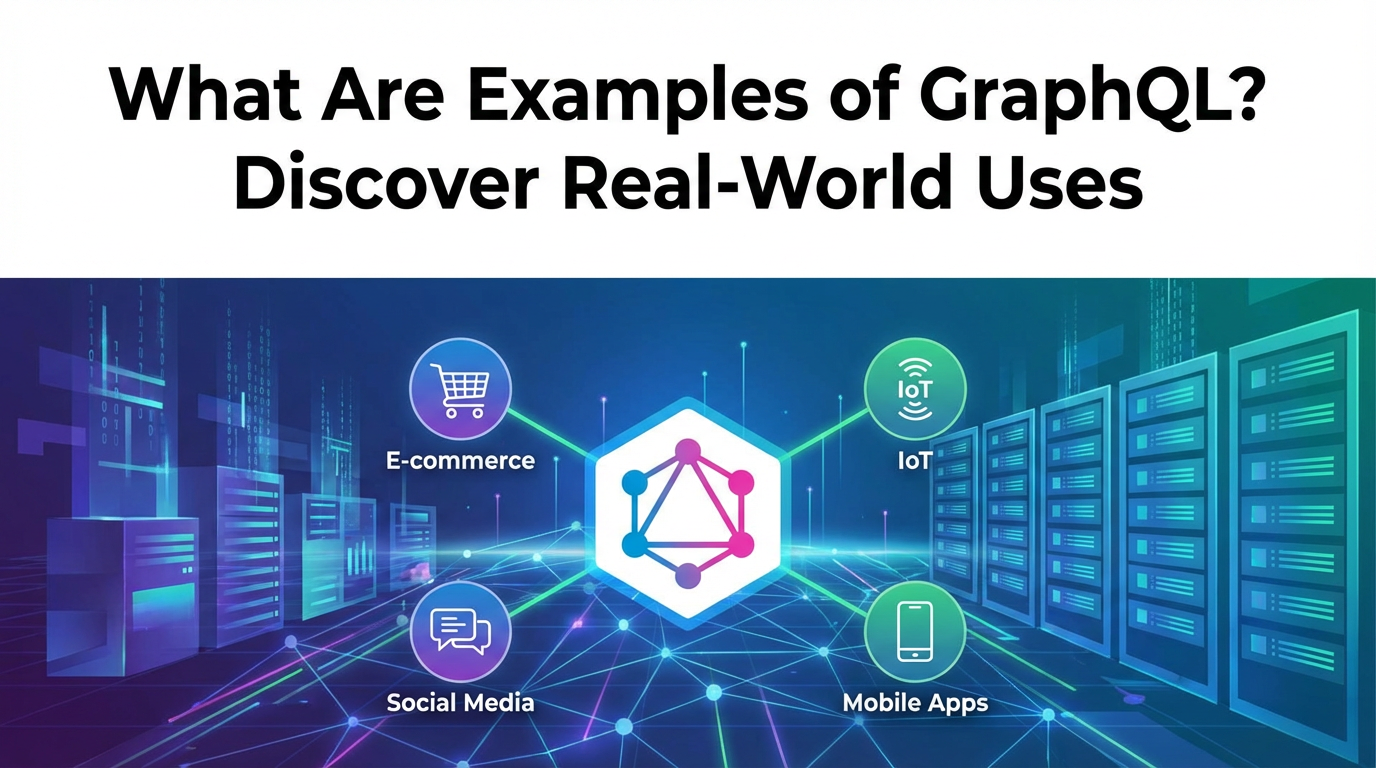
What Are Examples of GraphQL? Discover Real-World Uses


In the ever-evolving landscape of digital interaction, the way applications communicate and exchange data is paramount. For decades, Representational State Transfer, or REST, served as the dominant architectural style for building web services. Its simplicity and statelessness propelled countless innovations, forming the backbone of the internet as we know it. However, as applications grew more complex, user interfaces became richer, and mobile devices demanded more tailored data, developers began to encounter inherent limitations within the REST paradigm. The rigid structure of endpoints often led to inefficiencies – either over-fetching unnecessary data, thereby wasting bandwidth and increasing latency, or under-fetching, requiring multiple requests to assemble a single view, complicating client-side logic and straining server resources.
Enter GraphQL, a powerful query language for your API and a runtime for fulfilling those queries with your existing data. Conceived and open-sourced by Facebook in 2012, GraphQL emerged as a revolutionary approach to API design, promising to address the inefficiencies and inflexibility that had become increasingly apparent with traditional RESTful services. At its core, GraphQL empowers clients to request precisely the data they need, no more and no less, through a single, declarative query. This shift in control from the server to the client marked a significant paradigm change, fostering greater agility, enhancing developer experience, and unlocking new possibilities for application development across diverse platforms.
This comprehensive exploration delves deep into the essence of GraphQL, moving beyond theoretical definitions to uncover its practical applications and demonstrable benefits in the real world. We will dissect its fundamental concepts, illuminate its core advantages over conventional API architectures, and showcase compelling examples of its deployment across various industries, from social media giants and e-commerce platforms to cutting-edge FinTech solutions and the intricate world of microservices. Furthermore, we will address critical implementation considerations, best practices, and examine how GraphQL fits into the modern paradigm of AI-driven applications and complex distributed systems. By the end of this journey, you will gain a profound understanding of why GraphQL is not just a passing trend, but a foundational technology shaping the future of API development and data interaction.
Chapter 1: Understanding the Fundamentals of GraphQL
To truly appreciate the real-world utility of GraphQL, one must first grasp its underlying principles and architectural design. GraphQL is not a database technology, nor is it a replacement for your backend logic. Instead, it serves as a sophisticated intermediary, a powerful interface layer that sits between your client applications and your data sources, providing an intuitive and highly efficient means for data retrieval and manipulation. It defines a declarative way for clients to describe their data requirements, and a robust server-side runtime to fulfill those descriptions.
What is GraphQL? A Query Language and a Runtime
At its heart, GraphQL is a query language for your API. This means that instead of interacting with a multitude of predefined endpoints, each returning a fixed structure of data, a client sends a single query string to a GraphQL server. This query precisely describes the shape and content of the data the client needs. The server, equipped with a GraphQL schema, then parses this query, validates it against the schema, and executes a series of "resolvers" to fetch the requested data from various backend sources – databases, microservices, third-party API**s – before assembling it into a single, predictable JSON response.
Simultaneously, GraphQL is a runtime for fulfilling those queries. The GraphQL server acts as the central orchestrator. It receives a client's request, interprets the query, and intelligently delegates the work of fetching data for each specified field to the appropriate backend service or database. This intelligent orchestration is a cornerstone of GraphQL's power, allowing it to aggregate information from disparate sources into a unified response, all tailored exactly to the client's specifications. This approach fundamentally simplifies client-side data management, as applications no longer need to perform complex data joins or transformations after receiving multiple, fragmented responses from different REST endpoints.
Key Concepts: Building Blocks of a GraphQL API
Understanding the core components of a GraphQL API is crucial for both designing and interacting with it. These elements work in concert to provide its unique capabilities:
- Schema: The most critical component of any GraphQL API is its schema. Written in the GraphQL Schema Definition Language (SDL), the schema acts as a contract between the client and the server. It rigorously defines all the data types, fields, and operations (queries, mutations, subscriptions) that clients can perform. This strong typing and explicit declaration means the API is self-documenting, providing an immediate understanding of what data is available and how to access it. For instance, a schema might define a
Usertype with fields likeid,name,email, andposts, wherepostsitself might be a list ofPosttypes. This inherent structure guarantees data consistency and simplifies API exploration for developers. - Types and Fields: Within the schema, data is organized into types, much like objects in object-oriented programming. Each type has fields, which are specific pieces of data that can be queried. For example, a
Usertype might have anamefield of typeStringand anagefield of typeInt. GraphQL supports scalar types (String, Int, Float, Boolean, ID), object types, list types, and non-null types, providing a rich system for defining complex data structures. The precision with which these types and fields are defined allows clients to request exactly what they need, without concern for over-fetching. - Queries: Queries are the mechanism by which clients request data from the GraphQL server. They are read-only operations designed to fetch information. A client constructs a query that mirrors the structure of the data it desires, specifying not just the top-level entity but also the specific fields nested within that entity. For example, a query might ask for a
userbyid, but only require theirnameand thetitleof theirposts, rather than the entireUserobject and allPostdetails. This declarative nature is a hallmark of GraphQL's efficiency, ensuring minimal data transfer. - Mutations: While queries are for reading data, mutations are for writing, updating, or deleting data. Just like queries, mutations are explicitly defined in the schema and allow clients to send data to the server to perform actions. A mutation typically returns the updated state of the data, providing immediate feedback to the client. This consistent pattern for both reading and writing data simplifies client-side development and reduces ambiguity regarding the outcome of an operation. For example, a
createUsermutation might takenameandemailas input and return theidandnameof the newly created user. - Subscriptions: Subscriptions are a powerful feature that enables real-time data flow. They allow clients to subscribe to specific events on the server, receiving data updates automatically whenever that event occurs. This is particularly useful for applications requiring live data, such as chat applications, real-time dashboards, or notifications. When a client subscribes, a persistent connection (often WebSocket-based) is established, through which the server pushes data to the client in real-time, greatly simplifying the implementation of dynamic, responsive user interfaces.
How GraphQL Differs from REST: A Paradigm Shift
The fundamental differences between GraphQL and REST often lead to misunderstandings, yet they are crucial for appreciating GraphQL's distinct advantages. While both are architectural styles for building APIs, their philosophies diverge significantly:
- Single Endpoint vs. Multiple Endpoints: A core distinction is the number of endpoints. A traditional RESTful API typically exposes multiple endpoints, each representing a specific resource (e.g.,
/users,/products/123,/orders). To retrieve related data, clients often need to make multiple requests to different endpoints, leading to the "N+1 problem" on the client side. In contrast, a GraphQL API typically exposes a single endpoint (e.g.,/graphql). All client requests, regardless of their complexity or the variety of data they seek, are sent to this single endpoint. The GraphQL server then interprets the query and fetches the necessary data. - Declarative Data Fetching vs. Fixed Resource Structures: With REST, the server defines the structure of the data returned by each endpoint. Clients receive whatever the endpoint provides, even if they only need a subset of that information (over-fetching). Conversely, if an endpoint doesn't provide all the necessary data, the client must make additional requests (under-fetching). GraphQL champions declarative data fetching. Clients declare precisely what data fields they require, and the server responds with only that data. This precision is a fundamental efficiency gain, especially for mobile clients or applications with varied data needs.
- Strongly Typed Schema vs. Loosely Defined Contracts: GraphQL's schema provides a strong, explicit contract between the client and server. This schema acts as a single source of truth, detailing all available data types and operations. It facilitates automatic validation, enhances discoverability, and simplifies the development of robust tooling. REST APIs, while they can be documented (e.g., with OpenAPI/Swagger), often rely on less formal contracts, leading to more ambiguity and potential for client-server mismatches if documentation is not meticulously maintained.
- No Versioning (Typically) vs. Explicit Versioning: In REST, evolving an API often involves versioning (e.g.,
/v1/users,/v2/users) to avoid breaking existing clients when changes are introduced. This can lead to a proliferation of endpoints and maintenance overhead. GraphQL's extensible schema design largely mitigates the need for explicit versioning. New fields can be added to types without affecting existing queries, and old fields can be marked as deprecated, guiding developers towards newer alternatives without immediately breaking older clients. This allows for continuous evolution of the API without burdensome version management.
These fundamental differences highlight GraphQL's strategic advantage in modern application development, particularly where data fetching efficiency, developer agility, and the flexibility to accommodate diverse client needs are paramount.
Chapter 2: The Core Advantages of Adopting GraphQL in Practice
The theoretical underpinnings of GraphQL translate into tangible benefits that significantly impact the development process, application performance, and overall user experience. Moving beyond mere definitions, let's explore the practical advantages that drive organizations to adopt this powerful API technology.
Efficiency in Data Fetching: Eliminating Over-fetching and Under-fetching
One of the most compelling reasons for adopting GraphQL is its unparalleled efficiency in data fetching, directly addressing the endemic problems of over-fetching and under-fetching that plague many RESTful APIs.
Over-fetching, as the name suggests, occurs when a client receives more data than it actually needs for a particular view or operation. Imagine an e-commerce application displaying a list of products. A typical REST endpoint /products might return every detail for each product: name, price, description, images, reviews, stock quantity, and supplier information. If the product listing page only requires the product's name, price, and a thumbnail image, the client ends up downloading a substantial amount of extraneous data. This bloat translates to: * Increased Network Latency: More data takes longer to transmit, especially over slower mobile networks. * Higher Bandwidth Consumption: Users on metered connections consume more data unnecessarily, potentially incurring costs or hitting data caps. * Increased Client-Side Processing: The client application must then parse and filter out the unwanted data, adding unnecessary computational overhead.
GraphQL elegantly solves over-fetching by empowering the client to precisely specify the fields it requires. A client building a product list would simply query for products { name price thumbnailUrl }, and the GraphQL server would return only those fields, dramatically reducing payload size and improving loading times.
Conversely, under-fetching arises when a single API endpoint does not provide all the data necessary for a complete view, forcing the client to make multiple sequential or parallel requests. Consider a social media profile page. To display a user's basic information, their latest posts, and their friends list, a REST client might need to hit /users/{id}, then /users/{id}/posts, and finally /users/{id}/friends. This chain of requests introduces several issues: * Increased Round Trips: Each additional request incurs network overhead, multiplying latency. * Client-Side Data Aggregation Complexity: The client application becomes responsible for orchestrating these multiple requests, handling potential failures for each, and then combining the disparate pieces of data into a coherent view. This adds significant complexity to frontend development and error management. * Waterfall Effect: If requests are sequential, the total load time can become the sum of individual request times, leading to a noticeable delay for the end-user.
GraphQL resolves under-fetching by allowing clients to fetch all related data in a single request, regardless of its underlying source. The same social media client could send a single query like user(id: "123") { name email posts { title content } friends { name avatar } }. The GraphQL server, leveraging its resolvers, aggregates this data from various internal services (e.g., one service for user details, another for posts, a third for friendship graphs) and returns it in a single, well-structured JSON response. This drastically reduces network round trips and simplifies client-side data handling, leading to faster, more responsive applications.
Enhanced Developer Experience (DX) and Productivity
GraphQL's design inherently fosters a superior developer experience, leading to increased productivity for both frontend and backend teams.
- Self-Documenting API with Schemas: As discussed, the GraphQL schema serves as a comprehensive and authoritative contract. Any developer, whether a new team member or an external partner, can instantly understand the full capabilities of the API by inspecting its schema. Tools like GraphiQL or Apollo Studio provide interactive interfaces that automatically generate documentation from the schema, allowing developers to browse available types, fields, and operations, and even try out queries in real-time. This eliminates the need for external, often outdated, documentation and significantly shortens the learning curve. Developers spend less time guessing API structures and more time building features.
- Powerful Tooling Ecosystem: The GraphQL ecosystem is rich with powerful tools that enhance every stage of development.
- GraphiQL and GraphQL Playground: These in-browser IDEs provide an interactive environment for exploring schemas, writing queries, and viewing responses, complete with auto-completion, syntax highlighting, and error validation.
- Client Libraries (Apollo Client, Relay, URQL): These libraries simplify data fetching, caching, and state management on the client side. They integrate seamlessly with popular frontend frameworks like React, Vue, and Angular, providing features like declarative data binding, automatic UI updates, and intelligent caching strategies that dramatically reduce boilerplate code.
- Code Generation: Many GraphQL tools can automatically generate client-side code (e.g., TypeScript types) based on the schema, ensuring type safety across the entire stack and catching potential errors at compile time rather than runtime. This robust tooling accelerates development cycles and improves code quality.
- Rapid Prototyping and Iteration: The flexibility of GraphQL allows frontend and backend teams to iterate faster and more independently. Frontend developers can start building UI components even before the backend API is fully implemented, by simply mocking the expected GraphQL schema. As the backend evolves, new fields can be added to the schema without breaking existing client queries. This parallel development approach minimizes dependencies and allows teams to deliver features more quickly. Changes to data requirements on the frontend can often be accommodated by simply adjusting a query, rather than requiring backend changes or new REST endpoints.
Agility and Flexibility for Frontend Teams
GraphQL significantly empowers frontend teams by providing them with unprecedented control over data fetching, leading to greater agility and faster feature delivery.
- Decoupling Frontend from Backend Changes: In a REST architecture, a change to a backend resource might inadvertently affect multiple frontend applications that consume that resource. With GraphQL, as long as new fields are added non-destructively to the schema, existing client applications remain unaffected. Frontend teams can evolve their data needs independently, requesting new fields as their UI requires them, without coordinating with backend engineers for new endpoint deployments or modifications to existing ones. This loose coupling fosters greater autonomy for frontend teams.
- Tailored Data for Diverse UIs and Devices: Modern applications must cater to a myriad of devices (web, mobile, tablet, wearables) and varying user experiences. A single REST endpoint often returns a fixed data structure, meaning each client must adapt and filter that data, often leading to over-fetching on smaller devices or for simpler UIs. GraphQL allows each client to craft a query that precisely matches its specific UI requirements. A mobile app might fetch a minimal set of data for a list view, while a web dashboard might query for a richer dataset with more granular details, all from the same GraphQL API. This adaptability simplifies the development of multi-platform experiences and optimizes performance for each context.
- Reduced Backend Workload for Frontend-Driven Features: When a new UI feature requires data not currently exposed by a REST endpoint, it typically necessitates backend development to create a new endpoint or modify an existing one. With GraphQL, if the data exists somewhere in the backend systems and can be exposed through a resolver, the frontend team can often implement the new feature by simply extending their GraphQL query, without requiring any changes to the backend codebase. This shifts more control to the frontend, accelerating feature rollout and reducing coordination overhead.
Evolutionary APIs: Continuous Development Without Versioning Nightmares
The concept of "versioning" in API development is a common source of pain. Traditional RESTful APIs often resort to URL versioning (e.g., /v1/users, /v2/users) or header versioning to introduce breaking changes while maintaining compatibility with older clients. This leads to: * Maintenance of Multiple API Versions: The backend team must maintain, support, and document multiple versions of the same API, increasing operational complexity and resource consumption. * Forced Client Migrations: Eventually, old versions must be deprecated, forcing clients to upgrade, which can be a time-consuming and costly process for all involved. * Slow Innovation: The fear of breaking existing clients can stifle the introduction of new features or improvements to the API.
GraphQL offers a more graceful approach to API evolution. Its schema-driven nature means that: * Additive Changes are Non-Breaking: You can add new types, new fields to existing types, or new arguments to fields without impacting existing queries. Clients that don't ask for the new data simply won't receive it, and their existing queries continue to function seamlessly. This allows for continuous growth and enrichment of the API without forcing immediate client upgrades. * Deprecation Mechanism: When a field or type needs to be removed or replaced, it can be marked as @deprecated in the schema, along with a reason. This serves as a clear signal to developers using the API that the field should no longer be used. Tooling like GraphiQL can highlight deprecated fields, guiding developers to migrate their queries over time, rather than abruptly breaking their applications. This soft deprecation strategy provides a smooth transition path and avoids the hard breaks associated with traditional API versioning.
This ability to evolve an API incrementally and non-disruptively is a powerful advantage, significantly reducing the overhead associated with API lifecycle management and fostering a more agile development environment.
Consolidating Data Sources: The GraphQL Gateway as a Unifying Facade
In modern enterprise architectures, especially those built on microservices, data is often scattered across numerous disparate sources: multiple databases (SQL, NoSQL), specialized microservices, legacy systems, and third-party APIs. Aggregating this data for a single client view can be a daunting task. The client might need to make requests to five different services, each with its own authentication and data format, and then piece together the results. This leads to: * Client-Side Integration Complexity: The frontend becomes a complex integration layer, responsible for knowing about and interacting with many backend services. * Performance Bottlenecks: Coordinating multiple calls and waiting for all responses can introduce significant latency. * Security Concerns: Exposing multiple backend services directly to the client can increase the attack surface and complicate authentication/authorization.
GraphQL excels at addressing this challenge by acting as a powerful API gateway or a unified facade. A single GraphQL server can be configured to: * Abstract Multiple Backends: Each field in the GraphQL schema can be resolved by a different backend service or data source. For example, user.profile might come from a UserService, user.orders from an OrderService, and user.reviews from a ReviewService. The client remains oblivious to these underlying complexities, interacting only with the single, coherent GraphQL schema. * Centralize Data Access Logic: The GraphQL server becomes the single point of contact for data access, centralizing authentication, authorization, caching, and logging concerns. It orchestrates the calls to various backend services, handles data transformations if necessary, and aggregates the results into a single, client-friendly response. * Simplify Client Integration: Frontend developers only need to understand the GraphQL schema and how to construct queries. They are shielded from the intricacies of the underlying microservices architecture, allowing them to focus purely on building user interfaces and features.
This consolidation capability makes GraphQL an ideal choice for organizations transitioning to or operating within a microservices architecture, effectively solving the "data stitching" problem and simplifying the data layer for client applications.
Chapter 3: Real-World Applications Across Industries
The theoretical advantages of GraphQL translate into concrete benefits when deployed in production environments. From powering social media feeds to orchestrating complex financial data, GraphQL has found a robust foothold across diverse industries. Let's explore some prominent real-world examples and use cases.
Social Media & Content Platforms: Powering Dynamic User Experiences
Perhaps the most famous origin story of GraphQL is its genesis at Facebook. Faced with the immense challenge of serving a vast, interconnected, and constantly evolving graph of data – users, posts, comments, reactions, pages, groups – to a multitude of clients (web, iOS, Android) with varying data needs, Facebook developed GraphQL to solve its own scaling and development challenges.
- Facebook's News Feed: The News Feed is a prime example. It’s a highly dynamic component, composed of various types of stories (status updates, photos, videos, links), each with different associated data (author, timestamp, likes, comments, shares, location, privacy settings). Traditional REST would require multiple requests or a very complex, over-fetching endpoint to construct a single feed item, let alone an entire feed. With GraphQL, a client can issue a single query describing the exact structure and fields needed for each type of story, optimizing data transfer. For instance, a mobile client might only need the author's name and profile picture, the post text, and a count of likes, while a desktop client might fetch more extensive details.
- Instagram's Mobile App: Instagram, another Facebook-owned entity, heavily leverages GraphQL to power its mobile applications. When a user scrolls through their feed, the app fetches posts, user profiles, comments, and follower counts. When viewing a specific post, it might fetch more detailed information about that post, its comments, and the user who posted it. GraphQL allows the Instagram app to fetch precisely the right data for each screen and interaction, optimizing performance on mobile networks, minimizing battery drain, and ensuring a fluid user experience. The declarative nature of GraphQL queries simplifies the complex data requirements for features like user profiles, direct messages, and story feeds, which are all inherently graph-like.
- Netflix (and similar streaming services): While Netflix's architecture is complex and multi-faceted, the challenges they face regarding personalized recommendations, user profiles, content metadata, and diverse device support are perfectly suited for GraphQL. Imagine the query for a user's homepage: it needs their viewing history, personalized recommendations (grouped by genre, popularity, "continue watching"), watchlists, and perhaps new releases. Each of these elements might come from different backend services. A GraphQL API could act as the aggregation layer, allowing the client to fetch all this diverse data in a single, optimized query, ensuring a fast and personalized loading experience across smart TVs, web browsers, and mobile devices. This flexibility is crucial for delivering tailored content without creating an explosion of specific REST endpoints for every possible combination of user preference and device capability.
E-commerce: Building Dynamic and Personalized Shopping Experiences
E-commerce platforms inherently deal with a vast graph of interconnected data: products, categories, users, orders, reviews, payment methods, shipping information, and personalized recommendations. GraphQL provides a powerful framework for managing this complexity and delivering rich, responsive shopping experiences.
- Product Catalogs and Detail Pages: Displaying a product detail page often requires pulling information from numerous sources: basic product data (name, description, price, SKU), images, inventory levels, customer reviews, related products, and shipping options. A GraphQL query can fetch all this information in one go. For a product listing page, a simpler query can fetch only the necessary display fields. This flexibility ensures that clients receive precisely what they need, optimizing load times, especially important for conversion rates. When a user applies filters or sorts, GraphQL queries can be dynamically constructed to reflect these choices, fetching only the relevant subset of the catalog.
- Shopping Carts and Checkout Flows: Managing a shopping cart involves complex interactions: adding/removing items, updating quantities, applying discounts, checking stock, and calculating totals. The checkout process then requires user details, shipping addresses, payment information, and order confirmation. Each step might involve different backend services. A GraphQL API can abstract these complexities, allowing the client to manage the cart state and progress through checkout with a series of mutations and queries, all through a unified interface. For example, a mutation
addToCart(productId: "xyz", quantity: 1)might return the updated cart total and number of items. - User Accounts and Order History: Customers expect to view their order history, track shipments, manage their profile details, and handle payment methods. A GraphQL API can provide a single point of access for all these user-centric data points, allowing clients to query for specific order details, update addresses, or retrieve past purchase information efficiently. This enhances the user experience by providing a coherent view of their account data, even if it's sourced from multiple backend microservices (e.g.,
UserService,OrderService,PaymentService).
Mobile Development: Optimizing for Performance and Diverse Devices
Mobile applications face unique challenges: limited network bandwidth, intermittent connectivity, varying screen sizes, and the need for highly optimized data payloads to conserve battery and data plans. GraphQL is exceptionally well-suited to address these constraints.
- Tailored Payloads for Mobile-First Experiences: Mobile apps often need less data than their web counterparts to render a specific view. For example, a news app's list view might only need a headline and a small thumbnail, while the detail view needs the full article text and multiple images. GraphQL allows the mobile client to request precisely these minimal or expanded datasets, eliminating the overhead of over-fetching. This significantly reduces the size of data transmitted over the network, leading to faster loading times and reduced data consumption, which are critical for a positive mobile user experience.
- Offline First with Client-Side Caching: Client-side GraphQL libraries like Apollo Client offer robust caching mechanisms. By fetching data declaratively, the client can easily manage a normalized cache of data, reducing the need for repeated network requests for the same information. This not only speeds up subsequent data access but also lays a strong foundation for "offline-first" strategies, where cached data can be displayed even without an active network connection, improving resilience and user experience in areas with poor connectivity.
- Subscriptions for Real-time Updates: For features like live chat, notification feeds, or real-time score updates in a sports app, GraphQL subscriptions provide a seamless mechanism to push updates to mobile devices. Instead of polling the server inefficiently, the mobile app can subscribe to specific events and receive instant, targeted data updates, leading to a much more responsive and engaging user experience while conserving battery by avoiding constant requests.
Fintech & Enterprise Systems: Aggregating Complex Data and Enabling Analytics
Financial technology (Fintech) and large enterprise systems are characterized by extreme data complexity, often involving legacy systems, stringent security requirements, and the need to aggregate information from numerous internal and external sources for dashboards, reports, and transactional processes. GraphQL offers significant advantages here.
- Aggregating Data from Disparate Legacy Systems: Many large enterprises operate with a patchwork of legacy systems, each with its own data store and APIs (or lack thereof). Building new applications on top of this can be incredibly challenging. A GraphQL layer can act as a powerful abstraction, a unified API gateway that sits in front of these legacy systems, normalizing their data and presenting a consistent, modern interface to new client applications. This allows organizations to build innovative features without undertaking costly and risky "rip and replace" projects for their core infrastructure. For example, a GraphQL server could fetch customer details from a mainframe, transaction history from an RDBMS, and credit scores from a third-party service, all exposed as a single
CustomerProfiletype. - Complex Dashboards and Reporting: Financial dashboards often require highly specific subsets of data, aggregated and filtered in various ways to provide insights into market trends, portfolio performance, or operational metrics. The dynamic nature of these requirements makes traditional REST endpoints difficult to maintain, often leading to a proliferation of bespoke endpoints. GraphQL allows dashboard clients to construct highly granular queries, pulling exactly the data points needed for each widget or report, dramatically simplifying the backend logic and improving the flexibility of the reporting layer. This also reduces the burden on backend teams to create and maintain specific endpoints for every possible reporting permutation.
- Security Considerations and Access Control: While GraphQL provides flexible data access, it also offers robust mechanisms for implementing fine-grained access control. Resolvers can be equipped with authorization logic that checks user roles and permissions before fetching data for specific fields. This means that even if a field is defined in the schema, a user without the appropriate permissions will simply receive a null value or an access denied error for that field, ensuring data security and compliance. This granular control is crucial in highly regulated industries like finance.
IoT & Real-time Applications: Streamlining Device Interaction and Data Flow
The Internet of Things (IoT) generates vast amounts of real-time data from countless devices, ranging from smart home sensors to industrial machinery. Managing, querying, and reacting to this data in real-time is a significant challenge.
- Real-time Sensor Data and Device Status Updates: For applications monitoring IoT devices, such as smart city infrastructure or factory automation, GraphQL subscriptions are a game-changer. Devices can push status updates (e.g., temperature, humidity, power consumption) to the GraphQL server, which then broadcasts these updates to all subscribed clients. This enables real-time dashboards, alerts, and automated responses. Clients can subscribe to specific device types or individual device IDs, receiving only the updates relevant to them, optimizing network usage and client-side processing.
- Command and Control: Beyond data consumption, IoT often involves sending commands to devices (e.g., turning a light on/off, adjusting a thermostat). GraphQL mutations can be used for these command-and-control operations, providing a consistent and auditable interface for device interaction. For instance, a
setLightStatus(id: "123", isOn: true)mutation could be triggered from a mobile app, securely sending the command to the appropriate device. - Simplified Data Aggregation from Diverse Devices: An IoT platform might integrate data from various types of sensors, each emitting different data formats. A GraphQL schema can normalize and unify this diverse data, presenting a consistent model to client applications, regardless of the underlying device specifics. This simplifies the development of universal IoT management interfaces and analytical tools.
API Gateways and Microservices Architecture: A Synergistic Partnership
The rise of microservices architecture has brought immense benefits in terms of scalability, resilience, and independent team development. However, it also introduces complexity at the client-facing layer. A client application might need to interact with dozens of distinct microservices to assemble a single screen, leading to client-side complexity and performance issues. This is where API gateways become indispensable, and GraphQL often plays a pivotal role within them.
An API gateway acts as a single entry point for all client requests, routing them to the appropriate backend services. It centralizes cross-cutting concerns such as authentication, authorization, rate limiting, logging, and caching. In a microservices environment, a GraphQL server can function as an incredibly powerful type of API gateway, often referred to as a "GraphQL Gateway" or "GraphQL Federation Layer."
- Unified Facade for Microservices: Instead of clients directly calling multiple microservices, they interact with a single GraphQL endpoint. The GraphQL server then orchestrates calls to the relevant microservices, aggregates their responses, and shapes the data according to the client's query. This shields clients from the intricacies of the underlying microservices topology, simplifying frontend development and improving the maintainability of the overall system. Each field in the GraphQL schema can map to a specific microservice, allowing for seamless data stitching from disparate sources.
- Enhanced Security and Control: When a GraphQL API sits behind an API gateway, it benefits from the gateway's robust security features. The gateway can enforce authentication policies, apply rate limiting to prevent abuse, and implement advanced authorization rules before requests even reach the GraphQL server. This adds an extra layer of protection, ensuring that only legitimate and authorized traffic accesses the backend services. Furthermore, the gateway can provide granular traffic management, load balancing, and circuit breaking capabilities for the underlying microservices, enhancing the overall resilience of the system.
- Streamlined API Management: In such complex architectures, robust API management solutions become indispensable. While GraphQL simplifies data fetching for clients, managing the underlying infrastructure, security, and performance of the APIs that power it remains crucial. A robust gateway can provide a unified entry point, handle authentication, authorization, rate limiting, and observability for all your APIs, whether they are traditional REST or modern GraphQL endpoints. For organizations looking to streamline the management of their diverse API landscape, especially in an AI-driven world, platforms like ApiPark offer a comprehensive open-source AI gateway and API management solution. APIPark helps developers and enterprises manage, integrate, and deploy various services, ensuring that the critical infrastructure supporting your GraphQL implementation is robust, secure, and performant. With features for end-to-end API lifecycle management, traffic forwarding, load balancing, and detailed API call logging, APIPark ensures that even the most intricate GraphQL architectures are secure, scalable, and easy to maintain. This includes the ability to manage access permissions, monitor performance, and analyze call data to proactively identify and address potential issues, offering a comprehensive governance layer over your entire API ecosystem.
APIPark is a high-performance AI gateway that allows you to securely access the most comprehensive LLM APIs globally on the APIPark platform, including OpenAI, Anthropic, Mistral, Llama2, Google Gemini, and more.Try APIPark now! 👇👇👇
Chapter 4: Implementing GraphQL: Key Considerations & Best Practices
Adopting GraphQL is not merely about choosing a technology; it involves a shift in mindset and a commitment to certain design principles. Successful implementation requires careful consideration of schema design, performance optimization, security, and leveraging the rich tooling ecosystem.
Schema Design: The Heart of Your GraphQL API
The GraphQL schema is the single most critical component of your API. It defines the entire surface area of your data graph and dictates how clients will interact with it. A well-designed schema is intuitive, consistent, and extensible, while a poorly designed one can lead to confusion, inefficiency, and difficulties in evolution.
- Think in Graphs, Not Endpoints: Instead of thinking about isolated resources like
/usersor/products, think about the relationships between entities. How do users relate to orders? How do products relate to categories and reviews? Your schema should naturally reflect these connections, allowing clients to traverse the graph of your data. - Prioritize Client Needs: Design your schema from the perspective of the client applications that will consume it. What data do they need? How do they typically combine information? This client-driven approach helps ensure that the schema is practical and efficient. For example, if clients frequently need a user's
emailandphone_numbertogether, these should be direct fields on theUsertype, rather than requiring separate queries. - Modularity and Reusability: Break down your schema into smaller, manageable pieces (e.g., separate files for different domains like
User.graphql,Product.graphql). Use interfaces and unions to define shared behaviors and polymorphic types, promoting reusability and reducing duplication. - Clear Naming Conventions: Adopt consistent and descriptive naming conventions for types, fields, and arguments. Use singular nouns for types (e.g.,
User,Product) and descriptive names for fields (e.g.,firstNameinstead off_name). This greatly enhances readability and discoverability. - Documentation: Leverage the schema's ability to document itself. Add descriptions to types, fields, arguments, and enum values. This embedded documentation is automatically exposed by tools like GraphiQL, making your API truly self-documenting.
Performance Optimization: Taming the Data Graph
While GraphQL inherently offers efficiency benefits, proper performance optimization is crucial, especially when dealing with large datasets or complex queries.
- The N+1 Problem and Data Loaders: The "N+1 problem" is a common performance pitfall in GraphQL. It occurs when a resolver for a list of items (e.g., a list of
users) then makes a separate database query for a related piece of data for each item (e.g., fetching thepostsfor eachuserindividually). If you have N users, this results in 1 query for users + N queries for posts, leading to N+1 database round trips.- Solution: DataLoader: The
DataLoaderpattern (or similar batching and caching mechanisms) is the standard solution. It batches multiple individual requests for data into a single request to the backend service or database, and then caches the results for subsequent requests within the same GraphQL query. For instance, instead of querying for each user's posts separately, DataLoader gathers all user IDs requested in a single query execution and fetches all posts for those user IDs in one efficient batch query, significantly reducing database load and improving response times.
- Solution: DataLoader: The
- Caching Strategies: Implement caching at various layers:
- Client-Side Caching: GraphQL client libraries like Apollo Client provide intelligent, normalized caches that store query results and automatically update UI components when underlying data changes. This reduces network requests for previously fetched data.
- Server-Side Caching: Cache frequently accessed data at the GraphQL server layer (e.g., using Redis) or within the backend microservices. Consider techniques like query caching (caching the full response of a specific query) or fragment caching (caching parts of the response).
- HTTP Caching: For the GraphQL endpoint itself, traditional HTTP caching mechanisms (like CDN caching) can be challenging due to the single endpoint and dynamic queries. However, a well-configured API gateway can implement caching strategies at the gateway layer based on specific query hashes or operations, optimizing responses for common queries.
- Query Complexity Analysis and Throttling: Complex GraphQL queries, especially those with deeply nested fields or large lists, can be resource-intensive. Implement query complexity analysis to calculate a "cost" for each incoming query based on its depth, number of fields, and expected result size. If a query exceeds a predefined complexity threshold, it can be rejected or throttled. This prevents malicious or accidental denial-of-service attacks and protects your backend resources. An API gateway can also assist here by applying general rate limiting and throttling policies before queries reach the GraphQL server.
- Persisted Queries: For public or frequently used queries, consider using persisted queries. Instead of sending the full query string over the network, clients send a unique ID that corresponds to a pre-registered query on the server. This reduces network payload size and can improve security by limiting the types of queries that can be executed.
Security: Protecting Your Data Graph
Security is paramount for any API, and GraphQL is no exception. While it offers flexibility, it also requires careful attention to security best practices.
- Authentication: Integrate your existing authentication mechanisms (e.g., JWT, OAuth) with your GraphQL server. Typically, authentication tokens are sent in the
Authorizationheader, and the GraphQL server validates these tokens to identify the requesting user. - Authorization (Access Control): Implement granular authorization checks at the resolver level. Each resolver function should verify if the authenticated user has the necessary permissions to access the requested data field or perform a mutation. For example, a user might be able to view their own profile but not edit another user's profile. Role-Based Access Control (RBAC) and Attribute-Based Access Control (ABAC) can be effectively implemented within your resolvers.
- Rate Limiting and Throttling: Prevent abuse and denial-of-service attacks by implementing rate limiting. Limit the number of requests a client can make within a certain time frame. This can be done at the GraphQL server level (e.g., based on query depth or complexity) or, more effectively, at the API gateway layer, which can apply global limits across all your APIs.
- Input Validation: Thoroughly validate all input arguments for mutations and queries. Ensure that data types, formats, and values conform to expected norms to prevent injection attacks (SQL injection, XSS) and data corruption.
- Error Handling: Provide informative but not overly verbose error messages. Avoid exposing sensitive internal details (e.g., stack traces, database schema errors) in production error responses. Use standardized error formats to make client-side error handling easier.
- Disable Introspection in Production: GraphQL's introspection feature allows clients to discover the schema. While invaluable for development, it can be disabled in production environments to slightly reduce the attack surface, although many argue the security benefit is minimal compared to the loss of tooling convenience.
Error Handling: Providing Clarity and Consistency
Effective error handling is crucial for both developers consuming your API and for debugging your backend services. GraphQL offers a structured approach to errors.
- Structured Error Responses: GraphQL provides a dedicated
errorsfield in the response for communication of issues. Each error object typically includes amessage,locations(indicating where in the query the error occurred), and optionalextensionsfor custom error codes or additional context. - Partial Success: A key advantage is that a GraphQL response can contain both data and errors. If one part of a complex query fails (e.g., fetching a user's
posts), other successful parts (e.g., fetching the user'snameandemail) can still be returned. This allows clients to render partial UIs or handle failures more gracefully than an all-or-nothing REST response. - Custom Error Types: Define custom error types and codes within your
extensionsfield to provide more specific, machine-readable information about the nature of the error (e.g.,UNAUTHENTICATED,PERMISSION_DENIED,VALIDATION_ERROR). This simplifies client-side error processing and internationalization of error messages.
Versioning (or lack thereof): A Graceful Evolution
As previously discussed, GraphQL's schema-driven nature significantly reduces the need for explicit API versioning.
- Additive-Only Changes: The primary strategy for evolving a GraphQL API is to make additive-only changes. You can add new fields, types, or arguments without breaking existing clients. This allows your API to grow organically.
- Deprecation: When a field or type is no longer recommended or needs to be replaced, mark it as
@deprecatedin the schema. Provide areasonfor the deprecation (e.g., "UsefullNameinstead offirstNameandlastName"). This guides client developers to update their queries over time without a hard break. Most GraphQL tools will highlight deprecated fields, making the transition seamless. - Schema Stitching/Federation for Major Overhauls: For very large or fundamentally restructuring changes, techniques like Schema Stitching or Apollo Federation can be employed. These allow you to compose a single "supergraph" from multiple smaller GraphQL services (subgraphs). This provides a way to refactor or introduce entirely new parts of your API while still presenting a unified view to clients, offering a powerful strategy for large-scale API evolution.
Tooling Ecosystem: A Developer's Best Friend
The robust and ever-growing GraphQL tooling ecosystem is a significant factor in its widespread adoption and developer appeal.
- Client Libraries:
- Apollo Client: A feature-rich, community-driven client for JavaScript frameworks (React, Vue, Angular). Offers powerful caching, state management, declarative data fetching, and integrations with numerous GraphQL features.
- Relay: Developed by Facebook, optimized for React applications with strong compile-time guarantees and performance optimizations, often used in large-scale applications with predictable data flows.
- URQL: A lighter, more flexible, and highly customizable client for React and Vue, focusing on performance and extensibility.
- Many other clients exist for various languages (Swift, Kotlin, Python, etc.).
- Server Implementations: Libraries and frameworks for building GraphQL servers exist in almost every popular programming language (Node.js/Apollo Server, Python/Graphene, Ruby/GraphQL-Ruby, Java/GraphQL-Java, Go/gqlgen, etc.).
- Developer Tools:
- GraphiQL/GraphQL Playground: In-browser IDEs for exploring schemas, writing and testing queries, and viewing responses. Essential for both development and API documentation.
- VS Code Extensions: Provide syntax highlighting, auto-completion, and schema validation directly within your code editor.
- Backend as a Service (BaaS) and Headless CMS:
- Hasura: Instantly gives you a real-time GraphQL API over your PostgreSQL database, handling data fetching, mutations, and subscriptions with minimal setup.
- Prisma: A next-generation ORM that turns your database into a GraphQL-friendly data layer.
- Many Headless CMS platforms (e.g., Strapi, Contentful) now offer GraphQL APIs out of the box, simplifying content delivery.
Leveraging these tools effectively can dramatically accelerate GraphQL development, reduce boilerplate, and improve the quality and maintainability of your APIs.
Here's a comparison table summarizing key differences between REST and GraphQL:
| Feature | REST (Representational State Transfer) | GraphQL (Graph Query Language) |
|---|---|---|
| Architectural Style | Resource-based, multiple endpoints, verb-oriented (GET, POST, PUT, DELETE) | Schema-based, single endpoint, query-oriented |
| Data Fetching | Client gets fixed data structures from predefined endpoints. Leads to over-fetching or under-fetching. | Client specifies exact data fields needed. Eliminates over-fetching and under-fetching. |
| Number of Requests | Often requires multiple requests to different endpoints to fetch related data. | Typically a single request to fetch all required data, regardless of complexity. |
| API Versioning | Common practice (e.g., /v1/users, /v2/users) to manage breaking changes. |
Achieved through additive changes and @deprecated directives in the schema, minimizing explicit versioning. |
| Data Structure | Relies on resource URLs and HTTP methods. Data usually returned as full resources. | Strongly typed schema defines all available data, types, and relationships. Data returned as a graph. |
| Developer Experience | Can require extensive external documentation. Less predictable response structures. | Self-documenting schema. Excellent tooling (GraphiQL, client libraries) for exploration and development. |
| Real-time Capabilities | Typically uses long polling, WebSockets (separate endpoint), or server-sent events for real-time. | Built-in subscriptions for real-time data push over a single connection (often WebSockets). |
| Error Handling | HTTP status codes (200, 404, 500) and custom error bodies. All-or-nothing responses. | Errors communicated in the errors field of the response, alongside partial data. Structured error objects. |
| Complexity for Client | Client manages multiple endpoints, potentially complex data aggregation logic. | Client sends a single query, server handles data aggregation from various sources. |
| Caching | Well-understood HTTP caching mechanisms (CDNs, browser cache) for resource endpoints. | Client-side normalized caching is very powerful. Server-side caching more complex due to dynamic queries. |
| Microservices Integration | Each microservice often exposes its own REST API, requiring client or an API gateway to compose. | Can act as a unified API gateway (GraphQL Federation) to stitch multiple microservices into a single graph. |
Chapter 5: GraphQL in the Era of AI and Microservices
The digital landscape is increasingly characterized by the pervasive influence of Artificial Intelligence (AI) and the architectural paradigm of microservices. These two forces are transforming how applications are built and how data is consumed. GraphQL finds a powerful and synergistic role within this modern ecosystem, acting as an enabler for both AI-driven applications and the efficient management of distributed systems.
How GraphQL Complements Microservices: A Unified Facade
Microservices architecture, by decomposing monolithic applications into smaller, independently deployable services, offers unparalleled benefits in terms of scalability, resilience, and team autonomy. However, this modularity can introduce challenges at the API consumption layer. A single client application might need to interact with a multitude of backend microservices, each potentially having its own data model, authentication mechanism, and communication protocol. This "chatty" client-to-services interaction leads to: * Increased Network Latency: Multiple round trips between the client and various services. * Client-Side Aggregation Logic: The client becomes burdened with orchestrating multiple calls and stitching together disparate data, increasing frontend complexity. * Tight Coupling: Changes in underlying microservice APIs can potentially break clients directly consuming them.
GraphQL serves as an ideal solution to these challenges by providing a unified facade or API gateway layer over a microservices architecture. Instead of directly calling individual microservices, clients interact with a single GraphQL server. This server, acting as a "gateway" or "aggregator," then: * Orchestrates Backend Calls: The GraphQL server intelligently dispatches requests to the appropriate microservices based on the fields requested in the client's query. * Aggregates Data: It collects data from various services, performs any necessary transformations or data stitching, and composes a single, tailored response for the client. * Decouples Clients from Microservices: Clients are shielded from the complexities of the microservices landscape. They only need to understand the unified GraphQL schema, not the individual APIs of dozens of backend services. This promotes greater independence for frontend teams and allows backend microservices to evolve without directly impacting client applications. * Centralizes Cross-Cutting Concerns: The GraphQL gateway can centralize concerns like authentication, authorization, logging, and caching, ensuring consistency across all data access patterns, regardless of which microservice ultimately provides the data.
This architectural pattern, often implemented using GraphQL Federation or Schema Stitching, empowers organizations to fully leverage the benefits of microservices while simplifying data consumption for client applications, resulting in faster development cycles and more robust, scalable systems.
The Role of GraphQL in Data Aggregation for AI/ML Models
Artificial Intelligence and Machine Learning (AI/ML) models are data-hungry. Training these models, extracting features, and serving inferences often require access to vast and diverse datasets, which are typically scattered across different databases, data lakes, and streaming platforms. GraphQL can play a significant role in streamlining this data aggregation process:
- Feature Stores and Data Preparation: In ML pipelines, creating "feature stores" – centralized repositories of pre-computed features for models – is crucial. GraphQL can provide a flexible API for data scientists and ML engineers to query and aggregate these features from various sources. Instead of writing complex SQL queries or dealing with multiple APIs, they can use GraphQL to fetch precisely the features needed for model training or inference, dramatically simplifying data access. For instance, a data scientist might query for
userFeatures(userId: "abc") { age recentPurchases { category value } browsingHistory { productIds } }. - Real-time Inference Data: When models need to perform real-time inference (e.g., personalized recommendations, fraud detection), they often require fresh input data. GraphQL subscriptions can be used to push real-time updates of relevant data (e.g., user activity, market events) to inference services, ensuring models operate on the most current information. Mutations can also be used to feed model predictions back into the system.
- Standardizing Data Access for AI/ML Microservices: As AI/ML capabilities become more modularized (e.g., separate microservices for sentiment analysis, image recognition, recommendation engines), a GraphQL layer can provide a unified API for consuming these AI services. An application might query for
product(id: "xyz") { name description reviews { text sentiment(model: "basic") } }. Here, thesentimentfield could be resolved by calling an independent sentiment analysis microservice, abstracting its implementation details from the client.
By offering a flexible and precise way to query and aggregate data from diverse sources, GraphQL empowers data scientists and AI engineers to spend less time on data plumbing and more time on building and deploying intelligent models.
Managing API Complexity in the AI Era: The Indispensable API Gateway
The convergence of microservices, AI, and the proliferation of various API protocols (REST, GraphQL, gRPC) introduces unprecedented complexity in API management. Organizations are not just building more APIs; they are building more types of APIs, consuming more third-party APIs, and exposing more internal services to external partners. In this highly dynamic environment, the role of a sophisticated API gateway becomes not just beneficial, but indispensable.
A modern API gateway serves as the control plane for your entire API ecosystem, addressing critical concerns that extend far beyond simple request routing:
- Unified Access and Discovery: A central gateway provides a single entry point and a unified catalog for all your APIs, regardless of their underlying implementation or protocol. This simplifies API discovery for developers and ensures consistent access patterns.
- Security and Threat Protection: This is perhaps the most critical function. An API gateway enforces robust security policies, including authentication (OAuth, JWT), authorization (RBAC, ABAC), rate limiting, and input validation. It acts as the first line of defense against common web attacks (e.g., SQL injection, XSS) and can identify and block malicious traffic before it reaches your backend services. In an AI context, this means protecting sensitive data used by models and preventing unauthorized access to inference endpoints.
- Traffic Management and Scalability: A gateway handles load balancing, traffic shaping, and intelligent routing to ensure high availability and optimal performance. It can implement circuit breakers and retries to enhance resilience in microservices architectures. For AI services, which can be computationally intensive, a gateway can intelligently route requests to available GPU instances or manage queues to prevent overloading.
- Observability and Analytics: Comprehensive logging, monitoring, and analytics capabilities are essential. An API gateway captures every detail of API calls – latency, errors, usage patterns, and user behavior. This data is invaluable for troubleshooting, performance tuning, capacity planning, and understanding how your APIs are being consumed, providing critical insights into the health of your systems and the effectiveness of your AI services.
- Developer Portal and Lifecycle Management: Many advanced API gateways offer integrated developer portals where developers can discover, subscribe to, and test APIs. They also facilitate end-to-end API lifecycle management, from design and publication to deprecation, ensuring governance and control over your entire API portfolio.
In this context, platforms like ApiPark emerge as crucial tools. As an open-source AI gateway and API management platform, ApiPark is specifically designed to manage, integrate, and deploy AI and REST services with ease. It offers features like quick integration of 100+ AI models, unified API format for AI invocation, prompt encapsulation into REST APIs, and end-to-end API lifecycle management. By providing independent API and access permissions for each tenant, supporting subscription approval features, and delivering performance rivaling Nginx (over 20,000 TPS on an 8-core CPU), ApiPark directly addresses the challenges of managing complex, high-performance APIs in an AI-driven, microservices environment. Its detailed API call logging and powerful data analysis capabilities provide the deep insights necessary to ensure system stability, security, and optimize for preventive maintenance. Ultimately, solutions like ApiPark are essential for governing the increasingly intricate web of APIs that power modern applications, ensuring they are secure, efficient, and well-managed from design to deployment.
Conclusion
The journey through the landscape of GraphQL has revealed a powerful and transformative technology that is fundamentally reshaping how applications interact with data. From its origins at Facebook, addressing the inefficiencies of traditional RESTful APIs, GraphQL has matured into a robust standard, offering a declarative, client-driven approach to data fetching that addresses the complexities of modern, interconnected systems.
We've explored its foundational concepts – the expressive power of queries, mutations, and subscriptions, all governed by a strongly typed schema – which together provide a self-documenting and highly flexible API surface. The core advantages of GraphQL are clear: the elimination of over-fetching and under-fetching optimizes network usage and client-side processing, leading to faster, more responsive applications. Its schema-driven nature fosters an unparalleled developer experience, complete with intuitive tooling and rapid iteration capabilities. Furthermore, GraphQL’s graceful evolution strategy largely bypasses the painful versioning dilemmas common in traditional APIs, allowing for continuous, non-disruptive growth. Crucially, its ability to act as a unifying facade over disparate backend services, especially in microservices architectures, significantly simplifies client-side integration and centralizes data access logic.
The real-world examples across diverse industries underscore GraphQL's versatility and impact. Social media giants leverage it to power dynamic, personalized feeds and profiles. E-commerce platforms utilize it to deliver rich product catalogs and streamlined checkout experiences. Mobile applications benefit from its tailored data payloads, optimizing for limited bandwidth and diverse device requirements. In the complex domains of Fintech and enterprise systems, GraphQL acts as an essential aggregation layer for legacy data and sophisticated dashboards. Even in the emerging field of IoT, subscriptions offer real-time data flow and control over connected devices.
Finally, we delved into the critical considerations for successful GraphQL implementation, emphasizing the importance of thoughtful schema design, strategic performance optimizations like DataLoader, robust security measures, and consistent error handling. In the era of microservices and pervasive AI, the role of a sophisticated API gateway becomes paramount. Such a gateway, whether it directly implements GraphQL or provides a management layer for GraphQL endpoints, is essential for securing, scaling, and observing the intricate web of APIs that power our digital world. Platforms like ApiPark exemplify how an advanced API gateway can provide the necessary governance, performance, and analytical capabilities to manage this complexity, enabling organizations to confidently build and deploy high-performing, secure, and intelligent applications.
In essence, GraphQL is more than just an API technology; it's an architectural philosophy that empowers developers to build highly efficient, flexible, and scalable applications. Its adoption signifies a maturation in API design, moving towards more collaborative and client-centric data interactions. As applications continue to grow in complexity and data sources proliferate, GraphQL stands as a critical tool, ensuring that developers can effectively harness the power of their data, build exceptional user experiences, and navigate the challenges of the modern digital landscape with greater agility and confidence.
Frequently Asked Questions (FAQs)
1. What is the fundamental difference between GraphQL and REST APIs? The most fundamental difference lies in how data is fetched. REST APIs typically expose multiple endpoints, each returning a fixed structure of data for a specific resource (e.g., /users, /products). Clients often need to make multiple requests or receive more data than needed (over-fetching). GraphQL, conversely, uses a single endpoint and allows clients to send precise queries specifying exactly what data fields they require, eliminating over-fetching and under-fetching by enabling all necessary data to be retrieved in a single request.
2. Is GraphQL a replacement for databases or backend logic? No, GraphQL is neither a database nor a replacement for your backend logic. It is a query language for your API and a runtime for fulfilling those queries. It sits between your client applications and your data sources (databases, microservices, third-party APIs). The GraphQL server orchestrates fetching data from these underlying sources and then shapes it according to the client's precise query. Your existing databases and backend services remain the source of truth for your data.
3. What are the main benefits of using GraphQL for mobile applications? GraphQL offers significant benefits for mobile apps due to their unique constraints. Firstly, it allows clients to request only the exact data they need, drastically reducing data payload sizes. This minimizes network latency, conserves bandwidth (important for metered connections), and reduces battery consumption. Secondly, its ability to fetch all related data in a single request minimizes round trips to the server, leading to faster loading times and a more responsive user experience. Finally, GraphQL subscriptions enable real-time updates for dynamic features without inefficient polling.
4. How does GraphQL handle versioning compared to REST? GraphQL minimizes the need for explicit API versioning (like /v1, /v2 in REST). Instead, it supports an "additive-only" evolution strategy. You can add new fields and types to your schema without breaking existing clients, as old queries will simply ignore the new data. When a field or type needs to be phased out, it can be marked as @deprecated in the schema, guiding developers to update their queries over time rather than enforcing a hard break. This makes API evolution more graceful and less disruptive.
5. How does an API gateway relate to GraphQL in a microservices architecture? In a microservices architecture, an API gateway acts as a single entry point for all client requests, routing them to the appropriate backend services and centralizing cross-cutting concerns like authentication, authorization, and rate limiting. A GraphQL server can effectively be a powerful type of API gateway (often called a "GraphQL Gateway" or "GraphQL Federation Layer"). It provides a unified facade over multiple backend microservices, allowing clients to query a single, coherent data graph without knowing the underlying service topology. This simplifies client integration, consolidates data access logic, and enhances security and observability for the entire microservices ecosystem. Tools like ApiPark can further augment this by providing robust management, security, and performance capabilities for both GraphQL and other types of APIs within such complex architectures.
🚀You can securely and efficiently call the OpenAI API on APIPark in just two steps:
Step 1: Deploy the APIPark AI gateway in 5 minutes.
APIPark is developed based on Golang, offering strong product performance and low development and maintenance costs. You can deploy APIPark with a single command line.
curl -sSO https://download.apipark.com/install/quick-start.sh; bash quick-start.sh

In my experience, you can see the successful deployment interface within 5 to 10 minutes. Then, you can log in to APIPark using your account.

Step 2: Call the OpenAI API.