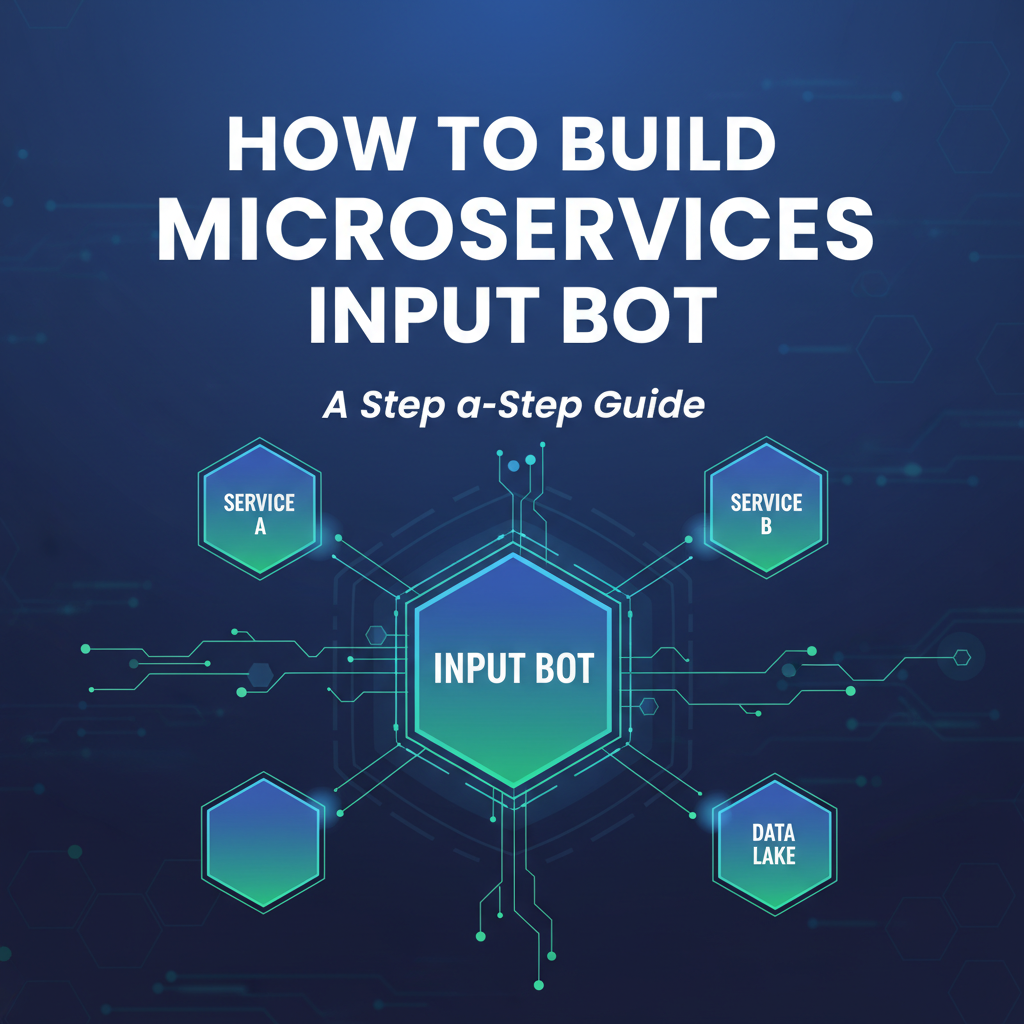
How to Build Microservices Input Bot: A Step-by-Step Guide


In an increasingly interconnected digital landscape, automated conversational agents, often referred to as bots, have become ubiquitous, streamlining customer service, automating tasks, and enhancing user experiences across various platforms. From simple chatbots answering frequently asked questions to sophisticated virtual assistants managing complex workflows, their utility is undeniable. As these bots evolve in complexity and scope, the traditional monolithic architectural approach often buckles under the pressure of scalability, maintainability, and agility. This is where the microservices paradigm offers a compelling alternative, transforming a single, unwieldy application into a collection of smaller, independent, and loosely coupled services.
Building a microservices input bot is not merely a technical exercise; it's a strategic decision to embrace flexibility and resilience. By decomposing the bot's functionalities into distinct services—each responsible for a specific domain such as natural language understanding, conversation management, or integration with external systems—developers can achieve unparalleled levels of scalability and fault isolation. This architectural shift enables independent development, deployment, and scaling of individual components, significantly reducing the blast radius of failures and accelerating the pace of innovation. Imagine a scenario where a bug in the sentiment analysis module doesn't bring down the entire bot, or where an increase in user requests for product information only requires scaling up the product lookup service, rather than the entire application. Such advantages are fundamental to delivering robust and high-performing conversational experiences in the modern era.
At the heart of any well-designed microservices architecture lies a robust communication layer, where the role of an API Gateway becomes paramount. This crucial component acts as the single entry point for all client requests, routing them to the appropriate microservices, handling authentication, rate limiting, and often caching. For a microservices input bot, the API Gateway is not just a traffic cop; it’s a strategic control point that ensures secure, efficient, and well-managed interactions between the external world and the bot's internal ecosystem of services. Without a meticulously planned API strategy and a powerful gateway, the benefits of microservices can quickly dissolve into a quagmire of complexity and unmanageability. This comprehensive guide will walk you through the intricate process of designing, developing, and deploying a microservices input bot, emphasizing best practices, critical components, and the strategic importance of an API Gateway in fostering a scalable and resilient conversational system.
Understanding Microservices Architecture for Bots
The conceptual shift from a monolithic application to a microservices architecture fundamentally alters how we design, build, and operate complex systems. For a conversational bot, this means breaking down its diverse functionalities—such as processing user input, understanding intent, managing dialogue state, integrating with backend systems, and generating responses—into discrete, self-contained services. Each service, often developed by a small, dedicated team, encapsulates a specific business capability, operates independently, and communicates with other services through well-defined APIs. This modularity offers significant advantages over the traditional monolithic approach, where all functionalities are tightly coupled within a single codebase, making development cycles longer, scaling harder, and introducing greater risk with every change.
One of the primary benefits of adopting microservices for bot development is enhanced agility. Teams can work in parallel on different services, deploying updates and new features without impacting the entire bot ecosystem. This independent deployability is crucial for iterating quickly on bot functionalities, responding to user feedback, and incorporating new technologies. For instance, if you want to experiment with a new natural language understanding (NLU) model, you only need to update the NLU service, leaving other parts of the bot untouched. This contrasts sharply with a monolithic bot, where any change, no matter how small, often necessitates rebuilding and redeploying the entire application, introducing significant downtime and risk.
Scalability is another cornerstone advantage. In a microservices architecture, individual services can be scaled independently based on their specific demand. If your bot experiences a surge in requests for a particular type of information, only the relevant data retrieval service needs to be scaled up, rather than the entire application. This optimizes resource utilization and cost efficiency, as you’re not over-provisioning resources for parts of the bot that are not under heavy load. This granular control over scaling ensures that your bot can gracefully handle fluctuating traffic patterns without performance degradation. The resilience of the system is also significantly improved; a failure in one microservice is less likely to cascade and bring down the entire bot, as services are isolated and communicate asynchronously. This fault isolation is a critical feature for maintaining high availability and a seamless user experience, even when individual components encounter issues.
However, the adoption of microservices is not without its challenges. The increased number of services introduces complexity in terms of inter-service communication, distributed data management, and operational overhead. Managing communication between dozens or even hundreds of services requires careful planning and robust tooling, often relying on message queues, event brokers, and a well-implemented API Gateway to orchestrate interactions. Ensuring data consistency across multiple, independent databases, each managed by a different service, presents complex architectural decisions. Furthermore, monitoring and debugging a distributed system can be significantly more challenging than a monolithic one, requiring sophisticated logging, tracing, and monitoring solutions to gain visibility into the system's behavior. Despite these complexities, the long-term benefits in terms of flexibility, scalability, and resilience often outweigh the initial hurdles, particularly for sophisticated and evolving bot applications that demand continuous innovation and high performance.
Core Components of a Microservices Input Bot
Building a microservices input bot involves orchestrating several specialized components, each performing a distinct function to collectively deliver a seamless conversational experience. Understanding these core building blocks is essential for designing an efficient and scalable architecture.
Input Layer
The Input Layer serves as the bot's ears, responsible for receiving messages from various user channels and normalizing them for internal processing. This layer is crucial for ensuring that irrespective of the source, the bot's internal services receive consistent and usable data.
- Channels (Web, Mobile, Messaging Platforms): Users interact with bots through a multitude of platforms, including web widgets, mobile applications, and popular messaging services like Slack, Telegram, WhatsApp, Facebook Messenger, and WeChat. Each platform has its own API for sending and receiving messages, often with unique message formats and interaction paradigms. The Input Layer must be adept at integrating with these diverse channels, translating platform-specific messages into a common internal format. For instance, a message containing an image in Telegram might be represented differently than an image in WhatsApp, and the Input Layer's responsibility is to abstract away these differences.
- Webhook Mechanism: Most modern messaging platforms leverage webhooks to deliver incoming messages to a bot. A webhook is an HTTP callback that triggers an event whenever a new message or interaction occurs on the platform. The Input Layer exposes secure webhook endpoints that messaging platforms can call to push user input. This mechanism ensures real-time processing of messages without the need for constant polling, significantly improving responsiveness and efficiency. Careful attention must be paid to validating incoming webhook requests to ensure their authenticity and prevent malicious attacks.
- Authentication and Security for Input: Given that the Input Layer is the public-facing component of the bot, robust security measures are paramount. This involves authenticating incoming requests to ensure they originate from legitimate sources (e.g., validating webhook signatures provided by messaging platforms). Additionally, measures like rate limiting should be implemented to protect against denial-of-service attacks, and secure communication protocols (HTTPS) are mandatory to encrypt data in transit, safeguarding user privacy and preventing eavesdropping. This initial point of contact must be unassailable to maintain the integrity of the entire bot system.
Orchestration/Router Service
The Orchestration/Router Service acts as the brain of the bot's internal processing, directing incoming user requests to the appropriate microservices and managing the overall flow of conversation. It's the central nervous system that ensures all components work harmoniously.
- Directing Input to Relevant Microservices: Once the Input Layer normalizes a user's message, the Orchestration Service takes over. It analyzes the initial input (or consults the conversation state) to determine which downstream services need to be invoked. For example, if the message requires natural language understanding, it routes the message to the NLU service. If the user is in the middle of a transaction, it might route the message to a specific business logic service that handles that transaction's state. This intelligent routing is critical for efficient resource utilization and maintaining conversational context.
- Handling Conversation State: Bots need memory to provide coherent and personalized interactions. The Orchestration Service is typically responsible for managing the conversation state, which includes information like the user's identity, previous turns in the conversation, expressed intents, extracted entities, and progress within specific dialogues. This state information is often stored in a dedicated, fast-access data store (e.g., Redis) and retrieved/updated with each user interaction. By maintaining state, the bot can remember past interactions and provide contextually relevant responses, enhancing the user experience significantly.
- Role of an API Gateway Here: While often considered an edge component, an API Gateway can also play a pivotal role internally, especially for orchestrating calls between services. For complex bots, the Orchestration Service might itself leverage an internal API Gateway to interact with other microservices. This internal gateway can enforce consistent API contracts, manage load balancing for internal service calls, and provide centralized logging for inter-service communication. Moreover, a comprehensive API Gateway solution like ApiPark can provide robust capabilities for unified API formats for AI invocation and end-to-end API lifecycle management, making it an ideal candidate for managing both external ingress traffic and internal microservice interactions, ensuring that all API calls, whether external or internal, are secure, managed, and monitored. This ensures that the Orchestration Service can reliably and efficiently interact with all other components without needing to handle the complexities of service discovery, load balancing, or security at its own layer.
Natural Language Understanding (NLU) Service
The NLU Service is the bot's linguistic intelligence, responsible for deciphering the meaning and intent behind a user's natural language input. It transforms unstructured text into structured data that the bot can act upon.
- Intent Recognition, Entity Extraction: The primary functions of the NLU service are intent recognition (determining the user's goal or purpose, e.g., "book a flight," "check order status") and entity extraction (identifying key pieces of information within the utterance, e.g., "flight to London," "order number ABC123"). These extracted intents and entities form the basis for triggering specific business logic.
- Tools/Libraries: Developing a custom NLU model from scratch can be resource-intensive. Fortunately, numerous robust tools and libraries are available. Open-source options like Rasa NLU allow for on-premise deployment and custom model training, offering greater control over data and privacy. Cloud-based services such as Google Dialogflow, Microsoft LUIS, and Wit.ai provide powerful, pre-trained models and easy-to-use interfaces, abstracting away much of the machine learning complexity. For highly specialized use cases, custom machine learning models built with frameworks like TensorFlow or PyTorch might be necessary, requiring significant expertise in data science and deep learning. The NLU service exposes an API (typically RESTful) that the Orchestration Service can call, sending raw user utterances and receiving structured intent and entity data in return.
Business Logic/Domain Services
These services represent the core functionalities and specific capabilities of the bot, implementing the rules and interactions required to fulfill user requests. They are the workhorses that perform the actual tasks.
- Specific Functionalities: Each business logic service is typically responsible for a single, well-defined domain. Examples include a "Booking Service" for managing reservations, an "Order Management Service" for tracking purchases, an "Information Retrieval Service" for fetching data from a knowledge base, or a "User Profile Service" for managing user-specific settings. This clear separation of concerns ensures that services are cohesive, maintainable, and independently deployable.
- Interacting with External Systems/Databases: Many bot functionalities require interaction with external systems. A "Booking Service" might need to communicate with an airline's reservation system via its API. An "Information Retrieval Service" might query a product database or an internal knowledge graph. These services encapsulate the logic for integrating with these external dependencies, abstracting away their complexities from other parts of the bot. They typically use a combination of persistent storage (e.g., SQL or NoSQL databases) for their own domain data and make API calls to other internal or external systems.
Response Generation Service
The Response Generation Service is responsible for crafting clear, concise, and contextually appropriate messages to be sent back to the user. It transforms the structured output from business logic services into a natural language response.
- Crafting Appropriate Responses: Based on the results from the NLU and business logic services, this service generates the final output. This might involve simple text responses, dynamic content (e.g., inserting specific product names or booking details), or even more complex rich media elements like images, buttons, carousels, or interactive cards. The service must be designed to handle various response types and formats, tailoring them to the capabilities of the specific messaging channel.
- Text-based, Rich Media, Interactive Elements: Modern bots often go beyond plain text. The Response Generation Service can leverage templates and conditional logic to construct responses that include rich media elements. For example, if a user requests a product, the service might generate a response with the product name, price, description, and an image, along with a "Buy Now" button. The complexity of this service can vary significantly depending on the desired richness and interactivity of the bot's responses. It needs to be aware of the capabilities of different output channels to avoid sending unsupported message types.
Output Layer
The Output Layer is the final stage of the bot's communication cycle, taking the generated response and delivering it back to the user through the appropriate channel. It is the counterpart to the Input Layer, handling outbound messages.
- Sending Responses Back to the User via the Original Channel: This layer receives the finalized response from the Response Generation Service and handles the complexities of sending it back to the user via the specific messaging platform (e.g., Slack, Telegram). This involves using the platform's dedicated API for sending messages, ensuring the correct message format, and handling any platform-specific requirements like message IDs or threading. Just like the Input Layer, the Output Layer must manage platform-specific nuances to ensure messages are delivered correctly and consistently.
- Error Handling and Delivery Confirmation: The Output Layer also needs to implement robust error handling for message delivery failures. If a message cannot be sent (e.g., due to network issues or an invalid user ID), the system should log the error and potentially attempt retries. Some platforms provide delivery confirmations, which this layer can process to ensure message delivery and update the conversation state accordingly.
Data Storage/Persistence
Data storage is fundamental to any microservices architecture, especially for maintaining state, user profiles, and operational data across independent services.
- Distributed Databases, Caching: Each microservice typically manages its own data store, adhering to the principle of "data ownership." This allows services to choose the most appropriate database technology (e.g., relational databases like PostgreSQL for structured data, NoSQL databases like MongoDB for flexible schemas, or graph databases for relationships). However, this distributed nature introduces challenges in data consistency and transaction management across services. Caching layers (e.g., Redis) are often employed to store frequently accessed data or conversation state, reducing latency and database load.
- Session Management: For conversational bots, session management is critical. The bot needs to remember who the user is, what they've said previously, and where they are in a particular conversation flow. This session data is often managed by the Orchestration Service but stored in a dedicated, highly available, and fast-access data store (like Redis or Memcached). This ensures that conversation context is preserved even if individual services restart or scale. The design of data storage needs to consider performance, reliability, and eventual consistency across different services to ensure a seamless and responsive user experience.
Step-by-Step Guide to Building the Bot
Building a microservices input bot requires a structured approach, moving from high-level requirements to detailed implementation and deployment. Each step builds upon the previous one, ensuring a cohesive and functional system.
Step 1: Define Requirements and Scope
Before writing a single line of code, it is imperative to clearly define what the bot is intended to achieve, for whom, and within what boundaries. This foundational step guides all subsequent architectural and development decisions.
- What Will the Bot Do? Use Cases: Begin by identifying the core problems the bot will solve and the specific tasks it will perform. Will it answer FAQs about a product, assist with booking appointments, process orders, provide technical support, or manage internal HR queries? Detail specific use cases, such as "A user can ask for their order status by providing an order ID," or "A user can request to reset their password." Each use case should describe the user's intent, the expected input, and the desired output. Documenting these scenarios helps in breaking down the bot's functionalities into manageable components later. For a customer service bot, for instance, initial use cases might include "Provide shipping information," "Process a return request," or "Connect to a human agent." These use cases directly inform the design of the NLU service (for intent recognition) and various business logic services (for executing actions).
- Target Audience, Channels: Understanding who will use the bot and through which platforms is critical. Is it for internal employees on Slack, external customers on a website chat widget, or users on a mobile app? Different audiences may have different expectations regarding tone, complexity, and available features. The choice of channels directly impacts the design of the Input and Output Layers, as each platform has unique integration requirements and message formats. For example, a bot designed for a professional environment like Slack might prioritize quick text-based interactions and integrations with internal tools, while a public-facing bot on WhatsApp might need to handle multimedia messages and provide a more guided, menu-driven experience.
- Functional and Non-Functional Requirements:
- Functional Requirements: These describe what the bot must do. Examples include "The bot must be able to understand requests for product prices," "The bot must integrate with the inventory management system to check stock," or "The bot must send a confirmation email after a booking." These are directly derived from the use cases.
- Non-Functional Requirements (NFRs): These define how well the bot performs its functions. NFRs are crucial for the architecture.
- Performance: How quickly must the bot respond? (e.g., average response time under 2 seconds for 95% of requests).
- Scalability: How many concurrent users or requests can the bot handle? (e.g., support up to 10,000 concurrent users without degradation). This is where microservices truly shine, allowing individual components to scale independently.
- Reliability/Availability: What is the uptime target? (e.g., 99.99% availability). What happens when a service fails?
- Security: How will user data be protected? (e.g., data encryption, authentication for all APIs, compliance with GDPR/HIPAA).
- Maintainability: How easy is it to update and fix the bot?
- Cost-effectiveness: What are the budget constraints for infrastructure and operations? Clearly defining these requirements upfront provides a clear vision for the project, allowing teams to make informed decisions throughout the development lifecycle and measure success against defined metrics.
Step 2: Design the Microservices Architecture
With a clear understanding of the bot's requirements, the next step is to translate them into a coherent microservices architecture. This involves identifying the distinct services, defining their responsibilities, and mapping out how they will interact.
- Identify Core Services: Based on the functional requirements and use cases, break down the bot's capabilities into logical, independent services. Aim for high cohesion within a service (its responsibilities are closely related) and low coupling between services (they can operate independently with minimal dependencies). A common decomposition might include:
Input Gateway Service(or Channel Adapter Service)Orchestration Service(or Conversation Manager)NLU ServiceResponse Generation Service- Specific
Business Logic Services(e.g.,OrderService,ProductCatalogService,UserService) Notification Service(for proactive messages) Each service should have a single, well-defined purpose, encapsulated with its own data storage where appropriate.
- Define API Contracts for Inter-Service Communication: This is a critical aspect of microservices. Since services communicate over networks, their interaction must be formalized through explicit API contracts.
- REST (Representational State Transfer): A popular choice for synchronous communication, defining resources and standard HTTP methods (GET, POST, PUT, DELETE). Easy to implement and widely supported.
- gRPC: A high-performance, language-agnostic remote procedure call (RPC) framework. Uses Protocol Buffers for efficient serialization, often preferred for internal, high-throughput service communication.
- Event-Driven Architecture (Message Queues): For asynchronous communication, where services publish events to a message broker (e.g., Kafka, RabbitMQ) and other services subscribe to these events. This decouples services in time, improving resilience and scalability. For example, a
BookingServicemight publish aBookingConfirmedevent, and aNotificationServicesubscribes to it to send an email. Define the request and response payloads, data types, error handling, and security mechanisms for each API. Tools like OpenAPI/Swagger can be used to document these contracts rigorously, ensuring consistency across teams.
- Draw a High-Level Architecture Diagram: Visualizing the architecture is invaluable. Create diagrams that show:
- All identified microservices.
- The communication paths between them (e.g., using arrows to denote API calls or message flows).
- External integrations (messaging platforms, third-party APIs).
- Data stores associated with each service. This diagram serves as a blueprint, helping to identify potential bottlenecks, communication patterns, and dependencies. It should illustrate the data flow from initial user input through NLU, business logic, response generation, and back to the user.
- Consider Data Flow: Carefully trace how data will move through the system for each key use case.
- How is user input received and transformed?
- What data does the NLU service need, and what does it return?
- Which business logic services consume this data, and what information do they generate?
- How is conversation state managed and accessed across services?
- Where is data persisted, and how is consistency maintained across distributed data stores? Considering data flow at this stage helps preempt data consistency issues and ensures that each service has access to the information it needs without violating data ownership principles. This detailed planning ensures a robust and well-integrated system.
Step 3: Choose Your Tech Stack
The choice of technology stack is fundamental, impacting development speed, performance, scalability, and long-term maintainability. This decision should align with team expertise, project requirements, and organizational preferences.
- Programming Languages:
- Python: Widely popular for bot development, especially for NLU and AI components, due to its rich ecosystem of libraries (e.g., scikit-learn, TensorFlow, PyTorch, Rasa). Excellent for rapid prototyping and data-intensive tasks. Frameworks like Flask and Django are mature for building web services.
- Node.js (JavaScript): Ideal for real-time applications and highly concurrent I/O operations, making it a strong candidate for the
Input GatewayandOrchestration Services. Its asynchronous, non-blocking nature is well-suited for handling numerous concurrent connections. Express.js is a common framework. - Go (Golang): Known for its performance, concurrency, and efficiency, making it suitable for high-throughput services like an
API Gatewayor performance-criticalBusiness Logic Services. Its static typing and compiled nature lead to robust, high-performance binaries. - Java: A mature and robust language, widely used in enterprise environments. Spring Boot provides a powerful framework for building microservices, offering comprehensive features for dependency injection, data access, and security. The beauty of microservices is that you can use different languages for different services, leveraging the strengths of each. For example, Python for NLU, Node.js for the
Input Gateway, and Java for complexBusiness Logic Services.
- Frameworks: Selecting appropriate frameworks streamlines development by providing structure, common functionalities, and best practices.
- Python: Flask (lightweight, flexible), Django (full-featured, ORM included).
- Node.js: Express.js (minimalist, flexible), NestJS (opinionated, TypeScript-based, robust for enterprise).
- Go: Gin (high-performance web framework), Echo (minimalist, high performance).
- Java: Spring Boot (industry standard for microservices, comprehensive ecosystem).
- Database Technologies: Data storage choices are critical for performance, scalability, and data consistency.
- Relational Databases (SQL): PostgreSQL, MySQL. Excellent for structured data with complex relationships, strong ACID compliance. Suitable for
User Profile Service,Order Management Service. - NoSQL Databases:
- Document Databases: MongoDB, Couchbase. Flexible schema, good for semi-structured data like conversation logs or user events.
- Key-Value Stores: Redis, Memcached. Extremely fast for caching and session management (critical for
Orchestration Serviceto store conversation state). - Graph Databases: Neo4j. Useful for representing complex relationships, e.g., knowledge graphs for the
Information Retrieval Service.
- Each service ideally owns its data store, allowing independent choice based on its specific needs.
- Relational Databases (SQL): PostgreSQL, MySQL. Excellent for structured data with complex relationships, strong ACID compliance. Suitable for
- Containerization (Docker): Essential for packaging microservices. Docker containers encapsulate each service along with its dependencies, ensuring consistent execution across different environments (development, testing, production). This simplifies deployment and promotes portability. Every microservice should be containerized.
- Orchestration (Kubernetes): For managing and deploying containerized applications at scale. Kubernetes automates the deployment, scaling, and operational aspects of microservices, handling service discovery, load balancing, self-healing, and rolling updates. Other options include AWS ECS, Google GKE, and Azure Kubernetes Service.
- Message Brokers (Kafka, RabbitMQ): For asynchronous communication between services.
- Kafka: A distributed streaming platform, excellent for high-throughput, fault-tolerant message queues and event streaming. Ideal for collecting telemetry data, processing events, and enabling reactive microservices.
- RabbitMQ: A general-purpose message broker, supporting various messaging patterns and protocols. Suitable for task queues and more traditional message passing. The choice of tech stack should be a balanced decision, considering the team's expertise, the project's specific requirements, and the long-term operational implications.
Step 4: Develop Core Microservices
With the architecture designed and tech stack chosen, the actual development of individual microservices begins. Each service is developed independently, adhering to its defined API contract.
A. Input Gateway Service
This is the public-facing entry point for your bot, acting as the first line of defense and traffic controller.
- Receives Input from Various Channels: The
Input Gateway Serviceis responsible for setting up webhook endpoints for each messaging platform (e.g.,/webhook/slack,/webhook/telegram). It listens for incoming HTTP POST requests from these platforms, which contain user messages and interaction events. For each supported channel, you will need to implement specific handlers that can parse the unique request body and headers. - Normalizes Input Format: Different platforms send data in different structures. For example, a text message from Slack might be represented as
{ "event": { "type": "message", "text": "Hello" } }, while Telegram might send{ "update_id": 123, "message": { "text": "Hello" } }. TheInput Gateway Servicetranslates these disparate formats into a unified, internal representation (e.g.,{ "user_id": "U123", "channel": "slack", "message_type": "text", "text": "Hello" }). This normalization is crucial because all downstream services will then only need to understand this single, standardized format, significantly reducing their complexity. - Forwards to the Orchestration Service: After normalization, the
Input Gateway Servicesecurely forwards the standardized input to theOrchestration Service. This can be done via a direct HTTP API call, or more robustly, by publishing the message to a message queue (e.g., Kafka topic) that theOrchestration Servicesubscribes to. Using a message queue provides asynchronous communication, buffering, and increased resilience, as theInput Gatewaydoesn't need to wait for theOrchestration Serviceto process the message before acknowledging the webhook request. - Natural Mention of APIPark: For complex microservices environments, especially those integrating AI models, a dedicated API Gateway is indispensable. An API Gateway like ApiPark can act as a robust entry point not just for external client applications, but also for managing requests originating from various bot channels and routing them to internal microservices. APIPark excels at providing a unified API format for AI invocation, which is particularly useful if your bot's NLU component is an external AI model. It can simplify the integration of 100+ AI models, ensuring consistent authentication and cost tracking. Moreover, its end-to-end API lifecycle management capabilities mean that the API exposed by your
Input Gateway Servicecan be designed, published, invoked, and monitored effectively, abstracting away complexities like load balancing and versioning. By leveraging APIPark, theInput Gateway Servicecan offload concerns such as security, rate limiting, and request routing, focusing solely on channel-specific message reception and initial normalization. This significantly enhances the security and scalability of your bot's public interface.
B. Orchestration/Conversation Management Service
This is the central coordinator of your bot's intelligence, responsible for managing the flow of conversation.
- Manages Conversation Flow, State: This service is the stateful core of the bot. For every incoming user message, it first retrieves the current conversation state for that user (e.g., from a Redis cache). This state includes past intents, extracted entities, and the current dialogue turn. Based on the NLU output and the current state, it determines the next action. For example, if the NLU identifies an "order_status" intent, and the state shows no order ID was provided yet, the
Orchestration Servicemight prompt the user for it. - Calls NLU service, then relevant business logic: After retrieving the state, the
Orchestration Servicesends the user's normalized text to theNLU Servicevia its API. Upon receiving the intent and entities, it then decides whichBusiness Logic Serviceto invoke. If the intent is "book_flight" and entities like origin, destination, and date are present, it calls theFlightBooking Service. If theBusiness Logic Servicerequires more information, theOrchestration Servicemight update the conversation state and instruct theResponse Generation Serviceto ask a clarifying question. - Ensures Asynchronous Communication: While some calls to
NLU ServiceorBusiness Logic Servicesmight be synchronous (blocking until a response is received), theOrchestration Serviceoften needs to interact asynchronously, especially when dealing with long-running tasks or external API calls. Using message queues for communication between theOrchestration ServiceandBusiness Logic Servicescan improve responsiveness and resilience. TheOrchestration Servicepublishes a task (e.g., "process_order_request") to a queue, and aBusiness Logic Servicepicks it up. Once completed, theBusiness Logic Servicepublishes a "order_processed" event, which theOrchestration Servicethen processes to generate a response.
C. NLU Service
This service translates human language into structured data.
- Trains and Deploys an NLU Model: This involves selecting an NLU framework (e.g., Rasa, spaCy, or a cloud API like Google Dialogflow). If using an open-source framework, you'll train your NLU model with annotated training data (utterances mapped to intents and entities). The training pipeline typically includes tokenization, feature extraction, intent classification, and entity recognition. The trained model is then deployed within this service, ready to process incoming text.
- Exposes an API for Intent and Entity Extraction: The
NLU Serviceexposes a simple API endpoint (e.g.,/parse) that accepts raw user text as input. When called, it runs the text through its deployed NLU model and returns a structured JSON object containing the identified intent (e.g.,{"intent": "order_status", "confidence": 0.95}) and any extracted entities (e.g.,{"entity": "order_id", "value": "XYZ789"}). This API must be highly available and performant, as it's typically called for every user message.
D. Business Logic Services (Example: "Order Processing Service", "Information Retrieval Service")
These are the specialized services that perform the actual work of the bot.
- Implement Specific Domain Functionalities: Each
Business Logic Serviceis focused on a single domain. For example, anOrder Processing Servicewould handle functionalities likecreate_order,track_order_status,cancel_order, etc. It encapsulates all the business rules, validation logic, and workflows related to orders. AnInformation Retrieval Servicemight query a knowledge base for product specifications, store opening hours, or policy details. These services are typically stateless themselves, processing a request and returning a result, with conversation state managed by theOrchestration Service. - Interact with Databases or External APIs: These services are often responsible for persisting and retrieving data from their own dedicated databases (e.g.,
OrderServiceinteracts with anordersdatabase). They also frequently integrate with external systems via their respective APIs. For example,OrderServicemight call a payment gateway API to process a transaction or an inventory API to check stock levels. The service encapsulates the logic for these external interactions, including credential management, retry mechanisms, and error handling for external API calls.
E. Response Generation Service
This service turns structured data into conversational output.
- Takes Processed Data, Generates User-Friendly Responses: Once the
Orchestration Servicereceives the results fromNLUandBusiness Logic Services, it passes this structured data (e.g.,{"status": "order_shipped", "order_id": "XYZ789", "tracking_link": "..."}) to theResponse Generation Service. This service uses templates and conditional logic to construct a natural language response. For instance, it might select a template like "Your order {order_id} has been shipped. You can track it here: {tracking_link}." - Handles Dynamic Content: Responses often need to be dynamic, incorporating data specific to the user or their request. The
Response Generation Servicemust be capable of injecting this dynamic content into templates. It can also be responsible for choosing the appropriate response style or tone based on the conversation context or user preferences. For rich media responses (e.g., cards with images and buttons), this service will construct the platform-specific JSON payload that theOutput Layerwill then send. The service might expose a simple API like/generate_responsethat accepts structured data and returns the final text or rich media payload.
Step 5: Implement Inter-Service Communication
Effective communication between microservices is the backbone of the architecture. This step focuses on establishing robust and consistent interaction patterns.
- Synchronous (RESTful API Calls) vs. Asynchronous (Message Queues):
- Synchronous (RESTful API Calls): Best for immediate requests where the calling service needs an immediate response, such as the
Orchestration Servicecalling theNLU Serviceto get intent and entities. These calls are typically blocking, meaning the caller waits for the callee to respond. While simple to implement for direct dependencies, excessive synchronous calls can create tight coupling and introduce latency, potentially leading to cascading failures if one service is slow or unavailable. - Asynchronous (Message Queues): Ideal for scenarios where the caller doesn't need an immediate response, or for long-running tasks. Services publish events or messages to a message broker (e.g., Kafka, RabbitMQ) without waiting for a direct reply. Other services subscribe to these messages and process them at their own pace. This decouples services, improving resilience (the caller doesn't fail if the receiver is down), scalability (receivers can process messages independently), and fault tolerance. For example, a
Business Logic Servicemight publish an "order_confirmed" event, and other services (like aNotification Serviceor anAnalytics Service) can react to it without being directly called. A common pattern is to use synchronous communication for direct request-response flows and asynchronous for event-driven scenarios or background tasks.
- Synchronous (RESTful API Calls): Best for immediate requests where the calling service needs an immediate response, such as the
- API Documentation and Consistency (e.g., using OpenAPI/Swagger): With multiple services exposing APIs, maintaining consistent documentation is crucial for developers working on different services. Tools like OpenAPI (formerly Swagger) allow you to define API contracts in a machine-readable format.
- Benefits:
- Clarity: Provides clear specifications of endpoints, request/response formats, data types, and error codes.
- Consistency: Enforces a standardized approach to API design across services.
- Code Generation: Can automatically generate client SDKs, server stubs, and interactive documentation (e.g., Swagger UI).
- Validation: Can be used to validate incoming requests against the defined schema, catching errors early. Implementing a strong API governance strategy ensures that all services expose well-defined, easy-to-understand, and stable APIs, facilitating seamless integration.
- Benefits:
- How an API Gateway like APIPark can simplify this by providing unified API format and management: An API Gateway acts as a centralized control plane for all your microservice APIs, both internal and external. ApiPark offers specific advantages here:
- Unified API Format for AI Invocation: If your bot integrates multiple AI models (e.g., for NLU, sentiment analysis, or image recognition) from different providers, APIPark can standardize their invocation format. This means your
Orchestration ServiceorNLU Servicedoesn't need to know the specific API quirks of each AI model; it interacts with a single, consistent API exposed by APIPark, which then translates and routes the request to the correct underlying AI model. This greatly simplifies AI integration and maintenance. - End-to-End API Lifecycle Management: APIPark assists with managing the entire lifecycle of your microservice APIs, from design and publication to invocation and decommissioning. It helps regulate API management processes, manages traffic forwarding, load balancing, and versioning of published APIs. This is vital in a dynamic microservices environment where services evolve. The
Orchestration Servicecan rely on APIPark to find the correct version of aBusiness Logic Serviceor to distribute requests efficiently across multiple instances of aNLU Service. - Centralized Security and Policy Enforcement: Instead of each service implementing its own authentication, authorization, rate limiting, and caching, APIPark can enforce these policies centrally at the gateway level. This reduces boilerplate code in individual services and ensures consistent application of security and traffic management rules across your entire bot ecosystem. By using a powerful API Gateway like APIPark, developers can focus on building core business logic within their microservices, offloading common concerns related to API management, integration, security, and communication to the gateway layer.
- Unified API Format for AI Invocation: If your bot integrates multiple AI models (e.g., for NLU, sentiment analysis, or image recognition) from different providers, APIPark can standardize their invocation format. This means your
Step 6: Integrate with External Channels
Connecting your bot to the real world involves configuring it to send and receive messages from the chosen communication platforms. This often requires interacting with specific platform APIs.
- Configure Webhooks for Platforms (Slack, Telegram, Messenger): For each messaging platform your bot supports, you need to configure a webhook. This typically involves registering your bot's public API endpoint (which points to your
Input Gateway Service) with the platform's developer console. When a user sends a message, the platform will then make an HTTP POST request to this registered webhook URL, delivering the message payload. Each platform will have specific instructions for this setup, often requiring you to verify ownership of the URL and subscribe to specific event types (e.g., message events, postback events). - Handle Platform-Specific Message Formats: While your
Input Gateway Servicenormalizes incoming messages, and yourResponse Generation Servicecreates a generic response structure, theOutput Layerneeds to convert this generic response into the specific format required by each platform. For example:- Slack: Uses a JSON payload with
blocksfor rich messages (e.g., buttons, images, cards). - Telegram: Uses JSON with
reply_markupfor inline keyboards and specific fields for media. - Facebook Messenger: Has its own
messageobject structure for text, attachments, and templates. TheOutput Layermust contain logic to dynamically generate the correct JSON payload for the target platform based on the generic response provided by theResponse Generation Service. This ensures that your bot's rich interactive elements (like buttons or carousels) render correctly on each platform, providing a consistent and engaging user experience. This layer will make outbound API calls to the respective platform's message sending API endpoint, often requiring an access token for authentication.
- Slack: Uses a JSON payload with
Step 7: Deployment and Orchestration
Once your microservices are developed and tested, the next crucial step is to deploy them into a production environment and manage their lifecycle. This is where containerization and orchestration platforms become indispensable.
- Containerize Each Microservice (Docker): The first step in deployment is to package each microservice into a Docker container. A
Dockerfilespecifies the service's dependencies, environment, and how to run it. This creates an isolated, portable, and consistent environment for each service.- Benefits:
- Portability: Containers run consistently across any environment that supports Docker.
- Isolation: Each service runs in its own isolated container, preventing conflicts between dependencies.
- Efficiency: Containers are lightweight and start quickly compared to virtual machines.
- Reproducibility: Ensures that what runs in development will run identically in production. Each microservice will have its own
Dockerfileand be built into a separate Docker image, which is then pushed to a container registry (e.g., Docker Hub, AWS ECR, Google Container Registry).
- Benefits:
- Deploy to a Container Orchestration Platform (Kubernetes, AWS ECS, Google GKE): Managing dozens or hundreds of individual containers manually is impractical. Container orchestration platforms automate the deployment, scaling, networking, and management of containerized applications.
- Kubernetes (K8s): The industry standard for orchestrating containers. It handles:
- Service Discovery: Automatically finds and connects services.
- Load Balancing: Distributes incoming traffic across multiple instances of a service.
- Self-Healing: Restarts failed containers, replaces unhealthy ones.
- Scalability: Automatically scales services up or down based on demand or predefined rules.
- Rolling Updates: Allows for zero-downtime updates of services.
- Cloud-specific options: AWS Elastic Container Service (ECS), Google Kubernetes Engine (GKE), Azure Kubernetes Service (AKS) offer managed Kubernetes or similar container orchestration capabilities, simplifying operations. Deploying your bot's microservices to such a platform ensures high availability, scalability, and automated management, allowing you to focus on developing features rather than infrastructure.
- Kubernetes (K8s): The industry standard for orchestrating containers. It handles:
- CI/CD Pipelines: Continuous Integration (CI) and Continuous Deployment (CD) pipelines are essential for automated and reliable software delivery in a microservices architecture.
- CI: Every code change is automatically built, tested (unit tests, integration tests), and merged into a shared repository.
- CD: Once merged, the changes are automatically deployed to a testing environment, and if all tests pass, they can be automatically deployed to production. For microservices, each service can have its own independent CI/CD pipeline, enabling separate deployment schedules and faster iterations. Tools like Jenkins, GitLab CI/CD, GitHub Actions, CircleCI, or Azure DevOps can be used to set up these pipelines. A well-implemented CI/CD pipeline significantly reduces manual effort, speeds up releases, and improves the overall quality and reliability of your bot.
Step 8: Monitoring, Logging, and Testing
In a distributed microservices environment, gaining visibility into system behavior and ensuring correctness is paramount. Robust monitoring, centralized logging, and comprehensive testing are non-negotiable.
- Distributed Tracing (e.g., OpenTelemetry): When a user request flows through multiple microservices, it's challenging to track its journey and identify performance bottlenecks or failures. Distributed tracing systems assign a unique ID to each request and propagate it across all services it touches. This allows you to visualize the entire request flow, measure latency at each service hop, and pinpoint the exact service causing an issue. Tools like OpenTelemetry (an open-source observability framework), Jaeger, or Zipkin provide this capability, offering critical insights into the performance and health of your distributed bot.
- Centralized Logging (ELK stack, Splunk): Each microservice generates its own logs, but scattering logs across multiple containers and hosts makes debugging impossible. Centralized logging aggregates logs from all services into a single, searchable platform.
- ELK Stack (Elasticsearch, Logstash, Kibana): A popular open-source solution for collecting (Logstash), storing and indexing (Elasticsearch), and visualizing (Kibana) logs.
- Splunk, Datadog, Grafana Loki: Commercial and other open-source alternatives offering similar functionalities. Centralized logging allows developers and operations teams to quickly search, filter, and analyze logs across the entire bot system, speeding up troubleshooting and root cause analysis.
- Performance Monitoring: Beyond logs, you need real-time metrics to understand your bot's performance. This involves collecting data points like CPU usage, memory consumption, network I/O, API response times, error rates, and queue lengths for each microservice.
- Prometheus: A widely adopted open-source monitoring system, often combined with Grafana for visualization.
- Cloud monitoring services: AWS CloudWatch, Google Cloud Monitoring, Azure Monitor. These tools help you set up alerts for deviations from normal behavior, visualize trends, and proactively identify performance bottlenecks before they impact users. Monitoring
APImetrics specifically (e.g., latency of theNLU Service API, success rate ofBusiness Logic Service APIs) is crucial.
- Unit, Integration, and End-to-End Testing: A comprehensive testing strategy is vital for microservices.
- Unit Tests: Verify individual functions and methods within a service.
- Integration Tests: Ensure that different components within a single service, or the API interactions between two specific services, work correctly.
- End-to-End Tests: Simulate real user interactions, testing the entire flow from input to output, traversing all microservices and external integrations. This is critical for catching issues that only manifest when the entire system is assembled.
- Contract Testing: Ensures that services adhere to their API contracts, preventing breaking changes between interdependent services.
- Importance of API Monitoring for Each Service: In a microservices architecture, every service exposes an API and relies on APIs from other services. Therefore, monitoring the health and performance of each individual API is critical. This includes tracking:
- Request rates: How many calls is an API receiving?
- Error rates: Percentage of failed API calls.
- Latency: Average and percentile response times for API calls.
- Payload sizes: How much data is being transferred. This granular API monitoring allows you to quickly identify which specific API is performing poorly or failing, significantly narrowing down the scope for debugging.
- Another mention of APIPark: ApiPark offers powerful features that directly address the monitoring and logging challenges in a microservices bot. Its detailed API call logging capability records every detail of each API call, whether it's an external request hitting your
Input Gatewayor an internal call between yourOrchestration ServiceandNLU Serviceif managed by APIPark. This comprehensive logging allows businesses to quickly trace and troubleshoot issues in API calls, ensuring system stability and data security. Furthermore, APIPark's powerful data analysis features analyze historical call data to display long-term trends and performance changes. This predictive analytics can help businesses with preventive maintenance before issues occur, allowing you to proactively address performance degradation or identify potential resource constraints, making it an invaluable tool for maintaining the health and performance of your microservices bot.
Step 9: Security Best Practices
Security is not an afterthought; it must be ingrained into every stage of the microservices bot development lifecycle. Given the bot's interaction with user data and external systems, robust security measures are paramount.
- Authentication and Authorization (OAuth, JWT):
- Authentication: Verifying the identity of a user or service. For external users, this might involve integrating with single sign-on (SSO) providers or handling user credentials securely. For inter-service communication, mutual TLS (mTLS) or shared secrets can authenticate services.
- Authorization: Determining what an authenticated user or service is allowed to do.
- OAuth 2.0: A widely used framework for delegated authorization, allowing users to grant third-party applications limited access to their resources without sharing credentials. Useful for integrating with user accounts on external platforms.
- JWT (JSON Web Tokens): A compact, URL-safe means of representing claims to be transferred between two parties. JWTs are commonly used for authorization, where a token is issued upon successful authentication and then included in subsequent API requests to verify the user's or service's permissions. The
API Gatewayis an ideal place to handle token validation and authorization enforcement.
- Secure API Endpoints: All API endpoints, especially those exposed publicly, must be secured.
- HTTPS/TLS: Mandatory for encrypting all data in transit, preventing eavesdropping and man-in-the-middle attacks.
- Input Validation: Sanitize and validate all incoming data to prevent injection attacks (e.g., SQL injection, XSS) and buffer overflows.
- Least Privilege: Services should only have the minimum necessary permissions to perform their function. Do not grant broad access.
- Secrets Management: Never hardcode API keys, database credentials, or other sensitive information in code. Use dedicated secrets management solutions (e.g., HashiCorp Vault, AWS Secrets Manager, Kubernetes Secrets) to securely store and retrieve these.
- Data Encryption:
- Encryption in Transit: As mentioned with HTTPS/TLS.
- Encryption at Rest: Encrypt sensitive user data when it's stored in databases, file systems, or backups. Use disk encryption, database encryption features, or application-level encryption for highly sensitive data.
- Rate Limiting: Protect your services from abuse and denial-of-service (DoS) attacks by implementing rate limiting. This restricts the number of requests a client can make to an API within a specific time frame. The
API Gatewayis the perfect place to enforce rate limiting policies, protecting downstream microservices from being overwhelmed. - APIPark Relevance: An API Gateway is a critical component for enforcing security policies centrally. ApiPark significantly enhances the security posture of your microservices bot through several features:
- API Resource Access Requires Approval: APIPark allows you to activate subscription approval features. This means callers (whether external applications or even other internal teams) must subscribe to an API and await administrator approval before they can invoke it. This prevents unauthorized API calls and potential data breaches, adding an extra layer of control over who can access your bot's functionalities.
- Independent API and Access Permissions for Each Tenant: If your bot platform needs to support multiple teams or departments, each with their own applications and data, APIPark enables the creation of multiple tenants. Each tenant can have independent applications, data, user configurations, and security policies, while sharing underlying applications and infrastructure. This provides strong isolation and granular access control, ensuring that one team's actions do not compromise another's data or APIs. By centralizing these security concerns at the gateway level, APIPark allows individual microservices to remain focused on their core business logic, offloading complex security enforcement to a dedicated and hardened layer.
APIPark is a high-performance AI gateway that allows you to securely access the most comprehensive LLM APIs globally on the APIPark platform, including OpenAI, Anthropic, Mistral, Llama2, Google Gemini, and more.Try APIPark now! 👇👇👇
Advanced Considerations
As your microservices input bot matures and scales, several advanced architectural and operational considerations become crucial for sustained success.
Scalability Strategies
Beyond simply running more instances, effective scaling involves strategic planning across multiple dimensions.
- Horizontal Scaling: This is the primary scaling mechanism for microservices, achieved by running multiple instances of stateless services. Load balancers distribute incoming requests across these instances. For stateful services, techniques like sharding or distributed databases are required. Your
Orchestration Service, which might manage conversation state, would need a highly scalable and partitioned data store (like Redis Cluster) to support horizontal scaling. - Asynchronous Processing: As highlighted earlier, leveraging message queues and event streams (e.g., Kafka) decouples services, allowing producers and consumers to scale independently. This is particularly useful for tasks that don't require an immediate response, such as processing user feedback, logging analytics data, or sending proactive notifications.
- Database Scaling: As individual services often have their own databases, scaling strategies vary. For relational databases, read replicas can handle increased read load, while sharding distributes data across multiple database instances. NoSQL databases are often designed for horizontal scaling from the ground up. Choosing the right database for each service's specific data access patterns is critical for performance.
- Caching: Implementing caching layers (e.g., Redis, Memcached) at various points (e.g., for frequently accessed configuration data, conversation state, or common NLU model predictions) can significantly reduce latency and database load, improving overall system responsiveness and scalability.
Fault Tolerance and Resilience (Circuit Breakers, Retries)
Distributed systems inherently face failures. Designing for resilience ensures the bot continues to operate effectively even when individual services encounter issues.
- Circuit Breakers: A design pattern that prevents a network or service failure from cascading to other services. If a service repeatedly fails or becomes slow, the circuit breaker "opens," preventing further calls to that service and quickly returning an error or a fallback response. This gives the failing service time to recover without overwhelming it further. Libraries like Hystrix (Java) or Polly (.NET) provide implementations.
- Retries: Services should implement intelligent retry mechanisms for transient failures (e.g., network glitches, temporary service unavailability). However, naive retries can exacerbate problems. Implement exponential backoff (waiting longer between retry attempts) and set maximum retry limits to avoid overwhelming a struggling service.
- Bulkheads: Isolating components into separate resource pools (e.g., different threads, connection pools, or even separate services) prevents a failure in one component from consuming all resources and bringing down the entire application.
- Timeouts: Configure timeouts for all external and inter-service API calls. This prevents a service from waiting indefinitely for a response from a slow or unresponsive dependency, ensuring that resources are not tied up unnecessarily.
Version Control for Services and APIs
Managing changes in a microservices environment requires robust versioning strategies for both code and API contracts.
- Semantic Versioning for Services: Assigning clear versions (e.g.,
v1.0.0) to each microservice helps track changes and dependencies. Teams can decide whether to deploy breaking changes as new major versions. - API Versioning: Critical for allowing services to evolve without breaking consumers. Common approaches include:
- URL Versioning:
/api/v1/orders,/api/v2/orders(simple but clutters URLs). - Header Versioning: Using a custom HTTP header like
Accept: application/vnd.mycompany.v2+json. - Query Parameter Versioning:
GET /api/orders?version=2. The choice depends on complexity and preference. The API Gateway can play a key role in routing requests to different API versions, allowing older clients to continue using older versions while newer clients leverage updated functionalities.
- URL Versioning:
- Backward Compatibility: Strive for backward compatibility whenever possible. If a breaking change is unavoidable, communicate it clearly, provide migration paths, and support older API versions for a grace period.
CI/CD for Microservices
As detailed previously, automated pipelines are crucial.
- Independent Pipelines: Each microservice should ideally have its own CI/CD pipeline, enabling independent builds, tests, and deployments. This allows teams to release updates to their services at their own pace without waiting for or affecting other services.
- Automated Testing in Pipelines: Integrate various levels of automated tests (unit, integration, contract, end-to-end) into the CI/CD pipeline to ensure quality at every stage.
- Automated Deployments: Implement automated deployment to staging and production environments, leveraging container orchestration platforms like Kubernetes for seamless, zero-downtime updates.
Observability: Metrics, Logging, Tracing
While mentioned in Step 8, the concept of observability extends beyond basic monitoring. It's about having sufficient data to understand the internal state of your system from its external outputs, even for complex or novel scenarios.
- Metrics: Collect detailed, time-series metrics from every service (latency, error rates, resource utilization). Use these to identify trends, create dashboards, and set up alerts.
- Logging: Ensure structured logging that includes correlation IDs (from distributed tracing) and contextual information. Centralize logs for easy searching and analysis.
- Tracing: Use distributed tracing to visualize the full request flow across services.
- Alerting: Implement intelligent alerting based on thresholds, anomalies, or predefined patterns in metrics and logs. Configure alerts to notify the right teams via appropriate channels (e.g., Slack, PagerDuty). A strong observability strategy allows teams to quickly understand, debug, and resolve issues in a complex distributed environment, moving from "we know something is wrong" to "we know exactly what is wrong and where."
Challenges and Solutions
While microservices offer significant advantages, they also introduce a new set of complexities. Anticipating these challenges and having strategies to address them is key to a successful implementation.
- Complexity Management:
- Challenge: The sheer number of services, deployments, communication paths, and data stores can quickly become overwhelming, leading to a "distributed monolith" or unmanageable sprawl.
- Solution: API Gateway pattern (ApiPark as an example) to centralize external access and internal API management. Strong API governance and documentation (OpenAPI). Service mesh (e.g., Istio, Linkerd) for abstracting inter-service communication concerns like traffic management, security, and observability at the infrastructure layer, offloading them from application code. Clear domain boundaries for services to prevent scope creep.
- Data Consistency in Distributed Systems:
- Challenge: With each service owning its data, maintaining data consistency across multiple independent databases for complex transactions is difficult. Traditional ACID transactions span a single database; in microservices, this needs different approaches.
- Solution: Eventual Consistency: Often a pragmatic approach, where data may be inconsistent for a short period but eventually converges. Saga Pattern: A sequence of local transactions, where each transaction updates its own database and publishes an event that triggers the next step in the saga. If a step fails, compensation transactions are executed to undo previous changes. Idempotent Operations: Design APIs so that calling them multiple times with the same parameters has the same effect as calling them once, to handle retries gracefully.
- Testing Distributed Systems:
- Challenge: Unit and integration tests for individual services are insufficient. Testing interactions between services and the end-to-end flow is complex due to network latency, partial failures, and distributed state.
- Solution: Contract Testing: Ensures that service consumers and providers adhere to a shared API contract, catching breaking changes early without needing to deploy all services. Consumer-Driven Contracts (CDC): Consumers define the contract they expect from a provider. End-to-End Testing: Automate tests that simulate real user journeys across the entire system. Chaos Engineering: Intentionally injecting failures into the system (e.g., network latency, service restarts) in controlled environments to test its resilience.
- Operational Overhead:
- Challenge: Managing, deploying, monitoring, and troubleshooting many independent services requires more sophisticated tooling and operational practices than a monolithic application.
- Solution: Automation: Extensive use of CI/CD pipelines, infrastructure-as-code (Terraform, Ansible), and automated deployment strategies. Observability Tools: Implement robust metrics, logging, and distributed tracing from the outset. Container Orchestration: Leverage Kubernetes or similar platforms to automate much of the operational burden (scaling, self-healing, rolling updates). Dedicated DevOps/SRE Teams: Invest in teams focused on operational excellence to manage the complexities of the distributed system.
Conclusion
Building a microservices input bot represents a significant architectural evolution for conversational AI systems, moving beyond the constraints of monolithic designs to embrace a future of unparalleled scalability, resilience, and agility. By dissecting the bot's functionalities into small, independently deployable services—each with a focused responsibility—developers gain the power to innovate rapidly, scale resources precisely, and isolate failures effectively. This guide has traversed the intricate landscape of such an endeavor, from the initial ideation and requirement definition to the nuanced considerations of deployment, security, and ongoing operations.
We've explored the critical components that collectively bring a microservices bot to life: the Input Layer that patiently listens across diverse channels, the Orchestration Service that intelligently guides conversation flow, the NLU Service that unlocks the meaning in human language, specialized Business Logic Services that execute core functionalities, and the Response Generation and Output Layers that craft and deliver engaging replies. Each component, though independent, contributes to a cohesive and dynamic conversational experience.
The journey underscored the indispensable role of robust tooling and architectural patterns. API Gateway solutions, for instance, emerge not just as traffic controllers but as strategic enablers for security, communication standardization, and lifecycle management within complex microservices ecosystems. Products like ApiPark exemplify how a powerful API Gateway can simplify the integration of AI models, enforce granular access controls, provide comprehensive logging, and offer insightful analytics, thereby reducing operational burden and accelerating development. Through careful design of API contracts, a judicious blend of synchronous and asynchronous communication, and unwavering commitment to security best practices, the inherent complexities of distributed systems can be effectively managed.
Ultimately, constructing a microservices input bot is an investment in future-proofing your conversational AI strategy. It equips you with a modular, extensible, and high-performing architecture capable of adapting to evolving user demands, integrating new technologies, and maintaining peak performance at scale. While challenges such as data consistency and operational overhead are inherent, they are surmountable with a disciplined approach, the right technological choices, and a continuous focus on observability and automation. By embracing this paradigm, organizations can deliver more sophisticated, reliable, and engaging conversational experiences, positioning their bots at the forefront of digital interaction.
FAQ
1. What are the main benefits of using a microservices architecture for building a bot compared to a monolithic approach? The primary benefits include enhanced scalability, allowing individual services (like NLU or a specific business logic module) to scale independently based on demand, optimizing resource usage. It also offers improved resilience, as a failure in one microservice is less likely to bring down the entire bot. Furthermore, microservices promote agility, enabling independent development, testing, and deployment of services by different teams, significantly accelerating feature delivery and iteration cycles.
2. Why is an API Gateway crucial in a microservices bot architecture? An API Gateway acts as the single entry point for all client requests, routing them to the appropriate microservices. Its crucial functions include handling authentication, authorization, rate limiting, and caching, centralizing these cross-cutting concerns. For a microservices bot, it secures the public-facing Input Gateway, manages internal API communication, standardizes API formats (especially for AI models), and provides critical monitoring and logging capabilities. An advanced API Gateway like ApiPark can streamline API lifecycle management and provide detailed analytics for both internal and external API calls.
3. How do microservices communicate with each other in a bot system? Microservices communicate primarily through well-defined API contracts, often using both synchronous and asynchronous patterns. Synchronous communication typically involves RESTful API calls for immediate request-response interactions (e.g., Orchestration Service calling NLU Service). Asynchronous communication, often facilitated by message queues (like Kafka or RabbitMQ), is used for event-driven scenarios or long-running tasks, decoupling services and improving resilience and scalability (e.g., Business Logic Service publishing an event that a Notification Service consumes).
4. What are the key challenges when building a microservices bot and how can they be addressed? Key challenges include managing the increased complexity (numerous services, deployments, and communication paths), maintaining data consistency across distributed data stores, and effectively testing and monitoring a distributed system. These can be addressed by adopting strong API governance, leveraging API Gateway solutions, implementing eventual consistency patterns and idempotent operations for data, utilizing comprehensive observability tools (logging, metrics, tracing), and employing container orchestration (Kubernetes) for automated deployment and management.
5. How do you ensure the security of a microservices bot? Security in a microservices bot is multilayered. It involves securing all API endpoints with HTTPS/TLS encryption and robust authentication/authorization mechanisms (e.g., OAuth, JWT). Input validation is critical to prevent injection attacks. Implementing rate limiting protects against abuse and DoS attacks. Sensitive data must be encrypted both in transit and at rest, and secrets should be managed securely using dedicated solutions. An API Gateway plays a vital role by centralizing security policy enforcement, such as access control and request approval, reducing the security burden on individual microservices.
🚀You can securely and efficiently call the OpenAI API on APIPark in just two steps:
Step 1: Deploy the APIPark AI gateway in 5 minutes.
APIPark is developed based on Golang, offering strong product performance and low development and maintenance costs. You can deploy APIPark with a single command line.
curl -sSO https://download.apipark.com/install/quick-start.sh; bash quick-start.sh

In my experience, you can see the successful deployment interface within 5 to 10 minutes. Then, you can log in to APIPark using your account.

Step 2: Call the OpenAI API.