How to Build Microservices Input Bot: A Step-by-Step Guide


The digital landscape is rapidly evolving, driving businesses towards more agile, scalable, and user-centric solutions. At the heart of this transformation lies the convergence of microservices architecture and intelligent input bots. Microservices, with their independent deployability and modularity, provide the robust backend infrastructure, while input bots offer an intuitive, conversational interface, making complex systems accessible to end-users. This comprehensive guide will walk you through the intricacies of designing, developing, and deploying a microservices-driven input bot, offering practical insights and best practices for creating a powerful, scalable, and maintainable system.
The journey to building such a sophisticated system is multifaceted, demanding careful consideration of architectural patterns, technological choices, and deployment strategies. We will delve into everything from the foundational principles of microservices to the nuances of natural language processing (NLP) for bot interactions, culminating in a robust framework that can handle diverse user inputs and orchestrate complex backend operations. By the end of this guide, you will possess a profound understanding of how to leverage the combined power of these technologies to build cutting-edge conversational interfaces that drive efficiency and enhance user experience.
Chapter 1: Understanding the Foundation of Microservices
Before embarking on the journey of building an input bot, it is imperative to establish a solid understanding of microservices architecture. This architectural style is not merely a technical choice but a fundamental shift in how applications are conceived, developed, and maintained. It represents a move away from monolithic applications towards a collection of small, independent services that communicate with each other over well-defined APIs.
1.1 What are Microservices? Deconstructing the Monolith
Traditionally, applications were built as monolithic units, where all functionalities were tightly coupled within a single codebase. While simple to develop and deploy initially, these monoliths quickly became unwieldy as they grew in size and complexity. Dependencies intertwined, making it difficult to update a small feature without risking the entire application, slowing down development cycles, and increasing the potential for widespread failures.
Microservices, conversely, advocate for breaking down an application into a suite of small, loosely coupled services. Each service represents a distinct business capability, owning its data and being independently deployable, scalable, and maintainable. For instance, in an e-commerce application, instead of a single massive codebase, you might have separate microservices for user authentication, product catalog, order management, payment processing, and shipping. This granular approach brings a plethora of advantages, but also introduces new challenges that require careful navigation. The true power of microservices lies in their ability to enable diverse technology stacks, fostering innovation and allowing teams to choose the best tool for each specific job without impacting other parts of the system. This architectural freedom significantly boosts productivity and accelerates time-to-market for new features, making it a compelling choice for modern, rapidly evolving applications.
1.2 Core Principles of Microservices Architecture
Several core principles underpin a successful microservices implementation:
- Single Responsibility Principle: Each service should be responsible for a single, well-defined business capability. This principle ensures that services remain small, focused, and easy to understand and maintain. If a service starts accumulating too many responsibilities, it might be a sign that it needs to be further decomposed.
- Loose Coupling: Services should be designed to be as independent as possible, minimizing dependencies on other services. This allows for independent deployment and scaling, and reduces the ripple effect of changes or failures in one service. Communication between services should be via well-defined APIs, acting as contracts that ensure interoperability.
- High Cohesion: Within a service, related functionalities should be grouped together. This maximizes the internal consistency and reduces the need for the service to interact extensively with external components for its core operations. High cohesion means that everything a service needs to fulfill its responsibility is contained within its boundaries.
- Independent Deployment: Each service should be deployable independently without affecting other services. This is a cornerstone of microservices, enabling continuous delivery and allowing teams to release updates frequently and with confidence. This also implies that each service can have its own build pipeline and deployment schedule, leading to faster iterations.
- Decentralized Data Management: Each microservice typically owns its data store, allowing it to choose the most suitable database technology (e.g., relational, NoSQL, graph) for its specific needs. This avoids a single point of failure and contention that often plagues shared databases in monolithic architectures. However, it also introduces challenges related to data consistency across services, often addressed through eventual consistency models.
- Resilience: Services should be designed to handle failures gracefully. If one service fails, it should not bring down the entire system. Techniques like circuit breakers, bulkheads, and retries are crucial for building fault-tolerant microservices. This principle recognizes that failures are inevitable in distributed systems and designs the system to withstand them.
- Observability: Understanding the behavior of a distributed system requires robust monitoring, logging, and tracing capabilities. Each service should expose metrics, generate detailed logs, and participate in distributed tracing to provide end-to-end visibility of requests flowing through the system. This is vital for debugging, performance optimization, and understanding user interactions.
1.3 Advantages of Microservices for Input Bots
Integrating microservices with an input bot architecture offers significant benefits:
- Scalability: Different components of your bot system can be scaled independently. If your NLU (Natural Language Understanding) service is experiencing high load, you can scale only that service without affecting other parts like user management or backend data processing. This optimizes resource utilization and ensures consistent performance under varying loads.
- Resilience: The failure of one microservice does not necessarily bring down the entire bot. If your weather forecast service goes offline, the bot can still handle requests for order status, providing a more robust user experience. This isolation of failures is a major advantage over monolithic designs where a single point of failure can cripple the entire application.
- Agility and Faster Development Cycles: Small, focused teams can work on individual microservices concurrently, leading to faster development and deployment cycles. New features for the bot can be developed and released more quickly without waiting for a large, coordinated release of a monolithic application. This agility allows businesses to respond more rapidly to market changes and user feedback.
- Technology Diversity: Teams can choose the best technology stack for each microservice. One service might use Python for its machine learning capabilities, another Java for its robust business logic, and yet another Node.js for real-time interactions. This flexibility empowers teams to leverage specialized tools and expertise, optimizing performance and development efficiency for each specific task.
- Maintainability: Smaller codebases are easier to understand, maintain, and refactor. This reduces technical debt over time and allows new developers to onboard more quickly, making the system more sustainable in the long run. The clear separation of concerns also simplifies debugging and troubleshooting, as issues can be isolated to specific services.
1.4 Challenges in Microservices Architecture
While the benefits are compelling, microservices introduce their own set of complexities:
- Distributed System Complexity: Managing a network of interconnected services is inherently more complex than a single application. This includes challenges in service discovery, configuration management, load balancing, and inter-service communication. Debugging across multiple services requires advanced tools and techniques.
- Data Consistency: Achieving data consistency across independent data stores owned by different services can be challenging. Developers often rely on eventual consistency models, which require careful design to ensure data integrity and reliable transactions over time. Patterns like the Saga pattern are often employed for distributed transactions.
- Monitoring and Logging: Tracing requests across multiple services and correlating logs from different components requires sophisticated monitoring and logging infrastructure. Centralized logging, distributed tracing (e.g., OpenTelemetry), and performance metrics are essential for understanding system behavior and troubleshooting issues.
- Deployment Complexity: While individual services are easier to deploy, managing the deployment of potentially dozens or hundreds of services requires robust automation and orchestration tools (e.g., Kubernetes). Ensuring consistent environments and smooth rollouts can be a significant undertaking.
- Inter-service Communication: Choosing the right communication mechanism (e.g., REST, gRPC, message queues) for different scenarios is crucial. Each has its trade-offs in terms of performance, reliability, and complexity. Over-reliance on synchronous communication can lead to tightly coupled services, undermining the benefits of microservices.
- Security: Securing communication between services, managing authentication and authorization across a distributed system, and protecting data in transit and at rest become more complex. A robust security strategy needs to be implemented across all layers of the architecture, including the network, application, and data layers.
Understanding these foundations and challenges is the first critical step toward building a successful microservices input bot. It sets the stage for designing a system that is not only functional but also scalable, resilient, and maintainable in the long term.
Chapter 2: The Role of Input Bots in Modern Architectures
With a solid grasp of microservices, let us now turn our attention to the "bot" half of our equation. Input bots are rapidly transforming how users interact with applications and services, moving beyond traditional graphical user interfaces to more natural, conversational paradigms.
2.1 What is an Input Bot? Defining Conversational Interfaces
At its core, an input bot is a software application designed to interact with users through a conversational interface. This interaction can take various forms, including text-based chat, voice commands, or even simple button-driven menus. The primary goal of an input bot is to automate tasks, provide information, or gather data from users in an intuitive and human-like manner. They act as a bridge, translating user intentions into actionable commands for backend systems.
Input bots can range from simple rule-based systems that follow predefined scripts to highly sophisticated AI-powered agents capable of understanding natural language, learning from interactions, and engaging in complex dialogues. The choice of complexity largely depends on the specific use case and the desired level of user experience. For our purposes, we are focusing on bots that can intelligently process user input and trigger appropriate actions within a microservices ecosystem.
2.2 Why Combine Input Bots with Microservices? The Synergistic Advantage
The combination of input bots and microservices is a powerful one, creating a synergistic effect where the strengths of each architecture amplify the other.
- User-Friendly Interface to Complex Systems: Bots provide a simplified, natural language interface to potentially complex backend microservices. Users don't need to understand the underlying architecture; they simply express their needs in plain language. For example, a user asking "What's my order status for product X?" is much simpler than navigating a multi-page web form or an API endpoint.
- Automation of Repetitive Tasks: Bots excel at automating routine inquiries and tasks, freeing human agents to focus on more complex issues. This can significantly reduce operational costs and improve response times for common requests. Think about resetting passwords, checking balances, or tracking shipments—all perfect candidates for bot automation.
- Efficient Data Collection: Input bots can guide users through a series of questions to collect necessary information for backend processes. This structured data collection ensures that all required parameters are gathered before invoking a microservice, minimizing errors and improving efficiency.
- Personalization and Context Retention: Advanced bots can maintain context across conversations and personalize interactions based on user history and preferences. This allows microservices to receive richer, more relevant requests, leading to more accurate and satisfying outcomes. For instance, if a user frequently orders coffee, the bot can pre-fill their usual order details.
- Omnichannel Presence: Bots can be deployed across various platforms—web, mobile apps, messaging services (Slack, WhatsApp, Telegram), voice assistants (Alexa, Google Assistant)—providing a consistent interaction experience wherever users are. Microservices provide the unified backend logic, allowing the bot's interface to be adapted to each channel without re-implementing core functionalities.
2.3 Key Components of an Intelligent Input Bot
To effectively interact with users and integrate with microservices, an intelligent input bot typically comprises several key components:
- Natural Language Understanding (NLU): This is the brain of the bot, responsible for interpreting user input. NLU breaks down raw text or speech into structured data, identifying:
- Intent: The user's goal or purpose (e.g., "order a pizza," "check account balance," "get weather").
- Entities: Key pieces of information within the input that provide context or parameters for the intent (e.g., "pizza type": "pepperoni," "location": "New York," "date": "tomorrow").
- Sophisticated NLU systems often employ machine learning models, including those based on Large Language Models (LLMs), to achieve high accuracy in intent recognition and entity extraction, even with nuanced or ambiguous language.
- Dialogue Management (DM): Once the NLU has understood the user's input, the dialogue manager decides how to respond and what action to take next. It manages the conversation flow, maintains context, handles clarifications, and prompts the user for missing information. It's like the conductor of an orchestra, ensuring the conversation progresses smoothly towards a goal.
- Natural Language Generation (NLG): This component is responsible for generating human-like responses back to the user. While simple bots might use predefined templates, advanced bots, especially those leveraging LLMs, can generate dynamic and contextually relevant free-form text.
- Integrations: This layer connects the bot to external systems, primarily our microservices backend. It translates the structured commands from the dialogue manager into API calls that the microservices can understand and execute. This is where the API Gateway plays a crucial role, acting as the intermediary.
- User Interface (UI) Connector: This component handles the communication with the specific chat platform or voice assistant the user is interacting with (e.g., a webhook for Slack, an API for a custom web chat widget). It abstracts away the platform-specific communication details.
The interplay of these components allows the bot to understand, process, and respond to user requests effectively, making it a powerful frontend for a microservices architecture. Leveraging advanced NLU/NLG, especially with the rise of LLMs, dramatically enhances the bot's capabilities, enabling more natural and complex conversations.
2.4 Design Considerations for Bot Interfaces
Designing an effective bot interface is paramount for user adoption and satisfaction. It's not just about technical implementation but also about user experience.
- Clarity and Simplicity: The bot's responses should be clear, concise, and easy to understand. Avoid jargon and overly complex sentences. The goal is to facilitate interaction, not complicate it.
- Error Handling and Fallbacks: Bots will inevitably misunderstand users. Design robust error handling mechanisms that gracefully inform the user of the misunderstanding and offer clear guidance or options to recover. Fallback intents and messages are crucial for maintaining user engagement.
- Context Retention: The bot should remember past interactions and user preferences to provide a seamless and personalized experience. This avoids repetitive questioning and makes the conversation feel more natural.
- Proactive vs. Reactive: While most bots are reactive (responding to user input), consider scenarios where the bot can proactively offer information or assistance based on predefined triggers or user data.
- Human Handoff: For complex or sensitive issues that the bot cannot resolve, a clear path to human agent handoff should be provided. This ensures that users always have a safety net and can get their problems solved, even if the bot reaches its limits.
- Tone and Persona: Define a consistent tone and persona for your bot. Is it formal or informal? Friendly or professional? This contributes significantly to the user experience and brand identity.
By carefully considering these design aspects, alongside the technical capabilities provided by microservices and intelligent NLU, you can build an input bot that is not only functional but also delightful to interact with. The next chapter will dive into structuring these components within a cohesive architecture.
Chapter 3: Designing Your Microservices Input Bot System
Building a microservices input bot requires a well-thought-out architecture that integrates the bot's conversational intelligence with the backend's distributed services. This chapter outlines the high-level design and key components necessary for such a system.
3.1 Architectural Overview: A Holistic View
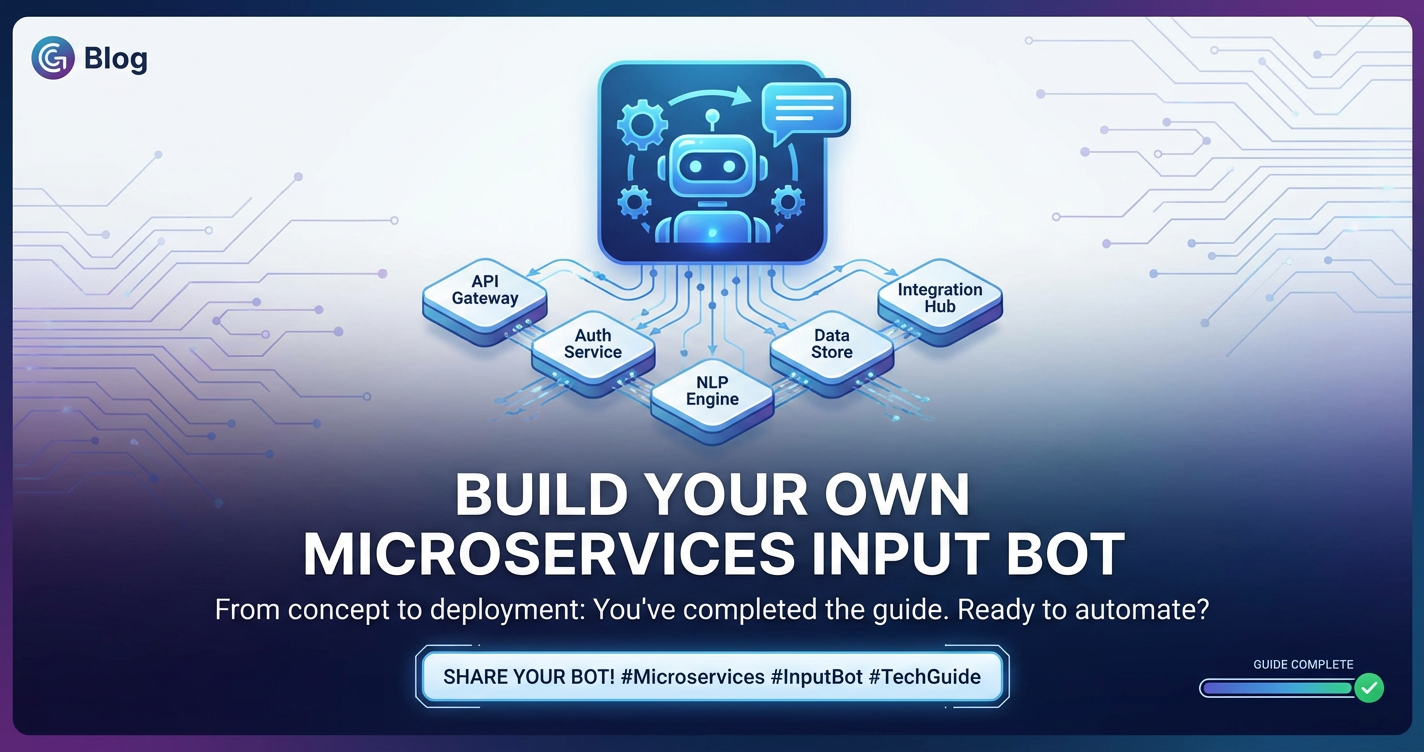
At a high level, the architecture of a microservices input bot can be visualized as layers interacting with each other. The user interacts with the Bot Interface, which then communicates with the Bot Service Layer. This layer, armed with NLU capabilities, interprets the user's intent and translates it into structured requests. These requests are then routed through an API Gateway to the appropriate Backend Microservices. These microservices perform the actual business logic, interacting with their respective Data Stores. Asynchronous communication channels and monitoring tools tie the entire system together, ensuring reliability and observability.
A typical flow would look like this: 1. User Input: A user types a message or speaks a command into the bot interface (e.g., Slack, custom chat widget). 2. Bot Interface Connector: The message is received by a connector service that translates the platform-specific message format into a standardized format for the Bot Service. 3. Bot Service (NLU & Dialogue Manager): The standardized message is processed by the NLU engine to identify intent and extract entities. The Dialogue Manager then uses this information, along with conversation history, to determine the next action. 4. Action Orchestration (via API Gateway): If an action requires interacting with backend business logic, the Bot Service constructs an API request. This request is sent to the API Gateway. 5. API Gateway: The API Gateway acts as the single entry point for all external requests into the microservices ecosystem. It routes the request to the correct backend microservice, handles authentication, authorization, rate limiting, and potentially transforms the request. This centralized management is crucial for both security and maintainability. 6. Backend Microservice: The target microservice receives the request, executes its business logic (e.g., fetches data from its database, processes an order), and returns a response. 7. Response Back to Bot Service: The response travels back through the API Gateway to the Bot Service. 8. Natural Language Generation (NLG): The Bot Service's NLG component generates a human-readable response based on the microservice's output. 9. User Output: The response is sent back to the user via the Bot Interface Connector.
This layered approach ensures clear separation of concerns, allowing different parts of the system to evolve independently.
3.2 Core Components in Detail
Let's break down the essential components that form the backbone of this architecture:
3.2.1 User Interface and Channel Connectors
This is the frontline of your bot, the point of interaction with the end-user. It could be: * Web Chat Widget: Embedded directly into your website. * Messaging Platform Integration: Connecting to popular platforms like Slack, Microsoft Teams, WhatsApp, Facebook Messenger, Telegram. * Voice Assistant Integration: Adapters for Amazon Alexa, Google Assistant. * Custom Mobile Application Interface: An in-app chat functionality.
Each channel will likely require a specific connector that handles the platform's API for sending and receiving messages. These connectors abstract away the intricacies of each platform, providing a uniform message format to the core Bot Service.
3.2.2 The Bot Service Layer
This layer is the intelligence hub of your bot. It typically comprises:
- Natural Language Understanding (NLU) Engine: Responsible for understanding user input. This could be an external SaaS solution (e.g., Google Dialogflow, IBM Watson Assistant, Microsoft LUIS), an open-source framework (e.g., Rasa NLU, Apache OpenNLP), or a custom-built solution leveraging pre-trained LLMs. The NLU parses the user's utterance to identify their intent and extract entities (key pieces of information).
- Dialogue Manager: This component orchestrates the conversation flow. It tracks the state of the conversation, maintains context (e.g., remembering previous questions or user preferences), and determines the appropriate response or action based on the identified intent and extracted entities. It also handles disambiguation and requests for missing information.
- Natural Language Generation (NLG) Module: Responsible for crafting human-like responses. For simple bots, this might involve selecting pre-defined templates and slot-filling with data from microservices. For more advanced bots, especially those integrated with LLM Gateway solutions, it might involve leveraging large language models to generate dynamic, contextually rich text responses. The NLG makes the bot's interactions feel more natural and less robotic.
3.2.3 The API Gateway: The Central Nervous System for Microservices
The API Gateway is a critical component in any microservices architecture, especially when exposing services to external clients like an input bot. It acts as the single entry point for all external requests, abstracting the internal microservice architecture from the client.
Its primary functions include: * Request Routing: Directing incoming requests to the appropriate microservice based on predefined rules. * Authentication and Authorization: Verifying the identity of the caller and ensuring they have the necessary permissions to access a particular service or resource. This can involve JWT validation, OAuth2 integration, or API key management. * Rate Limiting: Protecting backend services from being overwhelmed by too many requests from a single client, preventing abuse and ensuring fair usage. * Caching: Storing responses from backend services to reduce latency and load on those services for frequently accessed data. * Protocol Translation: Transforming client requests (e.g., HTTP/1.1) into different protocols used by backend services (e.g., gRPC, message queues) and vice-versa. * Request/Response Transformation: Modifying request payloads or response bodies to align with client or service expectations. * Load Balancing: Distributing incoming requests across multiple instances of a microservice to ensure high availability and optimal resource utilization. * Monitoring and Logging: Centralizing the collection of metrics, logs, and traces for all incoming and outgoing API calls, providing crucial visibility into system health and performance.
For systems that involve AI models, an advanced API Gateway can also function as an AI Gateway or LLM Gateway. This specialized role becomes incredibly valuable when your bot's intelligence relies on various AI models (like sentiment analysis, text summarization, or large language models for complex responses). An AI Gateway simplifies the integration of these models, offering features like unified API formats, prompt encapsulation, and cost tracking, regardless of the underlying AI provider. This standardization reduces complexity and development time, allowing the bot service to interact with diverse AI capabilities through a consistent interface.
3.2.4 Backend Microservices
These are the domain-specific services that implement the core business logic of your application. Each microservice should be independently deployable and responsible for a distinct business capability. Examples for an input bot might include: * User Service: Manages user profiles, authentication, and preferences. * Order Service: Handles order creation, status updates, and order history. * Inventory Service: Manages product stock levels and availability. * Payment Service: Processes transactions and manages payment methods. * Notification Service: Sends alerts or updates to users via email, SMS, or push notifications. * AI Helper Services: Microservices encapsulating specific AI functionalities (e.g., image recognition, document parsing) that the bot might leverage beyond core NLU/NLG.
3.2.5 Data Stores
Each microservice should ideally own its data store, choosing the most appropriate database technology for its needs. This allows for polyglot persistence, where different services can use different types of databases (e.g., PostgreSQL for relational data, MongoDB for document storage, Redis for caching). This decentralized approach enhances autonomy and scalability.
3.2.6 Asynchronous Communication (Message Queues)
For long-running tasks, event-driven processes, or ensuring reliability in inter-service communication, message queues (e.g., Apache Kafka, RabbitMQ, Amazon SQS) are invaluable. They decouple services, allowing them to communicate asynchronously. For example, when a bot places an order, the "Order Service" might publish an "Order Placed" event to a queue, which the "Inventory Service" and "Notification Service" can then consume to update stock and inform the user, respectively. This enhances system resilience and responsiveness.
3.2.7 Monitoring, Logging, and Tracing
In a distributed microservices environment, observing system behavior is paramount. * Monitoring: Collecting metrics (CPU usage, memory, response times, error rates) from all services to identify performance bottlenecks and anomalies. * Logging: Centralizing logs from all services into a single platform (e.g., ELK Stack, Splunk) for easy searching and analysis. * Distributed Tracing: Tools like OpenTelemetry or Jaeger track a single request as it flows through multiple services, providing end-to-end visibility and helping pinpoint latency issues or failures.
By carefully designing each of these components and understanding their interactions, you can construct a robust and highly functional microservices input bot system. The next chapter will guide you through the practical implementation steps.
APIPark is a high-performance AI gateway that allows you to securely access the most comprehensive LLM APIs globally on the APIPark platform, including OpenAI, Anthropic, Mistral, Llama2, Google Gemini, and more.Try APIPark now! 👇👇👇
Chapter 4: Step-by-Step Implementation Guide
With the architectural foundation laid, let's dive into the practical steps of building your microservices input bot. This chapter will walk you through the entire development lifecycle, from defining initial requirements to deployment.
4.1 Step 1: Define Requirements and Scope
Before writing a single line of code, clearly define what your bot will do and for whom. This crucial initial phase ensures that the development efforts are aligned with business objectives and user needs.
- Identify Target Audience: Who will be using the bot? What are their typical problems or questions? Understanding your users will inform the bot's persona, language, and functionality.
- Define Use Cases/User Stories: Break down the bot's functionality into specific use cases. For example:
- "As a customer, I want to check my order status by providing an order ID."
- "As an employee, I want to request time off by specifying dates."
- "As a user, I want to subscribe to daily weather updates for my city."
- Map Intents and Entities: For each use case, identify the primary intents the user might express and the entities (parameters) needed to fulfill that intent.
- Intent:
CheckOrderStatus, Entities:order_id - Intent:
RequestTimeOff, Entities:start_date,end_date,reason - Intent:
SubscribeWeather, Entities:city,frequency
- Intent:
- Determine Integration Points: Which existing systems or data sources will the bot need to interact with? This will help identify the required backend microservices.
- Set Performance and Availability Goals: How quickly should the bot respond? What level of uptime is expected? These will influence architectural decisions and infrastructure choices.
- Start Small, Iterate: Resist the urge to build a bot that does everything at once. Begin with a limited set of high-value use cases and iterate, gradually adding more features based on user feedback.
4.2 Step 2: Design Microservices and API Contracts
Based on your defined requirements, identify the distinct business capabilities that can be encapsulated as independent microservices.
- Domain-Driven Design (DDD): Use DDD principles to identify bounded contexts, which naturally map to microservices. For instance, "User Management," "Order Processing," "Product Catalog," "Notification," "Analytics."
- Define API Contracts: For each microservice, clearly define its API endpoints (RESTful, gRPC), request/response payloads, and data formats. This contract is critical for loose coupling, as it allows services to evolve independently as long as the API contract is maintained. Use tools like OpenAPI/Swagger for documenting these contracts.
- Example: Order Service API
GET /orders/{orderId}: Retrieve details of a specific order.POST /orders: Create a new order.PUT /orders/{orderId}/status: Update order status.
- Example: Order Service API
- Database Design: Determine the specific data schema and database technology for each microservice. Remember the principle of decentralized data management – each service owns its data.
- Communication Patterns: Decide on synchronous (REST, gRPC) vs. asynchronous (message queues) communication for inter-service interactions based on requirements for responsiveness, reliability, and eventual consistency.
Example Microservice Domains for an Input Bot System:
| Microservice Name | Primary Responsibilities | Data Store Example | Typical API Endpoints |
|---|---|---|---|
| User Service | Manage user profiles, authentication, preferences | PostgreSQL | /users, /users/{id}, /login |
| Order Service | Create, retrieve, update, cancel orders | MongoDB | /orders, /orders/{id}, /orderStatus |
| Product Service | Manage product catalog, inventory levels | PostgreSQL/Redis | /products, /products/{id}, /stock |
| Notification Service | Send emails, SMS, push notifications | RabbitMQ (for events) | /sendEmail, /sendSMS |
| Feedback Service | Collect and store user feedback, sentiment analysis | Cassandra | /feedback, /sentiment |
| AI Utility Service | Encapsulate specific AI models (e.g., summarization, translation) | (Stateless) | /summarize, /translate |
4.3 Step 3: Implement Core Microservices
Begin developing your backend microservices. Choose appropriate technologies for each service (e.g., Spring Boot with Java, Flask/Django with Python, Node.js with Express).
- Develop APIs: Implement the API contracts defined in the previous step. Focus on clean code, unit tests, and robust error handling within each service.
- Database Integration: Connect each microservice to its respective data store, ensuring efficient data access and persistence.
- Service Discovery: Implement a mechanism for services to find each other (e.g., Eureka, Consul, Kubernetes DNS). This is crucial in a dynamic microservices environment where service instances can come and go.
- Circuit Breakers: Implement circuit breaker patterns (e.g., Resilience4j, Hystrix) to prevent cascading failures. If a downstream service is unresponsive, the circuit breaker will "trip," preventing requests from hitting the failing service and returning a fallback response instead.
- Centralized Configuration: Use a configuration server (e.g., Spring Cloud Config, Consul) to manage configurations for all services, avoiding hardcoding and enabling dynamic updates.
4.4 Step 4: Set Up the API Gateway
The API Gateway is the linchpin that connects your bot service to your microservices. This step is critical for managing traffic, security, and observability.
- Choose an API Gateway: Several robust options exist, each with its strengths:Consider factors like performance, features (rate limiting, caching, WAF), ease of deployment, and community support.
- Open-Source/Self-Hosted: Kong Gateway, Apache APISIX, Tyk, Ocelot (.NET).
- Cloud-Managed: AWS API Gateway, Azure API Management, Google Cloud Apigee.
- Framework-Based: Spring Cloud Gateway (for Java microservices).
- Configure Routing Rules: Define how incoming requests from the bot should be routed to specific microservices based on paths, headers, or query parameters.
- Example:
GET /api/v1/orders/{orderId}-> routes toOrder ServicePOST /api/v1/users-> routes toUser ServiceGET /api/v1/weather/{city}-> routes toWeather Service
- Example:
- Implement Authentication and Authorization: Configure the API Gateway to secure access to your microservices. This often involves:
- API Key Management: Simple for bot-to-gateway communication.
- OAuth2/JWT Validation: For more robust security, especially if users are authenticated through the bot. The gateway can validate JWTs issued by an identity provider.
- Role-Based Access Control (RBAC): Ensure that the bot (or the user interacting through the bot) only accesses resources it's permitted to.
- Rate Limiting: Protect your backend services by configuring rate limits on the gateway. This prevents individual clients (or the bot itself) from overwhelming your system with too many requests.
- Logging and Monitoring Integration: Ensure the API Gateway integrates with your centralized logging and monitoring solutions. It's the first point of contact for all external requests, making its logs invaluable for debugging and performance analysis.
APIPark: An Advanced AI Gateway & API Management Solution
For organizations looking for a comprehensive, open-source solution that extends beyond traditional API Gateway functionalities, especially when dealing with AI models, APIPark stands out. APIPark is an open-sourced AI Gateway and API management platform that significantly simplifies the complexities of integrating and managing both REST and AI services.
When your input bot system needs to leverage various AI capabilities, such as advanced NLU, sentiment analysis, text generation with large language models (LLMs), or even specialized computer vision services, an AI Gateway like APIPark becomes indispensable. APIPark's unique features make it particularly well-suited for our microservices input bot:
- Quick Integration of 100+ AI Models: APIPark provides a unified management system for authenticating and tracking costs across a multitude of AI models, abstracting away the specifics of each provider. This means your bot service can easily tap into different AI capabilities without complex, bespoke integrations.
- Unified API Format for AI Invocation: A major headache in using multiple AI models is their differing API formats. APIPark standardizes the request data format, ensuring that changes in AI models or prompts do not affect your bot application or microservices. This "plug-and-play" capability for AI models dramatically simplifies maintenance and allows for quick swapping of models as technology evolves.
- Prompt Encapsulation into REST API: Imagine turning a complex prompt for an LLM into a simple REST API call. APIPark allows you to combine AI models with custom prompts to create new APIs, such as a "Sentiment Analysis API" or a "Summarization API." Your bot service can then call these simple, custom APIs directly, rather than managing complex prompt engineering within the bot itself. This effectively makes APIPark an LLM Gateway that encapsulates the intelligence.
- End-to-End API Lifecycle Management: Beyond AI, APIPark offers comprehensive lifecycle management for all your APIs, from design to publication, invocation, and decommission. This includes regulating management processes, managing traffic forwarding, load balancing, and versioning for published APIs, which are all crucial for a stable microservices environment.
- Performance Rivaling Nginx: With its high-performance architecture, APIPark can achieve over 20,000 TPS on modest hardware, supporting cluster deployment for large-scale traffic. This ensures your API Gateway is not a bottleneck, even under heavy load from your input bot and other applications.
- Detailed API Call Logging and Powerful Data Analysis: APIPark records every detail of each API call, providing comprehensive logs crucial for tracing and troubleshooting. Furthermore, it analyzes historical call data to display long-term trends and performance changes, helping businesses perform preventive maintenance. This observability is invaluable for understanding how your bot is interacting with backend services and AI models.
Integrating APIPark into your architecture provides a powerful, unified platform for managing both your traditional REST microservices and advanced AI models, making it an excellent choice for a scalable and intelligent microservices input bot. You can quickly deploy APIPark with a single command line: curl -sSO https://download.apipark.com/install/quick-start.sh; bash quick-start.sh.
4.5 Step 5: Develop the Bot Service
This is where the conversational intelligence comes to life, integrating with your NLU/NLG and connecting to the API Gateway.
- Choose a Bot Framework: Select a framework that suits your chosen language and integration needs. Popular choices include:
- Rasa: Open-source, self-hosted, powerful for custom NLU/DM.
- Dialogflow (Google): Cloud-based, managed NLU/DM.
- Microsoft Bot Framework: Comprehensive, multi-channel.
- Custom Frameworks: Using libraries like NLTK/SpaCy for Python, combined with a custom dialogue manager.
- NLU Integration: Configure your bot service to send user input to the chosen NLU engine and receive parsed intent and entities. Train your NLU model with diverse example utterances for each intent.
- Dialogue Flow Logic: Implement the core dialogue logic. This involves:
- State Management: Tracking the current state of the conversation (e.g., waiting for
order_id, confirmingstart_date). - Conditional Logic: Branching the conversation based on user input, identified intents, and entity values.
- Prompts and Clarifications: Crafting responses that guide the user when information is missing or ambiguous.
- State Management: Tracking the current state of the conversation (e.g., waiting for
- Connecting to the API Gateway:
- When the dialogue manager determines that a backend action is needed, construct an HTTP request (or gRPC call) using the extracted entities as parameters.
- Send this request to your API Gateway endpoint.
- Process the response from the API Gateway, which contains the results from the microservice.
- Natural Language Generation (NLG): Based on the results from the microservices, generate an appropriate, human-like response. For simple cases, use templates. For more dynamic responses, especially if your bot needs to summarize information or provide creative answers, consider integrating with an LLM Gateway (like APIPark's prompt encapsulation feature) to leverage generative AI models.
4.6 Step 6: Integrate with User Interface
Connect your bot service to the chosen user interface channels.
- Channel-Specific Adapters: Develop or use existing adapters to connect your bot framework to platforms like Slack, Telegram, WhatsApp, or a custom web chat widget. These adapters handle the platform-specific message formats and APIs.
- Webhooks: Many messaging platforms use webhooks to send incoming messages to your bot service. Ensure your bot service has an accessible endpoint for these webhooks and that it processes the incoming payload correctly.
- UI Customization: Customize the look and feel of your bot's interface (e.g., avatar, welcome message, quick replies, rich cards) to match your brand and enhance the user experience.
4.7 Step 7: Implement Monitoring, Logging, and Error Handling
Robust observability and error handling are non-negotiable for a distributed system.
- Centralized Logging: Implement a logging strategy that funnels logs from all services (bot, API Gateway, microservices) into a central logging system (e.g., Elasticsearch, Logstash, Kibana - ELK Stack; Splunk; Datadog). Ensure logs contain correlation IDs for distributed tracing.
- Metrics Collection: Collect performance metrics (response times, error rates, CPU usage, memory) from all components. Use tools like Prometheus and Grafana for monitoring and visualization.
- Distributed Tracing: Integrate a distributed tracing solution (e.g., OpenTelemetry, Jaeger) across all services. This allows you to visualize the entire path of a request as it traverses through the bot, API Gateway, and multiple microservices, helping to pinpoint latency bottlenecks or failures.
- Error Handling: Design a comprehensive error handling strategy for the entire system:
- Bot Level: Gracefully handle NLU misunderstandings and microservice errors, providing helpful fallback messages to the user.
- API Gateway Level: Implement robust error responses for unauthorized access, rate limit breaches, or unavailable backend services.
- Microservice Level: Return meaningful error codes and messages for business logic failures or database issues.
- Alerting: Set up alerts based on critical metrics and error thresholds to proactively identify and respond to issues before they impact users.
4.8 Step 8: Testing and Deployment
The final stages involve rigorous testing and setting up automated deployment pipelines.
- Unit Tests: Write unit tests for individual components and functions within each microservice and the bot service.
- Integration Tests: Test the interactions between services (e.g., bot service calling API Gateway, API Gateway routing to a microservice, microservice interacting with its database).
- End-to-End (E2E) Tests: Simulate real user interactions with the bot from the UI, through the entire microservices stack, and back to the user, verifying the complete flow.
- NLU Model Testing: Continuously evaluate your NLU model's accuracy (intent recognition, entity extraction) with new utterances and refine its training data.
- Performance Testing: Load test your entire system to identify bottlenecks and ensure it can handle expected user traffic and API call volumes.
- CI/CD Pipelines: Implement Continuous Integration and Continuous Delivery (CI/CD) pipelines for automated building, testing, and deployment of each microservice and the bot service. This ensures rapid and reliable releases. Tools like Jenkins, GitLab CI/CD, GitHub Actions, Azure DevOps, or CircleCI are commonly used.
- Containerization and Orchestration: Package each microservice and the bot service into Docker containers. Deploy them using container orchestration platforms like Kubernetes, which provides features for service discovery, load balancing, scaling, and rolling updates.
- Rolling Deployments: Implement rolling deployments to update services with zero downtime, ensuring a continuous user experience.
By following these detailed steps, you can systematically build a robust, scalable, and intelligent microservices input bot that delivers real value to your users and organization. The journey from conceptual design to a fully operational system requires diligence, adherence to best practices, and a commitment to continuous improvement.
Chapter 5: Advanced Considerations and Best Practices
Building a functional microservices input bot is a significant achievement, but moving from functional to truly robust, scalable, and secure requires attention to advanced considerations and adherence to best practices. This chapter delves into these crucial aspects, ensuring your system is prepared for the long haul.
5.1 Security: Protecting Your Distributed Ecosystem
In a distributed microservices environment, security is not an afterthought; it must be ingrained into every layer of your architecture. The attack surface is broader than a monolith, demanding a multi-layered approach.
- API Gateway as a Security Enforcer: As the single entry point, the API Gateway is your first line of defense.
- Authentication & Authorization: All external requests must be authenticated. The API Gateway can enforce API key validation, JWT (JSON Web Token) validation, or OAuth2 flows. It can also perform coarse-grained authorization checks based on scopes or roles embedded in tokens.
- Input Validation: The gateway can perform schema validation on incoming request bodies and query parameters to prevent common injection attacks and ensure valid data types before requests reach backend services.
- TLS/SSL Enforcement: All communication between the client (bot interface), API Gateway, and ideally, between microservices, should be encrypted using TLS/SSL to protect data in transit.
- Web Application Firewall (WAF): Integrating a WAF at the gateway level can protect against common web vulnerabilities like SQL injection, cross-site scripting (XSS), and DDoS attacks.
- Zero Trust Architecture: Assume no internal network is inherently trustworthy. Authenticate and authorize every request, regardless of its origin. This means even inter-service communication should be secured, perhaps using mutual TLS (mTLS) or short-lived service tokens.
- Least Privilege Principle: Each service should only have the minimum necessary permissions to perform its function. For example, a "Product Catalog" service doesn't need write access to the "Payment" database. This limits the blast radius in case a service is compromised.
- Secrets Management: Never hardcode sensitive information (database credentials, API keys, encryption keys) directly into your code. Use dedicated secrets management solutions like HashiCorp Vault, AWS Secrets Manager, or Kubernetes Secrets (with caution and encryption at rest) to store and retrieve sensitive data securely.
- Regular Security Audits and Penetration Testing: Periodically conduct security audits and penetration tests to identify vulnerabilities in your entire system, from the bot's front-end to the deepest microservices.
- Data Encryption: Encrypt sensitive data both in transit (using TLS/SSL) and at rest (disk encryption for databases, encrypted storage for files).
- Compliance: Ensure your security measures comply with relevant industry standards and regulations (e.g., GDPR, HIPAA, PCI DSS).
5.2 Scalability and Performance: Handling Growth
A key advantage of microservices is their ability to scale independently, but this requires thoughtful design and optimization.
- Horizontal Scaling: Design your services to be stateless wherever possible, allowing you to easily add or remove instances based on demand. Containerization (Docker) and orchestration (Kubernetes) make this seamless.
- Load Balancing: The API Gateway and your container orchestrator (e.g., Kubernetes Ingress/Service) will distribute incoming traffic across multiple instances of your services. Configure this strategically to ensure even load distribution.
- Caching: Implement caching at various levels to reduce load on backend services and improve response times.
- API Gateway Caching: Cache responses for frequently accessed, non-volatile data.
- Service-Level Caching: Services can cache their own internal data (e.g., product details in an in-memory cache or Redis).
- Database Caching: Leverage database-level caching features.
- Asynchronous Processing: For long-running or resource-intensive tasks triggered by the bot, use message queues to offload processing to dedicated worker services. This prevents the bot and immediate backend services from being blocked and improves responsiveness. For example, processing a complex report request can be queued, and the bot can inform the user that the report will be delivered when ready.
- Database Optimization: Optimize database queries, use appropriate indexing, and consider sharding or partitioning large databases across multiple instances for extreme scale.
- Content Delivery Networks (CDNs): If your bot serves static assets (images, stylesheets) or has a web-based UI, use a CDN to deliver these assets closer to your users, reducing latency.
5.3 Observability: Knowing What's Happening
In a distributed system, traditional debugging methods fall short. Robust observability is crucial for understanding system behavior, diagnosing issues, and optimizing performance.
- Comprehensive Logging: Every service should emit structured logs with relevant context (e.g., request IDs, user IDs, service names, timestamps). Centralize these logs into a platform like ELK Stack or Splunk for easy searching, filtering, and analysis. Ensure consistent logging formats across all services.
- Metrics and Dashboards: Collect key performance indicators (KPIs) and operational metrics from all services (e.g., request latency, error rates, resource utilization, queue depths, API call counts). Use a time-series database (e.g., Prometheus) and visualization tools (e.g., Grafana) to create interactive dashboards that provide real-time insights into system health.
- Distributed Tracing: Implement distributed tracing (e.g., OpenTelemetry, Jaeger). This allows you to visualize the entire lifecycle of a request as it propagates through multiple services, identifying bottlenecks and pinpointing the exact service where an error occurred. This is particularly vital for debugging complex interactions involving the bot, API Gateway, and several microservices.
- Health Checks: Each microservice should expose a health endpoint (e.g.,
/health) that can be queried by your orchestrator (Kubernetes) or a monitoring system to determine its operational status. This allows for automated restarts of unhealthy instances. - Alerting: Configure alerts based on predefined thresholds for critical metrics and log patterns. This ensures that operations teams are immediately notified of potential issues (e.g., high error rates, service downtime, slow response times) so they can respond proactively.
5.4 Data Management: Consistency in a Distributed World
Decentralized data stores offer flexibility but introduce challenges for data consistency.
- Eventual Consistency: In most microservices architectures, strict transactional consistency across services (like in a monolith) is sacrificed for availability and scalability. Instead, embrace eventual consistency, where data might be temporarily inconsistent but eventually synchronizes.
- Saga Pattern: For complex business transactions that span multiple services, the Saga pattern can manage distributed transactions. A saga is a sequence of local transactions, where each transaction updates data within a single service and publishes an event that triggers the next step in the saga. If a step fails, compensation transactions are executed to undo previous steps.
- Event Sourcing: Consider event sourcing where services store all changes to their state as a sequence of events. This provides an immutable audit log and allows for rebuilding state at any point in time, facilitating complex data interactions and debugging.
- Data Lake/Data Warehouse: For analytical purposes or aggregated reporting that requires data from multiple services, consider building a separate data lake or data warehouse. Services can publish relevant events or data snapshots to this central store, avoiding direct cross-service database queries.
5.5 Evolution and Maintenance: Keeping the System Agile
Microservices are designed for agility, but proper practices are needed to sustain this over time.
- API Versioning: As your services evolve, their APIs will change. Implement clear API versioning strategies (e.g.,
/v1/users,/v2/usersin the URL, or using custom headers) to manage backward compatibility and allow clients (like your bot) to upgrade gradually. - Backward Compatibility: Strive for backward compatibility in your API changes to avoid breaking existing clients. If breaking changes are unavoidable, provide clear migration paths and deprecation warnings.
- Documentation: Maintain comprehensive and up-to-date documentation for all microservices' APIs, including their purpose, endpoints, request/response formats, and authentication requirements. Tools like Swagger/OpenAPI are excellent for this. The documentation of your API Gateway itself, including its routing and security policies, is equally important.
- Automated Testing (Revisited): Maintain a strong suite of automated tests. As features are added or changed, tests ensure that existing functionality isn't inadvertently broken.
- Team Autonomy and DevOps Culture: Foster small, autonomous teams responsible for their microservices from development to production. Embrace a DevOps culture that emphasizes collaboration, automation, and continuous improvement.
By diligently applying these advanced considerations and best practices, your microservices input bot system will not only be capable of handling complex user interactions but also remain secure, performant, and adaptable to future demands, ensuring its long-term success and value.
Conclusion
The journey of building a microservices input bot is a testament to the power of modern architectural patterns and intelligent conversational interfaces. We have meticulously explored every facet, from the fundamental principles of breaking down monolithic applications into agile microservices to orchestrating complex conversational flows and integrating diverse AI capabilities. The synergy between these two domains — the robust, scalable backend of microservices and the intuitive, user-friendly frontend of an input bot — creates a powerful system capable of transforming how users interact with technology.
We began by dissecting microservices, understanding their inherent advantages in terms of scalability, resilience, and development agility, while also acknowledging the complexities they introduce. This foundational knowledge then paved the way for comprehending the role of input bots, their conversational mechanics, and how they simplify access to complex backend functionalities. The architectural overview provided a blueprint, detailing how components like the Bot Service, API Gateway, and specialized microservices work in harmony.
The step-by-step implementation guide offered a practical roadmap, covering everything from defining requirements and designing granular microservices to implementing robust security measures, optimizing for performance, and ensuring comprehensive observability. A critical highlight was the crucial role of the API Gateway as the central nervous system of your microservices ecosystem, securing and routing requests efficiently. Furthermore, we introduced how advanced platforms like APIPark elevate this capability, acting as an intelligent AI Gateway and LLM Gateway that simplifies the integration and management of diverse AI models, streamlining the development of truly intelligent bots. Its features, such as unified API formats and prompt encapsulation, directly address the challenges of leveraging cutting-edge AI within a microservices framework.
The advanced considerations underscored the importance of security, scalability, observability, and robust data management in sustaining a production-grade system. These practices are not mere suggestions but essential pillars for ensuring your bot remains reliable, maintainable, and adaptable in the face of evolving user demands and technological advancements.
Ultimately, building a microservices input bot is more than just a technical exercise; it's about crafting an intelligent, responsive, and efficient digital assistant that bridges the gap between human intent and machine action. By embracing the principles and methodologies outlined in this guide, you are well-equipped to design, build, and deploy a cutting-edge conversational system that drives innovation and delivers exceptional value. The future of interaction is conversational, and with microservices as your backbone, that future is not just within reach, but ready to be built.
Frequently Asked Questions (FAQs)
Q1: What are the primary benefits of using microservices for an input bot compared to a monolithic architecture?
A1: The primary benefits include enhanced scalability, resilience, and agility. With microservices, individual components of the bot system (e.g., NLU, order processing, user management) can be scaled independently based on demand, optimizing resource usage. If one microservice fails, the entire bot doesn't crash, ensuring higher availability. Furthermore, small, independent teams can develop and deploy features more quickly, leading to faster iteration cycles and time-to-market for new bot capabilities. This modularity also allows for technology diversity, enabling teams to choose the best tech stack for each specific task, which is particularly beneficial for integrating specialized AI models.
Q2: How does an API Gateway contribute to the security of a microservices input bot system?
A2: An API Gateway acts as the crucial first line of defense, centralizing security policies at the edge of your microservices ecosystem. It enforces authentication (e.g., API keys, JWT validation, OAuth2) for all incoming requests, ensuring only authorized callers interact with your backend. It can also perform granular authorization checks, rate limiting to prevent abuse or DDoS attacks, and input validation to guard against common vulnerabilities like SQL injection. Furthermore, the gateway facilitates TLS/SSL encryption for data in transit and can integrate with a Web Application Firewall (WAF) to block malicious traffic. For AI-driven bots, an AI Gateway like APIPark extends this by managing secure access to various AI models and ensuring cost tracking.
Q3: What is the role of Natural Language Understanding (NLU) and how does it integrate with microservices?
A3: NLU is the core intelligence of an input bot, responsible for interpreting user input by identifying the user's intent (what they want to do) and extracting relevant entities (key information like names, dates, or product IDs). The NLU engine processes raw user text, transforming it into structured data that the bot's dialogue manager can understand. This structured data is then used by the bot service to construct API calls, which are routed through the API Gateway to the appropriate backend microservice. For instance, if NLU identifies the intent "CheckOrderStatus" and the entity "order_id=123", the bot service sends a request to the Order Service via the API Gateway to retrieve order 123's status. Advanced NLU often leverages Large Language Models, where an LLM Gateway can further streamline their integration and management.
Q4: How can APIPark specifically enhance the development of a microservices input bot, especially one utilizing AI?
A4: APIPark, as an open-source AI Gateway and API management platform, offers several key advantages. It simplifies the integration of 100+ AI models by providing a unified management system for authentication and cost tracking. Critically, it offers a unified API format for AI invocation, meaning your bot service doesn't need to deal with varying API specifics of different AI providers or LLMs. Its "Prompt Encapsulation into REST API" feature allows you to define custom prompts for AI models and expose them as simple REST APIs, making it an effective LLM Gateway. This drastically reduces the complexity of adding advanced AI capabilities (like sentiment analysis, text summarization, or complex generative responses) to your bot, accelerating development and reducing maintenance overhead. Additionally, its robust API lifecycle management, high performance, and detailed logging capabilities benefit all microservices in the system.
Q5: What are the main challenges in maintaining data consistency across multiple microservices, and how are they typically addressed?
A5: In a microservices architecture, each service often owns its data store, which can lead to challenges in maintaining data consistency, especially for transactions that span multiple services. Strict ACID (Atomicity, Consistency, Isolation, Durability) transactions across services are typically avoided for better scalability and availability. Instead, developers often embrace eventual consistency, where data inconsistencies are temporary and eventually resolved. This is commonly addressed using patterns like the Saga pattern, which orchestrates a sequence of local transactions, with each transaction publishing an event that triggers the next step. If a step fails, compensation transactions are executed to undo previous actions. Another approach is Event Sourcing, where all changes to a service's state are stored as an immutable sequence of events, providing a reliable audit log and facilitating data reconstruction.
🚀You can securely and efficiently call the OpenAI API on APIPark in just two steps:
Step 1: Deploy the APIPark AI gateway in 5 minutes.
APIPark is developed based on Golang, offering strong product performance and low development and maintenance costs. You can deploy APIPark with a single command line.
curl -sSO https://download.apipark.com/install/quick-start.sh; bash quick-start.sh

In my experience, you can see the successful deployment interface within 5 to 10 minutes. Then, you can log in to APIPark using your account.

Step 2: Call the OpenAI API.