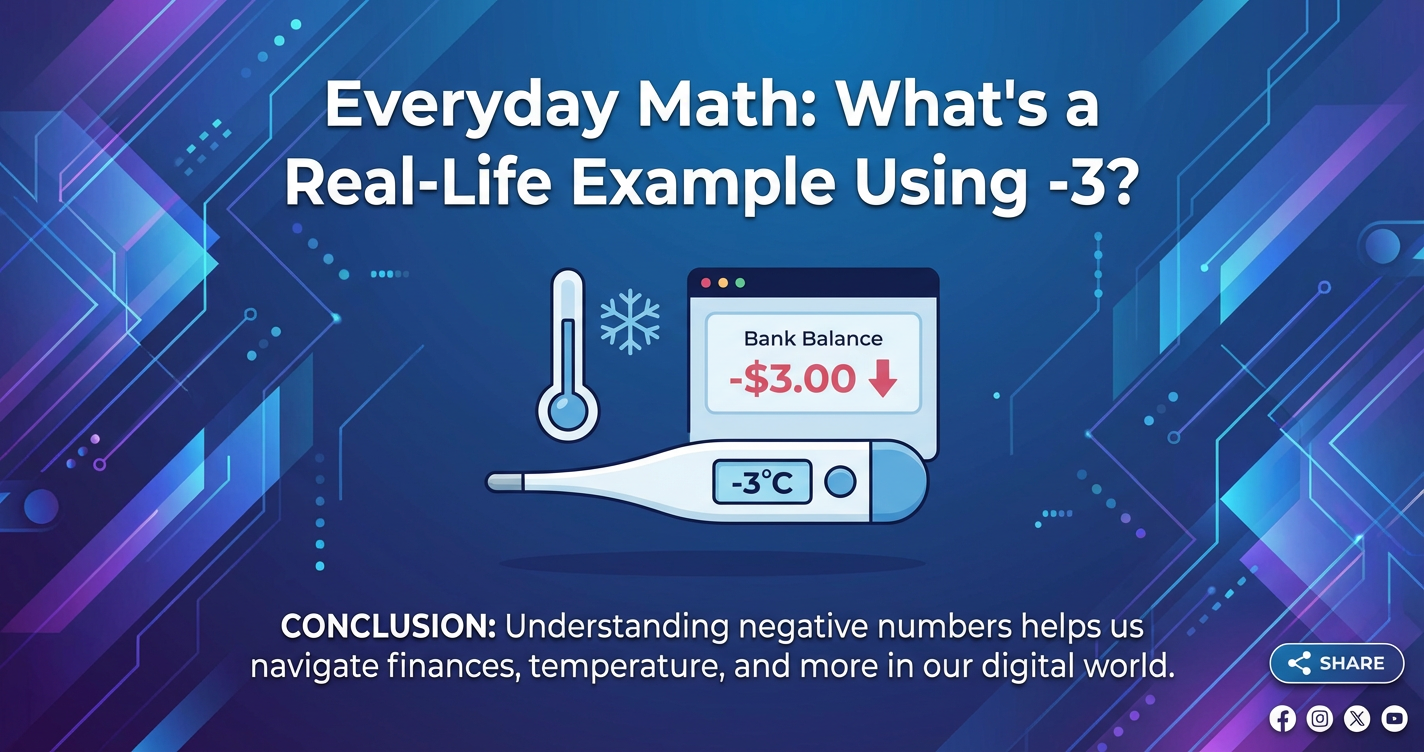
Everyday Math: What's a Real-Life Example Using -3?


Mathematics, at its core, is the language of the universe, a universal tool we use to quantify, understand, and predict the world around us. While many might associate "everyday math" with simple addition, subtraction, multiplication, and division of positive numbers, the truth is that our lives are replete with scenarios where negative numbers play a pivotal, often subtle, role. These seemingly abstract concepts, such as -3, are not confined to the pages of textbooks or the complex equations of advanced physics; they are woven into the very fabric of our daily experiences, from managing personal finances to understanding weather patterns and even tracking scores in a game.
For many, the introduction to negative numbers can feel like stepping through an unfamiliar gateway into a slightly bewildering mathematical landscape. It challenges the intuitive notion that numbers simply count 'things' that exist. How can you have 'minus three' apples? This initial cognitive dissonance is precisely what makes negative numbers such a powerful intellectual tool. They force us to expand our understanding of quantity, to recognize that numbers can represent not just existence and accumulation, but also absence, direction, debt, and relative position. The number -3, in particular, serves as an excellent, approachable example to explore this expanded numerical universe. It's a small, manageable negative integer, yet its implications can be profound and far-reaching, illustrating fundamental principles that apply to all negative values. Understanding -3 is not merely about arithmetic; it’s about grasping a deeper API – an interface – to how the world’s systems function, enabling us to interpret deficits, drops, and below-zero conditions with clarity and precision. It’s a foundational element that, once mastered, opens up a broader perspective on quantitative reasoning, making complex data sets more interpretable and real-world problems more solvable.
This extensive exploration aims to peel back the layers of abstraction surrounding negative numbers, specifically focusing on -3, and reveal its omnipresence in our daily lives. We will delve into various domains – finance, temperature, geography, sports, and even the digital realm – to demonstrate how this unassuming integer is not just an academic curiosity but a practical necessity. By the end, the concept of -3 will hopefully transform from a potential source of confusion into a recognized and indispensable component of our everyday mathematical toolkit, a clear gateway to numerical literacy that empowers us to navigate a world full of both positive and negative quantities with confidence and insight. We'll see how various aspects of our reality can be effectively modeled and understood through the lens of negative integers, ultimately enhancing our ability to make informed decisions and interpret the subtle cues that quantitative data provides.
The Fundamental Nature of Negative Numbers: Beyond Simple Counting
To truly appreciate the everyday examples of -3, we must first firmly grasp the fundamental nature of negative numbers themselves. For centuries, even brilliant mathematicians struggled with the concept. Ancient Egyptians and Babylonians dealt with deficits in practical ways but lacked a formal system for negative numbers. It was in India, around the 7th century, that mathematicians like Brahmagupta began to formalize rules for "debts" and "fortunes," treating them as opposite quantities, laying the groundwork for what we now understand as positive and negative integers. European mathematicians slowly adopted these ideas, often with great skepticism, until the 17th century when their utility in algebra and coordinate geometry became undeniable. This slow acceptance highlights how deeply ingrained our initial understanding of numbers as mere counts of tangible objects is.
At its core, a negative number represents a value less than zero. On a number line, zero acts as the crucial reference point, a fulcrum. Positive numbers extend to the right, indicating increase or a value 'above' the reference. Negative numbers extend to the left, indicating decrease, deficit, or a value 'below' the reference. So, -3 isn't just 'three of something'; it's 'three less than zero' or 'three in the opposite direction' from zero. This directional aspect is critical. If zero represents sea level, then -3 could mean three units below sea level. If zero represents a balanced budget, then -3 signifies a deficit of three units.
The properties of negative numbers are what make them so powerful. Adding a negative number is equivalent to subtracting its absolute value (e.g., 5 + (-3) = 5 - 3 = 2). Subtracting a negative number is equivalent to adding its absolute value (e.g., 5 - (-3) = 5 + 3 = 8). Multiplying or dividing two negative numbers yields a positive result, while multiplying or dividing a positive and a negative number yields a negative result. These rules, often taught in early algebra, aren't arbitrary; they are the logical API that allows these numbers to accurately model real-world interactions of opposing forces or conditions. For instance, if you remove three debts of $1 each, your financial position improves by $3, which is captured by the rule: -( -3) = +3.
Why focus on -3 specifically? It's a small, easily digestible integer that perfectly illustrates these principles without overwhelming us with complexity. It’s a single step away from -2 or -4, making it simple to visualize on a number line. It avoids the potentially confusing implications of larger numbers or fractions while still being distinctly negative. In many real-world contexts, a value of -3 is significant enough to notice but not so extreme as to be catastrophic, making it an excellent example for demonstrating how everyday situations manifest negative values. It acts as an accessible gateway to understanding the entire realm of negative integers and their practical applications. Grasping the nuances of -3 prepares us for interpreting broader numerical spectra, whether we are analyzing scientific data, managing complex logistical challenges, or simply understanding daily news reports that often feature fluctuations and deficits. Its simplicity belies its profound utility in developing a robust numerical intuition, an intuition that becomes increasingly valuable in an data-driven world.
Real-Life Scenarios: Finance and Economics
Perhaps nowhere are negative numbers more universally encountered and acutely felt than in the realms of finance and economics. The concept of -3 here moves beyond abstraction and directly impacts bank accounts, investment portfolios, and household budgets. It's a tangible representation of debt, loss, or a shortfall.
Consider the most common scenario: Debt or Overdrafts. If your bank account balance drops to -$3, it means you've spent $3 more than you had available. This isn't just a number on a statement; it could trigger bank fees, reflect a tight budget, or indicate a momentary lapse in financial planning. The bank's system, acting as an API for your financial data, clearly communicates this negative balance, signaling a need for action. Similarly, if you lend a friend $3, their financial position relative to you is -$3. They owe you three units of currency. Until that debt is repaid, their 'net worth' in that particular transaction remains negative. This simple example scales up to mortgages, car loans, and credit card balances, all of which are, in essence, large negative numbers representing future obligations. Understanding this fundamental concept of owing, represented by a negative value, is a crucial gateway to personal financial literacy and responsible money management. Without this comprehension, it’s impossible to accurately assess one's financial standing or plan for future expenditures.
In the Stock Market and Investments, -3 can represent a variety of negative outcomes. A stock might drop by -$3 per share. If you own 100 shares, your investment just decreased by $300. This is a direct loss of value, reflected by a negative change. A market index, like the Dow Jones Industrial Average, might be reported as "down -3 points," indicating a slight but noticeable dip in overall market performance for the day. While small, such a drop can be a leading indicator or part of a larger trend, influencing investor sentiment and decision-making. Investors constantly monitor these negative fluctuations, using complex API feeds from financial data providers to track market movements in real-time. A portfolio manager, for example, might be tasked with reducing risk if their overall portfolio performance dips below a certain negative threshold, perhaps -3% for the quarter, requiring strategic adjustments to prevent further losses.
Budgeting and Expense Tracking also heavily rely on negative numbers. Imagine you've set a strict budget for discretionary spending, say $50 for the week. If you've already spent $53, your budget is at -$3. This negative balance immediately tells you that you've overshot your target and need to either cut back or reallocate funds. Financial planning software often uses algorithms that calculate your spending relative to your income and budget, and any deficit is clearly displayed as a negative number. This allows individuals and businesses to quickly identify areas of overspending and make necessary corrections. Without the ability to represent these shortfalls as negative values, the true state of financial health would be obscured, making effective budgeting an impossible task.
Finally, in Profit and Loss Statements, -3 can signify a loss per unit or per transaction. If a company sells a widget for $10 but it costs $13 to produce and market, then the company incurs a -$3 loss on each widget sold. While a single -$3 loss might seem minor, if the company sells millions of these widgets, the cumulative loss becomes catastrophic. Analyzing these per-unit negative profits is a critical part of business strategy, helping companies identify unprofitable products or processes that need redesign or discontinuation. Business analysts often use intricate models and APIs to aggregate sales and cost data from various departments, allowing them to pinpoint these negative margins and advise on operational adjustments. Understanding these negative margins is a direct gateway to ensuring business sustainability and profitability in the long run, guiding strategic decisions from pricing to production efficiency. The clarity that negative numbers bring to financial reporting is unparalleled, offering an objective snapshot of performance that would otherwise be obscured by mere positive figures.
Real-Life Scenarios: Temperature and Climate
Beyond the world of money, negative numbers are an intrinsic part of our natural environment, most notably in the measurement of temperature and the analysis of climate. The concept of -3 degrees is a common experience for many across the globe, especially during winter months, and carries significant implications for daily life, infrastructure, and even biological processes.
In Weather Forecasting and Daily Temperatures, -3 degrees Celsius (or approximately 26.6 degrees Fahrenheit) is a familiar and important marker. It signifies a temperature well below the freezing point of water (0°C or 32°F). When the mercury dips to -3°C, people know to expect icy roads, frozen pipes, and the need for heavy winter clothing. This seemingly simple number becomes a critical piece of information for personal safety and convenience. Weather forecasters rely on complex atmospheric models that constantly process vast arrays of data, and these models frequently output negative temperature predictions. The ability to interpret these negative values correctly is vital for public alerts, agricultural planning (protecting crops from frost), and managing energy consumption. Local weather stations often use an API to feed their real-time temperature data to various public platforms, displaying these negative readings prominently when cold fronts move in, acting as an essential gateway for communities to prepare for harsh weather.
Beyond static temperature readings, negative numbers are crucial for understanding Temperature Changes and Trends. If the temperature drops by 3 degrees from one hour to the next, this change can be represented as -3 degrees. This tells us not just the current state but the direction and magnitude of the change. A "drop of 3 degrees" is universally understood, but formally, it's a change of -3. Over longer periods, in Climate Science, scientists analyze deviations from average temperatures. If a particular year's average temperature is 3 degrees below the historical average for that region, this deviation is recorded as -3°C. These negative deviations are crucial indicators of climate variability and change, helping scientists understand global warming or cooling trends, identify anomalies, and model future climate scenarios. Researchers utilize sophisticated APIs to access vast historical climate databases, allowing them to perform complex statistical analyses that often reveal long-term trends characterized by subtle positive or negative shifts in temperature, providing a comprehensive gateway to understanding our planet's evolving climate.
The impact of -3°C extends to various practical domains. For instance, in Horticulture, knowing that temperatures might drop to -3°C overnight signals to farmers that delicate crops need to be covered or heated to prevent damage from frost. In Engineering and Construction, materials are chosen and designed to withstand specific temperature ranges, and -3°C is a common benchmark for considering frost heave in soil or the brittleness of certain metals. Even in Healthcare, exposure to -3°C for extended periods can pose risks like hypothermia or frostbite, making public health advisories critical. The digital systems that monitor and control environmental conditions in controlled environments, such as cold storage facilities or research laboratories, constantly track temperatures, often displaying negative values, and communicate these through internal APIs to ensure optimal conditions are maintained.
Understanding -3 in the context of temperature is thus far more than a numerical exercise; it's a practical skill with direct implications for safety, planning, and scientific comprehension. It teaches us about relative measures and how a simple negative integer can be a powerful indicator of environmental conditions and changes, serving as a critical gateway to interacting with and adapting to the world around us. The precision offered by negative numbers in temperature measurements allows for exact communication and informed decision-making across numerous sectors, from personal comfort to large-scale infrastructure projects.
Real-Life Scenarios: Geography and Elevation
Our world is a three-dimensional tapestry of mountains, valleys, oceans, and subterranean features, and negative numbers are essential for accurately describing our position within this complex landscape. When a reference point, such as sea level, is established, anything below that point is naturally expressed using negative integers. Here, -3 becomes a clear indicator of depth or a position beneath a defined datum.
The most intuitive example lies in Elevation and Depth Measurements. Sea level, often defined as 0 meters, serves as the universal benchmark for elevation. If a geological feature, a specific point in a valley, or a part of a cave system is described as being at -3 meters, it means that location is precisely 3 meters below average sea level. This is critical for cartographers, geologists, and civil engineers. Mapping software and Geographic Information Systems (GIS) rely heavily on these negative values to construct accurate topographical maps and digital elevation models. These systems, often powered by vast datasets accessed via APIs, render our world's surfaces, depicting depressions and sub-sea level areas using negative coordinates.
Consider Submarines and Underwater Exploration. A submarine diving to -3 meters is three meters below the surface of the water. While a real submarine would typically dive much deeper, -3 meters serves as a simple illustrative point of being submerged. For divers, knowing their depth, often monitored by digital gauges, is paramount for safety, especially when managing decompression sickness risks. In the context of Mining and Tunnelling, if the entrance to a mine shaft is at ground level (0), then a specific working face 3 meters below the surface could be designated at -3 meters. This helps in spatial awareness, planning excavations, and ensuring safety within subterranean environments. Complex geological surveys and engineering plans frequently use negative coordinates to denote depths relative to a surface datum, guiding drillers and construction crews precisely.
Even in Architecture and Construction, negative numbers describe levels below ground. A building might have a basement that is "floor -1," and within that basement, a specific utility room might be located at "level -3" relative to the main ground floor entrance. This nomenclature, common in large buildings and underground facilities, helps with navigation, maintenance, and emergency response. Imagine navigating a multi-level underground parking garage, where each descending level is incrementally represented by a more negative integer: -1, -2, -3. This clear numerical labeling serves as an intuitive gateway for users to orient themselves and find their way within complex structures.
Furthermore, in Oceanography and Marine Biology, researchers often collect samples or deploy instruments at specific depths. A sensor deployed at -3 meters could be measuring salinity, temperature, or marine life activity at that particular shallow depth. The data collected then forms part of larger datasets, often shared through scientific APIs, allowing researchers worldwide to analyze and understand the properties of water columns and the distribution of species at various depths, including those represented by negative values. The precision of these negative depth measurements provides an accurate gateway to understanding aquatic ecosystems and geological formations hidden beneath the surface. Without the ability to quantify these below-zero positions, our understanding of the planet's diverse geography would be significantly limited, restricted only to what lies above a chosen baseline.
APIPark is a high-performance AI gateway that allows you to securely access the most comprehensive LLM APIs globally on the APIPark platform, including OpenAI, Anthropic, Mistral, Llama2, Google Gemini, and more.Try APIPark now! 👇👇👇
Real-Life Scenarios: Sports and Games
The competitive world of sports and games, with its emphasis on scores, handicaps, and goal differences, provides a dynamic and often thrilling context for the application of negative numbers. Here, -3 can represent a deficit, an advantage, or a penalty, directly influencing the outcome and strategy of play.
In Golf, negative numbers are often a sign of exceptional performance. A score of "3 under par" is represented as -3. Par is the expected number of strokes an expert golfer should take on a hole or a course. Finishing a hole in two strokes on a par-5 hole means you are "3 under par" (-3), a fantastic achievement. Golfers constantly strive for these negative scores, as the lowest score wins. The official scoring systems in golf tournaments often use an API to aggregate and display scores from multiple players across different holes, presenting these negative (and positive) values in real-time, offering a crucial gateway for fans and commentators to follow the leaderboards.
Penalties and Deficits in various sports also frequently use negative numbers. In American football, a team might incur a "loss of 3 yards" for a penalty, effectively moving them backward on the field, which can be thought of as a -3 change in field position. In basketball, a player might be assessed a technical foul that results in the opposing team gaining a free throw and potentially receiving an extra possession, negatively impacting the fouled team's scoring opportunities, though not typically quantified as -3 points directly for the foul itself. However, in games where penalties directly deduct points, a rule might state, "losing 3 points for an infraction," clearly represented as -3. These negative values influence strategic decisions, forcing teams to weigh the risks of certain actions against the potential penalties.
Goal Difference or Point Differential in team sports like soccer, hockey, or basketball is another prominent application. If a soccer team has scored 20 goals and conceded 23 goals over a season, their goal difference is 20 - 23 = -3. This negative number indicates that, on average, they concede more goals than they score. Goal difference is often a tie-breaker in league standings, so a -3 difference could mean the difference between qualifying for a playoff spot or being eliminated. Sports analysts and commentators frequently refer to these statistics, using them as a concise API to summarize a team's overall offensive and defensive performance. Websites and apps that display league tables often rely on these calculated negative differences, acting as a direct gateway for fans to quickly grasp a team's relative standing and performance trends throughout a season.
In Role-Playing Games (RPGs) and Video Games, negative numbers are ubiquitous. A character might have a "penalty of -3 to attack" if they are cursed or suffer from a debuff. This means their ability to hit an enemy is reduced by 3 points, making successful actions less likely. Conversely, an item might grant a "bonus of -3 to enemy armor," effectively reducing the enemy's defense and making them easier to damage. In health management systems, if a character takes damage, their health points might decrease from 10 to 7, a change of -3. These mechanics are fundamental to game balance and player progression, providing immediate feedback on a character's status and the impact of actions. Game developers often utilize an API framework for their internal game logic, where these negative modifiers are calculated and applied dynamically, ensuring that the gameplay experience is both challenging and fair. Understanding these negative modifiers is a critical gateway for players to strategize effectively and master the game’s mechanics, transforming raw numbers into meaningful tactical insights.
The pervasive presence of -3 in sports and games demonstrates how negative numbers can be used to add layers of depth, strategy, and realism to competitive and recreational activities. They are not just arbitrary symbols but integral components that quantify performance, predict outcomes, and shape the very narrative of play.
The Role of Technology in Handling Negative Values and Complex Data
In our increasingly data-driven world, the seamless handling and interpretation of negative values are no longer just a mathematical exercise but a critical function of modern technology. From the fundamental architecture of computers to sophisticated data analysis platforms, technology provides the infrastructure to process, store, and visualize these numbers, often interacting through an intricate system of APIs and gateways.
At the most basic level, Computers and Negative Numbers are inextricably linked. Digital systems, built on binary logic (0s and 1s), need a way to represent negative integers. The most common method is "Two's Complement" representation. This elegant system allows computers to perform addition and subtraction of both positive and negative numbers using the same hardware circuits, simplifying processor design. When a computer calculates 5 - 3, it internally might represent this as 5 + (-3), where -3 is encoded in its two's complement form. This fundamental design choice is a testament to the essential nature of negative numbers in computation. Without an efficient way to handle them, modern computing, from simple calculators to supercomputers, would be vastly limited in its capabilities, struggling to perform even basic arithmetic operations involving deficits or negative quantities.
Moving up the technology stack, Data Analysis and Visualization heavily rely on the ability to process negative values. Spreadsheets, statistical software, and business intelligence tools all display and manipulate data sets that frequently include negative numbers. Imagine a company's monthly financial report showing a -$3 million loss, or an environmental sensor recording -3°C. These software platforms are designed to not only store these numbers but also to perform calculations, create charts (like bar graphs extending below the zero axis), and generate reports that make the meaning of these negative values immediately clear to human users. The ability of these tools to quickly aggregate, sort, and filter vast quantities of data, including those with negative attributes, makes them an indispensable gateway for decision-makers to extract meaningful insights from raw information. For example, a global corporation might use a centralized data warehouse, accessed via a robust API, to pull financial performance data from all its subsidiaries, which will inevitably include divisions reporting losses (negative profits).
This leads us directly to the Need for Structured Data Access and Management. In a world where applications constantly need to talk to each other, to share information about financial transactions, weather updates, geographical coordinates, or game scores, there must be standardized ways to request and receive this data. This is where APIs (Application Programming Interfaces) become absolutely crucial. An API acts as a contract, a set of rules and protocols, specifying how different software components should interact. When an application requests the temperature from a weather service, it's making an API call. When a trading platform fetches real-time stock prices, it's using a financial API. These APIs define the structure of the data, including how negative numbers will be formatted and transmitted.
For organizations managing numerous such interfaces, particularly those incorporating advanced AI models, an API gateway becomes indispensable. It acts as a single entry point for all API requests, whether from internal services or external partners. The api gateway handles critical functions like security authentication, traffic routing, load balancing, caching, and even transforming data formats. It ensures that data, including those pesky negative numbers representing deficits, drops, or penalties, flows smoothly and securely across complex systems. Without an api gateway, managing a multitude of individual API connections would quickly become chaotic and insecure, like having countless individual doors to a building without a main entrance or security desk. The api gateway provides a unified, controlled gateway to an organization's digital resources.
This is precisely the kind of sophisticated infrastructure that platforms like APIPark are designed to provide. APIPark is an open-source AI gateway and API management platform that simplifies the integration and deployment of both traditional REST services and a rapidly growing array of AI models. It standardizes the API format for AI invocation, meaning whether you're querying a model about sentiment analysis (which might return a negative score for negative sentiment) or retrieving complex financial data, the interaction is streamlined. By offering capabilities like prompt encapsulation into REST APIs, end-to-end API lifecycle management, and robust security features, APIPark ensures that organizations can efficiently manage their digital assets, providing a high-performance API gateway solution that can handle over 20,000 transactions per second. This technological infrastructure underpins our ability to interact with and derive meaning from the vast ocean of data, much of which inherently involves negative values, making the abstract concept of -3 a tangible and functional element within our interconnected digital world. It allows for the seamless flow and secure access of information, ensuring that even the most subtle negative indicators in data can be captured, analyzed, and acted upon, enhancing decision-making across all sectors.
Beyond -3: A Gateway to Abstract Thinking
While -3 serves as an excellent entry point, its true power lies in its capacity to act as a gateway to more abstract and complex mathematical thinking. Understanding this simple negative integer not only clarifies its direct real-world applications but also builds a foundational intuition necessary for grappling with advanced scientific and mathematical concepts.
Consider the concept of Vectors in physics and engineering. A vector represents both magnitude and direction. If a force of 3 Newtons is applied in one direction, it's a positive vector. If an equal force is applied in the opposite direction, it's a -3 Newton vector. This direct mapping from a negative number to an opposing direction is fundamental to understanding motion, forces, and fields. In mechanics, if an object's velocity is -3 m/s, it means it's moving at 3 meters per second in the negative direction (e.g., backward or downward). These representations are not merely symbolic; they are critical for accurate modeling and prediction in fields ranging from aerospace engineering to robotics. The computer programs and simulation environments that model these physical interactions utilize complex APIs to process and visualize vector data, where negative components are crucial for accurate representation of direction and relative motion.
In Calculus, negative numbers are fundamental to understanding rates of change and accumulation. A negative derivative, for instance, indicates that a function is decreasing. If the rate of change of a quantity is -3 units per second, it means that quantity is diminishing at a constant rate. In integral calculus, negative areas can represent net change below a reference point. These concepts are the bedrock of modern science, enabling us to model population growth, chemical reactions, and the spread of diseases. Without a solid understanding of negative values, the nuances of these higher-level mathematical tools would remain inaccessible, creating a significant barrier to scientific inquiry.
Financial modeling and risk assessment in advanced economics also heavily rely on negative numbers in sophisticated ways. Concepts like negative interest rates (though rare, they exist), negative expected returns on investments, or negative correlations between assets are all critical. A financial model might calculate a scenario where the portfolio value drops by -3% under adverse market conditions. These complex calculations often leverage extensive data feeds accessed through APIs, running through algorithms that evaluate hundreds of variables, many of which can be negative, to provide a comprehensive risk profile. Understanding these potential negative outcomes is not just about avoiding loss; it's about making informed strategic decisions, preparing for contingencies, and optimizing for long-term growth.
The power of Abstraction in Problem-Solving is where the true intellectual value of understanding -3 shines. By learning to think about values less than zero, we train our minds to move beyond concrete, tangible counts. We develop the ability to conceptualize relative states, differences, and opposing forces. This abstract thinking is not confined to mathematics; it's a crucial skill in fields like computer science (thinking about negative indices in arrays or error codes), philosophy (considering negative existence or absence), and even art (using negative space). Mathematics, particularly through its use of negative numbers, provides an excellent training ground for developing this cognitive flexibility. It teaches us that our initial intuitions are sometimes insufficient, and that by expanding our numerical toolkit, we gain a more accurate and comprehensive API for interpreting the world's intricate systems. It's a fundamental gateway to unlocking deeper comprehension and innovative solutions across an astonishing array of disciplines. The ability to conceptualize and operate with negative integers expands our mental framework, allowing us to build more robust models of reality, predict outcomes with greater accuracy, and ultimately navigate complex challenges with enhanced intellectual agility.
Conclusion: The Ubiquity of -3 and the Power of Numerical Literacy
From the moment we check the morning temperature to the intricacies of our financial dealings, and from the dynamics of sports to the subterranean explorations beneath our feet, the unassuming integer -3 is a constant, though often overlooked, presence in our daily lives. This comprehensive journey through its myriad manifestations has aimed to illuminate not just the practical examples but also the profound implications of truly understanding negative numbers. They are not merely an abstract concept relegated to algebra textbooks; they are an indispensable component of the quantitative language we use to describe, analyze, and interact with the world around us.
We've explored how -3 signifies debt or loss in finance, providing critical insights into personal and corporate financial health. In the realm of temperature and climate, it clearly indicates conditions below freezing, influencing everything from daily attire to agricultural planning and climate modeling. Geographically, -3 precisely denotes depths below sea level or ground, essential for navigation, construction, and understanding our planet's topography. Even in sports and games, -3 can represent a strategic advantage, a penalty, or a performance differential, adding depth and excitement to competition. In each of these diverse contexts, the seemingly simple notion of "three less than zero" provides a clear, unambiguous piece of information that is vital for informed decision-making and accurate interpretation.
The advent of technology has further amplified the importance of negative numbers. From the fundamental binary representation within computer processors to the complex data analyses performed by advanced software, and the critical role of APIs and API gateways in managing information flow, negative values are seamlessly integrated into our digital infrastructure. Platforms like APIPark exemplify how sophisticated technology acts as a powerful gateway for managing and accessing data, including negative values, across vast and complex systems, thereby underpinning our ability to glean meaningful insights from the digital world. The efficiency and security provided by such API management platforms ensure that the quantitative data, regardless of its positive or negative valence, is reliably communicated and processed.
Ultimately, grasping the concept of -3 is more than just a mathematical exercise; it's a fundamental aspect of numerical literacy. It cultivates a nuanced understanding of quantity, direction, and relative position, empowering us to interpret the subtle cues that quantitative data provides. This foundational knowledge serves as a powerful gateway not only to more advanced mathematical concepts like vectors and calculus but also to critical thinking skills applicable across all disciplines. By recognizing the omnipresent utility of -3, we enhance our ability to navigate the complexities of our modern world, transforming what might initially appear as a confusing abstraction into a clear, concise, and incredibly useful tool. The world speaks in numbers, and by understanding negative integers, we become more fluent in its intricate language, gaining a deeper, more comprehensive understanding of its multifaceted nature.
Frequently Asked Questions (FAQs)
1. Why are negative numbers, specifically -3, important in everyday life? Negative numbers like -3 are crucial because they allow us to represent quantities that are less than zero, indicating deficits, debts, temperatures below freezing, depths below sea level, or drops in value. They provide a precise way to quantify "lack" or "opposite direction" that positive numbers cannot convey, making them essential for accurate financial tracking, weather interpretation, geographical mapping, and many other daily scenarios.
2. Can you give a quick example of -3 in finance? Certainly. If your bank account balance drops to -$3, it means you have spent $3 more than you had available, putting you into an overdraft or debt. Similarly, if a stock you own loses $3 per share, that change in value is represented as -$3.
3. How does -3 relate to temperature measurements? In temperature scales like Celsius, 0°C is the freezing point of water. So, -3°C means the temperature is three degrees below freezing. This indicates conditions where water will freeze, affecting everything from road conditions to plant life and personal comfort.
4. Where might I encounter -3 in sports or games? In golf, a score of "3 under par" is expressed as -3, indicating an excellent performance. In some games or sports, a penalty might result in a "loss of 3 points" or a "goal difference" might be -3, showing a team has conceded more goals than they've scored.
5. How does technology, like an API gateway, handle negative numbers? Computers inherently handle negative numbers using systems like Two's Complement. When various software applications or services exchange data (e.g., financial figures, temperature readings, game scores) through an API, negative numbers are transmitted as part of the structured data. An API gateway then acts as a central management point, ensuring that this data, including its negative values, is securely and efficiently routed, transformed, and managed across the various interconnected systems, underpinning our ability to analyze and react to these numerical insights.
🚀You can securely and efficiently call the OpenAI API on APIPark in just two steps:
Step 1: Deploy the APIPark AI gateway in 5 minutes.
APIPark is developed based on Golang, offering strong product performance and low development and maintenance costs. You can deploy APIPark with a single command line.
curl -sSO https://download.apipark.com/install/quick-start.sh; bash quick-start.sh

In my experience, you can see the successful deployment interface within 5 to 10 minutes. Then, you can log in to APIPark using your account.

Step 2: Call the OpenAI API.