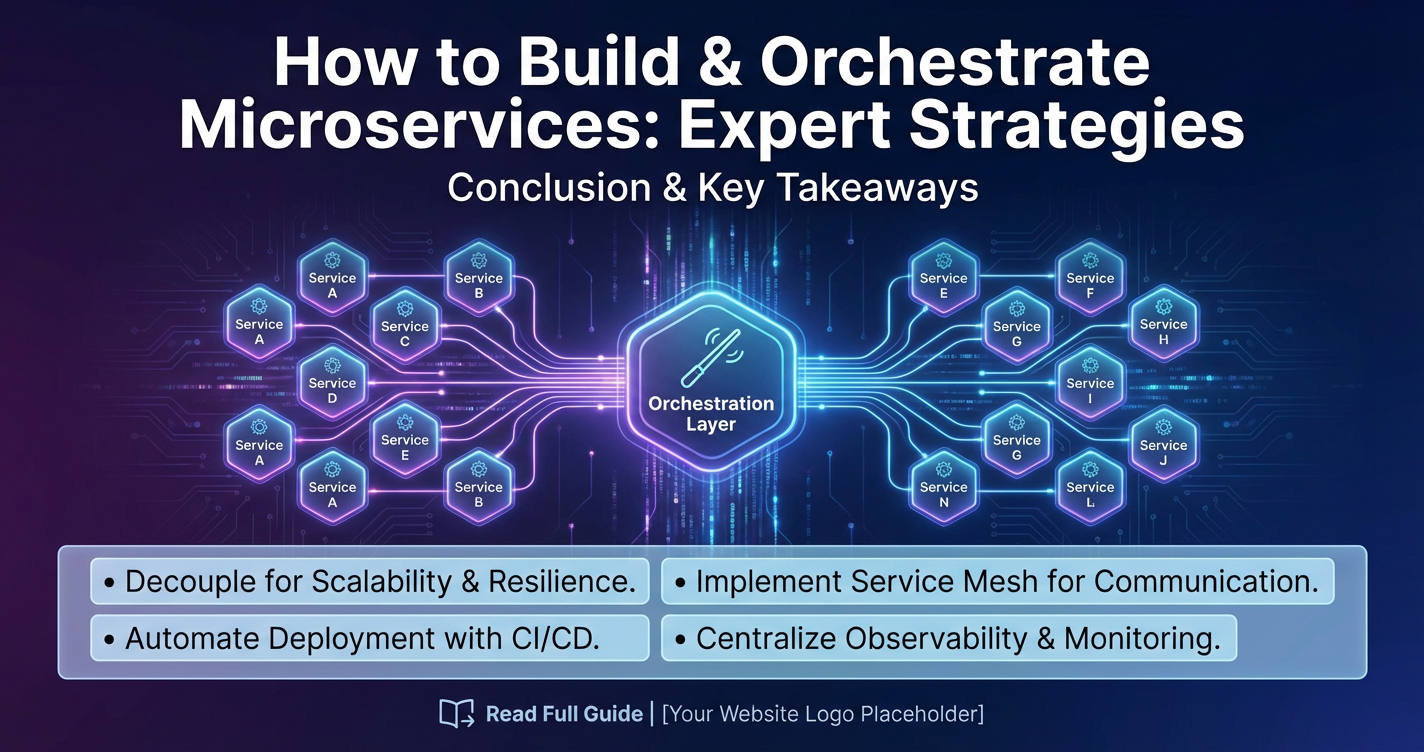
How to Build & Orchestrate Microservices: Expert Strategies



The digital landscape is undergoing a monumental transformation, driven by an insatiable demand for agility, scalability, and resilience in software systems. For decades, the monolithic architecture, where all components of an application are tightly coupled and deployed as a single unit, reigned supreme. While offering simplicity in development and deployment for smaller projects, this traditional approach began to buckle under the weight of modern requirements. As applications grew in complexity, user bases expanded exponentially, and the pace of feature delivery accelerated, monoliths became bottlenecks—slow to develop, difficult to scale, and risky to deploy. A single bug could bring down the entire system, and adopting new technologies became a prohibitive endeavor.
This paradigm shift paved the way for microservices architecture, a revolutionary approach that breaks down large applications into a collection of small, independent, and loosely coupled services. Each service typically focuses on a specific business capability, running in its own process and communicating with others over lightweight mechanisms, often HTTP-based application programming interfaces (APIs). The promise of microservices is compelling: enhanced agility, improved scalability, greater resilience, and the freedom to choose diverse technologies for different services. However, this architectural elegance comes with its own intricate set of challenges, demanding expert strategies for successful implementation and orchestration. The transition is not merely a technical one; it impacts organizational structure, development processes, and operational paradigms. Understanding these nuances and mastering the art of building and orchestrating microservices is paramount for any enterprise aiming to thrive in the modern digital economy. This comprehensive guide will delve deep into the principles, patterns, tools, and best practices required to navigate the complexities of microservices, with a particular focus on the critical role of the API gateway in enabling seamless communication and robust management of these distributed systems.
Understanding Microservices Architecture: The Foundation of Distributed Systems
At its core, microservices architecture represents a fundamental departure from the monolithic design philosophy. Instead of a single, monolithic application encompassing all functionalities, a microservices application is composed of numerous small, independent services. These services are self-contained, owning their own data and logic, and capable of being developed, deployed, and scaled independently. This modularity is a game-changer, but it's crucial to grasp the underlying principles that make this architecture effective.
What are Microservices? Defining the Granular Approach
Microservices are not just smaller pieces of code; they embody a distinct architectural philosophy. Each microservice typically:
- Focuses on a Single Business Capability: Adhering to the Single Responsibility Principle, a microservice should do one thing and do it well. For instance, in an e-commerce application, there might be separate services for user management, product catalog, order processing, payment, and inventory. This clear delineation helps in understanding, developing, and maintaining each service.
- Is Independently Deployable: One of the most significant advantages is the ability to deploy individual services without affecting others. This means faster release cycles and reduced risk. If a bug is found in the inventory service, only that service needs to be updated and redeployed, not the entire application.
- Owns Its Own Data: Each microservice should manage its own data store, whether it's a relational database, NoSQL database, or even a simple file system. This decentralization of data prevents tight coupling between services at the database level and allows each service to choose the most appropriate data technology for its specific needs.
- Communicates via Lightweight Mechanisms: Services interact with each other using well-defined APIs, typically through HTTP/REST, gRPC, or asynchronous message queues. This promotes loose coupling, as services only need to know the API contract of their counterparts, not their internal implementation details.
- Is Developed by Small, Autonomous Teams: Microservices often align with the organizational structure, where small, cross-functional teams are responsible for the entire lifecycle of one or more services. This fosters ownership, accelerates decision-making, and reduces communication overhead.
Key Principles Guiding Microservices Adoption
Successful microservices adoption hinges on embracing several core principles:
- Autonomy: Services should be independent, making their own decisions regarding technology, deployment, and scaling, as long as they adhere to their public API contracts. This empowers teams and reduces inter-dependencies.
- Decentralization: This applies not just to data ownership but also to governance. While standards are important, there's less centralized control compared to a monolith. Teams have more freedom to innovate.
- Failure Isolation: A failure in one service should ideally not cascade and bring down the entire system. This requires careful design with resilience patterns like circuit breakers and bulkheads, often facilitated by a robust API gateway.
- Continuous Delivery (CD): The independent deployability of microservices naturally lends itself to continuous delivery. Automated pipelines become crucial for rapidly building, testing, and deploying changes to individual services.
- Team Organization (Conway's Law): This principle suggests that organizations design systems that mirror their own communication structures. For microservices, this often means organizing teams around business capabilities rather than technical layers, promoting better communication and faster delivery within those domains.
Comparison with Monolithic Architecture: A Strategic Choice
The decision to adopt microservices over a monolith is a strategic one, with distinct trade-offs.
| Feature / Aspect | Monolithic Architecture | Microservices Architecture |
|---|---|---|
| Development | Simpler for small projects, single codebase. | More complex setup initially, multiple codebases. |
| Deployment | Single large deployment, high risk, slow. | Independent deployments, low risk, rapid. |
| Scalability | Scales as a whole, difficult to scale specific components. | Scales individual services, efficient resource utilization. |
| Technology Stack | Typically uniform across the application. | Polyglot—different services can use different technologies. |
| Resilience | Single point of failure; one bug can crash everything. | Failure isolation; less prone to cascading failures. |
| Complexity | Simpler to manage in small applications; becomes complex as it grows. | Inherent distributed system complexity from the start. |
| Team Size/Structure | Larger, often feature-centric or layer-centric teams. | Smaller, autonomous, business-capability-centric teams. |
| Communication | In-process function calls. | Out-of-process, network-based API calls. |
| Data Management | Single, shared database; tight coupling. | Decentralized, database-per-service; eventual consistency. |
While microservices offer compelling benefits for large, complex, and evolving systems, they introduce significant operational overhead and development complexity. The choice is not about one being inherently superior, but about selecting the architecture that best fits the organization's needs, capabilities, and the specific domain problem being solved. Often, a "monolith first" approach can be beneficial for startups to validate an idea, evolving into microservices as the system grows and specific bottlenecks emerge.
Designing Your Microservices: Crafting Cohesive and Loosely Coupled Systems
The design phase is perhaps the most critical for microservices, as decisions made here will have long-lasting impacts on the system's flexibility, scalability, and maintainability. Unlike a monolith where boundaries can be fuzzy, microservices demand clear, well-defined boundaries that align with business capabilities.
Domain-Driven Design (DDD): A Powerful Ally for Microservices
Domain-Driven Design (DDD) provides a robust framework for structuring software by modeling business domains. It's particularly effective for microservices because it helps identify natural service boundaries.
- Ubiquitous Language: This involves creating a common language between domain experts and developers. Terms used in discussions, documentation, and code should be consistent, reducing ambiguity and miscommunication.
- Bounded Contexts: This is the cornerstone of applying DDD to microservices. A Bounded Context is a conceptual boundary within which a specific domain model is defined and applicable. Terms within one context might have different meanings or representations in another. For example, a "Product" in an Inventory context might differ from a "Product" in a Sales context (e.g., inventory might track quantity and location, sales might track pricing and promotions). Each Bounded Context is a strong candidate for an independent microservice.
- Aggregates, Entities, Value Objects: Within a Bounded Context, DDD further refines the model into aggregates (clusters of domain objects treated as a single unit for data changes), entities (objects with a unique identity), and value objects (objects that represent descriptive aspects of the domain and lack identity). These concepts guide the internal design of a microservice's data and business logic.
Applying DDD helps in decomposing a complex domain into manageable, cohesive services, ensuring that each service encapsulates a specific business area and has clear responsibilities. This clarity is crucial for reducing coupling and improving maintainability.
Service Granularity: Finding the Sweet Spot
One of the trickiest aspects of microservices design is determining the "right" size for a service.
- Avoiding Nanoservices: Making services too small (nanoservices) can lead to an explosion of services, increased network latency, and overwhelming operational complexity. It's often referred to as "distributed monolith" where services are technically separate but functionally intertwined.
- Preventing Distributed Monoliths: Conversely, if services are too large, they might resemble mini-monoliths, retaining some of the same issues as a full monolith (e.g., tight coupling, difficulty scaling specific parts).
- Balancing Cohesion and Coupling: The ideal service size lies in balancing high cohesion (elements within a service belong together conceptually) and loose coupling (services interact minimally through well-defined APIs). A good heuristic is to consider what can be changed and deployed independently without affecting other services. If two pieces of functionality almost always change together, they might belong in the same service.
The "two-pizza team" rule (a team small enough to be fed by two pizzas) often correlates with the scope of a single microservice, emphasizing autonomous teams owning their services end-to-end.
Data Management in Microservices: Navigating Distributed Data
The "database per service" principle is a fundamental tenet of microservices, promoting autonomy and loose coupling. However, it introduces significant challenges related to data consistency across services.
- Database per Service: Each microservice has its own dedicated database, preventing direct database-level coupling. This allows services to choose the most suitable database technology (e.g., PostgreSQL for relational data, MongoDB for document storage, Redis for caching).
- Eventual Consistency: In a distributed system, immediate, strong consistency across all services is often impractical and leads to tight coupling. Instead, microservices often rely on eventual consistency, where data changes propagate across services over time. This means that at any given moment, different services might have slightly different views of the data, but they will eventually converge.
- Saga Pattern for Distributed Transactions: When a business process spans multiple services, traditional ACID transactions (Atomic, Consistent, Isolated, Durable) are not feasible. The Saga pattern addresses this by breaking down a long-running transaction into a sequence of local transactions, each within a single service. If a local transaction fails, the Saga executes compensating transactions to undo the preceding successful transactions, maintaining business consistency. Sagas can be orchestrated (centralized coordinator) or choreographed (services publish events, others react).
- CQRS (Command Query Responsibility Segregation): This pattern separates the read and write operations for a data store. Commands (write operations) are handled by one model, and queries (read operations) are handled by another, often optimized for specific query patterns. In microservices, this can mean a service maintains a write model (e.g., a transactional database) and publishes events, which other services or dedicated query services consume to build optimized read models (e.g., denormalized views, search indexes).
- Data Replication and Synchronization Strategies: For shared data or data needed across multiple services for read purposes, various strategies exist, such as event-driven replication, change data capture (CDC), or maintaining denormalized copies.
Managing distributed data requires careful design, an understanding of consistency models, and the willingness to embrace complexity for the benefits of autonomy and scalability.
API Design Principles for Microservices: The Contract of Communication
Since services communicate primarily through APIs, excellent API design is paramount. APIs are the contracts between services, and poorly designed APIs can lead to tight coupling, difficulty in integration, and operational headaches.
- RESTful API Design Best Practices:
- Resource-Oriented: APIs should expose resources (e.g.,
/users,/products) rather than actions. - Standard HTTP Methods: Use GET for retrieving, POST for creating, PUT for updating (full replacement), PATCH for partial updates, and DELETE for removing.
- Statelessness: Each request from a client to a server must contain all the information needed to understand the request. The server should not store any client context between requests.
- Clear Naming Conventions: Use consistent, plural nouns for resource paths (e.g.,
/orders). - Meaningful Status Codes: Use standard HTTP status codes (200 OK, 201 Created, 204 No Content, 400 Bad Request, 401 Unauthorized, 404 Not Found, 500 Internal Server Error) to convey the outcome of an operation.
- Resource-Oriented: APIs should expose resources (e.g.,
- Versioning Strategies: As services evolve, their APIs might change. Effective versioning is crucial to avoid breaking existing clients.
- URI Versioning: Include the version number in the URI (e.g.,
/v1/products). Simple and explicit. - Header Versioning: Include the version in a custom HTTP header (e.g.,
X-API-Version: 1). Keeps URIs clean. - Query Parameter Versioning: Include the version as a query parameter (e.g.,
/products?version=1). Least recommended as it can look less RESTful. - Evolutionary Design: Aim for backward compatibility as much as possible, adding new fields rather than removing old ones, thus delaying the need for new versions.
- URI Versioning: Include the version number in the URI (e.g.,
- HATEOAS (Hypermedia as the Engine of Application State): A more advanced REST principle where API responses include links to related resources, guiding the client on possible next actions. This makes clients more discoverable and resilient to future changes in API structure, reducing coupling between clients and the API implementation.
- API Documentation (OpenAPI/Swagger): Comprehensive and up-to-date documentation is non-negotiable. Tools like OpenAPI (formerly Swagger) allow developers to describe their APIs in a machine-readable format, which can then be used to generate interactive documentation, client SDKs, and even server stubs. This ensures that the API contract is clear to all consumers.
Building Microservices: Technologies, Tools, and Communication Patterns
Once the design is solid, the next phase involves selecting the right technologies and tools to bring the microservices to life. The polyglot nature of microservices offers immense flexibility, but also introduces choices that need careful consideration.
Programming Languages and Frameworks: Embracing Polyglot Persistence
One of the defining characteristics of microservices is the freedom to choose the best tool for the job.
- Polyglot Programming: Different services can be written in different programming languages. For instance, a high-performance recommendation engine might use Go, a complex business logic service might use Java with Spring Boot, and a quick-prototyping dashboard might use Node.js or Python. This allows teams to leverage language strengths and expertise.
- Common Choices and Ecosystems:
- Java (Spring Boot): Extremely popular for its mature ecosystem, robust frameworks, and strong community support. Spring Boot simplifies the creation of production-ready microservices with features like embedded servers, health checks, and externalized configuration.
- Node.js (Express, NestJS): Excellent for I/O-bound services, real-time applications, and rapid development due to its non-blocking I/O model and vast NPM ecosystem.
- Go (Gin, Echo): Favored for its performance, concurrency primitives, and small memory footprint, making it ideal for high-throughput, low-latency services like an API gateway or core infrastructure components.
- Python (Flask, Django): Strong in data science, machine learning, and rapid prototyping, often used for analytical services or administrative backends.
- .NET (ASP.NET Core): A strong choice for enterprise applications, offering cross-platform capabilities, excellent performance, and a comprehensive set of features.
The key is to make conscious choices, weighing factors like team expertise, performance requirements, and ecosystem maturity, rather than simply adopting a language because it's new or popular.
Containerization and Orchestration: The Backbone of Microservices Deployment
Containerization and orchestration are almost synonymous with modern microservices deployments, providing the necessary infrastructure for packaging, deploying, and managing distributed services.
- Docker: Packaging and Isolation: Docker revolutionized application deployment by packaging applications and their dependencies into lightweight, portable containers. Each microservice can be containerized, ensuring that it runs consistently across different environments (developer laptop, testing, production). This eliminates "it works on my machine" problems and simplifies deployment.
- Kubernetes: Orchestrating the Swarm: Kubernetes is the de facto standard for container orchestration. It automates the deployment, scaling, and management of containerized applications. For microservices, Kubernetes provides:
- Automated Rollouts and Rollbacks: Deploying new versions of services and rolling back to previous ones if issues arise.
- Service Discovery and Load Balancing: Automatically discovering service instances and distributing traffic among them.
- Self-Healing: Restarting failed containers, replacing unhealthy ones, and rescheduling containers on healthy nodes.
- Resource Management: Efficiently allocating CPU and memory to services.
- Configuration Management and Secrets: Managing application configurations and sensitive data securely.
Kubernetes significantly reduces the operational burden of managing a large number of microservices, providing a robust and scalable platform.
Service Discovery: Finding Your Peers in a Dynamic Environment
In a microservices architecture, service instances are often ephemeral—they are created, scaled, and destroyed dynamically. This means their network locations (IP addresses and ports) are constantly changing. Service discovery is essential to allow services to find and communicate with each other without hardcoding network locations.
- Why It's Needed: Without service discovery, a client service wouldn't know where to send its request, leading to brittle configurations and downtime when services scale or fail.
- Client-Side vs. Server-Side Discovery:
- Client-Side Discovery: The client service queries a service registry (e.g., Eureka, Consul) to get the network locations of available instances of a target service. The client then uses a load-balancing algorithm to select an instance.
- Server-Side Discovery: The client makes a request to a router or load balancer (e.g., an API gateway, Kubernetes Service, AWS ELB). The router queries the service registry and forwards the request to an available service instance. This abstracts discovery logic from the client.
- Tools for Service Discovery:
- Eureka (Netflix): A highly available, REST-based service for locating services in the AWS cloud, but can be used anywhere.
- Consul (HashiCorp): Provides service discovery, health checking, key/value storage, and a distributed configuration system.
- etcd: A distributed key-value store primarily used by Kubernetes for configuration data and service discovery.
- Kubernetes Built-in Service Discovery: Kubernetes Services abstract away the dynamic IP addresses of Pods, providing stable network endpoints and integrated load balancing. This is often the preferred method when running on Kubernetes.
Inter-Service Communication: The Threads of the Microservices Fabric
The way microservices communicate is fundamental to their behavior and performance. There are two primary paradigms: synchronous and asynchronous communication.
- Synchronous Communication:
- REST (HTTP/HTTPS): The most common choice due to its simplicity, ubiquity, and excellent tooling. Services expose RESTful API endpoints, and clients make HTTP requests. It's suitable for request-response patterns where an immediate answer is expected, like fetching user profiles or placing a simple order. However, it introduces tight temporal coupling (client waits for server), and network latency can add up in a chain of calls.
- gRPC: A high-performance, open-source RPC (Remote Procedure Call) framework developed by Google. It uses HTTP/2 for transport, Protocol Buffers for interface definition, and supports multiple languages. gRPC is significantly faster than REST for many use cases due to binary serialization, multiplexing over a single connection, and efficient payload handling. It's excellent for internal service-to-service communication where performance is critical and strong typing is desired.
- Asynchronous Communication:
- Message Queues and Brokers (e.g., RabbitMQ, Apache Kafka, AWS SQS, Azure Service Bus): Services communicate by sending and receiving messages via an intermediary message broker.
- Point-to-Point (Queue-based): A message is sent to a queue and consumed by only one recipient. Ideal for task offloading, buffering, and achieving eventual consistency.
- Publish-Subscribe (Topic-based): A message is published to a topic, and multiple subscribers can receive a copy of that message. Excellent for event-driven architectures.
- Event-Driven Architecture: Services publish events when something significant happens (e.g., "OrderCreated," "PaymentFailed"), and other services interested in these events subscribe and react accordingly. This promotes extreme loose coupling, enhances scalability, and improves resilience by decoupling producers from consumers.
- Saga Pattern Revisited for Long-Running Distributed Transactions: As discussed earlier, the Saga pattern relies heavily on asynchronous eventing to coordinate multi-service transactions. Services publish events indicating the success or failure of their local transaction, triggering subsequent actions or compensation logic in other services.
- Message Queues and Brokers (e.g., RabbitMQ, Apache Kafka, AWS SQS, Azure Service Bus): Services communicate by sending and receiving messages via an intermediary message broker.
The choice between synchronous and asynchronous communication depends on the specific use case. Synchronous is simpler for direct request-response interactions, while asynchronous excels in scenarios requiring loose coupling, long-running processes, and high throughput with eventual consistency. Often, a combination of both is used, with an API gateway handling synchronous requests from external clients and internal services leveraging asynchronous messaging.
APIPark is a high-performance AI gateway that allows you to securely access the most comprehensive LLM APIs globally on the APIPark platform, including OpenAI, Anthropic, Mistral, Llama2, Google Gemini, and more.Try APIPark now! 👇👇👇
Orchestrating Microservices: The Central Role of the API Gateway
As the number of microservices grows, managing communication, security, and access for external clients becomes increasingly complex. This is where the API gateway emerges as an indispensable component in a microservices architecture, acting as the single entry point for all clients. It plays a pivotal role in orchestrating the interactions between external consumers and internal services, abstracting away the underlying complexity of the microservices landscape.
What is an API Gateway? The Front Door to Your Microservices
An API gateway is a single, centralized entry point that handles client requests and routes them to the appropriate backend microservices. Instead of clients making direct requests to multiple services, they interact solely with the API gateway. This pattern is crucial for several reasons:
- Simplifying Client Interactions: Clients don't need to know the internal architecture, service discovery mechanisms, or individual endpoints of each microservice. They only interact with one well-defined API from the gateway.
- Decoupling Clients from Services: Changes in the internal microservice landscape (e.g., adding, removing, or refactoring services) do not necessarily impact external clients, as long as the gateway's public API remains consistent.
- Centralized Policy Enforcement: The gateway provides a choke point where common cross-cutting concerns can be addressed uniformly, rather than replicating logic in every microservice.
Key Functions of an API Gateway: More Than Just a Router
The API gateway is far more than a simple router; it’s a powerful engine that can implement a wide array of cross-cutting concerns, enhancing security, performance, and manageability of the microservices ecosystem.
- Routing: Its fundamental function is to route incoming requests from clients to the correct backend microservice based on the request's path, headers, or other criteria. This ensures requests reach their intended destinations within the distributed system.
- Authentication and Authorization: The API gateway centralizes security. It can authenticate incoming client requests (e.g., validating JWT tokens, OAuth2 tokens) and authorize them to access specific resources or services. This offloads security logic from individual microservices, which can then trust that requests arriving at their doorstep are already authorized.
- Rate Limiting and Throttling: To protect backend services from overload and abuse, the gateway can enforce rate limits (e.g., "100 requests per minute per user") and throttle requests that exceed these limits. This is vital for maintaining system stability and preventing denial-of-service attacks.
- Request Aggregation: For clients needing data from multiple microservices to render a single view (e.g., a dashboard displaying user details, order history, and recommendations), the gateway can aggregate responses from several services into a single, unified response. This reduces the number of round trips between the client and the backend, improving performance and simplifying client-side logic.
- Protocol Translation: The gateway can translate between different communication protocols. For example, an external client might use REST over HTTP/1.1, while internal services might communicate using gRPC over HTTP/2. The gateway can bridge this gap, handling the conversion.
- Caching: Frequently accessed data can be cached at the gateway level, reducing the load on backend services and significantly improving response times for subsequent requests.
- Load Balancing: While Kubernetes or other infrastructure might handle internal service load balancing, the API gateway can also perform load balancing for requests destined for multiple instances of a service, ensuring even distribution of traffic.
- Monitoring and Logging: The API gateway is a natural point to collect centralized metrics, logs, and tracing information for all incoming requests. This provides invaluable insights into system performance, bottlenecks, and error rates, making observability easier across the distributed system.
- Security (WAF, Attack Prevention): Beyond authentication and authorization, advanced gateways can offer Web Application Firewall (WAF) capabilities, protecting against common web vulnerabilities like SQL injection, cross-site scripting (XSS), and other malicious activities.
- Circuit Breaker Pattern: Implementing a circuit breaker at the gateway level prevents cascading failures. If a backend service becomes unhealthy or unresponsive, the gateway can "trip the circuit," immediately failing subsequent requests to that service without waiting for a timeout, and optionally returning a fallback response. This gives the failing service time to recover.
Types of Gateways: Tailoring the Entry Point
The concept of a gateway can manifest in different forms, each serving specific purposes:
- Traditional API Gateways: These are general-purpose gateways designed to handle a wide range of routing, security, and management tasks across many microservices. Examples include Kong, Apigee, Mulesoft, and AWS API Gateway. They are robust and feature-rich.
- GraphQL Gateways: Specifically designed for GraphQL APIs, these gateways allow clients to query for exactly the data they need from multiple backend services in a single request, reducing over-fetching and under-fetching.
- Backend-for-Frontend (BFF) Pattern: Instead of a single, monolithic API gateway for all clients, the BFF pattern suggests creating tailored gateway instances for specific client types (e.g., one for web applications, one for mobile iOS, one for mobile Android). Each BFF can expose an API optimized for its client's unique UI/UX requirements, minimizing data over-fetching and simplifying client-side development. While adding more gateways, it keeps them smaller and more focused.
Choosing an API Gateway: A Critical Decision
Selecting the right API gateway is a crucial decision that impacts the scalability, security, and operational efficiency of your microservices architecture. Factors to consider include:
- Performance: Can it handle the expected traffic load with low latency?
- Features: Does it offer the necessary routing, security, rate limiting, and aggregation capabilities?
- Ease of Use and Configuration: How complex is it to set up, configure, and manage?
- Extensibility: Can you easily add custom plugins or logic?
- Scalability and High Availability: Can it scale horizontally and operate in a highly available manner?
- Monitoring and Observability: Does it provide good integration with logging, monitoring, and tracing tools?
- Cost: Licensing fees, operational costs, and cloud provider charges.
- Community Support and Documentation: A strong community and comprehensive documentation are invaluable.
When considering solutions, platforms like ApiPark, an open-source AI gateway and API management platform, offer a comprehensive suite of features designed to manage, integrate, and deploy various services, including AI models and traditional REST services with remarkable ease. APIPark provides a unified API format for AI invocation, prompt encapsulation into REST APIs, and robust end-to-end API lifecycle management. Its capabilities extend to centralized team sharing of API services, independent API and access permissions for each tenant, and a subscription approval mechanism for enhanced security. Notably, APIPark boasts performance rivaling Nginx, capable of over 20,000 TPS with modest hardware, and offers detailed API call logging and powerful data analysis for proactive issue resolution and trend identification. Such platforms exemplify how modern API gateways have evolved to become central to efficient microservices orchestration, simplifying complex tasks and providing significant value to enterprises by enhancing efficiency, security, and data optimization. Its quick deployment with a single command line makes it an attractive option for teams looking to rapidly establish robust API management.
Advanced Orchestration and Operational Strategies: Mastering the Microservices Lifecycle
Building microservices is only half the battle; effectively orchestrating and operating them is where the true complexity—and value—lies. Advanced strategies in observability, resilience, security, and DevOps are essential to ensure a stable, scalable, and secure distributed system.
Observability: Seeing Inside the Black Box
In a microservices world, understanding the behavior of your system is challenging because requests traverse multiple services. Observability is about understanding the internal state of a system by examining the data it outputs. It's critical for troubleshooting, performance tuning, and understanding user experience.
- Logging: Centralized logging is a non-negotiable requirement. Each microservice should emit structured logs (e.g., JSON format) that include correlation IDs (to trace a request across services), timestamps, service names, and relevant business context. These logs are then aggregated into a central logging system (e.g., ELK stack - Elasticsearch, Logstash, Kibana; Grafana Loki; Splunk) for searching, analysis, and alerting.
- Monitoring: Collecting metrics (numerical data points) about the health and performance of individual services and the entire system. Key metrics include:
- Resource Utilization: CPU, memory, disk I/O, network I/O.
- Request Metrics: Request rates, error rates, latency (p95, p99 percentiles).
- Application-Specific Metrics: Business-level metrics relevant to a service (e.g., number of orders processed, items in inventory). Tools like Prometheus (for metric collection) and Grafana (for dashboarding and visualization) are widely used.
- Tracing: Distributed tracing allows you to visualize the end-to-end journey of a request as it flows through multiple microservices. Each request is assigned a unique trace ID, and spans (individual operations within a service) are recorded. This helps identify latency bottlenecks, error propagation, and dependencies across services. Popular tracing tools include Jaeger and Zipkin.
- Alerting: Proactive notification of issues before they impact users. Alerts should be configured based on critical metrics and error logs, delivered through channels like Slack, PagerDuty, or email. Effective alerting requires setting meaningful thresholds and reducing alert fatigue.
Resilience Patterns: Building Robust and Fault-Tolerant Systems
Microservices are inherently distributed, meaning network failures, service crashes, and slow responses are inevitable. Designing for resilience is about anticipating these failures and ensuring the system can gracefully handle them.
- Circuit Breaker: As mentioned with the API gateway, this pattern prevents a failing service from being called repeatedly. If calls to a service continuously fail or time out, the circuit "trips" (opens), and subsequent calls immediately fail without attempting to contact the service. After a configurable period, the circuit moves to a "half-open" state, allowing a few test requests to see if the service has recovered.
- Bulkhead: Isolates failing components to prevent them from taking down the entire system. Imagine ship compartments: if one compartment floods, the others remain dry. In software, this means isolating resource pools (e.g., separate thread pools, connection pools) for different services or client requests, so a problematic component doesn't exhaust shared resources.
- Retry: Temporarily failing operations can often succeed if retried. This pattern automatically retries failed requests, often with an exponential backoff strategy (increasing delays between retries) to avoid overwhelming the struggling service.
- Timeout: Defines a maximum duration for an operation. If the operation doesn't complete within this time, it's aborted, preventing indefinite waiting and resource exhaustion.
- Fallback: Provides an alternative action or response when a primary operation fails. For instance, if a recommendation service fails, the system might display generic popular items instead of personalized ones.
Implementing these patterns, often using libraries like Resilience4j (Java) or Polly (.NET), or via the API gateway, is crucial for building systems that can withstand failures.
Security in Microservices: Protecting the Distributed Perimeter
Securing a microservices architecture is more complex than securing a monolith due to the increased number of communication channels and deployment units. Security must be considered at every layer.
- OAuth2/OpenID Connect for Authentication: OAuth2 is an authorization framework, and OpenID Connect (OIDC) is an authentication layer built on top of OAuth2. These standards provide robust, token-based authentication and authorization mechanisms, often managed by an Identity Provider (IdP) and enforced by the API gateway.
- JWT (JSON Web Tokens) for Authorization: After a user authenticates, the IdP issues a JWT, a self-contained token that can carry claims (information about the user, roles, permissions). Services can validate this token to authorize access to resources without needing to call the IdP for every request.
- API Security Best Practices:
- Input Validation: Sanitize and validate all input to prevent injection attacks.
- Least Privilege: Services should only have the minimum necessary permissions to perform their function.
- HTTPS Everywhere: All inter-service communication and external API calls should be encrypted using HTTPS.
- Strict Access Controls: Implement fine-grained access control at the service level, even after gateway authorization.
- Secrets Management: Securely managing sensitive data like database credentials, API keys, and certificates is vital. Tools like HashiCorp Vault or Kubernetes Secrets provide centralized, secure storage and access control for secrets.
- Network Segmentation: Use virtual private clouds (VPCs), network policies (in Kubernetes), and firewalls to segment your network, restricting traffic flow between services based on need. This limits the blast radius of a security breach.
Deployment Strategies: Minimizing Risk, Maximizing Availability
Deploying changes in a microservices environment can be frequent, so robust deployment strategies are essential to minimize downtime and risk.
- Blue-Green Deployment: Two identical production environments ("Blue" and "Green") are maintained. New versions are deployed to the inactive environment (e.g., Green), thoroughly tested, and once confirmed, traffic is switched from Blue to Green. This allows for instant rollback by switching traffic back to Blue if issues arise.
- Canary Deployment: A new version of a service (the "canary") is deployed to a small subset of users. If no issues are detected, the rollout gradually expands to more users. This allows for early detection of problems with minimal impact.
- Rolling Updates: Gradually replaces instances of the old version with new ones. This is the default deployment strategy in Kubernetes, ensuring continuous availability during updates.
- Feature Toggles (Feature Flags): Allows enabling or disabling features dynamically at runtime without redeploying code. This decouples deployment from release, enabling A/B testing, gradual feature rollouts, and quick toggling off of problematic features.
DevOps and CI/CD for Microservices: Automating the Pipeline
DevOps culture and Continuous Integration/Continuous Delivery (CI/CD) pipelines are non-negotiable for successful microservices adoption. They automate the entire software delivery lifecycle, from code commit to production deployment.
- Automated Testing:
- Unit Tests: Verify individual components in isolation.
- Integration Tests: Verify interactions between services and external dependencies.
- End-to-End Tests: Simulate user scenarios across the entire system.
- Contract Tests: Ensure that services adhere to their API contracts, preventing breaking changes between consumers and providers.
- Automated Build and Deployment Pipelines: Tools like Jenkins, GitLab CI/CD, GitHub Actions, or Azure DevOps automate the entire process:
- Code commit triggers a build.
- Automated tests run.
- Docker images are built and pushed to a registry.
- Kubernetes manifests are applied (deployment).
- Post-deployment smoke tests and health checks are performed.
- Infrastructure as Code (IaC): Managing infrastructure (servers, networks, databases, Kubernetes clusters) using code (e.g., Terraform, Ansible, Pulumi). This ensures consistency, repeatability, and version control for infrastructure changes, treating infrastructure like any other part of the application.
Challenges and Pitfalls to Avoid: Navigating the Microservices Minefield
While the benefits of microservices are compelling, the journey is fraught with challenges. Awareness of these pitfalls is the first step toward avoiding them.
- Over-engineering: The "Microservices Tax": Jumping into microservices too early for a simple application can lead to unnecessary complexity. The overhead of managing distributed systems, communication, deployment, and observability can far outweigh the benefits. Sometimes, a well-structured monolith is the more pragmatic choice, especially for startups.
- Distributed Monoliths: This occurs when services are technically separate but remain tightly coupled through shared databases, synchronous communication chains, or implicit dependencies. They inherit the complexity of distributed systems without gaining the benefits of autonomy and independent deployability. Clear bounded contexts and asynchronous communication are antidotes.
- Data Inconsistencies: Managing data across multiple, independent databases is inherently complex. Embracing eventual consistency, designing robust Saga patterns, and carefully managing data replication are crucial. Developers must understand that joins across services are often anti-patterns and that strong consistency might not always be achievable or necessary.
- Operational Complexity: The sheer number of moving parts in a microservices architecture dramatically increases operational overhead. Monitoring, logging, debugging, and deploying become more challenging. Robust observability tools, automation, and a strong DevOps culture are essential to manage this complexity. Without proper tooling, operations teams can quickly become overwhelmed.
- Team Silos and Communication Breakdown: While microservices encourage small, autonomous teams, without proper cross-team communication and collaboration, silos can emerge. This can lead to redundant efforts, inconsistent API designs, and integration headaches. Clear communication channels, shared governance for API standards, and cross-functional meetings are vital.
- Performance Overhead: Network Latency: In-process function calls are replaced by network calls between services. Each network hop introduces latency. While this is often negligible, for chatty services or deep call chains, latency can accumulate, impacting overall performance. Optimizing API calls, judicious use of caching (e.g., at the API gateway), and efficient communication protocols like gRPC can mitigate this.
Conclusion: The Evolving Journey of Microservices Orchestration
The journey to building and orchestrating microservices is not merely a technical migration; it’s a profound shift in thinking, culture, and operational methodology. It promises greater agility, enhanced scalability, and superior resilience—qualities indispensable for enterprises navigating the unpredictable currents of the modern digital economy. However, this architectural transformation demands meticulous design, robust tooling, and a deep understanding of distributed systems principles.
We've explored the foundational elements, from the clear delineation of service boundaries using Domain-Driven Design to the critical role of containerization and orchestration with Docker and Kubernetes. We’ve delved into the diverse landscape of inter-service communication, balancing the immediacy of synchronous calls with the loose coupling benefits of asynchronous messaging. Throughout this intricate ballet of independent services, the API gateway emerges as a cornerstone, acting as the intelligent traffic controller, security enforcer, and performance optimizer at the very edge of your microservices ecosystem. Platforms like APIPark exemplify how advanced API gateway and management solutions streamline the entire API lifecycle, from quick integration to detailed logging and robust security, making the orchestration of even complex AI services manageable and performant.
Mastering the advanced operational strategies—observability through comprehensive logging, monitoring, and tracing; resilience through patterns like circuit breakers and bulkheads; and end-to-end security measures—is paramount. Coupled with a strong DevOps culture and automated CI/CD pipelines, these strategies transform the inherent complexity of microservices into a manageable and efficient operational reality.
The path is not without its perils. The allure of microservices can lead to over-engineering, accidental distributed monoliths, and a steep learning curve for operational teams. Yet, armed with expert strategies, a clear understanding of the trade-offs, and a commitment to continuous improvement, organizations can harness the immense power of microservices to build truly responsive, adaptable, and future-proof applications. The microservices landscape continues to evolve, with emerging trends like serverless computing and service meshes offering new dimensions to orchestration. Regardless of future innovations, the fundamental principles of clear service boundaries, robust communication, and intelligent API management, underpinned by a powerful API gateway, will remain central to the successful architecture of modern distributed systems. Embracing this journey is not just about adopting a new technology, but about cultivating a mindset of continuous innovation and adaptability.
Frequently Asked Questions (FAQs)
1. What is the primary difference between a monolithic application and a microservices architecture? The primary difference lies in their structure and deployment. A monolithic application is a single, tightly coupled unit where all components are deployed together. In contrast, a microservices architecture decomposes an application into small, independent services, each focusing on a specific business capability, deployed and scaled independently, and communicating via APIs. Monoliths are simpler for small applications but become complex and hard to scale for large ones, while microservices offer greater agility, scalability, and resilience but introduce significant operational complexity.
2. Why is an API Gateway crucial in a microservices architecture? An API gateway acts as a single entry point for all client requests, abstracting the internal complexity of the microservices from external consumers. It's crucial because it centralizes critical cross-cutting concerns such as routing requests to the correct service, authentication and authorization, rate limiting, request aggregation, caching, and monitoring. This simplifies client-side development, enhances security, improves performance, and enables easier management and evolution of the backend services without impacting client applications.
3. What are the main challenges when adopting microservices, and how can they be mitigated? Key challenges include increased operational complexity (managing many services), distributed data management (ensuring consistency across databases), inter-service communication overhead (network latency, fault tolerance), and the risk of creating "distributed monoliths" (tightly coupled services). These can be mitigated through robust observability tools (logging, monitoring, tracing), implementing resilience patterns (circuit breakers, retries), adopting strong DevOps practices with CI/CD, carefully designing service boundaries with Domain-Driven Design, and leveraging a sophisticated API gateway for centralized management and security.
4. How does service discovery work in a microservices environment, and why is it important? Service discovery is a mechanism that allows microservices to find and communicate with each other dynamically. In a microservices environment, service instances are often ephemeral, meaning their network locations (IP addresses and ports) can change frequently. Service discovery uses a service registry (e.g., Eureka, Consul, Kubernetes' built-in service discovery) where services register themselves upon startup. Client services then query this registry to get the current network locations of the services they need to call. This is crucial because it eliminates hardcoding network addresses, making the system resilient to scaling events, failures, and dynamic deployments.
5. What is the role of asynchronous communication in microservices, and when should it be preferred over synchronous communication? Asynchronous communication, typically via message queues or event brokers (like Kafka or RabbitMQ), involves services sending messages without waiting for an immediate response. It is critical for achieving loose coupling, high scalability, and enhanced resilience. It should be preferred over synchronous communication (like REST or gRPC) when: * Operations are long-running and don't require an immediate response. * Services need to react to events without direct dependencies. * You need to buffer messages to handle spikes in traffic. * Implementing patterns like the Saga pattern for distributed transactions where eventual consistency is acceptable. Asynchronous communication helps isolate failures, allows independent scaling of services, and improves overall system responsiveness by preventing blocking calls.
🚀You can securely and efficiently call the OpenAI API on APIPark in just two steps:
Step 1: Deploy the APIPark AI gateway in 5 minutes.
APIPark is developed based on Golang, offering strong product performance and low development and maintenance costs. You can deploy APIPark with a single command line.
curl -sSO https://download.apipark.com/install/quick-start.sh; bash quick-start.sh

In my experience, you can see the successful deployment interface within 5 to 10 minutes. Then, you can log in to APIPark using your account.

Step 2: Call the OpenAI API.