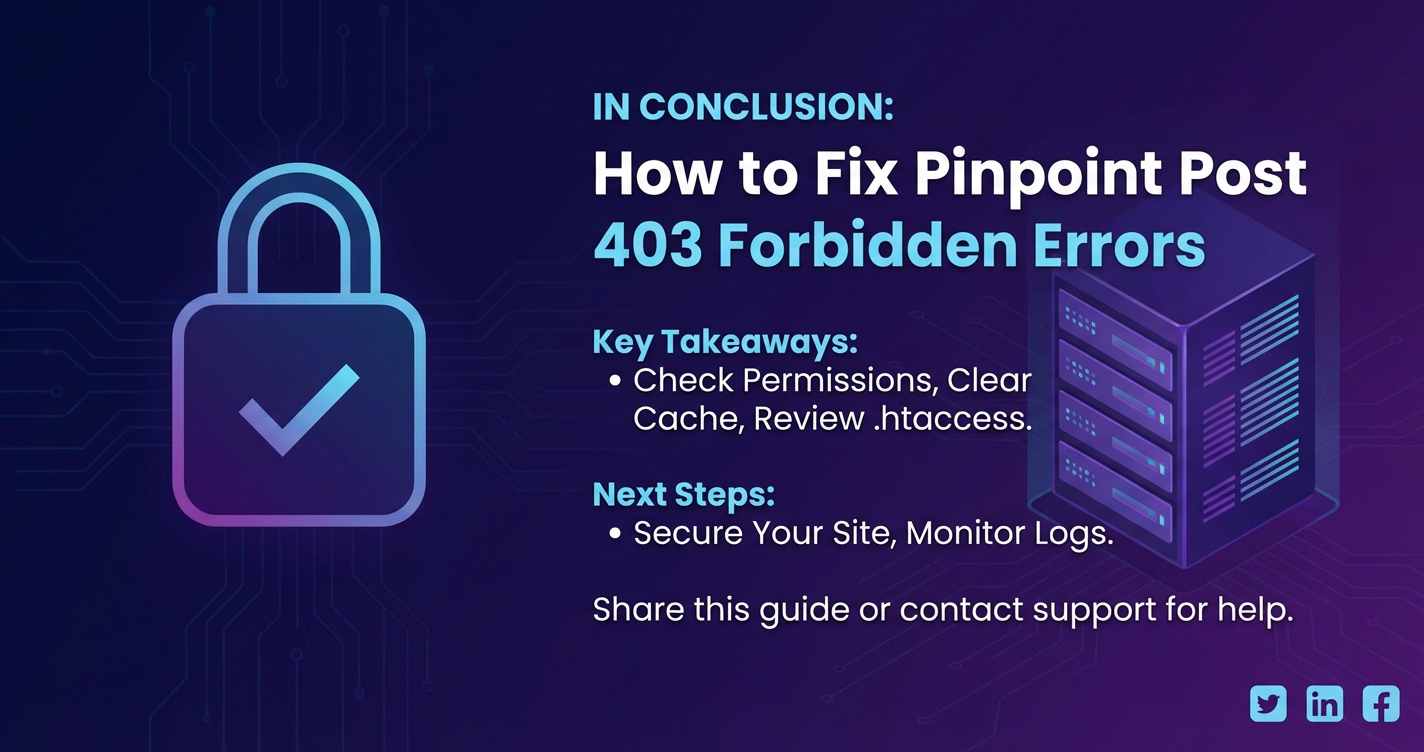
How to Fix Pinpoint Post 403 Forbidden Errors



The digital landscape is a complex tapestry of interconnected systems, services, and data exchanges. At the heart of much of this interaction are HTTP requests, the fundamental language spoken between clients and servers. Among the myriad responses a server can issue, the dreaded "403 Forbidden" error stands out as a particularly frustrating roadblock. Unlike a "404 Not Found" which simply states an absence, a 403 error explicitly tells you that the server understands your request but refuses to fulfill it, often due to insufficient permissions or access rights. This isn't just a minor inconvenience; a 403 can halt critical operations, prevent users from accessing essential content, or even bring down an entire application workflow. When this error specifically impacts a "Pinpoint Post" request – a targeted attempt to send data or trigger a specific action – the implications can be even more severe, affecting data submission, user interactions, or the successful execution of backend processes.
In an era increasingly reliant on interconnected services, from traditional web applications to sophisticated API ecosystems powering microservices, mobile apps, and machine learning models, understanding and rectifying 403 errors is paramount. Whether you're a developer debugging an integration, a system administrator troubleshooting server access, or a user encountering unexpected blocks, a systematic approach is essential. This comprehensive guide will meticulously dissect the nature of 403 Forbidden errors, explore their manifold causes, and provide an actionable, step-by-step methodology for diagnosis and resolution. We will delve into common pitfalls, explore the critical role of API gateways in managing and mitigating these issues, and equip you with the knowledge to not only fix these errors but also to prevent their recurrence, ensuring seamless digital operations and robust service delivery.
Understanding the 403 Forbidden Error: More Than Just a Blocked Path
Before diving into solutions, it's crucial to grasp the precise meaning and context of an HTTP 403 Forbidden error. This error belongs to the 4xx class of HTTP status codes, which universally signify client-side errors. While often perceived as a server issue, the server is merely reporting that the client's request, for one reason or another, cannot be fulfilled due to lack of authorization.
The Anatomy of HTTP Status Codes: A Quick Primer
HTTP status codes are three-digit numbers returned by a server in response to a client's request. They are categorized into five classes: * 1xx (Informational): Request received, continuing process. * 2xx (Success): The action was successfully received, understood, and accepted. * 3xx (Redirection): Further action needs to be taken by the user agent to fulfill the request. * 4xx (Client Error): The request contains bad syntax or cannot be fulfilled. * 5xx (Server Error): The server failed to fulfill an apparently valid request.
The 403 Forbidden error unequivocally falls into the client error category, indicating that the client's request is valid and understood by the server, but the server refuses to authorize access to the requested resource. This refusal isn't due to the resource being unavailable (that would be a 404) or requiring authentication (that would be a 401, which we'll discuss next). Instead, it's a definitive "no, you don't have permission to do that."
Distinguishing 403 from Its Siblings: 401 Unauthorized and 404 Not Found
It’s common to confuse 403 Forbidden with other similar client-side errors. Understanding the nuanced differences is crucial for effective troubleshooting:
- 401 Unauthorized: This error signifies that the client's request lacks valid authentication credentials. The server requires authentication (e.g., username/password, API key, token) but hasn't received it, or the provided credentials are invalid. The key difference here is "authentication" (who you are) versus "authorization" (what you're allowed to do). A 401 implies the server doesn't know who you are, or doesn't trust your identity. Once authenticated, you might still encounter a 403 if your authenticated identity doesn't have the necessary permissions.
- 404 Not Found: This familiar error indicates that the server cannot find the requested resource. The path might be incorrect, the file might have been moved or deleted, or the resource simply doesn't exist at the specified URL. A 404 means the resource is missing; a 403 means the resource exists, but you're not allowed to touch it.
Therefore, when you encounter a 403, your initial assumption should be centered around access rights, permissions, and security configurations, rather than incorrect URLs or missing authentication details (though the latter can sometimes indirectly lead to a 403 if the system is configured to deny access entirely without proper authentication, rather than challenge for it). This understanding forms the bedrock of our troubleshooting strategy.
Deconstructing the Root Causes of 403 Forbidden Errors
A 403 Forbidden error can stem from a surprisingly wide array of issues, ranging from basic file system misconfigurations to complex API authorization policies and server-side security measures. Pinpointing the exact cause requires a systematic investigation, as the symptom (the 403 response) remains the same regardless of its origin. Especially when dealing with a "Pinpoint Post" request, which often involves sending sensitive data or triggering backend logic, the security layers tend to be more stringent, increasing the likelihood of encountering these access denials. Let's meticulously examine the most common culprits.
1. File and Directory Permissions: The Foundation of Access Control
One of the most frequent causes of 403 errors, particularly in traditional web hosting environments, is incorrect file or directory permissions. Servers, especially Linux-based ones, rely on a robust permission system to control who can read, write, or execute files and directories.
- Incorrect File Permissions: If a web server process (e.g., Apache's
www-datauser or Nginx'snginxuser) does not have read access to a requested file (likeindex.php,index.html, or static assets), it will return a 403. Common file permissions are644(owner can read/write, group/others can read) for files and755(owner can read/write/execute, group/others can read/execute) for directories. Executable scripts might require755. If a script is set to600, the web server won't be able to read or execute it, leading to a 403. - Incorrect Directory Permissions: Similarly, if a directory lacks the appropriate execute permission for the web server user, the server cannot "enter" the directory to list its contents or access files within it. For directories,
755is usually the standard, allowing the web server to traverse. A directory with700permissions would block group and other users, including the web server, from accessing its contents. - Incorrect Ownership: Beyond permissions, file and directory ownership is critical. Files and directories must typically be owned by the user running the web server process, or at least be part of a group that has appropriate permissions. If files are owned by
rootand onlyroothas read access, the web server user will be denied.
When a "Pinpoint Post" request aims at a script or endpoint residing in a directory with incorrect permissions, or if the script itself lacks executable or readable permissions, the server will correctly deny access and respond with a 403.
2. .htaccess File Restrictions: The Local Overlord
The .htaccess file, primarily used by Apache web servers, is a powerful tool for configuring directory-level settings. While incredibly flexible, it's also a common source of 403 errors due to misconfigurations or overly restrictive rules.
- IP Blocking: Specific
Deny fromdirectives can block individual IP addresses or entire ranges, preventing certain clients from accessing resources. If your client IP happens to be on such a blacklist, you'll receive a 403. - Directory Browsing Disabled: The
Options -Indexesdirective (orOptions All -Indexes) prevents visitors from viewing a directory's contents if no index file (likeindex.htmlorindex.php) is present. Instead of listing files, the server returns a 403. - Rewrite Rules Misconfiguration: Complex
RewriteRuledirectives can inadvertently block access to certain paths or file types, redirecting requests to non-existent resources or simply denying access if conditions aren't met. Order Deny,Allow/Require all denied: These directives explicitly deny access to a directory or its contents by default, requiring explicitAllow fromorRequire all granteddirectives to permit access. If these are not configured correctly, all requests will be denied.- Syntax Errors: Even a simple syntax error in the
.htaccessfile can render it unreadable by Apache, potentially leading to a server misconfiguration that results in 403s across the affected directory.
For "Pinpoint Post" requests, .htaccess rules can be particularly problematic if they're designed to protect specific endpoints or if they interfere with the routing of POST requests.
3. Authentication and Authorization Issues: Who You Are vs. What You Do
This category is especially pertinent for API interactions and "Pinpoint Post" requests, where access control is often managed at a granular level.
- Missing or Invalid Credentials: While a 401 is typically returned for missing authentication, some systems might be configured to issue a 403 if any attempt to access a protected resource without any credentials is made, or if credentials are provided but are fundamentally invalid (e.g., an API key for a different service, a malformed token).
- Insufficient Permissions/Roles: Even if you are successfully authenticated (the server knows who you are), you might not be authorized to perform the requested action. This is the classic 403 scenario. Your user account, API key, or token might lack the specific role or scope required to execute a "Post" request to a particular endpoint. For instance, a read-only token will trigger a 403 if used for a write operation.
- Expired Tokens/Sessions: Authentication tokens (like OAuth tokens) often have a limited lifespan. An expired token will lead to an authorization failure, resulting in a 403 or sometimes a 401, depending on the server's specific implementation. Similarly, an expired user session can deny access to authenticated resources.
- Cross-Origin Resource Sharing (CORS) Issues: While often manifesting as browser console errors or 400/500 status codes, misconfigured CORS policies can sometimes indirectly lead to 403s. If a server is strictly configured to only allow specific origins and rejects preflight (OPTIONS) requests or actual cross-origin requests from unauthorized domains, it could potentially return a 403, especially for POST requests which typically trigger CORS preflight checks.
In complex API ecosystems, especially those managed by an API gateway, these authorization failures are a primary concern, and careful configuration is essential.
4. IP Restrictions and Firewall Rules: The Network Gatekeepers
Security configurations at the network or server level can also block requests based on the client's IP address.
- Server-Side IP Whitelisting/Blacklisting: Many servers, particularly those hosting sensitive applications or administrative interfaces, are configured to only allow access from a predefined list of trusted IP addresses (whitelisting) or to explicitly block known malicious IPs (blacklisting). If your IP address is not on the whitelist or is on the blacklist, your request will be met with a 403.
- Firewall Rules (Server or Network): Hardware or software firewalls can intercept requests before they even reach the web server application. If a firewall rule is set to deny traffic from specific IP addresses or to specific ports/protocols under certain conditions, a 403 can be returned (or sometimes a connection timeout, depending on the firewall's action). This is often employed to protect against brute-force attacks or unauthorized access attempts.
For "Pinpoint Post" requests, which might be originating from internal services or specific client applications, ensuring their IP addresses are correctly whitelisted is crucial.
5. Web Application Firewall (WAF) or Mod_Security Blocking: The Intelligent Defenders
Web Application Firewalls (WAFs), such as Mod_Security (an open-source WAF module for Apache and Nginx), are designed to protect web applications from common web-based attacks (e.g., SQL injection, cross-site scripting, directory traversal).
- Suspicious Request Blocking: WAFs analyze incoming requests for patterns indicative of malicious activity. If a "Pinpoint Post" request contains data, headers, or URL parameters that trigger a WAF rule, it will block the request and often return a 403 Forbidden status. This can happen legitimately if a request payload resembles a known attack signature, or falsely (a "false positive") if valid data happens to match a rule.
- Rate Limiting by WAF: Some WAF configurations include rate-limiting capabilities. If a client makes too many requests in a short period, the WAF might interpret this as an attack and temporarily or permanently block the client's IP, responding with 403s. (Note: A 429 Too Many Requests is more common for rate limiting, but 403 can be used).
WAFs are vital for security, but their aggressive nature can inadvertently impede legitimate "Pinpoint Post" requests, especially when dealing with complex data structures or non-standard headers.
6. Missing Index Files or Directory Listing Disabled: The Default Page Conundrum
When a client requests a directory (e.g., http://example.com/data/) without specifying a file, the web server looks for a default index file (like index.html, index.php, index.htm).
- No Index File and Directory Listing Disabled: If no index file is found in the requested directory and directory listing is explicitly disabled (e.g., via
Options -Indexesin.htaccessor server configuration), the server cannot serve the directory's contents and will issue a 403 Forbidden error. This is a common security measure to prevent attackers from browsing your file structure.
While this cause primarily affects GET requests for directories, it's worth noting as it frequently leads to 403 errors and can be confusing to debug if the user expects some default content.
7. Server Configuration Errors: The System-Wide Blunders
Less common but potentially more impactful, global server configuration issues can also lead to widespread 403 errors.
- Virtual Host Misconfiguration: Incorrect
DocumentRootdirectives,AllowOverridesettings, orDirectoryblocks in Apache'shttpd.confor Nginx'snginx.confcan inadvertently restrict access across an entire virtual host or specific paths. - SELinux/AppArmor Context Issues: On Linux systems with security enhancements like SELinux or AppArmor, processes and files are given specific security contexts. If the web server process is denied permission to access web root files due to an incorrect SELinux context, it will return 403. These errors often appear cryptic in system logs.
These are usually system-level issues requiring administrative access to resolve.
8. Application-Specific Logic: The Code's Own Rules
Finally, the 403 error might originate directly from the application code itself.
- Programmatic Access Denial: The application code, after processing a "Pinpoint Post" request, might explicitly check for certain conditions (e.g., user role, subscription status, API usage limits, data validity) and, if those conditions are not met, programmatically return a 403 status code. This is a deliberate decision by the application to deny access based on its internal business logic or security checks.
- Invalid Request Parameters (leading to logic denial): While typically a 400 Bad Request, some applications might be configured to return a 403 if certain required parameters for a "Post" request are missing or malformed, leading to a situation where the application's internal authorization logic cannot proceed and defaults to denial.
Understanding these varied causes is the first, and most crucial, step towards effectively troubleshooting and resolving any 403 Forbidden error, particularly when dealing with the sensitive nature of "Pinpoint Post" requests.
Pinpointing the Problem: Diagnostic Strategies for 403 Errors
Diagnosing a 403 Forbidden error requires a methodical approach, starting from the client side and progressively moving towards the server, often requiring access to various logs and configuration files. The goal is to gather enough evidence to narrow down the specific cause from the many possibilities outlined above.
1. Check Browser Developer Tools: The Client-Side Lens
For web-based "Pinpoint Post" requests, your browser's developer tools are an invaluable first line of defense.
- Network Tab: Open your browser's developer tools (usually F12 or Cmd+Option+I), navigate to the "Network" tab, and then re-initiate the POST request that's causing the 403.
- Status Code: Confirm it's indeed a 403.
- Headers: Examine the request headers being sent (Are authentication tokens present? Are they correct? Is the
Originheader what the server expects for CORS?). Also, check the response headers (e.g.,WWW-Authenticateif it should be a 401, or custom headers indicating the reason for the 403). - Response Body: Sometimes, servers provide a more descriptive error message in the response body, which can be immensely helpful (e.g., "Invalid API Key," "Insufficient Permissions," "Blocked by Firewall").
- Timing: Look at the request timing. If it's very fast, the block might be occurring early (e.g., by a WAF or
.htaccess). If it's slower, it might be deeper within the application logic.
- Console Tab: Check for JavaScript errors, especially CORS-related errors, which can sometimes precede or accompany a 403.
2. Utilize cURL or Postman/Insomnia: Reproducibility and Control
Tools like cURL (command-line) or graphical HTTP clients like Postman or Insomnia are essential for making controlled HTTP requests.
- Replicate the Request: Carefully construct the exact "Pinpoint Post" request (URL, headers, request body, method) that the application is making. This allows you to isolate the request from browser-specific behaviors.
- Modify Parameters: Systematically try varying components of the request. For example, remove or add authentication headers, change the
Originheader, simplify the request body. This can help identify which specific part of the request is triggering the 403. - Analyze Responses: These tools give you full visibility into response headers and bodies, often providing more detail than what a browser might display. They are indispensable for debugging API calls.
3. Examine Server Logs: The Server's Diary
The server's logs are the most authoritative source of information regarding why it denied a request. This is where you transition from client-side observation to server-side investigation.
- Web Server Access Logs: (e.g., Apache
access_log, Nginxaccess.log)- Look for entries corresponding to the 403 request, specifically noting the timestamp, client IP, requested URL, and the 403 status code. This confirms the request reached the web server.
- Web Server Error Logs: (e.g., Apache
error_log, Nginxerror.log)- These logs are critical. When a 403 occurs due to permissions,
.htaccessrules, WAFs (like Mod_Security), or server configuration, the error log will often contain specific messages explaining why access was denied. Search for the timestamp of your 403 request. You might see messages like "client denied by server configuration," "permission denied," "Mod_Security: Access denied," or "directory index forbidden."
- These logs are critical. When a 403 occurs due to permissions,
- Application Logs: If the 403 is generated by the application's internal logic, dedicated application logs (e.g., Node.js logs, Python logs, PHP error logs) will contain the specific error or decision path that led to the access denial. This is where you'd find messages like "User lacks 'admin' role for this operation."
- System Logs (e.g.,
syslog,journalctl,auth.log): For issues related to firewalls, SELinux/AppArmor, or more fundamental system access control, these logs can provide insights. SELinux denials, for example, are usually very verbose and helpful.
4. Review Server Configuration Files: The Blueprints
Directly inspecting the configuration files can reveal explicit rules causing the 403.
- .htaccess Files: Always check the
.htaccessfile in the directory (and parent directories) where the "Pinpoint Post" request is being made. Look forDeny from,Options -Indexes,RewriteRules that might be blocking the request. - Web Server Configuration:
- Apache:
httpd.conf,apache2.conf, and files withinconf-enabled/,sites-enabled/. Look forDirectoryblocks,Locationblocks,Requiredirectives,AllowOverridesettings. - Nginx:
nginx.conf, and files withinconf.d/,sites-enabled/. Look forlocationblocks,denydirectives,auth_basicmodules.
- Apache:
- WAF Configuration: If a WAF like Mod_Security is in use, review its configuration files (e.g.,
modsecurity.conf,modsecurity_crs_10_setup.conf) and associated rule sets. You might need to temporarily disable a rule or whitelist an IP/URL for testing purposes (with extreme caution in a production environment).
5. Check File and Directory Permissions: The Low-Level Access
Once you suspect permission issues (often indicated by server error logs), directly inspect them.
- SSH Access: Connect to your server via SSH.
ls -l: Use this command to list file and directory permissions and ownership in the relevant paths.- Example:
ls -l /var/www/html/your-app/
- Example:
id <webserver_user>: Determine the user under which your web server runs (e.g.,www-datafor Apache,nginxfor Nginx). This helps confirm ownership requirements.
6. API Gateway Logs and Monitoring: The Centralized View
For requests routed through an API gateway, its logs are paramount. An API gateway acts as the front-door for all your API traffic, providing centralized control over authentication, authorization, rate limiting, and traffic management.
- Gateway Access Logs: These logs will confirm if the request reached the API gateway and what status code it returned.
- Gateway Error/Policy Logs: Crucially, if the 403 is generated by the API gateway itself (due to policy enforcement), its logs will detail which policy was violated. This could be an authentication policy (e.g., invalid API key), an authorization policy (e.g., user lacks scope), a rate-limiting policy, or an IP filtering policy.
- Upstream Service Logs: An API gateway typically forwards requests to backend services. If the gateway returns a 403 because the backend service returned a 403, the gateway's logs might show the upstream response, and you would then need to check the backend service's logs.
Products like APIPark, an open-source AI gateway and API management platform, provide comprehensive logging and data analysis specifically designed for API calls. This centralized logging and monitoring capability, extending to LLM Gateway functions for AI models, makes diagnosing 403 errors across a multitude of APIs significantly more efficient. Instead of hunting through individual service logs, APIPark consolidates call details, allowing businesses to quickly trace and troubleshoot issues, understand long-term trends, and identify which specific policy (authentication, authorization, rate limit) triggered the denial.
By systematically working through these diagnostic steps, you can gather the necessary information to precisely "pinpoint" the cause of the 403 Forbidden error for your "Post" request.
Practical Steps to Fix 403 Forbidden Errors
Once you've diagnosed the root cause using the strategies above, applying the correct fix becomes a straightforward process. It's crucial to address the underlying issue rather than just patching symptoms, ensuring long-term stability and security. Remember to test thoroughly after each change.
1. Verify and Correct File and Directory Permissions
This is often the simplest fix but can be surprisingly elusive if not systematically checked.
- Identify Web Server User: Determine the user your web server runs as (e.g.,
www-datafor Apache,nginxfor Nginx, or a custom user). - Navigate to Affected Directory: Use SSH to go to the directory containing the file or script causing the 403.
- Check Permissions and Ownership:
bash ls -l path/to/your/file.php ls -ld path/to/your/directory/ - Adjust Permissions:
- Files: Set permissions to
644for most web files (HTML, images, PHP scripts) allowing the owner to read/write, and group/others to read.bash chmod 644 path/to/your/file.php - Directories: Set permissions to
755for directories, allowing the owner to read/write/execute, and group/others to read/execute (execute permission is needed to traverse a directory).bash chmod 755 path/to/your/directory/ - Executable Scripts: Some scripts (e.g., CGI scripts) might require
755file permissions to be executable.
- Files: Set permissions to
- Adjust Ownership: If the owner is incorrect (e.g.,
root), change it to the web server user.bash chown webserver_user:webserver_group path/to/your/file_or_directory # Example for Apache: chown www-data:www-data /var/www/html/my-app -R # -R for recursive - Restart Web Server: After making changes, always restart your web server (e.g.,
sudo systemctl restart apache2orsudo systemctl restart nginx) to ensure configurations are reloaded, although file permission changes usually take effect immediately.
2. Review and Correct .htaccess File Configurations
Carefully inspect .htaccess files, starting from the root of your domain and moving down to the affected directory.
- Locate
.htaccess: Find the.htaccessfile in the directory where the 403 occurs. If missing, ensure no parent.htaccessis inadvertently blocking. - Check for
Deny fromorRequire all denied: If present, comment them out temporarily (add#at the beginning of the line) or addAllow from allorRequire all grantedif access should be universal. If specific IPs are being denied, confirm if the blocking is intentional. - Review
Options -Indexes: If you're getting a 403 when requesting a directory, and you want directory listing, changeOptions -IndexestoOptions +Indexes. However, it's generally better to place anindex.htmlorindex.phpfile in the directory for security. - Examine
RewriteRules: Complex rewrite rules can be tricky. Temporarily disable them (comment out with#) one by one to see if the 403 resolves. Use online.htaccesstesters for complex rules. - Check for Syntax Errors: Even a single typo can break the
.htaccessfile. Tools likeapachectl configtestcan help identify syntax errors in Apache's main configuration, which might be impacted by.htaccesssettings ifAllowOverrideis enabled. - Clear Browser Cache:
.htaccesschanges might be cached by your browser or a CDN. Clear cache or use an incognito window.
3. Inspect and Rectify API Authentication and Authorization
This is paramount for "Pinpoint Post" requests involving APIs.
- Verify Credentials:
- API Keys: Ensure the API key being sent is correct, active, and belongs to the correct environment (dev, staging, production). Check for leading/trailing spaces or typos.
- Authentication Tokens (Bearer, OAuth, JWT): Confirm the token is valid, unexpired, and correctly formatted (e.g., "Bearer YOUR_TOKEN"). If using OAuth, ensure the token refresh mechanism is working.
- User Credentials: If using basic or digest authentication, verify the username and password.
- Check Permissions/Scopes: Does the authenticated entity (user, service account, API key) have the necessary permissions or scopes to perform the specific "Post" operation on the requested resource? Review the API documentation or internal authorization matrix.
- For example, an API key might only have
readpermissions, attempting awrite(POST) operation would result in a 403.
- For example, an API key might only have
- Renew Expired Tokens: If the token is expired, initiate the token refresh flow.
- Utilize an API Gateway for Centralized Control: For managing multiple APIs, particularly those integrated through an LLM Gateway or other specialized services, an API gateway is invaluable. Solutions like APIPark offer centralized authentication and authorization management. Instead of configuring access control on each backend service individually, APIPark allows you to define policies for API key validation, JWT verification, and role-based access control (RBAC) at the gateway level. If a "Pinpoint Post" request is denied, APIPark's detailed logging will show precisely which authorization policy was violated, simplifying debugging significantly.
4. Adjust Server IP Restrictions and Firewall Rules
If your IP is being blocked by a server or network firewall, you'll need to adjust those rules.
- Identify Your Public IP: Use a service like
whatismyip.com. - Check Server IP Restrictions:
.htaccess: As mentioned, remove or modifyDeny from <your_IP>.- Apache/Nginx Config: Look for
denydirectives inhttpd.conf,apache2.conf,nginx.conf, or virtual host files.
- Review Firewall Rules:
- Server Firewall (e.g.,
ufw,firewalld,iptables): Check rules that might be blocking your IP. You might need to add a rule to explicitlyallowyour IP.bash sudo ufw allow from your_IP to any port 80,443 # Example for ufw - Network Firewall/Security Groups (Cloud): If your server is in a cloud environment (AWS, Azure, GCP), check the security group or network ACL rules. Ensure that inbound traffic from your IP (or the IP of the service making the POST request) is allowed on ports 80 (HTTP) and 443 (HTTPS).
- Server Firewall (e.g.,
- VPN/Proxy Impact: Be aware that using a VPN or proxy will change your apparent IP address. If the target server has IP restrictions, this could cause a 403.
5. Configure WAF/Mod_Security Rules (With Caution)
If a WAF is blocking your request, you have a few options, but proceed with extreme care in production.
- Review WAF Logs: Most WAFs (like Mod_Security) have their own logs that specify which rule was triggered and why. This is crucial for identifying the false positive.
- Whitelist Request: The safest approach is to specifically whitelist the URL, client IP, or request pattern that is being falsely blocked, rather than disabling rules broadly.
- Mod_Security: You might add a
SecRuleRemoveByIddirective in your Mod_Security configuration to disable a specific rule for a particular location or URL, orSecRuleUpdateTargetByIdto exclude a specific variable (e.g.,REQUEST_BODY) from a rule's inspection for a given URL.
- Mod_Security: You might add a
- Temporarily Disable for Testing: In a development environment, you might temporarily disable Mod_Security (e.g.,
SecRuleEngine Off) to confirm if it's the culprit. Never do this on a production server without fully understanding the security implications. - Adjust Request: If possible, modify your "Pinpoint Post" request to avoid triggering WAF rules (e.g., by encoding special characters differently, simplifying the payload, or changing headers).
6. Add Missing Index Files or Enable Directory Listing
If the 403 is due to a directory request with no index file:
- Create an Index File: The most secure and common solution is to create an
index.html,index.php, or similar file in the affected directory. This file will be served automatically. - Enable Directory Listing (Less Secure): If you absolutely need directory listing (e.g., for file downloads), you can enable it by adding
Options +Indexesin your.htaccessor server configuration. Be aware of the security risks this poses, as it exposes your directory structure.
7. Correct Server Configuration Errors
For systemic 403s across your site, inspect the main web server configuration.
- Apache: Check
httpd.conf,apache2.conf,sites-enabled/files. Look forDocumentRootdirectives,Directoryblocks,AllowOverride None(which prevents.htaccessfiles from working), andRequiredirectives. Ensure they grant appropriate access to your web root. - Nginx: Check
nginx.confandsites-enabled/files. Look atrootdirectives,locationblocks, anddenydirectives. Ensure therootpoints to the correct location andlocationblocks correctly handle requests. - SELinux/AppArmor: If enabled, check
audit.logorjournalctl -xefor SELinux/AppArmor denials. Use tools likeaudit2allowto generate custom policies, or temporarily set SELinux to permissive mode for debugging (again, with extreme caution in production). Correcting SELinux contexts withchconorrestoreconis often the solution.
8. Debug Application-Specific Logic
If all server and network configurations appear correct, the 403 likely originates from your application's code.
- Review Application Logs: As discussed in diagnosis, these logs are crucial. Look for messages related to authorization failures, role checks, subscription status, or specific business logic that returns a 403.
- Step-Through Code: Use a debugger to step through the "Pinpoint Post" request's execution path in your application. Identify the exact line of code that issues the 403 response.
- Check Input Validation: Ensure the incoming POST data meets the application's expectations. Malformed or missing required data might trigger a custom 403.
- Verify Database Permissions: If your application interacts with a database for authorization roles, ensure the database user has the correct permissions to retrieve that information.
By meticulously following these practical steps, you can systematically eliminate causes and resolve the 403 Forbidden error, restoring full functionality to your "Pinpoint Post" requests and overall application.
APIPark is a high-performance AI gateway that allows you to securely access the most comprehensive LLM APIs globally on the APIPark platform, including OpenAI, Anthropic, Mistral, Llama2, Google Gemini, and more.Try APIPark now! 👇👇👇
The Indispensable Role of API Gateways in Preventing and Diagnosing 403 Errors
In today's interconnected digital ecosystem, where applications rely heavily on microservices, third-party integrations, and increasingly, sophisticated AI models, the management of APIs has become a critical concern. This is where an API gateway transcends being merely a proxy; it becomes a central nervous system for your API traffic. Its role in preventing, mitigating, and diagnosing 403 Forbidden errors, particularly for "Pinpoint Post" requests, is immense, offering a level of control and insight that traditional server configurations often lack.
An API gateway acts as a single entry point for all API calls. Instead of clients directly interacting with individual backend services, all requests first pass through the gateway. This architecture allows for the enforcement of consistent policies, security measures, and monitoring capabilities across your entire API landscape, significantly streamlining the process of handling errors like the 403 Forbidden.
Centralized Authentication and Authorization
One of the most profound benefits of an API gateway is its ability to centralize authentication and authorization. Instead of each backend service implementing its own logic for validating API keys, OAuth tokens, or JWTs, the API gateway handles this at the edge.
- Consistent Policy Enforcement: For a "Pinpoint Post" request, the gateway can verify the sender's identity and permissions before forwarding the request to the backend service. If the API key is invalid, the token is expired, or the user lacks the required scope for a POST operation, the gateway can immediately return a 403 Forbidden. This prevents unauthorized requests from even reaching your backend services, reducing their load and attack surface.
- Role-Based Access Control (RBAC): Many API gateways support granular RBAC. You can define roles and permissions at the gateway level, mapping them to specific API endpoints and HTTP methods (e.g., allowing only administrators to POST to
/usersendpoint). Any "Pinpoint Post" request from a user without the appropriate role will be blocked with a 403 by the gateway itself. - Simplified Backend Logic: By offloading authentication and initial authorization to the gateway, backend services can focus purely on their business logic, making them simpler, more secure, and less prone to authorization misconfigurations that could lead to 403s.
Rate Limiting and Throttling
While 429 Too Many Requests is the standard for rate limiting, some API gateways or specific configurations might return a 403 when throttling aggressively. The gateway can enforce limits on the number of requests a client can make within a certain timeframe. This prevents abuse, protects backend services from overload, and can, in certain implementations, lead to a 403 if an authorized client exceeds their quota for "Pinpoint Post" operations.
IP Whitelisting/Blacklisting and Firewall Integration
Similar to server-level firewalls, an API gateway can implement IP-based access control policies. It can be configured to only allow requests from specific IP ranges or to block known malicious IPs, effectively acting as an intelligent firewall at the API layer. If a "Pinpoint Post" request originates from an unauthorized IP, the gateway will return a 403. This centralized approach simplifies managing network-level access for your APIs.
Comprehensive Logging and Monitoring
This is where API gateways shine in the diagnostic process. Every request that passes through the gateway is logged, often with rich details about the request headers, body, authentication status, and the response from the backend service.
- Centralized Error Tracing: When a 403 Forbidden error occurs for a "Pinpoint Post" request, the gateway's logs will indicate whether the error was generated by the gateway itself (e.g., due to an authorization policy violation) or by the upstream backend service. This drastically reduces the time spent sifting through multiple server logs.
- Detailed Insights: Logs from a robust API gateway can show:
- Which authentication credential (e.g., API key) was used.
- Which authorization policy was triggered.
- The specific reason for the denial (e.g., "invalid scope for POST operation").
- The latency of the request and response.
- Proactive Monitoring: Beyond reactive debugging, API gateways provide real-time monitoring dashboards, alerting you to spikes in 403 errors, which can indicate an attempted attack, a misconfigured client, or a systemic issue.
The Rise of LLM Gateways and AI API Management
The emergence of Large Language Models (LLMs) and other AI services has introduced a new layer of complexity to API management. Integrating and governing numerous AI models, each with its own API specification and authentication mechanism, can be daunting. This is precisely where specialized LLM Gateway capabilities, often integrated within a broader API gateway solution, become essential.
An LLM Gateway standardizes the invocation of diverse AI models, providing a unified API format, managing authentication tokens for various AI providers, and encapsulating complex prompts into simple REST APIs. When a "Pinpoint Post" request targets an AI model via an LLM Gateway, a 403 error could occur if: * The AI provider's API key configured in the gateway is invalid or expired. * The user's application lacks permission to access that specific AI model through the gateway. * The request violates specific rate limits imposed on the AI model usage.
An API gateway that doubles as an LLM Gateway offers the same centralized control and diagnostic benefits for AI-related API calls, simplifying security and troubleshooting for these advanced services.
Introducing APIPark: An Open-Source AI Gateway & API Management Platform
This is where a product like APIPark demonstrates its immense value. APIPark is an open-source AI gateway and API management platform designed to help developers and enterprises manage, integrate, and deploy AI and REST services with ease. By acting as a comprehensive API gateway, APIPark directly addresses many of the challenges associated with 403 Forbidden errors for both traditional APIs and those specifically related to AI models.
Here's how APIPark contributes to preventing and diagnosing 403 errors:
- Unified API Format & Centralized Auth for AI: APIPark unifies the request data format for 100+ AI models, meaning authentication and access control for these diverse APIs are managed centrally. If a "Pinpoint Post" request to an AI model fails with a 403, APIPark's centralized authentication system is the first place to check, eliminating the need to debug individual AI service integrations.
- End-to-End API Lifecycle Management: APIPark helps regulate API management processes, including design, publication, invocation, and decommission. This structured approach ensures that access policies are well-defined and consistently applied, reducing the likelihood of permission-related 403s.
- API Resource Access Requires Approval: With APIPark, you can activate subscription approval features. This means callers must subscribe to an API and await administrator approval before invocation. If a "Pinpoint Post" request is made to an API without prior approval, APIPark will explicitly return a 403, preventing unauthorized calls and potential data breaches, and clearly logging the denial.
- Detailed API Call Logging: APIPark provides comprehensive logging capabilities, recording every detail of each API call. When a 403 occurs for a "Pinpoint Post" request, these logs are invaluable for quickly tracing and troubleshooting issues. You can see the exact request, the identity of the caller, and the specific policy that led to the denial, whether it was an authentication failure, an authorization mismatch, or a lack of subscription.
- Powerful Data Analysis: Beyond individual logs, APIPark analyzes historical call data to display long-term trends and performance changes, helping businesses understand patterns of access denials and proactively address underlying issues before they become critical.
- Independent API and Access Permissions for Each Tenant: APIPark allows for multi-tenancy, enabling different teams to have independent applications and security policies while sharing infrastructure. This ensures that a 403 in one tenant's "Pinpoint Post" request doesn't affect others, and their specific access rules can be debugged in isolation.
In essence, by funneling all API traffic through a robust API gateway like APIPark, organizations gain unparalleled visibility and control over their API ecosystem. This centralization is a powerful deterrent against arbitrary 403 errors and an accelerator for diagnosing them when they do occur, transforming a frustrating roadblock into a manageable security and operational check.
Advanced Troubleshooting and Proactive Prevention Strategies
While the previous sections covered the most common causes and fixes for 403 Forbidden errors, especially concerning "Pinpoint Post" requests, truly mastering this challenge involves adopting advanced troubleshooting techniques and implementing proactive prevention strategies. Moving beyond reactive fixes to a state of resilience requires continuous monitoring, robust security practices, and a culture of thorough testing.
Advanced Troubleshooting Techniques
When the standard diagnostic steps fail to yield a clear answer, it's time to dig deeper.
- Network Packet Sniffing (tcpdump/Wireshark): For highly elusive 403 errors, especially those potentially related to network firewalls or load balancers, a packet sniffer can be invaluable. Tools like
tcpdumpon Linux or Wireshark on a desktop allow you to inspect the raw network traffic. You can see precisely what data is being sent by the client, what the server responds with, and whether any intermediate network devices are altering the request or response. This can reveal if a 403 is generated by a device before the web server (e.g., a hardware WAF, a CDN edge node) or by the web server itself. For "Pinpoint Post" requests, this is particularly useful to ensure the entire request body is being transmitted and received correctly without truncation or modification. - Environment Comparison: If a "Pinpoint Post" request works in one environment (e.g., staging) but not another (e.g., production), perform a detailed comparison.
- Configuration Files: Use
diffto compare web server configs (.htaccess,httpd.conf,nginx.conf), firewall rules, and even application configuration files between environments. - Dependencies: Check for differences in software versions (PHP, Python, Node.js, libraries), database versions, and web server versions.
- Permissions: Re-verify file and directory permissions and ownership between environments.
- Network Topology: Compare network security groups, ACLs, load balancer rules, and CDN configurations.
- API Gateway Policies: If an API gateway is in use, compare its policies (authentication, authorization, rate limiting) across environments, especially if it functions as an LLM Gateway for AI models. A subtle difference in a regex for an API key validation or an authorization scope could be the culprit.
- Configuration Files: Use
- Temporarily Isolate Components: In complex architectures, try to simplify the request path temporarily (if feasible and safe).
- Bypass Load Balancer/CDN: If possible, direct the request directly to the origin server's IP address (bypassing CDN/load balancer/WAF) to rule out issues with those intermediate layers.
- Simplify Request Payload: Reduce the complexity of your "Pinpoint Post" request body or headers. Start with the simplest possible valid request and gradually add complexity until the 403 reappears. This helps isolate the specific part of the request data that might be triggering a WAF or application-level denial.
- Check for Reverse Proxies and Load Balancers: These components can sometimes misconfigure headers (like
X-Forwarded-FororHost), which might confuse the backend server's IP-based access controls or virtual host routing, leading to a 403. Ensure they are correctly forwarding the original client's IP and host.
Proactive Prevention Strategies
Preventing 403 Forbidden errors is far more efficient than constantly debugging them. A proactive approach focuses on robust design, secure configuration, and continuous vigilance.
- Implement Strong Access Control Policies:
- Least Privilege Principle: Grant only the minimum necessary permissions to users, services, and API keys. For "Pinpoint Post" requests, ensure that the calling entity has only the
write/createpermissions for the specific resource, and nothing more. - Role-Based Access Control (RBAC): Design your application and API gateway to use roles for managing permissions. This simplifies access management and reduces the chance of misconfigurations.
- Fine-Grained Authorization: For critical "Pinpoint Post" endpoints, implement very specific authorization checks within your application logic or API gateway policies, evaluating user roles, resource ownership, and request context.
- Least Privilege Principle: Grant only the minimum necessary permissions to users, services, and API keys. For "Pinpoint Post" requests, ensure that the calling entity has only the
- Utilize an API Gateway Effectively: As highlighted, an API gateway like APIPark is a cornerstone of prevention.
- Centralized Policy Management: Use the gateway to enforce consistent authentication, authorization, rate limiting, and IP filtering across all your APIs.
- Validation at the Edge: Configure the gateway to validate API keys, JWTs, and request schemas before requests reach your backend services. This proactively blocks invalid "Pinpoint Post" requests.
- Managed Access Approval: Leverage features like APIPark's subscription approval to ensure that only authorized and approved callers can invoke your APIs, preventing accidental or malicious 403s from unauthorized usage.
- Comprehensive Logging and Monitoring:
- Centralized Log Aggregation: Collect logs from all components (web server, application, API gateway, WAF, firewalls) into a centralized logging system (e.g., ELK Stack, Splunk, Graylog). This makes correlated analysis of 403s much easier.
- Alerting: Set up alerts for sustained spikes in 403 errors. A sudden increase could indicate an attack, a widespread misconfiguration, or a client application issue.
- Performance Monitoring: Regularly review API gateway metrics, such as call success rates and latency, provided by tools like APIPark. Analyzing historical call data helps identify patterns that might precede 403s.
- Secure Server Configuration and Maintenance:
- Correct Permissions: Regularly audit file and directory permissions on your servers, especially after deployments or migrations. Automate permission checks where possible.
- WAF Best Practices: Tune your Web Application Firewall (e.g., Mod_Security) rules carefully. Use learning modes where available to minimize false positives, and whitelist legitimate "Pinpoint Post" request patterns rather than disabling essential rules.
- Principle of Least Privilege for Web Server User: Ensure your web server process runs with the absolute minimum necessary permissions. It should only have read access to static files and execute access to dynamic scripts, and write access only to specific upload directories.
- Keep Software Updated: Regularly update your operating system, web server software, application frameworks, and API gateway to patch known security vulnerabilities that could lead to unauthorized access attempts.
- Automated Testing and CI/CD Integration:
- Unit and Integration Tests: Include tests that specifically verify authorization rules for your "Pinpoint Post" endpoints. Test scenarios where valid credentials are used, invalid credentials are used, and credentials with insufficient permissions are used, asserting that the correct HTTP status codes (401/403) are returned.
- Security Scans: Integrate automated security scanning tools (e.g., DAST, SAST) into your CI/CD pipeline to identify potential vulnerabilities that could lead to unauthorized access.
- Regression Testing: Ensure that new features or changes do not inadvertently introduce new 403 errors by breaking existing access controls.
By embracing these advanced troubleshooting methods and implementing a robust set of proactive prevention strategies, organizations can significantly reduce the occurrence and impact of 403 Forbidden errors, ensuring the reliable and secure operation of their web applications and API ecosystems, even for sensitive "Pinpoint Post" requests involving the most complex AI models.
Conclusion: Mastering the 403 Forbidden Error for Seamless Operations
The 403 Forbidden error, while frustrating, is fundamentally a security mechanism. It's the server's way of emphatically stating, "You shall not pass," due to a perceived lack of authorization or permission. For "Pinpoint Post" requests, where data integrity and action authorization are paramount, this response is a critical safeguard against unauthorized operations. While it can be a significant roadblock in development and operations, a systematic and informed approach to troubleshooting transforms it from an obscure obstacle into a clear indicator of a specific access control issue.
Throughout this comprehensive guide, we've dissected the multifaceted nature of the 403 Forbidden error, distinguishing it from related HTTP status codes and meticulously exploring its myriad root causes—from fundamental file system permissions and .htaccess directives to sophisticated API authentication failures, network firewalls, and application-specific authorization logic. We've also equipped you with a structured methodology for diagnosing these errors, leveraging client-side developer tools, server-side logs, configuration file inspections, and the invaluable insights provided by dedicated API gateway solutions.
Furthermore, we underscored the critical role of an API gateway in modern API ecosystems. Products like APIPark, an open-source AI gateway and API management platform, stand out as essential tools, offering centralized control over authentication, authorization, rate limiting, and comprehensive logging. This centralization is particularly beneficial when managing diverse APIs, including those for cutting-edge AI models through an LLM Gateway, significantly simplifying the prevention and diagnosis of 403 errors across complex, interconnected services. By consolidating policy enforcement and providing detailed call logs, APIPark transforms the arduous task of debugging security-related API failures into an efficient and transparent process.
Finally, we moved beyond reactive fixes to advocate for proactive prevention. Implementing the principle of least privilege, designing robust access control policies, leveraging the full capabilities of your API gateway, maintaining rigorous logging and monitoring, and integrating automated testing into your CI/CD pipeline are not just best practices; they are essential strategies for building resilient and secure digital infrastructures.
Mastering the 403 Forbidden error is not about circumventing security; it's about understanding and correctly configuring it. By adopting the principles and practices outlined in this guide, you can confidently diagnose and resolve these access denials, ensuring your "Pinpoint Post" requests—and indeed, all your web and API interactions—proceed securely and without unnecessary interruption. This mastery will ultimately lead to more robust applications, more efficient development cycles, and a more secure operational environment for your digital endeavors.
Common 403 Forbidden Error Scenarios and Quick Fixes
This table summarizes common causes of 403 Forbidden errors for "Pinpoint Post" requests and their immediate diagnostic and resolution steps.
| Cause Category | Common Scenario Leading to 403 for POST | Diagnostic Step | Quick Fix (Primary) |
|---|---|---|---|
| File/Directory Permissions | Web server lacks read/execute permission for script or directory. | Check server error logs; ls -l on target path via SSH. |
chmod 644 for files, chmod 755 for directories; chown to web server user. |
.htaccess Restrictions |
Deny from all, Options -Indexes, or incorrect RewriteRule. |
Inspect .htaccess file in affected directory. |
Comment out Deny from; add Allow from all or Require all granted; correct RewriteRule. |
| API Auth/Auth Failure | Invalid API key, expired token, or insufficient user/API scope for POST. | Browser Dev Tools (Network tab), cURL/Postman, API Gateway logs (if applicable). | Verify API key/token; renew expired tokens; ensure entity has correct POST scope/role; check API Gateway policies. |
| IP Restrictions/Firewall | Client IP address is blocked by server config or firewall. | Check server access/error logs; ufw status/iptables -L; cloud security groups. |
Whitelist client IP in server config (Allow from), firewall, or cloud security group. |
| WAF/Mod_Security Blocking | POST payload or headers trigger a WAF rule, e.g., SQL injection pattern. | Server error logs, WAF logs (e.g., mod_security.log). |
Whitelist specific request/URL in WAF config; adjust POST payload to avoid rule triggers. |
| Missing Index File | POST request to a directory without an index.html/index.php and directory listing disabled. |
Check directory contents via SSH; server error logs. | Create an index.html or index.php in the directory. |
| Application Logic Denial | Application code explicitly returns 403 based on internal business rules. | Application-specific logs; Debug application code. | Adjust application logic; ensure valid input/permissions are provided for the POST. |
| LLM Gateway Policies | Access denied to specific AI model through LLM Gateway due to usage limits, token issues, or specific access rules. | APIPark logs, LLM Gateway logs. | Review LLM Gateway configuration and quotas; ensure correct AI provider tokens/keys are configured in the gateway. |
Frequently Asked Questions (FAQ)
1. What is the fundamental difference between a 401 Unauthorized and a 403 Forbidden error?
A 401 Unauthorized error means the server requires authentication credentials (like a username/password or API key) to access the resource, but either they were not provided or they were invalid. It's asking "Who are you?" In contrast, a 403 Forbidden error means the server knows who you are (or doesn't care about authentication in this context) but explicitly denies you permission to access the requested resource. It's telling you, "I know who you are, but you're not allowed to do that."
2. Can a 403 Forbidden error be caused by client-side issues, or is it always a server problem?
While the 403 response originates from the server, the root cause is often client-side or client-related. This includes providing incorrect API keys, having an expired authentication token, making requests from a blocked IP address, or attempting an action for which your authenticated user/service simply doesn't have the necessary permissions. Server-side issues like incorrect file permissions or misconfigured .htaccess files are also common, but these are often triggered by the client's attempt to access a resource in a way the server deems unauthorized.
3. How can an API gateway help prevent 403 errors, especially for "Pinpoint Post" requests?
An API gateway centralizes control over API traffic. It can enforce authentication and authorization policies (like API key validation, JWT verification, role-based access control) at the edge, before requests reach backend services. If a "Pinpoint Post" request lacks valid credentials or sufficient permissions, the gateway can immediately return a 403. This prevents unauthorized requests from consuming backend resources and provides clear, centralized logging for easier diagnosis. Products like APIPark excel in this, offering centralized management even for diverse AI model integrations via an LLM Gateway.
4. What are the first steps to troubleshoot a 403 Forbidden error for a specific POST request?
Start by checking your browser's developer tools (Network tab) for the exact request and response headers/body. Then, try replicating the POST request using cURL or Postman/Insomnia to gain more control and visibility. Crucially, examine your web server's error logs (e.g., Apache error_log, Nginx error.log) as they often provide the precise reason for the denial (e.g., "permission denied," "client denied by server configuration"). If an API gateway is involved, its logs are a primary source for identifying policy violations.
5. Is it safe to temporarily disable security measures like a WAF (Web Application Firewall) or Mod_Security to troubleshoot a 403 error?
Temporarily disabling security measures like a WAF should be done with extreme caution and only in a controlled development or staging environment, never directly on a production server. This is a diagnostic step to confirm if the WAF is indeed the cause of the 403. Once confirmed, the best practice is to fine-tune the WAF rules (e.g., whitelisting specific legitimate requests) rather than disabling protection, to maintain security posture. Always re-enable security measures immediately after testing.
🚀You can securely and efficiently call the OpenAI API on APIPark in just two steps:
Step 1: Deploy the APIPark AI gateway in 5 minutes.
APIPark is developed based on Golang, offering strong product performance and low development and maintenance costs. You can deploy APIPark with a single command line.
curl -sSO https://download.apipark.com/install/quick-start.sh; bash quick-start.sh

In my experience, you can see the successful deployment interface within 5 to 10 minutes. Then, you can log in to APIPark using your account.

Step 2: Call the OpenAI API.