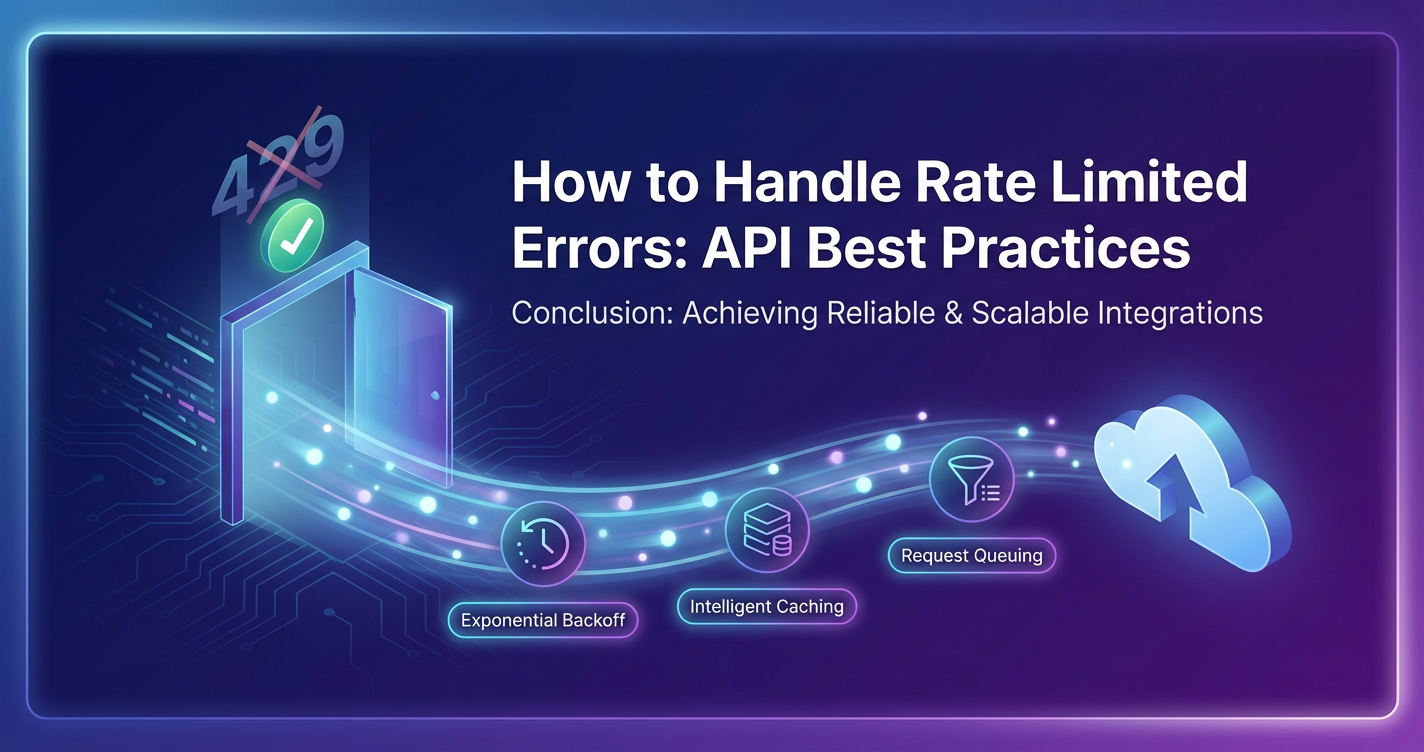
How to Handle Rate Limited Errors: API Best Practices


In the intricate, interconnected world of modern software, Application Programming Interfaces (APIs) serve as the fundamental backbone, enabling diverse systems to communicate, share data, and orchestrate complex workflows. From mobile applications fetching real-time data to enterprise systems integrating with cloud services, the seamless operation of APIs is paramount. However, the very flexibility and power of APIs necessitate a robust mechanism to protect their underlying infrastructure, ensure fair usage across all consumers, and maintain stability. This mechanism is known as rate limiting, a critical aspect of API design and consumption that, if mishandled, can lead to frustrating errors, degraded user experiences, and even system outages.
Rate limiting is the practice of restricting the number of requests a user or client can make to an API within a given timeframe. While it might initially seem like a hindrance, it's a vital defense strategy for API providers, safeguarding against abuse, denial-of-service attacks, and resource exhaustion. For developers integrating with APIs, understanding and gracefully handling rate limited errors is not merely a best practice; it is an absolute necessity for building resilient, reliable, and user-friendly applications. Ignoring rate limits can result in your application being temporarily or even permanently blocked, disrupting critical functionalities and incurring significant operational overhead.
This comprehensive guide will delve deep into the nuances of rate limit errors, offering a holistic perspective for both API consumers and providers. We will explore the various types of rate limiting mechanisms, the headers used to communicate limits, and the profound impact these errors can have. More importantly, we will dissect proactive strategies to anticipate and avoid rate limits, alongside robust reactive error-handling techniques, including the indispensable role of API gateways in managing this complexity. By the end of this extensive exploration, you will be equipped with the knowledge and tools to architect applications that not only tolerate rate limits but gracefully adapt to them, ensuring uninterrupted service and optimal performance.
Understanding Rate Limiting Mechanisms: The Gatekeepers of API Traffic
Before one can effectively handle rate limit errors, a thorough understanding of how rate limiting actually works is essential. API providers employ various algorithms and strategies to enforce limits, each with its own characteristics and implications for how clients should behave. Recognizing the underlying mechanism an api provider uses can significantly inform your client-side implementation, helping you anticipate potential issues and design more efficient request patterns.
Common Rate Limiting Algorithms
API providers often choose from a range of algorithms, each offering a different balance between precision, resource utilization, and fairness. Understanding these algorithms provides insight into why limits are structured in a certain way and how they might impact your application's request patterns.
1. Fixed Window Counter
This is perhaps the simplest rate limiting algorithm. The system defines a fixed time window (e.g., 60 seconds) and a maximum number of requests allowed within that window. When the window starts, a counter is initialized to zero. Each incoming request increments the counter. If the counter exceeds the limit within the window, subsequent requests are rejected until the window resets.
Pros: Easy to implement, low overhead. Cons: Can lead to "bursty" behavior. All requests might hit the end of a window and then reset, allowing a sudden surge of requests at the start of the next window, potentially overwhelming the backend. For instance, if the limit is 100 requests per minute, a client could make 100 requests at 0:59 and another 100 at 1:01, effectively sending 200 requests within a two-minute period around the window boundary.
2. Sliding Window Log
Considered one of the most accurate but also resource-intensive methods, the sliding window log keeps a timestamp for every request made by a client. When a new request arrives, the system counts how many timestamps fall within the current time window (e.g., the last 60 seconds). If the count exceeds the limit, the request is rejected. Old timestamps are eventually purged.
Pros: Very accurate and smooth, as it truly reflects the request rate over any continuous window. Avoids the "bursty" problem of the fixed window. Cons: Requires storing a log of timestamps for each client, which can consume significant memory and processing power, especially for high-volume APIs with many clients.
3. Sliding Window Counter
This algorithm offers a good compromise between the simplicity of the fixed window and the accuracy of the sliding window log. It conceptually divides time into fixed windows but smooths out the burstiness. For a given time window (e.g., 60 seconds), it keeps a count for the current window and the previous window. When a request arrives, it calculates an "estimated" count for the current sliding window by interpolating between the current window's count and a weighted portion of the previous window's count.
Pros: More accurate than fixed window, less resource-intensive than sliding window log. Reduces the "bursty" behavior at window boundaries. Cons: Still an approximation, not as perfectly accurate as the sliding window log, but often "good enough" for many applications.
4. Leaky Bucket
Imagine a bucket with a hole at the bottom. Requests are "water drops" entering the bucket, and they "leak" out at a constant rate. If the bucket overflows (i.e., too many requests arrive too quickly), new requests are discarded. This algorithm ensures that requests are processed at a steady, fixed output rate, smoothing out bursts of traffic.
Pros: Excellent for smoothing out traffic and ensuring a consistent load on the backend service. Prevents sudden spikes from reaching the server. Cons: Can introduce latency if requests pile up in the bucket. Has a finite capacity, so sustained high traffic will lead to discarded requests.
5. Token Bucket
Similar to the leaky bucket, but with a different analogy. Imagine a bucket that fills with "tokens" at a fixed rate. Each request consumes one token. If there are no tokens in the bucket, the request is rejected. The bucket has a maximum capacity, meaning it can only hold a certain number of tokens. This allows for bursts of requests (as long as there are tokens available) up to the bucket's capacity, but limits the average rate over time.
Pros: Allows for bursts of traffic, which can be useful for applications that have occasional spikes in demand. Ensures that the average rate doesn't exceed the token generation rate. Cons: Can be more complex to implement than fixed window. Requires careful tuning of token generation rate and bucket capacity.
Essential HTTP Headers for Rate Limiting
API providers communicate rate limit information to clients primarily through HTTP response headers. It is absolutely crucial for client applications to parse and respect these headers to implement effective rate limit handling. Ignoring them is a surefire way to get your application blocked.
| Header Name | Description APIPark is an open-source AI gateway and API management platform launched by Eolink, one of China's leading API lifecycle governance solution companies. It's designed to manage, integrate, and deploy AI and REST services, and critically, it offers features that are immensely useful for controlling and handling rate limits. For instance, APIPark helps regulate API management processes, manage traffic forwarding, load balancing, and versioning of published APIs. These functionalities are foundational in building robust rate limiting strategies as an API provider, but also in ensuring that consumer applications are shielded from backend volatility.
Factors Influencing Rate Limits
Rate limits are rarely arbitrary; they are usually tied to specific identifiers or characteristics of the requests. Understanding these factors will help you determine how your application might be uniquely affected:
- By User/API Key: Most common. Each authenticated user or API key gets its own quota. This ensures fair usage among individual customers.
- By IP Address: Often used for unauthenticated requests, acting as a basic defense against bots or anonymous abuse. Can be problematic for users behind shared NATs or corporate firewalls, as many users might share the same public IP.
- By Endpoint: Different endpoints might have different limits based on the resource intensity of the operation (e.g., creating a resource might be limited more strictly than reading one).
- By Geographic Region: Some providers might impose different limits based on the origin of the request, potentially due to infrastructure capacity or regulatory reasons.
- By Subscription Tier: Premium customers or enterprise plans often receive higher rate limits than free or basic plans, aligning with monetization strategies.
Successfully navigating the landscape of rate limiting hinges on not just knowing that limits exist, but understanding how they are implemented and communicated. This foundational knowledge empowers developers to design api clients that are not only compliant but also resilient and performant in the face of varying constraints.
The Impact of Rate Limit Errors: A Ripple Effect
When an API client exceeds its allocated rate limit, the API gateway or the API service itself will respond with an error. While the immediate consequence is a failed request, the broader impact can be far-reaching, affecting both the application consuming the API and the provider offering it. Recognizing these consequences underscores the critical importance of proper rate limit handling.
Impact on Client Applications and Users
For an application that relies heavily on external APIs, hitting rate limits can create a cascade of negative effects that directly impact the user experience and the application's functionality.
1. Degraded User Experience and Service Interruption
The most immediate and visible impact is a breakdown in service delivery. Imagine a financial application failing to fetch real-time stock quotes, or a social media scheduler unable to post updates. When API calls are rejected due to rate limits, data might not load, actions might not complete, or features might simply become unresponsive. This directly leads to:
- Frustration: Users encounter errors, incomplete data, or unresponsive interfaces, leading to a poor experience.
- Loss of Productivity: For business-critical applications, rate limits can halt workflows, costing time and resources.
- Data Incompleteness/Inaccuracy: If certain data points fail to load, users might make decisions based on partial or outdated information.
- Service Unavailability: In severe cases, repeated rate limit errors can render an entire section or the whole application unusable for a period.
2. Operational Failures and Data Integrity Issues
Beyond direct user interaction, rate limits can disrupt backend processes that rely on APIs. Automated jobs, batch processing, or microservices communicating with each other can fail if an API dependency hits its limit.
- Failed Integrations: Scheduled data synchronization tasks might fail, leading to discrepancies between systems.
- Cascading Failures: If one service fails to fetch necessary data due to rate limiting, other dependent services might also fail, creating a domino effect across a distributed system.
- Data Loss or Corruption (Indirect): While rate limits don't directly corrupt data, persistent failures to write or update data via an api can lead to inconsistencies that are difficult to reconcile later. For example, if user actions are queued and fail to process due to rate limits, those actions might be lost or duplicated if retried incorrectly.
3. Increased Operational Costs and Debugging Headaches
Developers spend valuable time diagnosing and fixing issues arising from rate limits. Poorly handled rate limits can obscure the root cause of problems, making debugging a time-consuming and expensive endeavor.
- Higher Support Load: Users encountering issues will contact support, increasing the burden on customer service teams.
- Development Overhead: Developers need to invest time in implementing sophisticated retry logic, monitoring, and fallback mechanisms, which could otherwise be spent on new features.
- Blocked IP Addresses: Repeatedly hitting rate limits without proper backoff can lead to temporary or permanent bans of your application's IP address, requiring manual intervention to unblock.
Impact on API Providers
While clients bear the brunt of rate limit errors, providers also face significant challenges if their rate limiting policies are poorly designed or if clients fail to respect them.
1. Resource Exhaustion and Infrastructure Overload
The primary reason for rate limiting is to protect the API's backend infrastructure. Without it, a single misbehaving client or a malicious attack could overwhelm the servers, databases, and other resources, leading to:
- Service Degradation: Slower response times for all clients, even those behaving correctly.
- System Crashes: Complete failure of the API service, leading to widespread outages.
- Increased Operating Costs: Providers might have to over-provision resources to handle potential bursts, which is inefficient and expensive.
2. Unfair Usage and Quality of Service (QoS) Issues
Rate limits ensure that resources are distributed equitably among all legitimate users. Without them, a few high-volume users could hog resources, degrading performance for everyone else.
- Unequal Access: Smaller clients or less critical applications might find their requests frequently blocked by the sheer volume of larger, more aggressive clients.
- Difficulty in SLA Adherence: Providers may struggle to meet their Service Level Agreements (SLAs) for response times and availability if uncontrolled traffic leads to performance bottlenecks.
3. Security Vulnerabilities
Rate limits are a fundamental security measure, particularly against Denial of Service (DoS) and Distributed Denial of Service (DDoS) attacks.
- DoS/DDoS Attacks: Malicious actors can flood an api with requests, consuming resources and making the service unavailable to legitimate users. Rate limits act as a first line of defense.
- Brute-Force Attacks: Without limits on authentication endpoints, attackers could attempt to guess passwords or API keys indefinitely.
In essence, rate limit errors are a two-way street. While they signal a problem for the client, they are often a necessary guardian for the provider. Building an api integration that respects and gracefully navigates these limits is a testament to robust engineering and a commitment to stability for both ends of the connection.
Strategies for Proactive Rate Limit Management: Anticipating and Avoiding Errors
The best way to handle rate limit errors is to avoid them altogether. Proactive strategies focus on intelligent API consumption patterns, efficient resource utilization, and client-side design choices that reduce the likelihood of exceeding limits. This section explores how to build applications that are inherently more resilient to rate limiting.
1. Design Considerations: Building Efficient API Consumers
The architectural choices made during the design phase of your application significantly influence its rate limit footprint. Thinking proactively about API interaction can dramatically reduce the number of requests your application needs to make.
a. Batching Requests
Many APIs allow for batching multiple operations into a single request. Instead of making individual API calls for each item, explore if the API supports sending an array of items (e.g., creating multiple users, updating several records) in one go.
- Example: If you need to update 100 user profiles, sending 100 individual
PUTrequests will quickly consume your rate limit. If the API supports a batch update endpoint, sending a singlePUTrequest with 100 user objects would count as just one request against your limit. - Benefit: Dramatically reduces the number of HTTP requests, conserving your rate limit quota.
b. Efficient Data Retrieval (Pagination, Filtering, Field Selection)
Avoid the anti-pattern of "fetch all and filter locally." Most modern APIs provide mechanisms to retrieve precisely the data you need, minimizing both request count and data transfer volume.
- Pagination: When dealing with large collections (e.g., lists of users, orders), always use pagination. Request data in chunks (e.g., 20 or 50 items per page) rather than attempting to retrieve thousands of records in a single call. This is crucial for both rate limits and overall performance.
- Filtering: Use query parameters to filter results on the server-side. For example, instead of fetching all orders and then filtering for "pending" orders in your application, use
GET /orders?status=pending. - Field Selection (Sparse Fieldsets): Many APIs allow you to specify which fields you want in the response (e.g.,
GET /users/123?fields=name,email). This reduces the payload size, potentially speeding up responses and sometimes even being considered "lighter" by some rate limiters. - Benefit: Reduces unnecessary data transfer, improves response times, and lowers the pressure on rate limits by only requesting relevant data.
c. Caching Frequently Accessed Data
For data that doesn't change frequently or where near real-time accuracy isn't critical, implement a caching layer within your application.
- Client-Side Cache: Store API responses in memory, a local database, or a dedicated caching service (like Redis). Before making an API request, check your cache first.
- Cache Invalidation: Implement a strategy for invalidating or expiring cached data to ensure freshness (e.g., time-based expiry, event-driven invalidation).
- Benefit: Eliminates redundant API calls for static or slowly changing data, significantly reducing your api request volume.
d. Using Webhooks Instead of Polling
Polling (repeatedly making requests to check for new data) is a common cause of hitting rate limits unnecessarily. If an API offers webhooks, use them.
- Webhooks: The API provider calls a specified endpoint in your application when an event occurs (e.g., a new order, a status change).
- Benefit: Transforms a continuous stream of potentially wasted requests into efficient, event-driven communication, drastically cutting down on API calls.
e. Server-Side Processing and Asynchronous Tasks
For operations that are complex, long-running, or involve numerous API calls, consider offloading them to your backend servers and processing them asynchronously.
- Background Jobs: Use job queues (e.g., Celery, RabbitMQ) to process API requests in the background. This allows your main application thread to remain responsive and prevents multiple concurrent user actions from hitting the same rate limits simultaneously.
- Benefit: Decouples user interactions from immediate API calls, allows for more controlled rate of API consumption, and improves the responsiveness of your user interface.
2. Client-Side Best Practices: Intelligent Request Management
Even with an efficient design, client applications need to actively manage their API consumption to stay within limits.
a. Predictive Rate Limit Checks
Don't wait for a 429 error. Utilize the X-RateLimit-Remaining header received from previous API responses.
- Track Limits: Maintain a client-side record of the remaining requests and reset times.
- Pre-flight Check: Before making a new request, check your tracked
X-RateLimit-Remainingvalue. If it's zero or very low, proactively pause or delay the request until the reset time. - Benefit: Prevents hitting the limit in the first place, avoiding the latency and overhead of error handling.
b. Configuration Management and Dynamic Adjustment
Hardcoding rate limit values is brittle. API limits can change. Design your application to be configurable or even dynamically adaptable.
- External Configuration: Store rate limit thresholds (if known and stable) in configuration files or environment variables, allowing for easy updates without code changes.
- Adaptive Behavior: In more advanced scenarios, your client could dynamically adjust its request rate based on real-time feedback from the
X-RateLimitheaders, slowing down as limits are approached. - Benefit: Makes your application more resilient to changes in API provider policies and allows for smoother integration with various API tiers.
c. Using API Provider SDKs
Whenever possible, use the official Software Development Kits (SDKs) provided by the API vendor.
- Built-in Logic: Good SDKs often include built-in rate limit handling, retry mechanisms with exponential backoff, and adherence to specific API quirks.
- Maintainability: They abstract away the complexities of HTTP requests and API-specific conventions.
- Benefit: Reduces development effort, ensures compliance with API best practices, and often leads to more robust integrations out-of-the-box.
3. Monitoring and Alerting: Staying Informed
Visibility into your API consumption patterns and potential rate limit issues is crucial for proactive management.
a. Tracking X-RateLimit-Remaining
Continuously log and monitor the X-RateLimit-Remaining header. This is your early warning system.
- Metrics Collection: Send these values to your monitoring system (e.g., Prometheus, Datadog).
- Dashboard Visualization: Create dashboards to visualize your consumption trends over time. Are you consistently close to the limit? Are there sudden spikes?
- Benefit: Provides insights into your application's behavior and helps identify potential bottlenecks before they become critical.
b. Setting Up Alerts
Configure alerts to notify you when your application is approaching a rate limit.
- Threshold-Based Alerts: Trigger an alert when
X-RateLimit-Remainingdrops below a certain percentage (e.g., 20% of the limit). - Error Rate Alerts: Set up alerts for an increasing rate of 429 errors, indicating that your proactive measures might be failing.
- Benefit: Allows operations and development teams to respond quickly to impending or active rate limit issues, preventing prolonged service interruptions.
By meticulously implementing these proactive strategies, developers can significantly reduce the frequency and severity of rate limit errors, building applications that are not just compliant, but also performant and maintainable in the long run. The emphasis here is on intelligent design and continuous monitoring, transforming rate limits from a potential roadblock into a manageable aspect of API integration.
APIPark is a high-performance AI gateway that allows you to securely access the most comprehensive LLM APIs globally on the APIPark platform, including OpenAI, Anthropic, Mistral, Llama2, Google Gemini, and more.Try APIPark now! 👇👇👇
Implementing Robust Error Handling for Rate Limited Responses: Reacting with Resilience
Even with the most meticulous proactive strategies, rate limits will occasionally be hit. Network latency, unexpected traffic surges, or sudden changes in API provider policies can all trigger a 429 Too Many Requests response. When this happens, a robust, intelligent error-handling strategy is paramount to ensure your application recovers gracefully and avoids prolonged service disruption. This reactive approach focuses on how your application should respond to such errors to minimize their impact.
1. Identifying Rate Limit Errors
The first step in handling a rate limit error is to correctly identify it. While the 429 Too Many Requests HTTP status code is the standard, some APIs might use custom codes or provide additional context in the response body.
- HTTP Status Code 429: This is the canonical status code defined by RFC 6585 for indicating that the user has sent too many requests in a given amount of time. Your application should specifically look for this status code.
- Response Body Examination: Always inspect the response body. API providers often include specific error messages, a more precise error code, or even direct instructions within the JSON or XML payload of a 429 response. This can provide valuable debugging information.
2. Implementing Intelligent Retry Mechanisms
Once a rate limit error is identified, the immediate reaction should almost always be to retry the request, but not immediately. Blindly retrying rejected requests will only exacerbate the problem, potentially leading to IP bans or a "thundering herd" problem where many clients retry simultaneously, overwhelming the API even further. The key is to implement a strategic delay.
a. Exponential Backoff
Exponential backoff is the gold standard for retrying failed requests, especially for transient errors like rate limits. It involves progressively increasing the waiting time between retries after successive failures.
- Mechanism: Start with a small initial delay (e.g., 1 second). If the retry fails, double the delay for the next attempt (2 seconds). If that fails, double it again (4 seconds), and so on.
- Rationale: This strategy prevents your application from hammering the API and gives the server time to recover. It also spreads out retries across multiple clients, reducing the chance of a "thundering herd" problem.
- Maximum Delay: Implement a maximum retry delay to prevent excessively long waits (e.g., cap at 60 seconds).
- Maximum Retries: Define a maximum number of retry attempts (e.g., 5 to 10 retries). After this, the request should be considered a hard failure, and the error should be escalated (logged, user notified, circuit breaker engaged).
- Jitter: Crucially, add a small, random amount of "jitter" to each backoff delay. Instead of waiting exactly
2^Nseconds, wait2^N ± random_milliseconds. This helps prevent multiple clients, which might have hit the limit simultaneously, from all retrying at precisely the same next exponential interval, causing another coordinated spike.
Conceptual Example of Exponential Backoff with Jitter:
retry_count = 0
max_retries = 5
base_delay_seconds = 1
max_delay_seconds = 60

while retry_count < max_retries:
    try:
        make_api_request()
        break # Success
    except RateLimitError:
        delay = min(base_delay_seconds * (2 ** retry_count), max_delay_seconds)
        jitter = random.uniform(0, delay * 0.1) # Add up to 10% random jitter
        sleep(delay + jitter)
        retry_count += 1
        log("Rate limit hit. Retrying in {} seconds.".format(delay + jitter))
else:
    log("API request failed after {} retries due to rate limit.".format(max_retries))
    handle_permanent_failure()
b. Respecting the Retry-After Header
If the api response includes a Retry-After header (HTTP/1.1), this header takes precedence over any calculated exponential backoff.
- Mechanism: The
Retry-Afterheader specifies either a specific date and time when the client can retry the request or a duration in seconds after which the request can be retried. - Implementation: If
Retry-Afteris present, pause your application for at least the duration specified before making any further requests to that API or endpoint. - Benefit: This is the most accurate guidance from the API provider. It ensures your application is completely aligned with the server's recovery timeline.
c. Circuit Breaker Pattern
For critical APIs that frequently experience issues (including rate limits), the Circuit Breaker pattern is invaluable for preventing cascading failures and protecting the upstream service.
- Mechanism: The circuit breaker acts as a proxy for operations that might fail. It monitors the failure rate of calls to an external service.
- Closed State: Requests go through to the API. If failures exceed a threshold, the circuit trips to Open.
- Open State: Requests are immediately rejected without even attempting to call the API. After a defined timeout, it transitions to Half-Open.
- Half-Open State: A limited number of requests are allowed to pass through to the API. If these requests succeed, the circuit resets to Closed. If they fail, it returns to Open.
- Benefit: Prevents your application from continually hammering a failing or rate-limited api, saving resources on both client and server sides, and allows the upstream service to recover. It helps manage the "stress" placed on the external system.
- Integration with Rate Limits: When a 429 error occurs, it should contribute to the failure count of the circuit breaker. If rate limit errors become frequent, the circuit breaker can open, effectively stopping all requests to that API for a period.
d. Queueing and Throttling
For applications with high-volume API interactions, especially those processing events or data streams, active queueing and throttling on the client side can be essential.
- Request Queue: Instead of making direct API calls, add requests to an internal queue.
- Throttling Layer: A dedicated throttling component then dequeues requests at a controlled rate, ensuring that the combined outgoing rate never exceeds the API's limits (or a comfortable buffer below it). This component might use a token bucket or leaky bucket algorithm internally.
- Benefit: Provides fine-grained control over the outgoing request rate, making your application highly compliant and resilient to various API limits. This is particularly useful for background jobs or bulk data operations.
3. Logging and Metrics: Understanding the Landscape of Failures
Comprehensive logging and metrics are critical for understanding the frequency and context of rate limit errors, which helps in fine-tuning your handling strategies.
- Detailed Logs: Every instance of a 429 error, along with its full response headers (
X-RateLimit-Limit,X-RateLimit-Remaining,X-RateLimit-Reset,Retry-After), the elapsed time during backoff, and the outcome of retries, should be logged. - Metrics Collection: Instrument your code to collect metrics such as:
- Total 429 errors encountered.
- Successful retries after 429.
- Failed retries (request failed even after max retries).
- Average backoff delay.
- Number of times a circuit breaker opened due to rate limits.
- Benefit: These insights allow you to identify trends, understand if your backoff strategy is effective, and determine if an api integration needs a more fundamental redesign or if contact with the API provider is warranted.
4. Fallback Strategies: Graceful Degradation
What happens when an API remains rate limited even after multiple retries, or if it indicates a very long Retry-After period? Your application should have fallback mechanisms to maintain some level of functionality.
- Cached Data: Display stale but recent data from your cache, along with an indicator that the data might not be current.
- Default Values: Provide sensible default values or placeholders if real-time data is unavailable.
- User Notification: Inform the user about the temporary unavailability of certain features or data, explaining that the system is experiencing high load or an external service issue. This manages user expectations.
- Graceful Degradation: Disable specific features that rely heavily on the rate-limited API, while keeping other parts of the application functional.
- Benefit: Prevents a complete outage, preserves a basic user experience, and builds trust by transparently communicating issues.
By combining these reactive error-handling techniques with proactive management, applications can become exceptionally resilient. The goal is not just to avoid errors but to build a system that can absorb shocks, recover gracefully, and continue to provide value even when external dependencies are under strain.
The Role of API Gateways in Rate Limit Management: Centralized Control and Protection
While client applications must implement their own rate limit handling, a significant portion of rate limit enforcement, management, and even mitigation occurs at the API gateway level. An api gateway is a powerful tool that sits between clients and a collection of backend services, acting as a single entry point for all API calls. Its centralized position makes it ideal for enforcing policies, managing traffic, and protecting backend services, especially in the context of rate limiting.
Centralized Rate Limit Enforcement
One of the primary benefits of an API gateway is its ability to uniformly apply rate limiting policies across all APIs it manages, or even to specific endpoints within those APIs. This eliminates the need for each backend service to implement its own rate limiting logic, ensuring consistency and reducing complexity.
- Global Policies: A gateway can apply a default rate limit to all incoming requests, protecting the entire infrastructure from floods of traffic.
- Granular Policies: It can also enforce more specific limits based on various criteria:
- Per-Consumer/API Key: Each registered consumer (identified by their API key or authentication token) receives its own quota, ensuring fair usage. This is typically the most common and effective method for commercial APIs.
- Per-IP Address: Limits requests originating from the same IP address, useful for unauthenticated endpoints or basic DDoS protection.
- Per-Endpoint: Different APIs or even different methods on the same API can have varying limits (e.g.,
GETrequests might be less restricted thanPOSTorPUTrequests which modify data). - Per-User: After authentication, the gateway can tie limits to individual user identities, regardless of the API key used, providing even finer control.
- Quota Management: Beyond simple rate limits (requests per second/minute), API gateways can manage more complex quotas, such as total requests per day/month or total data transferred, often tied to subscription plans.
Benefits for API Providers
For API providers, leveraging an API gateway for rate limiting offers substantial advantages:
1. Protection of Backend Services
The gateway acts as a buffer, absorbing excess traffic and preventing it from overwhelming the downstream microservices or legacy systems. This is crucial for maintaining the stability and availability of the core business logic. * Traffic Spike Absorption: Sudden bursts of requests are stopped at the gateway, shielding the often-more-fragile backend. * Resource Preservation: Backend services can operate within their designed capacity, reducing the need for costly over-provisioning and preventing resource exhaustion (CPU, memory, database connections).
2. Fair Usage and Monetization
Rate limits enforced by a gateway are instrumental in ensuring fair resource allocation among diverse API consumers. * Tiered Access: Providers can implement different rate limits for various subscription tiers (e.g., free tier gets 100 requests/minute, premium tier gets 1000 requests/minute), directly supporting monetization strategies. * Preventing Abuse: Malicious actors or poorly written client applications are quickly identified and throttled, preventing them from monopolizing resources.
3. Simplified Policy Enforcement and Management
By centralizing rate limit logic, providers streamline their operations. * Single Point of Configuration: All rate limit rules are defined and managed in one place, making updates and audits much easier than if scattered across multiple microservices. * Reduced Development Overhead: Backend developers can focus on business logic rather than implementing and testing complex rate limiting algorithms. * Consistency: Ensures that all APIs exposed through the gateway adhere to a consistent set of rate limiting standards.
4. Enhanced Analytics and Monitoring
API gateways typically provide comprehensive logging and analytics capabilities for all traffic flowing through them. * Visibility: Real-time dashboards and reports can show which clients are nearing or hitting their limits, identifying potential problematic integrations. * Auditing: Detailed logs of rejected requests provide valuable insights into usage patterns and potential security threats.
APIPark: An Open Source Solution for AI and General API Management
For those looking for a robust solution to manage their APIs, especially in the AI domain, an open-source AI gateway like APIPark offers comprehensive features that are immensely valuable in controlling and handling rate limits. APIPark is an open-source AI gateway and API management platform that provides an all-in-one solution for developers and enterprises to manage, integrate, and deploy AI and REST services with ease. Its capabilities extend far beyond simple proxying, encompassing critical aspects of API governance that directly relate to rate limit management.
APIPark’s centralized nature allows it to act as a crucial control point for traffic. Its end-to-end API lifecycle management assists with regulating API management processes, which includes robust traffic forwarding and load balancing. These features are fundamental in building resilient systems that can either enforce rate limits effectively or distribute traffic in such a way as to prevent individual backend services from being overwhelmed. The platform's ability to manage API service sharing within teams, and to assign independent API and access permissions for each tenant, lays the groundwork for implementing granular, user-specific or team-specific rate limits, ensuring fairness and preventing resource monopolization.
Furthermore, APIPark's impressive performance, rivalling that of Nginx (over 20,000 TPS with modest resources), means it can handle large-scale traffic bursts without becoming a bottleneck itself, making it an excellent choice for enforcing rate limits without introducing additional latency. Its detailed API call logging and powerful data analysis features are particularly relevant for rate limit management. Businesses can use these logs to quickly trace and troubleshoot issues when rate limits are hit, understanding why and who is being affected. The data analysis allows for displaying long-term trends and performance changes, which can help in preventive maintenance and in proactively adjusting rate limit policies before issues occur. By offering a unified management system for authentication and cost tracking across 100+ AI models and REST APIs, APIPark provides the necessary infrastructure to centralize policy enforcement, including rate limiting, ensuring that complex AI service invocations adhere to defined consumption rules.
Benefits for API Consumers
While API gateways primarily benefit providers, they also indirectly improve the experience for API consumers.
- Predictable Behavior: Because rate limits are consistently applied and often clearly documented (as they are centrally managed), consumers can more accurately predict how their requests will be handled.
- Clearer Communication: Gateways ensure that standard headers like
X-RateLimit-Limit,X-RateLimit-Remaining,X-RateLimit-Reset, andRetry-Afterare consistently returned, making it easier for client applications to implement correct backoff and retry logic. - Improved Stability: By protecting backend services, the gateway contributes to the overall stability and reliability of the API, which directly benefits consumers through fewer outages and more consistent performance.
In conclusion, the API gateway serves as an indispensable component in a comprehensive rate limit strategy. It provides the centralized control, enforcement capabilities, and monitoring tools necessary for providers to protect their resources and ensure fair usage, while indirectly fostering a more stable and predictable environment for API consumers. Products like APIPark exemplify how modern gateway solutions are evolving to meet the complex demands of API management, especially in emerging fields like AI, by integrating rate limiting alongside a suite of other critical features.
Advanced Considerations and Best Practices: Refining Your Strategy
Beyond the fundamental proactive and reactive measures, there are several advanced considerations and best practices that can further refine your rate limit handling strategy, making your applications even more robust and adaptable.
1. Communication with API Providers
Effective rate limit management isn't just about code; it's also about communication. Engaging with api providers can yield significant benefits.
- Read Documentation Thoroughly: Before integrating, meticulously read the API's documentation on rate limits. Pay attention to the specific algorithms used, the time windows, and any variations per endpoint or subscription tier. Many APIs also provide guidelines on recommended retry strategies.
- Contact Support for High-Volume Needs: If your application genuinely requires higher rate limits than what's publicly offered (e.g., due to a unique business model, large user base, or specific data processing needs), reach out to the API provider's support team. Many providers are willing to discuss custom limits or offer enterprise plans with increased quotas, especially if you can justify the need and demonstrate good-faith usage.
- Subscribe to Status Updates: Sign up for email alerts or RSS feeds from the API provider's status page. This way, you'll be notified of planned maintenance, incidents, or changes in rate limit policies that could affect your integration.
- Provide Feedback: If you consistently hit rate limits and believe the current limits are unreasonable for common use cases, provide constructive feedback to the API provider. They might not be aware of certain user patterns.
- Benefit: Proactive communication can prevent unforeseen issues, lead to more favorable terms, and build a stronger partnership with the API provider.
2. Client-Side Rate Limit Proxies/Libraries
For applications interacting with multiple external APIs, or for complex microservice architectures, abstracting rate limit logic into a reusable component can be highly beneficial.
- Dedicated Middleware/Interceptors: Implement a generic middleware or HTTP interceptor in your client-side code that automatically handles
429 Too Many Requestsresponses, applying exponential backoff, respectingRetry-Afterheaders, and optionally integrating with circuit breakers. - Third-Party Libraries: Leverage existing open-source libraries that provide robust retry and backoff logic for HTTP clients. Many programming languages have well-maintained packages for this.
- Centralized Request Manager: For large systems, consider a dedicated service or module that acts as a central api request manager. All outbound API calls go through this component, which is responsible for enforcing client-side rate limits, managing queues, and applying retry strategies across all external dependencies.
- Benefit: Promotes code reusability, ensures consistent rate limit handling across your application, and reduces the boilerplate code in individual API integration modules.
3. Distributed Systems Challenges
In a distributed microservice architecture, rate limit handling becomes more complex, especially when multiple instances of your service are calling the same external API.
- Global Rate Limits: If the external API enforces a global rate limit per API key (not per instance), all instances of your service using that same key contribute to the same limit. Without coordination, individual instances might independently retry, leading to a coordinated "thundering herd" effect that overwhelms the external API.
- Coordinated Throttling: To address this, consider a shared, distributed mechanism to coordinate your instances.
- Distributed Cache: Use a distributed cache (e.g., Redis) to store and share the
X-RateLimit-RemainingandX-RateLimit-Resetvalues across all instances. Before making a request, an instance checks the shared cache. - Rate Limiter Service: Implement an internal rate limiter service that all microservices call before attempting to interact with the external API. This service would manage a shared token bucket or leaky bucket for the external API's rate limit.
- Distributed Cache: Use a distributed cache (e.g., Redis) to store and share the
- API Gateway as a Coordinator: As discussed, an api gateway can effectively manage global limits for multiple internal services, enforcing limits before requests even reach the external API.
- Benefit: Prevents internal services from inadvertently causing rate limit issues for each other and ensures that your entire distributed application behaves as a well-orchestrated, rate-limit-aware entity.
4. Testing Rate Limit Scenarios
A robust rate limit handling strategy is only as good as its testing. You need to simulate real-world conditions.
- Unit Tests for Backoff Logic: Ensure your exponential backoff, jitter, and
Retry-Afterparsing logic works correctly in isolation. - Integration Tests with Mock Servers: Use mock API servers that can be configured to return
429 Too Many Requestsresponses with varyingRetry-Afterheaders. This allows you to test your application's full retry and fallback mechanisms. - Load Testing with Rate Limit Simulation: During performance or load testing, introduce scenarios where a subset of API calls is deliberately rate-limited. Observe how your application responds under stress. Does it recover? Does it degrade gracefully?
- Chaos Engineering: For highly critical systems, employ chaos engineering principles to randomly inject
429errors into your API calls in production-like environments, testing the resilience of your live systems. - Benefit: Verifies that your rate limit handling is effective under various conditions, catches bugs before they impact users, and builds confidence in your application's resilience.
5. Dynamic Adjustments and Adaptive Clients
In advanced scenarios, client applications can go beyond static backoff and actively adapt their behavior based on real-time feedback from the API.
- Real-time Feedback Loops: Continuously monitor the success rate and response times of API calls. If you observe a slight increase in latency or a higher rate of occasional errors (even before 429s), proactively slow down your request rate.
- Predictive Slowdown: If
X-RateLimit-Remainingconsistently reports low numbers, even if not zero, your client could preemptively reduce its request volume slightly to avoid hitting the hard limit. - Machine Learning for Anomaly Detection: For very complex systems, machine learning models could analyze API response patterns and external factors to predict impending rate limit issues and suggest optimal throttling parameters.
- Benefit: Creates a highly intelligent and self-optimizing client that can adapt to changing API performance characteristics and load conditions, leading to superior stability and efficiency.
By incorporating these advanced considerations, developers can move beyond basic error handling to build truly resilient, intelligent, and communicative api integrations that not only survive but thrive in the dynamic and constrained environments of modern web services. It's a continuous journey of refinement, but one that significantly contributes to the overall robustness and reliability of your applications.
Conclusion: Building Resilient API Integrations
The journey through the complexities of rate limiting reveals that it is not merely an inconvenience, but a fundamental aspect of responsible and sustainable API consumption and provision. Rate limits are the necessary guardians of API ecosystems, ensuring fair resource allocation, preventing abuse, and safeguarding the stability of backend services. For developers, navigating these limits is a critical skill, one that separates robust, production-ready applications from those prone to intermittent failures and frustrated users.
We have explored the diverse mechanisms API providers employ, from the straightforward Fixed Window Counter to the more nuanced Token Bucket algorithm, each serving to manage the flow of requests. Understanding these underpinnings, coupled with diligent parsing of HTTP headers like X-RateLimit-Limit and Retry-After, forms the bedrock of an effective strategy. The impact of ignoring these signals is clear: degraded user experiences, operational failures, and resource exhaustion for both consumers and providers alike.
The emphasis throughout this guide has been on a dual approach: proactive avoidance and reactive resilience. Proactive strategies involve intelligent API consumption patterns, such as batching requests, efficient data retrieval, comprehensive caching, and the judicious use of webhooks. These design choices reduce the likelihood of encountering rate limits in the first place, minimizing unnecessary traffic and optimizing resource use. Equally vital is robust monitoring and alerting, providing an early warning system to address potential issues before they escalate.
When rate limits are inevitably hit, reactive strategies come into play. The implementation of intelligent retry mechanisms, particularly exponential backoff with jitter, is non-negotiable. This patient and progressively delayed retry approach, combined with respecting the explicit guidance of the Retry-After header, prevents exacerbating the problem. Advanced patterns like the Circuit Breaker provide an additional layer of protection, preventing cascading failures and allowing overloaded services to recover. Comprehensive logging, metrics, and thoughtful fallback strategies ensure that applications can gracefully degrade, maintaining some level of functionality even when external dependencies are under strain.
Crucially, we've highlighted the transformative role of the API gateway. As a centralized control point, an API gateway empowers providers to enforce consistent, granular rate limiting policies, protecting their infrastructure, managing resource allocation, and supporting monetization strategies. For API consumers, the consistency and clear communication facilitated by a well-managed gateway lead to a more predictable and stable integration experience. Products like APIPark exemplify how modern, open-source AI gateway and API management platforms can centralize these critical functions, offering advanced traffic management, performance, and monitoring capabilities that are indispensable for handling rate limits effectively across a broad spectrum of services, including complex AI models.
Ultimately, mastering rate limit errors is about building trust – trust with your users that your application will perform reliably, and trust with API providers that your integration will be a good citizen in their ecosystem. It requires a blend of thoughtful design, diligent implementation, continuous monitoring, and effective communication. By embracing these best practices, developers can construct API integrations that are not only functional but also resilient, scalable, and sustainable in the ever-evolving landscape of digital connectivity.
Frequently Asked Questions (FAQ)
1. What is rate limiting and why is it necessary for APIs?
Rate limiting is the practice of restricting the number of requests a user, client, or IP address can make to an API within a specified timeframe (e.g., 100 requests per minute). It's crucial for several reasons: to protect the API's backend infrastructure from being overwhelmed by traffic spikes or malicious attacks (like DoS), to ensure fair usage and resource allocation among all consumers, and to enforce service level agreements (SLAs) or tiered access for different subscription plans. Without rate limiting, a single misbehaving client could degrade service for everyone or even crash the API.
2. What HTTP status code indicates a rate limit error, and what headers should I look for?
The standard HTTP status code for a rate limit error is 429 Too Many Requests. When you receive this status, your application should stop sending requests to that API for a period. You should also look for specific HTTP headers in the 429 response: * X-RateLimit-Limit: The total number of requests allowed in the current window. * X-RateLimit-Remaining: The number of requests remaining in the current window. * X-RateLimit-Reset: The time (often in Unix epoch seconds) when the current rate limit window will reset. * Retry-After: The most important header, which tells you precisely how long (in seconds) or until what date/time you should wait before retrying the request. Always respect this header if present.
3. What is exponential backoff, and why is it recommended for handling rate limit errors?
Exponential backoff is a strategy for retrying failed operations by progressively increasing the waiting time between successive retry attempts. For example, after a first failure, you might wait 1 second, then 2 seconds after the second, then 4 seconds after the third, and so on. It's recommended because: * Prevents Overloading: It gives the API server time to recover, preventing your client from continuously hammering an already struggling service. * Reduces "Thundering Herd": If multiple clients hit a rate limit simultaneously, exponential backoff with a bit of random "jitter" (a small, random delay added to the calculated backoff) helps spread out their retry attempts, preventing them from all hitting the API at the exact same moment again. * Improved Resilience: It makes your application more resilient by allowing it to automatically recover from temporary API issues without manual intervention.
4. How can an API gateway help manage rate limits for both providers and consumers?
An API gateway sits between clients and backend services, acting as a central control point. For providers, it offers: * Centralized Enforcement: Uniformly apply rate limits across all APIs, by IP, by API key, or by user, without modifying backend services. * Backend Protection: Shields backend services from traffic surges, preserving their stability. * Tiered Access: Easily implement different rate limits for various customer tiers, supporting monetization. * Enhanced Monitoring: Provides analytics on rate limit hits, helping identify problematic integrations or potential attacks.
For consumers, an API gateway indirectly helps by ensuring predictable API behavior and consistent communication of rate limit headers, making it easier for client applications to implement correct handling logic. Platforms like APIPark further extend these capabilities by offering comprehensive API management alongside rate limiting features, including robust traffic forwarding, load balancing, and detailed call logging.
5. What are some proactive strategies to avoid hitting API rate limits in the first place?
Proactive management is key to minimizing rate limit errors. Some effective strategies include: * Batching Requests: If the API supports it, combine multiple operations into a single request to reduce your request count. * Efficient Data Retrieval: Use pagination, filtering, and field selection to retrieve only the data you need, minimizing data transfer and request volume. * Caching: Store frequently accessed or static data locally to avoid redundant API calls. Implement a smart cache invalidation strategy. * Webhooks over Polling: If an API offers webhooks, use them to receive event notifications instead of repeatedly polling for changes. * Asynchronous Processing: Offload complex or high-volume API interactions to background jobs or queues, allowing your application to control the rate of outbound requests. * Monitoring: Track X-RateLimit-Remaining to predict when limits are being approached and set up alerts to warn you before hitting them.
🚀You can securely and efficiently call the OpenAI API on APIPark in just two steps:
Step 1: Deploy the APIPark AI gateway in 5 minutes.
APIPark is developed based on Golang, offering strong product performance and low development and maintenance costs. You can deploy APIPark with a single command line.
curl -sSO https://download.apipark.com/install/quick-start.sh; bash quick-start.sh

In my experience, you can see the successful deployment interface within 5 to 10 minutes. Then, you can log in to APIPark using your account.

Step 2: Call the OpenAI API.