IP Allowlisting vs. Whitelisting: Key Differences Explained


In the intricate landscape of modern cybersecurity, controlling access to digital resources stands as a paramount concern for organizations across all sectors. The proliferation of interconnected systems, cloud-based services, and the ubiquitous reliance on Application Programming Interfaces (APIs) have exponentially increased the attack surface, making robust access control mechanisms indispensable. Amidst a lexicon rich with security terminology, two terms frequently surface when discussing explicit permission-based access: IP whitelisting and IP allowlisting. While often used interchangeably, understanding their nuances, the subtle shifts in terminology, and their practical implications, particularly in securing sensitive data and services exposed through an API gateway, is crucial for architects, developers, and security professionals alike.
At its core, the principle behind both concepts is to create an exclusive perimeter, allowing only known and trusted entities to interact with a system, network segment, or specific api endpoint. This "default-deny" security posture is a cornerstone of robust protection, fundamentally differing from "blacklisting" or "denylisting" which aim to block only known malicious entities while implicitly permitting everything else. However, the journey from "whitelisting" to "allowlisting" is not merely a semantic triviality; it reflects an evolving consciousness within the tech community, moving towards more inclusive and less potentially loaded language. This comprehensive exploration will dissect both concepts, delve into their operational similarities and historical divergence, and provide a clear roadmap for their effective implementation in safeguarding vital digital assets, all while emphasizing their crucial role in api and gateway security.
The Foundational Role of IP Address Filtering in Network Security
Before diving into the specifics of whitelisting and allowlisting, it's essential to grasp the fundamental mechanism they leverage: IP address filtering. An Internet Protocol (IP) address serves as a unique numerical label assigned to each device connected to a computer network that uses the Internet Protocol for communication. Just as a physical address guides mail to its recipient, an IP address ensures that data packets reach their intended destination across networks, whether local or global. Given its role as a fundamental identifier in network communication, the IP address becomes a natural and powerful pivot point for controlling access.
IP address filtering, in its most basic form, involves inspecting the source or destination IP address of incoming or outgoing network traffic and making a decision—to permit or deny—based on predefined rules. This capability is inherent in various network devices, from simple home routers to sophisticated enterprise firewalls and, critically, api gateway solutions. The rationale for employing IP filtering is multifold: it acts as an initial, coarse-grained layer of defense, effectively reducing the exposure of services to the vast and often hostile public internet. By allowing traffic only from specified IP ranges, organizations can significantly shrink their attack surface, mitigating risks from various threats, including denial-of-service attacks, unauthorized access attempts, and brute-force credential stuffing, even before higher-level authentication and authorization mechanisms come into play.
Consider a scenario where an internal database or an administrative interface for a critical system should only be accessible by employees connected through the corporate VPN, or perhaps from specific office locations. By configuring an IP filter, any connection attempt originating from an IP address outside these predefined, trusted ranges would be immediately rejected at the network edge, never reaching the application layer. This proactive filtering prevents malicious actors, even if they possess valid credentials, from even attempting to interact with the service unless they can spoof an allowed IP, which is a significantly more complex and often detectable endeavor. The effectiveness of IP filtering, therefore, lies in its ability to establish a fundamental boundary, acting as a digital bouncer at the entrance of your digital premises, deciding who even gets to knock on the door. This foundational layer is especially pertinent when exposing services to external parties via apis, where the sheer volume of potential callers necessitates robust preliminary checks at the gateway level.
Furthermore, the robustness of a security posture often hinges on the "default-deny" principle. This paradigm dictates that all access attempts are inherently denied unless explicitly permitted by a rule. Conversely, a "default-allow" posture permits everything unless explicitly denied. The former is inherently more secure because it forces administrators to consciously approve every legitimate interaction, thereby minimizing the risk of inadvertently exposed vulnerabilities. IP whitelisting and allowlisting are direct manifestations of this default-deny philosophy, providing a powerful mechanism to enforce strict access policies at the very ingress of network interactions, forming an indispensable component of a layered security strategy.
Deep Dive into Whitelisting: The Exclusive Guest List
Traditionally, "whitelisting" has been a widely adopted term in cybersecurity to describe a security strategy where only explicitly approved entities are granted access, while all other entities are automatically denied. In the context of IP addresses, an IP whitelist is a list of IP addresses or ranges that are permitted to connect to a specific resource, service, or network. Any connection attempt originating from an IP address not present on this list is summarily rejected. This approach is akin to having an exclusive guest list for a private event: only those names explicitly written on the list are allowed entry; everyone else, regardless of their intent or affiliation, is turned away at the door.
The operational mechanics of IP whitelisting typically involve configuring network devices such as firewalls, routers, or api gateways with specific rules. These rules are part of an Access Control List (ACL) that dictates which network traffic is allowed to pass based on various criteria, including source IP address. When a packet arrives, the gateway or firewall inspects its source IP. If that IP matches an entry on the whitelist, the packet is forwarded to its intended destination. If there is no match, the packet is dropped, and often, the connection attempt is logged as a security event, providing valuable data for threat analysis. This process occurs at a very low level in the network stack, making it an efficient and performant method of access control, especially when implemented within a high-performance api gateway.
One of the most significant advantages of IP whitelisting is the drastic reduction in attack surface. By narrowing down the pool of potential communicators to a known, trusted set, organizations dramatically diminish the risk of external unauthorized access. This is particularly crucial for protecting administrative interfaces, sensitive internal services, or specific api endpoints that should only be consumed by partner applications or internal systems. For instance, a critical api that processes financial transactions might only allow connections from the IP addresses of trusted financial partners or specific backend microservices, thereby preventing the vast majority of internet-based threats from even reaching the api's authentication layer. This proactive filtering minimizes the resources spent on processing potentially malicious requests and significantly reduces the exposure to various web application vulnerabilities that might otherwise be exploited by untrusted sources.
Despite its powerful security benefits, IP whitelisting is not without its challenges. The primary drawback lies in its maintenance and scalability. In dynamic cloud environments, where IP addresses of client applications or microservices can change frequently, maintaining an accurate and up-to-date whitelist can become an administrative burden. False positives—where legitimate users or services are inadvertently blocked due to an outdated or incorrect whitelist entry—can lead to service disruptions and operational headaches. Furthermore, for services that need to be broadly accessible, such as public-facing websites or apis consumed by a wide range of external developers, whitelisting becomes impractical or even impossible. In such scenarios, other security mechanisms like strong authentication, authorization, and rate limiting become the primary defense layers. The granularity of whitelisting also needs careful consideration; specifying individual IPs might be too restrictive, while broad CIDR blocks might introduce unnecessary risk. A balance must be struck to ensure both security and operational flexibility.
However, for environments demanding the highest levels of access control, such as backend services within a private cloud, inter-service communication within a highly regulated architecture, or apis that serve a very specific, known set of consumers, IP whitelisting remains an exceptionally effective security measure. Its simplicity and directness in denying everything not explicitly permitted make it a foundational layer in a defense-in-depth strategy. Organizations often combine IP whitelisting with other security layers, such as mutual TLS, OAuth2, and granular role-based access control (RBAC), to create a formidable security posture for their critical apis and services accessible through an api gateway.
Deep Dive into Allowlisting: The Modern Terminology for Explicit Permission
As the digital landscape evolves, so too does its language, often driven by a collective desire for clarity, inclusivity, and precision. "Allowlisting" emerges as the contemporary counterpart to "whitelisting," fundamentally describing the same security principle but with a refined linguistic approach. While the mechanical function and security posture remain identical – that is, only explicitly permitted entities (like IP addresses) are granted access, and all others are implicitly denied – the shift to "allowlisting" is largely semantic and ethical. It represents a conscious move within the technology community to adopt terminology that is more neutral and avoids potentially exclusionary or loaded connotations associated with "white" and "black" lists, which historically have been used to denote good/bad or permitted/denied in contexts beyond technology.
The impetus for this terminological shift gained significant momentum in recent years, particularly in response to broader societal discussions around inclusive language. Major tech companies and open-source projects have actively embraced "allowlist" (and "denylist" instead of "blacklist") in their documentation, codebases, and product interfaces. This transition signifies a maturation of the industry, recognizing the power of language and striving for terms that are universally understood and free from unintended implications. Therefore, when discussing modern api management platforms, cloud security configurations, or network gateway security, "allowlisting" is now the preferred and increasingly standard term.
From a technical standpoint, the implementation of IP allowlisting is indistinguishable from IP whitelisting. An IP allowlist contains a curated collection of IP addresses or IP ranges (often expressed in CIDR notation) that are granted explicit permission to access a specific network resource, a particular api, or a service behind an api gateway. Any incoming network connection request whose source IP address is not found on this allowlist is automatically rejected and dropped. This mechanism is typically enforced at the network perimeter by firewalls, within virtual private clouds (VPCs) by security groups, or at the application layer by an api gateway or proxy. The core principle of "default-deny" remains absolutely central: if an IP address is not explicitly allowed, it is by default, denied.
The advantages of IP allowlisting mirror those of whitelisting: it dramatically enhances security by minimizing the attack surface. By strictly limiting who can even attempt to connect to a service, the risk of unauthorized access, brute-force attacks, and various forms of reconnaissance is significantly reduced. This is especially vital for critical infrastructure, administrative apis, or services that handle sensitive data where even a legitimate request from an unauthorized source could be a precursor to a data breach. Imagine a highly sensitive api that manages user authentication tokens. An allowlist ensures that only the internal services specifically designed to consume this api (e.g., a login gateway service) can even initiate a connection, providing an impenetrable first line of defense against external threats.
The challenges associated with allowlisting are also identical to those of whitelisting. Managing and updating allowlists in dynamic environments, particularly those leveraging auto-scaling groups or serverless functions with ephemeral IP addresses, can be complex and labor-intensive. Organizations must implement robust automation and continuous monitoring to ensure that allowlists remain accurate and do not inadvertently block legitimate traffic or, conversely, permit unauthorized access due to oversight. The balance between strict security and operational agility is a constant consideration. However, the benefits in terms of security posture often outweigh these operational complexities for critical systems.
Modern api gateway solutions are at the forefront of implementing IP allowlisting effectively. For instance, platforms like ApiPark, an open-source AI gateway and API management platform, employ robust api access control mechanisms that inherently include IP allowlisting features. This ensures that only authorized api consumers can interact with sensitive services, such as those integrating 100+ AI models or encapsulating prompts into REST APIs. By configuring allowlists within such a gateway, organizations can ensure that their valuable api assets, whether they are standard REST APIs or AI inference endpoints, are protected by a strong, explicit perimeter, thereby safeguarding intellectual property and sensitive data. This granular control at the gateway level is not just a feature but a fundamental requirement for securing complex api ecosystems, allowing for fine-tuned policies per api, per consumer, or per environment.
APIPark is a high-performance AI gateway that allows you to securely access the most comprehensive LLM APIs globally on the APIPark platform, including OpenAI, Anthropic, Mistral, Llama2, Google Gemini, and more.Try APIPark now! 👇👇👇
Key Differences and Striking Similarities: A Comparative Analysis
When scrutinizing IP allowlisting and IP whitelisting, the most critical takeaway is that their functional mechanism and security intent are virtually identical. Both strategies adhere to the "default-deny" principle, meticulously curating a list of approved IP addresses and rejecting all others. The difference lies almost exclusively in the terminology itself and the contemporary preference for "allowlisting." This distinction, while semantic, reflects an important evolution in how the tech industry communicates and frames its security practices.
Historically, "whitelisting" was the undisputed standard term. It was widely understood and applied across various security contexts—from email spam filters to application execution policies. The term served its purpose effectively for decades. However, as the global technology community grew more diverse and interconnected, and as societal dialogues increasingly emphasized inclusive language, the inherent connotations of "white" and "black" in a good/bad or permitted/denied context came under scrutiny. Many felt that these terms, even if used purely for technical demarcation, carried unintended biases or echoes of historical injustices. This awareness spurred a conscious effort to adopt more neutral and descriptive language.
"Allowlisting" emerged as the preferred alternative, directly stating the action being performed: allowing specific entities. It removes the color-based metaphor, opting for a functional description that is less likely to carry unintended social implications. Major organizations, open-source projects, and industry standards bodies have actively transitioned to using "allowlist" and "denylist," signaling a broad acceptance of this updated vocabulary. This shift is not merely cosmetic; it is a step towards making technical documentation and discussions more accessible and inclusive for a global audience.
Practically speaking, an IT professional working with legacy systems might still encounter and use "whitelisting," and the functionality will be exactly as described. However, when deploying new infrastructure, writing fresh documentation, or configuring modern api gateways and cloud security rules, "allowlisting" is the more appropriate and current term. The security posture achieved by both terms remains equally robust: a highly restrictive, explicit permission model that significantly enhances defense against unauthorized access. Both concepts serve as critical components in a layered security architecture, providing a formidable barrier at the network's ingress.
To further clarify, let's delineate their aspects in a comparative table:
| Feature | IP Whitelisting | IP Allowlisting |
|---|---|---|
| Mechanical Function | Explicitly permits traffic from specified IPs, denies all others. | Explicitly permits traffic from specified IPs, denies all others. |
| Core Principle | Default-deny security posture. | Default-deny security posture. |
| Terminology Origin | Traditional term, common in computing since decades. | Modern, inclusive term, gaining prominence post-2020. |
| Connotation | Neutral in technical context, but sometimes perceived as having insensitive social undertones. | Neutral, purely functional, and avoids potential social connotations. |
| Preferred Usage | Still found in legacy systems and older documentation; understood but less preferred for new initiatives. | Preferred and recommended term for new systems, documentation, and modern security practices. |
| Security Impact | High security, reduced attack surface. | High security, reduced attack surface. |
| Maintenance | Requires diligent management in dynamic IP environments. | Requires diligent management in dynamic IP environments. |
| Applicability | Critical for securing sensitive systems, internal networks, specific apis. |
Critical for securing sensitive systems, internal networks, specific apis. |
The table starkly illustrates that the operational core of both terms is identical. The "difference" is purely one of linguistic preference and a conscious move towards more inclusive and precise communication within the tech industry. For organizations tasked with securing apis and managing access through an api gateway, adopting "allowlisting" aligns with current best practices and forward-thinking terminology, ensuring that their security frameworks are not only robust but also communicate effectively and inclusively. This nuanced understanding is essential for security professionals who navigate a constantly evolving landscape where both technology and its language are subject to refinement.
Implementing IP Allowlisting/Whitelisting: Best Practices and the Role of an API Gateway
Effective implementation of IP allowlisting, whether referred to as whitelisting or allowlisting, is crucial for maximizing its security benefits while minimizing operational friction. It requires a thoughtful approach, adherence to best practices, and a clear understanding of the tools available, particularly the pivotal role of an API Gateway as an enforcement point.
Best Practices for IP Allowlisting
- Principle of Least Privilege (PoLP): This is the golden rule of security. When creating an allowlist, only include the absolute minimum set of IP addresses or ranges necessary for legitimate operation. Avoid broad
CIDRblocks (e.g.,/16or/8) unless absolutely justified, as they exponentially increase the attack surface. For example, instead of allowing192.168.0.0/16, specify192.168.1.0/24if only a smaller subnet requires access. - Granularity and Specificity: Be as specific as possible with IP addresses. If a service is consumed by a single partner with a static IP, allow only that
/32address. For data centers or cloud provider regions, use the most preciseCIDRblocks published by the provider. Avoid allowing0.0.0.0/0(all IPs) unless it's a truly public service, in which case other security layers must be exceptionally robust. - Regular Review and Audit: IP addresses can change. Cloud instances scale up and down, VPN endpoints might shift, and partner networks evolve. Allowlists must be regularly reviewed, audited, and updated to reflect current operational needs. Stale entries can create vulnerabilities (if an IP is re-assigned to a malicious entity) or cause legitimate service disruptions (if an allowed IP is no longer valid). Automated tools and scripts can assist in this continuous process.
- Combine with Other Security Measures: IP allowlisting is a powerful first line of defense, but it is rarely sufficient on its own. It should be part of a comprehensive, layered security strategy. This includes:
- Strong Authentication: Even if an IP is allowed, users/applications must still authenticate with strong credentials (e.g., multi-factor authentication, OAuth 2.0, API keys).
- Authorization: Beyond authentication, ensure that authenticated entities only have access to the resources and actions they are explicitly authorized for (Role-Based Access Control - RBAC, Attribute-Based Access Control - ABAC).
- Rate Limiting and Throttling: Prevent abuse and denial-of-service attacks by limiting the number of requests an allowed IP can make within a given timeframe.
- Encryption (TLS/SSL): All traffic, even from allowed IPs, should be encrypted in transit to prevent eavesdropping and tampering.
- Web Application Firewalls (WAFs): Provide protection against common web vulnerabilities (e.g., SQL injection, cross-site scripting) that might still be exploited even by an allowed IP if the application layer has flaws.
- Dynamic IP Management Strategies: For environments with dynamic IPs (e.g., cloud functions, mobile users), static allowlisting can be challenging. Solutions include:
- VPNs: Users connect to a VPN, and only the VPN
gateway's static IP is allowlisted. - Proxy Services: Traffic is routed through a proxy with a known static IP.
- Cloud Provider Tags/Security Groups: Leverage cloud-native security features that can dynamically allow traffic between resources based on tags or service identities rather than static IPs.
- Service Mesh: In microservices architectures, a service mesh can provide fine-grained access control based on service identity, reducing reliance on IP-based filtering between services.
- VPNs: Users connect to a VPN, and only the VPN
- Monitoring and Alerting: Implement robust monitoring to track connection attempts, especially denied ones. Alerts for repeated failed connection attempts from non-allowlisted IPs can indicate reconnaissance or attack attempts. Similarly, monitor for anomalies in traffic from allowlisted IPs, which could signal a compromised legitimate source.
The Critical Role of an API Gateway
An API Gateway acts as a single entry point for all api calls, serving as a powerful enforcement point for various security policies, including IP allowlisting. Placed at the perimeter of an organization's api ecosystem, the gateway is ideally positioned to apply access controls before requests ever reach backend services.
Here's how an API Gateway facilitates IP allowlisting:
- Centralized Enforcement: Instead of configuring IP rules on individual backend services or multiple firewalls, an
API Gatewayprovides a centralized location to define and enforce IP allowlists for all managedapis. This simplifies management and ensures consistent policy application. - Granular Policy Application: Modern
api gateways allow for highly granular IP allowlisting. You can define different allowlists for differentapis, specificapiroutes, or even for individualapiconsumers. For example, a/publicendpoint might have no IP restrictions, while an/adminendpoint could have a very strict allowlist limited to internal network IPs. - Performance and Efficiency:
API Gateways are designed for high-performance traffic routing and policy enforcement. Applying IP allowlists at thegatewaylevel is efficient, as it can quickly reject unauthorized traffic without forwarding it to backend services, thus saving processing power and network bandwidth for legitimate requests. - Integration with Other Security Features: An
API Gatewayseamlessly integrates IP allowlisting with other critical security functions like authentication, authorization, rate limiting, and traffic management. This layered approach ensures comprehensive protection. For instance, anAPI Gatewaymight first check the source IP against an allowlist, then validate theAPIkey or token, and finally apply rate limits, all before proxying the request to the backend. - Auditability and Logging:
API Gateways provide detailed logging capabilities, recording everyapicall, including source IP, authentication status, and policy enforcement decisions (e.g., IP denied). This rich data is invaluable for security auditing, compliance, and incident response, allowing businesses to quickly trace and troubleshoot issues. ApiPark, for example, offers comprehensive logging that records every detail of eachapicall, making it easy to track and troubleshoot issues, further complemented by powerful data analysis tools that display long-term trends and performance changes. - Tenant-Specific Policies: For platforms hosting multiple tenants or teams, an
API Gatewaycan enable independentapiand access permissions for each tenant. This means each team can have its own IP allowlists and security policies, sharing underlying infrastructure while maintaining strict isolation, a feature supported by advanced platforms like APIPark.
By strategically deploying and configuring an API Gateway with IP allowlisting, organizations establish a robust and adaptable security perimeter around their valuable api assets. This foundational security layer, combined with other best practices, ensures that apis are accessible only to intended consumers, significantly bolstering the overall security posture against an ever-evolving threat landscape.
Challenges and Future Trends in IP-Based Access Control
While IP allowlisting remains a cornerstone of network security, its application is not without challenges, especially in the context of modern cloud-native architectures and dynamic environments. Understanding these challenges and anticipating future trends is crucial for maintaining an adaptive and effective security posture.
Current Challenges
- Dynamic and Ephemeral IPs in Cloud Environments: The elasticity and scalability of cloud computing mean that the IP addresses of applications, microservices, and even client devices (e.g., mobile users connecting from various ISPs) can change frequently. Public cloud providers often assign dynamic IPs to instances, containers, and serverless functions. Maintaining accurate allowlists in such fluid environments manually is a monumental, if not impossible, task. This often leads to using broader IP ranges, which, while reducing maintenance, also diminishes the security benefit.
- Microservices Architectures and East-West Traffic: In a microservices architecture, applications are broken down into numerous smaller, independently deployable services. Communication between these services (east-west traffic) is extensive. Applying IP allowlisting to every inter-service communication becomes incredibly complex and brittle. If service A needs to talk to service B, and both are dynamically scaled, managing their mutual IP allowlists is a nightmare. This pushes the need for identity-based access control within the service mesh layer.
- Managing Large Allowlists: For organizations with a vast number of partners, remote workers, or globally distributed services, the allowlist can grow unwieldy. Managing thousands of individual IP addresses or CIDR blocks, especially across different security controls (firewalls,
api gateways, cloud security groups), introduces high operational overhead and increases the likelihood of misconfigurations. - IP Spoofing and Proxy Attacks: While IP allowlisting is a strong barrier, it's not foolproof. Sophisticated attackers might attempt IP spoofing (falsifying the source IP address) or compromise a legitimate, allowlisted IP address (e.g., through a partner's compromised system or an insecure proxy). Once an attacker operates from an allowlisted IP, they bypass this layer of defense, highlighting the need for layered security.
- False Positives and Business Disruption: An incorrectly configured or outdated allowlist can inadvertently block legitimate users or services, leading to downtime, frustrated customers, and lost revenue. The fear of such disruption often leads to overly permissive lists, weakening security.
Future Trends
The challenges posed by modern IT environments are driving innovation in how we approach access control. While IP allowlisting will remain a foundational tool, it will increasingly be augmented and integrated into more sophisticated, context-aware security frameworks.
- Zero Trust Architectures (ZTA): The Zero Trust model mandates that no user, device, or network enjoys implicit trust. Every access attempt, regardless of its origin, must be authenticated, authorized, and continuously validated. In a ZTA, IP allowlisting becomes one signal among many in a rich tapestry of context. Instead of being the sole gatekeeper, the source IP is evaluated alongside user identity, device posture, location, time of day, application being accessed, and behavioral anomalies to make dynamic access decisions. This shift reduces the sole reliance on IP as a static identifier.
- Identity-Centric Access Control: Moving beyond network-level IPs, future access control will increasingly focus on the identity of the user or service. Mechanisms like OAuth 2.0, OpenID Connect, and mutual TLS (mTLS) provide cryptographically verifiable identities for clients and services, allowing for more precise and resilient authorization decisions that are decoupled from network topology. An
API Gatewaylike APIPark can facilitate this by unifying API format for AI invocation and providing end-to-end API lifecycle management that incorporates strong identity-based access. - AI and Machine Learning for Behavioral Analysis: AI and ML will play a crucial role in enhancing access control by analyzing user and entity behavior. Instead of static allowlists, systems will learn normal patterns of access from allowlisted IPs. Any deviation—such as an unusual number of requests, access to unusual resources, or activity at strange hours, even from an allowlisted IP—could trigger alerts or dynamic access restrictions. This moves security from reactive rule-based to proactive, intelligence-driven.
- Context-Aware and Adaptive Access Policies: Future security systems will dynamically adjust access policies based on real-time context. For example, if a user is logging in from an allowlisted IP but from a new device, or if a service is making requests significantly outside its normal operating parameters, the system might trigger additional authentication challenges or temporarily restrict access. This adaptive approach enhances security without rigidly blocking all dynamic behavior.
- Service Meshes for Internal Traffic: For microservices communication, service meshes (e.g., Istio, Linkerd) are emerging as the preferred solution for East-West traffic control. They provide robust identity-based authentication (mTLS), authorization policies, and traffic management capabilities, effectively making IP allowlisting obsolete for internal service-to-service communication. The
API Gatewaythen focuses on securing North-South (external to internal) traffic.
In conclusion, while IP allowlisting remains a fundamental and highly effective security control, particularly for safeguarding North-South traffic into critical apis and services via an api gateway, its future lies in integration. It will continue to provide an essential layer of defense, but within broader, more intelligent, and adaptive security frameworks that prioritize identity, context, and continuous verification over static network identifiers. The ongoing evolution of technology demands that our security strategies evolve in parallel, moving towards smarter and more resilient defenses.
Conclusion
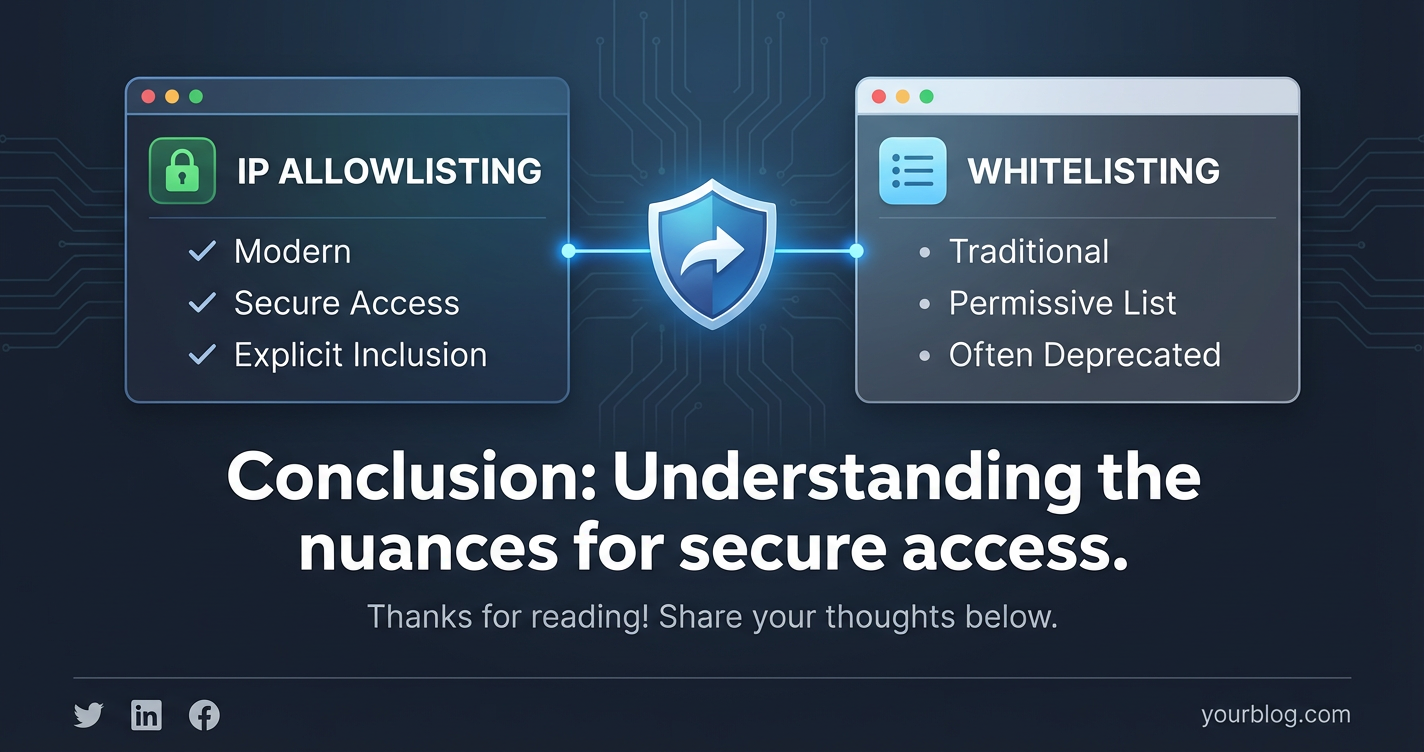
The discourse surrounding IP allowlisting versus IP whitelisting, while seemingly a subtle battle of semantics, underscores a deeper evolution in cybersecurity practices and the broader technology landscape. We have traversed the foundational principles of IP address filtering, delved into the traditional concept of whitelisting, embraced the modern terminology of allowlisting, and dissected their striking similarities and nuanced differences. Fundamentally, both terms describe the same powerful security strategy: creating an exclusive perimeter where only explicitly approved IP addresses are granted access, while all others are summarily denied. This "default-deny" posture remains one of the most effective methods for reducing the attack surface and significantly bolstering the security of critical digital assets.
The shift from "whitelisting" to "allowlisting" is more than just linguistic window dressing; it reflects a conscious effort within the tech community to adopt more inclusive, neutral, and precise language. While the mechanical implementation and the formidable security benefits remain identical, "allowlisting" stands as the preferred and modern term, aligning with contemporary best practices and a commitment to clear, unambiguous communication. Organizations and professionals are encouraged to adopt this terminology in new deployments, documentation, and discussions, fostering a more unified and progressive approach to security dialogue.
Throughout this exploration, the pivotal role of the API Gateway has been consistently highlighted. As the frontline enforcer of api security, the gateway serves as the ideal point for implementing and managing IP allowlists. By centralizing access controls, enabling granular policy application, and integrating with other crucial security features like authentication, authorization, and rate limiting, an API Gateway transforms theoretical security principles into practical, high-performance defense mechanisms. Platforms like ApiPark exemplify how an advanced gateway can seamlessly weave IP allowlisting into a comprehensive api management solution, protecting everything from conventional REST APIs to cutting-edge AI model invocations.
However, the journey of securing digital ecosystems is an ongoing one. While IP allowlisting provides an indispensable layer of defense, it is not a panacea. The dynamic nature of cloud environments, the complexities of microservices architectures, and the persistent threat of sophisticated attacks necessitate a multi-layered, adaptive security strategy. Future trends point towards the integration of IP-based controls into broader Zero Trust architectures, where identity and context take precedence, augmented by the intelligent insights of AI and machine learning for behavioral analysis.
In essence, whether you refer to it as whitelisting or allowlisting, the core principle of explicit permission remains a critical pillar of robust cybersecurity. By understanding its nuances, adhering to best practices, and strategically leveraging tools like an API Gateway, organizations can build resilient defenses that protect their valuable apis and services against the ever-evolving threat landscape, ensuring both security and operational integrity in the digital age.
Frequently Asked Questions (FAQs)
Q1: What is the fundamental difference between IP Whitelisting and IP Allowlisting?
A1: Fundamentally, there is no technical difference in their operational mechanism. Both IP whitelisting and IP allowlisting refer to a security strategy where only a predefined list of IP addresses or ranges is explicitly permitted to access a specific resource or service, while all other IP addresses are implicitly denied. The primary difference is semantic and terminological: "allowlisting" is the modern, preferred term that avoids potentially loaded connotations associated with "whitelisting" and "blacklisting," reflecting a move towards more inclusive and functional language in the tech industry.
Q2: Why is IP Allowlisting considered a crucial security measure for APIs and API Gateways?
A2: IP allowlisting is crucial for api and api gateway security because it provides an essential first layer of defense, significantly reducing the attack surface. By only allowing connections from known, trusted IP addresses, an api gateway can immediately filter out unauthorized access attempts, brute-force attacks, and reconnaissance from the vast majority of the internet. This proactive filtering prevents malicious traffic from even reaching the api's deeper authentication and authorization layers, conserving resources and enhancing overall system security.
Q3: What are the main challenges associated with implementing and maintaining IP Allowlists?
A3: The primary challenges include managing dynamic IP addresses in cloud environments (where IPs can change frequently due to scaling or ephemeral resources), the complexity of maintaining allowlists in microservices architectures for inter-service communication, the operational overhead of managing large lists for numerous partners or users, and the risk of false positives (blocking legitimate traffic) or false negatives (allowing unauthorized traffic due to outdated lists). These challenges often require automation, continuous monitoring, and careful integration with other security measures.
Q4: Can IP Allowlisting be a standalone security solution, or does it require other measures?
A4: IP allowlisting is a powerful and essential security layer, but it should never be considered a standalone solution. It is most effective when integrated into a comprehensive, layered security strategy. This includes strong authentication (e.g., multi-factor authentication, OAuth 2.0), robust authorization (Role-Based Access Control), encryption (TLS/SSL), rate limiting, and potentially Web Application Firewalls (WAFs). An API Gateway effectively orchestrates many of these layers, with allowlisting acting as the first line of defense.
Q5: How do modern API Gateway platforms, like APIPark, support IP Allowlisting?
A5: Modern api gateway platforms, such as ApiPark, provide robust features for implementing IP allowlisting. They act as centralized enforcement points, allowing administrators to define and apply granular IP allowlists to specific apis, routes, or consumer groups. These gateways efficiently process and enforce these rules, integrating them seamlessly with other security policies like authentication and rate limiting. They also offer detailed logging and monitoring capabilities, making it easy to audit access attempts and troubleshoot issues, thereby enhancing the security posture for all apis, including those that integrate AI models or encapsulate prompts into REST APIs.
🚀You can securely and efficiently call the OpenAI API on APIPark in just two steps:
Step 1: Deploy the APIPark AI gateway in 5 minutes.
APIPark is developed based on Golang, offering strong product performance and low development and maintenance costs. You can deploy APIPark with a single command line.
curl -sSO https://download.apipark.com/install/quick-start.sh; bash quick-start.sh

In my experience, you can see the successful deployment interface within 5 to 10 minutes. Then, you can log in to APIPark using your account.

Step 2: Call the OpenAI API.