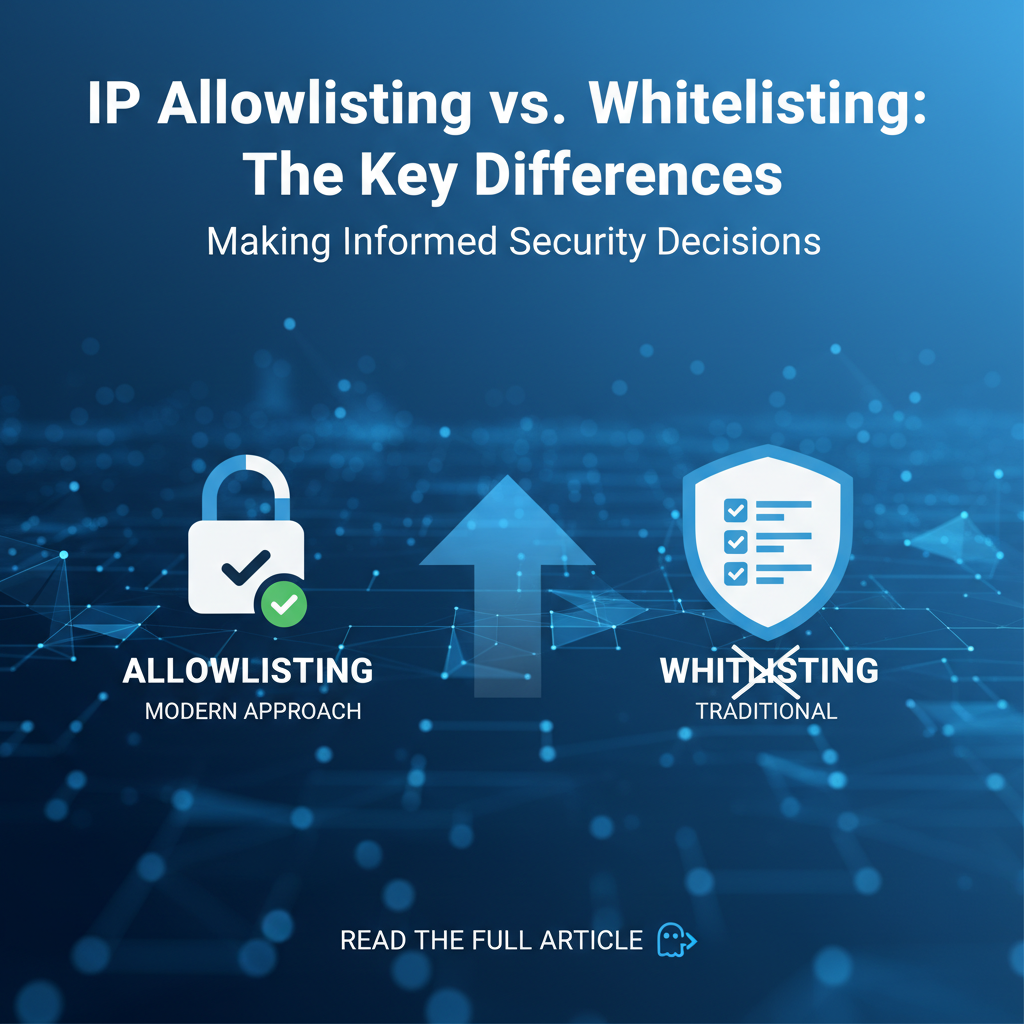
IP Allowlisting vs. Whitelisting: The Key Differences
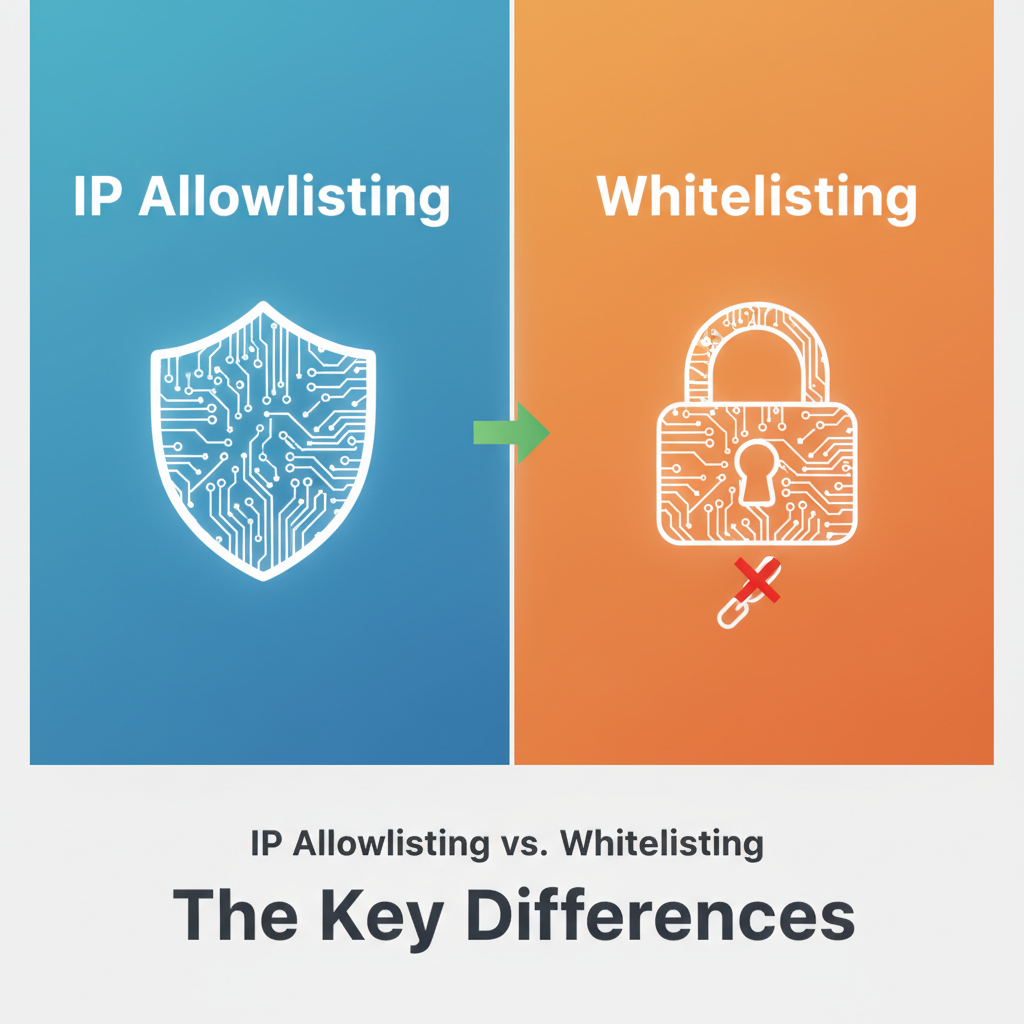


In the vast and interconnected landscape of modern computing, access control stands as a fundamental pillar of cybersecurity. From safeguarding sensitive corporate data to protecting individual privacy, the mechanisms by which we dictate who or what can interact with our digital assets are paramount. Among the myriad techniques employed to manage access, IP-based control has long been a foundational layer, offering a clear and often robust method of defining network perimeters. Historically, the terms "whitelisting" and "blacklisting" became entrenched in the lexicon of network security, referring to lists of explicitly permitted or denied entities, respectively. However, as technology evolves and societal understandings of language mature, so too does the terminology we employ. The emergence of "allowlisting" as a preferred alternative to "whitelisting" reflects a broader movement towards more neutral, precise, and inclusive language within technical discourse. While functionally, the actions these terms describe often remain identical – the creation of a definitive list of approved IP addresses – the shift in nomenclature carries significant implications for clarity, professional communication, and even the underlying philosophy of security.
This comprehensive exploration will delve into the nuances of IP-based access control, meticulously dissecting the concepts of "whitelisting" and "allowlisting." We will embark on a journey through their historical origins, technical definitions, practical applications across various technological strata, and the compelling reasons behind the industry's gradual adoption of "allowlisting." Furthermore, we will examine the critical role these mechanisms play in securing modern infrastructures, particularly within complex environments leveraging technologies such as api gateways, where precise control over api access is non-negotiable. By the end, readers will not only grasp the functional distinctions but also appreciate the broader context and importance of this terminological evolution in shaping the future of cybersecurity communication and practice. Understanding these differences is not merely an academic exercise; it is crucial for architects, developers, security professionals, and operations teams to implement robust, well-understood, and future-proof access control strategies.
Part 1: The Foundation of IP-Based Access Control
At the heart of IP-based access control lies the Internet Protocol (IP) address, a numerical label assigned to each device connected to a computer network that uses the Internet Protocol for communication. Just as a physical address directs mail to a specific location, an IP address guides data packets across the network to their intended destination. Understanding the nature and function of IP addresses is the first step in appreciating the power and limitations of IP-based access control.
What is an IP Address?
An IP address is essentially a unique identifier for a device on a network. There are two primary versions of IP addresses in use today:
- IPv4 (Internet Protocol version 4): This older standard uses 32-bit numbers, typically represented as four sets of numbers separated by dots (e.g.,
192.168.1.1). IPv4 addresses are finite, and their exhaustion spurred the development of IPv6. - IPv6 (Internet Protocol version 6): Designed to address the limitations of IPv4, IPv6 uses 128-bit numbers, represented by eight groups of four hexadecimal digits separated by colons (e.g.,
2001:0db8:85a3:0000:0000:8a2e:0370:7334). It provides an astronomically larger address space, accommodating the ever-growing number of internet-connected devices.
Beyond the version, IP addresses can also be categorized by their scope:
- Public IP Addresses: These are globally unique and routable on the internet. Your home router, your web server, and your cloud instances typically have public IP addresses that allow them to communicate with the broader internet.
- Private IP Addresses: These are non-routable on the internet and are used within private networks, such as your home or corporate LAN. Devices within these networks communicate with each other using private IPs, and a network address translation (NAT)
gatewayor router translates private IPs to a single public IP when communicating with the internet.
The static or dynamic nature of an IP address also plays a role in access control. Static IPs are fixed and rarely change, making them ideal for allowlisting critical services. Dynamic IPs, often assigned by DHCP servers, can change periodically, posing a challenge for persistent allowlisting unless handled carefully, often through VPNs or specific network configurations.
Why IP-Based Access Control?
The rationale behind implementing IP-based access control is multi-faceted, ranging from fundamental security posture to regulatory compliance:
- Layered Security Approach: IP-based access control acts as a crucial outer layer of defense, often preceding authentication and authorization mechanisms. It filters traffic at the network edge, reducing the load on deeper security systems and preventing unwanted traffic from even reaching internal applications. This "deny-by-default" approach inherently reduces the attack surface.
- Controlling Network Perimeter: By specifying which IP addresses are permitted to enter a network or access a specific resource, organizations can effectively define and fortify their digital perimeters. This is particularly vital for critical infrastructure, administrative interfaces, and highly sensitive data repositories.
- Limiting Attack Surface: Many cyberattacks, such as brute-force attempts, denial-of-service (DoS) attacks, and unauthorized reconnaissance, rely on probing accessible network endpoints. By restricting access to only known and trusted IP addresses, an organization drastically limits the pathways an attacker can exploit, making it significantly harder for malicious actors to even initiate an attack.
- Compliance Requirements: Numerous industry regulations and data protection standards mandate strict access control measures. For instance, PCI DSS (Payment Card Industry Data Security Standard) requires network segmentation and restricted access to systems processing cardholder data, where IP allowlisting can be a key control. Similarly, HIPAA (Health Insurance Portability and Accountability Act) and GDPR (General Data Protection Regulation) necessitate robust security to protect sensitive information, often including network-level access restrictions.
- Specific Use Cases:
- Restricting Administrative Access: Limiting SSH, RDP, or management panel access to a handful of known, secure IP addresses (e.g., from corporate offices or VPN
gateways) is a common and highly effective practice. - Secure Partner Integrations: When collaborating with external partners or vendors, IP allowlisting ensures that only their designated systems can connect to your specific integration points or
apis, adding a layer of trust and accountability. - Internal Service Segregation: Within a large organization, internal services might communicate over private networks. IP allowlisting can ensure that only specific internal applications or microservices can communicate with others, enforcing architectural boundaries and preventing lateral movement in case of a breach within the internal network.
- Restricting Administrative Access: Limiting SSH, RDP, or management panel access to a handful of known, secure IP addresses (e.g., from corporate offices or VPN
Fundamental Mechanisms: Firewalls and ACLs
IP-based access control is implemented through various network devices and software configurations, primarily relying on firewalls and Access Control Lists (ACLs):
- Firewalls: These are network security systems that monitor and control incoming and outgoing network traffic based on predetermined security rules. Firewalls can be hardware-based (dedicated appliances) or software-based (running on servers or operating systems). They inspect packet headers (including source and destination IP addresses) and apply rules to either permit or deny the traffic. A common firewall rule set operates on the principle of "deny all, except those explicitly allowed."
- Access Control Lists (ACLs): ACLs are lists of permissions attached to an object, such as a file, network port, or service. In networking, ACLs are configured on routers and switches to filter packets based on criteria like source IP, destination IP, port number, and protocol. An ACL essentially defines a set of rules that tell the device what traffic to allow and what to block.
These mechanisms are often deployed at critical junctures within a network architecture: at the network perimeter (edge firewalls), between network segments (internal firewalls, VLANs), or directly on host servers (host-based firewalls). Their configuration is the practical embodiment of IP-based access control policies.
Beyond IP: Contextualizing Access Control
While IP-based access control is undeniably powerful, it's crucial to understand that it is one component of a holistic security strategy. It operates primarily at the network and transport layers of the OSI model. However, many sophisticated access control mechanisms exist at higher layers, providing more granular and context-aware security:
- Multi-Factor Authentication (MFA): Requires users to present two or more verification factors to gain access, significantly bolstering user identity verification.
- Role-Based Access Control (RBAC): Assigns permissions to roles, and users are assigned to roles, simplifying management and ensuring users only have access to resources necessary for their job functions.
- Attribute-Based Access Control (ABAC): Provides highly granular access control based on attributes of the user, resource, and environment, allowing for dynamic and context-aware policy decisions.
- API Key and Token-Based Authentication: Essential for securing
apis, where clients present a unique key or token to authenticate their requests.
IP-based access control serves as an effective first line of defense, filtering out a large volume of unwanted traffic before it even reaches the application layer. It ensures that only traffic from expected locations or networks can even attempt to access a service. However, it should always be complemented by stronger, user-centric, and application-level security measures to create a truly robust defense-in-depth strategy.
Part 2: Understanding "Whitelisting"
For decades, the term "whitelisting" has been a standard part of the cybersecurity vernacular. It describes a security mechanism where only explicitly permitted entities are granted access, while everything else is automatically denied. To fully appreciate the shift towards "allowlisting," it is essential to delve into the historical context, technical definition, and practical implications of "whitelisting."
Historical Context and Origin
The term "whitelisting" (and its antithesis, "blacklisting") originated from a metaphorical use of color to denote approval or disapproval, permission or prohibition. Historically, "white lists" and "black lists" were used in various non-technical contexts, such as lists of approved suppliers, banned individuals, or excluded literary works. In computing, this metaphor was adopted to describe lists of accepted or rejected items.
The prevalence of "whitelisting" in cybersecurity began to solidify in the early days of networked computing when the internet was still nascent and threats were perhaps less sophisticated but still pervasive. The fundamental principle was simple: if an entity (be it an IP address, an email sender, or an application) was on the "white list," it was trusted and allowed; if not, it was treated as suspicious and blocked. This "deny-by-default, allow-by-exception" model was, and remains, a very strong security posture, as it minimizes the attack surface by only opening specific, controlled pathways.
Technical Definition
Technically, "whitelisting" refers to the process of creating and maintaining a list of items (e.g., IP addresses, email addresses, software applications, URLs) that are explicitly granted permission to perform a certain action or access a particular resource. Any item not present on this list is, by default, denied access or functionality.
Let's apply this to IP addresses:
- IP Whitelisting: This is a security measure where a network device (like a firewall or a server's access control configuration) is configured to permit connections or requests only from a predefined set of IP addresses. All other IP addresses attempting to connect are automatically blocked. This creates a highly restrictive and secure environment, assuming the list of allowed IPs is accurate and comprehensive. It's akin to having a private club where only members on a specific guest list are allowed entry; anyone not on that list, regardless of their intentions, is turned away at the door.
This model contrasts sharply with "blacklisting," where a list of known malicious or unwanted items is blocked, and everything else is allowed by default. While blacklisting can be useful for blocking specific, known threats, whitelisting offers a more proactive and inherently secure approach by operating on the principle of explicit trust rather than explicit distrust.
Common Use Cases
"Whitelisting" has found application in various domains within IT and cybersecurity:
- Email Whitelisting (Anti-Spam): Email servers often employ whitelisting to identify and allow emails from trusted senders, ensuring that legitimate communication isn't inadvertently blocked by aggressive spam filters. Companies might whitelist specific business partners' domains or IP addresses to guarantee delivery of critical correspondence.
- Application Whitelisting: This is a powerful endpoint security control where only approved applications are allowed to run on a computer or server. It prevents the execution of unauthorized software, including malware, unknown utilities, and potentially unwanted programs. This is particularly effective in environments requiring strict control over what software can be introduced and executed.
- Network Whitelisting (Specific IP Addresses): As our core topic, this is the most direct application. Organizations use IP whitelisting to:
- Secure Remote Access: Granting VPN
gatewayaccess or direct RDP/SSH access to servers only from specific office IP ranges or predefined administrative workstations. - Protect Critical Services: Ensuring that database servers, internal
apiendpoints, or sensitive administrative panels are only accessible from specific application servers or management subnets. - Cloud Security: Restricting access to cloud resources (e.g., S3 buckets, EC2 instances, Azure VMs) to specific IP addresses belonging to corporate networks or authorized cloud services.
- Secure Remote Access: Granting VPN
Benefits
The "whitelisting" approach offers several compelling benefits, which are largely inherited by "allowlisting":
- Strong Security Posture (Deny-by-Default): This is the paramount advantage. By default, everything is denied. This dramatically reduces the attack surface, as attackers have a much smaller (ideally non-existent) window of opportunity to exploit unknown vulnerabilities or misconfigurations. It shifts the burden from constantly identifying and blocking new threats to explicitly trusting only known entities.
- Simplicity in Management for Small, Static Environments: In environments where the set of trusted entities is small and changes infrequently, whitelisting is relatively straightforward to manage. A short, static list is easy to review, update, and maintain.
- Reduced Attack Surface: Malicious traffic, including scanning attempts, botnet activity, and attempts to exploit common vulnerabilities, is blocked at the perimeter, never reaching the actual application or service. This conserves resources and reduces the "noise" that security teams need to sift through.
- Enhanced Compliance: As mentioned, many regulatory frameworks appreciate or mandate the principle of least privilege, which whitelisting directly supports by restricting access to the bare minimum required.
Drawbacks
Despite its robust security benefits, "whitelisting" is not without its challenges and limitations:
- Potential for Misinterpretation or Negative Connotations: This is the primary driver for the shift to "allowlisting." The use of "white" and "black" in a security context, while seemingly innocuous to many, carries historical and sociological baggage tied to racial discrimination. In an increasingly global and inclusive industry, such terminology is viewed as insensitive and outdated. While the technical function remains effective, the language itself can be problematic.
- Maintenance Overhead in Dynamic Environments: This is a significant practical challenge. If the list of approved IPs changes frequently (e.g., dynamic IP addresses for remote workers, new cloud instances, evolving partner networks), maintaining an accurate whitelist can become an administrative nightmare. Each change requires a manual update, increasing the risk of misconfigurations, service disruptions (if a legitimate IP is accidentally blocked), or security gaps (if an old, insecure IP remains whitelisted).
- Rigidity: Whitelisting is inherently rigid. Any new legitimate access requires an explicit addition to the list. This can slow down development cycles, deployment processes, or incident response if new connections are needed urgently.
- Not Foolproof: While strong, whitelisting is not impenetrable:
- IP Spoofing: Attackers can attempt to forge their IP address to appear as a legitimate, whitelisted source. However, network infrastructure typically makes direct IP spoofing across the internet difficult for TCP connections (which require a handshake), but it can be a concern within certain network segments or for UDP-based attacks.
- Shared IPs: In cloud environments or behind NAT devices, multiple legitimate users might share a single public IP. Whitelisting that IP could inadvertently
allowaccess to all users originating from that shared IP, including potentially unauthorized ones. This dilutes the granularity of control. - Compromised Whitelisted Source: If a whitelisted IP address (e.g., a corporate workstation) is itself compromised, an attacker can leverage that trusted source to launch attacks from within the allowed perimeter. This underscores the need for multi-layered security beyond just IP filtering.
Sociological/Linguistic Considerations
The shift away from "black/white" terminology in tech is not arbitrary; it's part of a broader industry-wide movement towards more inclusive and precise language. Terms like "master/slave," "blacklist/whitelist," and "redline" have been re-evaluated due to their potential to evoke historical injustices or carry unintended negative connotations. For example, "master/slave" is being replaced by "primary/replica" or "leader/follower." Similarly, "blacklist" is often replaced by "denylist," and "whitelist" by "allowlist" or "safelist."
This evolution reflects a conscious effort to remove potentially exclusionary language from technical documentation, codebases, and everyday communication, fostering an environment that is welcoming to all professionals, regardless of background. While the technical function remains the same, the choice of words signals a commitment to diversity and a more thoughtful approach to linguistic precision. This is not about political correctness for its own sake, but about fostering clear, unambiguous, and respectful communication in a global industry.
Part 3: Embracing "Allowlisting"
In response to the linguistic and practical considerations associated with "whitelisting," the term "allowlisting" has gained significant traction, becoming the preferred nomenclature within many leading technology organizations and industry standards bodies. While functionally identical to its predecessor, "allowlisting" represents a crucial evolution in how we communicate about fundamental security practices.
The Evolution of Terminology
The impetus for adopting "allowlisting" stems from a growing awareness of the impact of language, particularly in a globalized and diverse industry. Technical terminology, often inherited from informal origins or older practices, can sometimes carry unintended cultural or social baggage. The "white/black" dichotomy, when used to denote good/bad or allowed/forbidden, has unfortunately been associated with racial bias and discrimination in broader societal contexts. While the original intent in computing was purely descriptive of list types, the potential for misinterpretation and the implicit reinforcement of harmful stereotypes led many organizations to advocate for a change.
This movement is part of a larger trend to refine technical vocabulary for greater clarity, neutrality, and inclusivity. The goal is to ensure that our professional language is precise, accessible, and respectful, avoiding terms that could inadvertently alienate or discomfort any member of the global tech community. The adoption of "allowlisting" aligns with this principle by using a term that is functionally descriptive without relying on potentially problematic color-based metaphors.
Technical Definition
Functionally, IP Allowlisting is indistinguishable from IP whitelisting. It is a security mechanism where access to a network resource (such as a server, service, api, or port) is granted exclusively to a predefined, finite list of IP addresses. All other IP addresses attempting to connect or interact with that resource are explicitly denied.
The core principle remains "deny-by-default, allow-by-exception." The allowlist serves as an explicit manifesto of trusted sources, and any source not appearing on this list is automatically treated as untrusted and blocked.
Let's reiterate with an example:
- If an organization sets up an
IP allowlistfor its administrativegateway, only the IP addresses of the authorized network operations center, specific administrator workstations, or secure VPN endpoints will be permitted to connect to thatgateway. Any attempt to connect from an IP address not on this specific list will be rejected outright by thegateway's firewall or access control policies.
The technical implementation, whether through firewall rules, server configurations, or api gateway policies, behaves exactly the same way as if the term "whitelisting" were used. The effectiveness and underlying logic of the security control are preserved entirely.
Key Differentiator: The Terminology Itself
The primary, and indeed most significant, differentiator between "whitelisting" and "allowlisting" is purely linguistic.
- "Whitelisting": Employs a color metaphor ("white" for allowed) which, while common, has come under scrutiny for its potential association with insensitive historical contexts. It is less directly descriptive of the action itself.
- "Allowlisting": Uses a verb ("allow") that directly describes the action being taken – permitting access. This makes the term immediately clear, functionally descriptive, and inherently neutral. It avoids any potentially problematic cultural or historical connotations.
This distinction might seem minor to some, but in a field where precision and clarity are paramount, and in an industry striving for greater inclusivity, the choice of words carries weight. It fosters better communication by removing ambiguity and preventing potential misunderstandings or discomfort arising from linguistic choices.
Advantages of "Allowlisting" as a Term
Embracing "allowlisting" as the standard term offers several advantages:
- Clear, Unambiguous Meaning: The word "allow" directly conveys permission. There is no need for cultural context or metaphorical understanding; it precisely describes the security action being performed. This improves clarity in documentation, code comments, and verbal communication.
- Neutral, Non-Discriminatory Language: By moving away from color-based terminology, "allowlisting" contributes to a more inclusive environment in tech. It removes potential associations that could be perceived as insensitive or exclusive, making the industry more welcoming to individuals from diverse backgrounds.
- Promotes Better Understanding and Communication: When security concepts are described with clear, functional language, they are easier to grasp, teach, and implement consistently. This reduces the cognitive load and potential for misinterpretation, particularly for new entrants to the field or non-technical stakeholders.
- Modern Industry Standard: Major tech companies, open-source projects, and standards bodies (e.g., NIST, major cloud providers) are increasingly adopting "allowlist" and "denylist" as their standard terminology. Adhering to this evolving standard helps align organizations with contemporary best practices and facilitates interoperability and shared understanding across the industry.
Practical Implications of the Terminology Shift
While the functional aspect of IP access control remains unchanged, the shift in terminology does have practical implications for organizations:
- Documentation Updates: All existing security policies, architectural diagrams, operational runbooks, and user guides should be reviewed and updated to consistently use "allowlist" and "denylist." This ensures that internal and external communication reflects current best practices.
- Codebase Refactoring: For developers, this might involve renaming variables, function names, or configuration parameters from
whitelist_ipstoallowlist_ips. While a purely aesthetic change for the code's function, it signals adherence to modern linguistic standards and improves code readability for those accustomed to the new terms. - Communication with Stakeholders: Security teams and operations personnel should consciously adopt the new terminology in their daily conversations, presentations, and incident reports. This helps embed the new language within the organizational culture.
- Training and Education: New employees and existing staff may need brief training or awareness sessions to explain the terminology shift and reinforce its importance.
Specific Use Cases for IP Allowlisting
The practical applications for IP allowlisting are broad and critical across various IT infrastructures:
- Securing Administrative Interfaces: This is perhaps the most common and vital use case. Access to highly privileged interfaces like SSH for servers, RDP for Windows machines, database administration portals, or cloud console logins should be strictly allowlisted. Only specific, pre-approved administrator workstations or secure VPN
gatewayIPs should ever be permitted to connect. This significantly reduces the risk of remote brute-force attacks or unauthorized access to the most sensitive control planes. - Protecting Database Access: Database servers, which often hold an organization's most valuable data, should typically not be directly exposed to the public internet. Instead, they should be accessible only from specific application servers, reporting tools, or internal management subnets via IP allowlisting, often enforced at the database's native access control layer or via network firewalls.
- Restricting Access to Internal Microservices: In microservice architectures, services often communicate with each other over internal networks. IP allowlisting, coupled with service mesh technologies, can ensure that only authorized microservices can call specific endpoints of other services, enforcing service boundaries and preventing unauthorized lateral movement if one service is compromised.
- Securing
APIs through anAPI Gateway: This is a particularly crucial application in modern, distributed systems. Anapi gatewayacts as a single entry point for allapirequests, sitting in front of backend services. It is an ideal location to enforce IP allowlisting. By configuring theapi gatewaytoallowrequests only from specific client IP ranges (e.g., known partner applications, mobile app backend servers, or specific web domains), organizations can add a powerful layer of defense to theirapis. Theapi gatewayinspects the source IP of every incoming request and denies any that are not on theallowlist, protecting the backend services from unwanted external traffic.
For organizations managing a multitude of APIs, especially those leveraging AI models, an advanced api gateway like ApiPark becomes indispensable. APIPark, an open-source AI gateway and API management platform, offers robust features including end-to-end API lifecycle management and granular access control, allowing for the precise implementation of IP allowlisting to secure API endpoints effectively. With APIPark, businesses can configure specific IP access policies directly within the gateway for their various APIs, ensuring that only trusted sources can invoke critical services, while also benefiting from features like quick integration of 100+ AI models, unified API invocation formats, and powerful data analysis. Its ability to manage traffic forwarding, load balancing, and versioning, combined with strong security features like subscription approval and detailed call logging, makes it a comprehensive solution for modern api gateway security, embodying the principles of controlled access through allowlisting.
The move to "allowlisting" is not just a change in jargon; it's a reflection of a maturing industry's commitment to precision, clarity, and inclusivity in its core communication. While the underlying security mechanism remains functionally identical to its "whitelisting" counterpart, the adoption of "allowlisting" signifies a more thoughtful and forward-looking approach to technical terminology.
APIPark is a high-performance AI gateway that allows you to securely access the most comprehensive LLM APIs globally on the APIPark platform, including OpenAI, Anthropic, Mistral, Llama2, Google Gemini, and more.Try APIPark now! 👇👇👇
Part 4: Implementation and Best Practices
Implementing IP allowlisting effectively requires a clear understanding of where to deploy these controls, how to design the strategy, and what challenges to anticipate. It's a foundational security measure that, when properly executed, can significantly enhance an organization's defensive posture.
Where to Implement IP Allowlisting
IP allowlisting can be enforced at various layers of the network and application stack, offering flexibility and redundancy in security controls:
- Firewalls (Network Level):
- Perimeter Firewalls: These are typically hardware appliances or robust software solutions placed at the edge of the corporate network, between the internal network and the internet. They are the first line of defense, filtering all incoming and outgoing traffic. Implementing IP allowlisting at this level ensures that only traffic from approved external IP addresses can even reach the internal network, protecting all internal assets behind the firewall. This is ideal for broad network access control.
- Internal Firewalls: Within larger networks, firewalls or advanced routing devices are used to segment the network into different security zones (e.g., DMZ, production, development, administrative). IP allowlisting here can control traffic flow between these zones, ensuring that, for example, only specific application servers in the production zone can access a database server in a separate database zone. This prevents lateral movement in case one segment is compromised.
- Operating System Level:
- Host-Based Firewalls: Modern operating systems (like Linux with
iptablesorfirewalld, and Windows with Windows Defender Firewall) include built-in firewalls. These can be configured to allow or deny connections to specific ports and services directly on the host machine. This provides a granular, machine-specific layer of defense, even if perimeter firewalls are bypassed or misconfigured. For instance, aniptablesrule could explicitlyallowSSH connections only from a single management server's IP. This is crucial for hardening individual servers, especially those exposed to public networks.
- Host-Based Firewalls: Modern operating systems (like Linux with
- Application Level:
- Web Servers (Nginx, Apache): Popular web servers can be configured to restrict access based on client IP addresses. For example, an Nginx configuration can have an
allowdirective for specific IPs or CIDR blocks and adenyall directive, effectively creating an IP allowlist for webapis or administrative interfaces exposed via HTTP/S. This is useful for protecting specific web applications or virtual hosts without affecting other services on the same server. - Custom Application Logic: Applications themselves can incorporate logic to check the source IP address of incoming requests and deny access if the IP is not on an internal allowlist. While generally less efficient than network or OS-level filtering, this can be useful for very specific, application-aware access control or when other layers are not sufficient. It offers the most granular control, allowing context-dependent decisions.
- Web Servers (Nginx, Apache): Popular web servers can be configured to restrict access based on client IP addresses. For example, an Nginx configuration can have an
API GatewayLevel:- Centralized
APIAccess Control: Theapi gatewayis a critically importantgatewayfor modern architectures. As discussed, it sits in front of all backendapis, acting as a single choke point for all inboundapitraffic. This makes it an ideal location for implementing IP allowlisting. Anapi gatewaycan inspect the source IP of every incomingapirequest and enforce policies to eitherallowordenythe request based on a predefined IPallowlist. This ensures that only authorized client applications, partner systems, or specific network segments can interact with yourapis. - Benefits at the
API Gateway: Implementing IP allowlisting at theapi gatewayprovides several advantages:- Decoupling:
APIdevelopers don't need to embed IP filtering logic into their backend services. Thegatewayhandles it centrally. - Consistency: Ensures uniform IP access policies across all
apis managed by thegateway. - Performance: Offloads IP filtering from backend services, which can focus on business logic. Many
api gateways are optimized for high-performance traffic routing and policy enforcement. - Security for Microservices: In a microservices environment, the
api gatewayprovides a critical perimeter, protecting individual services that might otherwise have internal-only access and minimal external-facing security.
- Decoupling:
- Centralized
Designing an Effective IP Allowlist Strategy
A robust IP allowlist strategy extends beyond simply listing IPs; it involves thoughtful design, ongoing maintenance, and integration with other security measures.
- Principle of Least Privilege: This is the golden rule of security. An IP allowlist should always adhere to this principle, granting only the absolute minimum necessary access. If an application only needs to communicate with a database on port 3306, the allowlist should restrict access to that specific port from only the necessary source IPs, not open all ports from a broad range.
- Regular Reviews and Audits: IP allowlists are not set-it-and-forget-it configurations. They must be regularly reviewed, ideally on a quarterly or bi-annual basis, or whenever there are significant architectural changes. This ensures that old, no-longer-needed entries are removed (reducing the attack surface) and new legitimate entries are added. Audits should verify that the allowlist aligns with current business needs and security policies.
- Documentation and Change Management: Every entry in an IP allowlist should be documented, explaining its purpose, the service it grants access to, the responsible team, and the approval date. All changes to the allowlist must go through a formal change management process, requiring approval and logging. This prevents unauthorized modifications and provides an audit trail for compliance and troubleshooting.
- Handling Dynamic IPs (VPNs, Fixed IPs for Trusted Partners):
- For Remote Users: Directly allowlisting individual dynamic home IPs is impractical. Instead, require remote users to connect via a corporate VPN, and then allowlist the VPN
gateway's static external IP address. This consolidates access through a controlled, encrypted tunnel. - For Partners: Encourage partners to use static IP addresses for their integration points. If this is not possible, work with them to use specific, managed cloud
gatewayIPs or virtual networks that can be allowlisted. For highly dynamic scenarios, consider alternative authentication methods (e.g., API keys, OAuth) in addition to or instead of IP allowlisting.
- For Remote Users: Directly allowlisting individual dynamic home IPs is impractical. Instead, require remote users to connect via a corporate VPN, and then allowlist the VPN
- Combining with Other Security Measures (MFA, Strong Authentication): IP allowlisting is a layer, not the entire solution. It should always be complemented by:
- Multi-Factor Authentication (MFA): For user logins, MFA adds a critical layer of identity verification.
- Strong Authentication and Authorization: For
apis and services, robust authentication (API keys, OAuth tokens, client certificates) and fine-grained authorization (RBAC, ABAC) are essential. Even if an IP is allowed, the user or service behind it still needs to prove its identity and permissions. - Encryption (TLS/SSL): All allowed connections, especially those over public networks, must be encrypted using TLS/SSL to protect data in transit.
- Geo-blocking vs. IP Allowlisting: While related, these are distinct. Geo-blocking denies access based on geographical location (country, region), often by mapping IP ranges to locations. IP allowlisting specifically permits access from individual IPs or very narrow ranges. Geo-blocking can be a useful additional layer (e.g., block all traffic from countries where you don't do business), but it is not a replacement for the surgical precision of IP allowlisting for critical assets.
Challenges and Considerations
Implementing and maintaining IP allowlisting comes with its own set of challenges that need to be carefully considered:
- IP Spoofing: While direct IP spoofing for TCP connections across the internet is difficult due to the handshake requirement, it's not impossible, especially in specific network configurations or for certain types of attacks (like UDP floods). Therefore, IP allowlisting should never be the sole authentication or authorization mechanism. It's a filter, not an identity verifier.
- Shared IP Addresses: In modern cloud environments or behind large corporate NAT
gateways, many users or services might originate from the same public IP address. Allowlisting such a shared IP grants access to everyone behind that IP. This dramatically reduces the granularity of control and can introduce significant security risks if some users behind that IP are untrusted. Solutions often involve using VPNs to assign unique virtual IPs or relying more heavily on application-level authentication. - Maintenance Burden in Large, Dynamic Environments: This is arguably the biggest practical challenge. In organizations with hundreds or thousands of services, constantly changing cloud infrastructure (auto-scaling, ephemeral containers), and numerous remote workers, managing IP allowlists can become extremely complex and error-prone. Manual processes scale poorly and are a source of security vulnerabilities (outdated entries) or operational downtime (legitimate IPs mistakenly blocked). Automation through Infrastructure as Code (IaC) and integration with CI/CD pipelines can mitigate this.
- Balancing Security with Usability: Overly restrictive allowlists can impede legitimate operations, slow down developers, or block critical business processes. Finding the right balance between stringent security and operational fluidity is crucial. A "too secure" system that impedes work will often be bypassed, creating shadow IT and greater risks.
- False Positives/Negatives: A false positive occurs when a legitimate IP is accidentally blocked, causing service disruption. A false negative occurs when an attacker's IP is mistakenly allowlisted, leading to a breach. Both are consequences of misconfiguration or poor maintenance and highlight the need for rigorous testing and change management.
- DNS Resolution Changes: If an allowlist relies on DNS hostnames that resolve to IP addresses, changes in DNS records (e.g., a service moving to a new cloud instance with a different IP) can silently break the allowlist. It's generally safer to allowlist specific IP addresses or CIDR blocks directly, rather than relying solely on DNS lookups which can introduce dynamic instability.
Effective IP allowlisting is a cornerstone of network security, particularly when applied at key control points like api gateways. However, its implementation demands careful planning, continuous oversight, and integration into a broader, multi-layered security framework to address its inherent challenges and ensure its long-term efficacy.
Part 5: Advanced Scenarios and the Future
As technology evolves at an unprecedented pace, the methods and contexts for implementing access control, including IP allowlisting, are also adapting. The rise of cloud-native architectures, Software-Defined Networking (SDN), and the overarching philosophy of Zero Trust are shaping the future of how we manage network access.
Dynamic IP Allowlisting
Traditional IP allowlisting often relies on static configurations, which can be cumbersome in dynamic environments. Dynamic IP allowlisting seeks to automate the management of trusted IP lists:
- Integration with Identity Providers (IdPs): For remote access, instead of allowlisting a fixed VPN
gatewayIP, solutions can integrate with IdPs. When a user authenticates successfully (perhaps with MFA), their current public IP address can be temporarily added to an allowlist for a specific resource or a limited time. This "just-in-time" access significantly enhances security by minimizing the window of opportunity for an attacker to leverage a whitelisted IP. - Ephemeral Cloud Resources: In cloud environments, services often scale up and down, assigning new IP addresses to instances or containers. Automated systems can monitor these changes and dynamically update security
gatewayconfigurations orapi gatewayrules to ensure that newly provisioned, authorized services can communicate, while deprovisioned resources are promptly removed from the allowlist. This requires tight integration with cloud provider APIs and orchestration tools. - Security Orchestration, Automation, and Response (SOAR): SOAR platforms can automate responses to security incidents. If a trusted IP is detected exhibiting suspicious behavior, SOAR can automatically remove it from allowlists (or add it to denylists) across various security controls, providing rapid remediation.
Software-Defined Networking (SDN) and Microsegmentation
SDN decouples the network control plane from the data plane, allowing network behavior to be programmatically managed. This paradigm fundamentally changes how access control policies, including IP allowlisting, are implemented:
- Centralized Policy Management: In SDN, policies are defined centrally and pushed out to distributed network devices. This greatly simplifies the management of allowlists across a complex network, ensuring consistency and reducing configuration errors that plague traditional, device-by-device configurations.
- Microsegmentation: SDN enables microsegmentation, which takes network segmentation to an extremely granular level. Instead of broad network zones, microsegmentation allows each individual workload (e.g., a virtual machine, a container, or even an application process) to have its own security perimeter. With microsegmentation, IP allowlisting can be applied precisely at the workload level, defining exactly which other workloads or external IPs can communicate with it. For example, a single microservice
apimight only be allowed to receive requests from theapi gatewayand communicate with a specific database service, and nothing else. This severely limits lateral movement for attackers, making it extremely difficult for a breach in one service to spread to others.
Zero Trust Architecture
The Zero Trust security model operates on the principle of "never trust, always verify." It assumes that no user or device, whether inside or outside the network perimeter, should be implicitly trusted. IP allowlisting fits within a Zero Trust framework as one of many verification factors, but it's not the sole determinant of trust:
- Reduced Implicit Trust: In Zero Trust, simply originating from an allowlisted IP address is not enough to grant access. Every request, from every source, must be authenticated and authorized. This often involves strong user identity verification, device posture checks, and granular
apiauthorization. - Contextual Access Decisions: Zero Trust environments leverage dynamic policy engines that consider multiple attributes (user identity, device health, location, time of day, data sensitivity) to make real-time access decisions. An IP allowlist might be a baseline check, but access could still be denied if other contextual factors indicate risk (e.g., the user's device is not compliant, or the request comes from an unusual location for that user).
- Fine-Grained Segmentation: Zero Trust heavily relies on microsegmentation to limit the blast radius of any potential breach. IP allowlisting within microsegments contributes to this by ensuring that communication between services is restricted to only explicitly permitted and verified pathways.
Cloud-Native Environments
Cloud-native architectures, with their emphasis on ephemeral resources, serverless functions, and containerized applications, present unique challenges and opportunities for IP allowlisting:
- Ephemeral IPs: In serverless (e.g., AWS Lambda, Azure Functions) or containerized (e.g., Kubernetes pods) environments, resources are often short-lived and assigned dynamic IP addresses. Directly allowlisting these individual IPs is impractical. Solutions involve:
- Cloud Service Endpoints/Private Links: Using private endpoints or service link technologies provided by cloud vendors to ensure that traffic between cloud services stays within the cloud's private network, eliminating the need to allowlist public IPs.
- Security Groups/Network Security Groups (NSGs): Cloud-native firewalls (like AWS Security Groups or Azure NSGs) can apply rules directly to instances, containers, or functions. These can often be defined using other security group IDs or service tags rather than explicit IP addresses, allowing for dynamic, service-to-service allowlisting.
API Gatewayfor Serverless: Anapi gatewayoften sits in front of serverless functions. IP allowlisting at theapi gatewayprotects the serverless backend, abstracting away the dynamic IPs of the functions themselves.
- Container Networking: In Kubernetes, network policies can define how pods communicate with each other and with external services. These policies can enforce IP allowlisting based on pod labels, namespaces, or specific IP ranges, providing granular control within the container orchestration platform.
Threat Intelligence Integration
While IP allowlisting focuses on explicitly trusted sources, its complement, IP denylisting (the modern term for blacklisting), benefits greatly from threat intelligence.
- Automated Denylist Updates: Integrating with threat intelligence feeds allows organizations to automatically update their denylists with known malicious IP addresses, command-and-control servers, or sources of brute-force attacks. This proactive approach helps block a significant volume of general malicious traffic without manual intervention.
- Complementary Security: Threat intelligence for denylists works in tandem with allowlists. The allowlist handles the explicit "who is allowed," while the denylist filters out known bad actors that might not even be attempting to reach an allowlisted service but are generally malicious. This multi-faceted approach enhances overall network hygiene.
The future of IP allowlisting is not about its obsolescence, but its evolution. It will continue to be a fundamental building block of network security, but its implementation will become more automated, more dynamic, and more integrated into sophisticated security architectures like Zero Trust and cloud-native platforms. The underlying principle of explicit permission will endure, adapting to the complexities of new computing paradigms while ensuring clarity and precision in its terminology.
Comparison: Whitelisting vs. Allowlisting (in Practice)
While functionally identical, the shift from "whitelisting" to "allowlisting" reflects an important evolution in technical communication and industry standards. The following table summarizes their key aspects:
| Feature/Aspect | Whitelisting (Traditional Term) | Allowlisting (Modern Term) |
|---|---|---|
| Core Concept | Explicitly permitted entities; all others denied by default. | Explicitly permitted entities; all others denied by default. |
| Terminology | Historically common; uses color metaphor (white/black). | Modern, inclusive; uses functional verb (allow/deny). |
| Connotation | Can carry unintended negative associations (racial/social). | Neutral, descriptive, professionally preferred. |
| Primary Goal | Restrict access to only known, trusted sources. | Restrict access to only known, trusted sources. |
| Implementation | Firewalls, ACLs, Operating System firewalls, API gateway policies, application logic. |
Firewalls, ACLs, Operating System firewalls, API gateway policies, application logic. |
| Industry Trend | Phasing out in favor of more neutral terms. | Increasingly adopted as the standard for clarity and inclusivity. |
| Effectiveness | Highly effective as a security control when implemented correctly and maintained diligently. | Highly effective as a security control when implemented correctly and maintained diligently. |
| Maintenance | Requires regular updates for dynamic environments; can be high administrative overhead. | Requires regular updates for dynamic environments; benefits from automation. |
| Communication | Potentially less clear or culturally sensitive for diverse audiences. | Clear, unambiguous, and globally respectful for technical and non-technical audiences. |
Conclusion
The discourse surrounding "IP Allowlisting vs. Whitelisting" is more than just a debate over semantics; it represents a tangible shift in the technology industry's approach to language, reflecting a broader commitment to clarity, precision, and inclusivity. While the underlying security mechanism—the creation of a definitive list of explicitly permitted IP addresses—remains functionally identical, the adoption of "allowlisting" as the preferred term marks a significant and positive evolution. It sheds the potentially problematic connotations of color-based metaphors, opting instead for a term that is directly descriptive of the action being taken: allowing access.
IP-based access control, whether termed whitelisting or allowlisting, remains an indispensable and foundational layer in any robust cybersecurity architecture. Its "deny-by-default" principle is inherently powerful, offering a robust first line of defense that significantly reduces the attack surface and helps enforce the principle of least privilege. From perimeter firewalls and host-based security to application-level controls and, critically, api gateways, IP allowlisting acts as a central mechanism for ensuring that only trusted entities can interact with valuable digital assets. Products like ApiPark exemplify how modern api gateways integrate sophisticated access control, including IP allowlisting, to secure complex api ecosystems, especially those leveraging advanced AI models.
However, it is crucial to reiterate that IP allowlisting, while potent, is not a silver bullet. Its effectiveness is maximized when it is part of a broader, multi-layered security strategy—a true defense-in-depth approach. It must be complemented by strong authentication (including multi-factor authentication), granular authorization, encryption, regular security audits, and robust change management processes. The challenges of managing dynamic IP addresses, mitigating IP spoofing, and overcoming the maintenance burden in ever-evolving, cloud-native environments necessitate a continuous focus on automation, integration with Zero Trust principles, and leveraging advanced networking paradigms like microsegmentation.
Ultimately, the embrace of "allowlisting" is a testament to an industry maturing not only in its technological capabilities but also in its communication. By adopting clear, unambiguous, and inclusive language, we foster better understanding, promote professional respect, and lay a stronger foundation for the collaborative development of secure and resilient digital infrastructures. The future of network security will undoubtedly continue to evolve, but the core principle of explicitly allowing trusted connections, articulated through the clear language of allowlisting, will remain a critical cornerstone.
5 FAQs
1. What is the fundamental difference between IP Whitelisting and IP Allowlisting? Functionally, there is no difference; both terms refer to the security practice of explicitly listing IP addresses that are permitted to access a resource, while all other IP addresses are denied access by default. The primary difference is linguistic: "whitelisting" uses a color-based metaphor, which has come to be seen as outdated and potentially insensitive in some contexts, while "allowlisting" uses a functional verb ("allow") that is clearer, more neutral, and professionally descriptive, aligning with modern industry standards for inclusive terminology.
2. Why is "Allowlisting" becoming the preferred term over "Whitelisting"? The shift to "allowlisting" is driven by a desire for clearer, more precise, and more inclusive language in the technology sector. The term "whitelist" can carry unintended negative social or racial connotations for some. "Allowlist" directly communicates the action of permitting access without relying on potentially problematic metaphors, thus fostering better communication and a more welcoming environment in a globally diverse industry.
3. Is IP Allowlisting sufficient as a standalone security measure? No, IP allowlisting is a foundational and highly effective layer of defense, but it is not sufficient as a standalone security measure. It should always be part of a multi-layered, "defense-in-depth" security strategy. While it restricts access to known IPs, it doesn't verify the identity of the user or service behind that IP, nor does it protect against threats originating from a compromised allowlisted source. It must be complemented by strong authentication (e.g., MFA, API keys), authorization (RBAC, ABAC), encryption (TLS), and other security controls.
4. How does an API gateway utilize IP Allowlisting? An API gateway acts as a central entry point for all API requests, sitting in front of backend services. It is an ideal place to enforce IP allowlisting by inspecting the source IP address of every incoming API request. If the source IP is not on the allowlist configured in the API gateway, the request is denied before it ever reaches the backend APIs. This provides a crucial layer of security, protecting APIs from unauthorized access and reducing the load on backend services from unwanted traffic, ensuring that only trusted client applications or partner systems can interact with the APIs.
5. What are some common challenges when implementing IP Allowlisting? Common challenges include: * Maintenance Burden: In dynamic environments (e.g., cloud auto-scaling, remote workers with dynamic IPs), keeping the allowlist updated can be administratively complex and prone to errors, potentially causing legitimate access to be blocked or insecure entries to persist. * Shared IP Addresses: Many users or services might share a single public IP, especially in cloud environments or behind NAT, making granular control difficult if that IP is allowlisted. * IP Spoofing: While harder for TCP, attackers can attempt to spoof IP addresses, underscoring the need for additional authentication. * Balancing Security and Usability: Overly restrictive allowlists can impede legitimate operations and lead to frustration or workarounds that undermine security. * Lack of Automation: Manual management scales poorly, leading to inefficiencies and increased risk.
🚀You can securely and efficiently call the OpenAI API on APIPark in just two steps:
Step 1: Deploy the APIPark AI gateway in 5 minutes.
APIPark is developed based on Golang, offering strong product performance and low development and maintenance costs. You can deploy APIPark with a single command line.
curl -sSO https://download.apipark.com/install/quick-start.sh; bash quick-start.sh

In my experience, you can see the successful deployment interface within 5 to 10 minutes. Then, you can log in to APIPark using your account.

Step 2: Call the OpenAI API.