IP Allowlisting vs Whitelisting: What's the Difference?


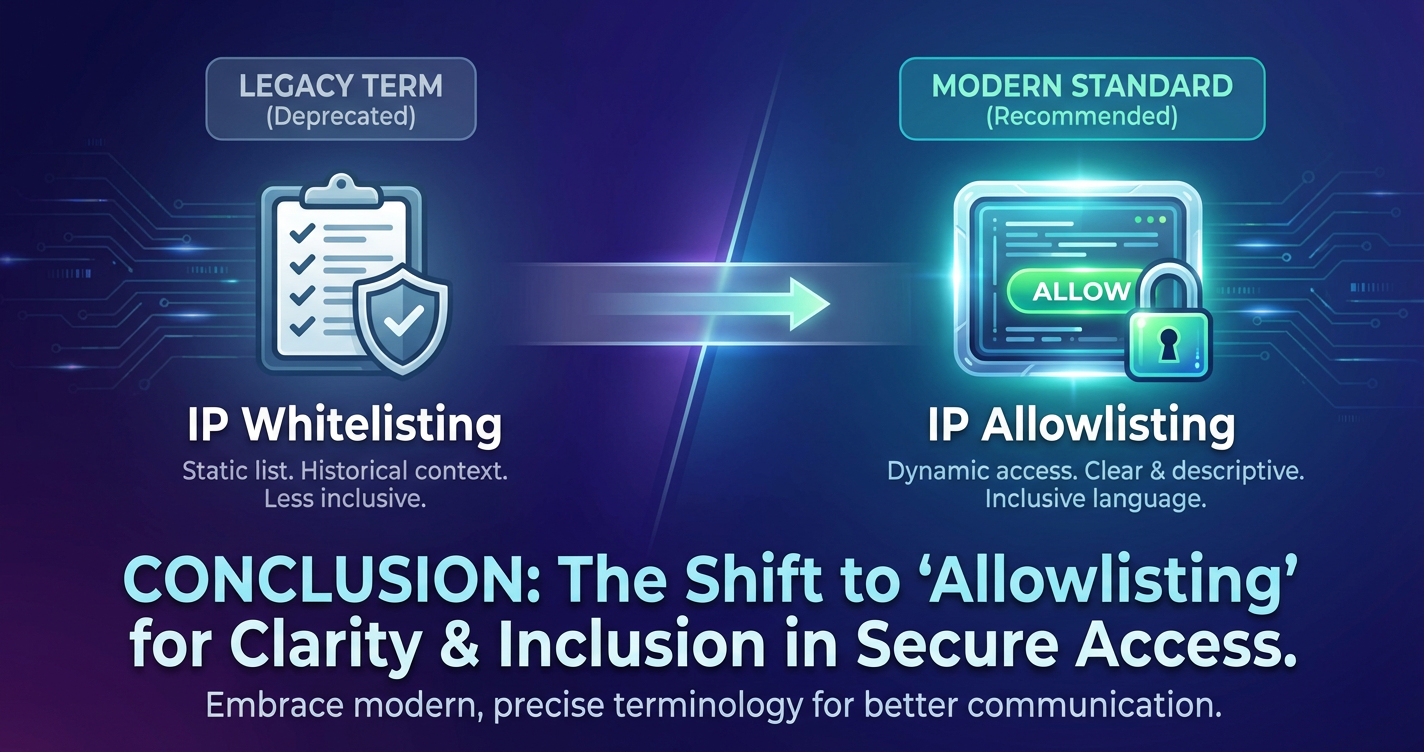
In the intricate world of cybersecurity and network management, precision in language is not merely a matter of semantics; it is a fundamental pillar upon which robust, intelligible, and equitable systems are built. The terms "IP Whitelisting" and "IP Allowlisting" frequently appear in discussions about access control, network security, and application permissions, often used interchangeably. While their practical application frequently achieves the same outcome—permitting specific entities while denying all others—the evolution from "whitelisting" to "allowlisting" represents a significant shift, driven by a confluence of technical clarity, ethical considerations, and a broader industry movement towards more inclusive language. This comprehensive exploration delves deep into the origins, implications, practical applications, and the nuanced differences between these two critical concepts, aiming to provide a definitive guide for IT professionals, developers, and anyone navigating the complexities of modern digital security.
The Genesis of Access Control: Understanding the Core Principle
At its heart, both IP whitelisting and IP allowlisting operate on the principle of explicit permission. This foundational security model dictates that unless an entity (in this case, an IP address or range of IP addresses) is specifically granted access, it is inherently denied. This contrasts sharply with "blacklisting" or "denylisting," where specific entities are explicitly forbidden, and everything else is implicitly allowed. The "permit-by-exception" or "deny-by-default" model inherent in allowlisting/whitelisting is widely regarded as a superior security posture because it minimizes the attack surface by reducing the number of potential entry points. Instead of trying to identify and block every conceivable threat, this approach focuses on verifying and permitting only trusted sources, thereby creating a much more controlled and secure environment.
Imagine a highly exclusive club where only members on a predefined roster are permitted entry. Anyone whose name does not appear on that list, regardless of their intentions or perceived legitimacy, is denied access at the door. This analogy perfectly encapsulates the core mechanism of IP allowlisting: only those IP addresses explicitly "on the list" are allowed to interact with a specific network, application, or service. This proactive approach to security significantly reduces the risk of unauthorized access, brute-force attacks, and various forms of cyber espionage, making it an indispensable tool in any comprehensive security strategy.
From "Whitelist" to "Allowlist": A Linguistic and Ethical Journey
The term "whitelist" has been pervasive in computing and network security for decades, along with its counterpart, "blacklist." These terms entered the technical lexicon at a time when language in technology was less scrutinized for its social and cultural implications. A "whitelist" denoted a list of approved items, while a "blacklist" signified a list of disapproved or forbidden items. This binary opposition, deeply embedded in many languages, often carries connotations of good versus bad, acceptable versus unacceptable, and historically, has been associated with racial and social discrimination. For instance, in real estate or employment, "blacklisting" someone often carried severe, unfair, and discriminatory consequences.
As the technology industry began to confront its role in shaping societal norms and fostering inclusive environments, a conscious effort emerged to purge potentially problematic terminology. The movement gained significant traction in the mid-to-late 2010s, with major tech companies and open-source projects actively advocating for and implementing changes to their internal and external communications, documentation, and codebase. The goal was not merely cosmetic; it was a concerted effort to remove language that, however unintentionally, could evoke associations with racism, exclusion, or other forms of discrimination, thereby fostering a more welcoming and inclusive environment for a global community of developers and users. This initiative paralleled similar shifts, such as replacing "master/slave" with "primary/replica" or "main/secondary" in database and version control systems, illustrating a broader commitment to ethical language in technology.
The transition from "whitelist" to "allowlist" is a direct outcome of this linguistic introspection. "Allowlist" is seen as a more neutral, descriptive, and inclusive term. It clearly communicates the action being performed—allowing specific entities—without carrying any potentially negative or exclusionary baggage. Similarly, "denylist" has emerged as the preferred alternative to "blacklist." While the functional operation remains identical, the semantic choice reflects a greater sensitivity to language and its impact, aligning technical terminology with broader organizational values of diversity, equity, and inclusion. This shift underscores a growing understanding that even seemingly innocuous technical terms can have wider societal resonance, and that conscious language choices contribute to building a more ethical and accessible technological landscape.
Deep Dive into IP Whitelisting: The Traditional Approach
Before the widespread adoption of "allowlist," "IP whitelisting" was the standard industry term for configuring network devices or software to permit traffic exclusively from a predefined set of IP addresses. This method has been a cornerstone of network security for decades, offering a straightforward yet powerful mechanism to restrict access to sensitive resources.
Conceptual Foundations of IP Whitelisting
IP whitelisting operates on an explicit "trust model." You, as the administrator, explicitly declare which IP addresses are trusted and therefore allowed to connect. Any IP address not present on this pre-approved list is automatically denied access. This is particularly effective for systems that expect connections from a limited, known set of locations. For example, if your internal database server should only ever be accessed by specific application servers within your private network, you would whitelist the IP addresses of those application servers. All other inbound connection attempts, whether from internal employees' laptops or external malicious actors, would be blocked at the network perimeter or the database firewall. This provides a robust first line of defense, significantly narrowing the window for unauthorized entry.
Common Use Cases for IP Whitelisting
The applications of IP whitelisting are broad and diverse, extending across various layers of IT infrastructure:
- Server and Application Access: Protecting critical servers (database servers, administrative interfaces, internal tools) is a primary use case. By whitelisting only the IP addresses of specific internal networks, VPN endpoints, or administrative workstations, organizations can significantly reduce exposure to external threats. For instance, an organization's central billing system, which only needs to be accessed by a specific finance department within its corporate network, can have its access restricted solely to the IP range used by that department.
- API Security: In the age of interconnected services, securing Application Programming Interfaces (APIs) is paramount. Many organizations use API gateways to manage and secure access to their APIs. Implementing IP whitelisting at the API gateway level ensures that only authorized client applications or partner systems, identified by their static IP addresses, can make calls to the APIs. This is crucial for protecting sensitive data and preventing unauthorized usage, especially for private or partner-facing APIs. For example, a financial institution providing an API for partners to access customer data might whitelist the IPs of its trusted partners. The API gateway would then enforce this policy, rejecting any requests originating from unwhitelisted IPs, regardless of other authentication credentials.
- Cloud Service Access: Cloud environments, while flexible, require stringent access controls. Whitelisting is frequently employed to restrict access to cloud resources like virtual machines, storage buckets, or managed databases. Cloud providers often offer security group or network ACL (Access Control List) functionalities that allow administrators to specify approved source IP addresses for inbound traffic, thereby creating a virtual perimeter around cloud assets.
- VPN Access: Organizations often whitelist the public IP addresses of their corporate offices or trusted remote branches to allow these locations to connect to their VPN servers. This adds an extra layer of security, ensuring that only known physical locations can initiate VPN connections to the internal network.
- Email Security: Whitelisting is also common in email systems to prevent spam and phishing. Organizations might whitelist trusted sender domains or IP addresses from which they expect legitimate emails, ensuring these messages bypass certain spam filters. Conversely, recipients might whitelist specific senders to ensure their important emails are never erroneously marked as spam.
Advantages of IP Whitelisting
- Enhanced Security: By far the biggest advantage is the significantly reduced attack surface. It adheres to the "deny by default" principle, making it extremely difficult for unauthorized entities to gain access.
- Simplicity and Effectiveness: For environments with stable and predictable network traffic patterns, IP whitelisting is relatively simple to implement and highly effective. Once configured, it provides a strong perimeter defense.
- Reduced False Positives: Unlike intrusion detection systems that might flag legitimate traffic as suspicious, a whitelist only permits known good traffic, minimizing false positives.
Disadvantages and Limitations
- Rigidity and Maintenance Overhead: In dynamic environments where IP addresses frequently change (e.g., mobile users, remote workers without static IPs, cloud autoscaling environments), maintaining an accurate whitelist can be cumbersome and time-consuming. Any change requires manual updates, which can lead to operational bottlenecks.
- Impact on Remote/Mobile Users: Users connecting from varying IP addresses (e.g., coffee shops, home networks with dynamic IPs) will be denied access unless their current IP is added to the whitelist, often making it impractical for widely distributed teams.
- Vulnerability to IP Spoofing: While a good first line of defense, IP whitelisting can be bypassed by sophisticated attackers who manage to spoof a whitelisted IP address. However, this typically requires the attacker to be on the same local network segment, or to compromise network infrastructure.
- Limited Granularity: Whitelisting an entire IP range might inadvertently grant access to untrusted devices within that range if the network segment isn't perfectly secure itself. It typically doesn't differentiate between users within the same IP address.
Deep Dive into IP Allowlisting: The Modern Standard
"IP Allowlisting" represents the contemporary and ethically conscious evolution of the "IP whitelisting" concept. While functionally identical to its predecessor in terms of operation, the adoption of "allowlist" signifies a deliberate choice for clearer, more inclusive language within the technology sector.
Conceptual Foundations of IP Allowlisting
Just like whitelisting, IP allowlisting establishes a definitive list of IP addresses or ranges that are explicitly permitted to access a specific resource, service, or network segment. All other IP addresses, not present on this "allowlist," are automatically blocked. This method adheres rigorously to the principle of least privilege, which posits that users and systems should only have access to the resources absolutely necessary for their function, and nothing more. By default, access is denied, and only specific, pre-vetted IP addresses are "allowed" through the gate. This proactive security stance creates a highly restrictive and secure environment, significantly reducing the attack surface. It's akin to having a bouncer at a private event who only allows entry to those whose names are explicitly on a pre-approved guest list, effectively preventing unauthorized individuals from even attempting to enter the venue.
Common Use Cases for IP Allowlisting
The practical applications of IP allowlisting mirror those of whitelisting, extending across the entire IT landscape, but with the benefit of clearer and more inclusive terminology:
- Securing Administrative Interfaces: This is perhaps one of the most critical applications. Access to sensitive administrative panels for servers, routers, firewalls, and cloud management consoles should always be restricted. Allowlisting the specific IP addresses of IT administrators' workstations or secure jump boxes ensures that only authorized personnel from designated locations can attempt to log in, significantly mitigating the risk of brute-force attacks or unauthorized configuration changes.
- Protecting Critical Infrastructure: Databases, message queues, and internal microservices that are not meant for public exposure can be heavily protected using IP allowlisting. For example, a PostgreSQL database that powers a customer-facing application might only allow connections from the API gateway and the application servers themselves. This ensures that even if an external attacker manages to breach the application layer, they still cannot directly access the underlying database without originating from one of the allowed IPs.
- Cloud Security Groups and Network Policies: In cloud environments (AWS Security Groups, Azure Network Security Groups, Google Cloud Firewall Rules), allowlisting is the primary mechanism for controlling inbound and outbound traffic to virtual machines, load balancers, and other cloud resources. Administrators define rules that explicitly allow traffic from specific IP addresses or IP ranges, ensuring only authorized sources can communicate with their cloud assets. This granular control is essential for maintaining a secure cloud footprint.
- Third-Party Integrations: When integrating with third-party services (e.g., payment gateways, CRM systems, analytics platforms), it's common practice for these services to provide their static IP addresses or ranges. You can then allowlist these IPs on your firewall or application security layer to ensure that only legitimate communication from these trusted partners is accepted, securing the data exchange between systems.
- VPN and Remote Access Servers: To bolster the security of remote access solutions, organizations can allowlist the expected public IP addresses of remote offices or specific employee VPN clients. This means the VPN server will only even process connection attempts from these pre-approved sources, adding an extra layer of defense before authentication even begins.
- Securing Development and Staging Environments: Development and staging environments often contain sensitive, pre-production data and code. Restricting access to these environments via IP allowlisting, permitting only developers' and testers' IP addresses, prevents unintended exposure or malicious access during critical development phases.
Advantages of IP Allowlisting
- Superior Security Posture: By strictly adhering to a "deny-by-default, permit-by-exception" model, allowlisting minimizes the attack surface to an absolute minimum, making it incredibly difficult for unauthorized entities to gain access.
- Reduced Attack Surface: Since only explicitly permitted IPs can interact with a resource, the number of potential entry points for attackers is drastically cut down. This makes it a highly effective preventative measure against many common cyber threats.
- Clear and Unambiguous Communication: The term "allowlist" clearly conveys the intent and action—explicitly allowing access—without any of the potentially negative or exclusionary connotations associated with older terminology. This promotes better understanding and aligns with modern ethical standards in technology.
- Enhanced Compliance: Many regulatory frameworks and security best practices (e.g., NIST, PCI DSS) implicitly or explicitly advocate for restrictive access control mechanisms. Implementing IP allowlisting helps organizations meet these compliance requirements by demonstrating robust control over network access.
Disadvantages and Limitations
- Operational Overhead in Dynamic Environments: Like whitelisting, allowlisting requires diligent management, especially in environments where IP addresses are frequently changing. Dynamic IPs, remote workers using varied networks, and cloud auto-scaling groups necessitate constant updates, which can be resource-intensive and prone to human error.
- Potential for Service Disruption: An incorrectly configured allowlist can inadvertently block legitimate users or services, leading to downtime and operational disruptions. This demands meticulous planning and testing before deployment.
- Risk of False Negatives: If a legitimate IP address is accidentally omitted from the allowlist, the corresponding user or service will be denied access, causing frustration and requiring immediate administrative intervention.
- Still Vulnerable to IP Spoofing (with caveats): While robust, allowlisting isn't foolproof against highly sophisticated attackers who can spoof a legitimate, allowed IP address. However, successful IP spoofing typically requires the attacker to be on the same local network segment or to compromise critical routing infrastructure, making it a much more difficult attack vector than simply trying arbitrary IPs.
- Scalability Challenges: For services with a very large, geographically dispersed user base, creating and maintaining an allowlist of all potential legitimate IP addresses becomes impractical. In such scenarios, other authentication and authorization mechanisms (e.g., token-based authentication, multi-factor authentication) are more appropriate or used in conjunction with allowlisting for specific backend access.
APIPark is a high-performance AI gateway that allows you to securely access the most comprehensive LLM APIs globally on the APIPark platform, including OpenAI, Anthropic, Mistral, Llama2, Google Gemini, and more.Try APIPark now! 👇👇👇
The Nuance of Difference: Whitelisting vs. Allowlisting
As established, the functional distinction between IP whitelisting and IP allowlisting is virtually non-existent. Both mechanisms perform the same task: creating a list of approved IP addresses that are granted access, while all others are denied. The "difference," therefore, is predominantly semantic, driven by a conscious effort within the technology industry to adopt more inclusive and unambiguous language. This shift is more profound than a simple word change; it reflects an evolving understanding of social responsibility in technology and the importance of clear communication.
| Feature | IP Whitelisting | IP Allowlisting |
|---|---|---|
| Functional Goal | Permit explicit, known good IPs; deny all others. | Permit explicit, known good IPs; deny all others. |
| Core Principle | Deny-by-default, permit-by-exception. | Deny-by-default, permit-by-exception. |
| Terminology Origin | Older, established term in computing. | Modern, inclusive term. |
| Connotations | Potentially carries historical associations with discriminatory practices (e.g., racial blacklisting/whitelisting). | Neutral, descriptive, action-oriented. |
| Industry Standard | Previously standard, now transitioning out. | Increasingly becoming the new standard. |
| Ethical Stance | Less sensitive to socio-linguistic impact. | Conscious effort towards inclusive and ethical language. |
| Clarity | Implies "good" vs "bad" through color association. | Explicitly states "allow," removing ambiguity and subjective judgment. |
| Practical Impact | None on technical functionality. | Improves documentation clarity, fosters inclusive environment. |
Why the Terminology Matters
While the bits and bytes flow the same way regardless of the term used, the choice of "allowlist" over "whitelist" is significant for several reasons:
- Promoting Inclusive Language: The primary driver for the change is to move away from terminology that inadvertently perpetuates associations with racial bias or discrimination. "Black" and "white" have historically been used in contexts that denote good/bad, acceptable/unacceptable, often with racial undertones. By adopting neutral terms like "allow" and "deny," the industry aims to create a more welcoming and respectful environment for everyone. This reflects a broader movement within tech to be more socially conscious.
- Clarity and Unambiguity: "Allowlist" is a more direct and descriptive term. It explicitly states the action being taken: "allowing" access. This removes any potential for misinterpretation that might arise from color-based metaphors. When someone sees "IP Allowlist," the meaning is immediately clear: "these IPs are allowed."
- Consistency Across the Industry: As more organizations, open-source projects, and standards bodies adopt "allowlist" and "denylist," it fosters greater consistency in technical documentation and communication across the industry. This reduces cognitive load and promotes a more unified understanding of security concepts. Major players like Google, Microsoft, AWS, and numerous open-source projects have officially adopted these newer terms, signaling a strong industry consensus.
- Professionalism and Modernity: Adopting contemporary and ethically sound terminology signals an organization's commitment to modern best practices, not just in security but also in corporate responsibility. It demonstrates an awareness of broader societal concerns and a willingness to adapt for the better. This subtle shift can reflect positively on an organization's brand and culture.
In essence, while an "IP whitelist" and an "IP allowlist" perform identical security functions, the latter represents a forward-thinking, ethically conscious, and linguistically precise approach that is increasingly becoming the preferred standard in the technology world. Organizations committed to inclusivity and clear communication are actively migrating their documentation, product interfaces, and internal vernacular to embrace "allowlist" and "denylist."
Practical Applications and Implementation Strategies
Implementing IP allowlisting (or whitelisting) effectively requires a strategic approach, understanding where and how to apply these controls for maximum security benefit without impeding legitimate operations. The following sections explore various practical scenarios and best practices.
1. Network Perimeter Security (Firewalls)
This is the most common and fundamental application. Firewalls, whether hardware appliances, software-based firewalls, or cloud-native firewall services, are the first line of defense.
- Implementation: Configure ingress (inbound) rules to accept connections only from a defined allowlist of source IP addresses for specific ports and protocols. For example, allowing SSH (port 22) access to your production servers only from your internal IT department's IP range or a dedicated jump server's IP.
- Considerations: Be extremely cautious when allowing broad IP ranges (e.g., entire continents) unless absolutely necessary. Granularity is key. Regularly review firewall rules to ensure they are still relevant and do not inadvertently open new vulnerabilities. Cloud security groups (like AWS Security Groups or Azure Network Security Groups) function in precisely this way, allowing administrators to define fine-grained inbound and outbound rules based on IP addresses.
2. Application Layer Security (API Gateways, Web Servers)
Beyond the network perimeter, allowlisting can be applied at the application layer for more granular control, especially for services exposed over the internet.
- Web Server Configuration: Web servers (Nginx, Apache, IIS) can be configured to allow requests only from specific IP addresses for certain directories or entire virtual hosts. This is particularly useful for administrative interfaces or internal tools hosted on a web server.
- Database Access: Database management systems often allow host-based access control. You can configure the database to accept connections only from the IP addresses of the application servers that need to access it, preventing direct connections from other sources, even if they bypass network firewalls.
- API Security with an API Gateway: This is a crucial area. An API gateway acts as a single entry point for all API calls, offering centralized control over security, traffic management, and monitoring. An effective API gateway will integrate IP allowlisting capabilities as a core security feature. For instance, if your organization uses an API gateway like APIPark, you can configure it to enforce IP allowlists for specific APIs or groups of APIs. This ensures that only trusted client applications or partner systems, identified by their static public IP addresses, can even initiate requests to your backend services through the API gateway. This layer of defense is invaluable because it applies security policies before requests reach your sensitive microservices or legacy systems. APIPark offers robust end-to-end API lifecycle management, including traffic forwarding and load balancing, making IP allowlisting a powerful tool within its broader security framework to protect your valuable digital assets. By consolidating API access through such a gateway, organizations can apply a consistent allowlisting policy across their entire API portfolio, simplifying management and strengthening their security posture.
3. Cloud Native Environments (Security Groups, Network ACLs, VPCs)
Cloud platforms provide highly sophisticated network segmentation and access control mechanisms, leveraging the allowlisting principle.
- Security Groups: In AWS, Azure, and Google Cloud, security groups are fundamental to controlling traffic to instances. You define inbound and outbound rules, specifying source/destination IP addresses (or other security groups) and ports. This effectively creates a virtual firewall around your cloud resources.
- Network Access Control Lists (NACLs): These operate at the subnet level in AWS (similar concepts exist in other clouds) and provide stateless packet filtering. NACLs allow you to permit or deny traffic based on IP addresses to and from entire subnets.
- VPC Flow Logs: While not an allowlisting mechanism itself, reviewing Virtual Private Cloud (VPC) flow logs can help audit which IPs are attempting to connect, aiding in the refinement and validation of your allowlists.
4. Software Execution Policies
Beyond network access, the concept of allowlisting extends to controlling what software is permitted to run on endpoints.
- Application Whitelisting/Allowlisting: This involves creating a list of approved applications that are allowed to execute on workstations or servers. All other applications are blocked. This is an extremely effective defense against malware, ransomware, and unauthorized software installations. Tools like Microsoft AppLocker or third-party endpoint security solutions implement this.
Best Practices for Implementing IP Allowlisting
Effective implementation goes beyond merely compiling a list of IPs; it involves a continuous process of management and refinement:
- Principle of Least Privilege (PoLP): This is paramount. Only allow the absolute minimum necessary access. If a service only needs to communicate on port 443, don't allow all ports. If an IP needs access only to one specific server, don't grant it access to the entire network segment.
- Regular Review and Audit: IP addresses change, services evolve, and network configurations are updated. Your allowlists must be regularly reviewed and audited to ensure they remain accurate, efficient, and secure. Stale entries should be removed, and new requirements should be meticulously added. Automated scanning tools can help identify potential discrepancies.
- Documentation: Maintain clear, up-to-date documentation for every allowlist entry, explaining why each IP or range is allowed, which service it supports, and who approved it. This is crucial for troubleshooting, auditing, and maintaining clarity within your security operations team.
- Version Control for Configuration: Treat your network security configurations, including allowlists, as code. Store them in a version control system (like Git) to track changes, enable rollbacks, and facilitate collaborative management. This also integrates well with Infrastructure as Code (IaC) practices.
- Integration with Identity and Access Management (IAM): For dynamic environments or remote workers, combining IP allowlisting with strong IAM practices (e.g., VPNs, multi-factor authentication, strong passwords) is essential. Allowlisting can secure the entry point, while IAM controls verify the user's identity and permissions.
- Granularity: Aim for the smallest possible IP ranges. Instead of allowing an entire /16 subnet, try to narrow it down to a /24 or even individual IPs if feasible. This significantly reduces the attack surface.
- Testing: Before deploying any allowlist changes to production, thoroughly test them in a staging or development environment to ensure legitimate traffic is not blocked and intended security posture is achieved.
- Monitoring and Alerting: Implement robust monitoring and alerting for rejected connection attempts by your allowlists. This can provide valuable insights into potential attack attempts or misconfigurations. Logs from your firewalls or API gateway (like APIPark, which offers detailed API call logging) can be invaluable for this, helping you trace and troubleshoot issues and detect unusual activity.
Risks and Challenges of IP Allowlisting
While incredibly effective, IP allowlisting is not without its challenges and potential risks, which must be carefully managed to maintain a secure and functional environment.
1. Maintenance Overhead in Dynamic Environments
The most significant challenge is the ongoing maintenance required for accurate allowlists. In environments characterized by:
- Dynamic IP Addresses: Many Internet Service Providers (ISPs) assign dynamic IP addresses to home users and small businesses, meaning a user's IP can change frequently. This makes it impossible to consistently allowlist individual remote workers without resorting to more complex solutions like VPNs.
- Cloud Auto-Scaling: Cloud environments often use auto-scaling groups where new instances are launched and terminated based on demand. These instances are assigned new IP addresses. If these instances need to communicate with allowlisted services, the allowlist must be dynamically updated, which requires sophisticated automation.
- Global Teams and Remote Work: With a globally distributed workforce, team members connect from diverse locations, each with its unique public IP address. Managing an allowlist for hundreds or thousands of individual IPs is an administrative nightmare, often leading to broad, less secure ranges being allowed, or frequent, frustrating access denials for legitimate users.
The continuous churn of IP addresses can lead to configuration drift, where the allowlist becomes outdated, either blocking legitimate traffic or inadvertently opening up new attack vectors.
2. Risk of False Negatives (Blocking Legitimate Traffic)
An improperly configured allowlist can inadvertently block legitimate users, services, or applications. This "false negative" scenario can lead to:
- Service Outages: If an application server's IP is removed from an allowlist connecting to a database, the application will cease to function, resulting in downtime.
- User Frustration: Remote employees constantly battling "Access Denied" messages due to their dynamic IP addresses not being on the list can severely impact productivity and morale.
- Operational Delays: IT teams might spend valuable time troubleshooting access issues that are ultimately traced back to an allowlist misconfiguration, diverting resources from more critical tasks.
3. Vulnerability to IP Spoofing (Contextual Risk)
While an allowlist offers strong perimeter defense, it's not entirely immune to IP spoofing. If an attacker manages to spoof a whitelisted (or allowlisted) IP address, they could potentially bypass the initial IP-based check. However, it's crucial to understand the limitations of IP spoofing:
- Local Network Segment: Successful IP spoofing typically requires the attacker to be on the same local network segment as the target or between the source and destination on an unroutable path. This limits its effectiveness against services exposed over the public internet, where intermediate routers drop spoofed packets that don't match routing tables.
- Session Management: Even if an attacker spoofs an IP, establishing a full TCP session (which most applications require) is difficult without controlling the legitimate IP address to see the return packets. Without the ability to complete the TCP handshake, most connections will fail.
- Multi-Layered Security: IP allowlisting is one layer. Combining it with strong authentication, encryption (TLS/SSL), and application-level authorization makes IP spoofing a much less viable attack vector for meaningful access. For example, even if a spoofed IP reached an API gateway, the subsequent authentication (API keys, OAuth tokens) would still prevent unauthorized access to the API.
4. Configuration Complexity and Human Error
Creating and maintaining numerous allowlists across various firewalls, security groups, application configurations, and API gateways can become complex. Each entry requires precision: correct IP, correct port, correct protocol.
- Typographical Errors: A single typo in an IP address or port number can either leave a gaping hole in security or block legitimate traffic.
- Overlapping Rules: Conflicting or overlapping rules can lead to unpredictable behavior, making troubleshooting difficult.
- Lack of Centralized Management: Without a centralized system for managing allowlists across an entire infrastructure, inconsistencies are inevitable, increasing the risk of security gaps. Solutions like Infrastructure as Code (IaC) and network policy managers can help mitigate this.
5. Scalability Issues for Public-Facing Services
For services designed for a broad, public audience (e.g., a public website, a mobile application backend), allowlisting all potential legitimate user IPs is simply not feasible. The sheer volume and dynamic nature of global consumer IPs make this approach impractical. In these scenarios, allowlisting is usually reserved for internal administrative access or specific partner integrations, while other robust security measures like strong authentication, rate limiting, Web Application Firewalls (WAFs), and robust authorization mechanisms handle public access.
Understanding these challenges is key to designing an allowlisting strategy that is both secure and operationally sustainable, often requiring a blend of IP-based controls with other security mechanisms.
The Future of Access Control Terminology
The shift from "whitelist" to "allowlist" is not an isolated incident but part of a broader movement within the technology industry towards more inclusive and precise language. This evolution is likely to continue as technology continues to permeate every aspect of global society, requiring terms that resonate across diverse cultures and backgrounds without carrying unintended historical baggage.
- Continued Emphasis on Inclusivity: The momentum to adopt neutral and inclusive language is strong and will likely expand to other areas of technical jargon. Organizations are increasingly scrutinizing their internal and external communications to ensure they align with ethical principles and foster a welcoming environment for all.
- Standardization and Best Practices: As major technology players and open-source communities coalesce around terms like "allowlist" and "denylist," these terms will increasingly become standard in documentation, APIs, and product interfaces. This standardization will simplify learning and communication for new entrants to the field.
- Impact on Education and Training: Future educational materials, certifications, and training programs will naturally adopt the new terminology, solidifying its place as the accepted standard for the next generation of IT professionals and developers.
- API Design and Documentation: Developers designing new APIs will gravitate towards using
allowlistparameters ordenylistconfigurations, and API documentation will reflect these changes. This ensures that the interfaces themselves promote the updated terminology, fostering consistency from core infrastructure to the application layer. For platforms like APIPark, which serves as an AI gateway and API management platform, adopting and propagating these modern terminologies within its feature set and documentation is crucial for staying relevant and aligned with industry best practices, ensuring a smooth and intuitive experience for its global user base. - Beyond Language: Ethical AI and Data Governance: The linguistic shift is reflective of a larger trend towards ethical considerations in technology, extending into areas like ethical AI development, responsible data governance, and algorithmic fairness. The choice of words is a microcosm of a much larger commitment to building technology that serves humanity responsibly.
The transition to "allowlist" is more than a superficial linguistic update; it symbolizes a maturing industry's commitment to social responsibility, clarity, and inclusivity. It underscores the idea that even seemingly minor terminological choices can have a profound impact on how technology is perceived, understood, and ultimately, used by a global community.
Conclusion: Embracing Clarity and Responsibility in Digital Security
In the dynamic and ever-evolving landscape of cybersecurity, the nuances of terminology play a crucial role in clarity, precision, and the fostering of an inclusive environment. While "IP whitelisting" and "IP allowlisting" achieve the identical functional outcome of explicitly permitting access to a defined set of IP addresses while denying all others, the shift towards "IP allowlisting" is a deliberate and significant step. This evolution is driven by a powerful combination of technical clarity—where "allow" more directly describes the action—and a profound ethical imperative to remove language that carries unintended historical baggage or discriminatory connotations.
The principle of "deny by default, permit by exception" remains a gold standard in access control, providing a robust defense against unauthorized access, reducing the attack surface, and simplifying security management. Whether you refer to it as "whitelist" or "allowlist," the strategic implementation of this security mechanism across firewalls, applications (especially via an API gateway like APIPark), and cloud environments is indispensable for protecting sensitive data and critical infrastructure. Organizations leveraging platforms such as APIPark for their API gateway needs find that applying IP allowlisting significantly enhances the security posture of their integrated services, ensuring that only trusted sources can interact with their valuable APIs.
However, recognizing the functional equivalence does not diminish the importance of adopting the modern terminology. Embracing "allowlist" signifies an organization's commitment to inclusive language, ethical technology practices, and a proactive approach to industry best practices. It aligns with a broader movement to ensure that technology serves all users equitably and respectfully.
Ultimately, the choice to use "IP allowlisting" reflects a forward-thinking mindset—one that prioritizes not only the technical efficacy of security measures but also the social and linguistic impact of the terminology we employ. By understanding this crucial distinction and adopting the modern standard, security professionals, developers, and organizations can contribute to building a more secure, clearer, and more inclusive digital future. It is a subtle yet profound testament to the power of language in shaping our technological world.
Frequently Asked Questions (FAQs)
1. What is the fundamental difference between IP Whitelisting and IP Allowlisting? Functionally, there is no difference: both terms refer to the security practice of explicitly permitting access only from a predefined list of IP addresses while denying all others. The distinction is primarily semantic and ethical. "IP Allowlisting" is the modern, preferred term, adopted to replace "IP Whitelisting" due to concerns that the "white/black" binary can carry unintended connotations of racial bias or discrimination, promoting more neutral and inclusive language in technology.
2. Why is IP Allowlisting considered a strong security measure? IP Allowlisting is strong because it operates on the principle of "deny by default, permit by exception." This significantly reduces the attack surface by ensuring that only trusted, explicitly approved IP addresses can initiate connections to a protected resource. It minimizes the risk of unauthorized access, brute-force attacks, and reduces the number of entry points an attacker can exploit.
3. Can IP Allowlisting be bypassed? While highly effective, IP Allowlisting is not foolproof. The most common theoretical bypass involves IP spoofing, where an attacker attempts to fake a legitimate, allowed IP address. However, successful IP spoofing for a full session is challenging, often requiring the attacker to be on the same local network segment or control routing infrastructure. When combined with other security layers like strong authentication, encryption, and application-level authorization (such as those provided by an API gateway), the risk of bypass is significantly mitigated.
4. Where is IP Allowlisting typically implemented? IP Allowlisting is commonly implemented at various layers of an organization's infrastructure. This includes network firewalls (hardware or software), cloud security groups/Network ACLs (for resources like virtual machines, databases, and load balancers), at the application level (e.g., web server configurations), and critically, within API gateways to control access to APIs. It's also used for securing administrative interfaces, VPN access, and in some email systems.
5. What are the main challenges when implementing IP Allowlisting? The primary challenges include high maintenance overhead, especially in dynamic environments where IP addresses frequently change (e.g., mobile users, cloud auto-scaling). This can lead to configuration errors, inadvertently blocking legitimate traffic (false negatives), or requiring constant manual updates. Furthermore, for services with a very large, public user base, allowlisting all legitimate IPs becomes impractical, necessitating a combination with other robust authentication and authorization mechanisms.
🚀You can securely and efficiently call the OpenAI API on APIPark in just two steps:
Step 1: Deploy the APIPark AI gateway in 5 minutes.
APIPark is developed based on Golang, offering strong product performance and low development and maintenance costs. You can deploy APIPark with a single command line.
curl -sSO https://download.apipark.com/install/quick-start.sh; bash quick-start.sh

In my experience, you can see the successful deployment interface within 5 to 10 minutes. Then, you can log in to APIPark using your account.

Step 2: Call the OpenAI API.