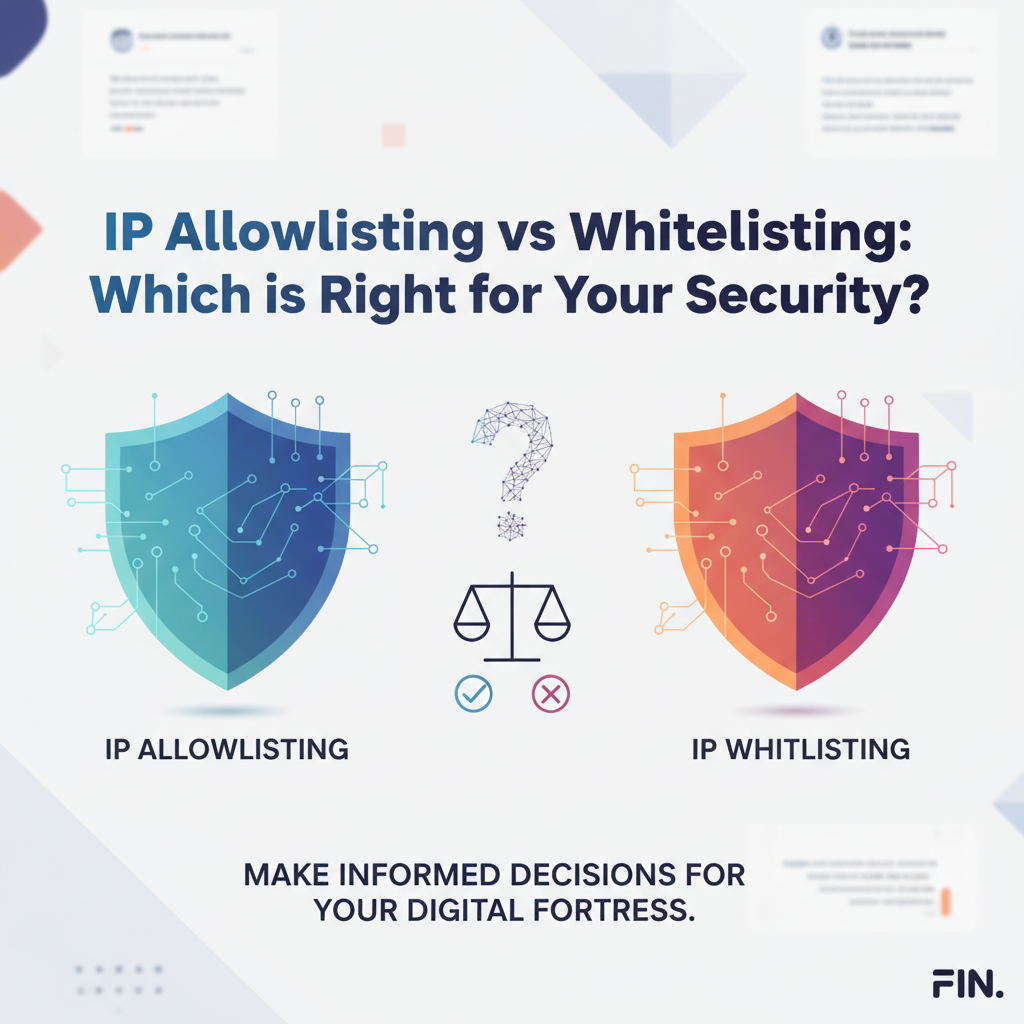
IP Allowlisting vs Whitelisting: Which is Right for Your Security?


In the increasingly interconnected digital landscape, where data flows across networks at unprecedented speeds, the paramount importance of robust cybersecurity cannot be overstated. Organizations, regardless of their size or industry, face a relentless barrage of cyber threats, ranging from sophisticated phishing attacks and ransomware to denial-of-service assaults and unauthorized data breaches. Protecting sensitive information and critical infrastructure has become a non-negotiable imperative, requiring a multi-layered defense strategy that encompasses technological safeguards, stringent policies, and continuous vigilance. Among the fundamental access control mechanisms employed to fortify network perimeters and safeguard digital assets, IP allowlisting and IP whitelisting stand out as powerful, albeit often interchangeably used, techniques. This comprehensive article delves deep into these concepts, dissecting their operational nuances, exploring their strategic advantages and potential pitfalls, and ultimately guiding security professionals and decision-makers in determining which approach, or rather, which terminology and implementation strategy, aligns best with their unique security posture and operational requirements.
The debate surrounding "whitelisting" versus "allowlisting" is more than just a semantic quibble; it reflects a broader evolution in cybersecurity discourse and an increased sensitivity to inclusive language. While historically, "whitelisting" has been the prevalent term, referring to a predefined list of approved entities—be they IP addresses, email addresses, applications, or domains—that are explicitly granted access while all others are implicitly denied, the term "allowlisting" has gained traction as a more neutral and precise alternative. Functionally, when applied to IP addresses, both terms refer to the same core security principle: a default-deny posture where only traffic originating from specific, pre-approved IP addresses or ranges is permitted to interact with a system, network, or application, including critical api endpoints. This method, often implemented at the firewall, api gateway, or application level, creates a highly restrictive and secure environment, significantly reducing the attack surface by eliminating access from unknown or untrusted sources.
However, despite their functional equivalence in the context of IP-based access control, understanding the philosophical underpinnings and practical implications of these concepts is crucial. This article will meticulously explore the "why" behind their implementation, the "how" of their technical deployment, and the "when" of their optimal application, providing a holistic perspective that transcends mere definitions. We will examine how these strategies integrate with broader security frameworks like Zero Trust, discuss their role in protecting sensitive apis and internal services, and offer insights into best practices for their effective management and maintenance. By the end, readers will possess a clear understanding of whether "IP allowlisting" or "IP whitelisting" (or perhaps both, with a clear understanding of the linguistic shift) is the right nomenclature and strategic choice for bolstering their organization's security defenses in an era of escalating cyber threats.
Unpacking the Terminology: Whitelisting vs. Allowlisting
The terms "whitelisting" and "allowlisting" are frequently encountered in cybersecurity discussions, often used interchangeably to describe a specific approach to access control. While their functional outcome, particularly when applied to IP addresses, is largely identical, there's a subtle but significant distinction in their connotations and the broader linguistic shift driving the adoption of "allowlisting." Understanding this nuance is crucial for clear communication and aligning with evolving industry standards.
The Traditional Concept of Whitelisting
Historically, "whitelisting" has been the dominant term, ingrained in cybersecurity lexicon for decades. At its core, whitelisting embodies a "deny-by-default, permit-by-exception" security philosophy. This means that access to a resource—be it a network, a server, an application, or a specific api—is denied to all entities unless they explicitly appear on a pre-approved "whitelist." Only those entities listed are granted permission to proceed. This approach is contrasted with "blacklisting," where access is granted by default, but specific known malicious or undesirable entities are placed on a "blacklist" and explicitly denied.
When applied to IP addresses, an IP whitelist is a meticulously curated list of trusted IP addresses or IP ranges that are authorized to connect to a protected system. Any connection attempt originating from an IP address not present on this list is automatically rejected. This method provides a stringent layer of security by drastically shrinking the attack surface. For instance, a critical internal api might only permit connections from the company's internal network IP range, effectively isolating it from the public internet and thwarting attempts from external, unauthorized sources. The strength of whitelisting lies in its inherent restrictiveness; it assumes all unknown entities are potentially hostile and only grants passage to verified, known-good actors.
The term "whitelist" has also been used more broadly in various contexts: * Email Whitelists: To prevent spam, only emails from approved senders are delivered to the inbox. * Application Whitelists: Only specific, approved software applications are allowed to run on a system, preventing malware execution. * Domain Whitelists: Web browsers or security tools might only allow connections to specific, trusted website domains.
The Emergence of Allowlisting: A Linguistic and Ethical Shift
In recent years, there has been a conscious effort within the tech industry and broader society to move away from language that might carry unintended racial or discriminatory connotations. Terms like "master/slave" in computing have largely been replaced by "primary/replica" or "leader/follower." Similarly, "whitelisting" and "blacklisting" have come under scrutiny for their implicit association with positive/negative or good/bad through color metaphors.
"Allowlisting" emerged as a preferred alternative that conveys the same technical meaning without these potentially problematic associations. It precisely describes the action being taken: explicitly allowing access to a defined set of entities, while implicitly denying all others. The term is more descriptive, neutral, and inclusive, aligning with a global push for more considerate and unambiguous language in professional and technical domains. Functionally, an IP allowlist behaves identically to an IP whitelist; it defines the set of permissible IP addresses, and anything not on that list is blocked.
From a practical cybersecurity perspective, when we talk about restricting access based on IP addresses, "IP allowlisting" and "IP whitelisting" are operationally synonymous. The choice between the two often comes down to an organization's internal linguistic policies and its commitment to adopting more inclusive terminology. However, regardless of the term used, the underlying principle of "deny by default, permit by exception" remains a cornerstone of robust access control.
Deep Dive into IP Allowlisting: Mechanisms, Benefits, and Challenges
IP allowlisting is not merely a theoretical concept; it's a practical, powerful security control implemented across various layers of an organization's IT infrastructure. Its effectiveness stems from its simplicity and its ability to create a clear, immutable boundary around protected resources.
How IP Allowlisting Works: The Underlying Mechanics
The fundamental mechanism of IP allowlisting involves evaluating an incoming network connection request against a predefined list of approved IP addresses. This evaluation can occur at several points within the network stack, each offering different levels of granularity and protection:
- Network Firewall Level: This is perhaps the most common and foundational implementation. Network firewalls, whether hardware appliances or software-based solutions, operate at the network layer (Layer 3/4 of the OSI model). They examine the source IP address of incoming packets. If the source IP address matches an entry in the firewall's allowlist, the packet is permitted to traverse the firewall and proceed towards its intended destination. If it does not match, the packet is typically dropped, and the connection is blocked, often without any notification to the originator. This provides a crucial first line of defense, preventing unauthorized traffic from even reaching internal network segments. For an
api gatewayor other critical services, configuring network firewalls to allowlist only specific upstreamgatewayIPs or partner network IPs is a standard practice. - Cloud Security Groups and Network Access Control Lists (NACLs): In cloud environments (e.g., AWS, Azure, GCP), security groups and NACLs serve a similar function to traditional network firewalls. Security groups are stateful virtual firewalls that control inbound and outbound traffic for one or more instances. NACLs are stateless firewalls that operate at the subnet level. Both allow administrators to define rules that explicitly permit traffic from specified source IP addresses or CIDR blocks, providing fine-grained control over network access to cloud resources, including virtual machines hosting
apiservices or database instances. - API Gateway Level: An
api gatewayacts as a single entry point for all incomingapirequests, mediating communication between clients and backend services. This position makes it an ideal enforcement point for security policies, including IP allowlisting. Theapi gatewaycan be configured to inspect the source IP address of everyapicall. If the IP address is not on the configured allowlist, theapi gatewaycan immediately reject the request, returning an appropriate error code (e.g., 403 Forbidden). This provides application-layer protection, ensuring that even if network-level firewalls are bypassed or misconfigured, theapiitself remains protected. This is particularly crucial for organizations exposingapis to external partners or customers, where network-level restrictions might be too broad. - Web Server / Application Level: Some web servers (like Nginx, Apache) or even the application code itself can be configured to implement IP allowlisting. For example, Nginx can use
allowanddenydirectives within its configuration to control access based on IP addresses. This offers a very specific and granular control, allowing differentapiendpoints or resources within the same application to have distinct IP allowlists. While effective, relying solely on application-level allowlisting is generally not recommended as a primary defense, as it places the burden on the application and may not prevent resource exhaustion from denied connections at an earlier stage.
Regardless of the implementation point, the core principle remains consistent: a definitive list of "allowed" IPs is maintained, and all other traffic is explicitly blocked.
Key Benefits of Implementing IP Allowlisting
The strategic advantages of IP allowlisting are numerous and significant, making it a cornerstone of many robust cybersecurity architectures:
- Enhanced Security and Reduced Attack Surface: This is the most prominent benefit. By restricting access to only known, trusted IP addresses, organizations dramatically reduce the potential entry points for attackers. Malicious actors, botnets, and unauthorized users from unlisted IP addresses are simply blocked at the perimeter, preventing them from even attempting to exploit vulnerabilities or launch attacks. This is exceptionally effective for protecting administrative interfaces, critical databases, internal
apis, and backend services that should never be exposed to the public internet. For example, anapi gatewayprotecting an internal microservice can be configured with an IP allowlist to only accept requests from other trusted internal services, thereby forming a strong defense perimeter. - Compliance with Regulatory Standards: Many industry regulations and compliance frameworks (e.g., HIPAA, PCI DSS, GDPR, ISO 27001) mandate strict access control measures to protect sensitive data. IP allowlisting directly contributes to meeting these requirements by providing an auditable and enforceable mechanism for restricting access to data processing systems. Auditors can easily verify that access to critical systems is limited to authorized sources, demonstrating a strong commitment to data security.
- Protection Against Brute-Force Attacks: When access is restricted to a small set of IP addresses, brute-force login attempts or password guessing attacks become significantly harder for attackers. Instead of being able to launch these attacks from a vast array of IP addresses globally, an attacker would first need to compromise an allowed IP, which is a much higher barrier. This buys valuable time for detection and response.
- Mitigation of DDoS Attacks (to some extent): While not a standalone DDoS solution, IP allowlisting can help mitigate certain types of distributed denial-of-service (DDoS) attacks, especially those aimed at application layers or specific
apiendpoints. If the DDoS traffic originates from IP addresses not on the allowlist, these requests can be dropped early by firewalls orapi gateways, preventing them from consuming critical backend resources. - Improved Performance for Authorized Users: By filtering out a large volume of illegitimate traffic at an early stage, network resources and application servers are freed up to efficiently serve legitimate requests. This can lead to better performance and responsiveness for authorized users and
apiconsumers, as the system isn't burdened by processing and denying millions of unauthorized connection attempts. - Simplified Security Audits: With a clear list of allowed IPs, security audits become more straightforward. It's easy to identify and review who is permitted access and to ensure that the list remains accurate and up-to-date, reflecting the principle of least privilege.
Challenges and Considerations in Implementing IP Allowlisting
Despite its powerful benefits, IP allowlisting is not without its complexities and potential drawbacks. Organizations must carefully consider these challenges to implement and maintain an effective allowlisting strategy:
- Management Overhead and Dynamic Environments: Perhaps the biggest challenge is the ongoing management of the allowlist. In dynamic environments where IP addresses change frequently (e.g., remote workers using dynamic IPs, cloud services with auto-scaling that provision new instances with new IPs, partner integrations with changing network infrastructures), maintaining an accurate and up-to-date list can be a significant operational burden. Outdated lists can lead to legitimate users being blocked or, worse, unauthorized IPs gaining access. For
apis consumed by mobile users, each with a potentially different IP address on every connection, IP allowlisting is generally impractical. - Scalability Issues: As an organization grows, or as the number of partners and remote users increases, the allowlist can become very large and complex. Managing thousands of individual IP addresses or CIDR blocks can become unwieldy, increasing the risk of misconfigurations and errors. This is where automation and integration with Identity and Access Management (IAM) systems become crucial.
- False Positives (Blocking Legitimate Users): If an authorized user's IP address changes unexpectedly and is not updated on the allowlist, they will be denied access. This can lead to frustration, lost productivity, and increased support requests. Balancing strict security with user accessibility is a constant challenge.
- Lack of Granularity for User-Specific Access: IP allowlisting provides network-level access control. It identifies where a request comes from, but not who is making the request or what specific action they are authorized to perform. Within an allowed IP range, any user could potentially gain access, necessitating additional authentication and authorization mechanisms (e.g., API keys, OAuth tokens, user credentials) to ensure granular, user-specific access control. For instance, an
api gatewaywill typically enforce both IP allowlisting and token-based authentication forapicalls. - Vulnerability to IP Spoofing and Compromised IPs: IP allowlisting assumes that an IP address is a reliable indicator of trust. However, attackers can sometimes spoof IP addresses, making their traffic appear to originate from a trusted source. More critically, if a legitimate IP address on the allowlist is compromised (e.g., an attacker gains control of a partner's server), the allowlist becomes a vulnerability, as the attacker can then use the trusted IP to bypass restrictions. This underscores the need for multi-layered security and never relying solely on IP restrictions.
- Complex Debugging: When legitimate traffic is unexpectedly blocked, troubleshooting can be complex. Determining whether the issue is a misconfigured allowlist, a changed IP, or another network problem requires careful investigation, often involving reviewing logs at multiple network layers, including
api gatewaylogs. - Cloud Native Environments: In cloud environments, services often use dynamic or ephemeral IP addresses, making static IP allowlisting challenging. Solutions often involve using PrivateLink, VPC peering, or service mesh technologies that rely on identity-based access rather than IP-based access for inter-service communication. For external access to cloud-hosted
apis, organizations might use dedicatedgateways with static egress IPs that can be allowlisted.
Organizations must weigh these challenges against the benefits and adopt a pragmatic approach that combines IP allowlisting with other security controls to build a resilient defense.
Where IP Restrictions Matter Most: Practical Implementation Points
The effectiveness of IP allowlisting hinges significantly on where and how it is implemented within the network architecture. Different points of enforcement offer varying levels of protection, granularity, and impact on performance. A multi-layered approach, employing IP restrictions at several critical junctures, typically yields the most robust security posture.
1. Network Firewalls: The Perimeter Defense
Network firewalls are the traditional gatekeepers of an organization's perimeter, acting as the first line of defense against unauthorized external access. Deploying IP allowlisting at this level is foundational:
- Function: Firewalls inspect incoming and outgoing network traffic, making decisions to permit or deny based on predefined rules. These rules often include source and destination IP addresses, ports, and protocols.
- Implementation: Administrators configure firewall rules to explicitly permit traffic from specific source IP addresses (or CIDR blocks) to reach designated internal servers, network segments, or even specific ports. All other traffic is blocked by default.
- Best Use Cases:
- Protecting critical internal systems (e.g., database servers, administrative consoles, internal
apiservices) that should never be directly exposed to the public internet. - Securing VPN concentrators, allowing connections only from specific remote office IPs.
- Restricting access to management interfaces of network devices and servers.
- Allowlisting trusted partner networks for B2B integrations, directing traffic to a specific
api gatewayor application server.
- Protecting critical internal systems (e.g., database servers, administrative consoles, internal
- Advantages: High performance, operates at a low network layer, effective in preventing traffic from reaching deeper into the network.
- Disadvantages: Lacks application-level context, can be difficult to manage in highly dynamic environments.
2. Cloud Security Groups and Network Access Control Lists (NACLs)
For organizations leveraging cloud infrastructure, cloud-native security constructs provide analogous functionality to traditional firewalls but are integrated directly into the cloud provider's ecosystem:
- Function:
- Security Groups: Act as stateful virtual firewalls for instances (e.g., EC2 instances in AWS). They control inbound and outbound traffic at the instance level.
- NACLs: Operate at the subnet level, acting as stateless packet filters for all traffic entering or leaving a subnet.
- Implementation: Rules are defined to allow specific inbound/outbound traffic based on source/destination IP addresses, ports, and protocols. For example, a security group attached to a server hosting an
apimight allow inbound HTTP/HTTPS traffic only from the IP addresses of anapi gatewayand internal monitoring systems. - Best Use Cases:
- Protecting individual cloud instances or services (e.g., VMs, databases, load balancers).
- Securing subnets containing sensitive resources.
- Controlling access to
apis deployed in serverless functions (e.g., AWS Lambda, Azure Functions) when combined with anapi gateway.
- Advantages: Cloud-native integration, easy to manage alongside other cloud resources, scalable.
- Disadvantages: NACLs are stateless (requires inbound and outbound rules for responses), can be complex to manage across many resources if not automated.
3. API Gateways: The Critical Enforcement Point for APIs
The api gateway serves as a proxy for api requests, sitting between clients and backend api services. Its strategic position makes it an ideal and highly effective point for enforcing IP allowlisting, especially for services exposed over apis.
- Function: An
api gatewaycan apply a wide array of security policies before requests reach the backendapis, including authentication, authorization, rate limiting, and IP filtering. It acts as an abstraction layer, centralizing common security concerns. - Implementation: The
api gatewayis configured with a list of permitted source IP addresses. When anapirequest arrives, thegatewayinspects the client's IP address. If it doesn't match an entry on the allowlist, thegatewayimmediately rejects the request with an access denied error. - Best Use Cases:
- Protecting publicly exposed
apis that should only be accessed by specific partners or client applications. - Securing internal
apis, allowing access only from other trusted microservices or internal applications. - Implementing a unified IP allowlisting policy across multiple backend
apis without modifying each service individually. - Integrating with other security features like rate limiting and
apikey management for a comprehensiveapisecurity posture.
- Protecting publicly exposed
- Advantages: Application-aware context, centralizes security policy enforcement, protects backend
apis from illegitimate traffic, provides detailedapicall logging. - Disadvantages: Adds a hop in the request path (minimal performance impact for modern
gateways), requires careful configuration to avoid blocking legitimateapiconsumers.
APIPark: A Comprehensive Solution for API Management and Security
In the context of robust API management and security, an advanced api gateway plays a pivotal role. This is where solutions like APIPark come into play. APIPark is an open-source AI gateway and API management platform designed to help developers and enterprises manage, integrate, and deploy AI and REST services with ease. Its capabilities extend beyond basic routing to include comprehensive security features that directly support and enhance IP allowlisting strategies for your apis.
APIPark’s position as an all-in-one gateway and developer portal makes it an excellent choice for enforcing granular access controls. For example, by leveraging APIPark, organizations can:
- Centralize IP Allowlisting for APIs: Instead of configuring IP restrictions on each individual backend service, APIPark allows you to define a single, consistent IP allowlist policy at the
gatewaylevel. This simplifies management and ensures uniform security across all managedapis. - Combine with Other Security Features: APIPark supports end-to-end API lifecycle management, including access permissions, subscription approval features, and detailed
apicall logging. These features complement IP allowlisting by providing additional layers of security: even if an attacker manages to spoof an allowed IP, they would still need valid API keys or go through an approval process to invoke theapi. - Enhance Traceability and Monitoring: With its comprehensive logging capabilities, APIPark records every detail of each
apicall. This allows businesses to quickly trace and troubleshoot issues, including failedapicalls due to IP allowlist denials, ensuring system stability and data security. This detailed logging is invaluable for security audits and incident response, providing clear evidence of access attempts and their outcomes. - Achieve High Performance: APIPark is engineered for high performance, rivaling solutions like Nginx, capable of handling over 20,000 TPS with an 8-core CPU and 8GB of memory. This ensures that IP allowlisting and other security policies are enforced efficiently without becoming a bottleneck for legitimate
apitraffic. - Simplify AI Model Integration and Management: Beyond traditional REST APIs, APIPark’s focus on AI gateway functionalities means it can secure access to integrated AI models, applying IP allowlisting to AI service invocations to ensure only authorized applications or users can trigger costly or sensitive AI inferences.
By integrating APIPark into their infrastructure, organizations gain a powerful gateway that not only manages and orchestrates their apis but also acts as a robust enforcement point for critical security policies like IP allowlisting, ensuring that their digital assets are protected from unauthorized access.
4. Web Application Firewalls (WAFs)
WAFs provide a more advanced layer of protection specifically designed for web applications and apis, operating at the application layer (Layer 7).
- Function: WAFs inspect the content of HTTP/HTTPS requests and responses to detect and block various web-based attacks (e.g., SQL injection, cross-site scripting, zero-day exploits). They can also enforce IP allowlisting rules.
- Implementation: WAFs are configured to accept traffic only from specified IP addresses or ranges. Requests from unlisted IPs are blocked before they reach the web server or
api. - Best Use Cases:
- Protecting public-facing web applications and
apis that require advanced threat detection beyond simple IP filtering. - Complements an
api gatewayby adding another layer of application-layer security.
- Protecting public-facing web applications and
- Advantages: Comprehensive protection against various web attacks, can integrate IP allowlisting with other intelligent threat detection rules.
- Disadvantages: Can be more complex to configure and tune, potential for false positives if not properly managed.
5. Application-Level Logic
While generally not recommended as the sole mechanism, IP allowlisting can also be implemented directly within the application code itself.
- Function: The application's business logic includes checks on the source IP address of incoming requests before processing them.
- Implementation: Developers embed code that retrieves the client's IP address and compares it against an internal list of allowed IPs. If there's no match, the application returns an error and terminates processing.
- Best Use Cases:
- For very specific, niche internal applications where other forms of IP restriction are impractical or overly complex.
- As a fail-safe or additional redundant check for extremely sensitive
apiendpoints.
- Advantages: Highly granular control at the
apiendpoint level. - Disadvantages: Places security burden on developers, impacts application performance, does not prevent unwanted traffic from consuming server resources up to the application layer. It's often better to offload this to an
api gatewayor WAF.
By strategically deploying IP allowlisting at multiple points—from the network perimeter (firewalls, cloud security groups) to the application entry point (api gateway, WAF) and potentially even within the application itself—organizations can construct a robust, multi-layered defense. Each layer acts as a safety net, ensuring that if one fails, another can still prevent unauthorized access, particularly crucial for protecting sensitive apis and data.
Developing a Robust IP Allowlisting Strategy
Implementing IP allowlisting effectively requires more than just configuring a few rules. It demands a well-thought-out strategy that considers the organization's unique environment, risk profile, and operational realities. A robust strategy encompasses planning, implementation, monitoring, and continuous refinement.
Step 1: Comprehensive Assessment and Identification
Before implementing any access control, a thorough understanding of the environment is paramount.
- Identify Critical Assets: Pinpoint which systems, applications,
apis, databases, and network segments contain sensitive data or perform critical functions that warrant IP-based access restrictions. Prioritize these assets based on their impact if compromised. For instance, anapiexposing customer PII would be a top priority. - Map Legitimate Access Paths: Document all legitimate sources of access to these critical assets. This includes:
- Internal networks (e.g., corporate offices, data centers, specific subnets).
- Remote access solutions (e.g., VPN gateways, jump servers).
- Trusted third-party partners (e.g., vendors, customers, integration partners) who need
apiaccess. - Cloud services or specific instances that interact with your protected resources.
- Automated systems, monitoring tools, or other applications that consume internal
apis.
- Understand Traffic Patterns: Analyze network logs and
api gatewaytraffic to understand the typical source IP addresses, volumes, and nature of legitimate traffic. This helps in building an accurate initial allowlist and identifying any dynamic IP considerations. - Identify Threat Vectors: Understand the potential ways an attacker might attempt to access these assets, and how IP allowlisting can specifically mitigate those risks. Consider scenarios like brute-force attacks, remote code execution, and unauthorized access to
apimanagement interfaces.
Step 2: Policy Definition and Granularity
Clear, well-defined policies are the backbone of any effective security control.
- Define Scope and Granularity: Determine the level at which IP allowlisting will be applied (e.g., network perimeter, specific
api gateway, individualapiendpoint). Decide on the granularity of the IP addresses (individual IPs, CIDR blocks for entire subnets, or broader ranges). A criticalapimight require individual IP addresses, while an internal service might allow an entire department's subnet. - Establish "Default Deny" Principle: Reiterate that the fundamental principle is to deny all access unless explicitly allowed. This mindset helps prevent accidental omissions from the allowlist.
- Document Allowlist Entries: For each entry on the allowlist, clearly document:
- The specific IP address or range.
- The purpose/reason for access.
- The associated system, application, or
apiit needs to access. - The owner or responsible team for that IP.
- The review/expiration date.
- Define Review and Update Processes: Establish a clear process for reviewing and updating the allowlist. How often will it be reviewed? Who is responsible for updates? What is the approval workflow for adding or removing entries? This is especially critical for environments with dynamic IPs or frequently changing partner integrations.
- Integrate with Change Management: Ensure that any changes to the allowlist are part of the broader IT change management process. This prevents unauthorized modifications and ensures proper documentation and approval.
Step 3: Tool Selection and Implementation
Choosing the right tools and implementing them correctly is crucial for operational success.
- Leverage Existing Infrastructure: Utilize existing network firewalls, cloud security groups, and
api gatewaysolutions. Avoid introducing new, standalone tools unless absolutely necessary, to minimize complexity. - Centralized Management: If possible, centralize the management of IP allowlists. For
apis, anapi gatewaylike APIPark can serve as a central point of enforcement, reducing configuration sprawl and ensuring consistency across variousapis. - Automation: For dynamic environments, explore automation options. This could involve scripting, Infrastructure as Code (IaC) tools, or integration with Configuration Management Databases (CMDBs) or Identity and Access Management (IAM) systems. For example, if a new cloud instance is provisioned, an automated process could update relevant security groups or
api gatewayallowlists. - Phased Rollout: For critical systems, consider a phased rollout. Initially, implement allowlisting in "monitor" or "log only" mode (if supported) to identify any legitimate traffic that might be inadvertently blocked. Then, transition to enforcement mode.
- Testing: Thoroughly test the allowlist configuration after implementation. Attempt to access the protected resource from both allowed and denied IP addresses to verify that the rules are working as expected. This includes negative testing to ensure blocked access from unauthorized IPs.
Step 4: Continuous Monitoring and Alerting
IP allowlisting is not a "set it and forget it" solution. Ongoing monitoring is essential.
- Log Analysis: Regularly review firewall logs,
api gatewayaccess logs (e.g., APIPark's detailed API call logging), and application logs for denied access attempts. A sudden surge in blocked IPs could indicate a targeted attack or a misconfigured client. - Alerting: Configure alerts for high volumes of denied connections from specific IP addresses or for any unusual patterns. This allows security teams to quickly respond to potential threats or identify legitimate users being unintentionally blocked.
- Performance Monitoring: Monitor the performance impact of allowlisting, especially at the
api gatewaylevel. While typically minimal for moderngateways, it's essential to ensure there are no unforeseen bottlenecks. APIPark, for example, is built for high performance, mitigating such concerns. - Anomaly Detection: Integrate allowlist logs with Security Information and Event Management (SIEM) systems or other anomaly detection tools. This can help identify sophisticated attacks where an attacker might be trying various IPs or attempting to spoof an allowed IP.
Step 5: Regular Review and Maintenance
The digital landscape is constantly evolving, and so too must security controls.
- Scheduled Reviews: Conduct periodic (e.g., quarterly, semi-annual) reviews of all allowlist entries. Verify that each entry is still necessary, accurate, and adheres to the principle of least privilege. Remove any stale or unnecessary entries.
- Ad-hoc Reviews for Changes: Trigger immediate reviews whenever there are significant changes in the environment (e.g., new partners, decommissioning of systems, changes in cloud infrastructure, internal reorganizations affecting
apiaccess). - Incident Response Integration: In the event of a security incident, review the allowlist as part of the post-mortem analysis. Determine if the allowlist played a role in preventing or enabling the attack, and adjust policies accordingly.
- Training and Awareness: Educate relevant teams (e.g., developers, operations, support) on the importance of IP allowlisting, the procedures for requesting changes, and how to troubleshoot access issues.
By following these strategic steps, organizations can harness the power of IP allowlisting to significantly enhance their security posture, particularly for protecting sensitive apis and critical digital assets, while managing the operational complexities effectively.
APIPark is a high-performance AI gateway that allows you to securely access the most comprehensive LLM APIs globally on the APIPark platform, including OpenAI, Anthropic, Mistral, Llama2, Google Gemini, and more.Try APIPark now! 👇👇👇
Comparison: Allowlisting vs. Other Security Measures
While IP allowlisting is a powerful security control, it is rarely sufficient on its own. A robust security strategy always involves multiple layers of defense, with IP restrictions working in conjunction with other mechanisms. Understanding how allowlisting compares and complements these other measures is crucial for building a comprehensive security architecture.
IP Allowlisting vs. IP Blocklisting (Blacklisting)
These are two sides of the same coin when it comes to IP-based access control, representing fundamentally different philosophies.
| Feature | IP Allowlisting (Whitelisting) | IP Blocklisting (Blacklisting) |
|---|---|---|
| Philosophy | "Deny by default, permit by exception." | "Permit by default, deny by exception." |
| Approach | Only explicitly approved IPs can access. | All IPs can access, except those explicitly denied. |
| Security Level | High. Significantly reduces the attack surface. | Moderate. Relies on knowing all bad actors. |
| Management | Easier to manage for a small, known set of trusted IPs. | Difficult to manage as the list of malicious IPs is constantly growing. |
| Protection Scope | Excellent for protecting internal resources or B2B apis. |
Better for public-facing services where the goal is to block known threats. |
| Attack Surface | Minimal. Only known trusted IPs can attempt access. | Large. Any IP not on the blocklist can attempt access. |
| Risk of Omission | High risk if a legitimate IP is missed (denies legitimate access). | High risk if a malicious IP is missed (allows malicious access). |
| Best For | Highly sensitive systems, internal apis, partner apis. |
Public web services, preventing access from known botnets/attackers. |
Complementary Use: Often, organizations employ both. IP allowlisting protects critical internal assets and partner-specific apis, while IP blocklisting can be used at the perimeter (e.g., by a WAF or an api gateway) to block traffic from known malicious IP addresses or geographic regions that pose a high risk, even if the primary access control is allowlisting for specific trusted entities.
IP Allowlisting vs. Rate Limiting
Rate limiting controls the number of requests a client can make to an api or service within a specific timeframe, regardless of the client's IP address (though it can be IP-based).
- IP Allowlisting: Restricts who can access, based on source IP.
- Rate Limiting: Restricts how much access an entity can have, based on request volume.
- Complementary Use: These measures work together effectively. IP allowlisting ensures only trusted IPs can connect to an
api gateway, but even trusted IPs can be exploited or misconfigured to send an overwhelming number of requests. Rate limiting prevents denial-of-service (DoS) attacks or abuse from within the allowed IP range, protectingapis from overload and ensuring fair usage. Anapi gatewaylike APIPark can enforce both IP allowlisting and sophisticated rate limiting policies.
IP Allowlisting vs. Multi-Factor Authentication (MFA)
MFA adds an extra layer of user authentication beyond just a password, requiring two or more verification factors.
- IP Allowlisting: Controls network-level access (where).
- MFA: Controls user-level access (who) and strengthens identity verification.
- Complementary Use: These are distinct but critically reinforcing security controls. An attacker gaining access to a compromised system within an allowed IP range would still face MFA to log into an application or access sensitive
apis. IP allowlisting can restrict the initial network access to the MFA portal or application, making it harder for attackers to even attempt MFA bypasses from untrusted networks. For criticalapis, a combination of IP allowlisting at theapi gatewayand strong authentication (like OAuth tokens secured by MFA for the user generating them) is highly recommended.
IP Allowlisting vs. Zero Trust Architecture
Zero Trust is a comprehensive security framework that operates on the principle "never trust, always verify." It assumes that no user or device, whether inside or outside the network perimeter, should be implicitly trusted.
- IP Allowlisting: A specific access control mechanism based on network location.
- Zero Trust: A broad security philosophy and architectural approach.
- Relationship: IP allowlisting can be a component within a Zero Trust architecture, but it is not Zero Trust itself. In a Zero Trust model, access decisions are based on multiple factors: user identity, device health, service context, and least privilege principles, continually re-evaluated. While IP allowlisting provides a foundational layer of "who can connect from where," Zero Trust extends this by verifying the identity of the user/device on that IP, their authorization for the specific resource, and the security posture of their device, regardless of their network location. For instance, an
api gatewayimplementing Zero Trust principles would not just check the source IP, but also validate the user's identity token, the device's compliance, and the context of theapirequest before granting access.
Example within Zero Trust: Even if an IP is allowlisted for a specific api, a Zero Trust approach would still require strong authentication for the user making the api call, verify the health of their device, and ensure they only have the minimum necessary permissions (least privilege) to execute that specific api function. The api gateway would be the ideal place to orchestrate these checks.
In summary, IP allowlisting is an indispensable tool in the cybersecurity arsenal, particularly effective for initial network-level filtering and protecting specific resources. However, its true power is unlocked when integrated strategically with other security measures like rate limiting, multi-factor authentication, and broader Zero Trust principles. This multi-layered defense creates a much more resilient and adaptive security posture against the constantly evolving threat landscape.
Security Best Practices for IP Allowlisting
Effective IP allowlisting goes beyond merely configuring rules; it requires adherence to a set of best practices that ensure its long-term viability, security, and operational efficiency. Neglecting these practices can turn a powerful security control into a source of vulnerabilities or operational headaches.
1. Adhere to the Principle of Least Privilege
This is arguably the most fundamental security principle and applies directly to IP allowlisting.
- Define the Smallest Necessary Scope: When defining IP allowlist entries, grant access only from the absolute minimum set of IP addresses or ranges required for legitimate operations. Avoid broad, sweeping CIDR blocks (e.g.,
/16or/8) if a/32(single IP) or/24(small subnet) would suffice. Each additional IP address on the allowlist represents an increased attack surface. - Granular Application: If different services or
apis have distinct access requirements, create separate, specific allowlists for each, rather than a single, monolithic list that grants broad access to everything. Anapi gatewaycan facilitate this by allowing specificapiroutes or groups to have their own IP access rules. - Time-Bound Access: For temporary access needs (e.g., a contractor requiring access for a specific project duration), implement time-bound rules that automatically expire. This ensures that access is revoked once it's no longer necessary, preventing stale permissions from becoming a future vulnerability.
2. Regular Audits and Reviews
Stale or outdated allowlist entries are a significant security risk.
- Scheduled Reviews: Establish a regular schedule (e.g., quarterly, bi-annually) for reviewing all IP allowlist entries. During these audits, verify that each entry is still required, accurate, and aligned with current business needs. Involve relevant stakeholders (e.g., application owners, security teams, business unit leads) in the review process.
- Justification for Each Entry: Maintain clear documentation for why each IP or range is on the allowlist. If a justification is no longer valid, the entry should be removed.
- Remove Stale Entries: Actively remove IP addresses or ranges that are no longer in use, have changed, or belong to decommissioned systems or partners. Proactive removal minimizes the potential for unauthorized access through forgotten or outdated permissions.
3. Comprehensive Logging and Monitoring
Visibility into access attempts, especially denied ones, is crucial for detection and incident response.
- Enable Detailed Logging: Ensure that all devices enforcing IP allowlisting (firewalls,
api gateways, WAFs) have detailed logging enabled. Logs should capture source IP, destination, timestamp, and the action taken (allowed/denied). APIPark, for instance, provides comprehensiveapicall logging, which is invaluable here. - Centralized Log Management: Forward all relevant logs to a centralized log management system (e.g., SIEM, Splunk, ELK Stack). This facilitates correlation, analysis, and easier incident investigation.
- Alerting on Denied Attempts: Configure alerts for unusual patterns of denied connections. This could include:
- A high volume of denied requests from a single source IP.
- Denied attempts to highly sensitive
apis or administrative interfaces. - Denied attempts originating from unexpected geographic locations.
- Sudden changes in the volume or pattern of denied access.
- Threat Intelligence Integration: Integrate log data with threat intelligence feeds to identify if denied IPs are known malicious actors, botnets, or part of ongoing campaigns.
4. Combine with Other Security Controls
IP allowlisting is a layer in a multi-layered defense; it should never be the sole security control.
- Strong Authentication and Authorization: Even after an IP is allowlisted, enforce robust authentication (e.g., MFA,
apikeys, OAuth tokens) and granular authorization (role-based access control, least privilege) at the application orapi gatewaylevel. This ensures that who is accessing is verified, not just where they are accessing from. - Encryption (TLS/SSL): All communication with protected resources should be encrypted using TLS/SSL to protect data in transit, preventing eavesdropping and tampering.
- Vulnerability Management: Regularly scan systems and applications for vulnerabilities. A compromised system within an allowed IP range can still be exploited.
- Intrusion Detection/Prevention Systems (IDPS): Deploy IDPS alongside firewalls to detect and prevent sophisticated attacks that might originate from an allowed IP but exhibit malicious behavior.
- Behavioral Analysis: Use tools that monitor user and entity behavior to detect anomalies, even if access originates from an allowlisted IP.
5. Automated Management and Infrastructure as Code (IaC)
Manual management of allowlists is prone to errors and can become unwieldy in dynamic environments.
- Automate Updates: For environments where IP addresses change frequently (e.g., cloud services using dynamic IPs, partner environments), investigate automated mechanisms for updating allowlists. This could involve scripts that poll cloud provider APIs or partner systems for IP changes.
- IaC for Allowlist Configuration: Manage firewall rules, cloud security groups, and
api gatewayconfigurations (including IP allowlists) using Infrastructure as Code tools (e.g., Terraform, CloudFormation, Ansible). This ensures consistency, version control, and easier deployment/rollback of changes. - Integrate with CI/CD Pipelines: Embed security configuration checks, including allowlist rules, into your Continuous Integration/Continuous Deployment (CI/CD) pipelines to catch misconfigurations early.
6. Disaster Recovery and Business Continuity Planning
Consider how IP allowlisting impacts DR/BCP scenarios.
- Redundancy and Failover: Ensure that IP allowlist configurations are replicated across redundant systems and failover sites.
- DR Site Access: Plan for how users and systems will access resources from a disaster recovery site, which may have different IP ranges. The allowlist should be flexible enough to accommodate these changes without compromising security during an emergency.
By diligently implementing these best practices, organizations can maximize the security benefits of IP allowlisting while minimizing its operational challenges, creating a more secure and resilient digital environment for their apis and critical infrastructure.
The Future of IP Restrictions in a Dynamic World
The digital landscape is continuously evolving, characterized by the proliferation of cloud-native architectures, serverless computing, remote workforces, and increasingly sophisticated cyber threats. These trends present both opportunities and challenges for the traditional concept of IP allowlisting. While its fundamental principle remains valid, its application needs to adapt to these dynamic realities.
Challenges with Dynamic IP Addresses
One of the most significant challenges to static IP allowlisting is the widespread adoption of dynamic IP addresses.
- Mobile and Remote Workforces: Employees connecting from home, coffee shops, or on the go often use dynamically assigned IP addresses from their ISPs. It's impractical and nearly impossible to allowlist every possible IP address they might use. This necessitates a shift towards identity-centric access control (e.g., VPNs combined with MFA, Zero Trust Network Access solutions) rather than solely relying on source IP.
- Cloud Services and Microservices: Cloud providers frequently assign dynamic IP addresses to instances (e.g., virtual machines, containers, serverless functions) for scalability and resilience. When a service scales up or down, or an instance is replaced, its IP address can change. This makes static allowlisting cumbersome and brittle for inter-service communication within cloud environments.
- API Consumers with Dynamic IPs: If external partners or customers consume
apis from environments with dynamic IPs, managing their allowlist entries becomes an ongoing operational burden, leading to frequent updates and potential service disruptions.
Towards Identity-Centric and Contextual Access Control
The response to dynamic environments is a move towards more intelligent, identity-centric, and contextual access control.
- Zero Trust Network Access (ZTNA): ZTNA solutions decouple access from network location. Instead of trusting based on IP, they verify the identity of the user and device, their compliance posture, and their authorization for specific applications or
apis, regardless of where they are connecting from. This aligns perfectly with the "never trust, always verify" philosophy. IP allowlisting can still play a role by restricting initial access to the ZTNAgatewayitself, but subsequent access decisions are based on identity. - Service Mesh: For inter-service communication within microservice architectures, a service mesh (e.g., Istio, Linkerd) provides powerful identity-based authentication and authorization for
apicalls. Services are identified by cryptographic identities, not just IPs, allowing for highly granular access policies (e.g., "Service A can callapiX on Service B, but only if its certificate is valid and it has the required permissions"). This largely supersedes the need for IP allowlisting for internal cloud-native communications. - APIs and Identity: For external-facing
apis, robustapikey management, OAuth 2.0, and OpenID Connect (OIDC) become paramount. Theapi gatewayenforces authentication based on tokens and identity, rather than just source IP. IP allowlisting might still be used as an additional layer for very high-securityapis accessed by a very small, static set of partners.
AI and Machine Learning in IP Reputation
The sheer volume and dynamism of threat intelligence make manual IP analysis difficult. AI and machine learning are increasingly being leveraged to enhance IP-based security.
- Dynamic Threat Intelligence: AI/ML algorithms can analyze vast datasets of network traffic, attack patterns, and global threat feeds to dynamically assess the reputation of IP addresses in real-time. This allows for more adaptive blocklisting (blocking IPs identified as malicious) and could inform allowlisting decisions by flagging potentially compromised IPs, even if they were previously trusted.
- Behavioral IP Analysis: Machine learning can identify anomalous behavior originating from specific IP addresses, even if they are allowlisted. For example, if an allowlisted IP suddenly starts making an unusually high number of failed login attempts or accessing sensitive
apis it never used before, AI can flag this as suspicious, prompting further investigation. This moves beyond static lists to intelligent, adaptive security. - Automated Allowlist Optimization: In the future, AI could assist in optimizing allowlists by suggesting additions, removals, or adjustments based on observed traffic patterns, user behavior, and evolving risk assessments. This could reduce the manual management burden and enhance accuracy.
Continued Relevance of IP Allowlisting
Despite these advancements, IP allowlisting will not become obsolete. It will likely evolve and find its niche in specific, high-security contexts:
- Initial Perimeter Defense: For securing the very outer layers of critical infrastructure (e.g., the management interface of a firewall, an
api gatewaymanagement portal, SSH access to critical servers), IP allowlisting from a handful of known administrative networks remains an incredibly effective and simple first line of defense. - High-Security B2B
apis: Forapis consumed by a very limited number of trusted business partners with stable, well-known network egress IPs, IP allowlisting offers a strong, easily auditable access control layer. - Layered Security: IP allowlisting will continue to be a crucial component of a multi-layered security strategy. Even with identity-based access, an initial IP filter reduces noise and legitimate access attempts, allowing more advanced security controls to focus on deeper threat analysis.
- Compliance Requirements: Many regulatory frameworks still implicitly or explicitly favor IP-based restrictions for certain types of critical data access.
In conclusion, while the digital world demands more flexible and intelligent access controls, IP allowlisting will remain a valuable tool. Its future lies in its integration with more advanced identity management, behavioral analytics, and AI-driven threat intelligence systems, transforming it from a static rule into an adaptive component of a sophisticated, multi-layered, and increasingly Zero Trust-aligned security architecture. The ability of modern api gateways, like APIPark, to incorporate both traditional IP allowlisting with more dynamic authentication and logging capabilities showcases this trend towards comprehensive and adaptive security solutions.
Conclusion
The discourse surrounding "IP Allowlisting vs Whitelisting" transcends mere semantics, embodying a critical principle in the pantheon of cybersecurity: the judicious control of access based on trusted network origins. While the terminology has evolved towards the more inclusive "allowlisting," the fundamental security mechanism remains the same – a proactive, "deny-by-default, permit-by-exception" approach that builds a robust perimeter around an organization's most sensitive digital assets. This exhaustive exploration has dissected the operational intricacies, underscored the profound benefits of drastically reduced attack surfaces and enhanced compliance, and illuminated the inherent challenges, particularly in dynamic cloud environments and with remote workforces.
We have seen that IP allowlisting, whether implemented at the network firewall, cloud security group, or, most critically, at the api gateway level, forms an indispensable layer of defense. For apis, in particular, a sophisticated api gateway acts as a pivotal enforcement point, centralizing policy application and ensuring that only authorized entities can interact with backend services. Products like APIPark exemplify this by offering robust API management coupled with advanced security features, enabling organizations to effectively deploy IP allowlisting alongside other controls like detailed logging and access permissions, thereby fortifying their api infrastructure against an array of threats.
However, the efficacy of IP allowlisting is not absolute. Its true power is unlocked when it operates in concert with other robust security measures. A comprehensive security strategy mandates a multi-layered approach, where IP allowlisting complements stringent authentication (including MFA), granular authorization (least privilege), rate limiting, and sophisticated threat intelligence. This layered defense acknowledges that no single control is foolproof, and a breach at one layer can be contained by another.
The future of IP restrictions will undoubtedly be shaped by the continued proliferation of dynamic IP addresses, the burgeoning adoption of cloud-native architectures, and the imperative for more identity-centric and contextual access controls. The shift towards Zero Trust principles, where trust is never inherent but always verified, suggests a future where IP allowlisting becomes a foundational, yet not singularly sufficient, component. It will increasingly be augmented by AI/ML-driven threat intelligence and integrated seamlessly into broader security orchestration, enabling adaptive and intelligent access decisions.
Ultimately, the question of "Which is Right for Your Security?" is answered by a synthesis of strategic foresight and meticulous implementation. For organizations safeguarding critical internal services, B2B apis with stable partner networks, and administrative access points, IP allowlisting remains a highly effective and easily auditable primary defense. For dynamic environments and public-facing apis, it serves as a powerful initial filter, setting the stage for more advanced identity and behavioral analytics. By embracing these nuances, adhering to best practices, and continuously adapting to the evolving threat landscape, organizations can harness the power of IP allowlisting to construct a resilient and formidable cybersecurity posture, protecting their invaluable digital ecosystem from the ever-present dangers of the digital age.
Frequently Asked Questions (FAQ)
1. What is the fundamental difference between IP Allowlisting and IP Whitelisting?
Functionally, when applied to IP addresses for access control, IP Allowlisting and IP Whitelisting are largely identical. Both refer to a security model where access to a system, network, or api is explicitly granted only to a predefined list of trusted IP addresses or ranges, while all other IPs are implicitly denied access. The primary difference lies in terminology; "allowlisting" is gaining preference as a more neutral and inclusive term, moving away from color-based metaphors.
2. Why should an organization use IP Allowlisting for its APIs?
IP Allowlisting is crucial for api security because it significantly reduces the attack surface by ensuring that only trusted client applications, partner networks, or internal services can attempt to connect to your apis. This helps prevent unauthorized access attempts, brute-force attacks, and reduces the risk of exploitation from unknown or malicious sources, especially when enforced at an api gateway. It also aids in compliance with various regulatory standards that mandate strict access controls.
3. What are the main challenges when implementing IP Allowlisting, especially in cloud environments?
The biggest challenges include managing dynamic IP addresses (e.g., from remote workers, mobile users, or cloud services that frequently change IPs), the operational overhead of maintaining accurate lists, and the risk of blocking legitimate users if their IP addresses change unexpectedly. In cloud environments, the ephemeral nature of resources and dynamic IP assignments make static IP allowlisting particularly complex, often necessitating integration with automation tools or a shift towards identity-based access.
4. Can IP Allowlisting be the only security measure for my systems and APIs?
No, IP Allowlisting should never be the sole security measure. While powerful for initial network-level filtering, it does not verify the identity of the user or device within an allowed IP range, nor does it protect against threats like IP spoofing or vulnerabilities within the application itself. It must be combined with other security controls such as strong authentication (MFA, api keys), authorization, encryption (TLS/SSL), rate limiting, and regular vulnerability management to create a robust, multi-layered defense.
5. How does an API Gateway like APIPark enhance the effectiveness of IP Allowlisting?
An api gateway like APIPark sits at the entry point for all api requests, making it an ideal place to centralize and enforce IP Allowlisting. It allows organizations to define consistent IP access policies across multiple apis, preventing unauthorized traffic from reaching backend services. Furthermore, APIPark can combine IP Allowlisting with other security features such as api key management, subscription approval, detailed api call logging, and performance monitoring, creating a more comprehensive and adaptive api security posture than IP restrictions alone.
🚀You can securely and efficiently call the OpenAI API on APIPark in just two steps:
Step 1: Deploy the APIPark AI gateway in 5 minutes.
APIPark is developed based on Golang, offering strong product performance and low development and maintenance costs. You can deploy APIPark with a single command line.
curl -sSO https://download.apipark.com/install/quick-start.sh; bash quick-start.sh

In my experience, you can see the successful deployment interface within 5 to 10 minutes. Then, you can log in to APIPark using your account.

Step 2: Call the OpenAI API.