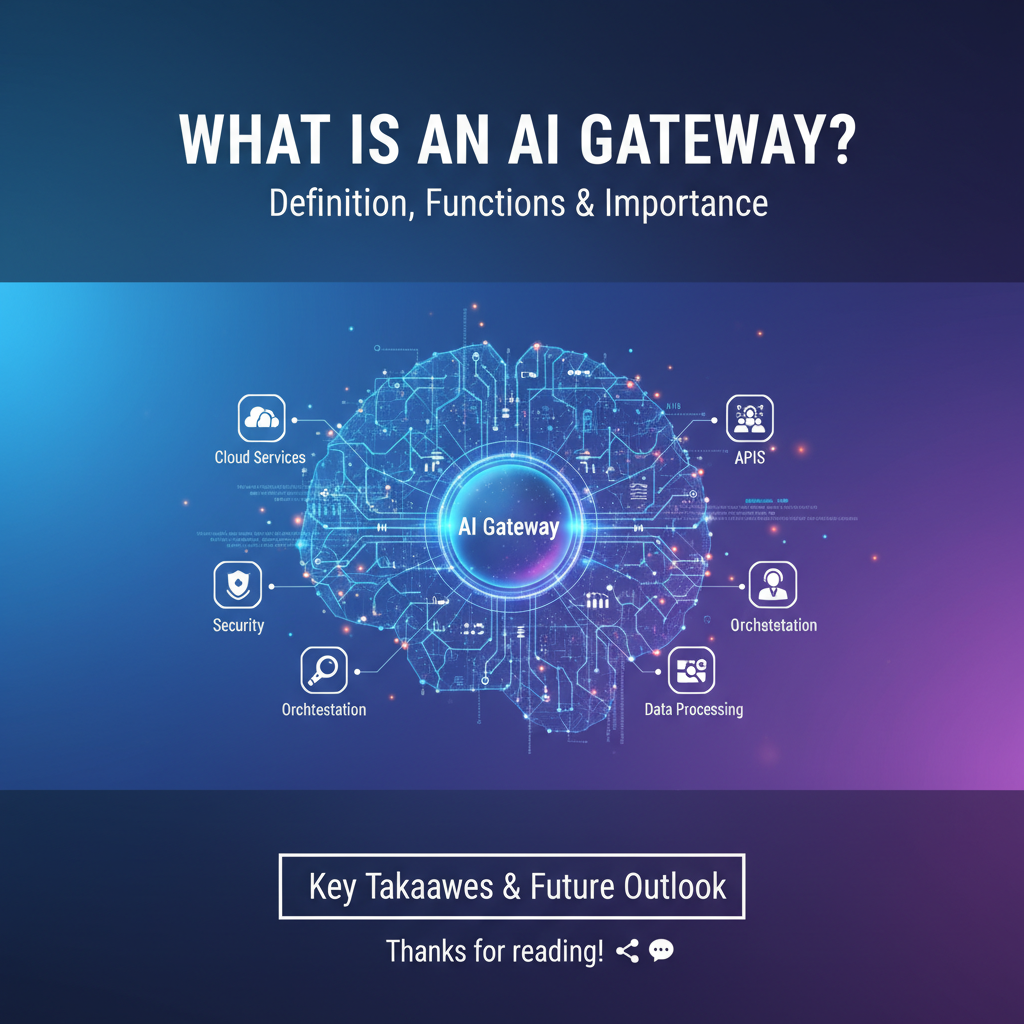
What is an AI Gateway? Definition, Functions & Importance


The advent of artificial intelligence, particularly the explosion of large language models (LLMs) and sophisticated machine learning applications, has fundamentally reshaped the technological landscape. From automating complex business processes to powering cutting-edge conversational interfaces, AI is no longer a futuristic concept but a tangible, transformative force integrated into the fabric of modern applications. However, this profound integration brings with it a significant layer of complexity. Developers and enterprises are grappling with the challenges of managing diverse AI models, ensuring their secure and efficient deployment, optimizing performance, and controlling costs across a myriad of use cases. It's in this intricate environment that the AI Gateway emerges not just as a convenience, but as an indispensable architectural component, bridging the gap between application logic and the powerful, yet often disparate, world of artificial intelligence.
At its core, an AI Gateway acts as a centralized control plane, a sophisticated intermediary that sits between client applications and the various AI models they interact with. Imagine it as a grand conductor orchestrating a complex symphony of intelligent services, ensuring every note is played in harmony, at the right time, and with optimal performance. This article will embark on a comprehensive journey to define what an AI Gateway truly is, explore its multifaceted functions, underscore its critical importance in the contemporary AI ecosystem, and delve into its architectural underpinnings, real-world applications, and future trajectory. We will uncover how this pivotal technology is not merely an extension of traditional API management but a specialized innovation designed to tame the unique complexities of AI, empowering businesses to unlock its full potential with unprecedented ease and control.
What is an AI Gateway? A Comprehensive Definition
To fully grasp the essence of an AI Gateway, it’s helpful to begin by understanding its foundational role as a specialized form of a traditional API Gateway. In the realm of microservices and cloud-native architectures, an API Gateway serves as a single entry point for all client requests, routing them to the appropriate backend services, applying policies like authentication, rate limiting, and caching, and abstracting the complexity of the backend infrastructure from the client. It’s a traffic controller, a security guard, and a performance optimizer all rolled into one, essential for managing the lifecycle of traditional RESTful APIs.
An AI Gateway takes this foundational concept and elevates it, specializing its capabilities to address the unique demands of artificial intelligence models and services. While it inherits many functionalities from its conventional counterpart, it introduces a layer of AI-specific intelligence and abstraction that is crucial for effective AI integration. Fundamentally, an AI Gateway is a robust, centralized infrastructure component that acts as an intelligent proxy for AI model interactions. It provides a unified, standardized interface for applications to consume various AI models, regardless of their underlying technology, deployment location (cloud-based, on-premise, different providers), or specific API protocols.
Consider the diverse landscape of AI models: you might have a Large Language Model (LLM) from OpenAI for text generation, a computer vision model from Google Cloud for image analysis, a custom-trained machine learning model deployed on your own Kubernetes cluster for predictive analytics, and another open-source model running locally for specific tasks. Each of these models likely has a distinct API, different authentication mechanisms, varying data formats for input and output, and unique operational characteristics. Integrating these directly into an application would lead to a tangled web of specific client code, making development cumbersome, maintenance a nightmare, and scalability a constant struggle.
This is where the AI Gateway steps in as a vital abstraction layer. It centralizes the management of these disparate AI services, offering a coherent and consistent experience for developers. Instead of writing bespoke code for each AI provider or model, applications interact solely with the gateway. The gateway then intelligently routes the request to the correct AI model, translates data formats if necessary, applies security policies, monitors performance, and manages costs, all transparently to the calling application.
A specialized form of an AI Gateway, often discussed in today's landscape, is an LLM Gateway. As the name suggests, an LLM Gateway specifically focuses on managing interactions with Large Language Models. Given the rapid proliferation of LLMs from various providers (OpenAI, Anthropic, Google, Hugging Face, etc.), each with their own pricing structures, performance characteristics, and API nuances, an LLM Gateway becomes particularly valuable. It handles prompt management, versioning, cost-aware routing (e.g., sending a request to the cheapest LLM that meets performance criteria), and provides a unified interface for invoking diverse language models. Essentially, an LLM Gateway is a highly specialized AI Gateway tailored to the specific challenges and opportunities presented by generative AI and natural language processing models.
Key characteristics that define an AI Gateway include:
- Abstraction: It hides the complexity of underlying AI models, offering a simplified and standardized interface.
- Centralized Control: It provides a single point of enforcement for security policies, routing rules, and performance optimization.
- Intelligence: It can make dynamic decisions based on factors like model performance, cost, availability, and specific request characteristics.
- Scalability: It's built to handle high volumes of AI inference requests and manage the lifecycle of numerous AI services.
- Observability: It offers deep insights into AI model usage, performance, and associated costs.
In essence, an AI Gateway is the intelligent intermediary that transforms the chaotic potential of diverse AI models into a well-managed, secure, and highly performant resource for any application. It is the architectural linchpin that enables enterprises to integrate AI seamlessly, experiment boldly, and scale confidently in an AI-first world.
The Evolution from Traditional API Gateways to AI Gateways
To fully appreciate the innovations brought forth by the AI Gateway, it is essential to understand its lineage and how it transcends the capabilities of traditional API Gateways. The journey from a general-purpose API management solution to a specialized AI-centric intermediary is driven by the unique demands and inherent complexities of artificial intelligence.
Traditional API Gateways emerged as a critical architectural pattern in the era of microservices. As monolithic applications fractured into smaller, independently deployable services, the need for a central orchestrator became paramount. A conventional API Gateway typically performs several vital functions:
- Routing: Directing incoming requests to the correct backend service based on the URL path or headers.
- Authentication and Authorization: Verifying client identity and permissions before allowing access to services.
- Rate Limiting and Throttling: Preventing abuse and ensuring fair usage by controlling the number of requests a client can make within a specified period.
- Caching: Storing responses to frequently accessed data to reduce latency and backend load.
- Load Balancing: Distributing incoming traffic across multiple instances of a service to ensure high availability and optimal resource utilization.
- Protocol Translation: Converting client-facing protocols (e.g., HTTP/1.1) to backend protocols (e.g., HTTP/2, gRPC).
- Request/Response Transformation: Modifying payloads to match expectations of different services or clients.
- Monitoring and Logging: Collecting metrics and logs for operational insights and troubleshooting.
These functionalities are robust and have served well in managing traditional RESTful APIs that primarily deal with structured data, predictable latency, and relatively static business logic. However, the world of AI introduces an entirely new set of challenges that push the boundaries of what a generic API Gateway can effectively manage:
- Diverse Model Types and Protocols: AI models come in various forms (statistical, deep learning, generative), from different providers (OpenAI, Huganthropic, Google, AWS, custom), and often expose unique APIs or SDKs. Standardizing access across these disparate interfaces is a non-trivial task.
- Dynamic Input/Output Formats: Unlike predictable JSON or XML schemas, AI models often require specific input formats (e.g., image tensors, audio waveforms, complex prompt structures) and produce equally varied outputs, necessitating sophisticated data transformation.
- Resource Intensity and Variable Latency: AI inference, especially for large models, can be computationally intensive, leading to higher and more unpredictable latencies. Managing queues, retries, and intelligent fallbacks becomes crucial.
- Prompt Engineering and Context Management (especially for LLMs): For generative AI, the prompt is paramount. Managing prompt versions, injecting context, and ensuring prompt consistency across different models or model versions is a unique AI challenge. Traditional gateways have no inherent understanding of prompt semantics.
- Cost Optimization: Different AI models and providers have varying pricing structures (per token, per inference, per GPU hour). Optimizing costs by intelligently routing requests based on real-time pricing and performance is beyond a generic API Gateway's scope.
- Stateful Interactions: Some AI applications require maintaining context across multiple turns or requests (e.g., conversational AI). A generic gateway might not be equipped to manage this state effectively or integrate it with model-specific memory systems.
- Data Privacy and Compliance for AI: Handling sensitive data processed by AI models requires specific controls and auditing capabilities to comply with regulations like GDPR, HIPAA, or CCPA, which can be more complex than for traditional data processing.
- Observability and AI-Specific Metrics: Beyond standard HTTP metrics, understanding AI model utilization, inference times per token, prompt effectiveness, and model drift requires specialized monitoring and logging capabilities.
- Security for AI-Specific Threats: AI models are susceptible to unique vulnerabilities like prompt injection, adversarial attacks, or data poisoning. An AI Gateway can serve as the first line of defense against these specialized threats, offering an additional layer of validation and sanitization.
In response to these distinct challenges, the AI Gateway extends the foundational capabilities of an API Gateway by adding an AI-aware layer. It doesn't just route HTTP requests; it routes intelligent interactions. It doesn't just apply generic security policies; it applies AI-specific guardrails. It doesn't just log API calls; it logs model inputs, outputs, and associated metadata to provide deep AI operational insights. This evolution signifies a paradigm shift, recognizing that AI services are not merely another type of backend endpoint, but a fundamentally different class of service requiring a purpose-built management solution. It's this specialization that makes the AI Gateway a transformative force in the era of pervasive artificial intelligence.
Core Functions and Features of an AI Gateway
The true power of an AI Gateway lies in its comprehensive suite of functions, each meticulously designed to address the unique complexities of integrating and managing AI models. These functions transform a chaotic landscape of diverse AI services into a cohesive, secure, and highly efficient operational environment.
1. Model Abstraction and Unification
One of the most profound benefits of an AI Gateway is its ability to abstract away the inherent diversity and complexity of various AI models and providers. In a world where you might be using a sophisticated LLM Gateway for OpenAI's GPT models, a specialized vision API from Google Cloud, and a custom-trained machine learning model on AWS SageMaker, each with its own specific API calls, authentication methods, and data formats, the integration headache can be immense.
The AI Gateway solves this by presenting a unified API interface to client applications. This means that regardless of whether the underlying model is a text-to-image generator, a sentiment analysis tool, or a recommendation engine, applications interact with a single, consistent endpoint and data schema. The gateway handles all the necessary translations, data transformations, and protocol adaptations in the background. This standardization drastically simplifies development, as engineers no longer need to write bespoke code for each AI service. Furthermore, it allows for seamless swapping of AI models—a critical capability for experimentation, cost optimization, and avoiding vendor lock-in—without requiring changes to the application logic. For instance, if you decide to switch from one LLM provider to another, the application continues to make the same standardized call to the gateway, and the gateway intelligently routes and translates the request to the new backend model.
Here, a product like APIPark excels, offering the capability to quickly integrate over 100 AI models. It provides a unified management system for authentication and cost tracking across these models. Crucially, APIPark standardizes the request data format across all AI models, ensuring that changes in AI models or prompts do not affect the application or microservices, thereby simplifying AI usage and maintenance costs.
2. Intelligent Routing and Orchestration
Beyond simple traffic forwarding, an AI Gateway implements intelligent routing logic tailored for AI workloads. This capability is critical for optimizing performance, managing costs, and enhancing reliability.
- Cost-Aware Routing: The gateway can dynamically route requests to the most cost-effective AI model or provider based on real-time pricing, request parameters (e.g., complexity, length), or defined budgets. For example, a non-critical request might be routed to a cheaper, slightly slower LLM, while a high-priority request goes to a premium, low-latency model.
- Latency and Performance-Based Routing: Requests can be directed to the AI model instance or provider that offers the lowest latency or best performance at a given moment, perhaps considering geographic proximity, current load, or historical performance metrics.
- Fallback Mechanisms: If a primary AI model or provider becomes unavailable or experiences degraded performance, the gateway can automatically failover to a predefined secondary model, ensuring service continuity and resilience.
- Load Balancing: For widely used models, the gateway can distribute requests across multiple instances of the same model (e.g., across different GPUs or regions) to prevent overload and ensure consistent response times.
- Chaining and Orchestration: More advanced AI Gateways can orchestrate multi-step AI workflows. This involves chaining multiple AI models together, where the output of one model becomes the input for the next, or integrating AI models with traditional microservices to create complex composite AI applications.
3. Security and Access Control
Security is paramount when dealing with AI models, especially those handling sensitive data. An AI Gateway acts as a central enforcement point for robust security policies, extending beyond traditional API security to address AI-specific concerns.
- Authentication and Authorization: It enforces strict authentication mechanisms (e.g., API keys, OAuth 2.0, JWT tokens) to verify the identity of calling applications. Authorization policies then determine what models or operations each authenticated client is permitted to access.
- Data Privacy and Compliance: The gateway can implement data masking, anonymization, or redaction rules on inputs and outputs to ensure compliance with regulations like GDPR, HIPAA, or CCPA, especially when sensitive user data is processed by external AI models.
- Threat Protection: Beyond basic rate limiting, an AI Gateway can offer defenses against AI-specific threats such as prompt injection (for LLMs), adversarial attacks (modifying inputs to mislead models), or denial-of-service attacks targeting AI endpoints. It can validate inputs for malicious patterns or excessive length.
- Tenant Isolation: For multi-tenant environments, the gateway ensures that each tenant's AI interactions, data, and configurations remain isolated and secure. APIPark, for example, enables the creation of multiple teams (tenants), each with independent applications, data, user configurations, and security policies, while sharing underlying applications and infrastructure to improve resource utilization and reduce operational costs.
- API Resource Access Approval: To prevent unauthorized use and maintain strict control over sensitive AI services, features like subscription approval can be activated. This ensures that callers must subscribe to an API and await administrator approval before they can invoke it, a capability also offered by APIPark, preventing unauthorized API calls and potential data breaches.
4. Performance Optimization and Reliability
Maintaining high performance and reliability for AI-driven applications is crucial for a positive user experience. The AI Gateway implements several features to achieve this.
- Caching: It can cache responses from AI models for identical or similar requests, significantly reducing latency and the load on backend AI services. This is especially effective for models that produce consistent outputs for specific inputs.
- Rate Limiting and Throttling: Beyond security, these controls ensure that individual AI models or providers are not overwhelmed by sudden spikes in traffic, maintaining their stability and responsiveness.
- Retry Mechanisms: The gateway can automatically retry failed AI inference requests, especially for transient errors, enhancing the resilience of the system without requiring application-level logic.
- Circuit Breakers: To prevent cascading failures, if an AI model or service repeatedly fails, the gateway can "trip" a circuit breaker, temporarily stopping requests to that service and allowing it to recover, rather than continuing to send requests that are destined to fail.
- Connection Pooling: Efficiently manages connections to backend AI services, reducing overhead and improving throughput.
- Load Management and Scalability: An effectively designed AI Gateway, like APIPark which boasts performance rivaling Nginx (achieving over 20,000 TPS with an 8-core CPU and 8GB of memory and supporting cluster deployment), is built to handle massive scales of AI inference requests. It can dynamically scale its own instances and efficiently manage traffic to backend AI services.
5. Monitoring, Logging, and Analytics
Deep observability into AI model usage, performance, and costs is invaluable for operational excellence and strategic decision-making. The AI Gateway provides a centralized platform for this.
- Detailed Request/Response Logging: It captures comprehensive logs for every AI interaction, including the input prompts, model outputs, timestamps, client IDs, latency, and any errors. This is critical for debugging, auditing, and understanding how AI models are being used. APIPark specifically provides comprehensive logging capabilities, recording every detail of each API call, enabling businesses to quickly trace and troubleshoot issues.
- Performance Metrics: The gateway collects metrics such as inference latency, error rates, model uptime, and throughput for each AI service, offering real-time insights into the health and performance of the AI ecosystem.
- Cost Tracking: It tracks and attributes AI model usage and associated costs per application, user, or business unit, enabling precise cost allocation and optimization.
- Anomaly Detection: By analyzing historical data, the gateway can detect unusual patterns in usage or performance, alerting administrators to potential issues before they impact users.
- Powerful Data Analysis: Beyond raw logs, AI Gateways can provide advanced analytics dashboards, allowing businesses to visualize trends, identify popular models, analyze performance changes over time, and gain actionable insights for preventive maintenance, as offered by APIPark.
6. Cost Management and Optimization
With AI services often priced per token, per call, or per compute hour, managing costs is a significant concern. The AI Gateway provides sophisticated tools for cost control.
- Quota Management: It allows administrators to set usage quotas per client, application, or model, preventing runaway costs.
- Budget Alerts: Automated alerts can be configured to notify teams when specific cost thresholds are approached or exceeded.
- Tiered Access: Different tiers of service can be offered, perhaps routing premium customers to higher-cost, lower-latency models, while standard users go to more economical options.
- Dynamic Provider Switching: As mentioned in intelligent routing, the gateway can dynamically switch between AI providers based on real-time cost comparisons for similar model capabilities.
7. Prompt Engineering and Management (especially for LLM Gateways)
For LLM Gateways, managing prompts is a core function, far more complex than simple HTTP request/response transformations.
- Prompt Templating and Versioning: Developers can define, store, and version prompt templates centrally. The gateway can then inject dynamic data into these templates before sending them to the LLM, ensuring consistency and allowing for easy iteration and A/B testing of different prompts.
- Prompt Encapsulation into REST API: APIPark allows users to quickly combine AI models with custom prompts to create new, specialized APIs, such as sentiment analysis, translation, or data analysis APIs, effectively treating a prompt-model combination as a distinct callable service.
- Guardrails and Content Moderation: The gateway can implement pre- and post-processing steps to filter out inappropriate, harmful, or sensitive content from prompts before they reach the LLM, and from LLM outputs before they reach the application.
- Context Management: For conversational AI, the gateway can manage conversation history and inject relevant context into subsequent prompts, ensuring coherent and continuous dialogues.
8. API Lifecycle Management
An AI Gateway is not just a runtime proxy; it often integrates with API lifecycle management tools to provide a complete developer experience.
- Design and Publication: It facilitates the design of AI service APIs and their publication to a developer portal.
- Versioning: It supports multiple versions of AI service APIs, allowing developers to gradually migrate clients to newer versions without disrupting older applications.
- Documentation: Integration with documentation tools ensures that developers have clear and up-to-date information on how to consume AI services.
- Developer Portal: A self-service portal allows developers to discover available AI APIs, subscribe to them, generate API keys, and access documentation. APIPark assists with managing the entire lifecycle of APIs, including design, publication, invocation, and decommission. It helps regulate API management processes, manage traffic forwarding, load balancing, and versioning of published APIs. It also enables API service sharing within teams, allowing for centralized display of all API services for easy discovery and use across departments.
By offering this comprehensive suite of functionalities, an AI Gateway transforms the daunting task of AI integration and management into a streamlined, secure, and cost-effective operation. It empowers organizations to harness the full power of artificial intelligence, driving innovation and competitive advantage.
The Importance and Benefits of Implementing an AI Gateway
The strategic implementation of an AI Gateway is no longer a luxury but a fundamental necessity for organizations looking to scale their AI initiatives, maintain security, and optimize operational efficiency. The benefits derived from deploying an AI Gateway are extensive and impact every facet of AI-driven development and deployment, from the individual developer to the overarching business strategy.
1. Simplified Integration and Faster Development Cycles
One of the most immediate and tangible benefits is the drastic simplification of integrating AI capabilities into applications. Without an AI Gateway, developers would face the daunting task of individually integrating with multiple AI models, each with distinct APIs, authentication methods, and data formats. This results in significant development overhead, bespoke code for each integration, and a high risk of errors.
An AI Gateway provides a unified, consistent api gateway to all AI services. Developers interact with a single interface, abstracting away the underlying complexity of diverse models and providers. This means: * Reduced Development Time: Engineers spend less time on integration plumbing and more time on core application logic. * Standardized Approach: A consistent way to access all AI models across the organization, improving code readability and maintainability. * Faster Prototyping and Experimentation: It becomes incredibly easy to swap out one AI model for another (e.g., trying a different LLM or a new sentiment analysis model) without altering application code, accelerating innovation and iteration.
2. Enhanced Security and Compliance
AI models, especially those processing sensitive user data, present unique security and compliance challenges. The AI Gateway centralizes security controls, acting as a critical enforcement point.
- Centralized Access Control: All AI interactions flow through the gateway, allowing for robust, centralized authentication (e.g., API keys, OAuth) and fine-grained authorization policies. This ensures only authorized applications and users can access specific AI models.
- Data Protection: The gateway can implement pre-processing and post-processing steps to mask, anonymize, or redact sensitive data before it reaches an AI model or before its output is returned to the client, ensuring compliance with regulations like GDPR, HIPAA, and CCPA.
- Threat Mitigation: It acts as the first line of defense against AI-specific vulnerabilities such as prompt injection, adversarial attacks, and denial-of-service attempts by implementing input validation, rate limiting, and content filtering.
- Audit Trails: Comprehensive logging capabilities provide detailed audit trails of all AI interactions, which is invaluable for security forensics, compliance reporting, and debugging.
3. Improved Performance and Reliability
Performance and reliability are critical for AI applications that often operate under tight latency constraints or handle mission-critical tasks. The AI Gateway is engineered to optimize these aspects.
- Optimized Routing: Intelligent routing logic directs requests to the best-performing, least-latent, or most available AI model instances, improving overall response times.
- Caching AI Responses: For idempotent requests, caching can drastically reduce latency and backend load, offering near-instant responses.
- Fault Tolerance and High Availability: Features like automatic failover, retry mechanisms, and circuit breakers ensure that AI services remain available even if individual models or providers experience outages or performance degradation.
- Load Balancing and Scalability: By distributing requests across multiple model instances, the gateway prevents overload and ensures that AI services can scale effectively to meet fluctuating demand, from modest usage to peak traffic.
4. Significant Cost Efficiency
The operational costs associated with consuming AI models, especially from third-party providers, can quickly spiral out of control if not properly managed. An AI Gateway provides powerful tools for cost optimization.
- Cost-Aware Routing: This allows organizations to strategically route requests to the most cost-effective AI model or provider based on factors like current pricing, model capabilities, and latency requirements. For example, less critical tasks can be routed to cheaper models.
- Usage Tracking and Quota Management: Detailed tracking of AI model consumption per application, user, or project allows for accurate cost attribution and the enforcement of usage quotas, preventing unexpected bills.
- Caching Benefits: By serving cached responses, the gateway reduces the number of actual calls made to paid AI services, directly impacting expenditure.
- Resource Utilization: By intelligently load balancing and optimizing resource use, the gateway ensures that compute resources for self-hosted AI models are utilized efficiently.
5. Increased Agility and Innovation
In the rapidly evolving AI landscape, the ability to quickly adapt, experiment, and deploy new models is a significant competitive advantage.
- Vendor Lock-in Reduction: By abstracting AI models, the gateway makes it easier to switch between different AI providers or deploy custom models without major code changes, reducing reliance on a single vendor.
- A/B Testing and Experimentation: The gateway can facilitate A/B testing of different AI models or prompt versions, routing a percentage of traffic to new models to evaluate their performance and impact before a full rollout.
- Rapid Deployment of New Features: With streamlined integration and management, new AI-powered features can be developed and deployed much faster.
6. Better Governance and Compliance
AI governance is becoming increasingly important, encompassing ethical considerations, regulatory compliance, and operational best practices.
- Centralized Policy Enforcement: All policies—security, routing, cost, and data handling—are managed from a single point, ensuring consistent application across all AI services.
- Auditability: Comprehensive logs provide an invaluable resource for auditing AI model behavior, data flows, and adherence to internal policies and external regulations.
- Model Versioning: The ability to manage and version different AI models and their associated prompts allows for controlled deployment and easier rollback if issues arise.
7. Scalability and Future-Proofing
As AI adoption grows, the demand for AI services will only increase. An AI Gateway is built to handle this expansion.
- Horizontal Scalability: The gateway itself can be horizontally scaled to handle increasing volumes of AI traffic.
- Seamless Model Expansion: Adding new AI models or integrating with new providers is a managed process through the gateway, ensuring the infrastructure can gracefully evolve with AI advancements.
- Standardized Foundation: Provides a stable and extensible foundation for future AI integrations, preventing the need for costly refactoring as the AI landscape changes.
In summary, implementing an AI Gateway transforms the chaotic and complex world of AI model integration into a well-ordered, secure, and efficient ecosystem. It empowers organizations to confidently leverage the transformative power of AI, driving innovation while simultaneously ensuring robustness, security, and cost-effectiveness.
Key Architectural Components of an AI Gateway
An AI Gateway is a sophisticated piece of infrastructure, typically composed of several interconnected modules working in concert to fulfill its diverse functions. While specific implementations may vary, a common architectural pattern includes the following core components:
1. Proxy/Reverse Proxy Engine
At the very heart of an AI Gateway lies a robust proxy or reverse proxy engine. This is the entry point for all client requests targeting AI services. Its primary role is to intercept incoming requests, forward them to the appropriate backend AI model, and return the model's response back to the client. This engine handles the fundamental network communication, including TCP/IP connections, HTTP/S request parsing, and response serialization. Popular technologies for this layer often include Nginx, Envoy Proxy, or specialized components built on frameworks like Netty or Go's standard library. It provides the initial layer for connection management, SSL/TLS termination, and basic load distribution.
2. Routing Engine
Building upon the proxy layer, the routing engine is responsible for intelligently directing incoming AI requests to the correct backend AI model or service. This engine is far more intelligent than a simple URL-based router in a traditional API Gateway. It considers a multitude of factors to make routing decisions:
- Request Metadata: Headers, query parameters, request body content (e.g., prompt length, model name hint).
- Policy Rules: Predefined rules based on cost, latency, geographic location, or specific model capabilities.
- Real-time Metrics: Current load on backend models, their availability, historical performance, and pricing data.
- Dynamic Configuration: The ability to update routing rules on the fly without service interruption.
The routing engine might implement sophisticated algorithms to achieve cost-aware routing (e.g., sending requests to the cheapest available LLM), performance-aware routing (e.g., routing to the fastest model instance), or even A/B testing scenarios where a percentage of traffic is directed to an experimental model.
3. Authentication and Authorization Module
This module is the security gatekeeper for all AI interactions. It ensures that only legitimate and authorized clients can access AI services.
- Authentication: Verifies the identity of the client. This can involve validating API keys, processing OAuth 2.0 tokens, JWT (JSON Web Tokens), or integrating with enterprise identity providers (e.g., Okta, Azure AD).
- Authorization: Once authenticated, this component determines what specific AI models, endpoints, or operations the client is permitted to perform based on predefined roles, permissions, or access control lists (ACLs). It might check if a client has subscribed to a particular AI service (as seen in APIPark's API resource access approval feature) or if they belong to a specific tenant.
- Tenant Management: For multi-tenant AI Gateways (like APIPark), this module also manages tenant isolation, ensuring that each tenant's resources and access policies are distinct and secure.
4. Policy Enforcement Engine
This component applies various operational policies to AI requests and responses, ensuring service quality, security, and resource governance.
- Rate Limiting and Throttling: Controls the number of requests a client can make to prevent abuse and ensure fair usage, protecting backend AI models from being overwhelmed.
- Quota Management: Enforces usage limits based on predefined quotas, contributing to cost control.
- Request/Response Transformation: Modifies request payloads (e.g., standardizing input formats for different AI models, injecting context into prompts) and response payloads (e.g., filtering sensitive information, translating output formats).
- Data Masking/Anonymization: Implements rules to protect sensitive data as it flows through the gateway.
- Content Moderation/Guardrails: For LLMs, this module can preprocess prompts to filter out harmful content or post-process responses to ensure outputs are within acceptable guidelines.
5. Monitoring, Logging, and Analytics Module
Visibility into the AI ecosystem is critical for operational stability, performance tuning, and cost management. This module is responsible for collecting and processing operational data.
- Detailed Logging: Captures comprehensive logs for every AI request and response, including request headers, payload snippets (e.g., prompt, response), latency, status codes, model used, and any errors. This level of detail is crucial for debugging and auditing.
- Metrics Collection: Gathers real-time performance metrics such as requests per second (RPS), error rates, average latency, CPU/memory usage of the gateway itself, and potentially model-specific metrics like token usage or inference time.
- Traceability: Often integrates with distributed tracing systems (e.g., OpenTelemetry, Jaeger) to provide end-to-end visibility of an AI request across multiple services.
- Analytics Dashboard: Processes collected data to generate dashboards and reports (like APIPark's powerful data analysis capabilities), offering insights into usage patterns, performance trends, cost attribution, and anomaly detection.
6. Configuration Store
The configuration store acts as the centralized repository for all gateway settings, policies, and metadata. This includes:
- Routing Rules: Definitions of how requests should be directed.
- Authentication/Authorization Policies: API keys, user roles, permissions.
- Rate Limits and Quotas: Thresholds and usage allowances.
- Model Metadata: Information about integrated AI models (e.g., their endpoints, specific API requirements, current pricing, version numbers).
- Prompt Templates: For LLM Gateways, stored templates and their versions.
This store should ideally be dynamic and hot-reloaded, allowing changes to be applied without restarting the gateway service. Technologies like Consul, etcd, Apache ZooKeeper, or even a robust database can serve this purpose.
7. Model Adapter Layer
This is a key component that differentiates an AI Gateway from a generic API Gateway. The model adapter layer is responsible for the intricate task of interfacing with diverse AI models, translating the unified API calls from the client into the specific protocols and data formats required by each backend AI service.
- Protocol Translation: Adapting between the gateway's internal standard (often HTTP/JSON) and the model's native interface (e.g., gRPC, a custom SDK, specific REST endpoints).
- Data Transformation: Converting the standardized input format from the client into the specific tensor or data structure required by the AI model, and vice-versa for the output.
- Credential Management: Securely managing and injecting credentials (e.g., API keys, OAuth tokens) specific to each AI provider.
- Error Handling: Translating model-specific errors into a standardized error format for the client.
8. Orchestration Engine (for advanced workflows)
For use cases involving complex multi-step AI processes, an orchestration engine might be integrated. This component allows for the definition and execution of workflows that chain multiple AI models or combine AI services with traditional microservices. For example, a single request to the gateway could trigger: 1. An image recognition model. 2. Then, a text description generator based on the image output. 3. Finally, a sentiment analysis LLM on the generated text.
This engine manages the state, dependencies, and flow control for these composite AI applications, providing a single endpoint for a multi-stage process.
By combining these architectural components, an AI Gateway creates a robust, intelligent, and flexible infrastructure layer that is essential for effectively managing the growing complexity and diversity of AI models in enterprise environments.
APIPark is a high-performance AI gateway that allows you to securely access the most comprehensive LLM APIs globally on the APIPark platform, including OpenAI, Anthropic, Mistral, Llama2, Google Gemini, and more.Try APIPark now! 👇👇👇
Use Cases and Applications of AI Gateways
The versatility and robustness of an AI Gateway make it an invaluable tool across a wide spectrum of industries and application types. It addresses common pain points and unlocks new possibilities for leveraging AI, transforming how organizations integrate, manage, and consume intelligent services.
1. Enterprise AI Integration and Centralization
One of the most prominent use cases is within large enterprises seeking to integrate a multitude of AI models into their diverse business operations. Modern enterprises often employ a mix of: * Third-party cloud AI services: Such as natural language processing (NLP) from Google Cloud, computer vision from AWS Rekognition, or advanced generative models from OpenAI/Anthropic. * Open-source models: Deployed internally (e.g., various LLMs from Hugging Face, custom-trained TensorFlow or PyTorch models). * Legacy AI systems: Older, perhaps on-premise, machine learning models.
Managing direct integrations for each of these would create an unmanageable mess. An AI Gateway provides a single, central API Gateway for all these services. * Example: A global retail company uses an AI Gateway to provide a unified interface for its various internal applications (e.g., CRM, e-commerce platform, supply chain management) to access different AI capabilities. This could include a sentiment analysis model for customer reviews, a demand forecasting model for inventory, and an LLM for internal knowledge base querying, all accessed through the same gateway. This ensures consistent security, unified logging, and simplified access for internal developers.
2. SaaS Platforms Leveraging AI
Software-as-a-Service (SaaS) providers are increasingly embedding AI features into their offerings to provide enhanced value to their customers. Whether it's AI-powered analytics, intelligent automation, or advanced content generation, an AI Gateway is crucial for managing the backend AI infrastructure. * Example: A marketing automation SaaS platform offers features like AI-powered email subject line generation, content summarization, and audience segmentation. The platform integrates various LLMs and predictive models through an AI Gateway. This allows them to: * Dynamically switch between different LLMs based on cost or performance for generating content. * Apply rate limits per customer or subscription tier. * Monitor AI usage and attribute costs to individual customers for billing. * Ensure data privacy by redacting sensitive information before sending it to third-party AI models.
3. Developer Platforms and Marketplaces for AI
For companies that provide AI models or API services to external developers, an AI Gateway acts as the foundational layer of their developer portal. * Example: A startup develops several specialized AI models (e.g., a unique image processing model, a niche industry-specific LLM) and wants to expose them as API services to other developers. An AI Gateway enables them to: * Publish these models as well-documented APIs with standardized interfaces. * Manage API keys, enforce subscription approval workflows (as seen with APIPark), and control access permissions for different developer tiers. * Provide comprehensive analytics on API usage, performance, and billing for their developer community. * Easily version their AI APIs and manage their full lifecycle, from design to decommissioning.
4. Cost-Optimized AI Deployments
Given the variable pricing models of AI services, particularly for LLMs, an AI Gateway is instrumental in optimizing operational expenditure. * Example: A financial services firm uses multiple LLMs for document analysis, risk assessment, and customer interaction. They configure their LLM Gateway (a specialized AI Gateway) to: * Route routine, lower-priority queries to a more cost-effective LLM (e.g., an open-source model running on their own infrastructure or a cheaper commercial offering). * Reserve high-priority, sensitive, or complex queries for premium, higher-performance, and potentially more expensive LLMs. * Implement dynamic routing that switches between providers based on real-time cost comparisons and current model loads. * Enforce quotas to prevent individual departments from exceeding their allocated AI budgets.
5. AI Model Experimentation and A/B Testing
The fast-paced nature of AI development necessitates continuous experimentation and evaluation of new models or prompt engineering strategies. An AI Gateway facilitates this with minimal risk. * Example: A product team wants to test if a new version of their recommendation engine (or a new LLM for product descriptions) performs better than the existing one. Through the AI Gateway, they can: * Route a small percentage (e.g., 5-10%) of live user traffic to the new model (or a new prompt template). * Collect performance metrics (e.g., latency, error rates) and business impact metrics (e.g., conversion rates, user engagement) through the gateway's monitoring capabilities. * Compare the results of the new model against the baseline, allowing for data-driven decisions on model deployment, without disrupting the main user experience.
6. Enhanced Customer Service and Support
AI Gateways can streamline the integration of various AI tools used in customer service, leading to more efficient and intelligent support systems. * Example: A customer support center uses an AI Gateway to integrate a chatbot (powered by an LLM), a sentiment analysis tool, and a knowledge base search engine. When a customer query comes in: * The gateway first routes it to the chatbot LLM. * Simultaneously, a sentiment analysis model processes the query for urgency. * If the chatbot can't resolve the query, the gateway might route it to a human agent, providing the agent with the sentiment analysis, the LLM's attempted responses, and relevant knowledge base articles retrieved by another AI model—all orchestrated and logged by the gateway.
7. Data Analysis and Insights
Organizations can use AI Gateways to streamline access to various analytical AI models, making it easier to extract insights from data. * Example: A data science team needs to apply various AI models (e.g., anomaly detection, predictive analytics, natural language understanding) to large datasets. The AI Gateway provides a unified programmatic interface to these models, allowing the team to: * Easily invoke different analytical AI services as part of their data pipelines. * Manage authentication and authorization for sensitive data. * Monitor the performance and cost of their analytical AI workloads.
By serving these diverse use cases, the AI Gateway stands out as an architectural cornerstone, enabling organizations to move beyond mere experimentation with AI to truly operationalize and scale their intelligent applications across the enterprise.
Challenges in Building and Managing an AI Gateway
While the benefits of an AI Gateway are profound, its implementation and ongoing management are not without their complexities. Building a robust, performant, and secure AI Gateway requires careful consideration and expertise across various technical domains.
1. Complexity of Diverse AI Models and Protocols
The fundamental challenge that an AI Gateway aims to solve — the diversity of AI models — is also its greatest implementation hurdle. * Heterogeneous APIs: Different AI providers (OpenAI, Google, AWS, custom internal models) expose wildly different APIs, data schemas, authentication mechanisms, and even communication protocols (HTTP/REST, gRPC, proprietary SDKs). The gateway must be capable of adapting to all these variations. * Data Transformation: Normalizing input data from client applications into the specific format required by a particular AI model (e.g., converting a standard image file into a tensor for a vision model) and then transforming the model's output back into a consumable format for the client is a non-trivial task, especially when dealing with complex data types. * Rapid Evolution of AI Models: The AI landscape is in constant flux, with new models, APIs, and versions being released frequently. The gateway must be agile enough to integrate these updates quickly without breaking existing integrations.
2. Ensuring Low Latency and High Throughput
AI applications, especially real-time ones like chatbots or autonomous systems, are highly sensitive to latency. The AI Gateway, as an intermediary, inherently adds some overhead. * Performance Overhead: Each layer of abstraction and processing (routing, security checks, data transformation, logging) adds microseconds or milliseconds to the total request latency. Minimizing this overhead while retaining functionality is critical. * High Throughput Requirements: Many AI applications require processing a large volume of requests concurrently. The gateway must be designed for high throughput, capable of handling thousands or even tens of thousands of requests per second (like APIPark's reported 20,000 TPS capability). This often involves efficient connection management, asynchronous processing, and highly optimized code. * Resource Intensiveness: Both the gateway and the underlying AI models can be resource-intensive. Managing CPU, memory, and network resources efficiently is crucial to prevent bottlenecks and ensure scalability.
3. Maintaining Security and Data Privacy
AI Gateway sits at a critical juncture, handling potentially sensitive data and controlling access to valuable AI models, making it a prime target for security concerns. * Robust Authentication and Authorization: Implementing secure, flexible, and scalable authentication and authorization mechanisms that can integrate with enterprise identity providers is complex. * AI-Specific Threats: The gateway needs to defend against threats unique to AI, such as prompt injection (for LLMs), adversarial attacks (crafting inputs to trick models), or data poisoning attempts. This often requires specialized validation and filtering logic. * Data in Transit and at Rest: Ensuring that sensitive data is encrypted in transit (TLS) and, if cached, encrypted at rest, is paramount for data privacy. * Compliance: Adhering to diverse regulatory requirements (GDPR, HIPAA, CCPA) when processing data through various AI models, potentially across different jurisdictions, adds significant complexity to policy enforcement.
4. Effective Cost Management
The dynamic and often opaque pricing models of external AI services make cost management a significant challenge. * Tracking and Attribution: Accurately tracking AI usage and attributing costs to specific projects, teams, or end-users across different providers and models requires sophisticated logging and analytics capabilities. * Dynamic Optimization: Implementing real-time, cost-aware routing that considers current model prices, performance, and organizational budgets is complex and requires continuous monitoring and algorithmic decision-making. * Preventing Bill Shocks: Without robust quotas and alerts, unexpected spikes in AI usage can lead to exorbitant bills. Designing effective preventive measures is critical.
5. Evolving AI Landscape and Rapid Model Updates
The field of AI is characterized by its incredibly rapid pace of innovation. New models, architectures, and capabilities emerge constantly. * Integration Agility: The gateway must be designed to quickly integrate new AI models and adapt to API changes from existing providers without requiring major architectural overhauls. * Versioning Management: Handling multiple versions of the same AI model (e.g., GPT-3.5 vs. GPT-4), or different versions of an organization's custom models, and allowing clients to switch between them gracefully, adds complexity. * Model Lifecycle: Managing the complete lifecycle of AI models, from experimentation and deployment to deprecation, within the gateway's framework requires robust governance.
6. Integration with Existing Infrastructure
An AI Gateway rarely operates in isolation. It needs to seamlessly integrate with an organization's existing infrastructure. * Logging and Monitoring Systems: Compatibility with existing SIEMs, observability platforms, and alert systems. * Identity and Access Management (IAM): Integration with corporate directories and IAM solutions. * CI/CD Pipelines: Automation of gateway configuration, deployment, and testing within existing continuous integration/continuous deployment workflows. * Network Infrastructure: Seamless fit within existing network security policies, firewalls, and load balancers.
7. Scalability for Fluctuating AI Workloads
AI workloads can be highly unpredictable, with sudden spikes in demand for specific models. * Elastic Scaling: The gateway itself must be designed for elastic scalability, capable of dynamically provisioning and de-provisioning resources to match demand. * Backend Model Scaling: While the gateway manages access, it also needs to provide mechanisms or integrate with systems that can scale the underlying AI models, especially for self-hosted solutions. * State Management: For applications requiring context (e.g., conversational AI), managing state across potentially scaled-out gateway instances adds complexity.
8. Developer Experience and Usability
While the gateway aims to simplify development, the gateway itself must be easy for operators and developers to configure and use. * Intuitive Configuration: Providing clear, intuitive ways to configure routing rules, security policies, and model integrations. * Comprehensive Documentation: Ensuring that developers have access to clear and up-to-date documentation for consuming AI services through the gateway. * Developer Portal: An effective self-service developer portal is critical for adoption, allowing developers to discover, subscribe to, and manage access to AI APIs.
Addressing these challenges effectively is key to realizing the full potential of an AI Gateway as a strategic asset for AI-driven transformation. It often requires a combination of robust commercial solutions, open-source tools, and in-house expertise in distributed systems, security, and machine learning operations.
Choosing the Right AI Gateway Solution
Selecting the appropriate AI Gateway solution is a critical decision that can significantly impact an organization's ability to effectively leverage AI. The market offers a variety of options, ranging from open-source projects to comprehensive commercial platforms, each with its own strengths and weaknesses. The "right" choice depends heavily on an organization's specific needs, existing infrastructure, budget, and long-term AI strategy.
1. Open-source vs. Commercial Solutions
This is often the first and most fundamental decision point.
- Open-source Solutions:
- Pros: Offer flexibility, transparency, community support, and typically no direct licensing costs. They allow for deep customization to fit unique requirements. Projects like Envoy Proxy (which can be extended to an AI Gateway) or specialized open-source AI Gateways can be powerful. APIPark is an excellent example of an open-source AI Gateway and API management platform that provides robust features.
- Cons: Require significant in-house expertise for deployment, configuration, maintenance, and ongoing development. The total cost of ownership can be higher due to operational overhead. Documentation and support might be less formal or comprehensive than commercial offerings.
- Commercial Solutions:
- Pros: Often come with a complete feature set, professional support, extensive documentation, and a more polished user interface. They can accelerate deployment and reduce operational burden, making them ideal for organizations with limited in-house expertise or strict SLAs.
- Cons: Involve licensing fees, potentially leading to vendor lock-in. Customization might be limited to what the vendor provides.
The choice often comes down to a trade-off between control/flexibility (open-source) and ease of use/support (commercial). Some solutions, like APIPark, bridge this gap by offering a strong open-source foundation with enterprise-grade commercial support and advanced features available for leading enterprises.
2. Scalability and Performance
For any gateway, especially one handling dynamic AI workloads, scalability and performance are non-negotiable. * Throughput and Latency: Evaluate the solution's ability to handle the expected volume of AI requests with acceptable latency. Look for benchmarks and real-world performance data. Solutions built on high-performance languages (like Go or Rust) or optimized proxies (like Nginx, as APIPark rivals) are often good indicators. * Horizontal Scalability: Ensure the gateway can be easily scaled horizontally by adding more instances to handle increased load without significant re-architecture. * Resilience: Check for built-in features like automatic failover, retry mechanisms, and circuit breakers that ensure high availability and fault tolerance.
3. Feature Set
A comprehensive AI Gateway should offer a rich set of features that address the full spectrum of AI management needs.
- Core API Gateway Functions: Routing, authentication, authorization, rate limiting, load balancing, caching.
- AI-Specific Abstraction: Unified API for diverse AI models, data transformation, prompt management (for LLM Gateway).
- Security: Advanced threat protection, data masking, tenant isolation, access approval workflows.
- Observability: Detailed logging, comprehensive metrics, powerful analytics, cost tracking.
- Orchestration: Ability to chain multiple AI models or services for complex workflows.
- Lifecycle Management: Support for API design, versioning, publication, and decommissioning, often through a developer portal.
- Developer Experience: Ease of use for developers consuming AI APIs, including clear documentation and a self-service portal.
4. Ease of Deployment and Management
The simplicity of getting the gateway up and running, and then managing it on an ongoing basis, is a significant factor in its total cost of ownership. * Deployment Options: Does it support various deployment environments (e.g., Kubernetes, Docker, cloud-native services)? Solutions like APIPark, with its quick 5-minute single-command line deployment, offer significant advantages here. * Configuration: Is configuration straightforward (e.g., declarative APIs, intuitive UI) or overly complex? * Operational Overhead: How much effort is required for patching, upgrades, monitoring, and troubleshooting? Does it integrate well with existing DevOps tools and practices?
5. Community Support and Documentation
For any software, especially open-source, the strength of its community and the quality of its documentation are vital. * Active Community: A vibrant community signals ongoing development, bug fixes, and readily available peer support. * Comprehensive Documentation: Clear, up-to-date, and easy-to-understand documentation reduces the learning curve and troubleshooting time. * Professional Support: For commercial solutions, evaluate the quality, responsiveness, and SLA of the vendor's technical support.
6. Vendor Reputation and Long-Term Viability
When considering commercial solutions, or even open-source projects backed by companies, the vendor's reputation and financial stability are important. * Track Record: Look at the vendor's history in the API management or AI space. * Roadmap: Understand the product's future direction and how it aligns with your evolving AI strategy. * Ecosystem Integration: How well does the solution integrate with other tools and platforms you use (e.g., cloud providers, monitoring tools, identity providers)?
7. Total Cost of Ownership (TCO)
Beyond initial licensing fees, consider all costs: * Infrastructure Costs: Compute, storage, and networking resources required to run the gateway. * Operational Costs: Labor for deployment, maintenance, support, and customization. * Training Costs: For developers and operations teams. * Opportunity Costs: The impact of slower development or increased risk if the wrong solution is chosen.
Table 1: Key Considerations for AI Gateway Selection
| Feature/Aspect | Open-Source Solution (e.g., extended Envoy, APIPark) | Commercial Solution (e.g., enterprise platforms) | Importance (1-5, 5=highest) |
|---|---|---|---|
| Initial Cost | Low (no license fees) | High (licensing fees) | 4 |
| Customization | High (source code access) | Moderate (vendor-defined extensions) | 4 |
| Deployment Speed | Moderate to High (requires setup; quick for tools like APIPark) | High (often guided installers/cloud-managed) | 3 |
| Management Effort | High (in-house expertise required) | Low to Moderate (vendor handles much) | 4 |
| Support | Community-driven; commercial support often available (e.g., APIPark) | Dedicated professional support (SLAs) | 5 |
| Feature Set | Can be comprehensive, but may require extensions | Typically comprehensive out-of-the-box | 5 |
| Vendor Lock-in | Low | Moderate to High | 3 |
| Data Control | High (you control deployment) | Moderate (depends on vendor's cloud deployment) | 4 |
| Innovation Pace | Varies (community-driven; strong for platforms like APIPark) | Varies (vendor-driven roadmap) | 4 |
| Security Updates | Relies on community/maintainers (or vendor for commercial support) | Regular, professional security patches | 5 |
Ultimately, choosing the right AI Gateway solution requires a thorough evaluation against an organization's specific requirements. For many startups and organizations looking for a robust, flexible, and rapidly deployable solution, open-source platforms like APIPark offer a compelling blend of advanced features and cost-effectiveness, with the option for commercial support as needs evolve. For larger enterprises with complex compliance needs and substantial budgets, a fully-fledged commercial platform might be a more suitable choice. The key is to prioritize the features and support mechanisms that best align with the organization's strategic AI objectives and operational capabilities.
The Future of AI Gateways
The rapid evolution of artificial intelligence guarantees that the AI Gateway will also continue to evolve, becoming even more sophisticated and integral to the AI ecosystem. Its future trajectory will be shaped by advancements in AI models, increasing demands for governance, and the need for ever-greater efficiency and intelligence in AI operations.
1. Increased Intelligence and Autonomous Optimization
Future AI Gateways will leverage AI themselves to become more intelligent and autonomous. * Self-Optimizing Routing: The routing engine will move beyond rule-based decisions to use reinforcement learning or predictive analytics to autonomously optimize routing based on real-time costs, latency, and even contextual cues from the requests themselves. Imagine a gateway that learns to predict which LLM Gateway provider will be most cost-effective for a given query type at a specific time of day. * Proactive Anomaly Detection and Self-Healing: AI Gateways will use machine learning to detect subtle anomalies in AI model performance, usage patterns, or security threats and proactively take corrective actions, such as rerouting traffic, isolating faulty models, or issuing pre-emptive alerts. * Adaptive Security: The gateway will learn from attack patterns and automatically adapt its security policies to counter emerging AI-specific threats, becoming a more robust intelligent firewall for AI services.
2. Closer Integration with MLOps Pipelines
The boundary between development, deployment, and operational management of AI models will blur, leading to tighter integration between AI Gateways and MLOps (Machine Learning Operations) platforms. * Automated Gateway Configuration: MLOps pipelines will automatically generate and update gateway configurations (e.g., new model routes, updated data transformations, prompt versions) as new AI models are trained and deployed. * Feedback Loops for Model Improvement: The gateway's rich monitoring and logging data will feed directly back into MLOps pipelines, providing crucial insights for model retraining, hyperparameter tuning, and performance improvement based on real-world usage. * Version Control for Prompts and Models: Deeper integration with version control systems to manage not just model artifacts but also prompt templates, gateway configurations, and associated policies.
3. Enhanced Security Features Against AI-Specific Threats
As AI becomes more pervasive, so too will the sophistication of attacks targeting AI systems. Future AI Gateways will play an even more critical role in defense. * Advanced Prompt Injection Detection: Utilizing advanced NLP and machine learning techniques to detect and neutralize increasingly subtle and sophisticated prompt injection attacks against LLMs. * Adversarial Attack Mitigation: Implementing built-in defenses against adversarial examples, such as input sanitization, perturbation detection, and robust feature extraction. * Responsible AI Guardrails: Enforcing ethical AI principles by integrating content moderation, bias detection, and fairness checks directly within the gateway's processing pipeline, ensuring AI outputs align with organizational values and regulatory requirements.
4. Broader Adoption Across Industries
The indispensable nature of AI Gateways will lead to their widespread adoption across virtually every industry vertical. * Healthcare: Managing secure access to diagnostic AI models, patient data analysis, and drug discovery LLMs, while ensuring strict compliance. * Finance: Orchestrating AI for fraud detection, algorithmic trading, personalized financial advice, and regulatory compliance. * Manufacturing: Centralizing access to AI for predictive maintenance, quality control, and supply chain optimization. * Government: Securely deploying AI for public services, defense, and intelligence, with robust auditing and access controls.
5. Greater Emphasis on Ethical AI and Governance Within the Gateway
As AI's impact on society grows, so does the demand for ethical considerations and robust governance. The AI Gateway will be a key enforcer of these principles. * Bias Detection and Remediation: Integrated tools to monitor and flag biased outputs from AI models, with potential for real-time remediation or rerouting. * Explainability (XAI) Integration: Providing mechanisms to capture and expose explanations for AI model decisions as they pass through the gateway, improving transparency and trust. * Policy-as-Code for AI Governance: Allowing organizations to define and enforce complex AI governance policies (e.g., data usage restrictions, ethical guidelines) as code within the gateway.
6. Federated AI and Distributed Model Management
The trend towards decentralized AI and data privacy will influence gateway architectures. * Federated Learning Integration: Managing access to and orchestration of federated learning models, where AI training happens on distributed datasets without centralizing raw data. * Edge AI Management: Extending gateway capabilities to the edge, managing AI models deployed on local devices or edge infrastructure, and optimizing data flow between edge and cloud.
7. Emergence of Specialized LLM Gateways Becoming More Prominent
While the generic AI Gateway will continue to evolve, specialized LLM Gateways will become even more critical and feature-rich. * Advanced Prompt Orchestration: Beyond simple templating, future LLM Gateways will offer sophisticated prompt engineering tools, including chain-of-thought prompting, agentic workflows, and automated prompt optimization. * Contextual Memory Management: Deeper integration with vector databases and other memory systems to provide highly relevant context to LLMs, moving beyond simple session history. * Multimodal AI Support: Seamlessly handling and orchestrating interactions with multimodal LLMs that can process and generate text, images, audio, and video.
The future of AI Gateways is one of increasing sophistication, intelligence, and essentiality. They will transform from mere proxies into intelligent control centers, acting as the indispensable nervous system for the next generation of AI-driven applications and enterprises. Those organizations that embrace and strategically implement these advanced gateways will be best positioned to harness the full, transformative power of artificial intelligence.
Conclusion
In an era increasingly defined by the pervasive influence of artificial intelligence, the AI Gateway has rapidly transitioned from a novel concept to an indispensable architectural cornerstone. As organizations strive to integrate a diverse and rapidly evolving landscape of AI models – from sophisticated Large Language Models (LLMs) to specialized vision and predictive analytics engines – the inherent complexities of disparate APIs, varied data formats, stringent security demands, and escalating costs present formidable challenges. The AI Gateway emerges as the elegant solution, acting as a crucial intermediary that unifies, secures, optimizes, and governs access to this powerful ecosystem.
We have thoroughly explored its definition, understanding it as a specialized extension of the traditional API Gateway, purpose-built to navigate the unique intricacies of AI workloads. Its core functions are vast and varied: providing unparalleled model abstraction and unification, intelligent routing and orchestration, robust security and access control, critical performance optimization, and invaluable monitoring, logging, and analytics. Furthermore, its specialized capabilities for prompt engineering, cost management, and comprehensive API lifecycle management underscore its holistic approach to AI operationalization. Products like APIPark, an open-source AI gateway and API management platform, exemplify how these features are brought together to simplify integration, standardize invocation, and provide end-to-end lifecycle management for AI and REST services.
The importance of implementing an AI Gateway cannot be overstated. It dramatically simplifies integration and accelerates development cycles, fortifies security and ensures compliance, enhances performance and reliability, and drives significant cost efficiencies. Moreover, it empowers organizations with greater agility for innovation, improves governance, and provides scalable, future-proof infrastructure crucial for navigating the dynamic AI landscape. From enterprise-wide AI integration to specialized SaaS platforms and cost-optimized deployments, its real-world applications are as diverse as they are impactful.
While the journey of building and managing an AI Gateway presents challenges, from handling diverse protocols to ensuring low latency and robust security against AI-specific threats, the strategic investment in overcoming these hurdles yields substantial returns. As the AI paradigm continues to evolve, the AI Gateway will become increasingly intelligent, autonomously optimizing and integrating even more seamlessly with MLOps pipelines, further solidifying its role as the critical control plane for all AI interactions.
In conclusion, for any enterprise or developer aspiring to harness the full transformative potential of artificial intelligence, the AI Gateway is not merely an option but a strategic imperative. It is the intelligent conductor that orchestrates the symphony of AI models, transforming complexity into clarity, chaos into control, and raw potential into tangible, secure, and scalable innovation. Embracing this pivotal technology is key to thriving in the AI-first future.
Frequently Asked Questions (FAQ)
1. What is the fundamental difference between an AI Gateway and a traditional API Gateway?
While an AI Gateway shares foundational functionalities with a traditional API Gateway (like routing, authentication, rate limiting), its key differentiator lies in its specialization for AI/ML workloads. An AI Gateway understands the unique characteristics of AI models, such as diverse input/output formats, varied API protocols from different providers, the need for prompt management (especially for LLMs), cost-aware routing based on model pricing, and AI-specific security threats (e.g., prompt injection). It provides a deeper layer of abstraction and intelligence tailored specifically for managing AI services, whereas a traditional API Gateway is more generalized for RESTful APIs.
2. Why is an AI Gateway particularly important for Large Language Models (LLMs)?
LLM Gateways, as a specific type of AI Gateway, are crucial for LLMs due to their unique complexities. Different LLM providers (OpenAI, Anthropic, Google, etc.) have distinct APIs, varying performance characteristics, and diverse pricing models (per token, per call). An LLM Gateway centralizes access, allowing for: * Unified API: Interacting with multiple LLMs through a single, consistent interface. * Cost Optimization: Dynamically routing requests to the most cost-effective LLM based on real-time pricing and performance. * Prompt Management: Versioning, templating, and injecting context into prompts, and even encapsulating prompts into new APIs. * Guardrails: Implementing content moderation and security filters specific to generative AI outputs. This significantly simplifies LLM integration, reduces vendor lock-in, and optimizes operational costs.
3. Can an AI Gateway help in reducing the cost of using external AI services?
Absolutely. Cost optimization is one of the primary benefits of an AI Gateway. It achieves this through several mechanisms: * Cost-Aware Routing: Intelligently directing requests to the cheapest available AI model or provider that meets performance requirements. * Caching: Storing responses for repeated identical requests, thus reducing the number of paid calls to external services. * Quota Management: Enforcing usage limits per user or application to prevent unexpected spikes in consumption. * Usage Tracking: Providing detailed analytics on AI model usage, allowing organizations to identify cost drivers and make informed decisions.
4. How does an AI Gateway enhance security for AI applications?
An AI Gateway significantly bolsters security by acting as a central enforcement point. It implements: * Robust Authentication and Authorization: Ensuring only authenticated and authorized clients can access AI models. * Data Protection: Masking or redacting sensitive data in prompts and responses to comply with privacy regulations. * Threat Mitigation: Defending against AI-specific attacks like prompt injection, adversarial examples, and denial-of-service attempts through input validation and content filtering. * Centralized Logging and Auditing: Providing comprehensive audit trails of all AI interactions for security monitoring and compliance. Features like API resource access approval also prevent unauthorized API calls.
5. Is it difficult to deploy and manage an AI Gateway?
The difficulty of deploying and managing an AI Gateway can vary. Open-source solutions might require more in-house expertise for setup, configuration, and maintenance. However, many modern open-source projects, like APIPark, are designed for quick deployment (e.g., with a single command line) and offer strong community support. Commercial solutions typically provide more streamlined deployment processes, professional support, and managed services to reduce operational overhead. When choosing a solution, it's crucial to consider the complexity of your AI ecosystem, your team's technical capabilities, and the deployment and management features offered by the specific gateway solution.
🚀You can securely and efficiently call the OpenAI API on APIPark in just two steps:
Step 1: Deploy the APIPark AI gateway in 5 minutes.
APIPark is developed based on Golang, offering strong product performance and low development and maintenance costs. You can deploy APIPark with a single command line.
curl -sSO https://download.apipark.com/install/quick-start.sh; bash quick-start.sh

In my experience, you can see the successful deployment interface within 5 to 10 minutes. Then, you can log in to APIPark using your account.

Step 2: Call the OpenAI API.