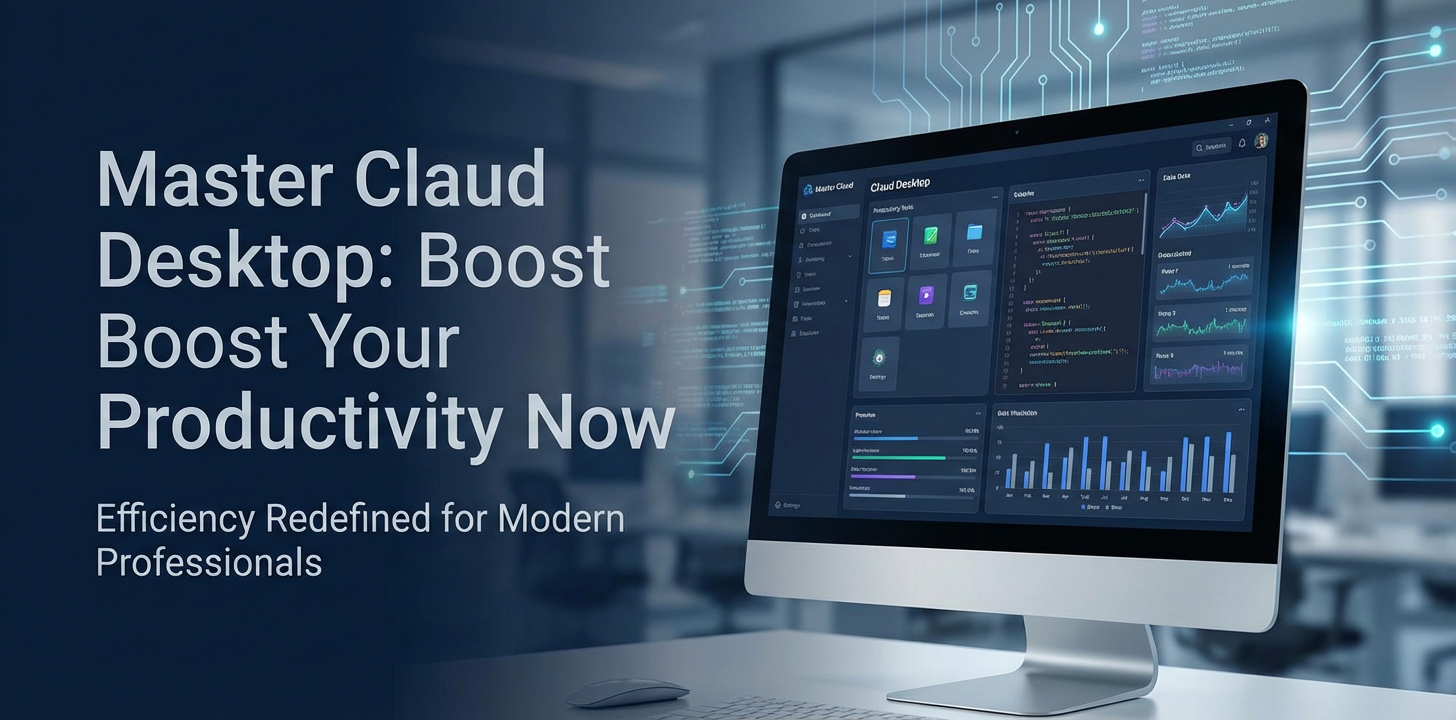
Master Claud Desktop: Boost Your Productivity Now


In an era defined by rapid digital transformation and the relentless pursuit of efficiency, the tools we choose profoundly shape our daily productivity. Artificial Intelligence, once a concept relegated to science fiction, has now firmly established itself as an indispensable partner in virtually every professional domain. From intricate data analysis to creative content generation, AI models are reshaping how we interact with information and execute tasks. However, for many, the interaction with these powerful AI entities remains largely confined to web browsers or complex API calls, often leading to fragmented workflows and a noticeable disconnect from the native desktop experience. This creates a compelling void, a space yearning for a more integrated, intuitive, and seamlessly accessible AI companion.
Enter the conceptualization of Claud Desktop—a revolutionary application designed not merely as another interface to an AI model, but as a holistic, deeply integrated productivity hub tailored for the modern professional. This envisioned application promises to transcend the limitations of traditional browser-based AI interactions, offering a robust, responsive, and secure environment where the unparalleled capabilities of Claude AI are brought directly to your desktop. Imagine an AI assistant that understands the nuances of your local files, collaborates effortlessly across your applications, and remains perpetually at your fingertips, ready to augment your intelligence and accelerate your output. This isn't just about bringing AI to your screen; it's about embedding it into the very fabric of your digital workspace, transforming how you think, create, and achieve. The promise of claud desktop is nothing less than a paradigm shift in personal and professional productivity, offering a glimpse into a future where AI isn't just a tool, but a true extension of your cognitive capabilities.
Understanding the Need: Bridging the Gap Between Cloud AI and Local Workflow
The proliferation of sophisticated AI models has undeniably revolutionized various industries, offering unprecedented capabilities in natural language understanding, generation, and complex problem-solving. Yet, for all their power, the primary mode of interaction with many of these cutting-edge AIs, including the formidable Claude, has largely remained tethered to web-based platforms. Users typically access these models through a browser interface, where they type prompts, receive responses, and often copy-paste information back into their local documents or applications. While functional, this method introduces inherent friction into the workflow, demanding constant context switching and manual data transfer, which inevitably diminishes efficiency and disrupts the flow of creative or analytical thought. Each tab opened, each piece of text copied and pasted, represents a small but cumulatively significant impediment to a truly fluid and productive experience.
Furthermore, relying solely on browser-based interactions often comes with subtle yet impactful limitations. Performance can be subject to network latency, browser responsiveness, and even the stability of the web service itself. Security and privacy concerns also surface more prominently when sensitive or proprietary information must be constantly routed through web forms and external servers without the benefit of a dedicated, locally managed application. The lack of deep operating system integration means these AI models exist in a silo, unable to natively interact with your local file system, clipboard, or other installed applications without cumbersome workarounds. This isolation prevents the AI from becoming a truly ambient and proactive assistant, limiting its potential to genuinely augment your daily tasks and provide real-time, context-aware support.
This burgeoning gap between the immense power of cloud-based AI and the practical demands of daily desktop productivity sets the stage for a transformative solution. Professionals across all sectors are increasingly seeking tools that not only leverage advanced AI but also integrate seamlessly into their existing digital ecosystems, respecting their workflow, safeguarding their data, and enhancing their natural capabilities without introducing additional complexities. The vision for claude desktop emerges precisely from this critical need: to provide a dedicated, high-performance, and deeply integrated application that liberates AI from the browser's confines and embeds it directly into the heart of your local operating system. By doing so, it promises to eliminate friction, enhance security, and unlock a new dimension of interactive intelligence, making advanced AI not just accessible, but truly indispensable to your daily operations. This move towards a native desktop experience is not merely an improvement; it is an evolution, signaling a maturation of AI deployment that prioritizes user experience, data integrity, and unparalleled efficiency.
Core Features of Master Claud Desktop: Unlocking Unprecedented Productivity
The true brilliance of Claud Desktop lies in its meticulously designed feature set, envisioned to go far beyond a simple wrapper for an AI model. It's conceived as a comprehensive productivity suite, engineered to integrate seamlessly with your operating system and your workflow, thereby unlocking levels of efficiency and capability previously unattainable.
Intuitive User Interface and Seamless Interaction
At its heart, Claud Desktop prioritizes an intuitive and clutter-free user interface, designed to minimize cognitive load and maximize focus. The streamlined aesthetic ensures that the powerful AI capabilities are always accessible without overwhelming the user. The primary interaction pane offers an enhanced chat experience that surpasses typical web interfaces. Users can engage in rich-text conversations, complete with markdown support, code blocks, and the ability to embed multimedia elements directly into their prompts and responses. This rich interaction layer allows for more nuanced communication with the AI, enabling users to formulate complex queries with greater clarity and receive more structured, actionable output. Furthermore, one of the standout features is its persistent conversational memory across sessions. This means that Claud Desktop remembers past interactions, learned preferences, and ongoing projects, allowing users to pick up conversations exactly where they left off, without the tedious need to re-explain context or re-upload previous documents. This continuity fosters a more natural, evolving relationship with the AI, transforming it from a mere tool into a genuine, long-term collaborative partner that understands your unique work style and project history.
Deep System Integration for a Unified Experience
The most transformative aspect of Claud Desktop is its profound integration with the underlying operating system, breaking down the artificial barriers between your AI assistant and your local environment. One of its most powerful functionalities is intelligent clipboard monitoring. With user permission, Claud Desktop can observe your clipboard activity, proactively offering contextually relevant assistance based on copied text, images, or code snippets. Imagine copying a paragraph and instantly having Claud Desktop offer to summarize it, translate it, or refine its language. Similarly, direct file system access, granted through secure, user-controlled permissions, allows Claud Desktop to interact with your local documents directly. This capability means you can drag and drop entire research papers, code repositories, or legal documents into the application and instruct the AI to analyze, summarize, extract key information, or even generate new content based on their contents, all without ever uploading them to an external web service or copying vast amounts of text manually. Beyond active interaction, Claud Desktop can also provide OS-level notifications for long-running tasks, critical updates, or proactive suggestions based on your calendar or active applications. Customizable quick-access widgets or a global hotkey ensure that Claud Desktop is always just a keystroke away, offering immediate assistance regardless of which application you are currently using, effectively turning your AI into an omnipresent, intelligent layer within your digital workspace.
Advanced Content Creation and Augmentation
For anyone involved in generating or refining content, Claud Desktop is set to become an indispensable ally. As a writing assistant, it moves beyond basic grammar checks, offering sophisticated aid for drafting emails, composing detailed reports, crafting compelling marketing copy, or even exploring creative narratives. It can help brainstorm ideas, structure outlines, suggest alternative phrasing, and maintain a consistent tone and style throughout extensive documents. For software developers and engineers, the capabilities extend to advanced coding assistance. Claud Desktop can generate code snippets in various languages based on natural language descriptions, assist in debugging by identifying potential errors and suggesting fixes, and even help in creating comprehensive documentation for complex functions or entire projects. Its ability to understand context from your open files or clipboard means it can offer highly relevant, actionable code suggestions. Researchers and academics will find an invaluable tool for information synthesis and summarization. Claud Desktop can ingest vast amounts of textual data—from scientific papers to historical archives—and distill key findings, identify trends, cross-reference information, and even generate structured summaries or literature reviews, dramatically accelerating the research process. Furthermore, for creative professionals and strategists, its brainstorming and ideation capabilities are unparalleled. Claud Desktop can act as a tireless thought partner, generating innovative concepts, exploring different perspectives, and providing a wealth of starting points for any creative endeavor, from product design to marketing campaigns.
Customization and Personalization for Every User
Recognizing that every user has unique needs and preferences, Claud Desktop is designed with extensive customization options to truly make it your own. Users can define and save custom personas for the AI, tailoring its tone, expertise, and communication style for different contexts—e.g., a formal corporate persona for reports, a creative brainstorming persona for ideation, or a technical persona for coding assistance. This is complemented by the ability to create and manage custom prompt templates, allowing users to quickly invoke complex queries for recurring tasks without retyping them each time. Beyond functional personalization, the application offers a range of aesthetic customizations, including various themes, color schemes, and layout options, ensuring the interface is visually appealing and comfortable for long-duration use. Furthermore, for power users, Claud Desktop supports customizable keyboard shortcuts for rapid access to frequently used features and even the ability to integrate simple automation scripts, allowing for personalized workflows that streamline repetitive tasks and maximize efficiency. This level of personalization ensures that Claud Desktop is not a one-size-fits-all solution but a bespoke AI companion perfectly adapted to your individual working style.
Security, Privacy, and Data Management
In an age where data breaches and privacy concerns are paramount, Claud Desktop is engineered with a steadfast commitment to security and user control. A core principle of its design emphasizes local processing where technically feasible and beneficial, minimizing the need to send sensitive data to cloud servers. For interactions that do require cloud AI processing, Claud Desktop employs robust encryption protocols for data in transit and at rest, ensuring that your information is protected from unauthorized access. Users are given granular control over their data—what information is shared, with whom, and under what conditions. Clear data retention policies and easy-to-use controls for deleting conversational history or shared files empower users to manage their digital footprint effectively. For enterprise deployments, Claud Desktop can be configured to comply with specific organizational security policies and regulatory requirements, offering features like role-based access control, audit logs, and integration with existing identity management systems. The focus is on building trust through transparency and giving users complete agency over their private information while leveraging the immense power of AI.
Performance Optimization and Resource Management
A desktop application designed for serious productivity must perform flawlessly, and Claud Desktop is architected with performance at its core. It's optimized for efficient use of system resources, ensuring that it runs smoothly without bogging down your computer, even during intensive AI processing tasks. Its intelligent background processing capabilities mean that it can handle continuous assistance, such as real-time spell-checking or content suggestions, without interrupting your foreground work. For long-running queries or complex analyses, Claud Desktop can perform these tasks asynchronously, providing notifications upon completion while allowing you to continue with other work. The aim is for rapid response times for real-time tasks, making interactions with the AI feel immediate and natural, eliminating any perceptible lag that might disrupt your thought process. This dedication to performance ensures that Claud Desktop remains a responsive and reliable partner throughout your busiest workdays, consistently delivering results with speed and precision.
Collaborative Capabilities (Enterprise Focus)
For organizations seeking to leverage AI at scale, Claud Desktop extends its powerful features into the collaborative realm, making it an indispensable tool for teams and enterprises. It facilitates the creation of shared workspaces where teams can collaborate on projects, share AI-generated insights, and co-create content. Imagine a marketing team working on a campaign, using Claud Desktop to generate various ad copies, then sharing these drafts within a collaborative workspace for team feedback and iteration, all while the AI assists in refining the messaging. The platform can support shared knowledge bases, allowing teams to pool their collective AI interactions, custom prompts, and persona configurations, fostering a culture of shared intelligence and best practices. Version control for shared content ensures that modifications are tracked, and previous iterations can be easily reviewed or restored, crucial for compliance and quality assurance in complex projects.
Here, the underlying infrastructure that supports such sophisticated, multi-user, and multi-AI interactions becomes paramount. For large enterprises or even advanced users who integrate Claud Desktop with various internal systems or other AI models, the complexities of managing these connections, ensuring security, and tracking usage can be daunting. This is precisely where a robust AI gateway and API management platform like APIPark becomes not just beneficial, but essential. APIPark, an open-source AI gateway and API developer portal, offers an all-in-one solution for managing, integrating, and deploying AI and REST services with ease. In an enterprise setting where Claud Desktop might need to access dozens of specialized AI models—some internal, some external—APIPark provides a crucial layer for "unified API format for AI invocation," meaning that regardless of the underlying AI model, Claud Desktop (or the systems it interacts with) can call them using a standardized format. This significantly simplifies development and maintenance. Furthermore, APIPark assists with "end-to-end API lifecycle management," ensuring that all API services utilized by Claud Desktop for complex tasks, whether for data retrieval or advanced AI processing, are properly designed, published, invoked, and decommissioned. For teams, APIPark facilitates "API service sharing within teams," allowing different departments to easily find and use the required API services for their Claud Desktop deployments. This level of structured API management ensures not only operational efficiency but also enhanced security and compliance, with features like "independent API and access permissions for each tenant" and "API resource access requires approval," preventing unauthorized API calls and potential data breaches. For a truly robust and scalable enterprise deployment of Claud Desktop, leveraging a platform like APIPark for underlying API governance would be a strategic imperative, ensuring seamless, secure, and cost-effective integration of AI capabilities across the organization.
| Feature Category | Claud Desktop Capability |
Benefit for Productivity |
|---|---|---|
| Core Interaction | Enhanced Rich-Text Chat, Persistent Memory | Fluid conversations, no context loss, personalized AI experience |
| System Integration | Clipboard Monitoring, Local File Access, OS Notifications | Eliminates context switching, real-time context-aware assistance |
| Content Creation | Advanced Writing Assistant, Code Generation, Research Summary | Accelerates content drafting, coding, and information synthesis |
| Personalization | Custom Personas, Prompt Templates, UI Themes | Tailored AI behavior, efficient task execution, comfortable workspace |
| Security & Privacy | Local Processing Focus, Encryption, Granular Data Control | Safeguards sensitive data, ensures compliance, builds trust |
| Performance | Optimized Resource Usage, Background Processing, Rapid Response | Smooth operation, uninterrupted workflow, immediate AI assistance |
| Collaboration | Shared Workspaces, Knowledge Bases, Version Control | Facilitates team synergy, standardized practices, secure collaboration |
The Transformative Benefits of Embracing Claud Desktop
Adopting Claud Desktop is more than just adding another application to your computer; it's an investment in a fundamentally more efficient, secure, and intelligent way of working. The benefits ripple across every aspect of your professional and personal life, delivering tangible improvements that redefine productivity.
Elevated Efficiency and Time Savings
One of the most immediate and profound benefits of Claud Desktop is the dramatic elevation of efficiency and the substantial time savings it offers. By automating mundane, repetitive tasks—from drafting routine emails to summarizing lengthy documents—it frees up invaluable cognitive resources that can be redirected towards more strategic and creative endeavors. Imagine the hours saved when Claud Desktop can instantly distill the key takeaways from a stack of research papers, or generate boilerplate code for a new function based on a simple description. The seamless integration with your operating system minimizes context switching, a notorious productivity killer. Instead of juggling multiple browser tabs, copy-pasting between applications, and repeatedly re-explaining your context to a web-based AI, Claud Desktop lives within your workflow, offering instantaneous, context-aware assistance. This reduction in friction means that creative bursts are not interrupted, analytical thoughts flow unimpeded, and the overall pace of work accelerates significantly. It's about empowering you to achieve more in less time, not by working harder, but by working smarter with an intelligent assistant at your side.
Enhanced Accuracy and Quality of Output
Beyond speed, Claud Desktop profoundly enhances the accuracy and quality of your output. As an AI-powered proofreading and refinement tool, it goes far beyond conventional grammar checkers. It can analyze the nuances of language, identify inconsistencies in tone, suggest more impactful vocabulary, and even restructure sentences for greater clarity and persuasiveness. For critical documents, legal texts, or scientific reports, this level of AI-driven scrutiny ensures a higher standard of precision and professionalism. The ability to maintain a consistent tone and style across vast amounts of content, or even across different authors contributing to the same project, is invaluable for brand messaging and organizational communication. Whether you are generating marketing copy, technical documentation, or academic papers, Claud Desktop acts as an ever-vigilant editor and stylistic guide, ensuring that your final output is not only error-free but also polished, precise, and perfectly aligned with your intended message. This leads to higher quality deliverables, fewer revisions, and a more professional presentation of all your work.
Improved Data Security and Compliance
In today's interconnected world, data security and compliance are non-negotiable, and Claud Desktop offers significant improvements in these critical areas. By emphasizing local processing where feasible and employing robust encryption for necessary cloud interactions, it inherently reduces the exposure of sensitive and proprietary data to the broader internet. This means less data is floating through insecure browser caches or unencrypted channels. For organizations, Claud Desktop can be configured to operate within strict compliance frameworks, integrating with existing security protocols and offering audit trails for AI interactions. The granular control it provides over data sharing ensures that users and administrators can precisely dictate what information is processed by the AI and how it is handled, aligning with internal policies and external regulations such as GDPR or HIPAA. This enhanced control and transparency instill greater confidence, allowing individuals and enterprises to leverage advanced AI capabilities without compromising on the integrity and confidentiality of their valuable information.
Seamless Workflow Integration
One of the most powerful yet subtle benefits of Claud Desktop is its ability to foster truly seamless workflow integration. The inherent nature of a desktop application means it lives and breathes within your operating system, becoming an integral part of your digital environment rather than an external tool. This eliminates the constant context switching that plagues browser-based AI interactions, where you might be jumping between an email client, a document editor, and an AI web interface. With Claud Desktop, your AI assistant is always there, accessible via a global hotkey or a quick-access widget, ready to assist without pulling you away from your current task. It integrates with existing tools and applications by intelligently interacting with your clipboard, file system, and potentially even specific APIs of other software (with user permission). This means your AI assistant isn't just a standalone entity; it actively participates in and enhances your existing digital ecosystem, making every application you use smarter and more efficient. The result is a more fluid, cohesive, and enjoyable work experience, where the AI feels like a natural extension of your personal computing environment.
Personalized AI Assistantship
Finally, Claud Desktop offers a level of personalized AI assistantship that is unparalleled by generic, web-based counterparts. Through its persistent conversational memory, customizable personas, and ability to learn from your interactions, Claud Desktop truly adapts to your individual needs and working style. It's an AI that understands your preferences for formality or creativity, your technical jargon, and the specific nuances of your projects. This personal connection transforms the AI from a mere query engine into a genuinely intelligent companion that anticipates your needs and offers proactive, highly relevant suggestions. It learns from your corrections, refines its understanding of your tasks, and evolves over time to become an increasingly invaluable and indispensable partner. This isn't just about efficiency; it's about fostering a more harmonious and effective collaboration between human and artificial intelligence, leading to a truly personalized and empowering digital assistant experience that grows with you.
Getting Started with Claud Desktop: Your Journey to Enhanced Productivity
Embarking on your journey with Claud Desktop is designed to be a straightforward and empowering experience. The path from discovery to becoming a master of your new AI companion is clear, beginning with securing the software and culminating in a highly personalized and efficient workflow.
Where to download claude desktop
The very first step in harnessing the transformative power of Claud Desktop is to acquire the application. It is absolutely crucial to prioritize security and authenticity by always seeking out the official download source. In the digital landscape, unofficial downloads can harbor malicious software or provide outdated, unstable versions that undermine the very productivity gains you seek. Therefore, the most reliable and secure location to download claude desktop will always be the official website of the software developer or Antropic itself, or through reputable, authorized application stores such as the Microsoft Store for Windows, the Mac App Store for macOS, or potentially a dedicated enterprise software portal for organizational deployments. These official channels guarantee that you receive a legitimate, virus-free, and up-to-date version of the application, along with access to crucial support and future updates. A quick search on the official developer's site should lead you directly to the download page, often accompanied by system requirements and installation instructions, ensuring a safe and reliable starting point for your AI journey. Always verify the URL and look for security indicators (like HTTPS) to ensure you are on a trusted site before initiating any downloads.
Installation Process
Once you have securely downloaded the official Claud Desktop installer, the installation process is typically designed to be intuitive and user-friendly, catering to users of all technical proficiencies. For Windows users, this usually involves locating the downloaded .exe file and double-clicking it to launch the setup wizard. The wizard will guide you through a series of prompts, asking you to accept the End User License Agreement (EULA), choose an installation directory (the default is often recommended), and decide whether to create desktop shortcuts. Simply follow the on-screen instructions, clicking "Next" or "Install" as appropriate, and the software will deploy itself onto your system. For macOS users, the process is often even simpler: mount the .dmg file, then drag the Claud Desktop application icon into your Applications folder. Some versions might provide a dedicated installer that automates this. Linux users might find a .deb or .rpm package, which can be installed via their distribution's package manager, or a .AppImage that can be run directly. In all cases, the process is streamlined to get you up and running as quickly as possible, requiring minimal intervention and often completing within a few minutes, depending on your system's specifications.
Initial Configuration and Setup
Upon the successful installation and first launch of Claud Desktop, you will typically be greeted by an initial setup wizard designed to tailor the application to your specific needs. The most critical step here involves account linking. You will likely be prompted to sign in with your existing Claude AI account or create a new one. This step is essential for authenticating your access to the powerful cloud-based AI models and for syncing your preferences and conversational history across devices (if supported). Beyond authentication, the wizard will guide you through setting up basic preferences. This might include selecting your preferred language, choosing an initial theme (light or dark mode), and granting necessary permissions for Claud Desktop to interact with your operating system, such as access to your clipboard or specific directories on your file system. These permissions are crucial for enabling the deep integration features that make Claud Desktop so powerful, but they are always presented transparently, allowing you to maintain full control over your privacy and data. Taking a few moments to carefully review and configure these initial settings will lay the groundwork for a highly personalized and efficient experience right from the start.
First Interactions and Explorations
With the initial setup complete, you are now ready to engage with Claud Desktop and begin exploring its vast capabilities. Your first interactions should focus on understanding the core interface and how to effectively communicate with the AI. Start with simple prompts: ask it a general knowledge question, request a brief summary of a topic, or generate a short piece of text. Observe how it responds, noting the clarity, conciseness, and relevance of its output. Experiment with the rich-text features, such as using markdown to format your prompts or requesting the AI to output in a specific format like a bulleted list or a code block. Next, delve into the key features you configured during setup. Try copying a paragraph from a document and see if Claud Desktop offers to summarize it via clipboard monitoring. If you granted file system access, drag a small text file into the chat window and ask the AI to analyze its contents. Don't be afraid to experiment and push the boundaries of what you think the AI can do. The more you interact, the more you will discover its potential and learn how to formulate effective prompts that yield the best results for your specific tasks. This exploratory phase is vital for building intuition and comfort with your new AI assistant.
Tips for Mastering Claud Desktop
To truly master Claud Desktop and unlock its full productivity potential, consider these advanced tips. First, invest time in crafting effective prompts. Think of your interaction with the AI as a collaboration: the clearer and more specific your instructions, the better and more relevant the AI's response will be. Experiment with providing examples, defining roles for the AI (e.g., "Act as a marketing expert"), and specifying desired output formats. Second, fully leverage the integration capabilities. If you're a developer, use the code generation and debugging features by feeding it snippets from your IDE. If you're a writer, utilize its document summarization and refinement tools directly on your local files. Explore how Claud Desktop can interact with other applications you use regularly, making it a central hub for various tasks. Third, customize and personalize relentlessly. Create and refine custom personas for different types of work, saving prompt templates for recurring tasks to save time and ensure consistency. The more Claud Desktop adapts to your unique workflow, the more indispensable it becomes. Finally, stay updated. AI models and application features evolve rapidly. Regularly check for Claud Desktop updates, read release notes, and explore new functionalities as they become available. Engaging with the Claud Desktop community or forums can also provide valuable insights and tips from other power users. By embracing these strategies, you'll transform Claud Desktop from a powerful tool into an unparalleled personal productivity engine.
APIPark is a high-performance AI gateway that allows you to securely access the most comprehensive LLM APIs globally on the APIPark platform, including OpenAI, Anthropic, Mistral, Llama2, Google Gemini, and more.Try APIPark now! 👇👇👇
Real-World Applications: Who Benefits Most from Claud Desktop?
The versatile capabilities of Claud Desktop extend across a myriad of professions, offering bespoke advantages to a diverse range of users. Its ability to integrate deeply, personalize interactions, and augment cognitive tasks makes it an indispensable asset for virtually anyone seeking to elevate their productivity and output quality.
Writers and Content Creators
For writers, journalists, marketers, and anyone whose livelihood depends on the written word, Claud Desktop is nothing short of a game-changer. It transforms the entire content creation workflow, from the nascent stages of brainstorming to the final polish of a publishable piece. Imagine starting a new article with a blank page; Claud Desktop can instantly generate a compelling outline, suggest different angles or perspectives, and even provide a bank of keywords to optimize for SEO. During the drafting phase, it acts as a tireless co-author, helping to overcome writer's block by generating initial paragraphs, expanding on ideas, or rephrasing sentences for greater impact. When it comes to editing, its advanced language models go beyond simple grammar checks, offering stylistic improvements, ensuring consistent tone, and identifying logical inconsistencies across long-form content. Whether it's crafting engaging social media posts, developing comprehensive whitepapers, writing captivating novels, or composing persuasive ad copy, Claud Desktop significantly accelerates the process, improves linguistic quality, and allows creators to focus on the core narrative and creative vision, leaving the heavy lifting of composition and refinement to their intelligent assistant.
Software Developers and Engineers
Software development is a complex and often time-consuming endeavor, fraught with debugging, documentation, and the constant need to learn new frameworks. Claud Desktop emerges as a powerful ally for developers and engineers, streamlining various aspects of their work. It can assist with rapid code generation, translating natural language descriptions into functional code snippets or even entire functions in popular programming languages, drastically reducing boilerplate writing. When encountering bugs, developers can feed error messages or problematic code segments into Claud Desktop, which can then suggest potential fixes, explain the underlying issues, and even propose alternative implementations. This debugging assistance can significantly cut down on troubleshooting time. Furthermore, documenting code, which is often a neglected but crucial aspect of development, becomes effortless. Claud Desktop can automatically generate comprehensive comments, docstrings, or even full API documentation based on the codebase, ensuring maintainability and future clarity. From understanding complex algorithms to refactoring existing code and learning new syntaxes, Claud Desktop serves as an intelligent coding assistant, making developers more efficient, reducing errors, and allowing them to focus on architectural design and innovative problem-solving.
Researchers and Academics
The world of research and academia is characterized by an immense volume of information and the constant need for synthesis, analysis, and coherent communication. Claud Desktop offers revolutionary support for researchers and academics across all disciplines. It can ingest vast quantities of scientific literature, historical documents, or raw data, and then swiftly summarize key findings, identify recurring themes, and extract critical data points, dramatically accelerating the literature review process. Imagine needing to understand the consensus on a particular scientific hypothesis; Claud Desktop can analyze dozens of papers and present a concise overview. For data synthesis, it can help structure disparate pieces of information into coherent arguments or generate preliminary drafts of research proposals and reports. It can assist in refining academic writing, ensuring clarity, conciseness, and adherence to specific citation styles. Furthermore, for students, it can act as a sophisticated learning aid, explaining complex concepts, answering questions about course material, and helping to structure essays (always with ethical considerations regarding original work). This makes Claud Desktop an invaluable tool for enhancing the depth and speed of research, improving the quality of academic output, and fostering a deeper understanding of complex subjects.
Marketing and Sales Professionals
In the dynamic and competitive fields of marketing and sales, effective communication, compelling content, and strategic insights are paramount. Claud Desktop provides a robust toolkit for professionals looking to enhance their campaigns and client interactions. For marketing, it can generate creative content ideas for social media, blogs, email newsletters, and advertising copy, tailored to specific target audiences and brand voices. It can assist in developing compelling value propositions, refining product descriptions, and even drafting entire marketing plans. For sales, Claud Desktop can help personalize outreach by drafting customized email sequences based on client profiles, summarizing complex product information for quick pitch preparation, or generating responses to common objections. It can also assist in analyzing market trends, synthesizing competitor information, and identifying potential lead generation strategies. The ability to rapidly generate high-quality, tailored content and insights means marketing and sales professionals can engage more effectively with their audience, close deals faster, and stay ahead in a constantly evolving marketplace, all while maintaining a consistent and professional brand presence.
Business Professionals and Executives
Business professionals and executives juggle a constant stream of information, demanding quick comprehension, astute decision-making, and clear communication. Claud Desktop offers powerful assistance in navigating this demanding landscape. It can swiftly summarize lengthy reports, financial statements, or legal documents, extracting the most critical information and presenting it in a digestible format, allowing executives to grasp complex issues rapidly. For strategic planning, it can help in brainstorming scenarios, analyzing market data to identify opportunities and threats, and even drafting components of business plans or investor presentations. Its communication drafting capabilities are invaluable for preparing internal memos, external announcements, board meeting minutes, or even refining speeches, ensuring clarity, professionalism, and impact. Claud Desktop becomes a confidential and tireless advisor, assisting in information management, decision support, and high-stakes communication, thereby enhancing executive efficiency and strategic agility. By offloading much of the informational heavy lifting, it allows leaders to focus on vision, leadership, and critical interpersonal interactions.
Students and Educators
For students, Claud Desktop can serve as an unparalleled learning aid, offering personalized explanations of difficult concepts, assisting with research by summarizing academic papers, and providing structured approaches to essay writing (while always emphasizing that the AI is a tool for assistance, not a substitute for original thought and learning). It can help in understanding complex equations, clarifying historical events, or breaking down scientific theories into understandable components. For educators, Claud Desktop can assist in generating diverse question sets, outlining lesson plans, creating engaging learning materials, and even drafting feedback for assignments, thereby reducing administrative burdens and allowing more focus on direct student interaction and pedagogical innovation. The key is to leverage the AI responsibly, promoting critical thinking and ethical use, ensuring that it enhances the learning process rather than circumventing it.
The Technical Underpinnings: Ensuring Robustness and Reliability
Behind the user-friendly interface and seamless productivity features of Claud Desktop lies a meticulously engineered technical architecture designed to ensure robust performance, reliability, and security. Understanding these underpinnings helps appreciate the sophistication required to bring such an advanced AI experience directly to your desktop.
System Requirements and Compatibility
For Claud Desktop to perform optimally, it relies on a set of minimum and recommended system requirements, ensuring compatibility across various operating systems. Typically, a modern operating system such as Windows 10/11 (64-bit), macOS Monterey (12.x) or newer, or a recent distribution of Linux (e.g., Ubuntu 20.04+) would be required. The application would likely demand a multi-core processor (Intel Core i5 or AMD Ryzen 5 equivalent or better is usually recommended for smooth operation, especially during intensive AI tasks) and a substantial amount of RAM, often 8GB as a minimum, with 16GB or more being ideal for power users who engage in heavy document processing or run multiple applications simultaneously. While Claud Desktop aims to offload most intensive AI processing to cloud-based Claude models, some local caching and pre-processing tasks might benefit from a solid-state drive (SSD) for faster loading times and responsiveness, with at least 2GB of free disk space for the application itself and additional space for cached data and user files. A stable internet connection is also crucial, as the core intelligence of Claud Desktop relies on communicating with Anthropic's cloud-based Claude AI models. Ensuring your system meets or exceeds these specifications guarantees a smooth, responsive, and uninterrupted AI-powered workflow, preventing lag or performance bottlenecks that could otherwise detract from the productivity gains.
Update Mechanisms and Maintenance
In the rapidly evolving world of artificial intelligence and software development, regular updates are not just desirable but absolutely essential. Claud Desktop would incorporate a robust and secure update mechanism designed to deliver the latest features, performance enhancements, security patches, and compatibility improvements without user hassle. This mechanism would likely include automatic checks for new versions upon application launch or at regular intervals, with users being notified of available updates. Depending on the criticality of the update, users might be prompted to install it immediately or given the option to defer it. Crucially, these updates would be delivered through secure, encrypted channels to prevent tampering and ensure the integrity of the software. Beyond core application updates, Claud Desktop would also facilitate seamless integration with updates to the underlying Claude AI models. As Anthropic refines its language models, improves their capabilities, or introduces new functionalities, Claud Desktop would be designed to automatically leverage these advancements, ensuring that users always have access to the most cutting-edge AI. This continuous maintenance and update cycle ensures that Claud Desktop remains a state-of-the-art tool, constantly improving its performance, features, and security posture, protecting user data, and extending its useful life.
Performance Benchmarks and Scalability
The architecture of Claud Desktop is fundamentally designed for high performance and scalability, recognizing that users demand instant responses and the ability to handle complex tasks. While the heaviest computational load of AI inference is typically handled by Anthropic's cloud infrastructure, Claud Desktop itself is optimized for efficient client-side processing, minimizing latency in user interactions. This includes optimized data handling for local files, efficient rendering of chat interfaces, and intelligent caching mechanisms to speed up frequently accessed information. Performance benchmarks would focus on metrics like application launch time, response time for various prompt complexities, CPU and RAM utilization during idle and active states, and network bandwidth efficiency. The goal is to achieve near-instantaneous feedback for typical interactions and prompt completion within seconds for more involved queries. For enterprise environments or power users, Claud Desktop would be designed with scalability in mind, meaning it can handle a large volume of daily interactions and integrate with extensive local data sources without degradation in performance. Its architecture would also allow for efficient scaling of API calls to the Claude models, capable of supporting individual users or entire teams accessing the AI concurrently, ensuring that the application remains responsive and reliable under diverse workloads.
Cloud-Native vs. Local Processing Architectures
The architectural philosophy of Claud Desktop represents a sophisticated hybrid approach, intelligently blending the power of cloud-native AI with the advantages of local desktop processing. The core intelligence of Claude AI, particularly its advanced reasoning and language generation capabilities, resides in Anthropic's secure, scalable cloud infrastructure. This cloud-native component allows Claud Desktop to leverage cutting-edge AI models without requiring immense local computational power, benefiting from continuous model updates, distributed processing, and high availability. However, Claud Desktop augments this by incorporating significant local processing capabilities. This includes client-side pre-processing of user input (e.g., tokenization, basic parsing), efficient post-processing of AI responses (e.g., formatting, rendering), and crucial functionalities related to privacy and integration. Local processing is paramount for features like clipboard monitoring, direct file system access, and persistent conversational memory, where data can remain on the user's machine, enhancing security and reducing reliance on continuous cloud communication for all operations. For sensitive data, Claud Desktop can perform operations like redaction or encryption locally before sending anonymized or secured prompts to the cloud. This intelligent division of labor ensures that users benefit from the powerful, ever-evolving capabilities of cloud AI while maintaining the speed, privacy, and deep system integration offered by a dedicated desktop application. It creates a robust, secure, and highly efficient ecosystem where the best of both cloud and local computing worlds are synergistically combined to deliver unparalleled productivity.
Ethical Considerations and Responsible AI Use with Claud Desktop
As with any powerful technology, the deployment and use of Claud Desktop—and AI in general—come with significant ethical responsibilities. To harness its immense potential truly, users and developers must commit to principles of responsible AI use, ensuring that the technology serves humanity positively while mitigating potential harms.
Data Privacy and User Consent
At the forefront of ethical AI use is the paramount importance of data privacy and explicit user consent. Claud Desktop is engineered with privacy-by-design principles, meaning that user data protection is considered at every stage of its development. This includes minimizing data collection, anonymizing data where possible, and employing robust encryption for all data in transit and at rest. Crucially, users must be given clear, transparent control over their data. This entails explicit consent mechanisms for any data sharing with cloud AI models, granular settings to manage conversational history, and easy-to-understand policies outlining how user data is utilized, stored, and protected. Claud Desktop would offer options for local processing for sensitive tasks where feasible, further reducing reliance on cloud transfers. For enterprise users, adherence to strict data governance frameworks, such as GDPR, CCPA, or HIPAA, is non-negotiable, with Claud Desktop offering tools and configurations to support organizational compliance. The ethical imperative is to ensure that users maintain complete sovereignty over their personal and proprietary information, fostering trust and empowering them to leverage AI with confidence, knowing their privacy is respected and protected.
Mitigating Biases in AI Output
One of the most critical ethical challenges in AI is the potential for models to perpetuate or amplify biases present in their training data. Since Claude AI models are trained on vast datasets of human-generated text, they can inadvertently reflect societal biases related to gender, race, culture, or other demographics. Claud Desktop plays a crucial role in mitigating these biases, both through the inherent design of the underlying Claude models and through features within the desktop application itself. Anthropic, the developer of Claude, is committed to extensive research and development to identify and reduce harmful biases in their models. Claud Desktop would incorporate these continuously improved models. Additionally, the application could provide features that alert users to potentially biased or problematic language in AI-generated output, offering alternative phrasing or flagging contentious topics. Education for users on the limitations and potential biases of AI is also vital. Claud Desktop could include guidelines or resources within the application to help users understand how to critically evaluate AI responses, encourage diverse prompting strategies, and promote awareness of the importance of human oversight in reviewing and refining AI-generated content. The ethical responsibility extends to both the AI developer and the user to actively work towards more fair, equitable, and unbiased AI interactions.
The Importance of Human Oversight
Despite the sophistication of Claud Desktop, the importance of human oversight remains absolute. AI is a powerful tool designed to augment, not replace, human intelligence, creativity, and judgment. Users must always act as the final arbiter of any AI-generated content or analysis. This means critically evaluating AI suggestions, fact-checking information, and applying domain-specific expertise to refine outputs. For sensitive applications—such as legal documents, medical diagnoses, or financial advice—AI should only be used as an assistive tool, with all final decisions and responsibilities resting with a qualified human professional. Claud Desktop would implicitly encourage this by clearly labeling AI-generated content and providing tools for easy modification and validation. The ethical framework necessitates that users understand the probabilistic nature of AI responses and are aware that AI can make errors, generate plausible but incorrect information, or produce outputs that lack nuance or critical context. Embracing human oversight ensures that AI remains a servant, not a master, empowering users to leverage its strengths while safeguarding against its limitations and maintaining accountability for the outcomes.
Preventing Misuse and Promoting Ethical Usage Guidelines
The immense power of Claud Desktop to generate persuasive text, synthesize information, and automate tasks also carries the potential for misuse. Ethical considerations extend to preventing the application from being used for harmful activities such as generating disinformation, engaging in fraudulent activities, plagiarizing content, or creating hateful and discriminatory material. Claud Desktop would be designed with guardrails against such misuse, incorporating content moderation filters and adhering to strict ethical guidelines established by Anthropic. Beyond technical safeguards, promoting a culture of ethical usage through clear guidelines is crucial. The application would provide users with accessible information on responsible AI practices, discouraging plagiarism in academic settings, advocating for transparency when AI is used in public-facing content (e.g., disclosing AI assistance in journalism), and emphasizing the ethical implications of deepfake generation or manipulative content. Educational resources within the application or via official channels would guide users on how to maximize the beneficial uses of Claud Desktop while adhering to legal, moral, and professional standards. This dual approach of technical safeguards and educational promotion is vital to ensure that Claud Desktop remains a force for good, boosting productivity ethically and responsibly.
The Future Landscape: What's Next for Desktop AI and Claud Desktop?
The introduction of Claud Desktop marks a significant milestone in the evolution of AI, yet it is merely a stepping stone into a future where AI becomes an even more integrated, intuitive, and intelligent part of our daily lives. The trajectory of desktop AI, with Claud Desktop at its forefront, is poised for rapid and transformative advancements.
Anticipated Advancements and New Features
The future of Claud Desktop will undoubtedly be characterized by a relentless pursuit of enhanced capabilities and deeper integration. We can anticipate several key advancements. Firstly, there will be an evolution towards even more sophisticated multimodal AI, where Claud Desktop won't just process text, but seamlessly interpret and generate content across various mediums—images, audio, and even video. Imagine describing a desired image to Claud Desktop, and it instantly renders it on your screen, or transcribing a meeting and having the AI automatically summarize key discussion points and generate actionable tasks. Secondly, hyper-personalization will deepen, with the AI learning not just from explicit prompts but also from observing user behavior patterns (with consent, of course), predicting needs, and offering proactive assistance even before it's explicitly requested. This might involve Claud Desktop suggesting relevant documents based on your open applications or drafting an email response that aligns perfectly with your usual tone and style. Thirdly, integration with hardware will become more profound, potentially leveraging specialized AI accelerators within modern CPUs and GPUs for even faster local processing, and interacting more seamlessly with peripherals like smart pens, voice input devices, or even augmented reality interfaces. Lastly, the ability to connect and orchestrate an even wider array of external AI models and APIs will expand, further solidifying Claud Desktop as a central hub for all AI interactions, potentially making it easier for users to switch between different specialized AIs (e.g., a creative AI for brainstorming, an analytical AI for data crunching) all from one unified interface.
The Evolving Role of AI in Daily Work and Life
The pervasive integration of tools like Claud Desktop signifies a profound shift in the role AI plays in our daily work and life. AI will transition from being a specialized tool used for specific tasks to an ambient layer of intelligence that permeates our entire digital experience. In the workplace, AI will become an omnipresent assistant, handling administrative burdens, synthesizing information for decision-making, and augmenting human creativity, thereby allowing professionals to focus on higher-level strategic thinking and interpersonal collaboration. Routine tasks that consume valuable time will increasingly be automated, freeing up human potential for innovation and empathy. In daily life, AI will facilitate learning, simplify complex information, and assist with personal organization, making technology more intuitive and responsive to individual needs. The line between human and artificial intelligence will blur not in terms of sentience, but in terms of seamless collaborative output, leading to a new era of augmented human capabilities where AI acts as a continuous cognitive enhancer. This evolution will necessitate new skills in prompt engineering, critical evaluation of AI output, and ethical stewardship of advanced technologies, reshaping education and professional development.
Claud Desktop as a Vanguard of Personalized Productivity
In this exciting future, Claud Desktop is poised to lead the charge as a vanguard of personalized productivity. Its commitment to deep system integration, extensive customization, and a secure user experience positions it uniquely to deliver the next generation of AI assistance. Unlike generic web-based solutions, Claud Desktop is built to understand the context of your local environment, your specific workflows, and your evolving preferences. This personalized approach means that the AI assistant truly becomes your assistant, learning and adapting to your unique needs over time, making its suggestions and contributions increasingly relevant and impactful. It transforms the often-impersonal interaction with AI into a collaborative partnership, fostering a sense of trust and familiarity. By putting powerful AI directly into the hands of individual users within their native desktop environments, Claud Desktop empowers them to master their digital workspace, amplify their creative and analytical output, and ultimately achieve a level of personal and professional efficiency that was once unimaginable. It represents not just an improvement in how we use AI, but a fundamental redefinition of what personal computing can achieve, ushering in an era where an intelligent, adaptive companion is a standard feature of every productive desktop.
Conclusion: Embrace the Future with Master Claud Desktop
In the rapidly accelerating landscape of digital productivity, the arrival of Claud Desktop is not merely an incremental upgrade; it represents a monumental leap forward, fundamentally reshaping how individuals and organizations interact with artificial intelligence. We have explored the pressing need for a dedicated, deeply integrated AI solution that transcends the limitations of browser-based tools, offering a robust, secure, and highly efficient environment.
Claud Desktop is meticulously crafted to be this transformative solution, boasting an array of core features designed to unlock unprecedented levels of productivity. From its intuitive user interface and persistent conversational memory that fosters natural, continuous interactions, to its profound system integration that allows seamless interaction with your clipboard, file system, and other applications, every aspect is engineered for efficiency. Its advanced content creation capabilities empower writers, developers, researchers, and marketing professionals to generate, refine, and synthesize information with unparalleled speed and quality. Crucially, Claud Desktop offers extensive customization and personalization, adapting to your unique workflow and preferences, ensuring it truly becomes your intelligent assistant. Beneath its powerful features lies a steadfast commitment to security, privacy, and performance optimization, ensuring that your data is protected, and your experience is consistently smooth and reliable. In enterprise settings, its collaborative features, further enhanced by robust API management platforms like APIPark, promise to revolutionize team productivity and ensure secure, unified AI invocation.
The benefits of embracing Claud Desktop are profound: elevated efficiency and substantial time savings, enhanced accuracy and quality of output, improved data security and compliance, seamless workflow integration that eliminates context switching, and a truly personalized AI assistantship that evolves with your needs. This is a tool designed to empower you to do more, better, and faster.
Getting started with Claud Desktop is a clear path, beginning with a secure download claude desktop from official sources, followed by a straightforward installation and initial configuration. With a few simple steps, you can begin your journey to mastering this powerful application, leveraging its capabilities across diverse real-world applications, from creative writing to complex code development, and strategic business planning. As we look towards the future, Claud Desktop stands as a vanguard, promising even more advanced multimodal capabilities, deeper personalization, and an increasingly integrated role in our daily work and life, always underpinned by a commitment to ethical AI use and human oversight.
The time for fragmented, inefficient AI interactions is drawing to a close. The future of productivity is integrated, intelligent, and immediate. Don't just keep up with the pace of innovation; lead it. Take the decisive step today.
Embrace the future of productivity. Experience the transformation.
Frequently Asked Questions (FAQ)
1. What exactly is Claud Desktop and how does it differ from the web version of Claude AI?
Claud Desktop is envisioned as a dedicated, native desktop application designed to provide a deeply integrated and highly efficient interface for interacting with Claude AI models. Unlike the web version, which operates solely within a browser, Claud Desktop offers features like direct local file system access, clipboard monitoring, OS-level notifications, and persistent conversational memory across sessions. It aims to eliminate context switching, enhance security through local processing where feasible, and provide a more personalized, fluid, and robust user experience that is seamlessly integrated into your operating system environment, rather than being confined to a web tab.
2. How can I download claude desktop and ensure I'm getting an official version?
To download claude desktop securely and ensure you're acquiring an authentic, virus-free version, you should always visit the official website of the software developer (Anthropic or its authorized partners) or reputable, authorized application stores such as the Microsoft Store for Windows or the Mac App Store for macOS. Avoid third-party download sites, as they may offer outdated, modified, or malicious versions of the software. Always verify the URL and look for security indicators (HTTPS) to confirm you are on a trusted site before initiating any downloads.
3. What are the main benefits of using Claud Desktop for productivity?
The primary benefits of using Claud Desktop for productivity include significantly elevated efficiency and time savings due to seamless system integration and automation of mundane tasks. It enhances the accuracy and quality of your output through advanced AI-powered refinement, improves data security and compliance with options for local processing and robust encryption, and offers a truly personalized AI assistantship that adapts to your unique working style. The reduction in context switching and the ability to interact directly with local files and applications streamline your entire workflow.
4. Is Claud Desktop suitable for enterprise or team collaboration, and how does it handle API management for advanced use cases?
Yes, Claud Desktop is designed with robust collaborative capabilities suitable for enterprise and team environments. It supports shared workspaces, team knowledge bases, and version control for collaborative content creation. For advanced use cases, particularly in enterprise settings where Claud Desktop might need to interact with various internal systems or multiple AI models, an AI gateway and API management platform like APIPark becomes essential. APIPark provides a unified API format for AI invocation, end-to-end API lifecycle management, detailed logging, and granular access permissions, ensuring secure, efficient, and scalable integration of AI services across the organization.
5. What are the ethical considerations when using Claud Desktop, and how does it address them?
Ethical considerations when using Claud Desktop include data privacy, mitigating biases in AI output, the importance of human oversight, and preventing misuse. Claud Desktop addresses these by prioritizing privacy-by-design principles, offering transparent user consent controls, and employing robust encryption. It leverages Anthropic's continuous efforts to reduce biases in Claude models and provides features that encourage critical evaluation of AI output. Furthermore, the application promotes ethical usage guidelines, emphasizing human oversight as paramount, and incorporates safeguards to prevent the generation of harmful or misleading content, ensuring responsible and beneficial AI interactions.
🚀You can securely and efficiently call the OpenAI API on APIPark in just two steps:
Step 1: Deploy the APIPark AI gateway in 5 minutes.
APIPark is developed based on Golang, offering strong product performance and low development and maintenance costs. You can deploy APIPark with a single command line.
curl -sSO https://download.apipark.com/install/quick-start.sh; bash quick-start.sh

In my experience, you can see the successful deployment interface within 5 to 10 minutes. Then, you can log in to APIPark using your account.

Step 2: Call the OpenAI API.