Master MLflow AI Gateway: Seamless AI Model Serving


The rapid evolution of Artificial Intelligence, particularly in the realm of deep learning and large language models (LLMs), has transformed industries, sparking innovation across countless sectors. From automating complex decision-making to powering hyper-personalized customer experiences, AI models are no longer confined to research labs; they are at the very heart of modern enterprise operations. However, the journey from a meticulously trained model to a production-ready, scalable, and secure service is fraught with challenges. Machine Learning Operations (MLOps) platforms like MLflow have emerged as indispensable tools, streamlining the model lifecycle from experimentation to deployment. While MLflow excels at tracking experiments, managing models, and providing basic serving capabilities, the demanding requirements of enterprise-grade AI model serving—especially for high-traffic, sensitive, or mission-critical applications—often necessitate a more sophisticated infrastructure layer: the AI Gateway.
This comprehensive guide delves into the intricate world of deploying and serving AI models, specifically focusing on how to leverage the power of MLflow in conjunction with a robust AI Gateway. We will explore the critical role an api gateway plays in this ecosystem, how it transcends traditional API management to cater to the unique demands of AI, and the specific considerations for an LLM Gateway when dealing with generative AI. Our aim is to illuminate the path towards achieving truly seamless, scalable, secure, and observable AI model serving, ensuring that your innovative AI solutions move from concept to impactful reality with unparalleled efficiency and reliability. By the end of this journey, you will possess a profound understanding of the architectural patterns, key capabilities, and strategic imperatives for mastering MLflow AI Gateway integration, empowering you to build resilient and future-proof AI deployments.
The Evolving Landscape of AI Model Serving: Beyond Basic Endpoints
The journey of an AI model doesn't end with its training and validation; in many respects, that's where the real challenge begins. Deploying and serving AI models in a production environment presents a unique set of complexities that demand careful architectural consideration. While a data scientist might be able to spin up a local server to test an inference, real-world applications require far more rigor and resilience. The traditional approach of deploying a model as a standalone microservice, while feasible for simple cases, quickly encounters limitations as the number of models, users, and requests escalates.
One of the primary challenges lies in model diversity and heterogeneity. AI models are developed using a multitude of frameworks—TensorFlow, PyTorch, Scikit-learn, Hugging Face Transformers, among others—each with its own dependencies, runtime environments, and optimal serving patterns. Unifying access to these disparate models, ensuring consistent API interfaces, and managing their specific requirements without creating a tangled web of bespoke integrations is a significant hurdle. Furthermore, models evolve; new versions are trained, bugs are discovered, and performance improvements are constantly sought. Version management and deployment strategies like A/B testing, canary releases, and graceful rollbacks become paramount to ensure continuous service availability and mitigate risks during updates.
Scalability and performance are equally critical. A sudden surge in user demand, perhaps driven by a viral marketing campaign or a seasonal trend, can overwhelm an inadequately provisioned serving infrastructure, leading to unacceptable latency or complete service outages. Models vary widely in their computational demands; some are lightweight and perform near-instantaneous inference, while others, particularly large language models, can require substantial GPU resources and incur significant processing times. Optimizing resource allocation, implementing efficient load balancing, and ensuring horizontal scalability are non-negotiable requirements for any production AI system.
Security, governance, and compliance add another layer of complexity. AI models often process sensitive user data or power critical business decisions, making them attractive targets for malicious actors. Protecting model endpoints from unauthorized access, ensuring data privacy through robust authentication and authorization mechanisms, and adhering to regulatory frameworks like GDPR or HIPAA are not just best practices but legal necessities. Beyond external threats, internal governance—tracking model usage, attributing costs, and monitoring model drift—is essential for operational efficiency and accountability. Without a centralized, intelligent control point, managing these multifaceted challenges can quickly become an overwhelming, error-prone, and resource-intensive endeavor, highlighting the indispensable need for a sophisticated AI Gateway.
MLflow: The MLOps Backbone for Model Lifecycle Management
MLflow has firmly established itself as a cornerstone in the MLOps ecosystem, providing a platform to manage the entire machine learning lifecycle. Developed by Databricks, MLflow addresses critical pain points faced by data scientists and ML engineers, offering a comprehensive suite of tools designed to streamline the development, deployment, and management of machine learning models. Its open-source nature and extensibility have fostered a vibrant community and widespread adoption across various industries.
At its core, MLflow is organized around four primary components, each addressing a specific stage of the ML lifecycle:
- MLflow Tracking: This component is the nerve center for recording and querying experiments. It allows data scientists to log parameters, code versions, metrics, and output files when running machine learning code. Imagine iterating through dozens, or even hundreds, of model configurations, hyperparameter tunings, and dataset variations. MLflow Tracking provides a systematic way to compare these experiments, understand their performance, and reproduce results, transforming what could be a chaotic process into an organized, auditable one. This capability is fundamental for scientific rigor and collaborative development in machine learning.
- MLflow Projects: Projects provide a standard format for packaging ML code, making it reusable and reproducible. An MLflow Project can be a simple folder or a Git repository, specifying its dependencies and entry points. This standardization enables other data scientists or automated systems to run the code, ensuring consistency across different environments. It dramatically simplifies the process of sharing models and workflows, allowing for seamless handoffs from research to production teams, and mitigating the common "works on my machine" syndrome.
- MLflow Models: This component offers a standard format for packaging machine learning models. An MLflow Model stores the model artifact (e.g., a serialized PyTorch model, a TensorFlow SavedModel, or a Scikit-learn pickle file) along with metadata about the model's flavor (e.g.,
pyfunc,sklearn,pytorch,tensorflow,transformers). Thepyfuncflavor is particularly powerful, offering a generic Python function interface that allows any MLflow Model to be loaded as a Python function, providing a unified way to make predictions regardless of the original framework. This standardization is crucial for ensuring that models can be served consistently across various deployment targets. - MLflow Model Registry: The Model Registry is a centralized hub for managing the full lifecycle of MLflow Models, including versioning, stage transitions (e.g., Staging, Production, Archived), and annotations. It serves as a single source of truth for all models within an organization. When a model is promoted to "Production" in the registry, it signifies that it has undergone rigorous validation and is ready for real-world inference. This component is vital for governance, enabling teams to track model lineage, approve versions, and maintain an organized inventory of deployed and historical models, greatly simplifying the audit process and ensuring that only validated models are used in production.
While MLflow provides robust capabilities for managing and packaging models, its direct model serving capabilities, while useful for development and basic deployments, often fall short of enterprise production demands. MLflow can serve models locally using a simple HTTP server, which is excellent for testing and rapid prototyping. It also offers integrations with various cloud-specific serving platforms like Azure ML, AWS SageMaker, and Google Cloud AI Platform, as well as Kubernetes-native solutions like KServe and Seldon Core. These integrations allow MLflow-packaged models to be deployed onto scalable infrastructure.
However, even with these integrations, there remains a critical gap. Cloud-native serving platforms handle infrastructure scaling and deployment, but they typically expose raw model endpoints. What's often missing is a sophisticated, application-layer control plane that sits in front of these endpoints, providing a unified interface for all models, enforcing consistent security policies, managing traffic, and offering advanced monitoring and transformation capabilities that are agnostic to the underlying serving infrastructure. This is precisely where the AI Gateway becomes an indispensable component, elevating MLflow's robust model management capabilities to truly seamless, production-grade model serving. Without an AI Gateway, managing a growing portfolio of MLflow-deployed models can quickly become a patchwork of custom configurations, security gaps, and operational overhead, undermining the very efficiency MLflow strives to achieve.
Demystifying the AI Gateway: More Than Just an API Proxy
In the burgeoning ecosystem of AI-driven applications, the term "AI Gateway" is rapidly gaining prominence, signaling a significant evolution beyond the traditional api gateway. While both serve as intermediaries between clients and backend services, an AI Gateway is specifically engineered to address the unique complexities, performance requirements, and governance challenges inherent in serving machine learning models, especially large language models (LLMs). It’s not just about routing HTTP requests; it’s about intelligently managing the entire AI inference lifecycle.
At its core, an AI Gateway acts as a unified entry point for all AI-related services, abstracting away the underlying complexities of diverse model deployments. Instead of clients needing to know the specific endpoint, framework, or infrastructure details for each model, they interact solely with the gateway. This abstraction simplifies client-side integration, accelerates development, and provides a centralized control point for administrators. The distinct value of an AI Gateway, particularly for MLflow-served models, lies in its ability to inject intelligent, AI-specific functionalities into the request-response flow, transforming raw model outputs into actionable insights and robustifying the entire serving pipeline.
Why an AI Gateway Transcends a Traditional API Gateway
While a conventional api gateway handles authentication, rate limiting, and basic routing for general REST APIs, an AI Gateway takes these capabilities several steps further, tailor-fitting them for the peculiarities of machine learning inference:
- Model-Aware Routing: Beyond simple URL-based routing, an AI Gateway can route requests based on model versions, performance metrics, A/B testing configurations, or even the characteristics of the input data itself. For instance, it can direct a specific type of query to a specialized model version or perform canary releases by gradually shifting traffic to a new model.
- Intelligent Load Balancing for AI Workloads: AI models, especially those requiring GPU acceleration, have vastly different resource footprints and inference times. An AI Gateway can implement sophisticated load balancing algorithms that consider model capacity, current GPU utilization, and historical latency to distribute requests efficiently, preventing bottlenecks and optimizing resource utilization across a fleet of model servers.
- Request/Response Transformation for Model Compatibility: Models often expect specific input formats (e.g., a tensor, a JSON object with particular keys) and produce outputs that might need post-processing before being consumed by an application. An AI Gateway can perform real-time data serialization/deserialization, feature engineering (e.g., embedding lookups, tokenization), and output parsing or formatting, ensuring seamless integration between client applications and disparate MLflow models. This is crucial for maintaining a consistent API interface even if underlying models change frameworks or versions.
- AI-Specific Security and Governance: Beyond generic API key authentication, an AI Gateway can implement granular access controls based on specific models, versions, or even the type of prediction requested. It can enforce data masking or anonymization for sensitive inputs, integrate with explainability services, and track model usage for cost attribution and regulatory compliance.
- Observability and Diagnostics Tailored for AI: While traditional gateways log HTTP status codes, an AI Gateway dives deeper. It can collect metrics on inference latency per model, GPU utilization, model error rates, prediction confidence scores, and even detect model drift by analyzing input distributions. This rich, AI-specific telemetry is invaluable for monitoring model health, debugging issues, and proactively identifying performance degradation.
- Caching for Inference Optimization: For frequently requested predictions or static model outputs, an AI Gateway can implement intelligent caching strategies. This significantly reduces redundant inference calls to the backend models, decreasing latency, offloading computational resources, and ultimately lowering operational costs.
The Rise of the LLM Gateway: Specializing for Generative AI
The advent of Large Language Models (LLMs) has introduced a new paradigm of AI model serving, giving rise to the specialized "LLM Gateway." LLMs, with their vast computational requirements, high token costs, and unique interaction patterns, demand specific gateway functionalities:
- Prompt Engineering and Management: An LLM Gateway centralizes the management of prompts, enabling templating, versioning, and dynamic injection of context or guardrails. It ensures consistent prompt application across different applications, prevents prompt injection attacks, and allows for rapid iteration on prompt strategies without code changes in client applications.
- Token-Based Rate Limiting and Cost Management: Unlike traditional API calls, LLM usage is often billed by tokens (input and output). An LLM Gateway can enforce rate limits based on token counts, track token consumption per user or application, and even optimize token usage by caching common prompts or responses, directly contributing to cost control.
- Content Moderation and Safety Filters: Generative AI models can sometimes produce biased, harmful, or inappropriate content. An LLM Gateway can integrate pre- and post-processing safety filters, automatically flagging or redacting problematic outputs before they reach the end-user, ensuring responsible AI deployment and adherence to ethical guidelines.
- Semantic Caching: Beyond simple key-value caching, an LLM Gateway can implement semantic caching, where similar prompts (even if not identical) retrieve cached responses, significantly reducing the load on expensive LLM inference endpoints.
- Model Chain Orchestration: For complex generative AI applications, multiple LLMs or other AI models might need to be chained together. An LLM Gateway can orchestrate these multi-step workflows, managing the sequential or parallel invocation of models and transforming intermediate outputs.
In essence, while an api gateway is a general-purpose traffic cop, an AI Gateway (and specifically an LLM Gateway) is a specialized air traffic controller for the complex and dynamic world of AI model deployments. It provides the crucial layer of intelligence, control, and efficiency needed to transform MLflow-managed models into robust, scalable, and secure production services, ensuring that organizations can truly harness the transformative power of AI.
Seamless Integration: MLflow Models with an AI Gateway
Integrating MLflow with an AI Gateway creates a powerful synergy, combining MLflow's robust model lifecycle management with the gateway's advanced serving capabilities. This architectural pattern forms the bedrock of a scalable, secure, and observable AI inference infrastructure. Understanding this integration involves visualizing the typical architectural flow and outlining a step-by-step workflow that moves a model from training to production-grade serving.
Architectural Blueprint: Where the AI Gateway Sits
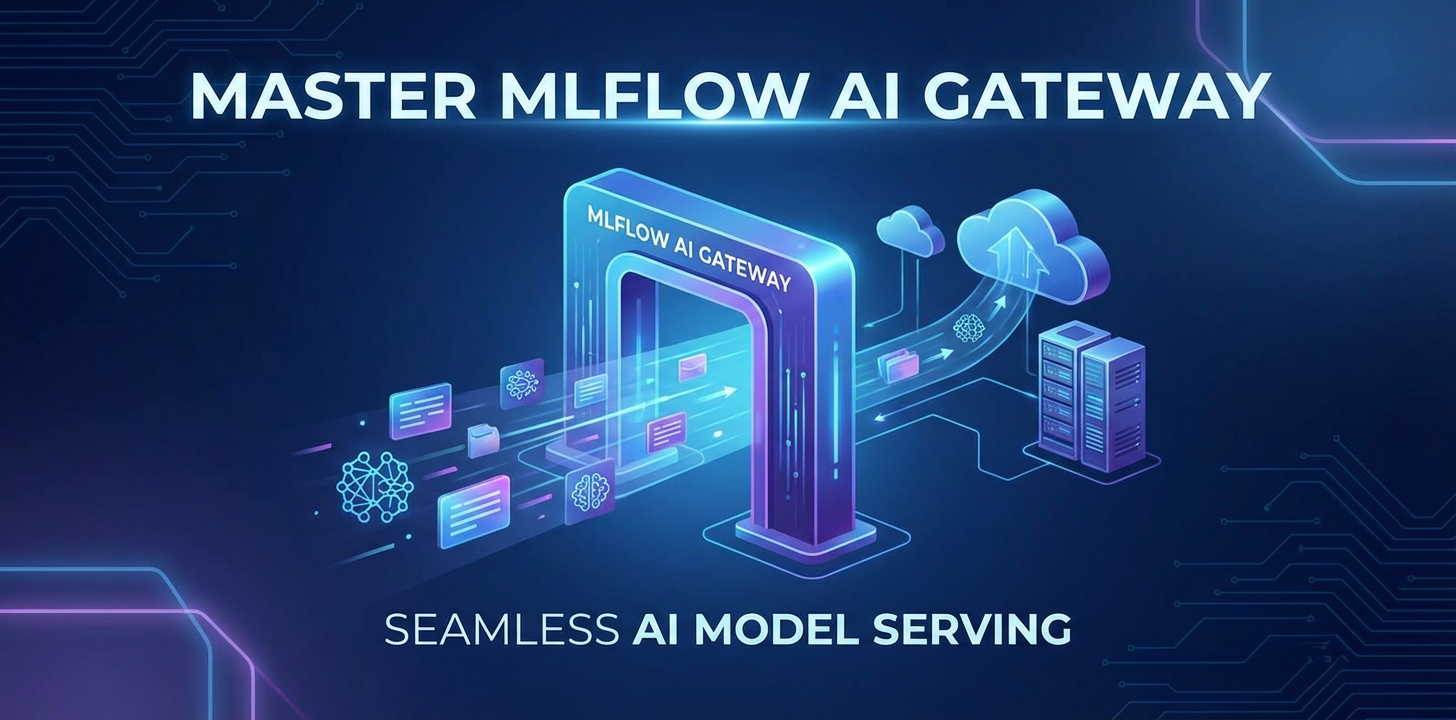
In a typical production deployment, the AI Gateway positions itself as the outermost layer, the single point of contact for all client applications interacting with AI models. Behind the gateway, various model serving platforms host the actual MLflow-packaged models.
Client Applications (web apps, mobile apps, other microservices) ---> AI Gateway ---> Model Serving Infrastructure (e.g., KServe, SageMaker Endpoint, custom Flask/FastAPI app, Serverless Functions) ---> MLflow Model (loaded from MLflow Registry)
Here’s a breakdown of the components and their interactions:
- Client Applications: These are the consumers of your AI services. They make requests to a standardized endpoint exposed by the AI Gateway, completely unaware of the complexities behind it.
- AI Gateway: This is the intelligent intermediary. It receives requests, performs initial processing (authentication, rate limiting, request transformation), routes them to the appropriate backend model serving instance, potentially performs post-processing on the response, and then returns the result to the client. Crucially, the AI Gateway maintains a mapping of logical API endpoints to physical model deployments, allowing for seamless model version updates or migrations without client-side changes.
- Model Serving Infrastructure: This layer is responsible for physically hosting and running the MLflow models. This could be:
- Kubernetes-based serving platforms: Solutions like KServe (formerly KFServing) or Seldon Core are designed to deploy and scale ML models on Kubernetes clusters. They can directly consume MLflow Models registered in the MLflow Model Registry.
- Cloud-managed ML platforms: Services such as AWS SageMaker Endpoints, Azure ML Endpoints, or Google Cloud AI Platform Prediction can deploy MLflow Models and handle underlying infrastructure scaling.
- Custom Microservices: A simple Python Flask or FastAPI application wrapping an MLflow
pyfuncmodel, deployed as a containerized microservice on VMs or a Kubernetes cluster. - Serverless Functions: For sporadic or low-volume inference, MLflow models can be deployed within serverless environments like AWS Lambda or Azure Functions.
- MLflow Model Registry: Though not directly in the request path, the Model Registry is foundational. It provides the source of truth for all production-ready model versions that are deployed to the serving infrastructure. The serving infrastructure continuously monitors the registry for new approved model versions, triggering updates or deployments.
Workflow: From Experiment to Gateway-Served Inference
The journey of an MLflow model through an AI Gateway for seamless serving typically follows these steps:
- Model Training and Experimentation (MLflow Tracking):
- Data scientists train various models, experiment with different algorithms, hyperparameters, and datasets.
- All relevant artifacts – parameters, metrics, code versions, model binaries – are logged using MLflow Tracking. This creates a historical record of every experiment.
- Model Packaging and Logging (MLflow Models):
- Once a promising model is identified, it is packaged into the MLflow Model format. This ensures it's self-contained and framework-agnostic (e.g., a
pyfuncmodel). - The model artifact and its metadata are then logged as an MLflow Model artifact within an MLflow Tracking run.
- Once a promising model is identified, it is packaged into the MLflow Model format. This ensures it's self-contained and framework-agnostic (e.g., a
- Model Registration and Versioning (MLflow Model Registry):
- The logged MLflow Model is then registered with the MLflow Model Registry. This assigns a unique name and version number (e.g.,
FraudDetectionModel/Version 1). - As the model undergoes further development or improvements, new versions are registered. The registry provides lifecycle management, allowing models to be transitioned through stages like
Staging,Production, orArchived. Only models inProductionstage are typically considered for live serving.
- The logged MLflow Model is then registered with the MLflow Model Registry. This assigns a unique name and version number (e.g.,
- Model Deployment to Serving Infrastructure:
- An automated CI/CD pipeline, often triggered by a model's transition to the
Productionstage in the MLflow Model Registry, deploys the selected model version to the chosen serving infrastructure. - For instance, a KServe controller might detect a new production version of
FraudDetectionModeland spin up a new KServe Service, loading the model artifact directly from the MLflow artifact store. - This deployment exposes a raw model endpoint (e.g.,
http://kserve-service-fraud-model.namespace.svc.cluster.local/predict).
- An automated CI/CD pipeline, often triggered by a model's transition to the
- AI Gateway Configuration and Policy Enforcement:
- The AI Gateway is configured to recognize the newly deployed model endpoint. This involves defining a new route or updating an existing one.
- Crucially, the gateway then applies various policies to this route:
- Authentication & Authorization: Enforcing API keys, JWT validation, or OAuth.
- Rate Limiting: Protecting the model backend from overload.
- Request/Response Transformation: Standardizing client requests to the model's expected input format (e.g., converting JSON to a NumPy array or a specific tensor format) and transforming model outputs for client consumption.
- Load Balancing: Distributing requests across multiple instances of the model server.
- Monitoring & Logging: Integrating with centralized observability systems to capture inference metrics and logs.
- A/B Testing/Canary Releases: If deploying a new model version, the gateway can gradually shift traffic, allowing for real-world performance validation before full rollout.
- Client Inference via AI Gateway:
- Client applications now make requests to the AI Gateway's public API endpoint (e.g.,
https://api.yourcompany.com/v1/models/fraud-detection). - The gateway processes the request, applies all configured policies, routes it to the correct MLflow-served model instance, receives the prediction, potentially transforms it, and sends the final response back to the client.
- Client applications now make requests to the AI Gateway's public API endpoint (e.g.,
By centralizing these critical functions, the AI Gateway not only simplifies the client experience but also provides the operational robustness necessary for production AI. It decouples the concerns of model development and serving infrastructure from the cross-cutting concerns of API management, security, and traffic control, allowing organizations to deploy and manage MLflow models with unprecedented agility and confidence. This seamless integration ensures that MLflow's power in managing the model lifecycle is fully realized in a production environment, delivering consistent, reliable, and secure AI services.
APIPark is a high-performance AI gateway that allows you to securely access the most comprehensive LLM APIs globally on the APIPark platform, including OpenAI, Anthropic, Mistral, Llama2, Google Gemini, and more.Try APIPark now! 👇👇👇
Key Capabilities of an Advanced AI Gateway for MLflow Deployments
An advanced AI Gateway significantly elevates the utility and reliability of MLflow deployments by providing a comprehensive suite of features tailored for the unique demands of AI model serving. These capabilities go far beyond basic HTTP proxying, offering granular control, robust security, and deep observability into the inference lifecycle.
1. Advanced Authentication and Authorization
Securing AI model endpoints is paramount, especially when models handle sensitive data or drive critical business processes. An AI Gateway acts as the first line of defense, implementing sophisticated security measures:
- API Key Management: Issuing and managing API keys with granular permissions, allowing specific keys to access only certain models or versions.
- OAuth 2.0 and JWT Integration: Integrating with enterprise identity providers to leverage existing user directories and single sign-on (SSO) mechanisms. JWT (JSON Web Tokens) allow for secure, stateless authentication, passing user identity and permissions information in each request.
- Role-Based Access Control (RBAC): Defining roles (e.g., "Data Scientist," "Application Developer," "Auditor") with specific permissions to invoke certain models or access particular endpoints, ensuring that only authorized entities can interact with sensitive AI services.
- Mutual TLS (mTLS): For highly secure internal communications, mTLS ensures that both the client (gateway) and server (model endpoint) authenticate each other using digital certificates, preventing man-in-the-middle attacks.
- Data Masking and Redaction: For privacy-sensitive applications, the gateway can intercept requests and responses to automatically mask or redact Personally Identifiable Information (PII) before it reaches the model or the client, helping with compliance (e.g., GDPR, HIPAA).
2. Intelligent Rate Limiting and Throttling
Protecting backend MLflow model servers from overload is crucial for maintaining performance and availability. An AI Gateway implements intelligent rate limiting:
- Request-Based Limiting: Limiting the number of requests per client, IP address, or API key within a specific time window (e.g., 100 requests per minute).
- Concurrency Limiting: Restricting the number of concurrent requests to a specific model, preventing resource exhaustion, especially for computationally intensive models.
- Token-Based Limiting (for LLMs): For LLM Gateway functionalities, rate limiting can be applied based on the number of input/output tokens rather than just requests, directly managing the cost and computational load associated with generative AI models.
- Dynamic Throttling: Adjusting rate limits based on the real-time load or health of the backend model servers, gracefully degrading service rather than failing outright.
3. Sophisticated Routing and Load Balancing (A/B testing, Canary)
Beyond simple path-based routing, an AI Gateway offers advanced traffic management:
- Content-Based Routing: Directing requests to different model versions or specialized models based on parameters in the request payload (e.g., routing sentiment analysis requests for "financial" text to a finance-specific model).
- Latency-Based Routing: Directing requests to the model instance with the lowest current latency or highest availability.
- Geographic Routing: Routing requests to the nearest data center for optimal performance.
- A/B Testing: Simultaneously serving two or more model versions (A and B) and splitting traffic between them based on predefined rules (e.g., 50/50 split, or based on user segments) to evaluate their performance in a live environment. The gateway facilitates the traffic splitting and potentially collects metrics for comparison.
- Canary Releases: Gradually rolling out a new model version by directing a small percentage of live traffic to it (e.g., 5-10%). If the new version performs well (monitored via the gateway), traffic is incrementally increased until it handles 100% of the load. This minimizes the risk of deploying faulty models.
4. Data Transformation and Validation
Ensuring compatibility between diverse client applications and MLflow models is a core function:
- Request Transformation: The gateway can modify incoming request payloads to match the exact input format expected by the MLflow model (e.g., converting a CSV payload to a JSON array, or restructuring JSON fields). This is invaluable when integrating models with varied API interfaces.
- Response Transformation: Similarly, the gateway can modify model outputs to a format more suitable for the client (e.g., adding metadata, formatting scores, or simplifying complex JSON structures).
- Input/Output Validation: Validating input data against predefined schemas before forwarding to the model, preventing invalid requests from reaching the backend and causing errors. This also applies to validating model outputs.
- Feature Augmentation: In some cases, the gateway can augment input requests with additional features (e.g., looking up user profiles from a feature store) before passing them to the model, offloading this logic from the client or the model itself.
5. Comprehensive Monitoring and Logging
Deep observability is critical for understanding AI model performance and health:
- Request and Response Logging: Capturing detailed logs of every API call, including request headers, body, response status, and latency. This data is invaluable for auditing, debugging, and compliance.
- Custom Metrics for AI: Beyond standard HTTP metrics, the gateway can expose AI-specific metrics such as inference latency per model, error rates per model version, specific prediction outcomes, and even GPU utilization if applicable.
- Integration with Observability Platforms: Seamlessly forwarding logs and metrics to centralized monitoring systems like Prometheus, Grafana, Splunk, ELK Stack, or cloud-native solutions (e.g., Datadog, New Relic) for real-time dashboards and alerting.
- Distributed Tracing: Integrating with distributed tracing tools (e.g., Jaeger, Zipkin, OpenTelemetry) to track a single request's journey across the gateway and multiple backend services, facilitating root cause analysis in complex microservice architectures.
6. Caching Strategies
Reducing redundant computations and improving latency:
- Response Caching: Caching the output of frequently requested predictions for a specified time-to-live (TTL). This is highly effective for models that provide consistent outputs for identical inputs.
- Semantic Caching (for LLMs): For LLM Gateway use cases, caching can be extended to recognize semantically similar prompts, even if not textually identical, returning a cached response and saving significant inference costs and time.
- Invalidation Policies: Implementing intelligent caching invalidation strategies based on model updates or data changes.
7. Prompt Management (for LLMs)
A specialized capability for generative AI through an LLM Gateway:
- Prompt Templating and Versioning: Centralizing prompt definitions, allowing developers to create and version prompt templates. The gateway can inject specific variables or context into these templates before forwarding to the LLM.
- Guardrails and Safety Policies: Implementing pre- and post-processing filters to detect and mitigate problematic inputs (e.g., prompt injection) or outputs (e.g., toxic content, bias) from LLMs. This is crucial for responsible AI.
- Cost Optimization through Prompt Rewriting: The gateway can analyze prompts and potentially rewrite them to be more concise or optimized for specific LLMs, reducing token usage and inference costs.
8. Model Chaining and Orchestration
For complex AI applications that involve multiple models:
- Sequential Inference: Orchestrating a workflow where the output of one MLflow model serves as the input for another, all managed transparently by the gateway. This enables building sophisticated multi-step AI pipelines.
- Parallel Inference: Invoking multiple models concurrently for a single request and aggregating their results, which can be useful for ensemble models or multi-modal AI.
By embodying these capabilities, an advanced AI Gateway transforms a collection of MLflow-managed models into a robust, secure, and highly performant AI service layer. It handles the operational heavy lifting, allowing data scientists to focus on model innovation and application developers to seamlessly integrate AI into their products.
Table: Comparison of AI Gateway Capabilities vs. Traditional API Gateway
| Feature / Aspect | Traditional API Gateway (e.g., Nginx, Kong basic) | Advanced AI Gateway (e.g., APIPark, specialized AI gateways) |
|---|---|---|
| Primary Focus | General REST API proxy, microservice communication | AI/ML model serving, inference lifecycle management |
| Core Functions | Auth, Rate Limiting, Routing, Load Balancing, Logging | All of the above, plus AI-specific enhancements |
| Auth & AuthZ | API Keys, Basic Auth, JWT, OAuth 2.0 | Granular RBAC for models, Data Masking, mTLS |
| Rate Limiting | Requests/time, Concurrent connections | Requests/time, Concurrent connections, Token-based (LLM), Dynamic throttling |
| Routing Logic | Path, Host, Header-based | Path, Host, Header-based, Model-version aware, A/B testing, Canary, Content-based, Latency-based |
| Load Balancing | Round Robin, Least Connections | All of above, AI-specific (GPU load, inference time) |
| Request/Response Transform | Basic header/body manipulation | Data serialization/deserialization, Feature Engineering, Prompt Templating, Input/Output Schema Validation |
| Monitoring & Logging | HTTP status, Latency, Errors | HTTP status, Latency, Errors, Inference latency per model, GPU utilization, Model drift metrics, Token usage |
| Caching | Response caching | Response caching, Semantic caching (LLM), Intelligent invalidation |
| AI-Specific Features | Limited/None | Prompt Management, Content Moderation (LLM), Model Chaining, Explainability hooks |
| Cost Management | General API usage | Detailed cost attribution per model/user/token |
| Deployment Complexity | Moderate | High, due to AI-specific optimizations & integrations |
| Ideal Use Case | General microservice APIs | MLflow model serving, LLM inference, real-time AI applications |
Real-World Application: Enhancing MLflow Serving with an AI Gateway
The theoretical advantages of an AI Gateway coalesce into tangible benefits when applied to real-world MLflow deployments. By providing a centralized, intelligent layer, the gateway solves critical operational problems, leading to enhanced efficiency, security, and scalability for AI-driven applications. Let's explore several illustrative scenarios where an AI Gateway proves indispensable.
Scenario 1: Securing a Financial Fraud Detection Model
Imagine a bank deploying a real-time fraud detection model, trained and managed via MLflow. This model processes sensitive transaction data and provides immediate predictions on suspicious activities.
- Problem without AI Gateway: Exposing the raw model endpoint directly risks unauthorized access, potential data breaches, and non-compliance with financial regulations (e.g., PCI DSS). Managing API keys and access for various internal applications or external partners becomes a logistical nightmare, lacking granular control.
- Solution with AI Gateway: The AI Gateway acts as a fortified perimeter.
- Authentication & Authorization: All requests must first pass through the gateway, which enforces strong authentication using JWTs issued by the bank's identity provider. Only applications with specific roles (e.g.,
FraudAnalystApp) are authorized to invoke the fraud detection model. - Data Masking: Before forwarding transaction data to the model, the gateway automatically masks sensitive PII (e.g., full credit card numbers, account details) to only expose necessary features for inference, ensuring data privacy even if the model itself isn't designed for full PII handling.
- Rate Limiting: Protects the model from denial-of-service attacks or excessive requests from a single application, ensuring the fraud detection service remains available during peak transaction volumes.
- Audit Logging: Every invocation, including the authenticated user and request payload (post-masking), is logged by the gateway, providing an auditable trail crucial for compliance and forensic analysis.
- Authentication & Authorization: All requests must first pass through the gateway, which enforces strong authentication using JWTs issued by the bank's identity provider. Only applications with specific roles (e.g.,
Scenario 2: Scaling a Recommendation Engine for E-commerce
An e-commerce platform uses several MLflow-managed recommendation models (e.g., personalized product recommendations, "customers who bought this also bought") that experience highly variable traffic, especially during sales events.
- Problem without AI Gateway: Directly scaling each recommendation model microservice independently can be complex, leading to over-provisioning during off-peak times or insufficient capacity during spikes. A/B testing new recommendation algorithms would require code changes in client applications.
- Solution with AI Gateway: The AI Gateway orchestrates scalability and experimentation.
- Intelligent Load Balancing: The gateway dynamically distributes incoming requests across multiple instances of the recommendation models deployed on Kubernetes. It monitors the health and current load of each instance, ensuring optimal utilization of resources and preventing bottlenecks.
- A/B Testing & Canary Releases: When a new recommendation algorithm (Model B) is developed and registered in MLflow, the gateway can easily configure an A/B test. For example, 10% of users are routed to Model B, while 90% still use the stable Model A. Performance metrics (e.g., click-through rate, conversion) are collected for both, allowing data scientists to objectively compare without disrupting the main user base. If Model B performs better, the gateway gradually shifts traffic (canary release) until Model B handles 100% of requests.
- Caching: For common product pages or user segments that frequently request recommendations, the gateway caches the model's output, significantly reducing latency and offloading requests from the backend model servers.
Scenario 3: Managing Multiple LLM Versions and Prompt Strategies
A tech company builds a customer support chatbot powered by various LLMs, all managed and fine-tuned via MLflow, including internal specialized LLMs and external foundation models. Different chatbot features require different prompt strategies or LLM versions.
- Problem without AI Gateway: Manually managing prompts within each application, handling token limits, and ensuring responsible AI usage for generative models is difficult. Switching LLM providers or versions for specific features would necessitate application code changes.
- Solution with LLM Gateway: The LLM Gateway centralizes control over generative AI interactions.
- Prompt Management: The gateway stores and versions prompt templates. When a customer support query comes in, the gateway dynamically injects relevant context (e.g., customer history, product details) into a predefined prompt template before sending it to the LLM. This ensures consistency and allows prompt optimization without client-side modifications.
- Token-Based Rate Limiting & Cost Management: The gateway tracks token usage per customer, department, or chatbot feature. It enforces token-based rate limits to prevent cost overruns and provides detailed reports for cost attribution, especially crucial when using expensive external LLMs.
- Content Moderation: All LLM outputs pass through the gateway's safety filters, which detect and redact inappropriate or harmful content before it reaches the customer. This ensures the chatbot adheres to ethical AI guidelines.
- Model Chaining: For complex queries, the gateway can orchestrate a sequence: first, an intent classification model (an MLflow
pyfuncmodel) processes the query, then an LLM is invoked with a specific prompt based on the detected intent, and finally, another MLflow model might summarize the LLM's response.
For organizations seeking a robust, open-source solution that encompasses the full spectrum of AI Gateway and api gateway capabilities, APIPark presents a compelling option. APIPark, as an open-source AI gateway and API management platform, directly addresses many of these challenges. It offers a unified management system for authentication and cost tracking across various AI models, standardizes API formats for AI invocation—a crucial feature when dealing with diverse MLflow model flavors—and even allows for prompt encapsulation into REST APIs, which is particularly useful for building an LLM Gateway. Its end-to-end API lifecycle management, high performance, and detailed logging capabilities make it a strong candidate for seamlessly integrating with and enhancing MLflow deployments, providing the robust control plane necessary for secure, scalable, and observable AI model serving in production. With solutions like APIPark, enterprises can leverage the power of MLflow's model management and combine it with a sophisticated gateway layer to unlock the full potential of their AI investments.
Scenario 4: Centralized Observability for a Multi-Model AI Service
A healthcare provider uses various MLflow-managed models for diagnostics, treatment recommendations, and administrative automation. Each model is critical, and operational teams need a unified view of their performance.
- Problem without AI Gateway: Monitoring individual model endpoints requires setting up separate monitoring agents for each, leading to fragmented observability. Correlating issues across different models or understanding the end-to-end latency from client to prediction is extremely difficult.
- Solution with AI Gateway: The AI Gateway centralizes all monitoring and logging.
- Unified Metrics Collection: The gateway captures standardized metrics for every AI API call, including request count, error rates, average inference latency, and specific model performance metrics (e.g., confidence scores, unique prediction categories). These metrics are automatically integrated into a central observability platform (e.g., Grafana dashboard powered by Prometheus).
- Detailed Call Logging: Every API invocation to an AI model is meticulously logged by the gateway, providing rich contextual information. This allows operations teams to quickly trace individual requests, debug issues, and identify patterns of failure or performance degradation across the entire AI service landscape.
- Distributed Tracing: The gateway initiates distributed traces, propagating unique trace IDs through the model serving infrastructure. This allows for end-to-end visibility into the request flow, pinpointing exactly where latency is introduced or errors occur, whether in the gateway itself, the model server, or the model inference logic.
- Anomaly Detection: By analyzing the aggregated metrics and logs, the gateway can be configured to detect anomalies in model performance (e.g., sudden spikes in error rates, unexpected drops in prediction confidence) and trigger alerts for immediate investigation, preventing potential service disruptions or degradation in AI model quality.
In each of these scenarios, the AI Gateway transforms disparate MLflow-managed models into cohesive, secure, and highly functional AI services. It not only addresses the immediate operational challenges but also provides the flexibility and control necessary to adapt to evolving business needs and technological advancements, firmly cementing its role as a critical component in any sophisticated MLOps architecture.
Choosing and Implementing Your MLflow AI Gateway: Practical Considerations
Implementing an AI Gateway for your MLflow deployments requires careful consideration of various factors, from technology stack choices to deployment strategies and operational best practices. The decision will largely depend on your existing infrastructure, team expertise, scalability requirements, and desired level of customization.
Choosing the Right Technology Stack
There are several categories of api gateway and AI Gateway solutions, each with its strengths:
- Open-Source Gateways:
- Pros: High flexibility, community support, no vendor lock-in, cost-effective for core features.
- Cons: Requires significant internal expertise for setup, maintenance, and customization; enterprise-grade features might need extensive configuration or custom development.
- Examples:
- Kong Gateway: A popular, extensible api gateway that can be extended with plugins for AI-specific functionalities (e.g., request transformation, AI model routing). It's built on Nginx and LuaJIT.
- Apache APISIX: Another high-performance, real-time api gateway built on Nginx and Lua. It boasts dynamic routing and rich plugins, making it suitable for AI workloads with appropriate customization.
- Envoy Proxy: A high-performance open-source edge and service proxy, often used as a sidecar in service mesh architectures (like Istio). While not a full AI Gateway out-of-the-box, its extensibility and L7 capabilities make it a strong building block for custom AI gateway functionalities.
- APIPark: Specifically designed as an open-source AI Gateway and API management platform. As detailed earlier, it offers out-of-the-box features for integrating various AI models, unifying API formats, managing prompts, and providing detailed logging and analytics, making it a compelling choice for MLflow users looking for an AI-centric solution without starting from scratch. Its single-command deployment makes it particularly accessible for quick adoption.
- Consideration: If opting for a generic api gateway, assess the effort required to build AI-specific plugins for features like prompt management or model-aware routing.
- Cloud-Managed Gateways:
- Pros: Fully managed, high availability, integrated with other cloud services, reduced operational overhead.
- Cons: Vendor lock-in, potentially higher recurring costs, less customization flexibility for highly specialized AI features.
- Examples:
- AWS API Gateway: Can be used to front MLflow models deployed on SageMaker, Lambda, or EC2. Requires custom Lambda authorizers or request/response mapping templates for AI-specific logic.
- Azure API Management: Similarly, integrates with Azure ML Endpoints, Azure Functions, or containerized apps. Policies can be written for transformations.
- Google Cloud API Gateway: Integrates with Cloud Run, Cloud Functions, and App Engine endpoints. Offers strong integration with Google's AI Platform.
- Consideration: These are excellent for basic routing and security but might require additional serverless functions or integration layers to implement advanced LLM Gateway or complex AI request transformations.
- Custom Solutions:
- Pros: Ultimate flexibility, perfectly tailored to specific needs.
- Cons: High development and maintenance cost, requires significant engineering effort, reinventing the wheel for common gateway features.
- Examples: Building a dedicated proxy using frameworks like Flask, FastAPI, or Node.js to implement specific AI gateway logic.
- Consideration: Only recommended for highly unique requirements where off-the-shelf or extensible solutions are insufficient.
Deployment Strategies
The choice of deployment environment significantly impacts the scalability, resilience, and manageability of your AI Gateway.
- Kubernetes:
- Advantages: Ideal for microservices, provides self-healing, auto-scaling, and declarative configuration. Many AI Gateway solutions (e.g., Kong, Apache APISIX, Envoy via Istio, APIPark) have strong Kubernetes support.
- Integration with MLflow Serving: Kubernetes is excellent for hosting MLflow models via platforms like KServe or Seldon Core, allowing the AI Gateway to seamlessly route traffic to these dynamic endpoints.
- Considerations: Adds operational complexity; requires Kubernetes expertise.
- Serverless Functions:
- Advantages: Pay-per-execution model, zero server management, auto-scaling out-of-the-box.
- Use Cases: Can serve as a lightweight AI Gateway for less complex transformations or specific LLM Gateway functions that don't require high-throughput streaming.
- Considerations: Latency overhead for cold starts, limits on execution time and memory, less suitable for high-throughput, low-latency scenarios that demand persistent connections or complex real-time processing.
- Virtual Machines (VMs) / Containers:
- Advantages: Granular control over the environment, suitable for existing infrastructure.
- Use Cases: Deploying AI Gateway solutions as standalone containers or on dedicated VMs.
- Considerations: Requires manual scaling and patching unless managed by container orchestration (like Kubernetes or Docker Swarm).
Operational Best Practices for AI Gateway Implementation
Beyond choosing the right tools, successful AI Gateway implementation hinges on robust operational practices:
- Infrastructure as Code (IaC):
- Manage all AI Gateway configurations, routes, policies, and deployments using IaC tools like Terraform, Ansible, or Kubernetes manifests. This ensures consistency, reproducibility, and version control.
- CI/CD Pipelines:
- Automate the deployment and update process for your AI Gateway. Changes to routes, authentication policies, or transformation logic should be version-controlled and deployed through automated pipelines, reducing human error and enabling rapid iteration.
- Robust Monitoring and Alerting:
- Leverage the AI Gateway's comprehensive logging and metrics capabilities. Set up dashboards to monitor key performance indicators (KPIs) like request volume, latency per model, error rates, and resource utilization. Implement proactive alerts for anomalies or threshold breaches.
- Integrate with distributed tracing to get end-to-end visibility from client to model inference.
- Security Audits and Penetration Testing:
- Regularly audit AI Gateway configurations for security vulnerabilities. Conduct penetration tests to identify potential weaknesses in authentication, authorization, or data handling.
- Keep gateway software and underlying operating systems patched and up-to-date.
- Disaster Recovery and High Availability:
- Design the AI Gateway for high availability, typically by deploying it across multiple availability zones. Implement backup and disaster recovery plans for configurations and critical data.
- Utilize circuit breakers and bulkheads to isolate failures and prevent cascading outages across your AI services.
- Version Control for Gateway Configurations:
- Treat gateway configuration files as code. Store them in a version control system (e.g., Git) to track changes, facilitate rollbacks, and enable collaborative development.
By thoughtfully selecting the appropriate technology, strategizing deployment, and adhering to best practices, organizations can construct a highly effective AI Gateway that seamlessly integrates with MLflow, transforming their machine learning models into resilient, secure, and performant production services. This deliberate approach ensures that the investment in AI translates into tangible business value, backed by a robust and manageable infrastructure.
The Horizon: Future Trends in AI Gateway and MLflow Synergy
The landscape of AI is continually evolving, driven by breakthroughs in model architectures and new application paradigms. As MLflow continues to refine its MLOps capabilities, the AI Gateway will similarly adapt and expand its functionalities, fostering an even deeper synergy between model development and serving. Several key trends are poised to shape the future of this crucial infrastructure layer.
Generative AI and the Evolving LLM Gateway
The explosive growth of generative AI and Large Language Models (LLMs) is perhaps the most significant driving force behind the specialized evolution of the LLM Gateway. Future LLM Gateways will move beyond basic prompt management to incorporate more sophisticated features:
- Advanced Prompt Orchestration and Flow Control: Imagine building complex multi-turn conversational agents or data analysis workflows where prompts are dynamically generated, chained, and conditionally executed based on intermediate LLM responses. The LLM Gateway will become an intelligent orchestrator of these prompt flows, managing state, context windows, and model selection.
- Real-time Cost Optimization: As LLM usage scales, token costs become a major concern. Future LLM Gateways will employ advanced techniques like dynamic model switching (e.g., routing to a smaller, cheaper LLM for simple queries and a larger, more expensive one for complex tasks), prompt compression, and intelligent semantic caching across different LLM providers to minimize costs in real-time.
- Enhanced Guardrails and Ethical AI Enforcement: With growing concerns about bias, hallucination, and misuse, LLM Gateways will integrate more sophisticated content moderation, safety filters, and alignment tools. These could include self-correction mechanisms, adversarial prompt detection, and dynamic policy enforcement to ensure responsible and ethical AI outputs.
- Contextual RAG (Retrieval-Augmented Generation) Integration: LLM Gateways will seamlessly integrate with external knowledge bases and RAG systems, allowing prompts to be automatically augmented with relevant contextual information before being sent to the LLM, enabling more accurate and up-to-date responses.
Edge AI and Distributed Inference
As AI moves closer to the data source for low-latency inference and privacy-preserving applications, the concept of a centralized AI Gateway will evolve to encompass distributed and edge deployments:
- Hybrid Cloud/Edge Gateways: Managing AI models deployed across diverse environments – cloud, on-premises, and edge devices – will require hybrid AI Gateways that can orchestrate traffic, synchronize configurations, and aggregate telemetry from distributed model inference points.
- Lightweight Edge Gateways: Smaller, optimized gateway instances will run directly on edge devices, providing localized authentication, rate limiting, and basic transformation for models inferring on the device. These edge gateways will securely communicate with a central cloud-based AI Gateway for model updates and aggregated monitoring.
Explainable AI (XAI) and Interpretability
The demand for explainable AI is increasing, especially in regulated industries. Future AI Gateways could play a role in democratizing XAI:
- Explanation Proxies: The gateway could intercept inference requests, trigger parallel calls to explainability services (e.g., SHAP, LIME), and then augment the model's prediction with an explanation before sending the combined response to the client. This provides transparency without altering the core model or client application.
- Auditability and Model Lineage: Leveraging MLflow's strong model registry, the AI Gateway could automatically link model invocations to specific model versions and training runs, providing an immutable audit trail for regulatory compliance and model understanding.
Standardization of AI API Interfaces
Efforts to standardize AI API interfaces (e.g., ONNX, Open Inference Protocol) will simplify the integration of diverse models behind an AI Gateway.
- Universal Adapters: Future AI Gateways will offer more robust, built-in adapters for these standard protocols, further reducing the need for custom request/response transformations and accelerating model deployment from MLflow to production.
Enhanced Observability with AI-Powered Insights
The sheer volume of telemetry generated by AI models and gateways can be overwhelming. Future AI Gateways will leverage AI itself to enhance observability:
- Anomaly Detection in Model Performance: AI algorithms within the gateway will proactively detect subtle shifts in model accuracy, bias, or performance degradation, alerting MLOps teams before issues become critical.
- Intelligent Alerting and Root Cause Analysis: By correlating metrics across the gateway, model servers, and underlying infrastructure, AI-powered systems will provide more intelligent alerts and even suggest potential root causes for performance issues, streamlining debugging.
The synergy between MLflow and the AI Gateway is destined to deepen. As MLflow continues to be the backbone for managing the machine learning lifecycle, the AI Gateway will evolve into an even more sophisticated, intelligent, and context-aware control plane, ensuring that the innovative models developed and tracked in MLflow can be seamlessly, securely, and efficiently served at scale, regardless of their complexity or deployment environment. This ongoing evolution will be critical for businesses aiming to fully operationalize AI and maintain a competitive edge in an increasingly AI-driven world.
Conclusion
The journey from a promising AI model developed in a research environment to a robust, scalable, and secure production service is a complex undertaking, one that demands more than just effective model training and basic deployment. While MLflow provides an unparalleled foundation for managing the entire machine learning lifecycle – from meticulous experiment tracking and reproducible project packaging to systematic model versioning and registry management – its inherent strength lies in orchestration rather than solely in high-performance, enterprise-grade serving. This is precisely where the AI Gateway emerges as an indispensable architectural component, bridging the gap between MLflow’s powerful MLOps capabilities and the stringent demands of real-world AI applications.
We have delved into the multifaceted challenges of AI model serving, from handling model heterogeneity and ensuring scalability to addressing paramount security concerns and achieving comprehensive observability. The traditional api gateway, while foundational for microservices, often lacks the specialized intelligence required to navigate these complexities. The AI Gateway, in contrast, is purpose-built for AI workloads, offering advanced capabilities such as model-aware routing, intelligent load balancing based on inference characteristics, dynamic request/response transformation, and sophisticated security policies tailored for sensitive AI data. Moreover, the rise of Large Language Models has necessitated the advent of the LLM Gateway, a specialized variant designed to manage prompt engineering, optimize token usage for cost efficiency, and enforce crucial safety guardrails for generative AI.
The seamless integration of MLflow with an AI Gateway forms a resilient and highly efficient MLOps architecture. MLflow meticulously manages the model's lifecycle up to its deployment, while the AI Gateway takes over at the inference layer, acting as a unified, intelligent control plane that simplifies client interaction, secures endpoints, optimizes performance, and provides deep insights into model behavior. From fortifying fraud detection models with granular access controls and data masking, to dynamically scaling recommendation engines with A/B testing, and centrally managing multiple LLM versions with intelligent prompt orchestration, the real-world applications of this synergy are vast and transformative.
For organizations embarking on this journey, the choice of AI Gateway technology is critical, with open-source solutions like APIPark offering comprehensive, AI-centric features, alongside extensible traditional gateways and managed cloud services. Regardless of the chosen path, adopting best practices in deployment, monitoring, and security is non-negotiable.
Looking ahead, the AI Gateway will continue to evolve, adapting to the nuances of generative AI, pushing intelligence closer to the edge, integrating with explainability frameworks, and leveraging AI itself to enhance its own observability. The convergence of MLflow's lifecycle management and an advanced AI Gateway's serving prowess is not merely an architectural choice; it is a strategic imperative for any organization committed to building, deploying, and sustaining impactful AI solutions in the dynamic and challenging landscape of modern technology. By mastering this synergy, you empower your teams to deliver AI that is not only innovative but also reliable, secure, and truly seamless.
5 FAQs about MLflow AI Gateway and Seamless AI Model Serving
Q1: What is the primary difference between a traditional API Gateway and an AI Gateway in the context of MLflow model serving?
A1: A traditional api gateway is a general-purpose proxy primarily focused on routing, basic authentication (like API keys), and rate limiting for standard REST APIs. An AI Gateway, on the other hand, is specifically optimized for serving AI/ML models, including MLflow-managed models. It offers AI-specific functionalities such as model-aware routing (e.g., A/B testing different model versions), intelligent load balancing based on model inference characteristics, dynamic request/response transformation to match model inputs/outputs, AI-specific security policies (like data masking for sensitive features), and advanced observability tailored for model performance metrics. For Large Language Models, an LLM Gateway extends this further with prompt management, token-based rate limiting, and content moderation.
Q2: How does an MLflow Model Registry integrate with an AI Gateway for seamless model serving?
A2: The MLflow Model Registry acts as the authoritative source for production-ready model versions. When a new model version is promoted to "Production" in the registry, an automated CI/CD pipeline (often triggered by this event) deploys the model to the underlying model serving infrastructure (e.g., KServe, SageMaker). The AI Gateway then monitors or is explicitly configured to route traffic to this newly deployed model endpoint. This separation of concerns means the gateway always routes to the current production model based on the registry's state, enabling seamless model updates, rollbacks, and A/B testing without requiring client-side application changes.
Q3: What specific benefits does an LLM Gateway offer for deploying Large Language Models that are potentially tracked by MLflow?
A3: An LLM Gateway provides critical specialized features for generative AI models. It centralizes prompt management, allowing for templating, versioning, and dynamic injection of context into prompts without altering client code. It implements token-based rate limiting and cost management, crucial for controlling expenses with LLMs billed by token usage. Furthermore, it incorporates content moderation and safety filters to prevent the generation of harmful or inappropriate outputs, ensuring responsible AI deployment. For complex applications, an LLM Gateway can also orchestrate model chaining, allowing multiple LLMs or other AI models to be composed into sophisticated workflows.
Q4: Can I use an existing open-source API Gateway like Kong or Apache APISIX as an AI Gateway for MLflow models?
A4: Yes, you can use existing open-source api gateway solutions like Kong or Apache APISIX as a foundation. They provide robust core functionalities like routing, authentication, and rate limiting. However, to transform them into a fully-fledged AI Gateway, you would typically need to develop custom plugins or integrations. This involves implementing AI-specific logic for features such as advanced request/response transformation to match diverse MLflow model inputs, model-aware routing strategies (e.g., A/B testing, canary releases based on model versions), and richer AI-specific telemetry collection. Alternatively, platforms like APIPark are designed from the ground up to offer many of these AI-centric capabilities out-of-the-box, simplifying the implementation.
Q5: What are the key considerations for ensuring security when deploying MLflow models via an AI Gateway?
A5: Security is paramount. Key considerations include: 1. Robust Authentication & Authorization: Implement strong mechanisms like OAuth 2.0, JWT, or granular API keys managed by the AI Gateway, ensuring only authorized applications and users can invoke specific models. 2. Data Masking/Redaction: Configure the AI Gateway to automatically mask or redact sensitive PII from request payloads before they reach the model, aiding privacy compliance. 3. Rate Limiting & Throttling: Protect model endpoints from abuse and DoS attacks by enforcing appropriate rate and concurrency limits. 4. Network Segmentation: Deploy the AI Gateway and model serving infrastructure in secure, isolated network segments. 5. Audit Logging: Ensure the gateway captures comprehensive logs of all API calls, including user, model, and outcome, for compliance and forensic analysis. 6. Secure Communication: Utilize TLS/SSL for all communications (client-gateway and gateway-model), and consider mTLS for internal service-to-service communication. 7. Vulnerability Management: Regularly patch and update the gateway software and underlying infrastructure to mitigate known vulnerabilities.
🚀You can securely and efficiently call the OpenAI API on APIPark in just two steps:
Step 1: Deploy the APIPark AI gateway in 5 minutes.
APIPark is developed based on Golang, offering strong product performance and low development and maintenance costs. You can deploy APIPark with a single command line.
curl -sSO https://download.apipark.com/install/quick-start.sh; bash quick-start.sh

In my experience, you can see the successful deployment interface within 5 to 10 minutes. Then, you can log in to APIPark using your account.

Step 2: Call the OpenAI API.