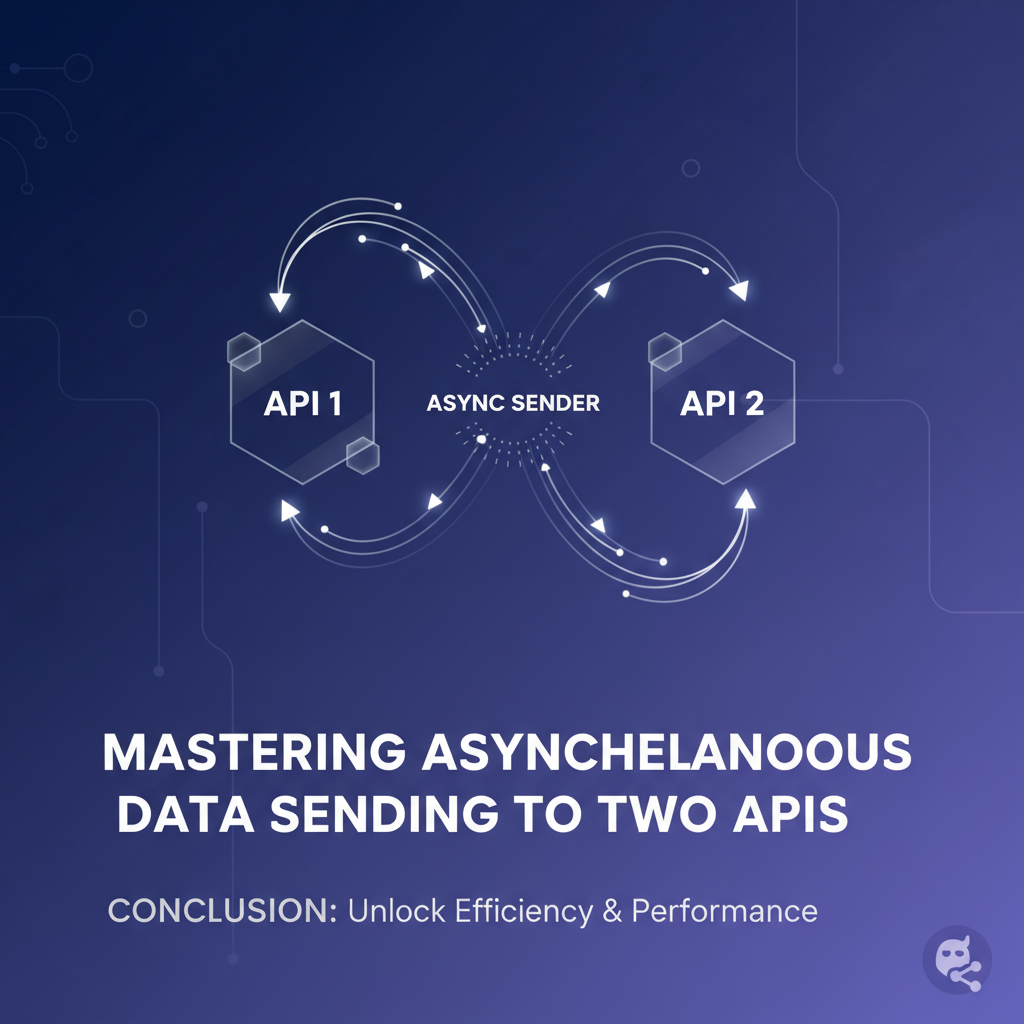
Mastering Asynchronous Data Sending to Two APIs


In the intricate tapestry of modern software architecture, the need to interact with multiple Application Programming Interfaces (APIs) has become a ubiquitous challenge and an essential capability. From powering sophisticated microservices ecosystems to integrating diverse third-party functionalities, applications frequently find themselves needing to dispatch data not just to one, but often several external endpoints. This complexity is compounded when these operations must occur asynchronously, a paradigm that unlocks immense potential for performance and responsiveness but introduces a fresh set of challenges in terms of reliability, consistency, and error management. Mastering the art of asynchronously sending data to two or more APIs is no longer a niche skill but a fundamental requirement for building resilient, scalable, and high-performing systems.
This extensive guide delves deep into the strategies, patterns, and best practices for effectively managing asynchronous data transmission to dual API destinations. We will explore the fundamental reasons driving such requirements, dissect the inherent technical challenges, and provide comprehensive architectural solutions, ranging from server-side orchestration to the pivotal role of an API gateway. By understanding these principles, developers and architects can navigate the complexities of distributed systems, ensuring data integrity, enhancing user experience, and building applications that can truly stand the test of time and scale.
The Imperative of Asynchronous Communication: Unlocking Performance and Responsiveness
Before delving into the specific intricacies of interacting with multiple APIs, it's crucial to firmly grasp the concept of asynchronous communication itself. In a synchronous interaction, a requesting system sends a request and then patiently idles, blocking further operations, until it receives a response. This "wait-and-see" approach, while straightforward, becomes a severe bottleneck in scenarios involving network latency, long-running processes, or multiple external dependencies. If an application needs to perform several independent operations, executing them synchronously means each must complete before the next can begin, leading to cumulative delays and a sluggish user experience.
Asynchronous communication, by contrast, operates on a non-blocking principle. When a request is dispatched asynchronously, the initiating system does not wait for an immediate response. Instead, it continues with other tasks, freeing up resources and maintaining responsiveness. The response, when it eventually arrives, is typically handled by a callback, a promise, or an event listener, allowing the system to react to the completion of the operation without having been idle in the interim. This paradigm shift is foundational to modern web development, enabling high-throughput systems, responsive user interfaces, and efficient utilization of computational resources.
The benefits of asynchronous communication are manifold:
- Improved Responsiveness: Applications can remain interactive even when performing resource-intensive or network-bound operations. Users don't experience frozen interfaces or long waits.
- Higher Throughput: By not blocking execution, a single thread or process can initiate multiple operations concurrently, leading to more work being completed in the same timeframe. This is critical for servers handling numerous client requests simultaneously.
- Better Resource Utilization: Instead of threads waiting idly for I/O operations (like API responses), they can be reused to process other requests or perform different computations, leading to more efficient use of CPU and memory.
- Enhanced User Experience: For client-side applications, asynchronous operations prevent the UI from freezing, providing a smoother and more fluid interaction. On the server side, it means faster responses to client requests, even if internal operations are complex.
However, this power comes with increased complexity. Asynchronous operations introduce challenges such as managing callback hell, handling race conditions, ensuring eventual consistency across distributed systems, and propagating errors effectively. When extending this model to interact with not just one, but two APIs, these challenges multiply, demanding sophisticated design and robust implementation strategies.
Why Send Data to Two APIs? Common Business and Architectural Drivers
The decision to send the same or related data to two distinct APIs is rarely arbitrary. It typically stems from specific business requirements or architectural patterns designed to enhance functionality, improve resilience, or decouple concerns within a system. Understanding these drivers is the first step toward choosing the most appropriate asynchronous integration strategy.
1. Data Duplication and Replication for Specialised Processing
A common scenario involves sending data to a primary transactional system while simultaneously dispatching a copy, or a transformed version, to a secondary system optimised for a different purpose. Consider an e-commerce platform: when a new order is placed, the order details must be securely recorded in the core order management system (OMS) API. Concurrently, a subset of this data (e.g., customer ID, product categories, total value) might need to be sent to an analytics API to update real-time dashboards, trigger marketing automation workflows, or feed into recommendation engines. These two systems have distinct responsibilities and data models, making direct integration impractical or inefficient. The OMS requires strict ACID properties (Atomicity, Consistency, Isolation, Durability) for transaction integrity, while the analytics platform prioritises high ingestion rates and flexible querying for insights. Sending data to both APIs asynchronously ensures that the analytics pipeline doesn't block the critical order placement process.
Another example involves customer relationship management (CRM) and marketing automation. When a new user signs up, their profile is created in the CRM via one API. Simultaneously, their details (name, email, subscription preferences) are pushed to a marketing platform's API to enrol them in welcome email sequences or segment them for targeted campaigns. These are two separate business functions, each managed by its own specialised system, necessitating dual API calls.
2. Primary/Secondary Systems and Redundancy
In mission-critical applications, redundancy is paramount. Data might be sent to a primary API for immediate processing and storage, and simultaneously to a secondary, often geographically dispersed or different-technology-stack API, for disaster recovery or high availability. If the primary system fails or becomes unavailable, the secondary system can take over, ensuring business continuity. This pattern requires robust asynchronous mechanisms to guarantee eventual consistency between the two systems, even in the face of network partitions or temporary outages. For instance, a financial transaction might be committed to a primary ledger system and then asynchronously replicated to an archival system or a read-replica database through a separate API for auditing and reporting purposes. The asynchronous nature prevents the replication process from delaying the primary transaction.
3. Cross-Functional Updates and Microservices Orchestration
Modern applications are increasingly built using microservices architectures, where a single user action might necessitate updates across several independent services. For example, a user updating their profile picture might trigger an update to the user profile service's API, which then cascades an update to a content delivery network (CDN) API to invalidate old cached images, and potentially a separate notification service API to inform relevant parties. Each service is a distinct bounded context, exposing its own API, and the orchestration of these updates often happens asynchronously to maintain loose coupling and responsiveness. The initial request to update the profile picture API might complete quickly, while the subsequent CDN invalidation and notification dispatch occur in the background, without blocking the user.
4. Event Sourcing and Auditing
Event sourcing is an architectural pattern where all changes to application state are stored as a sequence of events. When an event occurs (e.g., "Product Added to Cart"), it might be published to an event store API. Concurrently, a separate auditing API might receive a more detailed log entry about the event, including metadata like the user who initiated it, timestamp, and IP address, for compliance and security monitoring. The event store focuses on business events for reconstruction of state, while the auditing system focuses on comprehensive, immutable records for accountability. These distinct purposes necessitate two separate API interactions, typically handled asynchronously to ensure the core business process is not hampered by the logging overhead.
5. Third-Party Integrations and Value-Added Services
Many applications integrate with multiple third-party services to add features beyond their core capabilities. When a user completes a purchase, for example, the internal order processing API is invoked. At the same time, a payment gateway API is called to process the transaction, and potentially a separate shipping carrier API is invoked to generate a shipping label and track the package. These are all external APIs, owned by different entities, and they must be called in a coordinated yet asynchronous manner to ensure the checkout process is smooth and responsive. If the shipping API is slow, it shouldn't hold up the payment confirmation.
In all these scenarios, the common thread is the need to decouple operations and execute them without blocking the critical path, even when failures occur. This necessitates robust asynchronous handling, sophisticated error management, and careful consideration of data consistency across disparate systems.
Core Technical Challenges and Considerations in Multi-API Asynchronous Data Sending
Sending data asynchronously to two APIs introduces a layer of complexity that goes beyond simple single-API interactions. Developers must contend with a specific set of technical challenges to ensure reliability, performance, and data integrity.
1. Latency Management and Performance Impact
Each API call involves network overhead, potentially significant processing time on the remote server, and response transmission. When making two such calls, even asynchronously, their combined latency can impact the overall perceived performance, especially if one API is significantly slower than the other. While asynchronous execution prevents blocking, the total time until both operations are confirmed successful might still be considerable.
- Minimising Cumulative Delays: The primary goal is to ensure that the slower api does not unduly delay the completion of the overall operation if the two calls are independent. Techniques like parallel execution (sending both requests concurrently) are crucial here.
- Timeouts: Implementing strict timeouts for each API call is essential. An unresponsive api should not hold up resources indefinitely or cause the entire operation to hang.
- Load on Originating System: While asynchronous, initiating two network requests still consumes resources (threads, memory, network sockets) on the client or server making the calls. At high scale, this can still be a bottleneck.
2. Error Handling, Retries, and Partial Failures
This is arguably the most complex challenge. What happens if one api call succeeds, but the other fails? This leads to a "partial failure" state, where your system's data or state might be inconsistent across the two external APIs.
- Atomicity vs. Eventual Consistency: Achieving true atomicity (all succeed or all fail) across two independent, external APIs is exceptionally difficult, often requiring distributed transaction protocols (like two-phase commit), which are notoriously complex and resource-intensive. Most real-world scenarios opt for "eventual consistency," where the system aims to resolve inconsistencies over time.
- Idempotency: Designing API calls to be idempotent is critical. An idempotent operation is one that can be called multiple times without producing different results beyond the first call. This is vital for retry mechanisms; if a retry happens, you want to be sure it doesn't create duplicate entries or undesired side effects if the original call actually succeeded but the response was lost.
- Retry Mechanisms: When an API call fails due to transient errors (e.g., network glitch, temporary server overload), retrying the operation can often lead to success. Implementing intelligent retry strategies with exponential backoff and jitter is crucial to avoid overwhelming the failing api and to increase the chances of recovery.
- Compensating Transactions: For non-idempotent operations or when a partial failure occurs, a "compensating transaction" might be necessary. If API A succeeds but API B fails, and retries for B are exhausted, you might need to call API A again to "undo" its successful operation, restoring consistency. This requires a well-defined rollback strategy.
- Dead-Letter Queues (DLQ): For persistent failures, where retries are exhausted, failed messages or requests should be moved to a DLQ for manual inspection and reprocessing, preventing them from being lost entirely.
3. Data Consistency and State Management
Maintaining a consistent view of data across two independent systems is a significant hurdle. If your internal system expects both external APIs to reflect a certain state, a partial failure can lead to desynchronisation.
- Eventual Consistency Model: For most distributed systems, particularly those involving external third-party APIs, immediate strong consistency is not practical. Systems are often designed to reach consistency "eventually," meaning there might be a temporary period where data is out of sync. This requires careful design to ensure the application can tolerate temporary inconsistencies.
- Correlation IDs: Using a unique correlation ID for each request that is passed to both APIs (if supported) and logged internally is invaluable for tracing, debugging, and identifying related operations across distributed systems.
- Polling and Reconciliation: In some cases, to ensure consistency, your system might need to periodically poll one or both APIs to check the status of an operation or to reconcile data discrepancies.
4. Order of Operations and Dependencies
Sometimes, the calls to two APIs are not entirely independent. One API call might depend on the successful completion or the response data of the other.
- Sequential vs. Parallel Execution: If API B requires data returned by API A, then A must complete successfully before B can be initiated. This necessitates sequential asynchronous execution. If they are independent, parallel execution is preferred for performance.
- Conditional Execution: Logic might be required where the call to API B only happens if API A meets certain conditions.
5. Security and Authentication
Interacting with two APIs means managing potentially two sets of authentication credentials, authorisation scopes, and security protocols.
- Credential Management: Securely storing and retrieving API keys, OAuth tokens, or other credentials for each api is critical. Environment variables, secret management services (e.g., AWS Secrets Manager, HashiCorp Vault), or a robust api gateway are commonly used.
- Least Privilege: Ensuring that the credentials used for each API call have only the minimum necessary permissions to perform their specific task.
- Rate Limiting and Quotas: Adhering to the rate limits imposed by each API provider is crucial to avoid being blocked. Your system needs to manage its outgoing requests accordingly, potentially with token bucket or leaky bucket algorithms.
6. Scalability of the Orchestrator
The system responsible for sending data to two APIs must itself be scalable. If it becomes a bottleneck, the entire operation suffers.
- Horizontal Scaling: The service performing the API calls should be designed to scale horizontally, meaning multiple instances can run in parallel to handle increased load.
- Resource Contention: Be mindful of database connections, thread pools, and other shared resources that could become contention points under heavy load.
7. Monitoring, Logging, and Observability
In a distributed system, especially one making multiple external calls, comprehensive monitoring and logging are indispensable for troubleshooting, performance analysis, and ensuring operational health.
- Detailed Logging: Logging the initiation, success, failure, and response data for each API call (with sensitive information redacted) is crucial.
- Metrics and Alerts: Setting up metrics to track success rates, latency, and error rates for each API call. Alerts should be configured to notify operations teams of significant deviations or failures.
- Distributed Tracing: Tools that allow tracing a single request across multiple services and API calls (e.g., OpenTelemetry, Zipkin, Jaeger) are invaluable for understanding the flow and identifying bottlenecks in complex asynchronous interactions.
Addressing these challenges requires a combination of thoughtful architectural design, robust error handling logic, and the intelligent use of infrastructure components.
APIPark is a high-performance AI gateway that allows you to securely access the most comprehensive LLM APIs globally on the APIPark platform, including OpenAI, Anthropic, Mistral, Llama2, Google Gemini, and more.Try APIPark now! 👇👇👇
Design Patterns and Architectural Approaches for Multi-API Asynchronous Sending
Successfully navigating the complexities of sending data asynchronously to two APIs requires adopting proven design patterns and leveraging appropriate architectural components. The choice of approach largely depends on factors such as the scale of operations, consistency requirements, coupling between services, and the need for centralised control.
1. Client-Side Approaches (Generally Less Recommended for Dual Backend API Interactions)
While clients (web browsers, mobile apps) can technically make multiple asynchronous API calls in parallel (e.g., using Promise.all in JavaScript), this approach is generally not recommended for sending critical data to two distinct backend APIs for several reasons:
- Security Concerns: Exposing API keys or sensitive logic directly in client-side code is a significant security risk.
- CORS Issues: Cross-Origin Resource Sharing (CORS) policies can prevent clients from directly calling APIs on different domains without proper server-side configuration.
- Network Overhead for Client: The client has to manage two separate network requests, potentially increasing battery consumption and perceived latency, especially on mobile networks.
- Inconsistent State on Failure: If the client makes two calls and one fails, the client is solely responsible for retry logic, error handling, and potential data reconciliation, which can be fragile.
- Business Logic Exposure: Distributing complex orchestration logic to the client side often blurs the lines of responsibility and makes the system harder to maintain and secure.
Client-side parallel calls are better suited for scenarios where the client is fetching data from multiple read-only APIs for UI display, rather than initiating critical, state-changing data submissions to multiple backend services.
2. Server-Side Orchestration: The Backbone of Robust Integrations
For reliability, security, and scalability, sending data to two APIs should almost invariably be handled by a server-side component. This centralises control, protects sensitive credentials, and provides a robust environment for managing errors and consistency.
A. Direct Server-to-Server Calls
This is the most straightforward server-side approach. Your backend service receives a request, processes it, and then initiates two separate, outgoing HTTP requests to the two target APIs.
Implementation Details:
- Parallel Execution: To maximise performance, these two outgoing calls should be made concurrently. Most modern programming languages offer constructs for this:
- Python:
asyncio.gather()in conjunction withaiohttporhttpxallows concurrent execution ofasyncHTTP requests. - Node.js:
Promise.all()withaxiosornode-fetchenables parallel HTTP requests. - Java:
CompletableFuture.allOf()withHttpClient(since Java 11) or reactive frameworks like Spring WebFlux can execute calls concurrently. - .NET:
Task.WhenAll()withHttpClientcan achieve parallel asynchronous calls.
- Python:
- Sequential Execution (When Dependencies Exist): If API B's payload depends on the response from API A (e.g., API A returns an ID needed for API B), then the calls must be made sequentially. The second call is initiated only after the first has successfully completed and its response processed.
- Error Handling: Each API call must have its own
try-catchblock or error handling mechanism. If one fails, the system must decide on a strategy:- Retry: Attempt to retry the failed call with exponential backoff.
- Log and Alert: Record the failure details for future investigation and trigger alerts.
- Compensate: If API A succeeded and API B failed persistently, a compensating transaction might be needed to undo API A's operation.
- Partial Success: Acknowledge that one operation succeeded and manage the eventual consistency later (e.g., through reconciliation jobs).
Pros: * Relatively simple to implement for a small number of APIs and specific use cases. * Full control over the orchestration logic and error handling within your service.
Cons: * Tight Coupling: The orchestrating service becomes tightly coupled to the specifics of the two target APIs. Changes in one API might require changes in the orchestrator. * Scalability Concerns: The orchestrating service itself can become a bottleneck if it needs to handle a very high volume of concurrent requests, as it's directly managing network I/O. * Error Management Complexity: Implementing robust retry logic, idempotency checks, and compensating transactions manually can be complex and error-prone. * Operational Overhead: Requires careful monitoring and management of the orchestrating service.
B. Message Queues and Event Streams (Asynchronous Decoupling)
For highly scalable, resilient, and loosely coupled systems, message queues or event streams (like Apache Kafka, RabbitMQ, AWS SQS, Azure Service Bus, Google Cloud Pub/Sub) offer a superior solution. This pattern decouples the act of producing data from the act of consuming and acting upon it.
How it Works:
- Producer: Your backend service receives a request. Instead of directly calling the two target APIs, it publishes an "event" or "message" to a message queue (e.g., "UserCreatedEvent", "OrderPlacedEvent"). This is a very fast, non-blocking operation. The initial request to your service can return a success response immediately.
- Consumers: Two separate, independent consumer services (or even two different functions within a single consumer service) are subscribed to this message queue.
- Consumer 1: Picks up the "UserCreatedEvent" and calls API A (e.g., the CRM API).
- Consumer 2: Picks up the same "UserCreatedEvent" and calls API B (e.g., the Analytics API).
Pros: * High Decoupling: The producing service is completely unaware of who consumes the event or how many consumers there are. This makes the system extremely flexible and easy to extend. * Scalability: Message queues are designed for high throughput. Consumers can scale independently to handle the load of processing events and calling external APIs. * Fault Tolerance and Resilience: Messages are typically persisted in the queue. If an API is temporarily down or a consumer service fails, the message remains in the queue and can be reprocessed later (after the API recovers or the consumer restarts/retries). Built-in retry mechanisms and Dead-Letter Queues (DLQs) handle transient and persistent failures robustly. * Load Leveling: Message queues absorb bursts of traffic, smoothing out the load on downstream APIs and consumer services. * Auditing and Replay: Event streams can serve as a durable log of all changes, allowing for auditing, debugging, and even replaying past events to reconstruct state or test new consumers.
Cons: * Increased Complexity: Introduces a new infrastructure component (the message queue) and the overhead of managing consumers. * Eventual Consistency: By its nature, this pattern implies eventual consistency. There will be a time lag between an event being published and both APIs being updated. This might not be suitable for scenarios requiring immediate, strong consistency. * Debugging Distributed Systems: Tracing the flow of an event through producers, queues, and multiple consumers can be more challenging than in a direct synchronous call.
This pattern is highly recommended for microservices architectures and systems requiring high reliability and scalability, especially when the two API calls are largely independent.
C. API Gateway as an Orchestrator
An API gateway acts as a single entry point for all API calls from clients, routing requests to appropriate backend services. Beyond simple routing, modern API gateways offer powerful features, including orchestration, which makes them an excellent candidate for managing asynchronous data sending to multiple backend APIs.
How it Works:
- Client Request: A client sends a single request to the API gateway.
- Gateway Fan-out: The gateway is configured with a rule that, upon receiving this specific request, triggers two (or more) internal requests to different backend APIs.
- The gateway can perform payload transformations to adapt the incoming request format to the specific requirements of each backend api.
- It can inject authentication credentials for each backend api securely.
- It can execute these backend calls in parallel.
- Response Aggregation (Optional): If the client expects a single response that combines data from both backend APIs, the gateway can aggregate and transform the responses before sending a unified response back to the client. For purely fire-and-forget asynchronous sends, this aggregation might not be necessary.
The Role of an API Gateway in Multi-API Scenarios:
- Centralised Control: The gateway becomes the single point of control for all incoming API traffic, simplifying management, security, and observability.
- Decoupling Clients from Backends: Clients only know about the gateway's endpoint. They are completely decoupled from the topology and specific endpoints of the two backend APIs.
- Request Fan-out and Aggregation: The gateway can take a single incoming request and fan it out to multiple backend APIs concurrently, collecting their responses and potentially aggregating them before sending a consolidated response to the client. This offloads orchestration logic from individual microservices or clients.
- Centralised Security: Authentication and authorisation can be enforced at the gateway level, applying policies consistently across all backend API calls, even to multiple destinations. This simplifies security management for individual services.
- Rate Limiting and Throttling: The gateway can enforce rate limits globally or per API, protecting backend services from overload and ensuring fair usage.
- Load Balancing: The gateway can intelligently distribute traffic to multiple instances of downstream APIs, enhancing availability and performance.
- Observability: All traffic flows through the gateway, making it an ideal place to capture comprehensive logs, metrics, and distributed traces for every API interaction.
Platforms like ApiPark, an open-source AI gateway and API management platform, exemplify how a robust gateway can simplify sophisticated API interactions. APIPark provides an all-in-one solution for managing, integrating, and deploying AI and REST services. Its capabilities extend to end-to-end API lifecycle management, including design, publication, invocation, and decommission, making it highly relevant for orchestrating complex data flows. Features such as unified API format for AI invocation imply its ability to perform necessary transformations for diverse backend systems, a critical aspect of multi-API interactions. Furthermore, APIPark's performance rivals Nginx, supporting high TPS and cluster deployment, ensuring that the gateway itself does not become a bottleneck when fanning out requests to multiple APIs under heavy load. Its detailed API call logging and powerful data analysis features are invaluable for monitoring the success and failure of these distributed operations, providing businesses with insights for proactive maintenance and issue resolution.
Pros: * Simplifies client-side logic significantly. * Centralises complex orchestration, security, and traffic management. * Improves overall system resilience and performance through features like caching, load balancing, and circuit breaking. * Can shield backend services from direct exposure, enhancing security.
Cons: * Single Point of Failure: The gateway itself becomes a critical component; robust deployment (e.g., highly available clusters) is essential. * Increased Latency (Potential): An extra network hop through the gateway can add a small amount of latency, though this is often offset by its performance optimisation features. * Configuration Complexity: Configuring advanced routing, transformation, and orchestration rules can be complex, especially with a large number of APIs.
The API gateway approach is particularly suitable for organisations with a large number of APIs, a microservices architecture, or a need for centralised control over security, traffic management, and complex orchestration patterns. It provides a robust and scalable foundation for sending data asynchronously to two or more APIs, streamlining development and improving operational efficiency.
The following table summarises the key architectural approaches:
| Approach | Pros | Cons | Best Suited For |
|---|---|---|---|
| Direct Server-to-Server | Simplicity for specific cases, full control | Tight coupling, manual error handling, limited scalability for complex cases | Simple scenarios, low scale, direct control needed for a few APIs |
| Message Queues | Decoupling, scalability, fault tolerance, robust error handling, load leveling | Eventual consistency, increased infrastructure complexity, debugging challenges for distributed systems | High scale, microservices, asynchronous processes, critical data, systems requiring high resilience |
| API Gateway Orchestration | Centralized management, reduced client load, enhanced security, traffic management, fan-out capabilities | Gateway becomes a critical component (potential single point of failure), configuration complexity, slight added latency | Complex routing, large number of APIs, microservices, centralised security/management, high performance/observability needs |
Each approach has its merits and drawbacks. The optimal choice depends heavily on the specific context, including performance requirements, data consistency needs, existing infrastructure, team expertise, and the overall architectural vision. Often, a hybrid approach might emerge, using an API gateway for initial request routing and transformation, which then triggers a message to a queue, consumed by a backend service that makes further direct api calls.
Implementation Details and Best Practices for Multi-API Asynchronous Sending
Beyond choosing an architectural pattern, the success of asynchronously sending data to two APIs hinges on meticulous implementation details and adherence to best practices. These considerations ensure that the system is not only functional but also reliable, resilient, and maintainable.
1. Embracing Idempotency in API Design
Idempotency is a cornerstone of resilient distributed systems. An operation is idempotent if executing it multiple times produces the same result as executing it once. This is crucial when dealing with retries, as a network glitch might cause a request to be sent twice, or a retry mechanism might re-send a request whose initial attempt actually succeeded (but whose response was lost).
- How to achieve Idempotency:
- Unique Request IDs: Include a unique, client-generated
idempotency-keyin the header of every request. The receiving api can then store this key and, if it receives a subsequent request with the same key within a certain timeframe, it can simply return the previous response without re-processing the operation. - UPSERT operations: Instead of
POST(create new), usePUT(update or create) for resources where appropriate.PUT /resource/{id}is inherently idempotent if the client specifies theid. - Conditional Updates: Use conditional logic (e.g., "update if version is X") to prevent concurrent updates from overwriting each other or re-applying old changes.
- Unique Request IDs: Include a unique, client-generated
- Impact: Idempotent APIs drastically simplify retry logic, allowing you to re-send requests without fear of duplicate entries or unintended side effects, greatly improving system robustness.
2. Timeouts and Circuit Breakers: Preventing Cascading Failures
External API dependencies are inherent points of failure. An unresponsive or slow API can lead to cascading failures in your system, exhausting resources and bringing down other services.
- Timeouts: Implement aggressive but reasonable timeouts for every external API call. If an API doesn't respond within the specified time, the connection should be terminated, and the operation marked as a failure. This prevents threads or connections from hanging indefinitely.
- Circuit Breakers: The Circuit Breaker pattern is a vital resilience mechanism. When an API consistently fails (e.g., error rate exceeds a threshold), the circuit breaker "trips," preventing further calls to that failing api for a short period. Instead of making the call, it immediately returns an error (or a fallback response). After a configurable delay, it enters a "half-open" state, allowing a few test requests to see if the api has recovered. If successful, it "closes" and allows normal traffic; otherwise, it "opens" again. This prevents overwhelming a struggling downstream api and gives it time to recover, while also protecting your own service from waiting endlessly. Libraries like Hystrix (Java, though largely superseded by resilience4j) or Polly (.NET) provide robust circuit breaker implementations.
3. Smart Retry Strategies with Exponential Backoff and Jitter
Not all API failures are permanent. Transient network issues, temporary service unavailability, or rate limit excursions often resolve themselves quickly. Intelligent retry mechanisms are therefore essential.
- Exponential Backoff: Instead of immediately retrying a failed request, wait for a short period, then retry. If it fails again, wait for an exponentially longer period (e.g., 1s, 2s, 4s, 8s). This reduces the load on the failing api and increases the chance of success as the api recovers.
- Jitter: To prevent all retrying clients from hitting the api at exactly the same time (which can happen with pure exponential backoff), introduce "jitter" by adding a small, random delay to the backoff period. This spreads out the retries, reducing peak load.
- Maximum Retries and Timeouts: Define a maximum number of retries or a total time limit after which an operation is considered a permanent failure and moved to a Dead-Letter Queue (DLQ).
4. Distributed Tracing: Unravelling the Flow
In a system where a single logical operation spans multiple services and external API calls, understanding the end-to-end flow and identifying bottlenecks is notoriously difficult. Distributed tracing tools are indispensable here.
- Correlation IDs: As mentioned, pass a unique
correlation-id(also known astrace-id) through all services involved in a request. This ID is logged at each step, linking all log entries related to a single operation. - Tracing Frameworks: Implement open standards like OpenTelemetry or use vendor-specific solutions (e.g., AWS X-Ray, Azure Application Insights). These tools automatically propagate trace context (including
trace-idandspan-id) across service boundaries and provide visualisations of the entire request path, showing latency at each hop. - Benefits: Pinpoint performance bottlenecks, debug complex interactions, and understand the dependencies between services and external APIs.
5. Robust Monitoring and Alerting
Without visibility into the health and performance of your API integrations, you're flying blind. Comprehensive monitoring and alerting are non-negotiable.
- Key Metrics: Track success rates, error rates (categorised by type, e.g., 4xx, 5xx), average latency, p95/p99 latency, and throughput for each external API.
- Logging: Ensure detailed, structured logs for all API requests and responses (with sensitive data redacted). Logs should include
correlation-id,timestamp,service-name,target-api-endpoint,status-code,response-time, and any relevant error messages. - Alerting: Configure alerts for:
- Significant drops in success rates.
- Spikes in error rates.
- Latency exceeding predefined thresholds.
- Depletion of retries leading to DLQ messages.
- Dashboarding: Create dashboards that visualise these metrics over time, providing operations teams with a clear overview of system health.
APIPark provides powerful data analysis capabilities by analysing historical call data to display long-term trends and performance changes, which directly aids in preventive maintenance. Its comprehensive logging also records every detail of each API call, enabling quick tracing and troubleshooting of issues, ensuring system stability and data security. These features are crucial for managing the complex interplay of asynchronous API calls.
6. Payload Transformation: Bridging Data Format Differences
It's rare for two distinct APIs to expect precisely the same data format for related information. Often, data needs to be transformed between your internal representation and the target API's expected schema, or even between the schemas of two different external APIs.
- Mapping Layers: Implement clear mapping layers in your orchestration logic (whether in a microservice or an API Gateway) to translate fields, flatten nested structures, or enrich data as needed.
- Schema Validation: Validate outgoing payloads against the target API's schema (if available) to catch errors early.
- JSON/XML Transformers: Utilise libraries or tools that facilitate easy manipulation and transformation of data formats. For an API Gateway like APIPark, this might be a built-in feature, allowing you to define transformation rules directly in the gateway's configuration.
7. Security: Safeguarding Credentials and Access
When interacting with multiple external APIs, security must be a paramount concern.
- Secure Credential Storage: Never hardcode API keys or sensitive tokens directly in code. Use environment variables, secret management services (e.g., AWS Secrets Manager, Azure Key Vault, HashiCorp Vault), or the secure configuration of an API Gateway to store and retrieve credentials at runtime.
- Principle of Least Privilege: Ensure that the credentials used to call each API have only the bare minimum permissions required to perform the intended operation. Avoid using master keys if granular access is possible.
- OAuth/OIDC: If the external APIs support OAuth 2.0 or OpenID Connect, leverage these standards for more robust and secure authentication and authorisation flows, including token refreshing.
- Mutual TLS (mTLS): For highly sensitive server-to-server communication, mutual TLS can provide strong cryptographic authentication of both client and server.
8. Comprehensive Testing Strategies
Given the distributed and asynchronous nature of these integrations, thorough testing is non-negotiable.
- Unit Tests: Test individual components of your orchestration logic, including data transformations, error handling, and retry logic in isolation.
- Integration Tests: Test the interaction between your service and each external API individually. Use test doubles (mocks/stubs) for the other external API during these tests to isolate the component under test.
- End-to-End Tests: Simulate the entire user flow, from client request through your service, to both external APIs, and back. These tests are critical for verifying the overall correctness of the asynchronous flow and data consistency.
- Contract Testing: Use tools like Pact to define and enforce contracts between your service and the external APIs, ensuring that your expectations about their request/response formats are met.
- Chaos Engineering: Introduce controlled failures (e.g., latency injection, simulated API downtime) to test the resilience mechanisms (timeouts, circuit breakers, retries) in a realistic environment.
By diligently applying these implementation details and best practices, developers can build highly reliable, performant, and observable systems capable of mastering the complexities of sending data asynchronously to two or more APIs. The choice of architecture provides the framework, but these granular considerations ensure the robustness of the actual implementation.
Advanced Topics in Multi-API Asynchronous Data Sending
As systems grow in scale and complexity, even the robust patterns discussed previously may require further refinement or consideration of more advanced techniques. These topics push the boundaries of distributed system design, aiming for higher levels of consistency, flexibility, and operational efficiency.
1. Transaction Management in Distributed Systems: The Saga Pattern
Achieving true ACID (Atomicity, Consistency, Isolation, Durability) transactions across multiple independent services, each with its own database and APIs, is notoriously difficult. The concept of a "distributed transaction" in the traditional sense (like a two-phase commit protocol) often introduces unacceptable coupling, performance overhead, and availability risks in microservices architectures.
The Saga Pattern emerges as a powerful alternative for managing long-running business processes that involve multiple, distributed steps, where each step updates data in its own service via an API. A saga is a sequence of local transactions, where each transaction updates data within a single service and publishes an event that triggers the next local transaction in the saga.
- How it works:
- Orchestration Saga: A central "saga orchestrator" service manages the entire flow. It sends commands to participant services, which execute local transactions and reply with success/failure events. The orchestrator then decides the next step.
- Choreography Saga: Participant services publish events, and other participant services subscribe to these events and react by executing their own local transactions and publishing new events, creating a chain reaction.
- Failure Handling: If a step in the saga fails, the saga orchestrator (or the choreography of events) initiates "compensating transactions" to undo the effects of preceding successful transactions, bringing the system back to a consistent state.
- Relevance to Dual API Sending: If sending data to API A and API B constitutes two steps in a larger, critical business process, a saga pattern can guarantee atomicity across these steps eventually. For instance, if
CreateOrder(via API A) succeeds butChargePayment(via API B) fails, a compensating transactionCancelOrder(via API A again) would be triggered. - Complexity: Sagas significantly increase complexity due to the need for managing state across multiple services, implementing compensating transactions, and handling retries within each step. However, they provide a powerful mechanism for ensuring consistency in distributed, asynchronous flows where traditional transactions are not feasible.
2. GraphQL Federation and Stitching: Unifying Multiple APIs at the Edge
While an API Gateway can aggregate and transform responses, GraphQL offers a declarative, client-driven approach to data fetching that can be extended to unify multiple underlying REST or GraphQL APIs.
- GraphQL Federation: A pattern where multiple independent GraphQL services (called "subgraphs") each define a part of a larger, unified GraphQL schema. A "gateway" or "router" then combines these subgraphs into a single, cohesive schema that clients can query. The gateway intelligently routes parts of a client query to the relevant subgraphs and stitches the results together.
- GraphQL Schema Stitching: An older, more manual technique where multiple GraphQL schemas are programmatically merged into a single gateway schema.
- Relevance to Dual API Sending: While primarily focused on fetching data, GraphQL federation can be adapted for mutations (data sending). A single GraphQL mutation from the client could trigger operations on multiple backend services, as defined by the unified schema. The GraphQL gateway would orchestrate these backend API calls. This allows clients to interact with a single, unified data api even when the data originates from or is sent to multiple backend systems.
- Benefits: Highly flexible for clients to request exactly what they need, reduces over-fetching, and provides a powerful mechanism for unifying disparate APIs behind a single, consistent interface.
- Considerations: Adds another layer of abstraction and requires expertise in GraphQL schema design and gateway implementation.
3. Serverless Functions: Orchestration Without Infrastructure Overhead
Serverless computing platforms (like AWS Lambda, Azure Functions, Google Cloud Functions) offer a compelling model for orchestrating asynchronous API calls without the operational overhead of managing servers.
- Event-Driven Execution: Serverless functions are typically invoked by events (e.g., an HTTP request to an API Gateway, a message arriving in a queue, a file upload).
- Orchestration Capabilities:
- Direct Fan-out: A single serverless function can receive an event and then concurrently invoke two external APIs using HTTP clients.
- Queue-Triggered: A function could process an event from a message queue and then publish two new messages to different queues, each triggering a separate function responsible for calling one of the target APIs. This creates a highly decoupled, event-driven flow.
- Step Functions/Durable Functions: Cloud providers offer services (e.g., AWS Step Functions, Azure Durable Functions) that allow defining stateful workflows or orchestrations across multiple serverless functions. These are excellent for complex sagas or multi-step processes where state needs to be maintained and progress tracked.
- Benefits:
- Pay-per-execution: Only pay for the compute time consumed, scaling automatically with demand.
- Reduced Operational Burden: No servers to provision, patch, or scale manually.
- High Availability and Fault Tolerance: Built into the platform.
- Considerations:
- Vendor Lock-in: Strong ties to the cloud provider's ecosystem.
- Cold Starts: Functions might experience initial latency if they haven't been invoked recently.
- Complexity of Distributed Tracing: While improving, tracing across multiple functions and cloud services can still be challenging.
Serverless functions, especially when combined with services like an API Gateway and message queues, provide a powerful, cost-effective, and highly scalable way to implement sophisticated asynchronous multi-API data sending logic.
These advanced topics illustrate the continuous evolution of distributed systems design, offering increasingly sophisticated tools and patterns to address the challenges of integrating and orchestrating complex API interactions at scale. As businesses continue to rely heavily on interconnected services, mastering these advanced techniques will become paramount for building the next generation of robust and intelligent applications.
Conclusion: Crafting Resilient Multi-API Integrations
The landscape of modern application development is undeniably one of interconnectedness. The necessity of asynchronously sending data to two or more APIs, driven by demands for microservices orchestration, data replication, enhanced functionality through third-party integrations, and robust redundancy, is no longer a fringe requirement but a central tenet of building resilient and high-performing systems. This journey, while fraught with challenges ranging from managing latency and ensuring data consistency to handling the myriad complexities of partial failures and distributed error handling, is deeply rewarding for the architectural stability it provides.
Throughout this extensive guide, we have traversed the critical facets of this challenging domain. We began by solidifying our understanding of asynchronous communication's transformative power, highlighting its indispensable role in unlocking responsiveness and scalability. We then dissected the myriad business and architectural drivers that necessitate dual API interactions, from specific processing needs in analytics and CRM to the fundamental requirements of redundancy and microservices decoupling. The core technical challenges — latency, intricate error handling, the elusive goal of distributed consistency, and the crucial aspects of security and scalability — were laid bare, underscoring the imperative for thoughtful design.
Our exploration of architectural patterns revealed a spectrum of solutions. While client-side orchestration holds limited applicability for critical multi-API data sending, server-side approaches emerge as the unequivocal champions. Direct server-to-server calls offer simplicity for contained scenarios, but it is the decoupling power of message queues and event streams, and the centralized command and control of an API Gateway, that truly empower the construction of scalable and fault-tolerant systems. Platforms like ApiPark stand as prime examples of how an advanced API gateway can be leveraged to streamline the integration, management, and orchestration of diverse services, including complex multi-API data flows, offering robust features for performance, security, and observability.
Finally, we delved into the granular world of implementation details and best practices: the non-negotiable principle of idempotency, the safeguarding power of timeouts and circuit breakers, the intelligence of exponential backoff with jitter for retries, the clarity offered by distributed tracing, and the foundational role of comprehensive monitoring, alerting, and rigorous testing. The article also touched upon advanced topics such as the Saga pattern for distributed transaction management, GraphQL federation for unified API access, and the efficiency of serverless functions for orchestration, demonstrating the continuous evolution of solutions in this dynamic field.
Mastering asynchronous data sending to two APIs is fundamentally about embracing the realities of distributed systems: network unreliability, independent failure modes, and the inherent challenges of maintaining state across disparate components. It demands a pragmatic approach, often favouring eventual consistency over immediate strong consistency, and building resilience through redundancy, retry mechanisms, and robust error handling. By thoughtfully selecting the right architectural patterns, meticulously implementing best practices, and leveraging powerful platforms and tools, developers and architects can not only overcome these complexities but also engineer systems that are truly resilient, remarkably scalable, and profoundly capable of driving modern business innovation. The journey to seamless multi-API integration is ongoing, but armed with these insights, the path forward is clear and attainable.
Frequently Asked Questions (FAQs)
1. What are the main benefits of sending data asynchronously to two APIs instead of synchronously?
The primary benefits are improved responsiveness, higher throughput, and better resource utilization. Synchronous calls block execution, meaning your application waits idly for each API response. Asynchronous calls allow your application to initiate multiple requests concurrently or continue processing other tasks while waiting for responses, leading to a smoother user experience and more efficient use of server resources, especially important when dealing with external API latencies.
2. What happens if one of the two API calls fails in an asynchronous send operation?
This is known as a "partial failure" and is one of the biggest challenges. The system can end up in an inconsistent state (one API updated, the other not). To address this, strategies include: * Retries with Exponential Backoff: Attempting to re-send the failed request multiple times with increasing delays. * Idempotency: Designing APIs and requests so that re-sending a request doesn't cause duplicate or unintended side effects. * Compensating Transactions: If one API succeeded and the other permanently failed, initiating an "undo" operation on the successful API to restore consistency. * Dead-Letter Queues (DLQs): Moving persistently failed requests to a queue for manual inspection and reprocessing. * Eventual Consistency: Accepting that there might be a temporary period of inconsistency and designing the system to reconcile data over time.
3. When should I use a Message Queue versus an API Gateway for orchestrating multi-API sends?
- Message Queues (e.g., Kafka, RabbitMQ): Ideal for highly decoupled, scalable, and fault-tolerant systems. They excel when the sender doesn't need an immediate response from the downstream APIs, and when multiple independent consumers need to react to the same event. Good for microservices, event-driven architectures, and buffering high-volume writes.
- API Gateway (e.g., ApiPark): Best when you need centralized control over requests, including security, rate limiting, traffic management, and request/response transformations. A gateway can orchestrate fan-out requests and aggregate responses. It's often used as the single entry point for client requests, simplifying client-side logic and providing a robust edge layer for managing various backend services. Some gateways also offer advanced capabilities like request fan-out/scatter-gather patterns.
4. How can I ensure data consistency when sending data to two separate APIs, especially with asynchronous operations?
Achieving strong, immediate consistency across two independent external APIs is often impractical. The most common approach is eventual consistency. This means accepting that there might be a brief period where the data in the two APIs is out of sync, but the system guarantees that they will eventually converge to a consistent state. Strategies to support this include: * Idempotent API calls and robust retry mechanisms to eventually succeed. * Message Queues to buffer events and ensure delivery. * Reconciliation processes that periodically check for discrepancies and correct them. * Distributed Tracing to monitor the flow and identify where inconsistencies might arise. * Compensating Transactions as a fallback for unrecoverable partial failures.
5. What role does an API Gateway like APIPark play in managing asynchronous data sending to multiple APIs?
An API Gateway like ApiPark can act as a powerful orchestrator and central management point. It can receive a single request from a client and then intelligently "fan out" that request to multiple backend APIs, potentially transforming payloads, applying security policies, and managing retries automatically. APIPark specifically offers features for end-to-end API lifecycle management, quick integration of various services (including AI models and REST services) with unified formats, and robust performance rivaling Nginx. Its detailed API call logging and data analysis capabilities are crucial for monitoring the success, failures, and performance of these complex, distributed operations, simplifying troubleshooting and ensuring overall system stability when dealing with multiple API interactions.
🚀You can securely and efficiently call the OpenAI API on APIPark in just two steps:
Step 1: Deploy the APIPark AI gateway in 5 minutes.
APIPark is developed based on Golang, offering strong product performance and low development and maintenance costs. You can deploy APIPark with a single command line.
curl -sSO https://download.apipark.com/install/quick-start.sh; bash quick-start.sh

In my experience, you can see the successful deployment interface within 5 to 10 minutes. Then, you can log in to APIPark using your account.

Step 2: Call the OpenAI API.