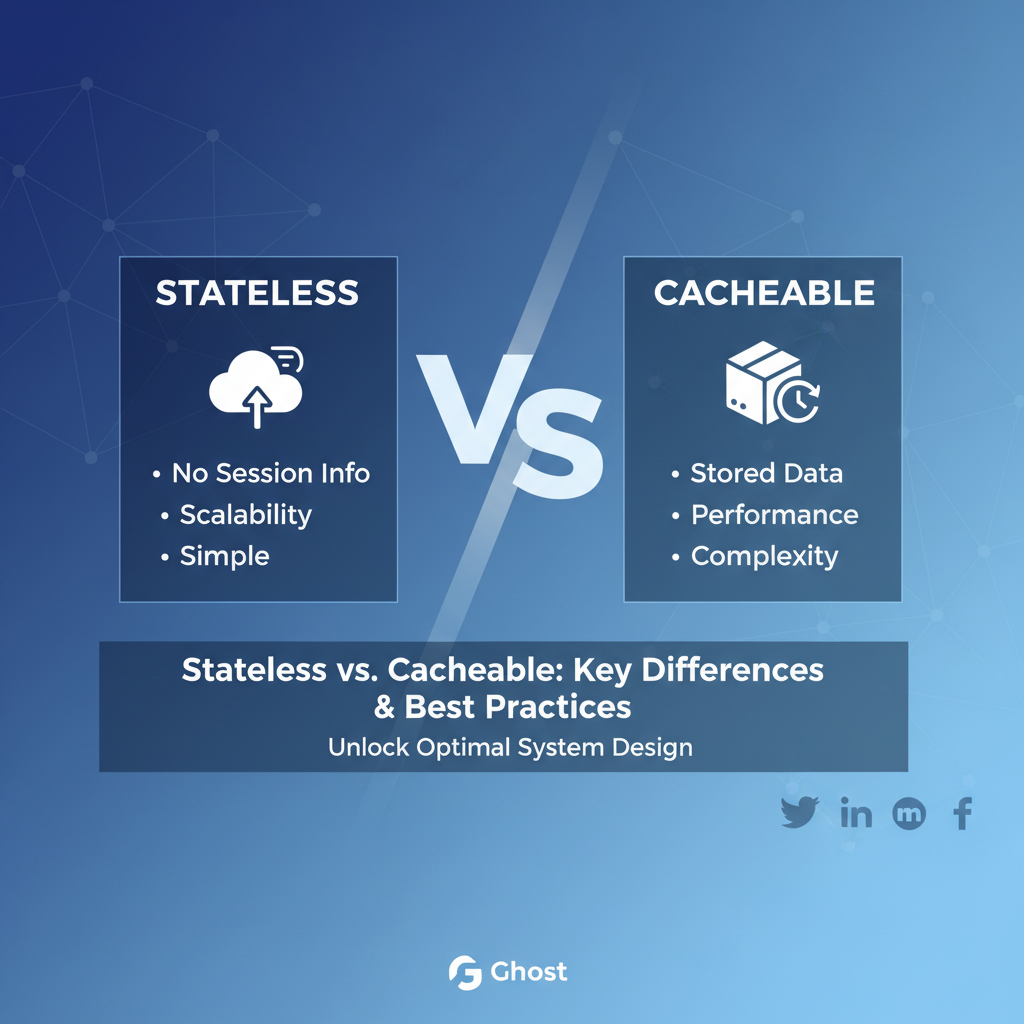
Stateless vs. Cacheable: Key Differences & Best Practices


The architectural choices made during the design phase of any modern software system profoundly influence its scalability, performance, resilience, and operational complexity. In the realm of distributed systems, microservices, and cloud-native applications, two fundamental concepts frequently emerge as central pillars of design philosophy: statelessness and cacheability. While seemingly distinct, or even at times contradictory, these two paradigms often operate in complementary roles, shaping how data is processed, stored, and delivered across intricate networks of services. Understanding their core definitions, inherent advantages, potential pitfalls, and the best practices for their implementation is not merely an academic exercise; it is a critical skill for architects and developers striving to build robust, high-performance, and scalable systems in today's dynamic digital landscape.
Modern applications, ranging from high-traffic e-commerce platforms to real-time analytics engines and sophisticated AI services, all grapple with the challenges of managing user sessions, optimizing data access, and ensuring consistent service delivery under varying loads. The strategic application of stateless principles enables systems to scale horizontally with remarkable ease, distributing requests across numerous instances without the burden of shared session state. Concurrently, judicious caching strategies can dramatically reduce latency, offload pressure from backend services, and significantly improve the overall user experience by placing frequently accessed data closer to the point of consumption. The effective interplay of these two concepts, often orchestrated and managed by an intelligent API gateway, forms the bedrock of highly efficient and resilient architectures.
This comprehensive article aims to dissect the intricacies of stateless versus cacheable design, providing a detailed exploration of their fundamental differences, individual benefits, inherent challenges, and the optimal scenarios for their application. We will delve into practical best practices for implementing each, illustrate how they can be harmoniously integrated within a single architecture, and highlight the pivotal role of an API gateway in bridging these concepts to forge systems that are not only performant but also inherently scalable and maintainable. By the end of this discussion, readers will possess a clearer understanding of how to leverage statelessness for resilience and scalability, and cacheability for unparalleled performance, thereby making informed architectural decisions that stand the test of time and evolving business demands.
Unpacking the Stateless Architecture
At its core, a stateless architecture dictates that the server, or the service processing a request, does not retain any memory or context about previous interactions with the client. Each request from the client to the server is treated as an entirely new and independent transaction, containing all the necessary information for the server to fulfill that specific request. There is no session state stored on the server side that needs to be maintained, retrieved, or updated between successive requests from the same client. This fundamental principle has profound implications for how systems are designed, deployed, and scaled.
Defining Statelessness and Its Core Principles
In a truly stateless system, the server processes a request based solely on the data provided within that request itself and any readily available global or persistent data (like a database entry, but not a session object specific to the current user interaction). This means that if a client sends two requests, the server treats them as completely isolated events, even if they originate from the same user or application instance. The responsibility for maintaining any "state" that spans multiple requests – such as user login status, shopping cart contents, or a multi-step form progress – falls entirely on the client or is externalized to a separate, shared state management layer, often a distributed database or a dedicated session store.
The core principles of statelessness can be summarized as:
- Self-Contained Requests: Every request must include all the necessary information for the server to understand and process it, without relying on any prior server-side context. This typically includes authentication tokens, user identifiers, transaction details, and any other relevant payload.
- Independence: Each request is independent of any other request, past or future. This characteristic is vital for resilience and concurrency.
- No Server-Side Session State: The server itself does not store user-specific or interaction-specific data between requests. If such data is needed, it must be provided by the client with each request or retrieved from a separate, persistent storage accessible to any server instance.
A classic example of a stateless protocol is HTTP itself. Each HTTP request (GET, POST, PUT, DELETE, etc.) is designed to be independent. When you browse the web, your browser sends a request to a server, and the server responds. The server doesn't inherently remember who you are or what you did on the previous page unless mechanisms like cookies (client-side state) or URL parameters are used to carry that information. Similarly, RESTful APIs, which build upon HTTP, strongly advocate for statelessness, making them inherently scalable and easy to consume.
Advantages of a Stateless Architecture
The benefits derived from adopting a stateless approach are numerous and directly address many of the challenges associated with building large-scale, high-availability distributed systems:
- Exceptional Scalability: This is perhaps the most significant advantage. Since no server maintains session state, any request can be handled by any available server instance. This allows for incredibly simple horizontal scaling: just add more servers behind a load balancer. The load balancer doesn't need "sticky sessions" (where requests from a specific client are always routed to the same server) because any server can process any request. This greatly simplifies load distribution and ensures efficient resource utilization. For instance, during peak traffic, new instances can be spun up and integrated into the service pool seamlessly, handling increased load without complicated state synchronization mechanisms.
- Enhanced Resilience and Fault Tolerance: If a server instance fails, it simply ceases to exist. Since it wasn't holding any unique session state, its failure does not result in lost user sessions or corrupted data. Subsequent requests from clients can be immediately routed to a healthy server instance without interruption. This provides a robust level of fault tolerance, as the failure of a single component does not bring down the entire system or even a specific user's experience. Clients can often transparently retry failed requests on a different server, an operation that is much simpler when requests are idempotent and stateless.
- Simplified Server-Side Design and Development: By shedding the burden of managing complex session state, server-side logic becomes inherently simpler. Developers can focus purely on processing the immediate request and generating a response, without needing to worry about state persistence, synchronization across multiple server instances, or complex garbage collection for expired sessions. This reduction in complexity often leads to faster development cycles, fewer bugs related to state management, and easier maintenance. The code becomes more focused on business logic rather than infrastructural concerns.
- Improved Resource Utilization: Without the need to allocate and maintain memory for active sessions on each server, resources (like CPU, memory, and network connections) can be more efficiently utilized for processing requests. Servers are not tied to specific clients or sessions, meaning resources can be dynamically allocated to the most pressing tasks. When traffic subsides, instances can be scaled down or even shut off without concern for losing active user data, leading to significant cost savings in cloud environments.
- Easier Testing and Debugging: The independent nature of each request makes testing and debugging stateless services significantly simpler. Each test case can be set up to send a complete, self-contained request, and the expected response can be verified without needing to simulate a sequence of interactions or manage complex mock session data. Debugging an issue often boils down to examining the input of a single request and the output, rather than tracing a stateful transaction across multiple distributed components.
Disadvantages and Challenges of Stateless Architecture
Despite its compelling advantages, stateless design is not without its own set of challenges and trade-offs:
- Increased Request Payload and Network Traffic: Because each request must carry all necessary context, the size of individual requests can increase. For example, authentication tokens (like JWTs) or user preferences might be sent with every request. While often negligible for small pieces of data, this can accumulate over many requests, leading to slightly higher network bandwidth consumption and processing overhead for deserialization on the server side. In scenarios where a large amount of context is required for every interaction, this overhead can become noticeable.
- Client-Side Complexity: The burden of state management shifts from the server to the client. This means the client application (web browser, mobile app, desktop application) must store, manage, and correctly attach all necessary state information to each outgoing request. For simple applications, this might be straightforward, but for complex, multi-step user workflows, managing client-side state can introduce its own set of complexities, requiring careful design patterns and robust error handling on the client.
- Overhead for Repeated Information: Information like authentication credentials or user permissions, which might be relatively static for a given session, needs to be re-sent and re-processed with every request. While this reinforces statelessness, it can introduce a small amount of redundant computation. For instance, a JWT might be re-validated on every incoming request to an API gateway or backend service, even if the user's authorization hasn't changed. This is often mitigated through caching strategies, which we will discuss later.
- Potential Performance Bottlenecks with External State: While the service itself is stateless, if it frequently needs to access a shared external state (like a database or a distributed cache) for every single request, that external state store can become a bottleneck. For example, if user preferences are stored in a database and fetched for every API call, the database's performance and network latency to it directly impact the overall response time, potentially negating some performance benefits. Careful database schema design, indexing, and internal caching within the stateless service can help alleviate this.
Use Cases for Stateless Architectures
Stateless architectures are particularly well-suited for a variety of applications and service types:
- RESTful APIs: The very design philosophy of REST (Representational State Transfer) emphasizes statelessness. Each request to a RESTful API should contain enough information to be understood by the server, without the server needing to remember previous interactions. This makes REST APIs highly scalable and easy to consume by various clients.
- Microservices: In a microservices architecture, individual services are often designed to be stateless to maximize their independent scalability and resilience. They communicate through well-defined APIs, passing all necessary context within the request or relying on shared, externalized data stores when persistent state is absolutely required.
- Serverless Functions (FaaS): Cloud functions like AWS Lambda, Azure Functions, or Google Cloud Functions are inherently stateless. Each invocation is a new execution environment, designed to process a single event or request. This model perfectly aligns with the principles of statelessness, enabling massive parallel execution and automatic scaling.
- Idempotent Operations: Operations that can be performed multiple times without changing the outcome beyond the initial application are ideal for stateless services. If a request can be retried without side effects, it vastly improves resilience in distributed systems where network issues or temporary service unavailability are common.
- Real-time Data Processing and Analytics: Services that process streams of data or perform computations where each event is independent of others can greatly benefit from a stateless design, allowing for massive parallelization and fault recovery.
The power of stateless design lies in its simplicity for scaling and resilience. By offloading session management and relying on self-contained requests, architects can build systems that effortlessly handle varying loads and recover gracefully from failures, forming a robust foundation for modern cloud-native applications.
Demystifying Cacheable Architecture
While statelessness focuses on the absence of server-side state between requests, cacheability deals with the strategic storage of data to improve performance and reduce the load on origin servers. A cacheable architecture is one that is designed to take advantage of caching mechanisms at various layers of the system to store copies of frequently accessed data closer to the point of consumption, thereby minimizing the need to repeatedly fetch it from the original source. This concept is vital for optimizing network traffic, reducing latency, and enhancing the overall responsiveness of an application.
Defining Cacheability and Its Core Principles
Cacheability refers to the characteristic of data or resources that allows them to be stored temporarily, often closer to the client or at an intermediate processing point, without compromising correctness or consistency to an unacceptable degree. The primary goal of caching is to reduce the "cost" (in terms of time, network bandwidth, or computational resources) associated with retrieving data from its authoritative source.
The core principles underpinning a cacheable architecture include:
- Data Locality: The idea is to bring data physically closer to where it's needed. This could mean caching data in a user's browser, on a local network proxy, or in an application server's memory, rather than fetching it across the internet from a distant database every time.
- Temporal Locality: If a piece of data is accessed now, it is likely to be accessed again in the near future. Caches exploit this by keeping recently accessed data readily available.
- Spatial Locality: If a particular item is accessed, items located nearby in memory or storage are likely to be accessed soon. Caches often fetch blocks of data rather than individual items.
- Validity and Invalidation: Caching introduces the challenge of ensuring that cached data remains "fresh" or "valid." When the original data changes, the cached copy must either be updated, marked as stale, or removed (invalidated) to prevent clients from receiving outdated information. This is often considered one of the hardest problems in computer science.
- Hit Ratio: A key metric for caching effectiveness, the hit ratio indicates the percentage of requests that are successfully served from the cache, rather than having to go to the origin server. A higher hit ratio means better performance and less load on the backend.
Types of Caching in Distributed Systems
Caching can be implemented at multiple layers within a distributed system, each offering distinct benefits and targeting different types of data:
- Client-Side Caching (Browser Cache, Application Cache):
- Description: This is the cache closest to the end-user. Web browsers store static assets (images, CSS, JavaScript files), and application-specific data. Mobile applications can also cache data locally.
- Mechanism: HTTP headers (like
Cache-Control,Expires,ETag,Last-Modified) instruct the client on how long to cache a resource and how to revalidate it. - Benefits: Extremely fast access (no network trip), significant reduction in server load and bandwidth, improved offline capabilities for some applications.
- Challenges: Limited storage, cache invalidation can be tricky (browser might not revalidate quickly enough).
- Proxy Caching (CDN, Reverse Proxy, API Gateway):
- Description: Intermediate servers store copies of resources requested by multiple clients.
- Content Delivery Networks (CDNs): Geographically distributed networks of proxy servers that cache static and dynamic content closer to users worldwide.
- Reverse Proxies: Servers placed in front of web servers to handle requests, often caching static content or common responses.
- API Gateway: A powerful intermediary that can cache responses from backend APIs, authentication tokens, and more, before forwarding requests to microservices.
- Mechanism: Intercepts requests, checks if the response is in its cache, serves it if available and valid, otherwise forwards to the origin server and caches the response.
- Benefits: Reduces load on origin servers, improves global latency for distributed users (CDNs), serves as a central point for caching policies.
- Challenges: Cache invalidation across a distributed network of proxies can be complex; ensuring cache coherence.
- Description: Intermediate servers store copies of resources requested by multiple clients.
- Application-Level Caching (In-memory, Distributed Cache):
- Description: Caching implemented directly within the application's code or by dedicated cache servers that the application interacts with.
- In-memory Cache: Data stored in the RAM of the application server itself (e.g., using libraries like Guava Cache, Ehcache). Fastest but limited to a single instance.
- Distributed Cache: Dedicated caching systems (e.g., Redis, Memcached) that store data across multiple servers, accessible by all application instances. Provides shared, scalable caching.
- Mechanism: Application logic explicitly stores and retrieves data from these caches before resorting to a slower persistent store (like a database).
- Benefits: Reduces database load, improves application response times for frequently computed or accessed data, can be highly scalable (distributed caches).
- Challenges: Cache invalidation logic within the application, managing cache memory, network latency to distributed cache servers.
- Description: Caching implemented directly within the application's code or by dedicated cache servers that the application interacts with.
- Database Caching:
- Description: Caching mechanisms built into database systems themselves. This can include query caches, result set caches, index caches, and buffer pools.
- Mechanism: The database system automatically stores frequently accessed data or query results in memory to speed up subsequent requests.
- Benefits: Reduces disk I/O, speeds up frequently run queries, transparent to the application.
- Challenges: Can be less efficient for highly dynamic data, may require careful configuration, can sometimes mask underlying database performance issues if relied upon too heavily.
Advantages of a Cacheable Architecture
Implementing caching effectively yields significant advantages for application performance and operational efficiency:
- Drastically Reduced Latency and Faster Response Times: The most direct benefit. By serving data from a cache, which is often in memory or geographically closer, the time taken for a response to reach the client is significantly cut down. This leads to a snappier user experience, particularly for applications with many static assets or frequently accessed read-heavy API endpoints. The milliseconds saved per request can add up to a noticeable difference in overall application fluidity and responsiveness, directly impacting user satisfaction and engagement.
- Significant Reduction in Load on Origin Servers: Every request served from a cache is one less request that hits the backend application server or database. This offloading effect is crucial during peak traffic periods, as it allows the origin servers to focus on processing unique, non-cacheable requests, or computationally intensive tasks. It also reduces the need to scale up backend infrastructure as aggressively, leading to substantial cost savings in terms of compute and database resources. Imagine a popular article or product page: if millions of users access it, and it can be served from a CDN cache, the backend never even sees the vast majority of those requests.
- Improved System Throughput: With less strain on origin servers, the overall capacity of the system to handle a greater volume of unique or complex requests increases. By serving cached responses quickly, resources that would otherwise be tied up in network I/O or database queries are freed up to handle more concurrent operations, leading to a higher transaction per second (TPS) rate for the entire system. This is vital for applications experiencing rapid growth or unpredictable traffic spikes.
- Enhanced Reliability and Availability: Caching can act as a partial buffer against backend service failures. If an origin server becomes temporarily unavailable, a cache (especially a distributed one like a CDN or an API gateway cache) might still be able to serve stale content for a period, providing a degraded but functional experience rather than a complete outage. This "graceful degradation" is a key aspect of resilient system design, ensuring that users can still access some information even when critical backend services are experiencing issues.
- Cost Savings: Reduced network egress costs (especially in cloud environments), lower infrastructure scaling needs, and optimized database resource utilization all contribute to significant operational cost savings. Less data transferred means lower bandwidth bills, fewer servers to provision and maintain means reduced hosting costs, and less stress on expensive database licenses or managed services translates to a more economical overall architecture.
Disadvantages and Challenges of Cacheable Architecture
While highly beneficial, caching introduces its own set of complexities and potential drawbacks:
- Cache Invalidation Complexity ("The Hard Problem"): This is famously dubbed one of the two hardest problems in computer science (the other being naming things). Ensuring that cached data remains consistent with the authoritative source is extremely challenging. When the original data changes, all relevant cached copies must be updated or removed. Incorrect invalidation strategies can lead to users seeing stale, incorrect, or inconsistent data, which can severely impact user trust and application correctness. Strategies range from simple Time-to-Live (TTL) expiration to complex event-driven invalidation.
- Increased Infrastructure Complexity: Implementing a robust caching strategy often requires additional infrastructure, such as dedicated cache servers (Redis clusters, Memcached), CDN services, or specialized API gateway components. This adds layers to the system, increasing the complexity of deployment, monitoring, and maintenance. Managing these cache layers, ensuring their high availability, and optimizing their performance requires specialized knowledge and operational effort.
- Cache Coherency Issues in Distributed Systems: In a distributed environment with multiple caches (e.g., a client cache, a CDN, an API gateway, and an application cache), ensuring that all these copies reflect the most current state of the data is a formidable task. Different caches might have different invalidation policies or refresh intervals, leading to situations where various users or components see different versions of the same data. Achieving strong consistency with caching in distributed systems often involves trade-offs with performance or availability (CAP theorem).
- Cold Start Problem: When a cache is empty (e.g., after deployment, a cache flush, or a server restart), the very first requests for data will not find anything in the cache. These requests must then go to the origin server, resulting in slower response times initially until the cache "warms up" and populates itself with frequently accessed data. This cold start period can sometimes lead to temporary performance degradation or increased load on backend services right after a cache reset.
- Storage and Memory Management: Caches consume memory or disk space. Effective cache management requires strategies for determining what to evict when the cache reaches its capacity. Algorithms like Least Recently Used (LRU), Least Frequently Used (LFU), or FIFO are employed, but choosing and tuning them for specific workloads adds another layer of complexity. Poor management can lead to a low cache hit ratio, essentially making the cache ineffective.
Use Cases for Cacheable Architectures
Caching is most effective for:
- Static Assets: Images, CSS files, JavaScript, video files – perfect candidates for client-side and CDN caching, as they rarely change.
- Frequently Accessed Dynamic Content: Data that changes infrequently but is read by many users (e.g., news articles, product descriptions, user profiles that aren't actively being updated).
- API Responses for Read-Heavy Workloads: If an API gateway exposes an endpoint that consistently returns the same data for a given request for a period, caching the API response at the gateway level or further upstream is highly effective.
- Authentication Tokens and User Permissions: Once generated and validated, these can be cached for a short period to avoid re-validation on every request, significantly speeding up subsequent requests. An API gateway is an ideal place for this.
- Pre-computed Reports or Aggregations: Results of complex analytics queries or reports that take time to generate can be cached and periodically refreshed.
- Database Query Results: Caching the results of expensive or frequently executed database queries can drastically reduce database load.
By carefully identifying cacheable resources and implementing appropriate caching strategies, architects can significantly boost the performance and resilience of their systems, while simultaneously reducing the operational burden on backend services. The key lies in balancing the benefits of speed and load reduction against the complexities of cache invalidation and consistency.
The Interplay: When Stateless Meets Cacheable
It is crucial to understand that statelessness and cacheability are not mutually exclusive concepts; rather, they are often complementary design paradigms that can be strategically combined to create highly performant, scalable, and resilient systems. In fact, many modern architectures leverage both, employing stateless services while judiciously applying caching at various layers to optimize performance.
Consider a microservice designed to be stateless. This service processes each request independently, without retaining any user-specific session data. This design allows it to scale horizontally with ease, as any instance can handle any incoming request. However, what if this stateless service frequently needs to fetch certain configuration data or reference data from a database that changes only rarely? Or perhaps it needs to validate an authentication token that, once validated, can be trusted for a short period. In such scenarios, while the service itself remains stateless, the access to its dependencies or its own output can be made cacheable.
For instance, an API gateway acts as the first point of contact for clients, sitting in front of a collection of stateless microservices. The API gateway itself is often designed to be largely stateless in how it routes requests or applies policies, enabling it to scale out to handle massive traffic without requiring sticky sessions. However, the same API gateway can be an exceptionally powerful caching layer. It can cache responses from downstream services, preventing identical requests from hitting the backend repeatedly. It can also cache authentication tokens after an initial validation, allowing subsequent requests with the same token to bypass a full authentication check for a defined duration, thereby speeding up authorization and reducing the load on identity services. This synergy is powerful: stateless services provide the backend scalability and resilience, while caching at the gateway or application layer provides the necessary performance boost and protection for those backend services.
This is precisely where sophisticated API gateway solutions become indispensable. Platforms like ApiPark, an open-source AI gateway and API management platform, are specifically engineered to provide robust API lifecycle management, quick integration of 100+ AI models, and unified API formats for AI invocation. Crucially, APIPark can act as a powerful caching layer for frequently accessed AI model responses or processed data, significantly reducing the load on expensive AI inference engines and improving response times, while simultaneously ensuring backend AI services remain stateless and highly scalable. Its performance, rivaling Nginx, underscores its capability to efficiently handle and cache large-scale traffic, making it an excellent choice for managing both stateless services and implementing effective caching strategies within a unified gateway. By abstracting away the complexities of AI model integration and offering a unified API format, APIPark empowers developers to treat AI models as stateless endpoints, while its underlying architecture can intelligently cache responses to ensure optimal performance, providing a seamless and highly efficient experience for AI-powered applications.
In essence, a system can be composed of stateless components that perform their work without maintaining session data, while simultaneously benefiting from caching mechanisms that store the outputs of these components or the inputs they rely on. Caching often enables more effective statelessness by reducing the need for stateless services to constantly re-fetch common data from external, slower persistent stores. It optimizes the "read path" in stateless architectures without introducing server-side session state complexity, thereby enhancing both scalability and performance. This balanced approach is characteristic of many modern, high-performance distributed systems.
Key Differences: A Comparative Analysis
While both statelessness and cacheability are fundamental to modern system design, they address different concerns and have distinct characteristics. A clear understanding of these differences is essential for making informed architectural decisions. The following table provides a concise comparison, followed by a more detailed explanation of each aspect.
| Feature / Aspect | Stateless Architecture | Cacheable Architecture |
|---|---|---|
| Core Principle | No server-side session state; each request self-contained. | Store copies of data closer to access point to reduce latency/load. |
| Primary Goal | Maximize horizontal scalability, resilience, and fault tolerance. | Enhance performance, reduce backend load, improve resource efficiency. |
| Key Challenge | Client must manage all necessary context; potential for larger request payloads. | Cache invalidation (ensuring data freshness), cache coherency. |
| State Management | Server treats each request independently; client or external store manages session/context. | Data is stored temporarily at an intermediate layer, not as session state. |
| Server Complexity | Simpler server logic regarding session state and request processing. | Added complexity of cache infrastructure, invalidation policies, and eviction. |
| Client Complexity | Client typically holds and sends all necessary state or context. | Client might deal with stale data if not handled properly; revalidation logic. |
| Impact on Backend | Reduced need for complex state synchronization across instances. | Significantly reduced request volume hitting origin services and databases. |
| Typical Layers | Backend services, microservices, API Gateway request processing. | CDN, Reverse Proxy, API Gateway caching, Application cache, Database cache. |
| Data Nature | Any type of request/response data; focus on process, not data storage. | Often static or semi-static data, frequently accessed, read-heavy. |
| Consistency | Inherently strong consistency per request if data source is consistent. | Trade-off between consistency and performance; eventual consistency often tolerated. |
Detailed Explanation of Key Differences:
- Core Principle:
- Stateless: The fundamental tenet is the absence of memory on the server side between requests. Each interaction starts fresh, carrying all its required context. This simplifies server design and enables effortless scaling.
- Cacheable: The principle is about data replication and proximity. It focuses on taking data that exists somewhere (the origin) and making a temporary copy of it available closer to the consumer or a choke point to expedite access.
- Primary Goal:
- Stateless: Its main objective is to achieve maximum horizontal scalability and resilience. By not holding state, any server can serve any request, making it easy to add or remove instances and ensuring graceful degradation during failures.
- Cacheable: Its primary aim is performance optimization. By reducing the need to repeatedly fetch data from a slower source, caching decreases latency, speeds up response times, and alleviates the load on backend systems.
- Key Challenge:
- Stateless: The main challenge is ensuring that every request is genuinely self-contained. This shifts complexity to the client, which must manage and transmit all necessary state, potentially leading to larger request payloads and client-side logic overhead.
- Cacheable: The "hard problem" of cache invalidation is central. Ensuring that cached data remains fresh and consistent with the origin source, especially in distributed environments, is complex and crucial to prevent stale data issues.
- State Management:
- Stateless: The server explicitly does not manage session or interaction-specific state. Any state that needs to persist across requests must be managed by the client (e.g., in cookies, local storage, or embedded in tokens) or externalized to a separate, shared, and typically highly available data store (e.g., a distributed database or session store).
- Cacheable: Caching inherently involves managing temporary data storage. This state is not about user sessions but about copies of resources. Cache management includes eviction policies (e.g., LRU), expiry times (TTL), and synchronization mechanisms across cache nodes.
- Server Complexity:
- Stateless: Server logic can be simpler as it doesn't need to deal with session management, state synchronization across instances, or complex state recovery mechanisms. It focuses purely on processing the current request based on its input.
- Cacheable: Introducing caching layers adds complexity to the infrastructure and potentially to application logic. This includes configuring and managing cache servers, designing invalidation strategies, monitoring cache hit ratios, and handling cache misses efficiently.
- Client Complexity:
- Stateless: Clients often bear more responsibility for maintaining and transmitting their context. This might mean including more headers, tokens, or body data with each request, potentially increasing client-side logic for state persistence and retrieval.
- Cacheable: Clients might need to be aware of caching mechanisms, particularly browser caches, to ensure they don't serve stale content. They might implement revalidation logic (e.g.,
If-None-MatchHTTP headers) to efficiently check for updated content without re-downloading everything.
- Impact on Backend:
- Stateless: The backend benefits from simpler internal state management, making it easier to scale out and recover from failures without worrying about state loss. It also inherently supports more flexible load balancing.
- Cacheable: The backend experiences a significant reduction in the volume of incoming requests, as many are served by the cache. This reduces database load, CPU utilization, and network traffic, allowing backend services to handle their core logic more efficiently.
- Typical Layers:
- Stateless: This design principle primarily applies to backend application services, microservices, and event processors. An API gateway itself might operate in a largely stateless manner for routing and policy enforcement.
- Cacheable: Caching occurs at various layers: client browsers, CDNs, reverse proxies, API gateways, application-level caches (in-memory or distributed), and even within databases. It's a cross-cutting concern.
- Data Nature:
- Stateless: This principle applies to the process of handling requests, regardless of the data's nature. Any type of request can be processed stateless.
- Cacheable: Caching is most effective for data that is relatively static or changes predictably, and is frequently accessed. Highly dynamic, real-time, or sensitive data often requires careful consideration or may not be suitable for aggressive caching.
- Consistency:
- Stateless: If the underlying persistent data store is consistent, each request to a stateless service will retrieve the most current data. The consistency of the service directly reflects the consistency of its data sources.
- Cacheable: Caching often introduces a trade-off with strong consistency. To achieve performance benefits, eventual consistency is often accepted, meaning there might be a short window where cached data is slightly out of sync with the origin. Maintaining strong consistency with caching across distributed systems is extremely complex and often comes at a high performance cost.
By understanding these distinctions, architects can thoughtfully design systems that leverage the strengths of both paradigms, creating highly optimized and robust solutions tailored to specific application requirements.
APIPark is a high-performance AI gateway that allows you to securely access the most comprehensive LLM APIs globally on the APIPark platform, including OpenAI, Anthropic, Mistral, Llama2, Google Gemini, and more.Try APIPark now! 👇👇👇
Best Practices for Stateless Design
Building truly stateless services requires a disciplined approach and adherence to several best practices. While the concept seems simple, ensuring that no implicit state creeps into your system can be challenging.
- Design for Idempotency:
- Elaboration: An idempotent operation is one that can be applied multiple times without changing the result beyond the initial application. For example, setting a value is idempotent (setting it again yields the same state), but incrementing a counter is not.
- Why it's Crucial: In distributed, stateless systems, network glitches or server failures can lead to requests being retried. If a service is stateless and its operations are idempotent, clients can safely retry failed requests without fear of unintended side effects (like duplicating a charge or creating multiple identical resources). This significantly enhances the resilience of the overall system.
- Implementation: For POST requests that are not inherently idempotent, consider including a unique client-generated "idempotency key" in the request headers or body. The server can then use this key to detect and deduplicate repeated requests within a certain time window, ensuring the operation is processed only once.
- Use Token-based Authentication (JWTs):
- Elaboration: Traditional session-based authentication relies on the server storing a session ID and mapping it to user data. Token-based authentication, particularly using JSON Web Tokens (JWTs), allows for a stateless approach. A JWT is a self-contained token that includes all necessary user information and cryptographic signatures, allowing any server to verify its authenticity and extract user data without querying a central session store.
- Why it's Crucial: Once a user authenticates, the server issues a JWT. The client then includes this JWT with every subsequent request. Any backend service, or an API gateway, can validate the token's signature and expiration directly, making the authentication process stateless from the perspective of individual service instances. This greatly simplifies horizontal scaling and load balancing for authenticated requests.
- Implementation: Upon successful login, issue a short-lived access token and a longer-lived refresh token. The client uses the access token for API calls and the refresh token to obtain new access tokens when the current one expires. Crucially, the server doesn't maintain state about these tokens; validation is cryptographic.
- Externalize Session State (if truly necessary):
- Elaboration: While the goal is statelessness, some applications genuinely require complex, multi-step workflows that inherently involve session data (e.g., a multi-page checkout process or interactive configuration). In such cases, the session state should not be stored directly on the application server.
- Why it's Crucial: To maintain the benefits of stateless application servers, any necessary session state should be pushed out to a highly available, external, and shared data store. This could be a distributed cache like Redis or Memcached, or a purpose-built session database. The application servers then become mere clients of this session store.
- Implementation: Each application server instance queries the external session store for session data using a session ID provided by the client (e.g., in a cookie or header). When the session data needs to be updated, it writes back to the external store. This ensures that any application instance can retrieve and update the session, allowing for seamless horizontal scaling of the application servers themselves.
- Leverage the API Gateway for Cross-Cutting Concerns:
- Elaboration: An API gateway sits between clients and backend services, acting as a single entry point. It's an ideal place to handle common concerns that would otherwise introduce state or complexity into backend services.
- Why it's Crucial: An API gateway can handle authentication, authorization, rate limiting, logging, and even request transformation before requests reach the backend. By offloading these concerns, backend services can remain simpler and purely focused on business logic, maintaining their stateless nature. For example, the API gateway can validate a JWT, extract user identity, and then forward the request with the validated user ID to the backend, which trusts the gateway to have performed the authentication.
- Implementation: Configure the API gateway to manage authentication policies, apply rate limits based on client IDs (which can be cached at the gateway), and centralize logging. This allows backend services to be truly stateless, focusing solely on their domain-specific tasks without worrying about these infrastructure-level concerns. Products like ApiPark excel at this, centralizing API management, authentication, and traffic control, allowing individual AI and REST services to operate in a streamlined, stateless fashion.
- Educate Teams and Document Principles:
- Elaboration: Ensuring a consistent stateless design across a large team or multiple microservices requires clear communication and documentation. Developers need to understand why statelessness is important and how to implement it correctly.
- Why it's Crucial: Without clear guidelines, it's easy for developers to accidentally introduce stateful components or assumptions that undermine the benefits of a stateless architecture. This can lead to unexpected scaling issues or resilience problems down the line.
- Implementation: Establish architectural guidelines that mandate statelessness for backend services. Conduct training sessions, provide code examples, and review pull requests with statelessness in mind. Document common patterns for handling transient state (e.g., using correlation IDs for logging distributed requests, passing context through headers).
By diligently applying these practices, development teams can construct highly scalable, resilient, and manageable systems where the benefits of statelessness are fully realized.
Best Practices for Cacheable Design
Effective caching is an art form, balancing performance gains with the complexities of data consistency. Implementing it successfully requires careful planning and a deep understanding of your data and access patterns.
- Identify Cache Candidates Carefully:
- Elaboration: Not all data is suitable for caching. The most effective candidates are:
- Static Assets: Images, CSS, JavaScript, fonts, videos. These rarely change.
- Reference Data: Lookup tables, configuration settings, country lists. Changes infrequently.
- Frequently Accessed Dynamic Content with Low Update Frequency: News articles, product descriptions, popular blog posts. Data that is read much more often than it is written.
- Computationally Expensive Results: Outputs of complex queries, AI model inferences, or aggregations that take time to generate but are requested often.
- Why it's Crucial: Caching data that changes too frequently, is rarely accessed, or is highly sensitive introduces more overhead and risk than benefit. Conversely, failing to cache ideal candidates leaves significant performance opportunities on the table.
- Implementation: Analyze access logs and database query patterns to identify hot spots. Use profiling tools to pinpoint expensive operations. Consult business domain experts to understand data volatility.
- Elaboration: Not all data is suitable for caching. The most effective candidates are:
- Implement Effective Cache Invalidation Strategies:
- Elaboration: This is the "hardest problem" in caching. When the original data changes, the cached copy must be updated or removed. Common strategies include:
- Time-to-Live (TTL): The simplest approach. Cached items are automatically expired after a predefined duration. This works well for data where a short period of staleness is acceptable.
- Event-Driven Invalidation (Publish/Subscribe): When the source data changes (e.g., a database record is updated), an event is published, and all caches subscribed to that event receive a notification to invalidate or refresh their copies. This provides near real-time consistency.
- Cache-Aside Pattern: The application explicitly manages caching. It first checks the cache; if data is found, it uses it. If not (a cache miss), it fetches from the database, uses the data, and then stores it in the cache for future use.
- Write-Through/Write-Back Patterns: In these patterns, writes go directly to the cache, and the cache is responsible for writing the data to the underlying persistent store. Write-through writes immediately; write-back buffers writes and flushes them periodically, offering better write performance but higher risk of data loss on cache failure.
- Versioned Caching (Cache Busting): For static assets, include a version hash (e.g.,
app.bundle.1a2b3c.js) in the filename. When the file changes, its hash changes, effectively creating a new URL and forcing clients/CDNs to fetch the new version.
- Why it's Crucial: Incorrect invalidation leads to stale data, which can cause user confusion, incorrect business decisions, or even security vulnerabilities. A well-chosen strategy balances consistency needs with performance gains.
- Implementation: Select a strategy based on data volatility and consistency requirements. For high-volume, low-staleness tolerance, event-driven invalidation might be preferred. For static assets, versioning is ideal. For frequently read reference data, TTL is simple and effective.
- Elaboration: This is the "hardest problem" in caching. When the original data changes, the cached copy must be updated or removed. Common strategies include:
- Choose the Right Caching Layer for the Job:
- Elaboration: As discussed, caching can occur at the client, CDN, API gateway, application, or database level. The choice depends on the type of data, its access patterns, and the desired scope of caching.
- Why it's Crucial: Placing a cache at the optimal point maximizes its benefits. For global static content, a CDN is indispensable. For frequently accessed API responses from an internal service, an API gateway or application-level cache is more appropriate. Using a client-side cache for sensitive, dynamic user data would be a mistake.
- Implementation: Architect caching layers from the client inwards, considering where the data is most effectively stored to reduce network hops and backend load. For instance, an API gateway like ApiPark offers a strategic point to implement caching for unified AI API responses, preventing redundant expensive AI model invocations and ensuring rapid delivery to various client applications. Its capability to unify API formats for AI invocation means that cached AI responses can be consistently served, regardless of underlying model changes, enhancing overall system efficiency and reducing operational costs.
- Monitor Cache Performance and Health Continuously:
- Elaboration: Caches are not "set it and forget it." They require continuous monitoring to ensure they are performing as expected and providing value. Key metrics include:
- Cache Hit Ratio: The percentage of requests served from the cache. A low hit ratio indicates an ineffective cache.
- Cache Miss Rate: The inverse of the hit ratio. High miss rates mean more requests are hitting the backend.
- Latency for Cache Hits vs. Misses: Compare the time taken to serve data from the cache versus fetching it from the origin.
- Eviction Rate: How often items are removed from the cache due to capacity limits. High evictions might mean the cache is too small or its eviction policy is suboptimal.
- Cache Size and Memory Usage: Ensure the cache is not over-provisioned or under-provisioned.
- Why it's Crucial: Monitoring provides insights into whether caching strategies are working, whether the cache needs resizing, or if invalidation logic is faulty. It allows for proactive adjustments to maintain optimal performance.
- Implementation: Integrate cache metrics into your observability stack (e.g., Prometheus, Grafana, ELK Stack). Set up alerts for critical thresholds (e.g., dangerously low hit ratio, high eviction rates). Regularly review dashboards.
- Elaboration: Caches are not "set it and forget it." They require continuous monitoring to ensure they are performing as expected and providing value. Key metrics include:
- Consider Cache Coherency for Distributed Systems:
- Elaboration: In systems with multiple distributed caches (e.g., multiple application instances each with an in-memory cache, plus a shared Redis cache), ensuring all caches present a consistent view of data can be complex. This relates to the CAP theorem.
- Why it's Crucial: Inconsistent data across caches can lead to incorrect behavior, especially if different parts of the application rely on different views of the same data. Choosing between strong consistency (all caches always up-to-date) and eventual consistency (caches eventually become consistent) is a fundamental trade-off.
- Implementation: For strong consistency, a global invalidation mechanism (e.g., broadcast messages via pub/sub) is often required. For eventual consistency, careful design of how stale data is handled and communicated to users is necessary. Often, the acceptable level of staleness dictates the complexity of the coherence strategy. For example, for a user's profile, a few seconds of staleness might be acceptable, but for a financial transaction, it's not.
- Secure Your Cache:
- Elaboration: Caches can store sensitive data. It's vital to ensure they are as secure as your primary data stores.
- Why it's Crucial: A compromised cache can expose sensitive user information, authentication tokens, or business secrets.
- Implementation: Encrypt sensitive data in the cache where possible. Implement strong access controls for cache servers. Ensure proper network segmentation. Consider the implications of caching personally identifiable information (PII) and adhere to data privacy regulations (GDPR, CCPA).
By diligently applying these best practices, architects and developers can harness the immense power of caching to deliver superior performance and efficiency while mitigating the inherent complexities and risks associated with data replication.
Integrating the API Gateway: The Orchestrator of Statelessness and Cacheability
The API gateway stands as a pivotal component in modern distributed architectures, serving as the single entry point for all client requests. It acts as an intelligent proxy, routing requests to appropriate backend services, applying policies, and centralizing numerous cross-cutting concerns. Crucially, the API gateway plays a central role in orchestrating both statelessness and cacheability, enabling backend services to remain lean and focused while enhancing overall system performance and resilience.
API Gateway as an Enforcer of Statelessness
From the perspective of backend services, the API gateway is instrumental in maintaining statelessness. It offloads common infrastructure concerns that might otherwise force backend services to maintain some form of state:
- Centralized Authentication and Authorization: Instead of each microservice having to validate a user's session or authentication token, the API gateway handles this upfront. It can validate JWTs, session cookies, or API keys. Once validated, it can inject user context (e.g., user ID, roles) into the request headers before forwarding to the backend. This allows backend services to trust the incoming request and remain entirely stateless regarding user identity and permissions. They simply process the request based on the context provided by the gateway, without needing to maintain active user sessions or re-validate credentials.
- Rate Limiting: Implementing rate limiting directly in each backend service can be cumbersome and difficult to synchronize. The API gateway provides a central point to apply and enforce rate limits across all APIs, protecting backend services from abuse or overload. The state for rate limiting (e.g., request counters per user/IP) is managed by the gateway (often in an internal, distributed cache), allowing backend services to remain stateless concerning traffic control.
- Request and Response Transformation: The gateway can modify incoming requests and outgoing responses (e.g., adding/removing headers, transforming data formats). This ensures that backend services receive requests in a consistent format and can respond with minimal concern for client-specific formatting, further simplifying their logic and promoting statelessness by externalizing presentation concerns.
- Routing and Load Balancing: The API gateway dynamically routes requests to healthy backend service instances. Since backend services are stateless, the gateway doesn't need "sticky sessions," allowing it to distribute load efficiently across any available instance, maximizing the benefits of horizontal scaling.
API Gateway as a Strategic Caching Layer
Beyond enabling statelessness, the API gateway is also an ideal location for implementing robust caching mechanisms, significantly improving performance and protecting backend services:
- API Response Caching: For read-heavy API endpoints with data that changes infrequently, the API gateway can cache entire API responses. When a subsequent, identical request arrives within the cache's time-to-live (TTL), the gateway can serve the response directly from its cache, bypassing the backend service entirely. This drastically reduces latency, offloads backend load, and saves computational resources. This is particularly effective for public APIs where many clients might request the same popular resources.
- Authentication Token Caching: After validating an authentication token (e.g., a JWT), the API gateway can cache the validation result or even parsed token details for a short period. Subsequent requests from the same user with the same token can then be quickly authorized from the cache without needing to re-execute the full validation logic or query an identity provider, leading to faster authorization decisions.
- Static Asset Caching: While CDNs are usually preferred for global static assets, an API gateway can effectively cache static content served from backend services, especially for internal applications or where a full CDN might be overkill.
- Rate Limit Counter Caching: The counters used for rate limiting (e.g., number of requests from an IP in a given minute) are transient data ideal for caching within the API gateway. This allows for high-performance rate limiting checks without burdening a persistent database.
This is precisely where an API gateway like ApiPark truly shines. As an open-source AI gateway and API management platform, APIPark is designed to manage, integrate, and deploy AI and REST services with ease. Its capabilities extend far beyond simple routing; it provides end-to-end API lifecycle management, ensuring that developers can design, publish, invoke, and decommission APIs efficiently. APIPark’s architecture, boasting performance rivaling Nginx and supporting cluster deployment, makes it an exceptionally powerful caching layer. For example, in an AI-driven application, invoking an AI model for inference can be computationally expensive and time-consuming. APIPark can strategically cache the results of these AI model inferences or complex prompt encapsulations into REST APIs. If multiple users or services request the same AI prediction for identical inputs, APIPark can serve the response directly from its cache, drastically reducing the load on the backend AI models and accelerating response times. This not only optimizes resource utilization but also ensures that the underlying AI services can remain stateless, focusing purely on processing unique inference requests, while APIPark handles the heavy lifting of caching and efficient delivery. The platform's powerful data analysis and detailed API call logging further support the fine-tuning of these caching strategies, allowing businesses to optimize performance based on real-world usage patterns. APIPark embodies the ideal integration of stateless service management with intelligent caching, delivering a robust and high-performing API ecosystem.
In conclusion, the API gateway acts as the crucial orchestrator, enabling a harmonious coexistence of stateless backend services and performance-enhancing caching strategies. By centralizing common concerns and abstracting away complexities, it allows development teams to build scalable, resilient, and highly performant systems that leverage the best of both stateless and cacheable design principles.
Advanced Considerations and Trade-offs
While statelessness and cacheability offer significant advantages, their implementation, especially when combined in complex distributed systems, introduces several advanced considerations and trade-offs that architects must navigate carefully.
- CAP Theorem and Consistency Models:
- Elaboration: The CAP theorem states that a distributed data store cannot simultaneously provide more than two out of three guarantees: Consistency (all nodes see the same data at the same time), Availability (every request receives a response, without guarantee that it contains the latest version of the information), and Partition tolerance (the system continues to operate despite network partitions).
- Impact on Stateless/Cacheable: Stateless services typically rely on a consistent backend data store. Introducing caching layers, especially distributed ones, often forces a trade-off between strong consistency and high availability/performance. Caching inherently involves data replication, which complicates consistency. If you prioritize immediate consistency, caches might need to be frequently invalidated or checked, reducing performance. If you prioritize performance and availability, you might accept eventual consistency, where cached data might be temporarily stale.
- Trade-off: Architects must explicitly choose a consistency model (e.g., strong, eventual, causal) appropriate for each piece of data. For financial transactions, strong consistency is paramount, limiting caching options. For a news feed, eventual consistency with aggressive caching might be perfectly acceptable.
- Cost vs. Performance vs. Complexity:
- Elaboration: Every architectural decision has cost implications—not just monetary, but also in terms of development effort, operational overhead, and maintenance.
- Impact on Stateless/Cacheable:
- Statelessness: Simplifies server-side logic and scales horizontally cost-effectively (more instances, less powerful ones). However, externalizing session state to a dedicated distributed store (e.g., a Redis cluster) adds infrastructure cost and management complexity.
- Caching: Significantly boosts performance and reduces backend load, potentially saving on origin server costs. However, caching infrastructure itself (CDNs, dedicated cache servers, API gateways with caching features) incurs costs for procurement, deployment, and ongoing management. The complexity of designing and maintaining robust cache invalidation strategies also adds to development and operational costs.
- Trade-off: The optimal solution is rarely to cache "everything" or make "everything" stateless. It's about finding the sweet spot where the performance benefits justify the added complexity and cost, considering the specific workload characteristics and business requirements. A detailed cost-benefit analysis is essential.
- Security Implications of Caching Sensitive Data:
- Elaboration: While caching is excellent for performance, it introduces new security considerations, particularly when dealing with sensitive information.
- Impact on Cacheable: Caching user data, authentication tokens, or other personally identifiable information (PII) means these sensitive details reside in more locations, potentially on less secure or more widely accessible systems (like a CDN edge node or a shared in-memory cache). A cache breach could expose a significant amount of data.
- Trade-off:
- Never Cache Truly Sensitive Data: For highly sensitive, dynamic data (e.g., credit card numbers, one-time passwords), caching should be avoided entirely.
- Minimize Scope and TTL: For moderately sensitive data, cache only what's absolutely necessary, with very short Time-to-Live (TTL) values.
- Encryption and Access Control: Ensure all caching layers are secured with strong access controls, encryption at rest and in transit, and robust authentication.
- Data Masking: Consider caching only masked or anonymized versions of sensitive data if possible.
- Stateless Security: Stateless authentication using signed tokens (like JWTs) relies heavily on cryptographic security. If the signing key is compromised, an attacker can forge tokens. Proper key management and rotation are critical.
- Observability and Troubleshooting:
- Elaboration: In complex distributed systems, understanding what's happening and troubleshooting issues requires robust observability (logging, metrics, tracing).
- Impact on Stateless/Cacheable:
- Stateless Services: While individual requests are simpler to debug, tracing a full user journey across multiple stateless microservices requires distributed tracing (e.g., OpenTelemetry, Jaeger) to correlate requests. Without shared session IDs, understanding the sequence of operations can be challenging.
- Caching Layers: Caches introduce an additional layer of indirection. When an issue occurs, it can be difficult to determine if it's due to a backend service error, a network problem, or stale data being served from a cache. Effective troubleshooting requires monitoring cache hit/miss ratios, eviction rates, and cache invalidation events.
- Trade-off: Investing in a comprehensive observability stack is non-negotiable. This includes detailed logging (e.g., correlation IDs for stateless requests), metrics for every service and cache (performance, error rates), and distributed tracing to visualize request flows across service boundaries and through caching layers. An API gateway like APIPark, with its detailed API call logging and powerful data analysis, provides crucial insights into API performance and potential issues, helping to pinpoint problems related to both stateless service execution and caching effectiveness.
These advanced considerations highlight that designing high-performance, scalable, and resilient systems is a continuous balancing act. There are no one-size-fits-all solutions, and the optimal strategy often involves carefully evaluating trade-offs based on the specific context, requirements, and constraints of the application.
Conclusion
In the intricate tapestry of modern distributed systems and microservices architectures, the concepts of statelessness and cacheability emerge as fundamental, yet often misunderstood, pillars of design. Our comprehensive exploration has unveiled that while they address distinct concerns – statelessness focusing on horizontal scalability and resilience through independent request processing, and cacheability aiming for superior performance and reduced backend load through intelligent data replication – they are far from mutually exclusive. Instead, they are powerful, complementary forces that, when judiciously combined, can forge systems of unparalleled efficiency and robustness.
A stateless architecture empowers services to scale effortlessly, recover gracefully from failures, and simplify server-side logic by shedding the burden of persistent session state. Each request becomes a self-contained unit, fostering independence and flexibility across the system. However, this independence can sometimes come at the cost of increased request payloads or redundant processing of common data. This is where caching seamlessly steps in.
A cacheable architecture provides the necessary performance augmentation, bringing frequently accessed data closer to the consumer, thereby reducing latency and offloading significant pressure from origin servers. By strategically storing copies of data at various layers – from client browsers and CDNs to application-level caches and, crucially, the API gateway – systems can deliver faster responses and handle greater throughput. Yet, the undeniable benefits of caching are accompanied by the inherent complexities of cache invalidation and ensuring data consistency across distributed environments.
The true mastery lies in their integration. An intelligent API gateway stands as the crucial orchestrator in this synergy. It enforces statelessness on backend services by centralizing cross-cutting concerns like authentication, authorization, and rate limiting, allowing microservices to remain lean and focused on their core business logic. Simultaneously, the API gateway serves as an optimal strategic caching layer, caching API responses, authentication tokens, and even the results of computationally intensive operations like AI model inferences. Platforms like ApiPark, an open-source AI gateway and API management solution, exemplify this harmonious integration. By abstracting AI models into unified, stateless APIs and then applying robust caching mechanisms at the gateway level, APIPark allows developers to build high-performance AI-powered applications that are both scalable and incredibly responsive, effectively merging the strengths of stateless design with the efficiency of caching.
Ultimately, building successful, high-performance, and resilient systems in today's dynamic digital landscape demands an informed, nuanced understanding of both stateless and cacheable principles. It requires architects and developers to weigh the trade-offs, choose appropriate strategies for different data types and workloads, and leverage powerful tools like API gateways to manage these complexities. By embracing these concepts with an eye towards their complementary nature, we can design and build applications that not only meet current demands but are also well-equipped to evolve and thrive in the face of future challenges. The journey toward optimal system design is one of continuous learning, strategic choices, and the elegant integration of these foundational architectural paradigms.
5 Frequently Asked Questions (FAQs)
Q1: What is the primary difference between a stateless service and a cacheable resource?
A1: The primary difference lies in their core focus and what they imply for server behavior. A stateless service (or architecture) means that the server does not store any session-specific data or context about a client's past interactions. Each request is processed independently, with all necessary information provided within that single request. This design is primarily aimed at achieving maximum horizontal scalability, resilience, and simplifying server-side logic, as any server instance can handle any client request at any time.
A cacheable resource (or architecture), on the other hand, refers to the ability to temporarily store a copy of data closer to the consumer (or an intermediate point like an API gateway) to reduce the need to fetch it from the original source. This is primarily aimed at enhancing performance, reducing latency, and offloading load from backend servers. A resource is cacheable if its content does not change too frequently, and retrieving a slightly outdated version for a short period is acceptable. While a service can be stateless, its outputs or dependencies can certainly be cacheable.
Q2: Can a system be both stateless and cacheable simultaneously? If so, how?
A2: Absolutely, and this is a common and highly effective design pattern in modern distributed systems. Statelessness and cacheability are complementary, not contradictory. A system can be designed with stateless backend services that do not maintain session data, making them inherently scalable and resilient. Simultaneously, caching mechanisms can be implemented at various layers (client-side, CDN, API gateway, or application-level) to store the responses from these stateless services or common data that these services rely on.
For example, an API gateway can receive a request from a client, which includes a stateless authentication token (like a JWT). The gateway can then authenticate the request, and if the requested API response is available in its cache and still valid, it can serve the response directly without ever forwarding the request to a stateless backend microservice. If the response is not cached, the gateway forwards it to the stateless microservice, which processes the request without maintaining any session state, and the gateway might then cache the microservice's response for future requests. This synergy allows for the scalability benefits of statelessness while leveraging caching for optimal performance and reduced backend load.
Q3: What are the main challenges associated with implementing a cacheable architecture?
A3: Cache invalidation is widely considered the most significant and challenging aspect of a cacheable architecture. The difficulty lies in ensuring that cached data remains consistent with the authoritative source. When the original data changes, all relevant cached copies must be updated or removed (invalidated) to prevent users from seeing stale or incorrect information. Complex distributed systems with multiple layers of caching (e.g., client, CDN, API gateway, application) further exacerbate this problem, leading to potential cache coherency issues where different caches show different versions of the same data.
Other challenges include: 1. Increased infrastructure complexity: Managing cache servers, distributed caches (like Redis), and CDN services adds layers to the system. 2. Cold start problem: Caches are empty initially, leading to slower performance until they "warm up." 3. Storage and memory management: Deciding what data to cache, how much memory to allocate, and which eviction policies to use. 4. Security concerns: Caching sensitive data requires careful encryption and access control to prevent data breaches. These challenges necessitate careful design, robust monitoring, and well-defined strategies to harness the benefits of caching effectively.
Q4: How does an API gateway contribute to both statelessness and cacheability?
A4: An API gateway plays a crucial role as an orchestrator for both statelessness and cacheability within a distributed system:
For Statelessness: * Centralized Authentication/Authorization: The gateway handles token validation and access control upfront, injecting user context into requests. This allows backend services to remain stateless and focus purely on business logic. * Rate Limiting and Traffic Management: The gateway enforces rate limits and manages traffic flow, protecting stateless backend services from overload without requiring them to manage these concerns internally. * Request/Response Transformation: It can standardize formats, abstracting client-specific requirements from backend services, further promoting their stateless design.
For Cacheability: * API Response Caching: The gateway can cache responses from backend APIs, directly serving repetitive requests and drastically reducing load on origin services. * Authentication Token Caching: After validating an authentication token, the gateway can cache the validation result, speeding up subsequent requests from the same user. * Strategic Placement: Being the first point of contact for clients, the gateway is an ideal place for caching to maximize hit rates and minimize latency before requests even reach the backend.
Platforms like ApiPark exemplify this, providing integrated API management, traffic control, and caching capabilities, enabling backend AI and REST services to operate in a scalable, stateless manner while ensuring high performance through intelligent caching.
Q5: When should you avoid aggressive caching, and what are the alternatives?
A5: You should avoid aggressive caching in several scenarios where the risks outweigh the performance benefits:
- Highly Dynamic or Real-time Data: Data that changes very frequently or requires absolute real-time consistency (e.g., financial transactions, real-time sensor readings, live chat messages). Caching such data aggressively leads to high invalidation complexity and a significant risk of serving stale information.
- Highly Sensitive Data: Personal Identifiable Information (PII), payment details, or highly confidential business data. Caching increases the attack surface and the risk of data exposure if the cache is compromised.
- Unique or Rarely Accessed Data: Data that is accessed only once or very infrequently by different users. The overhead of caching such data and managing its lifecycle often provides no meaningful benefit.
Alternatives and Mitigation Strategies: * Direct Database Access: For highly sensitive or transactional data, always access the authoritative database directly. Prioritize strong consistency over caching for such data. * Short TTLs: If some level of staleness is acceptable for dynamic data, use very short Time-to-Live (TTL) values (e.g., a few seconds) in your cache to minimize the window of inconsistency. * Event-Driven Invalidation: For moderately dynamic data, implement an event-driven invalidation system where caches are immediately notified to invalidate an item when its source data changes. * Partial Caching/Data Masking: Cache only non-sensitive parts of a response, or cache masked/anonymized versions of sensitive data. * Strong Cache Security: If sensitive data must be cached, ensure robust encryption at rest and in transit, strict access controls, and frequent security audits for the caching layer. * Query Optimization: For frequently accessed data that's not suitable for caching, focus on optimizing database queries, indexing, and database schema design to achieve performance gains at the source.
🚀You can securely and efficiently call the OpenAI API on APIPark in just two steps:
Step 1: Deploy the APIPark AI gateway in 5 minutes.
APIPark is developed based on Golang, offering strong product performance and low development and maintenance costs. You can deploy APIPark with a single command line.
curl -sSO https://download.apipark.com/install/quick-start.sh; bash quick-start.sh

In my experience, you can see the successful deployment interface within 5 to 10 minutes. Then, you can log in to APIPark using your account.

Step 2: Call the OpenAI API.