Mastering Clap Nest Commands for Efficient CLI
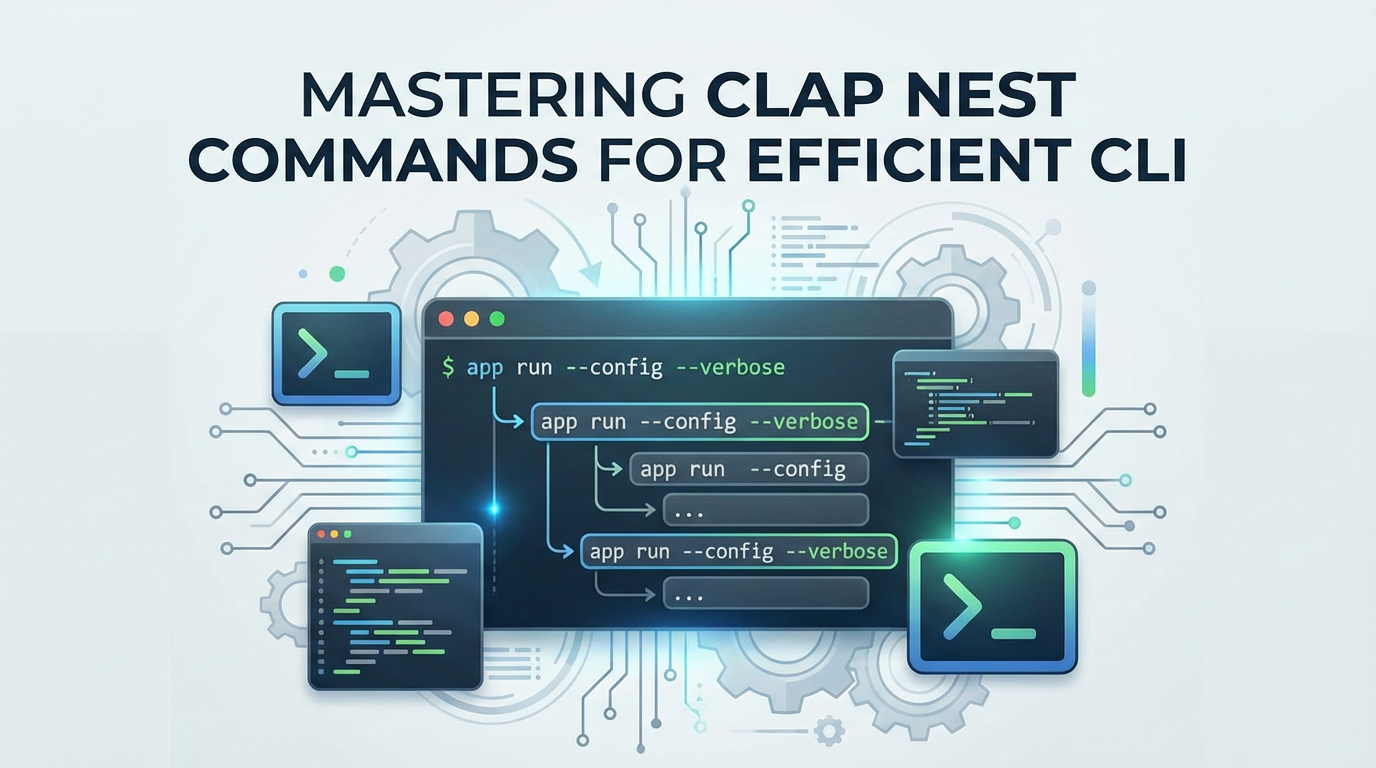


In the intricate tapestry of modern software development and system administration, the Command Line Interface (CLI) remains an unyielding cornerstone, an indispensable tool for automation, precision, and unparalleled efficiency. While graphical user interfaces (GUIs) offer intuitive visual metaphors, the CLI provides a direct, unmediated conduit to system operations, enabling power users to orchestrate complex tasks with speed and grace. For developers striving to empower their users with potent, scriptable tools, mastering the art of building sophisticated CLIs is not merely an advantage, but a necessity. This expansive guide delves into the foundational concepts, intricate architectures, and advanced techniques required to construct command-line tools that are not only powerful but also intuitive and maintainable. We will particularly focus on what we metaphorically refer to as "Clap Nest Commands," interpreting "Clap" as a paradigm for robust and user-friendly argument parsing (drawing inspiration from established libraries like clap in Rust, though the principles apply broadly), and "Nest" as the creation of deep, logical, and discoverable hierarchical command structures.
The journey through this article will traverse the landscape of effective CLI design, beginning with an exploration of why CLIs endure as critical instruments in a GUI-dominated world. We will dissect the fundamental components of command-line arguments, move into the sophisticated art of crafting nested subcommand architectures, and then elevate our understanding to advanced techniques that transform a functional script into a professional-grade utility. Critically, we will also examine the symbiotic relationship between CLIs and external services, elucidating how these local tools become potent gateways to the vast ecosystem of Application Programming Interfaces (APIs), highlighting the pivotal role of an API gateway in managing these interactions, and introducing APIPark as a robust solution for such comprehensive API management. By the end of this comprehensive exploration, you will possess a profound understanding of how to architect CLIs that are not just efficient for execution but also exceptionally pleasant for users to interact with, thereby unlocking new levels of productivity and operational fluidity.
I. The Enduring Power of the Command Line Interface
In an era seemingly dominated by sleek, visually rich graphical interfaces, the persistent relevance and, indeed, the surging resurgence of the Command Line Interface might strike some as an anachronism. However, for those immersed in the daily rhythm of development, operations, and advanced system management, the CLI is anything but obsolete; it is, in fact, an ever-evolving, highly efficient bedrock upon which much of the digital world is built. Its enduring power stems from a unique confluence of attributes that GUIs, for all their accessibility, simply cannot replicate with the same efficacy.
At its core, the CLI excels at speed and precision. A well-designed command, executed with a few keystrokes, can accomplish tasks that would require numerous clicks, menu navigations, and dialog box interactions in a graphical environment. This directness translates into significant time savings, especially when repetitive operations are involved. For developers, this means faster builds, quicker deployments, and more agile testing cycles. For system administrators, it translates to rapid diagnostics, efficient configuration management across multiple servers, and robust incident response. The absence of graphical overhead also means CLIs are inherently lightweight, consuming minimal system resources, making them ideal for remote access over slow network connections or for deployment in resource-constrained environments like containers and embedded systems.
Beyond mere speed, the CLI's unparalleled strength lies in its scriptability. Virtually every command-line utility is designed to be invoked programmatically, seamlessly integrating into shell scripts, CI/CD pipelines, and other automation frameworks. This capability transforms a collection of individual tools into a powerful, cohesive automation engine. Imagine orchestrating a complex deployment process: fetching code from a repository, compiling it, running tests, building a Docker image, pushing it to a registry, and then deploying it to a Kubernetes cluster—all through a single, automated script comprised of a sequence of CLI commands. This level of automation is not just about reducing manual effort; it's about eliminating human error, ensuring consistency, and accelerating the entire development lifecycle. The ability to chain commands, pipe output from one utility as input to another, and leverage conditional logic within scripts creates an incredibly versatile and powerful programming environment right within the terminal.
Furthermore, CLIs foster a deep understanding of the underlying system. Interacting directly with commands requires a conceptual model of how the system operates, what inputs it expects, and what outputs it produces. This direct engagement, while initially steeper in its learning curve compared to a point-and-click interface, cultivates a robust mental map of the system's architecture and behavior. It empowers users to diagnose problems more effectively, to understand the root causes of issues, and to innovate solutions that might be obscured by the abstractions of a GUI. For power users, the CLI represents a direct conduit to exerting fine-grained control, often uncovering functionalities that are either hidden or simply not exposed in a graphical interface. It allows for a level of granular manipulation and customization that is simply not feasible through higher-level visual tools.
The historical trajectory of computing, from early mainframes to modern cloud architectures, reveals a constant interplay between graphical user interfaces and command-line interfaces, each evolving to serve distinct yet complementary roles. While GUIs have democratized computing by making it accessible to a broader audience, CLIs have continued to empower professionals with the tools for extreme efficiency and automation. Icons like git, docker, kubectl, and aws cli exemplify this enduring power, acting as the primary interfaces for managing vast, complex systems like version control, containerization, and cloud infrastructure, respectively. Their success is a testament to the fact that for serious work, where precision, repeatability, and automation are paramount, the Command Line Interface is not just an option—it is the definitive choice, a timeless and continually evolving testament to efficiency and control.
II. Foundations of CLI Argument Parsing
The ability of a Command Line Interface to accept varied inputs and respond intelligently is fundamentally rooted in its argument parsing mechanism. This is the critical first step in any CLI application, where raw strings from the user's input are transformed into structured data that the program can understand and act upon. Without a robust and intuitive parsing system, even the most powerful backend logic remains inaccessible or frustrating to use. Understanding these foundations is paramount to building CLIs that are not only functional but also user-friendly and predictable.
At the most granular level, a command line input is typically composed of several distinct components: the primary command itself, followed by a series of subcommands, arguments, options, and flags. The primary command is the executable name (e.g., mycli). Subcommands represent distinct actions or functionalities within the broader tool (e.g., mycli create, mycli delete). These allow for the logical organization of a complex application into smaller, more manageable parts, a concept we will elaborate on as "nesting." Arguments are positional values that a command or subcommand requires (e.g., mycli create my-resource-name, where my-resource-name is an argument). Their order often matters, and their purpose is typically to provide the "what" or "who" for the action being performed.
Options, often referred to as flags or parameters, are non-positional inputs that modify the behavior of a command or subcommand. They are usually prefixed with one or two hyphens. For instance, --verbose might increase the logging level, or --output-format json might specify the desired output structure. Options can be categorized into two types: those that accept a value (e.g., --file path/to/file) and those that are simply boolean switches (e.g., --force or -f). The latter are sometimes called flags. Many parsing libraries support both short forms (e.g., -v for verbose) and long forms (e.g., --verbose) for options, providing flexibility for user convenience and readability. Short forms are concise for frequent use, while long forms enhance clarity and self-documentation.
The distinction between positional arguments and named options is crucial for CLI design. Positional arguments are concise and natural for a small number of mandatory inputs where context makes their purpose clear. However, they become unwieldy and error-prone as the number of inputs grows or if certain inputs are optional. Named options, by contrast, are self-documenting, order-independent, and excellent for providing optional parameters or configuration settings. A robust parsing library will handle the complexities of separating these input types, correctly associating values with their respective options, and managing default values when options are omitted.
Error handling is an indispensable aspect of argument parsing. When a user provides invalid input—missing a required argument, providing an unknown option, or supplying a malformed value—the CLI should not crash or behave unpredictably. Instead, it must gracefully inform the user about the error, ideally suggesting corrective actions or pointing to the relevant help documentation. A well-implemented parser will automatically detect common syntax errors and provide clear, human-readable error messages. This preventative measure significantly reduces user frustration and enhances the perceived reliability of the tool.
Perhaps one of the most vital features of a sophisticated argument parsing system is the automatic generation of help messages. When a user types mycli --help or mycli subcommand --help, the parser should be capable of dynamically generating a comprehensive usage guide. This help message typically includes a summary of the command's purpose, a list of available subcommands, a detailed description of each option (including its short and long forms, whether it's required, its expected value type, and a brief explanation), and examples of how to use the command. This self-documenting nature is a hallmark of a professional-grade CLI, ensuring that users can quickly discover functionality and resolve usage questions without needing to consult external documentation. Libraries like clap (in Rust), argparse (in Python), or yargs (in JavaScript) are exemplary in their ability to provide this automatic, detailed help generation with minimal developer effort, transforming the often tedious task of documentation into an inherent byproduct of argument definition. By meticulously defining arguments and options, developers are, in effect, writing the user manual as they build the tool, creating a powerful synergy between implementation and usability. Mastering these foundational elements is the first critical step towards building efficient, intuitive, and truly powerful command-line tools.
III. Crafting Hierarchical Command Structures: The "Nest" Concept
As Command Line Interfaces evolve beyond simple single-purpose scripts into comprehensive tools managing complex systems or processes, the need for robust organizational structures becomes paramount. This is where the concept of "nesting" commands comes into play, creating a logical hierarchy that mirrors the complexity of the application itself. Just as a well-organized file system allows users to navigate countless documents and directories without getting lost, a well-structured command hierarchy enables users to discover and utilize a vast array of functionalities within a single CLI tool with clarity and ease. This architectural pattern is a cornerstone of efficient CLI design, significantly enhancing usability, scalability, and maintainability.
The necessity of nesting arises when an application's scope expands to include multiple distinct functionalities that might share a common domain but perform different actions, or when actions operate on different types of resources. Instead of a flat list of potentially hundreds of commands (e.g., mycli create-user, mycli delete-user, mycli update-user-profile, mycli list-users, mycli create-project, mycli delete-project), which quickly becomes unwieldy and difficult to navigate, nesting allows for a logical grouping. For instance, all user-related operations can be grouped under a user subcommand, leading to more intuitive commands like mycli user create, mycli user delete, mycli user update, mycli user list. Similarly, project operations would reside under mycli project. This pattern scales gracefully, allowing for multi-level nesting, such as mycli project feature create, if a project has features that can be independently managed.
Defining subcommands effectively is about making a conscious design choice: when should a new functionality be an option to an existing command, and when should it be a separate subcommand? Generally, if a functionality represents a distinct action or operates on a different resource type, it's a strong candidate for a subcommand. If it merely modifies the behavior of an existing action, it's likely an option. For example, mycli build --release uses an option --release to modify the build action, but mycli test is a separate subcommand because it performs a distinct action (testing, not building). The primary goal is to create a predictable and discoverable structure where users can infer command usage based on common patterns.
The design principles for effective command hierarchies are crucial for maximizing their benefits:
- Consistency: This is perhaps the most vital principle. Users should be able to predict how commands work based on their experience with other commands in the same tool or even with other popular CLIs. If
createtypically comes before the resource name, it should always do so. If an option--idrefers to a unique identifier, it should do so consistently across subcommands. Inconsistent naming, argument order, or option usage will quickly lead to confusion and frustration. - Discoverability: A user should be able to explore the capabilities of the CLI without having to read a full manual. This is achieved through clear, concise command and subcommand names, logical groupings, and robust help messages at every level of the hierarchy (
mycli --help,mycli user --help,mycli user create --help). Auto-completion features in modern shells also heavily rely on well-structured command definitions to offer intelligent suggestions, further enhancing discoverability. - Readability and Conciseness: While descriptiveness is good, overly verbose command names can hinder efficiency. Strive for names that are clear and unambiguous yet not excessively long. Standard verbs like
create,get,set,delete,list, andupdateare excellent choices for actions. Nouns for resources likeuser,project,configare similarly effective. The balance here is key: clear enough to understand, short enough to type frequently. - Modularity and Extensibility: A hierarchical structure inherently promotes modularity. Each subcommand can represent a distinct module or concern within the application. This makes the codebase easier to understand, test, and maintain. Furthermore, it facilitates extensibility; adding a new feature often means simply adding a new subcommand or a new level to the existing hierarchy, without needing to refactor existing command logic. This is particularly valuable for large applications or those with evolving feature sets.
Let's examine some common subcommand design patterns observed in highly successful CLIs to illustrate these principles:
| Pattern | Description | Example Command | Pros | Cons |
|---|---|---|---|---|
| Git-style | cmd <subcommand> [args...]: The primary command acts as a wrapper, and subcommands represent distinct actions. Arguments and options then follow the subcommand. This is a very common and flexible pattern. |
git commit -m "My commit" |
Highly flexible, allows for deep nesting and complex logic per subcommand. Very familiar to developers. Easy to discover top-level actions. | Can become lengthy for very deep nesting. Less explicit about resource manipulation compared to other styles. |
| Docker-style | cmd <resource> <action> [args...]: This pattern organizes commands around resources (e.g., container, image, network) and then actions performed on those resources. The resource type acts as the first subcommand. |
docker container stop my_container |
Very explicit and intuitive for resource-oriented operations. Groups related actions effectively. Enhances discoverability of resource-specific commands. | Can feel less natural for tools that are primarily action-based rather than resource-based. Might introduce redundancy if actions are generic across many resources. |
| Kubectl-style | cmd <action> <resource> [name] [args...]: Similar to Docker-style but prioritizes the action verb first, followed by the resource type, and then often a specific resource name. This emphasizes what is being done before what it's being done to. |
kubectl get pods my-pod |
Highly explicit and self-descriptive. Excellent for manipulating specific instances of resources. The consistent action resource pattern is powerful for automation and scripting. |
Can be more verbose than Git-style. Might feel slightly redundant if the action already implies the resource (e.g., get pod where get-pod could be a single command). |
| AWS CLI-style | cmd <service> <action> [args...]: Designed for tools interacting with a vast ecosystem of services. The first subcommand names the service, and the second names the action within that service. Often has very deep nesting. |
aws s3api create-bucket --bucket ... |
Perfect for large ecosystems with many distinct services. Clearly scopes commands to specific service domains. Very scalable. | Can lead to extremely long commands if the service and action names are verbose. Requires good knowledge of service names. Less intuitive for simple, single-purpose tools. |
Choosing the right pattern depends heavily on the nature and scope of your CLI. For general-purpose tools with diverse functionalities, a Git-style approach offers maximum flexibility. For tools managing specific entities like virtual machines, containers, or users, a Docker- or Kubectl-style might be more appropriate, emphasizing resource manipulation. For vast platforms like cloud providers, an AWS CLI-style hierarchy is indispensable. Regardless of the chosen pattern, consistency within the tool is paramount.
Ultimately, crafting hierarchical command structures—the "nest" concept—is about bringing order to complexity. It transforms a potentially daunting array of functionalities into an approachable, navigable, and highly efficient interface. By adhering to principles of consistency, discoverability, readability, and modularity, and by thoughtfully applying established design patterns, developers can build CLIs that not only perform their duties with precision but also enhance the user's experience by making powerful capabilities feel intuitively organized and effortlessly accessible.
IV. Advanced Techniques for Robust CLI Development
Moving beyond basic argument parsing and hierarchical structures, the development of a truly robust and user-friendly CLI often necessitates the integration of advanced techniques. These methods elevate the user experience, improve the tool's flexibility, and enhance its ability to interact intelligently with its environment and user input. Mastering these aspects transforms a functional command-line script into a polished, professional-grade utility that users will find a pleasure to interact with.
One of the most critical aspects of advanced CLI development is configuration management. While command-line options provide runtime flexibility, many applications require persistent settings or default values that should not need to be specified with every invocation. This is where configuration files and environment variables come into play. Configuration files, often stored in standard locations like ~/.mycli.toml, /etc/mycli/config.yaml, or project-specific .myclirc files, allow users to define default behaviors, API keys, endpoints, or other parameters that can be overridden by explicit command-line options. A robust CLI should prioritize configuration sources in a clear order: command-line arguments take precedence over environment variables, which in turn override values found in local configuration files, and finally, global configuration files or built-in defaults. This layered approach offers maximum flexibility, allowing users to tailor the tool to their specific needs at various scopes. Libraries often provide helpers for parsing these configurations, integrating them seamlessly with argument definitions.
Interactive prompts are another powerful way to enhance user experience, particularly for commands that require user confirmation, selection from a list, or inputting sensitive data like passwords. Instead of forcing users to remember complex flags or pre-process information, an interactive prompt guides them through the necessary inputs. For instance, before performing a destructive action, a CLI might ask, "Are you sure you want to delete this resource? [y/N]". Similarly, when configuring a new service, it might present a list of available options for a particular setting. Libraries like inquirer.js (JavaScript), prompt-toolkit (Python), or dialoguer (Rust) provide rich capabilities for building these interactive elements, from simple yes/no questions to complex multi-select menus and password input fields that obscure characters. This makes the CLI more approachable for less experienced users and helps prevent costly mistakes, adding a layer of safety and intuition.
For long-running tasks, providing progress indicators is crucial for user feedback. A silent CLI that takes minutes to complete leaves users wondering if the program has frozen or is still working. Simple text-based spinners, progress bars, or even periodic status updates (e.g., "Processing step 3 of 7...") vastly improve the perceived responsiveness and usability of the tool. Libraries exist specifically for rendering these indicators in a terminal-friendly manner, handling the complexities of refreshing the display without flickering or corrupting other output. This small detail can significantly reduce user anxiety and enhance confidence in the application.
Rich output formatting is another area where advanced CLIs distinguish themselves. While basic stdout is sufficient for simple messages, professional tools often need to present data in structured, machine-readable, or highly visual ways. * JSON/YAML for machine consumption: For scripting and integration with other tools, outputting data in standardized formats like JSON or YAML is invaluable. This allows other programs to easily parse and process the CLI's results without resorting to fragile text parsing. A good CLI will offer an --output json or --output yaml option to switch to these formats. * Pretty tables for human consumption: When displaying lists of items (e.g., mycli list users), presenting the data in a neatly formatted, column-aligned table is far more readable than raw comma-separated values. Libraries for table rendering handle column widths, headers, and alignment, making complex data sets digestible at a glance. * Colorizing output: Judicious use of colors can significantly improve readability, drawing attention to warnings, errors, or important information. For instance, error messages might be red, warnings yellow, and success messages green. However, it's essential to provide an option to disable colors (e.g., --no-color) for users who might have color blindness or who are redirecting output to a file where escape codes are undesirable.
Beyond basic argument validation, input validation and sanitization are critical for security and robustness. This involves checking if arguments meet specific criteria (e.g., a number is within a certain range, a string matches a regex pattern, a file path exists) and sanitizing inputs to prevent injection attacks or unexpected behavior. While parsing libraries handle basic type checking, deeper domain-specific validation logic often resides within the CLI application itself. For example, validating an email address format or ensuring a resource name adheres to naming conventions.
Finally, for highly complex or evolving applications, designing for extensibility through a plugin architecture can be a game-changer. This allows users or third-party developers to extend the CLI's functionality without modifying its core codebase. Plugins could be new subcommands, custom output formats, or alternative backends. This approach relies on clear interfaces, runtime loading mechanisms, and careful versioning, transforming a monolithic tool into an adaptable platform.
By incorporating these advanced techniques—robust configuration management, interactive prompts, clear progress indicators, versatile output formatting, stringent input validation, and potential for extensibility—developers can build CLIs that are not only powerful and efficient but also intelligent, user-centric, and capable of adapting to a wide range of operational contexts, truly mastering the art of command-line interaction.
APIPark is a high-performance AI gateway that allows you to securely access the most comprehensive LLM APIs globally on the APIPark platform, including OpenAI, Anthropic, Mistral, Llama2, Google Gemini, and more.Try APIPark now! 👇👇👇
V. Connecting CLIs to the World: API Integration
In the modern interconnected digital landscape, a standalone CLI, no matter how powerful, often operates in isolation if it cannot interact with external services. The vast majority of contemporary software applications, from mobile apps to web platforms and even other CLIs, rely heavily on Application Programming Interfaces (APIs) to communicate, exchange data, and leverage remote functionalities. A truly efficient CLI, therefore, frequently acts as a sophisticated client to these APIs, transforming complex remote operations into simple, local command invocations. Understanding this symbiotic relationship and the mechanisms to manage it is crucial for building CLIs that are not just efficient for local tasks but also powerful conduits to the global digital infrastructure.
Many powerful CLIs are, at their core, thin clients that abstract the complexities of interacting with remote web services. Think of tools like aws cli, gcloud, kubectl, or even git (which interacts with Git APIs on platforms like GitHub or GitLab). These tools allow developers and operators to manage vast cloud resources, orchestrate containerized applications, or collaborate on codebases, all by translating intuitive local commands into a series of HTTP requests to various API endpoints. The beauty of the CLI in this context is its ability to hide the intricate details of RESTful interactions—authentication headers, JSON payload construction, error code interpretation, and retry logic—presenting a clean, consistent interface to the user.
However, directly interacting with raw APIs from a CLI can present numerous challenges. Developers must contend with a myriad of issues: handling diverse authentication mechanisms (OAuth, API keys, JWTs), managing rate limits to avoid service disruption, implementing robust error handling and retry strategies for transient network issues, and transforming data between the CLI's internal representation and the API's expected format. Moreover, as the number of APIs a CLI needs to interact with grows, or as the underlying APIs evolve, maintaining the CLI's code can become a significant burden. This is where the concept of an API gateway becomes not just beneficial, but often indispensable, especially for organizations that manage a multitude of internal and external services.
An API gateway acts as a single entry point for all client applications, routing requests to the appropriate backend services. It sits between the client (in our case, the CLI) and a collection of backend APIs, performing a variety of functions that simplify development, enhance security, and improve performance. Its role is multifaceted:
- Centralized Management and Security: A gateway can enforce authentication and authorization policies across all APIs, ensuring that only legitimate and authorized users (or CLIs) can access specific resources. It can handle token validation, rate limiting, and request throttling, protecting backend services from abuse or overload.
- Abstraction and Routing: It abstracts the complexity of microservices architectures. A CLI can make a single request to the gateway, which then intelligently routes it to the correct backend service, potentially composing responses from multiple services before returning a unified result. This decouples the CLI from the backend topology, making it resilient to changes in service deployment.
- Load Balancing and Caching: An API gateway can distribute traffic across multiple instances of a backend service, ensuring high availability and performance. It can also cache responses to frequently accessed APIs, reducing latency and backend load.
- Monitoring and Logging: By centralizing API traffic, the gateway becomes an ideal point for comprehensive monitoring and logging. It can record every API call, providing valuable insights into usage patterns, performance metrics, and error rates, which are crucial for debugging and operational oversight.
- Protocol Translation and Transformation: Some gateways can even translate between different protocols or transform data formats, allowing a CLI to interact with disparate backend services as if they presented a unified interface.
For organizations dealing with a multitude of APIs, particularly AI models, an API gateway becomes indispensable. This is where platforms like APIPark offer immense value. APIPark functions as an open-source AI gateway and API management platform, designed to simplify the integration and deployment of AI and REST services. Imagine a CLI tool designed to interact with various AI models for text generation, image recognition, or data analysis. Instead of the CLI having to manage the unique authentication, request formats, and endpoints for each AI model, it can simply interact with APIPark.
APIPark's features directly address the complexities a CLI developer might face when integrating with a diverse set of APIs:
- Quick Integration of 100+ AI Models: A CLI often needs to tap into various AI capabilities. APIPark unifies the access to over a hundred AI models under a single management system, abstracting away the specifics of each model. This means your CLI code doesn't need to change drastically when you switch or add AI models.
- Unified API Format for AI Invocation: This is a game-changer for CLIs interacting with AI. APIPark standardizes the request data format across all integrated AI models. From the CLI's perspective, every AI invocation looks the same, regardless of the underlying AI model. This significantly simplifies the CLI's codebase, reduces maintenance costs, and makes it incredibly resilient to changes in AI models or prompts.
- Prompt Encapsulation into REST API: CLI tools can issue simple commands, which through APIPark, trigger complex AI prompts. APIPark allows users to quickly combine AI models with custom prompts to create new, specialized APIs (e.g., a sentiment analysis API, a translation API, or a data analysis API). Your CLI can then call this simple, custom REST API instead of a convoluted AI model interface, making the CLI's logic cleaner and more focused.
- End-to-End API Lifecycle Management: For a CLI that relies on numerous APIs, ensuring those APIs are well-governed throughout their lifecycle is crucial. APIPark assists with managing API design, publication, invocation, and decommission, ensuring that the backend services your CLI connects to are stable, versioned, and properly managed.
- API Service Sharing within Teams: If multiple CLIs or teams within an organization rely on the same set of APIs, APIPark provides a centralized display of all API services. This fosters discoverability and consistent usage across different tools and teams.
- Independent API and Access Permissions for Each Tenant: In multi-tenant environments, APIPark allows for independent applications, data, user configurations, and security policies, ensuring that different CLIs or teams can securely access their specific API resources while sharing the underlying infrastructure.
- API Resource Access Requires Approval: To prevent unauthorized API calls and potential data breaches, APIPark supports subscription approval features. A CLI, or its underlying application, might need to "subscribe" to an API and await administrator approval before it can invoke it, adding an essential layer of security.
- Performance Rivaling Nginx: For CLIs making high-volume or performance-critical API calls, the responsiveness of the API gateway is vital. APIPark's ability to achieve over 20,000 TPS with modest resources and support cluster deployment ensures that the gateway itself doesn't become a bottleneck, guaranteeing reliable and fast API access for even the most demanding CLIs.
- Detailed API Call Logging and Powerful Data Analysis: When a CLI encounters an issue interacting with a remote service, comprehensive logging is invaluable. APIPark records every detail of each API call, allowing businesses to quickly trace and troubleshoot issues. Its data analysis capabilities display long-term trends and performance changes, enabling proactive maintenance for the APIs that CLIs depend on.
Deploying such a powerful API gateway might sound complex, but APIPark emphasizes ease of use: it can be quickly deployed in just 5 minutes with a single command line:
curl -sSO https://download.apipark.com/install/quick-start.sh; bash quick-start.sh
This simplicity allows developers to quickly integrate and manage their API landscape, freeing them to focus on the CLI's core logic rather than the intricate details of API orchestration. While the open-source version provides robust functionality for startups, APIPark also offers a commercial version with advanced features and professional technical support for enterprises needing even greater governance and scale. It's clear that APIPark's comprehensive API governance solution can enhance efficiency, security, and data optimization for developers, operations personnel, and business managers alike, serving as a critical piece of infrastructure for any organization leveraging CLIs that interact with an extensive API ecosystem.
When designing CLIs that interact with APIs, best practices include implementing graceful degradation (e.g., providing cached data if an API is temporarily unavailable), offering clear and actionable error messages that translate complex API errors into user-friendly language, and building in robust retry mechanisms with exponential backoff to handle transient network issues without overwhelming the API or gateway. By offloading much of the API management burden to a dedicated platform like APIPark, CLI developers can focus on building user-centric interfaces, ensuring their tools remain efficient, reliable, and powerful conduits to the world's digital services.
VI. Ensuring Quality: Testing and Deployment
The development of a sophisticated CLI, particularly one featuring hierarchical commands and integrating with external APIs, necessitates a rigorous approach to quality assurance. A robust CLI is not just about elegant code; it's about predictable behavior, reliable execution, and confidence that it performs as expected under all conditions. This section delves into the critical aspects of testing and deployment, ensuring that your meticulously crafted "Clap Nest Commands" are not only functional but also dependable, maintainable, and widely accessible.
The importance of testing CLIs cannot be overstated. Unlike graphical applications where visual inspection can catch many issues, CLI behavior is primarily determined by its inputs and outputs, making automated testing an ideal fit. A comprehensive testing strategy typically involves several layers:
- Unit Tests: These focus on the smallest testable parts of your code in isolation. For a CLI, this might include individual functions responsible for parsing specific argument types, validating input values, or formatting output. Unit tests ensure that each component behaves correctly, independent of its integration with other parts of the CLI. This forms the foundational layer of confidence.
- Integration Tests: These tests verify that different components of your CLI work together as expected. This could involve testing how the argument parser correctly passes data to the core logic, or how a subcommand correctly invokes a helper function. For an API-integrated CLI, integration tests would verify that the
apiclient (which might be behind theapi gateway) correctly constructs requests and handles responses, ensuring the internal data flow from command invocation to api gateway interaction is sound. These tests often require mock objects or stubs for external dependencies (like file systems or network calls) to keep them focused and fast. - End-to-End (E2E) Tests: E2E tests simulate actual user interaction with the CLI. They involve invoking the CLI executable from a shell, providing various combinations of commands, subcommands, arguments, and options, and then asserting that the output (stdout, stderr) is correct and that any side effects (e.g., file creation, database updates, API calls) have occurred as expected. These tests are the most expensive to run but provide the highest level of confidence that the entire application, from argument parsing to backend integration, functions correctly. Tools often provide utilities to capture output streams and exit codes, making it easier to write robust E2E tests.
When testing CLIs, specific considerations include: * Testing Argument Parsing: Cover all valid and invalid argument combinations. Test required arguments, optional flags, various value types, and nested subcommands. Ensure that --help messages are correctly generated and displayed for all commands and subcommands. * Testing Subcommand Logic: Verify that each subcommand executes its specific logic correctly, handling its unique inputs and producing the expected results. * Testing Output: Assert that the CLI produces the correct text, formatted tables, JSON, or YAML output on stdout and that error messages are informative and appear on stderr with appropriate exit codes. * Mocking External Dependencies: For CLIs that interact with apis, databases, or file systems, it's crucial to mock these dependencies during integration and unit tests. This prevents tests from being slow, brittle, or dependent on external network conditions. For instance, you would mock the api calls to a specific gateway like APIPark, simulating various successful responses and error scenarios without making actual network requests. This ensures your CLI's logic for handling API interactions is sound, regardless of the live API's status.
Once a CLI is thoroughly tested, the next challenge is deployment and distribution. Making your CLI available to users involves several considerations:
- Packaging as Standalone Executables: For maximum portability and ease of use, many CLIs are distributed as single, self-contained executable files. This eliminates the need for users to install language runtimes or dependencies, simplifying the installation process to a mere download and placement in their system's PATH. Tools like
pyinstaller(Python),pkg(Node.js), or Rust's native compilation to static binaries are examples of how this is achieved. - Package Managers: Distributing your CLI through language-specific package managers (e.g.,
pipfor Python,npmfor Node.js,cargofor Rust,go installfor Go) or system-level package managers (e.g.,Homebrewfor macOS,aptfor Debian/Ubuntu,Chocolateyfor Windows) provides a streamlined installation and update experience. These managers handle dependencies, versioning, and environment setup, greatly simplifying the user's experience. - Cross-Platform Compatibility: A well-designed CLI often aims for cross-platform compatibility (Windows, macOS, Linux). This requires careful consideration of file paths, environment variables, shell differences, and system-specific commands. Using a language and libraries that abstract these differences (like Rust with
clapor Go's standard library) is beneficial. - Documentation: Beyond the in-CLI
--helpmessages, external documentation is vital. A comprehensiveREADME.mdfile in your repository is a must, detailing installation, usage examples, configuration options, and common troubleshooting steps. For more complex tools, dedicated documentation websites or traditionalmanpages can provide in-depth guides. Clear documentation is an extension of the CLI's user interface, ensuring users can fully leverage its capabilities.
By meticulously testing every layer of your CLI's functionality and adopting thoughtful deployment strategies, you can ensure that your "Clap Nest Commands" are not only powerful but also reliable and accessible to a wide audience. This commitment to quality builds trust with users and lays the groundwork for a successful and widely adopted command-line tool.
VII. The Future of CLI: Evolution and Innovation
While the fundamental principles of the Command Line Interface have remained remarkably consistent over decades, the CLI is far from static. It continues to evolve, adapting to new technological paradigms and user expectations, ensuring its enduring relevance in the rapidly changing digital landscape. The future of CLI promises even richer interactions, greater intelligence, and seamless integration with emerging technologies.
One significant trend is the rise of rich terminal user interfaces (TUIs). Moving beyond simple text output, TUI frameworks (such as tui-rs in Rust, blessed in Node.js, or curses in Python) enable developers to create interactive, graphical-like applications directly within the terminal. This means CLIs can feature dynamic layouts, complex tables with pagination, interactive forms, real-time dashboards, and even simple charts, all without leaving the keyboard-driven efficiency of the terminal. This blend of graphical richness with CLI speed offers a powerful new dimension for developer tools, system monitors, and data visualization utilities, making complex information more digestible and interactive directly at the command line.
Another exciting frontier is the integration of AI-powered CLIs. As large language models (LLMs) become more sophisticated, the possibility of natural language command parsing within the terminal is becoming a reality. Imagine typing "find all containers created in the last hour and stop them" and having the CLI translate this into the precise docker commands. This capability would significantly lower the barrier to entry for complex tools, allowing users to interact with systems using conversational language rather than memorized syntax. AI could also assist with intelligent auto-completion, suggesting contextually relevant commands and arguments based on user intent and historical usage, further enhancing discoverability and efficiency. This could revolutionize how users interact with vast command sets, particularly those integrated with complex APIs and AI models, making even the most intricate API gateway interactions accessible through plain language.
Furthermore, the lines between CLIs and web interfaces are blurring. Tools are emerging that allow for seamless integration with web dashboards, where a CLI command might launch a browser to display more detailed information or to perform actions that are better suited for a visual interface, while still maintaining the CLI as the primary interaction point. This hybrid approach leverages the strengths of both paradigms, providing flexibility for diverse workflows.
The future of CLI is not about replacing its core strengths of speed, automation, and precision, but rather augmenting them with intelligence, interactivity, and deeper integration into the broader software ecosystem. By embracing these innovations, CLI developers can continue to build tools that are not only efficient but also intuitive, powerful, and ready for the challenges of tomorrow's computing environment.
Conclusion
The journey through the intricate world of Command Line Interface development, from the foundational mechanics of argument parsing to the sophisticated architecture of nested commands and the critical integration with external APIs, reveals a profound truth: the CLI is an indispensable, evolving, and exceptionally powerful interface. Mastering the principles encapsulated within "Clap Nest Commands" is not merely about writing code; it's about crafting tools that empower users, streamline workflows, and unlock unprecedented levels of automation and efficiency.
We began by reaffirming the enduring power of the CLI, highlighting its unmatched advantages in speed, precision, and scriptability—qualities that render it irreplaceable for developers, system administrators, and automation engineers. We then delved into the fundamental components of argument parsing, dissecting the roles of commands, subcommands, arguments, options, and flags, emphasizing the importance of clear syntax and robust error handling. The heart of our exploration lay in the "nest" concept: the art of designing hierarchical command structures. Through meticulous design principles like consistency, discoverability, and modularity, and by examining various subcommand design patterns, we illustrated how to tame complexity and present a logical, intuitive interface even for feature-rich applications.
Our gaze then turned to advanced techniques, enriching CLIs with configuration management, interactive prompts, dynamic progress indicators, and versatile output formatting, transforming functional tools into polished, professional-grade utilities. Crucially, we explored how CLIs connect to the vast digital ecosystem through API integration, underscoring the challenges of direct API interaction and highlighting the indispensable role of an API gateway. We introduced APIPark as a prime example of an open-source AI gateway and API management platform, demonstrating how it simplifies api consumption, unifies api formats, and provides comprehensive lifecycle management, thereby empowering CLIs to interact with a multitude of services, especially AI models, with unparalleled ease and security. Finally, we emphasized the critical importance of rigorous testing methodologies and thoughtful deployment strategies to ensure quality, reliability, and broad accessibility, while also peeking into the future of CLI, predicting even richer, AI-enhanced interactions.
By internalizing these lessons—from the granular details of argument parsing to the grand architecture of nested commands, from the intricacies of API integration facilitated by an API gateway like APIPark to the commitment to quality through testing and deployment—you are not just building command-line tools. You are crafting instruments of efficiency, precision, and automation that will stand the test of time, empowering users and organizations to navigate and master the ever-growing complexities of the digital world. The journey to mastering "Clap Nest Commands" is a journey toward building truly efficient and impactful command-line interfaces.
FAQ
- What does "Clap Nest Commands" mean, and why is it important for CLI efficiency? "Clap Nest Commands" is a metaphorical term used to describe building efficient CLIs by combining robust argument parsing (inspired by libraries like
clap) with hierarchical, nested subcommand structures. It's crucial for efficiency because it allows complex CLI tools to be logically organized, making them more discoverable, intuitive, and manageable. Instead of a flat list of hundreds of commands, related functionalities are grouped under parent commands, much like directories in a file system, enhancing user experience and reducing cognitive load. This structure ensures that users can quickly find the specific action they need, even in feature-rich applications, by following a predictable command hierarchy. - How do CLIs interact with external services, and what role does an API gateway play in this interaction? Many powerful CLIs act as clients to external services, interacting with them through Application Programming Interfaces (APIs). For instance, a cloud CLI (
aws cli,gcloud) translates local commands into HTTP requests to remote cloud APIs. Directly managing these API interactions can be complex due to authentication, rate limiting, error handling, and data transformation. An API gateway acts as a single, intelligent entry point for all API requests, sitting between the CLI (client) and the backend services. It centralizes security (authentication, authorization), traffic management (rate limiting, load balancing), logging, and routing, abstracting backend complexities from the CLI developer. This simplifies the CLI's code, improves security, and enhances the reliability and performance of API interactions. - How can APIPark enhance the development of a CLI that interacts with APIs, especially AI models? APIPark, as an open-source AI gateway and API management platform, significantly enhances CLI development by simplifying API interaction, particularly with AI models. It provides a unified API format for AI invocation, meaning your CLI doesn't need to learn the specific nuances of each AI model's API; it just communicates with APIPark in a standardized way. It also allows prompt encapsulation into REST APIs, so a simple CLI command can trigger complex AI prompts through a straightforward REST call. Furthermore, APIPark offers end-to-end API lifecycle management, robust performance, detailed logging, and data analysis, all of which contribute to building a more stable, secure, and efficient CLI that can reliably leverage a wide array of AI and REST services, without the CLI developer having to manage the underlying API complexities.
- What are some advanced techniques to make a CLI more user-friendly and robust beyond basic argument parsing? To elevate a CLI beyond basic functionality, several advanced techniques can be employed. Configuration management allows users to define persistent settings in files or environment variables, making repeated invocations easier. Interactive prompts (e.g., yes/no confirmations, list selections) guide users through complex inputs or prevent mistakes. Progress indicators provide crucial feedback for long-running tasks. Rich output formatting enables displaying data in structured ways (JSON/YAML for machines, pretty tables for humans) and using colors for emphasis. Finally, robust input validation and the potential for a plugin architecture enhance the CLI's security, flexibility, and extensibility, ensuring it's not just powerful but also intuitive and adaptable.
- What are the key considerations for testing and deploying a well-structured CLI? Testing a well-structured CLI involves a multi-layered approach: Unit tests verify individual code components, integration tests ensure different parts of the CLI work together (e.g., parser and core logic, or the API client with a mocked API gateway), and end-to-end tests simulate real-world user interactions from the shell, verifying overall behavior and output. During testing, mocking external dependencies (like APIs) is crucial. For deployment, key considerations include packaging the CLI as standalone executables for easy distribution, leveraging package managers for streamlined installation and updates, ensuring cross-platform compatibility, and providing comprehensive documentation (in-CLI help, READMEs, man pages) to guide users. A commitment to these practices ensures a high-quality, reliable, and accessible CLI.
🚀You can securely and efficiently call the OpenAI API on APIPark in just two steps:
Step 1: Deploy the APIPark AI gateway in 5 minutes.
APIPark is developed based on Golang, offering strong product performance and low development and maintenance costs. You can deploy APIPark with a single command line.
curl -sSO https://download.apipark.com/install/quick-start.sh; bash quick-start.sh

In my experience, you can see the successful deployment interface within 5 to 10 minutes. Then, you can log in to APIPark using your account.

Step 2: Call the OpenAI API.