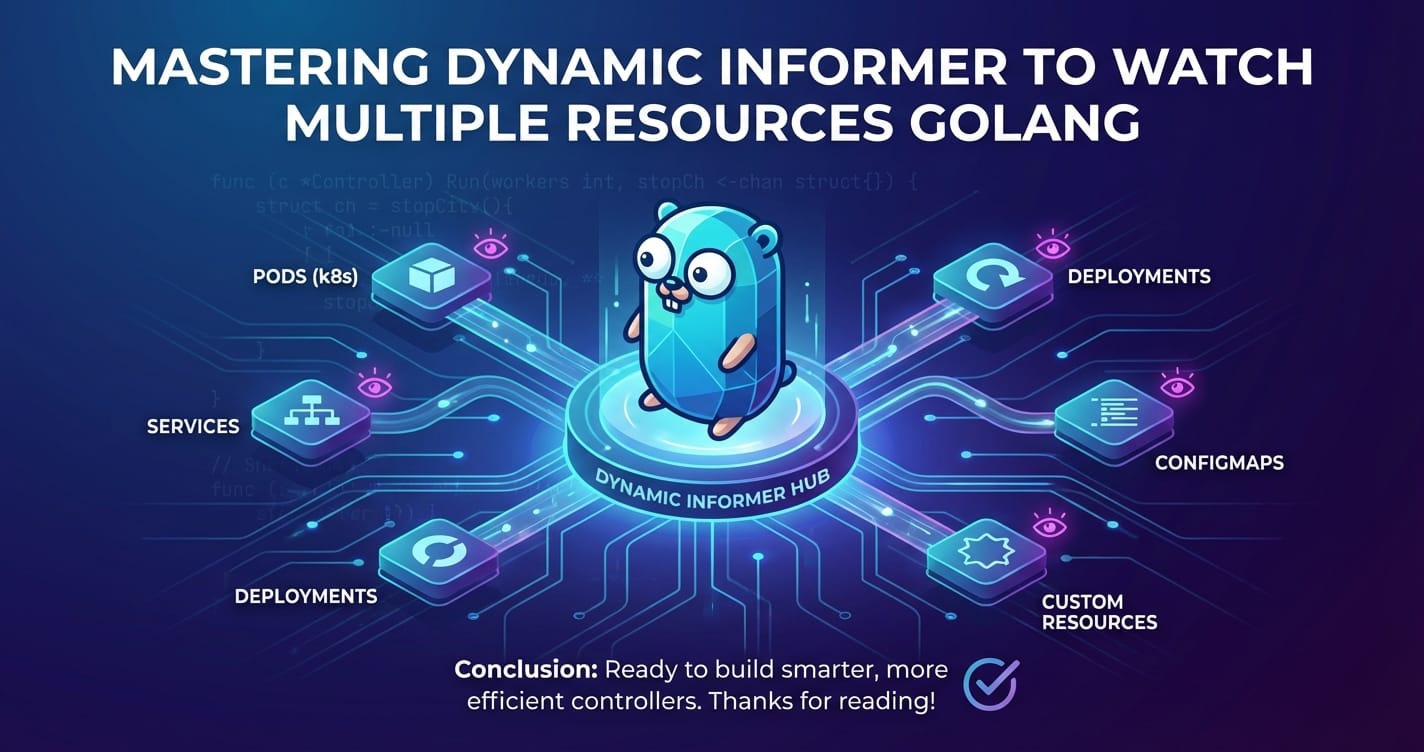
Mastering Dynamic Informer to Watch Multiple Resources Golang


The realm of cloud-native computing, particularly within the Kubernetes ecosystem, is fundamentally driven by a sophisticated reconciliation loop. At its core, Kubernetes continually strives to bridge the gap between a user's declared desired state and the actual state of the cluster. This powerful paradigm relies heavily on specialized components known as controllers, which are purpose-built Go programs designed to observe changes in Kubernetes resources and react accordingly. As the complexity of distributed applications grows, so does the need for controllers to monitor not just one, but often multiple interconnected resources simultaneously, making intelligent decisions based on a holistic view of the system. This comprehensive guide delves into the advanced techniques of leveraging Dynamic Informers in Golang, a critical tool from the client-go library, to effectively watch and manage multiple Kubernetes resources, ensuring robust, scalable, and efficient control planes for your applications.
The journey into mastering resource watching begins with understanding the inherent challenges of interacting with a dynamic, eventually consistent system like Kubernetes. Direct, synchronous API calls to the Kubernetes API server, while fundamental, are often inefficient and prone to race conditions when building reactive control loops. Imagine a scenario where a controller needs to know every time a Pod is created, updated, or deleted, and then correlate that information with the state of its parent Deployment, or even a custom resource (CRD) that defines a higher-level application. Polling the API server continuously for these changes would quickly overwhelm the cluster and introduce significant latency. This is precisely where the Informer pattern, and its more versatile sibling, the Dynamic Informer, emerge as indispensable components, offering an elegant solution to maintain a local, eventually consistent cache of Kubernetes objects, significantly reducing the load on the API server and enabling highly responsive controllers. This article will meticulously guide you through the intricacies of setting up, configuring, and deploying Golang-based controllers that harness the full potential of Dynamic Informers to intelligently manage the lifecycle of complex, multi-resource applications within Kubernetes.
The Foundation: Kubernetes Control Plane and the Reconciliation Loop
Before diving deep into the mechanics of Informers, it's crucial to solidify our understanding of the Kubernetes control plane and its central operating principle: the reconciliation loop. Kubernetes is not merely an orchestrator; it's a declarative system. Users define the desired state of their applications and infrastructure using YAML or JSON manifests. For instance, you might declare that you want 3 replicas of a particular Nginx Pod, managed by a Deployment, exposed via a Service. It's then the control plane's responsibility to continuously observe the actual state of the cluster, compare it against this desired state, and take corrective actions to bring the actual state into alignment with the desired state. This continuous cycle of observing, comparing, and acting is what we refer to as the reconciliation loop.
At the heart of this loop are controllers, specialized programs that are typically written in Go (though they can be implemented in other languages) and run as part of the Kubernetes control plane or as extensions to it (e.g., custom controllers, operators). Each controller is responsible for a specific resource type or a set of related resource types. For example, the Deployment Controller ensures that the number of running Pods matches the replicas field in a Deployment object. If a Pod crashes, the Deployment Controller notices the discrepancy and instructs the ReplicaSet Controller (which in turn instructs the kube-scheduler and kubelet) to create a new Pod. This intricate dance of controllers, each specializing in a particular domain, is what gives Kubernetes its self-healing and resilient properties.
The challenge for these controllers lies in efficiently detecting changes. Directly querying the Kubernetes API server for every single resource change across potentially thousands of objects is neither scalable nor practical. This is where the concept of an event-driven architecture becomes paramount. Instead of constantly asking "What has changed?", controllers need to be told "Something has changed!". This paradigm shift is precisely what the Informer pattern in client-go facilitates. It provides an abstraction layer that allows controllers to subscribe to events (additions, updates, deletions) for specific resource types, maintain a consistent local cache, and react to these events without overwhelming the API server. Understanding this foundational principle is the first step towards appreciating the power and necessity of Informers in building robust Kubernetes automation.
Deciphering the Informer Pattern: Beyond Direct API Calls
The Kubernetes client-go library offers various ways to interact with the Kubernetes API server. At the most basic level, you can make direct REST calls or use the generated client methods (e.g., client.CoreV1().Pods().List() or Get()). While useful for one-off operations or simple queries, these methods are ill-suited for building reactive controllers that need to continuously monitor the cluster for changes. Constantly listing and getting resources would generate an excessive amount of traffic to the API server, consume significant network bandwidth, and introduce considerable latency in detecting changes, ultimately making your controllers slow and inefficient. This is where the Informer pattern steps in as a cornerstone for building efficient and scalable Kubernetes controllers.
An Informer is essentially a sophisticated caching and eventing mechanism. It combines two core components: a Reflector and a DeltaFIFO. The Reflector is responsible for watching the Kubernetes API server for changes to a specific resource type (e.g., Pods, Deployments). It achieves this by first performing an initial List operation to populate its cache and then establishing a long-lived Watch connection. When new events (additions, updates, deletions) occur, the Reflector receives them and pushes these "deltas" into the DeltaFIFO.
The DeltaFIFO acts as a queue, storing these incoming changes. Its primary role is to ensure that events are processed in order and that updates to the same object are handled gracefully (e.g., if an object is updated multiple times quickly, the DeltaFIFO might coalesce these updates or ensure that only the latest state is processed). From the DeltaFIFO, events are then popped and delivered to registered ResourceEventHandlers. These handlers are custom functions provided by your controller, which define the logic to be executed when a resource is added, updated, or deleted.
The immediate benefit of this architecture is immense. First, by maintaining a local, in-memory cache, your controller can perform read operations (like Get() or List()) against this cache instead of constantly hitting the API server. This drastically reduces API server load and improves the read performance of your controller. This local cache is eventually consistent, meaning it will eventually reflect the true state of the cluster, but there might be a small delay between a change occurring on the API server and it being propagated to the local cache. Second, the event-driven nature allows your controller to react only when something relevant changes, rather than continuously polling. This makes your controllers far more efficient and responsive, aligning perfectly with the declarative and reactive nature of Kubernetes.
Standard Informers: Watching Known Resource Types
The client-go library provides pre-generated informers for all built-in Kubernetes resource types (e.g., Pods, Deployments, Services, ConfigMaps). These are known as "standard informers" because they operate on Go types that are explicitly defined and compiled into your controller. Using them is the most common and straightforward way to build controllers for native Kubernetes objects. The process generally involves setting up an InformerFactory, creating specific informers from it, registering event handlers, and then starting the informers.
Let's break down the components involved in setting up a standard informer:
- Specific Resource Informer: Once you have the
SharedInformerFactory, you can request an informer for a particular resource type. For example,factory.Core().V1().Pods()will give you access to the Pod informer, andfactory.Apps().V1().Deployments()for Deployments. Each of these methods returns anInformerinterface and aListerinterface.```go podInformer := factory.Core().V1().Pods().Informer() podLister := factory.Core().V1().Pods().Lister() // Use this to query the cachedeploymentInformer := factory.Apps().V1().Deployments().Informer() deploymentLister := factory.Apps().V1().Deployments().Lister() // Use this to query the cache ```- The
Informerinterface is used to register event handlers and to start/stop the informer. - The
Listerinterface provides methods to access the local cache, allowing you toGetorListobjects quickly without hitting the API server.
- The
- Event Handlers (
ResourceEventHandler): These are the core logic of your controller. You registerResourceEventHandlerfunctions with the informer, which will be invoked whenever anAdd,Update, orDeleteevent occurs for the watched resource type.```go import ( corev1 "k8s.io/api/core/v1" "k8s.io/client-go/tools/cache" "k8s.io/klog/v2" // For logging )podInformer.AddEventHandler(cache.ResourceEventHandlerFuncs{ AddFunc: func(obj interface{}) { pod := obj.(corev1.Pod) klog.Infof("Pod Added: %s/%s", pod.Namespace, pod.Name) // Enqueue pod key to a workqueue for processing }, UpdateFunc: func(oldObj, newObj interface{}) { oldPod := oldObj.(corev1.Pod) newPod := newObj.(corev1.Pod) if oldPod.ResourceVersion == newPod.ResourceVersion { // Periodic resync will send update events for all known objects. // We are only interested in changed objects. return } klog.Infof("Pod Updated: %s/%s", newPod.Namespace, newPod.Name) // Enqueue pod key to a workqueue for processing }, DeleteFunc: func(obj interface{}) { // Deleted objects might be of type cache.DeletedFinalStateUnknown if the event // is received after the object is already gone from the API server cache. // Useutil.DeletionHandlingMetaFromObjectto extract metadata robustly. pod, ok := obj.(corev1.Pod) if !ok { tombstone, ok := obj.(cache.DeletedFinalStateUnknown) if !ok { klog.Errorf("error decoding object, invalid type") return } pod, ok = tombstone.Obj.(*corev1.Pod) if !ok { klog.Errorf("error decoding tombstone object, invalid type") return } } klog.Infof("Pod Deleted: %s/%s", pod.Namespace, pod.Name) // Enqueue pod key to a workqueue for processing }, }) ```OnAdd(obj interface{}): Called when a new object is added.OnUpdate(oldObj, newObj interface{}): Called when an existing object is modified. It receives both the old and new states of the object.OnDelete(obj interface{}): Called when an object is deleted.
- Starting the Informers: After registering handlers, you need to start the informers. This typically involves starting the
SharedInformerFactory, which in turn starts all the informers it manages. TheRunmethod takes astopChchannel, allowing you to gracefully shut down the informers.```go stopCh := make(chan struct{}) defer close(stopCh) // Ensure stopCh is closed on exitfactory.Start(stopCh) factory.WaitForCacheSync(stopCh) // Wait for all caches to be synced before processing events klog.Info("All caches synced successfully")// Keep the main goroutine running select {} ```
SharedInformerFactory: This is the entry point for creating informers. It's a factory that can produce multiple informers for different resource types, sharing underlying Reflector and DeltaFIFO instances where appropriate, which helps optimize resource usage. You typically create one SharedInformerFactory per controller and use it to obtain all the informers your controller needs.```go import ( "k8s.io/client-go/informers" "k8s.io/client-go/kubernetes" "k8s.io/client-go/tools/clientcmd" "time" )func main() { // Build Kubernetes client config kubeconfig := "/techblog/en/path/to/kubeconfig" // Or use in-cluster config config, err := clientcmd.BuildConfigFromFlags("", kubeconfig) if err != nil { panic(err.Error()) }
// Create a Kubernetes client
clientset, err := kubernetes.NewForConfig(config)
if err != nil {
    panic(err.Error())
}

// Create a SharedInformerFactory
// Resync period defines how often the informer's cache is fully re-synced from the API server.
// A value of 0s means no periodic resync for the Reflector (only event-driven updates).
// It's usually set to a non-zero value (e.g., 30s-10m) to catch any missed events or eventual consistency issues.
factory := informers.NewSharedInformerFactory(clientset, time.Second*30)

// ... rest of the informer setup
} ```
This foundational setup for standard informers provides the backbone for most Kubernetes controllers. It elegantly handles the complexities of API interaction, caching, and event delivery, allowing you to focus on the core business logic of your reconciliation loop. However, Kubernetes is an extensible system, and often controllers need to interact with Custom Resources. This is where the Dynamic Informer becomes an indispensable tool, offering unparalleled flexibility.
The Power of Dynamic Informers: Unstructured Resource Watching
While standard informers are excellent for well-known, built-in Kubernetes resources, they fall short when you need to watch Custom Resources (CRDs) or when your controller needs to be generic and watch any resource given its Group, Version, and Resource name, without prior knowledge of its specific Go type. This is precisely the domain where Dynamic Informers shine.
Dynamic Informers operate on unstructured.Unstructured objects. Instead of expecting a strongly typed Go struct (like corev1.Pod), they receive and process raw JSON data represented by this Unstructured type. This provides tremendous flexibility, allowing you to write controllers that can adapt to new CRDs without needing to recompile or even know the CRD's schema at compile time. This is particularly powerful for generic operators, multi-tenant systems, or tools that need to observe and react to a wide array of potentially unknown custom resources.
The key differences and components involved in using Dynamic Informers are:
schema.GroupVersionResource(GVR): To specify which resource aDynamic Informershould watch, you provide its Group, Version, and Plural Resource name as aschema.GroupVersionResource. This GVR uniquely identifies a resource type in Kubernetes.```go import ( "k8s.io/apimachinery/pkg/runtime/schema" )// Example GVR for a custom resource named "myapps.example.com/v1/applications" // GVR for a built-in resource, e.g., Pods: podGVR := schema.GroupVersionResource{Group: "", Version: "v1", Resource: "pods"} // GVR for Deployments: deploymentGVR := schema.GroupVersionResource{Group: "apps", Version: "v1", Resource: "deployments"}// Assuming a custom resource "Application" in group "example.com" and version "v1" applicationGVR := schema.GroupVersionResource{Group: "example.com", Version: "v1", Resource: "applications"}// Request an informer for the custom resource applicationInformer := dynamicFactory.ForResource(applicationGVR).Informer() applicationLister := dynamicFactory.ForResource(applicationGVR).Lister() // For cache access ```- Starting and Waiting for Sync: The process is identical to standard informers. You start the dynamic factory and wait for its caches to sync.
Working with unstructured.Unstructured: When events are delivered to your ResourceEventHandler, the obj, oldObj, and newObj parameters will be of type *unstructured.Unstructured. You'll need to use utility methods provided by the unstructured package to extract fields, convert to structured types if needed, or modify them.```go import ( "k8s.io/apimachinery/pkg/apis/meta/v1/unstructured" "k8s.io/client-go/tools/cache" "k8s.io/klog/v2" )applicationInformer.AddEventHandler(cache.ResourceEventHandlerFuncs{ AddFunc: func(obj interface{}) { unstructuredObj := obj.(*unstructured.Unstructured) klog.Infof("Application Added: %s/%s", unstructuredObj.GetNamespace(), unstructuredObj.GetName())
    // Example: Accessing a specific field in the CRD spec
    // Assuming your CRD has a spec.image field
    if spec, ok := unstructuredObj.Object["spec"].(map[string]interface{}); ok {
        if image, ok := spec["image"].(string); ok {
            klog.Infof("  Image defined: %s", image)
        }
    }
},
UpdateFunc: func(oldObj, newObj interface{}) {
    oldUnstructured := oldObj.(*unstructured.Unstructured)
    newUnstructured := newObj.(*unstructured.Unstructured)
    if oldUnstructured.GetResourceVersion() == newUnstructured.GetResourceVersion() {
        return // No actual change
    }
    klog.Infof("Application Updated: %s/%s", newUnstructured.GetNamespace(), newUnstructured.GetName())
    // Compare fields, trigger reconciliation based on specific changes
},
DeleteFunc: func(obj interface{}) {
    unstructuredObj, ok := obj.(*unstructured.Unstructured)
    if !ok { // Handle tombstone case for deleted objects
        tombstone, ok := obj.(cache.DeletedFinalStateUnknown)
        if !ok {
            klog.Errorf("error decoding object, invalid type")
            return
        }
        unstructuredObj, ok = tombstone.Obj.(*unstructured.Unstructured)
        if !ok {
            klog.Errorf("error decoding tombstone object, invalid type")
            return
        }
    }
    klog.Infof("Application Deleted: %s/%s", unstructuredObj.GetNamespace(), unstructuredObj.GetName())
},
}) ```
DynamicSharedInformerFactory: Instead of informers.NewSharedInformerFactory, you use dynamicinformer.NewDynamicSharedInformerFactory. This factory is specifically designed to work with unstructured.Unstructured objects.```go import ( "k8s.io/client-go/dynamic" "k8s.io/client-go/dynamic/dynamicinformer" "k8s.io/client-go/rest" "k8s.io/client-go/tools/clientcmd" "time" )func main() { // Build Kubernetes client config kubeconfig := "/techblog/en/path/to/kubeconfig" // Or use in-cluster config config, err := clientcmd.BuildConfigFromFlags("", kubeconfig) if err != nil { panic(err.Error()) }
// Create a dynamic client (essential for dynamic informers)
dynamicClient, err := dynamic.NewForConfig(config)
if err != nil {
    panic(err.Error())
}

// Create a DynamicSharedInformerFactory
// Note: Dynamic informers typically use a shorter resync period for CRDs due to their dynamic nature.
dynamicFactory := dynamicinformer.NewDynamicSharedInformerFactory(dynamicClient, time.Second*60)

// ... rest of the dynamic informer setup
} ```
The flexibility offered by Dynamic Informers is a game-changer for building operators and generic controllers. It allows your software to evolve with the Kubernetes ecosystem, adapting to new CRDs or even changes in existing CRD schemas without requiring a full recompile and redeploy. This significantly enhances the maintainability and adaptability of your control planes, particularly in complex, multi-tenant environments where a diverse set of custom resources might be in play.
APIPark is a high-performance AI gateway that allows you to securely access the most comprehensive LLM APIs globally on the APIPark platform, including OpenAI, Anthropic, Mistral, Llama2, Google Gemini, and more.Try APIPark now! 👇👇👇
Watching Multiple Resources with a Unified Controller
Most real-world Kubernetes controllers need to watch and react to changes across multiple resource types to manage complex application lifecycles effectively. A common pattern is for a custom resource (CRD) to drive the creation and management of several built-in resources like Deployments, Services, and ConfigMaps. For instance, an Application CRD might create a Deployment for its pods, a Service to expose it, and a ConfigMap for its configuration. A controller managing this Application CRD must therefore watch the Application CRD itself, along with the associated Deployment, Service, and ConfigMap objects to maintain the desired state.
When watching multiple resources, the core principle remains the same: each resource gets its own informer. However, the crucial aspect is how these different informer events are coordinated to trigger a unified reconciliation for the primary resource (e.g., the Application CRD). The standard approach involves using a Workqueue (from client-go/util/workqueue) to centralize the processing of reconciliation requests.
Here’s a conceptual breakdown of how to watch multiple resources:
- Initialize Multiple Informers: Create an informer for each resource type you need to watch. This could be a mix of standard informers (for Pods, Deployments) and dynamic informers (for your custom
ApplicationCRD). All informers should be created from a singleSharedInformerFactory(orDynamicSharedInformerFactoryif all are dynamic, or a combination if you use both client types), configured with the samestopCh.```go // Assuming clientset and dynamicClient are already initialized factory := informers.NewSharedInformerFactory(clientset, time.Second30) dynamicFactory := dynamicinformer.NewDynamicSharedInformerFactory(dynamicClient, time.Second30)// Informer for our custom Application CRD applicationGVR := schema.GroupVersionResource{Group: "example.com", Version: "v1", Resource: "applications"} applicationInformer := dynamicFactory.ForResource(applicationGVR).Informer() applicationLister := dynamicFactory.ForResource(applicationGVR).Lister()// Informer for Deployments deploymentInformer := factory.Apps().V1().Deployments().Informer() deploymentLister := factory.Apps().V1().Deployments().Lister()// Informer for Services serviceInformer := factory.Core().V1().Services().Informer() serviceLister := factory.Core().V1().Services().Lister() ``` - Create a
Workqueue: AWorkqueueacts as a buffer for items (typicallynamespace/namestrings of the primary resource) that need to be reconciled. It provides rate-limiting and retry mechanisms, preventing your controller from overwhelming the API server or itself during transient errors.```go import ( "k8s.io/client-go/util/workqueue" )// Create a new rate limiting workqueue // MaxRetries specifies the maximum number of times an item will be retried. // DefaultControllerRateLimiter is a good starting point for common controller use cases. workqueue := workqueue.NewRateLimitingQueue(workqueue.DefaultControllerRateLimiter()) ```- For the primary resource (e.g.,
ApplicationCRD), its own key (namespace/name) is added to the workqueue directly. - For secondary resources (e.g.,
Deployment,Service), when one of them changes, you need to determine which primary resource owns it and add that primary resource's key to the workqueue. This usually involves inspecting owner references or labels. - Getting the primary resource from its informer's lister (local cache).
- Determining the desired state of secondary resources based on the primary resource's spec.
- Getting the current actual state of secondary resources from their respective listers.
- Comparing desired vs. actual and taking corrective actions (create, update, delete secondary resources via the Kubernetes API).
- Updating the primary resource's status.
- For the primary resource (e.g.,
Implement the Reconciliation Loop: In a separate goroutine, continuously pull items from the Workqueue and perform the actual reconciliation logic. This logic typically involves:```go func (c *Controller) Run(stopCh <-chan struct{}) { defer c.workqueue.ShutDown() // Ensure workqueue is shut down on exit
klog.Info("Starting controller")
// Start informers
go factory.Start(stopCh)
go dynamicFactory.Start(stopCh)

// Wait for all caches to sync
if !cache.WaitForCacheSync(stopCh, applicationInformer.HasSynced, deploymentInformer.HasSynced, serviceInformer.HasSynced) {
    klog.Error("Failed to sync caches")
    return
}
klog.Info("Caches synced successfully")

// Start N workers to process items from the workqueue
for i := 0; i < 2; i++ { // e.g., 2 worker goroutines
    go wait.Until(c.runWorker, time.Second, stopCh)
}

<-stopCh // Block until stopCh is closed
klog.Info("Shutting down controller")
}func (c *Controller) runWorker() { for c.processNextWorkItem() { } }func (c *Controller) processNextWorkItem() bool { obj, shutdown := c.workqueue.Get() // Get item from workqueue
if shutdown {
    return false
}

defer c.workqueue.Done(obj) // Mark item as done
key := obj.(string)

err := c.syncHandler(key) // Execute reconciliation logic
c.handleErr(err, key)    // Handle errors and retries
return true
}func (c *Controller) syncHandler(key string) error { namespace, name, err := cache.SplitMetaNamespaceKey(key) if err != nil { klog.Errorf("invalid resource key: %s", key) return nil // Don't retry invalid keys }
// Retrieve the Application object from the lister
application, err := c.applicationLister.Applications(namespace).Get(name)
if errors.IsNotFound(err) {
    klog.Infof("Application %s/%s no longer exists, perhaps deleted", namespace, name)
    return nil // Nothing to do, object deleted
}
if err != nil {
    return err // Error getting object, retry
}

// --- Core Reconciliation Logic Here ---
// 1. Read application.Spec
// 2. Query Deployment, Service, ConfigMap listers using application's name/labels
// 3. Compare current state with desired state from application.Spec
// 4. Create/Update/Delete secondary resources via clientset/dynamicClient
// 5. Update application.Status
// --- End Core Reconciliation Logic ---

klog.Infof("Successfully reconciled Application %s/%s", namespace, name)
return nil
}func (c *Controller) handleErr(err error, key interface{}) { if err == nil { c.workqueue.Forget(key) // Item processed successfully return }
if c.workqueue.NumRequeues(key) < MaxRetries { // MaxRetries is a constant, e.g., 5
    klog.Errorf("Error syncing %v: %v. Retrying...", key, err)
    c.workqueue.AddRateLimited(key) // Add back to queue with rate limiting
    return
}

c.workqueue.Forget(key) // Too many retries, drop item
klog.Errorf("Dropping %v out of the queue after %d retries: %v", key, MaxRetries, err)
} ```
Register Event Handlers and Enqueue Keys: For each informer, register event handlers (AddFunc, UpdateFunc, DeleteFunc). Inside these handlers, instead of directly processing the event, you extract the key of the primary resource that needs to be reconciled and add it to the Workqueue. This is a crucial design pattern:```go // Controller struct to hold common dependencies type Controller struct { // ... clientsets, listers, etc. workqueue workqueue.RateLimitingInterface }// Helper function to enqueue an item func (c *Controller) enqueueApplication(obj interface{}) { key, err := cache.MetaNamespaceKeyFunc(obj) if err != nil { klog.Errorf("couldn't get key for object %+v: %v", obj, err) return } c.workqueue.Add(key) }// Example Application CRD event handler applicationInformer.AddEventHandler(cache.ResourceEventHandlerFuncs{ AddFunc: c.enqueueApplication, UpdateFunc: func(old, new interface{}) { c.enqueueApplication(new) }, DeleteFunc: c.enqueueApplication, })// Example Deployment event handler - needs to find the owning Application deploymentInformer.AddEventHandler(cache.ResourceEventHandlerFuncs{ AddFunc: func(obj interface{}) { c.handleObject(obj) }, UpdateFunc: func(old, new interface{}) { c.handleObject(new) }, DeleteFunc: func(obj interface{}) { c.handleObject(obj) }, })// handleObject is a generic helper to find the owner of a secondary resource func (c *Controller) handleObject(obj interface{}) { object, ok := obj.(metav1.Object) // metav1.Object is an interface for objects with metadata if !ok { tombstone, ok := obj.(cache.DeletedFinalStateUnknown) if !ok { klog.Errorf("error decoding object, invalid type") return } object, ok = tombstone.Obj.(metav1.Object) if !ok { klog.Errorf("error decoding tombstone object, invalid type") return } }
// Check for owner references
if ownerRef := metav1.Get -> ownerReference(object.GetOwnerReferences()); ownerRef != nil {
    // Check if the owner is an Application
    if ownerRef.Kind == "Application" && ownerRef.APIVersion == "example.com/v1" {
        // Enqueue the owner Application's key for reconciliation
        c.workqueue.Add(ownerRef.Namespace + "/techblog/en/" + ownerRef.Name)
        return
    }
}
// Fallback: If no owner reference, try labels or other means to find the parent
// For example, if Deployments are labeled with "app.example.com/name: <application-name>"
// This is where you might use the applicationLister to search for matching applications.
} ```
This multi-resource watching pattern, combined with the Workqueue, forms the robust foundation for most Kubernetes operators. It ensures that changes across interdependent resources are detected efficiently, processed reliably, and reconciled consistently, even under heavy load or transient network issues. It's a testament to the power of the client-go library in enabling sophisticated automation within the Kubernetes ecosystem.
Advanced Topics and Best Practices for Robust Controllers
Building production-grade Kubernetes controllers with informers goes beyond basic setup. Several advanced topics and best practices are crucial for ensuring your controllers are robust, performant, and reliable in complex distributed environments.
Resource Version (RV) and Watch Bookmarking
Every Kubernetes object has a resourceVersion field in its metadata. This field is a monotonically increasing identifier that represents a specific version of the object. When a Reflector (part of the informer) establishes a watch, it typically provides the resourceVersion of the last object it saw. If the watch connection breaks, the Reflector can re-establish it, specifying the resourceVersion it last processed, ensuring it doesn't miss any events that occurred while the connection was down.
Watch bookmarking is an optimization introduced in Kubernetes 1.16. Instead of sending the full object in every watch event, the API server can send "bookmark" events that only contain a resourceVersion. This allows clients to update their internal resourceVersion without needing to receive a full object, reducing network traffic. While client-go handles this internally, understanding its role in ensuring event stream continuity is important for debugging and performance analysis. Always ensure your Kubernetes API server version supports watch bookmarking for optimal performance.
Informer Sync Status and Error Handling
It's paramount that your controller does not start processing events or performing reconciliation until all its informers have successfully synchronized their caches. factory.WaitForCacheSync() is designed for this. It blocks until all informers managed by the factory have performed their initial List operation and caught up with the Watch stream. If this fails (e.g., due to API server unavailability or RBAC issues), your controller should ideally exit or continuously retry until synchronization is achieved to prevent operating on stale or incomplete data.
Error handling within event handlers and the syncHandler is equally critical. Transient errors (network issues, API server rate limiting, temporary resource conflicts) should lead to items being re-enqueued into the Workqueue with a rate-limiting delay. Permanent errors (e.g., malformed CRD, invalid configuration that cannot be corrected by retries) should be logged thoroughly and, after a certain number of retries (MaxRetries), the item should be dropped from the workqueue to prevent it from blocking other legitimate work. This is handled by c.handleErr function as shown previously.
Performance Considerations: Efficient Event Processing
- Minimize work in event handlers: Event handlers (
AddFunc,UpdateFunc,DeleteFunc) should be lightweight. Their primary job is to extract the relevant object key and enqueue it into theWorkqueue. Avoid complex logic, API calls, or long-running operations directly within handlers, as this can block the informer's event processing loop, causing events to backlog. - Batching/Debouncing: If a single primary resource (e.g., an Application CRD) triggers multiple rapid updates to secondary resources (e.g., several Pods change state), you might get a flood of
Workqueueitems for the same primary resource. TheWorkqueue's rate limiter helps with this, but you can also implement debouncing logic within yoursyncHandlerto only act on the latest state after a brief quiet period. - Smart
UpdateFunccomparisons: In theUpdateFunc, always compare theresourceVersionofoldObjandnewObj. If they are the same, it's typically a periodic resync event (unless you've specifically modified an object without changing its RV, which is rare). Processing every resync update as a genuine change can be very inefficient. Only act if theresourceVersionor relevant fields have actually changed. - Lister usage: Always use the
Listerfrom your informers to retrieve objects within yoursyncHandler. This ensures you are working with the latest cached state, which is significantly faster and less burdensome on the API server than directclientsetcalls. Only use theclientsetwhen you need to create, update, or delete resources.
Testing Informers and Controllers
Testing Kubernetes controllers can be challenging due to their asynchronous and event-driven nature. * Unit Tests: Mock client-go interfaces or use fake clients (k8s.io/client-go/kubernetes/fake, k8s.io/client-go/dynamic/fake) to test individual components like event handlers or the syncHandler in isolation. * Integration Tests: Use a local Kubernetes cluster (like kind, minikube) or a testing framework like envtest (from sigs.k8s.io/controller-runtime/pkg/envtest) to spin up a minimal API server and etcd. This allows you to deploy your controller and interact with real Kubernetes objects, ensuring all components work together as expected. * End-to-End Tests: Deploy your controller to a full Kubernetes cluster and simulate real-world scenarios, verifying its behavior under various conditions (e.g., resource creation/deletion, updates, network partitions, API server downtime).
Security Implications: RBAC for Informer Access
Your controller needs appropriate Role-Based Access Control (RBAC) permissions to perform its duties. * List and Watch Permissions: For each resource type your informers are watching, your controller's ServiceAccount needs list and watch permissions. Without these, the informers will fail to synchronize their caches. * Create, Update, Delete Permissions: For any resources your controller manages (creates, updates, deletes), it needs the corresponding create, update, patch, and delete permissions. * Status Update Permissions: If your controller updates the status subresource of a CRD or a built-in object, it needs specific permissions for update on the status subresource.
Always follow the principle of least privilege: grant your controller only the permissions it absolutely needs, and no more. Regularly audit and review your RBAC configurations to mitigate security risks.
Integrating with External Systems: The Role of an API Gateway
While Kubernetes controllers are primarily focused on managing resources within the cluster, real-world applications often need to interact with external services, expose their internal state, or integrate with sophisticated functionalities residing outside the Kubernetes boundary. This is where the world of Kubernetes controllers intersects with robust API management and API gateway solutions. Imagine a controller that watches a custom resource, and based on its status, needs to trigger an external AI model for data processing, or perhaps expose a consolidated view of its managed resources as a programmatic endpoint for external dashboards or other microservices.
When your Golang controller, having mastered the art of watching multiple resources with dynamic informers, needs to interact with external services, or perhaps expose its own reconciled state or actions as external APIs, robust API management becomes paramount. For instance, after a controller successfully provisions a complex application, it might need to register this application with an external service discovery system or update an inventory database. Conversely, an external system might need to query the current state of a Kubernetes-managed application. Without proper management, these external interactions can become a sprawl of unauthenticated, unmonitored, and inconsistent direct calls, posing significant security and operational challenges.
This is precisely where solutions like APIPark, an open-source AI gateway and API management platform, provide the necessary infrastructure to manage these external interactions securely and efficiently. Whether it's exposing a custom resource's status through an API for external consumption, integrating with external AI models based on Kubernetes events, or routing incoming requests to specific services managed by your controller, APIPark can streamline the entire lifecycle of these external APIs.
APIPark offers a unified control plane for your entire API landscape. By acting as a central gateway, it provides features like authentication, authorization, rate limiting, traffic routing, and detailed logging for all incoming and outgoing external API calls. This means your Golang controllers can focus on their core reconciliation logic, delegating the complexities of secure and efficient external communication to a specialized platform. For example, if your controller processes data and wants to expose a computed result, it could write this result to a Kubernetes ConfigMap, and APIPark could then expose a secure API endpoint that retrieves and formats this data from the ConfigMap, adding layers of security and observability without burdening your controller's codebase.
Furthermore, in the context of advanced AI integration, where controllers might trigger LLM calls or interact with various machine learning models, APIPark's capabilities are particularly relevant. It can standardize the request format for different AI models, abstracting away their specific invocation details. This ensures that even if your controller needs to switch between different AI providers or models based on dynamic conditions observed from Kubernetes resources, the external API interaction remains consistent and manageable through the gateway. This not only enhances security and performance but also significantly reduces the operational overhead associated with managing a diverse portfolio of external API integrations, freeing up developers to focus on core controller logic rather than external communication complexities.
Deployment and Operational Considerations for Golang Controllers
Deploying and operating Golang-based Kubernetes controllers built with dynamic informers requires careful consideration beyond just writing the code. A well-planned deployment strategy and robust operational practices are essential for the long-term health and stability of your control plane.
Packaging Controllers for Deployment
Typically, a Golang controller is compiled into a static binary. This binary can then be packaged into a Docker image. The Dockerfile for your controller would be quite simple, often using a multi-stage build to keep the final image size minimal.
# Stage 1: Build the Go application
FROM golang:1.22 AS builder
WORKDIR /app
COPY go.mod go.sum ./
RUN go mod download
COPY . .
RUN CGO_ENABLED=0 GOOS=linux go build -a -o controller .

# Stage 2: Create a minimal final image
FROM alpine:latest
WORKDIR /root/
COPY --from=builder /app/controller .
CMD ["./controller"]
This minimal alpine image ensures a small footprint, which is beneficial for faster deployments and reduced attack surface.
Helm Charts and Operators
For deploying controllers to Kubernetes, Helm charts are the de facto standard. A Helm chart encapsulates all the necessary Kubernetes manifests (Deployment, ServiceAccount, ClusterRole, ClusterRoleBinding, etc.) for your controller, making it easy to install, upgrade, and manage its lifecycle.
A typical Helm chart structure for a controller would include:
templates/deployment.yaml: Defines the Kubernetes Deployment for your controller pod(s).templates/serviceaccount.yaml: Defines the ServiceAccount the controller pod will use.templates/clusterrole.yaml: Specifies the RBAC permissions (list, watch, create, update, delete for various resources) your controller needs.templates/clusterrolebinding.yaml: Binds the ClusterRole to the ServiceAccount.templates/crd.yaml: If your controller manages a Custom Resource Definition (CRD), its definition would go here (or in a separate CRD directory if using Helm 3's CRD pre-installation feature).values.yaml: Contains configurable parameters (e.g., image tag, replica count, resource limits) for the chart.
For more complex controllers that manage the lifecycle of other applications or perform advanced automation, the Operator pattern, often built using frameworks like Kubebuilder or Operator SDK, provides a higher level of abstraction. Operators extend the Kubernetes API to manage complex applications and services, taking the reconciliation loop to the next level by codifying human operational knowledge. While this guide focuses on the client-go fundamentals, understanding that client-go informers are the building blocks for such advanced operators is crucial.
Monitoring Controller Health and Performance
Operating a controller effectively requires robust monitoring.
- Logs: Your controller should output structured logs (e.g., JSON format) at appropriate verbosity levels. Use
klog/v2for standard Kubernetes logging. Integrate with a logging solution like Fluentd/Loki/ELK stack to collect, aggregate, and analyze these logs. Errors, retries, and reconciliation outcomes should be clearly logged. - Metrics: Expose Prometheus metrics from your controller.
client-goitself exposes some useful metrics (e.g., workqueue depth, API request latency). You can add custom metrics to track:- Number of reconciliation cycles.
- Duration of reconciliation cycles.
- Number of errors/retries.
- Cache sync status. This allows you to observe the controller's performance, detect bottlenecks, and set up alerts for operational issues.
- Health Checks: Implement liveness and readiness probes in your controller's Deployment.
- Liveness probe: Checks if the controller application is running. If it fails, Kubernetes will restart the pod.
- Readiness probe: Checks if the controller is ready to process requests (e.g., if its informers have synced). If it fails, Kubernetes will stop sending traffic to the pod until it becomes ready, preventing operations on stale data. A common readiness check is simply waiting for
factory.WaitForCacheSync()to complete.
By meticulously implementing these deployment and operational best practices, you ensure that your Golang controllers, powered by dynamic informers, not only function correctly but also perform reliably, securely, and scalably in a production Kubernetes environment. This holistic approach transforms a piece of code into a resilient, self-healing component of your cloud-native infrastructure.
Conclusion: Empowering Kubernetes Automation with Dynamic Informers
The journey through mastering Dynamic Informers to watch multiple resources in Golang has unveiled the sophisticated mechanisms underpinning robust Kubernetes controllers. We began by establishing the foundational importance of the Kubernetes control plane and its reconciliation loop, highlighting why an event-driven, cached approach is superior to direct API polling for building efficient automation. From there, we meticulously deconstructed the Informer pattern, understanding its core components like Reflector and DeltaFIFO, and how it provides an eventually consistent local cache of Kubernetes objects, drastically reducing API server load and improving controller responsiveness.
Our exploration then moved to the practical application of Standard Informers for watching known, built-in Kubernetes resources, detailing the setup of SharedInformerFactory, specific informers, and the crucial role of ResourceEventHandlers. The true power of extensibility, however, became evident with Dynamic Informers. By leveraging DynamicSharedInformerFactory and working with unstructured.Unstructured objects, we demonstrated how controllers can generically watch any resource, including custom resources (CRDs), without compile-time knowledge of their Go types, offering unparalleled flexibility in an evolving cloud-native landscape.
The challenge of managing interdependencies between various resources was addressed through the pattern of watching multiple informers and coordinating their events via a centralized Workqueue. This design ensures that a single reconciliation loop for a primary resource can be triggered by changes in any of its dependent secondary resources, maintaining a cohesive and consistent desired state. Furthermore, we delved into advanced topics such as Resource Version for event stream integrity, rigorous error handling, performance optimization techniques like smart UpdateFunc comparisons and efficient lister usage, and the critical security implications of RBAC permissions.
Finally, we explored the broader ecosystem where Kubernetes controllers often interact with external systems. Here, the strategic integration of robust API management and API gateway solutions like APIPark becomes indispensable. APIPark provides the secure, unified, and observable infrastructure required for controllers to expose their capabilities or consume external APIs seamlessly, whether for integrating with external AI models or simply providing programmatic access to cluster insights. This external gateway ensures that the boundaries between your Kubernetes-managed applications and the broader digital landscape are not just porous but intelligently managed, offering security, performance, and streamlined operations for all your external API interactions.
By mastering Dynamic Informers in Golang, you are not just writing code; you are building the very fabric of intelligent, self-healing, and automated infrastructure. You are empowering Kubernetes to manage increasingly complex and dynamic workloads, bridging the gap between declarative intent and operational reality with precision and resilience. The techniques discussed in this guide equip you with the knowledge to craft sophisticated controllers that are not only performant and scalable but also adaptable to the ever-evolving demands of modern cloud-native environments, positioning you at the forefront of Kubernetes automation.
Frequently Asked Questions (FAQ)
- What is the primary advantage of using Informers over direct API server calls for controllers? The primary advantage is efficiency and responsiveness. Informers maintain a local, in-memory cache of Kubernetes objects and provide an event-driven mechanism. This significantly reduces the load on the Kubernetes API server (as controllers query the local cache instead of the API server directly for reads) and allows controllers to react instantly to changes, rather than continuously polling the API server, which is slow and resource-intensive.
- When should I choose a
Dynamic Informerinstead of aStandard Informer? You should choose aDynamic Informerwhen you need to watch Custom Resources (CRDs) whose Go types might not be known at compile time, or when you are building a generic controller that needs to operate on arbitrary resource types specified by their Group, Version, and Resource (GVR) at runtime.Standard Informersare generated for built-in Kubernetes types and require strong typing, making them less flexible for custom or unknown resource schemas. - How do I handle reconciliation for a primary resource when a related secondary resource changes? This is typically managed using a
Workqueue. Each informer (for both primary and secondary resources) registers event handlers. When a secondary resource (e.g., a Pod managed by a Deployment) changes, its event handler identifies its owning primary resource (e.g., the Deployment) and enqueues the primary resource'snamespace/namekey into theWorkqueue. A separate worker goroutine then pulls keys from theWorkqueueand performs a full reconciliation for that primary resource, ensuring its desired state is maintained across all its dependents. - What are the key considerations for controller performance when watching many resources? Key performance considerations include:
- Minimize work in event handlers: Only enqueue keys; avoid heavy processing.
- Efficient
UpdateFunccomparisons: Only trigger reconciliation if relevant fields orresourceVersionhave genuinely changed, not for every periodic resync. - Leverage Listers: Always read objects from the local cache using informers'
Listerswithin yoursyncHandlerto avoid hitting the API server unnecessarily. - Workqueue management: Utilize rate-limiting and retry mechanisms to prevent overwhelming the controller or the API server during bursts of events or transient errors.
- How does an API Gateway like APIPark fit into a Kubernetes controller strategy? An API Gateway like APIPark becomes crucial when your Kubernetes controller needs to interact with systems outside the cluster or expose its own functionality externally. APIPark acts as a central proxy, providing a secure, managed, and observable layer for these external interactions. It can:
- Expose controller-managed data/actions: Allow external services to securely query the state or trigger actions of resources managed by your controller via well-defined APIs.
- Integrate with external services: Provide a unified and managed way for your controller to interact with external AI models, databases, or third-party APIs.
- Centralize API management: Handle authentication, authorization, rate limiting, logging, and traffic routing for all external API calls, abstracting these complexities from your controller's logic and enhancing overall system security and maintainability.
🚀You can securely and efficiently call the OpenAI API on APIPark in just two steps:
Step 1: Deploy the APIPark AI gateway in 5 minutes.
APIPark is developed based on Golang, offering strong product performance and low development and maintenance costs. You can deploy APIPark with a single command line.
curl -sSO https://download.apipark.com/install/quick-start.sh; bash quick-start.sh

In my experience, you can see the successful deployment interface within 5 to 10 minutes. Then, you can log in to APIPark using your account.

Step 2: Call the OpenAI API.