Mastering GQL Fragment On for Efficient GraphQL


In the intricate tapestry of modern web development, the pursuit of efficiency is a perpetual quest. Developers constantly seek paradigms and tools that not only simplify complexity but also amplify performance, delivering seamless experiences to end-users. GraphQL, with its declarative data-fetching capabilities, has emerged as a formidable contender in this arena, offering a refreshing alternative to traditional RESTful API architectures. It empowers clients to precisely define their data requirements, thereby mitigating the notorious problems of over-fetching and under-fetching that often plague conventional API interactions. Yet, merely adopting GraphQL isn't a silver bullet for efficiency; true mastery lies in understanding and leveraging its more sophisticated features. Among these, GraphQL fragments, particularly those augmented with type conditions using the ... on Type syntax, stand out as pivotal tools for crafting highly optimized, maintainable, and robust GraphQL applications.
This comprehensive guide delves deep into the power of GQL fragments, unraveling their mechanics, exploring their applications, and ultimately demonstrating how ... on Type transforms them into an indispensable asset for handling polymorphic data structures within your GraphQL queries. We will journey from the fundamental concepts of fragment reusability to advanced strategies for structuring your data fetching logic, illustrating how these constructs drastically enhance both the runtime performance of your applications and the long-term maintainability of your codebase. By the end of this exploration, you will possess the knowledge to wield GQL fragments with confidence, making your GraphQL interactions not just functional, but genuinely efficient and scalable.
The Foundations of GraphQL Efficiency: Beyond Basic Queries
At its core, GraphQL champions efficiency by granting the client unprecedented control over data retrieval. Unlike REST, where endpoints often dictate the structure of the response, GraphQL allows a client to specify exactly what fields it needs, nested as deeply as required. This fundamental principle minimizes the amount of data transferred over the network, a critical factor in optimizing application performance, especially for mobile clients or those operating in regions with limited bandwidth. The declarative nature of GraphQL queries also simplifies client-side data processing, as developers don't need to filter or reshape large payloads post-reception.
However, the journey to true GraphQL efficiency extends beyond merely asking for specific fields. As applications grow in complexity, so do their data requirements. Imagine an application that displays a user profile, comprising basic information like name and email, alongside a list of recent activities, each with its own set of details. Without proper structuring, querying this data might involve a monolithic request or, worse, multiple smaller, inefficient requests. Even within a single large query, repeatedly defining the same set of fields for different parts of the same entity can lead to verbose, difficult-to-read, and error-prone code. This repetition is not just an aesthetic concern; it presents a significant maintenance burden. Should the data structure for a common entity change, every instance where those fields are queried would need to be updated, a task ripe for human error.
Furthermore, the server-side resolution of GraphQL queries also benefits immensely from efficient client requests. When queries are precise and well-structured, the GraphQL engine can more effectively batch data fetches, utilize caching mechanisms, and optimize database interactions. A poorly structured query, even if it eventually fetches the correct data, might force the server to perform redundant operations or retrieve unnecessary information, thereby impacting the overall response time and the load on backend systems. Thus, while GraphQL inherently offers efficiency gains, unlocking its full potential necessitates a deeper understanding of its more advanced features designed to tackle these challenges, primarily by promoting reusability and explicit data type handling.
Unveiling GraphQL Fragments – The Power of Reusability
To truly master GraphQL and move beyond basic data fetching, one must embrace the concept of fragments. GraphQL fragments are reusable units of selection logic. They allow you to define a set of fields once and then reuse that set across multiple queries, mutations, or even within other fragments. Think of them as partial queries that you can compose together to build more complex data requests. This capability addresses the core problem of repetition and greatly enhances the maintainability and readability of your GraphQL code.
The syntax for defining a fragment is straightforward:
fragment UserInfo on User {
  id
  name
  email
}
Here, UserInfo is the name of the fragment, and on User specifies that this fragment can only be applied to types that are User or implement the User interface. Inside the curly braces, you list the fields you want to include in this reusable selection set.
Once defined, you can use this fragment in any query by spreading it into the selection set:
query GetCurrentUser {
  currentUser {
    ...UserInfo
    # Additional fields specific to GetCurrentUser query
    profilePictureUrl
  }
}

query GetTeamMembers {
  team(id: "123") {
    members {
      ...UserInfo
      # Additional fields specific to team members
      role
    }
  }
}
In these examples, the ...UserInfo syntax is called a "fragment spread." It tells the GraphQL engine to insert all the fields defined in the UserInfo fragment at that point in the query.
The primary benefit of fragments is immediately apparent: reusability. Instead of duplicating id, name, and email fields across every query that needs user information, you define them once in UserInfo. This not only makes your queries shorter and cleaner but also centralizes the definition of common data structures. If the User type gains a new field like phoneNumber, or if the email field is deprecated in favor of contactEmail, you only need to update the UserInfo fragment. All queries that use ...UserInfo will automatically pick up these changes, drastically reducing the chances of inconsistencies and bugs introduced by manual updates across disparate parts of your codebase.
Beyond simple reusability, fragments contribute significantly to improved readability and developer experience. When scanning a complex query, seeing a fragment spread like ...ProductDetails or ...OrderSummary immediately conveys the intent and structure of that part of the data request, without cluttering the view with a long list of individual fields. This abstraction makes large queries easier to understand, debug, and reason about, fostering better collaboration among development teams. It's akin to using functions or modules in programming languages, allowing developers to encapsulate related logic and promote a more modular codebase.
Furthermore, fragments can be nested. A fragment can itself include other fragment spreads, building up complex data selection sets from smaller, atomic units. This hierarchical composition encourages a design philosophy where data requirements are broken down into logical, manageable components, reflecting the often-modular structure of user interfaces. For instance, a UserDetails fragment might include a UserAddress fragment, and both could be used together to construct a comprehensive User profile. This capability not only enhances reusability further but also mirrors the component-based architectures prevalent in modern front-end frameworks, where UI components often declare their own data requirements using fragments.
In essence, GraphQL fragments transform your data fetching from a series of ad-hoc field lists into a structured, composable, and maintainable system. They are the first crucial step towards truly efficient GraphQL API consumption, setting the stage for even more powerful patterns, particularly when dealing with polymorphic data types through type conditions.
The Nuance of Type Conditions – Understanding ... on Type
While basic fragments provide immense value through reusability, their true power in handling complex, real-world data structures becomes evident when combined with type conditions. This is where the ... on Type syntax comes into play, enabling fragments to intelligently select fields based on the concrete type of an object in a polymorphic context. To fully appreciate ... on Type, we first need to understand GraphQL's mechanisms for handling polymorphism: interfaces and unions.
GraphQL Interfaces and Unions: Defining Polymorphic Data
GraphQL offers two primary constructs to model data that can take multiple forms:
- Interfaces: An interface defines a set of fields that a type must implement. It's like a contract. Any type that implements an interface must provide all the fields defined by that interface, and their arguments and return types must match. For example, consider a
Characterinterface:```graphql interface Character { id: ID! name: String! }type Human implements Character { id: ID! name: String! homePlanet: String }type Droid implements Character { id: ID! name: String! primaryFunction: String } ```Here, bothHumanandDroidimplementCharacter, meaning they both haveidandnamefields. However,Humanalso hashomePlanet, andDroidhasprimaryFunction. - Unions: A union type is an abstract type that states that an object could be one of several types, but doesn't specify any common fields between them. It's a set of concrete object types. For example, a
SearchResultunion might represent an item that could be aBook, anAuthor, or anArticle:```graphql union SearchResult = Book | Author | Articletype Book { title: String! pages: Int }type Author { name: String! booksWritten: Int }type Article { headline: String! url: String } ```In this case,Book,Author, andArticledo not necessarily share any common fields, but aSearchResultcan resolve to any one of them.
The Role of ... on Type
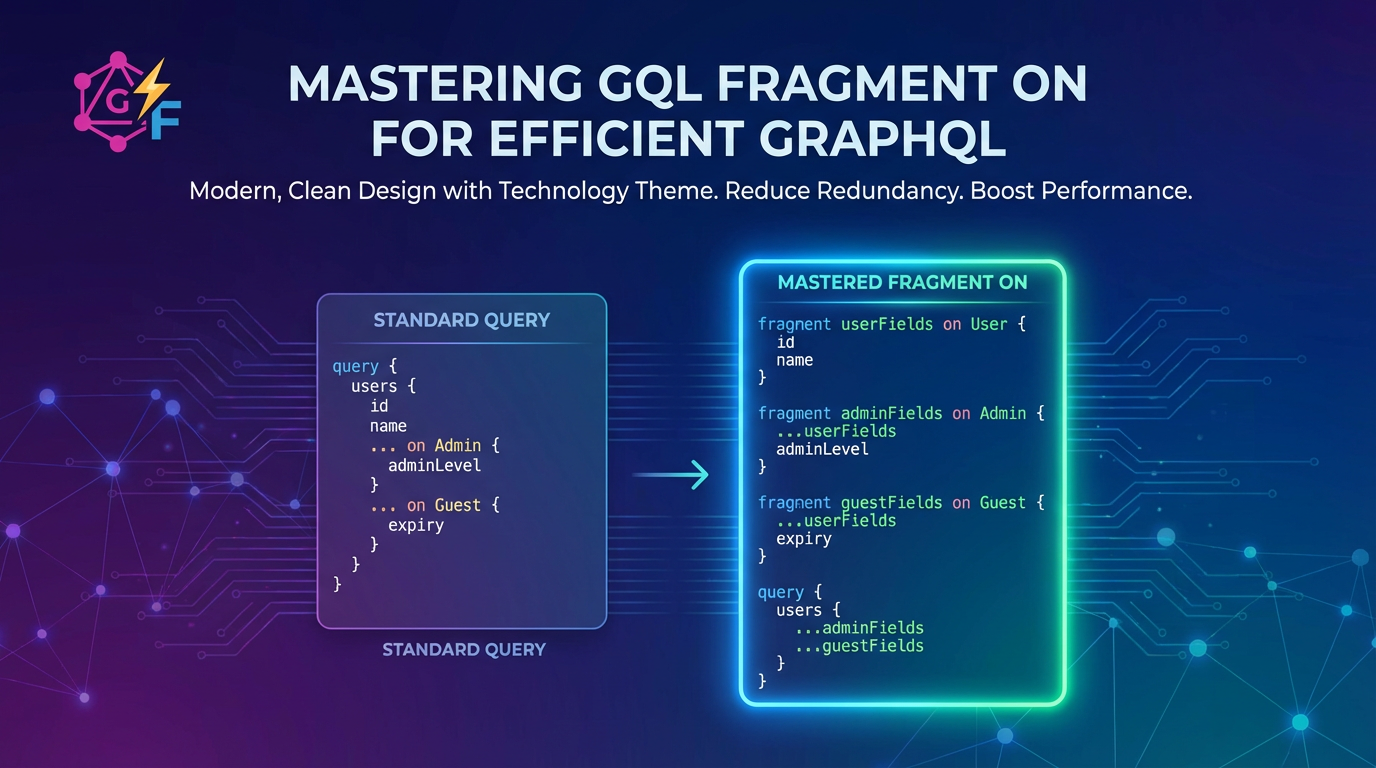
When you query a field that returns an interface or a union type, you cannot directly ask for fields specific to a concrete type without knowing which concrete type it will be at runtime. This is where ... on Type comes in. It allows you to specify a selection set that only applies if the underlying object is of a particular concrete type.
Let's illustrate with an example using the Character interface:
query GetCharacters {
  characters {
    id
    name
    # These fields are common to all Characters

    # Now, use a type condition to get fields specific to Human
    ... on Human {
      homePlanet
    }

    # And another type condition for Droid
    ... on Droid {
      primaryFunction
    }
  }
}
In this query, characters is a field that returns a list of objects implementing the Character interface. We can confidently request id and name because all Character implementations are guaranteed to have them. However, if we want homePlanet (which only Human has) or primaryFunction (which only Droid has), we must use ... on Human and ... on Droid, respectively. The GraphQL server will only include homePlanet in the response for Human objects and primaryFunction for Droid objects.
Similarly, for union types, ... on Type is essential because there are no guaranteed common fields.
query SearchQuery($query: String!) {
  search(query: $query) {
    __typename # Always request __typename for unions and interfaces to know the concrete type
    ... on Book {
      title
      pages
    }
    ... on Author {
      name
      booksWritten
    }
    ... on Article {
      headline
      url
    }
  }
}
When this query is executed, the search field will return a list of SearchResult objects. For each object in the list, the client will receive fields specific to its actual type (e.g., title and pages if it's a Book, name and booksWritten if it's an Author, etc.). The __typename meta-field is crucial here; it tells the client the concrete type of the object, enabling it to correctly process the received data.
Detailed Examples and Best Practices
Example 1: MediaItem Interface
Consider a streaming service where MediaItem is an interface implemented by Movie and TVShow.
interface MediaItem {
  id: ID!
  title: String!
  duration: Int!
}

type Movie implements MediaItem {
  id: ID!
  title: String!
  duration: Int!
  director: String
  releaseYear: Int
}

type TVShow implements MediaItem {
  id: ID!
  title: String!
  duration: Int! # duration of an episode
  seasons: Int
  episodesCount: Int
}

query GetPopularMedia {
  popularMedia {
    id
    title
    duration
    ... on Movie {
      director
      releaseYear
    }
    ... on TVShow {
      seasons
      episodesCount
    }
  }
}
In this scenario, GetPopularMedia fetches a list of MediaItems. For each item, it gets the common id, title, and duration. Then, it conditionally fetches director and releaseYear if the item is a Movie, and seasons and episodesCount if it's a TVShow. This ensures that the client only receives the relevant fields for each media type, optimizing bandwidth and data processing.
Example 2: Notification Union
Imagine a social media feed with various types of notifications: FriendRequestNotification, CommentNotification, LikeNotification.
union Notification = FriendRequestNotification | CommentNotification | LikeNotification

type FriendRequestNotification {
  sender: User!
  timestamp: DateTime!
}

type CommentNotification {
  comment: Comment!
  post: Post!
  timestamp: DateTime!
}

type LikeNotification {
  liker: User!
  item: Likable! # interface implemented by Post, Comment, etc.
  timestamp: DateTime!
}

query GetMyNotifications {
  notifications {
    __typename # Important for unions to know which type it is
    ... on FriendRequestNotification {
      sender {
        id
        name
      }
      timestamp
    }
    ... on CommentNotification {
      comment {
        id
        text
      }
      post {
        id
        title
      }
      timestamp
    }
    ... on LikeNotification {
      liker {
        id
        name
      }
      item { # item implements Likable interface
        __typename
        ... on Post {
          id
          title
        }
        ... on Comment {
          id
          text
        }
      }
      timestamp
    }
  }
}
This query for notifications demonstrates the power of type-conditioned fragments within a union. Each notification type has entirely different data requirements. By using ... on Type, the client can request only the fields pertinent to that specific notification, dynamically constructing a highly tailored response. Notice the nested ... on Post and ... on Comment within the LikeNotification's item field, which itself is an interface (Likable). This showcases the depth and flexibility achievable with fragments.
Common Pitfalls and Best Practices
- Always Request
__typenamefor Unions and Interfaces: When dealing with polymorphic data, especially unions, it's almost always a good practice to include the__typenamemeta-field in your selection set. This field tells the client the concrete type of the object at runtime, which is crucial for client-side logic to correctly interpret and render the received data. Without__typename, it can be challenging to determine which... on Typefragment's fields apply to a given object. - Avoid Excessive Nesting for Readability: While fragments can be deeply nested, be mindful of readability. Extremely deep nesting with many
... on Typeconditions can become hard to follow. Strive for a balance between modularity and clarity. - Client-Side Type Handling: On the client, after receiving a response with
__typename, you'll typically use aswitchstatement or a dictionary lookup to process the data based on its concrete type. Modern GraphQL client libraries often provide utilities to simplify this. - Consider Fragment Colocation: For UI components that display polymorphic data, consider colocating the fragments with their respective components. A
MovieCardcomponent might define aMovieFragment, and aTVShowCardmight define aTVShowFragment. Then, a parent component querying aMediaItemlist can spread these specific fragments using... on Movieand... on TVShow. This aligns data requirements directly with rendering logic.
In summary, ... on Type is the cornerstone for efficient and robust data fetching when dealing with GraphQL interfaces and union types. It allows for precise, conditional data retrieval, ensuring that your application only fetches and processes the data it genuinely needs, regardless of the underlying object's varying forms. This not only optimizes network payloads but also simplifies client-side logic by making the data structure predictable for each specific type.
APIPark is a high-performance AI gateway that allows you to securely access the most comprehensive LLM APIs globally on the APIPark platform, including OpenAI, Anthropic, Mistral, Llama2, Google Gemini, and more.Try APIPark now! 👇👇👇
Advanced Strategies for Efficient Data Fetching with Fragments
Leveraging GraphQL fragments with ... on Type is a fundamental step towards efficient data fetching. However, the true mastery of this feature lies in employing advanced strategies that go beyond basic reusability, focusing on deeply integrating fragments into your application's architecture to maximize performance and maintainability. These strategies often involve structuring your fragments in a way that directly mirrors your application's UI components, managing pagination, and carefully considering the impact on network and client-side processing.
Nesting Fragments for Granular Control
As we touched upon earlier, fragments can be nested. This capability is incredibly powerful for constructing complex data structures from smaller, manageable parts. Imagine a UserProfile component that displays user details, their address, and a list of their recent orders. You could define a UserCoreDetailsFragment, an AddressFragment, and an OrderSummaryFragment. The UserProfileFragment could then compose these:
fragment UserCoreDetails on User {
  id
  name
  email
}

fragment AddressDetails on Address {
  street
  city
  zipCode
  country
}

fragment OrderSummary on Order {
  id
  totalAmount
  status
}

fragment UserProfileData on User {
  ...UserCoreDetails
  address {
    ...AddressDetails
  }
  recentOrders(first: 3) {
    edges {
      node {
        ...OrderSummary
      }
    }
  }
}

query GetMyDetailedProfile {
  me {
    ...UserProfileData
  }
}
This nested approach allows for extreme modularity. Any component that needs only user core details can use ...UserCoreDetails. Components that need addresses can reuse ...AddressDetails. And the UserProfileData fragment orchestrates these smaller fragments into a comprehensive data request tailored for a specific view or component. This significantly reduces duplication, increases readability, and simplifies maintenance, as changes to an address's fields only require modifying AddressDetails.
Fragments for Pagination
Pagination is a common challenge in data fetching, and fragments offer an elegant solution for standardizing pagination data. The GraphQL Relay specification, for instance, proposes a standardized pagination structure using edges, nodes, and pageInfo. You can define fragments for these common patterns:
fragment PageInfoFragment on PageInfo {
  hasNextPage
  endCursor
}

fragment UserEdgeFragment on UserEdge {
  cursor
  node {
    id
    name
  }
}

fragment UserConnectionFragment on UserConnection {
  edges {
    ...UserEdgeFragment
  }
  pageInfo {
    ...PageInfoFragment
  }
}
Then, whenever you fetch a paginated list of users, you can simply spread ...UserConnectionFragment:
query GetPaginatedUsers($first: Int, $after: String) {
  users(first: $first, after: $after) {
    ...UserConnectionFragment
  }
}
This approach not only ensures consistency across all paginated queries but also makes the pagination logic within your client-side code more predictable and easier to manage, as the PageInfo and edges/nodes structure is consistently defined.
UI-Driven Data Fetching with Colocated Fragments
One of the most powerful paradigms enabled by fragments is UI-driven data fetching, often referred to as "fragment colocation." In this model, each UI component (e.g., a React component, a Vue component) declares its own data requirements as a GraphQL fragment.
Consider a ProductCard component that displays a product's name, price, and image. It might look something like this in a modern JavaScript framework:
// components/ProductCard.jsx
import React from 'react';
import { graphql } from 'react-apollo'; // or similar client library

const ProductCard = ({ product }) => (
  <div className="product-card">
    <img src={product.imageUrl} alt={product.name} />
    <h3>{product.name}</h3>
    <p>${product.price.toFixed(2)}</p>
  </div>
);

// Define the fragment directly with the component that uses it
export default graphql`
  fragment ProductCard_product on Product {
    id
    name
    price
    imageUrl
  }
`(ProductCard);
Then, a parent component (e.g., a ProductListing component) that renders a list of ProductCards would simply "spread" the ProductCard_product fragment for each product:
// components/ProductListing.jsx
import React from 'react';
import { graphql } from 'react-apollo';
import ProductCard from './ProductCard';

const ProductListing = ({ data: { loading, products } }) => {
  if (loading) return <p>Loading products...</p>;
  return (
    <div className="product-listing">
      {products.map(product => (
        <ProductCard key={product.id} product={product} />
      ))}
    </div>
  );
};

export default graphql`
  query GetProducts {
    products {
      # The parent component simply asks for the data that its children need
      ...ProductCard_product
    }
  }
`(ProductListing);
This colocation strategy offers several profound advantages:
- Encapsulation: Each component specifies exactly what data it needs, leading to highly encapsulated and independent components.
- Maintainability: When a component's data requirements change, you only update the fragment defined alongside that component. There's no need to hunt for global queries that might be affected.
- Developer Experience: Developers building UI components can immediately see and modify the data their component depends on, simplifying development and reducing context switching.
- Reduced Over-fetching: By composing fragments specific to components, the final query sent to the server is precisely what the current view needs, minimizing unnecessary data transfer.
Impact on Network Payload Size and Client-Side Rendering Performance
The judicious use of fragments, especially with ... on Type, directly impacts network payload size. By requesting only the fields relevant to specific types or components, you avoid sending extraneous data across the wire. For instance, if a list contains 100 polymorphic items, and only 10 of them are of a particular type, a type-conditioned fragment ensures that the additional fields for that type are only fetched for those 10 items, not all 100. This is crucial for optimizing data transfer, particularly in bandwidth-constrained environments.
On the client side, well-structured queries facilitated by fragments simplify data processing. When the client receives a response, it can immediately recognize which data belongs to which component or which concrete type (thanks to __typename and the predictable structure defined by fragments). This reduces the amount of client-side transformation or filtering required, leading to faster rendering times and a smoother user experience. Modern GraphQL client libraries are highly optimized to process fragment-driven responses efficiently, often normalizing data into a client-side cache, further boosting performance for subsequent queries.
Inline Fragments vs. Named Fragments
While named fragments (like UserInfo) are excellent for reusability across different parts of your application, GraphQL also supports inline fragments. An inline fragment is defined directly within a query or selection set using the ... on Type { ... } syntax, without giving it a separate name.
query GetItems {
  items {
    id
    name
    ... on Product {
      price
    }
    ... on Service {
      hourlyRate
    }
  }
}
This is essentially what we've been showing for type conditions. The primary distinction is that inline fragments are anonymous and typically used for one-off conditional field selections, especially for interfaces and unions. Named fragments, on the other hand, are declared separately and reused explicitly via spread syntax.
When to use which:
- Named Fragments:
- For selection sets that are truly reusable across multiple distinct queries or mutations.
- When the fragment represents a core data entity or a significant UI component's data requirements (e.g.,
ProductCard_product). - To improve the overall modularity and organization of your GraphQL documents.
- Inline Fragments:
- Primarily for type conditions on interfaces or union types where the specific fields for each type are short, simple, and not intended for reuse elsewhere.
- When you want to define conditional fields directly within the query context without creating a separate named fragment declaration.
- To keep very specific, localized conditional logic close to where it's used.
Both serve the purpose of conditional field selection, but named fragments add the layer of reusability and explicit modularity, making them generally preferred for complex or frequently used selection sets.
Fragment Types and Use Cases
Here's a comparison table summarizing different fragment types and their typical use cases:
| Fragment Type | Syntax | Primary Use Case | Benefits | Considerations |
|---|---|---|---|---|
| Named Fragment | fragment Name on Type { ... } |
Reusing common selection sets across multiple queries/mutations. | High reusability, improved readability, centralized schema definition. | Requires separate definition, can lead to many small files. |
| Inline Fragment | ... on Type { ... } |
Conditional field selection for interfaces/unions within a single query. | Localized logic, no separate definition needed, concise. | Not reusable, can make queries longer if many fields. |
| Type-Conditioned Named Fragment | fragment Name on InterfaceOrUnionType { ... on ConcreteType { ... } } |
Reusable fragment that handles polymorphic data, composing sub-fragments. | Combines reusability with polymorphism, highly modular. | More complex definition, requires careful structuring. |
| Colocated Fragment | fragment Component_data on Type { ... } (often in JSX/TSX) |
UI components declaring their own data requirements. | Strong encapsulation, aligns data with UI, easy maintenance. | Requires specific tooling/client setup, can disperse fragments. |
By mastering these advanced strategies, developers can transcend basic GraphQL usage and build highly efficient, maintainable, and performant applications that elegantly handle the complexities of modern data requirements.
GQL Fragments in the Real World: Performance and Maintainability
The practical impact of GQL fragments, particularly those employing type conditions, extends far beyond theoretical elegance. In real-world applications, they form a crucial pillar for both performance optimization and long-term codebase maintainability, directly influencing the efficiency and scalability of your GraphQL API.
Enhancing API Maintainability
One of the most significant benefits of fragments for an API is how they streamline maintainability. As an API evolves, data models often change. Fields might be added, removed, renamed, or restructured. Without fragments, every single query that touches a modified entity would need manual updating. This process is not only tedious and time-consuming but also highly susceptible to human error, leading to inconsistent data fetching or broken application features.
Fragments centralize these data definitions. If a User type's address field changes from a simple string to a complex Address object, and you've defined an AddressDetails fragment, updating that single fragment propagates the change across all queries that use it. This significantly reduces the surface area for errors and accelerates the development cycle. Shared definitions make the data requirements clearer and more explicit, fostering a common understanding among team members about how data should be queried and consumed. This is particularly valuable in large teams or projects with many developers working on different parts of the application that interact with the same GraphQL API.
Boosting Performance
Fragments contribute to performance in several critical ways:
- Reduced Network Traffic: By enabling precise data fetching and eliminating redundant field requests, fragments ensure that only the absolutely necessary data travels over the network. This is especially impactful for applications serving users on mobile devices or in regions with slower internet connections, leading to faster load times and a more responsive user experience.
- Efficient Server Resolution: When a GraphQL query arrives at the server, the server's execution engine needs to resolve each field. Fragments, particularly type-conditioned ones, guide the server to fetch only the data relevant to the concrete types present in the response. This prevents the server from unnecessarily querying or processing fields for types that aren't actually part of the data set. For complex schemas with interfaces and unions, this intelligent pruning of selection sets can dramatically reduce database load and API latency.
- Client-Side Caching and Normalization: Modern GraphQL client libraries (like Apollo Client or Relay) leverage fragments to optimize client-side caching. When data is received, it's often normalized into a flat cache, with each object identified by its
idand__typename. Fragments help these clients understand the structure of incoming data, efficiently update the cache, and serve subsequent requests from the cache, bypassing network calls entirely where possible. This is particularly effective for components that reuse the same fragments, ensuring their data is always up-to-date with minimal effort.
Monitoring and Debugging Fragments
While fragments simplify data fetching, monitoring and debugging them require a slightly different approach. The actual query sent to the GraphQL server is a "composed" query where all fragment spreads have been inlined. Therefore, when debugging a server-side issue, you'll see the full, expanded query. Client-side, however, developers often work with the fragment-based code.
- GraphQL Development Tools: Browser extensions for GraphQL (e.g., Apollo DevTools, GraphQL Voyager) can help visualize the queries being sent and the data being received. They often display the composed query, which can be useful for verifying that fragments are correctly expanding.
- Logging and Tracing: Server-side GraphQL APIs should implement robust logging and tracing. Tools that provide insights into field-level resolution times can help identify bottlenecks within fragments. For instance, if a specific field within a
UserProfileFragmentis consistently slow, tracing can pinpoint the underlying data source responsible. - Schema Validation: Before deployment, ensure your GraphQL schema and all fragments are valid against it. Most GraphQL toolchains include schema validation steps that catch issues like requesting a field that doesn't exist on a type within a fragment.
The Role of an API Gateway in Managing Complex GraphQL Queries
As applications grow and GraphQL APIs become more intricate, managing them efficiently and securely becomes paramount. This is where robust tools like an API gateway truly shine. An API gateway acts as a single entry point for all client requests, routing them to the appropriate backend services. For GraphQL APIs heavily utilizing fragments, especially those with complex type conditions, an API gateway can provide invaluable services.
For instance, APIPark, an open-source AI gateway and API management platform, offers comprehensive solutions for managing, integrating, and deploying AI and REST services. It plays a crucial role in overseeing the traffic, security, and performance for complex GraphQL endpoints that rely heavily on fragments for optimized data fetching. A well-configured gateway like APIPark can:
- Traffic Management: Handle load balancing, rate limiting, and routing of GraphQL queries, ensuring high availability and preventing abuse, even with deeply nested or high-volume fragment-based requests.
- Security: Enforce authentication and authorization policies at the gateway level, protecting your backend services from unauthorized access. This is vital when fragments expose various data points depending on user roles or permissions.
- Monitoring and Analytics: Provide detailed logs and analytics on GraphQL query performance, helping identify slow queries or fragment definitions that might be inefficient. This gives operations teams visibility into the health and usage patterns of their GraphQL API.
- Caching: Some advanced API gateways can implement caching strategies for GraphQL responses, reducing the load on backend services and improving response times for frequently requested data, even when those requests are composed of complex fragments.
- Schema Stitching/Federation: While not directly related to fragments, an API gateway often serves as the orchestrator for federated GraphQL architectures, where multiple backend services contribute parts of the overall GraphQL schema. Fragments are essential for querying across these federated services efficiently.
By centralizing these concerns at the gateway level, organizations can offload critical operational tasks from their GraphQL servers, allowing developers to focus on building business logic rather than infrastructure. A powerful gateway like APIPark ensures that even the most sophisticated GraphQL implementations, leveraging all the power of fragments and type conditions, remain performant, secure, and manageable at scale.
Best Practices and Future Considerations
Mastering GQL fragments, particularly with type conditions, is an ongoing journey that benefits from adopting established best practices and staying abreast of future developments in the GraphQL ecosystem. These guidelines ensure not only that your current implementations are robust and efficient but also that your codebase remains adaptable to future needs.
Naming Conventions for Fragments
Consistent naming conventions are paramount for readability and maintainability, especially in larger projects. A common pattern for named fragments is to suffix them with Fragment (e.g., UserCoreDetailsFragment, ProductCardFragment). When fragments are colocated with UI components, it's often useful to prefix them with the component's name to indicate their ownership, like ProductCard_product or UserDetails_user. This clear naming scheme makes it easy for developers to understand the purpose and scope of each fragment.
Fragment Modularization and Organization
As your application grows, the number of fragments can proliferate. Organizing them effectively is key:
- Feature-based folders: Group fragments related to a specific feature (e.g.,
src/features/users/fragments/UserCoreFragment.graphql). - Component-based colocation: As discussed, placing fragments directly alongside the UI components that consume them is a powerful pattern.
- Dedicated fragment files: For highly reusable, schema-level fragments (like
PageInfoFragment), keep them in a central location, perhaps under asrc/fragmentsdirectory.
The goal is to make fragments easy to find, understand, and reuse without causing clutter or confusion.
Avoiding Circular Dependencies
Fragments can reference other fragments, but you must avoid circular dependencies where Fragment A depends on Fragment B, and Fragment B depends back on Fragment A. Most GraphQL tools and APIs will detect and reject such cycles during validation or execution. This often indicates a design flaw in how data is being requested or how components are structured. Rethink your fragment composition to ensure a clear, unidirectional dependency flow.
Testing Fragments
Fragments are not directly executable queries, so they cannot be tested in isolation in the same way. Instead, you test the queries that use the fragments.
- Integration Tests: Write integration tests that execute full GraphQL queries that incorporate your fragments. Assert that the returned data structure matches your expectations, especially for type-conditioned fragments where different concrete types should yield different sets of fields.
- Mocking: When unit testing client-side components that use fragments, you can mock the GraphQL responses to ensure the component renders correctly with the data provided by the fragment. Client libraries often provide utilities for this.
- Schema Validation: As mentioned, validate your fragments against your GraphQL schema as part of your build process. This catches many common errors early.
The Evolving GraphQL Ecosystem and Tooling Support
The GraphQL ecosystem is dynamic and continuously evolving, bringing new tools and features that enhance fragment usage.
- Code Generation: Tools like GraphQL Code Generator can automatically generate TypeScript types, React hooks, or other client-side code based on your GraphQL schema and fragment definitions. This ensures type safety throughout your application and drastically reduces manual boilerplate, making fragments even more powerful.
- Schema Stitching and Federation: For large, distributed systems, schema stitching and GraphQL Federation allow you to compose a single, unified GraphQL API from multiple underlying microservices. Fragments are critical in these architectures, enabling clients to query across different services as if they were querying a single endpoint, with the API gateway (which could be powered by a platform like APIPark) handling the orchestration.
- Client-side Optimizations: GraphQL client libraries are constantly improving their internal mechanisms for handling fragments, including better cache normalization, optimized network requests (e.g., query batching), and features like persisted queries, which can further enhance performance for fragment-heavy applications.
Staying informed about these advancements and integrating relevant tools into your development workflow will ensure that you continue to leverage fragments to their fullest potential. The future of GraphQL, with its focus on efficiency and developer experience, undoubtedly places fragments at its core, enabling increasingly sophisticated and performant API interactions.
Conclusion
Mastering GQL fragments, particularly the nuanced application of the ... on Type syntax, is not merely an optional advanced technique in GraphQL; it is a fundamental pillar for building truly efficient, maintainable, and scalable applications. We have journeyed from understanding the basic premise of GraphQL efficiency to delving deep into the reusable nature of fragments, and then uncovering the transformative power of type conditions in elegantly handling polymorphic data.
Fragments allow developers to define reusable units of data selection, significantly reducing query verbosity and centralizing data requirements. When augmented with ... on Type, they empower clients to precisely request data for interfaces and unions, ensuring that only relevant fields are fetched for each concrete type. This precision directly translates to optimized network payloads, faster client-side processing, and more efficient server-side resolution, culminating in a superior user experience.
Beyond performance, the strategic use of fragments fosters a highly modular and maintainable codebase. Through techniques like nested fragments, pagination patterns, and particularly the colocation of fragments with UI components, developers can align their data fetching logic with their application's architecture, simplifying development, debugging, and future evolution. The role of robust tooling and platforms, such as an API gateway like APIPark, becomes increasingly vital in managing, securing, and monitoring these sophisticated GraphQL APIs, ensuring their seamless operation at scale.
In an ever-evolving digital landscape, where demanding users expect instant, rich, and responsive experiences, GraphQL offers a powerful paradigm shift. By embracing and mastering GQL fragments with ... on Type, you not only unlock the full potential of your GraphQL API but also equip your development team with the tools to build applications that are not just functional, but truly exceptional in their efficiency, elegance, and adaptability. The path to GraphQL mastery is paved with fragments, making your data interactions smarter, faster, and more resilient.
Frequently Asked Questions (FAQs)
1. What is a GraphQL Fragment and why is it important? A GraphQL Fragment is a reusable unit of selection logic that defines a set of fields for a specific GraphQL type. It's crucial because it prevents repetition in your queries, improves readability, centralizes schema definition for common data structures, and makes your GraphQL code more maintainable. If a data structure changes, you only need to update the fragment, and all queries using it will automatically reflect the change.
2. When should I use ... on Type in a GraphQL fragment? You should use ... on Type (a type condition) when querying a field that returns an interface or a union type. This syntax allows you to specify a selection set of fields that should only be included if the underlying object's concrete type matches the specified Type. This is essential for fetching fields unique to specific implementations of an interface or specific members of a union without over-fetching data for other types.
3. What's the difference between a named fragment and an inline fragment with ... on Type? A named fragment is defined separately with a specific name (e.g., fragment UserInfo on User { ... }) and can be reused multiple times across different queries. An inline fragment uses the ... on Type { ... } syntax directly within a query's selection set without a separate name. While both can provide type-conditioned field selection, named fragments are preferred for reusable, complex selections, whereas inline fragments are typically used for simpler, one-off conditional logic within a specific query.
4. How do fragments contribute to GraphQL API performance? Fragments enhance API performance by enabling precise data fetching, minimizing network payload sizes (you only request what you need). For polymorphic data, ... on Type ensures that the server only resolves and sends fields relevant to the actual type, reducing server-side processing load. On the client side, well-structured fragment-based queries simplify data processing and can be efficiently utilized by client-side caches, leading to faster application rendering and a more responsive user experience.
5. How can an API gateway like APIPark help manage GraphQL APIs with fragments? An API gateway like APIPark acts as a centralized control point for your GraphQL API. It can help manage complex GraphQL APIs that heavily use fragments by providing critical functions such as: traffic management (load balancing, rate limiting), robust security (authentication, authorization) for endpoints, and detailed monitoring and analytics on query performance. By abstracting these operational concerns, APIPark ensures that even highly optimized GraphQL interactions, leveraging fragments for efficiency, remain secure, stable, and scalable in a production environment.
🚀You can securely and efficiently call the OpenAI API on APIPark in just two steps:
Step 1: Deploy the APIPark AI gateway in 5 minutes.
APIPark is developed based on Golang, offering strong product performance and low development and maintenance costs. You can deploy APIPark with a single command line.
curl -sSO https://download.apipark.com/install/quick-start.sh; bash quick-start.sh

In my experience, you can see the successful deployment interface within 5 to 10 minutes. Then, you can log in to APIPark using your account.

Step 2: Call the OpenAI API.