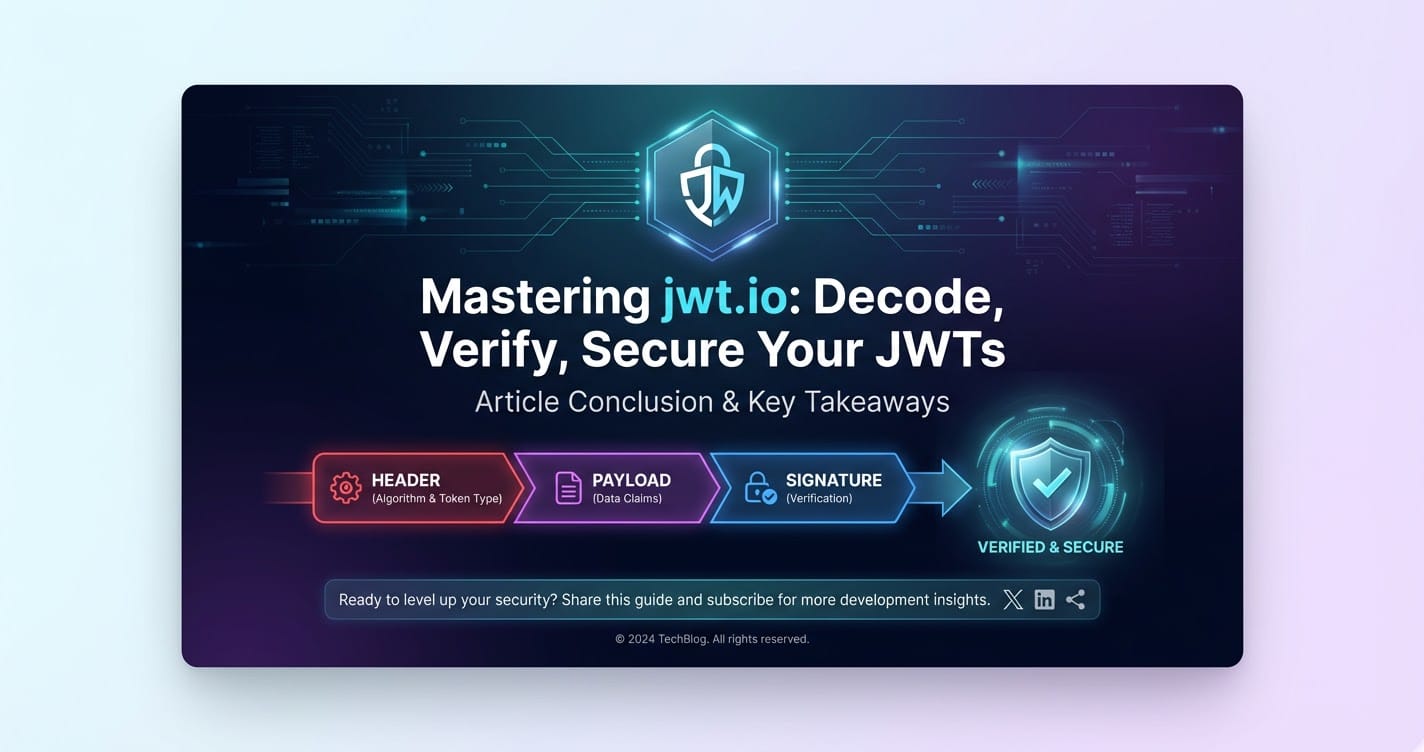
Mastering jwt.io: Decode, Verify, Secure Your JWTs
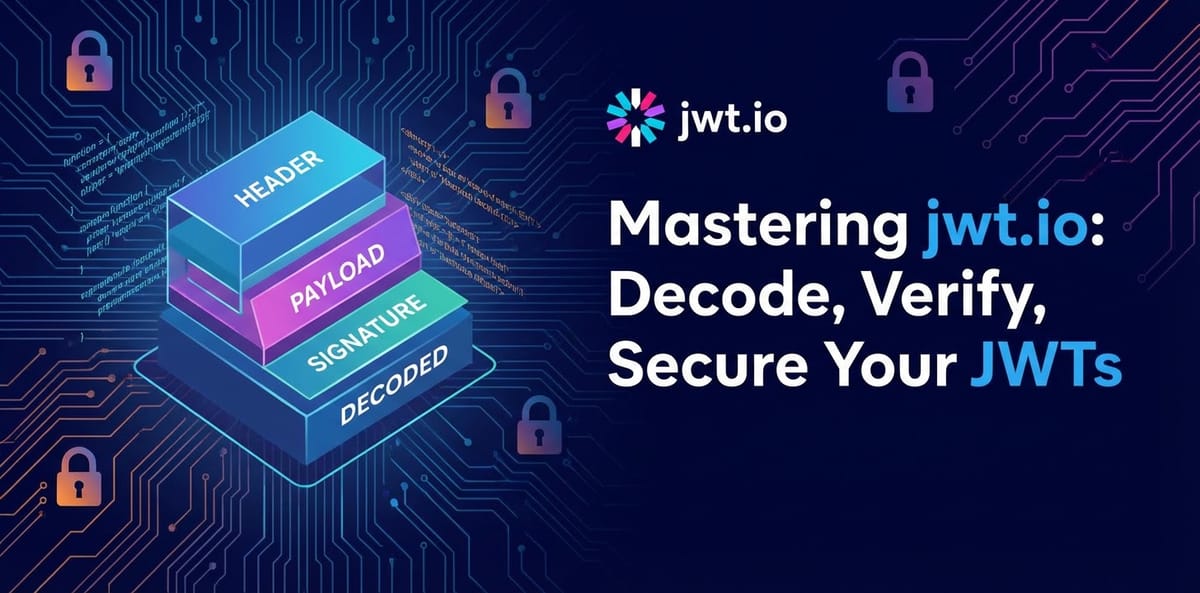


In the vast and intricate landscape of modern web and api development, secure communication is not merely an advantage but an absolute necessity. As applications become increasingly distributed, interacting with numerous services across diverse platforms, the challenge of authenticating users and authorizing their actions efficiently and securely grows exponentially. This is precisely where JSON Web Tokens (JWTs) emerge as a pivotal technology, offering a compact, URL-safe means of representing claims to be transferred between two parties. JWTs have become the de facto standard for stateless authentication in RESTful apis, single-page applications (SPAs), and microservices architectures, fundamentally reshaping how developers approach security.
The jwt.io website stands as an indispensable tool for anyone working with JWTs. It's not just a decoder; it's a comprehensive platform that allows developers to visually inspect, debug, and understand the intricacies of JWTs in real-time. From the header and payload to the signature, jwt.io provides an unparalleled window into the token's structure and integrity. This extensive guide aims to take you on a deep dive into jwt.io, exploring its capabilities for decoding and verifying tokens, while also providing a robust framework for securing your JWT implementations. We will unravel the foundational concepts of JWTs, demonstrate practical usage of jwt.io, and equip you with the knowledge to build resilient, secure systems that leverage this powerful token standard. By the end of this journey, you will not only master the technical aspects but also gain a profound understanding of the best practices and potential pitfalls in JWT-based security.
The Genesis of JWTs: A Foundation for Modern API Security
Before we delve into the practicalities of jwt.io, it's crucial to establish a solid understanding of what JWTs are and why they became so prevalent. JSON Web Tokens are an open, industry-standard RFC 7519 method for representing claims securely between two parties. These claims are essentially pieces of information about an entity (typically, a user) and additional metadata. The beauty of JWTs lies in their self-contained nature; all the necessary information about the user and the validity of the token is encapsulated within the token itself, signed to prevent tampering. This self-containment means that once a server issues a token, it doesn't need to store session information on its side, making authentication scalable and stateless – a perfect fit for microservices and cloud-native applications.
The stateless characteristic of JWTs directly addresses a significant challenge faced by traditional session-based authentication systems, particularly in distributed environments. In a traditional setup, user sessions are stored on the server side, often in a database or an in-memory store. While effective for monolithic applications, this approach becomes a bottleneck when dealing with multiple api servers, load balancers, or geographically dispersed data centers, necessitating complex session replication or sticky session configurations. JWTs elegantly circumvent this by transferring the session state directly to the client. Each subsequent request includes the JWT, which the server can then validate independently without querying a central session store. This significantly reduces server-side overhead and improves the overall scalability and resilience of the authentication system.
Furthermore, JWTs are compact, allowing them to be sent in HTTP headers (e.g., as part of an Authorization header using the Bearer schema), URL query parameters, or even embedded in POST request bodies. Their small size makes them efficient for transmission, especially over mobile networks, and their URL-safe design ensures they can be easily passed around without encoding issues. The security aspect is paramount: JWTs are digitally signed using a secret (for HMAC algorithms) or a private key (for RSA or ECDSA algorithms). This signature guarantees that the token has not been altered since it was issued, and that it originates from a legitimate source, providing crucial integrity and authenticity checks. However, it's vital to understand that while JWTs ensure integrity, they do not inherently encrypt the payload unless specifically used within a JSON Web Encryption (JWE) context. Therefore, sensitive information should never be stored directly in a JWT's payload. This fundamental distinction is critical for developers to grasp, guiding decisions on what data can and cannot be safely included in a token.
Dissecting the Anatomy of a JWT: Header, Payload, and Signature
A JSON Web Token is composed of three distinct parts, separated by dots (.), forming a structure that looks like header.payload.signature. Each of these components plays a crucial role in the token's functionality and security. Understanding each part deeply is the first step towards mastering JWTs and effectively utilizing jwt.io.
The Header (Header.Payload.Signature)
The header typically consists of two fields: alg and typ. - alg (Algorithm): This field specifies the cryptographic algorithm used to sign the JWT. Common algorithms include HS256 (HMAC SHA-256), RS256 (RSA Signature with SHA-256), and ES256 (ECDSA Signature with SHA-256). The choice of algorithm is critical as it dictates the type of key needed for signing and verification and impacts the overall security strength of the token. For instance, HS256 uses a symmetric key, meaning the same secret key is used for both signing and verification. In contrast, RS256 uses an asymmetric key pair, with a private key for signing and a corresponding public key for verification. The header itself is a JSON object, base64url encoded. - typ (Type): This field denotes the type of the token, which is usually "JWT". While seemingly simple, this field helps parsers identify the token as a JWT, enabling proper processing.
An example of a decoded header might look like this:
{
  "alg": "HS256",
  "typ": "JWT"
}
When encoded, this JSON object is converted into a base64url string, forming the first part of the JWT. The header's primary purpose is to inform the consuming application how to interpret and verify the token. Any changes to the header, especially the algorithm, without a corresponding change in the signature, would lead to validation failures, highlighting the integrity checks enforced by the signature.
The Payload (Header.Payload.Signature)
The payload, also known as the "claims" section, contains the actual information about the entity and additional data. Claims are essentially key-value pairs that convey information. There are three types of claims:
- Registered Claims: These are a set of predefined, non-mandatory but recommended claims to provide a set of useful, interoperable claims. Examples include:
iss(Issuer): Identifies the principal that issued the JWT.sub(Subject): Identifies the principal that is the subject of the JWT.aud(Audience): Identifies the recipients that the JWT is intended for. The token should only be accepted by services listed in this audience.exp(Expiration Time): Identifies the expiration time on or after which the JWT MUST NOT be accepted. This is a crucial security feature, preventing tokens from being used indefinitely.nbf(Not Before Time): Identifies the time before which the JWT MUST NOT be accepted.iat(Issued At Time): Identifies the time at which the JWT was issued.jti(JWT ID): Provides a unique identifier for the JWT. This can be used to prevent replay attacks or for blacklisting specific tokens.
- Public Claims: These are claims defined by those using JWTs, but to avoid collisions, they should be registered in the IANA JSON Web Token Claims Registry or be defined in a collision-resistant namespace.
- Private Claims: These are custom claims created to share information between parties that agree on their usage. For example, an
apimight include aroleclaim to indicate the user's permissions, or auser_idclaim to identify the user in a database. It's crucial to remember that the payload is only base64url encoded, not encrypted, meaning anyone can decode it and read its contents. Therefore, sensitive information like passwords, credit card numbers, or personally identifiable information (PII) should never be stored in the payload. Instead, only non-sensitive data or references to sensitive data (e.g., a user ID that can be used to retrieve details from a secure database) should be included.
An example of a decoded payload might look like this:
{
  "sub": "1234567890",
  "name": "John Doe",
  "admin": true,
  "iat": 1516239022,
  "exp": 1516242622
}
Like the header, this JSON object is base64url encoded to form the second part of the JWT. The claims within the payload are what ultimately provide the context and permissions associated with the token, forming the core of the authentication and authorization mechanism.
The Signature (Header.Payload.Signature)
The signature is the cryptographic heart of the JWT, providing its integrity and authenticity. It is created by taking the base64url encoded header, the base64url encoded payload, a secret key, and the algorithm specified in the header, and then applying the cryptographic signing function. The exact process involves concatenating the encoded header and payload with a dot (.), then signing this resulting string using the chosen algorithm and secret/private key.
For an HS256 algorithm, the signature is calculated as: HMACSHA256( base64urlEncode(header) + "." + base64urlEncode(payload), secret )
For RS256, it involves an RSA private key. The crucial aspect of the signature is that it ensures the token has not been tampered with. If even a single character in the header or payload is altered, the signature verification process will fail, rendering the token invalid. This mechanism is what makes JWTs "secure" in terms of integrity. When a server receives a JWT, it decodes the header and payload, then reconstructs the signature using the same algorithm and the same secret key (for symmetric algorithms) or the corresponding public key (for asymmetric algorithms) that was used to sign the token. If the reconstructed signature matches the signature provided in the JWT, the token is considered valid and untampered. If they don't match, the token is rejected.
The signature is also base64url encoded. This entire three-part structure—header, payload, and signature, separated by dots—constitutes the complete JSON Web Token, ready for transmission and verification. Without a correctly calculated and verified signature, a JWT is merely a string of encoded JSON objects, devoid of its security assurances. The strength of the secret key (for symmetric algorithms) or the security of the private key (for asymmetric algorithms) is paramount to the overall security of the JWT. Weak keys are easily guessable and compromise the entire system.
Decoding JWTs with jwt.io: A Developer's Playground
jwt.io is an invaluable resource for developers working with JSON Web Tokens. Its intuitive web interface provides a sandbox environment to effortlessly decode, verify, and understand JWTs without needing to write any code. This section will guide you through the process of using jwt.io for basic decoding and exploration.
Upon visiting jwt.io, you are greeted with a split-panel interface. On the left side, there's a large text area labeled "Encoded," where you can paste your JWT. As soon as a valid JWT is pasted, the right side of the screen comes to life, displaying the decoded contents in a structured, readable format.
Pasting and Instant Decoding
The primary function of jwt.io is its instant decoding capability. When you paste a JWT into the "Encoded" field, the website automatically parses the three parts of the token (header, payload, signature) and presents them distinctly. - Header: The decoded JSON representation of the header is shown, clearly indicating the alg (algorithm) and typ (type) fields. This allows you to quickly ascertain which algorithm was used to sign the token, which is crucial for subsequent verification steps. - Payload: Below the header, the decoded JSON payload is displayed, revealing all the claims contained within the token. This includes registered claims like iss, sub, exp, iat, and any custom (private) claims defined by your application, such as user_id or role. This visual representation is incredibly helpful for debugging, ensuring that the correct claims are being generated and included in your tokens. It’s also an excellent way to audit the information exposed in your tokens. Remember, since this part is only encoded and not encrypted, you should never see sensitive information here if your system is designed correctly. - Signature Verification: The most critical feature, beyond mere decoding, is the signature verification section. jwt.io provides a field where you can input the secret key (for symmetric algorithms like HS256) or the public key/certificate (for asymmetric algorithms like RS256). Once the correct key is provided, jwt.io attempts to re-calculate the signature based on the header, payload, and your supplied key. It then compares this calculated signature with the signature present in the original JWT. The result is prominently displayed as "Signature Verified" in green, or "Invalid Signature" in red, along with a clear explanation of what went wrong. This immediate feedback loop is invaluable for: - Debugging token generation issues: If your application is generating tokens that aren't verifying, you can paste the token and your secret/public key into jwt.io to see if the signature is valid. This helps pinpoint whether the issue is with the key used for signing, the signing algorithm, or perhaps an alteration to the token during transmission. - Understanding key rotation: When rotating keys, you can test if new keys correctly verify existing tokens (if applicable) or newly issued tokens. - Educating new team members: It serves as an excellent visual aid for explaining the mechanics of JWTs to developers new to the concept.
Common Use Cases for jwt.io
Beyond basic debugging, jwt.io serves several practical purposes in a developer's workflow:
- Exploring Token Contents: Before integrating a third-party
apithat uses JWTs, you can usejwt.ioto inspect the claims they provide. This helps you understand what information is available and how to process it in your application. For example, if an authentication service provides a JWT, you can examine its payload to identify the user ID, roles, or any custom permissions, ensuring that the token contains all the necessary data for your authorization logic. - Validating Token Integrity During Development: During development cycles, especially when building authentication services, it's easy to make mistakes. A forgotten secret, an incorrect algorithm, or even an accidental space in the encoded parts can invalidate a token.
jwt.ioacts as a quick diagnostic tool, allowing you to paste a token generated by your backend and the secret key to confirm its validity instantly. If the signature is invalid, it tells you immediately that there's an issue with how the token was signed or if it was tampered with. - Testing Different Algorithms:
jwt.iosupports various signing algorithms. You can experiment by changing thealgvalue in the header and observing how the signature calculation changes. This helps in understanding the differences between symmetric (e.g., HS256) and asymmetric (e.g., RS256) algorithms and the type of key required for each. The ability to switch between HS256, RS256, ES256, etc., directly within the interface allows for a hands-on exploration of cryptographic primitives without the overhead of setting up a coding environment. This is especially useful when considering which algorithm best suits your security requirements and infrastructure, such as whether you need to distribute public keys widely for verification without exposing the signing private key. - Learning and Teaching Tool: For newcomers to API security or JWTs,
jwt.iois an excellent educational resource. The visual separation of header, payload, and signature, combined with the real-time feedback on signature verification, makes the abstract concepts of cryptographic signing concrete and easy to grasp. Instructors often usejwt.ioin workshops and tutorials to demonstrate JWT mechanics. - Troubleshooting Integration Issues: When integrating with an
api gatewayor otherapimanagement platforms that handle JWTs, issues can arise. For instance, anapi gatewaymight reject a token. Usingjwt.iocan help you isolate whether the token itself is malformed or invalid, or if the issue lies with the gateway's configuration or interpretation of the token. This often happens when there are subtle differences in how expiry (exp) or audience (aud) claims are interpreted by different systems.
In essence, jwt.io demystifies the complex world of JWTs, making them more accessible and manageable for developers at all skill levels. It empowers you to inspect tokens with confidence, rapidly diagnose issues, and deepen your understanding of this critical api security standard.
APIPark is a high-performance AI gateway that allows you to securely access the most comprehensive LLM APIs globally on the APIPark platform, including OpenAI, Anthropic, Mistral, Llama2, Google Gemini, and more.Try APIPark now! 👇👇👇
Verifying JWTs: The Cornerstone of Trust
While decoding a JWT reveals its contents, the true power and security of a JWT lie in its verification. Verification is the process byifying the signature to ensure the token's integrity and authenticity, and then checking the claims within the payload to confirm its validity and authorization context. A properly verified JWT guarantees that the token has not been tampered with since it was issued and that it originated from a trusted source. This section explores the critical steps and considerations involved in robust JWT verification.
Signature Verification: Ensuring Integrity and Authenticity
The most crucial step in JWT verification is validating its signature. As discussed, the signature is a cryptographic hash of the encoded header and payload, computed using a secret key (for symmetric algorithms) or a private key (for asymmetric algorithms). When a server receives a JWT, it performs the following steps:
- Retrieve Header and Payload: The server first decodes the base64url encoded header and payload parts of the token.
- Identify Algorithm and Key: From the decoded header, the server extracts the
algparameter to determine the signing algorithm used (e.g., HS256, RS256). Based on this algorithm, it then identifies the appropriate key for verification.- Symmetric Algorithms (e.g., HS256): For symmetric algorithms, the server must possess the exact same secret key that was used to sign the token. This key is often shared between the issuer and the verifier and must be kept highly confidential.
- Asymmetric Algorithms (e.g., RS256, ES256): For asymmetric algorithms, the server needs the public key corresponding to the private key used by the issuer to sign the token. Public keys are designed to be shared openly, allowing any party to verify signatures without compromising the security of the private signing key. This is particularly useful in distributed systems where multiple services need to verify tokens issued by a central authentication service, but only the central service possesses the private signing key. Public keys are often distributed via JSON Web Key Sets (JWKS), which provide a standard way to publish cryptographic keys.
- Re-compute Signature: Using the decoded header, payload, and the identified verification key (secret or public key), the server re-computes the signature using the specified algorithm.
- Compare Signatures: The re-computed signature is then compared byte-for-byte with the signature provided in the received JWT.
- If they match, the signature is valid. This confirms that the token has not been altered since it was signed and that it was indeed signed by the legitimate issuer possessing the correct key.
- If they do not match, the signature is invalid. The token is rejected immediately, as its integrity cannot be trusted. This could indicate tampering, an incorrect key being used for verification, or an error during the token generation process.
It is absolutely critical that the signature verification process is robust and unforgiving. Never trust a token if its signature is invalid. A common vulnerability, known as the "alg" header bypass, occurs when an application blindly trusts the alg parameter in the JWT header. An attacker might change the alg to "none" (indicating no signature) or to a symmetric algorithm (like HS256) while presenting a public key for verification. If the application doesn't explicitly validate the alg parameter against a whitelist of expected algorithms and ensures that the correct key type is used for the specified algorithm, it could be tricked into accepting an unsigned or falsely signed token. Always validate the alg header against a predefined list of allowed algorithms and enforce the correct key usage.
Claim Validation: Beyond Signature Integrity
While signature verification guarantees the token's integrity, it doesn't mean the token is valid for current use. The claims within the payload must also be validated to ensure the token is appropriate for the context in which it's being used. Critical claims that require validation include:
exp(Expiration Time): This is perhaps the most important claim. The server must check if the current time is after theexptime. If it is, the token has expired and must be rejected. This prevents stale tokens from being used indefinitely. Implementations should also account for a small "leeway" or "clock skew" to handle minor time differences between systems, typically a few seconds.nbf(Not Before Time): If present, the server must check if the current time is before thenbftime. If it is, the token is not yet valid and should be rejected. This can be useful for issuing tokens that become active at a future point.iss(Issuer): The server should verify that theissclaim matches the expected issuer of the token. This prevents tokens issued by malicious or unintended parties from being accepted. For example, if yourapiexpects tokens fromauth.example.com, it should reject tokens issued byevil.com.aud(Audience): Theaudclaim identifies the recipients for which the JWT is intended. The server must verify that its own identifier (e.g., itsapiname or URL) is present in theaudclaim. If theapiis not an intended audience, the token should be rejected. This prevents cross-apiusage of tokens where a token for oneapiis mistakenly or maliciously sent to another.jti(JWT ID): Ifjtiis used, the server can use it to implement token replay protection. By storing usedjtis in a blacklist (e.g., in a cache like Redis) for the duration of the token's validity, the server can reject any subsequent tokens with the samejti, thereby preventing replay attacks where an attacker might capture and resubmit a valid token.- Custom Claims: Any custom claims (
role,user_id,permissions) that are essential for authorization logic must also be validated according to your application's business rules. For example, ensuring that a user has theadminrole before allowing access to administrative functions. These custom claims, while not formally defined by the RFC, are critical for your application's specific authorization logic.
Role of API Gateway in JWT Verification
In modern microservices architectures, an api gateway often plays a pivotal role in centralizing api security, including JWT verification. Instead of each backend service implementing its own JWT validation logic, the api gateway can handle this responsibility upfront.
Here's how an api gateway enhances JWT verification:
- Centralized Validation: The gateway acts as an enforcement point. All incoming requests bearing JWTs are first routed through the gateway, which performs comprehensive signature and claim validation. Only tokens that pass these checks are then forwarded to the respective backend services. This centralizes security logic, reduces code duplication across services, and ensures consistent security policies.
- Performance Optimization:
api gateways are often optimized for high-performance operations. By offloading JWT validation to the gateway, backend services can focus purely on their business logic, leading to better overall system performance. Manyapi gateways, like APIPark, are designed to handle high TPS (Transactions Per Second) with minimal latency, ensuring that the overhead of security checks doesn't become a bottleneck. APIPark, for instance, boasts performance rivaling Nginx, achieving over 20,000 TPS with modest hardware, making it an excellent choice for enterprises needing robust and scalableapimanagement that can integrate 100+ AI models while also securing traditional RESTapis. - Key Management: An
api gatewaycan centralize the management of public keys (for asymmetric algorithms) or shared secrets (for symmetric algorithms), simplifying key rotation and distribution. Instead of updating keys across all microservices, developers only need to update them in the gateway configuration. Some gateways can even automatically fetch JWKS from identity providers. - Token Transformation and Augmentation: After successful validation, the
api gatewaycan transform the JWT or extract relevant claims and inject them into request headers before forwarding the request to a backend service. This simplifies the processing for downstream services, as they receive clean, pre-validated context information without needing to parse or validate the entire JWT themselves. For example, theuser_idmight be extracted from the JWT and passed as a custom headerX-User-IDto the downstream service. - Audience and Issuer Validation: The
api gatewayis ideally positioned to enforceaudandissclaims, ensuring that only tokens intended for the internal ecosystem or specific services are allowed through. This is particularly important when dealing with multipleapis or third-party integrations.
The proper verification of JWTs, encompassing both signature integrity and claim validity, is non-negotiable for secure apis. By implementing robust verification logic, whether directly in services or centrally via an api gateway, developers can establish a trustworthy foundation for their application's authentication and authorization mechanisms.
Securing Your JWT Implementations: Best Practices and Pitfalls
While JWTs offer a powerful mechanism for secure api authentication, their effective security hinges entirely on correct implementation. Misconfigurations or oversight can lead to severe vulnerabilities. This section outlines critical best practices and common pitfalls to avoid, ensuring your JWT-based systems are robust and resilient against attacks.
Key Management is Paramount
The security of your JWTs is directly tied to the security of your signing keys.
- Strong, Unique Keys: Always use cryptographically strong, sufficiently long, and unique keys for signing. For HS256, a 256-bit (32-byte) random secret is the minimum. For RS256, use RSA keys of at least 2048 bits, preferably 4096 bits. Never hardcode keys in your application source code.
- Secure Storage: Signing keys (especially private keys for asymmetric algorithms and shared secrets for symmetric algorithms) must be stored securely. Use environment variables, secure configuration management systems, hardware security modules (HSMs), or dedicated key management services (KMS) provided by cloud providers. Access to these keys should be strictly controlled and audited.
- Key Rotation: Regularly rotate your signing keys. This limits the window of exposure if a key is compromised. When rotating, consider a graceful transition period where both old and new keys are accepted for verification for a limited time to allow existing valid tokens to expire naturally. This is where
api gateways can simplify the process by centralizing key management and allowing for dual-key verification during rotation. - Asymmetric Keys for Distributed Systems: For systems with multiple verifying services but a single issuer, asymmetric algorithms (RSA, ECDSA) are generally preferred. The public key can be widely distributed (e.g., via JWKS endpoints) without compromising the private signing key, which remains under the control of the issuing service. This prevents all verifying services from needing access to the sensitive signing secret.
Careful Claim Management
The claims in your JWT payload dictate the user's identity and permissions.
- No Sensitive Information in Payload: As iterated, JWT payloads are base64url encoded, not encrypted. Anyone can decode and read them. Never store sensitive PII, passwords, financial data, or highly confidential business information directly in the JWT payload. Instead, store only identifiers (like
user_id) that can be used to retrieve sensitive data from secure, authorized backend databases. - Short Expiration Times (
exp): JWTs should have relatively short expiration times (e.g., 5-15 minutes for access tokens). This limits the window during which a compromised token can be misused. For longer sessions, pair short-lived access tokens with longer-lived refresh tokens. - Mandatory Claim Validation: Always validate standard claims like
exp,nbf,iss, andaud. Failure to do so can lead to accepting expired tokens, tokens from untrusted issuers, or tokens intended for other applications. - Scope and Permissions: Use claims to define granular scopes and permissions. Instead of a simple
admin: true, use specific permissions likeuser:read,product:write,order:delete. This adheres to the principle of least privilege.
Robust Token Management
How tokens are issued, stored, and revoked is crucial.
- Refresh Tokens for Long Sessions: For applications requiring long user sessions (e.g., "remember me" functionality), implement a system with short-lived access tokens and longer-lived refresh tokens. Access tokens are used for
apirequests and expire quickly. When an access token expires, the client uses a refresh token (sent to an authentication endpoint, not typically with everyapicall) to obtain a new access token. Refresh tokens should be stored securely (e.g., HTTP-only cookies, encrypted database) and are typically single-use or have mechanisms for revocation. - Token Revocation (Optional but Recommended): JWTs are stateless, meaning revocation is not inherent. Once issued, a valid JWT cannot be "un-issued" until it expires. For critical applications, consider implementing a revocation mechanism (e.g., a blacklist/denylist of
jtis in a high-performance cache like Redis) for immediate termination of tokens, especially after a security event (e.g., password change, suspicious activity, user logout). This adds state to an otherwise stateless system but is often a necessary security trade-off. - Secure Transmission: Always transmit JWTs over HTTPS/TLS to protect them from interception. Without encryption in transit, attackers could sniff tokens, leading to session hijacking.
- Storage on Client Side:
- Browser-based applications: Storing JWTs in
HttpOnlycookies (for preventing XSS access) is a common and often recommended approach for security against Cross-Site Scripting (XSS). However, they can be vulnerable to Cross-Site Request Forgery (CSRF) if not properly protected with anti-CSRF tokens. Alternatively,localStorageorsessionStoragecan be used, but these are susceptible to XSS attacks. The choice depends on your specific threat model and risk assessment. - Mobile applications: Store JWTs securely using platform-specific secure storage mechanisms (e.g., iOS Keychain, Android KeyStore).
- Browser-based applications: Storing JWTs in
Mitigating Common Attacks
Understanding potential attack vectors is key to building defenses.
- "alg: none" Attack: Never accept tokens with
alg: none. Your JWT library orapi gatewayshould be configured to explicitly whitelist allowed algorithms (e.g., HS256, RS256) and reject any others. This is a critical validation step. - Algorithm Confusion Attacks: Ensure your verification logic correctly handles different algorithm types (symmetric vs. asymmetric). An attacker might change
algfrom RS256 to HS256 and try to sign the token with your public key as the symmetric secret. If your system is not careful to use the correct key type (public for asymmetric, secret for symmetric) based on the actual algorithm, it might incorrectly verify the token. Always explicitly check the algorithm and load the appropriate key. - Brute-Force Attacks on Weak Secrets: Weak secret keys can be easily guessed, compromising the signature. Use long, random, cryptographically strong secrets.
- Replay Attacks: If tokens are valid for a long time and don't contain unique identifiers, an attacker could capture a token and "replay" it multiple times. Using
jticlaims with a blacklist mechanism or ensuring very short expiration times for access tokens helps mitigate this. - SQL/NoSQL Injection: While not directly related to JWTs, ensure that any data extracted from JWT claims and used in database queries (e.g.,
user_id) is properly sanitized and parameterized to prevent injection attacks.
Documenting Security with OpenAPI
For teams developing and consuming apis, clear documentation of security schemes is paramount. OpenAPI (formerly Swagger) provides a standardized, language-agnostic interface description for REST apis, making it easier for humans and machines to discover and understand their capabilities. When using JWTs for api security, OpenAPI offers specific mechanisms to document this:
securitySchemes: In your OpenAPI definition (e.g., openapi: 3.0.0), you can define your JWT authentication scheme under the components.securitySchemes object. You would specify the type as http, the scheme as bearer, and the bearerFormat as JWT. This tells consumers how to authenticate requests (by including a Bearer token in the Authorization header).yaml components: securitySchemes: jwtAuth: type: http scheme: bearer bearerFormat: JWT description: > JWT authentication. Use a Bearer token. Access tokens are short-lived, use refresh tokens for prolonged sessions. * security Field: Once the security scheme is defined, you can apply it globally to all api endpoints or individually to specific operations using the security field.```yaml
Global security
security: - jwtAuth: []
Or per-operation
paths: /users: get: summary: Get all users security: - jwtAuth: [] responses: '200': description: A list of users `` ThisOpenAPIdocumentation makes it explicit to anyapiconsumer that a JWT is required for authentication, how it should be presented, and clarifies the security model. Tools like Swagger UI can then automatically provide fields for entering JWTs, simplifying testing and integration for developers. ProperOpenAPIdocumentation minimizes confusion and accelerates the adoption of yourapi`s, ensuring consumers understand the security requirements from the outset.
By diligently following these best practices and being aware of common pitfalls, you can leverage the power of JWTs to build secure, scalable, and efficient apis that meet the demands of modern application development.
Advanced JWT Topics: Beyond the Basics
While the core concepts of JWTs (header, payload, signature, and verification) cover most typical use cases, the JWT specification family offers more advanced features for specialized scenarios. Understanding these can help you build even more robust and tailored security solutions.
JSON Web Signature (JWS) and JSON Web Encryption (JWE)
It's important to distinguish between JWT, JWS, and JWE. - JWT (JSON Web Token): This is the overarching term for a compact, URL-safe means of representing claims. A JWT can be either a JWS or a JWE. - JWS (JSON Web Signature): This specifies how to represent digitally signed or MACed (Message Authentication Code) content using JSON and base64url encoding. All the JWTs we've discussed so far, with their header, payload, and signature, are essentially JWSs. The signature provides integrity and authenticity. - JWE (JSON Web Encryption): This specifies how to represent encrypted content using JSON and base64url encoding. Unlike JWS, JWE provides confidentiality by encrypting the payload. If you need to store truly sensitive information in a token (which is generally discouraged for access tokens but might be relevant for specialized internal tokens), JWE would be the mechanism to use. JWE tokens have a more complex structure, typically five parts separated by dots, including an encrypted key, initialization vector, ciphertext, and authentication tag, in addition to the header. Using JWE adds significant complexity and computational overhead compared to JWS. Therefore, it should only be adopted when absolute confidentiality of the token's contents is a strict requirement, and the performance implications are acceptable.
Custom Claims and Namespaces
While registered claims offer common functionality, applications often require domain-specific information within tokens. This is where private claims come into play. When defining private claims, it's a good practice to use unique, descriptive names to avoid collisions, especially if your tokens might be consumed by various services or third parties.
For example, a role claim is a common private claim: {"role": "admin"}. For more complex, hierarchical permissions, you might use an array: {"permissions": ["user:read", "product:write"]}.
When integrating with external systems or in complex multi-tenant environments, you might consider using namespaced custom claims to further prevent collisions and provide context. For instance, {"https://example.com/claims/premium_member": true}. The URL acts as a unique identifier for the claim's definition. This practice is particularly useful in federated identity scenarios where claims might originate from multiple sources.
Token Revocation Strategies
As established, the stateless nature of JWTs means that once a token is issued and signed, it remains valid until its expiration time. This characteristic, while beneficial for scalability, poses a challenge for immediate revocation (e.g., when a user logs out, their password changes, or an account is suspended). Several strategies can be employed to enable revocation, albeit at the cost of introducing some state:
- Short-Lived Tokens: The simplest approach is to issue very short-lived access tokens. While not immediate revocation, it limits the window of exposure. Paired with refresh tokens, this is a common and effective pattern.
- Blacklisting/Denylisting: For immediate revocation, a blacklisting mechanism can be implemented. When a token needs to be revoked, its
jti(JWT ID claim) is added to a centralized blacklist (e.g., in Redis, Memcached, or a distributed database) for the duration of the token's original validity. Each incoming JWT is then checked against this blacklist before full verification. If thejtiis present, the token is rejected. This method introduces a database lookup for every request, which adds latency and state management complexity but provides immediate revocation. - Expiring Sessions/Tokens on Change: When a critical user event occurs (e.g., password change, email change), all previously issued tokens for that user can be invalidated. This can be done by invalidating all active
jtis for that user in a blacklist or by changing aversionorissued_atclaim on the user's record, against which theiatclaim in the JWT is checked. If the token'siatis older than theversionon the user's record, the token is deemed invalid. - Reference Tokens: In some systems, the "token" issued to the client isn't a JWT itself, but merely a reference ID. This ID is then used to look up an actual JWT or session information stored on the server side. This completely reintroduces state but allows for immediate and easy revocation, as the server can simply delete the referenced session. This pattern is less common when the primary goal is statelessness, but it's an option for specific security requirements.
The choice of revocation strategy depends heavily on the application's specific security requirements, performance constraints, and tolerance for complexity. Most applications find a balance with short-lived access tokens and refresh tokens, reserving blacklisting for high-security scenarios or explicit user logout events.
JWTs in Microservices Communication
JWTs are exceptionally well-suited for securing communication in microservices architectures. When a request enters a microservices system, typically through an api gateway, an access token is validated. After validation, the api gateway can either pass the original JWT to downstream services or transform it (e.g., extracting claims and adding them as headers) before forwarding the request.
Benefits of using JWTs in microservices:
- Stateless Authentication: Each microservice can independently verify the JWT without needing to consult a central authentication service for every request (after initial key fetching). This reduces inter-service communication overhead and improves scalability.
- Decentralized Authorization: Claims within the JWT can carry fine-grained authorization information (e.g.,
roles,permissions). Each microservice can then use these claims to make authorization decisions specific to its domain, without needing to make additional calls to an authorization service. - Trust Across Services: By sharing a common public key (for asymmetric algorithms) or a shared secret (for symmetric algorithms) across services, trust can be established efficiently. Services can verify that tokens originate from a trusted issuer (e.g., the central identity provider) and have not been tampered with.
APIPark's Role: In such an environment, platforms like APIPark become indispensable. As anapi gatewayand API Management Platform, APIPark can act as the central enforcement point for JWT security. It can:- Perform robust JWT validation (signature,
exp,aud,iss) before forwarding requests to microservices. - Manage and rotate keys, retrieving public keys from identity providers or acting as a central secret store.
- Extract claims from JWTs and inject them as headers for downstream services, simplifying their authorization logic.
- Provide detailed logging and analytics of API calls, including insights into token usage and potential security anomalies.
- Enable quick integration of various AI models while standardizing API formats, making it easier to secure and manage AI-driven
apis alongside traditional REST services using consistent security policies like JWT authentication. This unified approach, combined with APIPark's performance and robust lifecycle management, ensures that all yourapis, regardless of their nature, are governed and secured effectively.
- Perform robust JWT validation (signature,
Table: Comparison of Common JWT Claims and Their Validation Needs
Understanding which claims are critical and how they should be validated is fundamental to building secure JWT systems. This table provides a quick reference for common registered claims.
| Claim | Description | Importance | Validation Strategy | Common Pitfalls |
|---|---|---|---|---|
iss |
Issuer of the JWT | High | Must match an expected trusted issuer URL or identifier. | Not validating the issuer, accepting tokens from untrusted sources. |
sub |
Subject of the JWT (e.g., user ID) | Medium | Used to identify the entity; its value should exist and be valid in your system. | Relying solely on sub for authorization without further checks. |
aud |
Audience(s) the JWT is intended for | High | Must contain the identifier of the current API/service as one of its values. | Not validating the audience, allowing tokens for other services to be used. |
exp |
Expiration time after which the JWT MUST NOT be accepted | Critical | Must be in the future. Allow a small clock skew (e.g., 60 seconds). | Not validating expiration, leading to replay attacks with stale tokens. |
nbf |
Not Before time before which the JWT MUST NOT be accepted | Medium | Must be in the past. Allow a small clock skew (e.g., 60 seconds). | Not validating nbf, accepting tokens prematurely. |
iat |
Time at which the JWT was issued | Low (for direct validation) | Can be used for auditing or in conjunction with revocation strategies (e.g., checking against user's last password change timestamp). | No direct security impact if not used for specific checks. |
jti |
Unique identifier for the JWT | Medium (for specific uses) | Can be used to implement token blacklisting/replay protection. | Not using jti when replay protection is a requirement. |
alg |
Signing algorithm used | Critical | Must be whitelisted (e.g., HS256, RS256). Never accept "none". | "alg: none" attack, algorithm confusion attack. |
These advanced topics highlight that JWTs, while straightforward in their basic form, offer considerable flexibility and depth for complex security scenarios. Thoughtful consideration of these aspects will lead to more secure, scalable, and manageable api ecosystems.
Conclusion: Mastering the Art of JWT Security
JSON Web Tokens have unequivocally revolutionized the landscape of api authentication and authorization in modern, distributed systems. Their stateless, compact, and self-contained nature addresses many of the challenges inherent in traditional session-based approaches, offering a powerful foundation for building scalable and efficient apis. However, the true strength and security of a JWT implementation are not inherent in the standard itself, but rather in the meticulous attention to detail during its design, implementation, and ongoing management.
Throughout this extensive guide, we've journeyed from the foundational anatomy of a JWT—dissecting its header, payload, and signature—to the indispensable role of jwt.io as a developer's primary tool for decoding, debugging, and understanding these tokens in real-time. We've emphasized that while jwt.io provides unparalleled visibility, the ultimate responsibility for robust security rests with the developer. The critical process of signature verification, ensuring the token's integrity and authenticity, combined with diligent claim validation, asserting its contextual validity, forms the twin pillars of JWT trust. Neglecting either can open doors to serious vulnerabilities.
Furthermore, we've explored the crucial best practices for securing your JWT implementations, ranging from impregnable key management and thoughtful claim usage to sophisticated token management strategies like refresh tokens and selective revocation. We delved into mitigating common attack vectors such as "alg: none" and algorithm confusion, stressing the importance of explicit whitelisting and robust validation logic. The role of an api gateway, like APIPark, emerged as a central pillar in modern architectures, streamlining JWT verification, key management, and api governance across microservices. By centralizing these critical security functions, platforms like APIPark not only enhance security but also significantly boost performance and operational efficiency, integrating seamlessly into complex api ecosystems, whether for traditional REST apis or cutting-edge AI models. Finally, we touched upon advanced topics like JWS/JWE, custom claims, and OpenAPI documentation, equipping you with the knowledge to tackle more specialized security requirements and communicate your api's security model effectively.
Mastering JWTs is not merely about knowing how to generate and consume them; it's about internalizing the underlying cryptographic principles, understanding the security implications of each design choice, and meticulously implementing verification and management processes. By embracing the principles outlined in this guide, leveraging tools like jwt.io, and integrating robust api management solutions such as APIPark, developers can confidently build secure, high-performing apis that stand resilient against the evolving threat landscape of the digital world. The journey to true api security is continuous, but with a deep understanding of JWTs and a commitment to best practices, you are well-equipped to navigate it successfully.
5 Frequently Asked Questions (FAQs)
1. What is the primary difference between JWT and traditional session-based authentication? The primary difference lies in their statefulness. Traditional session-based authentication is stateful, meaning the server needs to store session data (e.g., in a database or memory) for each active user. When a user authenticates, a session ID is generated and sent to the client (often in a cookie), and for every subsequent request, the server looks up the session ID to retrieve user data. This can become a bottleneck in distributed systems due to session replication challenges. JWTs, conversely, are largely stateless. After a user authenticates, the server issues a JWT containing all necessary user claims (e.g., user ID, roles, expiry). This token is then stored by the client and sent with every subsequent request. The server can verify the token's integrity and validity using its signature and claims (without needing to query a session store), making it highly scalable for microservices and apis. The trade-off is that immediate revocation of a JWT is not inherent and requires additional mechanisms like blacklisting.
2. Is it safe to store sensitive user data directly in a JWT's payload? No, it is generally not safe to store sensitive user data (like passwords, PII, financial information) directly in a JWT's payload. The payload of a JWT is only base64url encoded, meaning anyone with the token can easily decode it and read its contents. While the signature prevents tampering, it does not provide confidentiality. If confidentiality is a strict requirement for certain data within a token, JSON Web Encryption (JWE) should be used, but this adds significant complexity. For most access tokens, it's best practice to only include non-sensitive identifiers (e.g., a user_id or email if it's publicly known) that can be used by the backend to retrieve sensitive information from a secure, authorized database.
3. How do I handle JWT expiration and long user sessions? To manage JWT expiration and provide long user sessions securely, the common pattern is to use a combination of short-lived access tokens and longer-lived refresh tokens. * Access Tokens: These are typically short-lived (e.g., 5-15 minutes) and are used to authorize api requests. Their short lifespan limits the window of exposure if they are compromised. * Refresh Tokens: When an access token expires, the client can use a longer-lived refresh token (e.g., hours, days, or weeks) to request a new access token from an authentication endpoint. Refresh tokens are more sensitive and should be stored more securely (e.g., in HttpOnly cookies, secure local storage) and ideally be single-use or have robust revocation mechanisms. The server can revoke refresh tokens (e.g., on logout, password change, or suspicious activity), which effectively ends the user's session.
4. What is the role of an API Gateway like APIPark in JWT security? An api gateway like APIPark plays a critical role in centralizing and enhancing JWT security within a microservices architecture. It acts as the first line of defense, performing several key functions: * Centralized Validation: The gateway can handle all incoming JWT validation (signature, expiration, audience, issuer) before requests reach backend services, ensuring consistent security policies. * Key Management: It centralizes the management of signing keys and public keys, simplifying key rotation and distribution. * Performance Optimization: By offloading validation, backend services can focus on business logic, and the gateway (often highly optimized like APIPark) can handle high request volumes efficiently. * Token Transformation: The gateway can extract relevant claims from validated JWTs and inject them as headers into downstream requests, simplifying authorization for individual microservices. * Unified API Management: APIPark specifically offers end-to-end API lifecycle management, quick integration of various AI models, and unified API formats, ensuring consistent security practices across all API types, making it easier to secure and govern diverse api ecosystems.
5. What is the "alg: none" attack and how can it be prevented? The "alg: none" attack is a critical vulnerability where an attacker manipulates the JWT header to set the alg (algorithm) parameter to "none", indicating that the token is unsigned. If the server-side JWT verification library or api gateway is not configured to explicitly disallow this algorithm, it might accept the token as valid without verifying any signature. An attacker could then craft any desired payload, set alg: none, and bypass authentication. To prevent this, you must explicitly whitelist allowed signing algorithms (e.g., HS256, RS256, ES256) in your JWT verification logic. Any token with an alg value not in your whitelist, especially "none", should be immediately rejected. Modern JWT libraries and api gateway configurations usually provide mechanisms to enforce this whitelist.
🚀You can securely and efficiently call the OpenAI API on APIPark in just two steps:
Step 1: Deploy the APIPark AI gateway in 5 minutes.
APIPark is developed based on Golang, offering strong product performance and low development and maintenance costs. You can deploy APIPark with a single command line.
curl -sSO https://download.apipark.com/install/quick-start.sh; bash quick-start.sh

In my experience, you can see the successful deployment interface within 5 to 10 minutes. Then, you can log in to APIPark using your account.

Step 2: Call the OpenAI API.