Mastering PLM for LLM-Based Software Development


The advent of Large Language Models (LLMs) has inaugurated a transformative era in software development, redefining what is possible across industries. From intelligent chatbots and sophisticated content generation tools to complex data analysis and code assistance, LLMs are not merely components but often the central intelligence of next-generation applications. However, this revolutionary capability arrives hand-in-hand with unprecedented challenges in their development, deployment, and ongoing management. Building software around LLMs isn't just about integrating an API; it necessitates a fundamental rethink of the entire software lifecycle. This article delves into the critical need for an adapted Product Lifecycle Management (PLM) framework specifically designed for LLM-based software development, exploring how traditional PLM principles must evolve to encompass the unique demands of these powerful, yet intricate, artificial intelligences. We will meticulously unpack how elements like LLM Gateway solutions, robust API Governance, and sophisticated Model Context Protocol mechanisms are not just features but foundational pillars for successful, scalable, and secure LLM-driven products.
Traditional PLM focuses on managing a product's journey from conception through design, manufacture, service, and disposal. In the realm of software, this translates to requirements gathering, design, coding, testing, deployment, and maintenance. While these phases broadly apply, the inherent nature of LLMs—their probabilistic outputs, dependency on vast datasets, continuous evolution, and the critical role of prompt engineering—introduces complexities that necessitate a more nuanced, agile, and specialized PLM approach. Ignoring these new dimensions can lead to unpredictable model behavior, security vulnerabilities, spiraling operational costs, and ultimately, product failure. Therefore, understanding and implementing an adapted PLM framework is not just an advantage; it is an imperative for any organization aiming to harness the full potential of LLMs responsibly and effectively.
Understanding the Unique Landscape of LLM-Based Software Development
Developing software with Large Language Models presents a unique set of challenges and opportunities that significantly diverge from traditional software engineering paradigms. Unlike deterministic code where an input consistently yields the same output, LLMs operate on a probabilistic foundation. This fundamental difference introduces a layer of unpredictability that permeates every stage of the development lifecycle, demanding specialized strategies for design, testing, and deployment. The "black box" nature of many LLMs, especially proprietary ones, makes debugging and understanding failure modes particularly complex. Developers often find themselves wrestling with emergent behaviors, where a model might perform exceptionally in one context but falter unexpectedly in another, even with minor prompt variations. This calls for a much more iterative and experimental approach, moving beyond rigid, linear development models.
One of the most significant distinctions lies in the concept of "prompt engineering," which has emerged as a discipline unto itself. Crafting effective prompts is less like writing traditional code and more akin to guiding an intelligent, albeit often capricious, agent. Subtle changes in wording, tone, or formatting can drastically alter an LLM's response, making prompt versioning and rigorous testing as crucial as code versioning. Furthermore, the performance of LLM-based applications is heavily reliant on the quality and relevance of the data they were trained on, as well as any external data retrieved in a Retrieval Augmented Generation (RAG) setup. This introduces data governance, freshness, and bias considerations that are often less pronounced in conventional software. The potential for LLMs to hallucinate or generate factually incorrect information also necessitates robust validation and human oversight mechanisms, embedding trust and reliability as core architectural concerns from the outset.
Beyond technical intricacies, the lifecycle of LLM-based software is also characterized by rapid evolution and high operational costs. New models are released with remarkable frequency, each offering potential improvements in performance, efficiency, or capability. This necessitates a PLM framework that can facilitate rapid experimentation with different models, seamless integration of updates, and efficient migration paths without disrupting ongoing services. The computational resources required to run and fine-tune LLMs, even when accessed via APIs, can be substantial, leading to significant infrastructure and API invocation costs. Effective cost management, performance optimization, and intelligent resource allocation thus become integral parts of the operational phase. Finally, ethical considerations, including fairness, transparency, privacy, and the prevention of harmful content generation, are not optional add-ons but fundamental design constraints that must be addressed throughout the entire product lifecycle, from initial concept to end-of-life. These multifaceted challenges underscore why a tailored PLM approach is not merely beneficial but absolutely essential for navigating the complex waters of LLM-based software development.
Reimagining PLM for LLM-Based Software – The Core Principles
Adapting Product Lifecycle Management for LLM-based software demands a flexible yet structured approach that acknowledges the dynamic nature of AI. This reimagined PLM integrates traditional software development rigor with the unique demands of AI, ensuring continuous innovation, stability, and ethical deployment. Each phase, from ideation to maintenance, must be viewed through an LLM-specific lens, incorporating specialized tools and methodologies.
Concept & Ideation Phase: Navigating the Frontier of Possibility
The initial concept and ideation phase for LLM-based software is fundamentally different from traditional software projects, often involving more exploratory and experimental work. Instead of merely gathering functional requirements, this stage focuses on identifying compelling use cases where LLMs can genuinely deliver unique value, rather than simply automating existing processes. This involves deep dives into understanding user pain points that can be alleviated by natural language understanding or generation capabilities. Teams might conduct brainstorming sessions around "what if" scenarios, exploring how an LLM could enhance user interaction, generate insights from unstructured data, or even automate creative tasks.
A critical early step is preliminary "prompt design" and experimentation, which often starts with simple queries against publicly available LLMs to gauge feasibility and understand inherent limitations. This isn't about writing production-ready prompts, but rather testing basic hypotheses: Can an LLM summarize this type of document? Can it generate plausible text in this style? What are its common failure modes for this task? This rapid prototyping helps to quickly validate potential ideas and identify dead ends without significant investment. Furthermore, a thorough feasibility study during this phase must encompass not only technical viability but also ethical considerations. Teams must proactively assess potential biases, fairness concerns, and data privacy implications related to the proposed LLM application. Understanding the ethical landscape early can prevent costly redesigns or even project cancellations down the line, ensuring that the product aligns with societal values and regulatory requirements. This phase sets the strategic direction, establishing the core value proposition while laying the groundwork for responsible AI development.
Design & Architecture Phase: Constructing the AI Backbone
Once a concept is validated, the design and architecture phase for LLM-based software becomes a complex endeavor, focusing on how the LLM will integrate into a larger system and interact with other components. A primary decision involves selecting the appropriate LLM(s) – whether to use a commercial API (e.g., OpenAI, Anthropic), an open-source model hosted internally, or a fine-tuned custom model. This choice impacts everything from cost structures and performance characteristics to data privacy and deployment complexity. The architecture must account for hybrid approaches, where multiple LLMs might be orchestrated for different tasks, or where an LLM works in conjunction with traditional rule-based systems or knowledge graphs to enhance accuracy and control.
Data pipelines are a cornerstone of this architecture, particularly for applications employing Retrieval Augmented Generation (RAG). Designing efficient and scalable pipelines for data ingestion, cleaning, indexing, and retrieval (often involving vector databases) is paramount to ensure the LLM receives relevant and up-to-date context. Security design takes on heightened importance, focusing not only on protecting sensitive user data but also on safeguarding the LLM itself against prompt injections, data exfiltration through generated text, and denial-of-service attacks. This requires careful consideration of access controls, input sanitization, and output validation mechanisms. Moreover, establishing robust API Governance becomes a critical concern during this phase. If the LLM is accessed via external APIs, defining how these APIs are consumed, authenticated, rate-limited, and monitored is essential. For applications exposing their own LLM-powered capabilities as APIs, clear API design standards, versioning strategies, and comprehensive documentation are non-negotiable. The architecture must also anticipate the need for continuous monitoring of model performance, cost tracking, and mechanisms for rapid model updates or rollbacks, building in observability and flexibility from day one.
Development & Testing Phase: Iteration, Validation, and Refinement
The development and testing phase for LLM-based software is characterized by an iterative loop of prompt engineering, model interaction, and rigorous validation. Unlike traditional software where code logic is the primary focus, here, the "logic" is often encapsulated in the prompts and the model's inherent capabilities. This means developers spend significant time crafting, refining, and optimizing prompts to elicit desired behaviors from the LLM. This iterative process often involves A/B testing different prompt variations to identify the most effective ones for specific tasks, measuring metrics like accuracy, relevance, conciseness, and tone. Furthermore, if fine-tuning is part of the strategy, this phase involves preparing high-quality datasets, training the model, and meticulously evaluating its performance against defined benchmarks.
Testing methodologies must expand beyond traditional unit and integration tests to include specialized LLM-centric validation. "Red teaming" becomes crucial, where teams actively attempt to elicit undesirable or harmful responses from the LLM, such as hallucinations, biases, or privacy breaches. Adversarial testing aims to identify vulnerabilities where subtle input manipulations can lead to catastrophic failures. Performance testing is essential not only for latency and throughput but also for cost implications, as LLM invocations can accrue significant charges. Continuous integration and continuous delivery (CI/CD) pipelines must be adapted to handle prompt versions, model updates, and data pipeline changes. This ensures that every change, whether to code, prompt, or data, is automatically tested and validated before deployment. Throughout this phase, detailed logging of inputs, outputs, and metadata is critical for debugging, auditing, and future model improvements. The goal is to move from initial prototypes to a robust, reliable, and ethically sound LLM-powered application, validated across a spectrum of scenarios.
Deployment & Operations Phase: Orchestration, Monitoring, and Scalability
The deployment and operations phase of LLM-based software demands sophisticated infrastructure and practices to ensure high availability, optimal performance, and cost efficiency. Orchestration tools are vital for managing the complex interplay between the LLM, data pipelines, other microservices, and user interfaces. This involves setting up environments for staging and production, managing dependencies, and automating deployment workflows. Scalability is a paramount concern; LLM applications can experience fluctuating loads, requiring dynamic resource allocation to handle peak demands without incurring excessive costs during quiescent periods. This often involves leveraging cloud-native architectures, containerization (e.g., Docker, Kubernetes), and serverless functions to ensure elasticity.
A critical component in this phase is the implementation of an LLM Gateway. An LLM Gateway acts as a central proxy for all interactions with one or more LLMs, providing a crucial layer of abstraction, security, and control. It handles request routing, load balancing across different model instances or providers, rate limiting to prevent abuse and manage costs, and authentication/authorization for accessing the LLMs. Furthermore, an LLM Gateway can standardize API formats, allowing applications to switch between different LLMs (e.g., GPT-4, Claude, LLaMA) without significant code changes, thereby future-proofing the architecture against evolving model landscapes. Comprehensive monitoring systems are indispensable, tracking not only typical application metrics (latency, errors, throughput) but also LLM-specific indicators. This includes monitoring model performance for drift, detecting unusual response patterns, tracking token usage and associated costs, and analyzing user feedback for prompt effectiveness. Observability across the entire LLM stack—from input data to model output—enables rapid detection and resolution of issues, ensuring the stability and reliability of the service.
For instance, platforms like ApiPark, an open-source AI gateway and API management platform, exemplify how a unified system can streamline the integration and management of diverse AI models. APIPark provides features such as quick integration of over 100 AI models, a unified API format for invocation, and prompt encapsulation into REST APIs. These capabilities are invaluable for managing the complexities introduced by multiple LLM providers or internal models, allowing development teams to focus on building features rather than wrestling with integration challenges. Its end-to-end API Lifecycle Management, performance rivalling Nginx, and detailed API call logging further underscore how specialized gateway solutions are not just beneficial but essential for robust, scalable, and cost-effective deployment and operations of LLM-powered applications. By centralizing management and providing rich analytics, solutions like APIPark empower organizations to confidently operate their LLM-based services at scale, while also offering commercial support for advanced features required by leading enterprises.
Maintenance & Evolution Phase: Adapting to Change and Sustaining Value
The maintenance and evolution phase for LLM-based software is a continuous cycle of learning, adaptation, and improvement, driven by the inherent dynamism of AI. Unlike traditional software that might enter a long period of stable maintenance, LLM applications require constant vigilance and proactive adjustments. Model drift, where an LLM's performance degrades over time due to changes in real-world data distributions or user interaction patterns, is a significant concern. Teams must establish robust mechanisms for monitoring model performance metrics (e.g., accuracy, relevance, helpfulness) and trigger alerts when performance deviates from acceptable thresholds. This often necessitates A/B testing new model versions or fine-tuned iterations against existing ones to ensure improvements without introducing regressions.
Prompt updates are also a frequent activity during this phase. As user needs evolve, new models emerge, or external data sources change, prompts must be continually refined and optimized. This requires a robust prompt versioning system integrated into the CI/CD pipeline, allowing for quick deployment of new prompts and easy rollbacks if issues arise. Furthermore, maintaining the data pipelines that feed LLMs (especially in RAG architectures) is crucial. This involves ensuring data freshness, integrity, and expanding the knowledge base as new information becomes available. Performance optimization is an ongoing effort, focusing on reducing latency, managing token usage to control costs, and exploring more efficient models or inferencing techniques. Ultimately, the lifecycle may conclude with the "retirement" of an LLM-based product, which involves carefully deprecating services, migrating users to newer solutions, and ensuring data privacy and compliance during the winding down process. This phase is characterized by continuous learning and agile responses to both internal and external factors, ensuring the LLM application remains valuable and effective throughout its operational lifespan.
Key Enablers and Technologies for PLM in LLM Software
Successful implementation of PLM for LLM-based software hinges on leveraging specific technologies and methodologies that address the unique challenges of AI. These enablers form the backbone of a resilient, scalable, and adaptable LLM ecosystem, ensuring that products can evolve effectively while maintaining performance and security.
A. The Pivotal Role of LLM Gateways
An LLM Gateway is arguably one of the most critical infrastructural components in any serious LLM-based software development effort, particularly as organizations move beyond simple proof-of-concepts to production-grade applications. Conceptually, it functions as a sophisticated proxy layer situated between an application and one or more LLM providers. Its primary role is to abstract away the complexities of interacting with diverse LLM APIs, providing a single, unified interface for developers. This abstraction is invaluable; imagine an application that needs to leverage both a proprietary model like GPT-4 for creative writing and an open-source model like LLaMA 2 for sensitive internal summarization. Without a gateway, the application would need separate integration logic, authentication credentials, and error handling for each. An LLM Gateway consolidates this, simplifying development and maintenance significantly.
Beyond simple proxying, an LLM Gateway offers a rich suite of features that are indispensable for robust PLM. Authentication and authorization are paramount, ensuring that only legitimate applications and users can access the LLMs, and often integrating with existing identity management systems. Rate limiting is crucial for managing costs and preventing abuse, allowing administrators to define how many requests can be made within a given timeframe, per user or per application. Load balancing intelligently distributes requests across multiple instances of the same model or even across different LLM providers, optimizing for performance, cost, or reliability. This is particularly useful for failover scenarios or when A/B testing different models in production.
Moreover, an LLM Gateway can perform model routing, dynamically directing requests to the most appropriate LLM based on criteria like prompt content, user identity, cost constraints, or specific task requirements. For example, a simple query might go to a cheaper, faster model, while a complex generation task is routed to a more capable but costlier LLM. Many advanced gateways also offer cost tracking and analytics, providing granular visibility into token usage and spending across different models, applications, and teams, which is vital for budget management and optimization. The capability to enforce a unified API format for AI invocation means that applications can interact with various LLMs using a consistent data structure, insulating them from provider-specific API changes and drastically reducing technical debt. This feature is particularly powerful when experimenting with or migrating between different models, as changes to the underlying LLM or prompt don't necessitate modifications to the application code.
Furthermore, some LLM Gateways extend their capabilities to include prompt encapsulation into REST APIs. This feature allows developers to combine specific LLM models with pre-defined, optimized prompts and expose them as a simple REST API. For instance, a complex prompt designed for sentiment analysis or technical translation can be wrapped into a dedicated API endpoint, which other applications can then consume without needing to understand the intricacies of prompt engineering or LLM invocation. This democratizes LLM capabilities within an organization, making it easier for diverse teams to leverage AI without deep expertise. The performance of an LLM Gateway is also a critical consideration; it must be able to handle high volumes of traffic with minimal latency to avoid becoming a bottleneck. Platforms like ApiPark exemplify these functionalities, providing an all-in-one open-source solution for managing, integrating, and deploying AI and REST services. With features like quick integration of 100+ AI models, unified API formats, prompt encapsulation, end-to-end API lifecycle management, and impressive performance metrics, APIPark demonstrates the comprehensive value an LLM Gateway brings to the PLM of LLM-based software. By centralizing management and providing a robust operational backbone, an LLM Gateway transforms the chaotic landscape of multiple LLM integrations into a streamlined, secure, and manageable ecosystem.
B. Establishing Robust API Governance
In the ecosystem of LLM-based software development, where external LLM services are frequently consumed and internal LLM capabilities are often exposed as services, robust API Governance is not merely a best practice; it is an absolute necessity. API Governance encompasses the set of rules, standards, processes, and tools that dictate how APIs are designed, developed, published, consumed, and retired within an organization and across its external integrations. Its importance is amplified in the LLM context due to the sensitive nature of data, the cost implications of API calls, and the need for predictable, reliable interactions with AI models.
At its core, API Governance ensures consistency and quality. For APIs consuming external LLMs, it defines procurement processes, contractual agreements, and clear usage policies, including data handling, privacy compliance, and cost allocation. For internal APIs that leverage LLMs, it dictates design standards, such as adherence to OpenAPI specifications for clear documentation, consistent naming conventions, and predictable error handling. This standardization drastically reduces the learning curve for developers, making it easier to discover, understand, and integrate new LLM-powered services into their applications. A well-governed API landscape ensures that engineers are not reinventing the wheel for every LLM integration, but rather building upon a solid, standardized foundation.
Security is another cornerstone of API Governance. This involves implementing rigorous authentication and authorization mechanisms (e.g., OAuth 2.0, API keys, JWTs) to control who can access specific LLM APIs and with what permissions. It also mandates input validation and output sanitization to mitigate risks like prompt injection attacks, where malicious prompts could trick an LLM into revealing sensitive information or performing unintended actions. Auditing and logging of all API calls are crucial for security monitoring, compliance, and troubleshooting, providing a clear trail of interactions with the LLM. Furthermore, API Governance dictates versioning strategies, ensuring that updates to LLMs or their interfaces can be rolled out smoothly without breaking existing applications. Clear deprecation policies for older API versions are also essential, allowing consumers adequate time to migrate to newer endpoints.
Beyond technical aspects, API Governance also fosters collaboration and reusability. By centralizing the display of all API services and providing an API developer portal—a feature offered by platforms like APIPark—different departments and teams can easily discover and utilize existing LLM-powered APIs. This prevents duplicate efforts, accelerates development, and promotes a cohesive architectural landscape. The platform's ability to allow for independent APIs and access permissions for each tenant, along with features like requiring approval for API resource access, further reinforces a secure and managed environment. In essence, robust API Governance transforms the potential chaos of numerous LLM integrations into an organized, secure, and efficient ecosystem, enabling organizations to maximize the value derived from their AI investments while minimizing risks.
C. Mastering the Model Context Protocol
One of the most profound challenges and critical areas of innovation in LLM-based software development is mastering the Model Context Protocol. "Context" in the realm of LLMs refers to the information provided alongside a user query that helps the model generate a relevant, coherent, and accurate response. This includes previous turns in a conversation, specific instructions, retrieved external knowledge, or details about the user and their environment. Effectively managing this context is fundamental to building sophisticated LLM applications that can maintain state, provide personalized experiences, and avoid generating generic or nonsensical outputs.
The primary challenge lies in the inherent limitations of LLMs, particularly their "context window" or "token limit." While models are continually evolving with larger context windows, there's always a finite amount of information an LLM can process in a single inference call. Exceeding this limit results in truncation, leading to loss of crucial information and degraded performance. Moreover, simply stuffing all available information into the context window can dilute the model's focus, increase computational cost, and sometimes even lead to "lost in the middle" phenomena, where relevant information buried deep within a long context is overlooked.
To overcome these challenges, several strategies have emerged, forming the bedrock of effective Model Context Protocol:
- Retrieval Augmented Generation (RAG): This is perhaps the most impactful strategy. Instead of relying solely on the LLM's pre-trained knowledge, RAG systems dynamically retrieve relevant information from an external knowledge base (e.g., documents, databases, web content) based on the user's query. This retrieved information is then provided to the LLM as part of its context, allowing it to generate responses that are grounded in factual, up-to-date data, significantly reducing hallucinations and improving accuracy. This typically involves vector databases for efficient semantic search.
- Conversational Memory Management: For chatbots and conversational agents, maintaining a coherent dialogue requires remembering past interactions. Strategies include:
- Sliding Window: Keeping only the most recent N turns of the conversation in the context, discarding older ones.
- Summarization: Periodically summarizing past conversational turns into a concise digest, which is then added to the context. This preserves key information while staying within token limits.
- Entity Extraction: Identifying and storing important entities or facts from the conversation, and then re-injecting them into the context when relevant.
- Context Compression and Optimization: Techniques like document chunking, re-ranking retrieved passages, and using smaller, more focused prompts can help maximize the effective use of the context window. Pre-processing the input to remove irrelevant noise or redundance also contributes to a cleaner, more efficient context.
- Structured Context Injection: Beyond raw text, context can be provided in structured formats (e.g., JSON, XML) to guide the LLM more precisely. For instance, providing a schema for desired output or specific data points related to a user profile can significantly improve the quality and format of responses.
- Prompt Chaining and Agents: For complex tasks, breaking them down into smaller sub-tasks and using an LLM to orchestrate a sequence of prompts (each with its own focused context) can be highly effective. This allows for intricate problem-solving while managing context for each individual step.
Mastering these strategies is crucial for designing LLM applications that are not only powerful but also reliable, consistent, and user-friendly. It directly impacts the effectiveness of prompt engineering, the accuracy of generated responses, and the overall user experience, making it a central pillar of LLM-based software PLM.
D. Data Management and MLOps for LLMs
Effective Data Management and MLOps (Machine Learning Operations) are foundational for the successful lifecycle management of LLM-based software, serving as the operational backbone for continuous improvement and reliability. Unlike traditional software, where data is often static inputs, for LLMs, data is a living, breathing component that influences model behavior, performance, and ethical considerations. The entire data lifecycle—from acquisition to deployment and monitoring—must be meticulously managed.
Data Acquisition and Preparation: The journey begins with sourcing relevant data. For pre-training or fine-tuning custom LLMs, this means gathering vast quantities of text, code, or multimodal data. For RAG architectures, it involves curating and maintaining external knowledge bases. Data quality is paramount; biases, inaccuracies, or outdated information in the training or retrieval data will directly translate into flawed LLM outputs. Therefore, robust processes for data cleaning, deduplication, normalization, and annotation are essential. This often involves specialized tooling for data labeling and validation, ensuring that the data is fit for purpose and adheres to ethical guidelines, including privacy regulations like GDPR or CCPA.
Model Training and Fine-tuning: Once data is prepared, it feeds into model training or fine-tuning workflows. MLOps ensures that these processes are automated, reproducible, and scalable. This involves managing experimental runs, tracking hyperparameters, versioning models, and storing training artifacts. For proprietary models, it means effective integration with provider APIs. For open-source models, it requires robust infrastructure for distributed training and model hosting. The ability to quickly iterate on model versions, deploy new fine-tuned models, and revert to previous versions if issues arise is critical for agile development.
Continuous Integration/Continuous Deployment (CI/CD) for LLMs and Prompts: A core tenet of MLOps is extending CI/CD principles to the entire AI pipeline. This means not just versioning code, but also versioning prompts, configurations, datasets, and models. Automated tests should run not only on application code but also on prompt changes, evaluating their impact on LLM output quality, safety, and cost. When a new model version or a refined prompt is ready, CI/CD pipelines facilitate seamless deployment to staging and production environments, often incorporating canary deployments or A/B testing to minimize risks. This continuous delivery of improvements ensures that the LLM application remains responsive to evolving user needs and model advancements.
Monitoring Model Performance and Drift: Post-deployment, continuous monitoring is non-negotiable. MLOps platforms provide tools to track LLM-specific metrics in real-time. This includes: * Performance Metrics: Latency, throughput, error rates, and cost per token. * Quality Metrics: Human feedback loops, semantic similarity scores for generative tasks, accuracy for classification tasks, and relevance for RAG outputs. * Model Drift Detection: Identifying when the distribution of input data changes, or when the model's output quality degrades over time compared to its initial performance. This might necessitate retraining, fine-tuning, or prompt adjustments. * Safety and Bias Monitoring: Detecting harmful content generation, undesirable biases, or prompt injection attempts in production.
Detailed logging of every API call, including inputs, outputs, timestamps, and associated costs—a feature provided by APIPark—is invaluable for this monitoring. It enables rapid troubleshooting, root cause analysis, and provides the data necessary for proactive maintenance and strategic decision-making. By integrating robust data management and MLOps practices, organizations can ensure their LLM-based software is not only built efficiently but also operates reliably, transparently, and cost-effectively throughout its entire lifecycle.
APIPark is a high-performance AI gateway that allows you to securely access the most comprehensive LLM APIs globally on the APIPark platform, including OpenAI, Anthropic, Mistral, Llama2, Google Gemini, and more.Try APIPark now! 👇👇👇
Best Practices for Implementing PLM in LLM Projects
Successfully integrating PLM into LLM projects requires a strategic blend of established software engineering principles and novel AI-specific methodologies. These best practices are designed to mitigate risks, accelerate innovation, and ensure the long-term viability of LLM-powered applications.
1. Embrace Agile Methodologies Adapted for LLMs: Traditional waterfall models are ill-suited for the probabilistic and iterative nature of LLM development. Agile frameworks like Scrum or Kanban, with their emphasis on short sprints, continuous feedback, and rapid iteration, are far more effective. However, pure Agile needs adaptation. This includes treating prompt engineering as a core development activity, conducting frequent "prompt reviews" alongside code reviews, and incorporating AI-specific testing (e.g., adversarial testing, bias evaluation) into every sprint. The product backlog should include not just feature development but also experimentation with new models, prompt optimizations, and data pipeline enhancements. This flexibility allows teams to respond quickly to new LLM advancements or unexpected model behaviors.
2. Foster Cross-Functional Teams with Diverse Expertise: Developing LLM-based software demands a broader skill set than traditional software. Teams should ideally include not only software engineers and machine learning engineers but also prompt engineers, data scientists, UX designers, product managers, and crucially, ethicists or domain experts. The ethicist's role is particularly vital from the concept phase, helping identify and mitigate potential biases, fairness issues, and privacy risks. Domain experts ensure that the LLM's outputs are contextually accurate and relevant to the target industry or use case. This interdisciplinary collaboration ensures a holistic approach, addressing technical, business, and ethical dimensions concurrently.
3. Version Everything: Prompts, Models, Data, and Configurations: The dynamic nature of LLMs means that the "code" is not just the application logic but also the prompts, the specific model versions, and the data used for fine-tuning or retrieval. A robust version control system must extend to all these assets. For prompts, this means tracking every iteration, allowing for rollbacks and A/B testing. For models, it involves documenting the exact model version, its training data, and evaluation metrics. Data pipelines and configurations also need rigorous versioning to ensure reproducibility and traceability. This comprehensive versioning is critical for debugging issues, reproducing past results, and ensuring compliance, providing a single source of truth for the entire LLM solution.
4. Prioritize Security and Ethical AI from Design: Security and ethics are not afterthoughts; they must be baked into the design and architecture of LLM-based systems from day one. This involves designing for data privacy (e.g., anonymization, differential privacy), implementing robust access controls for LLM APIs, and actively mitigating risks like prompt injection and data leakage. Ethically, this means transparently disclosing the use of AI, building in human oversight mechanisms, and continuously monitoring for and addressing biases, fairness issues, and potential for harm. Regular security audits and ethical reviews are essential throughout the product lifecycle, not just before launch.
5. Focus on Observability and Monitoring: What gets measured, gets managed. For LLM applications, comprehensive observability is paramount. This goes beyond traditional application performance monitoring to include LLM-specific metrics: * Model Performance: Tracking accuracy, relevance, perplexity, and hallucination rates. * Cost Monitoring: Granular tracking of token usage per model, per feature, per user. * Latency and Throughput: For LLM API calls and overall system responsiveness. * User Feedback: Mechanisms for users to report incorrect or problematic LLM outputs. * Prompt Effectiveness: Analyzing which prompts yield the best results and identifying areas for improvement. Detailed logging capabilities, such as those offered by APIPark, are invaluable here, providing the raw data needed for analysis. Proactive alerts for performance degradation, cost spikes, or unusual model behavior enable rapid response and minimize downtime or financial impact.
6. Embrace Experimentation and Rapid Iteration: Given the probabilistic nature of LLMs, development is inherently experimental. Establish an infrastructure that supports rapid prototyping and iterative testing. This includes setting up sandboxed environments for safe experimentation with new models and prompts, A/B testing frameworks for comparing different LLM strategies in production, and continuous feedback loops with users. The goal is to learn quickly from failures, pivot when necessary, and continually refine the LLM's performance and behavior based on real-world interactions. This culture of continuous experimentation is key to unlocking the full potential of LLM technology.
By integrating these best practices, organizations can build a resilient, adaptable, and ethically responsible PLM framework for their LLM-based software, transforming the complexities of AI development into a structured and manageable process that delivers lasting value.
The Interplay of Key Components in LLM PLM
To further illustrate how the discussed components integrate within the PLM framework for LLM-based software, let's consider their role across different lifecycle stages. This table provides a concise overview of how LLM Gateway, API Governance, and Model Context Protocol contribute to the success of an LLM project.
| PLM Phase | LLM Gateway's Role | API Governance's Role | Model Context Protocol's Role |
|---|---|---|---|
| Concept & Ideation | - Initial Feasibility: Evaluate potential LLM providers via gateway's unified access. - Cost Estimation: Preliminary cost analysis using gateway's tracking capabilities. |
- Provider Selection: Evaluate external LLM APIs based on governance standards (SLA, data privacy, security features). - Internal API Strategy: Consider how LLM capabilities might be exposed internally. |
- Use Case Validation: Determine if complex context (e.g., long conversations, external data) is required for core use cases. - Feasibility Assessment: Can required context be managed effectively? |
| Design & Architecture | - Integration Point: Define the gateway as the single entry point for LLM interactions. - Routing Logic: Design rules for directing requests to specific LLMs based on task/cost. - Security Layer: Incorporate gateway's authentication, authorization, rate limiting. |
- Standardization: Define API specs (OpenAPI) for internal LLM services. - Security Design: Implement access control for LLM APIs. - Versioning Strategy: Plan for API versioning of LLM capabilities. |
- Context Strategy Selection: Choose RAG, summarization, entity extraction, etc. - Data Flow Design: Architect data pipelines for context retrieval (e.g., vector DB integration). - Prompt Structure: Design initial prompt templates considering context limits. |
| Development & Testing | - Seamless Dev/Test Access: Provide unified endpoint for developers to interact with LLMs in dev environments. - A/B Testing Support: Facilitate routing different requests to various LLM versions/providers for testing. - Detailed Logging: Capture all LLM interactions for debugging and performance analysis. |
- Enforce Standards: Ensure internal LLM APIs adhere to design guidelines. - Automated Testing: Include API contract testing for LLM services. - Access Control Testing: Verify permissions for LLM API consumers. |
- Prompt Engineering: Iteratively refine prompts to effectively utilize context. - RAG Testing: Validate accuracy and relevance of retrieved context. - Memory Testing: Test conversational memory persistence and coherence. |
| Deployment & Operations | - Traffic Management: Load balancing, auto-scaling, failover across LLM providers. - Cost Optimization: Enforce rate limits, optimize routing based on cost/performance. - Runtime Security: Real-time threat detection, unified observability of LLM interactions. |
- Lifecycle Management: Publish, monitor, and deprecate LLM APIs. - Runtime Security: Monitor API usage for anomalies, audit logs for compliance. - Service Level Agreements (SLAs): Monitor adherence to SLAs for LLM-powered services. |
- Context Monitoring: Track context window usage, latency impact of context retrieval. - Performance Tuning: Optimize context processing for efficiency. - Error Handling: Gracefully handle context truncation or retrieval failures. |
| Maintenance & Evolution | - Model Migration: Facilitate seamless switching to newer LLMs or fine-tuned models with minimal application changes. - Performance Tuning: Analyze gateway metrics to identify bottlenecks. - Cost Control: Continuous optimization of LLM usage based on cost data. |
- Version Updates: Manage and communicate updates to LLM APIs. - Policy Refinement: Adapt governance policies based on new LLM capabilities or regulations. - Developer Portal: Keep documentation and API discovery up-to-date. |
- Context Adaptation: Adjust context handling strategies for evolving LLM capabilities (e.g., larger context windows). - RAG Updates: Maintain and expand knowledge bases. - Prompt Evolution: Refine prompts based on feedback and model updates. |
This table clearly demonstrates that these three pillars are not isolated concerns but deeply intertwined, providing a robust framework for managing the entire lifecycle of LLM-based software.
Conclusion
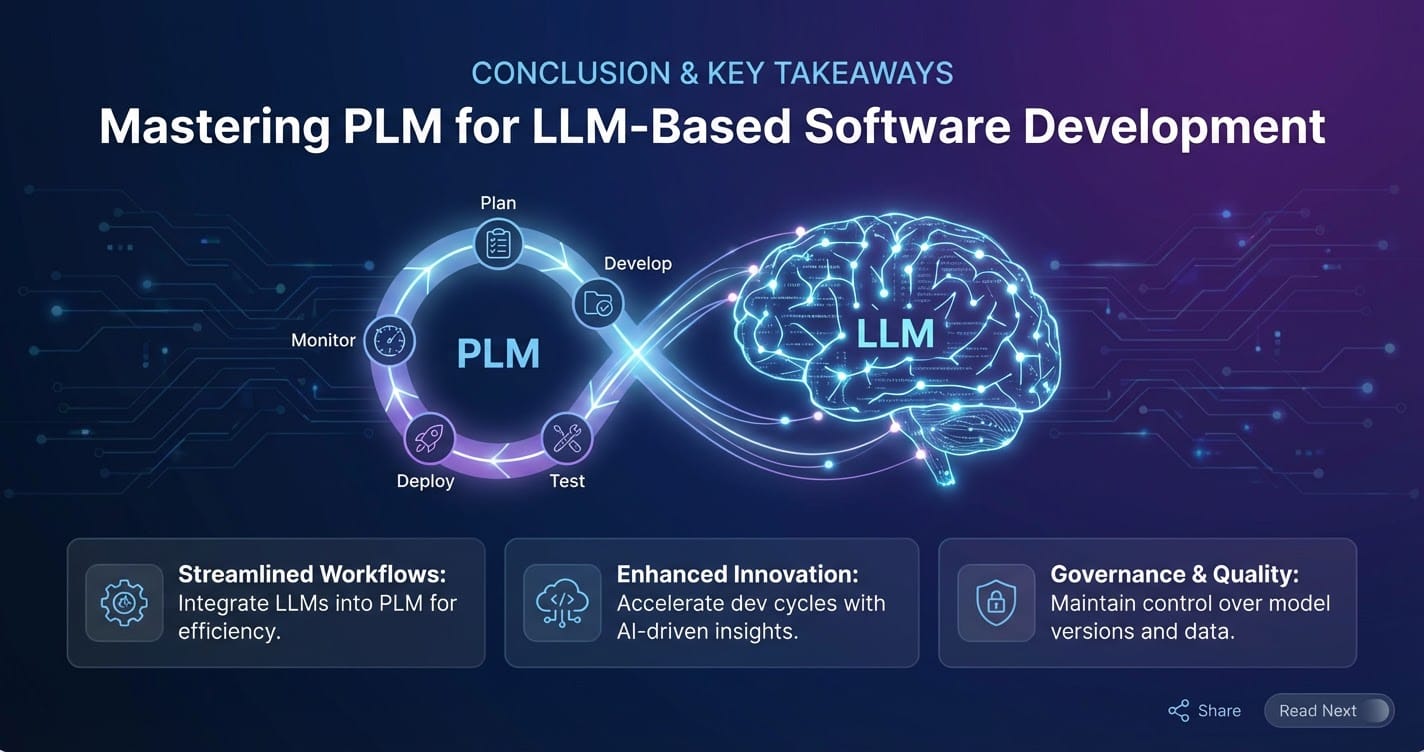
The journey of developing, deploying, and maintaining software powered by Large Language Models is characterized by both immense potential and unparalleled complexity. As organizations increasingly embed LLMs into their core products and services, the need for a disciplined, yet adaptable, approach to Product Lifecycle Management becomes critically apparent. This exploration has highlighted that traditional PLM methodologies, while foundational, must evolve to address the unique characteristics of LLMs: their probabilistic nature, sensitivity to prompts, rapid evolution, and significant operational considerations.
We've delved into how each phase of the PLM – from concept and design to development, deployment, and ongoing maintenance – requires specific adaptations for LLM-based applications. The conceptual stage demands an emphasis on ethical considerations and rapid prompt experimentation. The design phase necessitates meticulous architectural planning for LLM integration, data pipelines, and security. Development and testing introduce prompt engineering as a core discipline, alongside specialized AI validation techniques. Crucially, the deployment and operations phase underscores the indispensable role of an LLM Gateway in abstracting complexity, ensuring security, managing costs, and facilitating seamless model switching. Solutions like ApiPark exemplify how a robust open-source AI gateway can significantly streamline the integration, management, and operational oversight of diverse AI models, offering features that directly address the challenges of unified API formats, prompt encapsulation, and end-to-end API lifecycle management.
Furthermore, we've established the vital importance of robust API Governance in bringing order, security, and reusability to the fragmented landscape of LLM integrations. By standardizing API design, enforcing security policies, and managing the lifecycle of both consuming and exposing LLM-powered APIs, organizations can build a coherent and trustworthy AI ecosystem. Concurrently, mastering the Model Context Protocol is fundamental for creating intelligent, stateful, and contextually aware LLM applications, leveraging techniques like Retrieval Augmented Generation (RAG) and sophisticated conversational memory management to overcome inherent model limitations. Finally, the integration of comprehensive Data Management and MLOps practices, alongside best practices such as embracing agile methodologies, fostering cross-functional teams, rigorous versioning, and unwavering focus on observability, ensures that LLM projects are not only technically sound but also ethically responsible and economically viable.
The future of software development is undeniably intertwined with the evolution of AI. By proactively reimagining and mastering PLM for LLM-based software development, organizations can navigate this exciting, yet challenging, frontier with confidence. This strategic approach will not only unlock the transformative power of Large Language Models but also ensure that these intelligent systems are built, deployed, and operated in a manner that is sustainable, secure, and beneficial for all.
5 Frequently Asked Questions (FAQs)
1. What is the primary difference between traditional PLM and PLM for LLM-based software? The primary difference lies in adapting the lifecycle phases to account for the unique characteristics of LLMs. Traditional PLM focuses on deterministic code and well-defined requirements. LLM-based PLM, however, must address the probabilistic nature of LLMs, the critical role of prompt engineering, model drift, data dependency (especially for RAG), high computational costs, and inherent ethical considerations like bias and hallucination. This necessitates more iterative development, specialized testing (e.g., adversarial testing), robust monitoring of model performance, and comprehensive versioning of prompts and models, not just code.
2. Why is an LLM Gateway considered indispensable for LLM-based software development? An LLM Gateway is indispensable because it acts as a central abstraction and control layer for interacting with multiple LLM providers or models. It provides a unified API interface, simplifying integration and allowing applications to switch between different LLMs with minimal code changes. Critically, it centralizes vital functions like authentication, authorization, rate limiting, load balancing, model routing, and cost tracking. This not only enhances security and optimizes performance but also provides granular insights into LLM usage, making the entire ecosystem more manageable, scalable, and cost-effective, particularly in production environments.
3. What role does API Governance play when developing with Large Language Models? API Governance plays a crucial role in bringing order, security, and efficiency to LLM integrations. It establishes standards for how LLM APIs (both internal and external) are designed, consumed, and managed throughout their lifecycle. This includes defining consistent API specifications, implementing robust security protocols (e.g., OAuth, API keys), setting up clear versioning strategies, and ensuring compliance with data privacy regulations. Good API Governance prevents chaos, reduces development overhead, enhances security against prompt injection or data breaches, and promotes reusability and collaboration across different development teams within an organization.
4. How does the Model Context Protocol directly impact the user experience of an LLM application? The Model Context Protocol directly impacts the user experience by enabling LLM applications to be more intelligent, personalized, and coherent. Effective context management (through techniques like RAG, conversational memory, or summarization) ensures that the LLM receives all necessary information to generate relevant and accurate responses. Without a strong context protocol, an LLM might "forget" past interactions, hallucinate facts, provide generic answers, or fail to incorporate external, up-to-date knowledge. By providing the right context, the application can maintain a natural flow of conversation, retrieve precise information, and offer highly relevant outputs, leading to a much more satisfying and trustworthy user experience.
5. How does APIPark contribute to mastering PLM for LLM-based software development? APIPark significantly contributes by serving as an open-source AI gateway and API management platform that addresses several key aspects of LLM-based PLM. It offers quick integration of over 100 AI models, providing a unified API format for invocation, which streamlines model experimentation and migration (critical for design and development phases). Its prompt encapsulation into REST APIs simplifies prompt engineering and allows for easier sharing and reuse of LLM capabilities. Furthermore, APIPark's end-to-end API Lifecycle Management, robust API Governance features (including access permissions, subscription approval), high performance, and detailed API call logging directly support the deployment, operations, and maintenance phases by ensuring security, scalability, and comprehensive observability of LLM-powered services. This holistic approach helps organizations efficiently manage the entire lifecycle of their AI products.
🚀You can securely and efficiently call the OpenAI API on APIPark in just two steps:
Step 1: Deploy the APIPark AI gateway in 5 minutes.
APIPark is developed based on Golang, offering strong product performance and low development and maintenance costs. You can deploy APIPark with a single command line.
curl -sSO https://download.apipark.com/install/quick-start.sh; bash quick-start.sh

In my experience, you can see the successful deployment interface within 5 to 10 minutes. Then, you can log in to APIPark using your account.

Step 2: Call the OpenAI API.