Mastering Vue: Why I Prefer Option API for Clarity
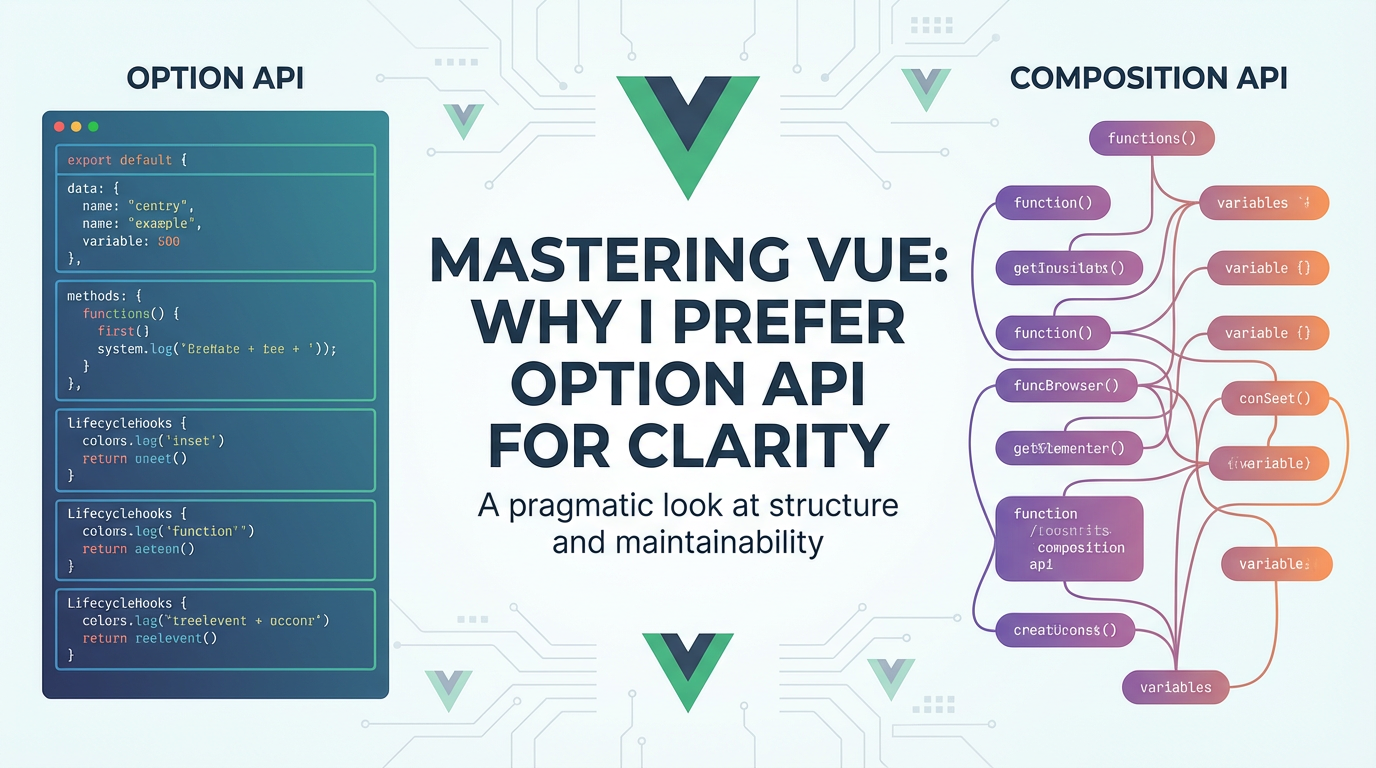


The landscape of modern web development is a vibrant tapestry woven with various frameworks and paradigms, each promising efficiency, scalability, and developer delight. Among these, Vue.js has carved out a significant niche, celebrated for its progressive adoptability, intuitive reactivity system, and approachable learning curve. Within the Vue ecosystem, a foundational debate often arises: the choice between the Option API and the Composition API. While the latter has garnered significant attention and adoption, particularly since Vue 3, I find myself consistently drawn back to the Option API, not out of nostalgia or resistance to change, but for its unparalleled clarity, predictable structure, and inherent self-documentation, especially in projects where maintainability and onboarding new team members are paramount. This article delves deeply into the rationale behind this preference, exploring the nuanced advantages that make the Option API a powerful and often superior choice for constructing robust, understandable, and enduring Vue applications.
The evolution of frontend frameworks often involves iterating on how developers define and manage component logic. Vue.js, right from its inception, championed a component-based architecture, empowering developers to encapsulate UI and behavior into reusable, self-contained units. The initial and long-standing method for achieving this encapsulation was the Option API. It presented a structured way to declare a component's properties, methods, computed values, watchers, and lifecycle hooks within a single JavaScript object. This approach, by grouping related concerns by type, inherently fosters a highly organized codebase. Contrast this with the Composition API, which allows for greater flexibility in organizing code by feature or logical concern, often leading to a more scattered but potentially more organized approach for complex, highly intertwined logic. However, this flexibility, while powerful, can sometimes come at the cost of immediate clarity and a standardized mental model, especially for teams with diverse skill sets or projects with a long lifecycle. My preference for the Option API stems from a deep appreciation for its ability to provide an immediate, coherent mental map of a component’s entire functionality, a quality that is invaluable in the day-to-day grind of development, debugging, and collaboration. The consistent api (application programming interface) exposed by each Option API component makes it incredibly straightforward to understand its contract and how it interacts with the rest of the application, solidifying its place as a reliable foundation for building user interfaces.
The Core Tenets of Option API: A Foundation of Predictable Structure
The Option API, at its heart, is about explicit declaration and structured organization. When you define a Vue component using the Option API, you're essentially filling out a well-defined form, specifying what the component is and what it does through distinct options. This prescriptive approach is not a limitation but a strength, guiding developers towards a consistent pattern that enhances readability and reduces cognitive load. Let's unpack the core tenets that define this clarity.
First and foremost is its declarative nature. Instead of imperative instructions, you declare the desired state and behavior. The data option, for instance, is where all reactive state variables are declared. This single, dedicated section provides an immediate overview of all the component's internal data, making it effortless to understand what information the component holds and manages. If you need to know what a component "knows," you look at data. This is a stark contrast to approaches where reactive state might be scattered across various functions or hooks, requiring more effort to piece together the complete picture. For example, a UserCard component would clearly list firstName, lastName, and email within its data property, instantly communicating its core data points.
Following this, the methods option serves as the designated place for all the component's functionality and event handlers. This segregation ensures that actions are clearly separated from state. When examining a component, a developer can quickly scan the methods block to understand what operations the component can perform, such as saveUser, deleteUser, or toggleEditMode. This grouping by type of concern means that if you're looking for how a button click is handled, you immediately navigate to the methods section. This consistent pattern eliminates the need to search through potentially scattered setup functions or custom hooks, which, while offering flexibility, can sometimes obscure the direct relationship between a function and the component's main API.
The computed properties are another cornerstone of Option API's clarity. They provide a concise way to define derived state based on existing reactive data. By grouping all computed properties in one place, developers can instantly grasp the component's derived values and how they relate to the raw data. For instance, a fullName computed property clearly shows that it combines firstName and lastName. This explicit declaration within a dedicated section reinforces the component's data flow and logic transformations, making complex derivations transparent and easy to follow. Debugging becomes simpler when you can isolate the derived values and trace their dependencies within a single, dedicated block.
Similarly, the watch option offers a centralized location for side effects that react to changes in specific data properties. Whether it's making an api call when a userId changes or performing complex DOM manipulations, the watch block explicitly declares these reactive side effects. This clear separation helps in understanding the component's reactive behavior and ensures that such effects are not hidden within other parts of the logic. Without this dedicated section, tracking down where a particular state change triggers a side effect can become a far more convoluted process, particularly in larger components.
Furthermore, the props and emits options, introduced more explicitly in Vue 3 for Option API, clarify the component's external interface. props define what data the component expects from its parent, establishing its input contract. emits declare what custom events the component can send to its parent, outlining its output contract. Together, these options provide a comprehensive view of how the component interacts with the outside world, making it a truly self-documenting unit. A quick glance at the props and emits tells you everything you need to know about how to use the component and what to expect from it, much like reading the header file for a C++ class or a Javadoc for a Java api.
This consistent, self-documenting structure profoundly impacts readability at a glance. When a developer encounters an Option API component, their eyes are immediately drawn to specific, predictable sections to find the information they need. There's no guesswork involved in locating state, actions, derived values, or side effects. This standardized layout significantly lowers the cognitive load required to understand a component, making it an ideal choice for projects prioritizing long-term maintainability and collaborative development. The clear separation of concerns by type (data, methods, computed, etc.) fosters a robust mental model that is quick to learn and easy to apply across an entire codebase, ensuring that even a component you haven't touched in months can be understood and modified with minimal effort. This inherent clarity is a powerful argument for its continued preference in many real-world development scenarios.
Option API and Maintainability: The Bedrock of Sustainable Projects
Maintainability is the silent hero of software development, often undervalued until a project matures, a team expands, or a critical bug emerges in an unfamiliar corner of the codebase. It's in these scenarios that the Option API truly shines, proving itself as a bedrock for sustainable projects. The inherent structure and predictability it offers directly translate into a more maintainable application, fostering better collaboration and reducing the long-term cost of ownership.
One of the most significant advantages of the Option API for maintainability is its impact on onboarding new developers. Imagine a new team member joining a complex Vue project. When faced with a codebase primarily built using the Option API, they encounter a consistent pattern across every component. They quickly learn that data holds reactive state, methods define actions, computed derives values, and watch handles side effects. This predictable mental model drastically reduces the learning curve. Instead of spending valuable time deciphering varied code organizations dictated by individual developer preferences or the specific complexities of the Composition API's setup function, new hires can immediately focus on the business logic within these well-defined sections. This uniformity means that once they understand one Option API component, they largely understand the structure of all of them, accelerating their productivity and integration into the team.
Code review efficiency also receives a significant boost with the Option API. During a code review, the goal is to quickly understand changes, identify potential issues, and ensure adherence to best practices. With Option API, reviewers know exactly where to look for specific types of changes. If a pull request modifies a component's state, the reviewer goes straight to the data option. If new functionality is added, the methods section is the target. This targeted approach streamlines the review process, allowing reviewers to focus on the logic itself rather than spending time navigating a custom structure. The clear separation helps in spotting unintended side effects or misplaced logic, contributing to higher code quality and fewer post-deployment bugs.
For long-term project health, the Option API acts as a guardian against "spaghetti code." As projects grow, and multiple developers contribute over time, the temptation to take shortcuts or introduce inconsistent patterns can be strong. The Option API's fixed structure serves as a natural constraint, encouraging developers to maintain a consistent organization. This disciplined approach prevents the codebase from devolving into an unmanageable tangle of logic, ensuring that even years down the line, the core structure remains intact and comprehensible. This consistency is invaluable when revisiting older parts of the application or when a different team takes over maintenance. Without this guidance, the Composition API's flexibility, while powerful, could potentially lead to highly individualized component structures that are efficient for the original author but challenging for others to decipher later.
Refactoring efforts also benefit from the Option API's clarity. When a component needs to be restructured, broken down, or its responsibilities reallocated, the clearly defined sections make it easier to isolate the relevant pieces of logic. If you need to extract a set of methods into a reusable utility, you know exactly where those methods reside. This precise identification of logic blocks reduces the risk of introducing regressions during refactoring, as the dependencies and boundaries of each concern are more explicit. The ability to quickly identify and move distinct units of logic contributes significantly to the agility and adaptability of the codebase over time.
Finally, debugging becomes a more straightforward endeavor. When an issue arises, the Option API's structured approach helps in isolating the problem's source. If a UI element isn't displaying correctly, you'd first check the data for its state, then the computed properties for derived values, and finally the methods for any logic that might manipulate this state. The clear separation allows for a systematic approach to debugging, narrowing down the potential culprits quickly. For example, if a value in the template is wrong, you can quickly trace it back to its source: is it directly from data, a prop, or a computed property? This diagnostic clarity is a significant advantage, reducing the time and effort required to identify and resolve bugs, thereby ensuring higher application stability and reliability.
In essence, while the Composition API excels at grouping logic by feature, which can be incredibly powerful for highly complex, interwoven concerns, the Option API's grouping by type (data, methods, computed) often proves superior for overall maintainability, especially in large, multi-developer projects. It establishes a universal language within the codebase, ensuring that every developer, regardless of their experience level, can quickly understand and contribute to any component. This foundational clarity makes the Option API not just a viable choice, but often the preferred one for projects designed for longevity and collaborative success.
Specific Scenarios Where Option API Shines
While the Composition API offers undeniable power and flexibility, particularly for advanced logic reuse and complex reactive patterns, there are numerous practical scenarios where the Option API not only remains perfectly adequate but actively excels dueading to clearer, more maintainable code. Understanding these contexts is key to making an informed choice between Vue's two primary api styles.
1. Simple to Medium Complexity Components: For the vast majority of common UI components—buttons, input fields, dropdowns, navigation items, modals, simple data display cards, and many forms—the Option API's structure is not just sufficient, but often more concise and immediately understandable. These components typically have a clear set of data, a few methods for interaction, and perhaps one or two computed properties. Trying to use the Composition API's setup function for such components can sometimes feel like overkill, introducing a slightly higher cognitive load for what is fundamentally a straightforward piece of logic. The Option API allows you to define these components with minimal boilerplate and maximum clarity, presenting all their concerns neatly organized by type. For instance, a simple ToggleButton component that just tracks its isActive state and a toggle method would be incredibly clear and compact using the Option API.
2. Educational Contexts and Onboarding: When teaching Vue.js to beginners, the Option API is almost universally the preferred starting point. Its explicit, categorized structure mirrors common object-oriented programming concepts (data fields, methods) and provides a clear mental model for how a component is constructed. This makes it easier for new learners to grasp core Vue concepts like reactivity, methods, and lifecycle hooks without simultaneously grappling with the more abstract concepts of reactive primitives (ref, reactive) and the implicit flow within a setup function. For teams onboarding new members, especially those less familiar with modern JavaScript module patterns or advanced reactivity concepts, starting with or sticking to Option API significantly smooths the transition, allowing them to focus on Vue's declarative nature rather than the intricacies of setup and its reactive apis.
3. Teams with Mixed Skill Levels: In development teams comprising junior, mid-level, and senior developers, maintaining a consistent and easily understandable codebase is paramount. The Option API provides a common, easily understood pattern that ensures all team members can read, understand, and contribute to any component with minimal friction. Senior developers can still leverage its power for well-structured components, while junior developers can quickly get up to speed without being overwhelmed by the more advanced patterns that the Composition API can enable (and sometimes implicitly encourage). This uniformity prevents the codebase from becoming fragmented into highly idiosyncratic component implementations, which can happen if each developer is given too much freedom in how they structure their Composition API setup functions.
4. Legacy Projects and Migration Scenarios: The vast majority of existing Vue 2 applications and a significant portion of early Vue 3 projects were built using the Option API. When working on legacy codebases, or during a gradual migration from Vue 2 to Vue 3, a deep understanding of the Option API is absolutely crucial. Even if a team decides to adopt Composition API for new features, maintaining and understanding the existing Option API components is a daily reality. Furthermore, many Vue 3 features integrate seamlessly with the Option API, meaning that a full rewrite of existing components isn't always necessary or desirable. For projects with a long history, relying on the Option API ensures continuity and reduces the burden of understanding two distinct component definition styles simultaneously, allowing for a smoother evolutionary path.
5. Building Reusable UI Libraries: While the Composition API offers excellent patterns for logic reuse, the self-contained and clearly defined nature of Option API components makes them excellent candidates for reusable UI libraries, especially for foundational elements. Each component, with its props, data, methods, and emits explicitly declared, acts as a perfectly encapsulated unit. This clarity makes it easy for other developers consuming the library to understand each component's api and integrate it correctly without needing to dive deep into its internal implementation details. The fixed structure also encourages a consistent design language across the components in the library.
To illustrate the structural differences and highlight the clarity of the Option API in a simple scenario, consider a basic counter component:
Table 1: Comparing Counter Component Implementation
| Feature/API Style | Option API (Vue 3) | Composition API (Vue 3, with <script setup>) |
|---|---|---|
| Template | vue<template> <div> <p>Count: {{ count }}</p> <button @click="increment">Increment</button> <button @click="decrement">Decrement</button> </div></template> |
vue<template> <div> <p>Count: {{ count }}</p> <button @click="increment">Increment</button> <button @click="decrement">Decrement</button> </div></template> |
| Script | vue<script>export default { data() { return { count: 0 }; }, methods: { increment() { this.count++; }, decrement() { this.count--; } }};</script> |
vue<script setup>import { ref } from 'vue';const count = ref(0);const increment = () => { count.value++;};const decrement = () => { count.value--;};</script> |
| Clarity Advantage | Clear segregation: data explicitly holds state, methods explicitly hold actions. All component's core logic is easily found in fixed sections. |
Co-location: State (count) and actions (increment, decrement) are declared adjacent, which can be concise for simple components. However, for more complex components, this co-location can spread logic. |
| Mental Model | Object-based structure, mapping directly to component lifecycle and properties. | Function-based composition, requiring understanding of reactive primitives (ref, reactive) and their .value access. |
| Verbosity | Slightly more boilerplate due to object property declarations (data, methods). |
Often more concise for simple cases due to direct variable declarations and implicit return in <script setup>. |
| Scalability for Simple Logic | Excellent. Immediate understanding of component's purpose. | Good. Concise for quick implementations. |
As seen in the table, for a straightforward counter, both APIs are effective. However, the Option API's explicit data and methods sections immediately tell you where to find the state and actions, respectively. This fixed map is a consistent advantage as components grow and become more complex, preventing the developer from having to parse the unique structure of each setup function. The predictable categorization remains a powerful argument for its utility in a broad spectrum of development tasks.
Addressing Common Criticisms and Misconceptions
Despite its clear advantages in terms of structure and clarity, the Option API has faced its share of criticisms, particularly since the advent of the Composition API. It's important to address these points not to dismiss the Composition API's merits, but to provide a balanced perspective and demonstrate how many of these criticisms are either overblown for typical applications, have viable solutions within the Option API paradigm, or have been mitigated by advancements in Vue 3.
1. "Scalability Issues" and the "Mixins Problem": A frequent criticism leveled against the Option API is its perceived lack of scalability for very large components, particularly the difficulty in reusing logic without resorting to mixins. Mixins, while a valid mechanism for logic reuse, have their drawbacks: they can lead to naming collisions, make it harder to trace the origin of properties and methods, and obscure the component's implicit dependencies. The Composition API explicitly addresses this by allowing logic to be extracted into composables, which are essentially functions that encapsulate reactive state and logic, offering superior type inference and clearer dependency tracking.
However, the "scalability issue" for Option API is often overstated for typical application development. Most components in a well-designed application should ideally be kept small and focused, adhering to the Single Responsibility Principle. When components become excessively large and complex, it's often an indication of a design flaw that could be mitigated through better component decomposition, regardless of the api style used. For the vast majority of simple to medium-complexity components, the Option API's structure is perfectly adequate and does not present scalability hurdles. Furthermore, careful structuring within the Option API, such as leveraging prop drilling for data sharing and event emission for communication, can keep components manageable. For cases where genuine cross-cutting concerns need to be shared, patterns like global state management (e.g., Pinia, Vuex) or even simpler utility functions can often provide a cleaner solution than deeply nested mixins.
2. "Lack of Logic Reuse": While mixins in Option API can be problematic, they are not the only form of logic reuse. Vue's ecosystem offers various other ways to achieve logic reuse, such as renderless components, higher-order components (though less common in Vue than React), and simple utility functions. These patterns, combined with good component design principles, can address many reuse requirements without necessarily needing the Composition API's setup function. For instance, a common pattern for form validation logic could be a utility function that takes form data and rules, returning validation errors. This function can be used across multiple Option API components without any of the mixin-related issues. The argument that Option API lacks logic reuse is thus a simplification; it simply offers different mechanisms compared to the Composition API, some of which are more appropriate for specific contexts.
3. "Lack of Type Inference" and TypeScript Integration: Initially, when TypeScript was gaining traction, the Option API was indeed less friendly to type inference compared to the Composition API, which naturally lends itself to better type inference due to its function-based structure and explicit ref/reactive usage. This was a legitimate concern for developers aiming for highly type-safe applications. However, Vue 3 has significantly improved TypeScript support for the Option API. With defineComponent, Vue can now infer types more effectively, providing type checking for props, data, computed, and methods. While Composition API might still offer a slightly smoother experience for complex type scenarios, the Option API's TypeScript integration is now robust enough for most enterprise applications, making this criticism less impactful than it once was. Developers can confidently build type-safe Option API components without sacrificing the clarity of its structure.
4. "Fragmentation of Concerns for a Single Feature": One common complaint is that a single feature's logic (e.g., user authentication) might be scattered across data, methods, computed, and watch options in an Option API component. For instance, authentication state in data, login/logout methods in methods, isLoggedIn in computed, and a watch for token changes. The Composition API aims to solve this by allowing you to group all related authentication logic within a single block inside setup. While this is a valid observation, for many components, the logical separation by type often aligns well with the component's inherent structure. For example, knowing that all reactive state is in data and all actions are in methods provides its own form of clarity. The "fragmentation" is by design, providing a predictable map. For highly complex, intertwined features that genuinely benefit from co-location, a well-designed Option API component might delegate specific feature logic to smaller, internal Option API sub-components or leverage global state management where appropriate, maintaining overall clarity without sacrificing the structural benefits.
In summary, while the Composition API certainly addresses some of the Option API's historical shortcomings, particularly concerning advanced logic reuse and TypeScript inference, these issues are often not deal-breakers for the majority of projects. The Option API continues to evolve and integrate well with modern Vue 3 features. For many teams and projects, the immediate and enduring clarity offered by its predictable structure often outweighs the theoretical maximum flexibility of the Composition API. The choice ultimately depends on a careful assessment of project requirements, team familiarity, and the desired balance between flexibility and explicit structure, with Option API frequently emerging as the clearer, more maintainable path.
Integrating with Modern Ecosystems and Continued Relevance
The debate between Option API and Composition API sometimes gives the impression that the Option API is an outdated relic, superseded by its younger, more flexible counterpart. This couldn't be further from the truth. In Vue 3, the Option API is not merely tolerated; it is fully supported, continuously refined, and seamlessly integrates with the entire modern Vue ecosystem, proving its enduring relevance and capability.
Option API components interact flawlessly with cornerstone libraries like Vuex (or its successor, Pinia) for state management and Vue Router for navigation. For example, within an Option API component, you can easily access the Vuex store (or Pinia store) via this.$store or mapState/mapActions helpers to interact with global state. Navigating using Vue Router is equally straightforward with this.$router and this.$route. The consistency of this context within the Option API makes these integrations feel natural and familiar. A Dashboard component, for instance, might fetch user data using this.$store.dispatch('fetchUserData') in its created hook, and navigate to a profile page via this.$router.push('/profile') in a viewProfile method. These patterns are well-established, widely understood, and continue to be powerful means of building interconnected applications.
Lifecycle hooks, which are integral to managing a component's behavior throughout its existence, are also a cornerstone of the Option API. Hooks like created, mounted, updated, and unmounted provide explicit points to inject logic, whether it's fetching initial data, setting up event listeners, or cleaning up resources. The Option API groups these hooks clearly, making it easy to see what happens at each stage of the component's lifecycle. This explicit separation aids in debugging and understanding the component's reactive flow over time. For example, a common use case for mounted is to make an initial api call to populate the component's data or to interact with the DOM after the component has been rendered. The unmounted hook is then the perfect place to clean up any subscriptions or event listeners, preventing memory leaks. This clear separation of concerns at different lifecycle stages significantly contributes to the overall clarity and maintainability of the component.
Moreover, Vue 3 has introduced enhancements that make the Option API even more robust. The defineComponent helper, while not strictly necessary for simple components, offers improved type inference and better integration with TypeScript, bridging a gap that was once a strong argument for the Composition API. This means developers can enjoy the structural clarity of the Option API while still benefiting from strong type checking throughout their components.
The continued active development and support for the Option API by the Vue core team itself is a strong testament to its viability. It is not considered deprecated or a second-class citizen. Rather, it is seen as a fully capable alternative that serves different preferences and project requirements. Official documentation, examples, and community resources consistently provide guidance for both API styles, affirming that both are valid and powerful ways to build Vue applications. This dual api approach underscores Vue's philosophy of progressive adoptability, allowing developers to choose the style that best fits their project's needs and their team's comfort level. For those who prioritize explicit structure, predictable patterns, and immediate clarity, the Option API remains a highly effective and fully modern choice for building sophisticated and scalable Vue applications.
The Role of APIs in Software Development: From Components to Ecosystems
Our deep dive into Vue's Option API has highlighted how its structured approach provides a clear api for individual components, making them easier to understand, use, and maintain. This concept of a well-defined api extends far beyond the confines of a single framework or a component definition. In the broader world of software development, apis – Application Programming Interfaces – are the fundamental building blocks of communication and integration. They are the contracts that allow different software systems, applications, or even parts of an application, to interact with each other without needing to understand each other's internal complexities.
Just as a Vue component's props define its input api and emits define its output api, external services expose RESTful apis or GraphQL apis that allow your Vue application to fetch data, authenticate users, or trigger backend processes. Effective api management is crucial for the success of any modern application, especially those that rely heavily on microservices or integrate with a multitude of third-party services. As applications become more distributed and complex, the challenge of integrating, securing, and managing these diverse apis grows exponentially.
For organizations dealing with a myriad of external apis, especially in the evolving landscape of AI where new models and services are constantly emerging, managing and standardizing these interactions becomes paramount. Much like how Vue's Option API strives for clarity and predictability in component design, an effective API management solution brings clarity, consistency, and control to your entire API ecosystem. Tools like APIPark, an open-source AI gateway and API management platform, offer comprehensive solutions to streamline API integration, unify formats, and manage their entire lifecycle. APIPark helps organizations quickly integrate over 100 AI models, standardize api invocation formats, encapsulate prompts into new REST apis, and manage the full lifecycle of all their apis, from design to decommissioning. This ensures efficient and secure communication between services, reduces maintenance costs, and enhances overall system stability, reflecting a similar pursuit of clarity and maintainability, but on a grander, architectural scale. Just as a well-structured Option API component simplifies frontend development, a robust API management platform simplifies the complexities of backend and third-party service integration, allowing developers to focus more on core application logic and less on the intricacies of api consumption and governance. This parallel underscores the universal importance of well-defined and managed interfaces, whether internal to a component or external across an entire distributed system.
Conclusion
The journey through Vue's Option API reveals a compelling case for its continued relevance and preference in the modern web development landscape. While the Composition API offers undeniable power and flexibility, particularly for advanced logic reuse and complex reactive patterns, the Option API stands firm as a beacon of clarity, predictability, and maintainability. Its structured approach—grouping component concerns by type into distinct data, methods, computed, watch, props, and emits options—provides an immediate and intuitive mental map of a component's functionality. This inherent organization significantly benefits new developers, streamlines code reviews, fortifies long-term project health, simplifies refactoring, and accelerates the debugging process.
We've explored how the Option API particularly shines in scenarios involving simple to medium complexity components, educational contexts, teams with mixed skill levels, legacy projects, and the creation of robust UI libraries. Furthermore, addressing common criticisms reveals that many perceived limitations are either overblown for typical applications, have viable workarounds, or have been significantly mitigated by advancements in Vue 3 and improved TypeScript integration. The Option API is not a relic; it is a fully supported, evolving, and powerful tool within the Vue ecosystem, seamlessly integrating with modern libraries like Pinia and Vue Router, and leveraging explicit lifecycle hooks for comprehensive component management.
Ultimately, mastering Vue means understanding both API styles and making an informed decision based on project requirements, team dynamics, and the desired balance between flexibility and explicit structure. For those who prioritize immediate understanding, consistent patterns, and a solid foundation for collaborative and long-lived projects, the Option API remains an exceptionally strong, often preferred, and highly effective choice. It allows developers to build sophisticated applications with confidence, ensuring that clarity is never sacrificed at the altar of complexity. The enduring value of a well-defined api, whether for a component or an entire enterprise ecosystem, cannot be overstated, and in this pursuit, the Option API consistently delivers.
Frequently Asked Questions (FAQs)
1. What is the main difference between Vue's Option API and Composition API? The main difference lies in how component logic is organized. The Option API groups logic by type of option (e.g., data, methods, computed), providing a fixed, predictable structure. The Composition API, introduced in Vue 3, groups logic by feature or logical concern within a setup function, allowing developers to co-locate related state, methods, and lifecycle hooks, offering greater flexibility and logic reuse through composables.
2. Is the Option API deprecated in Vue 3? Should I still use it? No, the Option API is absolutely not deprecated in Vue 3. It is fully supported, actively maintained, and continues to be a perfectly valid and powerful way to build Vue applications. The Vue core team explicitly supports both API styles, allowing developers to choose the one that best suits their project's needs, team's comfort level, and specific use cases. Many developers, including myself, prefer it for its clarity and predictable structure, especially in enterprise environments.
3. When should I choose the Option API over the Composition API? You might prefer the Option API when: * You prioritize immediate clarity, predictable structure, and ease of onboarding for new team members. * Your components are of simple to medium complexity. * Your team has mixed skill levels or is more familiar with object-oriented programming paradigms. * You are working on a legacy Vue 2 project or migrating to Vue 3 gradually. * You are building reusable UI components where a clear, self-documenting interface is crucial.
4. Can I use both Option API and Composition API in the same Vue 3 project? Yes, Vue 3 allows for full interoperability between Option API and Composition API components within the same project. You can even mix and match them within the same component using a setup() option within an Option API component. This flexibility enables incremental adoption and allows teams to choose the most suitable API for each individual component or feature.
5. How does the Option API handle TypeScript integration in Vue 3? Vue 3 has significantly improved TypeScript support for the Option API. By using the defineComponent helper, Vue can infer types more effectively for props, data, computed, and methods, providing robust type checking. While the Composition API might offer a slightly more natural experience for complex type scenarios due to its function-based structure, the Option API's TypeScript integration is now more than adequate for building type-safe enterprise applications, allowing developers to benefit from both clarity and type safety.
🚀You can securely and efficiently call the OpenAI API on APIPark in just two steps:
Step 1: Deploy the APIPark AI gateway in 5 minutes.
APIPark is developed based on Golang, offering strong product performance and low development and maintenance costs. You can deploy APIPark with a single command line.
curl -sSO https://download.apipark.com/install/quick-start.sh; bash quick-start.sh

In my experience, you can see the successful deployment interface within 5 to 10 minutes. Then, you can log in to APIPark using your account.

Step 2: Call the OpenAI API.