OpenAPI Default vs. 200: Which One Should You Use?


In the intricate world of modern software development, Application Programming Interfaces (APIs) serve as the fundamental building blocks, enabling distinct systems to communicate, share data, and orchestrate complex operations. At the heart of designing, documenting, and consuming these interfaces lies the OpenAPI Specification (OAS), a robust, language-agnostic standard that allows both humans and machines to discover and understand the capabilities of an API without access to source code or additional documentation. A well-defined OpenAPI specification is more than just a blueprint; it's a contract that ensures consistency, reduces ambiguity, and significantly streamlines the development process for both API providers and consumers.
However, even within a meticulously crafted specification, certain choices can lead to subtle but significant differences in how an API is perceived and utilized. One such critical decision point revolves around how to define successful and unsuccessful responses, particularly the distinction between explicitly listing a 200 OK status code and using the more generic default response within the OpenAPI responses object. This seemingly minor syntactical difference in an api's definition can have profound implications for client-side error handling, code generation, and the overall clarity of the API contract.
This comprehensive article will embark on an in-depth exploration of OpenAPI's response definition mechanisms, dissecting the precise semantics and practical applications of both 200 (and other explicit HTTP status codes) and the default keyword. We will delve into the advantages and disadvantages of each approach, examine real-world scenarios, and provide clear guiding principles to help api designers make informed decisions that lead to more robust, understandable, and maintainable APIs. Our aim is to equip you with the knowledge to craft OpenAPI specifications that are not just syntactically correct, but truly effective in communicating the full spectrum of your api's behavior, ensuring a seamless experience for developers interacting with your services.
Understanding the Foundation: The OpenAPI Specification and its Response Object
Before we dive into the specifics of 200 and default, it’s essential to solidify our understanding of the OpenAPI Specification itself, particularly how it structures api responses. The OpenAPI Specification (OAS), formerly known as Swagger Specification, provides a standardized, machine-readable format for describing RESTful apis. It covers various aspects, including available endpoints, operations (GET, POST, PUT, DELETE, etc.), parameters, authentication methods, and crucially, the expected responses.
The responses object within an OpenAPI operation definition is where the magic happens. It's a map that associates HTTP status codes (or the default keyword) with descriptions of the expected response body, headers, and any associated schemas. This object is vital because it explicitly communicates to api consumers what they can expect to receive under different circumstances, whether a successful data retrieval, a resource creation, a client-side error, or a server-side malfunction. Without clear response definitions, api consumers would be left guessing, leading to increased integration time, more errors, and frustrating debugging sessions.
Each entry in the responses object maps a status code (like 200, 201, 400, 500) to a Response Object. This Response Object typically contains:
description: A human-readable summary of the response.content: A map of media types (e.g.,application/json,text/plain) to their respective schemas, defining the structure of the response body.headers: An optional map of HTTP headers that might be returned with the response.
Understanding this foundational structure is paramount, as both 200 and default operate within this responses framework, each serving distinct yet sometimes overlapping purposes. The choice between them often hinges on the desired level of granularity and the commonality of response structures across various scenarios in your api.
The 200 OK Response: Precision, Clarity, and Explicit Success
The 200 OK HTTP status code is arguably the most common and universally understood signal of a successful operation in a RESTful api. When an api returns a 200 OK, it unequivocally states that the client's request was received, understood, processed, and the server is returning the requested data or indicating a successful action. In the context of an OpenAPI specification, explicitly defining a 200 response leverages this clear semantic meaning to provide precise expectations to api consumers.
Understanding 200 OK Semantics
According to the HTTP/1.1 specification, 200 OK indicates that "The request has succeeded. The payload sent in a 200 response depends on the request method." For a GET request, it typically means the requested resource has been successfully retrieved and is included in the response body. For a POST, PUT, or DELETE request, it might indicate that the operation completed successfully, and the response body could contain relevant status information or the updated/created resource. The key takeaway is success and data delivery.
When to Use 200 (or 201, 204, etc.) in OpenAPI
Explicitly defining 200 (or other 2xx success codes like 201 Created, 202 Accepted, 204 No Content) is the cornerstone of a well-documented OpenAPI specification for expected successful outcomes. You should use 200 when:
- A Specific Successful Payload is Expected: The most common use case. For instance, a
GET /users/{id}endpoint is expected to return aUserobject upon successful retrieval. Defining200with aUserSchemaensures clients know exactly what data structure to anticipate.yaml responses: '200': description: A single user object content: application/json: schema: $ref: '#/components/schemas/User' - Clients Need Exact Structure for Success: When your
apiconsumers rely on strong typing, code generation tools, or robust client-side frameworks, providing an explicit200(or2xx) definition is invaluable. It allows these tools to generate accurate data models, reducing boilerplate code and potential runtime errors. - Differentiating Multiple Success States: While
200is general, other2xxcodes offer more specific semantics. For example:201 Created: Used after aPOSTrequest successfully creates a new resource. The response body often contains the newly created resource and aLocationheader pointing to its URI.202 Accepted: Indicates that the request has been accepted for processing, but the processing is not yet complete. This is useful for asynchronous operations.204 No Content: Signifies that the request was successful, but theapiwill not return any content in the response body. This is common forDELETEoperations orPUToperations that only update a resource without needing to return its new state. Defining these specific success codes allows clients to react differently based on the exact outcome, for example, redirecting to a newly created resource's page after a201.
Advantages of Using Explicit 2xx Responses
- Unambiguous Communication: There is no guesswork involved.
apiconsumers know precisely what data to expect on a successful call, facilitating easier integration and development. - Enhanced Code Generation: Tools that generate client SDKs or server stubs from an
OpenAPIspecification thrive on explicit definitions. They can create strongly typed objects for each successful response, improving developer experience and reducing manual parsing. - Robust Client-Side Logic: Clients can implement highly specific logic for handling successful responses. For example, a client can confidently parse the
Userobject after a200on/users/{id}, knowing its exact structure. - Improved Documentation Readability: For human readers, explicit
2xxdefinitions make theapicontract immediately clear and intuitive. It's easy to see what a successful interaction looks like.
Potential Drawbacks
While generally recommended, there can be minor considerations:
- Verbosity for Highly Granular Success States: If an
apioperation could return many distinct successful payloads, each requiring a different2xxcode, theresponsesobject could become quite verbose. However, this is relatively rare for success cases, as most operations have one primary successful outcome. - Requires Careful Design: Deciding which
2xxcode applies to which scenario requires careful thought duringapidesign to ensure semantic correctness. Misusing status codes can be just as confusing as not defining them.
In essence, explicit 2xx definitions embody the principle of least astonishment: clients should always know what to expect when an api call works as intended. This clarity is a hallmark of a well-designed OpenAPI api.
The default Response: The Catch-All for the Unexpected
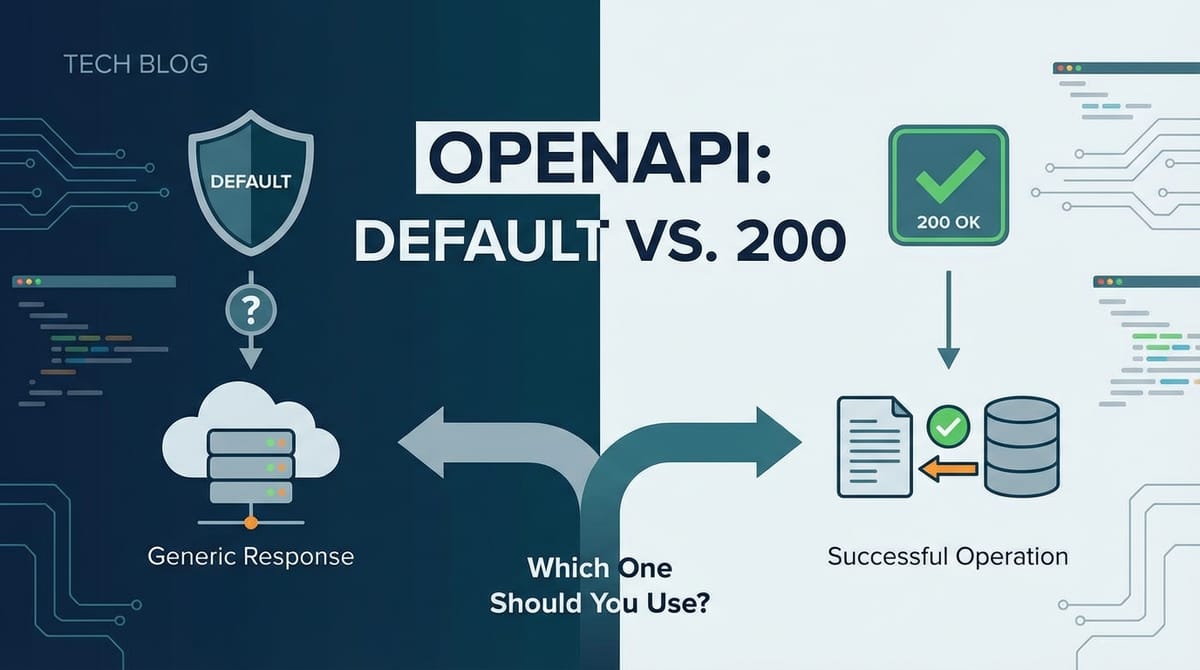
While 2xx responses explicitly define successful outcomes, the default response in OpenAPI serves a fundamentally different purpose: it acts as a catch-all for any HTTP status code not explicitly defined for an operation. It's crucial to understand that default is not an HTTP status code itself; it's a special keyword within the OpenAPI Specification. This distinction is vital for proper interpretation.
Understanding the default Keyword in OpenAPI
When an api operation is executed, and the resulting HTTP status code does not match any of the explicitly listed status codes in the responses object (e.g., 200, 201, 400, 404, 500), the OpenAPI specification indicates that the default response definition should be used. This makes default particularly useful for handling situations where:
- Common Error Structures: Your
apimight have a standardized error response format (e.g., anErrorDetailsobject with acodeandmessage) that applies to a wide range of unexpected client-side (4xx) or server-side (5xx) errors. - Unforeseen Circumstances: It covers status codes that you might not have anticipated during design, or less common errors that don't warrant individual explicit definitions.
- Simplifying Documentation: Instead of listing every possible
4xxor5xxerror code with the same schema, you can consolidate them underdefault.
Consider an example where most errors return a simple Error object:
responses:
  '200':
    description: A list of items
    content:
      application/json:
        schema:
          type: array
          items:
            $ref: '#/components/schemas/Item'
  '400':
    description: Invalid request payload
    content:
      application/json:
        schema:
          $ref: '#/components/schemas/ValidationError'
  default:
    description: An unexpected error occurred.
    content:
      application/json:
        schema:
          $ref: '#/components/schemas/Error'
In this example, if the api returns a 401 Unauthorized, 404 Not Found, 500 Internal Server Error, or any other code not explicitly 200 or 400, the default response schema (Error) would apply.
When to Use default in OpenAPI
The default response is best utilized for scenarios where:
- Generic Error Handling: Its primary strength lies in defining a common structure for all unspecified error responses. If your
apiconsistently returns a uniformErrorobject for various4xxand5xxconditions that you don't need to differentiate with separate schemas,defaultis an excellent choice. This significantly reduces the verbosity of yourOpenAPIdocument. - Reducing Specification Clutter: Imagine an
apiwith dozens of potential error codes, many of which share the same response body format. Explicitly listing each one would make the specification unwieldy and hard to maintain.defaultprovides an elegant solution to consolidate these. - Backward Compatibility and Resilience: As
apis evolve, new error conditions or HTTP status codes might emerge. Usingdefaultensures thatapiconsumers will always have some documented response schema for unexpected errors, even if the exact status code isn't explicitly known to their client at compile time. This can prevent client applications from crashing due to unexpected response formats. - Covering the Unforeseen: It's practically impossible to anticipate every single HTTP status code an
apimight return under all possible circumstances.defaultacts as a safety net, ensuring that even truly unexpected responses have a defined structure.
Advantages of Using default
- Conciseness and Maintainability: Drastically reduces the size and complexity of the
OpenAPIspecification by avoiding repetitive error definitions. Updates to a common error format only need to happen in one place. - Guaranteed Response Structure: Ensures that some response is always documented for any status code not explicitly defined, preventing undefined behavior for
apiconsumers. - Simplifies Client-Side Error Parsing for Generic Cases: If a client just needs to know that an error occurred and parse a generic error message,
defaultmakes this straightforward without needing to check for a multitude of specific error codes. - Handles New/Unknown Status Codes: Offers resilience against future
apichanges or standard HTTP code additions, as clients will fall back to thedefaultdefinition.
Potential Drawbacks
Despite its utility, relying too heavily on default can lead to complications:
- Loss of Specificity for Errors: The most significant drawback. If an
apireturns401 Unauthorized,403 Forbidden, and404 Not Found, and all fall underdefault, the client loses the ability to programmatically differentiate between these crucial error types without inspecting the response body for a custom error code. This hinders precise error handling. - Limited Client-Side Actionability: Clients might need to take different actions based on a
400 Bad Request(e.g., re-prompt user for input) versus a404 Not Found(e.g., indicate resource non-existence). If both map todefault, this distinction is lost at the HTTP status code level. - Ambiguity for Code Generation: While client generators will create a type for the
defaultresponse, they won't be able to associate specific HTTP status codes with distinct error types if they're all lumped underdefault. This can lead to less precise generated code. - Risk of Hiding Important Information: Over-reliance on
defaultcan obscure critical error paths thatapiconsumers truly need to be aware of and handle explicitly. For example, a403 Forbiddenis much more actionable than a generic "an error occurred."
The default response is a powerful tool for generalization, particularly for error handling. However, its use requires a careful balance to ensure that crucial information is not lost and api consumers retain the ability to react appropriately to significant api outcomes. It should typically be used as a last resort for errors, after defining the most important and common error codes explicitly.
The Nuance: Beyond 200 and default – A Holistic Approach to OpenAPI Responses
The discussion of 200 versus default is not an either/or proposition, but rather a spectrum of choices within a comprehensive api response strategy. A truly robust and user-friendly OpenAPI specification will judiciously combine specific success codes, specific client error codes, and a well-defined default for everything else. Understanding the broader context of HTTP status codes is paramount here.
Other HTTP Success Codes (2xx)
As mentioned, 200 OK is not the only success code. Each 2xx code carries specific semantic meaning that, when used correctly, enhances the clarity of your api:
201 Created: The request has been fulfilled and resulted in a new resource being created. This is almost exclusively used withPOSTrequests and often includes aLocationheader pointing to the URI of the new resource.202 Accepted: The request has been accepted for processing, but the processing has not been completed. The request might or might not be acted upon, and eventually, processing may be disallowed. This is typical for asynchronous operations where the server will process the request in the background.204 No Content: The server successfully processed the request, and is not returning any content. This is commonly used forDELETEoperations, orPUToperations where the client doesn't need to see the updated resource in the response. It helps minimize network traffic.
Always prioritize these specific 2xx codes when their semantics align with your api's behavior. They provide much richer context than simply 200 for every success.
Specific Client Error Codes (4xx)
For client-side errors, being specific is often more valuable than being generic. Clients need to understand why their request failed so they can correct it. Some common 4xx codes include:
400 Bad Request: The server cannot or will not process the request due to something that is perceived to be a client error (e.g., malformed request syntax, invalid request message framing, or deceptive request routing). Use this for validation failures, missing mandatory parameters, or incorrect data types.401 Unauthorized: The client must authenticate itself to get the requested response. This implies the client is unauthenticated.403 Forbidden: The client does not have access rights to the content. This implies the client is authenticated but lacks the necessary permissions.404 Not Found: The server cannot find the requested resource.409 Conflict: Indicates a request conflict with the current state of the target resource. Often used for concurrent updates (e.g., attempting to update a resource that has changed since it was last fetched).429 Too Many Requests: The user has sent too many requests in a given amount of time ("rate limiting").
Defining these specific 4xx errors explicitly allows api consumers to build intelligent error handling logic. For instance, a 400 might trigger re-displaying a form with validation messages, while a 404 might show a "resource not found" page.
Specific Server Error Codes (5xx)
While default is often used for 5xx errors, it can sometimes be beneficial to explicitly define a 500 Internal Server Error if your api provides a specific diagnostic message or identifier for server-side failures.
500 Internal Server Error: The server has encountered a situation it doesn't know how to handle. This is a generic "catch-all" error response.503 Service Unavailable: The server is not ready to handle the request. Common causes are a server that is down for maintenance or that is overloaded.
Even if the response body for all 5xx errors is the same generic Error object, explicitly defining 500 or 503 still adds semantic value by stating that these are anticipated (though undesired) outcomes with a known structure, rather than just falling into a black box of default.
Combining Specificity with default for Robustness
The most effective strategy often involves a combination:
- Define all specific
2xxsuccess codes: Always be explicit about how a successful operation looks. - Define crucial
4xxclient error codes: Identify the client errors that warrant distinct handling or specific feedback to the user (e.g.,400,401,403,404,429). - Use
defaultfor all other responses: This includes less common4xxerrors (if their response body is generic and no specific client action is required), and most5xxserver errors (unless a specific5xxhas a unique response format or meaning). Thedefaultthen acts as a safety net for unexpected or unhandled situations, providing a consistent fallback error structure.
This approach balances the need for precise communication with the desire for a concise and maintainable OpenAPI specification. It ensures that api consumers have enough information to handle common success and error paths intelligently, while still providing a predictable structure for truly unexpected events.
APIPark is a high-performance AI gateway that allows you to securely access the most comprehensive LLM APIs globally on the APIPark platform, including OpenAI, Anthropic, Mistral, Llama2, Google Gemini, and more.Try APIPark now! 👇👇👇
Best Practices and Guiding Principles: Making the Right Choice
Choosing between 200 (and other specific codes) and default isn't a one-size-fits-all decision. It's a design choice that should be guided by several key principles centered around clarity, maintainability, and the needs of your api consumers.
Principle 1: Prioritize Specific 2xx for Success
Always explicitly define 2xx success responses. This is non-negotiable for a clear OpenAPI api. Whether it's 200 OK, 201 Created, 202 Accepted, or 204 No Content, your api consumers need to know exactly what to expect when a request is successful. This includes the response body's schema and any relevant headers. Using default for a successful response is strongly discouraged as it removes critical semantic information and makes it impossible for clients to differentiate successful outcomes programmatically.
Principle 2: Be Specific for Actionable Client Errors (4xx)
Identify the 4xx error codes that warrant distinct handling logic on the client side. For example: * 400 Bad Request: Client needs to correct input. * 401 Unauthorized: Client needs to authenticate. * 403 Forbidden: Client lacks permission, maybe inform user to request access. * 404 Not Found: Resource does not exist, inform user. * 409 Conflict: Inform user about the conflict and potentially suggest a resolution. * 429 Too Many Requests: Client needs to retry later.
For these, define them explicitly with their specific response schemas. Even if the schema is the same (e.g., ErrorDetails), the status code itself provides immediate, actionable information.
Principle 3: Use default Primarily for Generic or Unexpected Errors
Reserve default for situations where: * Common Error Structure: Your api has a consistent error response format for a wide range of 4xx or 5xx errors that don't require specific client-side differentiation beyond "an error occurred." * Unforeseen or Less Critical Errors: To cover all other HTTP status codes that you haven't explicitly listed, often 5xx server errors, or 4xx errors whose specific handling doesn't add significant value over a generic error message. * Fallback Mechanism: It acts as a safety net, ensuring that some response schema is always available, even for truly unexpected outcomes.
Crucially, default should never hide an important, actionable error that a client needs to specifically address. If a client needs to know the difference between a 401 and a 403, they must be defined explicitly, even if their body schema is identical.
Principle 4: Consider the API Consumer's Perspective
Always put yourself in the shoes of the developer consuming your api. * What information do they need to build robust applications? Do they need to know the exact status code to display a specific message or retry logic? * How does this choice impact code generation? Will generated SDKs be clear and easy to use? * What are the common failure modes, and how should clients recover?
The more complex and critical the api and its operations, the greater the need for specificity in response definitions.
Principle 5: Strive for Consistency Across Your API
Once you establish a pattern for defining responses (e.g., always explicitly define 200, 400, 401, 404, and use default for others), stick to it across your entire api. Consistency greatly improves the learning curve and usability for consumers.
Principle 6: Provide Clear Descriptions and Examples
Regardless of whether you use 200, 400, or default, always provide a clear description for each response. Furthermore, include examples in your content schemas. Examples are incredibly powerful for illustrating the exact structure and possible values of a response body, making your OpenAPI specification far more user-friendly and unambiguous.
By adhering to these principles, api designers can craft OpenAPI specifications that are both precise and pragmatic, effectively communicating the api contract while remaining maintainable and flexible.
Impact on API Management, Tooling, and the Role of Platforms like APIPark
The clarity and precision of your OpenAPI response definitions extend far beyond mere documentation; they significantly influence how your apis are managed, consumed, tested, and monitored. A well-defined OpenAPI specification is a strategic asset, enabling a wide ecosystem of tools and platforms to interact with and enhance your apis.
API Gateways and Proxies
API gateways, which sit between api consumers and backend services, often leverage OpenAPI definitions for various functionalities. Precise response definitions, especially for different status codes, can inform:
- Traffic Routing: While less direct, understanding expected responses can inform future routing decisions or versioning.
- Response Transformation: Gateways might transform response payloads based on the consumer's needs, and explicit schemas (like those defined for
200or specific error codes) provide the necessary structure for these transformations. - Policy Enforcement: For example, a gateway could enforce different rate limits or security policies based on the type of error response anticipated, even before the request hits the backend.
Code Generation Tools
One of the most immediate and tangible benefits of a well-defined OpenAPI specification is its ability to drive code generation. Tools like Swagger Codegen or OpenAPI Generator can automatically produce:
- Client SDKs: These provide strongly typed objects and methods for
apiconsumption in various programming languages. Explicit2xxdefinitions directly translate into specific success types, while distinct4xxerror definitions can lead to different exception types or error handling branches. Ifdefaultis used for generic errors, the generator will produce a single error type, requiring clients to further inspect the body if they need more detail. - Server Stubs: Generating server-side boilerplate helps ensure that the server implementation adheres strictly to the
OpenAPIcontract, including the exact structure of responses for all defined status codes.
Testing and Mocking Frameworks
Clear response definitions are invaluable for api testing.
- Automated Testing: Test frameworks can validate that the actual
apiresponses conform to the schemas defined in theOpenAPIspecification for200,400, ordefaultoutcomes. This ensures theapibehaves as documented. - Mock Servers:
OpenAPIspecifications can be used to spin up mockapiservers that return predefined responses for specific status codes. This allows client-side development and testing to proceed even when the backendapiis still under development, significantly accelerating the development cycle.
Observability and Monitoring Tools
Understanding the expected structure of both successful and error responses aids in api observability. Monitoring tools can:
- Identify Anomalies: By comparing actual
apiresponses against theOpenAPIspecification, monitoring systems can detect unexpected response structures or status codes, signaling potential issues. - Categorize Errors: Specific
4xxand5xxdefinitions allow monitoring dashboards to provide granular insights into the types of errors anapiis encountering, helping operations teams prioritize and troubleshoot effectively.
The Role of API Management Platforms: Introducing APIPark
This is where a robust api management platform becomes indispensable. Platforms like APIPark are designed to leverage the power of well-defined OpenAPI specifications to provide comprehensive api lifecycle management. APIPark, as an open-source AI gateway and api management platform, directly benefits from precise OpenAPI definitions, whether they involve explicit 200 responses or a well-structured default for errors.
APIPark's features, such as traffic forwarding, load balancing, detailed api call logging, and powerful data analysis, are significantly enhanced when the underlying apis are meticulously documented with OpenAPI. For instance, APIPark's ability to provide end-to-end API lifecycle management means it can help regulate api management processes from design to publication, invocation, and decommission. Clear 200 (and other success) response definitions, along with structured error responses (whether explicit 4xx/5xx or a consistent default error schema), make it easier for APIPark to:
- Manage Traffic and Load Balancing: Understand the expected successful responses to correctly route traffic to healthy instances. In case of defined error patterns, it can respond or reroute accordingly.
- Provide Detailed
APICall Logging: By understanding the structure of both success and error payloads through theOpenAPIdefinition,APIParkcan log every detail of eachapicall more intelligently. This allows businesses to quickly trace and troubleshoot issues, ensuring system stability and data security. If200responses consistently return specific data,APIParkcan log the presence and type of that data. Ifdefaulterrors follow a standard format,APIParkcan consistently extract error codes and messages for logging, even for diverse HTTP status codes. - Offer Powerful Data Analysis:
APIParkanalyzes historical call data to display long-term trends and performance changes. This analysis becomes much more powerful when the distinction between successful responses (200,201, etc.) and various types of errors (explicit4xx/5xxordefaultcatch-alls) is clearly delineated in theOpenAPIspecification.APIParkcan, for example, track the frequency of400 Bad Requestversus500 Internal Server Errorand even analyze the contents of theirdefaulterror payloads if a consistent schema is provided. This helps businesses with preventive maintenance and proactive issue resolution. - Enable
APIService Sharing within Teams: Centralized display ofapiservices is greatly simplified. Clear response definitions ensure that different departments and teams can easily understand and use the requiredapiservices without confusion.
In essence, APIPark thrives on well-defined api contracts. Whether an api designer opts for explicit 200 responses for precision or uses default judiciously for generic error handling, the underlying clarity provided by a comprehensive OpenAPI specification significantly enhances the operational efficiency, security, and analytical capabilities of a platform like APIPark. It bridges the gap between api design and robust api operations, fostering a more efficient and secure api ecosystem.
Case Studies and Practical Examples
Let's illustrate the concepts with practical OpenAPI (YAML) examples for various api operations.
Scenario 1: Simple GET Request for a Resource (Retrieving a User)
For a GET /users/{id} endpoint, we expect a 200 OK with a User object, a 404 Not Found if the user doesn't exist, and a default for any other errors (e.g., 5xx server errors).
paths:
  /users/{id}:
    get:
      summary: Retrieve a user by ID
      operationId: getUserById
      parameters:
        - in: path
          name: id
          schema:
            type: string
          required: true
          description: The ID of the user to retrieve
      responses:
        '200':
          description: Successfully retrieved user data
          content:
            application/json:
              schema:
                $ref: '#/components/schemas/User'
              examples:
                userExample:
                  value:
                    id: "usr_123"
                    name: "Alice Wonderland"
                    email: "alice@example.com"
        '404':
          description: User not found
          content:
            application/json:
              schema:
                $ref: '#/components/schemas/Error'
              examples:
                notFoundExample:
                  value:
                    code: "NOT_FOUND"
                    message: "User with ID usr_123 not found."
        default:
          description: Unexpected server error
          content:
            application/json:
              schema:
                $ref: '#/components/schemas/Error'
              examples:
                serverErrorExample:
                  value:
                    code: "INTERNAL_ERROR"
                    message: "An unexpected server error occurred."

components:
  schemas:
    User:
      type: object
      required:
        - id
        - name
        - email
      properties:
        id:
          type: string
          format: uuid
          description: Unique identifier for the user
        name:
          type: string
          description: Full name of the user
        email:
          type: string
          format: email
          description: Email address of the user
    Error:
      type: object
      required:
        - code
        - message
      properties:
        code:
          type: string
          description: A unique error code
        message:
          type: string
          description: A human-readable error message
Here, 200 and 404 are explicit because they represent common, actionable outcomes. default covers all other 4xx and 5xx errors with a generic Error schema.
Scenario 2: Complex POST Request (Creating an Order)
For a POST /orders endpoint, we might expect a 201 Created upon successful creation, a 400 Bad Request for invalid input, and 401 Unauthorized if the client isn't authenticated. All other errors fall under default.
paths:
  /orders:
    post:
      summary: Create a new order
      operationId: createOrder
      requestBody:
        required: true
        content:
          application/json:
            schema:
              $ref: '#/components/schemas/NewOrderRequest'
            examples:
              newOrderExample:
                value:
                  items:
                    - productId: "prod_A"
                      quantity: 2
                    - productId: "prod_B"
                      quantity: 1
                  customerId: "cust_456"
      responses:
        '201':
          description: Order successfully created
          headers:
            Location:
              description: URI of the newly created order
              schema:
                type: string
                format: uri
          content:
            application/json:
              schema:
                $ref: '#/components/schemas/Order'
              examples:
                createdOrderExample:
                  value:
                    id: "ord_789"
                    status: "PENDING"
                    createdAt: "2023-10-27T10:00:00Z"
                    items:
                      - productId: "prod_A"
                        quantity: 2
                      - productId: "prod_B"
                        quantity: 1
                    customerId: "cust_456"
        '400':
          description: Invalid order data provided
          content:
            application/json:
              schema:
                $ref: '#/components/schemas/ValidationError'
              examples:
                validationErrorExample:
                  value:
                    code: "INVALID_INPUT"
                    message: "Validation failed."
                    details:
                      - field: "items[0].quantity"
                        error: "Must be at least 1."
        '401':
          description: Authentication required
          content:
            application/json:
              schema:
                $ref: '#/components/schemas/Error'
              examples:
                unauthorizedErrorExample:
                  value:
                    code: "UNAUTHORIZED"
                    message: "Authentication token missing or invalid."
        default:
          description: An unexpected error occurred.
          content:
            application/json:
              schema:
                $ref: '#/components/schemas/Error'
              examples:
                serverErrorExample:
                  value:
                    code: "INTERNAL_ERROR"
                    message: "Failed to process order due to server issue."

components:
  schemas:
    NewOrderRequest:
      type: object
      required:
        - items
        - customerId
      properties:
        items:
          type: array
          minItems: 1
          items:
            $ref: '#/components/schemas/OrderItem'
        customerId:
          type: string
          description: ID of the customer placing the order
    OrderItem:
      type: object
      required:
        - productId
        - quantity
      properties:
        productId:
          type: string
        quantity:
          type: integer
          minimum: 1
    Order:
      type: object
      required:
        - id
        - status
        - createdAt
        - items
        - customerId
      properties:
        id:
          type: string
          format: uuid
        status:
          type: string
          enum: [ "PENDING", "COMPLETED", "CANCELLED" ]
        createdAt:
          type: string
          format: date-time
        items:
          type: array
          items:
            $ref: '#/components/schemas/OrderItem'
        customerId:
          type: string
    ValidationError:
      type: object
      required:
        - code
        - message
        - details
      properties:
        code:
          type: string
        message:
          type: string
        details:
          type: array
          items:
            type: object
            properties:
              field:
                type: string
              error:
                type: string
Here, 201, 400, and 401 are clearly defined because they represent distinct, critical outcomes for clients. default is used for all other potential errors.
Scenario 3: An API where all errors have a generic message structure, and client differentiation is done via a custom error code in the body.
This is a scenario where default might be used for many error types, even specific 4xx errors, if the api designer explicitly decides that the HTTP status code itself is less important than a custom error code within a consistent response body. This approach reduces OpenAPI verbosity at the cost of losing immediate HTTP semantic clarity.
paths:
  /products/{id}/purchase:
    post:
      summary: Purchase a product
      operationId: purchaseProduct
      parameters:
        - in: path
          name: id
          schema:
            type: string
          required: true
          description: The ID of the product to purchase
      requestBody:
        required: true
        content:
          application/json:
            schema:
              type: object
              properties:
                quantity:
                  type: integer
                  minimum: 1
                  default: 1
                paymentToken:
                  type: string
              required:
                - paymentToken
      responses:
        '200':
          description: Product successfully purchased
          content:
            application/json:
              schema:
                type: object
                properties:
                  orderId:
                    type: string
                    format: uuid
                  status:
                    type: string
                    enum: [ "PENDED", "CONFIRMED" ]
        default: # This default covers all 4xx (400, 401, 403, 404, etc.) and 5xx errors
          description: An error occurred during the purchase process
          content:
            application/json:
              schema:
                $ref: '#/components/schemas/UnifiedAPIError'
              examples:
                badRequestError:
                  value:
                    statusCode: 400
                    errorCode: "BAD_INPUT"
                    message: "Invalid quantity or payment token."
                unauthorizedError:
                  value:
                    statusCode: 401
                    errorCode: "AUTH_FAILED"
                    message: "Authentication required or invalid."
                notFoundError:
                  value:
                    statusCode: 404
                    errorCode: "PRODUCT_NOT_FOUND"
                    message: "Product with ID prod_xyz not found."
                internalServerError:
                  value:
                    statusCode: 500
                    errorCode: "SYSTEM_ERROR"
                    message: "Service temporarily unavailable."

components:
  schemas:
    UnifiedAPIError:
      type: object
      required:
        - statusCode
        - errorCode
        - message
      properties:
        statusCode:
          type: integer
          description: The HTTP status code that was returned.
        errorCode:
          type: string
          description: A custom, internal error code for specific error types.
        message:
          type: string
          description: A human-readable error message.
        traceId:
          type: string
          format: uuid
          description: Optional trace ID for debugging purposes.
In this scenario, all error responses (4xx, 5xx) fall under default. The client must parse the errorCode field within the UnifiedAPIError schema to understand the specific type of error (e.g., BAD_INPUT, AUTH_FAILED, PRODUCT_NOT_FOUND). This approach prioritizes a single error schema but shifts the burden of error classification from the HTTP status code to the response body's content.
Comparison Table: 200 (Explicit Status Codes) vs. default
To summarize the critical differences and appropriate use cases, here's a comparative table:
| Feature/Aspect | Explicit Status Codes (e.g., 200, 201, 400, 404) |
default Keyword |
|---|---|---|
| Purpose | Defines specific, anticipated outcomes (success or specific error) | Catch-all for any HTTP status code not explicitly defined |
| HTTP Semantics | Direct correlation to standard HTTP status code meanings | Not an HTTP status code; OAS keyword for generic handling |
| Clarity | High. Unambiguously communicates expected response for specific scenarios. | Lower for individual error types unless body content compensates. |
| Specificity | Very High. Allows fine-grained definition of payloads for each outcome. | Low. Groups multiple HTTP status codes under a single response schema. |
| Client Handling | Enables precise, conditional logic based on status code and schema. | Requires clients to parse response body for specific error types if needed. |
| Code Generation | Leads to strongly typed, distinct success/error objects in generated SDKs. | Generates a single type for all unlisted status codes; less precise. |
| Maintainability | Can be verbose if many distinct responses; easy to update specific responses. | Concise for common error patterns; updates to general error apply broadly. |
| Best Use Case | All success responses (2xx); critical, actionable client errors (4xx). |
Generic, non-actionable client errors; most server errors (5xx); fallback. |
| Recommendation | Always for 2xx. Highly recommended for key 4xx. |
Recommended as a fallback for all unspecified errors. |
Conclusion: Crafting a Robust API Contract
The decision of whether to use 200 (or other explicit HTTP status codes) versus default in your OpenAPI specification is a fundamental design choice that profoundly impacts the usability, clarity, and maintainability of your api. It's not a binary choice, but rather a strategic balance between precision and pragmatism.
For successful operations, the mandate is clear: always use explicit 2xx status codes. 200 OK, 201 Created, 202 Accepted, and 204 No Content each convey specific semantic meaning that api consumers rely on for building robust, predictable applications. These explicit definitions enable strong type checking, simplify client-side development, and provide an unambiguous contract for how your api operates when everything goes as planned.
For error handling, the situation becomes more nuanced. While default offers an attractive way to reduce specification verbosity and provide a fallback for unexpected errors, over-reliance on it can obscure critical information. The best practice is to explicitly define the most common and actionable 4xx client error codes (e.g., 400 Bad Request, 401 Unauthorized, 404 Not Found). These errors require specific client-side logic and feedback, and their explicit definition in OpenAPI empowers api consumers to react appropriately. Only then should you leverage the default keyword as a catch-all for all other unspecified errors, particularly for 5xx server errors or less common 4xx errors that don't warrant unique client-side handling beyond a generic error message. This hybrid approach ensures a high degree of specificity where it matters most, while maintaining conciseness and providing a robust safety net for unexpected scenarios.
Ultimately, a well-designed OpenAPI api is one that communicates its entire behavioral spectrum with precision, clarity, and consistency. By thoughtfully applying these principles and understanding the distinct roles of explicit status codes and the default keyword, api designers can create api contracts that are not just technically correct, but truly intuitive and developer-friendly, fostering seamless integration and accelerating the pace of innovation. Platforms like APIPark further amplify the value of such meticulous OpenAPI definitions, transforming static api blueprints into dynamic, manageable, and observable assets crucial for the modern digital economy.
Frequently Asked Questions (FAQs)
1. What is the primary difference between 200 and default in OpenAPI?
The primary difference is their purpose and what they represent. 200 (and other specific HTTP status codes like 201, 400, 404) explicitly defines a response for a known, specific HTTP status code. It tells the api consumer exactly what to expect for that precise outcome. In contrast, default is an OpenAPI keyword, not an HTTP status code, that defines a generic response for any HTTP status code that is not explicitly listed in the responses object. It acts as a catch-all, typically for unexpected errors.
2. Can I use default for successful responses (e.g., a 200 OK)?
While technically OpenAPI allows it, it is strongly discouraged and considered a bad practice. Using default for a 200 OK response would obscure the explicit successful outcome, making it ambiguous for api consumers and hindering client-side code generation. Successful responses should always be explicitly defined with their respective 2xx HTTP status codes (200, 201, 204, etc.) to provide clarity and precision.
3. When should I prioritize explicit error codes (like 400, 404) over default?
You should prioritize explicit error codes when the client needs to perform different actions or display specific feedback based on the type of error. For example, a 400 Bad Request might prompt the client to re-display a form with validation errors, while a 404 Not Found might lead to a "resource not found" page. If the client needs to programmatically differentiate between these errors, they must be explicitly defined in your OpenAPI specification. Use default only for errors that don't require such specific, actionable client logic.
4. Does using default make my OpenAPI specification less robust or less useful for code generation?
Using default can make your OpenAPI specification slightly less robust in terms of specificity for error handling. If many distinct 4xx or 5xx errors all fall under default, client code generators will produce a single error type, forcing clients to inspect the response body for custom error codes to differentiate. This can reduce the precision of generated client SDKs compared to explicit definitions. However, default still ensures some documented response, preventing completely undefined behavior and reducing specification verbosity for generic error structures. The key is to balance its use with explicit definitions for critical, actionable errors.
5. How do well-defined OpenAPI responses benefit API management platforms like APIPark?
Well-defined OpenAPI responses significantly enhance the capabilities of API management platforms like APIPark. Precise 2xx definitions allow platforms to accurately understand successful data flows, while explicit or consistently structured default error responses enable robust error monitoring and analysis. APIPark can leverage these definitions for features such as: * Detailed API Call Logging: Accurately logging the structure of successful payloads and specific error details from defined schemas. * Powerful Data Analysis: Distinguishing between different error types (e.g., 400 vs 500 or different default error codes) for trend analysis and preventive maintenance. * API Lifecycle Management: Ensuring consistency from design to deployment and retirement, facilitating easier sharing and governance of api services within teams. This clarity helps APIPark manage traffic, load balancing, and security policies more effectively, improving the overall reliability and observability of your api ecosystem.
🚀You can securely and efficiently call the OpenAI API on APIPark in just two steps:
Step 1: Deploy the APIPark AI gateway in 5 minutes.
APIPark is developed based on Golang, offering strong product performance and low development and maintenance costs. You can deploy APIPark with a single command line.
curl -sSO https://download.apipark.com/install/quick-start.sh; bash quick-start.sh

In my experience, you can see the successful deployment interface within 5 to 10 minutes. Then, you can log in to APIPark using your account.

Step 2: Call the OpenAI API.