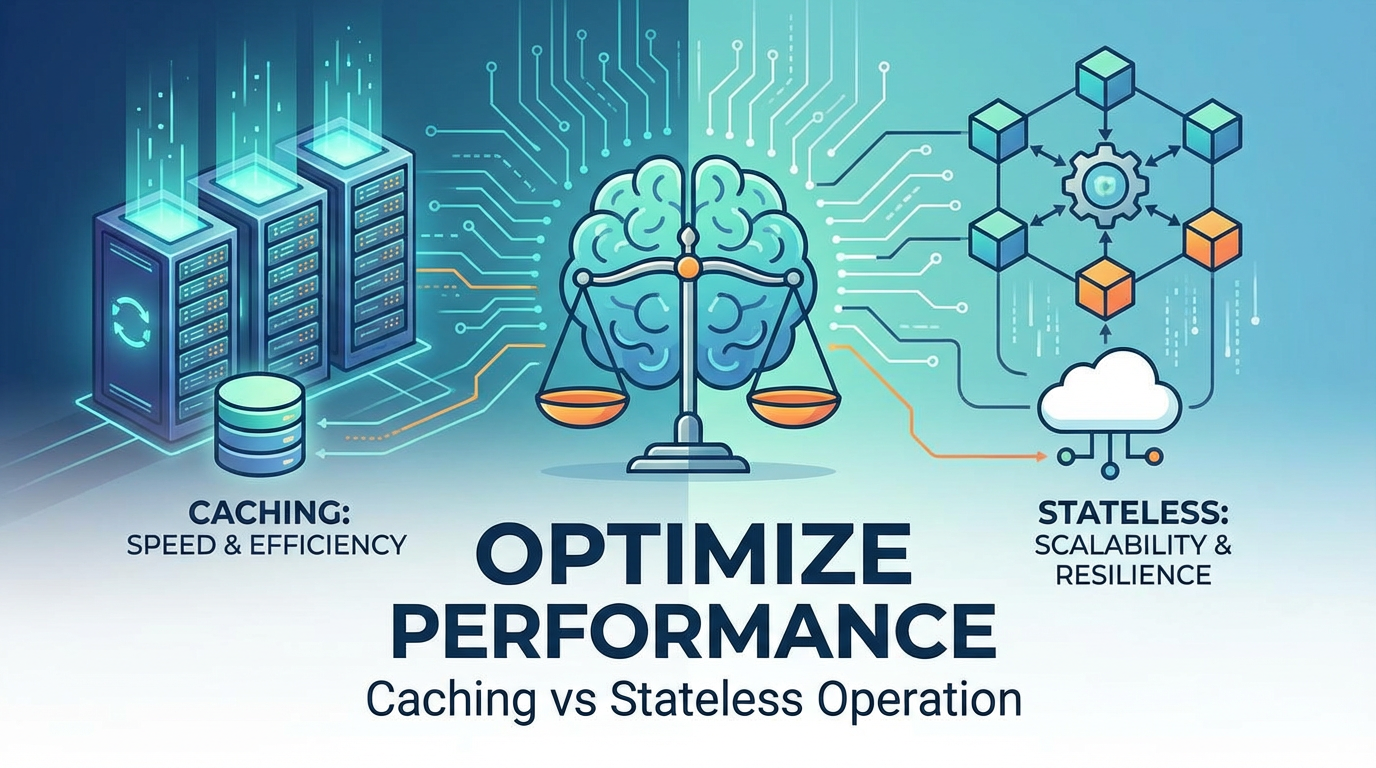
Optimize Performance: Caching vs Stateless Operation


APIPark is a high-performance AI gateway that allows you to securely access the most comprehensive LLM APIs globally on the APIPark platform, including OpenAI, Anthropic, Mistral, Llama2, Google Gemini, and more.Try APIPark now! 👇👇👇
Optimize Performance: Caching vs Stateless Operation in Modern Architectures
In the intricate tapestry of modern software development, where user expectations for speed and reliability are perpetually soaring, optimizing performance stands as a paramount objective. Engineers and architects are continually wrestling with design paradigms and tactical implementations to squeeze every ounce of efficiency from their systems. At the heart of many performance discussions, particularly in distributed and microservices-oriented architectures, lies a fundamental dichotomy: the strategic application of caching versus the inherent elegance of stateless operation. These two powerful concepts, while seemingly distinct, often intersect and complement each other, forming the bedrock of highly scalable and responsive systems. Understanding their individual strengths, their inherent trade-offs, and how they interact, especially within the context of an api gateway, is crucial for anyone building the next generation of digital services.
This extensive exploration will delve deep into the nuances of caching and statelessness, dissecting their underlying principles, operational mechanics, and the myriad benefits and challenges each presents. We will examine how an effective api gateway acts as a pivotal control point, orchestrating these strategies to deliver optimal performance for api interactions. By the end, readers will possess a comprehensive framework for evaluating when to embrace caching, when to champion statelessness, and, most importantly, how to strategically combine them to forge resilient, high-performance applications that meet the rigorous demands of today's digital landscape.
Understanding Performance Optimization in Distributed Systems
The pursuit of performance in software systems is not merely an academic exercise; it directly translates into tangible business outcomes. A fast application fosters better user experience, leading to higher engagement, retention, and ultimately, revenue. Conversely, slow systems frustrate users, damage brand reputation, and can incur significant operational costs due to inefficient resource utilization. In today's interconnected world, most significant applications are built as distributed systems, characterized by multiple independent components communicating over a network. This distributed nature introduces a unique set of performance challenges that traditional monolithic applications rarely encountered.
The primary bottlenecks in distributed systems often manifest as network latency, database access overhead, and computationally intensive operations. Every interaction between services, every api call, every database query, and every complex calculation adds to the overall response time. Network latency, the time it takes for data to travel across a network, is an immutable physical constraint that can only be mitigated by reducing the number of round trips or the distance data travels. Database access, while essential for persistent storage, can be a major bottleneck due to the I/O operations and query processing required. Finally, complex business logic or data transformations can consume significant CPU cycles, delaying responses.
Modern architectures, particularly those adopting microservices, amplify these challenges and opportunities. In such environments, a single user request might trigger a cascade of dozens or even hundreds of internal api calls between various services. Each api interaction, while promoting modularity and independent deployability, adds to the cumulative latency if not managed efficiently. This is precisely where strategies like caching and maintaining statelessness become not just desirable, but absolutely essential. An api gateway plays an indispensable role in managing these complex interactions, acting as the first line of defense and optimization point for all inbound and outbound api traffic. Without careful consideration of performance, these sophisticated architectures can quickly devolve into slow, unwieldy beasts, undermining the very benefits they were designed to deliver.
Deep Dive into Caching: The Art of Remembering
Caching is a fundamental optimization technique in computer science, rooted in the principle of locality of reference. In essence, caching involves storing copies of data or computational results in a temporary, high-speed storage location so that future requests for that same data can be served more quickly than retrieving it from its original, slower source. It's akin to keeping frequently used tools or reference books close at hand rather than having to fetch them from a distant workshop or library every time they're needed. The core idea is to trade off some memory or storage space for a significant boost in access speed.
When a system attempts to retrieve data, it first checks the cache. If the data is found there, it's a "cache hit," and the data is returned almost instantaneously. If the data is not in the cache, it's a "cache miss." In this scenario, the system must retrieve the data from its primary source (e.g., a database, an external api, or a computational process), and typically, a copy of this newly fetched data is then placed into the cache for future use. The effectiveness of a cache is measured by its hit ratio: the proportion of requests that result in a cache hit. A higher hit ratio indicates a more efficient cache.
Types of Caching
Caching manifests in various forms across the software stack, each serving distinct purposes and operating at different scopes:
- Browser Cache (Client-Side Caching): This is the cache maintained by a user's web browser, storing static assets like HTML pages, CSS stylesheets, JavaScript files, and images. When a user revisits a website, the browser can retrieve these assets from its local cache, significantly reducing page load times and network requests. HTTP caching headers (e.g.,
Cache-Control,Expires,ETag,Last-Modified) are crucial for instructing browsers on how to manage these cached resources. - Proxy Cache (Intermediate Caching): These caches sit between clients and origin servers. Content Delivery Networks (CDNs) are prime examples, distributing cached content to edge locations geographically closer to users. Reverse proxies and
api gateways also commonly implement proxy caching. By caching responses at thegatewaylevel, requests for identical data can be served directly from thegatewaywithout ever reaching the backend services, dramatically reducing load and latency forapicalls. This is a particularly powerful optimization for public-facingapis with high read volumes. - Application Cache (In-Memory/Local Caching): Within an application server, data can be cached directly in memory or on the local file system. In-memory caches, such as those implemented with Guava Cache or Ehcache, offer extremely fast access times as they bypass network and disk I/O. However, they are volatile (data is lost on application restart) and specific to a single application instance. For microservices, this means each instance might have its own cache, leading to potential consistency issues if not carefully managed.
- Database Cache: Databases themselves often employ internal caching mechanisms (e.g., query plan cache, data page cache) to speed up common queries and data access. ORM (Object-Relational Mapping) frameworks can also implement their own levels of caching, storing objects fetched from the database to avoid redundant queries.
- Distributed Cache (External Caching): For scalable, high-performance distributed systems, a single, shared cache accessible by multiple application instances is often required. Distributed caching solutions like Redis, Memcached, and Apache Ignite provide a separate, highly optimized service dedicated to storing and serving cached data. These caches offer resilience, can be scaled independently, and ensure consistency across multiple application instances, making them ideal for microservices and cloud-native environments. They are particularly effective when application instances are stateless, relying on the distributed cache for shared, temporary data.
How Caching Works: Policies and Eviction
The effectiveness of a cache hinges on its ability to manage data efficiently, particularly when its capacity is finite. When the cache becomes full and new data needs to be stored, an "eviction policy" determines which existing item to remove. Common eviction policies include:
- Least Recently Used (LRU): Discards the item that has not been used for the longest period of time. This is a very popular and generally effective policy, assuming that data accessed recently is likely to be accessed again soon.
- Least Frequently Used (LFU): Evicts the item with the lowest access count. While intuitively appealing, LFU can suffer if an item was frequently accessed in the past but is no longer needed.
- First-In, First-Out (FIFO): Removes the oldest item, regardless of how often it has been accessed. Simple to implement but often less effective than LRU.
- Most Recently Used (MRU): Evicts the item that was accessed most recently. This is counter-intuitive for general caching but can be useful in specific scenarios, such as when iterating through a large dataset where the most recently used item is less likely to be needed again.
- Random Replacement (RR): Randomly selects an item to discard. Simple but generally least effective.
Beyond eviction policies, Time-to-Live (TTL) is a critical concept. TTL specifies how long a cached item is considered valid before it expires and must be re-fetched from the primary source. A well-chosen TTL balances data freshness with cache hit ratio. A shorter TTL ensures greater data freshness but potentially lower cache hits, while a longer TTL improves hit ratios but risks serving stale data.
Benefits of Caching
The advantages of strategically employing caching are numerous and impactful:
- Reduced Latency: By serving data from a fast local or nearby cache, the round trip time to a slower backend or database is eliminated, resulting in significantly faster response times for
apicalls and user interactions. - Reduced Load on Backend Services: Caching offloads requests from databases, external
apis, and computational services. This allows backend systems to handle a greater volume of unique or write-intensive requests, preventing overload and improving their overall stability and performance. - Improved Scalability: By reducing the load on upstream services, caching effectively scales the entire system. Application instances can serve more requests without needing to scale up their backend dependencies as rapidly. An
api gatewaywith robust caching capabilities can scaleapiaccess dramatically without overwhelming the underlying microservices. - Better User Experience: Faster response times directly translate to a more fluid and enjoyable user experience, reducing frustration and increasing engagement.
Challenges of Caching
Despite its powerful benefits, caching introduces its own set of complexities and challenges, often encapsulated by the famous adage: "There are only two hard things in computer science: cache invalidation and naming things."
- Cache Invalidation: Ensuring that cached data remains consistent with the primary data source is notoriously difficult. When the underlying data changes, the corresponding cached entry must be updated or removed (invalidated) to prevent serving stale information. Incorrect invalidation strategies can lead to users seeing outdated data, which can range from minor inconvenience to critical business errors.
- Data Consistency Issues (Stale Data): If invalidation fails or is delayed, the cache can serve stale data. This is a trade-off between performance and absolute data freshness. Applications must define their tolerance for eventual consistency versus strong consistency.
- Increased Complexity: Implementing and managing a caching layer adds architectural complexity. This includes choosing the right caching technology, defining eviction policies, managing TTLs, and developing robust invalidation strategies. Distributed caches, while powerful, add another network hop and a separate infrastructure component to manage.
- Cache Cold Start: When a cache is empty (e.g., after deployment or a system restart), it provides no performance benefit until it has been populated. This "cold start" period can temporarily degrade performance until the cache warms up.
- Thundering Herd Problem: If a popular item expires from the cache, many concurrent requests might all simultaneously miss the cache and hit the backend system, leading to a sudden surge in load that can overwhelm the primary data source. This can be mitigated with techniques like a short re-cache period or distributed locks.
Strategies for Effective Caching
To harness the power of caching effectively, several strategies can be employed:
- Cache-Aside: The application code is responsible for checking the cache first. If a cache miss occurs, the application retrieves data from the database, then stores it in the cache for future use. This gives the application full control but requires more explicit code.
- Read-Through: The cache acts as a data source. If the requested data is not in the cache, the cache itself retrieves the data from the underlying data store, populates itself, and then returns the data to the application. This abstracts the data loading logic from the application.
- Write-Through: When data is written, it's written simultaneously to both the cache and the primary data store. This ensures data consistency but can introduce latency for writes.
- Write-Back: Data is initially written only to the cache, and then asynchronously written to the primary data store. This offers low latency for writes but risks data loss if the cache fails before data is persisted.
- Granularity of Caching: Decide what level of data to cache. Should it be raw database rows, processed
apiresponses, or derived aggregates? Cachingapiresponses at theapi gatewaylevel is often highly effective for reducing backend load for read-heavy operations. - Monitoring Cache Performance: Continuously track cache hit rates, miss rates, eviction rates, and latency. This data is essential for identifying bottlenecks, optimizing eviction policies, and fine-tuning TTLs.
- Using Appropriate Caching Technologies: Select a caching solution that matches the specific requirements of your application in terms of scale, consistency needs, and operational overhead. Redis and Memcached are popular choices for distributed caches due to their speed and feature sets.
- Leveraging
API Gatewayfor Caching: Anapi gatewayis an ideal location to implement caching for external and internalapirequests. It can cache full responses or specific parts of responses, applying policies globally or on a per-apibasis. This provides a centralized point of control for caching logic, shielding backend services from redundant requests and significantly improving the performance and reliability of the entireapilandscape. An advancedapi gatewaylike APIPark offers functionalities to manage traffic forwarding and load balancing, which inherently involves making decisions that can leverage caching to reduce the load on integrated services, especially for commonapicalls or AI model invocations.
Deep Dive into Stateless Operation: The Power of Forgetting
In contrast to caching, which is about remembering, stateless operation is about forgetting – specifically, a server forgetting any client-specific context between requests. A stateless system is one where each request from a client to a server contains all the information necessary for the server to understand and fulfill that request, without the server needing to rely on any previously stored session information or client state. The server processes the request based solely on the current request data, and the response it sends is self-contained. It treats every request as an independent transaction, as if it were the first and only request from that particular client.
Imagine interacting with a helpful but forgetful librarian. Every time you ask a question, you have to provide all the necessary context (your name, the book you're looking for, etc.), even if you just asked a related question. The librarian doesn't remember your previous query. This contrasts with a conversation where context builds up over time. In a stateless interaction, each api call is a complete interaction, self-describing and self-sufficient.
Characteristics of Stateless Systems
Stateless systems embody several key characteristics that contribute to their popularity in modern distributed architectures:
- No Session Affinity Required: Because the server holds no client state, any available server instance can process any client request. This eliminates the need for "sticky sessions" or session affinity, where a client's requests must consistently be routed to the same server instance.
- Easy to Scale Horizontally: The absence of server-side state makes it incredibly simple to scale stateless services horizontally. New instances can be added or removed on demand without concern for migrating session data, ensuring that the system can handle fluctuating loads efficiently.
- Resilient to Server Failures: If a server instance fails, no client session data is lost because no data was stored on that specific server. Clients can simply retry their request, and any other available server can pick it up. This significantly improves fault tolerance.
- Predictable Behavior: Each request is processed independently, based solely on its input. This leads to more predictable behavior and simpler reasoning about system logic, as there are no hidden interdependencies stemming from server-side state.
How Statelessness Works
The operational flow in a stateless system is straightforward:
- Client Sends Complete Request: The client constructs a request that includes all necessary data, authentication tokens (e.g., JWT), and context for the server to process it. For an
apicall, this means the HTTP request headers, body, and query parameters contain everything the server needs. - Server Processes Request: The server receives the request, processes it using only the information provided in the request itself (and potentially data from a persistent, shared data store like a database or external cache, which is distinct from server-local client state).
- Server Sends Complete Response: The server generates a response that also contains all relevant information for the client, without expecting the client to maintain any state on the server's behalf.
RESTful api design principles are a prime example of advocating for statelessness. Each RESTful api call should be self-contained and idempotent where appropriate, meaning multiple identical requests should have the same effect as a single request. This adherence to statelessness is a cornerstone of building robust and scalable web services.
Benefits of Stateless Operation
Embracing statelessness offers a compelling suite of advantages:
- Simplicity in Server Design and Implementation: Stateless servers are inherently simpler to design and implement because they don't have to manage complex session data, synchronize state across instances, or handle session recovery after failures. Each request can be handled by a clean slate.
- High Scalability and Elasticity: This is arguably the most significant benefit. Adding more stateless server instances is trivial; load balancers can distribute requests across them evenly without any special configuration for session stickiness. This makes scaling up and down based on demand extremely efficient and cost-effective.
- Fault Tolerance and Resilience: As no client state is tied to a specific server, individual server failures do not lead to loss of client sessions or service interruption beyond the immediate request. The load balancer simply routes subsequent requests to a healthy server. This significantly enhances the overall reliability of the system.
- Easier Load Balancing: Any server can handle any request, making load balancing strategies much simpler and more effective. Complex algorithms for session routing are unnecessary.
- Improved Reliability: The reduced complexity and enhanced fault tolerance contribute to a more reliable system overall, with fewer points of failure related to state management.
Challenges of Stateless Operation
While powerful, statelessness is not without its own set of trade-offs:
- Increased Payload Size: Since each request must carry all necessary context, the size of individual request payloads can increase, potentially leading to higher network traffic and marginally increased processing overhead for parsing larger requests.
- Potential for Redundant Data Transmission: If the same contextual information (e.g., user preferences) needs to be sent with every request, it represents redundant data transmission across the network.
- Requires Client to Manage State, or Pass it Explicitly: If client-specific state is necessary for a multi-step workflow, the client application (or a shared external state store) becomes responsible for managing that state and including it in subsequent requests. This shifts complexity from the server to the client or an external service.
- Authentication/Authorization Mechanisms Need Careful Design: In a stateless system, traditional session-based authentication (where the server stores session IDs) is not feasible. Token-based authentication, such as JSON Web Tokens (JWT), is commonly used. JWTs are self-contained and can be validated by any server instance without needing to query a central session store, aligning perfectly with stateless principles.
- Can Lead to Inefficient
APICalls if Not Designed Well: If a single logical user operation requires many small, context-richapicalls because state cannot be maintained on the server, it can lead to chatty interactions and increased overall latency. Carefulapidesign is crucial to aggregate related operations.
Caching in a Stateless World
At first glance, caching (remembering state) and stateless operation (forgetting state) might appear to be contradictory paradigms. However, they are not mutually exclusive; in fact, they can be highly complementary. The key distinction lies in where the state is managed and whose state it is.
When we talk about stateless operation, we primarily refer to the application servers themselves not retaining client-specific session state between requests. This means an application instance doesn't store variables or objects tied to a particular user's ongoing interaction. However, this does not preclude the use of shared, external state stores like databases or distributed caches.
A distributed cache, while itself a stateful component, enables application servers to remain stateless. Application servers can store and retrieve temporary, shared data from the cache without managing that state internally. For example, if a stateless api service needs to access frequently requested configuration data, it can retrieve it from a shared Redis cache. Each individual api call remains stateless from the perspective of the application server, as it doesn't carry forward session context.
Furthermore, caching can be applied upstream of stateless services. An api gateway sits in front of potentially many stateless microservices. This gateway can implement robust caching policies for responses from these services. For instance, if a stateless "product catalog" service exposes an api to fetch product details, and those details change infrequently, the api gateway can cache the responses to /products/{id} requests. Subsequent requests for the same product ID would hit the gateway cache, never reaching the stateless product catalog service, significantly reducing load and improving response times. The product catalog service itself remains stateless, processing each request independently, but its performance is enhanced by the gateway's caching layer.
This synergistic relationship is critical for building high-performance, scalable distributed systems. Stateless servers provide the horizontal scalability and resilience, while caching layers provide the speed and efficiency for frequently accessed data, thereby optimizing the flow of api traffic without compromising the core benefits of statelessness at the service level. This is where a comprehensive platform like APIPark, an open-source AI gateway and api management platform, proves invaluable. It acts as the central hub where these strategies converge, allowing developers and enterprises to manage, integrate, and deploy AI and REST services with built-in optimizations.
The Role of the API Gateway in Performance Optimization
The api gateway has evolved from a simple reverse proxy to a sophisticated traffic management and policy enforcement point that plays a crucial role in optimizing the performance, security, and reliability of apis. It acts as a single entry point for all client requests, abstracting the complexity of the backend services and providing a centralized location for various cross-cutting concerns. For any modern api-driven architecture, the api gateway is not merely a convenience but a strategic imperative.
What is an API Gateway?
An api gateway is a service that sits in front of a group of microservices (or other backend services) and acts as an api entry point for clients. It routes requests to the appropriate backend service, potentially transforming requests and responses along the way. Conceptually, it's like a concierge for your apis: clients talk only to the concierge, who then directs them to the correct backend "room" and handles any pre- or post-processing.
How an API Gateway Facilitates Performance
The strategic placement and capabilities of an api gateway make it an ideal candidate for implementing various performance optimizations:
- Caching: This is one of the most direct ways an
api gatewayboosts performance. By caching responses from backend services, thegatewaycan serve subsequent identical requests directly from its cache, bypassing the backend entirely. This drastically reduces latency for read-heavyapis and significantly lowers the load on upstream services. Anapi gatewaycan implement granular caching policies, such as caching specificapiendpoints for a defined TTL, or based on specific request headers or query parameters. This is especially useful forapis that return static or semi-static data, or results from computationally expensive operations like AI model inferences. - Load Balancing:
API gateways are inherently designed to distribute incoming requests across multiple instances of backend services. By intelligently routing traffic based on factors like server health, current load, or round-robin algorithms, they ensure optimal utilization of resources and prevent any single backend service from becoming a bottleneck. This is fundamental to maintaining performance and availability under varying loads. - Request/Response Transformation:
Gateways can modify request payloads before forwarding them to backend services or transform responses before sending them back to clients. This could involve data compression, content type negotiation, or even restructuringapipayloads to optimize network transfer and simplify backend serviceapis. For example, agatewaymight combine multiple smallerapiresponses into a single, aggregated response for a mobile client, reducing the number ofapicalls. - Rate Limiting/Throttling: To protect backend services from being overwhelmed by sudden spikes in traffic or malicious attacks,
api gateways can enforce rate limits, allowing only a certain number of requests per client or perapiwithin a given timeframe. This prevents resource exhaustion and maintains the stability and performance of the system for legitimate users. - Authentication/Authorization: Offloading security concerns like authentication and authorization to the
api gatewayreduces the burden on individual backend services. Thegatewaycan validate tokens (e.g., JWTs), enforce access control policies, and then pass only authorized requests to the backend. This centralizes security logic and frees backend services to focus purely on business logic, leading to cleaner code and often better performance. - Monitoring/Logging: As the central point of ingress and egress for all
apitraffic, anapi gatewayis uniquely positioned to capture comprehensive metrics, logs, and trace data for everyapicall. This provides invaluable insights into performance bottlenecks,apiusage patterns, error rates, and overall system health, enabling proactive optimization and troubleshooting. - Circuit Breaking: In distributed systems, a failing service can cascade failures throughout the entire system. An
api gatewaycan implement circuit breakers that temporarily stop sending requests to a struggling backend service, allowing it time to recover, and returning a fallback response to the client. This prevents further strain on the failing service and improves the overall resilience and performance of dependent services.
APIPark Integration: Elevating API Performance and Management
This is precisely where a robust platform like APIPark comes into play, offering a compelling solution for managing and optimizing api performance, particularly in the burgeoning field of AI services. APIPark, an open-source AI gateway and api management platform, provides a comprehensive suite of features that directly address the needs of performance optimization through smart caching and support for stateless architectures.
APIPark is designed from the ground up to be an all-in-one AI gateway and api developer portal. Its capabilities extend far beyond basic routing, making it an excellent example of how a modern api gateway orchestrates performance. For instance, its "Performance Rivaling Nginx" claim—achieving over 20,000 TPS with an 8-core CPU and 8GB memory—highlights its raw power to handle high-volume api traffic, a prerequisite for any effective performance strategy. This robust gateway infrastructure can effectively implement both caching and support stateless services at scale.
Here's how APIPark's features directly contribute to optimizing performance in the context of caching and stateless operations:
- Unified API Format for AI Invocation & Prompt Encapsulation: By standardizing the request data format across 100+ integrated AI models and allowing users to encapsulate prompts into REST
apis, APIPark inherently encourages a more stateless design at the application integration layer. Applications makingapicalls to AI models via APIPark don't need to worry about the specifics of each AI model'sapior its internal state; they interact with a consistent, self-containedapiendpoint provided by thegateway. This reduces application complexity and promotes scalable, stateless interactions with AI services. For frequently invoked AI inferences with stable inputs, APIPark's underlyinggatewaycan then apply caching policies to serve results directly, reducing latency and cost associated with repeated AI model calls. - End-to-End API Lifecycle Management: APIPark assists with managing the entire lifecycle of
apis, including design, publication, invocation, and decommission. This governance helps regulateapimanagement processes, including traffic forwarding, load balancing, and versioning. These are all critical functions that directly impact performance. Efficient load balancing ensures requests are distributed optimally across backend services, while versioning allows for seamless updates without disrupting existing consumers, crucial for maintaining high availability and consistent performance. - Detailed API Call Logging and Powerful Data Analysis: To effectively optimize performance, you need visibility. APIPark provides comprehensive logging, recording every detail of each
apicall. This data is essential for identifying performance bottlenecks, analyzingapiusage, and understanding the impact of caching strategies or stateless service design. Its powerful data analysis capabilities, which analyze historical call data to display long-term trends and performance changes, enable businesses to perform preventive maintenance and continuously refine their optimization strategies before issues arise. This observability is paramount for making informed decisions about where to apply caching, how to tune stateless services, and overallapihealth. - Deployment and Scalability: With quick deployment and support for cluster deployment, APIPark is built for modern, scalable architectures. This means it can serve as a highly available and performant
api gatewaythat can grow with your system's demands, acting as a reliable traffic manager whether your backend services are stateless or benefit from caching.
By leveraging an api gateway like APIPark, organizations can centralize the implementation of performance-enhancing techniques. It allows backend services to remain focused on their core business logic, while the gateway handles the intricate dance of traffic management, security, and optimization. This architecture promotes a clean separation of concerns, leading to more resilient, scalable, and performant api ecosystems, critical for managing a diverse set of AI and REST apis.
Choosing Between Caching and Statelessness (and When to Combine)
The decision to lean on caching, embrace statelessness, or, more commonly, combine them, is a nuanced one that depends heavily on the specific requirements and characteristics of the system being built. There is no one-size-fits-all answer, but rather a spectrum of approaches tailored to different contexts. The ultimate goal is to strike a balance between performance, scalability, consistency, and complexity.
Decision Matrix: Factors to Consider
When evaluating these strategies, several critical factors should guide your decision-making process:
- Data Volatility and Consistency Requirements: How frequently does the data change? How critical is it for users to see the absolute latest data? If data changes rapidly and real-time freshness is paramount (e.g., stock market prices, sensor readings), caching must be minimal or employ very aggressive invalidation, which can add complexity. If stale data is acceptable for a short period (e.g., social media feeds, weather forecasts), caching is a strong candidate. Statelessness itself doesn't directly address data freshness but works well with external, highly consistent data stores if needed.
- Read-Heavy vs. Write-Heavy Workloads: If your
apis are predominantly read operations with relatively few writes (high read-to-write ratio), caching is an extremely effective optimization. It can drastically reduce the load on your primary data sources. For write-heavyapis, caching is less impactful and might introduce consistency challenges if not handled carefully (e.g., using write-through or write-back caches). Stateless systems handle both read and write operations equally well, as long as the underlying persistent storage can cope. - Scalability Needs: How much traffic do you anticipate, and how rapidly might it grow? Stateless services are inherently easier to scale horizontally, making them ideal for systems requiring extreme elasticity. Caching complements this by reducing the effective load on these stateless services, allowing them to serve even more requests with fewer instances.
- Complexity Tolerance: Both caching and managing state, or the lack thereof, introduce complexity. Caching introduces complexity around invalidation, eviction policies, and cache infrastructure. Maintaining statelessness shifts state management to the client or an external service, which can also be complex. The choice should consider the team's expertise and the operational overhead.
- Nature of the
APIand its Consumers: Are yourapis public or private? Internal or external? Are they serving mobile apps, web applications, or other microservices? Publicapis often benefit significantly fromapi gatewaycaching to reduce latency for external consumers.APIs that are part of a multi-step user flow might require some form of state, which would either need to be managed by the client or through an external, shared state store (like a distributed cache for temporary workflow state) if the backend services are to remain stateless. - Cost Implications: Caching can reduce infrastructure costs by minimizing the need for expensive database reads or computation. However, maintaining a distributed cache cluster also incurs costs. Stateless services, by enabling easy horizontal scaling, can optimize resource utilization, allowing you to pay only for the compute you need.
When Caching is Dominant
Caching shines in scenarios where data access patterns exhibit strong locality and a tolerance for eventual consistency:
- Static or Semi-Static Data: Configuration data, product catalogs (that don't change hourly), news articles, blog posts, and user profiles (where immediate updates aren't critical) are prime candidates for aggressive caching.
- High Read-to-Write Ratio: Websites with many visitors viewing the same content repeatedly, or
apis primarily used for data retrieval, benefit immensely. For example, a social media feedapimight cache popular posts. - Expensive Computations or Database Queries: If generating a response involves a long-running calculation, complex join queries, or repeated external
apicalls (like AI model inferences), caching the result can save significant computational resources and time. - Latency-Sensitive Applications: Applications where every millisecond counts, such as real-time dashboards or high-traffic web pages, often rely heavily on caching to deliver sub-second response times.
When Statelessness is Paramount
Statelessness is preferred when architectural simplicity, extreme scalability, and resilience are the top priorities:
- Highly Dynamic Data Where Freshness is Critical: While caching can be used, if data changes every few milliseconds and must be absolutely up-to-date (e.g., real-time bidding platforms, banking transactions), bypassing cache and hitting a persistent, consistent store is often necessary. The
apiservices themselves should remain stateless, relying on the source of truth for each request. - Systems Requiring Extreme Horizontal Scalability: Cloud-native applications, serverless functions, and microservices designed for elastic scaling thrive on statelessness. The ability to spin up and tear down instances without state migration overhead is invaluable.
- Microservices Architectures Where Service Independence is Key: Stateless services are easier to decouple and deploy independently. They don't rely on sticky sessions, which simplifies load balancing and service discovery. Each
apicall is self-contained. - When Client-Side State Management is Acceptable or Preferred: For simpler applications, letting the client manage its own session state (e.g., shopping cart in local storage) can offload complexity from the server, aligning with stateless design.
Hybrid Approaches: The Best of Both Worlds
In most real-world scenarios, the optimal strategy involves a judicious combination of both caching and statelessness. The goal is to build stateless application servers (for scalability and resilience) and then strategically introduce caching layers (for performance) where they provide the most benefit without compromising consistency unduly.
- Stateless Application Servers Backed by a Distributed Cache: This is a very common and powerful pattern. Application instances are stateless; they don't store client-specific session data. However, they interact with a fast, shared distributed cache (like Redis) for temporary, session-like data or frequently accessed reference data. The cache becomes an external state store, allowing the servers to remain stateless and easily scalable.
API GatewayCaching for StatelessAPIEndpoints: As discussed, anapi gatewaycan cache responses from stateless backend services. The backend remains stateless, but theapi gatewayenhances its performance by serving repeated requests from cache. This is particularly effective for read-heavy RESTapis.- Combining Stateless Microservices with Eventual Consistency Models: For systems where strong consistency isn't required for every read (e.g., a "like" count on a social post), stateless microservices can update a primary data store, and an event can be published to invalidate or update cached values. The read path can benefit from caching, while the write path ensures eventual consistency, all handled by scalable, stateless services.
A well-designed api gateway like APIPark inherently supports these hybrid approaches. Its ability to manage apis, apply traffic policies, and integrate with diverse backend services, including AI models, means it can intelligently cache responses from those services while the services themselves remain stateless and highly scalable. This unified approach offers a practical and powerful pathway to optimizing performance across the entire api ecosystem.
Advanced Strategies and Considerations
Beyond the foundational concepts of caching and statelessness, several advanced strategies and considerations can further refine performance optimization in complex distributed systems. These often build upon the core principles, adding layers of sophistication for specific challenges.
Event-Driven Architectures and Cache Invalidation
One of the persistent challenges in caching is invalidation. In highly dynamic systems, simply relying on TTLs might not be sufficient for data that changes unpredictably. Event-driven architectures offer a robust mechanism for managing cache invalidation. When a piece of data changes in the primary data store (e.g., a product price is updated in a database), an event can be published to a message queue or stream (e.g., Kafka, RabbitMQ). Cache services or the api gateway (if it's responsible for caching) can subscribe to these events. Upon receiving an event indicating a data change, the corresponding entry in the cache can be immediately invalidated or updated, ensuring greater data freshness without manual intervention or short TTLs. This push-based invalidation mechanism complements stateless services by providing a highly scalable and decoupled way to maintain cache consistency across the system.
Content Delivery Networks (CDNs)
For applications with a global user base, CDNs are an indispensable form of external caching. A CDN geographically distributes cached copies of static and semi-static content (HTML, CSS, JavaScript, images, videos, and even api responses) to "edge locations" closer to end-users. When a user requests content, it's served from the nearest edge server, dramatically reducing latency due to geographical distance. While distinct from an api gateway (which often handles more dynamic, application-specific routing and policies), CDNs serve as a powerful first layer of caching that can significantly improve the performance of static assets that complement api interactions. Some api gateways can be configured to integrate directly with CDNs for api response caching, extending the reach of their performance optimizations.
Service Mesh
As microservices architectures grow in complexity, managing inter-service communication becomes a challenge. A service mesh (e.g., Istio, Linkerd) provides a dedicated infrastructure layer for handling service-to-service communication. While a service mesh typically operates at a different level than an api gateway (which focuses on north-south traffic from clients to services), they can complement each other. A service mesh can provide sophisticated traffic management (routing, retries, circuit breaking), observability (metrics, logging, tracing), and security features (mutual TLS) for east-west traffic (service-to-service). While service meshes don't typically implement application-level caching, their traffic management capabilities can support stateless microservices by ensuring reliable and efficient communication. The api gateway then focuses on external client interactions, potentially caching external api responses, while the service mesh optimizes the internal api calls between stateless services.
Observability: The Eyes and Ears of Performance Optimization
Regardless of whether you heavily rely on caching or embrace statelessness, comprehensive observability is non-negotiable for performance optimization. This includes:
- Monitoring: Collecting real-time metrics on response times, error rates, throughput (TPS), resource utilization (CPU, memory, network I/O), and specific cache metrics (hit ratio, miss ratio, eviction count). These metrics provide a high-level view of system health and performance trends.
- Logging: Detailed logs provide granular insights into individual requests, errors, and system events. Effective logging helps in diagnosing specific issues, tracing user requests, and understanding why a particular
apicall might be slow or failing. - Tracing: Distributed tracing (e.g., OpenTelemetry, Jaeger) allows you to visualize the flow of a single request across multiple services in a distributed system. This is invaluable for identifying latency bottlenecks within a chain of
apicalls, understanding service dependencies, and pinpointing which specific stateless service or cache interaction is contributing most to overall response time.
APIPark's "Detailed API Call Logging" and "Powerful Data Analysis" features are precisely designed to provide this level of observability. By recording every detail of each api call and analyzing historical data, APIPark empowers developers and operations teams to quickly trace and troubleshoot issues, understand performance changes, and proactively optimize their apis, whether they are cached or stateless. This data-driven approach is critical for continuous performance improvement.
Security Implications
Both caching and statelessness have security implications that must be carefully considered:
- Caching Sensitive Data: Caching sensitive information (e.g., personally identifiable information, financial data) requires extreme caution. Cached data needs to be secured (encryption at rest and in transit) and access control policies must be rigorously enforced. Incorrect cache invalidation for sensitive data can lead to data breaches. The decision to cache sensitive data should be made very carefully, if at all, and only with robust security measures in place.
- Stateless Authentication (JWT): While JWTs are excellent for stateless systems, they present their own set of security challenges. Revocation of JWTs (e.g., if a user logs out or their account is compromised) is not straightforward since they are self-contained and not typically stored on the server. Strategies like short expiration times, blacklisting mechanisms, or incorporating a small amount of state (e.g., a "revoked token" list in a distributed cache) might be necessary to manage JWT revocation effectively. An
api gatewayoften handles JWT validation and can be extended to manage blacklists, centralizing this security concern for all backendapis.
These advanced considerations highlight that performance optimization is an ongoing journey that requires a holistic view of the entire system, from client to api gateway to individual microservices and their data stores.
Case Studies and Examples
To illustrate the practical application and impact of caching and stateless operation, consider these brief examples:
- News Website (Caching Dominant): A high-traffic news website serves millions of readers daily. News articles, once published, are relatively static. By aggressively caching full page renders and
apiresponses for article content at the CDN andapi gatewaylevels, the site can handle massive traffic spikes with minimal load on its backend content management system and database. This strategy ensures rapid page loads and a smooth user experience even during breaking news events. The underlying content services remain stateless, retrieving data from a database, but their performance is supercharged by the caching layers. - Online Retail Product Catalog
API(Hybrid Approach): An e-commerce platform exposes a product catalogapi. Product details (description, images, categories) change infrequently, but stock levels and pricing can be highly dynamic.- The
api gatewaycaches responses for/products/{id}and/categoriesendpoints with a moderate TTL (e.g., 5-10 minutes). This significantly reduces database load for common product lookups. - The backend product service is designed to be stateless, fetching product data from the database for each request that bypasses the cache.
- For real-time stock availability, a separate, specific
apiendpoint/products/{id}/stockmight be designed to be uncached, always hitting a fast, dedicated inventory service that is also stateless and optimized for high-volume, low-latency reads from a persistent store. This hybrid approach delivers high performance where it matters most, balancing freshness with speed.
- The
- Serverless Function Backend for Mobile App (Stateless Dominant): A mobile application uses serverless functions (e.g., AWS Lambda, Google Cloud Functions) as its backend
apis. Each function invocation is entirely stateless; it receives a request, performs its task (e.g., processing an image, updating a user's status), interacts with a persistent database (like DynamoDB), and returns a response. There's no server-side session to manage. This architecture naturally scales with demand, tolerates failures well, and requires minimal operational overhead, all thanks to its inherently stateless design. While individual functions can still use in-memory caches for very short-lived reference data, the core paradigm is stateless.
These examples highlight that the optimal strategy is not about choosing one over the other but understanding their interplay and applying them intelligently to different parts of an architecture based on their specific requirements.
Conclusion
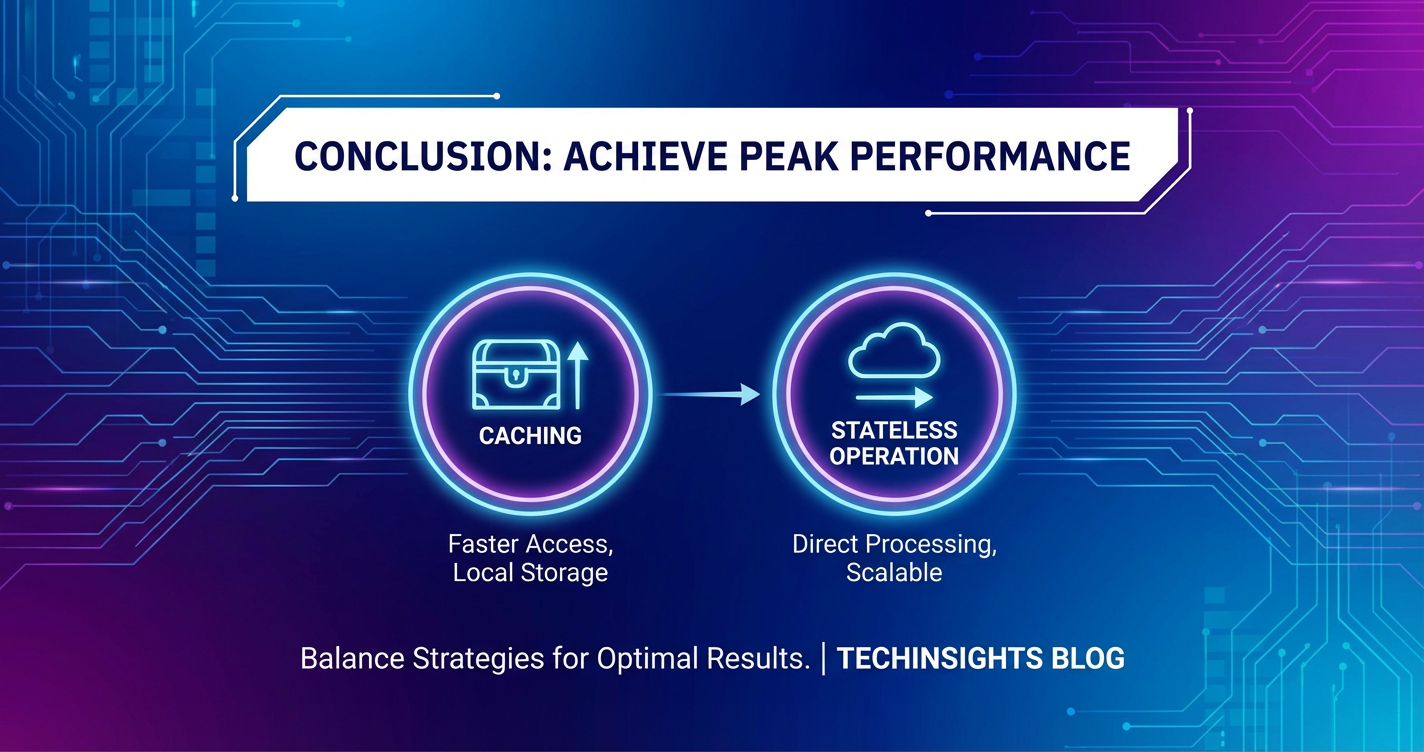
The journey to optimize performance in modern software systems is a continuous and multifaceted endeavor. At its core, the strategic interplay between caching and stateless operation defines the efficiency, scalability, and resilience of our api-driven applications. Caching, the art of remembering, accelerates access to frequently requested data, dramatically reducing latency and offloading backend services. Statelessness, the power of forgetting, simplifies server design, enables unparalleled horizontal scalability, and enhances fault tolerance by making each request self-contained.
Crucially, these two paradigms are not in opposition but are powerful allies. Stateless application servers, free from the burden of managing client state, can be combined with intelligent caching layers (often managed by an api gateway) to achieve exceptional performance. The api gateway emerges as the central orchestrator in this symphony of optimization, acting as a crucial control point for implementing caching policies, load balancing, rate limiting, and providing the vital observability needed to fine-tune system behavior. Solutions like APIPark, an open-source AI gateway and api management platform, exemplify how a modern gateway can streamline the management of diverse apis, including AI services, while simultaneously boosting their performance through unified formats, robust traffic management, and insightful analytics.
Ultimately, the choice and combination of caching and statelessness must be guided by a deep understanding of data volatility, workload characteristics, scalability demands, and the acceptable trade-offs between consistency and performance. By thoughtfully applying these principles and leveraging the capabilities of advanced api gateways, developers and architects can build systems that not only meet but exceed the ever-growing expectations for speed, reliability, and efficiency in the digital age. The path to optimal performance is paved with informed decisions, continuous monitoring, and a willingness to adapt strategies as systems evolve.
Comparison Table: Caching vs. Stateless Operation
| Feature / Aspect | Caching | Stateless Operation |
|---|---|---|
| Primary Goal | Reduce latency, offload backend, improve response time. | Enable horizontal scalability, simplify server design, enhance resilience. |
| Core Principle | Store data copies for faster retrieval (remembering). | Do not store client-specific state between requests (forgetting). |
| State Management | Manages temporary copies of data (stateful component). | Application server holds no client-specific session state. |
| Scalability | Improves effective scalability of backend by reducing load. | Inherently easy to scale horizontally by adding more instances. |
| Fault Tolerance | Cache failure can lead to cold start; data loss if cache not durable. | High; server failures don't lose client state; any server can pick up. |
| Consistency Challenges | Cache invalidation is complex; risk of stale data. | Data consistency managed by underlying persistent stores (e.g., database). |
| Network Traffic | Reduces network traffic to backend for cache hits. | Can increase network traffic due to larger request payloads (carrying state). |
| Complexity | Adds complexity for cache management, invalidation, eviction policies. | Simplifies server logic; shifts state management to client or external store. |
| Typical Use Cases | Read-heavy apis, static/semi-static data, expensive computations. |
Microservices, serverless functions, RESTful apis, high elasticity. |
| Role of API Gateway | Ideal point for response caching, reduces backend load for external apis. |
Facilitates routing to any available stateless service instance. |
| Example Technologies | Redis, Memcached, CDN, in-memory caches, api gateway cache. |
RESTful apis, JWT authentication, serverless functions, microservices. |
| Complementary Usage | Yes, stateless services can query distributed caches; gateway caches responses from stateless backends. |
Yes, stateless services greatly benefit from gateway and distributed caching. |
Frequently Asked Questions (FAQs)
- What is the fundamental difference between caching and stateless operation? The fundamental difference lies in their approach to state. Caching involves remembering data (storing temporary copies) to improve retrieval speed and reduce load on primary data sources. Stateless operation, conversely, means the server forgets any client-specific context between requests, processing each
apicall independently based solely on the information provided within that request. Caching is a performance optimization technique, while statelessness is an architectural design principle for scalability and resilience. - Can I use caching in a stateless system, or are they mutually exclusive? Absolutely, they are not mutually exclusive and, in fact, are highly complementary. A stateless application server does not store client-specific session data, but it can certainly interact with an external, shared distributed cache (which is itself a stateful component) to store and retrieve temporary or frequently accessed data. Moreover, an
api gatewaycan implement caching for responses from entirely stateless backend services, transparently improving performance for externalapiconsumers without altering the stateless nature of the services themselves. - What role does an
api gatewayplay in optimizing performance with caching and statelessness? Anapi gatewayis pivotal. It acts as a central control point that can implement caching policies for incomingapirequests, significantly reducing the load on backend services and improving response times. For stateless services, thegatewayfacilitates efficient load balancing across multiple instances without needing session affinity, ensuring high availability and scalability. It also provides essential cross-cutting concerns like rate limiting, authentication, and detailed logging, all of which contribute to overall system performance and manageability, making it an ideal platform for managing both cached and statelessapis. - What are the biggest challenges when implementing caching, and how can they be mitigated? The biggest challenge in caching is "cache invalidation," ensuring that cached data remains consistent with the primary data source when changes occur, to avoid serving stale information. This can be mitigated by:
- Strategic TTLs: Setting appropriate Time-to-Live values based on data volatility.
- Event-driven invalidation: Using message queues to push invalidation messages to the cache whenever data changes.
- Write-through/Write-back caches: Ensuring data is written to both the cache and the primary store, though these have their own trade-offs.
- Careful cache granularity: Only caching data that is truly static or semi-static.
- Comprehensive monitoring: Tracking cache hit/miss rates to identify issues.
- When should I prioritize a purely stateless design over one that incorporates caching? You should prioritize a purely stateless design when:
- Extreme Horizontal Scalability and Resilience are the absolute highest priorities, as stateless services are inherently easier to scale and recover from failures.
- Data Freshness is Absolutely Critical for every transaction, and the overhead of caching (even with aggressive invalidation) is deemed unacceptable.
- Simplified Server Logic is a primary goal, as managing server-side state adds complexity.
- Client-Side State Management or the use of external, persistent data stores for state is acceptable or preferred. However, even in such scenarios, caching can still be beneficial at the
api gatewaylayer or for highly dynamic data that is eventually consistent, by improving the overallapiperformance.
🚀You can securely and efficiently call the OpenAI API on APIPark in just two steps:
Step 1: Deploy the APIPark AI gateway in 5 minutes.
APIPark is developed based on Golang, offering strong product performance and low development and maintenance costs. You can deploy APIPark with a single command line.
curl -sSO https://download.apipark.com/install/quick-start.sh; bash quick-start.sh

In my experience, you can see the successful deployment interface within 5 to 10 minutes. Then, you can log in to APIPark using your account.

Step 2: Call the OpenAI API.