Optimize Your AI Gateway with Kong for Enhanced Performance
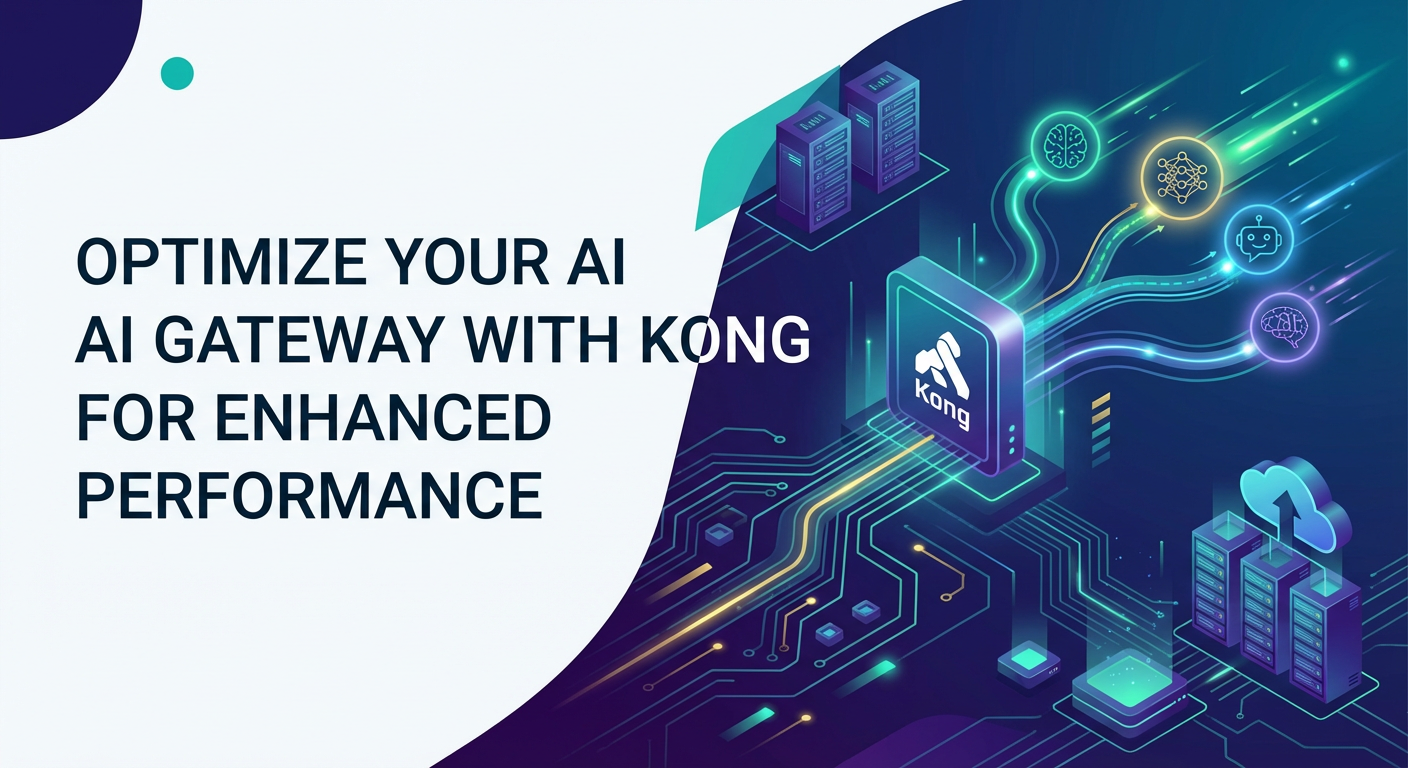


The rapid proliferation of Artificial Intelligence (AI) and Large Language Models (LLMs) has fundamentally reshaped the technological landscape, presenting both immense opportunities and significant architectural challenges. As enterprises increasingly integrate sophisticated AI capabilities into their applications and services, the need for robust, scalable, and secure infrastructure to manage these interactions becomes paramount. At the heart of this infrastructure lies the AI Gateway, a critical component designed to orchestrate the complex flow of data between client applications and diverse AI models. This article delves into how Kong, a leading open-source API Gateway, can be leveraged and optimized to serve as a powerful AI Gateway or LLM Gateway, ensuring not only efficient traffic management but also enhanced performance, security, and observability for your AI-powered ecosystems.
The journey of AI integration is not merely about deploying models; it's about making them accessible, reliable, and governable at scale. Without a sophisticated gateway, developers face a convoluted web of direct integrations, disparate authentication mechanisms, and an inability to monitor or control the usage of their valuable AI resources. This fragmented approach invariably leads to performance bottlenecks, security vulnerabilities, and exorbitant operational costs. By strategically implementing Kong as an AI Gateway, organizations can centralize control, apply consistent policies, and unlock the full potential of their AI investments, driving innovation while maintaining operational excellence. We will explore the architectural considerations, configuration strategies, and advanced optimization techniques necessary to transform Kong into an indispensable asset for any AI-driven enterprise.
The Unprecedented Rise of AI and Large Language Models: A New Era of Computing
The past few years have witnessed an explosion in the capabilities and adoption of Artificial Intelligence, particularly with the advent and widespread availability of Large Language Models (LLMs). From foundational models capable of generating human-like text, translating languages, and summarizing complex information, to specialized AI services performing image recognition, anomaly detection, and predictive analytics, AI is no longer a niche technology but a pervasive force driving innovation across every industry sector. This rapid evolution has profoundly impacted how applications are built, how businesses operate, and how users interact with technology. The demand for integrating these powerful AI capabilities into existing and new software systems has never been higher, creating an urgent need for robust infrastructure to manage this burgeoning ecosystem.
The proliferation of AI models, each with its unique API, input/output formats, authentication requirements, and performance characteristics, presents a significant integration challenge. Developers are often faced with the complexity of connecting to dozens, if not hundreds, of different AI endpoints, each requiring specific handling. This heterogeneity introduces substantial overhead in terms of development time, maintenance, and operational complexity. Furthermore, many AI models, especially LLMs, are resource-intensive, demanding significant computational power and often leading to high inference costs. Managing these costs, ensuring optimal performance under varying loads, and safeguarding proprietary models and sensitive data are critical concerns that cannot be addressed by ad-hoc integration methods. The sheer volume of potential requests to AI services, from simple chatbots to complex data analysis pipelines, necessitates a resilient and highly scalable solution to prevent bottlenecks and ensure consistent service delivery. Without a central point of control and optimization, the promises of AI can quickly turn into a quagmire of unmanageable dependencies and prohibitive expenses.
Understanding the AI Gateway Concept: Your Central Control Point for Intelligent Services
At its core, an AI Gateway serves as a vital intermediary between client applications and a diverse array of AI models, whether they are hosted internally, consumed from third-party providers, or running in a hybrid cloud environment. It acts as a single, unified entry point for all AI-related requests, abstracting away the underlying complexities of individual AI services. This architectural pattern is not merely a convenience; it is a fundamental necessity for building scalable, secure, and maintainable AI-powered applications. By centralizing the management of AI interactions, an AI Gateway empowers organizations to apply consistent policies, enhance operational visibility, and optimize resource utilization, effectively transforming a disparate collection of models into a cohesive and governed ecosystem.
The primary functions of an AI Gateway extend far beyond simple request routing. It encompasses a comprehensive suite of capabilities designed to address the specific challenges inherent in AI model consumption. These capabilities typically include:
- Authentication and Authorization: Ensuring that only legitimate users and applications can access specific AI models, enforcing access control policies based on roles, scopes, or credentials. This is crucial for protecting proprietary models and sensitive data.
- Rate Limiting and Throttling: Preventing abuse, managing costs, and ensuring fair usage by controlling the number of requests an application or user can make to an AI model within a given timeframe. This protects the backend AI services from being overwhelmed.
- Traffic Management and Load Balancing: Intelligently distributing incoming requests across multiple instances of an AI model or routing requests to different model versions based on criteria such as latency, availability, or capacity. This is vital for performance and resilience.
- Observability (Logging, Monitoring, Tracing): Providing a comprehensive view into AI model usage, performance metrics, errors, and latency. Detailed logs and traces enable quick troubleshooting, performance analysis, and cost attribution.
- Data Transformation and Protocol Mediation: Adapting request and response payloads to meet the specific requirements of different AI models, translating between various data formats (e.g., JSON to Protobuf) or even enriching requests with additional context before forwarding them.
- Model Routing and Versioning: Enabling seamless switching between different versions of an AI model, facilitating A/B testing of new models, or dynamically routing requests to specialized models based on input characteristics without impacting client applications.
- Cost Management and Quota Enforcement: Tracking the consumption of AI resources per user or application and enforcing predefined spending limits or quotas, particularly critical for expensive LLM inference.
- Prompt Engineering and Template Management: For LLMs, an LLM Gateway can standardize prompts, inject system instructions, manage prompt templates, and even enable prompt chaining or A/B testing of different prompt strategies to optimize model outputs without altering client code.
- Caching: Storing responses for frequently requested AI inferences to reduce latency, decrease load on backend models, and lower operational costs.
Without these capabilities, enterprises risk operational chaos, security breaches, uncontrolled expenses, and a severe impediment to scaling their AI initiatives. An AI Gateway acts as the central nervous system, bringing order and intelligence to the complex world of AI model consumption.
Why Kong for AI Gateways? Leveraging a Battle-Tested API Gateway
Kong Gateway, a robust and highly extensible open-source API Gateway, has long been a staple in modern microservices architectures, known for its performance, flexibility, and comprehensive plugin ecosystem. While not originally designed specifically as an AI Gateway, Kong's inherent capabilities and architectural design make it an exceptionally powerful and adaptable platform for managing AI and LLM traffic. Its ability to act as a programmable proxy, intercepting and processing API requests at the edge, aligns perfectly with the requirements of centralizing AI model access. Organizations looking to optimize their AI Gateway strategy can find immense value in Kong's established features, which can be tailored to address the unique demands of AI workloads.
Kong's core architecture, built on Nginx and OpenResty, grants it exceptional speed and scalability, making it capable of handling millions of requests per second. This performance characteristic is crucial for AI services, where low latency and high throughput are often non-negotiable requirements, especially for real-time applications. Furthermore, its plugin-based architecture allows for incredible customization and extensibility, enabling developers to inject specific logic at various points in the request/response lifecycle. This extensibility is key to transforming a general-purpose API Gateway into a specialized LLM Gateway or AI Gateway tailored for intelligent services.
Core Kong Features Relevant to AI Gateway Functionalities
Kong's extensive feature set, primarily delivered through its rich plugin marketplace, provides a strong foundation for building a sophisticated AI Gateway:
- Traffic Management: Kong excels at routing requests based on various criteria (paths, headers, hosts), load balancing across multiple upstream services, and managing traffic split for A/B testing or canary deployments. For AI, this translates to intelligently distributing requests to different instances of an AI model, routing specific queries to specialized models, or gradually rolling out new model versions. For instance, an AI Gateway could direct image classification requests to one set of GPUs and natural language processing requests to another, ensuring optimal resource utilization and performance. Kong's ability to apply advanced load balancing algorithms (e.g., consistent hashing) ensures that stateful AI sessions or specific user contexts can be consistently directed to the same backend instance.
- Security (Authentication, Authorization, ACLs): Protecting valuable AI models and sensitive data is paramount. Kong offers a wide array of authentication plugins (JWT, OAuth 2.0, Key-Auth, Basic Auth, LDAP) to secure API endpoints, ensuring only authorized applications or users can access AI services. Its Authorization and ACL (Access Control List) plugins allow for granular control over which consumers can access which AI models or specific operations. For example, an LLM Gateway can enforce that only premium subscribers have access to a high-capacity, low-latency LLM, while free-tier users are routed to a more cost-effective but potentially slower model. This layered security approach is essential in preventing unauthorized access, data breaches, and ensuring compliance with regulatory requirements.
- Observability (Logging, Monitoring, Tracing): Understanding how AI models are being used, their performance characteristics, and any potential issues is critical for operational stability and cost optimization. Kong provides robust logging capabilities, allowing integration with various logging systems (Splunk, Logstash, Datadog, Syslog). Its monitoring plugins can export metrics to Prometheus, StatsD, or Datadog, enabling real-time performance tracking of API calls to AI services, including latency, error rates, and throughput. Distributed tracing plugins (e.g., OpenTelemetry, Zipkin) help visualize the entire request flow through the AI Gateway and into the backend AI services, invaluable for debugging complex AI pipelines and identifying performance bottlenecks. This detailed visibility empowers operations teams to proactively identify and resolve issues, ensuring high availability and optimal performance of AI-powered applications.
- Rate Limiting and Throttling: AI inference can be computationally expensive. Kong's powerful rate-limiting plugins allow granular control over request volumes, protecting backend AI services from overload and helping manage inference costs. Limits can be applied per consumer, service, route, or IP address, based on various criteria such as requests per second, per minute, or per hour. This is particularly crucial for LLM Gateways, where each token generated can incur a cost. By implementing smart rate limiting, organizations can enforce fair usage policies, prevent malicious denial-of-service attacks, and ensure consistent service quality for all users without over-provisioning expensive AI resources. Different tiers of service can be established, with varying rate limits for premium versus standard users.
- Transformation (Request/Response Manipulation): AI models often have specific input and output format requirements. Kong's transformation plugins (Request Transformer, Response Transformer, Header Transformer) enable modification of payloads, headers, and query parameters on the fly. This means an AI Gateway can normalize incoming requests to a standard format expected by a backend AI model or adapt model responses before sending them back to the client. For instance, if an LLM outputs raw JSON, the gateway can transform it into a more user-friendly format, or inject additional metadata. This significantly reduces the integration effort for client applications, allowing them to interact with a unified API regardless of the backend AI model's specific interface.
- Custom Plugins: The true power of Kong as an AI Gateway lies in its extensibility through custom plugins written in Lua (or Go with Kong's Go Plugin Server). This allows developers to implement AI-specific logic that is not available out-of-the-box. Examples include:
- Prompt Pre-processing/Post-processing: Injecting system prompts, managing prompt templates, or sanitizing user inputs for LLMs.
- Model Selection Logic: Dynamically choosing an AI model based on the content of the request, user persona, or even real-time model performance metrics.
- Cost Tracking: Intercepting requests and integrating with billing systems to accurately track AI inference costs per user or application.
- Output Moderation/Safety Filters: Applying additional checks on AI model outputs to filter out undesirable content before it reaches the end-user, enhancing responsible AI deployment.
- Response Caching: Implementing intelligent caching strategies for AI responses to reduce latency and load on backend models, especially for deterministic queries.
By leveraging these capabilities, Kong provides a robust and flexible foundation for building a high-performance AI Gateway that can adapt to the evolving demands of AI-driven applications, ensuring security, scalability, and optimal operational efficiency.
Building an AI Gateway with Kong - A Deep Dive into Architectural and Design Considerations
Establishing Kong as an effective AI Gateway requires careful architectural planning and consideration of several key design principles unique to AI workloads. It's not simply about pointing a proxy at an AI endpoint; it's about creating an intelligent, resilient, and optimized layer that enhances every aspect of AI model consumption. This section explores the strategic elements necessary for a successful Kong-based AI Gateway implementation.
Architecture for AI Model Integration
A typical deployment involves Kong acting as the central entry point, sitting in front of various AI models. These models can reside in diverse environments:
- On-premise deployments: GPU clusters running custom-trained models or open-source LLMs.
- Cloud-based services: Managed AI services from major cloud providers (AWS SageMaker, Azure AI, Google AI Platform).
- Third-party AI APIs: External LLM providers like OpenAI, Anthropic, or specialized AI services.
- Hybrid environments: A mix of the above, necessitating a flexible gateway capable of routing across different network boundaries.
Kong's deployment can be highly flexible, ranging from a single instance for smaller workloads to a multi-node cluster deployed on Kubernetes for high availability and scalability. Each AI model or group of models exposed through the gateway should be configured as a Kong Service, with specific Routes defined to match incoming client requests. This modularity allows for independent management and scaling of different AI capabilities.
Key Design Considerations for an Optimized AI Gateway
To truly optimize Kong as an AI Gateway, several critical factors must be addressed in the design phase:
- Scalability: AI workloads are notoriously spiky. An AI Gateway must be able to scale horizontally to handle sudden surges in demand without degrading performance. Kong's stateless architecture allows for easy horizontal scaling by adding more gateway instances.
- Implementation Strategy: Deploy Kong in a containerized environment like Kubernetes, leveraging autoscaling features based on CPU utilization or request queue length. Ensure that backend AI services are also capable of scaling to match the gateway's throughput. Use a robust data store (e.g., PostgreSQL) for Kong's configuration, which can also be scaled for high availability.
- Performance Metrics: Monitor gateway latency, request queue size, and CPU/memory usage. Implement alerts for critical thresholds.
- Security: Beyond basic authentication, an AI Gateway needs sophisticated security measures to protect intellectual property (proprietary models), sensitive input data, and prevent misuse.
- Implementation Strategy:
- Mutual TLS (mTLS): For communication between the AI Gateway and backend AI services, especially in zero-trust environments.
- Input/Output Sanitization: Custom plugins can scan and filter sensitive information (PII, confidential data) from prompts before they reach the AI model and from responses before they return to the client.
- Vulnerability Scanning: Regular security audits of Kong instances and associated plugins.
- JWT/OAuth: Use for robust client authentication, issuing short-lived tokens.
- API Key Management: Securely manage and rotate API keys for third-party AI services.
- Auditing: Comprehensive logging of all access attempts, policy violations, and data transformations.
- Implementation Strategy:
- Performance: Minimizing latency is often critical for AI applications, especially for real-time user experiences.
- Implementation Strategy:
- Efficient Plugins: Prioritize lean, performant Kong plugins. Custom Lua plugins should be highly optimized.
- Caching: Implement intelligent caching strategies for deterministic AI responses (e.g., embedding lookups, common summarizations). Kong's proxy cache plugin can be configured, or a custom plugin can interface with external caching layers like Redis.
- HTTP/2 and HTTP/3: Enable modern HTTP protocols for reduced overhead and improved multiplexing.
- Connection Pooling: Configure upstream services in Kong with appropriate connection pooling settings to reduce overhead of establishing new connections.
- Resource Allocation: Allocate sufficient CPU and memory resources to Kong instances, especially if performing heavy data transformations or complex plugin logic.
- Geo-distributed deployments: Deploy Kong instances closer to the end-users and AI models to reduce network latency.
- Implementation Strategy:
- Observability: Detailed insights into AI model usage, performance, and costs are non-negotiable for effective management.
- Implementation Strategy:
- Standardized Logging: Configure Kong to log all API requests and responses in a consistent format, enriching logs with metadata like user ID, model ID, prompt length, and token count. Integrate with a centralized logging solution (ELK Stack, Splunk, Datadog Logs).
- Metrics Collection: Use Kong's Prometheus plugin to export detailed metrics (request count, latency percentiles, error rates) per AI service, route, and consumer. Create dashboards (Grafana) to visualize these metrics.
- Distributed Tracing: Integrate with OpenTelemetry or Zipkin to trace requests from the client through the AI Gateway to the backend AI model and back. This helps pinpoint latency issues across the entire AI pipeline.
- Cost Tracking: Develop custom plugins to extract AI-specific metrics (e.g., number of input/output tokens for LLMs) from responses and send them to a cost management system.
- Implementation Strategy:
- Cost Management: AI inference, especially with proprietary LLMs, can be expensive. The AI Gateway is the ideal place to monitor and control these costs.
- Implementation Strategy:
- Quota Enforcement: Implement per-consumer or per-application quotas based on API calls, token usage, or even a monetary budget.
- Usage Tracking: A custom plugin can intercept responses to extract token counts or cost estimates provided by external AI APIs, logging these for billing and analysis.
- Tiered Access: Route users to different AI models (e.g., cheaper, smaller models vs. expensive, larger models) based on their subscription tier or usage patterns.
- Alerting: Set up alerts for approaching quota limits or unexpected cost spikes.
- Implementation Strategy:
- Model Routing and Versioning: Managing multiple AI models, their versions, and experimentation is a core function.
- Implementation Strategy:
- Dynamic Routing: Use Kong's routing capabilities to direct requests to different AI models based on headers (e.g.,
X-AI-Model: gpt-4), query parameters (?model=claude), or even payload content (using custom plugins to parse the request body). - A/B Testing: Implement canary deployments using Kong's traffic splitting features to gradually roll out new AI models or prompt versions, routing a small percentage of traffic to the new variant while monitoring performance and quality.
- Fallback Mechanisms: Configure Kong to automatically route requests to a fallback AI model if the primary model is unavailable or returns an error. This enhances resilience.
- Dynamic Routing: Use Kong's routing capabilities to direct requests to different AI models based on headers (e.g.,
- Implementation Strategy:
- Prompt Engineering Management (for LLMs): For an LLM Gateway, managing prompts is as crucial as managing the models themselves.
- Implementation Strategy:
- Prompt Templating: Custom plugins can inject predefined system prompts, context, or common instructions into user queries, ensuring consistency and adherence to best practices without client-side modifications.
- Prompt Versioning: Store prompt templates externally and dynamically load them via the gateway, allowing for A/B testing of different prompt strategies.
- Input Sanitization: Filter out prompt injection attempts or malicious inputs before they reach the LLM.
- Context Management: For conversational AI, the gateway can manage and append historical conversation context to prompts to maintain coherence across turns.
- Implementation Strategy:
By meticulously addressing these design considerations, organizations can transform Kong into a highly optimized and specialized AI Gateway, capable of securely, efficiently, and intelligently managing their entire AI model ecosystem.
Advanced Kong Configurations for AI Performance Optimization
Achieving peak performance for your AI Gateway with Kong goes beyond basic configuration; it involves implementing advanced strategies that leverage Kong's full potential. These optimizations are designed to minimize latency, maximize throughput, and ensure the resilience of your AI services under varying loads.
1. Caching Strategies for AI Responses
Caching is perhaps one of the most effective ways to boost the performance of an AI Gateway, especially for deterministic or frequently accessed AI inferences. * Kong's Proxy Cache Plugin: Configure this plugin to cache responses for specific AI services or routes. For example, if you have an AI model that generates embeddings for a known set of text inputs, caching these responses can drastically reduce latency and the load on the backend model. * Configuration: Define appropriate cache_ttl values based on how often the AI model's output changes. Use cache_control_header to respect Cache-Control headers from the upstream AI service. * Considerations: Caching is most effective for idempotent GET requests. For LLMs, consider caching common prompts or system-generated responses where the output is highly predictable. Dynamic or highly personalized AI responses are less suitable for general caching. * External Caching with Custom Plugins: For more complex caching needs, a custom Lua plugin can integrate with an external distributed cache (like Redis). This allows for fine-grained control over cache keys, invalidation strategies, and storage of larger AI responses that might exceed Kong's default cache limits. This approach can also enable cross-gateway caching in a distributed Kong deployment. * Example: Cache the results of a sentiment analysis API call for a specific text, using the text hash as the cache key.
2. Intelligent Load Balancing Strategies
Kong's ability to load balance requests across multiple instances of an AI model is fundamental for performance and resilience. * Upstream Configuration: Define multiple targets (IPs/hostnames) for your Kong Upstreams, representing different instances of your AI model. * Load Balancing Algorithms: * Round Robin: Distributes requests evenly. Good for stateless AI models. * Least Connections: Directs requests to the instance with the fewest active connections. Ideal for stateful AI models or those with variable processing times. * Consistent Hashing (with a custom plugin or Nginx directives): Crucial for AI models that maintain session state or benefit from sticky sessions (e.g., maintaining context in an LLM conversation). Hash criteria could be user ID, session ID, or a specific input parameter. * Weighted Round Robin/Least Connections: Assign weights to different instances based on their capacity (e.g., GPU memory, processing power). A more powerful AI instance receives more traffic. * Health Checks: Configure active and passive health checks for upstream targets. Kong will automatically remove unhealthy AI instances from the load balancing pool, ensuring requests are only sent to available and performant models. This prevents client applications from receiving errors due to failed AI backends.
3. Connection Pooling and Keepalives
Optimizing network connections between Kong and backend AI services reduces overhead and latency. * Keepalive Connections: Configure keepalive directives in your Upstream block to reuse existing TCP connections instead of establishing new ones for each request. This is particularly beneficial for high-volume AI traffic. * Configuration: keepalive_requests, keepalive_timeout. * Connection Limits: Set max_connections for upstream servers to prevent resource exhaustion on both the gateway and the AI backend.
4. Plugin Optimization and Performance Tuning
While plugins offer immense flexibility, poorly optimized plugins can introduce latency. * Lua Plugin Best Practices: * Minimize CPU-intensive operations: Avoid complex string manipulations or heavy computations within the plugin logic, especially in the access phase. * Efficient Data Structures: Use Lua tables efficiently. * Asynchronous Operations: When interacting with external services (e.g., a database for quota checks), use non-blocking API calls provided by OpenResty. * Pre-computation: If a value is constant or can be pre-computed, do so once at the init phase rather than per request. * Plugin Order: The order of plugins matters. Place high-frequency, low-latency plugins (e.g., authentication) earlier in the chain, and more resource-intensive plugins (e.g., logging to an external system) later. * Selective Plugin Application: Apply plugins only to the specific routes or services where they are needed, rather than globally. This reduces processing overhead for requests that don't require certain functionalities.
5. Resource Allocation and Scaling
Properly sizing your Kong deployment is crucial for handling AI workloads. * CPU and Memory: AI services can generate large payloads and require extensive processing for transformation or custom plugin logic. Allocate sufficient CPU cores and memory to Kong instances, especially if TLS termination or heavy plugin processing is involved. * Horizontal Scaling: Deploy Kong as a cluster in Kubernetes. Use Horizontal Pod Autoscaler (HPA) to automatically scale Kong instances based on metrics like CPU utilization or network throughput. This ensures your AI Gateway can dynamically adapt to fluctuating AI traffic demands. * Network Capacity: Ensure the underlying network infrastructure has sufficient bandwidth between clients, Kong, and backend AI models.
6. Hybrid and Multi-Cloud Deployments
For organizations leveraging AI across multiple cloud providers or hybrid environments, Kong's flexibility shines. * Global Load Balancing: Use a Global Server Load Balancer (GSLB) or DNS-based routing to direct client traffic to the nearest Kong AI Gateway instance. * Hybrid Connectivity: Securely connect Kong deployments in different environments (on-prem, public cloud) using VPNs or direct connect links. This allows a single AI Gateway to manage AI models across your entire distributed infrastructure. * Consistency: Use declarative configuration (YAML/JSON) managed through GitOps principles to ensure consistent Kong configurations across all environments.
By meticulously applying these advanced optimization techniques, you can transform Kong into an exceptionally performant and resilient AI Gateway, capable of handling the most demanding AI workloads while ensuring low latency and high availability for your intelligent applications.
APIPark is a high-performance AI gateway that allows you to securely access the most comprehensive LLM APIs globally on the APIPark platform, including OpenAI, Anthropic, Mistral, Llama2, Google Gemini, and more.Try APIPark now! 👇👇👇
Real-World Use Cases and Tangible Benefits of a Kong AI Gateway
The implementation of Kong as an AI Gateway delivers a multitude of practical benefits, addressing common pain points in AI integration and unlocking new possibilities for innovation. From fortifying security to streamlining development, the advantages are clear across various real-world scenarios.
1. Enterprise-Grade AI Security and Compliance
In regulated industries or for organizations dealing with sensitive data, securing AI models is paramount. A Kong AI Gateway provides a robust security perimeter. * Use Case: A financial institution uses an AI model for fraud detection, handling vast amounts of customer transaction data. * Benefits: * Centralized Authentication: All applications accessing the fraud detection model must authenticate via the gateway using OAuth 2.0 or JWT. This prevents direct access to the sensitive backend model. * Data Masking/Sanitization: Custom plugins can automatically identify and mask Personally Identifiable Information (PII) or sensitive financial details in incoming requests before they reach the AI model. This reduces data exposure risk. * Access Control: Different internal teams (e.g., fraud analysis vs. product development) are granted distinct access levels, ensuring they can only query or train the model in authorized ways. * Audit Trails: Every API call, including authentication attempts, successful inferences, and errors, is logged comprehensively, providing a detailed audit trail for compliance purposes (e.g., GDPR, HIPAA).
2. Efficient LLM Management and Prompt Orchestration
The proliferation of LLMs (e.g., GPT-4, Claude, Llama 2) introduces challenges in consistency, cost, and prompt engineering. An LLM Gateway built with Kong can effectively manage this complexity. * Use Case: A content creation platform integrates multiple LLMs for article generation, summarization, and translation, serving diverse internal and external users. * Benefits: * Unified API for Multiple LLMs: Client applications interact with a single /generate endpoint on the gateway. A custom plugin then routes the request to the appropriate backend LLM based on parameters (e.g., model=gpt-4-turbo, model=claude-3). This abstracts away the differences in LLM provider APIs. * Prompt Templating and Versioning: The gateway automatically injects standard system prompts (e.g., "You are a helpful assistant...") or dynamically loads specific prompt templates based on the use case (e.g., "Summarize this article for a 5th grader"). Different versions of prompts can be A/B tested to optimize output quality. * Cost Control: The gateway tracks token usage for each request to each LLM, enforcing quotas and routing requests to cheaper models if a user's budget is exceeded, or providing cost-effective fallbacks. * Resilience: If one LLM provider experiences an outage, the gateway can automatically failover to another configured provider, ensuring service continuity.
3. Streamlined Developer Experience and Rapid Experimentation
For developers building AI-powered applications, the complexity of integrating with various AI models can be a significant hurdle. An AI Gateway simplifies this considerably. * Use Case: An internal innovation lab wants to rapidly prototype new features using a variety of cutting-edge AI models without heavy integration work. * Benefits: * Single Integration Point: Developers only need to learn one API endpoint (the gateway's) and its common request/response formats. The gateway handles all backend AI model specifics. * Abstracted Model Details: Developers don't need to worry about specific API keys, rate limits, or endpoint URLs for each AI model. The gateway manages all of this. * A/B Testing and Canary Deployments: New AI models or prompt variations can be deployed behind the gateway and exposed to a small percentage of traffic. Developers can quickly compare performance and quality without modifying client code, accelerating experimentation cycles. * Self-Service API Access: With a developer portal integrated with Kong, internal teams can discover and subscribe to AI services, generating their own API keys, further speeding up development.
4. Efficient Cost Optimization for AI Inference
AI inference, particularly with high-end models, can be a major cost center. The gateway offers direct control over spending. * Use Case: An e-commerce platform uses an image recognition AI to tag product images, incurring costs per image processed. * Benefits: * Per-User/Per-Application Quotas: Marketing team might have a higher daily image processing quota than a content team. The gateway enforces these limits. * Intelligent Caching: Frequently uploaded images or images needing re-tagging are served from the cache, eliminating redundant AI inference calls and associated costs. * Tiered Model Usage: For less critical images, the gateway can route requests to a cheaper, slightly less accurate AI model, reserving the high-fidelity (and high-cost) model for premium products or specific use cases. * Detailed Cost Tracking: A custom plugin captures the number of images processed by each AI model for each consumer, providing granular data for internal billing and cost analysis.
5. Enhanced Observability and Proactive Problem Resolution
Understanding the performance and health of your AI services is critical for maintaining availability and quality. * Use Case: A healthcare diagnostic system relies on multiple AI models for disease detection, where latency and accuracy are critical. * Benefits: * Real-time Monitoring: Kong exports detailed metrics (latency, error rates, throughput) for each AI model, allowing operators to monitor system health via Grafana dashboards. * Distributed Tracing: If a request to an AI model is slow, tracing helps pinpoint whether the bottleneck is in the client, the gateway, the network, or the AI model itself. * Proactive Alerting: Automated alerts are triggered if an AI model's error rate exceeds a threshold or its latency spikes, enabling immediate intervention before it impacts patient care. * Detailed Logging: All requests, including input prompts and AI responses, are logged (with appropriate data protection measures), providing invaluable data for debugging model behavior, auditing, and improving AI performance.
By acting as a central intelligent control point, a Kong AI Gateway empowers organizations to securely, efficiently, and innovatively integrate AI into their core operations, transforming complex challenges into strategic advantages.
The Role of a Specialized AI Gateway: A Complementary Perspective with APIPark
While Kong offers unparalleled flexibility and a robust foundation for building a general-purpose API Gateway capable of managing AI traffic, the increasing specialization and unique demands of AI, particularly LLM Gateway functionalities, have led to the emergence of purpose-built solutions. These specialized AI Gateway platforms often come with out-of-the-box features tailored specifically for AI model integration, prompt management, cost tracking, and AI-specific security concerns. They can complement a broader Kong deployment by handling the intricate AI-specific layer, or serve as a standalone solution for organizations primarily focused on AI services.
One such example of a specialized AI Gateway is APIPark. APIPark is an open-source AI gateway and API management platform designed from the ground up to streamline the management, integration, and deployment of AI and REST services. It emphasizes ease of use, rapid integration, and a unified approach to AI service governance, addressing many of the challenges we've discussed for general-purpose gateways but with an AI-centric focus.
APIPark differentiates itself with several key features that highlight the benefits of a specialized AI Gateway:
- Quick Integration of 100+ AI Models: APIPark offers pre-built connectors and a unified management system for a vast array of AI models, simplifying authentication and cost tracking across diverse providers. This significantly reduces the initial setup and integration burden compared to manually configuring each AI model within a generic gateway.
- Unified API Format for AI Invocation: It standardizes the request data format across all integrated AI models. This means developers interact with a single, consistent API, and changes in underlying AI models or prompts do not necessitate modifications in application code or microservices. This abstraction layer is invaluable for reducing maintenance costs and increasing developer agility.
- Prompt Encapsulation into REST API: APIPark allows users to quickly combine AI models with custom prompts to create new, specialized APIs (e.g., a sentiment analysis API, a translation API, or a data analysis API). This moves prompt engineering from application code into the gateway, enabling centralized management and versioning of AI logic.
- End-to-End API Lifecycle Management: Beyond just AI, APIPark assists with managing the entire lifecycle of APIs—design, publication, invocation, and decommission. It provides tools to regulate API management processes, manage traffic forwarding, load balancing, and versioning, offering a comprehensive platform for both AI and traditional REST APIs.
- Performance Rivaling Nginx: APIPark is engineered for high performance, capable of achieving over 20,000 TPS with modest hardware, and supporting cluster deployment for large-scale traffic. This demonstrates its readiness for demanding enterprise AI workloads.
- Detailed API Call Logging and Powerful Data Analysis: It provides comprehensive logging for every API call, essential for tracing issues and ensuring stability. Furthermore, it analyzes historical call data to display long-term trends and performance changes, empowering businesses with predictive maintenance capabilities specifically for AI service usage.
The existence of platforms like APIPark underscores the growing need for specialized solutions that deeply understand the nuances of AI model management. While Kong can be meticulously configured to replicate many of these features, a dedicated AI Gateway like APIPark offers an out-of-the-box, opinionated approach that can accelerate deployment and reduce operational complexity for organizations whose primary focus is AI integration. It’s an example of how the ecosystem is evolving to meet the specific demands of AI, either complementing or providing an alternative to general-purpose API Gateway solutions.
Deployment Strategies and Best Practices for a High-Performance AI Gateway
Successfully deploying and operating a high-performance AI Gateway with Kong requires adherence to strategic deployment models and best practices. The goal is to ensure stability, scalability, security, and maintainability across its lifecycle.
1. Deployment Environments: On-Premise vs. Cloud
The choice of deployment environment significantly impacts the gateway's performance, cost, and operational overhead.
- On-Premise Deployment:
- Considerations: Ideal for organizations with strict data residency requirements, existing on-premise AI models (e.g., large GPU clusters), or low-latency needs for local applications.
- Best Practices:
- Dedicated Hardware: Provision dedicated servers or VMs with sufficient CPU, RAM, and network I/O.
- High Availability: Deploy Kong in a clustered configuration with redundant instances and a highly available database (e.g., PostgreSQL cluster).
- Network Proximity: Place the AI Gateway as close as possible to the backend AI models to minimize network latency.
- Security Hardening: Implement network segmentation, firewalls, and regular security patching.
- Cloud Deployment (IaaS, PaaS, or Kubernetes):
- Considerations: Offers unparalleled scalability, flexibility, and reduced operational burden. Ideal for AI models hosted in the cloud or for geographically distributed client applications.
- Best Practices:
- Managed Services: Leverage cloud provider managed databases (AWS RDS, Azure Database for PostgreSQL) for Kong's datastore.
- Containerization (Docker & Kubernetes): Deploy Kong as Docker containers orchestrated by Kubernetes. This enables automated scaling, self-healing, and declarative configuration.
- Cloud Load Balancers: Use cloud-native load balancers (e.g., AWS ELB, Azure Load Balancer, GCP Load Balancing) in front of your Kong instances for traffic distribution and TLS termination.
- Geo-distribution: Deploy Kong instances in multiple regions or availability zones to improve resilience and reduce latency for global users.
2. Containerization and Orchestration with Kubernetes
Kubernetes has become the de facto standard for deploying microservices, and Kong fits seamlessly into this ecosystem.
- Kong in Kubernetes:
- Official Helm Charts: Use Kong's official Helm charts for a streamlined deployment, including Kong Gateway, Ingress Controller (if needed for cluster ingress), and migrations.
- Declarative Configuration: Manage Kong services, routes, and plugins using Kubernetes custom resources (CRDs) or by directly applying declarative configurations via
kong-admin-clior Kong Manager. This promotes GitOps practices. - Autoscaling: Configure Kubernetes
Horizontal Pod Autoscaler(HPA) to automatically scale Kong pods based on metrics like CPU utilization, memory, or custom metrics (e.g., request per second from Prometheus). This is critical for managing fluctuating AI traffic. - Service Mesh Integration: Kong can integrate with service mesh solutions like Istio or Linkerd, complementing their capabilities by providing edge gateway functionalities while the service mesh handles internal service-to-service communication.
3. Comprehensive Monitoring and Alerting
An AI Gateway is a critical component; its health and performance must be continuously monitored.
- Metrics:
- Gateway Metrics: CPU, memory, network I/O, open file descriptors, active connections.
- API Metrics: Total requests, latency (p90, p95, p99), error rates (4xx, 5xx), upstream latency, cache hit/miss ratio.
- AI-Specific Metrics: Number of tokens processed (for LLMs), inference time per model, specific model errors.
- Tools:
- Prometheus & Grafana: Use Kong's Prometheus plugin to export metrics and Grafana for creating interactive dashboards and visualizing trends.
- Logging Aggregation: Centralize all Kong logs (access logs, error logs, plugin-specific logs) into an ELK Stack (Elasticsearch, Logstash, Kibana), Splunk, Datadog, or similar platform.
- Distributed Tracing: Integrate with OpenTelemetry, Jaeger, or Zipkin to trace requests across the gateway and backend AI models.
- Alerting:
- Threshold-based Alerts: Configure alerts for high error rates, increased latency, CPU/memory spikes, or AI model specific errors (e.g., specific error codes from an LLM indicating a prompt issue).
- Anomaly Detection: Leverage AI-powered monitoring tools to detect unusual patterns in AI gateway traffic or performance that might indicate emerging issues.
4. Continuous Integration/Continuous Deployment (CI/CD) Integration
Automating the deployment and configuration changes for your AI Gateway is crucial for agility and consistency.
- Declarative Configuration: Treat your Kong configuration (services, routes, plugins) as code. Store it in a version control system (Git).
- Automated Testing: Implement automated tests for your gateway configuration, ensuring that changes don't introduce regressions or security vulnerabilities. Test API endpoints, authentication, rate limits, and custom plugin logic.
- Pipeline Automation:
- Linting/Validation: Validate Kong configuration files.
- Deployment: Use CI/CD pipelines (Jenkins, GitLab CI, GitHub Actions, CircleCI) to automatically apply configuration changes to Kong instances after successful testing.
- Rollback Strategy: Ensure you have a clear rollback strategy in case of issues, leveraging versioned configurations.
- Blue/Green or Canary Deployments: For major gateway configuration changes or plugin updates, use Blue/Green or canary deployment strategies orchestrated by your CI/CD pipeline to minimize risk.
5. Security Best Practices
Securing the AI Gateway itself is as important as securing the AI models it protects.
- Principle of Least Privilege: Grant Kong only the necessary permissions to operate. Limit access to its underlying database and API.
- Secure Secrets Management: Store API keys, database credentials, and other sensitive information in secure vaults (HashiCorp Vault, Kubernetes Secrets with encryption, cloud secrets managers) rather than directly in configuration files.
- Regular Patching: Keep Kong, its underlying Nginx, OpenResty, and the operating system up-to-date with the latest security patches.
- Network Security: Place Kong behind a Web Application Firewall (WAF) to protect against common web exploits. Isolate Kong instances in dedicated network segments.
- Input Validation: Even before reaching AI models, the gateway can perform basic input validation to prevent malformed requests or injection attempts.
By diligently following these deployment strategies and best practices, organizations can build and maintain a highly performant, secure, and resilient AI Gateway with Kong, providing a solid foundation for their AI-driven initiatives.
Challenges and Future Trends in AI Gateway Management
The landscape of AI is continuously evolving, and with it, the demands placed upon AI Gateways. While Kong provides an excellent foundation, acknowledging future challenges and trends is crucial for long-term strategic planning and ensuring your AI Gateway remains future-proof.
1. Evolving AI Landscape and Model Diversity
The rapid pace of innovation in AI means new models, architectures, and capabilities are emerging constantly. * Challenge: The gateway must be flexible enough to integrate disparate AI models (e.g., multimodal models handling text, images, and audio), supporting new API formats, authentication schemes, and data requirements without constant re-architecting. The current paradigm, heavily skewed towards LLMs, will broaden. * Future Trend: Increased use of model-as-a-service platforms, requiring gateways to handle diverse pricing models, dynamic model loading, and specialized inference endpoints. The gateway might need to orchestrate complex AI workflows involving multiple models in sequence or parallel, requiring more sophisticated orchestration capabilities beyond simple routing. Gateways will become more intelligent, potentially learning optimal routing based on real-time model performance.
2. Ethical AI, Governance, and Responsible AI Practices
As AI becomes more pervasive, concerns around ethics, fairness, bias, and transparency are growing. The AI Gateway has a role to play in enforcing responsible AI practices. * Challenge: Implementing guardrails, content moderation, bias detection, and explainability features at the gateway level without introducing excessive latency. * Future Trend: Ethical AI Gateways will incorporate sophisticated pre- and post-processing plugins. This could include: * Bias Detection/Mitigation: Pre-filtering inputs or post-filtering outputs for potential biases. * Content Moderation: Applying real-time content filters to AI-generated text or images, preventing the generation of harmful or inappropriate content. * Explainability (XAI) Integration: Augmenting AI responses with explanations generated by XAI models, providing transparency to end-users (e.g., "Why did the AI make this recommendation?"). * Compliance and Lineage: Tracking which models were used, what data they processed, and what policies were applied for auditing and regulatory compliance.
3. Edge AI Deployments and Low-Latency Demands
Many AI applications, particularly in IoT, industrial automation, and autonomous systems, require ultra-low latency inference close to the data source. * Challenge: Deploying and managing AI Gateway instances at the edge (on-device, local servers) with limited resources, ensuring security, and synchronizing configurations with central gateways. * Future Trend: Edge AI Gateways will become prevalent. These lighter-weight gateway deployments will manage local AI models, perform pre-processing of data before sending it to cloud AI, and handle local policy enforcement. Kong Konnect's data plane nodes or lightweight alternatives could extend gateway functionalities to edge locations, enabling hybrid AI architectures that optimize for latency and bandwidth.
4. Advanced Cost Optimization and FinOps for AI
The opaque and often high costs of AI inference necessitate more sophisticated cost management strategies. * Challenge: Accurately tracking, attributing, and optimizing AI costs across diverse models and usage patterns, often with complex billing structures (e.g., per-token, per-call, per-compute-unit). * Future Trend: AI FinOps Gateways will provide deeper insights into AI spending. This includes: * Granular Cost Attribution: Breakdown costs per user, team, application, and even per prompt type. * Predictive Cost Analysis: Forecasting AI spending based on usage patterns. * Dynamic Model Tiers: Automatically switching to cheaper, lower-performance models during off-peak hours or when a user's quota is approached, with seamless fallback mechanisms. * Resource Scheduling: Optimizing AI model instance allocation based on forecasted demand to minimize idle compute costs.
5. Integration with Data and Feature Stores
AI models are only as good as the data they receive. The AI Gateway can play a role in orchestrating data flows. * Challenge: Seamlessly integrating with feature stores to enrich AI model inputs with real-time features, ensuring data consistency and freshness. * Future Trend: The AI Gateway might evolve to interact more closely with data pipelines. It could potentially: * Feature Enrichment: Automatically fetch and inject relevant features from a feature store into AI model requests. * Data Validation: Validate incoming data against schemas defined in a data catalog. * Feedback Loops: Capture AI model predictions and actual outcomes, sending them back to data stores for model retraining and continuous improvement.
By staying abreast of these challenges and trends, organizations can proactively adapt their AI Gateway strategies, ensuring that their Kong-based (or specialized) solutions remain powerful, relevant, and optimized for the AI-driven future. This continuous evolution and thoughtful planning are paramount to leveraging AI's full transformative potential responsibly and efficiently.
Conclusion: Empowering Your AI Ecosystem with an Optimized Kong Gateway
The journey to effectively harness the power of Artificial Intelligence and Large Language Models is fraught with architectural complexities, performance demands, and stringent security requirements. As enterprises deepen their reliance on AI, the strategic imperative to deploy a robust, scalable, and secure AI Gateway becomes undeniably clear. Throughout this extensive exploration, we have demonstrated how Kong, a leading open-source API Gateway, stands as an exceptionally capable platform to fulfill this critical role.
By architecting Kong as your AI Gateway, you are not merely implementing a proxy; you are establishing an intelligent control plane that orchestrates the intricate dance between client applications and a diverse array of AI models. We delved into Kong's inherent strengths, from its high-performance Nginx-based core to its extensive, customizable plugin ecosystem. These capabilities enable sophisticated traffic management, stringent security enforcement through advanced authentication and authorization, unparalleled observability for proactive problem-solving, and precise cost control through rate limiting and quota management. Furthermore, the flexibility to develop custom plugins transforms Kong into a truly specialized LLM Gateway, capable of handling prompt engineering, model versioning, and AI-specific data transformations.
The tangible benefits of an optimized Kong AI Gateway are profound: enhanced security for sensitive AI models and data, streamlined management of diverse LLMs, accelerated developer workflows, significant cost savings through intelligent resource allocation, and real-time operational insights for proactive performance tuning. While specialized solutions like APIPark offer purpose-built features for AI model integration, Kong provides a versatile and extensible foundation that can be meticulously tailored to meet the unique demands of any enterprise AI strategy.
Building and optimizing this critical infrastructure requires careful consideration of deployment strategies—whether on-premise, in the cloud, or orchestrated via Kubernetes—coupled with best practices in monitoring, CI/CD integration, and robust security. As the AI landscape continues its relentless evolution, embracing advanced concepts such as ethical AI governance, edge deployments, and sophisticated FinOps becomes imperative. By strategically investing in and continuously refining your Kong AI Gateway, organizations can not only unlock enhanced performance and resilience but also foster innovation, ensure compliance, and confidently navigate the transformative future of AI.
Frequently Asked Questions (FAQ)
1. What is an AI Gateway and why is it important for LLMs?
An AI Gateway acts as a central intermediary between client applications and various Artificial Intelligence models, including Large Language Models (LLMs). It's crucial because it provides a unified entry point, abstracting away the complexities of individual AI services. For LLMs, an LLM Gateway is especially important for managing multiple LLM providers, standardizing prompt formats, enforcing rate limits to control costs, providing consistent authentication, and enabling advanced features like A/B testing different models or prompt strategies, all while improving security and observability.
2. How does Kong Gateway enhance the performance of AI services?
Kong enhances AI service performance through several key mechanisms. Firstly, its high-performance architecture built on Nginx allows it to handle massive traffic volumes with low latency. Secondly, features like intelligent load balancing distribute requests efficiently across multiple AI model instances, preventing bottlenecks. Thirdly, caching static or frequently accessed AI responses reduces the load on backend models and minimizes response times. Lastly, connection pooling and optimized plugin execution further reduce network overhead and processing delays, ensuring AI applications remain responsive and efficient.
3. Can Kong manage different AI models from various providers (e.g., OpenAI, Google AI)?
Yes, Kong is highly capable of managing different AI models from various providers. Each AI model or provider API can be configured as a separate "Service" within Kong, with "Routes" defined to direct client requests appropriately. Custom plugins can then be used to standardize authentication, transform request/response payloads to match each provider's specific API format, and even dynamically route requests to different models based on business logic, user preferences, or cost considerations. This provides a unified API surface for client applications, abstracting away the underlying AI diversity.
4. What security features does Kong offer for protecting AI models and data?
Kong offers a comprehensive suite of security features vital for protecting AI models and sensitive data. These include robust authentication plugins (e.g., JWT, OAuth 2.0, API Key authentication) to ensure only authorized users or applications can access AI services. Access Control Lists (ACLs) allow granular permission management. Kong also supports mTLS for secure communication with backend AI services and offers plugins for IP restriction and rate limiting to prevent abuse. Custom plugins can further implement data masking, input sanitization, and content moderation to protect sensitive information and ensure responsible AI usage.
5. Is Kong suitable for cost management and tracking of AI inference usage?
Absolutely. Kong is an excellent tool for managing and tracking AI inference costs. Its rate-limiting capabilities can enforce quotas based on API calls, token usage, or custom metrics, preventing unexpected cost overruns. Custom plugins can be developed to extract specific usage data from AI model responses (e.g., token counts for LLMs) and send it to internal billing or cost management systems. This provides granular visibility into AI resource consumption per user, application, or team, enabling businesses to optimize spending, implement tiered access, and attribute costs accurately.
🚀You can securely and efficiently call the OpenAI API on APIPark in just two steps:
Step 1: Deploy the APIPark AI gateway in 5 minutes.
APIPark is developed based on Golang, offering strong product performance and low development and maintenance costs. You can deploy APIPark with a single command line.
curl -sSO https://download.apipark.com/install/quick-start.sh; bash quick-start.sh

In my experience, you can see the successful deployment interface within 5 to 10 minutes. Then, you can log in to APIPark using your account.

Step 2: Call the OpenAI API.