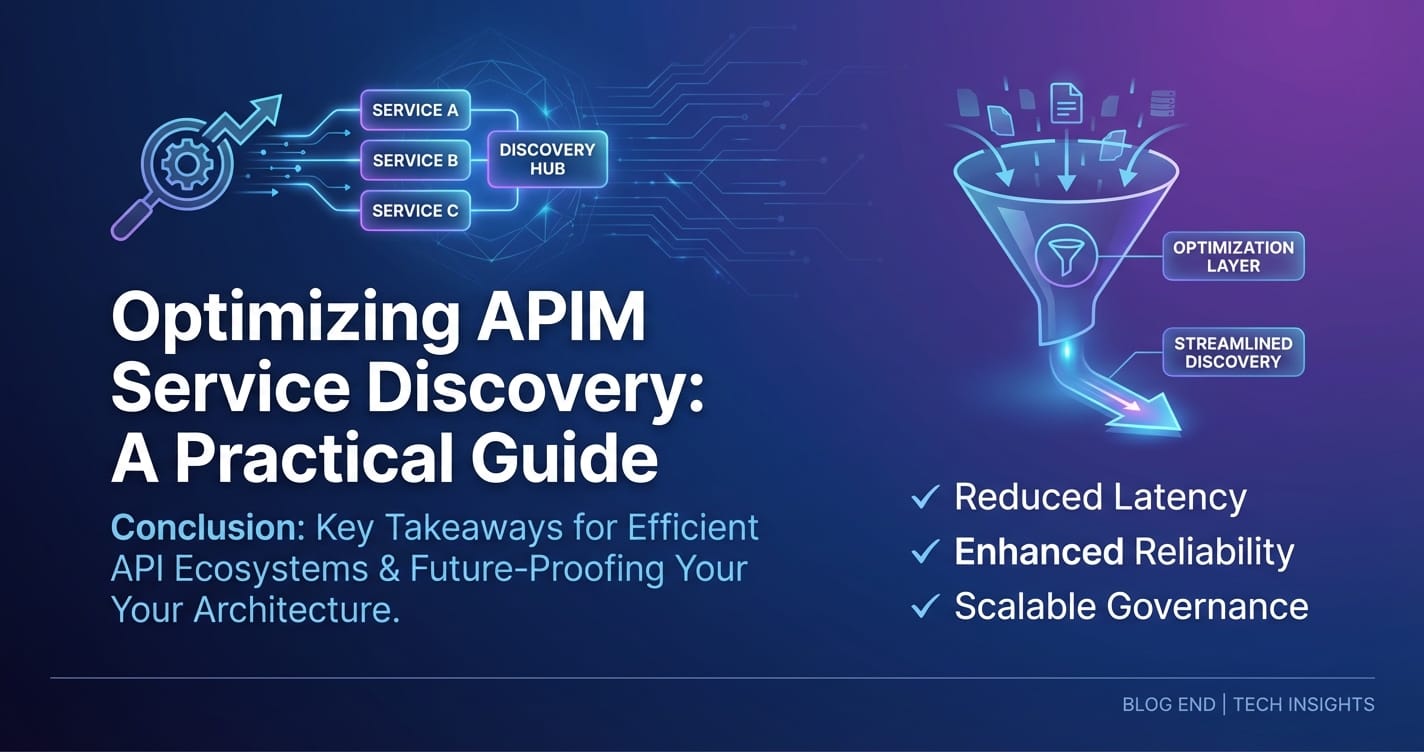
Optimizing APIM Service Discovery: A Practical Guide



Introduction: Navigating the Complexities of Modern API Landscapes
In the rapidly evolving landscape of modern software development, Application Programming Interfaces (APIs) have emerged as the fundamental building blocks for interconnectivity, enabling seamless communication between disparate systems, services, and applications. From mobile apps interacting with backend services to intricate microservice architectures and vast enterprise ecosystems, APIs are the invisible threads that weave together our digital fabric. The proliferation of these interfaces, while unlocking unprecedented agility and innovation, simultaneously introduces considerable complexity, particularly when it comes to managing their lifecycle and ensuring their discoverability. As organizations embrace cloud-native patterns, containerization, and serverless computing, the number of services and their dynamic nature amplify the challenge of knowing "who's where" and "how to talk to them."
This is where the critical concept of API service discovery enters the spotlight. In a static, monolithic application world, knowing a service's location was often a matter of hardcoding an IP address or a fixed hostname. However, in today's highly dynamic and distributed environments, service instances are spun up and down with remarkable frequency, scaling elastically based on demand, failing and recovering, or migrating across different hosts. Relying on manual configuration in such a fluid environment is not only unsustainable but also a direct path to system instability, operational overhead, and frustrating downtime. Optimized service discovery becomes the bedrock upon which resilient, scalable, and manageable API ecosystems are built. It acts as the intelligent directory that allows consumers – whether they are other microservices, client applications, or a powerful API Gateway – to locate and interact with available service instances without prior knowledge of their network locations.
This comprehensive guide delves deep into the practical strategies for optimizing API service discovery within an API Management (APIM) context. We will explore the foundational principles, dissect the inherent challenges, and provide actionable insights into building robust and efficient service discovery mechanisms. Our journey will cover the core components, various implementation patterns, advanced optimization techniques, and the pivotal role that an API Gateway plays in orchestrating this intricate dance of service location and communication. By the end, readers will possess a holistic understanding of how to architect their systems for superior API performance, resilience, and operational simplicity, ensuring that their APIs are not just available, but intelligently discoverable and reliably callable.
Chapter 1: Understanding API Management (APIM) and Service Discovery Fundamentals
To truly appreciate the intricacies of optimizing service discovery, it’s essential to first establish a firm understanding of API Management (APIM) and the fundamental principles of service discovery itself. These two concepts, while distinct, are inextricably linked in modern distributed architectures, with each profoundly influencing the effectiveness and resilience of the other.
What is API Management?
API Management refers to the process of overseeing the entire lifecycle of APIs, from their design and publication to their deployment, versioning, security, monitoring, and eventual deprecation. It encompasses a suite of tools and processes designed to make APIs easier to consume, more secure, and more resilient. The primary goal of APIM is to provide a consistent and controlled environment for API providers to publish their services and for API consumers to discover, subscribe to, and utilize those services effectively. Without robust APIM, the proliferation of APIs can quickly lead to an ungovernable tangle of integrations, security vulnerabilities, and operational nightmares.
A comprehensive API Management solution typically comprises several key components, each playing a crucial role in the overall ecosystem:
- API Gateway: This is arguably the most critical component, acting as the single entry point for all API calls. The API Gateway handles request routing, load balancing, authentication, authorization, rate limiting, caching, and often protocol translation, abstracting the complexity of the backend services from the consumers. It is the frontline defender and orchestrator of API traffic.
- Developer Portal: A self-service platform where API consumers (developers) can discover available APIs, access documentation, subscribe to APIs, test them, and manage their API keys. It fosters a vibrant developer ecosystem and simplifies API adoption.
- API Analytics and Monitoring: Tools that collect and analyze metrics related to API usage, performance, errors, and security threats. This data is vital for understanding API health, making informed business decisions, and proactively identifying issues.
- API Security: Mechanisms to protect APIs from various threats, including authentication (e.g., OAuth, API keys), authorization, threat protection (e.g., DDoS protection, injection attack prevention), and data encryption.
- API Design and Publishing Tools: Tools that assist in defining API specifications (e.g., OpenAPI/Swagger), managing versions, and publishing APIs to the developer portal and the API Gateway.
In essence, API Management provides the governance, control, and visibility necessary to transform a collection of APIs into a strategic asset. It ensures that APIs are not just built, but also consumed securely, efficiently, and at scale, driving business value and fostering innovation.
What is Service Discovery?
Service discovery is the automated process by which applications and microservices locate other services on a network. In a dynamic, distributed system, where service instances frequently change their network locations (IP addresses and ports) due to scaling events, deployments, failures, or updates, hardcoding these locations is impractical and brittle. Service discovery solves this problem by providing a mechanism for services to register their network addresses and for clients to find them by name, rather than by a static, volatile address.
The necessity for service discovery arises directly from the characteristics of modern cloud-native architectures:
- Elasticity and Scalability: Services are designed to scale horizontally, meaning new instances can be added or removed rapidly based on demand. Each new instance will have a new network address.
- Resilience and Fault Tolerance: Service instances can fail or be terminated unexpectedly. Service discovery helps route requests away from unhealthy instances and towards healthy ones.
- Dynamic Environments: Technologies like containers and Kubernetes orchestrators abstract away underlying infrastructure, leading to dynamic IP assignments and transient service instances.
- Decoupling: Service discovery allows services to be truly decoupled, as they don't need to know the physical location of their dependencies. They only need to know the logical name.
There are primarily two main types of service discovery, often employed in combination:
- Client-Side Service Discovery: In this pattern, the client (the service consumer) is responsible for querying a service registry to get the network locations of available service instances. The client then uses a load-balancing algorithm (like Round Robin) to select an instance and make the request. The intelligence resides with the client.
- Server-Side Service Discovery: Here, the client makes a request to a router or a load balancer, which then queries the service registry and forwards the request to an available service instance. The client remains unaware of the service registry and the individual instances; it only knows the address of the router. The intelligence resides with the router/load balancer.
Both approaches rely on a central component: the Service Registry. This is a database that stores the network locations of service instances. Service providers register themselves with the registry upon startup and typically send heartbeats to confirm their health and availability. Service consumers query this registry to find available instances of a particular service.
The Intersection: Service Discovery within an APIM Context
The relationship between API Management and service discovery is symbiotic and crucial. An API Gateway, as a cornerstone of APIM, inherently relies on effective service discovery to perform its primary function: routing incoming api requests to the correct backend service instances.
When an api gateway receives an api request, it doesn't typically know the exact network address of the specific microservice instance that needs to handle that request. Instead, it knows the logical name of the service (e.g., "order-service"). The api gateway then acts as a service consumer, querying the service registry to discover available instances of "order-service." Once it receives a list of healthy instances, it applies its internal load-balancing algorithms to select one and forwards the request.
This integration is powerful because:
- Abstraction: The
api gatewayabstracts the complexities of service location from both theapiconsumers (who only interact with thegateway's URL) and the backend services (who only need to register themselves). - Dynamic Routing: The
api gatewaycan dynamically adapt its routing based on the real-time availability and health of backend services as reported by the service registry. - Centralized Control: Combining service discovery with an
api gatewayallows for centralized application of policies like security, rate limiting, and analytics, regardless of where the backend services are running. - Resilience: The
gatewaycan leverage service discovery information to implement advanced resilience patterns like circuit breaking, retries, and intelligent failover, ensuring that requests are only sent to healthy and available service instances.
Without robust service discovery, an api gateway would be largely ineffective in a dynamic microservices environment, requiring constant manual updates or being susceptible to routing failures as services scale or move. Therefore, optimizing service discovery is not merely a technical detail; it is a fundamental requirement for building a high-performing, resilient, and manageable API ecosystem that leverages an API Gateway effectively.
Chapter 2: The Challenges of API Service Discovery in Modern Architectures
While the concept of service discovery elegantly addresses the dynamic nature of distributed systems, its implementation and optimization are far from trivial. Modern architectures, characterized by their scale, volatility, and inherent complexity, introduce a myriad of challenges that can hinder efficient API service discovery if not carefully addressed. Understanding these hurdles is the first step towards designing resilient and high-performing solutions.
Dynamic Environments: The Fluidity of Cloud-Native Workloads
The shift towards cloud-native paradigms, containerization with Docker, and orchestration with Kubernetes has fundamentally altered how applications are deployed and managed. In these environments, service instances are ephemeral:
- Frequent Scaling: Services are constantly scaling up or down based on demand, leading to new instances being created and old ones terminated rapidly. Each new instance often receives a dynamic IP address and port.
- Container and Pod Lifecycles: Containers and Kubernetes Pods have relatively short lifespans. They can be restarted, rescheduled, or replaced due to updates, resource constraints, or failures. This constant churn means service locations are highly transient.
- Serverless Functions: In serverless architectures, individual functions are invoked on demand, run their course, and then terminate. Their "location" is even more abstract and dynamic, managed entirely by the serverless platform.
This fluidity makes traditional, static configuration methods obsolete. Any service discovery mechanism must be highly responsive to these changes, ensuring that the service registry accurately reflects the current state of available instances in near real-time. Delays in registration or de-registration can lead to requests being routed to non-existent or unhealthy instances, causing errors and degrading user experience.
Scalability Issues: Managing a Swarm of Services
As an application scales from a few microservices to hundreds or even thousands of interconnected services, each potentially with multiple instances, the sheer volume of information that the service registry must manage becomes a significant challenge.
- Registry Overload: A service registry must handle a high volume of registration, de-registration, and heartbeat messages from all service instances. It also needs to process a constant stream of discovery queries from clients and API Gateways. The registry itself must be highly scalable and performant to avoid becoming a bottleneck.
- Network Overhead: Each heartbeat and discovery query consumes network resources. In large systems, this can lead to substantial network traffic, potentially impacting other operations and increasing operational costs.
- Data Consistency: Ensuring that all components (registry, clients, gateways) have a consistent view of the available services, especially in a distributed registry, is complex. Eventual consistency models might be acceptable, but significant delays can lead to issues.
Designing a service discovery system that can gracefully handle thousands of dynamic instances, process millions of requests per second, and maintain data consistency across a distributed registry is a non-trivial engineering feat.
Network Latency and Reliability: The Performance Imperative
The performance of service discovery directly impacts the overall latency of API calls. Every time a client or an API Gateway needs to resolve a service name to a network address, a lookup operation against the service registry occurs.
- Lookup Latency: If the service registry is slow or experiences high latency, every
apicall that relies on discovery will be delayed. This cumulative effect can significantly degrade the perceived performance of the entire system. - Registry Availability: The service registry is a single point of failure if not properly designed for high availability. If the registry goes down, clients and gateways will be unable to discover services, effectively bringing the entire application to a halt. Replicating the registry and implementing robust failover mechanisms are essential but add complexity.
- Stale Information: Even with a healthy registry, network partitions or transient communication issues can lead to clients or gateways holding stale information about service instances, resulting in connection errors or requests being sent to unavailable services.
Optimizing service discovery requires minimizing lookup times, ensuring the high availability of the registry, and implementing strategies to handle stale information gracefully, such as aggressive caching with short Time-To-Live (TTL) values.
Security Concerns: Protecting the Gates to Your Services
Service discovery mechanisms, by their very nature, expose the locations of internal services. This exposure introduces several critical security vulnerabilities if not properly secured:
- Unauthorized Access to Registry: If an attacker gains access to the service registry, they can potentially discover internal service endpoints, opening avenues for further attacks or information leakage.
- Malicious Service Registration: An attacker could register a malicious service with the registry, leading clients or gateways to route legitimate traffic to a compromised endpoint.
- Spoofing and Tampering: Without proper authentication and authorization, an attacker could spoof legitimate services or tamper with registration information, causing widespread disruption.
- DDoS Attacks on Registry: The service registry itself can be a target for Denial-of-Service attacks, which would cripple the entire service discovery process.
Robust security measures, including strong authentication and authorization for services registering with and querying the registry, network segmentation, and encryption of communication channels, are paramount. The API Gateway often plays a crucial role here, enforcing security policies before requests even reach the backend services, complementing the security of the discovery mechanism itself.
Complexity of Configuration and Maintenance
Implementing and maintaining a production-grade service discovery system adds a significant layer of operational complexity:
- Configuration Management: Managing the configuration for service registration, health checks, and client-side discovery logic across numerous services and environments can be cumbersome.
- Deployment and Orchestration: Deploying and orchestrating the service registry itself (especially a highly available, clustered one) requires expertise in distributed systems.
- Troubleshooting: Diagnosing issues in a system where services are dynamically appearing and disappearing, and where routing decisions are made based on real-time discovery, can be challenging. Problems can arise from incorrect registration, failed health checks, network issues, or registry failures.
- Version Management: As service discovery tools evolve, managing upgrades and ensuring compatibility across different components can introduce further complexity.
Simplifying these operational aspects through automation, standardized patterns, and robust observability is key to making service discovery a manageable part of the infrastructure rather than a constant source of headaches.
Hybrid and Multi-Cloud Scenarios
Many enterprises operate in hybrid cloud environments (on-premises and public cloud) or multi-cloud settings (using multiple public cloud providers). Service discovery across these disparate environments introduces additional challenges:
- Network Connectivity: Ensuring seamless and secure network connectivity between different cloud environments and on-premises data centers for the service registry and service instances.
- Latency Across Regions: Discovery lookups across geographical regions or different cloud providers can introduce significant latency.
- Unified Discovery: Establishing a unified service discovery mechanism that can span across these varied environments, allowing services in one cloud to discover services in another, requires sophisticated architecture.
- Compliance and Governance: Adhering to different compliance regulations and governance policies across multiple cloud providers and on-premises infrastructure complicates the design of a unified discovery solution.
Addressing these challenges requires careful consideration of architectural choices, often leveraging technologies like service meshes or specialized multi-cloud service discovery solutions that can bridge these environments effectively. The complexity of service discovery in modern architectures underscores the need for thoughtful design, robust tooling, and continuous optimization to ensure that APIs remain accessible, reliable, and secure.
Chapter 3: Core Components of an Optimized Service Discovery System
An optimized service discovery system is not a monolithic entity but rather a finely tuned orchestration of several interconnected components, each playing a distinct yet vital role. Understanding these core components – the service registry, service provider, service consumer, and critically, the API Gateway – is fundamental to designing a robust and efficient discovery mechanism.
Service Registry: The Central Directory
At the heart of any service discovery system lies the Service Registry. This component acts as a central database or directory that maintains a real-time, up-to-date list of all available service instances and their network locations (IP addresses and ports). Think of it as the white pages for your microservices, allowing them to find each other by name rather than a constantly changing address.
Key features and responsibilities of a service registry include:
- Service Registration: When a new service instance starts up, it registers itself with the registry, providing its service name, network address, and potentially other metadata (e.g., version, health endpoint). This can happen automatically (self-registration) or via a third-party agent.
- Service De-registration: When a service instance shuts down gracefully, it should de-register itself from the registry. This removes its entry, preventing clients from attempting to connect to an unavailable instance.
- Health Checks: To handle abrupt failures or non-graceful shutdowns, the registry (or a component working with it) periodically performs health checks on registered service instances. If an instance fails its health checks for a certain period, it is marked as unhealthy or automatically removed from the registry, ensuring that only operational services are discoverable.
- Service Lookup/Discovery: Clients and API Gateways query the registry to retrieve the network locations of service instances by their logical service name. The registry responds with a list of currently available and healthy instances.
- Event Notification (Optional): Some registries can notify clients when changes occur (e.g., a new instance comes online, an instance goes down), allowing clients to update their cached service lists proactively.
Popular examples of service registries include:
- Netflix Eureka: A highly available, client-side discovery service that provides a REST API for registration and discovery. It emphasizes availability over consistency (AP of CAP theorem).
- HashiCorp Consul: A distributed service mesh and service discovery system that offers DNS and HTTP interfaces for service discovery, a key-value store, health checks, and multi-datacenter support. It provides strong consistency guarantees.
- etcd: A distributed reliable key-value store used for the backbone of distributed systems, notably as Kubernetes' primary datastore. It can be used as a service registry by storing service metadata.
- Apache ZooKeeper: A centralized service for maintaining configuration information, naming, providing distributed synchronization, and providing group services. Often used as a robust service registry in older distributed systems.
The choice of service registry depends on factors such as required consistency, ease of deployment, integration with existing infrastructure, and specific features like multi-datacenter support or a built-in KV store.
Service Provider (Microservices): Announcing Availability
The Service Provider is the actual microservice instance that offers a particular functionality. For service discovery to work, these providers must actively participate in the registration process, making their presence known to the registry.
Their key responsibilities include:
- Registration: Upon startup, a service provider registers its unique identifier, network address (IP:Port), and the service name (e.g.,
user-service) with the service registry. This registration can be:- Self-Registration: The service instance itself contains logic to register and de-register with the registry. This is common with Eureka clients.
- Third-Party Registration: An external agent (e.g., a sidecar proxy, a Kubernetes controller) running alongside or observing the service instance is responsible for managing its registration and de-registration. This decouples the discovery logic from the service code, often seen in Kubernetes environments with
kube-dnsor Consul agents.
- Heartbeating/Health Checks: To signal its continued health and availability, a service provider typically sends periodic "heartbeat" signals to the service registry. If the registry doesn't receive a heartbeat within a configured timeout, it assumes the instance is unhealthy or has crashed and removes it from the list of available services. This mechanism is crucial for automatically pruning dead instances from the registry, ensuring that clients only discover active services. Providers might also expose a dedicated health endpoint (e.g.,
/health) that the registry or an external health checker can probe.
Service Consumer (Client/API Gateway): Finding the Right Target
The Service Consumer is any entity that needs to invoke a service provider. In the context of API Management, this can be another microservice (a client-side consumer) or, more prominently, the API Gateway itself.
Their responsibilities revolve around locating and connecting to service instances:
- Discovery Query: When a consumer needs to call a service, it queries the service registry using the service's logical name (e.g.,
product-catalog-service). - Instance Selection: The registry responds with a list of available and healthy service instances (e.g.,
product-catalog-service-1:10.0.0.1:8080,product-catalog-service-2:10.0.0.2:8080). The consumer then applies a load-balancing algorithm (e.g., round-robin, least connections, random) to select one instance from the list. - Connection and Invocation: Once an instance is selected, the consumer establishes a connection and invokes the desired API.
- Caching (Optional): To reduce latency and reliance on the registry for every call, consumers often cache the list of service instances. However, this requires a mechanism to refresh the cache to avoid using stale information.
API Gateway: The Pivotal Role in Routing and Abstraction
The API Gateway occupies a uniquely central and critical position in an optimized service discovery system. While it functions as a service consumer in the sense that it needs to discover backend services, its role extends far beyond a typical client. It acts as the intelligent facade that abstracts the entire backend infrastructure, including the dynamic nature of service discovery, from external and internal API consumers.
Its pivotal role is multi-faceted:
- Centralized Traffic Management: The
api gatewayserves as the single entry point for all incomingapirequests. It receives requests, inspects them, and then, based on routing rules, forwards them to the appropriate backend service. This centralizes traffic flow, simplifying network configuration and security enforcement. - Integration with Service Discovery: The
api gatewayis a primary user of the service registry. When a request for a service (e.g.,/api/v1/users) arrives, thegatewayconsults the service registry to find a healthy instance of theuser-service. It then intelligently routes the request to one of these discovered instances. This is a critical point of convergence for APIM and service discovery. - Decoupling Clients from Backend Services: One of the most significant benefits is that client applications (web, mobile, third-party) only need to know the
gateway's URL. They remain completely unaware of the individual microservices, their network locations, or how they are discovered. This allows backend services to scale, move, or change without impacting client code. - Enhanced Security: The
api gatewayis the first line of defense. It can enforceapisecurity policies such as authentication (e.g., JWT validation, OAuth token introspection), authorization checks,apikey validation, and rate limiting before requests are even forwarded to backend services. This protects individual service endpoints from direct exposure. - Performance and Resilience: Beyond simple routing, a sophisticated
api gatewaycan implement advanced features that enhance performance and resilience:- Load Balancing: Distributing requests evenly across discovered service instances.
- Caching: Caching responses for frequently accessed
apicalls to reduce backend load and latency. - Circuit Breakers and Retries: Preventing cascading failures by quickly failing requests to unhealthy services and automatically retrying failed requests under certain conditions.
- Request Aggregation: Combining multiple backend service calls into a single
apiresponse for certain client needs.
- API Transformation and Protocol Translation: The
gatewaycan transform request/response formats or translate between different protocols (e.g., HTTP to gRPC), allowing clients to interact with services using their preferred protocols.
The symbiotic relationship means that an effective API Gateway depends on a reliable service discovery mechanism to know where to send requests, and service discovery benefits from the gateway's centralized control and traffic management capabilities. Together, they form the backbone of a robust and scalable microservices architecture.
APIPark is a high-performance AI gateway that allows you to securely access the most comprehensive LLM APIs globally on the APIPark platform, including OpenAI, Anthropic, Mistral, Llama2, Google Gemini, and more.Try APIPark now! 👇👇👇
Chapter 4: Practical Strategies for Implementing Robust Service Discovery
Implementing robust service discovery is crucial for the health and scalability of any distributed system. This chapter explores various practical strategies, patterns, and technologies commonly employed to achieve efficient service discovery, ranging from client-side intelligence to server-side abstraction and Kubernetes-native approaches.
Client-Side Service Discovery
In the client-side service discovery pattern, the client (or a component embedded within it) is responsible for querying the service registry, retrieving a list of available service instances, and then selecting an instance to send the request to.
Mechanism: 1. Service Registration: Service instances register their network locations with a central service registry. 2. Client Query: When a client needs to call a service, it queries the service registry for instances of that service. 3. Client-Side Load Balancing: The registry returns a list of healthy instances. The client then uses a built-in load-balancing algorithm (e.g., Round Robin, Random) to choose one instance and makes the direct request.
Pros: * Simplicity: Conceptually, it's straightforward, as the client directly interacts with the registry and the service. * Fewer Moving Parts: Doesn't necessarily require an additional network hop through a dedicated load balancer for every request after the initial discovery. * Customizable Load Balancing: Clients can implement highly sophisticated, service-specific load-balancing logic.
Cons: * Tightly Coupled Clients: The service discovery logic and load balancing intelligence must be built into or integrated with every client (each microservice that acts as a consumer). This can lead to code duplication and makes client updates challenging. * Technology-Specific Client Libraries: Often requires using client libraries specific to the chosen service registry (e.g., Netflix Eureka client). * Operational Overhead: Managing and updating client-side discovery logic across numerous services can be complex.
Example: Netflix Eureka with Ribbon Netflix Eureka is a prime example of a client-side service registry. Service instances (providers) register themselves with the Eureka server. Client applications (consumers) integrate the Eureka client library, which enables them to query the Eureka server for service instances. Ribbon, another Netflix project, is a client-side load balancer that integrates with Eureka to distribute requests across the discovered instances. The client code directly calls the chosen instance.
Server-Side Service Discovery
In contrast, server-side service discovery delegates the responsibility of discovery and load balancing to a dedicated network component, typically a router, load balancer, or an API Gateway.
Mechanism: 1. Service Registration: Service instances register their network locations with a central service registry. 2. Client Request to Router: The client makes a request to a fixed, well-known address of a router/load balancer. 3. Router Query and Forwarding: The router queries the service registry to find a healthy instance of the target service. It then forwards the client's request to the chosen service instance.
Pros: * Decoupled Clients: Clients are completely unaware of the service registry and the individual service instances. They only need to know the address of the router/load balancer. This simplifies client logic and makes them easier to manage. * Centralized Management: Load balancing and discovery logic are centralized in the router, making updates and policy enforcement easier. * Language Agnostic: Clients don't need language-specific libraries for discovery; they just make standard HTTP requests to the router.
Cons: * Additional Infrastructure: Requires deploying and managing a dedicated server-side load balancer or router (e.g., Nginx, HAProxy, an API Gateway). * Single Point of Failure (if not HA): The router itself can become a single point of failure if not configured for high availability. * Increased Network Hops: Every request goes through the router, potentially adding a small amount of latency.
Example: Kubernetes Service with kube-proxy and AWS ELB * Kubernetes Service: In Kubernetes, a Service acts as a stable IP address and DNS name for a set of Pods. kube-proxy on each node ensures that traffic to the Service IP is load-balanced across the healthy Pods backing that service. The Service abstraction effectively provides server-side discovery and load balancing within the cluster. * AWS Elastic Load Balancer (ELB): When using AWS, service instances register with a service registry (e.g., DNS, or even directly with ELB). An Application Load Balancer (ALB) or Network Load Balancer (NLB) can then be configured to route requests to these registered instances. The client sends requests to the ELB's DNS name, and ELB handles the discovery and load balancing.
DNS-based Service Discovery
DNS (Domain Name System) is a foundational service discovery mechanism, universally understood and widely implemented. It can be adapted for modern service discovery, especially with advancements in dynamic DNS.
Mechanism: 1. Service Registration as DNS Records: Service instances (or their managing agents) register their network information as DNS records (A records for IP, SRV records for port and host) with a DNS server. 2. Client DNS Lookup: Clients resolve a service's logical name (e.g., my-service.local) via DNS. 3. Direct Connection: The DNS server returns the IP address (and potentially port via SRV records), and the client connects directly.
Pros: * Universally Understood: DNS is a mature and widely used technology. * Simple for Clients: Most operating systems and programming languages have built-in DNS resolvers. * Caching: DNS queries are heavily cached, reducing lookup latency after the initial resolution.
Cons: * Caching Issues: Aggressive caching can lead to clients holding stale information, especially in highly dynamic environments where service instances churn rapidly. Shortening TTLs helps but increases DNS server load. * Limited Load Balancing: Basic DNS usually only provides round-robin load balancing. Advanced load balancing strategies require more sophisticated DNS solutions (e.g., those offered by cloud providers). * Port Information: Standard A records only provide IP addresses, requiring SRV records for port information, which can complicate client implementation.
Example: CoreDNS in Kubernetes Kubernetes uses CoreDNS (or kube-dns previously) within the cluster. Every Service created in Kubernetes automatically gets a DNS entry (e.g., my-service.my-namespace.svc.cluster.local). Pods can resolve these names to the Service's cluster IP, and kube-proxy handles the load balancing to the backend Pods. This is an efficient form of DNS-based server-side discovery within the cluster.
Leveraging Kubernetes for Service Discovery
Kubernetes has become the de-facto standard for container orchestration, and it offers powerful, native service discovery capabilities that significantly simplify the management of microservices.
- Kubernetes Services: The
Serviceresource in Kubernetes provides a stable network abstraction over a dynamic set of Pods. When Pods matching aService's selector are created or terminated, theServiceautomatically updates its endpoints, ensuring that traffic is always routed to healthy, available Pods. - kube-proxy: This component runs on each Kubernetes node and is responsible for implementing the
Serviceabstraction. It watches the Kubernetes API server forServiceandEndpointSlicechanges and maintains network rules (usingiptablesor IPVS) to direct traffic arriving at aService's Cluster IP to the correct backend Pods, effectively performing server-side load balancing. - CoreDNS (or kube-dns): Kubernetes includes a DNS server that provides name resolution for
Servicesand Pods within the cluster. Pods can resolveServicenames (e.g.,my-serviceormy-service.my-namespace) to their Cluster IP. - Ingress Controllers: While
Serviceshandle internal cluster traffic, an Ingress Controller (e.g., Nginx Ingress, Traefik, Istio Ingressgateway) acts as anapi gatewayfor external traffic into the cluster. It can dynamically route external requests to internalServicesbased on rules defined in Ingress resources. These controllers rely on Kubernetes' internal service discovery to find the backendServices.
Kubernetes' integrated approach provides a highly effective and automated server-side service discovery mechanism, reducing the need for separate service registries for internal cluster communication.
Consul for Distributed Environments
HashiCorp Consul is a powerful tool that extends beyond basic service discovery, offering a comprehensive suite for service networking in distributed systems. It’s particularly well-suited for hybrid or multi-cloud environments.
Key Features: * Service Mesh Capabilities: Consul Connect enables secure service-to-service communication with mutual TLS (mTLS), identity-based authorization, and traffic management policies, acting as a lightweight service mesh. * Service Discovery: Provides a highly available and distributed service registry with a DNS interface and an HTTP API for querying. Services can register themselves via a Consul agent. * Health Checks: Robust health checking capabilities for registered services, automatically updating their status in the registry. * Key-Value Store: A flexible distributed KV store for dynamic configuration, feature flagging, and coordination. * Multi-Datacenter Support: Designed from the ground up to support service discovery and communication across multiple data centers or cloud regions, making it ideal for globally distributed applications.
Mechanism: 1. Consul Agents: Each service host runs a Consul agent. This agent automatically registers the local services with the Consul cluster, performs health checks, and forwards queries to other agents. 2. Consul Servers: A cluster of Consul servers (typically 3 or 5 for fault tolerance) stores the service registry data, manages health statuses, and handles replication across datacenters. 3. Discovery: Clients can query Consul via its DNS interface (e.g., service.consul resolves to the service's IP) or its HTTP API. Consul returns healthy service instances.
Consul’s strength lies in its ability to provide a consistent and reliable service discovery layer across complex, heterogeneous infrastructure, including virtual machines, containers, and multiple cloud providers. Its integration with an API Gateway is seamless, with the gateway querying Consul to dynamically route requests to the correct backend services, leveraging Consul's health checks and multi-datacenter awareness.
| Feature / Strategy | Client-Side Discovery | Server-Side Discovery | DNS-Based Discovery | Kubernetes Native Discovery | Consul-Based Discovery |
|---|---|---|---|---|---|
| Primary Mechanism | Client queries registry, picks instance | Router queries registry, forwards | DNS server provides IP/SRV records | K8s Service abstraction + DNS | Consul Agents + Servers |
| Intelligence Location | Client | Router/Load Balancer | DNS Resolver (Client) | K8s Control Plane + Kube-proxy | Consul Agents + Servers |
| Decoupling | Lower (clients need discovery logic) | Higher (clients unaware of registry) | Moderate (clients use DNS) | High (clients use K8s Service names) | High (clients use Consul DNS/API) |
| Load Balancing | Client-side logic (e.g., Ribbon) | Router/LB logic (e.g., Nginx, ELB) | Basic Round Robin (DNS records) | Kube-proxy (iptables/IPVS) | Consul (via DNS/Connect LB) |
| Best For | Simpler architectures, controlled clients | Complex systems, diverse clients | Static/less dynamic services | Cloud-native, containerized apps | Hybrid/Multi-cloud, Service Mesh |
| Key Advantage | Directness, client control | Centralized control, client simplicity | Universality, caching | Built-in, automated | Multi-DC, Service Mesh, KV store |
| Key Disadvantage | Client complexity, library dependency | Extra network hop, LB as SPOF (if not HA) | Stale cache issues, limited LB | K8s-only ecosystem | Operational complexity, learning curve |
| Example Tech | Netflix Eureka + Ribbon | Nginx, HAProxy, AWS ELB, Envoy | CoreDNS, external DNS providers | K8s Services, CoreDNS, Ingress | HashiCorp Consul |
Each of these strategies offers distinct advantages and trade-offs. The optimal choice often depends on the specific architectural requirements, existing infrastructure, team expertise, and the desired level of abstraction and control. For many modern cloud-native applications, a combination of these approaches, such as leveraging Kubernetes for internal service discovery and an API Gateway integrated with an external registry like Consul for external-facing APIs, provides the most robust solution.
Chapter 5: Advanced Optimization Techniques for APIM Service Discovery
Beyond the fundamental strategies, truly optimizing API service discovery in high-performance, resilient API Management contexts requires delving into advanced techniques. These methods focus on enhancing fault tolerance, improving performance, bolstering security, and ensuring comprehensive observability of the entire discovery ecosystem.
Health Checks and Circuit Breakers: Proactive Resilience
The effectiveness of service discovery hinges on its ability to accurately identify and exclude unhealthy service instances. Simply knowing where a service is located isn't enough; we need to know if it's actually capable of handling requests.
- Robust Health Checks:
- Liveness Checks: Determine if a service instance is running and responsive. These are often simple HTTP endpoints (e.g.,
/health) that return a 200 OK. If a liveness check fails, the instance should be removed from the discovery pool. - Readiness Checks: Determine if a service instance is ready to receive traffic. A service might be "live" but not "ready" (e.g., still loading configuration, connecting to a database). Readiness checks prevent traffic from being sent to instances that are not yet fully operational.
- Deep Health Checks: Beyond simple liveness, these checks might involve verifying connectivity to downstream dependencies (databases, message queues, other microservices) to ensure the service can perform its core function. However, deep checks can add overhead and complexity.
- Periodic & Configurable: Health checks must run periodically (e.g., every 5-10 seconds) with configurable timeouts and failure thresholds. Multiple consecutive failures are usually required before an instance is marked unhealthy to prevent "flapping."
- Integration with Registry: The results of these health checks must be communicated back to the service registry, which then updates the status of the service instance. The API Gateway then queries the registry and only routes requests to instances marked as healthy.
- Liveness Checks: Determine if a service instance is running and responsive. These are often simple HTTP endpoints (e.g.,
- Circuit Breaker Pattern:
- Problem: If a downstream service is struggling or unavailable, constantly sending requests to it can exacerbate the problem, consume resources on the calling service, and lead to cascading failures across the system.
- Solution: The circuit breaker pattern, inspired by electrical circuit breakers, helps prevent this. When calls to a service (discovered via the registry) consistently fail, the circuit breaker "trips" open, quickly failing subsequent calls to that service without attempting to connect. After a configurable timeout, it enters a "half-open" state, allowing a few test requests to pass through. If these succeed, the circuit "closes," and normal operation resumes.
- Impact on Discovery: Circuit breakers complement service discovery by adding an extra layer of real-time health management at the consumer (or API Gateway) level. Even if the registry hasn't yet marked an instance as unhealthy, a circuit breaker can immediately prevent further calls to a failing instance, providing faster fault isolation.
- Implementations: Libraries like Hystrix (legacy, Netflix), Resilience4j (Java), or Polly (.NET) provide robust circuit breaker implementations. Service meshes like Istio and Linkerd also offer built-in circuit breaking capabilities.
Load Balancing Strategies: Intelligent Traffic Distribution
Once service instances are discovered and deemed healthy, distributing incoming requests among them efficiently is crucial for performance and resource utilization. The API Gateway, or the client in client-side discovery, typically handles load balancing.
- Basic Strategies:
- Round Robin: Distributes requests sequentially to each server in the list. Simple and fair for homogeneous servers.
- Random: Sends requests to a randomly selected server.
- Least Connections: Directs traffic to the server with the fewest active connections, ideal for servers with varying processing times.
- Advanced Strategies (Dynamic & Context-Aware):
- Weighted Round Robin/Least Connections: Assigns weights to servers based on their capacity or performance. Servers with higher weights receive more requests.
- Latency-Based: Routes requests to the server that has historically responded fastest, suitable for geographically distributed deployments.
- Hash-Based (Consistent Hashing): Routes requests based on a hash of a request attribute (e.g., user ID, session ID) to ensure that specific client requests always go to the same server. Useful for maintaining session stickiness or caching locality.
- Zone-Aware Load Balancing: In multi-zone or multi-region deployments, this strategy prioritizes sending requests to services within the same availability zone or region to minimize latency and inter-zone data transfer costs.
- Integration with Service Discovery: These advanced strategies dynamically adapt based on the list of healthy instances provided by the service registry. A sophisticated API Gateway can monitor the performance of each discovered instance and adjust its load balancing decisions in real-time.
Caching Service Discovery Results: Boosting Performance
Repeatedly querying the service registry for every api call can introduce latency and put undue load on the registry, especially for high-volume services. Caching service discovery results at the client or API Gateway level is a common optimization.
- Mechanism:
- The client or
api gatewayretrieves a list of healthy service instances from the registry. - This list is stored in a local cache.
- Subsequent requests for the same service consult the local cache first.
- The client or
- Balancing Freshness and Performance:
- Time-To-Live (TTL): Cached entries must have a TTL. After the TTL expires, the entry is considered stale, and the client/gateway must query the registry again for the latest list.
- Short TTLs for Dynamic Environments: In highly dynamic environments (e.g., Kubernetes), shorter TTLs (e.g., 30-60 seconds) are preferred to ensure that changes in service instances (new ones, unhealthy ones) are picked up relatively quickly.
- Event-Driven Updates: Some advanced systems (e.g., Consul) allow clients to subscribe to changes in the service registry. When a change occurs, the registry can proactively push updates to registered clients, allowing them to invalidate and refresh their caches immediately, offering the best balance of freshness and performance.
- Graceful Degradation: In scenarios where the service registry itself becomes unavailable, a client or
api gatewaymight temporarily rely on its stale cached list of instances to continue operating, providing a degree of resilience during registry outages.
Security in Service Discovery: Fortifying the Foundation
Given that service discovery components reveal the internal topology of an application, securing them is paramount. A breach in this layer can expose sensitive information or lead to widespread system compromise.
- Authentication and Authorization for Registry Access:
- Service Registration: Only authorized service instances or agents should be allowed to register or modify entries in the registry. This requires strong authentication (e.g., mTLS, API tokens, OAuth) and fine-grained authorization policies.
- Service Lookup: While often less restrictive, it's prudent to authenticate and authorize clients (especially API Gateways) querying the registry, preventing unauthorized parties from mapping your internal network.
- Mutual TLS (mTLS) in Service Meshes:
- For service-to-service communication, service meshes like Istio or Linkerd automatically enforce mTLS, encrypting all traffic and verifying the identity of both the client and the server before establishing a connection. This extends identity and security down to individual service instances.
- While primarily for service-to-service, mTLS can also secure communication between service instances and the service registry.
- Network Segmentation: Deploying the service registry and internal services in a protected network segment, separated from external access points by firewalls and an API Gateway, adds a crucial layer of defense.
- Encryption of Communication: All communication channels involving the service registry (registration, heartbeats, queries) should be encrypted using TLS/SSL to prevent eavesdropping and tampering.
- Auditing and Logging: Comprehensive logging of all registration, de-registration, health check failures, and discovery queries is essential for security auditing and forensic analysis in case of a breach.
Monitoring and Alerting: The Eyes and Ears of Discovery
An optimized service discovery system isn't just about robust implementation; it's also about continuous monitoring and proactive alerting to detect and address issues before they impact users.
- Key Metrics to Monitor:
- Registry Health: CPU utilization, memory usage, network I/O, disk space for the service registry servers.
- Registration/De-registration Rates: High rates might indicate unstable services or misconfigurations.
- Number of Registered Instances: Track the number of healthy instances per service. Sudden drops indicate problems.
- Health Check Success/Failure Rates: Percentage of successful health checks. A high failure rate indicates unhealthy services.
- Discovery Lookup Latency: Time taken for clients/gateways to query the registry. High latency impacts API performance.
- Cache Hit Ratios: For cached discovery results, track how often the cache is hit versus a full registry lookup.
- Service Instance Uptime/Downtime: Track individual service instance availability.
- Monitoring Tools Integration:
- Prometheus and Grafana: Widely used for collecting metrics and visualizing them on dashboards. Service registries often expose Prometheus-compatible endpoints.
- ELK Stack (Elasticsearch, Logstash, Kibana): For centralized logging of all service discovery events, aiding in troubleshooting and security analysis.
- Distributed Tracing (e.g., OpenTelemetry, Jaeger): To trace requests across multiple services and identify bottlenecks or failures related to service discovery lookups within a complex transaction.
- Alerting: Set up alerts for critical thresholds (e.g., registry server high CPU, drop in healthy instances, spike in health check failures, high discovery lookup latency) to notify operators immediately. Proactive alerts are essential for maintaining the stability and performance of the API ecosystem.
By diligently applying these advanced optimization techniques, organizations can move beyond basic service discovery to build a highly resilient, performant, secure, and observable API Management infrastructure, capable of handling the demands of dynamic, large-scale distributed systems.
Chapter 6: The Role of an API Gateway in Service Discovery Optimization
The API Gateway is not merely a component in the API Management stack; it is the linchpin that binds external API consumers to the intricate, dynamic world of backend microservices. Its role in service discovery optimization is absolutely pivotal, acting as the intelligent intermediary that transforms complex backend topologies into a unified, stable, and secure API surface. Without a sophisticated API Gateway, even the most robust service discovery mechanism would struggle to deliver its full potential, particularly for external-facing APIs.
Centralized Traffic Management: The Single Entry Point
One of the most fundamental contributions of an API Gateway is its ability to provide a single, well-defined entry point for all API consumers. Instead of exposing individual microservice URLs and requiring clients to manage numerous endpoints, the API Gateway presents a consolidated API surface.
- Simplified Client Interaction: Clients (web browsers, mobile apps, third-party integrations) only need to know the
gateway's URL (e.g.,api.yourcompany.com). They make all their requests to this central point, regardless of how many backend services are involved or where those services reside. This dramatically simplifies client-side development and configuration. - Unified Routing: The
gatewayreceives all incoming requests and, based on its routing configuration, intelligently forwards them to the appropriate backend service. This routing logic is often based on URL paths, HTTP methods, headers, or query parameters. The integration with service discovery is critical here: thegatewayuses the service registry to resolve the logical service name (e.g.,/productsmaps toproduct-service) into a physical, healthy instance. - Abstraction of Backend Complexity: The
gatewaycompletely abstracts the underlying microservices architecture, including the service discovery mechanism, from the clients. Clients don't need to know about containers, Kubernetes pods, dynamic IPs, or health checks; they just interact with a stable, virtualized API.
Decoupling Clients from Backend Services: Enhancing Agility
The API Gateway provides a crucial layer of decoupling, isolating API consumers from the constant churn and evolution of backend services. This decoupling is a cornerstone of agile development and continuous delivery.
- Independent Service Evolution: Backend microservices can be independently developed, deployed, scaled, and refactored without impacting the client applications, as long as the API contract exposed by the
gatewayremains stable. - Dynamic Backend Changes: When new versions of services are deployed, instances are scaled up or down, or services are migrated to different infrastructure, the service discovery mechanism updates the registry. The API Gateway, being tightly integrated with this registry, automatically adapts its routing without requiring any changes on the client side. This agility is impossible without a dynamic discovery mechanism feeding the
gateway. - Graceful Degradation: If a backend service becomes unhealthy or unavailable, the
api gateway, leveraging its service discovery integration and internal health checks, can stop routing traffic to that service immediately, preventing errors from reaching the client. It can potentially redirect to a fallback service or return a cached response.
Enhanced Security: The First Line of Defense
The API Gateway serves as the primary enforcement point for API security, acting as a robust shield that protects backend services and the service discovery process itself.
- Centralized Authentication and Authorization: The
gatewaycan handle all aspects of user and application authentication (e.g., validating API keys, JWT tokens, OAuth access tokens) and authorization, ensuring that only legitimate and authorized requests reach backend services. This offloads security concerns from individual microservices. - Rate Limiting and Throttling: To protect backend services from overload and to manage API consumption, the
gatewaycan enforce rate limits, controlling how many requests a client can make within a given time frame. - Traffic Filtering and Validation: The
gatewaycan inspect incoming requests, filter out malicious payloads, validate request parameters against API schemas, and prevent common attack vectors like SQL injection or cross-site scripting (XSS). - DDoS Protection: As the single entry point, the
api gatewayis an ideal place to implement distributed denial-of-service (DDoS) protection mechanisms, filtering out malicious traffic before it impacts backend infrastructure. - Protection of Service Discovery: By sitting in front of the backend services, the
gatewayprevents external entities from directly accessing the internal service registry or individual service endpoints, significantly reducing the attack surface.
Performance and Resilience: Optimizing the Flow
Beyond security and routing, a modern API Gateway contributes significantly to the overall performance and resilience of the API ecosystem, especially when integrated with service discovery.
- Intelligent Load Balancing: The
gatewaycan implement sophisticated load-balancing algorithms (e.g., least connections, weighted round robin, latency-based) to distribute requests efficiently across the healthy service instances discovered via the registry. - Caching: The
gatewaycan cache responses for frequently accessed, immutable APIs, reducing the load on backend services and improving response times for clients. This dramatically boosts performance for read-heavy APIs. - Circuit Breakers and Retries: Similar to client-side implementations, the
gatewaycan incorporate circuit breakers to prevent cascading failures to unhealthy backend services. It can also implement intelligent retry mechanisms for transient errors, enhancing the robustness of API calls. - Request Aggregation: For certain client use cases, the
gatewaycan aggregate calls to multiple backend microservices into a single API response, reducing network chatter between the client and thegateway, and simplifying client logic. - Protocol Translation: The
gatewaycan translate between different protocols (e.g., expose a REST API to clients while communicating with backend services via gRPC), providing flexibility.
For organizations seeking a robust, open-source solution that streamlines API management and even integrates AI models seamlessly, platforms like APIPark offer comprehensive capabilities. APIPark, an AI gateway and API management platform, excels not only in unifying API formats for AI invocation but also provides end-to-end API lifecycle management, which inherently supports sophisticated service discovery. Its ability to manage traffic forwarding, load balancing, and versioning of published APIs demonstrates how a well-designed api gateway can abstract away the complexities of service discovery, offering a performant and secure entry point to diverse backend services, including a growing number of AI models. APIPark's impressive performance, rivaling Nginx, further underscores how a specialized gateway can effectively handle large-scale traffic while orchestrating dynamic service locations and ensuring seamless API interactions. By providing detailed API call logging and powerful data analysis, APIPark helps businesses maintain system stability and optimize performance, integrating tightly with the principles of effective API service discovery.
Monitoring and Analytics: Gaining Insights
As the central point of all API traffic, the API Gateway is an invaluable source of operational data and insights.
- Comprehensive Logging: The
gatewaycan log every incoming and outgoing API request, providing rich data for auditing, troubleshooting, and security analysis. - Performance Metrics: It collects metrics on API latency, error rates, throughput, and resource utilization, offering real-time visibility into API health and performance.
- Business Analytics: By correlating API usage data with business metrics, the
gatewaycan provide insights into API monetization, adoption, and overall business impact.
The API Gateway, especially one integrated with advanced service discovery mechanisms, transforms the chaotic nature of dynamic microservices into a structured, performant, and secure API landscape. It is the architectural cornerstone that enables developers to build and deploy agile, resilient, and scalable applications while providing a consistent and reliable experience for API consumers. Without its orchestrating role, optimizing service discovery would be a fragmented and significantly more challenging endeavor.
Chapter 7: Best Practices and Future Trends
Optimizing API service discovery is an ongoing journey that requires continuous refinement and adaptation to evolving technological landscapes. This chapter outlines essential best practices for maintaining robust service discovery and looks ahead at emerging trends that will shape its future.
Best Practices for Robust Service Discovery
Adhering to a set of established best practices is critical for ensuring the reliability, performance, and security of your service discovery system. These practices span across design, implementation, and operational aspects.
- Prioritize Automated Registration and De-registration:
- Eliminate Manual Intervention: Never rely on manual processes to register or de-register service instances. In dynamic environments, this is a recipe for disaster.
- Self-Registration or Third-Party Automation: Implement automated mechanisms, either within the service itself (self-registration, e.g., Eureka client) or via external orchestrators/agents (third-party registration, e.g., Kubernetes, Consul agents).
- Graceful Shutdowns: Ensure services are designed to de-register gracefully upon shutdown.
- Implement Comprehensive and Timely Health Checks:
- Liveness and Readiness Probes: Differentiate between a service being "alive" (running) and "ready" (able to handle traffic). Configure both types of probes, especially in orchestrators like Kubernetes.
- Deep Checks for Critical Paths: For highly critical services, consider checks that validate connectivity to essential downstream dependencies (databases, queues). However, balance this with the overhead it introduces.
- Appropriate Frequencies and Thresholds: Configure health check intervals, timeouts, and failure thresholds carefully. Too frequent can be overhead; too infrequent can lead to stale data. Multiple failures before removal from the registry prevent "flapping."
- Actively Communicate Status: Ensure health check results are accurately and quickly communicated back to the service registry.
- Choose the Right Service Discovery Pattern and Tools:
- Client-Side vs. Server-Side: Understand the trade-offs. Client-side offers more control but couples clients; server-side (like with an API Gateway) decouples clients and centralizes logic.
- Leverage Platform Natives: For Kubernetes, embrace its native
Serviceand DNS capabilities before introducing external registries for in-cluster communication. - Consider Purpose-Built Tools: For hybrid, multi-cloud, or advanced service mesh requirements, tools like Consul or specialized cloud provider services are highly effective.
- Architect for High Availability of the Service Registry:
- Replication: Deploy the service registry in a clustered, highly available configuration with multiple instances across different fault domains (e.g., availability zones).
- Fault Tolerance: Ensure the registry can tolerate node failures gracefully without data loss or service disruption.
- Data Persistence: For registries that store configuration or other persistent data, ensure robust backup and restore procedures.
- Prioritize Security at Every Layer:
- Authenticate and Authorize Registry Access: Restrict who can register, de-register, and query services. Implement strong authentication (mTLS, API keys) and fine-grained access control policies.
- Encrypt All Communications: Use TLS/SSL for all traffic between services, the registry, and the API Gateway.
- Network Segmentation: Isolate the service discovery infrastructure within a protected network segment.
- API Gateway as Security Enforcer: Leverage the API Gateway for centralized authentication, authorization, rate limiting, and threat protection for external-facing APIs.
- Implement Caching with Intelligent Refresh:
- Reduce Registry Load: Cache service instance lists at the client or API Gateway to reduce load on the registry and improve lookup latency.
- Short TTLs or Event-Driven Updates: Balance performance with data freshness using appropriate TTLs, or, ideally, employ event-driven mechanisms to push updates when changes occur in the registry.
- Embrace Comprehensive Monitoring and Alerting:
- Key Metrics: Monitor the health of the registry, the number of registered instances, health check success/failure rates, and discovery lookup latency.
- Centralized Logging: Aggregate all service discovery logs for easy troubleshooting and auditing.
- Proactive Alerting: Configure alerts for critical thresholds to detect issues (e.g., registry going down, sudden drop in healthy instances) before they impact end-users.
- Regularly Review and Optimize Configuration:
- Configuration as Code: Manage service discovery configuration (e.g., health check parameters, registration rules) as code to ensure consistency and version control.
- Performance Tuning: Periodically review and tune parameters for the registry and client-side logic based on observed performance and traffic patterns.
Future Trends in API Service Discovery
The landscape of service discovery is continually evolving, driven by advancements in cloud computing, network architectures, and the increasing complexity of distributed systems. Several key trends are shaping its future.
- Service Mesh Adoption:
- Ubiquitous Sidecars: Service meshes (e.g., Istio, Linkerd, Consul Connect) inject sidecar proxies alongside each service instance. These proxies transparently handle service discovery, load balancing, traffic management, circuit breaking, and mTLS without requiring changes to the application code.
- Policy-Driven Control: They offer a control plane that allows operators to define network policies, security rules, and routing configurations at a higher, more abstract level, which are then enforced by the sidecars.
- Enhanced Observability: Service meshes provide deep telemetry and tracing for service-to-service communication, making it easier to monitor and troubleshoot complex interactions.
- Shift from API Gateway to Ingress Gateway: While API Gateways remain crucial for external APIs, service meshes often provide an "ingress gateway" that integrates seamlessly with the mesh, bringing external traffic into the mesh-controlled environment.
- Serverless Functions and Service Discovery:
- Platform-Managed Discovery: In serverless architectures (AWS Lambda, Azure Functions, Google Cloud Functions), the platform itself abstracts away most traditional service discovery concerns. Functions are invoked by events or HTTP triggers, and the platform handles the underlying routing and scaling.
- Event-Driven Discovery: Discovery shifts from finding "instances" to finding "event subscribers" or "trigger points."
- Challenges: Inter-function communication and discovery of non-serverless backend services still present unique challenges, often relying on API Gateways (e.g., AWS API Gateway for Lambda) or managed service names (e.g., in AWS AppSync or Step Functions).
- Edge Computing and Decentralized Discovery:
- Services Closer to Users: With the rise of edge computing, services are increasingly deployed at the network edge, closer to end-users, reducing latency.
- Decentralized Registries: Traditional centralized service registries might introduce latency at the edge. Future trends could lean towards more decentralized, federated service discovery mechanisms, where edge locations maintain local registries and synchronize with a global view.
- Hybrid Discovery: A combination of local, geo-aware discovery and central coordination will be critical.
- AI/ML-Driven Optimization for Service Routing:
- Predictive Load Balancing: Machine learning models could analyze historical traffic patterns, service performance metrics, and user behavior to predict future demand and dynamically optimize load balancing decisions, directing traffic to instances or regions best equipped to handle it.
- Proactive Anomaly Detection: AI could proactively detect anomalies in service behavior or health check patterns that indicate an impending failure, allowing for pre-emptive traffic rerouting before a service goes down.
- Self-Optimizing Systems: The ultimate vision is a self-optimizing system where service discovery, traffic management, and resource allocation are continuously adjusted by intelligent algorithms to maintain optimal performance and resilience.
- Universal API Gateways and Unified Control Planes:
- The distinction between an API Gateway, an Ingress Controller, and a Service Mesh
gatewaymight blur further. We could see the emergence of "universal gateways" that manage all north-south (client-to-service) and east-west (service-to-service) traffic under a single, unified control plane, simplifying operational overhead and providing consistent policy enforcement.
- The distinction between an API Gateway, an Ingress Controller, and a Service Mesh
The future of API service discovery is exciting, promising even greater automation, intelligence, and resilience. By embracing these best practices and keeping an eye on emerging trends, organizations can ensure their API ecosystems remain agile, performant, and ready for the demands of tomorrow's digital world.
Conclusion: The Indispensable Backbone of Modern APIs
In the intricate tapestry of modern distributed systems, API service discovery is far more than a mere technical detail; it is the indispensable backbone that underpins the agility, resilience, and scalability of every API-driven application. From the smallest microservice to the largest enterprise architecture, the ability to dynamically locate and connect to service instances is paramount, dictating not only performance but also operational viability. We have journeyed through the foundational concepts of API Management and service discovery, unraveled the inherent complexities introduced by cloud-native environments, and explored a spectrum of practical strategies for building robust discovery mechanisms.
The core components – the service registry, service providers, and service consumers – each play a vital role, but it is the API Gateway that emerges as the orchestrator, the intelligent facade that transforms the chaotic dance of dynamic services into a unified, secure, and performant API surface for external and internal clients alike. By centralizing traffic management, decoupling clients from backend complexities, enforcing critical security policies, and optimizing performance through intelligent routing and caching, the API Gateway significantly enhances the value proposition of a well-implemented service discovery system. Solutions like APIPark exemplify this convergence, offering powerful API management features, including robust gateway capabilities and seamless AI model integration, demonstrating how a holistic approach to API governance and discovery can elevate an organization's digital capabilities.
Optimizing API service discovery is an ongoing commitment, requiring adherence to best practices such as automated registration, comprehensive health checks, thoughtful tool selection, robust security measures, and proactive monitoring. As we look to the horizon, emerging trends like ubiquitous service meshes, serverless architectures, edge computing, and AI-driven optimizations promise to further refine and automate this critical aspect of distributed computing.
Ultimately, building resilient and scalable API ecosystems is about embracing the dynamic nature of modern software. By mastering the art and science of API service discovery, integrating it seamlessly with a powerful API Gateway, and continuously adapting to new advancements, organizations can ensure their APIs are not just available, but intelligently discoverable, reliably callable, and poised to drive innovation in an ever-connected world. The journey towards optimal API performance and operational excellence begins with a solid foundation in service discovery.
Frequently Asked Questions (FAQ)
1. What is the fundamental difference between API Management and Service Discovery? API Management (APIM) is a broad discipline covering the entire lifecycle of APIs, including design, security, monitoring, and publication through tools like an API Gateway and developer portal. Service Discovery, on the other hand, is a specific mechanism within distributed systems that allows services and clients to find each other's network locations dynamically. While distinct, APIM (especially the API Gateway component) heavily relies on service discovery to route requests to the correct backend services.
2. Why is client-side service discovery often considered less desirable than server-side discovery in complex microservice architectures? Client-side service discovery requires each client (every microservice acting as a consumer) to embed discovery logic and a load balancer. This can lead to code duplication, increased complexity for client developers, and difficulty in updating discovery logic across numerous services. Server-side discovery, typically handled by an API Gateway or a dedicated load balancer, centralizes this intelligence, decoupling clients from the discovery mechanism and simplifying client development.
3. How does an API Gateway improve the security of API service discovery? An API Gateway acts as the first line of defense for all API traffic. It can enforce centralized security policies such as authentication (e.g., API keys, OAuth, JWT validation), authorization, rate limiting, and threat protection (e.g., filtering malicious payloads) before requests even reach the backend services. By abstracting the internal network topology, it prevents external clients from directly accessing the service registry or individual microservice endpoints, significantly reducing the attack surface.
4. What are the main benefits of using Kubernetes for service discovery within a cluster? Kubernetes provides native, automated server-side service discovery through its Service abstraction and internal DNS (CoreDNS). Services offer stable network endpoints for dynamic sets of Pods, with kube-proxy handling load balancing. This simplifies networking for containerized applications, as services can discover each other by logical name, eliminating the need for external service registries for in-cluster communication and reducing operational overhead.
5. What is the role of health checks and circuit breakers in optimizing service discovery, and why are they important? Health checks are crucial for ensuring that only healthy and available service instances are registered and discoverable. Liveness checks verify if a service is running, while readiness checks determine if it's ready to handle traffic. Circuit breakers complement this by preventing cascading failures; if a discovered service consistently fails, the circuit breaker "trips" open, quickly failing subsequent calls to that service without attempting to connect, thus protecting both the calling service and the struggling downstream service. Together, they ensure that discovery systems route traffic efficiently and prevent requests from being sent to faulty or overloaded instances, significantly improving system resilience.
🚀You can securely and efficiently call the OpenAI API on APIPark in just two steps:
Step 1: Deploy the APIPark AI gateway in 5 minutes.
APIPark is developed based on Golang, offering strong product performance and low development and maintenance costs. You can deploy APIPark with a single command line.
curl -sSO https://download.apipark.com/install/quick-start.sh; bash quick-start.sh

In my experience, you can see the successful deployment interface within 5 to 10 minutes. Then, you can log in to APIPark using your account.

Step 2: Call the OpenAI API.