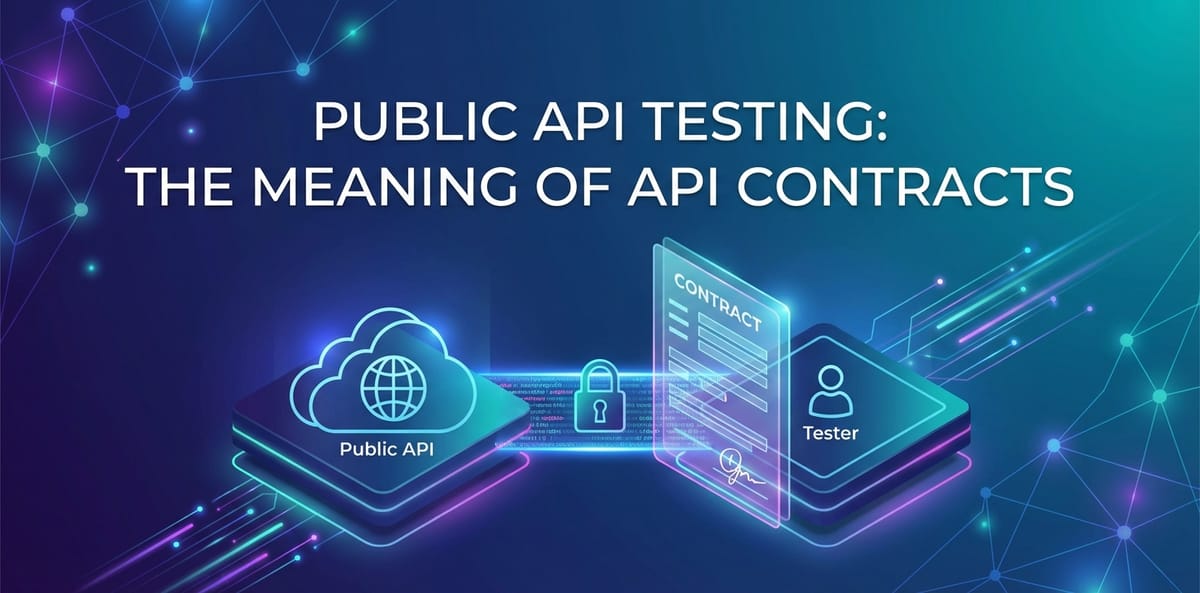
Public API Testing: The Meaning of API Contracts


In the relentlessly accelerating digital landscape, where the mantra of "everything is an API" increasingly rings true, the efficacy and reliability of interconnected systems hinge critically on how effectively Application Programming Interfaces (APIs) are designed, developed, and, most importantly, tested. Public APIs, in particular, serve as the very sinews of the modern internet, enabling unprecedented innovation, fostering vast developer ecosystems, and driving significant economic value. However, the very public nature of these interfaces introduces a unique set of complexities and challenges, making rigorous and systematic testing not merely a best practice, but an absolute imperative. At the core of this imperative lies a concept often overlooked yet profoundly impactful: the API contract. This exhaustive exploration will delve into the essence of public API testing, unraveling the foundational significance of API contracts, the transformative power of OpenAPI specifications, and the overarching framework of robust API Governance that binds these elements into a cohesive strategy for digital success.
The API Economy and the Imperative of Public APIs
The digital revolution has brought about a paradigm shift, moving away from monolithic applications towards a decentralized, service-oriented architecture. Microservices, serverless functions, and Software-as-a-Service (SaaS) platforms have become the building blocks of contemporary software development, each exposing functionalities through APIs. Public APIs stand at the vanguard of this evolution, acting as the open gateways through which different applications, services, and even entire businesses can seamlessly communicate and collaborate. They empower developers to build richer, more integrated experiences without having to reinvent the wheel, fostering an unprecedented pace of innovation.
Consider the ubiquitous payment gateways, social media integrations, mapping services, or even AI models that can be accessed and embedded into virtually any application. These are prime examples of public APIs in action, each a testament to the power of exposing functionality in a standardized and accessible manner. For businesses, public APIs are not just technical interfaces; they are strategic assets that can unlock new revenue streams, expand market reach, and cultivate vibrant developer communities around their core offerings. They democratize access to sophisticated capabilities, allowing startups and established enterprises alike to leverage powerful tools and data that would otherwise be prohibitively complex or expensive to develop in-house.
However, the advantages of public APIs come with a distinct set of responsibilities and challenges. Unlike internal APIs, which operate within a controlled environment with known consumers, public APIs are exposed to a diverse and often unpredictable audience. This lack of control over the consuming applications necessitates an extraordinary focus on stability, security, scalability, and, critically, discoverability and ease of use. A single breaking change, a performance degradation, or a security vulnerability in a widely consumed public api can have cascading effects, disrupting countless dependent applications and eroding trust within the developer community. This volatile environment makes the role of rigorous testing for public APIs not merely a suggestion but an absolute non-negotiable requirement for sustained success and credibility. Without a robust testing strategy, public APIs risk becoming liabilities rather than assets, hindering innovation instead of accelerating it.
Understanding API Contracts – The Foundational Agreement
At its heart, an API contract is a formal, machine-readable definition of how an API behaves, specifying the exact terms of interaction between a client and a server. Much like a legal contract outlines the obligations and expectations of parties involved in an agreement, an API contract establishes a clear, unambiguous understanding of the api's functionality, its inputs, and its outputs. It serves as the ultimate source of truth for an API, bridging the gap between design, implementation, and consumption. This contract isn't merely a piece of documentation; it's an executable blueprint that dictates the data formats, communication protocols, and behavioral patterns that both the API provider and the consumer must adhere to.
The components of an API contract are comprehensive, covering every facet of an api's interaction. These typically include:
- Endpoints and Operations: A precise listing of all available URIs (Uniform Resource Identifiers) and the HTTP methods (GET, POST, PUT, DELETE, etc.) that can be performed on them. This defines the range of actions a client can request from the server.
- Request Structure: This section meticulously details what the client is expected to send to the API. It encompasses:
- Headers: Specific HTTP headers required, such as
Content-Type,Authorization, or custom headers, along with their expected values or formats. - Parameters: Any query parameters, path parameters, or form parameters, specifying their names, data types (e.g., string, integer, boolean), whether they are optional or required, and any constraints (e.g., minimum length, maximum value, regular expressions).
- Body Schema: For requests that carry a payload (like POST or PUT), a detailed schema (often using JSON Schema) defines the structure, data types, and constraints for the request body. This ensures that the data sent by the client conforms to the server's expectations.
- Headers: Specific HTTP headers required, such as
- Response Structure: Equally critical, this outlines what the client can expect to receive from the API in return. It includes:
- Status Codes: A comprehensive list of possible HTTP status codes (e.g., 200 OK, 201 Created, 400 Bad Request, 500 Internal Server Error) that the API might return, each with an associated description.
- Headers: Any specific HTTP headers that the API will include in its responses.
- Body Schema: For successful responses, a schema defining the structure and data types of the response payload. Crucially, it also defines the structure of error responses for various failure scenarios, providing clients with predictable error handling mechanisms.
- Authentication/Authorization Mechanisms: How clients authenticate themselves to the API (e.g., API keys, OAuth2, JWT) and the scope of access granted based on their credentials. This is vital for security and access control.
- Rate Limiting and Throttling Policies: Details on the number of requests a client can make within a given timeframe to prevent abuse and ensure fair usage.
- Versioning Strategy: How the API evolves over time, and how different versions are managed and communicated to consumers.
- Deprecation Policies: Clear guidelines on when and how certain endpoints or features will be retired, allowing consumers to plan for necessary migrations.
It is crucial to differentiate an API contract from mere API documentation. While documentation is designed for human readability and understanding, an API contract is fundamentally machine-readable and executable. This distinction is paramount: documentation can be vague or outdated, leading to misinterpretations and integration errors. A well-defined API contract, however, provides an unambiguous and verifiable specification that can be leveraged by automated tools for validation, testing, and code generation.
The principle of "contract-first" API design emerges directly from this understanding. In this approach, the API contract is designed and agreed upon before any code is written for either the API's implementation or its consumers. This ensures that all parties—API developers, frontend developers, mobile developers, and third-party integrators—are aligned on the expected behavior from the outset. It minimizes misunderstandings, reduces rework, and accelerates development cycles by providing a stable interface for concurrent development. By establishing the contract as the authoritative source, organizations can build more resilient, maintainable, and interoperable systems.
OpenAPI (formerly Swagger) – The Industry Standard for API Contracts
The abstract concept of an API contract gains tangible form through concrete specifications, and among these, the OpenAPI Specification (OAS) stands as the undisputed industry standard for defining RESTful APIs. OpenAPI, formerly known as Swagger Specification, provides a powerful, language-agnostic interface description for REST APIs, enabling both humans and computers to discover and understand the capabilities of a service without access to source code or additional documentation. It's a foundational element for robust API Governance and testing strategies.
The history of OpenAPI traces back to the Swagger project, initiated by Tony Tam at Reverb Technologies in 2011. Its primary goal was to simplify the documentation and consumption of REST APIs. Recognizing its immense potential, a broad community formed around the specification, leading to its donation to the Linux Foundation in 2015, where it was rebranded as the OpenAPI Specification under the governance of the OpenAPI Initiative (OAI). This move signaled a commitment to fostering an open, vendor-neutral standard for describing APIs, propelling its adoption across virtually every sector of the software industry.
Key features of OpenAPI that solidify its position as the de facto standard for API contracts include:
- Descriptive Language (YAML/JSON):
OpenAPIspecifications are written in either YAML or JSON, making them human-readable yet machine-parseable. This dual nature allows developers to easily understand the contract while also enabling automated tools to process and utilize the information. The structured format ensures consistency and reduces ambiguity. - Schema Definitions: At its core,
OpenAPIheavily leverages JSON Schema to define the data models for both request and response bodies. This allows for precise specification of data types, formats, required fields, allowed values, and complex nested structures. The power of JSON Schema means that validation can be incredibly granular, catching issues like incorrect data types or missing mandatory fields before they ever reach the API implementation. - Path Definitions, Parameters, and Responses:
OpenAPIprovides clear sections to define eachapiendpoint (path), the HTTP methods supported for that path, and all associated parameters (path, query, header, cookie). For each operation, it meticulously describes the expected request body and all possible responses, including different HTTP status codes (e.g., 200 OK, 400 Bad Request) and their corresponding response body schemas. This level of detail leaves no room for guesswork regardingapibehavior. - Security Schemes: It allows for the explicit declaration of various security mechanisms, such as API keys, OAuth2, HTTP Basic authentication, and JWT (JSON Web Token). This provides a standardized way to communicate authentication requirements, which is critical for securing public APIs and enabling consistent security testing.
- Examples:
OpenAPIspecifications can include example values for requests and responses. These examples are invaluable for developers consuming theapi, as they provide concrete instances of valid data, aiding in faster integration and reducing common errors. They also serve as excellent test cases. - Reusable Components:
OpenAPIencourages modularity through reusable components. Common data schemas, parameters, response objects, and security schemes can be defined once and referenced across multiple parts of the specification, promoting consistency, reducing redundancy, and simplifying maintenance.
The benefits of utilizing OpenAPI for defining API contracts are manifold:
- Clarity and Consistency: It enforces a standardized way of describing APIs, eliminating ambiguity and ensuring that all stakeholders have a consistent understanding of the
api's interface. - Rich Tooling Ecosystem: The widespread adoption of
OpenAPIhas led to a vibrant ecosystem of tools. These tools can automatically generate interactive documentation (like Swagger UI), client SDKs in various programming languages, server stubs, and even test cases directly from theOpenAPIdefinition. This dramatically accelerates development and reduces manual effort. - Facilitates Collaboration: By providing a single source of truth,
OpenAPIenables seamless collaboration between API providers, frontend teams, mobile developers, and quality assurance engineers. All parties can work against a stable contract, even before the API is fully implemented. - Enables Automated Validation and Testing: Perhaps most critically for our discussion,
OpenAPIspecifications are machine-readable, making them perfect for automated validation. Automated tools can compare actual API requests and responses against theOpenAPIschema, instantly flagging any deviations. This forms the bedrock of contract-driven testing.
In essence, OpenAPI transforms the abstract concept of an API contract into a practical, actionable artifact. It's not just documentation; it's a living, breathing specification that drives development, testing, and API Governance throughout the entire API lifecycle.
The Crucial Role of API Contracts in Public API Testing
The strategic importance of API contracts truly comes to the fore when discussing public API testing. For public APIs, where the consumer base is vast and varied, and the potential for misuse or misunderstanding is high, adhering to a well-defined contract is paramount. The contract transforms testing from a reactive, guesswork-driven process into a proactive, specification-driven endeavor, profoundly impacting functional correctness, integration, performance, and security.
Ensuring Functional Correctness
An API contract serves as the definitive blueprint against which an API's actual implementation can be validated. * Contract Validation During Development: By integrating contract validation into the early stages of the development lifecycle, developers can ensure that the code they write precisely matches the agreed-upon contract. This "shift-left" approach catches inconsistencies and errors much earlier, reducing the cost and effort of fixing them later. Tools can automatically compare the deployed api's metadata or even its runtime behavior against the OpenAPI specification. * Schema Validation for Requests and Responses in Tests: A core benefit of machine-readable contracts like OpenAPI is their ability to enable automated schema validation. During functional testing, every incoming request can be validated against the request schema defined in the contract to ensure it's well-formed and contains valid data. Similarly, every outgoing response can be validated against the response schema to guarantee that the API is returning data in the expected format, with correct types and all required fields. This prevents malformed requests from reaching the api's business logic and ensures that consumers always receive predictable and correctly structured data. * Preventing Regressions: Tests Based on Contract: Contract-driven tests are inherently robust against regressions. When a contract is established, a suite of tests can be built directly from it. If a developer inadvertently introduces a change that violates the contract (e.g., changes a field name, alters a data type, or removes a required parameter), the contract tests will immediately fail, signaling a breaking change. This protects consumers from unexpected disruptions and maintains the stability crucial for public APIs.
Facilitating Integration Testing
Integration testing for public APIs can be notoriously complex due to the external dependencies and the need to coordinate between disparate teams or organizations. API contracts significantly simplify this by providing a stable interface for interaction. * Consumer-Driven Contract Testing (CDCT): In CDCT, the consumers of an API define their expectations of the api's behavior in the form of contracts. The API provider then runs tests against these consumer contracts to ensure their implementation meets those expectations. This is particularly valuable for public APIs, as it ensures that the API remains compatible with its diverse consumer base. It minimizes the risk of breaking changes for specific consumers and allows providers to understand the real-world usage patterns. * Provider-Driven Contract Testing (PDCT): Conversely, PDCT involves the API provider writing tests to verify that its own API implementation adheres to its declared OpenAPI contract. This ensures internal consistency and confirms that the API is delivering what it promises to deliver. * Reducing Integration Friction: By having a clear, machine-readable contract, both the provider and the consumer can independently develop and test their respective systems. Consumers can generate mock servers based on the OpenAPI contract, allowing them to develop and test their client applications without needing the actual API to be fully implemented or available. This dramatically reduces integration friction and accelerates parallel development efforts.
Enabling Performance and Load Testing
API contracts also play a critical, albeit often underestimated, role in performance and load testing. * Generating Realistic Test Data and Request Patterns: The detailed schemas within an OpenAPI contract provide all the necessary information to generate realistic and valid test data for performance testing. Tools can parse the contract to create a diverse range of requests that mimic real-world usage, covering various valid input combinations and edge cases. This ensures that load tests accurately simulate actual client interactions. * Identifying Bottlenecks Against Expected Behavior: By using contract-defined requests, performance tests can precisely measure how the API behaves under stress, identifying bottlenecks, latency issues, and scalability limits. Comparing actual response times and error rates against expected service level objectives (SLOs) defined implicitly or explicitly within the context of the contract helps to ensure the api can handle production-level loads while adhering to its functional contract.
Boosting Security Testing
Security is paramount for public APIs. API contracts are instrumental in establishing and enforcing security policies and conducting effective security testing. * Verifying Authentication/Authorization Mechanisms: An OpenAPI contract clearly specifies the required authentication and authorization schemes for each endpoint. Security tests can directly validate whether these mechanisms are correctly implemented and enforced, ensuring that only authorized requests with valid credentials can access protected resources. This helps prevent unauthorized access and data breaches. * Input Validation Against Schema to Prevent Injection Attacks: The detailed request body and parameter schemas in an OpenAPI contract are a powerful defense against various injection attacks (e.g., SQL injection, XSS). Security testing tools can use these schemas to craft malicious inputs that violate the schema constraints and then observe how the api handles them. If the api fails to properly validate inputs against the contract, it indicates a vulnerability that could be exploited. * API Governance Perspective: Ensuring Security Policies are Enforced: From an API Governance standpoint, contracts serve as a tangible way to enforce organizational security policies. By mandating that all public APIs adhere to a contract that specifies robust authentication, strict input validation, and proper error handling, organizations can ensure a baseline level of security across their entire API portfolio.
Streamlining Usability and Developer Experience (DX)
Beyond technical correctness, API contracts significantly enhance the usability and developer experience (DX) of public APIs. * Clear Contracts Lead to Better Client SDKs and Intuitive Usage: A well-defined OpenAPI contract allows for the automated generation of high-quality client SDKs in multiple programming languages. These SDKs encapsulate the complexities of API interaction, providing developers with an intuitive, type-safe interface. This reduces the learning curve and time-to-integration for consumers. * Reducing "Trial and Error" for Consumers: With a precise contract, developers consuming the API don't have to resort to guesswork or extensive trial and error to understand how to interact with it. The contract explicitly states what to send and what to expect, making the integration process smooth and efficient. This improves developer satisfaction and encourages broader adoption of the public api.
In summary, API contracts elevate public API testing from a reactive measure to a proactive, integral part of the development lifecycle. They provide the necessary clarity, consistency, and automation potential to build, test, and maintain public APIs that are not only functionally correct and secure but also robust, scalable, and a pleasure for developers to use.
APIPark is a high-performance AI gateway that allows you to securely access the most comprehensive LLM APIs globally on the APIPark platform, including OpenAI, Anthropic, Mistral, Llama2, Google Gemini, and more.Try APIPark now! 👇👇👇
Strategies and Best Practices for Public API Contract Testing
Implementing effective public API contract testing requires a strategic approach that integrates the contract throughout the API lifecycle. It’s not just about having a contract; it’s about actively leveraging it to drive quality and consistency.
Contract-First Development
This is perhaps the most fundamental best practice. Instead of writing the API code and then documenting it (code-first), the contract-first approach dictates that the OpenAPI specification (or equivalent contract) is designed and finalized before any implementation code is written. This ensures that the API design is well-thought-out, consistent, and agreed upon by all stakeholders—including API providers, consumers, and business analysts—from the outset. It promotes clear communication, reduces rework, and enables parallel development, as consumers can start building against mock servers generated from the contract while the provider implements the actual api.
Automated Contract Validation
Integrating automated contract validation into the Continuous Integration/Continuous Deployment (CI/CD) pipeline is crucial. Every time changes are pushed to the API code, or even to the contract itself, automated checks should run to verify compliance. * Schema Validation: Tools should automatically validate that API requests and responses at runtime conform to the defined schemas in the OpenAPI specification. This can happen at the API Gateway level, within unit tests, integration tests, or end-to-end tests. * Structure and Syntax Validation: The OpenAPI document itself should be validated for correct syntax and structure, ensuring it adheres to the OpenAPI Specification rules.
Version Control for Contracts
API contracts should be treated as first-class artifacts and managed under version control (e.g., Git) alongside the API's source code. This practice offers several benefits: * History and Auditability: Provides a complete history of changes to the API's interface, allowing teams to track evolution and revert to previous versions if needed. * Collaboration: Facilitates collaborative editing and review of contracts among different teams using standard code review workflows. * Automated Tooling: Enables CI/CD pipelines to automatically retrieve the correct contract version for testing, documentation generation, and other automated tasks.
Consumer-Driven Contract Testing (CDCT)
CDCT is an advanced form of contract testing that ensures an API provider's service meets the expectations of its consumers. * Explanation: Consumers define their specific needs (contracts) for the API. These "consumer contracts" describe the minimum expected behavior from the api necessary for the consumer to function correctly. The API provider then runs automated tests to verify that its implementation satisfies all these consumer-defined contracts. * Tools: Popular tools for CDCT include Pact (a language-agnostic framework) and Spring Cloud Contract (for Spring-based applications). * Benefits for Public APIs: For public APIs with numerous diverse consumers, CDCT is invaluable. It helps providers understand how their API is actually being consumed and ensures that changes don't inadvertently break existing client applications. This collaborative approach fosters trust and significantly reduces the risk of breaking changes in a public api ecosystem.
Provider-Driven Contract Testing (PDCT)
While CDCT focuses on consumer expectations, PDCT ensures that the API provider's implementation adheres to its own published contract (e.g., the OpenAPI specification). * Explanation: The provider writes tests that validate its API against the OpenAPI document it publishes. These tests check if the endpoints exist, parameters are correctly handled, and responses conform to the defined schemas and status codes. * Tools: Tools like Postman (with Newman for automation), Karate DSL, Rest-Assured, and dedicated OpenAPI validators can be used for PDCT. Many API gateways also have built-in capabilities to validate incoming requests against OpenAPI schemas.
Mocking and Stubbing
Generating dynamic mock servers from OpenAPI specifications is a powerful technique for accelerating client-side development and testing. * Benefits: * Decoupled Development: Consumers can develop and test their applications against a realistic mock API even when the actual api is not yet available or is undergoing maintenance. * Controlled Environments: Mocks allow testers to simulate various api behaviors, including error conditions, specific data responses, and edge cases, which might be difficult to reproduce in a live environment. * Faster Feedback Cycles: Developers get immediate feedback without waiting for actual API deployments. * Tools: Tools like Prism (from Stoplight), OpenAPI Mock, or even custom mock servers can parse an OpenAPI spec and generate dynamic responses based on defined examples or schemas.
Continuous Monitoring and Alerting
Even after deployment, the contract compliance of public APIs should be continuously monitored. * Runtime Validation: Implement runtime validation at the API gateway or within the api itself to ensure that all requests and responses conform to the contract even in production. * Performance Monitoring: Track key performance indicators (KPIs) like latency, error rates, and throughput. Deviations from expected performance, often defined in the context of the api's contract, should trigger alerts. * Proactive Alerts: Set up alerts for any contract violations detected in production. This allows for immediate action to rectify issues before they impact a large number of consumers.
Establishing API Governance Policies
Effective API Governance provides the overarching framework for managing and enforcing API contracts across an organization. * Standardization: Define clear guidelines and standards for API design, documentation (using OpenAPI), security, and testing. These policies ensure consistency across all public APIs. * Compliance: Establish processes to audit and ensure that all new and existing APIs comply with these governance policies, including mandatory contract-first design and automated contract testing. * Version Management: Define a clear strategy for versioning APIs and managing deprecation, ensuring consumers are well-informed about changes. * The Role of Platforms: Platforms like APIPark are instrumental in enforcing robust API Governance. By offering end-to-end API lifecycle management, from design and publication to invocation and decommission, APIPark helps regulate API management processes, manage traffic, load balancing, and versioning of published APIs. Its capability to unify API formats for AI invocation and centralize API service sharing within teams directly supports the enforcement of consistent API contracts and adherence to governance standards across an organization. Organizations can leverage such platforms to ensure their public APIs are not only performant and secure but also consistently governed by well-defined contracts.
By embracing these strategies and best practices, organizations can build a resilient, trustworthy, and scalable public API ecosystem that leverages the full power of API contracts to drive innovation and maintain long-term success.
The Synergy of API Contracts and Robust API Governance
While API contracts provide the precise technical blueprint for individual APIs, API Governance offers the strategic framework that ensures these contracts are consistently applied, managed, and adhered to across an entire organization's API portfolio. API Governance encompasses the rules, processes, and tools that dictate how APIs are designed, developed, deployed, consumed, and retired, ultimately ensuring their quality, security, and consistency. The relationship between API contracts and API Governance is deeply symbiotic; one cannot truly flourish without the other.
An organization's API Governance strategy is intrinsically linked to its commitment to API contracts. Contracts serve as the tangible expression of governance policies, transforming abstract rules into verifiable specifications.
Here’s how API contracts are central to robust API Governance:
- Standardization of Design and Documentation:
API Governancemandates consistent design principles (e.g., RESTful conventions, consistent naming schemes) and standardized documentation formats.OpenAPIspecifications directly fulfill this requirement by providing a universal, machine-readable format for describing API interfaces. By enforcing the use ofOpenAPIfor all public APIs, governance ensures a uniform approach to design and documentation, making APIs easier to understand, consume, and maintain across the enterprise. - Enforcement of Security Policies: A critical aspect of
API Governanceis ensuring API security. Contracts allow organizations to formally define and enforce security requirements, such as specific authentication methods (e.g., OAuth2, API keys), authorization scopes, and data encryption standards. Governance dictates that these security schemes must be included in theOpenAPIcontract, and subsequent automated testing verifies their implementation. This provides a clear, auditable trail for security compliance. - Facilitating Versioning and Deprecation Strategies:
API Governanceestablishes policies for how APIs evolve, how new versions are introduced, and how old versions are gracefully retired. API contracts, particularly through their capacity to define breaking changes and provide clear versioning metadata, are crucial for communicating these strategies. Governance ensures that contract updates align with versioning policies, and that deprecated features are clearly marked, allowing consumers sufficient time to adapt. - Improving Discoverability and Reusability: Well-defined contracts, especially when combined with a centralized
APIcatalog, significantly enhance API discoverability.API Governancepromotes the creation of such catalogs, often powered byOpenAPIspecifications, making it easier for internal and external developers to find and understand available APIs. This, in turn, fosters reusability, reducing redundant development efforts and accelerating innovation.
The consequences of poor API Governance are severe and far-reaching. Without a governing framework, organizations risk falling into a state of "API sprawl," characterized by: * Inconsistent APIs: Different teams or business units might develop APIs with varying design patterns, data formats, and error handling mechanisms, leading to a fragmented and confusing developer experience. * Security Vulnerabilities: Lack of standardized security practices, not enforced through contracts, can expose APIs to critical vulnerabilities, leading to data breaches and reputational damage. * Increased Development Costs: Duplication of effort, integration headaches, and the constant need to fix issues arising from inconsistent APIs inflate development and maintenance costs. * Poor Developer Experience (DX): Consumers struggle to integrate with inconsistent, poorly documented, or unreliable APIs, leading to frustration, reduced adoption, and a negative perception of the organization's digital offerings.
This is where API management platforms become indispensable in establishing and enforcing robust API Governance. As an all-in-one AI gateway and API developer portal, APIPark plays a pivotal role in this landscape. APIPark provides end-to-end API lifecycle management, encompassing design, publication, invocation, and decommission. This comprehensive approach is foundational to robust API Governance, as it ensures that governance policies are applied at every stage of an API's existence. Its features, such as the ability to unify api formats for AI invocation and offer centralized api service sharing within teams, directly contribute to enforcing consistency and control, which are core tenets of strong governance. Furthermore, by managing traffic forwarding, load balancing, and versioning of published APIs, APIPark enables organizations to regulate api management processes effectively. For enterprises striving for a coherent, secure, and high-quality API ecosystem, platforms like APIPark provide the necessary infrastructure and tools to operationalize their API Governance strategy, transforming abstract principles into concrete, managed realities. By leveraging such platforms, organizations can ensure that their API contracts are not just documents, but actively enforced agreements that drive the quality and reliability of their public APIs.
Tooling and Ecosystem for OpenAPI and Contract Testing
The power of OpenAPI and API contract testing is magnified by a rich and rapidly evolving ecosystem of tools that automate various stages of the API lifecycle. These tools cater to different aspects, from design and documentation to testing and API management.
Design Tools
These tools help in creating, editing, and validating OpenAPI specifications. * Swagger Editor: A web-based editor for writing and validating OpenAPI specifications in YAML or JSON. It provides real-time feedback and renders interactive documentation as you type. * Stoplight Studio: A comprehensive desktop application and web platform for API design, documentation, and governance. It offers a visual editor for OpenAPI, mock server capabilities, and collaboration features. * OpenAPI Generator: A command-line tool that can generate client SDKs, server stubs, and documentation in various programming languages directly from an OpenAPI specification. This significantly accelerates development by automating boilerplate code generation.
Testing Frameworks
These tools and frameworks are used to execute API tests, often leveraging the OpenAPI contract for definition and validation. * Postman: A widely popular API development environment that allows users to send requests, inspect responses, and organize API calls into collections. Its scripting capabilities enable comprehensive manual and automated testing, including validating responses against schemas. Newman is Postman's command-line collection runner, ideal for integrating Postman tests into CI/CD pipelines. * Karate DSL: A powerful open-source API test automation framework that supports testing REST/GraphQL APIs, web services, and even UI automation. It uses a BDD (Behavior-Driven Development) syntax, making tests highly readable and maintainable. Karate can directly consume OpenAPI specifications to generate and validate tests. * Rest-Assured: A Java library that provides a BDD-style syntax for testing REST services. It's highly flexible and integrates well with existing Java testing frameworks like JUnit and TestNG, allowing for robust, code-driven API testing and contract validation. * Cypress: Primarily a frontend testing tool, Cypress can also be effectively used for API testing, especially in end-to-end scenarios where frontend interactions trigger API calls. It allows for intercepting and stubbing network requests, making it valuable for comprehensive integration tests.
Contract Testing Tools
Specifically designed for implementing Consumer-Driven Contract Testing (CDCT) or Provider-Driven Contract Testing (PDCT). * Pact: The most prominent open-source tool for Consumer-Driven Contract Testing. Pact enables consumers to define their expectations of a provider api in a 'pact' file, which the provider then uses to verify its implementation. It supports many programming languages and fosters a collaborative approach to integration. * Spring Cloud Contract: A framework that facilitates contract-first development and testing for Spring-based applications. It supports both consumer-driven and provider-driven approaches, allowing teams to generate tests, stubs, and even client code from a single contract definition.
Mocking Tools
Tools that create simulated API responses based on an OpenAPI specification, ideal for decoupled development and testing. * WireMock: A flexible library for stubbing and mocking HTTP-based APIs. While not exclusively OpenAPI-driven, it can be configured to return responses based on request matching patterns, which can be derived from contract specifications. * Prism (from Stoplight): A mock server that automatically generates API responses based on an OpenAPI specification. It supports dynamic responses, including validation of requests and generation of examples, making it an excellent tool for developing against an api before it's built. * OpenAPI Mock: A simple tool to create mock servers from OpenAPI specification files, allowing developers to quickly simulate API behavior.
API Gateways & Management Platforms
These platforms leverage OpenAPI specifications for critical functionalities like routing, policy enforcement, documentation serving, and API lifecycle management. They are crucial for orchestrating API Governance.
In this category, APIPark stands out as an all-in-one AI gateway and API developer portal. APIPark is designed to help developers and enterprises manage, integrate, and deploy AI and REST services with ease. Its features are directly beneficial for organizations employing OpenAPI and contract-driven testing strategies:
| Feature Category | APIPark Feature | Relevance to OpenAPI & Contract Testing |
|---|---|---|
| API Lifecycle Management | End-to-End API Lifecycle Management: Design, Publication, Invocation, Decommission. | Ensures contracts are enforced at every stage, from initial design (where OpenAPI is created) to retirement, maintaining consistency and API Governance. |
| Standardization & Consistency | Unified API Format for AI Invocation; Prompt Encapsulation into REST API. | Helps standardize API interfaces, aligning perfectly with OpenAPI's goal of consistent API descriptions. This reduces ambiguity and simplifies contract validation. |
| Developer Experience | API Service Sharing within Teams; API Developer Portal. | A centralized portal (often powered by OpenAPI docs) enhances discoverability and usability, making it easier for consumers to access and understand API contracts. |
| Performance & Reliability | Performance Rivaling Nginx (20,000+ TPS); Detailed API Call Logging. | While not directly an OpenAPI tool, high performance and detailed logging are crucial for operating APIs that adhere to their performance contracts and for debugging contract-related issues. |
| Security & Governance | API Resource Access Requires Approval; Independent API and Access Permissions for Each Tenant. | Enables robust API Governance by controlling access and enforcing security policies, which are often defined within the security schemes of an OpenAPI contract. Logs help trace unauthorized attempts. |
APIPark facilitates robust API Governance by providing a centralized platform for managing all aspects of an API. It can leverage OpenAPI definitions to enforce traffic policies, manage API versions, and serve interactive documentation, thereby streamlining the process of ensuring that public APIs adhere to their contracts and organizational standards. With its quick deployment and focus on both traditional REST and AI apis, APIPark empowers organizations to operationalize their OpenAPI and contract-driven strategies efficiently.
This rich ecosystem of tools empowers developers and organizations to fully embrace OpenAPI and contract testing, transforming API development into a more predictable, reliable, and secure process, particularly critical for the public APIs that form the backbone of the digital economy.
The Future of API Contracts and Public API Testing
The landscape of API development and integration is perpetually evolving, and with it, the role of API contracts and public API testing. As systems become even more distributed, dynamic, and intelligent, the significance of precise, machine-readable agreements will only intensify. The future promises further sophistication, automation, and integration of contracts into every facet of the software lifecycle.
One clear direction is the evolution of specifications beyond traditional REST. While OpenAPI remains the dominant force for RESTful APIs, the rise of event-driven architectures and streaming data necessitates new contract specifications. AsyncAPI is rapidly gaining traction as the OpenAPI for event-driven APIs, allowing developers to describe message formats, channels, and protocols for systems like Kafka, RabbitMQ, and WebSockets. As public APIs increasingly adopt event-driven paradigms, standards like AsyncAPI will become equally vital for ensuring reliable communication and enabling contract testing in real-time streaming environments.
AI-driven contract generation and validation are on the horizon. Imagine AI models capable of analyzing existing codebases, network traffic, or even natural language descriptions to automatically generate initial OpenAPI specifications. Conversely, AI could be employed to intelligently audit existing OpenAPI documents for inconsistencies, potential vulnerabilities, or deviations from best practices, providing proactive feedback to API designers. This could significantly reduce the manual effort involved in contract creation and maintenance, making contract-first design even more accessible.
Increased automation and shift-left testing will continue to be a dominant trend. The goal is to detect and prevent contract violations as early as possible in the development cycle. This means deeper integration of contract testing tools directly into IDEs, build tools, and CI/CD pipelines, providing instantaneous feedback to developers. Automated tools will not only validate against the contract but also generate comprehensive test suites, mock servers, and even regression tests automatically whenever a contract changes, minimizing manual test writing.
The growing importance of API security testing tied to contracts cannot be overstated. As public APIs become prime targets for cyberattacks, security testing will become more sophisticated and contract-aware. Future tools will leverage OpenAPI definitions to automatically identify potential injection points, authentication flaws, and authorization bypasses based on the specified security schemes and data models. Contract-driven security scanning will move beyond generic vulnerability checks to highly targeted, context-aware assessments, ensuring that security measures are precisely aligned with the API's defined interface.
Finally, we might see a rise in micro-contracts and granular testing. Instead of one monolithic OpenAPI file for an entire service, future approaches might involve more granular contracts for individual operations or even specific data components. This could enable highly precise, isolated testing and validation, especially beneficial in highly distributed microservice environments where individual components evolve rapidly. This level of granularity would allow for extremely targeted testing, ensuring that changes to one small part of an api only trigger revalidation of its specific contract, rather than the entire service.
The journey towards truly reliable and resilient public APIs is continuous. The evolution of API contracts, the tools that support them, and the API Governance frameworks that encompass them will collectively shape the future of interconnected digital systems, ensuring that innovation can thrive on a foundation of trust and predictability.
Conclusion
In an era defined by hyper-connectivity and pervasive digital interaction, the reliability and integrity of public APIs are paramount. They are not merely technical interfaces but strategic assets that underpin entire digital ecosystems, fostering innovation and driving economic growth. The journey to building and maintaining such robust public APIs begins and ends with a profound understanding and diligent application of API contracts.
API contracts serve as the foundational agreement between API providers and consumers, precisely defining the operational parameters, data structures, and behavioral expectations of an API. They eliminate ambiguity, prevent misinterpretations, and establish a single source of truth that guides every stage of the API lifecycle. The OpenAPI Specification has emerged as the indispensable industry standard for formalizing these contracts, providing a machine-readable, language-agnostic format that unlocks a vast ecosystem of tools for automated documentation, code generation, and, crucially, testing.
Robust public API testing is inseparable from API contracts. Contracts enable systematic validation of functional correctness, streamline complex integration efforts through consumer-driven and provider-driven approaches, facilitate realistic performance and load testing, and significantly enhance API security by enforcing strict input validation and authentication mechanisms. Moreover, clear contracts dramatically improve the developer experience, making APIs more usable, discoverable, and enjoyable to integrate.
However, the mere existence of API contracts is insufficient. Their true power is unleashed when embedded within a comprehensive framework of API Governance. Governance ensures that contracts are consistently applied, enforced, and managed across an organization's entire API portfolio, mandating adherence to standards, security policies, and versioning strategies. Platforms like APIPark exemplify the tooling that enables organizations to operationalize their API Governance strategies, providing end-to-end API lifecycle management, unified formats, and centralized control essential for maintaining high-quality public APIs.
In summary, investing in contract-driven development and testing, fueled by OpenAPI and fortified by robust API Governance, is not just a technical choice; it is a strategic imperative. It is an investment in the reliability, security, scalability, and future-proofing of public APIs, ensuring that they remain engines of innovation and cornerstones of the interconnected digital landscape for years to come. The future of the API economy hinges on our collective ability to define, honor, and rigorously test these vital digital agreements.
Frequently Asked Questions (FAQ)
1. What is an API Contract and why is it so important for Public APIs? An API contract is a formal, machine-readable specification that defines the exact terms of interaction between an API client and server, detailing endpoints, request/response structures (schemas, headers, parameters, status codes), authentication methods, and error formats. For public APIs, it's critically important because it provides an unambiguous, universal agreement for a diverse, unknown consumer base. This contract ensures clarity, consistency, and predictability, minimizing integration errors, facilitating automated testing, and safeguarding against breaking changes that could impact numerous dependent applications. It acts as the ultimate source of truth, establishing trust and reliability.
2. How does OpenAPI (formerly Swagger) relate to API Contracts and API Governance? OpenAPI Specification (OAS) is the industry-s Open Standard for defining RESTful API contracts in a machine-readable format (YAML or JSON). It provides the concrete language to describe all aspects of an API contract, from data schemas to security schemes. OpenAPI is central to API Governance because it standardizes API descriptions across an organization, enabling consistent design, automated documentation, test generation, and policy enforcement. By mandating OpenAPI usage, API Governance ensures that all APIs adhere to a common, verifiable standard, improving quality, security, and discoverability.
3. What is the difference between Consumer-Driven Contract Testing (CDCT) and Provider-Driven Contract Testing (PDCT) in the context of public APIs? * Consumer-Driven Contract Testing (CDCT): In CDCT, the consumers of a public API define their specific expectations (contracts) for how the API should behave. The API provider then runs tests to verify that its actual implementation satisfies these consumer-defined contracts. This approach is highly valuable for public APIs as it ensures backward compatibility and prevents providers from inadvertently introducing changes that break existing client applications, fostering trust within the developer ecosystem. * Provider-Driven Contract Testing (PDCT): In PDCT, the API provider's internal tests verify that its API implementation adheres to its own published API contract, typically an OpenAPI specification. This ensures internal consistency and confirms that the API delivers what it promises to deliver according to its own documentation. Both CDCT and PDCT are crucial for comprehensive public API testing, providing different perspectives on contract compliance.
4. How can API Management platforms like APIPark assist with API Governance and contract enforcement? API Management platforms like APIPark are instrumental in operationalizing API Governance and enforcing contracts. They provide centralized control over the entire API lifecycle, from design to decommissioning. APIPark, for example, helps regulate API management processes, manage traffic, load balancing, and versioning, all of which are critical for governance. By supporting unified API formats, centralized sharing of services, and access approval mechanisms, such platforms ensure that API contracts are not just documents but actively enforced agreements. They can leverage OpenAPI definitions to automatically validate requests/responses, generate documentation, and apply security policies, thereby enhancing API quality, security, and consistency across the enterprise.
5. What are some best practices for implementing API Contract Testing effectively for public APIs? Effective API Contract Testing for public APIs involves several best practices: 1. Contract-First Development: Design and finalize the OpenAPI contract before writing any API implementation code. 2. Automated Contract Validation: Integrate contract validation into CI/CD pipelines to automatically verify OpenAPI syntax, schema conformity, and runtime request/response adherence. 3. Version Control for Contracts: Treat API contracts as code, managing them in version control systems (e.g., Git) alongside source code. 4. Implement CDCT and PDCT: Utilize both Consumer-Driven Contract Testing (using tools like Pact) and Provider-Driven Contract Testing (validating against your OpenAPI spec) to ensure comprehensive contract compliance from both consumer and provider perspectives. 5. Leverage Mocking: Generate mock servers from OpenAPI specifications to enable parallel development and allow consumers to test against stable interfaces without waiting for the actual API. 6. Continuous Monitoring: Implement runtime monitoring for contract deviations and performance metrics in production, with alerts for immediate issue detection. 7. Strong API Governance: Establish clear policies and processes to standardize API design, security, and documentation, ensuring all public APIs adhere to these governed contracts.
🚀You can securely and efficiently call the OpenAI API on APIPark in just two steps:
Step 1: Deploy the APIPark AI gateway in 5 minutes.
APIPark is developed based on Golang, offering strong product performance and low development and maintenance costs. You can deploy APIPark with a single command line.
curl -sSO https://download.apipark.com/install/quick-start.sh; bash quick-start.sh

In my experience, you can see the successful deployment interface within 5 to 10 minutes. Then, you can log in to APIPark using your account.

Step 2: Call the OpenAI API.