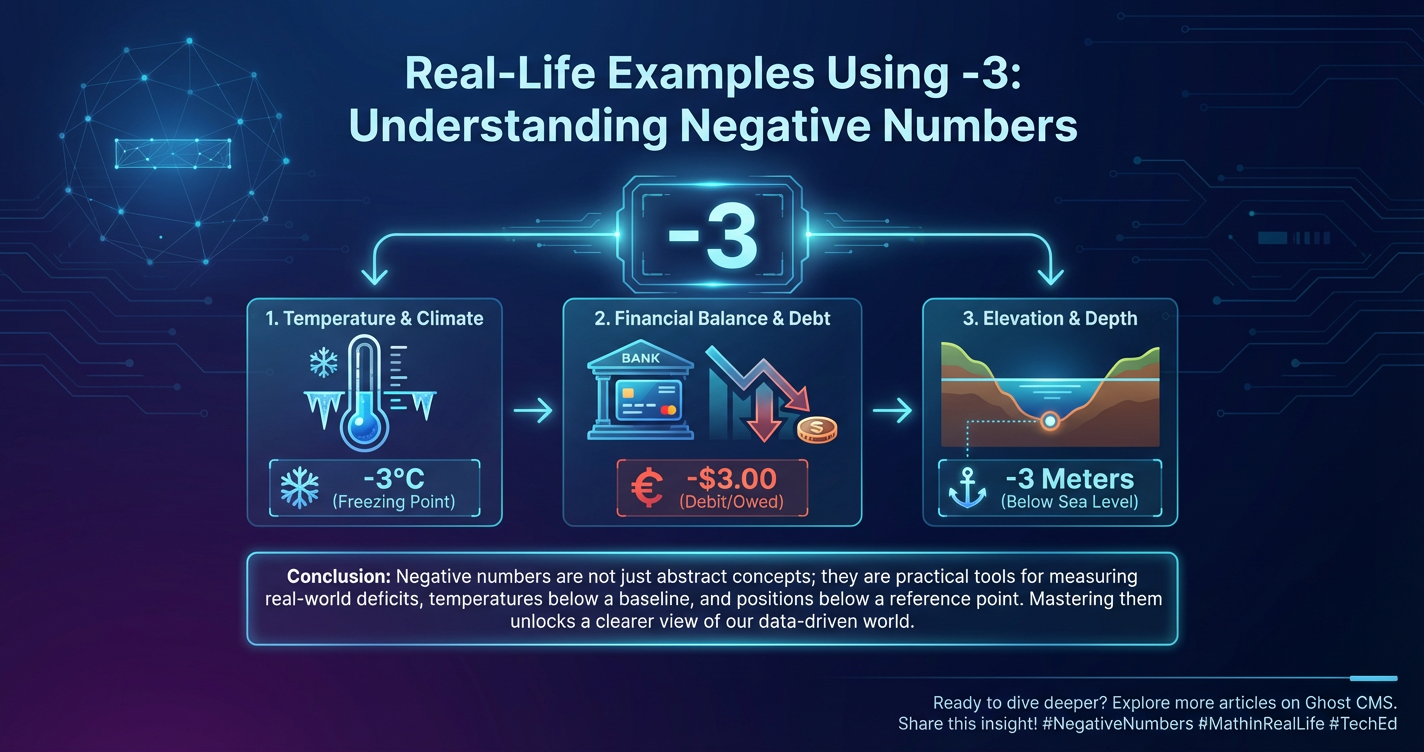
Real-Life Examples Using -3: Understanding Negative Numbers
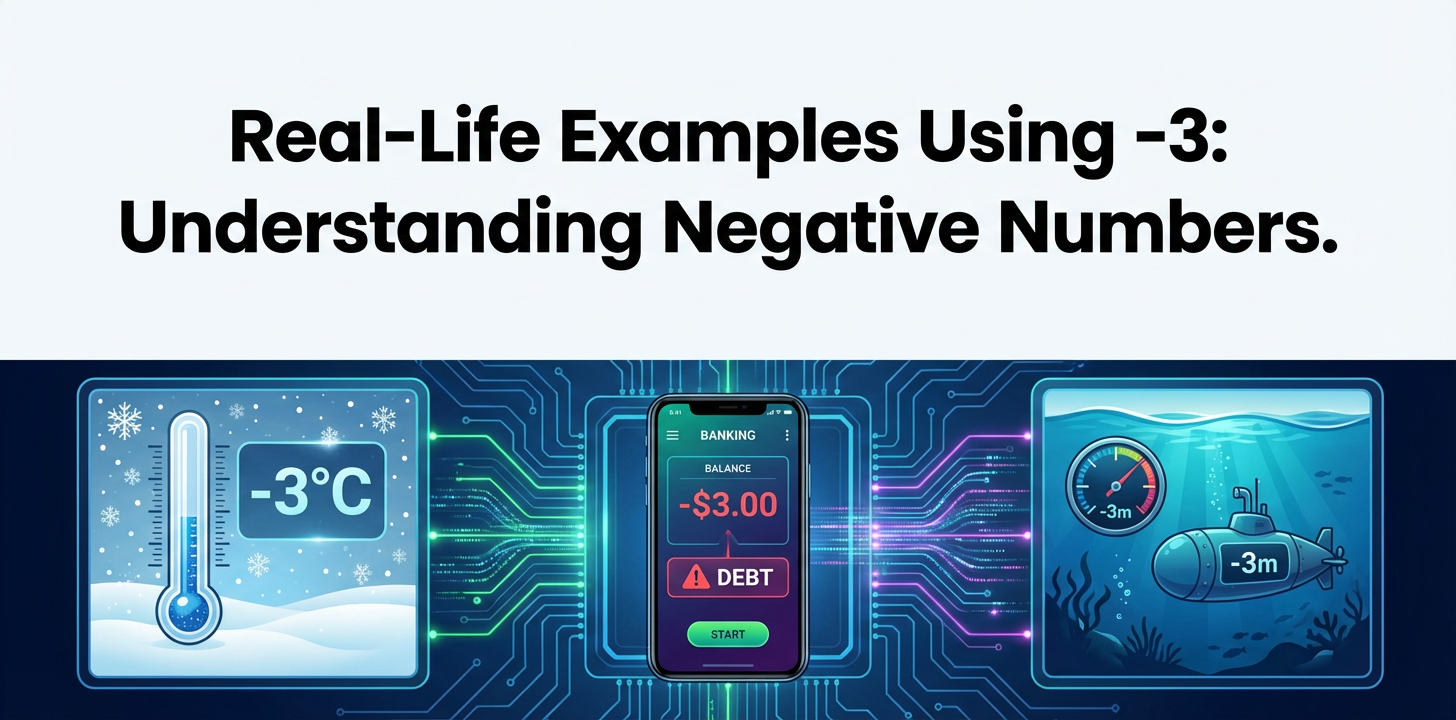


From the biting chill of a winter morning to the subtle shifts in a financial market, negative numbers are an indispensable part of our daily lives, often operating silently in the background, shaping our understanding of quantities that fall below a zero baseline. While positive numbers intuitively represent presence, gain, or advancement, their negative counterparts elegantly articulate absence, loss, recession, or a state of being "below" a specific reference point. Among these, the number -3, in particular, serves as a powerful yet understated exemplar, appearing in an astonishing array of contexts that extend far beyond simple arithmetic. Understanding -3 is not merely about grasping a single numerical value; it’s about unlocking a deeper comprehension of how mathematical concepts mirror, define, and enable the intricate dynamics of the physical world and the sophisticated digital infrastructures that now govern so much of our existence.
This exploration will delve deep into the pervasive presence of negative numbers, with a specific focus on the illustrative power of -3. We will journey through historical insights, fundamental mathematical principles, and an extensive collection of real-world scenarios where -3 plays a crucial, often defining, role. Furthermore, we will connect this fundamental mathematical concept to the cutting-edge of technology, examining how negative numbers are processed and managed within complex digital ecosystems, particularly in the realm of modern API architectures and AI systems, touching upon the critical functions of an API Gateway, an LLM Gateway, and the subtleties of a Model Context Protocol. By the end, the seemingly simple notion of "minus three" will reveal itself as a cornerstone of both our intuitive and technological understanding of the world.
The Genesis of "Below Zero": A Historical Perspective
The journey of negative numbers into mainstream mathematics and everyday acceptance was far from straightforward, marked by centuries of skepticism and philosophical debate. Ancient civilizations, while adept at practical arithmetic, largely focused on quantities that represented existing physical objects or tangible outcomes, making the concept of "less than nothing" conceptually challenging. The Egyptians and Babylonians, for instance, used negative numbers implicitly in financial calculations, where debts were understood as a reduction, but they lacked a formal symbolic representation. Early Indian mathematicians, particularly Brahmagupta in the 7th century, were among the first to formally define negative numbers, equating debts to negative quantities and assets to positive ones, even laying down rules for their addition and subtraction. He referred to them as "debts" or "losses," providing them with a concrete, understandable context.
However, in the Western world, the acceptance of negative numbers was much slower. European mathematicians for centuries dismissed them as "fictitious" or "absurd." Even prominent figures like René Descartes, in the 17th century, referred to negative roots of equations as "false" roots. The intuitive difficulty lay in visualizing a negative quantity: how could one have "negative three apples"? It wasn't until the 18th and 19th centuries, with the development of more abstract mathematical theories and the increasing need to describe phenomena like temperature below freezing, geographic elevations below sea level, and financial deficits, that negative numbers gained full legitimacy. The introduction of the number line, a simple yet profound visualization tool, finally provided a universally accepted framework for understanding negative numbers as positions relative to zero, making their existence and utility undeniably clear. This historical reluctance highlights the deep-seated human inclination to ground mathematical concepts in physical reality, a challenge that negative numbers uniquely posed until their abstract utility became undeniable.
Mathematical Foundations: Deconstructing -3
At its core, -3 is the additive inverse of 3. This means that when 3 and -3 are added together, their sum is zero. On a number line, zero serves as the origin, a neutral point. Positive numbers extend to the right, representing increments, gains, or forward movement. Negative numbers extend to the left, symbolizing decrements, losses, or backward movement. Thus, -3 is found three units to the left of zero on the number line. This simple graphical representation is incredibly powerful, clarifying the concept of "direction" in numbers.
The properties of negative numbers are fundamental to modern mathematics. When multiplying or dividing two numbers with the same sign (both positive or both negative), the result is positive. For example, -3 multiplied by -3 equals 9. When multiplying or dividing two numbers with different signs (one positive and one negative), the result is negative. For instance, -3 multiplied by 3 equals -9. These rules, often taught early in mathematics education, are not arbitrary; they maintain consistency within the number system and ensure that mathematical operations accurately reflect real-world scenarios, such as the overall change in a quantity after multiple positive or negative adjustments.
Understanding -3 also involves appreciating its relationship to other numbers. It is less than -2, -1, 0, 1, 2, and so on. This concept of magnitude and ordering is crucial. A temperature of -3 degrees Celsius is colder than -1 degree Celsius, and significantly colder than 10 degrees Celsius. In financial terms, a debt of -$3 is a smaller debt than -$10, but a worse financial position than $0 or $5. This seemingly basic ordering is critical for logical reasoning and decision-making across countless disciplines, making the abstract concept of negative numbers a practical tool for comparative analysis.
Real-Life Applications of -3: A Multifaceted Presence
The ubiquity of negative numbers, and specifically -3, in various real-life contexts underscores their essential role in describing phenomena that extend below a baseline. Let's explore some detailed examples:
1. Temperature: The Thermometer's Descent
Perhaps the most common and intuitive encounter with negative numbers is through temperature. The Celsius and Fahrenheit scales both employ negative values to denote temperatures below their respective freezing points (0°C and 32°F). A reading of -3°C (or -3 degrees Celsius) immediately conveys a sense of biting cold. It means the temperature is three degrees below the freezing point of water. This specific value has significant implications: water pipes might freeze, certain delicate plants could be damaged, and outdoor activities might require extreme cold-weather gear. In many parts of the world, -3°C is a regular winter occurrence, signifying a clear, crisp, and often snowy environment. The impact of even a slight shift, say from -2°C to -3°C, can mean the difference between wet snow and powdery snow, or between merely cold and dangerously cold conditions for exposed skin. Meteorologists rely on these negative values not just to report current conditions, but to forecast weather patterns, understand atmospheric dynamics, and issue warnings for frost or ice, which directly affect agriculture, transportation, and public safety. The precision of -3 is not merely an academic point; it's a practical indicator with tangible consequences for millions.
2. Finance and Economics: The World of Debt and Deficits
In the realm of money, negative numbers are a constant companion, representing debt, losses, and deficits. If an individual overspends their bank account by three dollars, their balance is -$3. This means they owe the bank three dollars, a simple yet critical indicator of their current financial standing. Similarly, in a business context, if a company's quarterly earnings report shows a net loss of three million dollars, this would be represented as -$3,000,000. This figure isn't just an abstract number; it signals potential operational inefficiencies, market challenges, or strategic missteps that need immediate attention. In stock market trading, a stock price dropping by -$3 means a loss of three dollars per share for investors, directly impacting their portfolios. National budgets can also run deficits, where government spending exceeds revenue, often expressed in billions or trillions of dollars as negative figures. Understanding these negative financial indicators is crucial for personal budgeting, corporate strategy, and national economic policy. Without the concept of negative numbers, the intricate dance of credits and debits, profits and losses, and assets and liabilities would be impossible to quantify and manage, leaving us with a profoundly incomplete picture of financial health.
3. Elevation and Depth: Below Sea Level
Geography and oceanography frequently utilize negative numbers to describe positions relative to sea level, which is conventionally set at zero meters or feet. A diver exploring a coral reef might be at a depth of -3 meters (approximately 10 feet) below the surface. This measurement tells us exactly how far they are submerged, influencing factors like water pressure, light penetration, and the types of marine life they might encounter. In geology, certain landforms, like the Dead Sea region, are well known for being significantly below sea level, with some points reaching hundreds of meters into negative territory. If a specific geological feature were identified at -3 meters relative to an established datum (e.g., the top of a canyon wall), it precisely describes its vertical position. This spatial orientation is critical for mapping, construction, and understanding environmental processes. For instance, when constructing a tunnel or excavating for foundations, engineers must account for depths below grade, often using negative numbers to denote these precise vertical measurements. These applications underscore how negative numbers provide a universal standard for vertical positioning, allowing for accurate and consistent measurements across diverse fields.
4. Time: Before the Event
While time generally moves forward (positive direction), negative numbers are frequently used in countdowns or to denote events occurring before a specific reference point. In rocket launches, the sequence often begins with a "T-minus" countdown. At T-minus 3 seconds, the launch sequence is three seconds away from ignition, a critical juncture where all systems must be green for launch. Similarly, in project management, if a task is scheduled to start on day 0, and a preparatory activity needs to occur three days prior, it would be marked as starting on day -3. This notational clarity helps project managers visualize timelines, sequence dependencies, and manage critical paths. In sports, a penalty incurred three seconds before the end of a period might be marked as "at -3 seconds" relative to the period's end, impacting subsequent play. This temporal application of negative numbers allows for precise scheduling, historical sequencing, and the clear articulation of relative time intervals, whether in milliseconds for high-speed events or days for long-term projects.
5. Sports and Gaming: Penalties and Handicaps
In the world of sports, negative numbers frequently quantify disadvantages, penalties, or handicaps. In golf, a player might be -3 strokes under par after a round, indicating an excellent performance (three strokes better than the expected score). Conversely, in many team sports, if a team incurs a penalty that results in a deduction of points, or if their goal difference is calculated, a result of -3 could signify a significant deficit. For example, if a soccer team has scored 10 goals and conceded 13, their goal difference is -3, which can be a crucial tie-breaker criterion. In racing, if a competitor starts with a time penalty of -3 seconds due to an infraction, their final time will be adjusted accordingly. In video games, a player might lose -3 health points after being hit by an enemy, or their resource count might drop by -3 units. These negative values are essential for fair play, scoring, ranking, and balancing competitive environments, making the outcome of contests clear and quantifiable.
6. Physics and Engineering: Direction and Magnitude
In physics, negative numbers are indispensable for representing quantities that have both magnitude and direction, such as displacement, velocity, acceleration, force, and electric charge. If an object moves -3 meters, it signifies a displacement of three meters in the opposite direction from a predefined positive direction. For instance, if moving east is positive, then -3 meters means moving three meters west. In a circuit, an electron carries a negative charge, and if we were to quantify a specific charge value as -3 coulombs, it precisely indicates the magnitude and type of charge. When describing forces, a force of -3 Newtons could mean a force of 3 Newtons acting in the reverse direction of a chosen positive axis, perhaps resisting motion. Engineers use negative numbers extensively in stress analysis, structural calculations, and control systems, where values can indicate compression versus tension, or a system's state relative to a desired setpoint. For instance, a control system might register an error of -3 units, meaning the output is three units below the target, prompting corrective action. These applications highlight the vector nature of many physical quantities, where negative numbers are not just "less than zero" but represent a critical directional component.
7. Computer Science and Programming: Beyond Basic Arithmetic
Computer science provides a rich tapestry of scenarios where negative numbers, and specifically -3, are not just mathematical curiosities but fundamental operational values. In array indexing, while most languages start at 0, some (or specific libraries) allow negative indexing to access elements from the end of the array. For instance, in Python, list[-3] refers to the third element from the end of the list. More broadly, negative numbers are crucial in error codes. A function returning -3 might signify a specific type of error, indicating failure to allocate memory, a file not found, or an invalid parameter. This standardization allows programs to interpret various failure modes and react appropriately.
Furthermore, in resource management within operating systems, a process might request a certain amount of memory, and if that request cannot be fully met, a negative value might indicate the deficit or the specific failure code. In network protocols, TTL (Time To Live) fields, while typically positive, are decremented. If a packet were somehow assigned a negative TTL value (e.g., -3), it would indicate an immediate discard or an erroneous state. In data structures, algorithms often use negative numbers as sentinel values or to represent special conditions, such as an unvisited node in a graph traversal algorithm.
This computational reliance on negative numbers extends deeply into the architecture of modern software systems, particularly those dealing with distributed services and artificial intelligence. This is where concepts like API Gateway, LLM Gateway, and Model Context Protocol become not just relevant but essential for managing the flow and interpretation of diverse data, including those critical negative indicators.
The Digital Frontier: Negative Numbers in Advanced Systems
As our world becomes increasingly interconnected and driven by data, the complexity of managing information flow grows exponentially. Negative numbers, far from being a niche mathematical concept, are embedded within the very fabric of these digital systems, often signifying critical states, error conditions, or specific control parameters.
The Role of an API Gateway
An API Gateway acts as the single entry point for a multitude of clients requesting access to backend services. It's a traffic cop, a bouncer, and a translator all rolled into one. In this crucial role, an API Gateway often encounters and processes negative numbers in various forms. For instance:
- Error Codes: When a backend service encounters an issue, it might return a specific error code. While HTTP status codes are positive (e.g., 404 Not Found, 500 Internal Server Error), the body of the error response might contain custom error codes, some of which could be negative (e.g.,
{ "errorCode": -3, "message": "Insufficient permissions for requested resource" }). The API Gateway is responsible for intercepting these, logging them, and potentially transforming them into a more user-friendly format before sending them back to the client. This ensures that a client application doesn't have to understand the intricacies of every backend service's internal error numbering scheme. - Rate Limiting: An API Gateway enforces rate limits to prevent abuse and ensure fair usage. If a client exceeds their allocated requests, the gateway might return a
429 Too Many Requestsstatus, but it could also internally track the "remaining requests" or "cool-down period" with negative values if a pre-emptive penalty system is in place for an extended breach. - Financial Transactions: For services involving payments or credits, an API Gateway might handle requests that deduct funds. A request to "reduce balance by $3" would ultimately lead to an internal calculation involving -3, and the gateway ensures the secure and accurate transmission of such critical financial parameters.
- Resource Allocation: In microservices architectures, an API Gateway might communicate with services that manage computational resources. If a service indicates that it has a deficit of "3 available slots" for a particular operation, this negative availability is a critical piece of data that the gateway might use for routing decisions or to queue requests.
The API Gateway is not merely passing data; it is often validating, transforming, and sometimes even generating responses based on these numerical inputs, including the nuanced implications of negative values. It provides a layer of abstraction and control, essential for robust and scalable systems.
The Specialization of an LLM Gateway
As Large Language Models (LLMs) become central to more applications, a specialized form of API Gateway has emerged: the LLM Gateway. This gateway is specifically designed to manage interactions with AI models, addressing unique challenges like prompt management, model versioning, and cost optimization. Negative numbers play a significant role here as well:
- Sentiment Analysis Scores: LLMs can perform sentiment analysis. The output might be a numerical score, where negative values indicate negative sentiment. A score of -3 on a scale of -5 to 5 would signify a moderately negative sentiment in a piece of text. The LLM Gateway ensures this score is correctly transmitted and potentially aggregated or interpreted by downstream applications.
- Confidence Levels/Uncertainty: In some AI tasks, models might output a confidence score. While usually positive, in complex scenarios or when dealing with highly ambiguous inputs, an internal representation might use negative values to denote extreme uncertainty or a strong negative correlation with a particular outcome. The LLM Gateway would need to handle these model-specific outputs correctly.
- Cost Tracking and Budget Overruns: LLM usage can be expensive. An LLM Gateway tracks token usage and costs. If a user's allocated budget for AI calls is exceeded, the system might internally register a deficit, showing -$3 remaining in the budget, prompting the gateway to block further requests or switch to a cheaper model.
- Penalty/Bias Adjustments: Some advanced LLM applications might involve mechanisms to penalize certain types of responses or introduce a negative bias in generation to steer the model away from undesirable outputs. These internal parameters could involve negative numerical adjustments.
The LLM Gateway, therefore, provides not only an interface but also a crucial layer for interpreting, managing, and securing the highly specific numerical outputs and inputs characteristic of AI models, where negative values carry distinct semantic weight related to model performance, output quality, and resource consumption.
The Precision of a Model Context Protocol
The Model Context Protocol refers to the agreed-upon standards and mechanisms for how a model's state, memory, and sequential information are managed and communicated, especially important for conversational AI or continuous learning systems. Negative numbers within such a protocol can define boundaries, historical shifts, or decrements within the context window.
- Context Window Management: LLMs have a finite "context window" – the amount of previous conversation or data they can remember. A Model Context Protocol might use negative numbers to indicate how many "turns back" in the conversation a specific piece of information refers to, or how many tokens have been removed from the beginning of the context due to length limits. For example, if the current input refers to an entity mentioned "3 turns ago," this historical reference could be encoded using negative indexing relative to the current turn.
- State Deltas: In systems where a model's internal state is updated incrementally, negative numbers can represent a decrease or removal of specific attributes from the current state. If a system's "focus" attribute needs to be reduced by -3 units due to a user's disengagement, the protocol would ensure this negative delta is correctly applied to the model's internal representation.
- Session Timers: In conversational AI, a session might have a timeout. If the user has been inactive for a certain period, the system might track the "time remaining until session expiration" as a negative value (e.g., -3 seconds past expiration), signaling to the Model Context Protocol that the context should be flushed or a new session initiated.
- Correction or Reversion Markers: In scenarios where a model's output needs correction or a reversion to a previous state (e.g., "undo" functionality in a creative AI tool), the Model Context Protocol might use negative integers to signify the number of steps to revert or the specific negative adjustment to apply to the model's internal parameters to undo a particular change.
The precision offered by negative numbers within a Model Context Protocol allows for sophisticated control over how AI models maintain continuity, manage information flow, and respond to dynamic changes, making complex interactions seamless and effective.
APIPark: Harmonizing the Digital Orchestra
Managing the flow of diverse data, including the nuanced implications of negative numbers, across numerous services and AI models can be a monumental task. This is where platforms like ApiPark become invaluable. As an open-source AI gateway and API management platform, APIPark helps developers and enterprises manage, integrate, and deploy AI and REST services with ease, ensuring consistency and reliability even when dealing with complex data types like negative indicators.
APIPark's unified API format for AI invocation is particularly relevant here. It standardizes the request data format across all AI models. This means that whether an AI model returns a positive sentiment score, a negative confidence level, or a specific error code like -3, APIPark ensures that these varying numerical outputs are presented consistently to the consuming application. This standardization drastically simplifies AI usage and maintenance, allowing developers to focus on application logic rather than wrestling with disparate model interfaces or parsing complex, model-specific negative values. For instance, if one sentiment model outputs values from -1 to 1, and another from -5 to 5, APIPark can normalize these, providing a consistent numerical output for downstream systems.
Furthermore, APIPark's end-to-end API lifecycle management capabilities are crucial for handling critical data points, including those represented by negative numbers. From design to publication and invocation, APIPark helps regulate API management processes, manage traffic forwarding, load balancing, and versioning. This ensures that when an API handles sensitive data, such as financial transactions that might result in a -$3 balance or error codes like -3 indicating a critical system fault, the entire process is secure, traceable, and reliable. Detailed API call logging, another key feature, records every detail of each API call. This allows businesses to quickly trace and troubleshoot issues when, for example, a series of API calls consistently returns an errorCode: -3, enabling rapid identification and resolution of underlying problems.
By providing a robust, high-performance platform for managing API services, APIPark essentially acts as the conductor of a digital orchestra, ensuring that every instrument (or service/AI model) plays in harmony, and that even the most subtle notes (like a crucial negative integer) are correctly interpreted and acted upon. This reduces the operational burden and enhances the overall reliability and security of complex digital ecosystems, making the intricate dance of positive and negative data points manageable and predictable.
The Philosophical Underpinnings: Beyond Mere Absence
Beyond their practical applications, negative numbers also prompt a deeper philosophical reflection on the nature of quantity and existence. They challenge the intuitive notion that numbers must always represent something tangible that can be counted or accumulated. Instead, they introduce the concept of "position" or "state" relative to a baseline. -3 isn't just "less than zero"; it's a descriptor of a specific state that is three units "below" or "opposite" a chosen reference.
This shift from counting "how many" to describing "where" or "what state" has profound implications. It allows us to quantify not just what is present, but also what is absent, what is owed, what is reversed, or what falls below a desired threshold. In a world increasingly defined by relative measurements – relative performance, relative standing, relative changes – negative numbers provide the indispensable vocabulary for expressing these nuanced relationships. They allow mathematics to describe not just positive creation, but also decay, entropy, and the intricate dynamics of systems where gains and losses, forwards and backwards, perfectly balance or profoundly diverge. The concept of zero as a neutral point, then, becomes a powerful demarcation, and negative numbers become the precise tools for mapping the vast territory that lies on the other side.
Conclusion: The Indispensable Nature of Negative Three
The journey through the real-life examples using -3, from the frigid temperatures of winter to the complex error codes in advanced AI systems, reveals a profound truth: negative numbers are not just mathematical abstractions but indispensable tools that allow us to accurately model, understand, and interact with the world around us. They provide the language to describe states below zero, to quantify debts, to mark reversals, and to signal critical conditions in both natural phenomena and intricate technological architectures.
Whether it’s a meteorologist forecasting a bone-chilling -3°C, an accountant balancing a ledger with a -$3 deficit, an engineer calculating a -3 meter depth, or an API Gateway processing an internal error code of -3, the underlying principle remains the same: negative numbers provide clarity, precision, and a crucial directional component to our understanding of quantity. In the age of sophisticated digital platforms and artificial intelligence, the correct handling and interpretation of these negative values by systems like an LLM Gateway or within a Model Context Protocol become paramount for ensuring accuracy, security, and optimal performance. Platforms like ApiPark further empower this by standardizing and streamlining the management of such diverse data flows.
Far from being merely "less than nothing," -3, and indeed all negative numbers, represent a rich and essential dimension of numerical understanding. They empower us to comprehend the full spectrum of reality, from the tangible to the abstract, enabling us to navigate a world where things can not only be present but also absent, not only gained but also lost, and not only above but also precisely, meaningfully, below zero. Their continued presence in our daily lives and at the forefront of technological innovation underscores their timeless and foundational importance.
Frequently Asked Questions (FAQs)
1. Why are negative numbers important in real life? Negative numbers are crucial because they allow us to quantify concepts that fall below a zero baseline or represent a direction opposite to a positive one. Without them, we couldn't precisely describe temperatures below freezing, financial debts, depths below sea level, or countdowns to an event, nor could we effectively manage error states or resource deficits in complex digital systems. They provide a complete mathematical framework for describing changes and states.
2. How does -3 relate to temperature in everyday scenarios? In temperature, -3°C (or -3 degrees Celsius) means the temperature is three degrees below the freezing point of water. This specific temperature has practical implications such as the potential for freezing pipes, icy roads, and the need for specific winter clothing. It is a common indicator of cold weather in many parts of the world.
3. What role do API Gateways play in handling negative numbers in technology? API Gateways are central in managing how data, including negative numbers, flows between client applications and backend services. They can process and log error codes (which might be negative), manage financial transactions involving deductions, and enforce rate limits. They ensure that negative values, which often indicate critical system states or specific conditions, are correctly transmitted, interpreted, and acted upon across the entire service architecture, enhancing reliability and security.
4. How are negative numbers used in the context of LLM Gateways and AI? In LLM Gateways, negative numbers can represent crucial information related to AI model outputs and management. For example, they might indicate sentiment scores (e.g., -3 for negative sentiment), specific error codes from the AI model, or even budget overruns in token usage. The LLM Gateway ensures these diverse negative numerical outputs are consistently handled and correctly interpreted by consuming applications, facilitating robust AI integration.
5. Can you give an example of -3 being used in a Model Context Protocol? In a Model Context Protocol, -3 could signify a historical reference or a specific decrement within an AI model's memory or state. For instance, in a conversational AI, if a user's current query refers to a topic discussed "3 turns ago," the protocol might use -3 to precisely indicate this relative position in the conversation history, allowing the model to retrieve relevant information from its context window accurately. It's a way to define backward steps or decrements in state management.
🚀You can securely and efficiently call the OpenAI API on APIPark in just two steps:
Step 1: Deploy the APIPark AI gateway in 5 minutes.
APIPark is developed based on Golang, offering strong product performance and low development and maintenance costs. You can deploy APIPark with a single command line.
curl -sSO https://download.apipark.com/install/quick-start.sh; bash quick-start.sh

In my experience, you can see the successful deployment interface within 5 to 10 minutes. Then, you can log in to APIPark using your account.

Step 2: Call the OpenAI API.