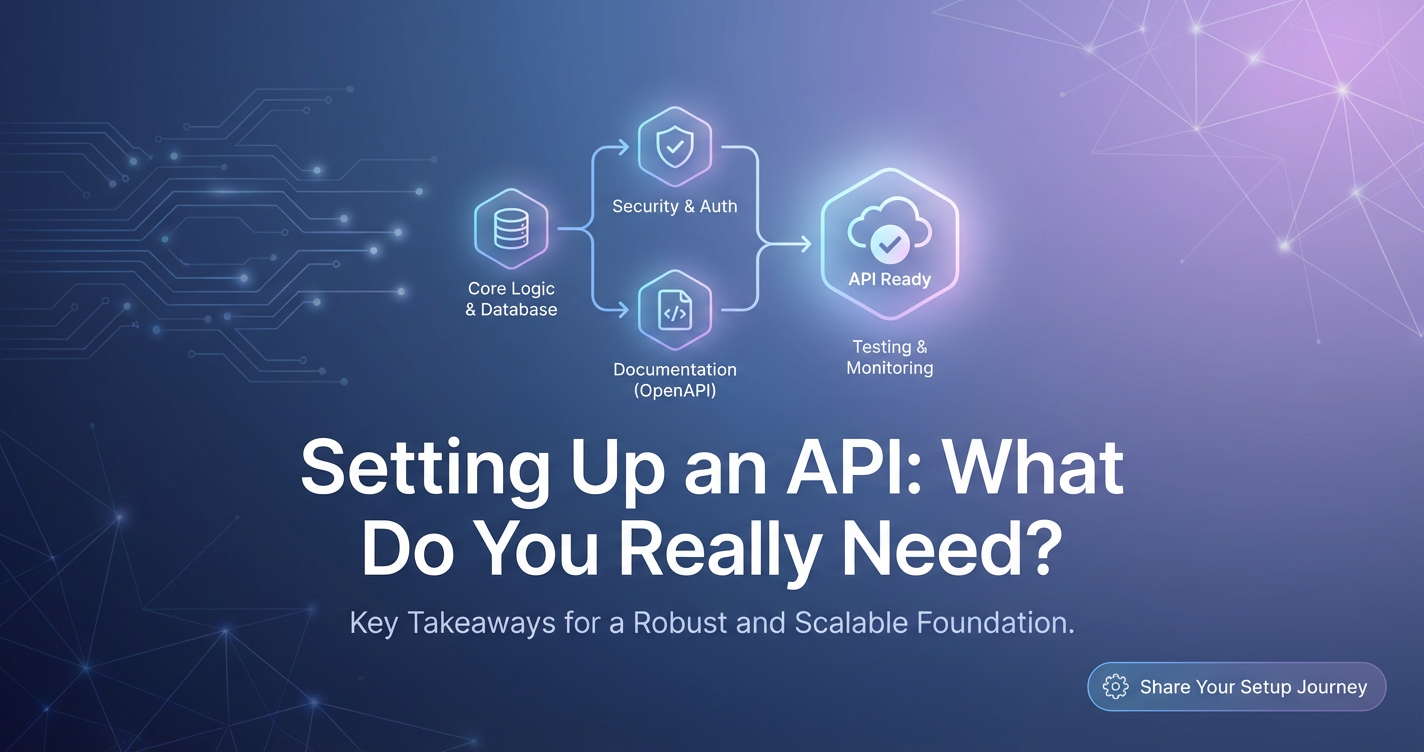
Setting Up an API: What Do You Really Need?



In the labyrinthine world of modern software development, Application Programming Interfaces (APIs) have emerged as the crucial connective tissue, orchestrating interactions between disparate systems, services, and applications. From the most mundane data retrieval tasks to the most complex machine learning inferences, APIs are the silent workhorses powering the digital economy. However, merely understanding what an API is falls far short of the comprehensive knowledge required to effectively design, implement, and manage one. The journey of setting up an API is fraught with critical decisions, technical nuances, and strategic considerations that, if overlooked, can lead to inefficiencies, security vulnerabilities, and ultimately, project failure. This extensive guide aims to demystify the process, delving deep into every facet of API setup, from conceptualization and design principles to robust deployment, advanced management, and ongoing maintenance. We will explore the fundamental components, best practices, and essential tools, ensuring you are equipped with a holistic understanding of what it truly takes to build and maintain a successful API that stands the test of time and scale.
The Indispensable Role of APIs: A Foundational Understanding
Before embarking on the intricate journey of API setup, it is imperative to solidify our understanding of what an API fundamentally represents and why it holds such a pivotal position in today's technological landscape. At its core, an API is a set of defined rules and protocols that allows different software applications to communicate with each other. It acts as an intermediary, abstracting the complexities of underlying systems and providing a simplified interface for interaction. Think of it as a meticulously designed menu in a restaurant: you don't need to know how the chef prepares the meal (the underlying code and infrastructure), you just need to know what to order (the API endpoint) and what ingredients it requires (the request parameters) to receive your desired dish (the response).
The proliferation of APIs is not merely a trend; it is a fundamental shift in how software is architected and integrated. In an era dominated by distributed systems, microservices, mobile applications, and the Internet of Things (IoT), APIs facilitate seamless interoperability. They empower developers to build sophisticated applications by leveraging existing services without reinventing the wheel. For instance, a ride-sharing app doesn't need to develop its own mapping service; it can integrate with a mapping API provided by a third party. Similarly, an e-commerce platform can integrate with payment gateway APIs, shipping carrier APIs, and inventory management APIs to create a comprehensive user experience. This modularity not only accelerates development cycles but also fosters innovation, allowing businesses to focus on their core competencies while relying on specialized services for ancillary functionalities.
There are various architectural styles for APIs, each suited to different use cases and constraints. The most prevalent style is REST (Representational State Transfer), which emphasizes statelessness, client-server separation, and the manipulation of resources through a uniform interface using standard HTTP methods (GET, POST, PUT, DELETE). RESTful APIs are highly popular due to their simplicity, scalability, and compatibility with the web's existing infrastructure. Another significant style is SOAP (Simple Object Access Protocol), an older, XML-based protocol known for its strong typing, security features, and suitability for enterprise-level applications where strict contract enforcement is paramount. More recently, GraphQL has gained traction, offering clients the power to request precisely the data they need, thereby reducing over-fetching and under-fetching issues common in traditional REST APIs. Each style presents its own trade-offs in terms of complexity, flexibility, and performance, and the choice often depends on the specific requirements of the project, the nature of the data, and the target consumers of the API. Understanding these foundational concepts is the critical first step in determining what you truly need for setting up an API that is both functional and future-proof.
Phase 1: Meticulous Planning and Design – The Blueprint for Success
The bedrock of any successful API lies in meticulous planning and a well-conceived design. Much like constructing a building, a robust API requires a detailed blueprint that anticipates future needs, mitigates potential challenges, and ensures a coherent and intuitive experience for its consumers. Rushing through this phase often leads to technical debt, reworks, and a poor developer experience, ultimately undermining the API's value.
Defining the Purpose and Scope: What Problem Are We Solving?
The initial step in planning involves a clear articulation of the API's purpose. What specific problem is this API designed to solve? Who are its primary users – internal teams, external developers, partners, or a combination? Understanding the target audience is crucial because it dictates the level of abstraction, the security model, the documentation style, and even the choice of technologies. For instance, an internal API might prioritize raw performance and direct data access, while a public API would need robust authentication, strict rate limiting, and exceptionally clear documentation.
Furthermore, defining the scope involves identifying the specific functionalities and data that the API will expose. It’s essential to avoid the trap of "feature creep" – trying to make the API do everything for everyone. A well-designed API is typically focused, offering a clear set of capabilities that are easy to understand and use. This requires careful consideration of what resources will be made available, what operations can be performed on those resources, and what constraints will be imposed. This foundational understanding will guide all subsequent design decisions, ensuring that the API remains cohesive and manageable.
Resource Identification and Data Modeling: The API's Core Assets
Once the purpose and scope are established, the next critical task is to identify the core "resources" that the API will manage or expose. In the context of a RESTful api, a resource is essentially any information or service that can be named, addressed, or manipulated. For example, in an e-commerce API, resources might include products, orders, customers, and categories. Each resource typically has a unique identifier and a set of properties that define its characteristics.
Following resource identification, robust data modeling becomes paramount. This involves defining the structure of the data that will be exchanged between the API and its consumers. This includes:
- Request Payloads: What data must the client send to the API to create or update a resource?
- Response Payloads: What data will the API send back to the client after an operation?
- Data Types: Specifying whether a field is a string, integer, boolean, array, or another complex object.
- Constraints and Validation Rules: Defining minimum/maximum lengths, regular expressions, required fields, and acceptable value ranges.
A clear and consistent data model is vital for reducing ambiguity, preventing errors, and ensuring that both the API provider and consumer have a shared understanding of the data contract. It's often beneficial to use established serialization formats like JSON (JavaScript Object Notation) or XML, with JSON being the de facto standard for most modern web APIs due to its lightweight nature and human-readability.
Choosing the Right Architecture and Style: REST, GraphQL, or SOAP?
The choice of API architectural style significantly impacts how the API is designed, developed, and consumed. While we touched upon these earlier, a deeper dive is necessary during the planning phase:
- RESTful APIs: Emphasize resources, using standard HTTP methods (GET, POST, PUT, DELETE) to perform operations. They are stateless, meaning each request from a client to the server must contain all the information necessary to understand the request. This simplicity and adherence to HTTP standards make them highly cacheable, scalable, and easy to consume from various client types. For many standard web services and mobile backends, REST remains the go-to choice.
- GraphQL: Offers a more flexible approach, allowing clients to precisely specify the data they need in a single request, thereby eliminating issues of over-fetching (receiving more data than needed) or under-fetching (requiring multiple requests for related data). GraphQL is particularly powerful for complex UIs, mobile applications with varying data requirements, and scenarios where frontend control over data fetching is highly beneficial. However, it introduces more complexity on the server side in terms of schema definition and resolver implementation.
- SOAP APIs: While less common for new web APIs, SOAP remains prevalent in enterprise environments, especially for integrating with legacy systems. It uses XML for message formatting and typically relies on specific protocols like HTTP, SMTP, or TCP. SOAP offers strong typing, built-in error handling, and robust security features (WS-Security), but its verbose nature and complexity can make it less agile for rapid development.
The decision should be driven by the specific requirements of the project, including data complexity, client diversity, performance expectations, and the existing technology ecosystem. Often, a combination of styles might be appropriate for different parts of a larger system.
API Specification and Documentation: The Crucial Role of OpenAPI
Once the design decisions are made, documenting them rigorously is not merely a good practice; it is an absolute necessity. Poor or outdated documentation is a leading cause of frustration for API consumers and a significant barrier to adoption. This is where API specifications, particularly the OpenAPI Specification (OAS), play an indispensable role.
The OpenAPI Specification, formerly known as Swagger, is a language-agnostic, human-readable, and machine-readable interface description language for RESTful APIs. It allows developers to describe the entire API, including:
- Available Endpoints: The paths and HTTP methods the API supports (e.g.,
/products/{id}, GET, POST). - Operations: What each endpoint does, its parameters (query, header, path, body), and their data types.
- Request and Response Models: The structure of data sent to and received from the API, including example payloads.
- Authentication Methods: How clients can authenticate with the API (e.g., API keys, OAuth2).
- Error Responses: Standardized error codes and messages.
The benefits of using OpenAPI are manifold and transformative for the entire API lifecycle:
- Clarity and Consistency: It provides a single source of truth for the API contract, ensuring that developers, testers, and consumers all have a consistent understanding of how the API behaves.
- Tooling Ecosystem: A vast ecosystem of tools exists around OpenAPI. This includes code generators for client SDKs (allowing consumers to quickly integrate the API into their applications), server stubs (speeding up API implementation), and interactive documentation viewers (like Swagger UI), which allow users to explore and even test the API directly from their browser.
- Automated Testing: The specification can be used to generate automated tests, ensuring that the API implementation adheres to its defined contract.
- Onboarding Efficiency: New developers can quickly understand and integrate with the API by simply referring to the OpenAPI document, significantly reducing the learning curve.
- Design-First Approach: Encourages a "design-first" philosophy, where the API is designed and documented before or concurrently with its implementation, leading to more thoughtful and consistent APIs.
Creating an OpenAPI specification can be done manually using YAML or JSON, or with the aid of design tools that provide graphical interfaces. For instance, you might start by defining your /products endpoint, specifying that a GET request returns a list of product objects, each with an id, name, price, and description. A POST request to the same endpoint might require a name and price in the request body to create a new product, returning the newly created product object upon success. This detailed articulation in a standardized format is indispensable for setting the stage for successful API development and ensuring broad adoption.
Phase 2: Robust Development and Implementation – Bringing the API to Life
With a meticulously crafted plan and a comprehensive OpenAPI specification in hand, the next critical phase involves the actual development and implementation of the api. This stage transforms the theoretical design into functional code, building the backend logic that will respond to requests, interact with databases, and enforce the defined contract.
Choosing a Technology Stack: The Engine of Your API
The choice of programming language and framework forms the technological backbone of your API. This decision often hinges on factors such as existing team expertise, project requirements, performance considerations, and the ecosystem's maturity.
- Languages: Popular choices include Python (with frameworks like Flask, Django, FastAPI), JavaScript/TypeScript (Node.js with Express, NestJS), Java (Spring Boot), Go (Gin, Echo), Ruby (Rails), and C# (.NET Core).
- Frameworks: These provide a structured way to build web applications and APIs, offering features like routing, middleware, ORMs (Object-Relational Mappers), and templating engines. For instance, Spring Boot in Java streamlines the creation of production-ready, standalone Spring applications, while FastAPI in Python is known for its high performance and automatic OpenAPI documentation generation.
A key consideration here is how well the chosen stack integrates with OpenAPI. Many modern frameworks offer built-in support or third-party libraries that can generate or consume OpenAPI specifications, further streamlining the development process and ensuring consistency between code and documentation. For example, using a framework that automatically generates an OpenAPI spec from your code annotations can significantly reduce the overhead of manual documentation updates.
Database Integration: The API's Data Store
Almost every API interacts with a database to store and retrieve information. The choice of database — relational (e.g., PostgreSQL, MySQL) or NoSQL (e.g., MongoDB, Cassandra, Redis) — depends on the data structure, scalability needs, and consistency requirements.
- Relational Databases: Excellent for structured data where strong consistency, complex queries, and ACID (Atomicity, Consistency, Isolation, Durability) properties are crucial. They typically use SQL for querying.
- NoSQL Databases: Offer greater flexibility in data models, horizontal scalability, and often better performance for specific types of workloads (e.g., large volumes of unstructured data, real-time analytics).
To interact with the database from your API code, you'll typically use an ORM (Object-Relational Mapper) or a database driver. ORMs (like SQLAlchemy for Python, Hibernate for Java, Sequelize for Node.js) allow you to interact with your database using object-oriented programming paradigms, abstracting away the raw SQL queries and making database operations more intuitive and less error-prone. This layer translates your API's resource models into database schemas and operations, ensuring data integrity and efficient persistence.
Business Logic Implementation: The API's Brains
This is where the core functionality of your API resides. It involves writing the code that processes incoming requests, performs computations, interacts with the database, orchestrates calls to other internal or external services, and generates appropriate responses.
For example, if you have an API endpoint /orders for creating new orders, the business logic might involve:
- Parsing the Request: Extracting order details (items, quantities, customer ID) from the incoming JSON payload.
- Validation: Checking if the provided data is valid (e.g., positive quantities, existing customer ID).
- Database Operations: Creating a new entry in the
orderstable and corresponding entries in anorder_itemstable. - External Service Calls: Potentially calling a payment processing API or an inventory management service.
- Response Generation: Constructing a success response with the newly created order's ID, or an error response if something went wrong.
Effective business logic is modular, testable, and adheres to principles like separation of concerns, making the codebase easier to understand, maintain, and scale.
Error Handling: Graceful Failures
No system is infallible, and APIs are no exception. Robust error handling is crucial for providing a predictable and usable experience for API consumers. When an error occurs (e.g., invalid input, resource not found, server-side issue), the API should respond with a meaningful error message and an appropriate HTTP status code.
Key aspects of error handling include:
- HTTP Status Codes: Using standard codes like
200 OKfor success,201 Createdfor resource creation,400 Bad Requestfor invalid client input,401 Unauthorizedfor authentication failures,403 Forbiddenfor authorization failures,404 Not Foundfor non-existent resources,429 Too Many Requestsfor rate limiting, and500 Internal Server Errorfor unexpected server-side issues. - Consistent Error Response Structure: Providing a standardized JSON (or XML) format for error messages, typically including an error code, a human-readable message, and potentially specific details about validation failures.
- Logging: Detailed logging of server-side errors is vital for debugging and monitoring, but care must be taken not to expose sensitive internal details in public error responses.
Versioning Strategies: Evolving with Grace
APIs are not static; they evolve over time to introduce new features, improve existing ones, or adapt to changing requirements. Versioning allows you to manage these changes without breaking existing integrations. Several common strategies exist:
- URI Versioning: Including the version number directly in the API path (e.g.,
/api/v1/products). This is straightforward but can lead to long URIs and less RESTful approaches if not managed carefully. - Header Versioning: Specifying the API version in a custom HTTP header (e.g.,
X-API-Version: 1). This keeps URIs clean but might be less intuitive for some clients. - Content Negotiation: Using the
Acceptheader to request a specific media type that includes the version (e.g.,Accept: application/vnd.mycompany.v1+json). This is often considered the most RESTful approach but can be more complex to implement.
Regardless of the chosen strategy, clear communication and a well-defined deprecation policy for older versions are essential to guide consumers through transitions.
Initial Security Considerations: Building Defenses from the Start
Security must be baked into the API design and implementation from day one, not bolted on as an afterthought. Neglecting security can lead to data breaches, unauthorized access, and severe reputational and financial damage.
- Authentication: Verifying the identity of the API consumer. Common methods include:
- API Keys: Simple tokens usually passed in a header or query parameter, suitable for basic client identification and rate limiting.
- OAuth 2.0: A robust framework for delegated authorization, allowing third-party applications to access user data without exposing user credentials. Ideal for user-facing APIs.
- JWT (JSON Web Tokens): Self-contained, digitally signed tokens used for securely transmitting information between parties. Often used with OAuth 2.0 for stateless authentication in microservices architectures.
- Authorization: Determining what an authenticated user or application is permitted to do. This involves implementing role-based access control (RBAC), attribute-based access control (ABAC), or custom logic to ensure users can only access or manipulate resources they are authorized for.
- Input Validation and Sanitization: Every piece of data received from the client must be validated against expected types, formats, and constraints. Sanitization removes or neutralizes potentially malicious input (e.g., SQL injection attempts, cross-site scripting).
- HTTPS/SSL/TLS: All API communication must occur over HTTPS to encrypt data in transit, protecting against eavesdropping and man-in-the-middle attacks. This is non-negotiable for any API handling sensitive information.
- Basic Rate Limiting: Implementing mechanisms to control the number of requests an API consumer can make within a given time frame. This prevents abuse, protects against denial-of-service (DoS) attacks, and ensures fair resource utilization. While initial implementation might be simple, a dedicated api gateway will handle this much more robustly.
By diligently addressing these development and implementation aspects, you lay the groundwork for a functional, resilient, and secure API that is ready for deployment and interaction with the wider ecosystem.
APIPark is a high-performance AI gateway that allows you to securely access the most comprehensive LLM APIs globally on the APIPark platform, including OpenAI, Anthropic, Mistral, Llama2, Google Gemini, and more.Try APIPark now! 👇👇👇
Phase 3: Deployment and Management – Scaling and Securing Your API
Once the API is developed and thoroughly tested, the next critical phase involves deploying it to a production environment and establishing robust management mechanisms. This stage moves beyond the code itself, focusing on the infrastructure, operational practices, and tools necessary to ensure the API is accessible, performant, secure, and easily maintainable at scale.
Infrastructure Selection: Where Does Your API Live?
Choosing the right infrastructure is paramount for the API's performance, scalability, and cost-effectiveness. The options range from traditional on-premise servers to highly elastic cloud environments.
- Cloud Platforms (AWS, Azure, GCP): These hyperscale providers offer a vast array of services, including virtual machines (IaaS), container orchestration (PaaS), serverless functions (FaaS), and managed databases. Cloud deployment offers immense flexibility, scalability, and reduced operational overhead compared to managing physical hardware. For APIs, services like Amazon EC2, Google Compute Engine, Azure Virtual Machines, or container services like Kubernetes (EKS, GKE, AKS) are common choices. Serverless options like AWS Lambda or Azure Functions can be particularly cost-effective for APIs with spiky traffic patterns, as you only pay for actual execution time.
- Containers (Docker) and Orchestration (Kubernetes): Containerization, primarily with Docker, has revolutionized application deployment. It packages the API code, its dependencies, and configuration into a single, isolated unit that can run consistently across any environment. Kubernetes then orchestrates these containers, automating deployment, scaling, and management. This approach ensures portability, simplifies CI/CD pipelines, and provides high availability and fault tolerance, making it a powerful choice for complex microservices architectures.
- On-Premise: While less common for greenfield API projects due to the high initial investment and operational burden, some organizations opt for on-premise deployment for strict data governance, compliance requirements, or leveraging existing infrastructure investments.
The decision should factor in scalability requirements, budget constraints, regulatory compliance, and the team's expertise in managing specific infrastructure types.
CI/CD Pipelines: Automating the Release Cycle
Continuous Integration (CI) and Continuous Delivery/Deployment (CD) are essential practices for modern API development. A CI/CD pipeline automates the entire software release process, from code commit to production deployment.
- Continuous Integration (CI): Developers frequently merge their code changes into a central repository, where automated builds and tests are run. This helps detect integration issues early and maintains a healthy codebase.
- Continuous Delivery/Deployment (CD): Once CI passes, the application is automatically prepared for release (delivery) or even automatically deployed to production (deployment), depending on the configuration.
For APIs, a CI/CD pipeline ensures that every code change is thoroughly tested (unit, integration, performance, security) and deployed consistently. This significantly reduces manual errors, speeds up the release cycle, and provides a reliable mechanism for rolling out updates and bug fixes. Tools like Jenkins, GitLab CI/CD, GitHub Actions, CircleCI, and Travis CI are widely used for building and managing these pipelines.
Monitoring and Logging: The Eyes and Ears of Your API
Once deployed, an API needs constant vigilance to ensure its health, performance, and security. Robust monitoring and logging systems provide the necessary visibility into its operational state.
- Monitoring: Involves tracking key metrics such as:
- Request Rates: Number of requests per second/minute.
- Latency: Time taken for the API to respond.
- Error Rates: Percentage of requests resulting in errors (e.g., 4xx, 5xx status codes).
- Resource Utilization: CPU, memory, network, and disk usage of the underlying infrastructure.
- Dependency Health: Status of databases, external services, and other components the API relies on.
- Business Metrics: API-specific metrics like number of new users, successful transactions, etc. Tools like Prometheus, Grafana, Datadog, New Relic, and Elastic APM provide comprehensive monitoring capabilities, often with dashboards and alerting features to notify teams of critical issues.
- Logging: Capturing detailed records of events occurring within the API. This includes:
- Access Logs: Who accessed what, when, and from where.
- Error Logs: Details of exceptions, stack traces, and relevant context.
- Application Logs: Custom messages for tracking specific business logic flows or debugging. Effective logging ensures that when something goes wrong, developers have the necessary information to diagnose and resolve issues quickly. Centralized logging solutions like ELK Stack (Elasticsearch, Logstash, Kibana), Splunk, or cloud-native services like AWS CloudWatch Logs or Azure Monitor Log Analytics aggregate logs from multiple sources, making them searchable and analyzable.
Scalability and Performance: Handling Growth
As an API gains adoption, its ability to handle increasing loads becomes critical. Strategies for ensuring scalability and optimal performance include:
- Load Balancing: Distributing incoming API traffic across multiple instances of the API backend. This prevents any single instance from becoming a bottleneck and improves overall availability.
- Caching: Storing frequently accessed data closer to the client or in a faster-access layer (e.g., Redis, Memcached) to reduce the load on the backend and database, significantly improving response times.
- Database Optimization: Indexing, query optimization, connection pooling, and choosing appropriate database scaling strategies (e.g., sharding, replication) are vital for handling data access demands.
- Asynchronous Processing: For long-running tasks, offloading them to background workers or message queues (e.g., RabbitMQ, Kafka) can prevent the API from blocking and improve responsiveness.
The Indispensable Role of an API Gateway
As APIs grow in number and complexity, especially in microservices architectures, managing them individually becomes an arduous task. This is where an api gateway becomes an absolutely critical component. An api gateway acts as a single entry point for all client requests, routing them to the appropriate backend service. It's essentially a reverse proxy that sits in front of your APIs, providing a centralized control plane for numerous cross-cutting concerns.
The functions of an api gateway are extensive and transformative:
- Request Routing: Directs incoming client requests to the correct backend microservice or legacy system based on predefined rules.
- Authentication and Authorization: Centralizes security policies, offloading these concerns from individual microservices. It can validate API keys, JWTs, or OAuth tokens before forwarding requests.
- Rate Limiting: Enforces quotas on API usage, preventing abuse, ensuring fair access, and protecting backend services from overload.
- Traffic Management: Handles load balancing, circuit breaking (to prevent cascading failures), and retries.
- Data Transformation and Protocol Translation: Can modify request/response payloads or translate between different protocols (e.g., REST to SOAP).
- Monitoring and Analytics: Collects metrics on API usage, performance, and errors, providing valuable insights into API health and consumer behavior.
- Security Policies: Acts as the first line of defense, implementing Web Application Firewall (WAF) rules, protecting against common web vulnerabilities, and enforcing security policies across all APIs.
- Caching: Can cache responses to reduce latency and load on backend services.
- Versioning: Helps manage different API versions by routing requests based on version identifiers.
By centralizing these functions, an api gateway simplifies the development of individual microservices (which can focus purely on business logic), enhances security, improves performance, and provides a unified experience for API consumers. It is an investment that pays dividends in scalability, manageability, and security.
For organizations navigating the complexities of API management, especially those integrating AI models, platforms like APIPark offer a comprehensive solution. APIPark is an open-source AI gateway and API management platform designed to help developers and enterprises manage, integrate, and deploy AI and REST services with remarkable ease. It provides capabilities like quick integration of over 100 AI models, a unified API format for AI invocation (meaning changes in AI models or prompts don't affect your applications), and the ability to encapsulate prompts into new REST APIs. Beyond AI, APIPark supports end-to-end API lifecycle management, including design, publication, invocation, and decommission, helping regulate processes, manage traffic forwarding, load balancing, and versioning of published APIs. Its robust performance, rivaling Nginx, with over 20,000 TPS on modest hardware, detailed API call logging, and powerful data analysis features make it an invaluable tool for any organization serious about API governance. You can learn more about this powerful platform at ApiPark.
Developer Portal: Empowering API Consumers
A well-designed api gateway is often complemented by a developer portal. This is a crucial component for the external consumption of your APIs. A developer portal serves as a self-service platform where API consumers can:
- Discover APIs: Browse available APIs and understand their capabilities.
- Access Documentation: Find comprehensive, up-to-date documentation (often generated from OpenAPI specs), including examples and tutorials.
- Manage API Keys/Credentials: Register applications, generate and manage API keys, and configure authentication settings.
- Monitor Usage: View their API usage statistics and potentially billing information.
- Get Support: Access FAQs, forums, or contact support channels.
A user-friendly developer portal significantly enhances the developer experience, fostering adoption and reducing the burden on your support teams. It's the public face of your API program and a testament to your commitment to your developer community.
Phase 4: Continuous Testing and Maintenance – Ensuring Longevity and Reliability
The deployment of an API is not the end of the journey; it marks the beginning of its operational lifecycle, which necessitates continuous testing, proactive maintenance, and iterative improvement. A "set it and forget it" mentality is a recipe for disaster in the dynamic world of software. To ensure the api remains reliable, secure, and valuable over time, a structured approach to ongoing management is indispensable.
Comprehensive Testing Strategies: Validating Every Aspect
Testing extends far beyond the initial development phase. As the API evolves, new features are added, and dependencies change, a continuous testing regimen is vital to prevent regressions and identify new vulnerabilities. A multi-faceted testing approach includes:
- Unit Tests: These are the smallest, fastest tests, focusing on individual components or functions of the API in isolation. They ensure that discrete units of code behave as expected. For example, testing a function that calculates a discount or validates an email format.
- Integration Tests: These verify that different components of the API work together correctly. This includes testing interactions with databases, external services, or other internal modules. For instance, testing if the API correctly saves a new product to the database and retrieves it afterwards.
- End-to-End (E2E) Tests: These simulate real-user scenarios, testing the entire flow of an application from the client's perspective, through the API, and back. This might involve sending a request, verifying the response, and then making a subsequent request based on the first response. While slower and more brittle than unit tests, E2E tests provide confidence in the overall system integrity.
- Performance Tests: Also known as load tests or stress tests, these evaluate the API's behavior under various loads to determine its scalability, stability, and response times. They help identify bottlenecks and predict how the API will perform under peak traffic conditions. Tools like JMeter, Locust, or Postman's performance features are commonly used.
- Security Tests: These are specialized tests designed to uncover vulnerabilities such as injection flaws, broken authentication, sensitive data exposure, and misconfigurations. This can include penetration testing, vulnerability scanning (DAST, SAST), and ethical hacking to proactively identify weaknesses before malicious actors do.
- Contract Tests: These verify that the API adheres to its published OpenAPI specification. For microservices, contract testing ensures that consumer expectations align with provider capabilities, preventing breaking changes between services.
Automating these tests within your CI/CD pipeline is crucial. Every code commit should trigger a suite of tests, providing immediate feedback on the health of the API and preventing defective code from reaching production.
Documentation Updates: Keeping Your Contract Current
An outdated OpenAPI specification or inconsistent documentation is worse than no documentation at all, as it misleads consumers and erodes trust. Maintaining accurate and current documentation is an ongoing responsibility.
- Automated Generation: Whenever possible, leverage tools that can generate or update the OpenAPI spec directly from the API code (e.g., using annotations or decorators in frameworks). This minimizes manual effort and ensures consistency.
- Review Process: Establish a clear review process for any changes to the API's contract. Before deploying a new version or making significant modifications, the OpenAPI spec should be updated and reviewed by relevant stakeholders (e.g., API consumers, product managers).
- Versioning of Documentation: Just as you version your API, you should version your documentation. Consumers should be able to access the documentation for the specific API version they are integrating with.
Feedback Loops: Listening to Your Consumers
API development is an iterative process, and continuous improvement relies heavily on feedback from API consumers. Establishing effective feedback channels is vital for understanding user needs, identifying pain points, and prioritizing future enhancements.
- Developer Forums/Communities: Provide platforms where developers can ask questions, share insights, and report issues.
- Support Channels: Offer clear ways for users to get technical assistance.
- Analytics: Use API gateway and monitoring data to understand how APIs are being used (which endpoints are popular, common error patterns, etc.).
- Surveys and User Interviews: Directly engage with key API consumers to gather qualitative feedback on their experience.
This feedback should directly inform the API roadmap, helping prioritize new features, address usability issues, and refine the API design.
Deprecation Strategy: Graceful Sunsetting
No API version lasts forever. Over time, older versions may become obsolete, incur maintenance costs, or become security liabilities. A clear and well-communicated deprecation strategy is essential for gracefully phasing out older API versions without disrupting existing integrations.
A typical deprecation strategy involves:
- Announcement: Publicly announce the deprecation of an API version well in advance, providing ample time for consumers to migrate. Specify the date of deprecation (when new features will stop being added) and the date of shutdown (when the API will no longer be available).
- Migration Guide: Provide comprehensive documentation and tools to help consumers migrate to the newer API version. Highlight the differences, improvements, and any breaking changes.
- Support Period: Continue to provide critical bug fixes and security patches for the deprecated version during the transition period.
- Monitoring: Monitor usage of the deprecated version to identify remaining users and proactively assist them with migration.
- Phased Shutdown: Gradually reduce support or even introduce "warnings" or "soft errors" for requests to the deprecated API before its final shutdown.
This structured approach minimizes negative impact on consumers and allows for a smooth transition to newer, more capable API versions.
API Security Maintenance: An Ongoing Battle
Security is not a one-time setup; it's an ongoing battle against evolving threats. Continuous security maintenance is non-negotiable.
- Regular Security Audits: Conduct periodic security assessments, penetration tests, and vulnerability scans to identify new weaknesses.
- Dependency Updates: Regularly update all libraries, frameworks, and operating system components to patch known vulnerabilities. Many supply chain attacks exploit vulnerabilities in outdated dependencies.
- Security Patches: Apply security patches to the API gateway, operating system, and any other infrastructure components promptly.
- Access Control Review: Periodically review and audit API keys, OAuth tokens, and user permissions to ensure that only authorized entities have access to necessary resources.
- Incident Response Plan: Have a clear plan in place for how to respond to security incidents, including detection, containment, eradication, recovery, and post-incident analysis.
By embracing a culture of continuous testing and proactive maintenance, organizations can ensure that their APIs remain robust, secure, and valuable assets throughout their operational lifespan, adapting to change and delivering consistent value to their consumers.
Advanced Considerations for API Excellence
Beyond the foundational aspects of setting up and managing an API, several advanced considerations can significantly elevate an API's capabilities, resilience, and adaptability, particularly as systems grow in complexity and scale. These concepts often cater to more sophisticated architectural patterns or specific performance and data access needs.
Event-Driven Architectures: Responding to Change
Traditional APIs primarily follow a request-response model, where a client sends a request and waits for a synchronous reply. While effective for many use cases, this model can become inefficient or insufficient for scenarios requiring real-time updates, long-running processes, or reactive behaviors across distributed systems. This is where event-driven architectures (EDA) come into play, often complementing, rather than replacing, traditional APIs.
In an EDA, services communicate by publishing and subscribing to events. When a significant change occurs (an "event"), a service publishes this event to an event broker (like Kafka, RabbitMQ, AWS Kinesis, or Azure Event Hubs). Other services interested in this event can then subscribe to it and react accordingly.
- Webhooks: A common pattern for enabling event-driven communication through APIs. Instead of polling an API endpoint repeatedly for updates, a client can register a webhook URL with the API. When a specific event occurs on the API provider's side (e.g., an order status change, a new user registration), the API automatically sends an HTTP POST request (the "webhook") to the registered URL, notifying the client in real-time. This reduces unnecessary traffic and allows clients to react instantly.
- Message Queues/Brokers: For internal system communication or more robust asynchronous processing, message queues provide durable storage for events and messages. Services can publish messages to a queue without needing to know which consumers will process them, and consumers can process messages at their own pace. This decouples services, improves fault tolerance, and enables highly scalable asynchronous workflows. For example, an API receiving a complex order might publish an "OrderCreated" event to a queue, allowing separate services for inventory, shipping, and billing to process it independently and asynchronously.
Integrating event-driven patterns with your API can lead to more responsive, scalable, and resilient systems, especially in microservices environments where loose coupling is highly desirable.
GraphQL vs. REST: A Deeper Dive into Data Fetching Paradigms
While both REST and GraphQL are powerful architectural styles for building APIs, understanding their deeper implications and when to choose one over the other is crucial for optimizing data fetching and client-server interactions.
REST (Representational State Transfer): * Resource-Oriented: Data is organized around "resources" (e.g., /users, /products), each with a unique URL. * Fixed Data Structures: Each endpoint typically returns a predefined data structure. If a client needs specific fields or related data, it might require multiple requests (under-fetching) or receive more data than necessary (over-fetching). For example, to get a user's details and their last 5 orders, a client might need to make one request to /users/{id} and another to /users/{id}/orders?limit=5. * Stateless: Each request contains all information needed to process it. * HTTP Methods: Leverages standard HTTP methods (GET, POST, PUT, DELETE) for operations. * Caching: HTTP caching mechanisms can be effectively used due to separate endpoints for each resource. * Simplicity: Often simpler to implement for basic CRUD operations.
GraphQL: * Graph-Oriented: Data is viewed as a graph, allowing clients to query for exactly the data they need in a single request. * Flexible Data Structures: Clients define the shape of the response. For example, a single query can ask for a user's name and email along with the totalAmount of their last 5 orders, all in one go. * Single Endpoint: Typically operates over a single HTTP endpoint (e.g., /graphql), using POST requests with a query in the request body. * Strongly Typed Schema: Requires a schema definition that acts as a contract between client and server, defining all available types, fields, and operations. * No HTTP Caching by Default: Caching mechanisms are often implemented at the client side or within the GraphQL server itself. * Complexity: Can be more complex to set up on the server side due to resolvers and schema management.
When to Choose Which:
- Choose REST when:
- You have simple, well-defined resources that map cleanly to CRUD operations.
- You need to leverage standard HTTP caching mechanisms.
- Your API consumers are diverse and prefer the simplicity of standard HTTP.
- You are building public APIs where broad accessibility and adherence to web standards are paramount.
- Choose GraphQL when:
- You have complex data requirements where clients need to fetch related data efficiently and avoid over/under-fetching.
- Your clients (especially mobile or frontend applications) have varying data needs and want fine-grained control over the response structure.
- You have a microservices architecture where GraphQL can act as an API Gateway/aggregation layer, federating data from multiple backend services into a single graph.
- Rapid UI development with evolving data needs is a priority.
Some organizations adopt a hybrid approach, using REST for core resources and public APIs, while exposing a GraphQL layer for internal applications or specific frontend experiences that require more flexible data querying.
Microservices Orchestration and Choreography: APIs in Complex Architectures
In complex distributed systems built on a microservices architecture, APIs are not just external interfaces but also the primary means of communication between internal services. Managing these inter-service dependencies and interactions becomes a significant challenge, leading to patterns of orchestration and choreography.
- Orchestration: In this pattern, a central "orchestrator" service (often called a saga orchestrator or API composer) takes charge of the entire workflow. It issues commands to other microservices, waits for their responses, and then decides the next step. If a service fails, the orchestrator handles error recovery or compensation logic. This provides a clear, centralized view of the business process. For example, an "Order Processing" orchestrator might call a "Payment" service, then an "Inventory" service, and finally a "Shipping" service in a defined sequence.
- Choreography: In contrast, choreography is a decentralized pattern where each service is aware of relevant events and reacts independently. There's no central coordinator; services communicate by exchanging events, often through a message broker. When one service completes its task, it publishes an event, and other interested services subscribe to that event and perform their respective actions. For example, an "Order Service" publishes an "OrderCreated" event, to which the "Payment Service," "Inventory Service," and "Shipping Service" all subscribe and act independently.
Both patterns leverage internal APIs (often RESTful or message-based) for communication. An API gateway plays a crucial role here, not just for external client requests but potentially also as an entry point for orchestrator services or to provide a unified façade over multiple internal APIs, simplifying the management of internal service interaction patterns. Choosing between orchestration and choreography depends on the complexity of the workflow, the desired level of decoupling, and the team's preference for centralized versus decentralized control.
Conclusion: The Journey of API Excellence
The journey of setting up an API is far more intricate and demanding than simply exposing a few endpoints. It is a multi-faceted endeavor that demands meticulous planning, rigorous design, robust implementation, sophisticated deployment strategies, continuous management, and an unwavering commitment to security and maintenance. From the initial conceptualization of its purpose and the meticulous crafting of its OpenAPI specification, through the intricate choices of technology stacks, to the indispensable role of an api gateway in unifying and securing disparate services, every stage presents unique challenges and opportunities.
A truly successful API is not just functional; it is intuitive, reliable, scalable, and secure. It is a product in itself, requiring the same level of care and strategic thinking as any other software offering. Embracing a design-first philosophy, prioritizing clear documentation, implementing comprehensive testing, and establishing proactive monitoring and feedback mechanisms are not mere suggestions but fundamental requirements for achieving API excellence. Moreover, recognizing the evolving landscape, whether through the integration of AI models via platforms like ApiPark or by adopting advanced architectural patterns like event-driven systems and GraphQL, ensures that your APIs remain relevant and performant in an increasingly interconnected world.
Ultimately, setting up an API is an iterative process, demanding continuous improvement and adaptation. By understanding and diligently applying the principles and practices outlined in this guide, developers and organizations can not only navigate the complexities of API development but also unlock the full potential of their digital assets, fostering innovation, enhancing interoperability, and driving significant business value in the digital age. The API is the bridge to the future of software, and building that bridge correctly is paramount.
Frequently Asked Questions (FAQ)
1. What is the fundamental difference between an API and an API Gateway?
An API (Application Programming Interface) is a set of definitions and protocols that allow different software applications to communicate with each other. It defines how clients can request data or functionality from a backend service. An API Gateway, on the other hand, is a management tool or architectural component that sits in front of one or more APIs. It acts as a single entry point for all client requests, routing them to the appropriate backend service while simultaneously handling cross-cutting concerns like authentication, rate limiting, monitoring, logging, and security policies. Essentially, an API defines what can be done, while an API Gateway manages how those interactions are handled at scale and securely.
2. Why is the OpenAPI Specification so important for API development?
The OpenAPI Specification (OAS) is crucial because it provides a standardized, language-agnostic, and machine-readable description of RESTful APIs. Its importance stems from several key benefits: it serves as a single source of truth for the API contract, ensuring clarity and consistency for all stakeholders (developers, testers, consumers). It enables a rich ecosystem of tooling for generating client SDKs, server stubs, and interactive documentation (like Swagger UI), significantly accelerating development and integration. Furthermore, it facilitates automated testing against the API contract and promotes a "design-first" approach, leading to more thoughtful and coherent API designs.
3. What are the key security considerations I need to implement when setting up an API?
API security is paramount and must be integrated from the very beginning. Key considerations include: * Authentication: Verifying the identity of the API consumer (e.g., using API keys, OAuth 2.0, or JWT). * Authorization: Ensuring authenticated users/applications only access resources they are permitted to. * HTTPS/SSL/TLS: Encrypting all data in transit to protect against eavesdropping and tampering. * Input Validation and Sanitization: Protecting against common vulnerabilities like SQL injection and cross-site scripting by carefully validating and cleaning all incoming data. * Rate Limiting: Preventing abuse and denial-of-service attacks by controlling the number of requests a client can make within a specific timeframe. * Regular Security Audits and Updates: Continuously monitoring for vulnerabilities, applying security patches, and keeping dependencies up to date. An api gateway can centralize many of these security functions.
4. How can I ensure my API scales effectively as user demand grows?
Ensuring API scalability involves a combination of architectural and operational strategies: * Load Balancing: Distributing incoming traffic across multiple instances of your API backend. * Caching: Storing frequently accessed data closer to the client or in a fast-access layer to reduce database and backend load. * Database Optimization: Indexing, efficient query design, and employing database scaling techniques (e.g., replication, sharding). * Asynchronous Processing: Offloading long-running tasks to background workers or message queues to prevent API blocking. * Containerization and Orchestration: Using technologies like Docker and Kubernetes for efficient resource utilization, automated scaling, and high availability. * Monitoring: Continuously tracking performance metrics (latency, error rates, resource usage) to identify and address bottlenecks proactively.
5. What role does a Developer Portal play in API success?
A Developer Portal is a critical component for the successful adoption and usage of your APIs. It serves as a self-service hub where API consumers (developers, partners) can: * Discover and explore available APIs and their capabilities. * Access comprehensive and up-to-date documentation (often generated from OpenAPI specifications), including examples and tutorials. * Register applications, generate API keys, and manage their credentials. * Monitor their API usage and troubleshoot issues. * Engage with the API provider through support channels or community forums. A well-designed Developer Portal significantly enhances the developer experience, streamlines onboarding, reduces support overhead, and ultimately drives broader adoption of your API program.
🚀You can securely and efficiently call the OpenAI API on APIPark in just two steps:
Step 1: Deploy the APIPark AI gateway in 5 minutes.
APIPark is developed based on Golang, offering strong product performance and low development and maintenance costs. You can deploy APIPark with a single command line.
curl -sSO https://download.apipark.com/install/quick-start.sh; bash quick-start.sh

In my experience, you can see the successful deployment interface within 5 to 10 minutes. Then, you can log in to APIPark using your account.

Step 2: Call the OpenAI API.