Space Engineers: How to Add Monolith to Your Save
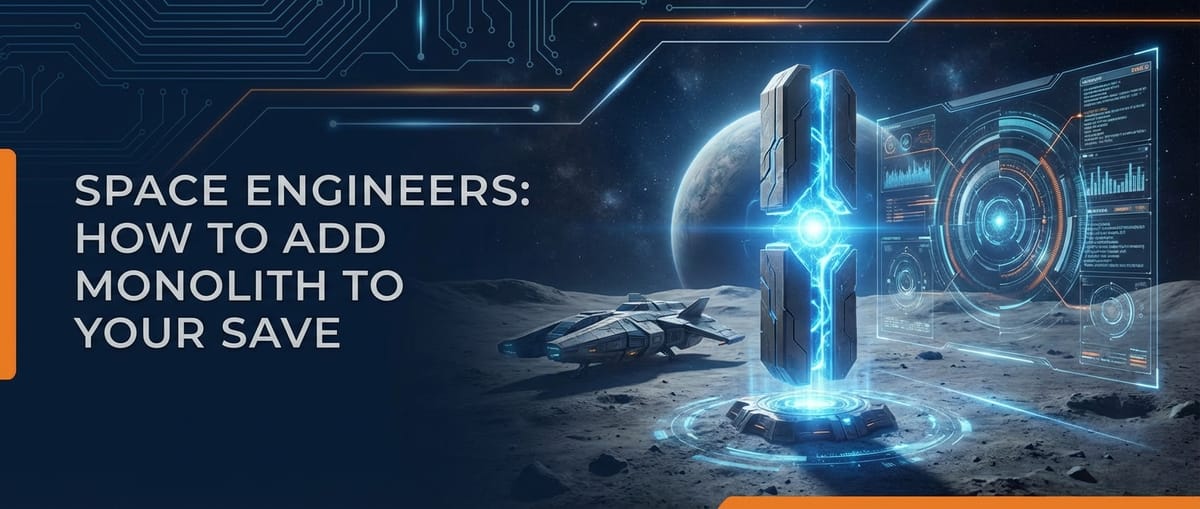


Space Engineers, Keen Software House's critically acclaimed sandbox game, offers players an unparalleled canvas for creativity and engineering prowess in the vast expanse of space. From intricately designed starships to sprawling orbital stations and automated mining operations, the game empowers engineers to build virtually anything they can imagine. Yet, amidst the construction and combat, a particular fascination often grips players: the desire to introduce an element of monumental mystery, a colossal, static structure that defies conventional explanation – a monolith.
Inspired by the iconic black slab from Arthur C. Clarke's "2001: A Space Odyssey," a monolith in Space Engineers is more than just a large block of material; it's a statement, a landmark, a source of awe, and often, a catalyst for new adventures or an enigmatic backdrop for an unfolding narrative. It can be a colossal, alien artifact, a relic of a forgotten civilization, a massive sculptural tribute, or even a daunting challenge for future engineering projects. The beauty of Space Engineers lies in its flexibility, allowing players to weave such grand visions into their personal universes. However, the process of embedding such a significant, pre-defined, or custom-designed structure into an existing save file is not always straightforward. It requires a blend of in-game creativity, external tool manipulation, and a deep understanding of the game's underlying file structure.
This comprehensive guide will meticulously walk you through the various methodologies for adding a monolith to your Space Engineers save, exploring everything from the fundamental principles of save file management to advanced editing techniques. We will delve into the nuances of design, placement, and integration, ensuring that your monolith not only appears in your world but becomes an organic, impactful part of your ongoing spacefaring saga. Prepare to embark on a journey that will transform your Space Engineers experience, allowing you to sculpt the very fabric of your digital cosmos.
The Allure of the Monolith: Why Add One to Your World?
Before diving into the technicalities, it's worth pondering the profound appeal of the monolith. Why would an engineer, typically focused on efficiency, survival, and combat, dedicate time and resources to placing a colossal, inert structure? The reasons are as varied as the players themselves, but generally converge on several key aspects:
Firstly, narrative enhancement. A monolith, by its very nature, suggests a story. Who built it? What is its purpose? Is it a beacon, a tomb, a data repository, or a forgotten monument to a long-dead civilization? Its presence can spark countless hours of role-playing, encouraging players to construct bases around it, launch expeditions to investigate it, or even integrate it into their faction's lore. It transforms a generic asteroid field or a barren planet into a site of historical or cosmic significance.
Secondly, aesthetic grandeur and landmark creation. Space Engineers worlds can be vast and sometimes monotonous. A striking monolith, rising from the surface of a moon or hanging silently in deep space, provides a powerful visual anchor. It becomes a recognizable landmark, helping players navigate immense distances and offering a sense of scale. Imagine traversing light-years only to spot the familiar, imposing silhouette of your monolith on the horizon, a testament to your world's unique identity. It offers a photographic opportunity, a point of pride, and a constant reminder of the infinite possibilities within the game's engine.
Thirdly, personal challenge and engineering spectacle. Constructing or placing a truly massive structure in Space Engineers, especially within the constraints of survival mode, is an engineering feat in itself. It requires careful planning, resource gathering, and potentially innovative construction techniques. Even in creative mode, designing a monolith that is visually compelling and structurally sound can be a rewarding challenge. For many, the monolith is a symbol of their mastery over the game's mechanics, a monument to their architectural ambition.
Finally, creating a sense of mystery and wonder. In a game where players are constantly building and deconstructing, a monolith introduces an element that feels ancient, pre-existing, and often, alien. It can evoke a sense of the sublime, reminding players of the vast, unexplored cosmos and the potential for unimaginable discoveries. This element of wonder can reinvigorate a long-running save, providing new motivations and directions for exploration and expansion.
Understanding these motivations is crucial, as they will influence not only the "how" but also the "what" and "where" of your monolith placement. A monolith intended as a challenge will differ from one designed purely for aesthetic appeal or narrative depth.
Preparing Your Environment: Essential Pre-Monolith Steps
Before you even consider opening a save file or downloading a tool, preparation is paramount. The modifications we're about to undertake involve directly manipulating your game world's data, which carries inherent risks. A single misstep can lead to a corrupted save, hours of lost progress, or unforeseen glitches. Therefore, a methodical approach is not merely recommended but absolutely essential.
The Sacred Art of Backup Creation
This cannot be stressed enough: ALWAYS BACK UP YOUR SAVE FILE BEFORE MAKING ANY SIGNIFICANT CHANGES. Think of your save file as a delicate, hand-drawn map of your universe. Would you make permanent alterations to such a precious document without first making a copy? Space Engineers saves are typically located in C:\Users\[YourUsername]\AppData\Roaming\SpaceEngineers\Saves\[SteamID]\[SaveName]. The AppData folder is often hidden, so you may need to enable "Show hidden files, folders, and drives" in your File Explorer options.
To create a backup, simply navigate to your save folder (e.g., C:\Users\YourUsername\AppData\Roaming\SpaceEngineers\Saves\123456789\MyAwesomeWorld) and copy the entire MyAwesomeWorld folder to a safe location, such as your desktop or a dedicated "Space Engineers Backups" folder. You might even consider zipping it for better organization. This way, if anything goes awry, you can simply delete the corrupted save folder and replace it with your pristine backup, ensuring minimal downtime and zero lost progress. It's a fundamental principle of data management, and ignoring it is an open invitation to frustration.
Understanding Save File Structure and Game Modes
Space Engineers saves are complex collections of files. The primary data is stored within .sbs and .sbc files, which are essentially XML-formatted descriptions of your world, including grids (ships, stations), voxels (planets, asteroids), entities, and game settings. When you make changes, whether in-game or via external tools, you're modifying these underlying data structures.
Game modes also play a role. Creative Mode offers unlimited resources, instant construction, and powerful creative tools (like copy-pasting large structures), making it ideal for designing and initially placing your monolith. Survival Mode, on the other hand, imposes resource constraints and physics challenges, making the integration of a massive structure a far more involved process. While you'll likely use Creative Mode for initial design or placement, the goal is often to then integrate this monolith into a Survival save.
Essential Tools for the Task
Depending on your chosen method, you'll need one or more of the following:
- Space Engineers Game Client: Obviously, to play and test.
- A Reliable Text Editor: For manual save file editing. Notepad++ or Visual Studio Code are excellent choices, offering syntax highlighting and robust search/replace functions that standard Notepad lacks. These tools are crucial when dealing with complex data files and ensuring that your changes are precise.
- SE Toolbox: A powerful, third-party save editor. While it hasn't been actively updated in some time, its core functionalities remain invaluable for manipulating game objects, voxel hands, and entity properties. It offers a graphical interface for tasks that would otherwise require manual XML editing, significantly simplifying complex operations like pasting grids or modifying terrain.
- Steam Workshop Access: If you plan to use community-created monoliths or blueprint mods, a stable internet connection and access to the Steam Workshop are necessary.
- Blueprint Files: For importing and exporting structures. These are typically
.sbcfiles located inC:\Users\[YourUsername]\AppData\Roaming\SpaceEngineers\Blueprints.
Having these tools ready and understood is your first step towards successfully integrating a monolith into your Space Engineers universe.
Crafting Your Colossus: Designing the Monolith
Before you can add a monolith to your save, you first need a monolith to add. This section focuses on the creative process of designing your structure within Space Engineers, whether from scratch or by adapting existing designs. The goal is to create a structure that is both visually striking and technically feasible within the game's engine.
Conceptualization: What is Your Monolith?
Begin with a clear vision. Is it: * The Classic Slab: A minimalist, rectangular prism, perhaps made of solid heavy armor blocks, echoing the "2001" aesthetic. Its power lies in its simplicity and stark contrast to the natural environment. * An Alien Device: More complex, featuring intricate patterns, unusual materials (e.g., modded blocks, different colored armor), glowing elements, or even moving parts (though moving parts require a grid, which brings its own challenges). * A Natural Anomaly: A massive, sculpted asteroid or planetary feature, appearing as if naturally formed but with an unnaturally perfect geometry. This leans heavily into voxel manipulation. * A Ruined Monument: Partially destroyed, overgrown, or weathered, suggesting a forgotten past. This requires deliberate damage and perhaps integrating it with existing terrain.
Consider its scale. A "monolith" implies immense size. Will it be a few hundred meters tall, or will it pierce a planet's atmosphere? The larger it is, the more complex its construction and placement will be, and the greater the potential impact on game performance.
Construction in Creative Mode: The Ideal Workshop
Creative Mode is your best friend for monolith design. You have infinite resources, no welding/grinding time, and the ability to fly freely.
- Start a New Creative World: This isolates your design project from your main save, preventing accidental modifications and keeping your blueprint folder clean. You can use a blank space or a planet/asteroid field as a backdrop for context.
- Basic Shape and Scale: Begin by laying down the fundamental shape using armor blocks. For a classic slab, start with a large, flat plane, then extrude it upwards. Use the symmetry tool (M key) to significantly speed up construction and ensure perfect geometric forms. Experiment with different dimensions. Remember that Space Engineers blocks are 2.5 meters per side, so a 100x100x400 block monolith is a truly massive structure.
- Material and Texture:
- Armor Blocks: Heavy armor offers the most robust and visually dense appearance. Light armor is lighter but might feel less "monolithic." Experiment with different block types (cube, slope, corner, round) to add subtle variations to the surface.
- Paint and Color: A dark, imposing color (black, dark grey, dark metallic) is traditional for monoliths, but don't be afraid to experiment. A stark white or reflective chrome monolith can be equally striking. Consider using the texture tool (P key, then right-click on the block) to apply different material appearances like carbon fiber, concrete, or specific armor textures.
- Internal Structure (Optional): If your monolith is more than just a solid block, you might want to include internal chambers, power systems (reactors, batteries), lights, or even a small control room. Be mindful that adding functional components adds complexity and grid mass.
- Detailing and Refinement: Once the basic shape and material are established, focus on details.
- Lighting: Subtle internal or external lighting can dramatically change the mood. Hidden spotlights can create dramatic shadows or illuminate specific features. Glowing interior blocks can make it appear active or alien.
- Patterns and Glyphs: Use different colored blocks or a combination of block shapes to create patterns on the surface. These could be alien glyphs, geometric designs, or even a subtle fractal motif.
- Interaction Points: Will players be able to land on it? Enter it? If so, consider adding landing pads, airlocks, or access shafts.
- Integrate with Terrain (if applicable): If your monolith is partially buried or emerging from a planet, consider sculpting the terrain around its base using the voxel hand tools (or SE Toolbox later) to make it look like it's been there for ages.
Performance Considerations
A colossal grid made of thousands, or even hundreds of thousands, of blocks will have a significant impact on game performance. * Block Count: Keep an eye on the block count. While modern CPUs and GPUs can handle large structures, an excessively dense monolith might cause frame drops, especially in multiplayer or on less powerful systems. * Grid Complexity: Simple, blocky shapes are less performance-intensive than intricate designs with many small, complex blocks. * Dynamic vs. Static: If your monolith is a single, static grid, performance will generally be better than if it comprises multiple connected grids, especially if those grids have pistons, rotors, or other moving parts. For a true "monolith," static is usually preferred. * Voxels vs. Grids: A monolith entirely made of voxels (terrain) is generally more performant than a grid of blocks, as the game handles voxel data differently. This is an option if you plan to sculpt a massive, custom asteroid or mountain.
Saving Your Masterpiece as a Blueprint
Once your monolith design is complete, you need to save it as a blueprint for later use. 1. Select the Structure: Ensure you are in Creative Mode. Look at any block of your monolith. 2. Open Blueprint Menu: Press Ctrl+B. This will bring up the blueprint screen. 3. Create Blueprint: Click "Create New Blueprint." Give it a descriptive name (e.g., "MyEpicMonolith"). The game will generate a thumbnail and save the blueprint. 4. Locate Blueprint File: Your blueprint is saved as an .sbc file (and potentially a .png for the thumbnail) in C:\Users\[YourUsername]\AppData\Roaming\SpaceEngineers\Blueprints\local\[BlueprintName]. This file contains all the data needed to paste your monolith into any world. This .sbc file is essentially a self-contained definition of your structure, acting as a standardized api for transferring your creation across different game instances or even sharing it with others. Think of it as a meticulously documented design specification.
With your monolith designed and blueprinted, you're now ready to choose your method for integrating it into your target save file.
Method 1: In-Game Blueprint Pasting (Creative Mode Only)
This is the simplest and most direct method, but it is limited to Creative Mode saves. If your target save is already in Creative Mode, or if you don't mind temporarily switching to Creative Mode (and potentially enabling admin tools), this method is ideal.
Step-by-Step Process
- Load Your Target Save: Open the Space Engineers game and load the save file where you want to place your monolith.
- Ensure Creative Mode and Admin Privileges:
- If your save is already Creative Mode, you're good.
- If it's Survival Mode, you have two options:
- Temporarily Switch: Go to
Load Game -> Edit Settingsfor your save, and change "Game Mode" to "Creative." Save and load. - Enable Admin Tools (Space Master): While in Survival, press
Alt+F10to open the Space Master menu. Enable "Enable creative mode tools" and "Show admin screen." This allows you to use Creative Mode functions without fully switching the game mode, but it does mean your save is no longer "pure" survival if that matters to you. For the purpose of just placing a monolith, it's often the quicker option.
- Temporarily Switch: Go to
- Paste the Blueprint:
- Press
F10to open the blueprints menu in-game. - Select your monolith blueprint from the list.
- Click "Project onto world" or "Paste grid" (depending on the blueprint and game version). The monolith will appear as a holographic projection in front of you.
- Press
- Positioning Your Monolith:
- Use your mouse to move the projection.
- Use the scroll wheel to rotate it.
Ctrl+Scrollfor finer rotation.Shift+Scrollfor moving along a single axis.Ctrl+Shift+Scrollfor small increments along a single axis.- Fly around, get different angles, and ensure it's precisely where you want it. Consider the terrain, other structures, and the overall aesthetic. If placing it partially submerged or embedded in an asteroid, you'll need to use the voxel hand later to sculpt the environment around it.
- Place the Monolith: Once satisfied with its position, left-click to paste the actual structure into your world. It will instantly materialize.
- Revert to Survival (Optional): If you temporarily switched to Creative Mode or enabled Space Master tools, you can now revert your save. If you switched game modes, save and exit, then go to
Load Game -> Edit Settingsand switch back to "Survival." If you used Space Master, simply close the menu and disable the creative tools.
Advantages and Disadvantages
Advantages: * Simplicity: No external tools required beyond the game itself. * Visual Feedback: You see exactly where the monolith will appear before pasting. * Speed: Instant placement.
Disadvantages: * Creative Mode Dependency: Only works directly in Creative Mode or with Space Master tools enabled, which might feel like "cheating" for a pure Survival playthrough. * Performance Impact: Pasting a massive grid can cause a momentary stutter or even a crash if your system is struggling or the monolith is exceptionally large. * No Voxel Integration: This method only places grids. If your monolith is meant to be part of an asteroid or planet's terrain, you'll need to use the voxel hand tool (F6, if enabled via Space Master) or an external editor like SE Toolbox to sculpt the surrounding voxels after placement.
This method is excellent for quick deployments and when the "purity" of a survival experience isn't the primary concern. For a more integrated or "natural" placement in a Survival context, other methods are often preferred.
Method 2: Utilizing SE Toolbox (Advanced Grid and Voxel Editing)
SE Toolbox is a powerful, albeit community-maintained, external save editor for Space Engineers. It allows for deep manipulation of save files, including moving grids, editing voxel terrain, and even spawning new entities. While it has a learning curve and requires careful handling, it offers unparalleled control over your Space Engineers world. For sophisticated integration of a monolith, especially one that interacts with voxels, SE Toolbox is invaluable.
Acquiring and Installing SE Toolbox
- Download: Search online for "SE Toolbox Space Engineers" or look for it on GitHub. Ensure you download from a reputable source, as it's a third-party tool. Always check for the latest compatible version with your Space Engineers game version.
- Installation: SE Toolbox is typically a standalone executable. Download it, extract it to a convenient folder (e.g.,
C:\SEToolbox), and create a shortcut. No complex installation process is usually required.
Navigating SE Toolbox: A Brief Overview
Upon launching SE Toolbox, you'll be presented with a complex interface. Don't be intimidated; we'll focus on the relevant sections for monolith placement.
- Open World: Click
File -> Open World. Navigate to your Space Engineers save folder (C:\Users\[YourUsername]\AppData\Roaming\SpaceEngineers\Saves\[SteamID]\[SaveName]) and select theSandbox.sbcfile (this is the primary save data file). - Main Interface: The left panel typically lists "Entities" (grids, asteroids, planets, characters), while the main view shows a 3D representation of your world. You can pan, zoom, and rotate this view using standard mouse controls.
- Tool Tabs: The top tabs provide various tools, such as "Asteroid Generator," "Entity Editor," "Voxel Manipulator," and "File Manager."
Integrating Your Monolith Using SE Toolbox
There are several ways SE Toolbox can assist:
Option A: Pasting a Blueprint Directly (Similar to In-Game, but with More Control)
- Load Blueprint: Go to
Tools -> Load Blueprint. Navigate to your blueprint file (.sbcinC:\Users\[YourUsername]\AppData\Roaming\SpaceEngineers\Blueprints\local\[BlueprintName]). Load it. - Place in World: Once loaded, the blueprint will appear as a placeholder in the 3D view. You can use the transformation tools (position, rotation) in the entity editor to precisely place it. This is where SE Toolbox shines, offering numerical precision that in-game placement lacks. You can input exact XYZ coordinates.
- Save Changes: After positioning, click
File -> Save Worldto commit the changes.
Option B: Modifying Existing Voxels to Become a Monolith
This method is for creating a monolith out of an asteroid or planet.
- Select a Voxel Entity: In the "Entities" list on the left, find an asteroid or a planet (e.g., "Planet Earth").
- Voxel Manipulator Tab: Switch to the "Voxel Manipulator" tab.
- Sculpting: This tab provides tools similar to a 3D modeling program. You can select different brush shapes (sphere, box), sizes, and materials.
- Add/Subtract Material: Use these functions to shape your chosen asteroid or planetary chunk into a monolithic form. You can effectively "carve" a perfect cuboid out of an irregular asteroid or add material to a planet's surface to create a rising structure.
- Material Picker/Painter: Change the material (iron, stone, ice, custom textures) to give your voxel monolith its desired appearance. You can ensure it looks like dark, mysterious rock or a crystalline structure.
- Precise Alignment: Use the coordinate system and numerical inputs to ensure perfect angles and dimensions, something that's difficult with the in-game voxel hand.
- Save Changes:
File -> Save World.
Option C: Copying Grids Between Saves (Advanced)
If you have a monolith in one save and want to transfer it to another without using a blueprint:
- Open Source World: Load the world containing the monolith you want to copy.
- Select Grid: In the "Entities" list, find your monolith grid (it will usually be named "LargeGrid" or similar, you might need to identify it by its location or block count).
- Copy Entity: Right-click the entity and select "Copy."
- Open Target World: Close the source world (
File -> Close World) and then open your target world (File -> Open World). - Paste Entity: Right-click anywhere in the "Entities" list and select "Paste." Your monolith grid will appear.
- Position and Save: Use the entity editor to position the pasted monolith, then
File -> Save World.
Best Practices and Cautions for SE Toolbox
- BACKUP! We cannot stress this enough.
- One Change at a Time: Make a small change, save, and check in-game. This helps isolate errors.
- Performance: Pasting extremely large grids can still strain your system.
- Coordinate Systems: Be aware that SE Toolbox uses a global coordinate system. Understand how X, Y, and Z relate to your world (e.g., Y is usually up/down).
- Potential for Corruption: Incorrectly modifying properties or deleting vital entities can corrupt your save. Always proceed with caution.
- Voxel Holes: When placing a grid monolith partially into a planet/asteroid, you might create a "voxel hole." You'll need to use the Voxel Manipulator or in-game voxel hand to smooth out the terrain around it.
SE Toolbox offers a granular level of control that makes it possible to integrate your monolith with exceptional precision, making it appear as if it was always meant to be part of your Space Engineers universe. Its capabilities can be likened to a powerful api for interacting directly with the game's core data, allowing you to bypass in-game limitations and sculpt your world with unparalleled freedom. This level of direct data manipulation, while powerful, underscores the need for robust management and understanding, much like managing a sophisticated api gateway in a complex enterprise system.
APIPark is a high-performance AI gateway that allows you to securely access the most comprehensive LLM APIs globally on the APIPark platform, including OpenAI, Anthropic, Mistral, Llama2, Google Gemini, and more.Try APIPark now! 👇👇👇
Method 3: Modding and Workshop Monoliths
The Space Engineers community is incredibly vibrant, and the Steam Workshop is a treasure trove of creations, including pre-made monoliths, scripts, and world generators. This method leverages the work of others to introduce monoliths into your game.
Finding Monolith Mods and Blueprints
- Steam Workshop Search: Navigate to the Space Engineers section of the Steam Workshop.
- Keywords: Search for "monolith," "alien artifact," "ancient structure," "mystery," or "large structure."
- Types of Workshop Items:
- Blueprints: These are pre-designed structures, just like the one you'd create in Creative Mode. You subscribe, and they appear in your in-game blueprint menu (F10). You then paste them using Method 1.
- World Mods/Scenarios: Some mods or custom scenarios might include monoliths as part of their world generation or specific challenges. These usually involve subscribing to the mod and then starting a new game with that specific mod enabled.
- Spawnable Objects: A mod might introduce a new item that, when placed or activated, spawns a monolith into the world.
- Voxel Hand Textures/Shapes: Less common for entire monoliths, but some mods provide unique voxel textures or shapes that you could then use with the in-game voxel hand (if enabled via Space Master) or SE Toolbox to sculpt a monolithic terrain feature.
Subscribing and Enabling Workshop Items
- Subscribe: On the Workshop page of an item you like, click the "Subscribe" button. Steam will automatically download it.
- Enable in Game:
- For Blueprints: They should automatically appear in your F10 blueprint menu.
- For Mods (World/Gameplay):
- Load your save file (or start a new one).
- Go to
Load Game -> Edit Settings(for an existing save) orNew Game -> Custom Game(for a new game). - Navigate to the "Mods" section on the left.
- Find the subscribed mod in the "Available Mods" list and click the arrow to move it to "Active Mods."
- Save your game settings (if existing) or start the new game.
Considerations for Modded Monoliths
- Compatibility: Ensure the mod is compatible with your current version of Space Engineers. Outdated mods can cause crashes or unexpected behavior.
- Dependency: Some mods require other mods to function. Always read the mod description carefully.
- Performance: As with player-created monoliths, large modded structures can impact performance.
- Lore Integration: Consider whether a pre-made monolith fits your world's existing lore. You might need to adapt your story to incorporate the new structure.
- Server Implications: If you play on a multiplayer server, the server administrator will need to add the mod to the server for it to be visible to all players.
Using Workshop items can be an excellent way to quickly add a professional-looking or uniquely themed monolith without having to design it from scratch. It taps into the collective creativity of the Space Engineers community, offering an immense library of assets. The Workshop itself, with its structured categories and search functions, acts as a decentralized api gateway for community-created content, enabling players to easily access and integrate new features and structures into their game worlds.
Method 4: Manual Save File Editing (Expert Level)
This method is the most direct but also the most challenging. It involves directly editing the XML data within your save file (Sandbox.sbc) to introduce a grid. This approach is not for the faint of heart and requires a very good understanding of XML structure and Space Engineers data definitions. However, it offers ultimate control and insight into how the game stores its world data.
Understanding Sandbox.sbc
The Sandbox.sbc file is the heart of your save. It contains definitions for almost everything in your world: * <MyObjectBuilder_Checkpoint>: General save game metadata. * <SectorObjects>: Contains definitions for grids (ships, stations), planets, asteroids, and other entities. * <VoxelMaps>: Details about voxel terrain. * <Factions>: Faction data. * And much more.
A grid (your monolith) is defined within the <MyObjectBuilder_EntityBase xsi:type="MyObjectBuilder_CubeGrid"> tag inside <SectorObjects>. This tag contains information about: * EntityId: Unique identifier for the grid. * DisplayName: The name of the grid (often "Large Grid"). * PositionAndOrientation: The grid's location and rotation in space. * LinearVelocity, AngularVelocity: If it's moving. * GridSizeEnum: Large or Small. * CubeBlocks: A crucial section that lists every single block on the grid, including its type, subtype, color, and orientation. This is what makes a monolith definition so large.
The Process: Copying a Blueprint's Data
Instead of writing a grid definition from scratch (which is practically impossible due to the sheer number of blocks), we'll leverage your already created blueprint.
- Create a Dummy Save: Start a new Creative Mode world, paste your monolith blueprint into it using Method 1, and save that world. This dummy save now contains a fully formed
Sandbox.sbcfile with your monolith's data. - Open Both Save Files in a Text Editor:
- Locate the
Sandbox.sbcfile of your dummy save (C:\Users\[YourUsername]\AppData\Roaming\SpaceEngineers\Saves\[SteamID]\DummyMonolithWorld\Sandbox.sbc). - Locate the
Sandbox.sbcfile of your target save (C:\Users\[YourUsername]\AppData\Roaming\SpaceEngineers\Saves\[SteamID]\MyTargetWorld\Sandbox.sbc). - Open both using a powerful text editor like Notepad++ or Visual Studio Code.
- Locate the
- Identify the Monolith's Grid Data in the Dummy Save:
- In the dummy save's
Sandbox.sbc, search forMyObjectBuilder_CubeGrid. - You'll likely find several, but one will be your massive monolith. Look for a
DisplayNamethat matches your blueprint, or identify it by its immenseCubeBlockssection. - The entire section you need to copy starts with
<MyObjectBuilder_EntityBase xsi:type="MyObjectBuilder_CubeGrid">and ends with</MyObjectBuilder_EntityBase>. Select this entire block of XML. It will be very long.
- In the dummy save's
- Copy and Paste into Target Save:
- In your target save's
Sandbox.sbc, find the<SectorObjects>tag. - Paste the copied XML block of your monolith's grid data inside the
<SectorObjects>tag, typically at the end of the existing list ofMyObjectBuilder_EntityBasedefinitions.
- In your target save's
- Adjust Position and Orientation (Crucial):
- Within the pasted XML, find the
<PositionAndOrientation>tag. This is where the monolith's XYZ coordinates and its rotation are defined. <Position x="123.45" y="678.90" z="11.22" /><Forward x="0" y="0" z="-1" /><Up x="0" y="1" z="0" />- You will need to change these
x, y, zvalues to position your monolith correctly in your target world. Getting these coordinates right is challenging without visual feedback. You might need to:- Use SE Toolbox to get a target XYZ coordinate.
- Load the game, note your player's coordinates (Alt+F10, "Display Developer Data"), and then manually adjust.
- Iterate: Guess, save, load game, check, exit, adjust, repeat.
- The
ForwardandUpvectors define the orientation.Forwardis the direction the "front" of the grid faces,Upis its "top." These are usually default values unless you explicitly rotated your blueprint.
- Within the pasted XML, find the
- Ensure Unique EntityId (Important):
- Every entity in Space Engineers needs a unique
EntityId. When you copy-paste, the ID from the dummy save will be duplicated. - Find the
EntityId="XXXXXXXXXXXXX"attribute within the pasted<MyObjectBuilder_EntityBase>tag. - You need to generate a new, unique 64-bit integer ID. The easiest way is to use an online UUID generator or simply add a few random digits to the end of the existing ID, making sure it's a very large number. Failure to do this will cause the game to crash or have unpredictable behavior.
- Every entity in Space Engineers needs a unique
- Save Changes: Save the modified
Sandbox.sbcfile.
Challenges and Pitfalls of Manual Editing
- Syntax Errors: A single misplaced comma, forgotten closing tag, or incorrect attribute can render your save file unreadable and prevent the game from loading. XML is extremely sensitive to syntax.
- Massive File Size:
Sandbox.sbcfor a large save can be tens or even hundreds of megabytes. Navigating and editing such a file can be slow and memory-intensive for text editors. TheCubeBlockssection for a monolith will be enormous. - Coordinate Guesswork: Without visual tools, precise positioning is a trial-and-error process.
- Entity ID Conflicts: As mentioned, duplicating
EntityIds is a critical error. - Version Incompatibility: If your blueprint was created in a vastly different game version, block definitions might have changed, causing issues.
- No Undo: Once you save the file, the changes are permanent. Your backup is your only undo button.
Despite these challenges, manually editing the Sandbox.sbc file offers the deepest understanding of Space Engineers' internals. It's akin to being the master control program (MCP) of your game world, with the power to directly manipulate its core data structures. For those who thrive on absolute control and enjoy reverse-engineering, this method is a rewarding (if arduous) path. It offers insight into the intricate api that underpins the game's dynamic world, allowing for manipulations that even powerful tools like SE Toolbox might not directly expose. This deep dive into the raw data highlights why robust api management and well-defined data formats are essential in any complex system, be it a game engine or an enterprise software solution.
Integrating APIPark: A Brief, Natural Interlude
The meticulous effort involved in placing a colossal monolith into your Space Engineers save, ensuring its seamless integration, stable performance, and correct behavior within the game's complex engine, mirrors the challenges faced in managing intricate digital ecosystems in the real world. Just as you, the engineer, meticulously manage grid definitions, entity IDs, and coordinate systems to prevent conflicts and ensure your virtual world functions harmoniously, enterprises grapple with managing countless digital services.
For developers and organizations striving to manage, integrate, and deploy AI and REST services with similar precision and efficiency, platforms like APIPark offer a robust solution. APIPark is an open-source AI gateway and API management platform that simplifies the complexities of the digital realm. It provides a unified framework for integrating over 100 AI models, standardizing API formats, and encapsulating prompts into easily consumable REST APIs. Much like how a well-structured blueprint simplifies the construction of your in-game monolith, APIPark streamlines the lifecycle management of APIs, from design and publication to invocation and decommissioning. It ensures that disparate services communicate flawlessly, managing traffic, balancing loads, and providing detailed call logging and powerful data analysis—features that parallel the meticulous planning required to keep your massively complex Space Engineers creations from bogging down your game. Essentially, APIPark acts as a master control program for your digital services, ensuring they operate with the stability and performance needed for modern enterprise applications. This level of comprehensive api management is crucial for businesses navigating the intricate landscape of AI and web services, allowing them to build and connect with the same confidence and control you now wield over your Space Engineers universe.
Designing Your Monolith's Surroundings: Lore and Environmental Integration
Once your monolith is physically in place, the work isn't over. To truly embed it into your Space Engineers world, you need to consider its context, its story, and how it interacts with its environment. This transforms a mere object into a significant landmark.
Crafting a Backstory and Lore
A monolith thrives on mystery. Consider these questions: * Origin: Was it built by an ancient, forgotten race? Is it a naturally occurring, but statistically improbable, geological formation? Did it arrive from another dimension? Is it a remnant of a crashed megaship? * Purpose: Is it a beacon, transmitting a signal to distant stars? A tomb for a powerful being? A data archive containing forbidden knowledge? A power source? A terraforming device that failed? * Current State: Is it active or dormant? Damaged or pristine? Is it sentient, or merely an object? Does it emit any strange energy readings or signals that players can detect? * Player Interaction: What role will the players play in its story? Are they discoverers, archaeologists, engineers tasked with reactivating it, or guardians protecting its secrets?
Even a simple backstory enriches the experience exponentially. You don't need to write a novel; a few intriguing questions or hints are often more powerful.
Environmental Integration
A monolith shouldn't just float in space or sit awkwardly on a planet. It needs to look like it belongs.
- Terrain Sculpting: If your monolith is on a planet or asteroid, use the in-game voxel hand (if enabled via Space Master) or SE Toolbox's Voxel Manipulator to sculpt the terrain around its base. Make it appear as if it has been there for millennia, with natural erosion patterns or, conversely, perfectly carved foundations.
- Blending: Use voxel materials that match the monolith's base or the surrounding environment to create a seamless transition.
- Impact Craters: If it's implied to have crashed, sculpt a massive impact crater around it.
- Excavation Sites: If it's partially buried, imagine what an excavation site would look like. Add small bases, equipment, and tunnels leading into the monolith.
- Structural Additions:
- Observation Posts: Build small, minimalist observation posts on nearby cliffs or asteroids, suggesting that others have studied the monolith.
- Research Stations: Construct a full-fledged research base around or even partially integrated into the monolith, complete with power, life support, and laboratories.
- Defenses: If the monolith holds valuable secrets, consider adding defensive turrets or energy shields to protect it.
- Approaches: Create designated landing pads, docking ports, or even an elaborate bridge leading to its entrance, inviting exploration.
- Lighting and Atmosphere:
- Natural Lighting: Consider how sunlight (or the lack thereof) hits the monolith. Does it cast dramatic shadows?
- Artificial Lighting: Add subtle exterior lights to highlight its features at night or in deep space. Use different colors to create a mood (e.g., eerie green, cold blue, warning red).
- Environmental Hazards: Perhaps the area around the monolith has strange atmospheric conditions, high radiation, or unusual gravity fields, adding to its mystery and challenging players.
- Flora and Fauna (if using mods): If you have mods that add plants or creatures, consider how they might interact with the monolith. Is it overgrown? Are strange alien creatures drawn to it?
Performance Revisited: Optimization for the Grand Scale
While designing your monolith, remember the impact of sheer size and complexity on game performance. A beautiful monolith is useless if it renders your game unplayable.
- Block Density: A solid, monolithic structure uses a high number of blocks in a small volume. If performance becomes an issue, consider making parts of it hollow or using fewer dense block types where visual impact is minimal.
- Active Blocks: Avoid adding unnecessary functional blocks (e.g., conveyors, reactors, programmable blocks) to the monolith itself unless they are integral to its lore or design. Each active block adds to simulation load.
- Grid Splits: If your monolith is truly colossal and you face severe lag, consider breaking it into multiple, smaller, unconnected static grids. This can sometimes help the game's engine manage load, but it adds complexity.
- LOD (Level of Detail) Bias: In game options, you can adjust the "Render Distance" and "Voxel Quality." Lowering these might help, though it reduces visual fidelity.
- Keep it Simple, Stupid (KISS): For the most robust and performant monolith, stick to solid armor blocks and simple geometry. The "2001" monolith is effective precisely because of its austere simplicity.
By carefully considering both the narrative and environmental aspects, your monolith will not just be a static object but a living, breathing part of your Space Engineers world, enriching gameplay and providing countless hours of exploration and storytelling.
| Feature Area | Design Considerations | Impact & Integration Tips |
|---|---|---|
| Physical Form | Shape: Classic slab, intricate alien structure, sculpted natural formation. Size: From hundreds of meters to kilometers. Material: Heavy armor, light armor, custom voxel textures, varied block types (slopes, corners). Color/Texture: Dark, reflective, weathered, pristine, specific patterns. |
Performance: Simpler shapes & fewer block types generally perform better. Excessive small blocks or complex geometry can reduce FPS. Visibility: Ensure it's large enough to be seen from a distance, becoming a clear navigational landmark. Durability: Heavy armor resists damage better, important if it's meant to be an ancient, enduring relic. |
| Environmental Context | Location: Deep space, planetary orbit, embedded in a moon/asteroid, emerging from a planet's surface. Interaction with Terrain: How does it meet the ground? Cleanly cut, naturally eroded, crashed and embedded, partially excavated? Celestial Alignment: Does it align with stars, planets, or other celestial bodies during specific times or events? |
Realism/Believability: Use SE Toolbox or voxel hand to sculpt terrain seamlessly around the monolith, avoiding floating structures or abrupt edges. Gameplay: Deep space placement might require jump drives for access, planetary placement could be a new ground base location. Visual Impact: Strategic placement can create dramatic sunrises/sunsets over the monolith. |
| Lore & Narrative | Origin Story: Alien creation, ancient civilization, unknown cosmic event, failed super-project. Purpose: Beacon, tomb, data core, weapon, monument, prison. Status: Active, dormant, damaged, protected, forgotten. Potential Interaction: Does it emit signals, react to presence, have a hidden entrance, require a key to activate? |
Player Engagement: A compelling backstory encourages exploration, base building around it, and role-playing. Quest Hooks: Its purpose can inspire new goals, like finding artifacts to activate it, or defending it from hostile entities. World Building: Connect the monolith's lore to other elements in your save (e.g., a specific faction studies it, pirates try to loot it). |
| Functional Elements | Power: Internal reactors/batteries, solar panels, or implied unknown power source. Systems: Hidden control rooms, simple lighting, minor utility blocks (refinery, assembler) for a connected base. Access: Landing pads, docking ports, airlocks, tunnels. Defenses: Turrets, shields (if mods are used), or natural hazards around it. |
Gameplay Integration: Make it accessible and interactable if players are meant to explore or use it. Resource Management: If it has functional blocks in Survival, ensure it's powered and maintained. Security/Challenge: Defenses add a layer of challenge or protection if the monolith is guarding something valuable. Avoid excessive functional blocks to maintain performance if its primary role is aesthetic. |
| Visual Accents | Lighting: Internal glow, external spotlights, subtle warning lights. Patterns: Geometric designs, alien glyphs, etched lines on its surface. Atmospherics (if modded): Surrounding fog, strange weather patterns, energy fields. Scale Cues: Place smaller structures (like a landing beacon or a lone explorer ship) nearby to emphasize its immense size. |
Mood Setting: Lighting can dramatically change the perception of the monolith (e.g., eerie, welcoming, dangerous). Detailing: Small visual elements can add depth and suggest complexity, even on a simple structure. Immersion: Consistent atmospheric elements enhance the monolith's integration into the world. |
Troubleshooting and Best Practices for Monolith Integration
Even with careful planning, issues can arise. Here's how to troubleshoot common problems and a summary of best practices for a smooth experience.
Common Issues and Solutions
- Game Crash on Loading Save:
- Cause: Most likely a syntax error in
Sandbox.sbc(if manually edited), a corrupted blueprint, anEntityIdconflict, or an excessively large grid overloading your system. - Solution: Restore from your last backup immediately. If manually editing, carefully re-check your XML for errors. If using a blueprint, try a smaller blueprint or ensure your system meets minimum requirements for such large structures. For
EntityIdconflicts, ensure allEntityIds in<SectorObjects>are unique.
- Cause: Most likely a syntax error in
- Monolith Not Appearing:
- Cause: Incorrect coordinates, monolith pasted too far away to render, or a save/load error.
- Solution: If using SE Toolbox or manual editing, double-check the
PositionAndOrientationvalues. Try loading the save, flying around the estimated location. Ensure you saved theSandbox.sbcfile correctly. If using an in-game blueprint, ensure you clicked "paste" and not just "project."
- Performance Drop (Low FPS/Lag):
- Cause: Overly large block count, complex grid physics, too many active blocks, or system limitations.
- Solution:
- Reduce block count if possible (e.g., make parts hollow, use simpler shapes).
- Ensure the monolith is a static grid (not connected to pistons, rotors, or other dynamic elements unless intentional).
- Check for unnecessary functional blocks on the monolith.
- Lower in-game graphics settings (render distance, voxel quality).
- Consider splitting the monolith into multiple static grids if it's exceptionally large.
- Upgrade hardware if consistently hitting performance bottlenecks with large builds.
- Monolith Floating or Clipping Terribly:
- Cause: Inaccurate placement coordinates, especially if done via SE Toolbox or manual editing, or insufficient voxel sculpting.
- Solution: Reload into SE Toolbox, adjust coordinates, and use the Voxel Manipulator to sculpt the terrain around it for a seamless look. In-game, use the voxel hand (if enabled) to blend the monolith with the environment.
- Monolith Disappears or Behaves Strangely:
- Cause: Grid ownership issues, corrupted data, or physics glitches.
- Solution: Check grid ownership in SE Toolbox or in-game (using
Alt+F10Space Master tools). Try changing ownership to "Nobody" or your character. If it disappears, it might have merged with another grid or despawned due to an error; restore backup.
- Mod Conflicts:
- Cause: Two mods trying to modify the same game aspect, or an outdated mod.
- Solution: Deactivate mods one by one to find the culprit. Always check mod descriptions for known conflicts and compatibility.
General Best Practices
- Backup Religiously: This remains the single most important rule. Keep multiple backups at different stages of your project.
- Test Incrementally: Make a small change, save, load the game, verify, then proceed to the next step. This saves countless hours of debugging.
- Start Small: For your first monolith, don't aim for a kilometer-long structure. Begin with something manageable to learn the process.
- Utilize Creative Mode for Design: It's the most efficient way to design and blueprint your structure without resource constraints.
- Use Tools Wisely: Understand the strengths and weaknesses of each tool (in-game blueprinting, SE Toolbox, manual editing) and choose the appropriate one for the task.
- Consult Community Resources: The Space Engineers subreddit, official forums, and YouTube tutorials are excellent sources of information and help. Don't hesitate to ask for advice.
- Embrace the Journey: Adding a monolith, especially a grand one, is a project. Enjoy the process of design, integration, and troubleshooting. The satisfaction of seeing your vision materialize is the ultimate reward.
The process of adding a monolith to your Space Engineers save is a testament to the game's flexibility and the boundless creativity of its community. Whether you choose the directness of in-game pasting, the precision of SE Toolbox, the convenience of Workshop mods, or the granular control of manual file editing, each method offers a unique path to bringing your monumental vision to life. The challenges along the way, much like the engineering hurdles faced by real-world developers, underscore the importance of robust management, whether it's managing game assets or, in the professional sphere, utilizing comprehensive api management platforms like APIPark to orchestrate complex digital services. By following the steps outlined in this guide and adhering to best practices, you are not just adding a structure; you are shaping your own digital cosmos, embedding a piece of your imagination into the very fabric of your Space Engineers universe.
Conclusion
The journey to implant a magnificent monolith within your Space Engineers save is a rich tapestry woven with threads of design, technical mastery, and creative vision. We've traversed the landscape from conceptualizing your grand structure to the meticulous steps of its physical integration, exploring four distinct methodologies: the straightforward in-game blueprint pasting for immediate gratification; the granular control offered by the venerable SE Toolbox for precise grid and voxel manipulation; the expansive possibilities presented by community-driven Steam Workshop mods; and the expert-level, deep-dive into manual save file editing, offering unparalleled insight into the game's core data.
Each method, with its unique advantages and inherent challenges, underscores the multifaceted nature of Space Engineers as a sandbox. It empowers players not just to build, but to sculpt their very world, adding layers of narrative, aesthetic grandeur, and profound mystery. Whether your monolith stands as a stark testament to forgotten civilizations, a silent sentinel in the void, or a complex hub for future operations, its presence fundamentally alters the dynamics of your personal universe.
Crucially, throughout this endeavor, the unwavering principle of backing up your save files has been paramount. This seemingly simple act is the bedrock of safe experimentation, safeguarding countless hours of dedication against unforeseen digital entropy. Similarly, the detailed discussion of troubleshooting and best practices equips you with the knowledge to navigate potential pitfalls, transforming obstacles into learning opportunities.
The complexities of managing such colossal in-game assets, from ensuring performance to maintaining structural integrity and preventing data conflicts, serve as a fascinating parallel to the real-world demands of managing intricate digital infrastructures. Just as you, the Space Engineer, meticulously manage every block and every coordinate, enterprises leverage sophisticated tools for api management. This echoes the value of platforms like APIPark, which serves as an open-source AI gateway and API management platform, simplifying the orchestration of diverse services and acting as a central master control program for an organization's digital assets.
Ultimately, adding a monolith to your Space Engineers save is more than a technical procedure; it's an act of creation, a bold stroke on your cosmic canvas. It invites exploration, sparks imagination, and leaves an indelible mark on your personal galaxy. So go forth, engineer, armed with knowledge, creativity, and a healthy respect for your backup folder, and sculpt the universe you’ve always dreamed of.
Frequently Asked Questions (FAQ)
- What is the easiest way to add a monolith to my Space Engineers save? The easiest way is to design your monolith as a blueprint in Creative Mode, then paste it into your target save using the in-game blueprint pasting feature (F10). This requires your target save to be in Creative Mode or for you to temporarily enable Creative Tools via Space Master (Alt+F10).
- Can I add a monolith to a Survival Mode save without "cheating"? Directly pasting a pre-made monolith (especially a large one) into a Survival save typically involves using Creative Tools (Space Master: Alt+F10) or temporarily switching your game mode to Creative. While this might feel like "cheating" to some, it's the only practical way for instant placement. For a purer Survival experience, you would need to build the monolith block by block, gathering all resources, which is a monumental task for a truly massive structure. Alternatively, you could integrate a pre-made monolith and then "pay the cost" in resources or disable creative tools afterwards.
- Will adding a very large monolith affect my game's performance? Yes, absolutely. A monolith consisting of thousands or hundreds of thousands of blocks can significantly impact your game's frame rate (FPS), especially on less powerful computers or in multiplayer environments. Factors like block count, grid complexity, and the number of active blocks all contribute to performance issues. Consider optimizing your design by making parts hollow, using simpler block shapes, and limiting functional components.
- Is SE Toolbox still safe and compatible with current Space Engineers versions? SE Toolbox is a community-made tool and has not been officially updated by Keen Software House for some time. While many of its core functionalities still work, there's always a risk of incompatibility with newer game updates, which could lead to save corruption or unexpected behavior. Always download from reputable sources, read recent user feedback, and always back up your save file before using SE Toolbox.
- How do I make my monolith look like it's naturally integrated into a planet or asteroid? After placing your monolith (which is a grid of blocks), you'll need to use voxel editing tools to sculpt the surrounding terrain. In-game, if you enable Creative Tools via Space Master (Alt+F10), you can use the voxel hand (F6) to add or remove terrain around its base. For more precise and powerful sculpting, SE Toolbox's "Voxel Manipulator" tab allows you to shape asteroids and planets with greater control and apply different material textures for a seamless blend.
🚀You can securely and efficiently call the OpenAI API on APIPark in just two steps:
Step 1: Deploy the APIPark AI gateway in 5 minutes.
APIPark is developed based on Golang, offering strong product performance and low development and maintenance costs. You can deploy APIPark with a single command line.
curl -sSO https://download.apipark.com/install/quick-start.sh; bash quick-start.sh

In my experience, you can see the successful deployment interface within 5 to 10 minutes. Then, you can log in to APIPark using your account.

Step 2: Call the OpenAI API.