Stash AI Tagger Plugin: Automate & Organize Your Content
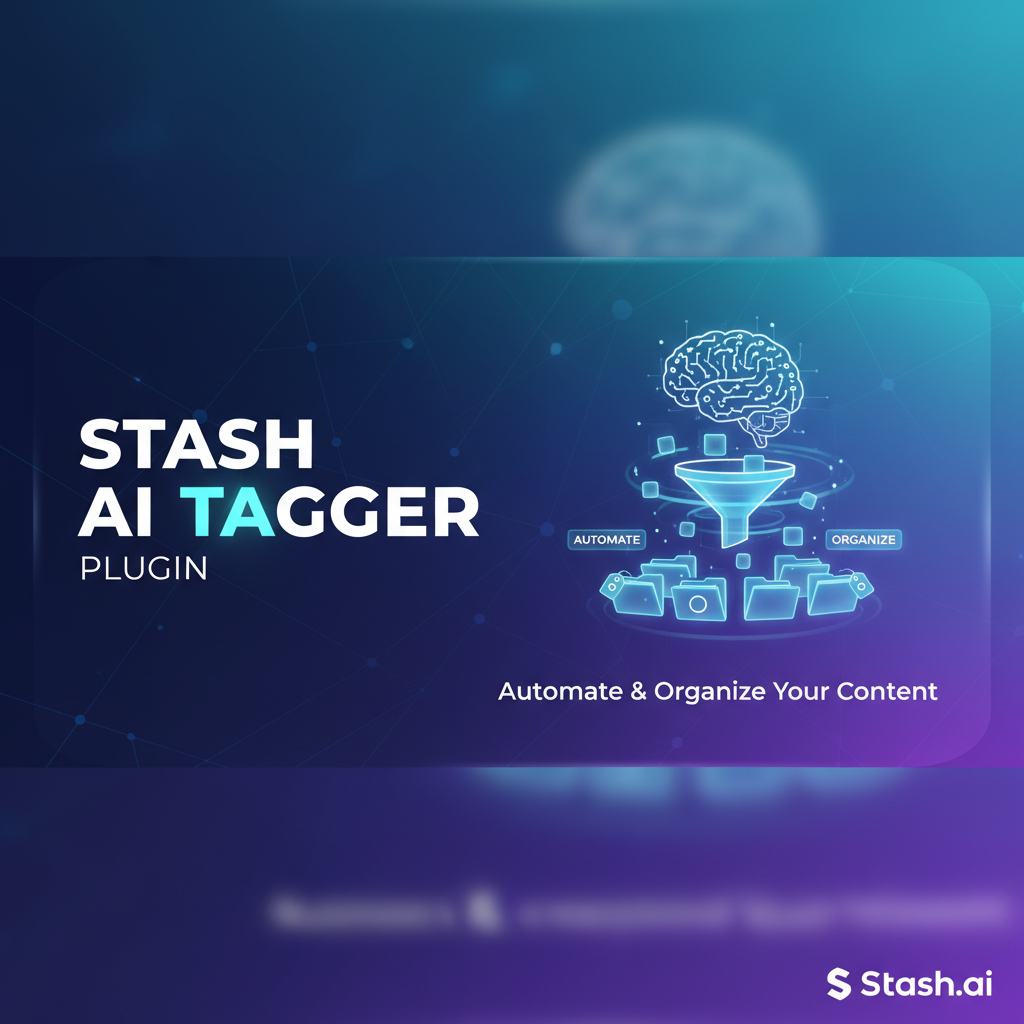


In an era defined by the ceaseless proliferation of digital media, the challenge of effective content organization has escalated from a mere convenience to an absolute necessity. From personal archives brimming with memories to vast corporate repositories of critical information, the sheer volume of data we generate and consume daily is staggering. Videos, images, audio clips, and documents, once meticulously categorized by hand, now demand a more intelligent, scalable, and efficient approach to management. This profound need for streamlined organization finds a powerful ally in sophisticated media management platforms like Stash, and more specifically, in its innovative Stash AI Tagger Plugin. This plugin doesn't just promise to automate the mundane task of content labeling; it revolutionizes the way users interact with their digital libraries, transforming chaotic collections into searchable, structured, and instantly accessible assets. It leverages the cutting-edge capabilities of artificial intelligence to breathe new life into content discoverability, drastically reducing the time and effort traditionally associated with metadata generation and content categorization.
The true power of the Stash AI Tagger Plugin lies in its ability to harness advanced AI models to perform complex analytical tasks that would otherwise require countless hours of human labor. Imagine a scenario where a massive video library, accumulated over years, can be automatically scanned, analyzed frame-by-frame, and tagged with relevant keywords describing objects, activities, locations, and even the emotional tone of the content. This is not a futuristic fantasy but a present-day reality made possible by this plugin. By integrating seamlessly into the Stash ecosystem, it provides a robust, intelligent layer of automation that empowers users to regain control over their digital domains. This article will embark on a comprehensive exploration of the Stash AI Tagger Plugin, delving into its core functionalities, the intricate AI technologies that power it, its multifaceted benefits, the technical considerations for deployment, and how it fits into the broader landscape of modern content management and api-driven AI services. We will uncover how this tool is not merely an add-on but a transformative component, fundamentally altering the paradigm of digital content organization for individuals and enterprises alike, preparing them for a future where content volume only continues to surge.
The Unyielding Deluge: The Challenge of Content Management in the Digital Age
The digital revolution, while offering unparalleled opportunities for creation and sharing, has simultaneously ushered in an unprecedented era of content overload. Every second, gigabytes of new data are generated globally – from high-definition videos captured on smartphones to professional multimedia projects, vast image galleries, and an ever-expanding library of audio recordings. For individuals, this manifests as burgeoning hard drives filled with unsorted family moments and personal projects. For businesses, it translates into sprawling content management systems (CMS) and digital asset management (DAM) platforms struggling under the weight of marketing materials, training videos, product images, and archived documents. The sheer scale of this content deluge presents a formidable organizational challenge.
Traditionally, the primary method for categorizing and making this content discoverable has been manual tagging and metadata entry. This human-centric approach, while capable of delivering highly nuanced and contextually rich descriptions, is fraught with significant limitations. Firstly, it is extraordinarily time-consuming. Imagine manually tagging thousands of video clips, each requiring careful review to identify key elements, themes, and subjects. This process can quickly become a full-time job for a dedicated team, incurring substantial operational costs. Secondly, manual tagging is inherently inconsistent. Different individuals may use varying terminology, levels of detail, or subjective interpretations when applying tags, leading to a fragmented and unreliable metadata schema. This inconsistency severely hampers search accuracy, making it difficult for users to reliably retrieve the specific content they need, even if it exists within the system. A video tagged "beach vacation" by one person might be tagged "Hawaii trip" or "ocean scenes" by another, creating silos of information that are hard to bridge.
Moreover, the problem extends beyond just retrieval. Inefficient content organization leads to a cascade of negative impacts on workflow efficiency. Content creators spend more time searching for assets than actually creating new ones. Marketing teams struggle to locate the right visuals for campaigns, delaying launches. Archivists face an insurmountable task of preserving and making accessible historical media. The absence of robust, consistent, and granular metadata effectively renders vast portions of digital libraries invisible, trapped in a digital limbo where they exist but cannot be easily found or utilized. This 'dark data' represents a significant lost opportunity, stifling productivity, hindering collaboration, and ultimately undermining the very purpose of collecting and storing digital content in the first place. The increasing demand for instant access and personalized experiences further amplifies this challenge, making the search for an automated, intelligent solution not just desirable, but absolutely critical for navigating the modern digital landscape.
Introducing Stash: A Foundation for Media Mastery
At its core, Stash emerges as a powerful, versatile media management application meticulously designed to help users curate, organize, and interact with their extensive digital media collections. Far from being just another file browser, Stash provides a robust framework that goes beyond simple file storage, offering advanced features for detailed content description, categorization, and retrieval. It’s built with the understanding that modern media libraries require more than just file paths; they demand rich metadata, customizable taxonomies, and intelligent search capabilities to unlock the true value of their contents. Users can import their media files into Stash, which then acts as a central hub, allowing them to manage everything from personal video archives to professional multimedia assets with a high degree of control and flexibility.
The core purpose of Stash revolves around providing a structured environment where media files are not merely passive data points but active, searchable entities. It enables users to attach a wide array of metadata, including titles, descriptions, dates, genres, and custom tags, to each piece of content. This manual metadata entry, while effective for smaller collections or highly specific requirements, still faces the inherent limitations discussed previously when scaled up. However, Stash's true genius lies in its extensible architecture, particularly its sophisticated plugin system. This system is the lifeblood of Stash, transforming it from a powerful standalone application into a dynamic, adaptable platform capable of evolving with the needs of its users and the advancements in technology.
The plugin system is essential for Stash for several compelling reasons. Firstly, it fosters extensibility. No single application can anticipate or fulfill every conceivable user need or integrate with every emerging technology. Plugins allow third-party developers, or even the community, to extend Stash's functionality beyond its core offerings, addressing niche requirements or integrating specialized tools. This modular approach ensures that Stash remains lightweight and focused on its primary mission, while offering an open-ended pathway for enhanced capabilities. Secondly, it promotes innovation. As new AI models, data processing techniques, or external apis emerge, plugins provide the perfect conduit for integrating these cutting-edge advancements directly into the Stash workflow without requiring a complete overhaul of the core application. This agility is crucial in the fast-paced world of technology, allowing Stash to remain at the forefront of media management solutions. Finally, the plugin system caters to diverse user needs. Not every user requires every feature, and a monolithic application crammed with functionalities can be overwhelming and resource-intensive. Plugins allow users to pick and choose the exact tools they need, tailoring their Stash experience to their specific requirements, thereby optimizing performance and user experience. It is within this flexible and innovative plugin ecosystem that the Stash AI Tagger Plugin finds its indispensable role, embodying the platform's commitment to intelligent, automated, and user-centric media management.
Deep Dive into the Stash AI Tagger Plugin: The Engine of Automation
The Stash AI Tagger Plugin represents a monumental leap forward in addressing the daunting task of digital content organization. It is not merely an automation tool; it is an intelligent assistant that fundamentally redefines how users categorize, search, and interact with their media libraries. At its heart, the plugin's core functionality is elegantly simple yet profoundly powerful: it automates the process of generating and applying metadata tags to media content within Stash. This automation is achieved through a sophisticated workflow that involves scanning, analyzing, and then intelligently suggesting or directly applying descriptive tags.
When a user initiates the tagging process, either on individual files, selected batches, or even an entire library, the plugin springs into action. For video content, it might sample frames at regular intervals or focus on key scenes to extract visual cues. For images, the entire picture is analyzed. Audio files might undergo speech-to-text transcription or acoustic analysis. This initial scanning phase is crucial for preparing the raw data for AI processing. Following this, the raw data, whether it's visual features, textual descriptions, or audio patterns, is fed into advanced artificial intelligence models. These models, trained on vast datasets, are capable of recognizing patterns, objects, faces, activities, and even abstract concepts. Once the AI has processed the content and generated its insights, the plugin then translates these insights into actionable tags. Depending on user settings, these tags can either be presented as suggestions for manual review and approval, offering a human-in-the-loop approach, or they can be automatically applied directly to the content's metadata, providing a fully automated, hands-off experience. This seamless integration into the Stash metadata framework ensures that the generated tags are immediately searchable and discoverable through Stash's native search functionalities.
The Underlying Technology: Pillars of Intelligence
The intelligence driving the Stash AI Tagger Plugin is built upon several foundational pillars of Artificial Intelligence and Machine Learning, each contributing a specialized capability to the overall tagging process.
- Machine Learning (ML) and Artificial Intelligence (AI) Principles: At the most fundamental level, the plugin operates on the principles of machine learning. This involves training algorithms on massive datasets of labeled content. For instance, to recognize a "cat," an ML model is fed millions of images, some containing cats and some not, alongside labels indicating their presence. Over time, the model learns to identify intricate patterns and features associated with cats, enabling it to recognize new, unseen images of cats with remarkable accuracy. The AI component then leverages these trained ML models to make intelligent decisions and inferences about the content. The plugin likely utilizes a combination of supervised learning (where models learn from labeled data) and potentially unsupervised learning (for clustering similar content) to achieve its tagging objectives. The continuous evolution of these AI models, often deployed as accessible
apis, allows the Stash AI Tagger to stay current with the latest advancements in recognition capabilities. - Computer Vision (for Visual Content): For processing images and videos, Computer Vision (CV) is the primary technological engine. CV is a field of AI that enables computers to "see" and interpret visual information from the real world. Within the Stash AI Tagger, CV algorithms perform several critical tasks:
- Object Detection: Identifying and locating specific objects within an image or video frame (e.g., "car," "tree," "person," "building"). Advanced models can differentiate between hundreds, if not thousands, of distinct objects.
- Scene Understanding: Analyzing the overall context and environment of an image or video to determine the scene type (e.g., "beach," "cityscape," "forest," "indoor office"). This provides broader contextual tags.
- Activity Recognition: For videos, CV can go beyond static objects to identify dynamic actions and activities (e.g., "running," "swimming," "eating," "dancing"). This is particularly useful for categorizing footage by event.
- Facial Recognition: Identifying and sometimes even recognizing specific individuals based on their facial features. This allows for automated tagging of performers or known individuals within a media library, a powerful feature for personal archives.
- Natural Language Processing (NLP) (for Descriptions, Audio Transcripts): While Computer Vision handles visual data, Natural Language Processing (NLP) comes into play when dealing with textual information associated with content, or when extracting text from audio. If a video has an existing description, or if the plugin incorporates speech-to-text functionality for audio tracks, NLP models can analyze this text to extract keywords, entities, sentiments, and themes. For example, an NLP model can read a video description and automatically tag it with keywords like "adventure," "travel," or "cooking" based on the linguistic context. Moreover,
LLM Gatewayservices can facilitate the integration of large language models for more sophisticated text analysis, such as summarization of transcripts or generation of highly descriptive tags from sparse metadata. - Specific Models or Approaches: The plugin might employ a variety of deep learning models, such as Convolutional Neural Networks (CNNs) for image and video analysis, Recurrent Neural Networks (RNNs) or Transformers for sequence data like text or audio, and specialized neural architectures for facial recognition (e.g., FaceNet). The choice of model often depends on the specific task (e.g., a pre-trained ResNet for object detection, or a BERT model for text embeddings). The ability to swap or update these models, potentially via an
AI Gatewaythat manages different service endpoints, ensures the plugin remains at the cutting edge.
Unlocking the Power: The Benefits of Automation
The integration of the AI Tagger Plugin into Stash brings forth a cascade of transformative benefits, fundamentally altering the landscape of digital content management.
- Drastically Reduced Time Savings: This is perhaps the most immediate and tangible benefit. What once took hours, days, or even weeks of manual labor can now be accomplished in minutes or hours, depending on the library size and processing power. Content managers, hobbyists, and professionals alike can reclaim invaluable time previously spent on tedious tagging, redirecting their efforts towards more creative and strategic tasks. For large organizations, this translates into significant operational cost savings and improved resource allocation.
- Enhanced Consistency: Human error and subjective interpretation are inherent challenges in manual tagging. The AI Tagger, by contrast, applies a consistent set of rules and a unified understanding derived from its training data. This ensures that content is tagged uniformly across the entire library, adhering to predefined taxonomies and reducing ambiguity. Consistent tagging is the bedrock of reliable search and efficient content discoverability.
- Improved Accuracy: While AI is not infallible, for specific tasks like object detection, scene recognition, and even facial recognition, it can often surpass human capabilities in terms of speed and objective accuracy. AI can identify subtle patterns or objects that a human might overlook, especially when processing vast amounts of data quickly. Furthermore, the ability to process every frame of a video or every pixel of an image leads to a depth of analysis that is simply unfeasible for human review.
- Unparalleled Scalability: As digital libraries grow exponentially, the burden of manual management grows proportionally. AI-powered tagging, however, scales effortlessly. Whether a user has a few hundred videos or several hundred thousand, the plugin can process them efficiently. While computational resources increase with scale, the human effort does not; it remains minimal, making it an ideal solution for ever-expanding archives.
- Superior Discoverability: The ultimate goal of organization is discovery. By generating rich, granular, and consistent metadata, the AI Tagger dramatically enhances the discoverability of content. Users can perform highly specific searches (e.g., "videos featuring [person's name] on a beach with a dog") and expect relevant results, unlocking previously hidden or forgotten assets. This leads to better content utilization and a more engaging user experience within Stash.
- Seamless Workflow Integration: The plugin is designed to integrate smoothly into the existing Stash workflow. Users don't need to export content to external tools or learn entirely new interfaces. The tagging process can be initiated directly within Stash, and the results are immediately reflected in the content's metadata, ready for searching, filtering, and smart collection creation. This minimizes disruption and maximizes adoption.
Key Features Explained in Detail
The Stash AI Tagger Plugin is packed with a suite of features designed to offer both powerful automation and flexible control.
- Automated Scene Recognition: This feature allows the AI to analyze the visual context of images and video frames to identify and tag the type of scene depicted. For example, it can automatically detect if a scene takes place in a "forest," "urban environment," "indoors," "ocean," "mountain range," or a "desert." This provides high-level contextual tags that are invaluable for broad categorization and filtering.
- Object and Landmark Detection: Going a step further than scene recognition, this capability enables the AI to identify specific objects within the media. This could range from common items like "car," "bicycle," "book," "computer," to more specific entities like famous "landmarks" (e.g., Eiffel Tower, Statue of Liberty) or specific types of animals ("dog," "cat," "bird"). This granular object tagging makes content highly searchable for specific elements.
- Facial Recognition and Performer Tagging: A highly sought-after feature, facial recognition allows the plugin to detect human faces in media and, with user training, identify specific individuals. Once a face is linked to a "performer" or a specific "person" tag in Stash, the AI can automatically tag all future appearances of that individual across the entire library. This is revolutionary for organizing personal photo and video collections or professional media involving recurring actors or presenters.
- Content Classification (Genre, Theme, Mood): Beyond concrete objects and scenes, the AI can be trained to infer more abstract attributes. This includes classifying content by "genre" (e.g., "action," "comedy," "documentary"), "theme" (e.g., "travel," "romance," "adventure," "learning"), or even "mood" (e.g., "happy," "sad," "exciting," "calm"). This adds a layer of semantic richness to the metadata, allowing for more intuitive and emotionally resonant searches.
- Custom Tagging Rules and Blacklists/Whitelists: Recognizing that pure AI automation might sometimes generate unwanted or irrelevant tags, the plugin provides robust control mechanisms. Users can define "custom rules" to generate specific tags based on other detected features (e.g., "if car and forest detected, add 'road trip'"). "Blacklists" allow users to specify tags that the AI should never apply, or tags that should be ignored even if detected. Conversely, "whitelists" can restrict the AI to only apply tags from a predefined, approved set, ensuring compliance with internal taxonomies.
- Confidence Scores and Manual Review Options: For every tag the AI suggests, it can often provide a "confidence score" indicating its certainty. For instance, it might say "cat (98% confidence)" or "mountain (60% confidence)." Users can set thresholds, choosing to automatically accept tags above a certain confidence level and routing lower-confidence tags for "manual review." This human-in-the-loop approach balances automation with human oversight, ensuring accuracy for critical content.
- Batch Processing vs. On-Demand Tagging: The plugin offers flexibility in how tagging tasks are executed. "Batch processing" allows users to select a large group of files or an entire library and initiate a comprehensive tagging operation, often run in the background. "On-demand tagging" enables users to process individual files or smaller selections as needed, perfect for newly imported content or quick adjustments.
- Integration with Existing Stash Metadata: Crucially, the AI-generated tags are not siloed. They seamlessly integrate with and augment any existing metadata already present in Stash. This means that AI tags can coexist with manually entered data, creating a richer, more comprehensive metadata profile for each piece of content. This combination of human insight and AI efficiency offers the best of both worlds.
Technical Aspects and Implementation: Powering the Intelligence
Implementing and managing an AI-powered plugin like the Stash AI Tagger involves several key technical considerations, from initial setup to ongoing performance optimization and integration strategies. Understanding these aspects is crucial for users to maximize the plugin's potential and for developers to design robust, scalable solutions.
Conceptual Installation Guide
While specific installation steps would depend on the plugin's actual design, a typical Stash plugin installation often follows a relatively straightforward process:
- Plugin Discovery: Users usually discover plugins through Stash's built-in plugin manager or by downloading them from a community repository.
- Download and Placement: The plugin files (often a
.zipor.tar.gzarchive containing the necessary code and resources) are downloaded and placed into a designated "plugins" directory within the Stash application's data folder. - Activation: After placing the files, users typically navigate to Stash's settings or plugin management interface to "enable" or "activate" the newly installed plugin. Stash then loads the plugin's code, making its functionalities available.
- Initial Setup: Some plugins might require an initial setup phase, such as downloading pre-trained AI models, configuring
apikeys for external services, or setting up local dependencies (e.g., Python environments, specific libraries). This setup might involve running a script or configuring settings within Stash's UI. This is where components of anAI Gatewaymight come into play, abstracting the complexity of managing multiple AI serviceapis.
Configuration: Tailoring AI to Your Needs
Once installed, the real power of the AI Tagger Plugin is unlocked through its configuration options, allowing users to fine-tune its behavior to match their specific content and organizational philosophy.
- Model Selection: Users might have the option to choose between different AI models, especially if the plugin integrates with various external
AI Gatewayservices or local model repositories. For instance, one model might be optimized for general object detection, while another might excel at specific niche content (e.g., recognizing bird species for a nature videographer). The choice of model can significantly impact accuracy, speed, and resource consumption. - Thresholds: This is a critical setting for balancing automation and accuracy. Users can set confidence score thresholds for automatic tagging. For example, tags with a confidence above 90% are applied automatically, those between 70-90% are flagged for review, and anything below 70% is discarded. This prevents the system from cluttering metadata with low-confidence, potentially inaccurate tags.
- Tag Sets and Taxonomies: To maintain consistency, users can define or import predefined tag sets. This ensures that the AI generates tags that align with an existing taxonomy (e.g., using "automobile" instead of "car" if "automobile" is the preferred term). Blacklists and whitelists, as mentioned earlier, fall under this category, providing granular control over the vocabulary of tags.
- Processing Schedules: Users can configure when and how the tagging process runs. This could involve scheduled nightly runs for new content, batch processing of specific folders, or real-time tagging as new media is imported.
- Resource Allocation: For computationally intensive tasks, users might be able to allocate specific resources (e.g., dedicated GPU, number of CPU cores) to the plugin, especially if it runs local AI inference.
Performance Considerations: Balancing Speed and Resources
Running sophisticated AI models, particularly for video analysis, is computationally intensive. Understanding the performance implications is vital for a smooth user experience.
- Hardware Requirements (CPU, GPU): While some AI inference can run on CPUs, many advanced computer vision models benefit immensely from Graphics Processing Units (GPUs). A dedicated GPU can accelerate processing times by orders of magnitude, making real-time or rapid batch processing feasible for large media libraries. The type and power of the GPU (e.g., VRAM, CUDA cores) directly correlate with performance. CPU performance is still crucial for pre-processing, data handling, and orchestrating the AI tasks.
- Processing Time for Different Content Types/Sizes: Processing an image might take milliseconds, but a multi-hour 4K video could take many hours, even with a powerful GPU. The resolution, frame rate, duration, and complexity of the content all impact processing time. Users need to set realistic expectations based on their hardware and media library characteristics.
- Scalability for Large Libraries: For truly massive libraries (terabytes or petabytes), a single workstation might not suffice. Enterprise-level deployments might require distributed processing, where multiple machines or cloud-based services work in parallel. This is where an
AI Gatewaythat can distribute workloads across variousapiendpoints for different AI models becomes incredibly useful. Such a gateway would manage the scaling of AI inference services, allowing Stash to send requests without needing to manage the underlying infrastructure directly.
Model Selection and Fine-tuning: Precision and Relevance
The accuracy and relevance of the tags generated by the plugin are heavily dependent on the quality and suitability of the underlying AI models.
- Off-the-shelf vs. Custom Models: Many AI tagging plugins will leverage pre-trained, "off-the-shelf" models from major cloud providers or open-source initiatives (e.g., Google Vision API, Azure Cognitive Services, models from Hugging Face). These models are generally versatile but might lack specificity for niche content. For highly specialized content (e.g., rare species, industrial equipment), users or developers might need to "fine-tune" these models with their own labeled data or even train "custom models" from scratch.
- Transfer Learning: Fine-tuning often employs "transfer learning," where a pre-trained model (that has learned general features from a large dataset) is adapted to a new, smaller dataset specific to the user's needs. This is more efficient than training from scratch and yields better results with less data.
- Iterative Improvement: AI models are not static. Users can contribute to their improvement by correcting misidentified tags, thereby providing valuable feedback that can be used to retrain or fine-tune models, leading to continuously improving accuracy over time. This iterative process is key to maintaining high performance.
Ethical Considerations: Responsibility in Automation
As with any powerful AI tool, the Stash AI Tagger Plugin brings with it important ethical considerations that users and developers must be mindful of.
- Bias in AI: AI models are only as unbiased as the data they are trained on. If training data overrepresents certain demographics or cultural contexts, the AI might exhibit bias in its tagging (e.g., misidentifying faces, misinterpreting scenes, or generating culturally insensitive tags). Users should be aware of this potential and exercise caution, especially for content with social or cultural implications.
- Privacy Implications: Facial recognition, while powerful, raises significant privacy concerns. Users must be transparent about its use, especially if the content features individuals who have not consented to such processing. For personal use, users control their own data, but for shared or public content, strict privacy policies are essential. The data sent to external
AI Gatewayservices must be handled with the utmost security and privacy compliance. - Data Security: If the plugin sends data (e.g., video frames, image snippets, audio transcripts) to external
AI GatewayorLLM Gatewayservices for processing, ensuring the secure transmission and storage of this data is paramount. End-to-end encryption, strict access controls, and adherence to data protection regulations (like GDPR or CCPA) are non-negotiable. Developers of such plugins must prioritize secureapiintegration. - Misinformation and Misidentification: While AI improves accuracy, it can still misidentify content, leading to potentially misleading tags. Users should understand that AI is a tool, and human oversight remains crucial for verifying critical metadata, particularly in contexts where accuracy is paramount (e.g., historical archives, legal documents). The balance between automation and human verification is a key ethical and practical challenge.
APIPark is a high-performance AI gateway that allows you to securely access the most comprehensive LLM APIs globally on the APIPark platform, including OpenAI, Anthropic, Mistral, Llama2, Google Gemini, and more.Try APIPark now! 👇👇👇
The Nexus of Intelligence: The Role of AI Gateway and LLM Gateway
The emergence of sophisticated AI models has revolutionized countless applications, but their integration and management, especially for diverse functionalities like those required by a comprehensive AI tagger, present significant architectural challenges. This is where the concepts of an AI Gateway and LLM Gateway become not just beneficial, but indispensable, particularly for platforms like Stash that aim to leverage a multitude of advanced AI services.
Bridging the Gap: Connecting Stash Plugins to External AI Services
A Stash AI Tagger plugin, while capable of running some AI inference locally, often benefits immensely from accessing external, specialized AI services. These external services might offer: * Greater Accuracy: Cloud-based AI services are often backed by massive computational resources and continuously updated models, potentially offering superior accuracy for certain tasks (e.g., highly specific object recognition, complex scene understanding, advanced sentiment analysis). * Wider Range of Capabilities: No single local model can cover the entire spectrum of AI tasks. External services provide access to a broader array of capabilities, from advanced speech-to-text engines to highly specialized image classification, or even generative LLM Gateway functions for descriptive text generation. * Scalability: For large-scale batch processing, offloading compute-intensive AI tasks to cloud services can provide unparalleled scalability without requiring users to invest in powerful local hardware.
However, integrating with multiple external AI services directly from a plugin can be complex. Each service might have its own api structure, authentication methods, rate limits, and data formats. Managing these disparate integrations, ensuring fault tolerance, and optimizing costs becomes a significant burden for plugin developers and end-users alike.
Introducing APIPark: A Unified Platform for AI and API Management
This is precisely where an AI Gateway like ApiPark steps in, acting as a crucial intermediary. For developers building such powerful AI plugins or managing complex AI backend services, an AI Gateway like APIPark becomes indispensable. It acts as a unified platform for integrating and managing a multitude of AI models, standardizing api invocation formats, and providing robust lifecycle management. This allows the Stash AI Tagger, or similar applications, to seamlessly access and switch between various AI providers without extensive code changes, ensuring scalability, cost efficiency, and consistent performance across different AI tasks.
APIPark offers a centralized, open-source solution that streamlines the entire process of leveraging AI and REST services. Here's how its features directly benefit the ecosystem around a Stash AI Tagger plugin and similar AI-driven applications:
- Quick Integration of 100+ AI Models: Instead of the Stash plugin needing to directly integrate with dozens of different AI providers (each with its own
api), it can make a single, standardized call to APIPark. APIPark then routes and translates this request to the appropriate backend AI model, whether it's Google Vision, OpenAI's GPT, or a custom-deployed model. This drastically simplifies the plugin's codebase and development effort. - Unified API Format for AI Invocation: A core challenge with diverse AI models is their varying
apispecifications. APIPark standardizes the request data format across all integrated AI models. This means the Stash plugin can make a consistentapicall, and if the underlying AI model changes (e.g., switching from one object detection model to another), the plugin's code remains unaffected. This significantly reduces maintenance costs and future-proofs the application against changes in AI provider landscapes. - Prompt Encapsulation into REST API: For
LLM Gatewayfunctionalities, APIPark allows users to combine specific AI models with custom prompts to create new, specializedapis. For example, a user could create anapithat takes a video transcript and automatically generates a short summary, or one that performs sentiment analysis on audio dialogue. The Stash plugin could then call this encapsulatedapiwithout needing to understand the underlying prompt engineering, simplifying its use of sophisticated language models for tagging or description generation. - End-to-End API Lifecycle Management: APIPark assists with managing the entire lifecycle of APIs, including design, publication, invocation, and decommission. For an AI Tagger plugin that relies on various AI services, this means consistent management of the
apis it consumes. It helps regulateapimanagement processes, manage traffic forwarding, load balancing, and versioning of publishedapis, ensuring reliability and maintainability. - API Service Sharing within Teams: In larger organizations using Stash for enterprise content management, APIPark enables centralized display of all
apiservices. This means different departments or teams can easily discover and use the specific AIapis exposed via APIPark, ensuring consistent usage and preventing redundant development efforts for similar AI tasks. - Performance Rivaling Nginx: An
AI Gatewayneeds to be performant. APIPark boasts impressive performance, capable of handling over 20,000 TPS with modest hardware. This ensures that even when processing large batches of media through the Stash AI Tagger, theapicalls to the underlying AI models are handled swiftly and efficiently, preventing bottlenecks. This is critical for scaling AI inference for massive media libraries. - Detailed API Call Logging and Powerful Data Analysis: APIPark provides comprehensive logging of every
apicall, offering crucial insights into AI model usage, performance, and potential issues. This allows developers of the Stash AI Tagger plugin, or administrators of its backend AI services, to quickly trace and troubleshoot problems, monitor costs, and analyze long-term trends in AI model performance. Such analysis can inform decisions about model selection, optimization, and resource allocation, enhancing the overall efficiency and reliability of the AI tagging process.
In essence, APIPark transforms the complex landscape of AI service integration into a manageable, efficient, and scalable reality. By leveraging an AI Gateway and LLM Gateway like APIPark, the Stash AI Tagger plugin can abstract away the complexities of interacting with diverse AI models, allowing it to focus on its core mission: intelligently organizing content, while benefiting from the power and flexibility of a broad range of cutting-edge AI capabilities. It empowers Stash plugins to be more robust, adaptable, and performant, truly unlocking the potential of AI for content automation.
API Management for AI Services: A Necessity for Robust Integration
Beyond the immediate benefits to the Stash AI Tagger plugin, the broader concept of api management for AI services is a fundamental necessity for any organization serious about deploying AI at scale. An AI Gateway provides: * Security: Centralized authentication and authorization for all AI api calls, protecting sensitive data and preventing unauthorized access. * Rate Limiting and Throttling: Managing traffic to AI models to prevent overload and ensure fair usage, especially for costly services. * Caching: Storing responses from frequently accessed AI models to reduce latency and api call costs. * Monitoring and Analytics: Comprehensive dashboards to track api usage, performance metrics, and error rates, crucial for optimizing AI deployments.
Platforms like APIPark embody this critical functionality, ensuring that the powerful capabilities of AI, whether for tagging, analysis, or generation, can be seamlessly integrated into applications like Stash with reliability, security, and efficiency.
Use Cases and Practical Applications: Transforming Content Management
The Stash AI Tagger Plugin is more than a technological marvel; it's a practical solution addressing real-world content organization challenges across diverse sectors. Its capabilities translate into tangible benefits for a wide array of users, from individuals managing personal media to large enterprises handling vast digital archives.
Personal Media Libraries: Preserving and Reliving Memories
For the average individual, digital cameras and smartphones have become ubiquitous memory-capturing devices, leading to sprawling personal media libraries that often number in the tens of thousands of photos and hundreds of hours of video. Manually sorting through these can be an insurmountable task, often resulting in cherished memories being lost in a digital haystack. The AI Tagger plugin fundamentally changes this dynamic:
- Effortless Photo Organization: Imagine importing years of family photos into Stash. The AI can automatically tag images with objects (e.g., "birthday cake," "Christmas tree," "beach"), locations (e.g., "Grand Canyon," "New York City skyline"), and most powerfully, recognize family members and friends. This allows users to instantly pull up all photos of "Grandma at the park" or "John's 5th birthday," transforming chaotic folders into neatly categorized, searchable albums.
- Video Highlights and Scene Discovery: For home videos, the plugin can identify key events or scenes. A lengthy vacation video can be automatically tagged with "swimming," "hiking," "dinner party," or "sunset," allowing users to quickly jump to specific moments without scrubbing through hours of footage. Facial recognition can identify which family members appear in which segments, making it easy to create highlight reels for each person.
- Sentiment and Mood Tagging: For personal vlogs or recorded messages, the AI might even infer the dominant mood, tagging segments as "joyful," "nostalgic," or "thoughtful," adding another layer of personal context for future recall.
Content Creators: Expediting Workflow and Enhancing Discoverability
For YouTubers, independent filmmakers, videographers, and social media influencers, time is money, and efficient asset management is critical for a smooth production workflow. The AI Tagger streamlines several labor-intensive tasks:
- Rapid Asset Search: A video editor needing a specific shot of a "person walking in a bustling market" or a "drone shot over a forest" can use precise keyword searches to instantly locate relevant clips from their vast stock footage library, drastically cutting down on search time.
- Automated Stock Footage Tagging: For creators who generate or purchase large volumes of stock footage, the plugin can automatically tag every clip with granular details about objects, scenes, actions, and even camera movements (e.g., "panning shot," "timelapse"), making their entire library far more marketable and usable.
- Consistent Metadata for Platforms: When uploading content to platforms like YouTube or Vimeo, consistent and descriptive tags are vital for SEO and discoverability. The AI Tagger helps generate these tags, ensuring that videos are found by the right audience. For social media, it can help classify content into relevant categories (e.g., "DIY tutorial," "travel vlog," "gaming review"), assisting with content strategy.
- Performer Identification: For multi-person productions, automatically tagging specific actors or presenters across different takes and projects ensures that all footage featuring them is easily traceable, aiding in continuity and archival.
Archivists and Researchers: Cataloging Vast Digital Archives
Libraries, museums, universities, and historical societies often possess immense digital archives, comprising decades or centuries of visual and audio records. Manual cataloging of such collections is an overwhelming endeavor. The AI Tagger offers a scalable solution:
- Historical Content Analysis: The plugin can process historical photographs and videos, identifying significant landmarks, historical figures (with appropriate training), specific vehicles, or recurring themes. This helps in cross-referencing and contextualizing archival material, uncovering connections that might otherwise go unnoticed.
- Scientific Data Organization: Researchers working with large datasets of imagery (e.g., ecological surveys, medical scans, astronomical observations) can use the AI Tagger to automatically classify images based on detected features (e.g., "tree species," "cell type," "galaxy morphology"), enabling faster analysis and data retrieval for specific studies.
- Preservation and Accessibility: By generating rich, standardized metadata, the AI Tagger ensures that valuable historical and scientific content is not only preserved digitally but also made genuinely accessible and discoverable for future generations of scholars and the public.
Enterprise Content Management: Boosting Productivity and Compliance
In a corporate environment, efficient management of internal knowledge bases, training materials, marketing assets, and internal communications is crucial for operational efficiency and compliance.
- Automated Training Video Tagging: Companies producing numerous training videos can use the AI Tagger to automatically tag segments with specific topics, procedures, or software interfaces, making it easy for employees to find exactly the part of a video they need for a particular task.
- Marketing Asset Organization: A marketing department with a vast library of product photos, campaign videos, and brand assets can leverage the plugin to tag content by product line, campaign, target audience, or even visual style, ensuring brand consistency and rapid asset deployment.
- Internal Communications: For recorded meetings or presentations, the AI Tagger could identify key speakers, topics discussed, or decisions made (especially if linked with speech-to-text and
LLM Gatewayanalysis), making internal knowledge more accessible and searchable. - Compliance and Risk Management: In regulated industries, content often needs to be tagged for compliance purposes. While not a standalone compliance tool, the AI Tagger can assist in automatically flagging content that might contain sensitive information (e.g., PII in documents, specific competitor logos in marketing material) for human review, thus contributing to risk mitigation strategies.
Across these diverse applications, the Stash AI Tagger Plugin consistently demonstrates its value by transforming the laborious and often inconsistent task of manual content organization into an automated, efficient, and highly accurate process. It empowers users to unlock the full potential of their digital assets, making them not just stored, but truly discoverable and usable.
Challenges and Limitations of AI Tagging: A Balanced Perspective
While the Stash AI Tagger Plugin offers transformative advantages, it is crucial to approach AI-powered solutions with a balanced perspective, acknowledging their inherent challenges and limitations. AI is a powerful tool, but it is not infallible, nor is it a panacea for all content management woes. Understanding these constraints helps users manage expectations and implement the plugin most effectively.
Accuracy vs. Subjectivity: The Nuance Gap
One of the primary challenges lies in the inherent difference between human and artificial intelligence in processing information. AI excels at pattern recognition and objective identification (e.g., "this is a cat," "this is a car"), but struggles significantly with subjective interpretations, abstract concepts, and nuanced human experiences.
- Abstract Concepts: An AI can identify "a person laughing," but tagging it with "joyful" or "mocking" requires a much deeper, context-dependent understanding of human emotion and social cues that current AI models often lack. Similarly, themes like "melancholy," "irony," or "sarcasm" are incredibly difficult for AI to consistently and accurately detect.
- Cultural Nuances: Meanings and interpretations of images, gestures, or language vary widely across cultures. An AI trained predominantly on Western datasets might misinterpret culturally specific symbols or behaviors from other regions, leading to inaccurate or even offensive tags.
- Artistic Interpretation: For creative works, AI might identify literal objects, but it cannot grasp artistic intent, symbolism, or the metaphorical significance of elements within a frame. Tagging a painting with "sadness" because of dark colors is a simplistic interpretation compared to a human art critic's analysis.
- Contextual Ambiguity: A single object or scene can have multiple meanings depending on its context. An AI might tag a "gun," but whether it's part of a historical reenactment, a crime scene, or a sporting event requires broader contextual understanding that might extend beyond what can be inferred from a few frames or a short audio clip.
The "Black Box" Problem: Trust and Transparency
Many advanced AI models, particularly deep learning networks, are often described as "black boxes." This refers to the difficulty, or sometimes impossibility, of fully understanding why the AI arrived at a particular conclusion or applied a specific tag.
- Lack of Explainability: When the AI Tagger applies a tag, it might not provide a clear, human-understandable rationale for its decision. This lack of transparency can be problematic in contexts where accountability is important (e.g., why was this image flagged as "inappropriate"?), or when users want to fine-tune the AI but don't know which features led to a misclassification.
- Difficulty in Debugging: If the AI consistently misidentifies certain content, debugging the underlying model without insight into its decision-making process becomes challenging. It's hard to know if the issue lies in the training data, the model architecture, or an incorrect inference step.
- User Trust: Users may be hesitant to fully trust and rely on an automated system if they cannot understand its reasoning. This necessitates robust confidence scores and manual review options, but the fundamental "black box" remains a limitation for certain applications.
Data Bias: Perpetuating and Amplifying Inequalities
As previously discussed, AI models are trained on data, and if that data is biased, the AI will learn and perpetuate those biases. This is a critical ethical and practical concern.
- Skewed Representation: If a facial recognition model is trained primarily on images of certain demographics, it may perform poorly or inaccurately on others, leading to misidentification or missed detections. Similarly, object recognition models might fail to recognize objects prevalent in specific cultures if they were absent from the training data.
- Reinforcing Stereotypes: AI trained on historical data, which might contain societal biases, could inadvertently reinforce harmful stereotypes in its tagging. For example, tagging certain professions predominantly with male or female pronouns if the training data reflected such a gender imbalance.
- Impact on Discoverability: Biased tagging can lead to content being unfairly prioritized or overlooked. If an AI disproportionately tags content from certain groups with less descriptive or negative terms, it can effectively make that content less discoverable, exacerbating existing inequalities in information access.
Over-tagging/Under-tagging: Finding the Right Granularity
Striking the right balance in the number and specificity of tags is a nuanced challenge that AI struggles to perfect on its own.
- Over-tagging (Noise): An AI, especially with high sensitivity, might generate an excessive number of tags, many of which are irrelevant, redundant, or too granular to be useful. For example, tagging every leaf in a forest scene instead of just "forest." This adds noise to the metadata, making effective search more difficult.
- Under-tagging (Missing Context): Conversely, if the AI is too conservative or the confidence thresholds are too high, it might miss important contextual tags, leading to a sparse metadata profile that doesn't fully capture the essence of the content.
- Maintaining Relevance: The "right" level of tagging often depends on the user's specific needs. A photo enthusiast might want specific bird species tags, while a general user just wants "bird." Configuring the AI to adapt to these varying levels of desired granularity is complex.
Computational Resources: The Cost of Intelligence
While AI offers immense scalability in terms of human effort saved, it demands significant computational resources, especially for local inference or high-volume processing.
- Hardware Investment: Running sophisticated deep learning models locally, particularly for video processing, often requires powerful GPUs with substantial VRAM. This represents a significant upfront hardware investment for users who want to avoid cloud
apicosts. - Energy Consumption: AI inference is energy-intensive. Running a powerful AI Tagger constantly on a local machine can lead to increased electricity bills and a larger carbon footprint.
- Cloud API Costs: If the plugin relies heavily on external
AI GatewayorLLM Gatewayservices (like those facilitated by APIPark), there are recurring costs associated withapicalls. While often cost-effective for smaller volumes, these costs can accumulate rapidly for very large libraries or frequent processing, requiring careful budget management and monitoring viaapigateway analytics. - Bandwidth Requirements: Uploading large video files or vast numbers of images to cloud AI services consumes significant network bandwidth, which can be a bottleneck for users with slower internet connections or limited data plans.
In conclusion, while the Stash AI Tagger Plugin is a powerful innovation, users must approach it with realistic expectations, understanding that it augments, rather than entirely replaces, human intelligence and oversight. The most effective use of AI tagging often involves a hybrid approach, combining the speed and consistency of AI with the nuance and contextual understanding of human review, complemented by robust AI Gateway solutions for efficient and secure api management.
The Future of AI Tagging in Stash: A Horizon of Innovation
The journey of AI-powered content organization is far from complete; it's an evolving landscape rich with potential innovations. The Stash AI Tagger Plugin, by its very nature as an extensible component of a dynamic platform, is perfectly positioned to integrate these future advancements, promising an even more intelligent, intuitive, and integrated content management experience.
Integration with More Advanced AI Models (e.g., Multimodal AI)
The current generation of AI models often specializes in one domain – computer vision for images, NLP for text, or audio processing for sound. The future, however, lies in multimodal AI, which can simultaneously process and understand information from multiple modalities.
- Rich Contextual Tagging: Imagine an AI Tagger that analyzes video by simultaneously processing visual frames, audio tracks (speech, music, ambient sounds), and even any embedded text (like subtitles or on-screen graphics). This allows for a far richer, more contextual understanding of the content. For instance, it could tag a scene not just with "beach" (visual) but also with "calm music" (audio) and "dialogue about vacation plans" (NLP on speech), providing a holistic description.
- Improved Accuracy and Nuance: By cross-referencing information from different modalities, multimodal AI can resolve ambiguities and improve overall tagging accuracy. If an object is visually unclear, an accompanying audio description might confirm its identity.
- Emotion and Sentiment from Combined Cues: Detecting emotions becomes significantly more accurate when analyzing facial expressions, body language, tone of voice, and spoken words concurrently. This would allow for more precise emotional tagging of content.
- Leveraging APIPark for Multimodal Services: An
AI Gatewaylike APIPark will be crucial here, providing a unifiedapiendpoint for complex multimodal AI services. This would allow the Stash plugin to send diverse data streams (video, audio, text) to a single APIPark-managedapi, which then routes it to the appropriate (potentially multi-modal) backend AI, simplifying the plugin's integration with increasingly complex AI models.
User Feedback Loops for Model Improvement
The "black box" problem and the issue of AI bias can be mitigated through robust user feedback mechanisms.
- Human-in-the-Loop Refinement: Future versions of the plugin could incorporate explicit features for users to correct misidentified tags or add missing ones. This "human-in-the-loop" feedback is invaluable for fine-tuning the underlying AI models. Every correction made by a user becomes a data point that helps retrain and improve the model's accuracy and relevance for that specific user's content or community.
- Personalized Models: Over time, consistent feedback from a user could lead to the development of a personalized AI model, uniquely tailored to their specific tagging preferences, content types, and even subjective interpretations, making the tagging experience highly customized.
- Community-Driven Improvements: For open-source projects or shared repositories, aggregated anonymized feedback from a community of users could be used to improve general-purpose models, leading to a collectively more intelligent tagging system. This requires careful consideration of data privacy and consent.
Predictive Tagging, Semantic Search, and Knowledge Graphs
The evolution of AI tagging will move beyond simple keyword generation to more sophisticated forms of content understanding and retrieval.
- Predictive Tagging: As users manually tag content or provide feedback, the AI could learn their specific patterns and proactively "predict" relevant tags for similar, untagged content with high confidence, even before full analysis.
- Semantic Search: Instead of just searching for keywords, semantic search allows users to query content using natural language, understanding the intent behind the query. For example, a search for "videos about joy and celebration" would retrieve content tagged with "birthday," "wedding," "graduation," "party," or even just visually depicting happiness, even if the exact words "joy" or "celebration" aren't present in the tags. This requires the AI to build a deeper understanding of the relationships between tags and concepts.
- Knowledge Graphs: The ultimate goal could be to construct a "knowledge graph" of the user's media library. This isn't just a list of tags but a network of interconnected entities, concepts, and relationships. If the AI knows that "John" is "Mary's brother," and "Mary" was at "Hawaii," then a search for "John's family vacation" could intelligently retrieve videos featuring Mary in Hawaii, even if John himself isn't in those specific clips. This creates a much richer, more intelligent form of content exploration.
- LLM Gateway for Contextual Queries: An
LLM Gatewaycan be leveraged to translate natural language queries into structured searches that the AI tagging system can understand, effectively acting as an intelligent interface between the user's intent and the vast metadata generated by the plugin.
More Sophisticated Rule Engines and Automation Workflows
Current rule engines allow for basic "if-then" conditions. Future iterations will likely offer more complex, AI-assisted automation workflows.
- Dynamic Rule Generation: The AI could suggest new tagging rules based on observing user behavior and existing tag patterns.
- Automated Content Summarization: For videos and long documents, the AI, especially leveraging
LLM Gatewayservices, could generate concise summaries based on key identified scenes, dialogue, or extracted text, which could then be added as descriptive metadata. - Smart Collections and Playlists: Beyond just searching, the plugin could automatically create "smart collections" or "dynamic playlists" based on complex, evolving criteria (e.g., "all videos featuring [person A] and [person B] from the last year, with a positive sentiment, excluding outdoor scenes").
The future of the Stash AI Tagger Plugin is inextricably linked with the rapid advancements in AI technology. By maintaining an open, extensible architecture and embracing cutting-edge AI Gateway solutions for managing diverse AI apis, Stash can ensure its AI Tagger remains at the forefront of digital content organization, continuously empowering users to manage their increasingly complex digital lives with unprecedented ease and intelligence. It promises a future where content is not just stored, but truly understood and made effortlessly accessible, fulfilling the long-held promise of smart digital archives.
Conclusion: Orchestrating Order from Digital Chaos
The journey through the capabilities and potential of the Stash AI Tagger Plugin underscores a profound shift in how we approach digital content organization. In an age where media libraries expand exponentially, the traditional methods of manual tagging are simply unsustainable, leading to pervasive inefficiencies, lost discoverability, and the daunting prospect of digital content falling into an abyss of unsearchable data. The Stash AI Tagger emerges as a beacon of innovation, offering a sophisticated, AI-driven solution that not only alleviates the burden of manual categorization but fundamentally transforms the very nature of media management.
We've delved into the plugin's core functionality, observing how it intelligently scans, analyzes, and tags content using cutting-edge Computer Vision and Natural Language Processing techniques. The benefits are clear and compelling: unparalleled time savings, enhanced consistency across vast libraries, improved accuracy in content identification, and scalable solutions that effortlessly grow with the user's needs. From automated scene recognition and object detection to facial identification and nuanced content classification, the plugin empowers users to unlock the true value of their digital assets, making them instantly searchable and genuinely discoverable.
Furthermore, we've explored the critical role of robust AI Gateway and LLM Gateway solutions in extending the plugin's capabilities. Platforms like ApiPark are instrumental in providing a unified, efficient, and secure means for Stash plugins to interface with a diverse array of advanced AI models. This abstraction layer not only simplifies development and integration but also ensures scalability, performance, and consistent api management for the complex AI services that power intelligent tagging. It allows applications like Stash to leverage the best of breed AI without being bogged down by the complexities of disparate apis, embodying the future of interconnected, AI-powered ecosystems.
While acknowledging the inherent challenges – the nuances of subjectivity, the "black box" nature of some AI, the potential for bias, and the computational demands – the future of AI tagging in Stash is bright with promise. Anticipated advancements like multimodal AI, sophisticated user feedback loops, predictive tagging, and the development of semantic search capabilities all point towards an even more intuitive, personalized, and intelligent content management experience.
Ultimately, the Stash AI Tagger Plugin is more than just a tool; it's a testament to the power of artificial intelligence to orchestrate order from digital chaos. It empowers individuals and enterprises alike to regain control over their media, transforming overwhelming collections into meticulously organized, easily accessible, and invaluable resources. As digital content continues to proliferate, such intelligent automation will not just be a convenience, but an absolute necessity for navigating, understanding, and harnessing the vast digital universe we inhabit.
Table: Manual Tagging vs. AI-Powered Tagging
| Feature | Manual Tagging | AI-Powered Tagging (Stash AI Tagger Plugin) |
|---|---|---|
| Speed | Very Slow (human time, limited throughput) | Extremely Fast (machine speed, high throughput) |
| Consistency | Low to Moderate (subjective, prone to human error) | High (rules-based, objective application of learned patterns) |
| Scalability | Very Low (linear increase in effort with content volume) | Very High (effort remains minimal regardless of content volume) |
| Cost | High (significant human labor cost) | Low to Moderate (initial setup/hardware, ongoing API costs) |
| Initial Effort | Low (start tagging immediately) | Moderate to High (setup, configuration, model training/selection) |
| Accuracy | High for nuance, Low for sheer volume/detail | High for patterns/objects, Moderate for nuance/subjectivity |
| Nuance/Context | Excellent (human understanding) | Limited (struggles with abstract concepts, cultural context) |
| Discoverability | Dependent on human effort/consistency | Greatly Enhanced (rich, granular, consistent metadata) |
| Maintenance | Constant human effort to update/correct | Automated updates, feedback loops for model improvement |
| Resource Needs | Human capital, time | CPU/GPU, internet bandwidth, API credits |
5 FAQs about the Stash AI Tagger Plugin
1. How accurate is the Stash AI Tagger Plugin, and can I trust its tags? The accuracy of the Stash AI Tagger Plugin is generally very high for objective tasks like identifying common objects, scenes, and faces, often powered by advanced AI models. However, its accuracy can vary depending on the complexity and quality of your content, the specific AI models used, and the clarity of the visual or audio cues. For subjective or highly nuanced content, AI may struggle. The plugin typically includes features like confidence scores and options for manual review, allowing you to verify and correct tags. It's best to view AI tagging as a powerful assistant that significantly reduces manual effort, but human oversight remains valuable for critical or context-sensitive content.
2. Can I customize the types of tags the AI Tagger generates, or define my own tag vocabulary? Yes, most sophisticated AI tagging plugins, including the Stash AI Tagger, offer extensive customization options. You can often define blacklists to exclude unwanted tags, whitelists to restrict tags to a predefined vocabulary, and even set custom rules to generate specific tags based on the detection of other elements. This allows you to align the AI's output with your existing metadata schema, personal preferences, or organizational taxonomies, ensuring that the tags are relevant and consistent with your specific needs.
3. What are the hardware requirements for running the Stash AI Tagger Plugin, especially for large video libraries? The hardware requirements can vary significantly. If the plugin primarily relies on local AI inference (running models directly on your machine), processing large video libraries, especially in high resolution, will greatly benefit from a powerful Graphics Processing Unit (GPU) with substantial VRAM, as well as a robust multi-core CPU and ample RAM. Without a dedicated GPU, processing can be very slow. However, if the plugin leverages external AI Gateway services (which APIPark can facilitate) for AI processing, your local hardware requirements will be much lower, as the heavy computation is offloaded to cloud servers. In this scenario, a stable and fast internet connection becomes more critical.
4. Is my data private when using the AI Tagger Plugin, especially if it uses external AI services? Data privacy is a critical concern. If the Stash AI Tagger Plugin processes data locally on your machine, your data typically remains within your control. However, if the plugin utilizes external AI Gateway or LLM Gateway services for advanced AI analysis (e.g., cloud-based computer vision or natural language processing), then snippets or entire files of your data might be sent to those third-party services. It is essential to review the privacy policies and data handling practices of both the plugin developer and any integrated AI Gateway providers (like APIPark) or specific AI models. Ensure that data transmission is encrypted, and that these services comply with relevant data protection regulations (e.g., GDPR, CCPA) and your personal privacy expectations.
5. How does the AI Tagger Plugin handle new or unusual types of content it hasn't encountered before? AI models are trained on vast datasets, but they can still encounter content that falls outside their training distribution. When facing new or unusual content, the AI Tagger might: * Generate lower confidence scores: Indicating its uncertainty about the identified elements. * Fail to identify specific features: It might only tag general categories rather than specific objects or themes. * Misidentify content: Occasionally, it might incorrectly tag content if it finds patterns that superficially resemble something it was trained on. This is where features like manual review, customizable thresholds, and the potential for user feedback loops become crucial. Over time, as AI models are continuously updated and fine-tuned (potentially with user-provided data or through AI Gateway services that manage model versions), their ability to handle diverse and novel content improves.
🚀You can securely and efficiently call the OpenAI API on APIPark in just two steps:
Step 1: Deploy the APIPark AI gateway in 5 minutes.
APIPark is developed based on Golang, offering strong product performance and low development and maintenance costs. You can deploy APIPark with a single command line.
curl -sSO https://download.apipark.com/install/quick-start.sh; bash quick-start.sh

In my experience, you can see the successful deployment interface within 5 to 10 minutes. Then, you can log in to APIPark using your account.

Step 2: Call the OpenAI API.